



The history of sake stretches back roughly two thousand years, at least if you use the word broadly for Japanese alcoholic drinks made from rice. Yet the earliest rice-based drinks were nothing like modern nihonshu. The sake people pour today grew out of repeated changes in farming, religion, government, brewing technique, commerce, and science.
This pillar article follows that long arc, from ancient rice fermentation to the industry of the present day. It also separates what surviving records actually say from what historians can only infer. Where the evidence runs thin, this page says so.
Introduction: What Is the History of Sake?
So what is the history of sake, in one paragraph? Rice farming reached the Japanese archipelago, and rice-based alcohol followed. The imperial court then organized brewing, temples and shrines refined the technique, and Edo merchants turned it into an industry. Meiji tax law and laboratory science reshaped it once again. Modern nihonshu is the product of all those layers, not of a single ancient invention.
Quick Facts
- Length of tradition: about 2,000 years, using a broad definition of rice-based alcohol
- Confirmed invention date: none, and no source names a place or an inventor
- Earliest koji-related record: the Harima no Kuni Fudoki, compiled around 716
- Biggest structural turning point: the Edo period, when brewing became a large, licensed, long-distance industry
- Scientific turning point: the Brewing Research Institute, founded in 1904
- UNESCO listing: traditional koji-based sake-making knowledge and skills, inscribed in 2024
No record names an inventor, a village, or a year. Because of that, careful writers avoid claiming that anyone invented sake in a particular century. The Yayoi period offers a broad setting for early rice fermentation, although it gives us no founding date.
Ancient rice alcohol and modern seishu share a raw material, and not much else. Milling was rudimentary by modern standards, and many early drinks were probably cloudy, thick, or sweet. Their exact fermentation times, strength, and flavor remain uncertain. Today’s brewing, by contrast, relies on selected yeast strains, temperature management, and legal definitions that simply did not exist before the twentieth century.
This article covers the whole span, from the first evidence of rice alcohol through to the UNESCO listing of 2024. Seven companion articles go deeper into individual eras. Think of this page as the map, and of those as the detailed surveys.
Sake History at a Glance
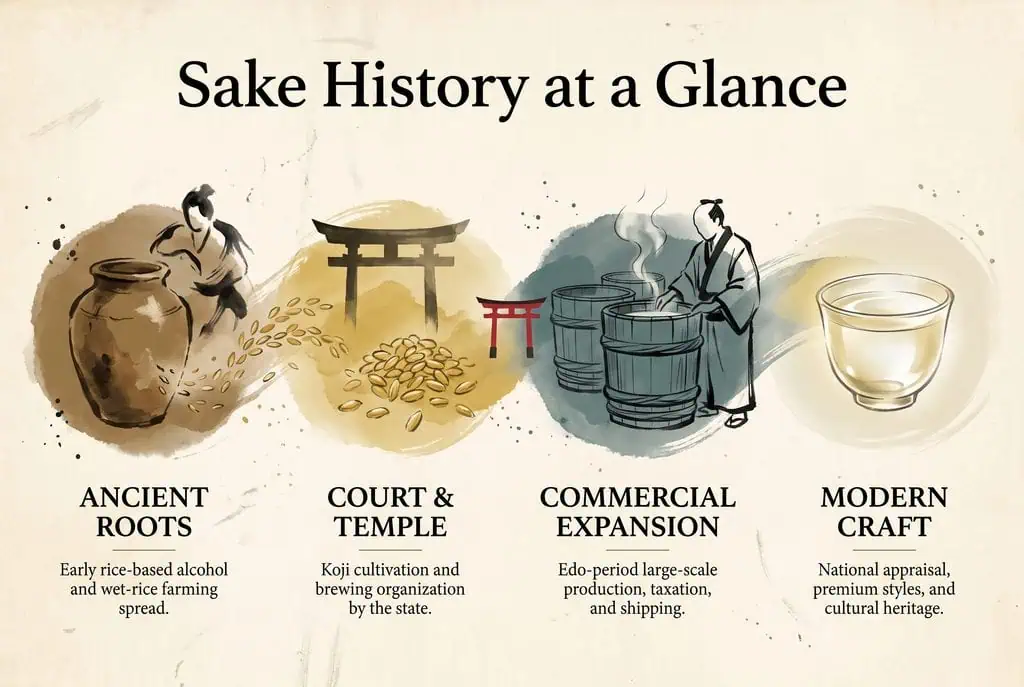
A short overview helps before the detail arrives. The table below marks only the turning points that later sections explain. It skips minor dates on purpose, because a crowded chronology hides the shape of the change.
| Period | Major development |
|---|---|
| Ancient Japan | Wet-rice farming spreads, and early rice-based alcohol appears |
| Nara period | The imperial court organizes brewing through a dedicated office |
| Heian period | Court recipes, ritual use, and growing temple and shrine production |
| Medieval Japan | Temple breweries, commercial sake shops, and municipal taxation |
| Sixteenth century | Morohaku, staged mashing, heat treatment, and larger wooden vats |
| Edo period | Licensed mass production, winter brewing, and barrel shipping to Edo |
| Meiji period | Brewing licenses, heavy alcohol taxation, and a national research institute |
| Early twentieth century | Pure yeast distribution, national appraisal, and quality standards |
| 1940s to 1990s | Wartime controls, mass production, then premium and regional sake |
| Twenty-first century | Exports, new styles, brewery tourism, and cultural heritage listing |
Every row hides a story about why the change happened. Notice, too, that the pace quickens sharply after 1600. That is not an accident of record keeping, since commerce and the state both began generating far more paperwork.
Origins and the Earliest Evidence of Rice Alcohol
Rice Farming Created the Conditions
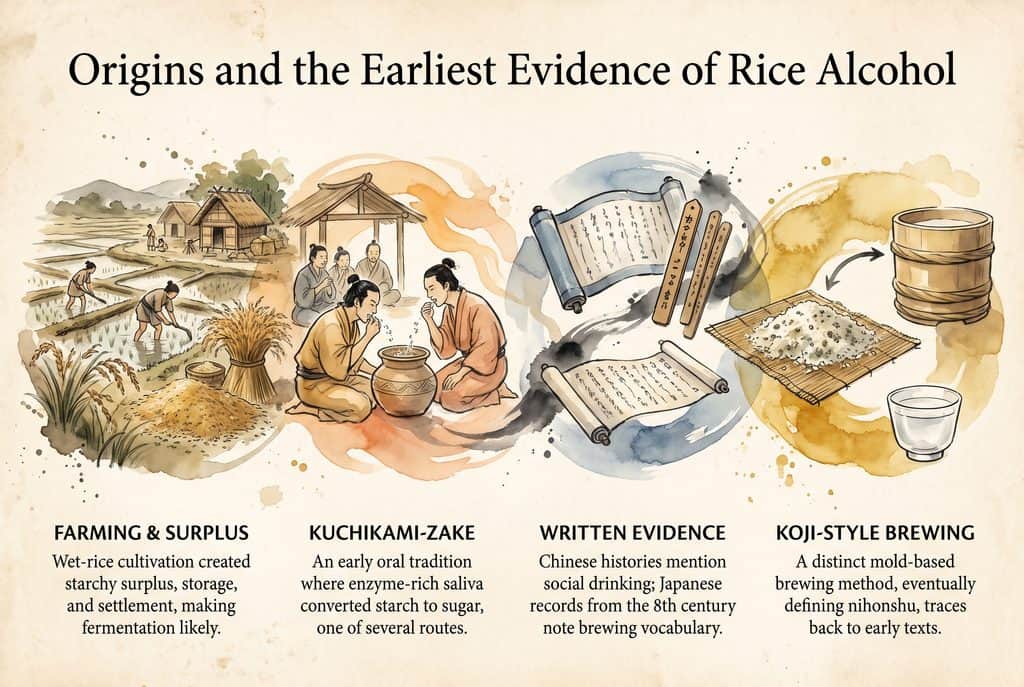
Wet-rice cultivation reached the Japanese archipelago during the Yayoi period, and it changed everything downstream. Communities suddenly had a starchy surplus, storage vessels, and a calendar built around harvest. Those conditions made the development of grain-based fermentation increasingly likely.
Still, nobody can point to a first brewer. Archaeologists recover jars and residues, yet jars alone do not prove deliberate brewing. So the honest position stays simple. Rice alcohol probably emerged after wet-rice farming spread, and the evidence stops right there.
Two further points deserve attention. First, damp grain can undergo microbial change without any deliberate human action, although rice starch cannot become alcohol until enzymes convert it into fermentable sugars. Second, turning such accidental changes into a repeatable drink would have taken generations of patient observation. That transition is where the real story begins, and no surviving document records it.
Kuchikami-zake and the Limits of Oral Tradition
Kuchikami-zake (口噛み酒), or chewed-rice sake, turns up in almost every popular account. In this method, people chewed grain so that enzymes in saliva converted starch into sugar, and wild yeast handled the rest. Regional records and later traditions describe such practices, particularly in ritual settings.
However, treating kuchikami-zake as the single origin of all sake overstates the case badly. It belongs in the conversation as one early fermentation route among several. Mold-based brewing, which eventually defined nihonshu, follows a different technical line altogether.
What the Earliest Written Records Actually Say
Chinese histories of the third century, including the Wei Zhi (魏志), describe the people of Wa as fond of drink. That tells us drinking mattered socially. It tells us nothing about method, and readers should resist filling the gap with modern assumptions.
Japanese sources arrive in the eighth century. The Harima no Kuni Fudoki (播磨国風土記), compiled around 716, records that rice offered to a deity became moldy, and that people then used it to brew sake for a feast. Japan’s National Tax Agency treats this passage as the earliest written trace of koji-style brewing. Note the wording, though. The text links mold and brewing in a single breath, which suggests a practice already familiar rather than newly discovered.
Provincial tax ledgers from the Nara period list several drinks, including one written with the characters now read as seishu. Those ledgers record volumes and categories instead of recipes. As a result, we know the vocabulary of early sake far better than we know its method.
Later chronicles complicate the picture further. The Kojiki mentions a brewer from the continent presenting sake to the emperor, while the Nihon Shoki describes a sweet ceremonial drink offered at harvest rites. Compilers wrote these chronicles centuries after the events they describe, so the accounts blend legend, ritual memory, and political tradition rather than contemporary reporting. They still matter, though, because they show how much sake already meant to the people writing history down.
Evidence, interpretation, and guesswork are three different things. Records confirm that people drank, and that mold played a role by the eighth century. Everything about ancient flavor, strength, and clarity remains reconstruction.
Nara and Heian Japan: Sake, Government, Court, and Religion
Brewing Under the Nara Imperial Court
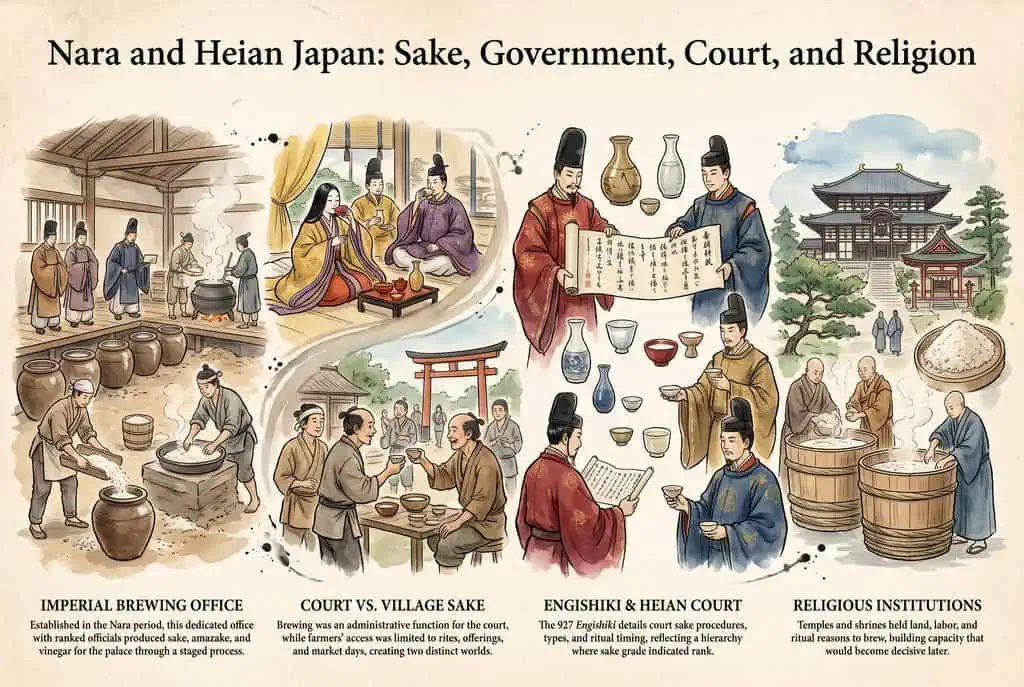
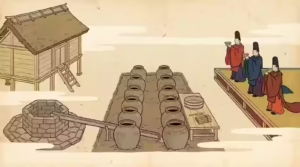
By the eighth century, the imperial court no longer left brewing to chance. A dedicated office, the Miki no Tsukasa (造酒司), also read Sake no Tsukasa, produced sake, amazake, and vinegar for the palace. Chronologies published by the Japan Sake and Shochu Makers Association place its origins in the late seventh century.
Scale and status both matter here. Brewing staff, known as sakabe, numbered around sixty, and the head of the office held a substantial court rank. In other words, brewing had become an administrative function, complete with budgets, quotas, and ceremonial deadlines.
Ordinary farmers meanwhile faced repeated prohibitions on drinking. Their access came through agricultural rites, shrine offerings, market days, and rations at provincial offices. Court sake and village sake therefore belonged to two different worlds.
The equipment tells its own story. Excavations associated with the Nara court brewing office have revealed large jars set into earthen floors, which is rare physical evidence of organized palace production. Records of the office also distinguish milling, koji work, and fermentation as separate tasks. In other words, brewing already ran as a staged process rather than a single operation.
The Heian Court, the Engishiki, and Religious Institutions
The Engishiki (延喜式), completed in 927, remains the richest early source available. Its provisions describe more than a dozen court sake types, along with vessels, ingredient ratios, and ritual timing. Some entries appear to describe repeated additions of rice and koji to a single batch, although historians disagree over how closely those procedures resembled later staged mashing.
Reading it needs care, all the same. The Engishiki sets out procedure for the palace rather than practice across the country. Historians still disagree about individual terms, and the compilation itself postdates many of the customs it preserves.
Outside the palace walls, temples and shrines were quietly building their own capacity. Religious institutions held land, labor, and a ritual reason to brew. That combination would prove decisive once the court’s grip loosened.
By the close of the Heian period, sake had stopped being merely a local ferment. Instead it sat inside a political, ceremonial, and religious system with rules attached.
Court sake also came in grades, and rank decided who drank what. Emperors and senior officials received the richest styles, some of them brewed with sake in place of water. Junior officials made do with thinner versions that carried their own names. Sake had become a marker of hierarchy as much as a drink.
Medieval Japan: Religious Brewing, Commerce, and Technological Change
Temple and Shrine Breweries
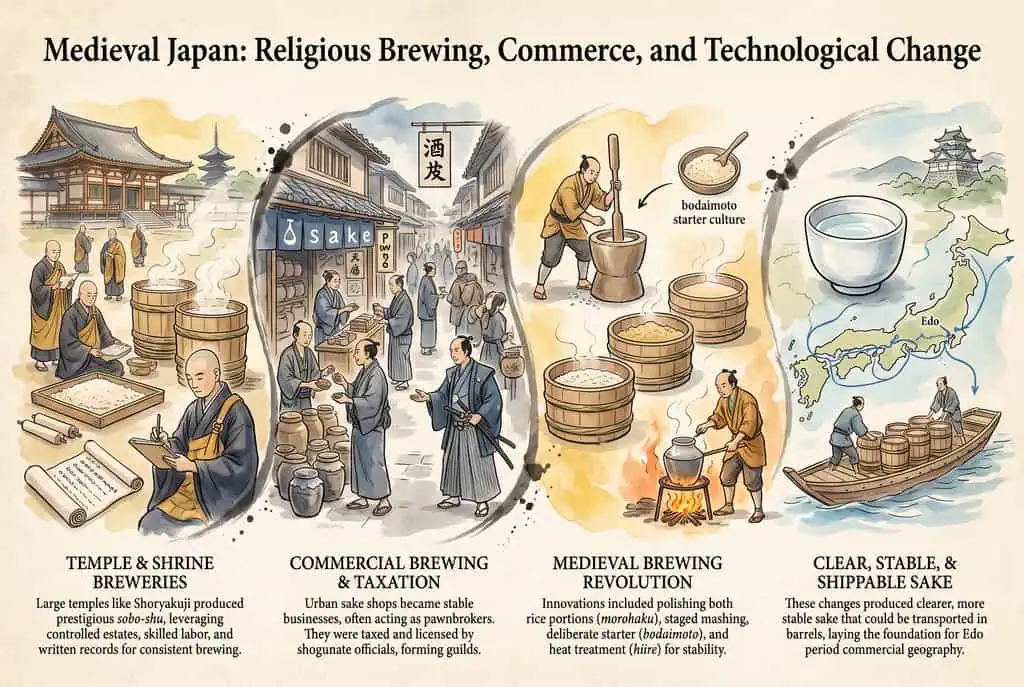
Aristocratic infighting scattered the court’s technicians, and brewing knowledge moved outward with them. Large temples in the Kinki region picked much of it up. Their products, known collectively as sobo-shu (僧坊酒), earned real prestige from the fifteenth century onward.
Shoryakuji in Nara, Kongo-ji in Kawachi, and several Kofukuji sub-temples appear repeatedly in the sources. Their brewing peaked during the sixteenth century. Before roughly 1450, though, most temple production stayed small and served in-house or gift use.
It would be wrong to claim that monks in general drove Japanese brewing forward. Only a limited set of wealthy institutions did so, largely because they controlled estates, grain, and skilled labor at the same time.
Their advantage was organizational as well as material. Monastic communities kept written records, trained successors, and repeated the same process every year. A commercial brewer in a rented shop could rarely match that continuity. Unsurprisingly, most surviving technical documents from this period come from temples.
Sake Shops, Merchants, and Taxation
Commercial brewers grew alongside them. By the late twelfth century, urban sake shops had become stable businesses. Many doubled as pawnbrokers, since anyone holding that much grain and cash moved naturally into lending.
Authorities noticed. In 1252 the Kamakura shogunate ordered brewing jars destroyed across the city, allowing each household to keep only one. Roughly 37,000 vessels went in that single campaign. Muromachi officials later took the opposite approach, licensing shops and taxing their jars instead.
The numbers speak for themselves. A document preserved at Kitano Shrine counts 342 sake shops in and around Kyoto in 1425, and some produced several hundred koku a year. Brewing had turned into an urban industry with guilds, rivalries, and, in 1444, an armed dispute over who held the right to make koji.
Politics followed the money. Sake taxes funded the Muromachi shogunate directly, which gave officials a strong reason to protect brewers. Brewers, for their part, used that leverage to defend their privileges. The bargain between the state and the industry, so visible in later centuries, took shape right here.
A Medieval Brewing Revolution
Technique changed just as fast, and the sixteenth century is where the modern outline finally appears. Morohaku (諸白) meant polishing the koji rice as well as the main rice. Diaries kept at Kofukuji use the term repeatedly from 1576, and polishing both portions of the rice probably produced a cleaner, more refined sake. Staged mashing spread at the same time, as brewers learned to add ingredients in batches rather than all at once.
Starter preparation grew more deliberate too. The bodaimoto method deliberately encouraged lactic fermentation to acidify the brewing environment, which helped suppress unwanted microorganisms. Larger wooden vats also replaced ceramic jars. One record from 1582 mentions a ten-koku tub of about 1.8 kiloliters, which dwarfed the 360 to 540 liter jars of the previous century.
Then there is hiire (火入れ). Temple diaries from the 1560s note heating finished sake, sometimes more than once. That practice predates Louis Pasteur by roughly three centuries. Even so, the monks had no germ theory, and reading modern microbiology into their notes would be a mistake. They knew heating helped, and they wrote down what worked. Our guide to sake fermentation explains how the modern process handles the same problem.
Why did these changes matter so much? Taken together, they made sake clearer, more stable, and far easier to move. A drink that survives a month in a barrel can travel, and a drink that travels can sell far from where anyone made it. The commercial geography of the Edo period rested on exactly this technical base.
The Edo Period: Sake Becomes a Major Industry
Edo’s Thirst and the Growth of Urban Demand
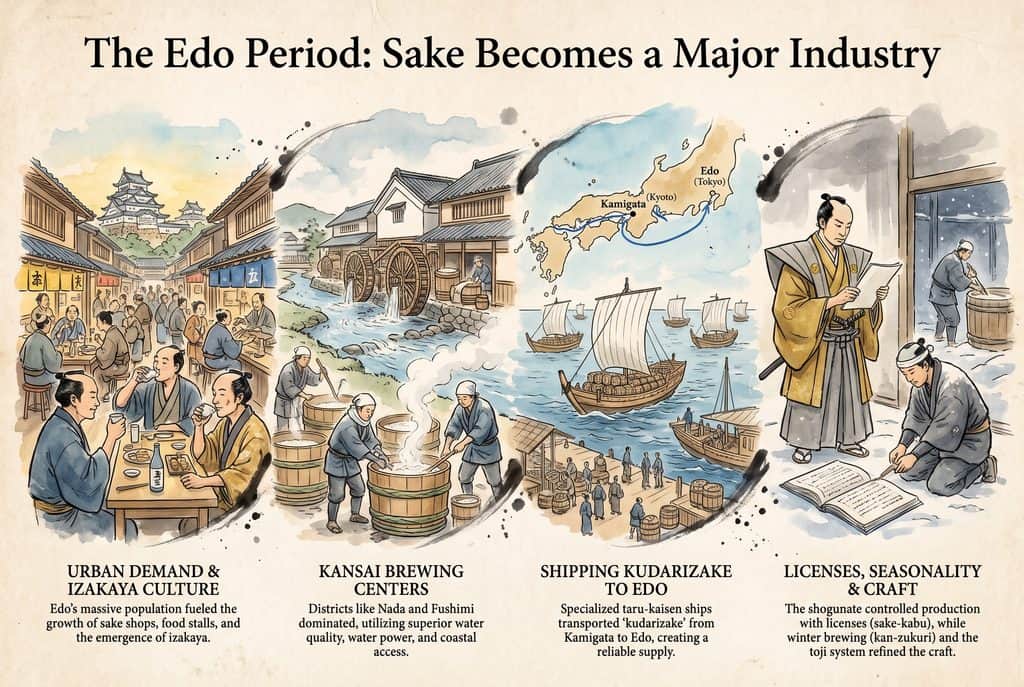
Edo grew into one of the largest cities on earth during the seventeenth century. Hundreds of thousands of samurai, merchants, and laborers lived there, which created an enormous market for food and drink. Retail sake shops multiplied, while cooked-food stalls and drinking houses followed close behind.
That concentrated demand did something genuinely new. For the first time, brewers could plan production around a distant, predictable, year-round market. Sake therefore stopped being a local product with a local ceiling.
The scale behind that demand was unusual for the age. Edo probably passed a million residents during the eighteenth century. Many were single men on stipends or wages, living in rented accommodation. They ate out and they drank out, which helped turn sake into a daily retail purchase.
Itami, Ikeda, Nada, and Fushimi
Supply concentrated in the Kansai region, which held the right combination of assets. Itami and Ikeda led during the early Edo period, and their sake carried a reputation for quality. Nada, Imazu, and Nishinomiya overtook them after the middle of the eighteenth century.
Why those particular places? Water quality mattered, and so did access to ports. Nada sat directly on the coast, with steep rivers off the Rokko mountains to power milling. Fushimi in Kyoto built a different reputation on softer water. Competition between these districts pushed technical improvement along for two centuries.
One discovery shows how fine the margins had become. In 1840 the brewer Yamamura Tazaemon traced the superiority of his Nishinomiya sake to the local water rather than the rice or the staff. Nada brewers then began carting that water, later known as miyamizu, to their own kura.
Kudarizake and the Route from Kamigata to Edo
Getting the sake to Edo became an industry of its own. Kamigata brewers shipped their product east as kudarizake (下り酒), the name given to sake sent down from Kamigata to Edo. Early consignments traveled by packhorse, which was slow and expensive.
Sea transport solved that. Mixed-cargo higaki-kaisen ships came first, and then taru-kaisen (樽廻船) carried nothing but sake casks. Late in the seventeenth century a fast run took two weeks, while an average one took a month. By the end of the period, ten days to two weeks had become normal. Wholesalers, brokers, and retailers in Edo then handled distribution at the far end.
Brewing Licenses and Government Control
The shogunate watched all of this closely, because sake consumed rice and rice governed prices. In 1657 it introduced the sake-kabu (酒株) system, a brewing license that named the holder and capped the volume of rice they could use.
Enforcement stayed uneven. Brewers routinely exceeded their quotas, so officials ran audits and then raised the caps to match reality. Policy also swung with the harvest. In poor years the government issued reduction orders, sometimes cutting output to a third. In good years it loosened the rules and let newcomers register. Records from 1698 count more than 27,000 brewing households nationwide.
Licenses also became property. Holders could sell or lease them, so the right to brew acquired a market value of its own. That shift mattered a great deal, because it turned brewing into an asset as well as a trade.
Kan-zukuri, Toji, and Kurabito
Seasonality changed next. A 1667 edict banned new-sake brewing from around the autumn equinox, and further restrictions followed over the decades. Production gradually concentrated into winter, a pattern known as kan-zukuri (寒造り).
Winter brewing suited the biology, since cold slows spoilage and lets fermentation run long and clean. It matched seasonal labor patterns equally well. Farmers and fishermen could work in the brewing districts during agricultural slack periods, or at times when fishing was limited. Out of that seasonal migration came the toji (杜氏) system, with regional guilds such as Tanba, Echigo, and Nanbu each developing a house style. Our article on the traditional sake brewery shows how that team still works today.
Documentation improved alongside the craft. Technical manuals such as the Domo Shuzoki set out koji work, starter management, and staged mashing in real detail. Reading them now, the sequence looks remarkably close to modern practice.
Sake in Everyday Edo Life
Drinking habits shifted along with production. Cook shops and restaurants spread through Edo during the eighteenth century. Retailers began letting customers drink on the premises, and the izakaya grew out of that small change.
Warming sake became fashionable as well, helped along by Kaibara Ekiken’s popular health writing. Festivals, weddings, and funerals had always involved sake. Now ordinary weekday evenings did too.
Sake also shaped the food around it. Cook shops and early izakaya helped establish the familiar pairing of sake with grilled, simmered, and strongly seasoned dishes. Nobody planned that, yet the habits of a modern izakaya trace back to these shops.
By the close of the Edo period, sake was no longer a ritual offering or a courtly luxury. It had become a regulated, shipped, marketed, and widely consumed urban commodity.
Meiji Modernization and the Birth of Scientific Brewing
Sake and the Modern State
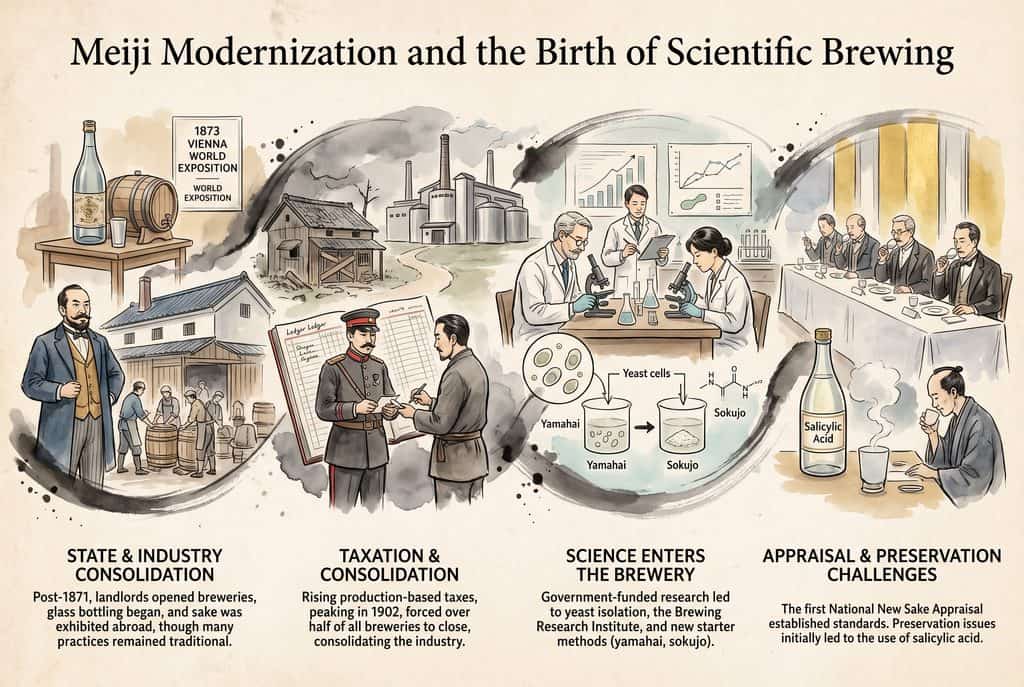
Abolition of the domains in 1871 unified brewing policy almost overnight. The old sake-kabu system effectively ended, and anyone who could pay for a license could brew. Landlords across the country opened breweries, and by 1881 the count had reached roughly 27,700 sites.
Other changes arrived in the same decade. Glass bottling began in 1878, although measured pours from a cask stayed normal well into the twentieth century. Sake also traveled abroad in an organized way for the first time. The Japan Sake and Shochu Makers Association dates the first overseas shipment to 1872, in connection with Japan’s participation in the Vienna World Exposition of 1873. That consignment went to an exhibition rather than a market, and the distinction is worth keeping.
Not everything modernized at once, either. Wooden vats stayed in use for decades, and many breweries kept their existing buildings and routines. Railways changed the map more than machinery did in some regions. Fushimi and Saijo in Hiroshima both rose partly because trains reached them, which shows how much logistics still mattered.
The Tax That Reshaped an Industry
Then the tax arrived, and it changed the industry more than any recipe ever did. The initial arrangement looked mild enough, with a flat annual license fee and a five percent levy on sales. Rates climbed quickly afterward.
By 1877 the brewing tax stood at twenty percent. In 1878 the government switched to a production-based tax charged per koku brewed, which guaranteed revenue whether or not the sake sold. Further increases followed from 1882. At its peak in 1902, alcohol tax supplied about 36 percent of national tax revenue.
Small brewers could not carry that load. Brewery numbers fell from roughly 27,700 in 1881 to 11,438 by 1904. Taxation, in other words, did the consolidating that market forces alone had not managed. Anyone studying this era should treat tax policy as brewing history rather than as a separate subject.
Science Enters the Brewery
Revenue on that scale gave the state a direct interest in reliable fermentation. Spoiled mash meant lost tax, so the government funded research.
Foreign scientists at Tokyo University began analyzing sake during the 1870s. Robert William Atkinson published The Chemistry of Sake Brewing in 1881, and he singled out the parallel saccharification and fermentation that makes sake unusually strong for a brewed drink. Researchers isolated sake yeast for the first time in 1895.
The decisive step came in 1904, when the Ministry of Finance opened the Brewing Research Institute in Tokyo. Over the following several years, its researchers developed the yamahai and sokujo starter methods. They also collected promising yeast strains from breweries nationwide, tested them, and distributed the best performers through the Brewing Society of Japan. Those became the kyokai yeasts that most breweries still rely on.
Evaluation followed research. The institute held the first National New Sake Appraisal in 1911, which established a nationwide forum for examining newly brewed sake. Brewing had entered a new phase. Craft knowledge now sat alongside laboratory analysis, national comparison, and formal training.
Preservation posed the hardest problem of all. Hiochi bacteria spoiled finished sake, and visiting chemists initially recommended salicylic acid as a preservative. Breweries used it widely until 1969, when concerns about food additives ended the practice. Thorough heat treatment and general hygiene, rather than any single chemical, eventually solved the problem.
Sake in the Twentieth Century
Wartime Shortage and Alcohol Addition
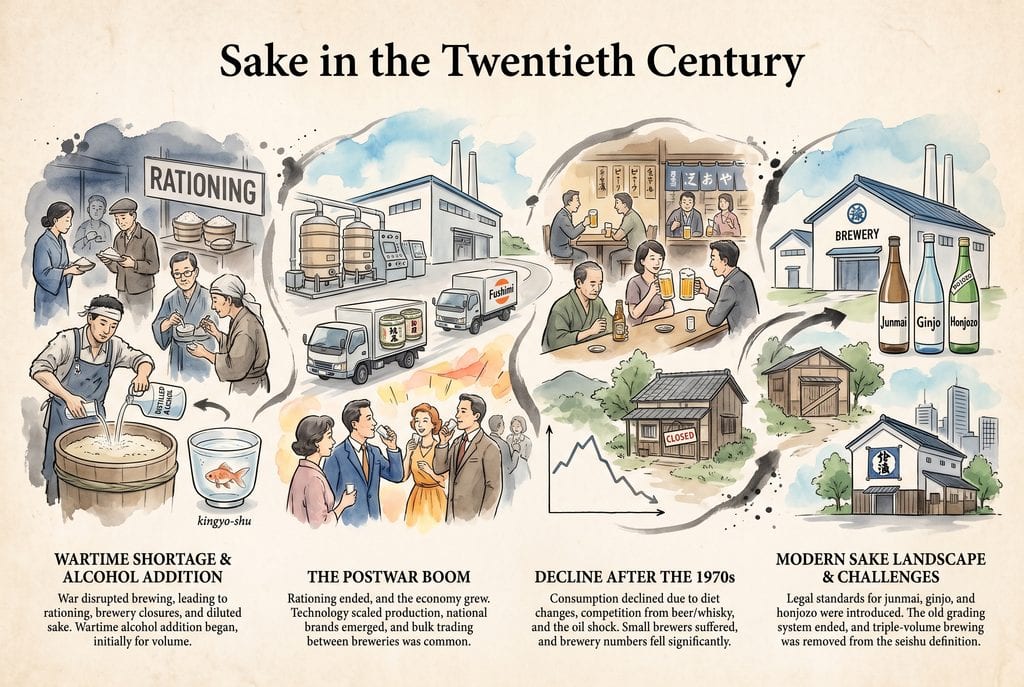
War disrupted everything. Rice went to rationing, and brewers received allocations instead of buying freely. Production sites merged or closed under government direction.
Sake ran short, and diluted product reached the market. People mocked the worst of it as kingyo-shu, sake thin enough for a goldfish to swim in comfortably. In response, the authorities introduced alcohol content standards and a grading system.
Adding distilled alcohol to the mash started as a wartime expedient. Trials ran in Manchuria first, and domestic use began in 1943. After the war, food shortages pushed the practice further, and a triple-volume brewing method arrived in 1949 with added alcohol, sugars, and acids.
That history deserves care. Wartime alcohol addition chased volume above all. Modern honjozo and ginjo use a small, carefully judged addition to shape aroma and texture instead. The two practices are not equivalent, even though both involve brewer’s alcohol.
The Postwar Boom
Recovery came faster than anyone expected. Rationing of alcoholic drinks ended in 1952, and price controls followed in 1964. Growth then tracked the wider economy closely.
Technology scaled with demand. Continuous rice steamers, automatic koji machines, and air conditioning let large breweries run year-round rather than only through winter. Firms in Nada and Fushimi built national distribution networks and became household names.
The rice allocation system produced an odd side effect. Because production quotas and actual sales rarely matched, large firms bought sake in bulk from small ones and sold it under their own labels. That trade shaped the industry until the allocation system ended in 1969.
Consumers noticed the change in the glass. Grades, national brands, and heavy advertising taught people to buy by label rather than by brewery. That habit helped the majors enormously, and it hurt small producers badly once tastes turned.
Decline After the 1970s
Consumption peaked and then turned. Diets changed, beer and whisky gained ground, and the 1974 oil shock hit discretionary spending hard. Small brewers, no longer cushioned by bulk sales to the majors, closed in numbers. Licensed sake production sites fell from about 4,000 in 1960 to around 1,600 by 2018.
Regulation caught up slowly. The industry ran voluntary labeling standards first, and legal rules for junmai, ginjo, and honjozo took effect in 1990. The old wartime grading system then disappeared in stages, with the top grade going in 1989 and the remainder in 1992.
One more piece of tidying followed. A 2006 revision of the Liquor Tax Act removed the triple-volume method from the legal definition of seishu, and producers stopped making it.
Closures were not evenly spread, either. Breweries in rural prefectures with small local markets suffered most. Those near cities, or with a genuinely distinctive product, had more room to adapt.
From Mass-Market Sake to Premium and Regional Sake
Why Premium Sake Emerged
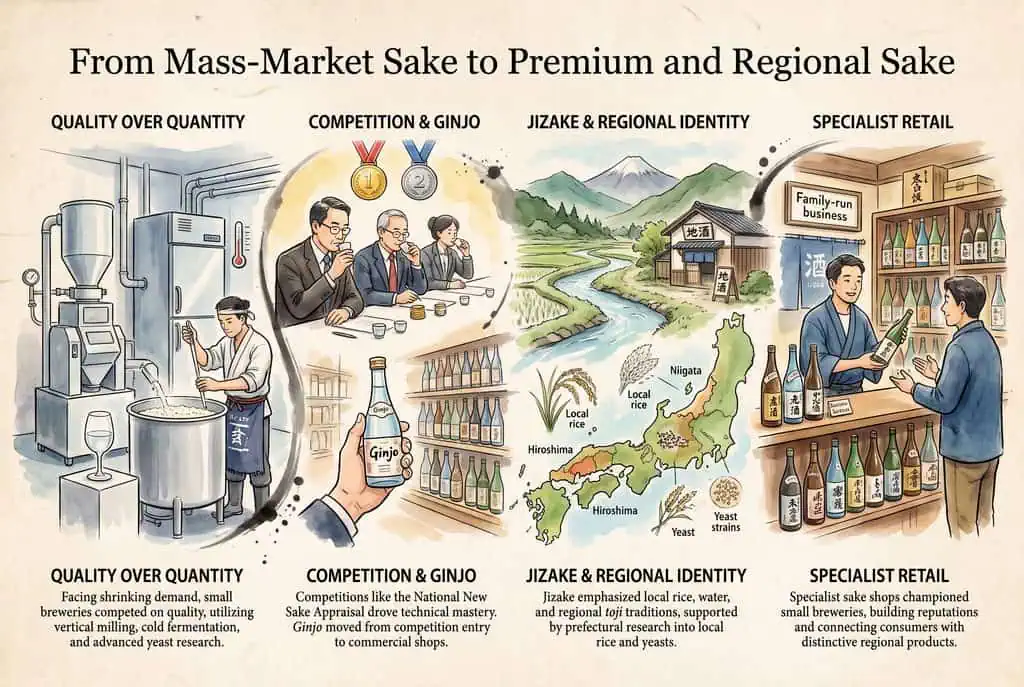
Shrinking demand forced a choice. Small breweries could fight national brands on price, or they could compete on quality. Many picked quality, and premium sake grew directly out of that decision.
Several strands came together at once. Vertical milling machines, available from around 1930, made deep polishing practical. Yeast research produced strains that generate fruity aromatic compounds at low temperatures. Refrigeration allowed a mash to sit cold for weeks. Competition circuits, meanwhile, rewarded exactly the kind of sake these tools produced.
Ginjo shows the pattern clearly. For decades it existed mainly as a competition entry, brewed in tiny quantities for judges rather than customers. During the 1980s it finally reached ordinary shops. Junmai, made without added alcohol, revived on similar logic, because it gave brewers a story that mass-market sake could not tell.
Government data suggests the shift continues. National Tax Agency figures show junmai and junmai ginjo gaining share over the longer term, even as total sake production keeps falling. For the legal definitions behind each category, our guide to the types of Japanese sake works through them one by one.
Competitions deserve more credit than they usually receive. The National New Sake Appraisal set a public benchmark, and prefectural events fed into it. Brewers chasing a medal had to master deep polishing, cold fermentation, and aroma control. Those skills then flowed into commercial products once the market finally wanted them.
The Rise of Jizake
Jizake (地酒) simply means local sake, yet the word carried real weight from the 1970s. Consumers who had grown up on national brands started hunting for something with a place attached.
Part of the appeal was reaction. Standardized products dominated the shelves, so regional character felt like the obvious alternative. Small breweries answered by emphasizing local rice, local water, and the traditions of their regional toji guild.
Some of this was marketing, and some of it clearly was not. Niigata built a national reputation for a light, dry style through the 1970s and 1980s. Hiroshima had developed its own soft-water method much earlier, after Miura Senzaburo and the local brewers’ association tackled the problem during the 1890s.
Prefectural research stations then amplified the trend by breeding local rice varieties and isolating local yeasts. As a result, regional identity became a technical fact as well as a marketing line.
Retailing changed alongside it. Specialist sake shops, often family run, championed small breweries that supermarkets ignored. Their recommendations built reputations quickly, and several famous names today owe their early growth to a handful of stores.
Contemporary Sake and Globalization
Sake in Japan Today
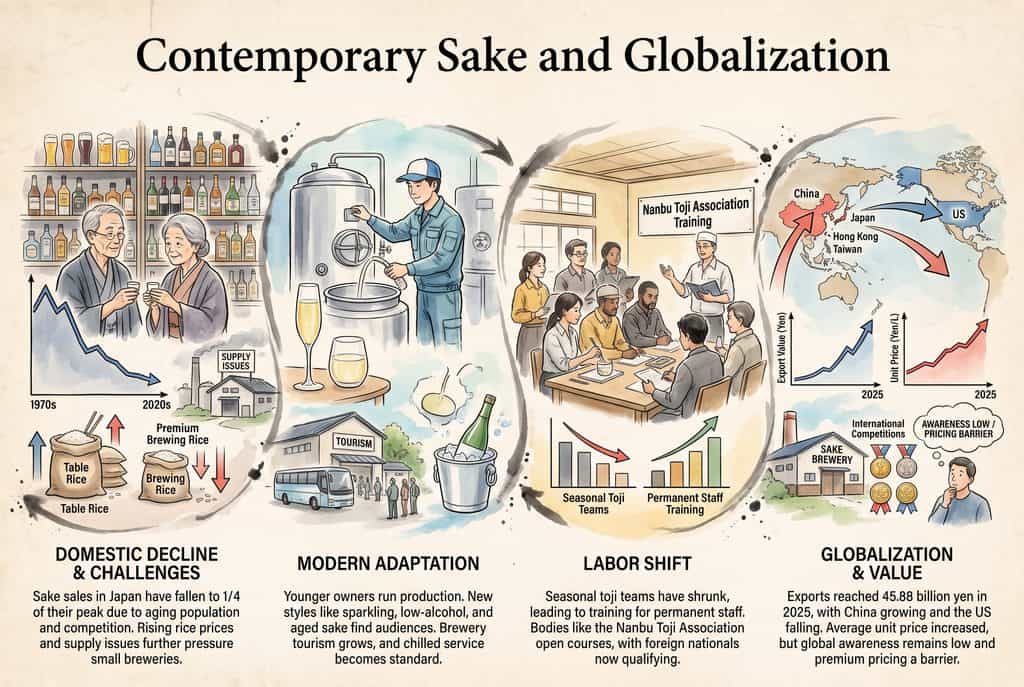
The domestic picture is difficult, and there is little point pretending otherwise. National Tax Agency data shows that seishu sales in Japan have fallen to roughly one quarter of the level recorded around the early 1970s peak. An aging population and an increasingly crowded drinks market both contribute to the decline.
Costs add further pressure. The agency’s July 2026 report notes that table rice prices surged from the 2024 crop, and that growers switched acreage in response. Output of premium brewing rice for the 2025 crop looked set to fall by roughly ten percent, which makes stable sourcing genuinely harder for small breweries.
Still, the industry is hardly standing still. Younger owners now run production directly, a role people call kuramoto toji. Sparkling sake, low-alcohol styles, and long-aged sake have each found an audience. Brewery visits have grown into a genuine tourism category, and serving habits keep changing, with chilled service now standard for aromatic styles.
Labor is another quiet constraint. Seasonal toji teams have shrunk, so many breweries now train permanent staff instead. The National Tax Agency and prefectural centers run courses to close the gap, and bodies such as the Nanbu Toji Association have opened their training to outsiders. A few foreign nationals now hold toji qualifications.
Sake Goes Global
Exports tell a happier story. Seishu exports reached 45.88 billion yen in calendar 2025, up 5.6 percent from the previous year, according to Ministry of Finance trade statistics compiled by the National Tax Agency.
The destination mix has shifted noticeably. China took 13.3 billion yen and grew 14.0 percent, while the United States took 11.0 billion yen and fell 3.5 percent. Hong Kong, South Korea, and Taiwan followed. Note that these figures cover seishu alone, in yen, for the calendar year. Totals for all Japanese alcoholic beverages run much higher, and confusing the two remains a common reporting error.
Value and volume have also diverged. Average export unit price reached about 1,368 yen per liter in 2025, well above its level a decade earlier. That increase is consistent with the industry’s growing emphasis on higher-value exports.
Breweries now operate outside Japan as well, across North America, Europe, and Asia. International competitions include sake categories, and formal education programs have spread the vocabulary widely. Even so, the National Tax Agency judges global awareness to be low relative to the drink’s potential.
Awareness still lags behind availability. Sake holds a very small share of the world alcohol market outside Japan. Retailers in most countries stock a narrow range, while pricing remains a real barrier at the premium end.
UNESCO and Sake-Making as Cultural Heritage
In December 2024, UNESCO added Traditional knowledge and skills of sake-making with koji mold in Japan to the Representative List of the Intangible Cultural Heritage of Humanity. The Intergovernmental Committee took that decision at its nineteenth session in Asuncion, Paraguay.
Precision matters here, because the shorthand version gets it wrong constantly. This is not a World Heritage Site listing. No brewery, region, or bottle received a designation. The listing covers knowledge, skills, and practice, together with the people who carry them forward.
So what does it actually include? UNESCO’s description centers on craftspeople who use koji mold to convert starch into sugar, and who manage temperature and humidity by judgment. The nomination also covers toji and kurabito, apprenticeship, regional brewing associations, the farmers who grow the rice, and the festivals and rites where communities drink together.
The scope reaches beyond nihonshu, too. Within the Japanese nomination and its safeguarding framework, traditional sake-making covers koji-based production of nihonshu, shochu, awamori, and mirin. Japan had proposed the element in 2022, and it became the country’s twenty-third inscription on the list.
Recognition brings obligations as well as prestige. Japan’s Agency for Cultural Affairs, working with a dedicated preservation association, now runs promotion and safeguarding programs at home and abroad. Succession remains the practical worry, since many breweries face the same aging-owner problem as other small Japanese firms.
What Changed, and What Survived?
What Changed
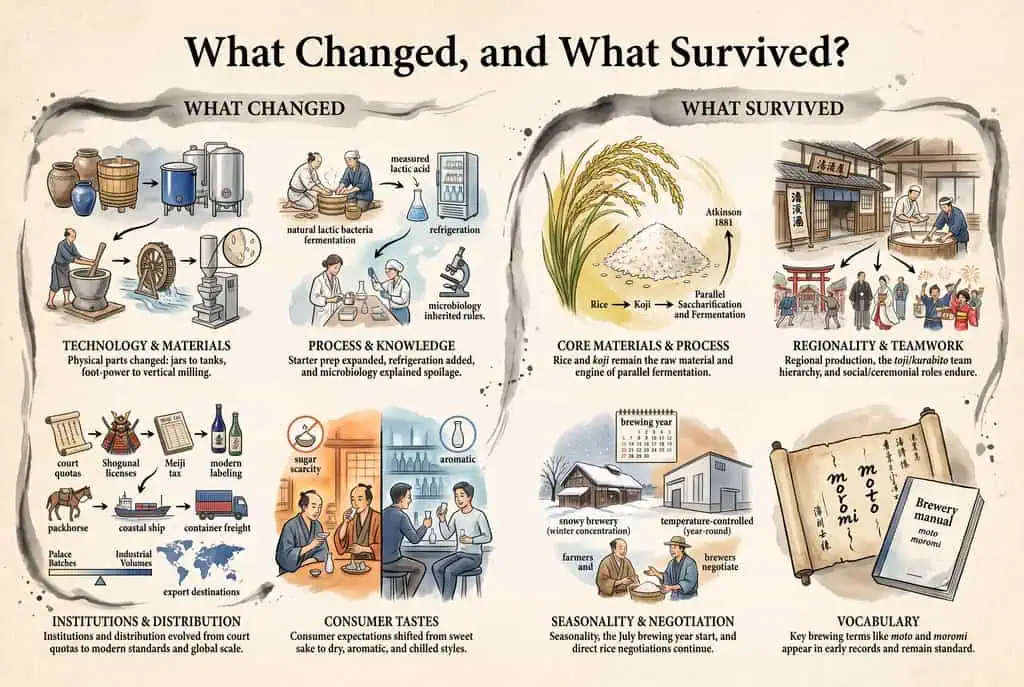
Almost every physical part of brewing looks different now. Ceramic jars gave way to wooden vats, and those gave way to enamel and stainless tanks. Foot-powered mortars gave way to water wheels, then to vertical rice-polishing machines that can reduce a grain to less than half its original weight.
Starter preparation expanded from methods that encouraged naturally occurring lactic bacteria to include methods using measured additions of lactic acid. Refrigeration supplemented the cold weather on which brewers had once depended. Microbiology, meanwhile, explained many inherited rules of thumb about spoilage.
The institutional layer changed just as much. Court quotas became shogunal licenses, then Meiji tax law, then modern labeling standards. Distribution ran from packhorse to coastal shipping to container freight. Output grew from palace batches of a few hundred liters to industrial volumes, and the market widened from a single court to dozens of export destinations worldwide.
Consumer expectations moved furthest of all. Edo drinkers wanted sweet sake, partly because sugar stayed scarce and expensive. Today’s buyers usually ask for dry, aromatic, and chilled instead. Brewers have redesigned their recipes around that shift more than once.
What Survived
Yet the core held. Rice remains the raw material, and koji remains the engine. Parallel saccharification and fermentation still define the process, exactly as Atkinson described it in 1881.
Regional production survived, and in some ways it strengthened. Toji and kurabito still work as a team with a clear hierarchy, and skills still pass from senior to junior hands. Sake still appears at shrine festivals, weddings, and New Year celebrations, continuing social and ceremonial roles that records document more than a thousand years ago.
Seasonality endures as well. Many breweries still concentrate production in the colder months, although larger producers can brew year-round in temperature-controlled facilities. Brewing years still run from July. Farmers and breweries also negotiate directly over rice, much as they have for centuries.
Even parts of the vocabulary survived. Terms such as moto and moromi appear in early brewing records, and they remain standard in brewery manuals today.
Continuity is not the same thing as stasis. What survived was a technical and cultural core, and each era reorganized that core in its own way.
Timeline of Major Turning Points
The opening table listed periods. This one shows causation instead, because each step made the following one possible.
- Rice cultivation reaches the archipelago
- Early rice-based alcohol appears
- Court-controlled brewing under the Miki no Tsukasa
- Temple, shrine, and estate brewing
- Commercial breweries and urban merchants
- Medieval technique: morohaku, staged mashing, hiire
- Edo industrialization: licensing, winter brewing, barrel shipping
- Meiji taxation and licensing
- Scientific brewing and national appraisal
- Wartime controls and postwar mass production
- Premium and regional sake
- Globalization and export growth
- UNESCO recognition of traditional sake-making, 2024
Read down that list and the pattern becomes obvious. No single invention created modern nihonshu. Instead, each stage inherited a problem from the one before, then solved it with whatever tools the period offered.
One caution about reading it, though. The sequence shows order, not inevitability. Several branches died out along the way, including chewed-rice methods and the triple-volume brewing of the postwar years.
Common Misconceptions About Sake History
Six claims come up again and again in English-language writing about sake. Each one deserves a correction.
- Sake was invented in one specific year. No source confirms a year, a place, or an inventor. Estimates circulate freely, yet none of them rests on documentary proof.
- Ancient sake was the same drink as modern nihonshu. They share rice and little else. Milling, starter methods, fermentation control, and legal definitions all differ substantially.
- Sake has always been brewed in winter. Medieval brewers worked across several seasons. Concentration into winter followed Edo-period rules and seasonal labor patterns, so it is a relatively late development.
- Sake has always been a commercial product. Early sake served ritual, court, and community purposes first. Commercial brewing expanded much later, mainly from the medieval period onward.
- Hiire was identical to modern pasteurization. Brewers heated sake from the sixteenth century, although they had no microbiology to explain it. The practice came first, and the theory arrived about three hundred years afterward.
- UNESCO designated sake a World Heritage Site. UNESCO inscribed the traditional knowledge and skills of koji-based sake-making on its intangible heritage list. The inscription applies to knowledge and practice, not to any individual drink, brewery, or site.
A single pattern connects all six. Each misconception swaps a long, messy process for one clean fact. History rarely behaves that way, and sake history certainly does not.
Final Thoughts
The history of sake is not a straight line from ancient rice wine to modern nihonshu. Nothing survived unchanged, and honestly that is the interesting part.
Look at what actually happened. Ancient communities fermented rice without knowing why it worked, the court turned brewing into administration, and temples turned it into technique. Edo merchants built an industry, Meiji tax collectors regulated it, and scientists later explained the microbiology. Through all of that, rice, koji, fermentation, craft, and community stayed at the center. That is precisely why the 2024 UNESCO inscription centerd on the knowledge, skills, practitioners, and communities behind sake-making, rather than designating any particular product, brewery, or region.
One final point is easy to miss from the outside. The romance of tradition is real, yet daily brewing rests on repetition, measurement, teamwork, and constant attention to temperature. That combination, more than any single date, explains how sake reached the present.
Modern sake, then, is not a relic. It is a living tradition that people have argued over, taxed, tested, and reinvented for two thousand years, and it is still changing. If you want the detail behind any single era, the companion articles in this History section pick up where this page leaves off.
Frequently Asked Questions About the History of Sake
When did sake originate?
Nobody knows the exact date. Rice-based alcohol most likely appeared after wet-rice farming spread during the Yayoi period. However, no surviving record names a year, a place, or an inventor. Treat any single origin date you see as an estimate rather than an established fact.
How old is the history of sake?
Roughly two thousand years, if you define sake broadly as Japanese alcohol made from rice. Industry bodies use that figure because rice remained the common ingredient throughout. Even so, the drink changed enormously over that span, so the number describes continuity of material rather than continuity of recipe.
What is the oldest written record of sake in Japan?
The Harima no Kuni Fudoki, compiled around 716, offers the earliest clear link between mold and brewing. It describes rice offered to a deity becoming moldy, and then serving as the base for sake at a feast. Nara-period provincial tax ledgers list several drinks by name shortly afterward, although they record no recipes.
Was ancient sake the same as modern sake?
No, and the gap is wide. Ancient rice alcohol came from rice polished far less than modern brewing rice, and it was probably often cloudy, thick, or sweet. Exact fermentation times and alcohol levels cannot be reconstructed with confidence. Modern seishu instead takes shape through controlled milling, selected yeast, temperature management, and legal standards. Rice provides the continuity, not the finished drink.
What was kuchikami-zake?
Kuchikami-zake was a chewed-rice drink. People chewed grain so that salivary enzymes converted starch into sugar, and wild yeast then fermented it. Regional traditions link the practice to ritual contexts. It forms one strand of early fermentation history, though it did not lead directly to koji-based brewing.
When did koji become part of sake brewing?
Written evidence points to the early eighth century at the latest. The Harima no Kuni Fudoki describes brewing from moldy offering rice around 716, and its matter-of-fact tone suggests a familiar practice. Some researchers argue that koji techniques arrived alongside wet-rice farming, but nobody has confirmed that.
What was the Miki no Tsukasa?
The Miki no Tsukasa, also read Sake no Tsukasa, was the imperial court office that brewed sake, amazake, and vinegar for the palace. Around sixty brewing staff worked under it, and its head held a notable court rank. Its existence shows that the state treated brewing as official business well before commercial breweries appeared.
Why is the Engishiki important to sake history?
Completed in 927, the Engishiki records court procedure in unusual detail. Its entries cover more than a dozen sake types, along with ratios, vessels, and ceremonial timing. Some passages appear to describe repeated additions of rice and koji, although historians disagree over how closely those procedures resembled later staged mashing. The text documents palace practice rather than brewing across the whole country.
When did commercial sake breweries appear?
Urban sake shops had stabilized as businesses by the late twelfth century. Growth accelerated afterward, and a document at Kitano Shrine counts 342 shops in and around Kyoto in 1425. Many also worked as moneylenders. Temple breweries turned commercial around the middle of the fifteenth century.
Why was the Edo period so important for sake?
Because everything scaled at once. Edo’s huge population created steady demand, Kansai districts concentrated production, and cask ships carried the result east. Meanwhile the shogunate licensed brewers and capped their rice use. Winter brewing and seasonal toji teams also took shape then, so the modern industry starts here.
When did winter brewing become common?
Mainly during the Edo period. A 1667 edict restricted autumn brewing, and further orders followed. Production drifted into winter over the following decades, since cold weather reduced spoilage and farm workers were free. Earlier brewers had worked in several seasons, so kan-zukuri is a later development.
When did scientific sake brewing begin?
The 1880s and 1890s laid the groundwork, and 1904 marks the decisive year. Foreign chemists analyzed sake from the 1870s, and researchers isolated sake yeast in 1895. The Brewing Research Institute opened in 1904, then developed the yamahai and sokujo starter methods and supported nationwide distribution of selected yeast strains.
When did ginjo sake become commercially important?
During the 1980s. Before that, most breweries made ginjo only for competitions, in very small volumes. Better milling machines, aromatic yeast strains, and refrigeration made wider production realistic. Legal labeling rules for junmai, ginjo, and honjozo then took effect in 1990, which cemented the category.
What exactly did UNESCO recognize in 2024?
UNESCO inscribed Traditional knowledge and skills of sake-making with koji mold in Japan on its Representative List of the Intangible Cultural Heritage of Humanity. The listing covers craft knowledge, toji and kurabito, apprenticeship, farming links, and community ritual. No brewery, product, or site became a World Heritage Site.
References
Government and Institutional Sources
- National Tax Agency of Japan, Sake no Shiori, July 2026 edition, https://www.nta.go.jp/taxes/sake/shiori-gaikyo/shiori/2026/index.htm (Accessed September 2026)
- Japan’s National Tax Agency, Recent Trends in Seishu Exports, Sake no Shiori item 36, https://www.nta.go.jp/taxes/sake/shiori-gaikyo/shiori/2026/pdf/36.pdf (Accessed September 2026)
- UNESCO Intangible Cultural Heritage, Traditional knowledge and skills of sake-making with koji mold in Japan, https://ich.unesco.org/en/RL/traditional-knowledge-and-skills-of-sake-making-with-koji-mold-in-japan-01977 (Accessed September 2026)
- National Research Institute of Brewing, Institutional History, https://www.nrib.go.jp/gui/about/enkaku.html (Accessed September 2026)
- Japan Sake and Shochu Makers Association, The History of Sake, https://japansake.or.jp/sake/about-sake/history-of-sake/ (Accessed September 2026)
- Ministry of Foreign Affairs of Japan, Statement on the Inscription of Traditional Sake-Making, https://www.mofa.go.jp/press/release/pressite_000001_00789.html (Accessed September 2026)
- Permanent Delegation of Japan to UNESCO, Inscription Announcement of 4 December 2024, https://www.unesco.emb-japan.go.jp/itpr_ja/11_000001_00200.html (Accessed September 2026)
- Government of Japan, Highlighting Japan: The Techniques and Appeal of Traditional Sake-Making, March 2025, https://www.gov-online.go.jp/hlj/en/march_2025/march_2025-00.html (Accessed September 2026)
- National Tax Agency of Japan, Traditional knowledge and skills of sake-making with koji mold in Japan, https://www.nta.go.jp/traditional_sake_making/english/index.htm (Accessed September 2026)
Academic and Archival Sources
- National Tax Agency of Japan, Koji Mold and Japanese Alcoholic Beverages, Chapter 2: The History of Japanese Sake, https://www.nta.go.jp/taxes/sake/koujikin/pdf/0021012-102_03.pdf (Accessed September 2026)
- Tax College Archives, National Tax Agency of Japan, The Founding of the Brewing Research Institute, https://www.nta.go.jp/about/organization/ntc/sozei/tokubetsu/h21shiryoukan/05.htm (Accessed September 2026)
- National Diet Library of Japan, Expositions: The 1873 Vienna World Exposition, https://www.ndl.go.jp/exposition/s1/1873.html (Accessed September 2026)
- Wakai, One Hundred Years of Progress in Sake Rice Research, Breeding and Milling Technology, Journal of the Brewing Society of Japan, Vol. 99, No. 10, pp. 701 to 707, 2004, cited in the National Tax Agency bibliography (Accessed September 2026)
- Kuriyama, The Modernization of Sake Brewing, Kagaku to Seibutsu, Vol. 22, No. 9, pp. 659 to 661, 1984, cited in the National Tax Agency bibliography (Accessed September 2026)
- Yoshida, Kindai Nihon no Sakezukuri: Bishu Tankyu no Gijutsushi, Iwanami Shoten, 2013, cited in the National Tax Agency bibliography (Accessed September 2026)
- Horie, Nihonshu no Kita Michi: Rekishi kara Mita Nihonshu Seizoho no Hensen, Imai Shoten, 2012, cited in the National Tax Agency bibliography (Accessed September 2026)
- Yuki, Sakezukuri no Rekishi, Yuzankaku, 1987, cited in the National Tax Agency bibliography (Accessed September 2026)
Related Articles
- Types of Japanese Sake Explained: Junmai, Ginjo, Daiginjo, and More (Surveyed: September 2026)
- How Sake Is Made: Step-by-Step Japanese Brewing Guide (Surveyed: September 2026)
- Sake Fermentation: How Sake Is Brewed (Surveyed: September 2026)
- Kura: Inside a Traditional Sake Brewery (Surveyed: September 2026)
- Alcohol in Japan: A Complete Guide to Drinks, Culture and Izakaya Prices (Surveyed: September 2026)




Comments