




One bottle is lightly cloudy and velvety. Another is dry, with aromas the brewery compares to pink grapefruit. A third rests in whisky casks, and the brewery describes maple and vanilla-like notes. All three are Shichiken sake (七賢), and they come from the same family brewery in Yamanashi Prefecture.
That brewery, Yamanashi Meijo, has stood beside the old Koshu Kaido highway at the foot of Mount Kaikoma since 1750. Today, its bottle-fermented sparkling sake has become a prominent part of its international profile. In 2026, its Hoshi no Kagayaki won the President’s Award at Kura Master in Paris.
What Is Shichiken Sake?
Shichiken is the main sake brand of Yamanashi Meijo, a brewery founded in 1750 in Hakushu, Yamanashi Prefecture. It makes both still sake, including junmai and junmai daiginjo, and bottle-fermented sparkling sake. For brewing, it relies on natural subterranean water from the Mount Kaikoma system that springs up within the brewery grounds.
Quick Facts: Shichiken Sake
- Brand
- Shichiken (七賢, “Seven Sages”)
- Producer
- Yamanashi Meijo Co., Ltd. (山梨銘醸株式会社)
- Place
- Daigahara, Hakushu-cho, Hokuto City, Yamanashi Prefecture
- Founded
- 1750; incorporated in 1925
- Water
- Natural subterranean water from the Mount Kaikoma system that springs up within the brewery grounds
- Styles
- Still sake (junmai to junmai daiginjo) and bottle-fermented sparkling sake
- Name origin
- Carved transoms of the Seven Sages of the Bamboo Grove, received in 1835
- Recent awards
- IWC 2025 Champion Sake (Hakushin); Kura Master 2026 President’s Award (Hoshi no Kagayaki)
- Sustainability
- Hydropower-based electricity for sake production; reuse of sake lees
A Brand, a Brewery, and a Place
Three names show up around this sake, and it helps to keep them apart. First, Shichiken is the brand. Second, Yamanashi Meijo is the company that brews it. Finally, Hakushu, and the old post town of Daigahara within it, is the place.
The founder came from the Kitahara family, and family members still lead the business. Because the range is so broad, “I tried Shichiken” says little on its own. The bottle matters more than the brand name.
What Does Shichiken Sake Taste Like?
Shichiken does not have one single flavor profile. The brewery presents its still sake as smooth and clean on the palate. Its sparkling range, meanwhile, runs from soft and lightly cloudy to dry, and on to whisky-cask styles. So the specific bottle matters more than the brand name alone.
For example, the brewery describes Yama no Kasumi as velvety, with hints of cheesecake, butter, and pineapple. Hoshi no Kagayaki, on the other hand, is dry with subtle umami, and its notes include pink grapefruit and marshmallow. Mori no Kanade, by contrast, is medium-dry, with acidity and maple and vanilla tones from the cask.
For still sake, start with the category on the label. Junmai is often described as fuller or more grain-led, while junmai daiginjo is often more aromatic and polished. Even so, these are broad tendencies, not rules. Yeast, acidity, fermentation, filtration, and aging all matter too.
We checked product specifications and prices in this guide against the brewery’s official Japanese-language pages in October 2026. Tasting descriptions are the brewery’s own, not independent tasting notes.
Shichiken’s Bottle-Fermented Sparkling Sake
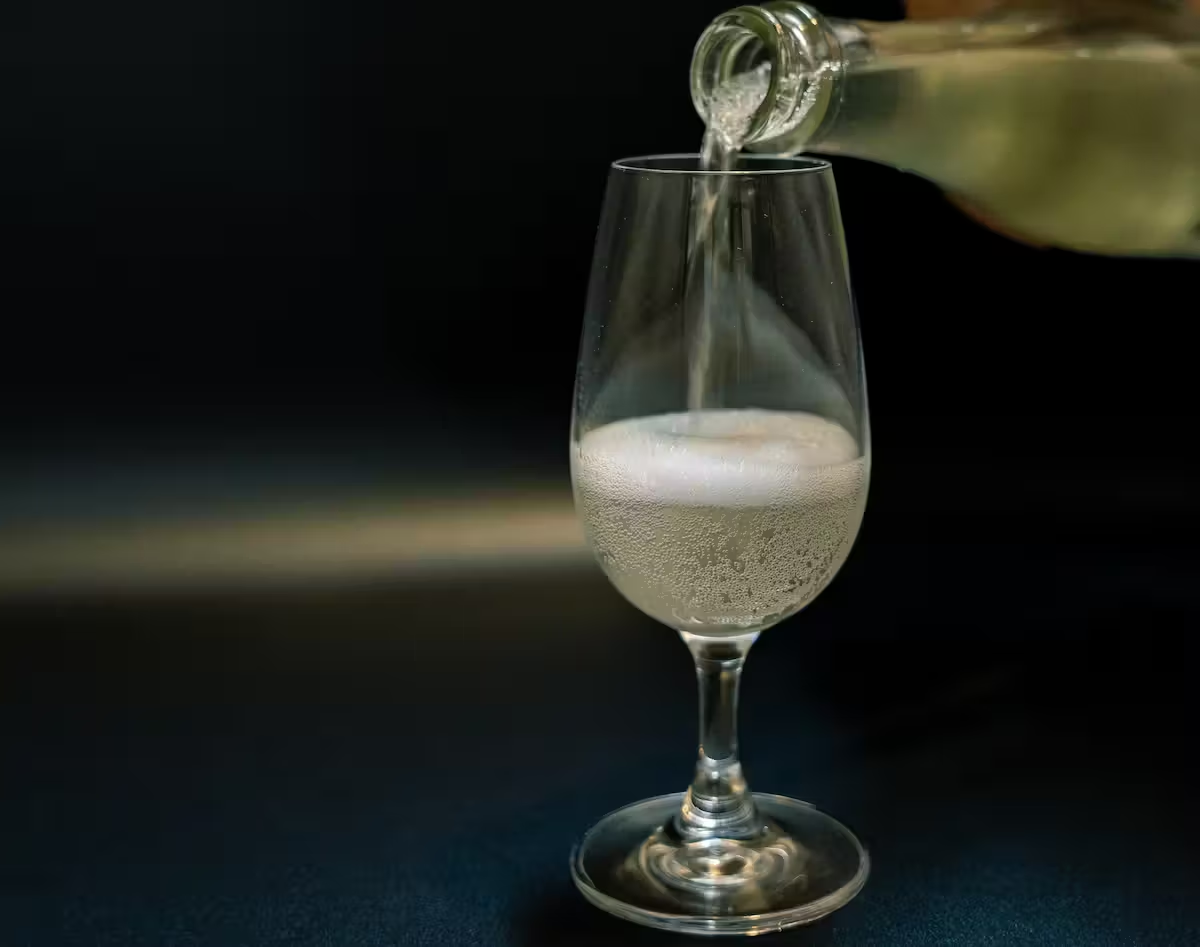
Shichiken’s main sparkling sakes get their bubbles from secondary fermentation in the bottle, rather than from added carbon dioxide. Overall, the range covers lightly cloudy, dry, cask-aged, kijoshu, and aged-sake styles. In short, “Shichiken sparkling” names a family of bottles, not one fixed flavor.
Yama no Kasumi, the first in the series, went on sale in 2015 after about five years of development. Hoshi no Kagayaki followed in 2016, and Mori no Kanade in 2017.
What Is Bottle Fermentation?
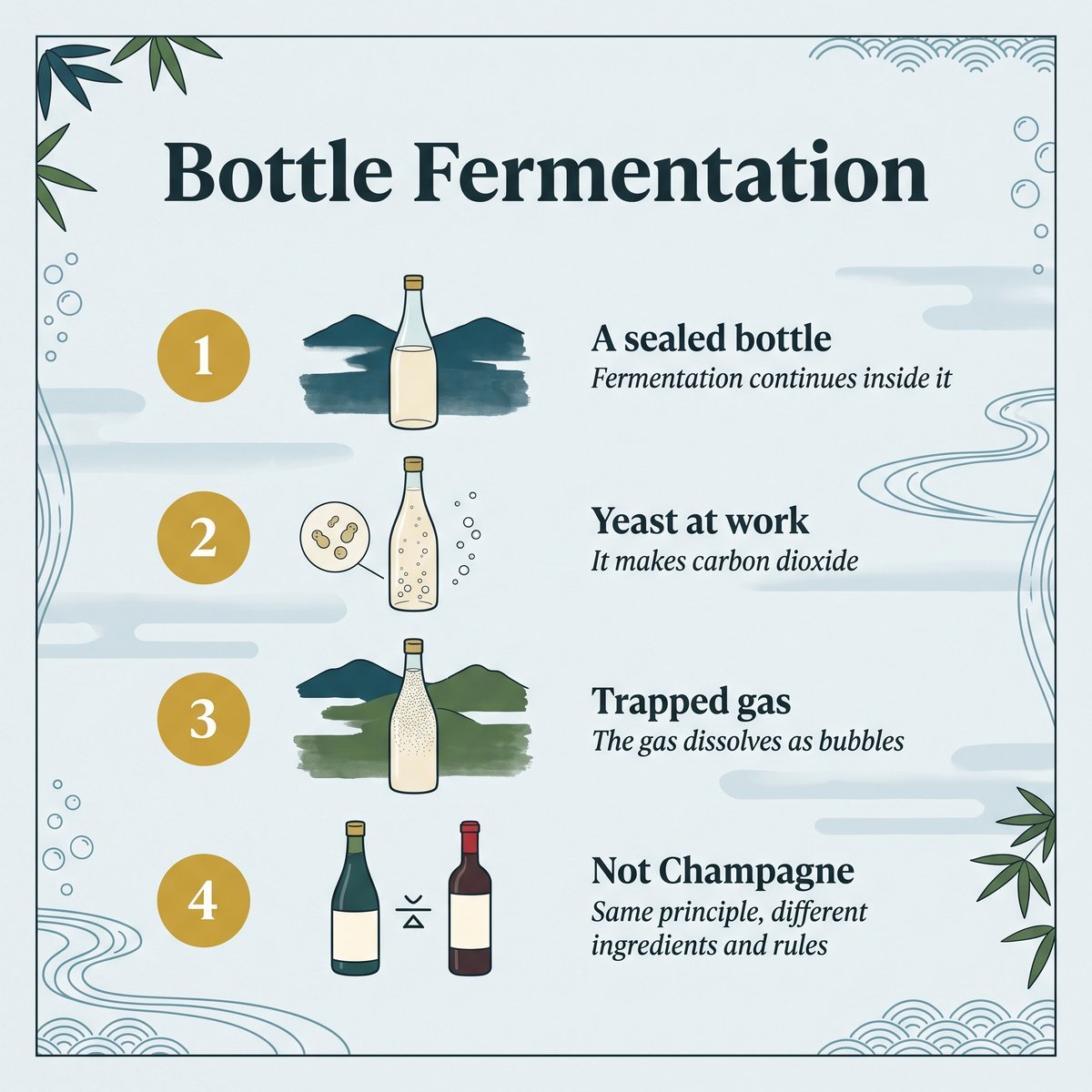
In simple terms, fermentation continues inside a sealed bottle. Then, as the yeast works, it makes carbon dioxide. Because the gas cannot escape, it dissolves into the sake as bubbles. By contrast, some brewers carbonate sparkling sake or ferment it in a tank. Our guide to sparkling sake covers these methods.
This shares one broad principle with traditional-method sparkling wine. However, sake starts from rice, koji, and water, and the rules differ. The brewery has not published every step, such as how it removes sediment. For that reason, we would not call it “the same as Champagne.”
The Main Sparkling Bottles Compared
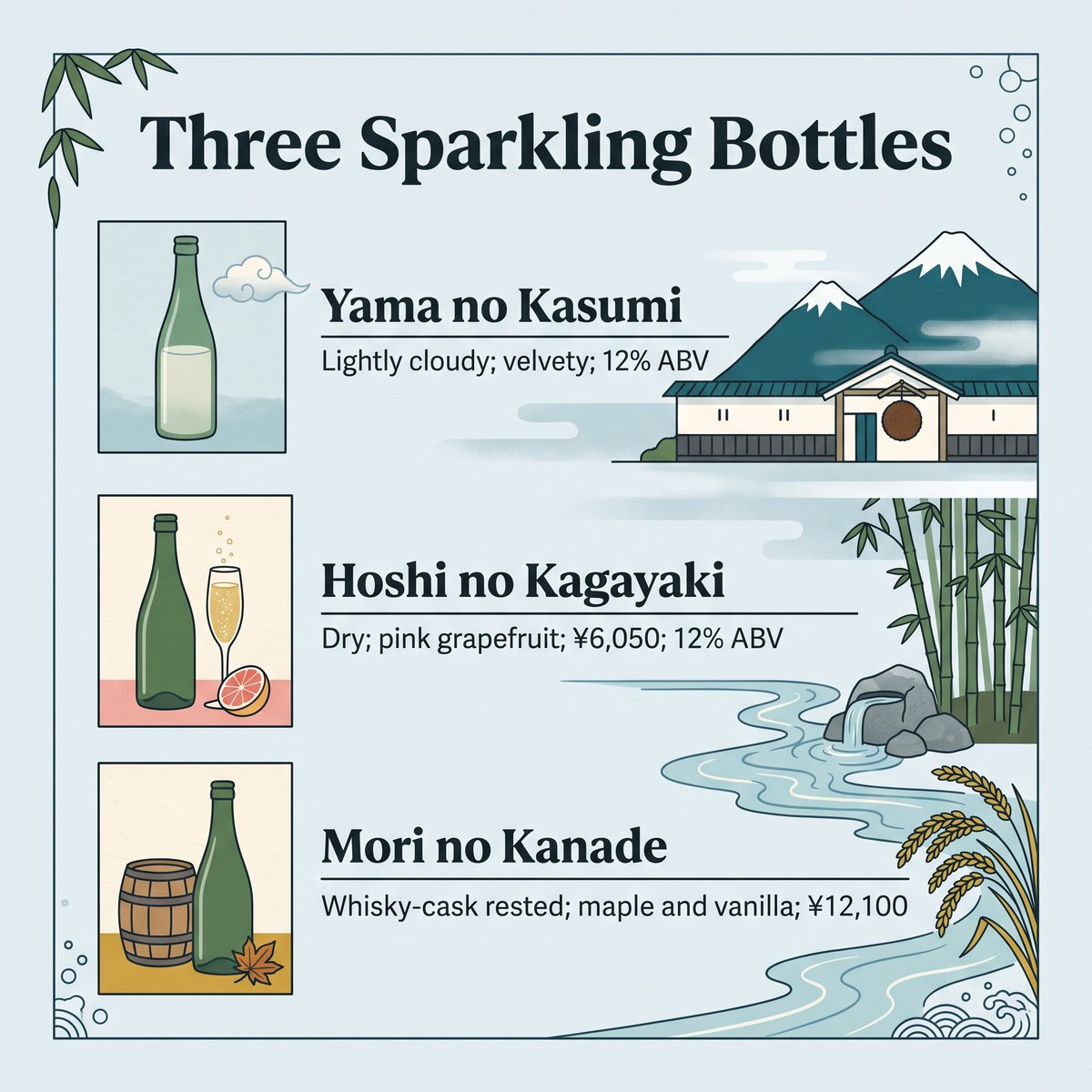
Three bottles form the core of the range. Yet they differ more than the labels suggest. Note that prices below are from the brewery’s site in October 2026 and may change.
| Bottle | Style | Dryness | Brewery’s flavor notes | Best for | Size and price (Oct 2026) | ABV |
|---|---|---|---|---|---|---|
| Yama no Kasumi (山ノ霞) | Usu-nigori (lightly cloudy); launched 2015 | Not stated; soft, velvety texture | Cheesecake, butter, pineapple | A first try; creamy or mildly sweet food | 720 ml or 360 ml; see the official shop for size-specific prices | 12% |
| Hoshi no Kagayaki (星ノ輝) | Bottle-fermented; launched 2016 | Dry | Pink grapefruit, marshmallow, cotton candy | Toasts, aperitifs, light dishes | 720 ml; ¥6,050 | 12% |
| Mori no Kanade (杜ノ奏) | Rested in whisky casks; launched 2017 | Medium-dry | Maple, vanilla-like spice, lemon | Gifts; richer food | 720 ml; ¥12,100 | 12% |
Of the three, Mori no Kanade is the most local. The brewery rests it in casks from Suntory’s nearby Hakushu Distillery. It calls this a meeting of two “homes of famous water.” All three, the brewery says, are best served chilled.
Beyond the Core Three
As checked in October 2026, the brewery’s official sparkling page listed nine products. They include Sora no Irodori, a sparkling kijoshu, which is sake brewed partly with sake instead of water. There is also a bottle developed with Alain Ducasse’s team in Paris, completed in 2021.
The EXPRESSION series occupies the top end of the range. For instance, some versions blend in long-aged sake, which the brewery says matured for 25 or even 40 years. Another edition grew out of a project with the Yamanashi Prefectural Museum of Art, inspired by a Millet painting in its collection.
The 2026 Kura Master Awards
Kura Master is a sake and spirits competition in Paris, judged largely by French wine and food professionals. In May 2026, Hoshi no Kagayaki received the Jury Prize as the top entry in the sparkling sake category. Then, on September 30, it won the President’s Award, the competition’s highest honor for sake that year.
According to Jiji Press, judges praised its vivid flavor, both fresh and powerful. It is a major result for a sparkling sake, though it is one competition in one year, so it does not make this “the world’s best sake.”
Traditional Sake and Hakushin
It would be easy to see Shichiken as a sparkling brand only, but that misses half the range. The brewery still makes a full line of still sake, from junmai to junmai ginjo and junmai daiginjo.
One of those still bottles drew wide attention a year before the Kura Master win. In 2025, the junmai daiginjo Hakushin (白心) won Champion Sake at the 19th International Wine Challenge (IWC) in London. Yamanashi Prefecture then announced the result that September. As a result, recent recognition covers both sides of the range.
Which Shichiken Sake Should You Try?
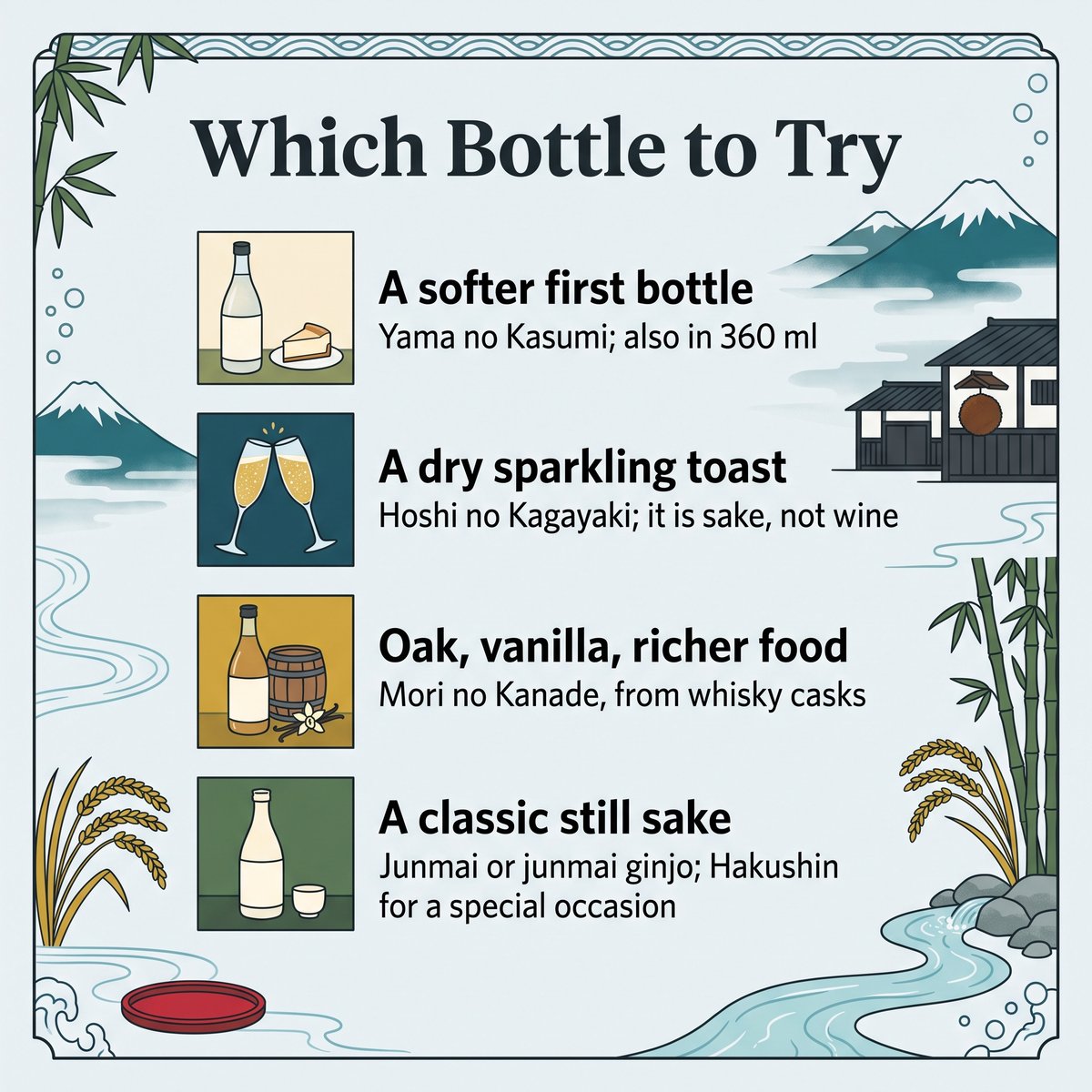
First, start with the flavor you enjoy, then check the label. These picks are our suggestions based on the brewery’s own descriptions.
For a softer, rounder first bottle
Choose Yama no Kasumi. It also comes in a smaller 360 ml size.
For a dry sparkling toast
Choose Hoshi no Kagayaki, the Kura Master winner. Just remember it is sake, not wine.
For oak, vanilla, and richer food
Choose Mori no Kanade, rested in Hakushu whisky casks.
For a classic still sake
Choose a junmai or junmai ginjo, or Hakushin for a special occasion.
Reading a Shichiken Label
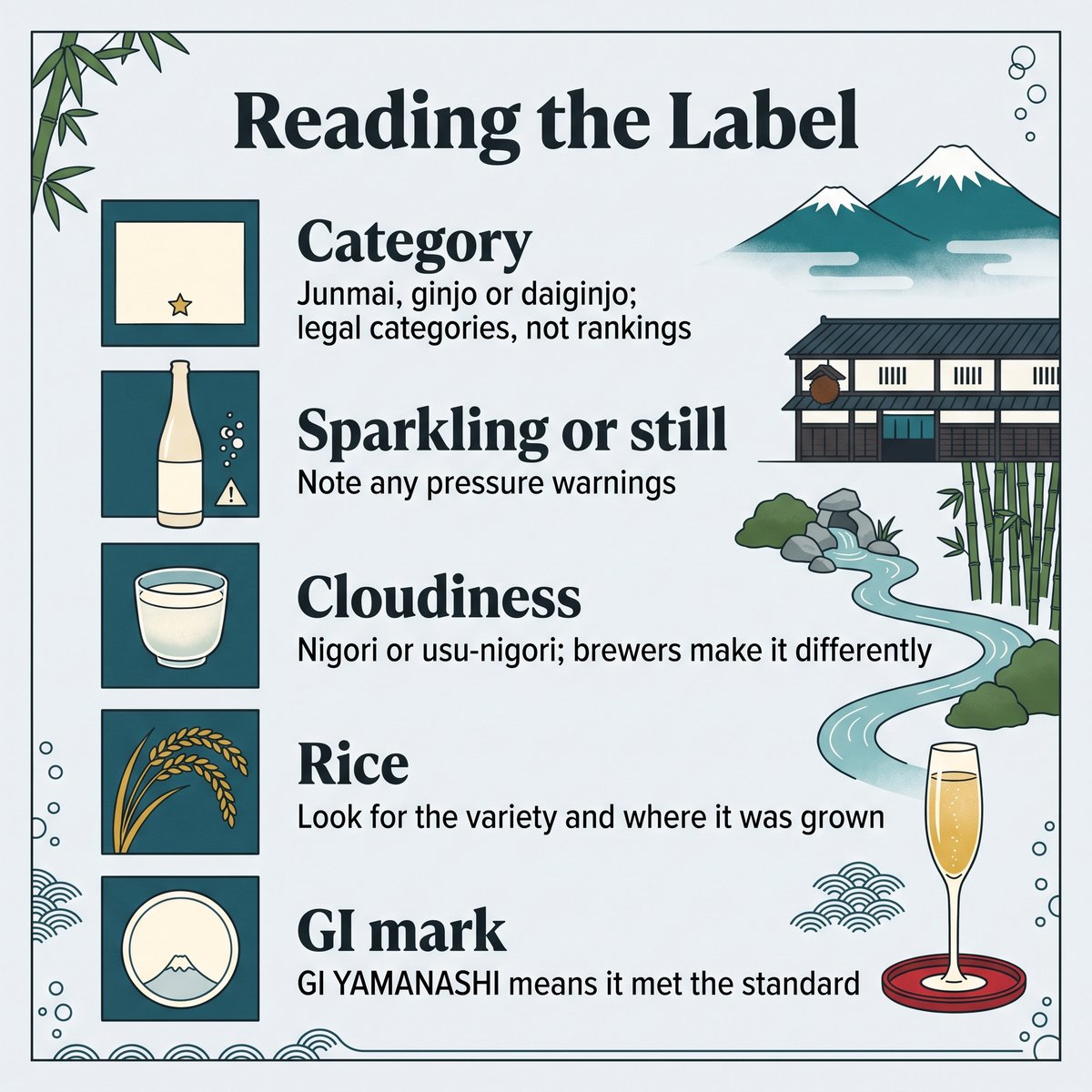
Before you buy, a few label terms help. Our guide on how to read a sake label goes deeper, but these are the basics.
- Category. “Junmai” means no added brewing alcohol. “Ginjo” and “daiginjo” have set production rules, including a rice-polishing ratio of 60% or less and 50% or less. These are legal categories, not simple quality rankings.
- Sparkling or still. Look for “sparkling” and note any pressure warnings.
- Cloudiness. Some sake keeps fine rice solids, and people call it nigori or usu-nigori. The brewery calls Yama no Kasumi usu-nigori (“lightly cloudy”). However, brewers make cloudy sake in different ways.
- Rice. Look for the rice variety and, if stated, where farmers grew it.
- GI mark. A “GI YAMANASHI” mark shows the bottle met the regional standard. Brewing in Yamanashi alone does not qualify a bottle.
How to Serve and Pair Shichiken
The brewery recommends serving its sparkling bottles chilled. A white wine glass or flute also shows off the bubbles and aroma. Before opening, keep the bottle cold and upright, and ease the cap off slowly, since it is under pressure.
The product pages do not give one storage rule for the whole range. Since requirements may differ by product, follow the instructions on the bottle or the retailer’s listing. After opening, reseal the bottle, refrigerate it, and drink it promptly, because the carbonation fades. Our guide on how to store sake covers the basics.
Food Pairing Ideas
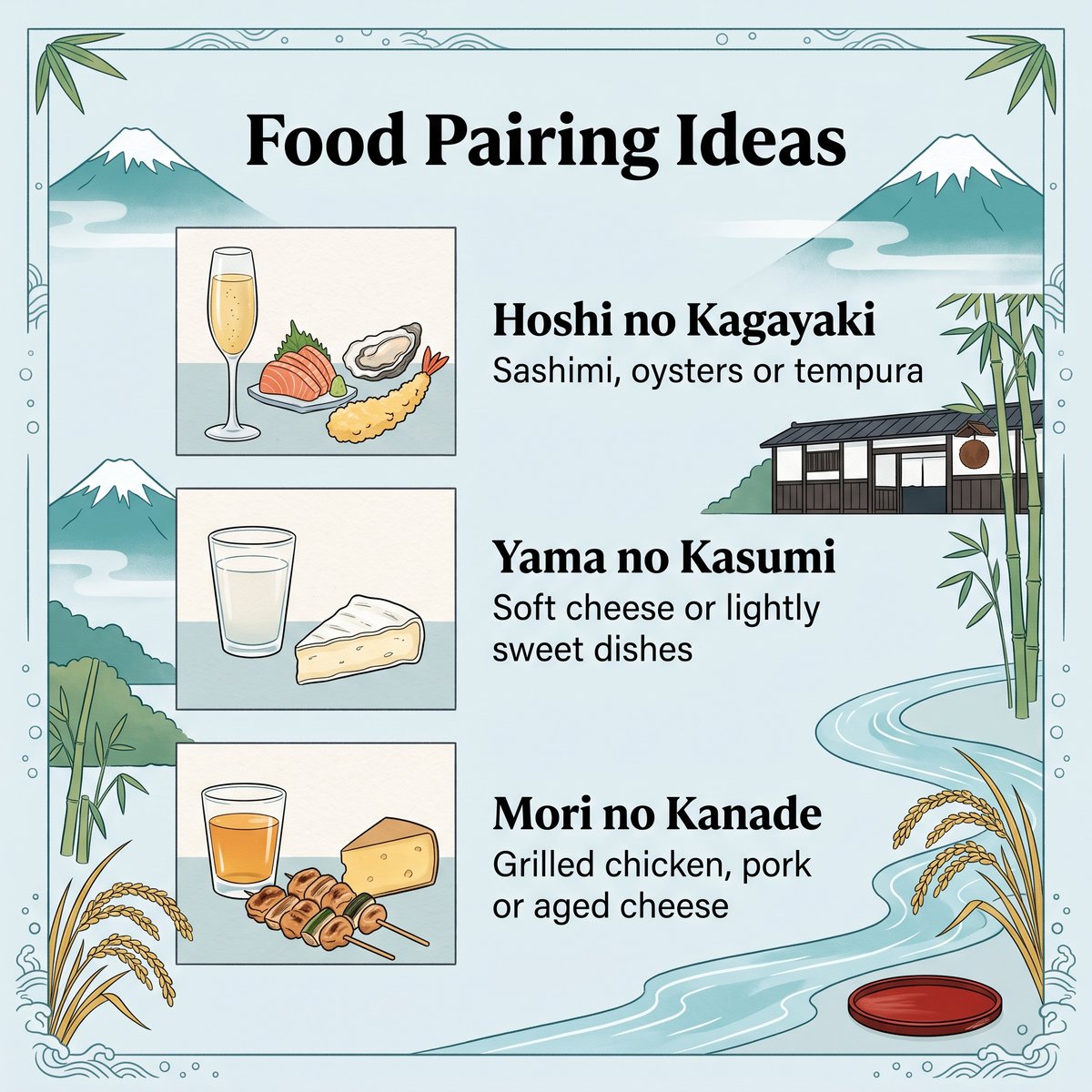
When pairing, think about weight and texture first. A dry, fine-bubbled bottle like Hoshi no Kagayaki suits sashimi, oysters, or tempura, where the carbonation can refresh the palate after fried or oily textures. Yama no Kasumi, which is rounder, may work with soft cheese or lightly sweet dishes.
Cask-aged Mori no Kanade, on the other hand, can stand up to grilled chicken, pork, or aged cheese. These are our general suggestions, not official pairings. For more ideas, see our guide to sake and food pairing.
Where Can You Buy Shichiken Sake?
In Japan, you can buy Shichiken at the brewery shop, Onakaya, and from selected sake retailers. Outside Japan, the brewery lists importers across North America, Europe, and the Asia-Pacific, but availability varies by bottle. Because an importer listing does not guarantee retail stock, contact the distributor before ordering.
In the United States, the brewery lists JFC USA for still sake and Mutual Trading for sparkling sake. It also lists partners in Canada, the United Kingdom, continental Europe, East and Southeast Asia, and Australia, as checked in October 2026.
The brewery’s Japanese website also has an online shop with a cart. However, we could not confirm whether it ships abroad, so check the brewery’s official partner page for your country first.
Hakushu Water and GI Yamanashi
Hakushu lies in northwestern Yamanashi, beneath Mount Kaikoma (Kaikomagatake) on the northern edge of the Southern Alps. The area is particularly known for water. Hokuto City has three sites in Japan’s official lists of 100 remarkable waters, including the Hakushu–Ojiragawa river area.
According to a Yamanashi Prefecture guide, the Ojiragawa river rises on Mount Kaikoma, and its basin holds plenty of groundwater. Because of that water, mineral water bottlers and a whisky distillery also operate nearby.
What the Brewery Says About Its Water
The brewery presents its water as a central influence on its house style. It describes the water as natural subterranean flow from Mount Kaikoma, a granite mountain, that springs up inside the brewery. Snow and rain, it says, take about 27 years to filter through the granite.
That figure comes from the brewery, which has not published detailed water analysis. But water does not decide flavor by itself. Rice, koji, yeast, fermentation control, and the brewers’ choices all shape the final sake.
What Is GI Yamanashi Sake?
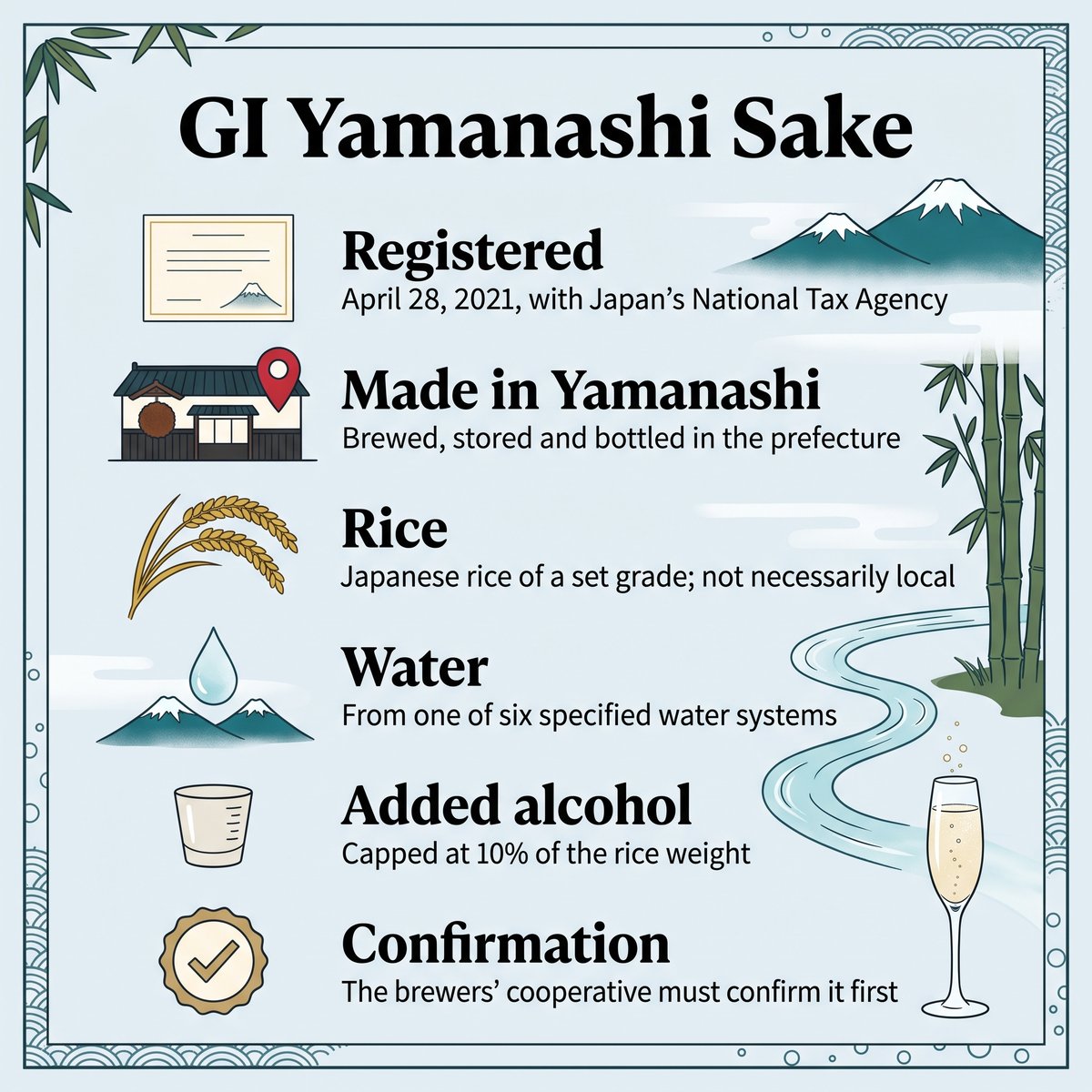
GI Yamanashi is a protected geographical indication for sake, registered on April 28, 2021, under Japan’s National Tax Agency. Brewers must make, store, and bottle qualifying sake in Yamanashi. It must also use Japanese rice of a set grade and water from one of six specified water systems in the prefecture.
Notably, the standard does not require Yamanashi-grown rice. It also caps added alcohol at 10% of the rice weight. Brewing in Yamanashi does not make a bottle GI Yamanashi automatically. Instead, the sake must meet the standard, and the Yamanashi Prefecture Sake Brewers Cooperative, the designated management body, must confirm it before the mark appears.
Koshu (甲州) Versus Koshu (古酒)
You will see “Koshu” often around Shichiken. Koshu (甲州) is an old name for the Yamanashi area, so the Koshu Kaido was the highway that led there. However, koshu aged sake (古酒) uses different characters and simply means long-aged sake.
History and the Meaning of Shichiken
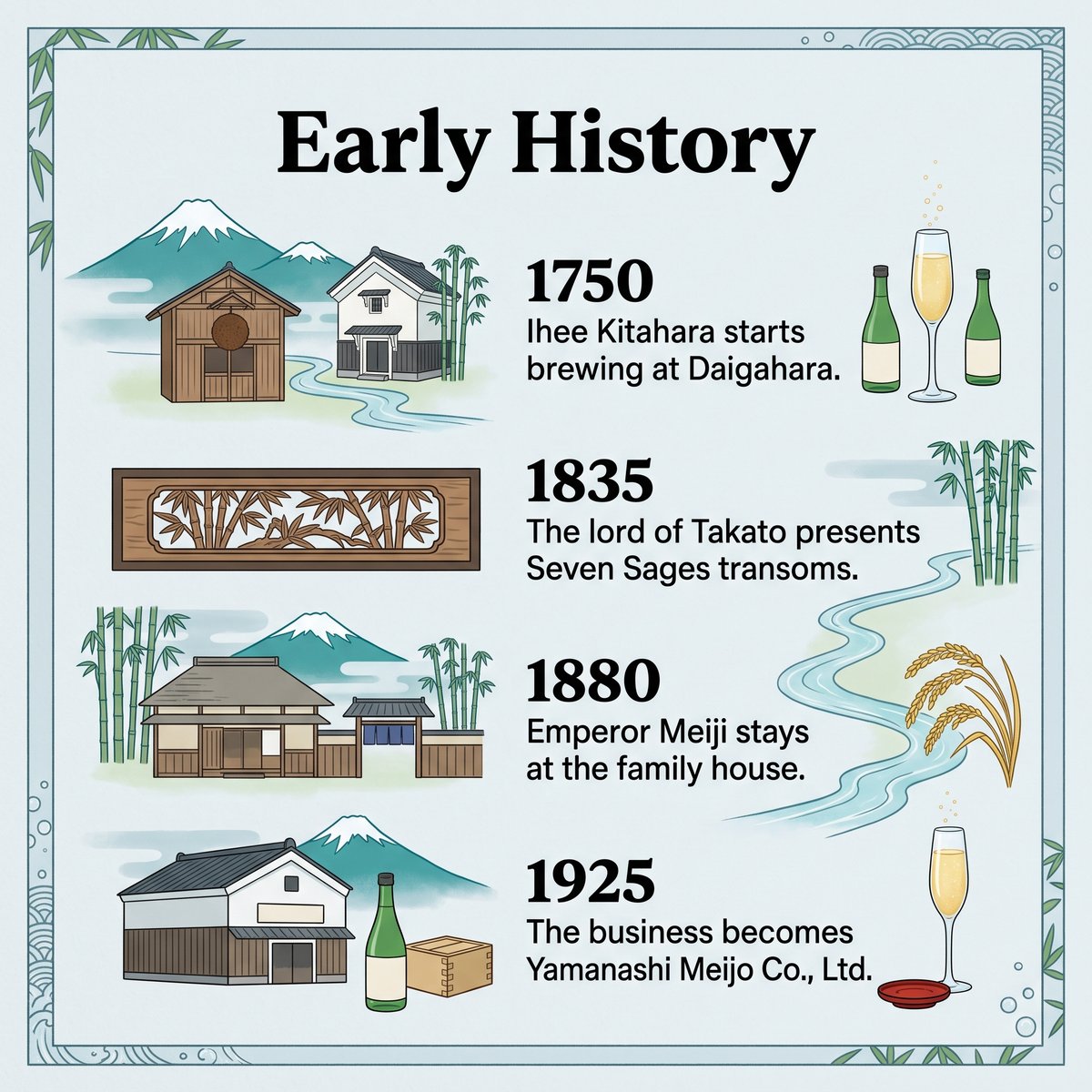
Shichiken’s story begins with a branch of a brewing family from Takato, in neighboring Nagano Prefecture. According to the brewery, founder Ihee Kitahara fell for the water at Hakushu and started brewing at Daigahara in 1750. A tourism account adds that he found it while traveling to and from Edo, though the brewery’s own history does not mention the journey.
1750
Ihee Kitahara, from a Takato brewing family, starts brewing at Daigahara.
1835
The lord of Takato presents carved transoms showing the Seven Sages of the Bamboo Grove.
1880
Emperor Meiji stays at the family house during his tour of Yamanashi.
1925
The business becomes Yamanashi Meijo Co., Ltd.
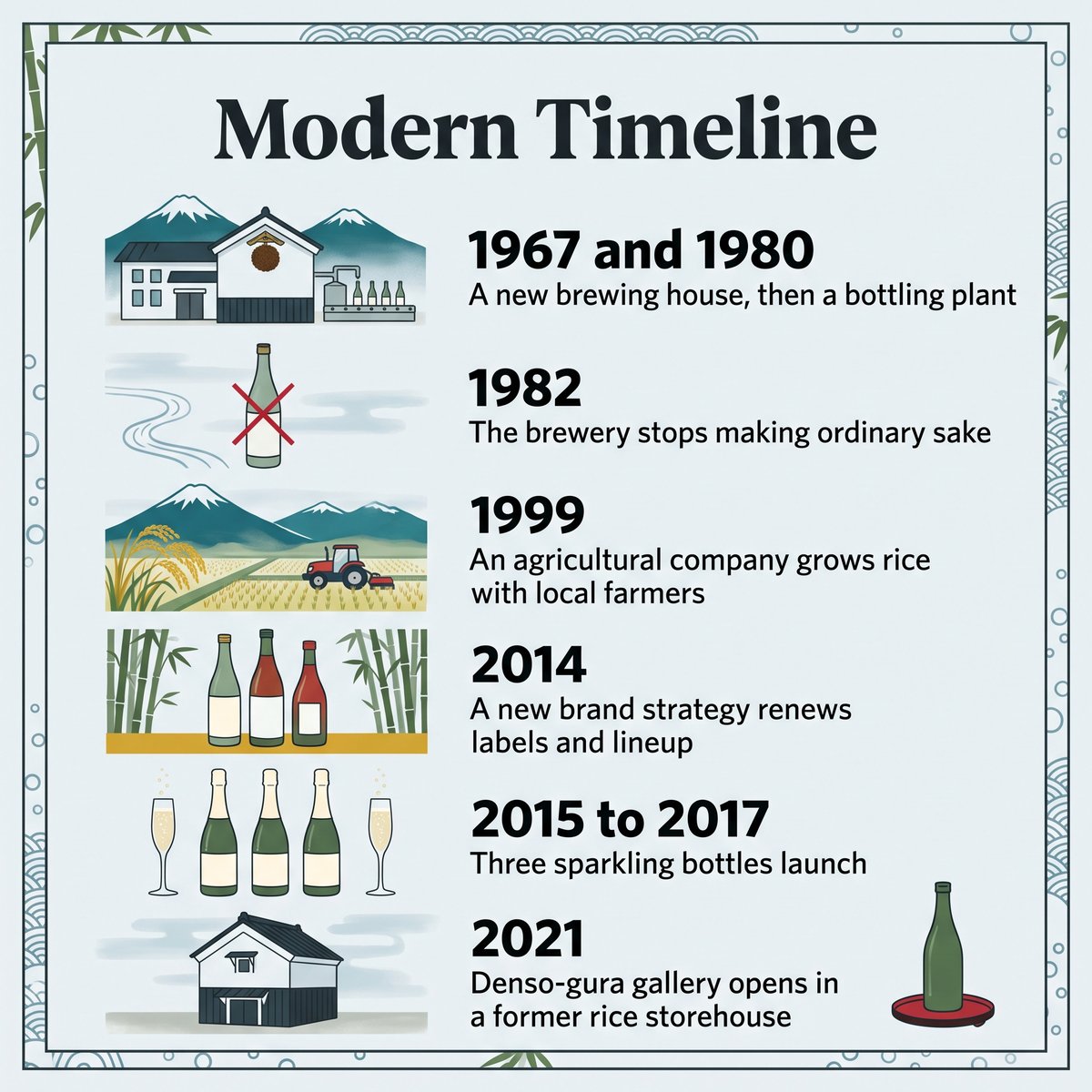
1967 and 1980
The family builds a new brewing house, Seiwa-gura, and then a bottling plant.
1982
The brewery stops making ordinary sake.
1999
The family sets up an agricultural company to grow rice with local farmers.
2014
A new brand strategy renews the labels and lineup.
2015 to 2017
Yama no Kasumi, Hoshi no Kagayaki, and Mori no Kanade launch.
2021
The Denso-gura gallery opens in a former rice storehouse.
Why Is It Called Shichiken?
Shichiken means “Seven Sages.” The name comes from a pair of carved ranma transoms showing the Seven Sages of the Bamboo Grove. The lord of the Takato domain, Naito Surugano-kami, gave them to the family in 1835 for its new main house. A ranma is a decorative panel set above sliding doors.
The Seven Sages were third-century Chinese scholars. In East Asian art, they came to stand for independence, nature, drinking, conversation, and music, which suits a sake brand nicely. Since then, the panels have stayed in the Kitahara family house.
From Ordinary Sake to a Specialized Range
In 1982, the brewery says, it stopped making ordinary sake, or futsushu, and moved its whole range into higher grades. That was an early choice of quality over volume.
A note on dates, though. Japan set its labeling standard for the legally defined special-designation categories, such as junmai and ginjo, in November 1989. It took effect in April 1990. So the 1982 shift reflects the brewery’s direction, since today’s legal definitions did not exist yet.
The 2014 Rebrand
Later, the next big turn came in 2014, when the brewery renewed its brand strategy, labels, and lineup. A later Sony Bank crowdfunding page adds more detail. It says the brewery ended the traditional toji (master brewer) system, updated its equipment, and aimed for “high added value” and “internationalization.”
Rice and Local Agriculture
Shichiken works with Yamanashi farmers to grow sake rice, naming the varieties Yumesansui and Hitogokochi. Still, rice varies by product, and not every bottle uses local rice. For example, the Hoshi no Kagayaki product page says only “carefully selected sake rice.”
The partnership goes back to 1999. That year, according to the brewery, it set up an agricultural company and formed a growers’ group with local farmers. Its stated belief is that local rice, local water, and local people together make true local sake.
What Is Yumesansui?
Yumesansui is not unique to Shichiken. Instead, Aichi Prefecture’s mountain agriculture research station bred it from Yamada Nishiki and Chubu 44, and registered it in 2001. Later, Yamanashi researchers tested it for the prefecture’s farms at 350 to 700 meters.
Those trials included a Hakushu field test in 2007 and 2008, at about 600 meters. The researchers found it higher-yielding than Miyama Nishiki and more resistant to rice blast. In addition, it formed the starchy white core that brewers want. Our guide to sake rice explains why that core matters.
Visiting the Shichiken Brewery
Yes, visitors can tour parts of the Shichiken brewery complex by reservation. Options include short guided visits to the imperial lodging and Denso-gura gallery, plus a longer paid tour with sake tasting. The site also has a shop with brewery-only bottles and a restaurant.
The Kitahara family house faces the old Koshu Kaido highway at Daigahara. Yamanashi Prefecture designated it a Tangible Cultural Property on October 12, 2000. According to the prefecture, construction began in the Tenpo era, from 1830, and was complete by 1854.
The designation covers the main house, a rear lavatory, a document storehouse, and another historic storehouse. It also includes related materials, such as a traditional house-layout drawing. With its high eaves and wide earthen-floored hall, the house shows the scale of a major merchant family.
The Imperial Lodging and Denso-gura
In 1880, the inner room of the main house became an imperial lodging, or anzaisho, for Emperor Meiji. That room still holds the Seven Sages transoms. Nearby, the Denso-gura gallery opened in June 2021 in a converted rice storehouse. It shows art and documents from the family, with displays changed about every three months.
Tours, Shop, and Restaurant
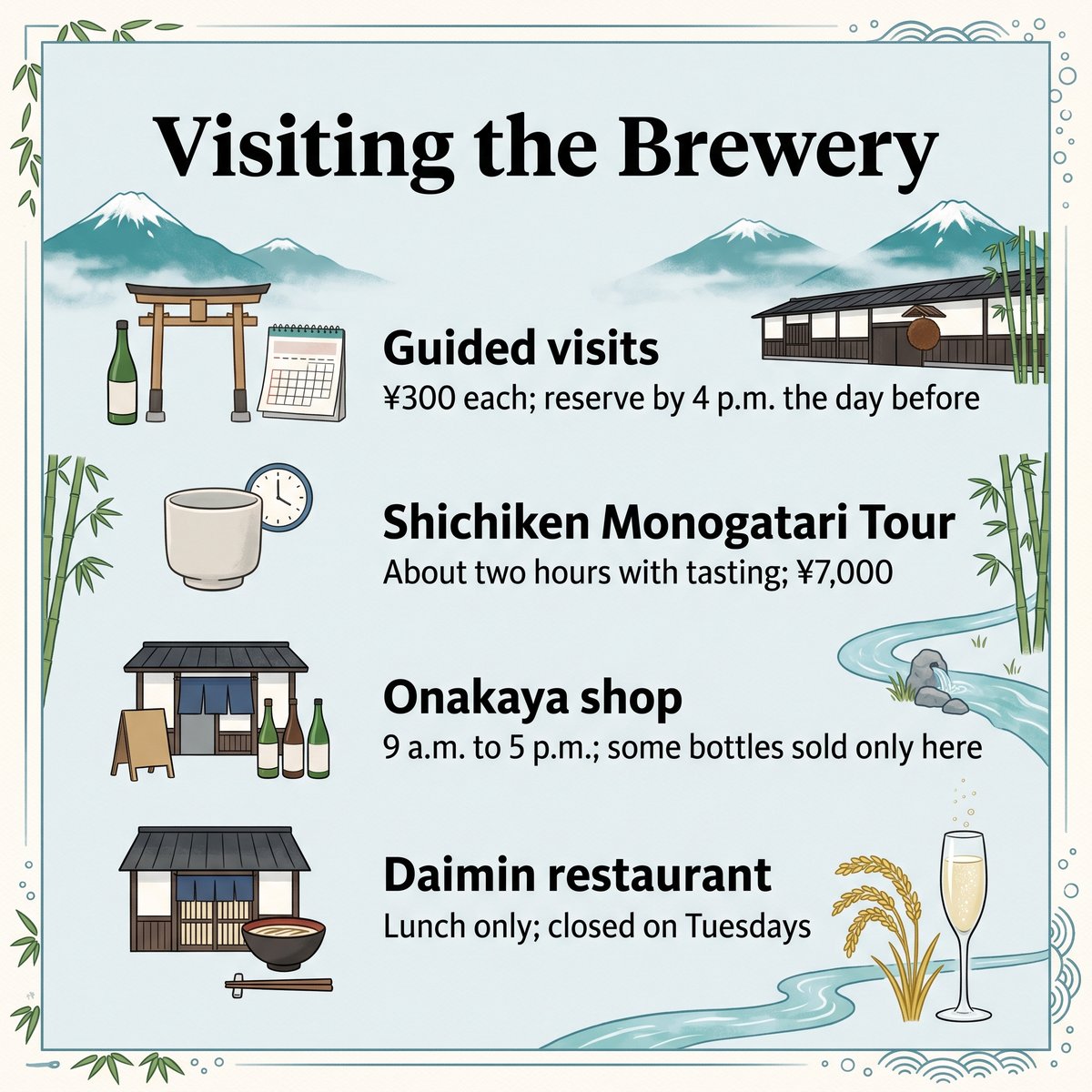
In October 2026, the brewery listed these options. Times, fees, and rules can change, so check the official site before you go.
- Guided visits. The imperial lodging and Denso-gura each cost ¥300 for junior-high age and up. Reserve by 4 p.m. the day before.
- Shichiken Monogatari Tour. A longer tour of about two hours with a sake tasting, ¥7,000 per person, scheduled about twice a month, subject to change.
- Onakaya shop. Open 9 a.m. to 5 p.m., with a tasting counter until 4:30 p.m. It sells some bottles only available there.
- Daimin restaurant. Lunch service, closed on Tuesdays. The restaurant takes lunch bookings only for 11:30 a.m.
However, the full visit details appear only on the Japanese site, and we could not confirm English-language tours. For more on what you see inside a brewery, read our guide to the kura, the traditional sake brewery.
Getting to Daigahara
The brewery’s address is 2283 Daigahara, Hakushu-cho, Hokuto City. According to the brewery, take the JR Chuo Line to Nagasaka Station, then a taxi for about 10 minutes. If you drive, it is about 20 minutes from Kobuchizawa Interchange on the Chuo Expressway, and parking is available.
Before you go, if you plan to drink, book a taxi for the return trip ahead of time. Then, after your visit, take a short walk through the old post town, where traditional houses still line the former highway.
Shichiken and Sustainable Brewing
Shichiken presents sustainability as a set of practical steps rather than one big claim. Since each step covers a different part of the business, it helps to look at them separately.
Electricity and Fuel
According to its timeline, the brewery switched the electricity used in sake production to 100% renewable energy in 2022. Its philosophy page says the power comes from Yamanashi Prefecture’s hydroelectric plants. The switch cuts about 510 tonnes of CO₂ a year. Earlier, in 2018, it changed its boiler fuel from heavy oil to LP gas.
Those are real steps. Nevertheless, they have limits. The 510-tonne figure covers electricity, not rice, bottles, or shipping. LP gas is also a fossil fuel, so that change reduced emissions rather than ending them.
The River and a Second Life for Sake Lees
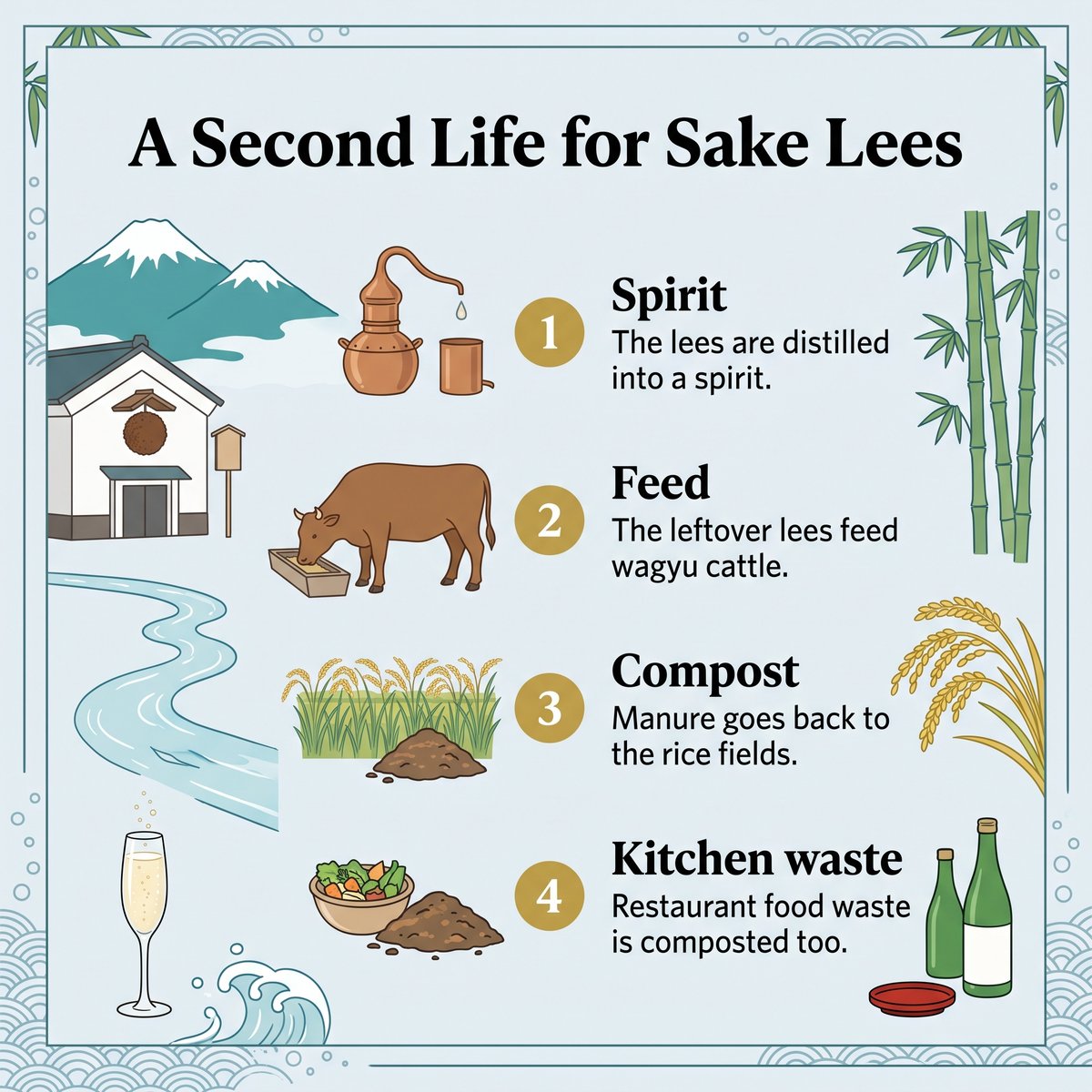
Beyond energy, the brewery says it cleans the Ojiragawa river every summer. Visitors can also take home brewery water, and the brewery gives the donations it receives to a Hokuto City environmental fund. Its sake lees follow a loop.
- Spirit. The brewery distills a spirit from sake lees, the solids left after pressing.
- Feed. The lees left after distilling become feed for wagyu cattle.
- Compost. Manure from the cattle then goes back to the rice fields as fertilizer.
- Kitchen waste. The brewery also composts food waste from its restaurant, Daimin.
One lees spirit became a product of its own. According to a 2024 Sony Bank page, Alain Ducasse Sustainable Spirits rests for about three years in Hakushu whisky casks. However, the brewery has not published volumes for the loop. So these are best called circular projects, not a zero-waste system.
Common Misconceptions About Shichiken
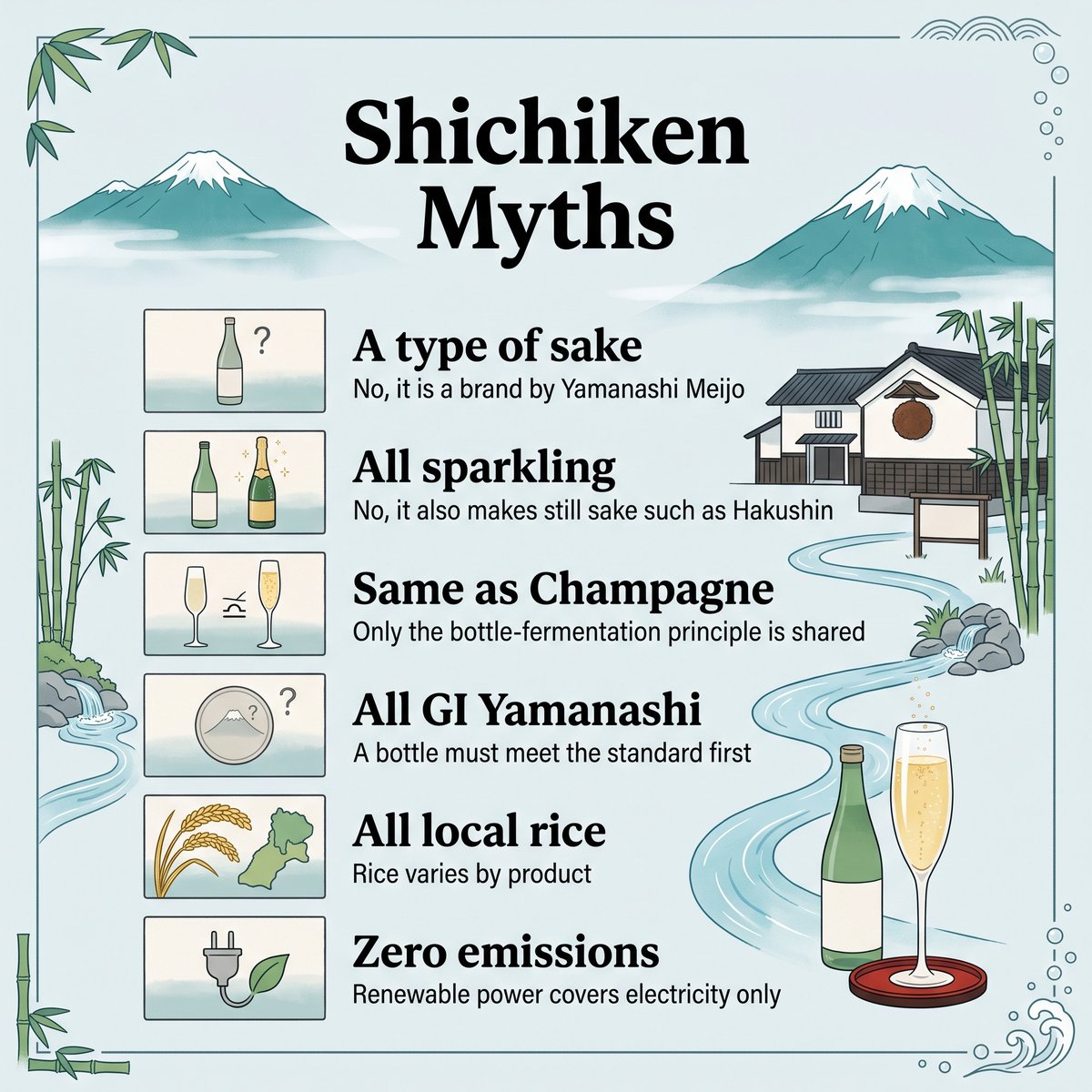
Myth: Shichiken is a type of sake.
Fact: It is a brand made by Yamanashi Meijo.
Myth: All Shichiken sake is sparkling.
Fact: It also makes still sake, including the IWC-winning Hakushin.
Myth: Its sparkling sake is the same as Champagne.
Fact: It shares bottle fermentation as a principle, but ingredients and rules differ.
Myth: Every Yamanashi bottle is GI Yamanashi.
Fact: A bottle must first meet the standard and pass confirmation.
Myth: All its rice comes from local farms.
Fact: It works with local farmers, but rice varies by product.
Myth: Renewable power means zero emissions.
Fact: The switch covers electricity, not the full supply chain.
Final Thoughts
Shichiken is easiest to understand one bottle at a time. Start with Yama no Kasumi for a softer, lightly cloudy style, or Hoshi no Kagayaki for a drier celebration bottle. Then, to see the brewery’s traditional side, compare either one with a readily available still junmai or junmai ginjo.
For the best comparison, however, try one sparkling and one still bottle side by side. For other breweries with deep regional roots, see Masumi in neighboring Nagano and our Nagano sake guide.
Frequently Asked Questions About Shichiken Sake
Taste and Choosing a Bottle
- What is Shichiken sake?
-
Shichiken is the main sake brand of Yamanashi Meijo, a brewery founded in 1750 in Hakushu, Yamanashi Prefecture. It makes still sake, including junmai and junmai daiginjo, and bottle-fermented sparkling sake.
- Is Shichiken sake sweet or dry?
-
It depends on the bottle. The brewery calls Hoshi no Kagayaki dry and Mori no Kanade medium-dry. It describes Yama no Kasumi by texture, as velvety, rather than as sweet or dry. For still sake, check each label.
- Which Shichiken bottle is best for beginners?
-
We suggest Yama no Kasumi for a soft, rounded start, since it also comes in a 360 ml size. If you like dry sparkling wine, try Hoshi no Kagayaki. Both are best served chilled.
- Is Yama no Kasumi a nigori sake?
-
The brewery describes it as usu-nigori, meaning “lightly cloudy.” The term separates its look from more heavily clouded nigori styles. However, the brewery does not publicly explain how the cloudiness is produced.
Sparkling Sake and Storage
- Is Shichiken sparkling sake similar to Champagne?
-
It shares one broad principle with traditional-method sparkling wine: bubbles form through fermentation in a sealed bottle. However, sake starts from rice and koji, and the rules and many details differ.
- Does sparkling sake need refrigeration?
-
The brewery recommends serving its sparkling sakes chilled, but its product pages give no single storage rule for the range. So follow the instructions on the bottle or retailer listing. If it says to refrigerate, keep it chilled continuously.
- How long does Shichiken sparkling sake keep after opening?
-
The brewery does not publish a time frame. Because the bubbles fade once the bottle is open, finish it the same day or within a day or two. Until then, keep it cold with a tight stopper.
Buying, Rice, and Visiting
- Where can I buy Shichiken outside Japan?
-
The brewery lists importers across North America, Europe, and the Asia-Pacific. In the US, for example, JFC USA handles still sake and Mutual Trading handles sparkling sake. Ask the importer about current stock.
- Does every Shichiken sake qualify for GI Yamanashi?
-
No. A bottle must meet the GI standard and pass confirmation before it can use the mark. The standard also does not require Yamanashi-grown rice, and Shichiken’s rice varies by product.
- Can you visit the Shichiken brewery?
-
Yes. The brewery offers reserved guided visits, a longer tour with tasting, a shop, and a restaurant. It is about 10 minutes by taxi from JR Nagasaka Station. Check the official site for current times and fees.
References
Brewery and Official Sources
- Shichiken (Yamanashi Meijo) – 300 Years of History (Accessed October 2026)
- National Tax Agency Japan – Production Standards for the Geographical Indication “Yamanashi” (Sake) (Accessed October 2026)
- Shichiken (Yamanashi Meijo) – About Our Water (Accessed October 2026)
- Yamanashi Prefecture – Cultural Property Guide: Kitahara Family House (Accessed October 2026)
- Shichiken (Yamanashi Meijo) – Corporate Philosophy (Accessed October 2026)
- National Tax Agency Japan – Overview of Labeling Standards for Sake Production Methods and Quality (Accessed October 2026)
- Shichiken (Yamanashi Meijo) – Sparkling Sake Lineup (Accessed October 2026)
- Yamanashi Prefecture – Governor’s Report on Shichiken Hakushin’s IWC Champion Sake Award, September 2025 (Accessed October 2026)
- Shichiken (Yamanashi Meijo) – Visit the Brewery (Accessed October 2026)
- Yamanashi Design Center – Yamanashi Sake Shaped by Water and Climate, Exhibition Notice, August 2025 (Accessed October 2026)
- Shichiken (Yamanashi Meijo) – Overseas Partners (Accessed October 2026)
- Yamanashi Prefecture – Naruhodo Yamanashi: The Secret Is in the Groundwater, February 2025 (Accessed October 2026)
Product, Research, Media, and Competition Sources
- Nippon.com (Jiji Press) – “Shichiken” from Yamanashi Wins Top Sake Prize in France, October 2026 (Accessed October 2026)
- Shichiken (Yamanashi Meijo) – Hoshi no Kagayaki Product Page (Accessed October 2026)
- Yamanashi Prefectural Agricultural Technology Center – Yumesansui: A High-Yielding, Blast-Resistant Sake Rice Variety (Accessed October 2026)
- Shichiken (Yamanashi Meijo) – Yama no Kasumi Product Page (Accessed October 2026)
- Association de Kura Master (PR TIMES) – Kura Master 2026 Jury Prize Results, May 2026 (Accessed October 2026)
- Shichiken (Yamanashi Meijo) – Mori no Kanade Product Page (Accessed October 2026)
- Yamanashi Tourism Organization – Shichiken (Yamanashi Meijo) (Accessed October 2026)
- Sony Bank GATE – Shichiken Fund: Business Overview (Accessed October 2026)
Related Articles
- Sparkling Sake (Surveyed: October 2026)
- Masumi Sake: The Nagano Brewery Behind Japan’s No. 7 Yeast (Surveyed: October 2026)
- Hakkaisan Sake: The Story of Niigata’s Snow-Country Brewery (Surveyed: October 2026)
- Nabeshima Sake: Saga’s Award-Winning Japanese Sake Brand (Surveyed: October 2026)
- Kijoshu (Surveyed: October 2026)
- Sake Rice (酒米): The Foundation of Premium Sake (Surveyed: October 2026)





Comments