Tokyo is one of the world’s great food cities, but its restaurant culture can feel unfamiliar when you visit for the first time. A small ramen counter, a conveyor-belt sushi restaurant, an underground food hall, and a neighborhood izakaya may all use different ordering and payment systems.
Fortunately, ordering food in Tokyo is usually easier than it first appears. Restaurants may use ticket vending machines, paper menus, touchscreens, QR codes, or simple counter service. Once you understand the basic process, you can explore the city’s food scene with much more confidence.
A reliable phone connection can also make dining in Tokyo easier. You may need to translate a menu, check opening hours, find a restaurant inside a large station, or look up unfamiliar ingredients. Travelers who want to stay connected during their trip can consider an eSIM Japan option before arriving.
Tokyo Restaurant Quick Guide
Ordering methods
Paper menus, ticket machines, touchscreens, QR codes, and counter service
Payment timing
Before eating at ticket-machine restaurants, or after eating at the register in many conventional restaurants
Useful payment methods
Cash, credit cards, transportation IC cards, and self-service terminals
Tipping
Generally not expected in Tokyo restaurants
Useful phrase
Kore o kudasai, meaning “This one, please”
Best preparation
Keep a translation tool and some Japanese yen available
TOC
Before You Enter a Restaurant
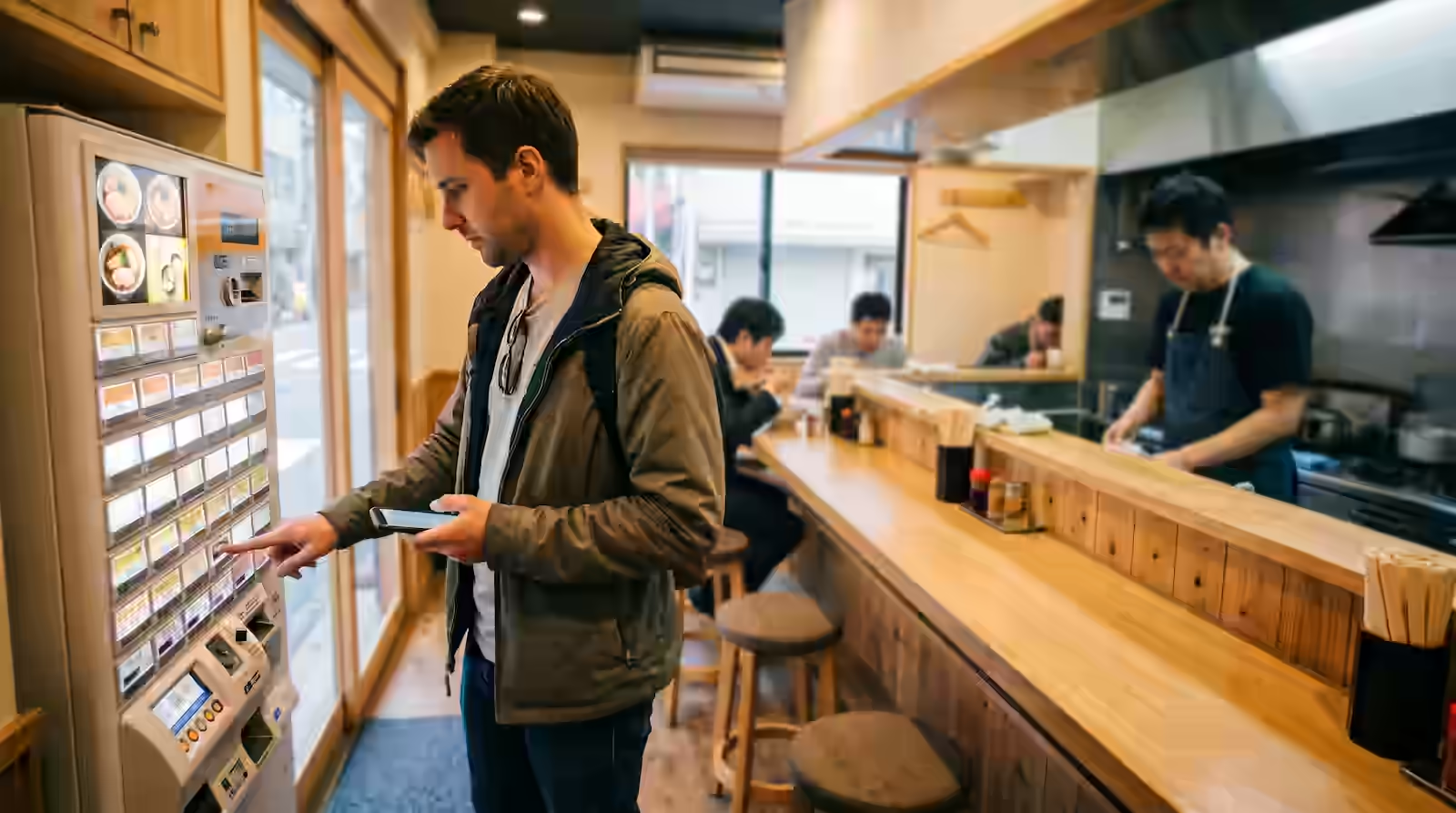
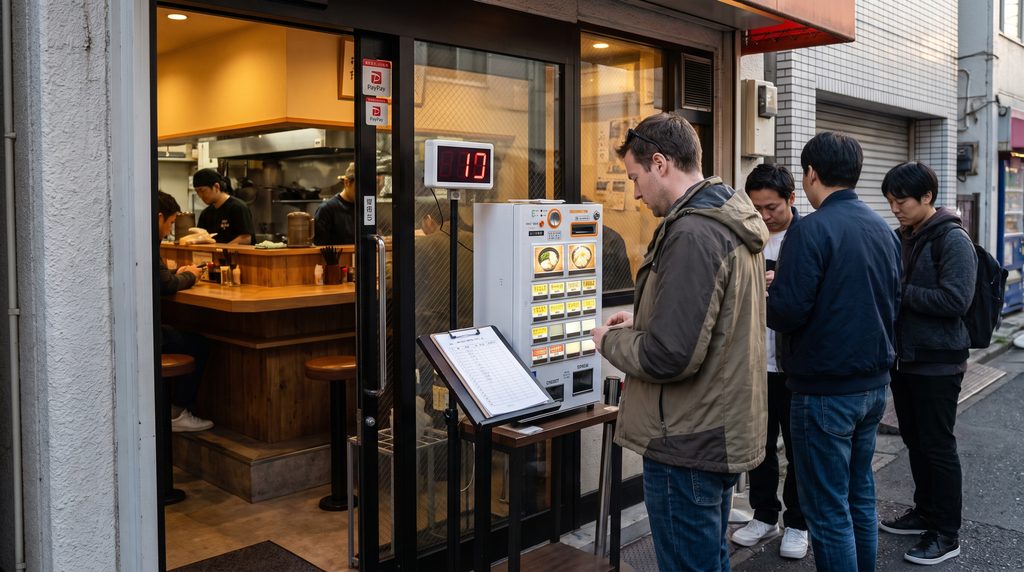
Customers using a ticket vending machine outside a Tokyo restaurant for food orders.
Tokyo has restaurants for almost every budget, from inexpensive noodle shops and casual set-meal restaurants to traditional sushi counters and high-end dining establishments.
Before entering, take a moment to examine the entrance. Look for a ticket vending machine, waiting list, numbered reception system, menu with prices, food photographs, plastic food models, or signs explaining how to queue.
A ticket machine may mean that you must order and pay before sitting down.
A sign-in sheet may require you to write your name and the number of people in your group.
A digital reception screen may issue a numbered ticket.
Payment logos can show whether the restaurant accepts cards or electronic payments.
Busy restaurants in Shinjuku, Shibuya, Ikebukuro, Ginza, and around Tokyo Station may have queues during lunch and dinner. Do not automatically join a line without checking the entrance. Some restaurants require customers to register before waiting.
A Typical Restaurant Experience in Tokyo
Every restaurant is different, but many dining experiences follow the same general sequence. Understanding it can remove much of the uncertainty from your first meal.
1
Check the entrance
Look for a queue, waiting list, ticket machine, reception screen, or seating instructions.
2
Wait to be seated
At some casual restaurants you can choose a seat, but at others you should wait for a staff member.
3
Choose your food
Use the paper menu, touchscreen, QR code, conveyor belt, or vending machine provided by the restaurant.
4
Place your order
Tell the server, submit the order electronically, or hand your food ticket to a staff member.
5
Enjoy your meal
Water, tea, condiments, and napkins may be on the table or at a self-service station.
6
Check how to pay
Payment may take place before eating, at the table, at a register, or through a self-service machine.
7
Leave after payment
Tipping is generally not expected. A polite gochisōsama deshita is a pleasant way to thank the staff.
One important difference from some other countries is that payment is not always taken at the table. Many restaurants leave a small bill slip or plastic tag beside your seat. Take it to the register when you are ready to leave.
How to Use a Japanese Ticket Machine
Ticket vending machines are common at ramen, soba, curry, beef-bowl, and other casual restaurants. At these establishments, you usually choose and pay for your meal before sitting down.
Ticket Machine Checklist
Look for an English-language button.
Select your main dish.
Choose the portion size, toppings, or side dishes.
Insert cash or choose an available electronic payment method.
Collect the ticket and any change.
Hand the ticket to the staff or place it on the counter.
Newer machines may accept credit cards or transportation IC cards, but older machines may take only cash. Keeping a few ¥1,000 notes and coins available is helpful.
What If the Machine Is Only in Japanese?
You do not need to understand every button. Start by looking for photographs, prices, numbered options, and buttons that appear to indicate popular or recommended dishes.
A camera translation tool can help identify food names and basic instructions. If you remain uncertain, show a photograph to the staff or point to the item you want. During busy periods, step aside while checking your translation so that other customers can use the machine.
Ordering at a Ramen Restaurant
Ramen restaurants range from large chains with multilingual machines to tiny counters with only a few seats. Depending on the establishment, you may need to choose the broth, noodle firmness, portion size, extra noodles, meat, egg toppings, or side dishes.
Traditional Tokyo-style ramen is commonly associated with a clear soy-sauce-based broth. However, modern Tokyo restaurants serve numerous styles, including shio, miso, tonkotsu, seafood-based broths, and original specialty ramen.
Some restaurants ask about noodle firmness after you hand over your ticket. If you do not have a preference, the standard option is usually the easiest choice. Ramen is best eaten while it is hot, and audible slurping is generally accepted, although it is not required.
How to Order at Conveyor-Belt Sushi Restaurants
Conveyor-belt sushi is a practical choice for first-time visitors because much of the ordering process is visual. At a traditional restaurant, plates travel past your seat on a conveyor. You can take the plate you want, but first check whether the plate color or design indicates its price.
Many newer restaurants use touchscreens. Select the sushi, quantity, and available options on the screen. The order may then arrive on a separate delivery lane.
Conveyor-Belt Sushi Tips
Do not return a plate after taking it from the conveyor.
Leave special delivery trays in place if they belong to another customer.
Check whether wasabi is already inside the sushi.
Use hot-water taps carefully because the water can be extremely hot.
Press the checkout button or call the staff when you have finished.
The restaurant may calculate your total by counting the plates, recording digital orders, or scanning your table. Payment usually takes place at a register or self-service checkout machine.
How to Read a Japanese Menu
A Japanese menu can look overwhelming, but you do not need to read Japanese fluently. Begin with photographs, prices, and familiar food names.
Menu term
Meaning
Sushi
Vinegared rice served with seafood or other ingredients
Ramen
Noodles served in broth
Tonkatsu
Breaded and fried pork cutlet
Tempura
Lightly battered and fried seafood or vegetables
Soba
Buckwheat noodles served hot or cold
Udon
Thick wheat noodles
Yakitori
Grilled chicken pieces served on skewers
Don or donburi
Ingredients served over a bowl of rice
Teishoku
A set meal commonly served with rice, soup, and side dishes
Ōmori
A larger portion
Common terms that can help first-time visitors understand Japanese restaurant menus.
Menu photographs are helpful, but they may not show every ingredient. Travelers with allergies or dietary restrictions should not rely on pictures alone.
Useful Japanese Restaurant Phrases
You can visit many Tokyo restaurants without speaking Japanese, but a few simple phrases can make communication easier.
Do you have an English menu?
Eigo no menyū wa arimasu ka?
This one, please.
Kore o kudasai.
What do you recommend?
Osusume wa nan desu ka?
The bill, please.
Okaikei onegaishimasu.
Can I use a card?
Kādo wa tsukaemasu ka?
Where do I pay?
Okaikei wa doko desu ka?
How to Pay for Food in Tokyo
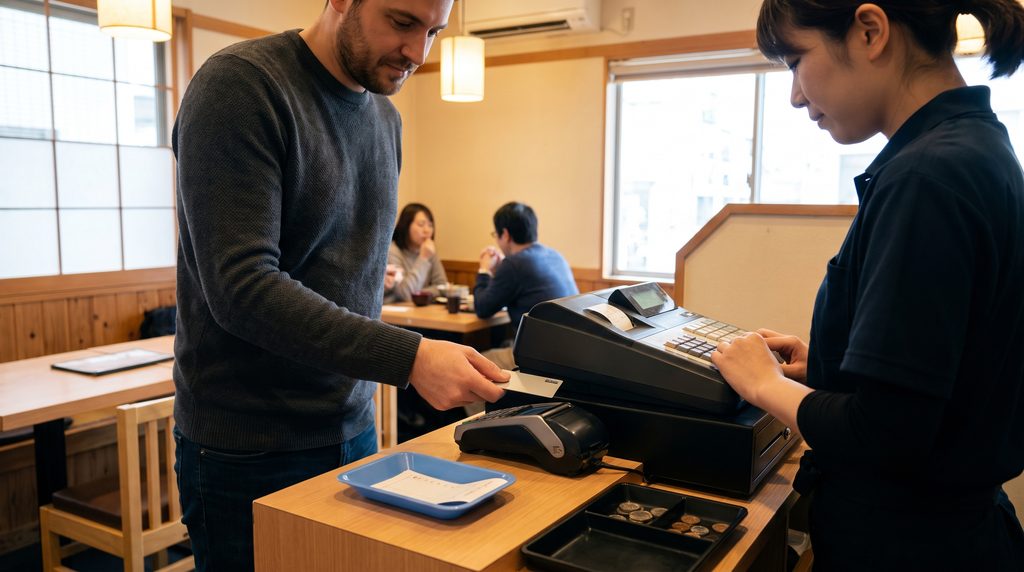
Customer paying at a Japanese restaurant cash register, with staff helping at the counter.
Payment methods vary considerably between restaurants. Larger restaurants, department stores, and national chains commonly accept credit cards, but small independent establishments may still require cash.
Cash: Still important at small restaurants and older ticket machines.
Credit and debit cards: Commonly accepted at larger restaurants, chains, shopping centers, and department stores.
Transportation IC cards: Suica, PASMO, and compatible cards may be accepted at casual restaurants and chains.
Contactless payments: Available at some modern registers and self-service terminals.
QR payments: Offered by some establishments, although supported services vary.
Do You Pay Before or After Eating?
Both systems are common. At ticket-machine restaurants, you normally pay before eating. At many conventional restaurants, you eat first and then take the bill slip to the register.
Some restaurants accept payment at the table, while others use automated checkout machines near the exit. Do not leave cash on the table unless the staff specifically instructs you to do so. Carrying some Japanese yen remains a sensible precaution even though electronic payment is increasingly common.
Ordering at an Izakaya
An izakaya is a casual Japanese dining establishment where customers usually order drinks and several small dishes rather than one main course. Menus often include grilled meat or fish, sashimi, yakitori, fried foods, tofu, vegetables, and rice or noodle dishes.
Dishes are commonly shared and ordered gradually. You do not need to choose everything at the beginning of the meal.
Understanding Otoshi
Some izakayas automatically serve a small appetizer called otoshi. It usually forms part of a seating or cover charge and may appear on the bill even though you did not order it separately. This is a standard practice at many establishments rather than an attempt to add an unexplained dish.
Some small izakayas may expect each customer to order at least one drink or dish. Check the menu or ask the staff if you are unsure about minimum orders or seating charges.
What If There Is No English Menu?
A restaurant without an English menu can still be approachable. First, look for photographs, food displays, dish numbers, or prices. If the menu is text-only, use a camera translation tool to identify the main dishes and ingredients.
You can also search for recent menu photographs before entering. This is especially useful for small neighborhood restaurants with handwritten menus.
If translation remains difficult, point to the dish and say Kore o kudasai. Clear gestures, short phrases, and photographs are often enough to complete an order.
Food Allergies and Dietary Restrictions
Travelers with serious food allergies or dietary restrictions should take additional precautions. Japanese dishes may contain ingredients that are not immediately visible, including fish-based stock, soy, wheat, sesame, shellfish, eggs, dairy products, and alcohol used in sauces or seasonings.
Important Allergy Advice
A dish without visible meat or fish may still contain fish-based stock. If you have a serious allergy, prepare a clearly written Japanese allergy card and show it to the staff before ordering. Ask about broths, sauces, seasonings, cooking oil, and possible cross-contact.
Small restaurants may be unable to change recipes or guarantee an allergen-free preparation area. If the staff cannot confidently confirm that a dish is safe, choose another restaurant rather than taking an unnecessary risk.
Tokyo-Specific Dining Situations
Tokyo Station and Other Major Stations
Tokyo Station contains extensive restaurant areas inside and around the station complex. Shinjuku, Shibuya, Ueno, and Ikebukuro also have large dining districts connected to railway stations and shopping buildings.
Check the building, floor, and station exit before visiting. A restaurant that appears nearby on a map may be inside a basement complex, on an upper floor, or behind a railway ticket gate.
Depachika Food Halls
Department-store basement food halls, known as depachika, sell bento boxes, sweets, bakery products, sushi, side dishes, and prepared meals. They offer a convenient way to see many kinds of Japanese food in one location.
Seating is not always available. Unless a designated eating area is provided, take the food away rather than eating directly beside the counter.
Tsukiji and Toyosu
Tsukiji remains known for seafood shops, casual restaurants, and food-focused streets. Toyosu is associated with Tokyo’s wholesale market facilities and market-related restaurants.
Some market-area businesses close much earlier than conventional city restaurants. Check current opening hours and ordering arrangements before traveling across Tokyo.
Yokocho Dining Alleys
Tokyo’s yokocho alleys contain small izakayas, yakitori counters, and other casual restaurants. These establishments can provide a memorable local experience, but they may have limited seating, Japanese-only menus, cover charges, or minimum-order expectations.
Basic Tokyo Dining Etiquette
Traditional Japanese soy sauce barrels stored in a brewery, showcasing authentic brewing methods.
Do not tip: Paying the stated amount is generally sufficient.
Follow the queue: Check whether you must register before waiting.
Use the oshibori for your hands: Avoid using the wet towel to clean the table.
Place chopsticks correctly: Do not leave them standing upright in a bowl of rice.
Ask before extensive photography: This is especially important at small counters.
Follow shoe-removal instructions: Place your shoes neatly in the designated area.
Avoid bringing outside food: Unless explicitly permitted, consume only food purchased at the restaurant.
Five Tokyo Foods to Recognize
Sushi
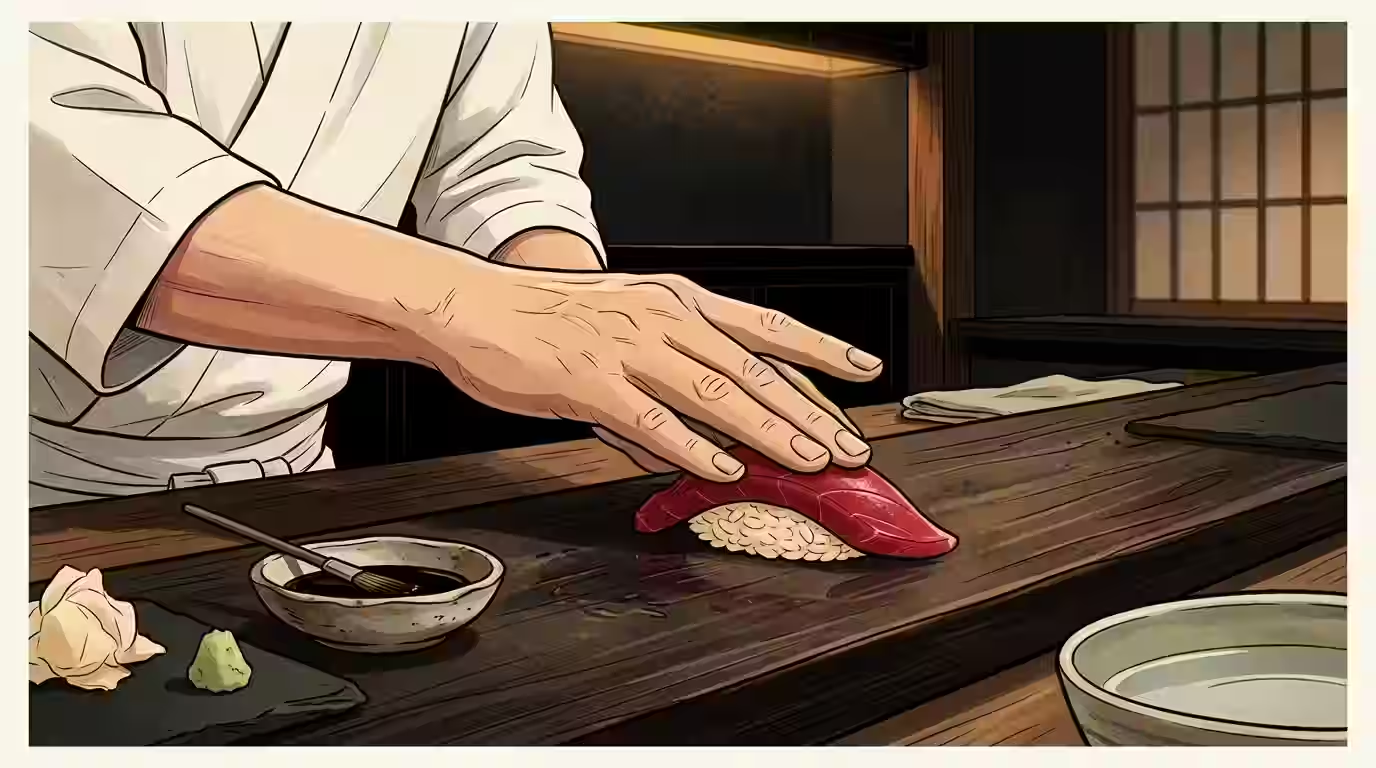
Tokyo has a strong connection with Edomae sushi. Options range from affordable conveyor-belt restaurants to small counters where the chef serves each piece individually.
Ramen
Tokyo offers traditional soy-sauce-based ramen as well as miso, shio, tonkotsu, seafood, and specialty broths. Check each restaurant’s menu rather than expecting every ramen shop to serve the same style.
Monjayaki
Monjayaki is closely associated with Tsukishima. It has a soft texture and is cooked on a hot plate, sometimes with diners participating in the cooking process.
Tonkatsu
Tonkatsu is a breaded pork cutlet commonly served with rice, miso soup, shredded cabbage, and sauce. Restaurants may offer different pork cuts and set-meal combinations.
Ningyo-yaki
Ningyo-yaki is a small cake associated with Asakusa. It is often filled with sweet red bean paste and can be purchased from shops without navigating a formal restaurant ordering process.
Convenience Stores and Quick Meals
Tokyo’s convenience stores sell much more than drinks and packaged snacks. Visitors can find onigiri, sandwiches, bento meals, salads, desserts, noodles, and other ready-to-eat foods.
Convenience stores are useful for an inexpensive breakfast, a late-night meal, or food between sightseeing stops. Some locations provide microwaves, hot water, or limited eating spaces.
If there is no designated eating area, take the food with you. Avoid eating while blocking the entrance or standing in a crowded pedestrian area.
What to Do If You Are Unsure
Before Ordering, Remember These Five Points
Check the entrance before choosing a seat.
Look for a ticket machine, waiting list, touchscreen, or QR code.
Confirm whether payment happens before or after the meal.
Use translation tools for unfamiliar menu items.
Keep some cash available as a backup.
You do not need to understand every Japanese word or restaurant custom before your first meal. After ordering successfully once or twice, the process will usually feel much less intimidating.
Frequently Asked Questions About Ordering Food in Tokyo
Ordering and Menus
Can I order food in Tokyo without speaking Japanese?
Yes. Many restaurants use photographs, food models, touchscreens, numbered menus, or ticket machines. Pointing to an item and saying Kore o kudasai, meaning “This one, please,” is often enough. A camera translation tool can also help with Japanese-only menus.
Do restaurants in Tokyo usually have English menus?
Many restaurants in popular visitor areas offer English menus, but availability is not guaranteed. Smaller neighborhood restaurants may have Japanese-only or handwritten menus. Look for photographs, use a translation tool, or ask Eigo no menyū wa arimasu ka?
Should I wait to be seated in a Tokyo restaurant?
In most full-service restaurants, wait for a staff member to show you to a seat. Some small counter restaurants allow customers to sit in an available place, while ticket-machine restaurants may direct you after you purchase a ticket. Check the entrance and observe the restaurant’s system.
Payment and Tipping
Do I need cash at restaurants in Tokyo?
Cash is still useful, particularly at small independent restaurants and older ticket machines. Credit cards and electronic payments are increasingly common, but carrying several ¥1,000 notes and some coins is a sensible precaution.
Can I use Suica or PASMO at Tokyo restaurants?
Some restaurant chains, shopping centers, station restaurants, and modern ticket machines accept transportation IC cards. Acceptance depends on the establishment, so check for the Suica, PASMO, or IC payment logo before ordering.
Should I tip at restaurants in Tokyo?
No. Tipping is generally not expected. Pay the amount shown on the bill. Some izakayas and higher-end restaurants may include a seating or service charge, but this is different from a voluntary tip.
Do I pay at the table or at the register?
Many restaurants expect customers to take the bill slip to a register near the exit. Ticket-machine restaurants collect payment before the meal, while some restaurants offer table payment or automated checkout. If you are unsure, ask Okaikei wa doko desu ka?
Restaurant Customs
What is the small dish served automatically at an izakaya?
It is often called otoshi. The dish is commonly connected with a seating or cover charge and may be served without a separate order. The charge should normally appear on the final bill.
Is it polite to slurp ramen in Tokyo?
Slurping noodles is generally accepted and is not normally considered poor manners. It is not compulsory, however, so you can eat quietly if that feels more comfortable.
Can I take photographs inside Tokyo restaurants?
Food photography is often acceptable, but restaurant rules vary. Ask before taking extensive photographs, using flash, recording staff, or photographing other customers. This is especially important at small sushi counters and intimate restaurants.
Final Thoughts
Ordering food in Tokyo is less about speaking perfect Japanese and more about recognizing the system each restaurant uses. A ramen shop may require payment at a ticket machine before you sit down, while a sushi restaurant may use touchscreen ordering and automated checkout. At an izakaya, you may order several small dishes throughout the evening.
With a reliable phone connection, a translation tool, a few useful phrases, and some cash as a backup, you can confidently explore ramen counters, sushi restaurants, department-store food halls, izakayas, and small neighborhood eateries.
Most visitors quickly discover that ordering food in Tokyo is much easier than they expected. Once you understand the basic process, even an unfamiliar restaurant can become an enjoyable and memorable part of your trip.
Ryo Iwa is the founder and editor of foodinjapan.org. Born and raised in Japan, he writes from regional travel, market visits, and Japanese-language primary sources that rarely reach English readers, including brewing institute publications and industry glossaries. Where a figure cannot be traced to a source, the article says so.
He has been a Google Maps Local Guide for over 10 years, with more than 1,800 reviews and over 41,000 photos viewed hundreds of millions of times. He previously spent two decades as an IT consultant in Japan, the US, and the UK.











Comments