


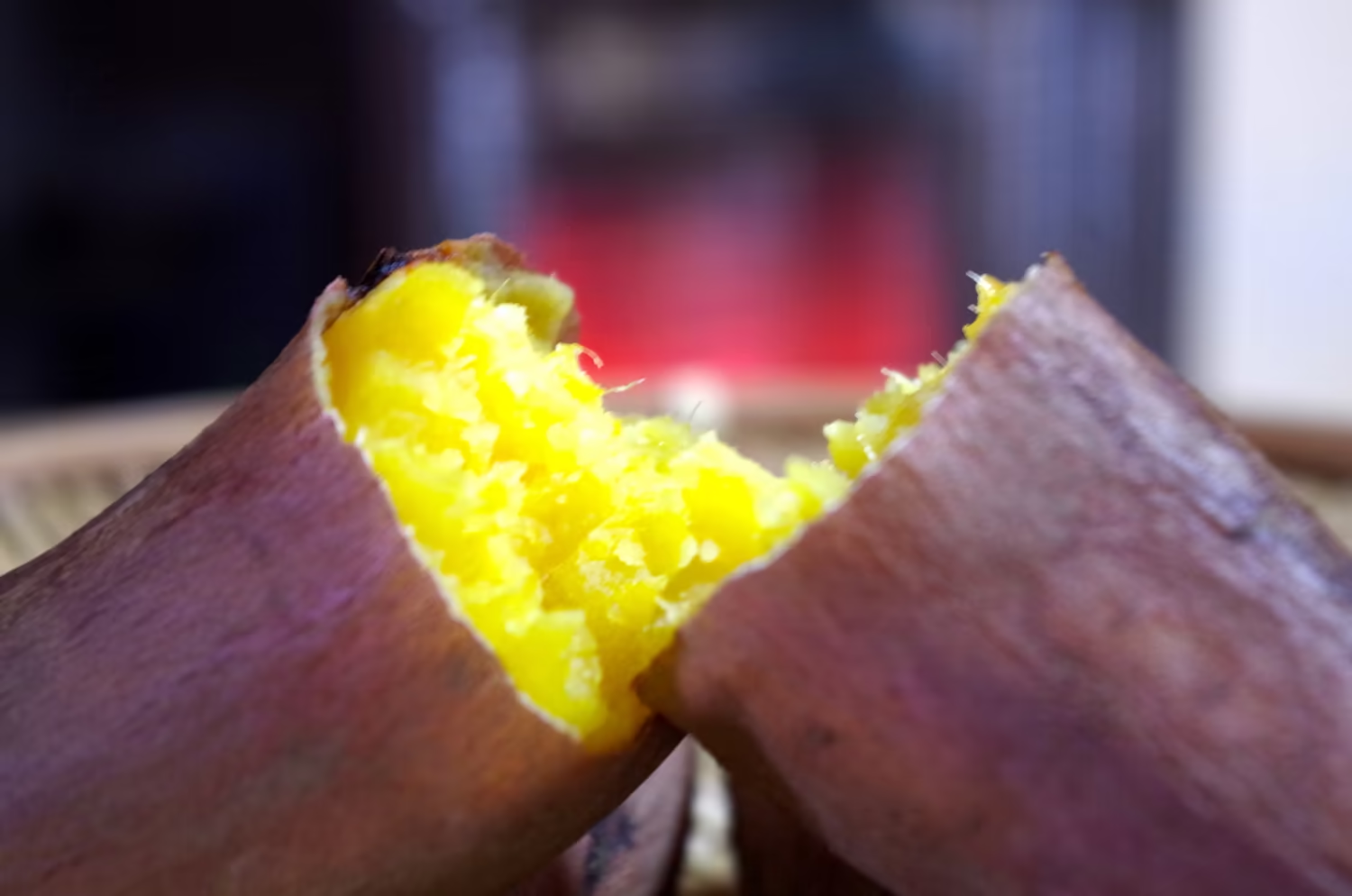

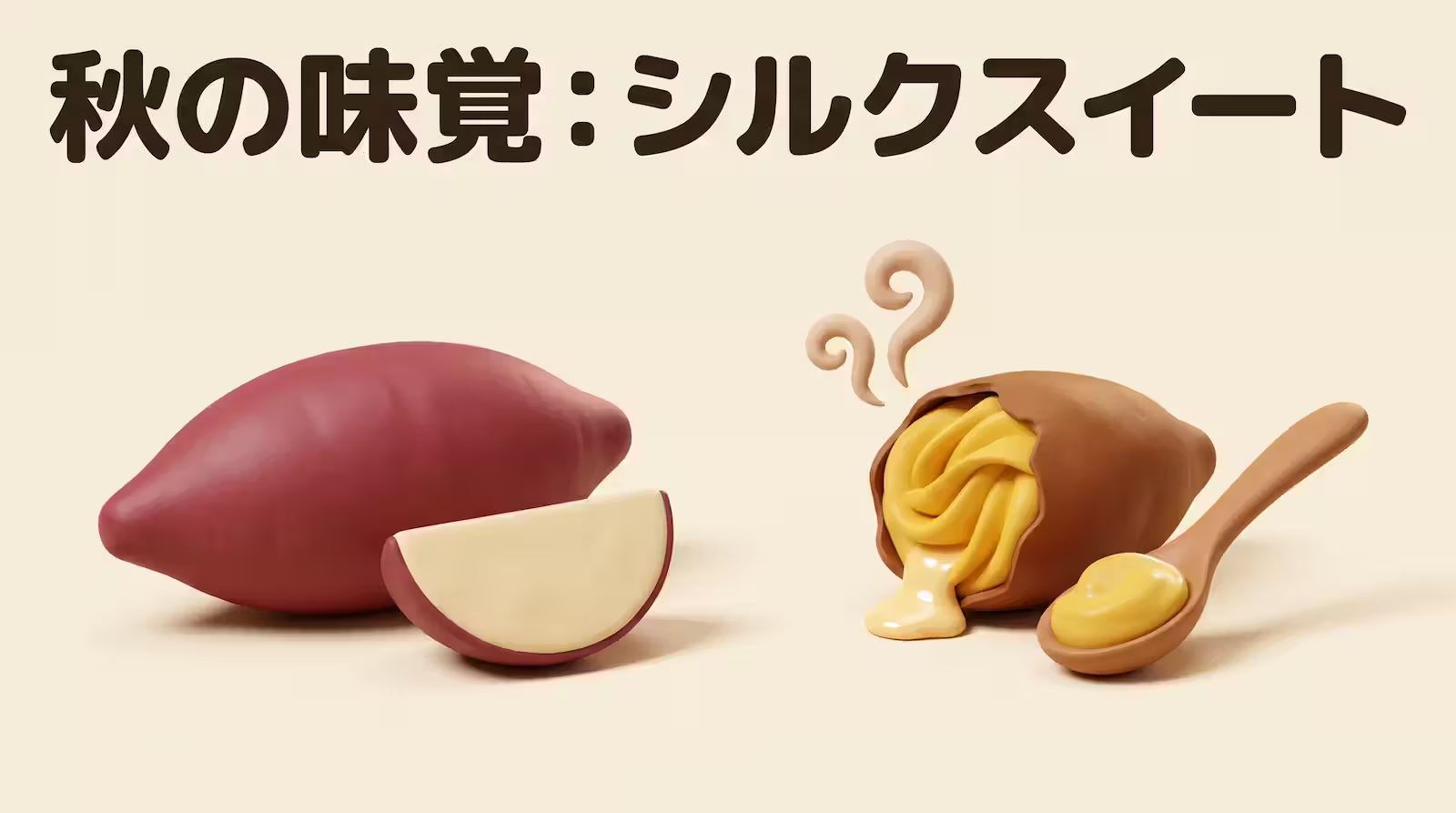

Picture a roasted sweet potato split open on a cold evening. The skin is wrinkled and dark, while the flesh glows golden orange with a glossy, syrup-like surface. This is the image most often associated with Anno Imo (安納芋), a Japanese sweet potato closely connected with Tanegashima, an island in Kagoshima Prefecture. Among Japan’s many satsumaimo varieties, it is known for turning soft, moist, and pronounced in sweetness when cooked slowly.
This guide explains what Anno Imo is, where it comes from, how it tastes, and how it differs from other Japanese sweet potatoes. It also covers seasonality, cooking methods, storage, nutrition, and what to check before buying Anno Imo in or outside Japan.
What Is Anno Imo?
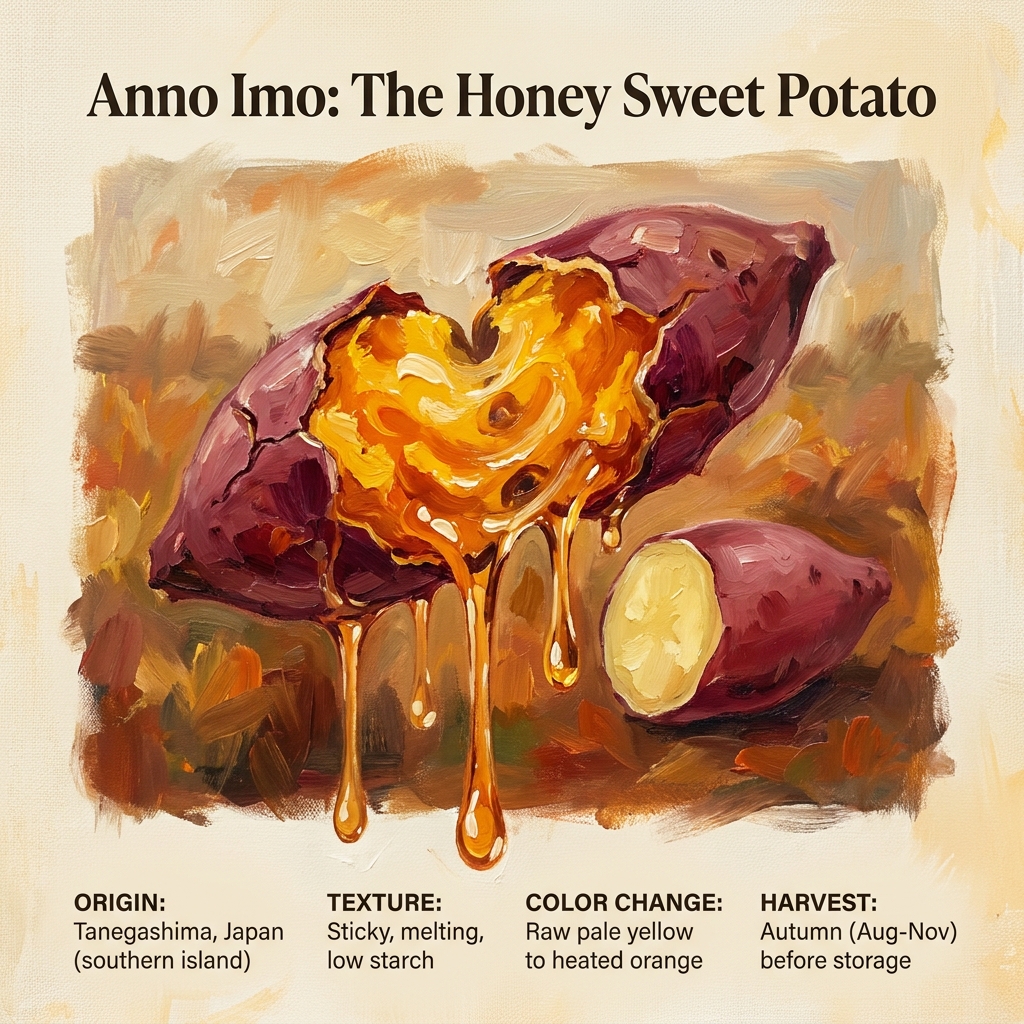
Anno Imo is a name used for sweet potatoes descended from a local Tanegashima line, particularly the registered cultivars Anno Beni and Anno Kogane. Tanegashima lies about 115 km south of Kagoshima city. Japan’s Ministry of Agriculture, Forestry and Fisheries (MAFF) describes the island’s product as a driver of the demand for moist, sticky roasted sweet potatoes that grew in Japan from the 2000s. The same documentation notes that it has higher sugar content and lower starch content than typical fresh-market sweet potatoes, which is why it becomes so soft and syrupy when heated.
Quick Facts
- Name
- Anno Imo (安納芋), also written Annou Imo
- Type
- Japanese sweet potato (satsumaimo), sticky “nettori” texture
- Origin
- Anno district, Nishinoomote City, Tanegashima, Kagoshima Prefecture
- Main cultivars
- Anno Beni (red skin) and Anno Kogane (pale yellow skin), registered in 1998
- Protected name
- “Tanegashima Annou Imo,” Geographical Indication No. 115 (registered March 2, 2022)
- Harvest
- Roughly August to November, then stored before shipping
- Best for
- Yaki imo (roasted sweet potato), steaming, pastes, and desserts
Is Anno Imo a Japanese Sweet Potato?
Yes. Anno Imo belongs to the same species as every other sweet potato, Ipomoea batatas. Japanese speakers simply call it a satsumaimo. However, “Japanese sweet potato” is an umbrella term that covers dozens of cultivars with very different textures. Some are fluffy and chestnut-like, while others are moist or sticky. Anno Imo sits firmly at the sticky end of that range. Therefore, treat it as a distinct type within the broader Japanese sweet potato category, rather than as a synonym for all Japanese sweet potatoes.
What Does the Name “Anno Imo” Mean?
The name comes from a place, not a person or a flavor. “Anno” (安納) is a district in Nishinoomote City on the northern part of Tanegashima, and “imo” simply means potato or tuber. MAFF’s GI registration notes that farmers in the Anno district began growing this sweet potato around 1947. Because it tasted so good, cultivation spread across the island. People then started calling it “Anno imo” after the district where it began.
Anno Beni and Anno Kogane: Two Registered Cultivars
Anno Imo is not a single uniform cultivar. Kagoshima Prefecture selected stable lines from the local population, and two cultivars were registered in 1998: Anno Beni (安納紅), which has reddish-purple skin, and Anno Kogane (安納こがね), which has pale yellow skin. According to the prefecture, both have a sticky texture and very sweet flesh that turns a vivid deep yellow when cooked. In retail markets, Anno Beni is generally easier to find, while Anno Kogane is produced in smaller quantities. Some sellers write the second name with the kanji 安納黄金, although the registered cultivar name is 安納こがね.
The Origin and History of Anno Imo
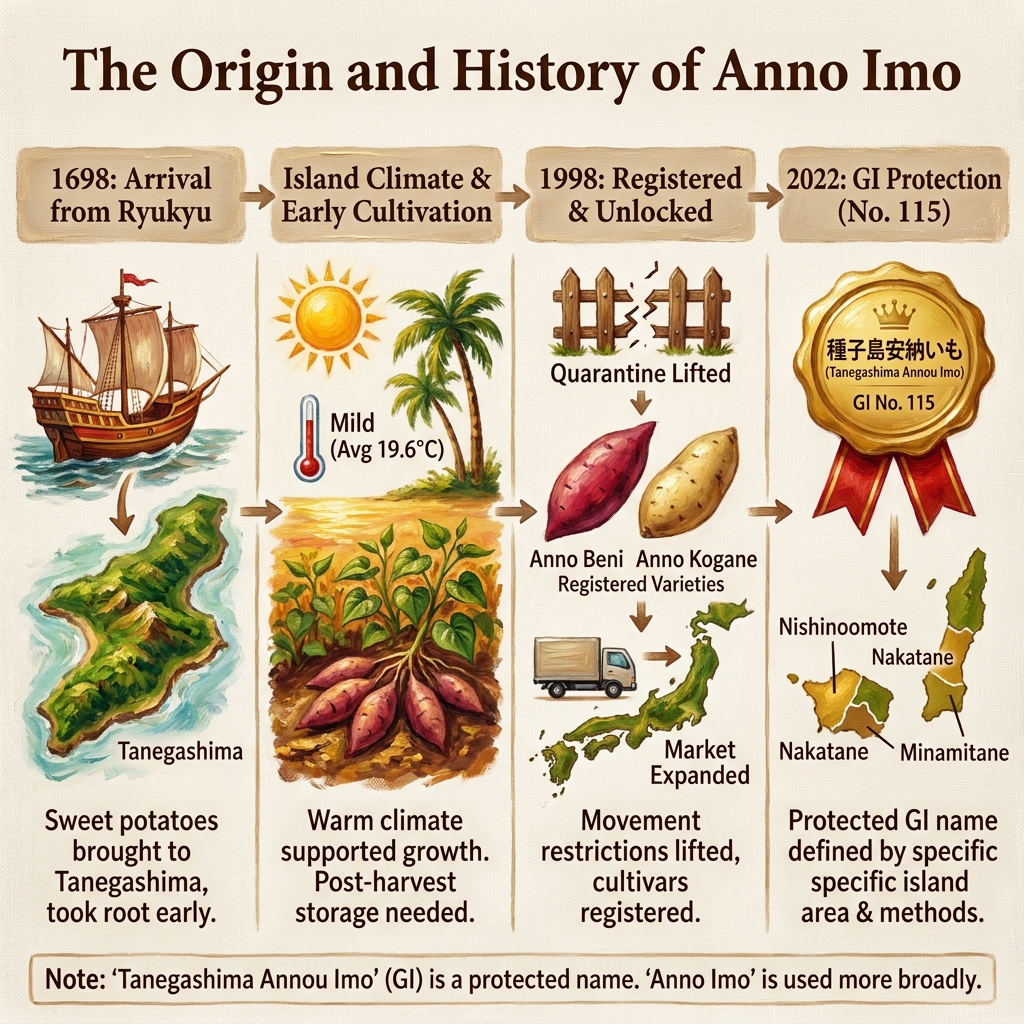
Anno Imo is a relatively young name, but it grew out of one of the oldest sweet potato traditions in Japan. Understanding Tanegashima’s history explains why this island, of all places, produced such a distinctive variety.
Tanegashima and the Early History of Sweet Potatoes in Japan
According to MAFF’s GI documentation, Tanegashima received sweet potatoes from the Ryukyu Kingdom in 1698, and cultivation took root there earlier than anywhere else in Japan. The island lies at the boundary between temperate and subtropical zones. Kagoshima Prefecture reports an average annual temperature of about 19.6°C with almost no frost. That mild climate supports sweet potato cultivation and limits exposure to severe cold. Post-harvest storage, however, still requires controlled conditions, because the tubers remain vulnerable to chilling injury, excess moisture, and decay.
From Home Gardens to Registered Varieties
For decades after 1947, Anno Imo stayed an island crop. MAFF explains that plant-quarantine measures against the sweet potato weevil prohibited moving the tubers off Tanegashima until 1998, so growers could only sell locally. Meanwhile, Kagoshima Prefecture worked with island farmers to select stable, well-shaped lines from the local population. That work produced Anno Beni and Anno Kogane, both registered as plant varieties in 1998. After those movement restrictions were lifted, the sweet, sticky roasted potato reached a much wider market. MAFF reports that by 2017 production covered about 540 hectares, with roughly 9,600 tonnes a year and around 520 growers.
Tanegashima Annou Imo and Japan’s GI System
On March 2, 2022, MAFF registered “Tanegashima Annou Imo” (種子島安納いも) as Geographical Indication No. 115. The registered producer group is the Anno Imo Brand Promotion Headquarters. Its production area covers all three municipalities on the island: Nishinoomote City, Nakatane Town, and Minamitane Town. In addition, the GI specification sets requirements covering eligible cultivars, cultivation, harvest timing, post-harvest storage, and grading before shipment.
This creates an important distinction. The name “Anno Imo” is used more broadly for sweet potatoes of the Anno types, including those grown outside Tanegashima. Products carrying the protected GI name, by contrast, must meet the registered production-area and production-method requirements. In other words, every Tanegashima Annou Imo is Anno Imo, yet sweet potatoes sold more generally as Anno Imo do not necessarily qualify for the GI name.
What Does Anno Imo Taste Like?
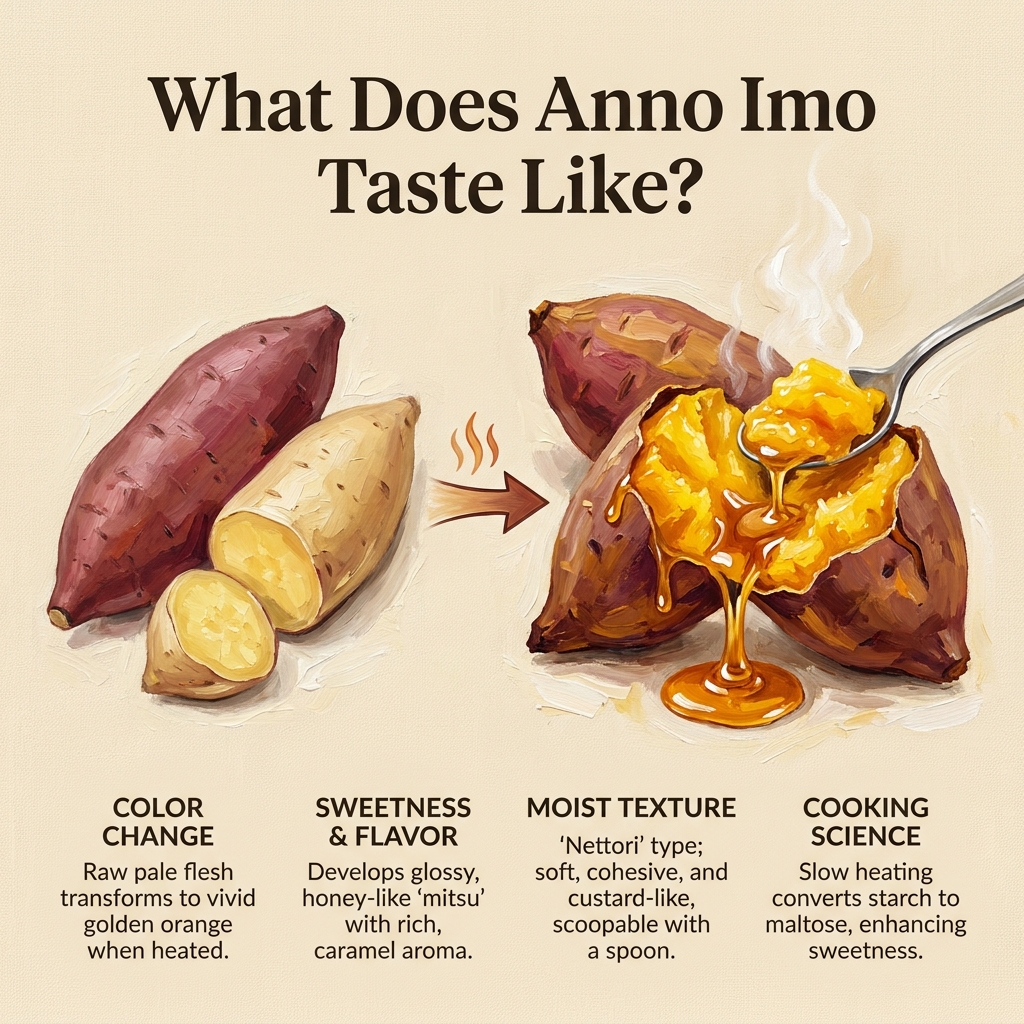
Anno Imo is widely known for pronounced sweetness, but sweetness alone does not explain its appeal. Color, aroma, and texture all change dramatically between the raw tuber and the roasted one. That transformation is the whole story of this sweet potato.
Skin and Flesh Color
Raw Anno Beni has a dull reddish-purple skin, while Anno Kogane has a pale yellow-beige skin. Inside, both cultivars look surprisingly modest, with pale yellow to light orange flesh. Heat changes everything. Kagoshima Prefecture describes the cooked flesh as a vivid, deep yellow, and roasted tubers often look closer to golden orange. This is quite different from the typical Japanese sweet potato sold abroad. That one usually has purple skin and cream-colored flesh that stays pale after cooking.
Sweetness and Flavor
MAFF’s GI description notes that heating brings out a sweetness pronounced enough that the flesh develops a glossy, syrup-like quality, described in Japanese as mitsu. That honey-like appearance is associated with the nickname mitsu imo (蜜芋), literally “honey potato.” The flavor itself is rich and rounded rather than sharp, with a caramel-like aroma from the roasted skin. For readers familiar with North American foods, it may recall pumpkin pie filling or candied sweet potatoes, although plain Anno Imo contains no added sugar. Sweetness still varies with the individual tuber, the storage period, and the cooking method.
Moist and Creamy Texture
Japanese speakers sort sweet potatoes into three textures: hokuhoku (fluffy and dry), shittori (moist), and nettori (sticky). Anno Imo is the classic nettori type. Its relatively low starch content, high sugar content, moisture, and response to heating all contribute to a soft, cohesive result. A properly roasted Anno Imo typically stays moist and holds together like a soft custard, so you can scoop it with a spoon. “Creamy” here describes mouthfeel, not an ingredient; the potato contains no dairy at all.
Why Cooking Changes the Taste
During heating, enzymes including beta-amylase convert part of the starch into maltose. How far that conversion goes depends on the cultivar, the temperature profile, the heating time, and the condition of the tuber. Slow heating can therefore promote more maltose formation than rapid, high-power microwave cooking. Anno Imo also starts with less starch and more sugar than most varieties, so it has a head start. Even so, unhurried cooking still brings out its best.
Anno Imo vs Other Japanese Sweet Potatoes
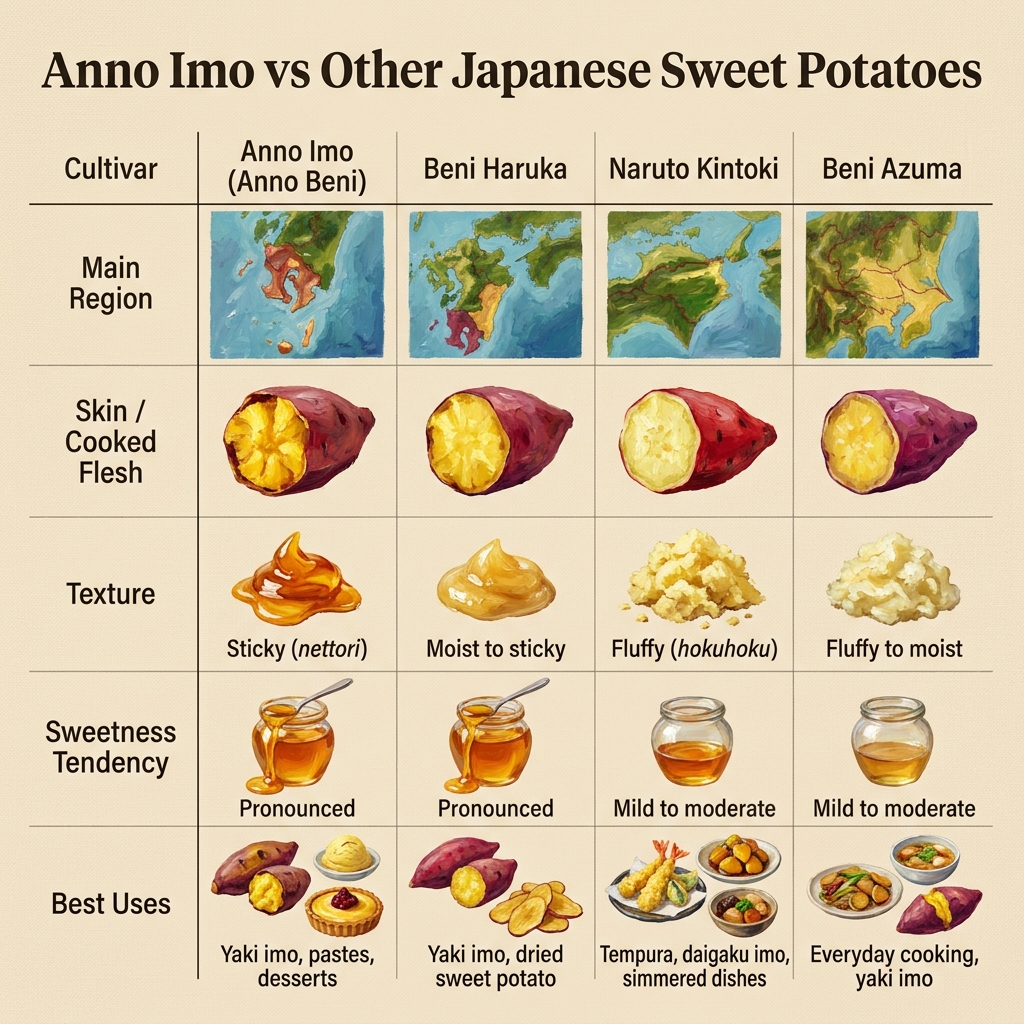
Japan grows many sweet potato cultivars, and each has a loyal following. The table below compares Anno Imo with three you are most likely to encounter, either in Japan or in Japanese grocery stores abroad. Sweetness and texture are general tendencies, not laboratory rankings.
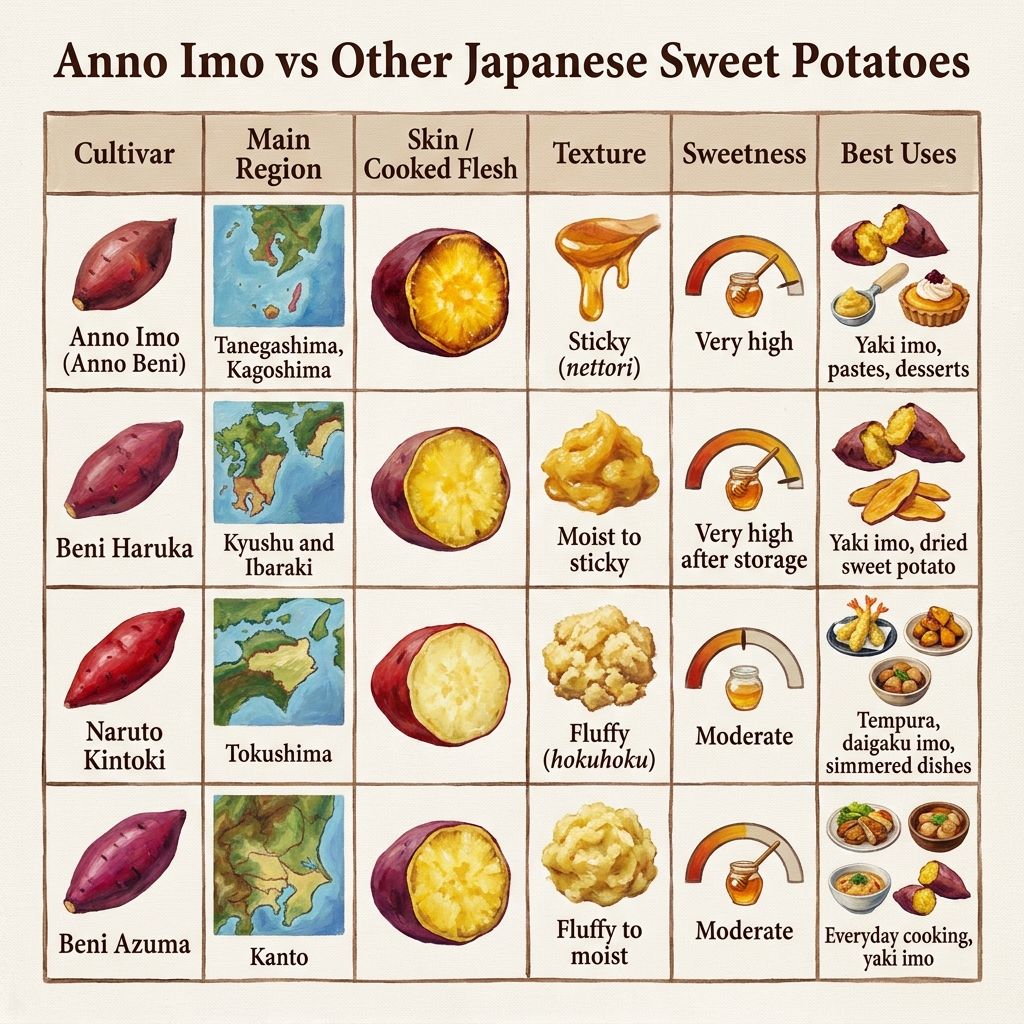
| Cultivar | Main region | Skin / cooked flesh | Texture | Sweetness tendency | Best uses |
|---|---|---|---|---|---|
| Anno Imo (Anno Beni) | Tanegashima, Kagoshima | Reddish-purple / deep yellow-orange | Sticky (nettori) | Pronounced, especially after suitable storage and slow cooking | Yaki imo, pastes, desserts |
| Beni Haruka | Kyushu, Ibaraki, and beyond | Reddish-purple / yellow | Moist to sticky | Pronounced after suitable storage and cooking | Yaki imo, dried sweet potato |
| Naruto Kintoki | Tokushima | Red / pale yellow | Fluffy (hokuhoku) | Mild to moderately sweet | Tempura, daigaku imo, simmered dishes |
| Beni Azuma | Kanto region | Purple-red / yellow | Fluffy to moist | Mild to moderately sweet | Everyday cooking, yaki imo |
Anno Imo vs Beni Haruka
These two cultivars are often sold side by side in Japan. Beni Haruka is a newer cultivar developed by Japan’s national agricultural research organization and registered as a plant variety in 2010. Growers across a wider area plant it, so it is generally easier to find. Depending on storage and cooking, Beni Haruka can also become very moist and sticky. Anno Imo is often described as softer and more custard-like, while Beni Haruka tends to retain slightly more structure, though the distinction is not absolute. Anno Imo tubers are also typically rounder and smaller.
Anno Imo vs Naruto Kintoki
Naruto Kintoki, from Tokushima Prefecture, represents the opposite school of Japanese sweet potato. Its flesh is pale, dry, and fluffy, with a gentle chestnut-like sweetness. Cooks prize it for tempura, simmered dishes, and the candied snack daigaku imo. Anno Imo’s soft texture makes it less suitable for dishes that need the pieces to hold a firm shape. If you enjoy a floury baked potato, start with Naruto Kintoki. If you prefer a naturally sweet, soft roasted potato to eat on its own, choose Anno Imo.
Which Japanese Sweet Potato Is the Sweetest?
There is no honest single answer. Sugar content depends on the cultivar, the harvest date, and the storage period. It also depends on the individual potato and on how slowly you cook it. A well-stored Beni Haruka can taste sweeter than a freshly dug Anno Imo, and vice versa. MAFF’s GI description confirms that Tanegashima Annou Imo has higher sugar and lower starch than typical fresh-market sweet potatoes. That supports its reputation. Nevertheless, treat any “sweetest in Japan” claim as marketing rather than measurement.
When Is Anno Imo in Season?
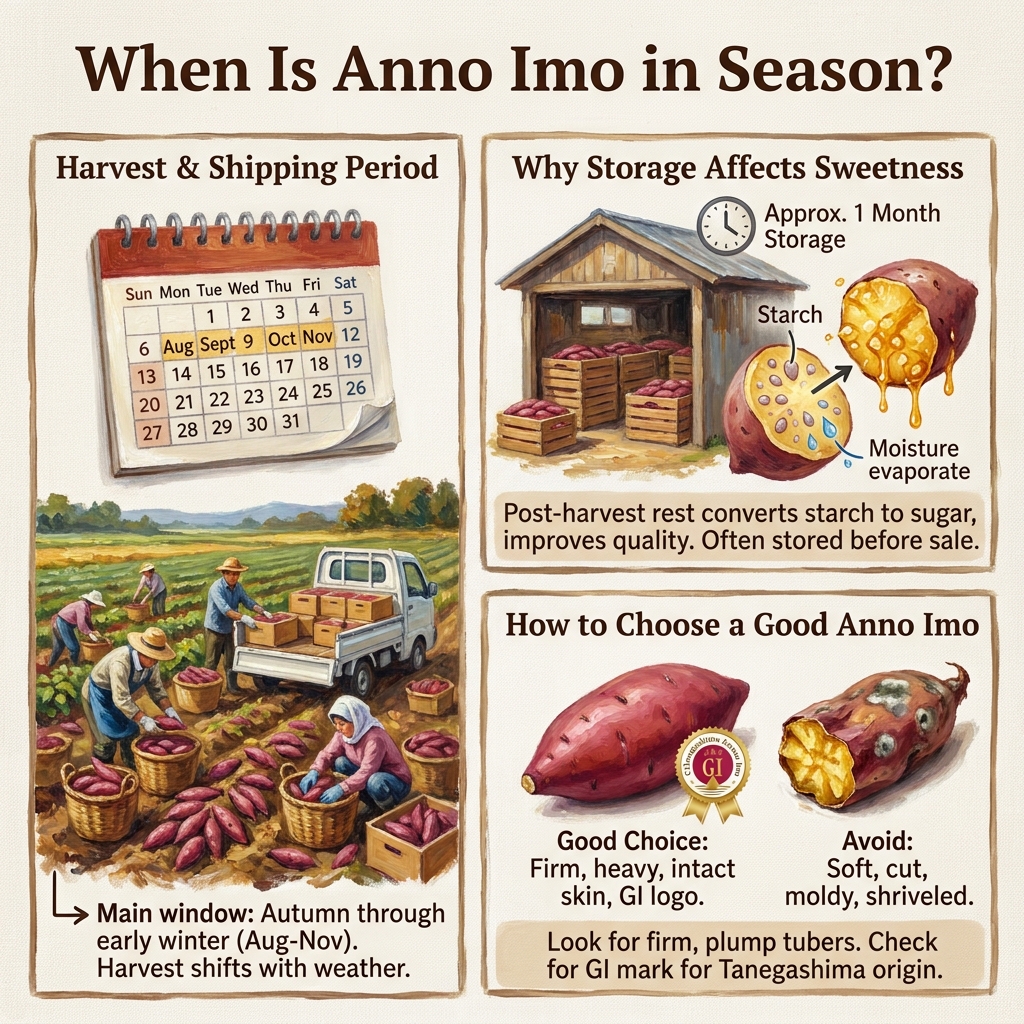
Sweet potatoes are an autumn crop, but Anno Imo has a slightly unusual calendar because storage is part of the production process. Fresh tubers appear in early autumn, and stored tubers keep coming to market through winter and into spring.
Harvest and Shipping Period
Japan’s Agriculture and Livestock Industries Corporation (ALIC) published a report on the Tanegashima growing area in 2018. According to that report, farmers there plant Anno Imo from April to June and harvest from August to November. The GI specification additionally requires harvest within the calendar year. Timing shifts with weather and with each grower’s schedule. For that reason, think of autumn through early winter as the main harvest and shipping window rather than a fixed date.
Why Storage Affects Sweetness
Freshly harvested Anno Imo may not yet show the sweetness associated with properly stored and cooked tubers. The ALIC report notes that growers on Tanegashima store the tubers for about a month before shipment so that post-harvest changes improve eating quality, and the GI specification also builds a storage period into the production standard. During that rest, part of the starch converts to sugar and excess moisture escapes. Commercially sold Anno Imo may therefore have gone through this storage already. At home, follow the seller’s guidance rather than trying to reproduce commercial curing conditions.
How to Choose a Good Anno Imo
Look for tubers that feel firm and heavy for their size. The skin should be intact, with no large cuts or soft patches. Avoid any with mold, a sour smell, or shriveled ends. Size matters less than shape for roasting; a plump, evenly rounded tuber cooks more uniformly than a long, thin one. If you want the Tanegashima product specifically, check the packaging for the GI name and logo, or for a clear statement of origin. Some sellers point to sticky residue on the skin as a sign of sweetness. However, that varies from potato to potato and is not a reliable quality test on its own.
How to Cook Anno Imo
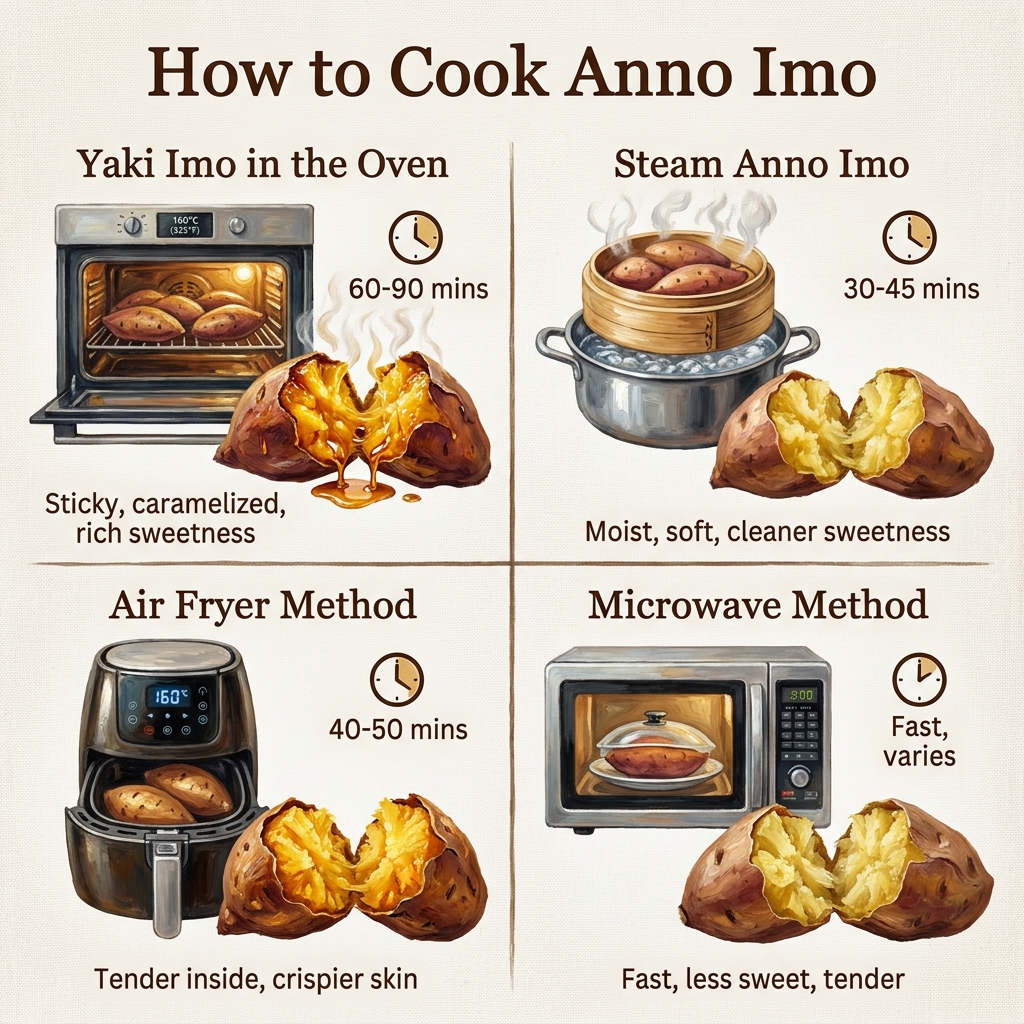
The best way to cook Anno Imo is also the simplest: low heat, a long time, and nothing added. Every method below works, but they produce noticeably different results, so pick the one that suits your equipment and your patience.
How to Make Yaki Imo in the Oven
Oven roasting comes closest to the stone-roasted yaki imo sold from trucks in Japan. Wash the tubers, leave them whole and unpeeled, and place them directly on a rack or a lined tray. As a general starting point, roast at about 160°C (325°F) for 60 to 90 minutes, depending on size. Cooking time varies substantially with diameter, starting temperature, oven type, and moisture content. Then turn off the oven and let the potatoes rest inside for another 10 to 15 minutes. They are done when a bamboo skewer slides through the thickest part with no resistance. Handle them carefully, because any hot, syrup-like liquid around the skin can cause burns.
How to Steam Anno Imo
Steaming keeps more moisture in the flesh and gives a softer, wetter result with a cleaner sweetness. Place whole tubers in a steamer over boiling water. Steam medium-sized tubers for approximately 30 to 45 minutes, or until a skewer passes through the thickest part easily. Steamed Anno Imo is the easiest form to mash. Consequently, it is the usual starting point for pastes, sweet potato cakes, and yokan. However, you lose the caramelized skin aroma that roasting produces.
Air Fryer and Microwave Methods
An air fryer works well for one or two tubers. Set it to a low temperature, around 160°C (320°F), and cook for 40 to 50 minutes, turning once. Results vary widely between machines, so check with a skewer rather than trusting the clock. Microwave cooking is faster but tends to give less sweetness, because the flesh passes quickly through the range where the enzymes work. Timing also depends heavily on the tuber’s weight and the appliance’s wattage. Prepare and cover the tuber according to the manufacturer’s instructions, turn it during cooking, and continue in short intervals until the center is completely tender.
Popular Ways to Eat Anno Imo
Roasted and eaten plain is the definitive Anno Imo experience. In Japan, people treat it as a snack or dessert rather than a side dish. Beyond that, its low starch content and vivid color make it a favorite ingredient for sweets. Steamed and mashed, it becomes a smooth paste for sweet potato tarts, Mont Blanc-style cakes, puddings, and ice cream. Many of these need little or no added sugar. Food companies on Tanegashima also produce frozen roasted Anno Imo. It reheats in a toaster oven and has become a popular way to ship the flavor nationwide. Dried sweet potato (hoshi imo) made from Anno Imo is dark, chewy, and almost candy-like. When shopping for these products, read the label. Some use Anno Imo as the main ingredient, while others use only a small amount for flavoring and add sugar.
Anno Imo Nutrition
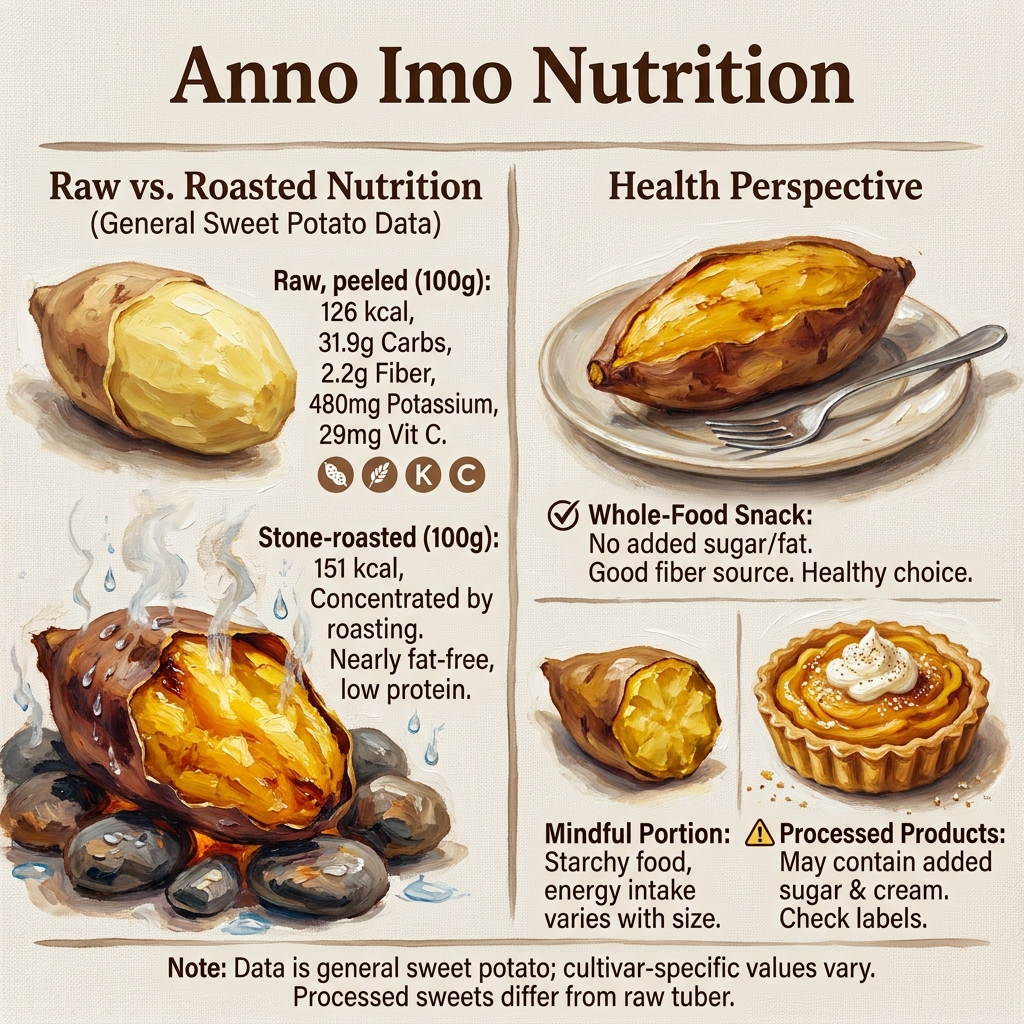
Japan’s official food composition tables, published by the Ministry of Education, Culture, Sports, Science and Technology (MEXT), do not list Anno Imo separately. The figures below come from the 2020 edition (eighth revised) and describe sweet potatoes in general, not cultivar-specific analysis of Anno Imo.
For raw, peeled sweet potato, the tables give 126 kcal per 100 g of edible portion, together with 31.9 g of carbohydrate, 2.2 g of dietary fiber, 480 mg of potassium, and 29 mg of vitamin C. For stone-roasted sweet potato, the energy value rises to 151 kcal per 100 g, largely because roasting drives off water and concentrates the edible portion. Sweet potatoes contain almost no fat and only a small amount of protein.
Is Anno Imo healthy? A plain roasted tuber has no added sugar and no fat, along with a useful amount of fiber, so it works well as a whole-food snack. Because sweet potato is a starchy food, however, portion size contributes meaningfully to total energy intake. Note also that cultivar-specific nutrition values should not be inferred from general sweet potato data, and that Anno Imo sweets and pastes may contain added sugar and cream the raw tuber does not.
How to Store Anno Imo
Raw sweet potatoes dislike cold. MAFF’s GI description specifically mentions that they are prone to chilling injury in storage, which is one reason Tanegashima’s frost-free climate suits them. At home, keep raw Anno Imo in a dark, dry, well-ventilated place, wrapped loosely in newspaper and protected from both cold and excessive heat. Avoid prolonged refrigeration unless the seller specifically recommends it. Storage life varies with harvest condition, prior storage, temperature, humidity, and skin damage, so check the tubers regularly.
Cooked Anno Imo is different. Cool it promptly, keep it covered in the refrigerator, and follow current official food-safety guidance for leftovers. Freeze it if you will not eat it within the recommended refrigerated period. Frozen roasted Anno Imo reheats well in a toaster oven, and you can also let it soften partially for a chilled, dense, dessert-like texture. Mashed flesh freezes well in portioned bags for later baking. Discard any tuber, raw or cooked, that shows mold, smells sour, leaks liquid, or has turned unusually soft or discolored.
Where to Buy Anno Imo
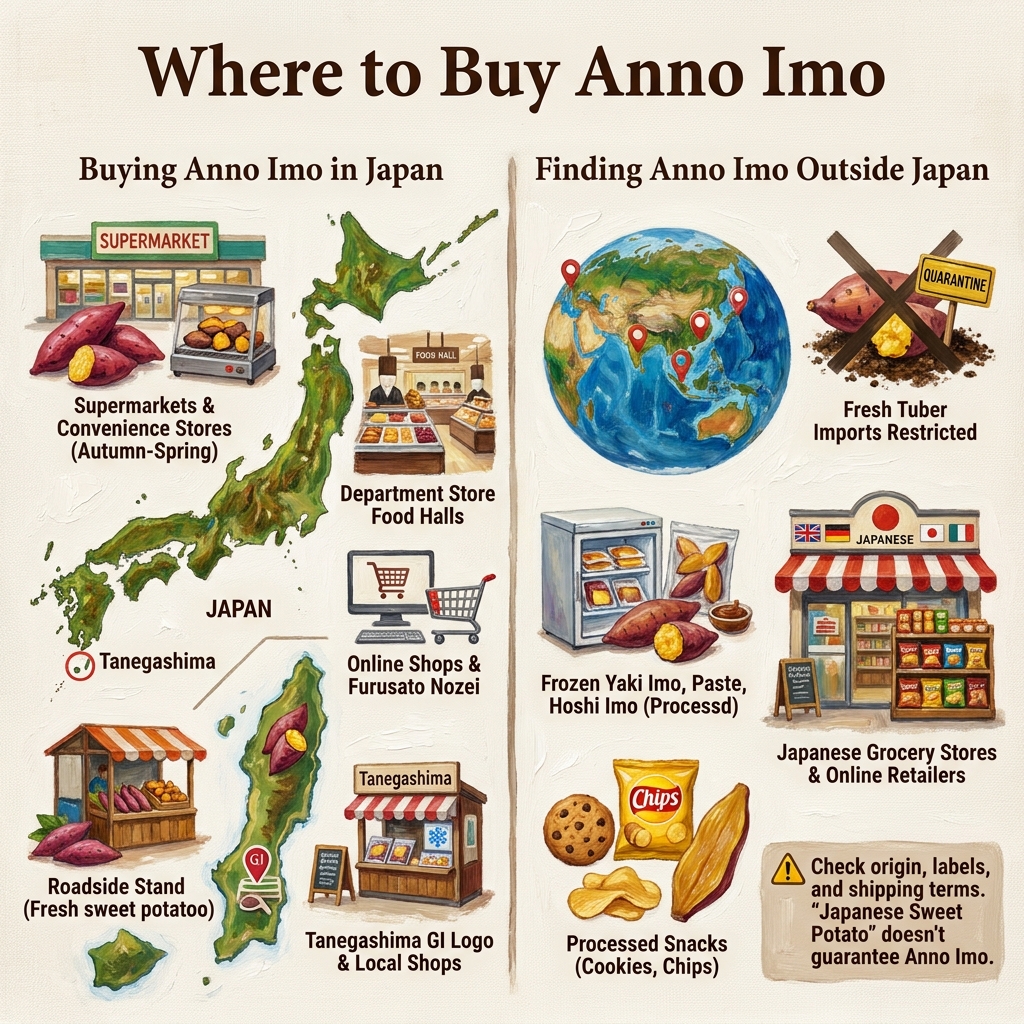
Inside Japan, Anno Imo is widely available during its main selling season. Outside Japan, the fresh tuber is rare, but processed products travel well.
Buying Anno Imo in Japan
From autumn through spring, many supermarkets, department store food halls, specialty retailers, and online shops stock Anno Imo. Some convenience stores and supermarkets also sell roasted sweet potatoes in winter, though the cultivar varies, so check the label if you specifically want Anno Imo. For the Tanegashima product, look for the GI name and logo, or for current listings from island producer groups and agricultural cooperatives. Japan’s hometown tax donation program (furusato nozei) also lists Tanegashima Anno Imo as a return gift. On the island itself, roadside stands and the airport shop sell it in season alongside frozen yaki imo.
Finding Anno Imo Outside Japan
Fresh sweet potatoes fall under plant quarantine rules that differ by country. Many destinations restrict or prohibit imports of fresh tubers with soil, and many Japanese retailers therefore do not offer international shipping for fresh produce. What you can find are frozen roasted Anno Imo, sweet potato paste, and snacks such as cookies, chips, and hoshi imo. Japanese grocery stores and online retailers carry them. Before ordering, check the origin, whether the product is fresh or processed, added sugar, allergens, and the seller’s shipping terms for your country. If a store labels something only as “Japanese sweet potato,” do not assume it is Anno Imo; check the cultivar and country of origin where available.
Frequently Asked Questions About Anno Imo
Origin and Varieties
- Is Anno Imo only grown on Tanegashima?
-
No. Anno-type sweet potatoes may also be grown outside Tanegashima. However, only products meeting the registered geographical and production requirements may use the protected name “Tanegashima Annou Imo.” If origin matters, check the label for that name or the GI logo.
- Is Anno Imo the same as satsumaimo?
-
Satsumaimo is the general Japanese word for sweet potato, so Anno Imo is one kind of satsumaimo. The word covers everything from fluffy Naruto Kintoki to purple-fleshed cultivars. Anno Imo refers to sweet potatoes associated with a local Tanegashima line, especially Anno Beni and Anno Kogane.
- What is the difference between Anno Beni and Anno Kogane?
-
Anno Beni has reddish-purple skin, while Anno Kogane has pale yellow skin. Both share the same sticky texture and deep yellow cooked flesh. Anno Beni is generally more widely available commercially, and Anno Kogane is produced in smaller quantities.
Taste and Cooking
- Is Anno Imo sweeter than Beni Haruka?
-
Not always. Cultivar, storage conditions, individual variation, and cooking method all affect perceived sweetness. Neither one is sweeter under every condition. Anno Imo tends to be softer and more syrupy, while Beni Haruka often holds a slightly firmer shape.
- What is the best way to cook Anno Imo?
-
Slow roasting in an oven at around 160°C (325°F) for 60 to 90 minutes gives the sweetest, stickiest result. Steaming produces a softer, wetter texture that is ideal for mashing. Always test doneness with a skewer, since size and equipment change the timing.
- Can you eat the skin of Anno Imo?
-
Yes, the skin is edible and carries much of the roasted aroma. Wash the tuber well before cooking, because the skin can hold soil. Some people prefer to peel it after roasting when the skin has become tough or charred.
- Why does Anno Imo turn orange when cooked?
-
The raw flesh is pale yellow, and heat makes its natural pigments and sugars appear far more intense. Kagoshima Prefecture describes the cooked flesh as a vivid deep yellow, and roasted tubers often look golden orange. The exact shade varies with the individual potato and the cooking method.
Storage and Buying
- Can you freeze roasted Anno Imo?
-
Yes, and it freezes well. Cool the roasted tubers promptly, wrap each one tightly, and freeze them. Reheat in a toaster oven, or let one soften partially for a chilled, dense dessert.
- Can you buy Anno Imo outside Japan?
-
Fresh Anno Imo is rarely available abroad because of plant quarantine rules on fresh tubers. Frozen roasted Anno Imo, pastes, and snacks are much easier to find at Japanese grocery stores and online. Check the product’s origin and ingredients before buying.
- Does Anno Imo contain added sugar?
-
Fresh, unprocessed Anno Imo contains no added sugar. Its sweetness comes from carbohydrates naturally present in the tuber and from changes during storage and heating. Processed products such as pastes, cakes, and ice cream often do include sugar and cream, so read the ingredient list.
Why Anno Imo Is Worth Trying
Anno Imo tells a small but complete story about Japanese food. It started as a home-garden potato in one district of a remote island and stayed largely confined there for decades while plant-quarantine restrictions limited off-island shipment. It later became one of the varieties most associated with Japan’s growing preference for moist, sticky yaki imo. Its soft flesh and glowing color make it unlike any sweet potato most visitors have eaten before.
If you see Anno Imo roasting in Japan during winter, or spot the GI logo at a Kagoshima market, it is worth trying. Let it cool just enough to handle safely, then eat it while it is still warm. Its sweetness, color, and soft texture offer a memorable introduction to Japan’s diverse sweet potato culture.
References
- Registered Product No. 115: Tanegashima Annou Imo, Ministry of Agriculture, Forestry and Fisheries (MAFF). Accessed September 2026.
- Tanegashima Annou Imo, Geographical Indication Product Information Site (Japan GI Council). Accessed September 2026.
- Anno Imo (Traditional Agricultural Products of Kagoshima), Kagoshima Prefecture. Accessed September 2026.
- Tanegashima Annou Imo, Kagoshima no Shoku (Kagoshima Prefecture). Accessed September 2026.
- Production Area Report: JA Tanegashima-Yaku, Kagoshima (Monthly Vegetable Report, November 2018), Agriculture and Livestock Industries Corporation (ALIC). Accessed September 2026.
- Plant Variety Registration Database, Ministry of Agriculture, Forestry and Fisheries (MAFF). Accessed September 2026.
- Food Composition Database (Standard Tables of Food Composition in Japan, 2020 / Eighth Revised Edition), Ministry of Education, Culture, Sports, Science and Technology (MEXT). Accessed September 2026.
- Plant Protection Station: Import and Export Conditions, Ministry of Agriculture, Forestry and Fisheries (MAFF). Accessed September 2026.
Related Articles
- Japanese Sweet Potato Varieties: Taste, Texture, and Uses
- Yaki Imo: Japan’s Roasted Sweet Potato
- Beni Haruka (紅はるか)
- Kagoshima Food Guide





Comments