


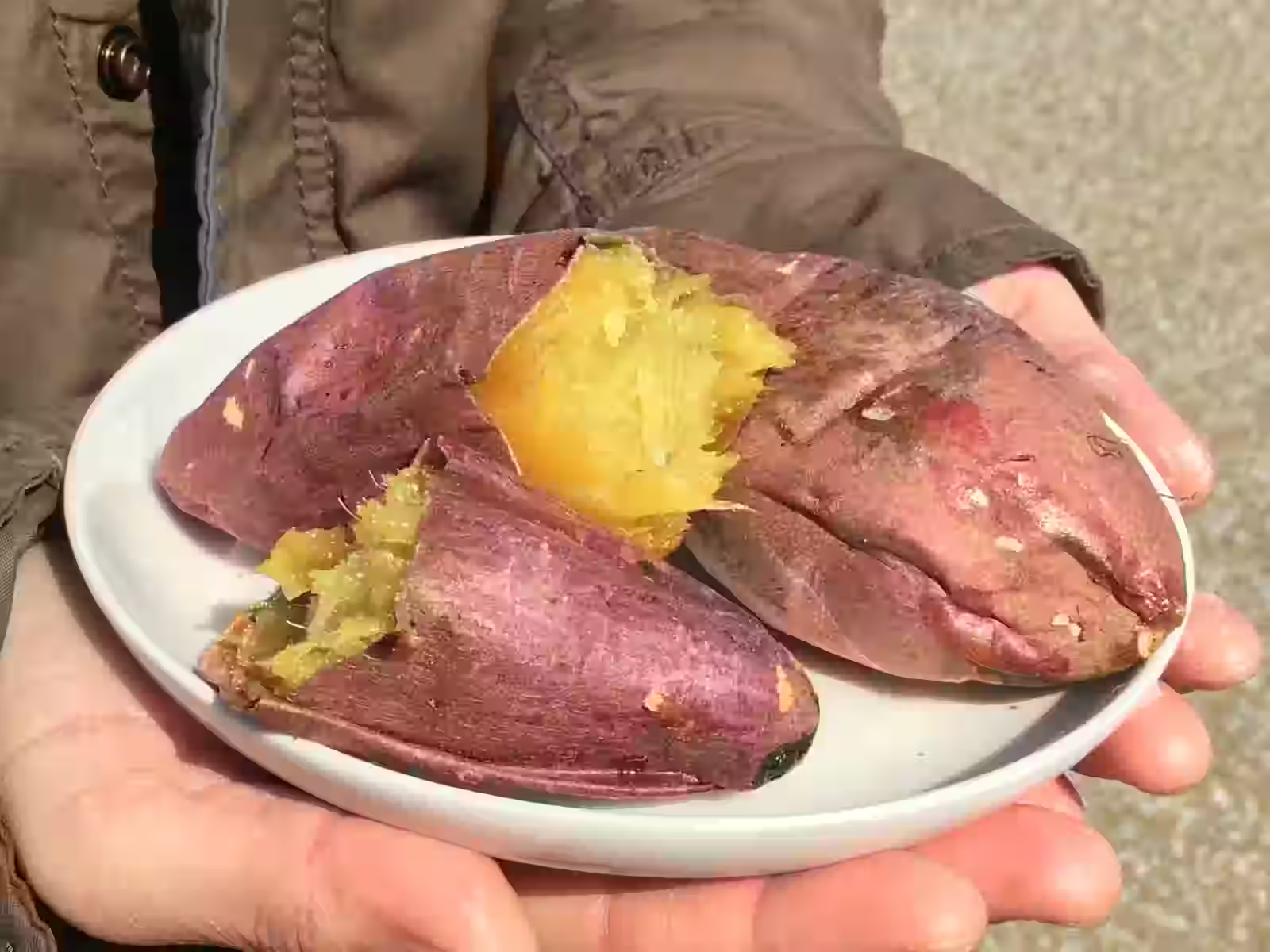

Beniharuka, officially registered in Japanese as べにはるか and commonly written 紅はるか in shops, is one of Japan’s best-known sweet potato cultivars for moist, strongly sweet yakiimo. It has reddish-purple skin and pale flesh that turns deeper yellow and much softer when cooked. In general, Japanese sweet potatoes, known collectively as satsumaimo, range from dry and fluffy to moist and creamy. Beniharuka belongs firmly to the second group, especially after some weeks of storage and slow cooking.
First, this guide traces where the cultivar came from, why storage and heat change its sweetness and texture, and how to cook it at home. Along the way, it separates breeding research and official statistics from regional branding and sweetness claims on shop signs.
What Is Beniharuka Sweet Potato?
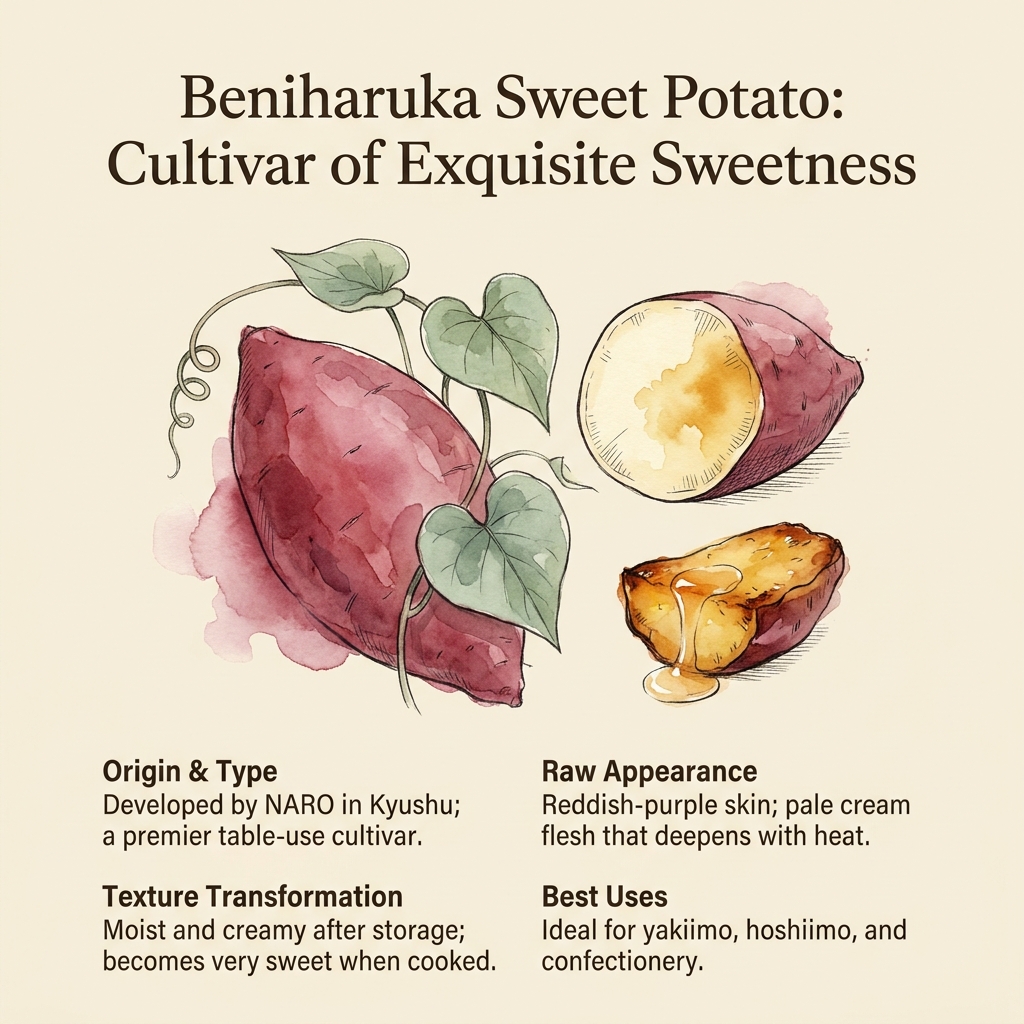
Beniharuka is a sweet potato cultivar developed primarily for table use rather than industrial starch or spirits. Breeders at the Kyushu National Agricultural Experiment Station made the original cross. That station’s work now sits within the Kyushu Okinawa Agricultural Research Center, part of NARO, Japan’s national agricultural research organization. What distinguishes it, above all, is high sweetness after cooking, a smooth texture after storage, and a relatively uniform spindle shape.
Quick Facts
- Japanese Name
- べにはるか (registered name); 紅はるか is common in retail
- Type
- Table-use cultivar of sweet potato (Ipomoea batatas), Norin No. 64
- Developed By
- Bred at the Kyushu National Agricultural Experiment Station, now NARO’s Kyushu Okinawa Agricultural Research Center
- Key Dates
- Cross made in 1996; registration applied for in 2007; registered in March 2010
- Skin and Flesh
- Reddish-purple skin; cream to pale yellow flesh that deepens when cooked
- Texture
- Slightly dry just after harvest; moist and creamy after storage
- Best For
- Yakiimo, hoshiimo (dried slices), purées, and confectionery
- Main Season
- Harvest from early autumn; widest retail supply from late autumn into winter
Meaning of the Name
The name has two parts. Beni (紅) means crimson, so it points to the skin. Haruka (はるか) means “far” or “by far.” According to the breeders’ own report, the name expresses reddish-purple skin and qualities far better than earlier cultivars. It is undeniably a confident name, and the cultivar’s later popularity suggests shoppers responded to those qualities.
Officially, the registered cultivar name uses hiragana: べにはるか. In retail and consumer materials, it also commonly appears as 紅はるか with the kanji for crimson. In ordinary shop use, both spellings generally refer to the same cultivar. English sources use both Beniharuka and Beni Haruka.
Beniharuka, Satsumaimo, and Yakiimo
Admittedly, these three words cause most of the confusion. Satsumaimo is the general Japanese word for sweet potato, since it covers every variety grown in the country. Our guide to Japanese sweet potatoes and how satsumaimo differ from Western types covers that wider family. Beniharuka, by contrast, is one cultivar within it, in the way Fuji is one kind of apple.
Yakiimo is different again. It is a dish, not a variety: the whole roasted sweet potato sold from trucks, shops, and supermarket ovens. Beniharuka, then, is simply one of the cultivars most often roasted that way.
What Does Beniharuka Look Like?
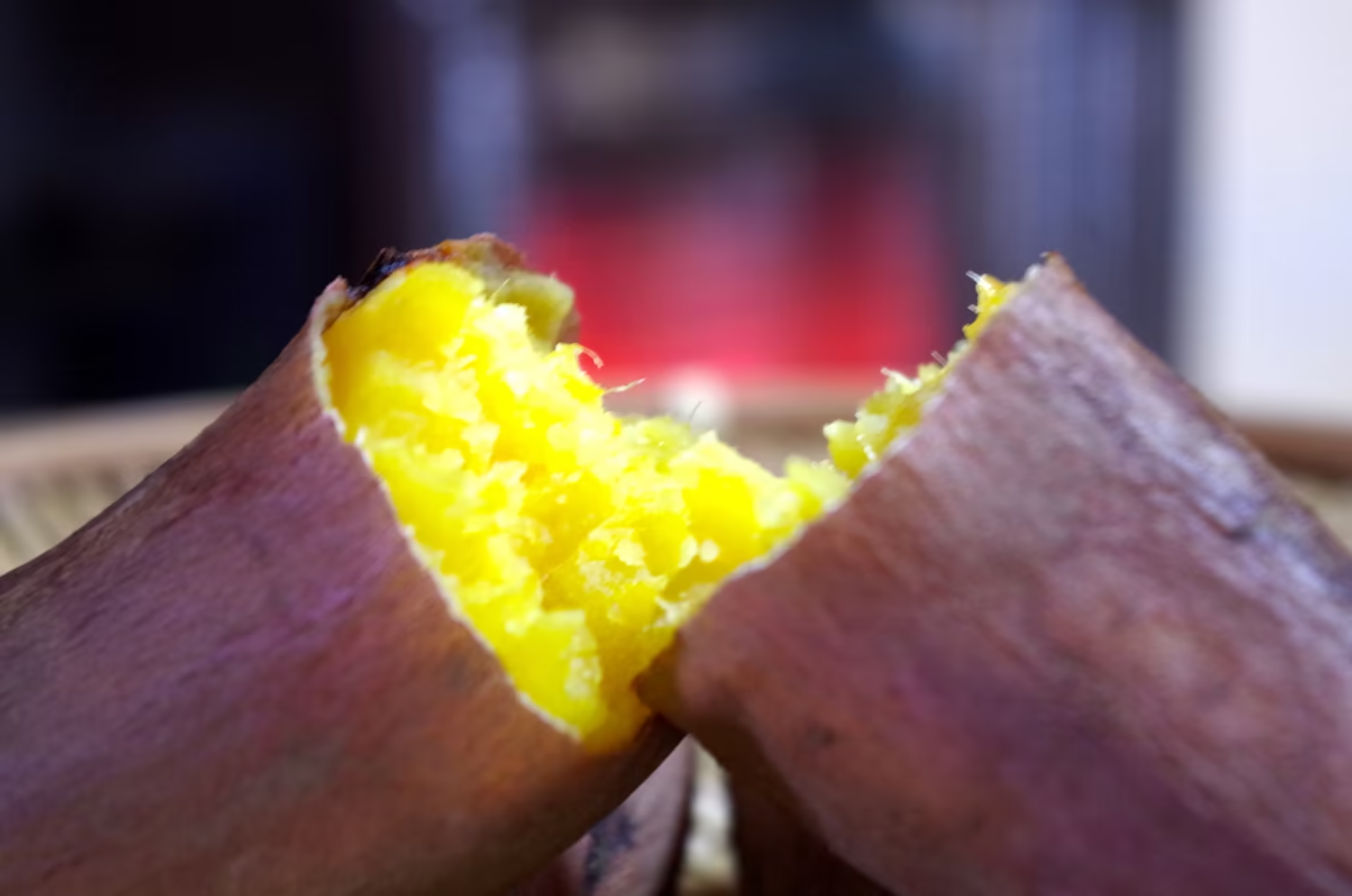
When raw, the roots are spindle-shaped, with thin reddish-purple skin and few grooves. Cut one open, and at first the flesh looks pale, almost cream. Heat changes that. The cooked flesh turns a deeper yellow. Moreover, in a well-stored root, syrup often beads on the cut surface.
What Does Beniharuka Taste Like?
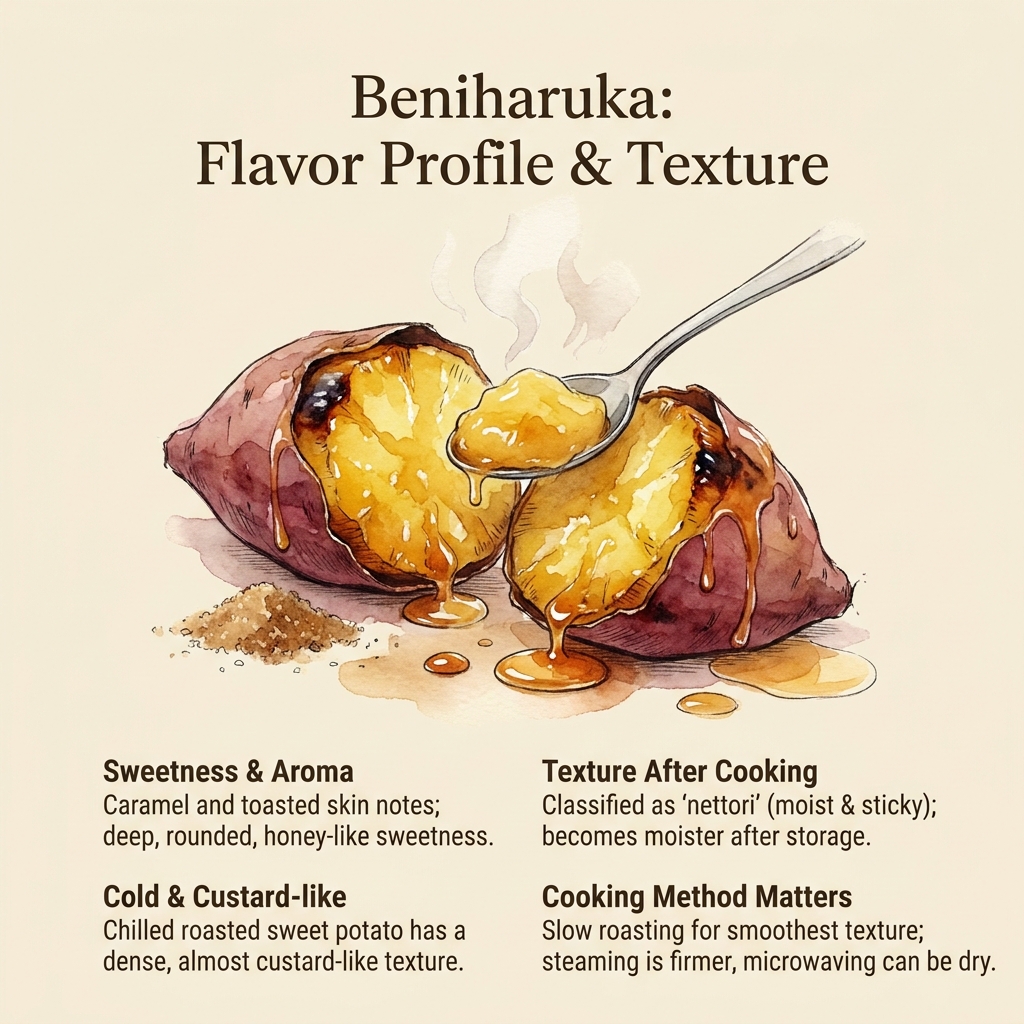
A slow-roasted, well-stored Beniharuka eats more like a dessert than a vegetable. The sweetness can feel deep and rounded, with honey-like and brown-sugar notes. Compared with some richer moist cultivars, however, many descriptions call its finish relatively clean. The breeders themselves describe it as a surprisingly sweet potato with a high eating-quality rating.
Sweetness and Aroma
Pull one from the oven, and the first thing you notice is the smell of caramel and toasted skin. Where the skin splits, leaking juice cooks into a glossy crust that tastes like dark caramel. Inside, the flavor is sweet enough that most people eat it plain, without butter or sugar. Chilled roasted sweet potatoes have also become a summer snack in Japan, since cooling gives a dense, almost custard-like texture.
Texture After Cooking
Japanese shoppers sort sweet potatoes into two camps: hokuhoku (fluffy and dry) and nettori (moist and sticky). Beniharuka ends up in the second camp, but timing matters. In the breeders’ tests, steamed roots were slightly dry just after harvest. After about a month of storage, however, they turned moist and tasted sweeter. A Chiba prefectural trial likewise found the flesh grew stickier over three months.
Cooking method also shapes the result. Generally, slow roasting gives the smoothest, most spoonable flesh. Steaming, meanwhile, keeps it a little firmer and less caramelized. Fast microwave cooking, on the other hand, often leaves it drier, for reasons explained next.
Why Is Beniharuka So Sweet?
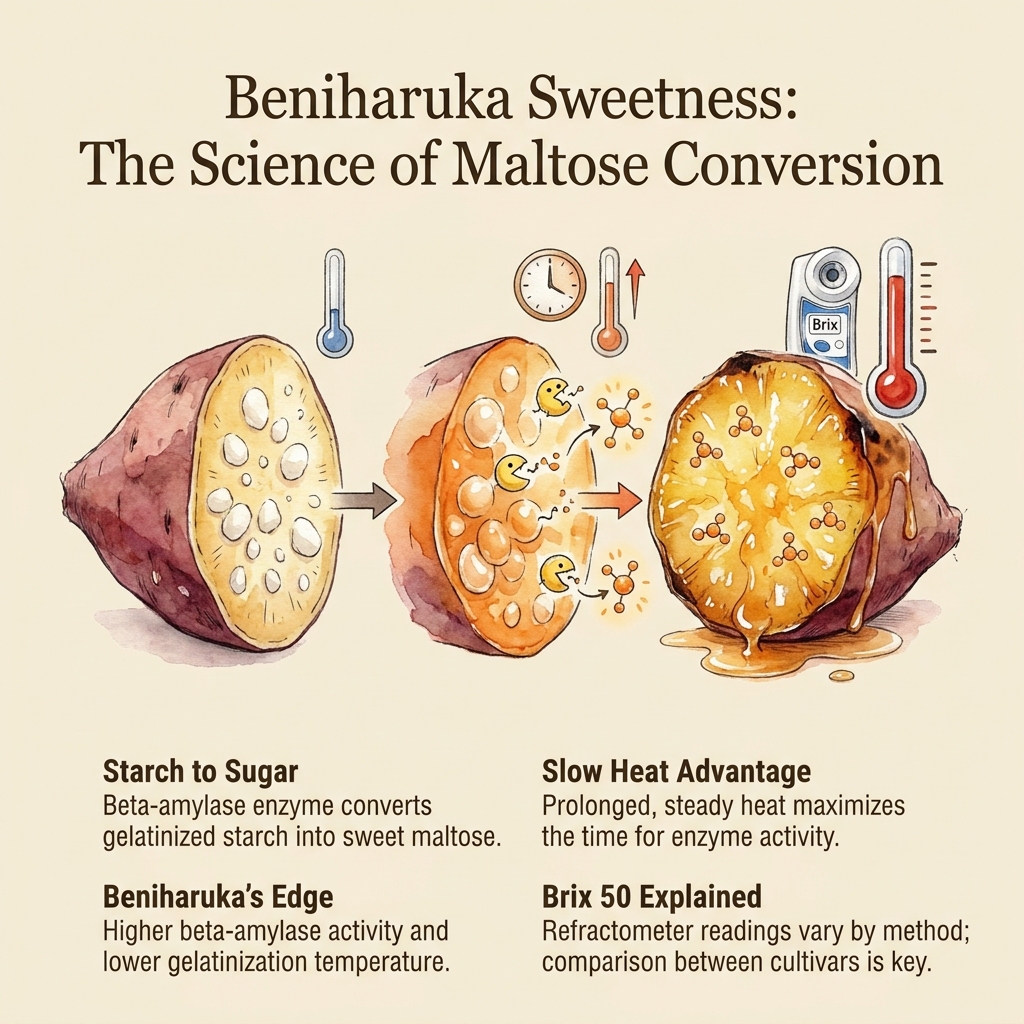
Raw sweet potatoes already contain sugars such as sucrose, glucose, and fructose. Still, starch holds much of their carbohydrate. During heating, that starch gelatinizes and becomes accessible to beta-amylase, an enzyme that produces maltose. Maltose is the main reason cooked sweet potatoes taste so much sweeter than raw ones.
Starch, Enzymes, and Slow Heat
Beta-amylase works far better once heat has opened up the starch granules. Yet the enzyme also gradually loses activity as temperature rises. So maltose forms most readily while gelatinization and enzyme activity overlap. Slow heating extends that overlap, whereas rapid heating may leave less time for the reaction.
Why Slow Roasting Helps
The longer a root stays in conditions where starch has gelatinized but the enzyme still works, the more maltose it can make. That overlap is one reason slow, steady heat works so well in traditional stone-roasting ovens. Size, moisture loss, and oven temperature matter too.
What Makes Beniharuka Different
Here, the breeders’ report gives unusually direct evidence. In tests using roots grown in Kagoshima, raw Beniharuka showed beta-amylase activity more than twice that of Beni Satsuma, a Kokei No. 14 selection. Steamed Beniharuka also had more sucrose and maltose, and its total sugar rose further after two months of storage. In addition, its starch begins to gelatinize at a slightly lower temperature than Kokei No. 14.
A separate study by Nakamura and colleagues, which tested Beniharuka and Beniazuma grown in Ibaraki and Hokkaido, linked maltose formation to both enzyme activity and gelatinization temperature. Of course, the results apply to steamed samples under the study’s conditions. Nevertheless, they fit well with what roasters see in practice.
What “Brix 50” on a Sign Really Means
In Japan, you will often see shop signs claiming Brix 40, 50, or even 60 for roasted Beniharuka. Such figures come from refractometer readings, but the sample preparation varies widely. In the breeders’ own method, for example, they blended 15 g of cooked flesh with 45 ml of water before measuring. As a result, that diluted method gave steamed Beniharuka about 6 percent Brix, against about 5 for Kokei No. 14.
Therefore, a high reading on a sign does not tell you the percentage of sugar in the whole potato. Instead, it reflects one producer’s method, sample, and day. The comparison between cultivars measured the same way is more meaningful than any single headline number.
How to Cook Beniharuka
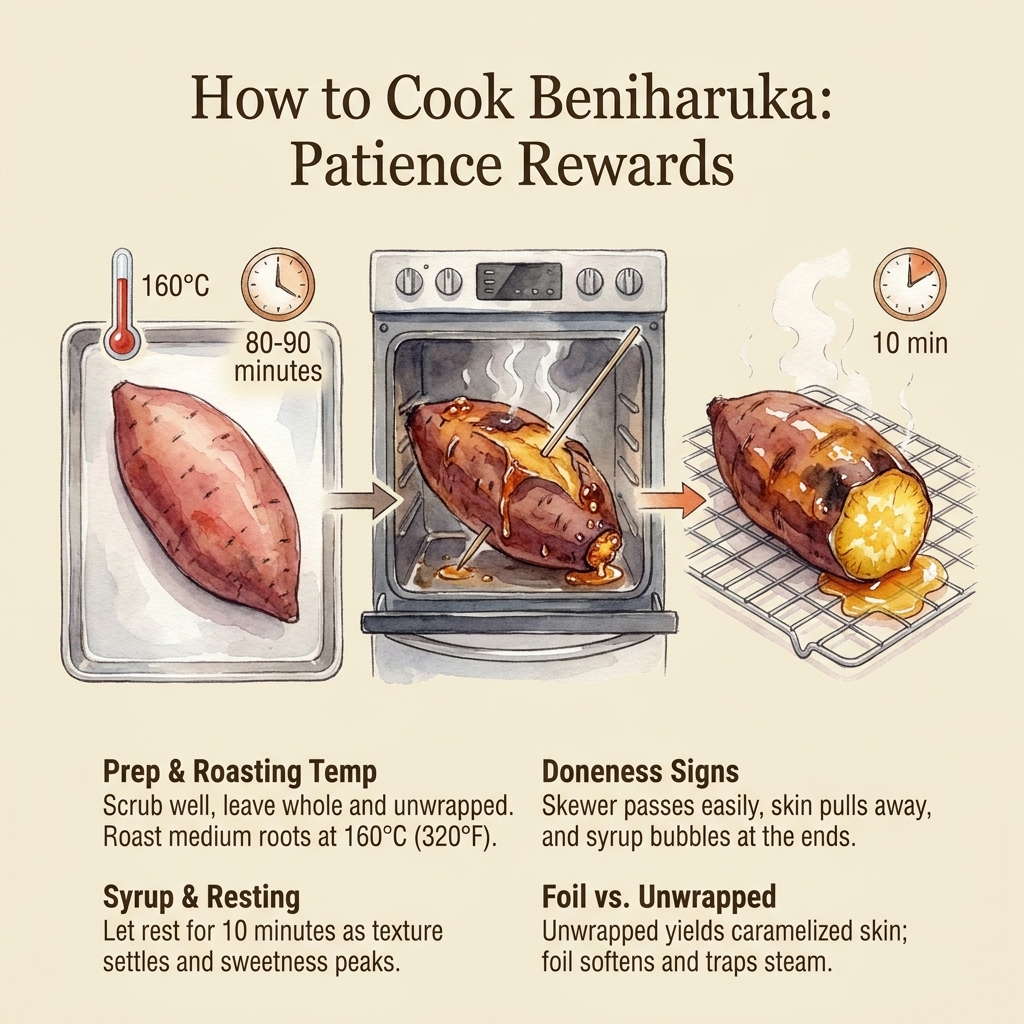
Beniharuka forgives most cooking methods, but it rewards patience. The aim is simple: give the flesh plenty of time in the range where maltose forms. Here is how that works in a home kitchen, method by method.
Japanese-Style Slow-Roasted Beniharuka
Scrub the skin well, since you will probably eat some of it. Then leave the root whole and unwrapped. Foil softens the skin and traps steam, which some people prefer, but it also blunts the caramelized edges. For a practical home method, then, roast medium roots at about 160°C (320°F) for roughly 80 to 90 minutes.
Time is only a guide, because thickness and ovens vary. Keep going until a skewer passes easily through the thickest part and the skin starts to pull away. Syrup bubbling at the ends is also a good sign. Finally, let it rest about ten minutes, as the center keeps cooking from retained heat and the texture settles.
Oven, Air Fryer, and Steamer
Short on time? A hotter oven at around 200°C (390°F) for about 50 minutes still works, though the result may be a little less sweet. Similarly, in an air fryer, choose smaller roots, cook at about 160°C for 40 to 50 minutes, and turn them halfway. Real temperatures differ between models, so trust the skewer test over the clock.
For purées, cakes, or miso soup, steaming is the better choice. Steam large chunks or small whole roots until a skewer passes through easily, commonly about 25 to 40 minutes depending on size. The flesh stays firmer and milder than roasted Beniharuka.
Simple Recipe: Oven Yakiimo at Home
Simple Recipe
Slow-roasted Beniharuka (serves 2)
Ingredients
- 2 medium Beniharuka sweet potatoes, about 250 g each
- Nothing else
Steps
- Scrub the potatoes under running water and pat dry.
- Place them on the oven rack with a tray below to catch drips.
- Roast at about 160°C (320°F) for roughly 80 to 90 minutes, turning once.
- Check with a skewer at the thickest point, and continue if you meet resistance.
- Rest for 10 minutes, then split open and eat with a spoon.
Serve plain, with a pinch of salt, or with a little butter. Cool leftovers promptly, refrigerate them covered, and use them within about three days. Discard them sooner if they smell odd, show mold, or feel slimy.
Can You Eat the Skin?
Yes. The skin is thin, and after roasting it also turns papery with a faintly bitter edge. Wash it thoroughly, trim damaged patches, and eat as much as you enjoy. In fact, many people in Japan eat the whole thing, while others peel it back as they go.
Beniharuka vs Other Japanese Sweet Potatoes
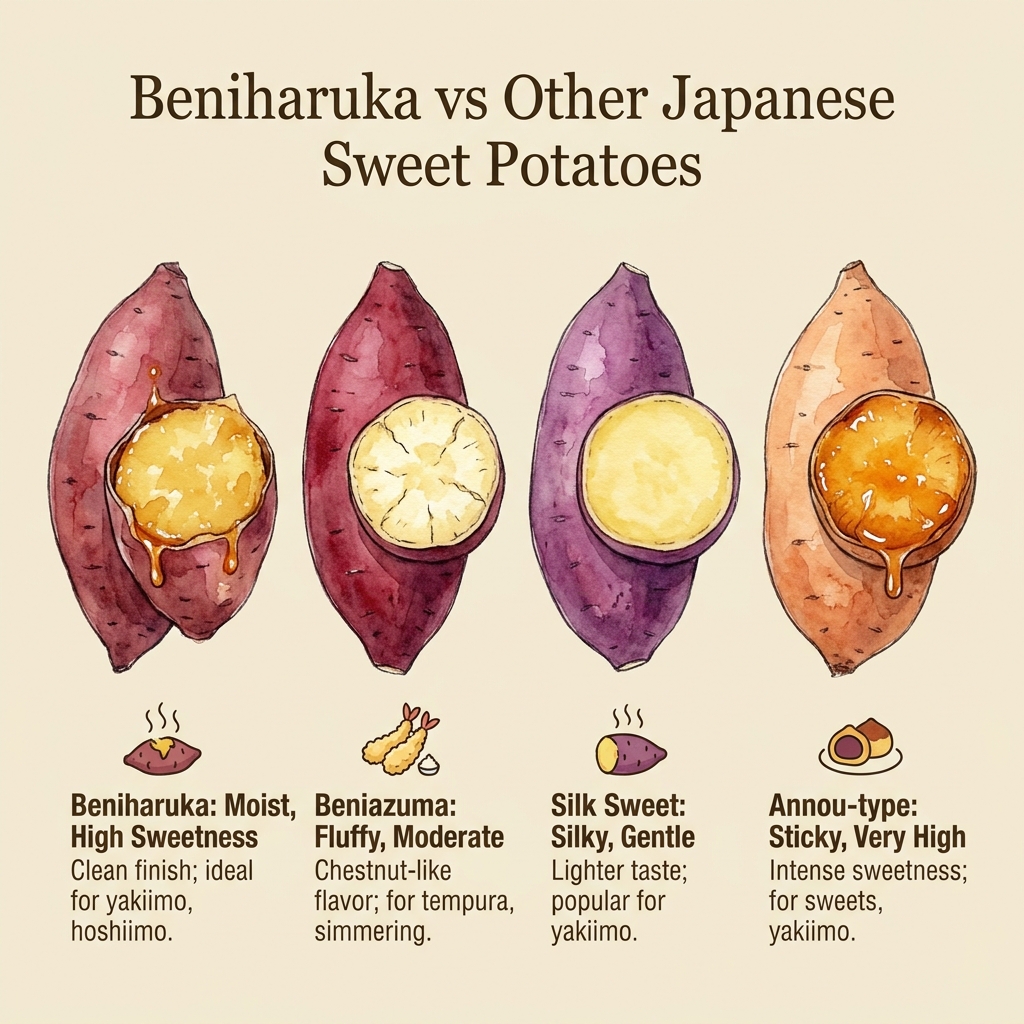
Walk into a Japanese supermarket in November, and you may find four or five cultivars side by side. For that reason, the comparison below summarizes commonly reported eating qualities and typical kitchen uses. Texture and sweetness vary with growing conditions, harvest date, storage, and cooking, so the terms are relative rather than laboratory grades.
| Cultivar | Texture | Sweetness | Skin and Flesh | Typical Use |
|---|---|---|---|---|
| Beniharuka | Moist, creamy after storage | High, clean finish | Red-purple skin, pale yellow flesh | Yakiimo, hoshiimo, purées |
| Beniazuma | Fluffy, dry | Moderate, chestnut-like | Deep red-purple skin, yellow flesh | Tempura, simmered dishes, frying |
| Silk Sweet | Silky, smooth | Moderate, gentle | Purple skin, yellow flesh | Yakiimo with a lighter taste |
| Annou-type | Very sticky, rich | Very high | Light orange skin, orange flesh | Yakiimo, sweets |
This table combines official cultivar descriptions, prefectural trials, and common culinary usage. In other words, it is a qualitative guide, not a standardized sensory ranking.
Beniharuka vs Beniazuma
When the breeders’ report was written, Beniazuma was the most widely grown table cultivar in Kanto, prized for its fluffy, dry bite. In Ibaraki’s trial, Beniharuka received higher eating-quality scores than Beniazuma soon after harvest, with similar yields and more top-grade roots. Both cultivars change in storage. Beniharuka, however, shifted more strongly toward a moist texture in Chiba’s tests.
Beniharuka vs Silk Sweet
Both cook up smooth, and the difference is mostly in the mouth. Silk Sweet feels velvety and light, with sweetness in the background. Beniharuka, meanwhile, is denser and stickier, and its sweetness leads. For readers who prefer a smoother texture and less assertive sweetness, Silk Sweet may be a good alternative.
Beniharuka vs Annou Imo
Annou-type sweet potatoes have strong ties to Tanegashima island in Kagoshima. They are often sold as a regional specialty, and JETRO describes them as sticky and sweet with orange flesh. Beniharuka, on the other hand, was bred and trialed for a wide range of regions from Kanto to Kyushu. That broad adaptability is one reason it is now easy to find well beyond any single district.
Moist and Fluffy Types of Satsumaimo
Nettori: moist and creamy
- Beniharuka
- Annou-type
- Silk Sweet
- Best roasted whole or used in soft desserts
Hokuhoku: dry and fluffy
- Beniazuma
- Best for tempura, frying, and simmering
- Kokei No. 14 and its selections, such as Naruto Kintoki, sit between the two types
History and Origin of Beniharuka
For decades, western Japan’s leading table sweet potato was Kokei No. 14, bred in 1945, and its local selections such as Naruto Kintoki. According to the breeders’ report, it had real strengths but tasted less sweet just after harvest. It was also vulnerable to root-knot nematodes and a soil disease called soil rot. Against this background, the report notes, growers in western Japan needed a better table cultivar.
How Beniharuka Was Developed
In 1996, breeders at the Kyushu National Agricultural Experiment Station, a predecessor of today’s NARO center, crossed two table cultivars. First, the seed parent, Kyushu No. 121, had attractive roots. The pollen parent, Harukogane, had good skin color and eating quality. Then, from 278 seeds, the team selected lines over several years for yield, appearance, and taste.
The team named the promising line Kyushu No. 143 in 2001 and then tested it across many prefectures. After strong results, NARO applied to register it as Beniharuka in 2007. It became Norin No. 64 and gained registration under Japan’s Plant Variety Protection and Seed Act in March 2010. In short, breeders chose it for a combination of eating quality, root appearance, pest resistance, storage performance, and yield.
How It Spread Across Japan
Timing helped. According to Nippon.com, electric roasters that spread around 2010 fueled a yakiimo boom, and moist, dessert-like types were gaining fans. Soon, Kagoshima, Oita, and Fukuoka adopted Beniharuka as a recommended table cultivar, and Ibaraki did the same for table use and for hoshiimo. By 2012, the breeders report, it covered more than 2,000 hectares, about 5.3 percent of Japan’s sweet potato area.
For context, Japan grew a preliminary 699,400 tonnes of sweet potatoes of all cultivars in the 2025 crop year, according to the agriculture ministry. That figure covers every variety and use, including starch and shochu, so it says nothing about Beniharuka’s own share today.
Regional Brands
Several regions also sell Beniharuka under their own brand names, which confuses shoppers. The breeders’ report names two: Oita’s Kanta-kun (甘太くん) and Kagoshima’s Kanoya Beniharuka. Oita’s research center describes Kanta-kun as Oita-grown Beniharuka that meets set standards for storage period and sugar content, with the name registered as a trademark by JA Zen-Noh. A 2021 JA Zen-Noh announcement put the minimum storage at 40 days, plus a sugar survey and quality check.
Certainly, these brands use the same cultivar. Yet each can apply its own rules for origin, storage, size, grading, or sweetness. A brand name, then, is a promise about handling rather than a different potato.
Season, Choosing, and Storing Beniharuka
When Is Beniharuka in Season?
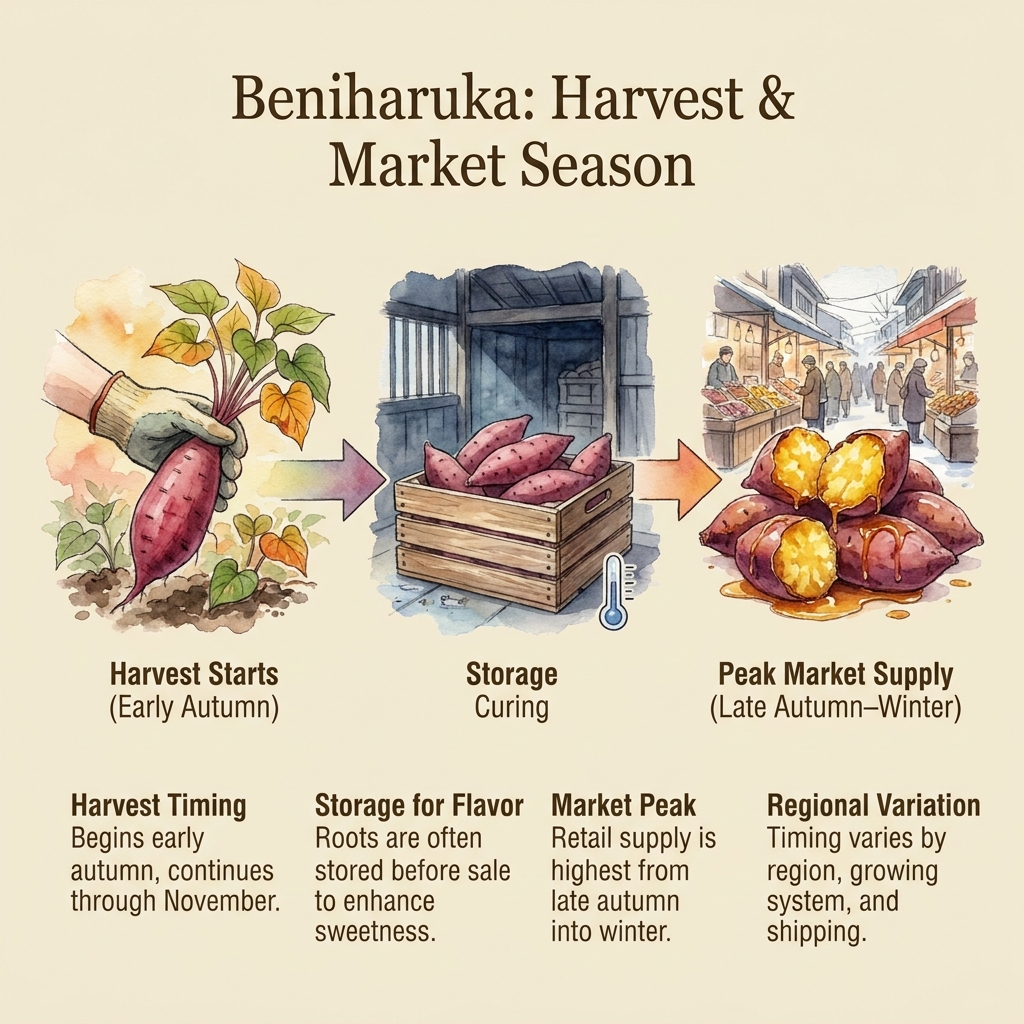
In many Japanese growing areas, harvest begins in early autumn and continues into November. Because growers often store roots before sale, retail supply commonly peaks from late autumn through winter. Timing still varies by region, growing system, and shipping plan. A root sold in December is more likely to have had some storage than one sold right after the first harvest. Even so, you cannot know the actual storage period without producer information.
How to Choose Good Beniharuka
- Look for smooth, unbroken skin with an even color. Deep wrinkles suggest moisture loss.
- Then pick roots that feel heavy for their size.
- Avoid soft spots, black patches, or mold near the ends.
- Medium, evenly shaped roots roast more evenly than very large ones.
- A little dried white latex at a cut end can be normal. It contains resin glycosides, often called yalapin in Japanese consumer information, and does not by itself mean spoilage.
Storing Beniharuka at Home
Sweet potatoes come from the tropics, so prolonged cold can damage them. Storage is where many home cooks go wrong, and homes outside Japan vary a great deal. So the guide below assumes a cool, dry spot is available.
Do
- Keep sound, whole roots in a cool, dark, well-ventilated place
- Wrap them loosely in newspaper or keep them in a paper bag
- Inspect them regularly and use any damaged roots first
- Refrigerate only after cutting or cooking
Avoid
- Prolonged refrigeration of whole raw roots when a cool space exists
- Sealing them in plastic, which traps moisture
- Direct sun or spots near a heater
- Keeping wet, moldy, or soft roots with healthy ones
If sound roots taste bland and your storage space stays cool, dry, and airy, a short rest may improve them. Do not attempt this with damaged, wet, moldy, or soft roots. In very warm homes, on the other hand, brief refrigeration may beat exposure to heat, even though chilling can affect quality. In that case, buy smaller amounts and use them promptly.
Commercial storage is a different world. The breeders rated Beniharuka’s storability as easy in a semi-underground store and an unheated test room through winter. Niigata’s station also reported good results under its unheated-room conditions. Those controlled trial settings, however, may not match every household.
Can You Freeze Cooked Beniharuka?
Yes, and it works well. First roast the roots, then cool them completely, wrap each one tightly, and freeze. Eaten half-thawed, frozen yakiimo has a texture close to sherbet. Once fully thawed and reheated, it is also fine for purées and baking.
Popular Ways to Eat Beniharuka in Japan
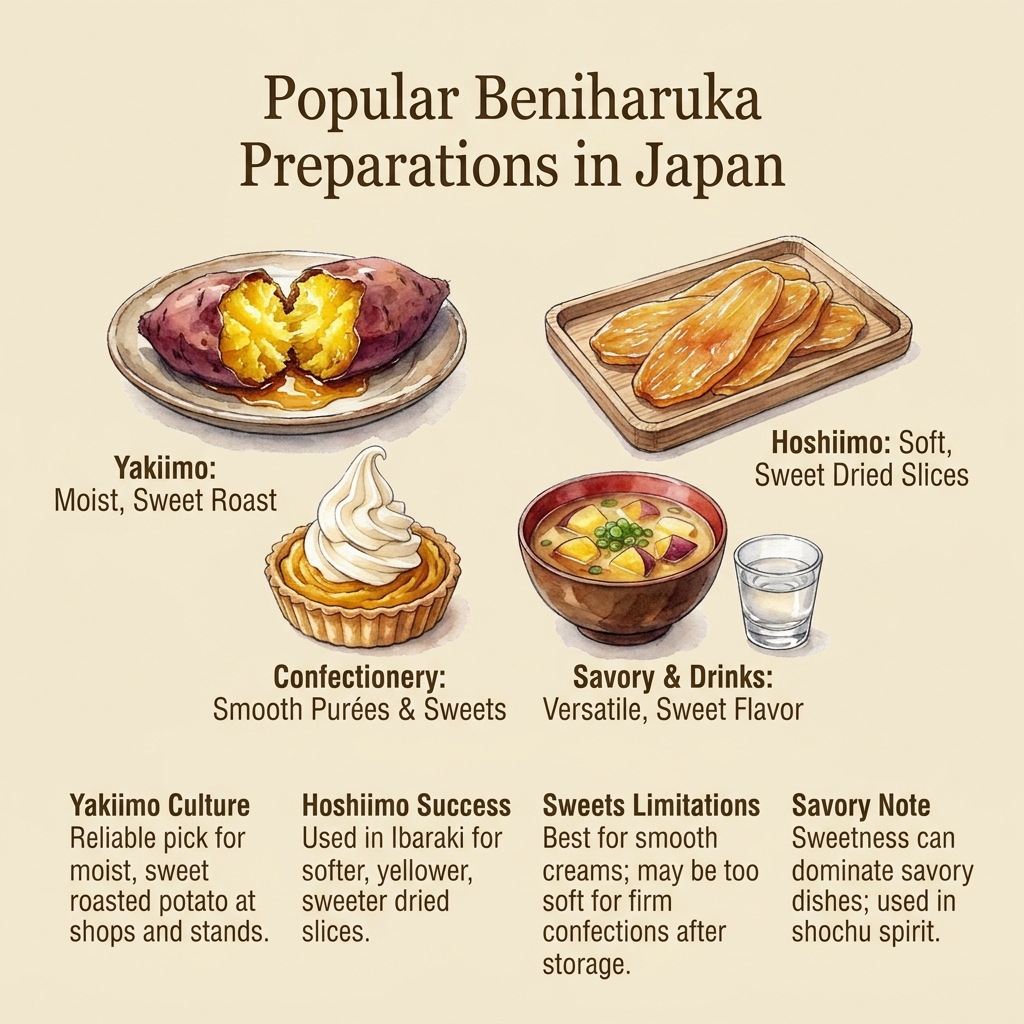
Sweet potatoes have been grown in parts of what is now Japan since the early seventeenth century, and they later spread nationwide. Over that time, cooks found many uses for them. Beniharuka’s moisture, though, suits some of those uses better than others.
Yakiimo
Today, many specialty yakiimo shops and supermarkets commonly sell Beniharuka. Interestingly, the breeders’ English summary notes that one parent, Kyushu No. 121, especially suited baking. Our guide to yakiimo, Japan’s roasted sweet potato tradition, covers the trucks, the stone ovens, and the winter culture around them. If a stand lets you choose, Beniharuka is a reliable pick for a moist, sweet result.
Hoshiimo
Makers of Ibaraki’s hoshiimo, the dried sweet potato slices the prefecture is known for, now often use Beniharuka. The prefectural trial found it gave a yellower, softer, sweeter product than the traditional Tamayutaka. According to the breeders’ report, Beniharuka covered about half the hoshiimo area on surveyed farms by 2014.
Sweets and Confectionery
Its smooth flesh purées easily, so bakeries use it in tarts, puddings, and soft-serve. There is a catch, though. After several months of storage, the flesh can become too soft for some traditional uses. In a Chiba study of four-month-stored paste, confectioners rated it well for cream and kinton. By contrast, they rated it less suitable for imo-an bean-style paste and imo yokan, the firm sweet potato confection.
Savory Dishes and Drinks
Beniharuka works in tempura, miso soup, and sweet potato rice, although its sweetness can dominate. For daigaku imo, the candied sweet potato snack, a moist cultivar gives a softer center, while a firmer one keeps more bite. Some distillers also produce cultivar-labelled imo shochu, Japan’s sweet potato spirit, made with Beniharuka.
Beniharuka Nutrition
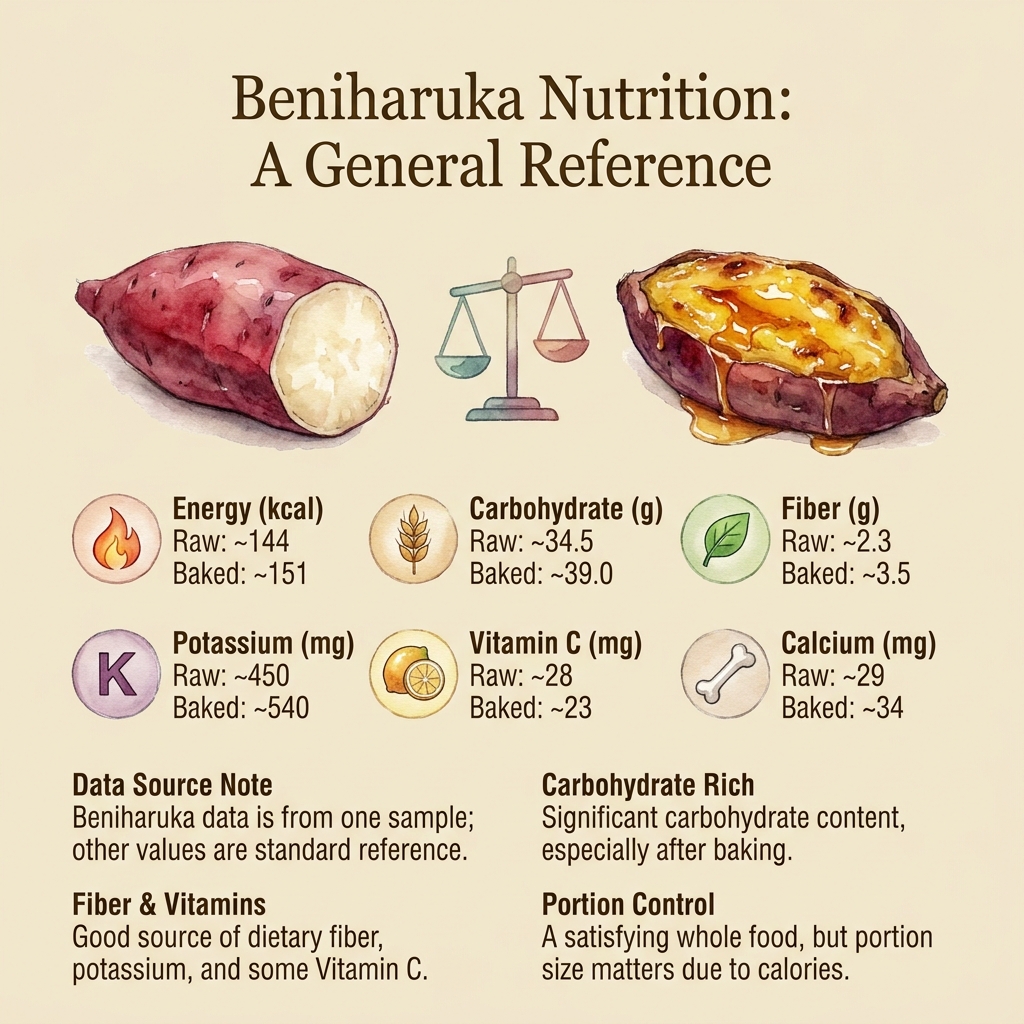
Japan’s Standard Tables of Food Composition give reference values for sweet potatoes in general, not for individual cultivars. The breeders’ report, however, includes one laboratory analysis of Beniharuka itself. So the table below shows both, per 100 g, to give a sense of the range.
| Per 100 g | Beniharuka, raw (one 2005 sample) | Sweet potato, raw, skin on | Sweet potato, baked, peeled |
|---|---|---|---|
| Energy | 144 kcal | 127 kcal | 151 kcal |
| Carbohydrate (total) | 34.5 g | 33.1 g | 39.0 g |
| Dietary fiber | 2.3 g | 2.8 g | 3.5 g |
| Potassium | 450 mg | 380 mg | 540 mg |
| Vitamin C | 28 mg | 25 mg | 23 mg |
| Calcium | 29 mg | 40 mg | 34 mg |
Note that the Beniharuka column comes from a single sample grown in Miyazaki in 2005, stored for two months, and analyzed by the Japan Food Research Laboratories. The other two columns come from the 2020 Eighth Revised Edition of the national tables. The two sources also calculated energy differently, so treat the numbers as general reference only. Beniharuka’s composition can also shift with growing conditions, storage, moisture, and cooking.
Is Beniharuka Healthy?
It is a whole root vegetable with fiber, potassium, and some vitamin C. Moreover, it needs no added sugar to taste like dessert. Still, it is rich in carbohydrate. At 151 kcal per 100 g, a 250 g edible portion of baked sweet potato would provide about 378 kcal. In short, Beniharuka is a satisfying, minimally processed food, and portion size matters more than the cultivar.
Where to Buy and Eat Beniharuka
Finding Beniharuka in Japan
In season, look for it in supermarkets, farmers’ markets, roadside stations (michi-no-eki), and in-store roasters. Some specialty yakiimo shops name the cultivar on their signs, and a few offer more than one type to compare. If the label or sign does not say, simply ask which variety it is.
Buying Beniharuka Outside Japan
Availability depends mainly on where you live and on each country’s import rules for fresh produce. Japanese grocery chains and larger Asian supermarkets sometimes stock it in autumn and winter. Dried hoshiimo and frozen roasted Beniharuka travel more easily than fresh roots, so they are often easier to find. In some markets, locally grown potatoes are also sold under the Beniharuka name. For that reason, check the grower and cultivar details, since labeling practices vary by country.
What to Look for on the Label
- The words Beniharuka, Beni Haruka, べにはるか, or 紅はるか
- “Product of Japan” and a prefecture name on imported stock
- A brand name such as Kanta-kun, which signals brand-specific storage and grading
- Whether it is fresh, dried as hoshiimo, or frozen and already roasted
Why Beniharuka Is Worth Trying
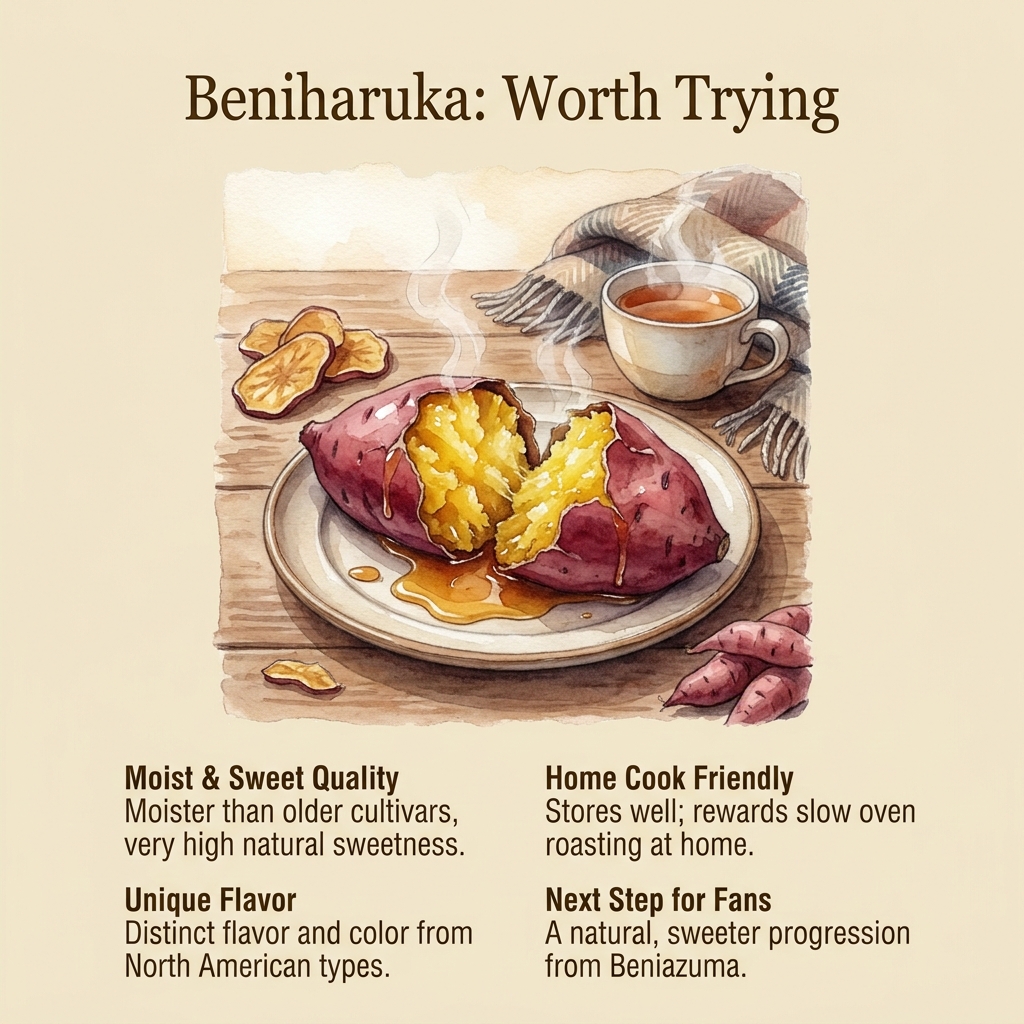
Beniharuka offers a sweeter, moister eating quality than many older fluffy cultivars traditionally used at the table. It stores well, and it rewards the home cook who owns nothing fancier than an oven. Its character reflects a combination of starch properties, enzyme activity, storage after harvest, and cooking conditions.
If your reference point is the moist, orange-fleshed sweet potato common in North American supermarkets, Beniharuka offers a different flavor, color, and texture. If you already love satsumaimo, it is a natural next step from Beniazuma. Either way, roast one slowly on a cold evening, and decide for yourself whether it lives up to its confident name.
Frequently Asked Questions About Beniharuka
Basics and Names
- What is Beniharuka sweet potato?
-
Beniharuka is a Japanese sweet potato cultivar, registered as べにはるか and often written 紅はるか. It comes from a 1996 cross made by breeders whose work now belongs to NARO’s Kyushu Okinawa Agricultural Research Center, and it gained registration in 2010. It has reddish-purple skin and becomes moist and strongly sweet after storage and slow cooking.
- Is Beniharuka the same as Kanta-kun?
-
Kanta-kun is a brand, and Beniharuka is the cultivar inside it. Kanta-kun (甘太くん) is Oita-grown Beniharuka that meets brand standards for storage and sugar content. Other regions sell Beniharuka under their own brand names, each with its own rules.
- Why is Beniharuka so sweet?
-
Mainly because heating turns much of its starch into maltose. The breeders found Beniharuka has high beta-amylase activity and starch that gelatinizes at a slightly lower temperature than Kokei No. 14. Storage after harvest also raises its sucrose, so the cooked root tastes sweeter still.
Cooking and Eating
- What is the best way to cook Beniharuka?
-
Slow roasting whole and unwrapped is a reliable way to get a sweet, creamy result. Roast medium roots at about 160°C for roughly 80 to 90 minutes, then continue until a skewer slides through easily. Steaming suits purées and desserts better.
- Why is my Beniharuka dry instead of creamy?
-
Most likely, the root was freshly harvested, heated too quickly, or simply varied as an individual. Freshly dug Beniharuka is slightly dry and becomes moist only after some storage. Slow cooking improves the odds of a creamy result, but it cannot guarantee the same texture every time.
- Can you eat Beniharuka cold?
-
Yes, and many people prefer it that way. Chilled roasted Beniharuka becomes dense and almost custard-like, and chilled roasted sweet potatoes are sold as a summer snack in Japan. Refrigerate cooked roots covered and eat them within about three days, or freeze them for longer.
Storage and Buying
- Does Beniharuka need to be aged before eating?
-
No, but storage usually improves it. Freshly harvested roots are edible, yet their sweetness and texture differ from stored roots. In trials, the flesh turned moister and sweeter over one to three months. Most shop-bought Beniharuka has already had some storage.
- Should Beniharuka be refrigerated?
-
Whole raw roots are generally best kept above refrigerator temperatures, in a cool, dark, ventilated place. Prolonged chilling can affect their quality. In very warm homes, however, brief refrigeration may be the safer choice. Once cut or cooked, always refrigerate them.
- Is the white liquid from a cut sweet potato safe?
-
A small amount of white latex at a cut end is normal. It contains resin glycosides, often called yalapin in Japanese consumer information, and does not by itself mean spoilage. Discard roots that also smell off, feel soft, or leak fluid.
- Where can you buy Beniharuka outside Japan?
-
Try Japanese grocery stores, larger Asian supermarkets, and specialty produce shops in autumn and winter. Availability depends on your country and its import rules. Dried hoshiimo and frozen roasted Beniharuka are often easier to find than fresh roots.
References
Cultivar Records and Official Data
- NARO (National Agriculture and Food Research Organization) – Kai, Y., Sakai, T., Katayama, K., et al. (2017). “Beniharuka”: A New Sweetpotato Cultivar for Table Use. Bulletin of the NARO Kyushu Okinawa Agricultural Research Center, 66: 87–119 (PDF) (Accessed September 2026)
- NARO (National Agriculture and Food Research Organization) – Press release: Development of the high-sugar table sweet potato “Beniharuka” (Accessed September 2026)
- NARO (National Agriculture and Food Research Organization) – Cultivar profile: Beniharuka (Accessed September 2026)
- Ministry of Agriculture, Forestry and Fisheries (MAFF) – Sweet potato planted area and harvest, 2025 crop, preliminary figures (Accessed September 2026)
- Ministry of Education, Culture, Sports, Science and Technology (MEXT) – Food Composition Database, Standard Tables of Food Composition in Japan 2020 (Eighth Revised Edition): sweet potato entries (Accessed September 2026)
- Oita Prefecture Agriculture, Forestry and Fisheries Research Center – Research Now Vol. 17 (2013): Toward branding the high-sugar sweet potato Kanta-kun (PDF) (Accessed September 2026)
Prefectural Trial Reports
- Chiba Prefectural Agriculture and Forestry Research Center – Characteristics of the new sweet potato cultivar Beniharuka (PDF) (Accessed September 2026)
- Ibaraki Agricultural Research Institute – Adoption of Beniharuka as a semi-recommended table cultivar, FY2012 (PDF) (Accessed September 2026)
- Ibaraki Agricultural Research Institute – Adoption of Beniharuka as a recommended cultivar for hoshiimo, FY2014 (PDF) (Accessed September 2026)
- Niigata Agricultural Research Institute – Selection of the good-tasting, storable sweet potato Beniharuka, FY2012 (PDF) (Accessed September 2026)
Academic Research
- Nippon Shokuhin Kagaku Kogaku Kaishi (J-STAGE) – Nakamura, Y., Kuranouchi, T., Takada, A., and Katayama, K. (2014). Effects of beta-amylase activity and starch gelatinization temperature of storage roots on maltose formation in steamed sweet potato (title translated). 61(12): 577–585 (Accessed September 2026)
- NARO (National Agriculture and Food Research Organization) – Research result: Effects of beta-amylase activity and starch gelatinization temperature on maltose formation in sweet potato (Accessed September 2026)
Scientific Reviews and Educational Articles
- Kagaku to Kyoiku (J-STAGE) – The secret of roasted sweet potato sweetness (title translated). 67(7): 318 (2019) (PDF) (Accessed September 2026)
- The Japanese Society of Applied Glycoscience – Kitahara, K. More on sweet potato starch (title translated) (Accessed September 2026)
- Japan Root and Tuber Crops Development Association – Q&A: Why are roasted sweet potatoes sweet? (Accessed September 2026)
Industry and Cultural Sources
- JA Zen-Noh (via PR Times) – Launch of Oita-grown sweet potato Kanta-kun on JA Town, December 2021 (Accessed September 2026)
- JETRO (Japan External Trade Organization) – Regional highlights: Kyushu sweet potato varieties and exports (Accessed September 2026)
- Nippon.com – Satsumaimo: Sweet Potatoes Here, There, and Everywhere (Accessed September 2026)
- Honolulu Star-Advertiser – Popular chilled baked sweet potatoes help beat the heat (Accessed September 2026)
Related Articles
- Japanese Sweet Potato (Satsumaimo) (Surveyed: September 2026)
- Yakiimo (焼き芋): Japanese Roasted Sweet Potatoes (Surveyed: September 2026)
- Hoshiimo: Japan’s Dried Sweet Potato Snack (Surveyed: September 2026)
- Daigaku Imo (大学芋) (Surveyed: September 2026)
- Imo Youkan (芋ようかん) (Surveyed: September 2026)
- Imo Kenpi (いもけんぴ) (Surveyed: September 2026)
- Imo Shochu (芋焼酎): Sweet Potato Shochu (Surveyed: September 2026)




Comments