




Ancient sake in Japan was not the clear, filtered nihonshu poured today. The term covers a loose family of rice-based alcoholic drinks tied to farming, ritual, and early political life. Some were cloudy. Some were probably closer to a thick porridge than to a beverage.
This article looks instead at what we actually know, and at how much remains genuinely uncertain. That distinction matters more here than almost anywhere else in sake history.
Introduction: What Was Ancient Sake?
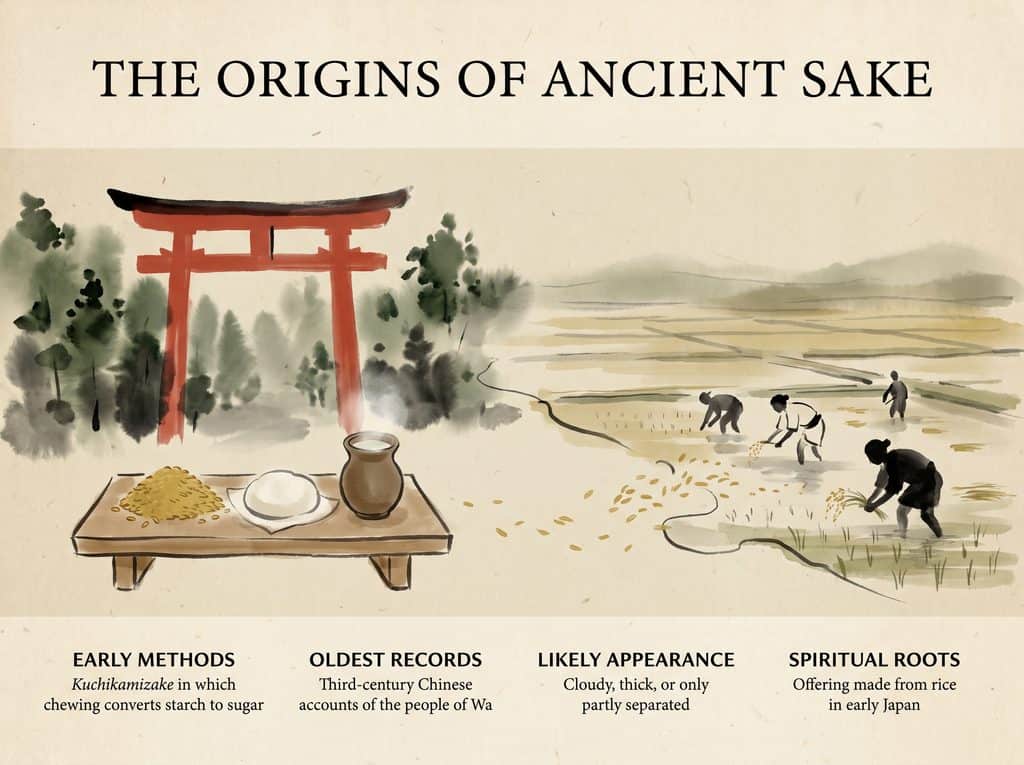
Ancient sake refers to alcoholic drinks made from rice in early Japan, from roughly the spread of wet-rice farming through the Nara court. No record names an inventor or a founding year. Rice cultivation created the conditions for rice alcohol, although its arrival does not prove that modern-style brewing began at the same moment.
Quick Facts
- What it means: rice-based alcohol in early Japan, not one standardized drink
- Invention date: unknown, and no surviving source identifies a place or a person
- Oldest cited written reference: a third-century Chinese account of the people of Wa
- Oldest Japanese written traces: eighth-century chronicles and provincial gazetteers
- Best-known early method: kuchikamizake, in which chewing converts starch to sugar
- Likely appearance: often cloudy, thick, or only partly separated
Throughout this article, three kinds of information stay separate. Evidence means what surviving records or archaeology actually show. Interpretation means what historians reasonably conclude from incomplete material. Tradition means stories passed down, valuable in themselves, but not automatically factual.
The National Research Institute of Brewing states plainly that nobody knows exactly when sake making began in Japan. Official and industry histories tend to hedge, using phrases such as “it is believed” or “it is said.” That caution is worth copying rather than smoothing over.
What “Ancient Sake” Actually Means
A Modern Label for a Messy Reality
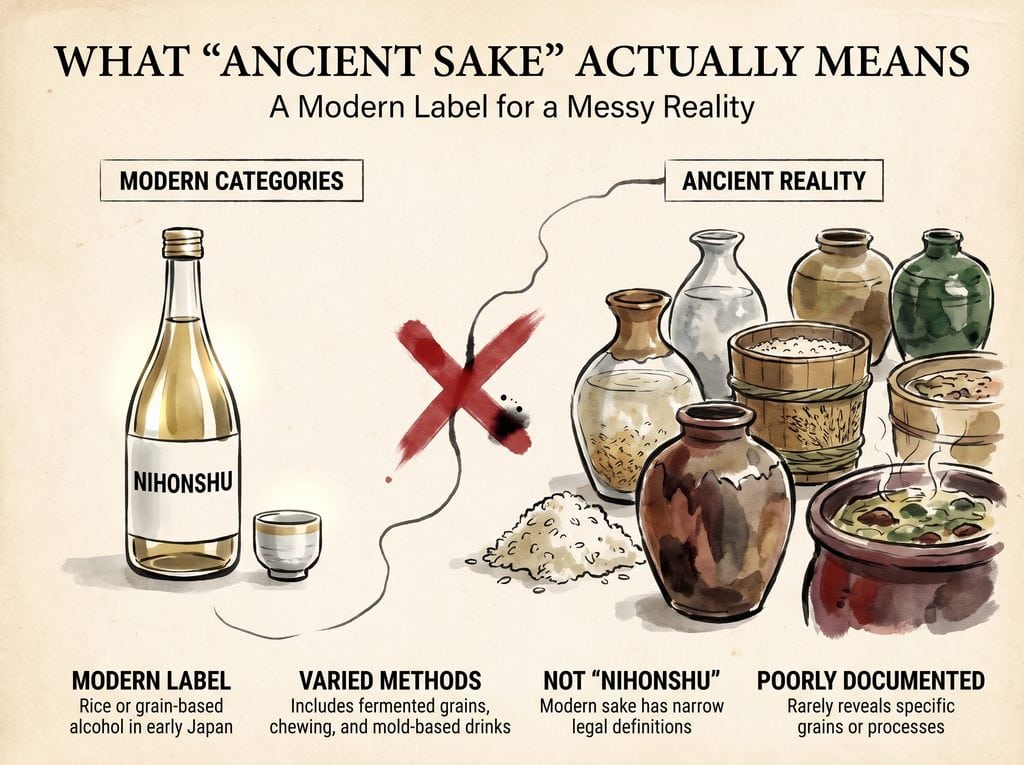
“Ancient sake” is a convenient modern label rather than a historical category. In this article it means rice-based or grain-based alcohol produced in Japan from the spread of wet-rice agriculture through the early court brewing of the Nara and early Heian periods.
Depending on the place and the century, that could include early fermented grain drinks, mixtures saccharified by chewing, drinks made with molded grain, unstrained cloudy alcohol, court beverages, and local products recorded only in passing. The definition is deliberately wide. Notably, it does not assume that every drink an old text calls sake came from the same method.
Why Modern Categories Do Not Fit
The Japanese word sake can simply mean alcohol. Modern legal categories are far narrower. Today, by contrast, nihonshu is a form of seishu made chiefly from rice, rice koji, and water, under controlled conditions and specific rules. Our guide to the types of Japanese sake walks through those definitions.
Ancient references may tell us that people drank, offered alcohol to deities, or supplied it to the court. However, they rarely reveal the grain, the microbial culture, the water ratio, the alcohol content, or the fermentation time. So try not to picture ancient sake as a rustic bottle of junmai. It was a varied and poorly documented world of fermented drinks, and later brewing traditions grew out of it.
Rice Arrives in Japan, and Alcohol Follows
Wet-Rice Farming Reaches the Archipelago
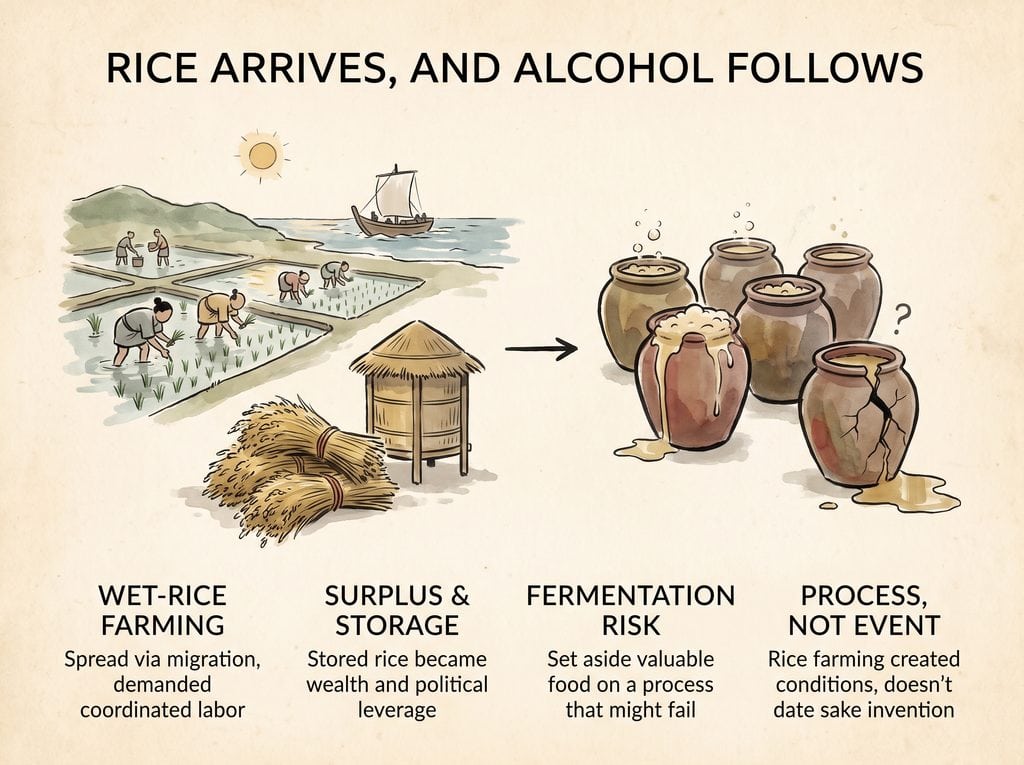
The story of rice alcohol starts with the much larger story of rice itself. Wet-rice agriculture gradually spread into the Japanese archipelago through contact with communities on the Asian continent and the Korean Peninsula. Historians generally associate that process with sustained migration rather than a single arrival. Historians associate that spread with the Yayoi period, though its timing and pace differed sharply by region.
Rice did not sweep everything else aside. Communities still kept using millet, nuts, fish, and wild plants alongside cultivated grain. Still, rice gained an importance well beyond nutrition, because growing it demanded coordinated labor, irrigation, seasonal planning, and storage.
Surplus, Storage, and Risk
Stored rice could carry a household through the year. It could also become tribute, wealth, ceremonial material, or political leverage. That matters for brewing, since fermentation needs more than the presence of grain.
Someone has to set part of the harvest aside rather than eat it. Containers, water, time, and technical knowledge are all necessary. Above all, a community has to be willing to gamble valuable food on a process that might fail. In a year of poor yields, that is not a small decision.
Did Sake Begin with Rice Farming?
A tidy narrative runs from rice cultivation to surplus, then storage, then fermentation, then sake. The sequence is plausible. It is not a demonstration.
Cooked grain left in the right conditions can certainly change. However, yeast cannot turn intact rice starch into alcohol on its own. Something must first break that starch into fermentable sugars. Any successful rice drink therefore needs saccharification as well as fermentation, and that requirement shapes everything that follows.
Ancient brewers needed no microbiology to get results. For example, they could notice that certain containers, seasons, or reused materials produced sweetness, warmth, aroma, or intoxication. Practical skill can accumulate long before anyone understands the organisms responsible.
Even so, rice farming alone does not prove a stable brewing tradition. One household might stumble on accidental fermentation without ever repeating it, for instance. One village might chew grain while its neighbor relied on naturally molded rice. Some drinks may have combined rice with other cereals entirely.
Rice agriculture created the conditions in which rice alcohol could emerge and matter culturally. It does not date the invention of sake. The origins are better read as a process than as an event.
Kuchikamizake: Chewing as Technology
How the Method Worked
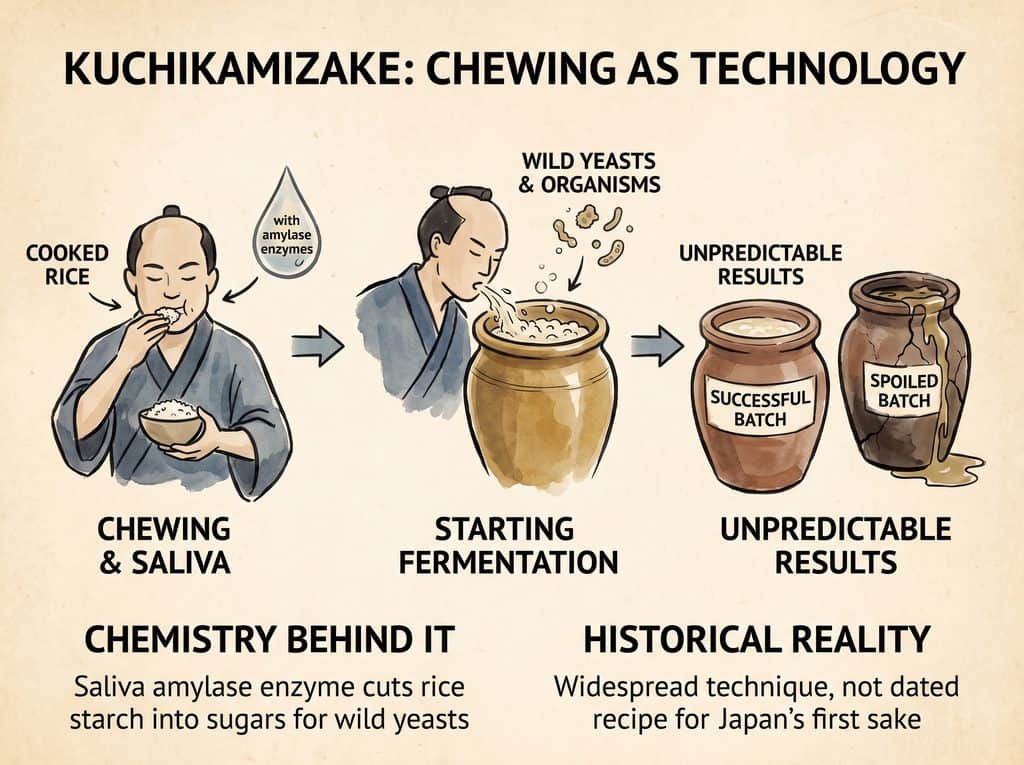
Kuchikamizake (口噛み酒) is the most famous explanation of early Japanese rice alcohol. The name simply joins kuchi for mouth, kami for chewing, and sake. In the usual description, someone chewed cooked rice or another starchy food, mixed it with saliva, and put the result in a vessel to ferment.
The chemistry is easy enough to follow. Rice is largely starch, and yeast therefore cannot use most of it directly. Human saliva, however, contains amylase, an enzyme that cuts starch into smaller carbohydrates, including sugars that microorganisms can consume.
Chewing therefore does more than soften grain. It starts saccharification. Once the sweetened mash sits in a container, wild yeasts and other organisms from the surroundings may take over. Modern amazake works on the same basic principle, though it uses koji enzymes instead of saliva.
The results would have been unpredictable. Wild organisms vary by season, vessel, and household, so one batch might turn out pleasantly sweet while the next spoiled outright. Nobody had a way to tell in advance.
What Reproduction Experiments Show
Researchers have actually tested the method. A 1993 study in the Journal of the Brewing Society of Japan reported trial production of kuchikamizake, using saliva as the saccharifying agent. Batch fermentation turned out to be slow. Yeast needed roughly five days to build up, and fermentation took about five more, so a mash ran close to ten days.
Faster results, on the other hand, came from reusing part of a previous mash, or from running batches back to back. Those approaches produced roughly one to five percent alcohol within three to five days. Lactic acid bacteria showed up alongside the yeast throughout.
Two cautions apply. The work used modern laboratory conditions, so it shows what the method can do rather than what ancient brewers achieved. It also hints that a repeatable tradition would need technique, not merely chewing. Reusing a promising mash is a learned habit, and somebody had to learn it.
What the Sources Say
The best-known Japanese reference survives only as a fragment. A passage associated with the Osumi no Kuni Fudoki, the provincial gazetteer for what is now Kagoshima, describes villagers chewing rice, spitting it into a vessel, and waiting for the smell of alcohol before drinking together. The text reaches us through later quotation rather than as a complete original manuscript.
The Japan Sake and Shochu Makers Association also includes mouth chewing in its account of early rice fermentation. Related practices appear elsewhere in Asia and the Pacific, which suggests a widespread technique rather than a uniquely Japanese one.
Three Claims That Get Confused
Popular accounts often blur three separate statements. First, chewing can convert starch into fermentable sugars, which is chemically sound. Second, mouth-chewed alcohol has existed in Japan and elsewhere, which historical and ethnographic material supports. Third, kuchikamizake was definitively the first sake ever made in Japan, which is much harder to establish.
A 1999 review in the same journal puts it carefully. Mouth-chewed alcohol is probably one of the origins of drink, and reports place similar practices across Central and South America, the South Pacific, and Southeast Asia. That same review admits how much stays unclear, including the roots of the method, the organisms involved, and the relationship between technique and finished composition.
Of course, a practice recorded in the eighth century may well preserve something older. That does not date the technique to the beginning of rice agriculture, nor does it show that every early community used it. Descriptions also tend to involve young women or ritually selected participants. Such details may reflect ceremonial control, ideas about purity, or later cultural memory, so projecting them backward is risky.
Kuchikamizake matters because it proves a workable route from starch to alcohol without cultivated koji. Treating it as a dated recipe for Japan’s first sake goes well beyond what survives.
The Earliest Written Record of Alcohol in Japan
A Chinese Account of the People of Wa
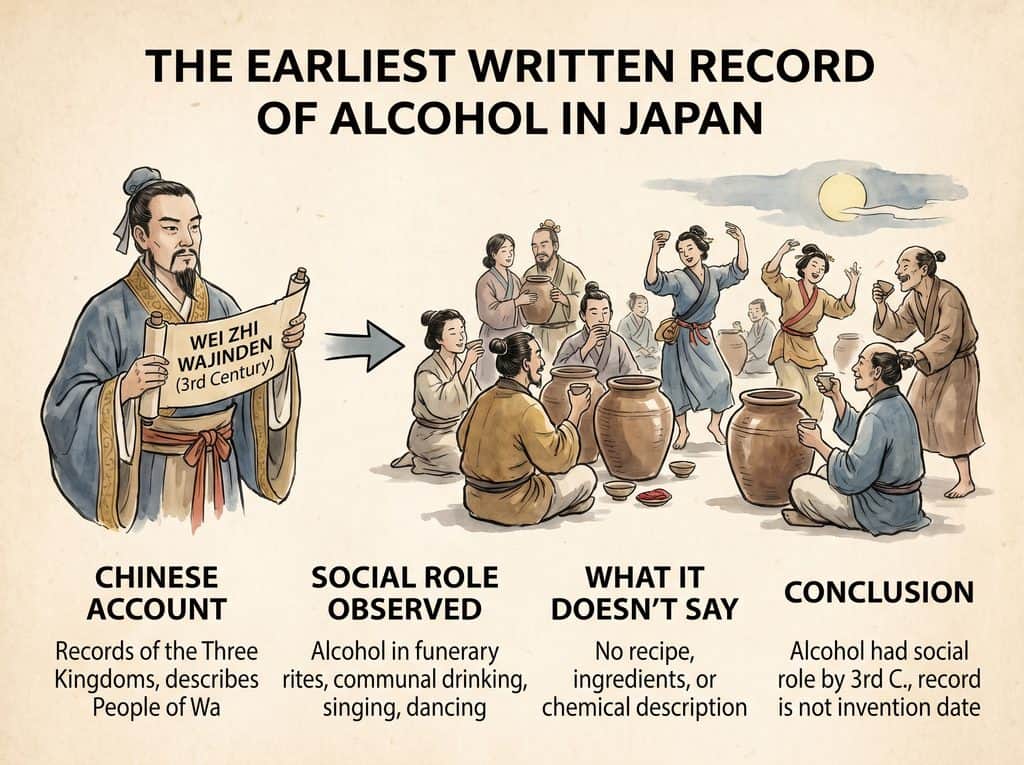
The earliest widely cited reference appears in a Chinese text rather than a Japanese one. The third-century account usually called the Wei Zhi Wajinden forms part of the Records of the Three Kingdoms. It describes the people of Wa, a term then used for communities in the archipelago.
Among its observations are references to drinking. In particular, alcohol turns up in descriptions of funerary behavior, with mourners followed by communal drinking, singing, and dancing. The NRIB treats this source as the oldest surviving documentary reference to alcohol in Japan.
What It Can and Cannot Tell Us
Chinese historians compiled the account from diplomatic contact, reports, and earlier records. No brewer wrote it. Consequently, it gives no recipe, identifies no ingredients with certainty, and offers nothing resembling a chemical description.
So the record supports one clear conclusion. Alcohol had a recognized social role in parts of the archipelago by the third century. Brewing may have started centuries before, or particular methods may have arrived across several waves of contact.
The funerary detail is the most revealing part. Alcohol was not described merely as everyday refreshment. Instead it belonged to collective conduct around death, where drinking helped structure the gathering and, perhaps, eased the transition. The oldest record of sake is not the same thing as the date sake was invented.
There is a further wrinkle. After all, the account describes what outsiders noticed and thought worth writing down, filtered through their own categories. Foreign observers tend to record what strikes them as unusual, which shapes the picture in ways we cannot fully correct for.
Sake in the Eighth Century
Chronicles, Gazetteers, and Their Limits
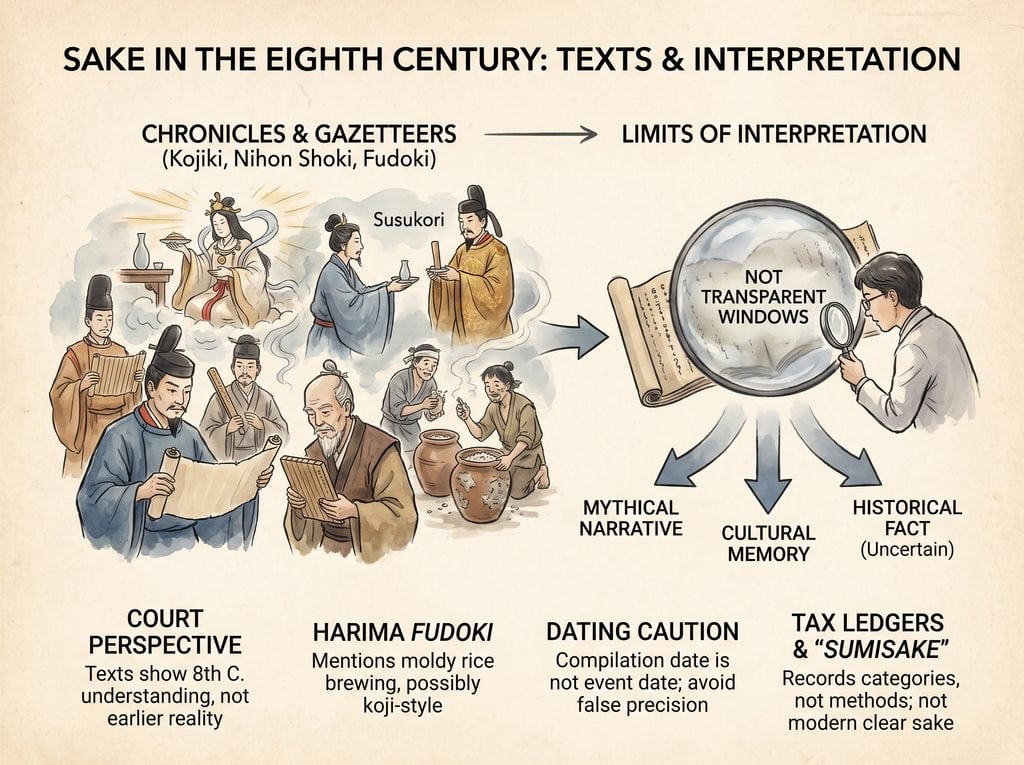
By the eighth century the documentary picture becomes much richer. The Kojiki, completed early in the century, and the Nihon Shoki, finished shortly after, contain stories where alcohol appears in divine, heroic, political, and ceremonial settings. One episode names Susukori, a brewer said to have come from the continent, presenting sake to the emperor. Meanwhile the provincial gazetteers known as the Fudoki preserve regional traditions, place-name explanations, and local products.
Literate court society produced these works. In short, they show how alcohol was understood by the people who wrote or transmitted the texts. They are not transparent windows onto much earlier events.
Mythic narratives are especially awkward as brewing evidence. A tale involving a deity, a feast, or a miraculous drink may capture cultural attitudes without proving that any particular recipe existed in the era the story describes.
The Harima no Kuni Fudoki
One passage appears in almost every sake history. The Harima no Kuni Fudoki, compiled around 716, records that rice offered to a deity became moldy, and that people then used it to brew sake for a feast. Japan’s National Tax Agency accordingly treats this as the earliest written trace of koji-style brewing.
Read closely, the tone is casual rather than astonished. Mold and brewing sit in the same breath, which hints at a familiar practice rather than a discovery. That is an inference, though, not a statement in the text.
Dating needs care here too. The date of an event, the date of a tradition, and the date of a surviving manuscript are three different things. Conflating them produces false precision.
This is not pedantry. A great deal of confusing writing about early sake comes from treating a compilation date as an event date, or a legendary episode as a production record.
Other gazetteers add their own material. A surviving fragment of the Tango no Kuni Fudoki tells of a heavenly maiden who brewed sake, while the Osumi fragment describes chewing. Read side by side, the Fudoki preserve at least three different pictures of where sake came from. None of them agrees with the others, and that disagreement is itself informative.
Tax Ledgers and the Word Sumisake
Provincial tax ledgers from the Nara period also list several drinks by name. One uses characters now read as seishu, sometimes rendered sumisake and taken to mean a clearer beverage. Industry timelines occasionally treat such references as an early milestone toward clear sake.
That interpretation deserves a caveat. A term translated as “clear” certainly does not imply modern filtration, polishing, stability, or legal seishu standards. Ledgers record volumes and categories, not methods, so we know the vocabulary of early sake far better than its technique.
Above all, these sources show a drink becoming an object of written knowledge. Officials could name it, categorize it, allocate it, and tie it to institutions. That shift toward paperwork prepared the ground for the detailed court regulations of later centuries.
When Did Koji Enter Sake Brewing?
Why Koji Changed Everything
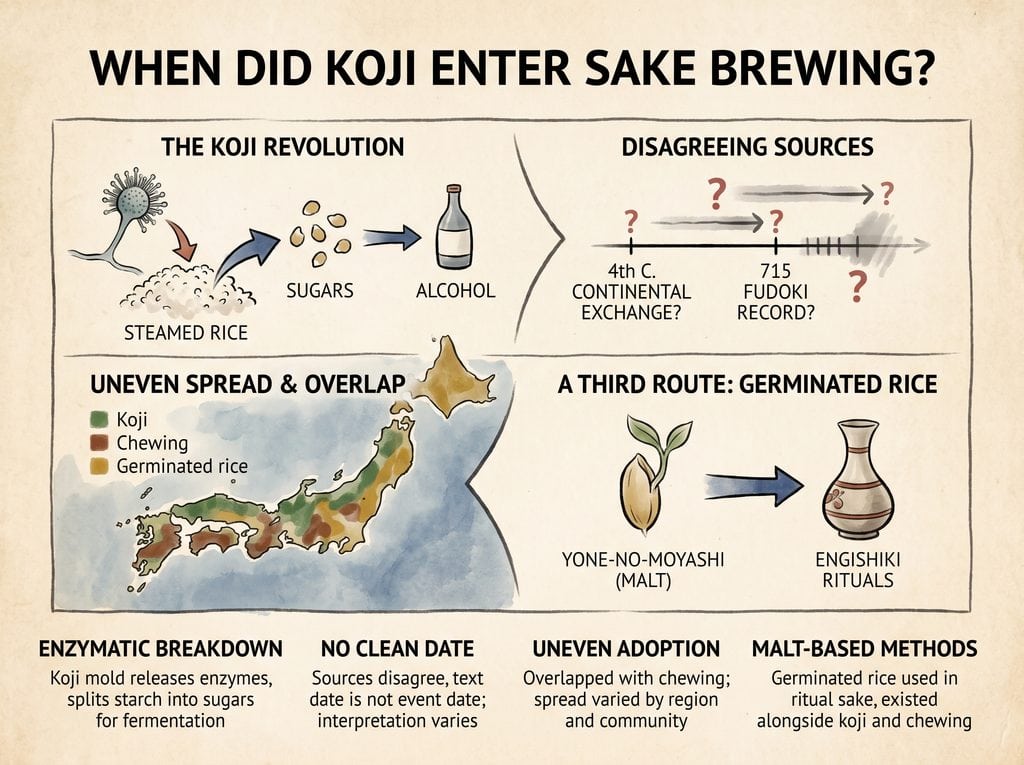
Koji solved the central problem of rice brewing. Rice is mostly starch, and yeast makes alcohol from sugars, so something must break that starch down first. Brewers therefore make koji by growing koji mold, principally strains of Aspergillus oryzae, on steamed grain. The mold produces enzymes that split starch into sugars and also act on proteins and other components.
In modern brewing, koji and yeast work inside the same mash at the same time. Enzymes release sugars while yeast converts them, a pattern brewers call multiple parallel fermentation. Our explanation of sake fermentation covers how brewers manage that balance today.
Sources That Do Not Quite Agree
So when did the technique arrive? There is no clean answer, and the disagreement is instructive.
Some histories associate mold-based brewing with a much earlier period, sometimes around the fourth century, linking it to continental exchange. Others emphasize the eighth-century written evidence, particularly the Fudoki. The Japan Sake and Shochu Makers Association timeline, for instance, flags 715 as an early record of brewing with mold.
These dates are not describing the same thing. One may mark a proposed period of introduction, another a traditional association, and yet another the date of a surviving document. Forcing them into a single chronology creates a tidiness that the evidence does not support.
Notice also what the 715 marker really is. It points to a text, not to a brewery, and the text itself was compiled from provincial reports gathered over years. Treating it as a technological start date asks far too much of one document.
Evidence for early koji-based brewing is read differently depending on the source, the dating method, and whether a claim concerns the introduction of a technique or its earliest surviving documentation.
Uneven Spread, and What Early Koji Was Not
One new method rarely replaces all older ones at once. Brewing knowledge would have spread unevenly across court centers, migrant communities, temples, shrines, and farming villages. Similarly, ingredients and skills varied from valley to valley. Ingredients and skills differed from place to place.
Koji’s real significance lies in scale rather than in any neat date. Compared with chewing, mold-based saccharification could process far more grain without every portion passing through someone’s mouth. Skilled producers could also select grain, prepare it, encourage mold growth, and fold it into a planned cycle.
Early koji was clearly not the standardized tane-koji of today. Modern production depends on specialized cultures, sanitation, measured temperatures, and selected yeast, as our guide to how sake is made describes. Ancient brewers had almost none of that. What they built instead was the technological foundation everything later rested on.
It also seems likely that mold-based and chewing-based methods overlapped for a long time. New techniques rarely arrive with a clean switchover, especially across a mountainous country with limited communication.
A Third Route: Germinated Rice
Chewing and mold were not the only options available. A third route used germinated grain, and it left a clear trace in the ritual record.
Provisions in the Engishiki describe sake for the Niiname harvest rites made from cooked rice, water, and an ingredient written with the character 糵, read yone-no-moyashi or kamutachi. The word means germinated rice, a malt rather than a mold culture. Sprouting grain generates its own enzymes, and although rice malt is much weaker than barley malt, brewing with it works.
That mixture then fermented in a jar for around ten days and came out thin. Passed through a sieve, it became shiroki, the white sake. Adding ash from the kusaki plant afterwards produced kuroki, the black sake. Both still appear at the Niiname-sai and at the Daijosai accession rites.
A caveat belongs here. The Engishiki dates to 927, well after the period this article covers. Many researchers read the passage as preserving an older ritual form, which would place malt-based saccharification alongside chewing and koji rather than neatly after them.
Ancient Sake and the Imperial Court
Brewing Becomes Administration
By the late seventh and eighth centuries, sake production was moving into the machinery of the state. A centralized court needed food, clothing, rituals, offices, taxes, and, above all, systems for gathering and redistributing farm produce. Sake entered that world because ceremonies, banquets, offerings, and official hospitality all required it.
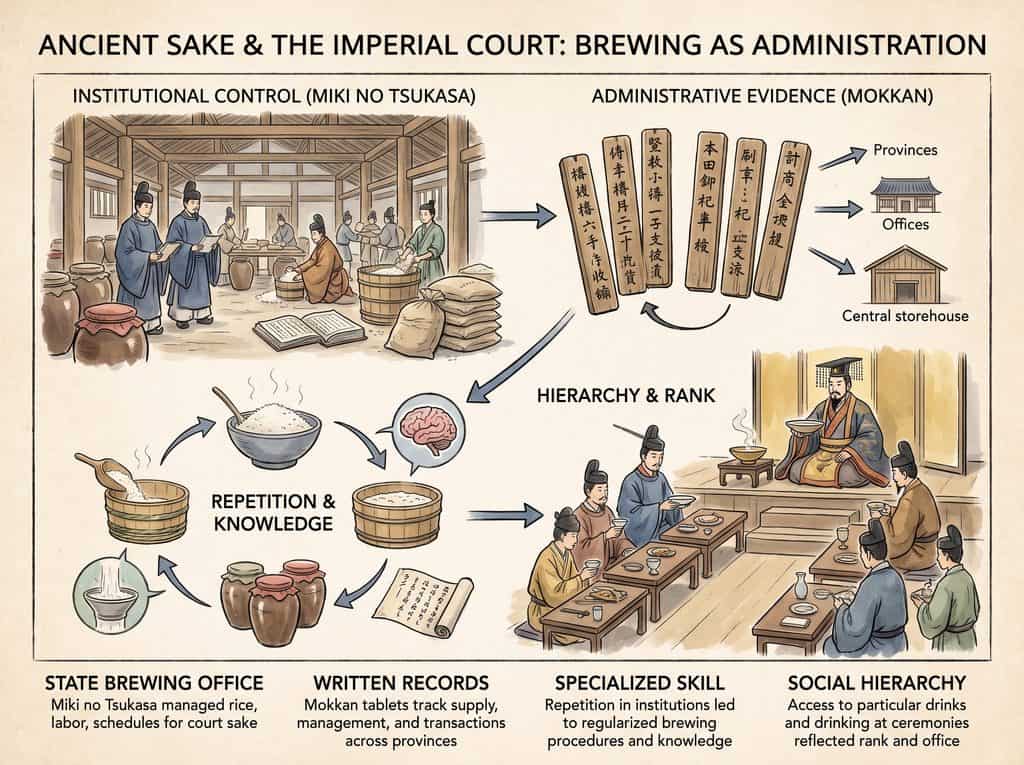
A brewing office known as the Miki no Tsukasa (造酒司), also read Sake no Tsukasa, supervised alcohol for the imperial court. The Japan Sake and Shochu Makers Association dates a court brewing division to 689, while the NRIB places significant organization in the Nara period.
An office does not mean the court controlled all brewing. Households and villages kept making their own drinks. What the office demonstrates is that sake had become important enough to need specialists at the political center.
Written evidence is not limited to chronicles, either. Wooden tablets, known as mokkan, survive in large numbers from Nara sites, and recent scholarship reads them specifically for sake. A 2025 study in the journal Nihon Rekishi, for example, uses them to trace supply and management, following rice and drink between provinces, offices, and the capital.
Those tablets add something the chronicles cannot. They are administrative scraps rather than literary compositions, so they record ordinary transactions that nobody meant to preserve.
Knowledge, Rank, and Repetition
Official production meant managing rice, labor, schedules, containers, and finally the allocation of finished drink. It also meant differentiating by purpose. A beverage for an offering, for instance, did not need the same qualities as one for a banquet or a seasonal rite.
Repetition inside an institution produces knowledge. Clerks could log quantities, experienced brewers could pass on what worked, and procedures therefore grew steadily more regular. Brewing shifted from occasional household experiment toward occupational skill.
Sake expressed hierarchy as well. Gathering the rice and labor took resources, and access to particular drinks reflected rank, office, or closeness to the throne. Drinking at a state ceremony was never simply personal. It signaled a place in an ordered political world.
None of this made sake a luxury product in the modern sense. It circulated as an obligation and an entitlement rather than a purchase, and the commercial trade that later defined the industry lay centuries ahead.
Sake and Religion in Ancient Japan
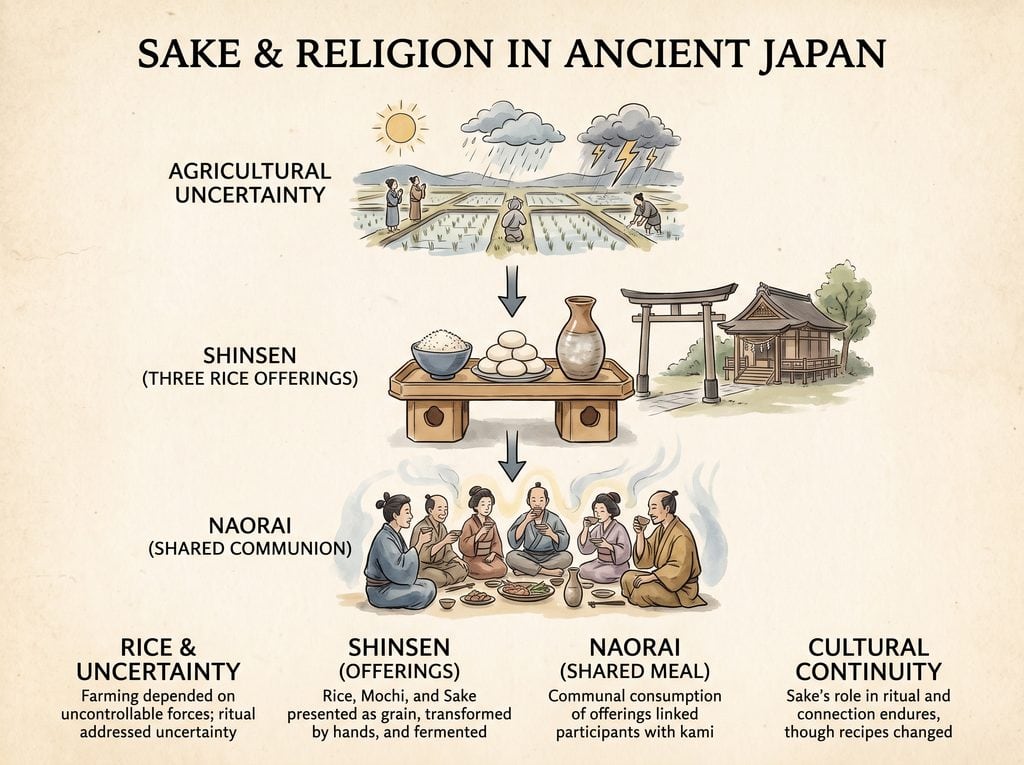
Rice, Offerings, and Naorai
Ancient sake cannot be understood only as a drink. It also worked as a ritual substance.
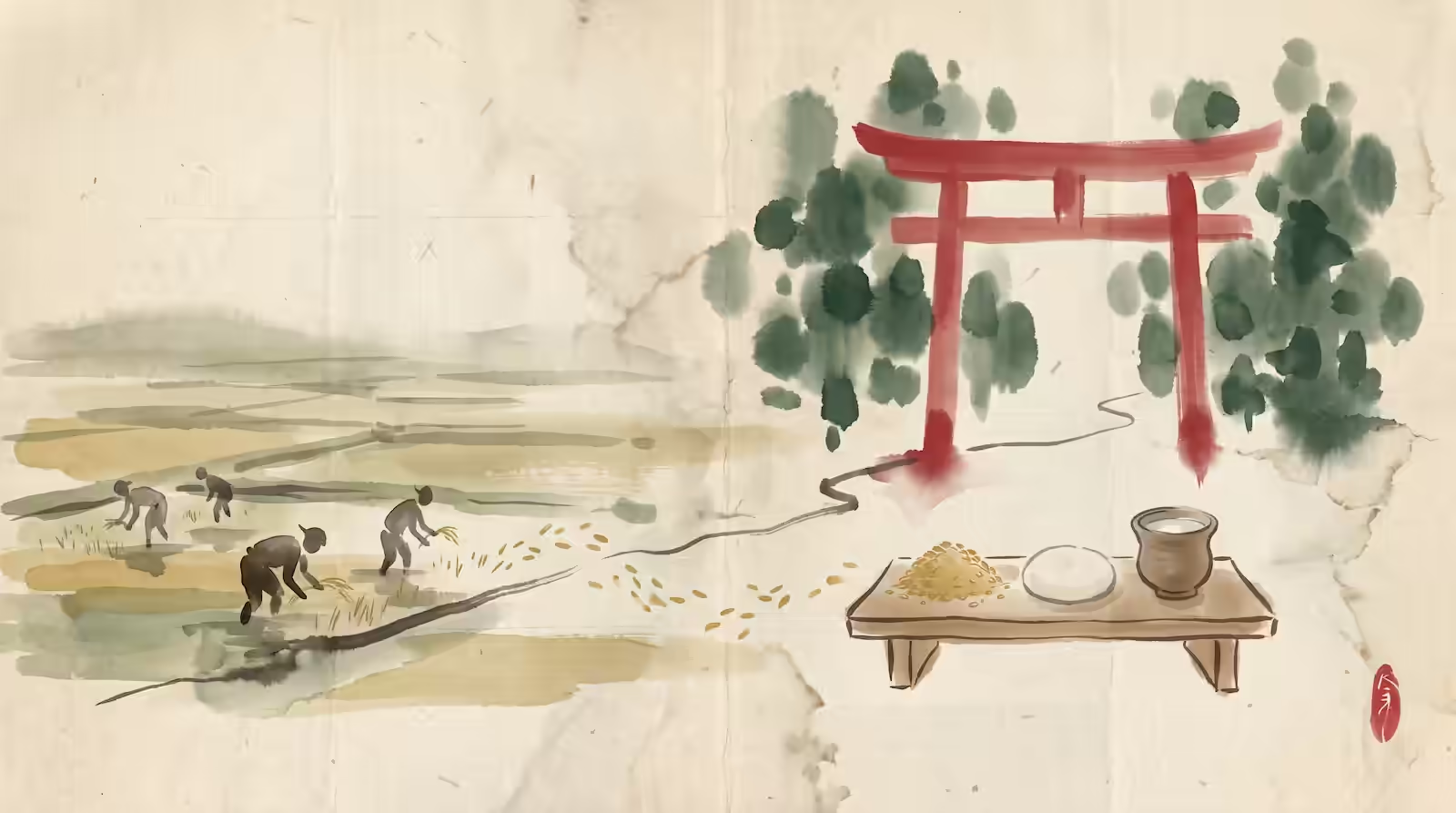
Rice farming depended on forces nobody could control, including rain, temperature, water supply, pests, and storms. Ritual therefore gave communities a way to address that uncertainty and to mark the agricultural year. Because rice stood for the harvest itself, turning rice into sake produced an unusually valuable offering.
Shinsen: The Three Rice Offerings
- Rice, presented as grain, standing for the harvest and the labor behind it
- Mochi, pounded rice cake, the harvest transformed by human hands
- Sake, rice transformed again through water, time, and fermentation
After the offering came naorai, the shared meal in which participants consumed part of the offering. In effect, eating and drinking with the kami turned a ritual act into a communal one.
Continuity of Meaning, Not of Recipe
It would be careless to treat Shinto as a single fixed system across all of antiquity. Local practices varied widely, and the institutions now associated with Shinto developed over centuries. Buddhism also grew increasingly influential from the sixth century, interacting with court and local traditions.
Even so, sake’s place in offerings, festivals, weddings, and funerals proved remarkably durable. Modern official descriptions still identify it as central to those occasions.
The continuity is cultural rather than technical. A ceremonial sake today is likely clear, pasteurized, and commercially brewed. An ancient one, by contrast, would share almost none of those qualities. Such a drink may well have been cloudy, and brewers may have prepared it for a single event. What links them is the idea that sake mediates relationships, between people, between households, and between a community and the sacred.
What Did Ancient Sake Taste Like?
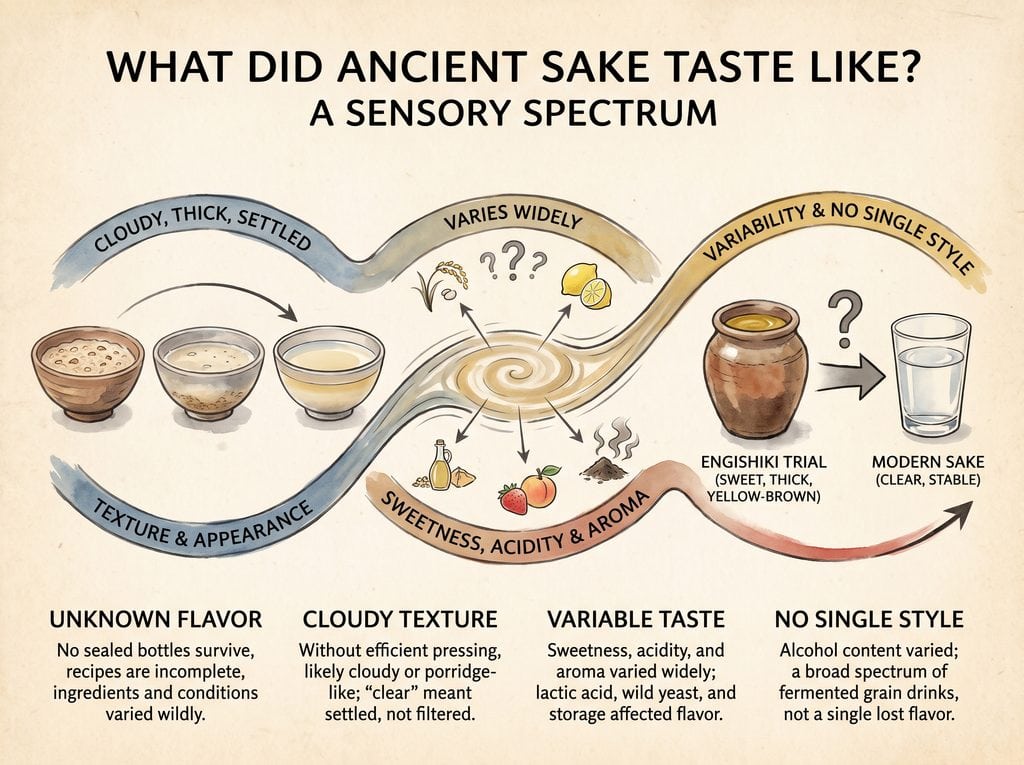
Nobody knows, and any confident answer should raise suspicion. No sealed bottle survives from the Yayoi period with a verified recipe. Written sources likewise give little of the production detail needed to reconstruct flavor. Even where ingredients appear, differences in rice, water, microorganisms, vessels, and temperature would produce wildly different results.
Texture and Appearance
Without efficient pressing, most early rice drinks were probably cloudy or porridge-like. Some went down with rice solids suspended throughout. Others could have been left to settle, so that a clearer portion could be drawn off the top.
That settling trick requires no equipment at all, which is partly why “clear” in an ancient text tells us so little. Clearer than the mash beneath it is not the same as clear in the modern sense.
Sweetness, Acidity, and Aroma
If saccharification outpaced fermentation, sugar would remain and the drink would taste sweet. Similarly, a short fermentation or sluggish yeast could leave sugar behind. Yet a longer or more vigorous fermentation would consume that sugar, so sweetness was hardly universal.
Naturally occurring lactic acid bacteria could add acidity. Controlled acidity later became a deliberate protection for sake fermentation, but uncontrolled activity would produce sharp, sour, or simply unstable flavors. Aromas would have varied just as much, from fruity and cereal-like to earthy, smoky, or frankly unpleasant.
Storage would have compounded all of this. Without heat treatment or sealed vessels, a drink kept changing after fermentation ended. What people drank probably depended a great deal on how soon after brewing they got to it.
One experiment offers a partial glimpse. A 1987 article in the Journal of the Brewing Society of Japan, for example, reported trial brewing based on recipes recorded in the Engishiki. The result came out sweet, thick, and yellowish-brown, in other words nothing like a modern glass of sake.
Treat that gently, though. The trial used cultured yeast and added lactic acid, and the author acknowledged it was not a full reconstruction. It shows only what those written ratios can produce with modern tools. It does not tell us what anyone actually drank.
Strength and Refinement
Alcohol content almost certainly varied. Some drinks may have been weak, and people probably drank them soon after fermentation. Others could have reached a more substantial strength where saccharification and yeast activity ran well together.
Any single figure quoted for “ancient sake” as a whole would therefore mislead. There was probably no one ancient style at all. Picture a broad spectrum of fermented grain drinks rather than a single lost flavor waiting for someone to recreate it.
Ancient Sake Was Not Modern Nihonshu
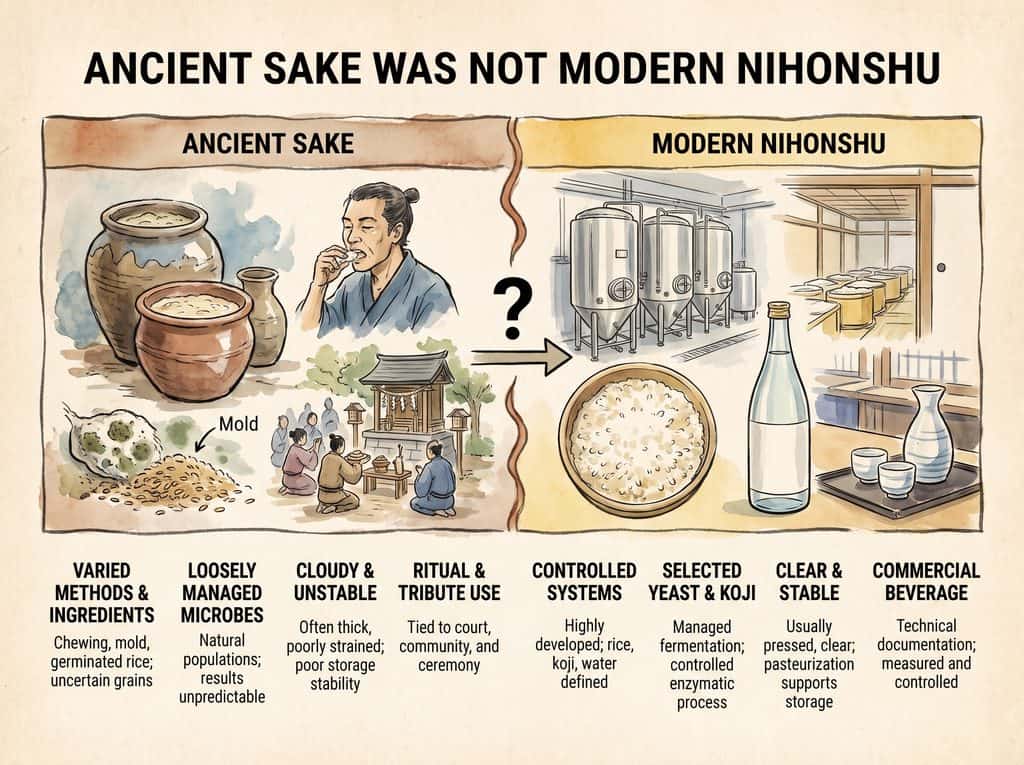
The gap between the two is not simply a matter of quality, though. It reflects different technologies, institutions, vocabulary, and purposes.
| Ancient sake | Modern nihonshu |
|---|---|
| Methods varied by period and place | Production follows highly developed brewing systems |
| Ingredients often uncertain | Defined ingredients: rice, rice koji, water, permitted additions |
| Saccharification by chewing, molded grain, or germinated rice | Rice koji performs controlled enzymatic saccharification |
| Natural microbial populations, loosely managed | Selected yeast and managed microorganisms |
| Often cloudy, thick, or only partly strained | Usually pressed and presented as a clear liquid |
| Alcohol content variable and undocumented | Alcohol content measured and controlled |
| Knowledge passed on orally or through scant records | Technical, scientific, and legal documentation exists |
| Tied to ritual, tribute, court, and community use | A commercial beverage as well as a ceremonial one |
| Storage stability was poor | Pasteurization, refrigeration, and packaging support stability |
Some ancient drinks carried names translated as clear sake, black sake, white sake, or sweet sake. Each label needs reading in its original context rather than through modern product categories.
Real continuity does exist. Ancient producers, after all, learned to transform grain using water, enzymes, microorganisms, and time. Ritual gave sake cultural authority, and court offices organized its production. Later temple, shrine, and commercial brewers built on those foundations. Continuity, however, does not require identity.
Rice, Water, and Vessels in Ancient Brewing
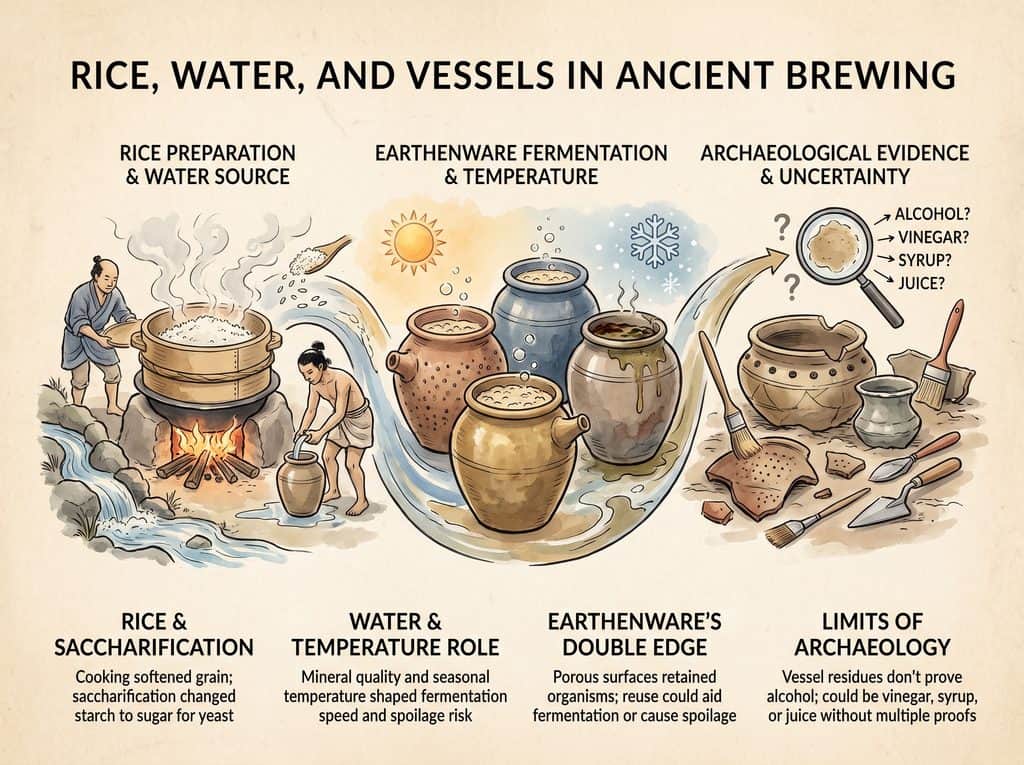
The Basic Relationships
Someone had to prepare the rice before its starch became accessible. Cooking or steaming first softened the grain and changed the structure of that starch. Saccharification then produced sugars, and yeast turned those sugars into alcohol and carbon dioxide.
Water took part at every stage, whether washing grain, cooking it, adjusting a mash, or cleaning vessels. Modern brewers know that minerals and microbial quality affect fermentation. Ancient brewers, meanwhile, could observe that some springs gave better results without ever knowing why.
Temperature mattered too. Warmth sped up microbial growth while also inviting spoilage, and cool conditions slowed everything down. Climate, storage, and available labor would therefore have shaped when brewing happened.
What We Can Say About Vessels
Caution belongs here more than anywhere. Ancient Japan used earthenware widely for cooking, storage, transport, serving, and ritual. Some vessels could certainly have held fermenting grain. Nevertheless, their general presence does not make every excavated jar a brewing vessel.
To connect a vessel with brewing, researchers look at context: where it was found, residues inside it, associated tools, its shape, signs of heating, and comparison with documented practice. Without that, identification stays speculative.
Earthenware also had a double edge. Porous surfaces were nearly impossible to sterilize, so they retained organisms, flavors, and residues. Reuse might therefore preserve a successful microbial community, or ruin the next batch entirely.
Wood became hugely important to Japanese brewing later, particularly for large tubs and barrels. Projecting that technology back into antiquity would be a mistake, since the NRIB associates large wooden vats and high-volume production with much later change. A modern sake brewery looks nothing like an ancient brewing space.
Candidates have been proposed for decades. Perforated-rim jars from the Jomon period, sometimes found near wild grape seeds, have featured in brewing arguments since the 1970s. Spouted vessels, steamers, and Sue ware jars enter the discussion for later periods, along with ink-inscribed pottery and wooden tablets.
None of that settles anything on its own. A 2016 review of plant archaeology makes the methodological point bluntly. Finding grain or fruit remains inside a vessel does not prove alcohol, because vinegar, syrup, and juice fit the same evidence. Choosing between them takes several independent lines of proof at once.
Ancient Sake in Everyday and Ritual Life
Occasions That Left a Record
One of the earliest glimpses of alcohol in Japan is a funeral. The third-century Chinese account places drinking alongside mourning and communal behavior, which tells us that alcohol already carried social meaning.
At agricultural festivals, sake could mark planting or harvest. Offering part of the crop in transformed form acknowledged the forces believed to sustain the fields, and sharing the drink afterward redistributed that value among the participants.
At court, similarly, drinking belonged to hospitality, banquets, and ceremonies of rank. Who poured, in what order, and for whom could all express hierarchy quite precisely.
The Silence of Ordinary Life
Everyday drinking is far harder to document. Elite and ritual records survive more often than the routine habits of ordinary households, so the absence of descriptions proves very little.
Alcohol may also have featured in marriage or alliance rituals, though specific claims need evidence from the relevant period. Nobody should treat modern ceremonial customs automatically as unchanged survivals from prehistory. Sake culture in Japan has kept shifting, as our overview of alcohol in Japan shows for the modern era.
Ancient sake therefore occupied overlapping worlds at once: household production, harvest festivals, funerals, offerings to kami, court ceremony, political hospitality, and local traditions that nobody ever wrote down. Its meaning depended entirely on context.
From Ancient Sake to Organized Brewing
No single sequence applied everywhere. At the political center, though, a broad pattern is visible.
- Early rice alcohol, produced locally and irregularly
- Written references showing that drinking mattered socially
- Documented use of mold-affected grain in brewing
- Court organization of production and supply
- The Miki no Tsukasa and specialized brewing staff
- Detailed court procedures recorded in writing
- Temple, shrine, and private brewing traditions
Each step represents a different kind of development. Rice alcohol shows that communities could transform grain. Written references show social visibility. Mold-based brewing represents a saccharification technology. Court organization gathered labor and resources, while written procedures finally made that knowledge transmissible.
Much of what defines sake today was still missing. Commercial breweries, deep rice polishing, pressing systems, heat treatment, large wooden vats, scientific yeast selection, and modern taxation all belong to later periods.
Evidence, Interpretation, and Tradition
The origins of sake get clearer once you sort claims by the kind of support behind them.
Documented
- A third-century Chinese account describes alcohol consumption in Wa
- Eighth-century Japanese texts contain stories and descriptions involving sake
- The Harima no Kuni Fudoki links mold-affected offering rice with brewing
- The court developed an office responsible for sake production
- Nara-period tax ledgers name several categories of drink
These points still need interpretation. Anyone can at least verify that the sources exist.
Inferred
- Rice agriculture made rice-based alcohol more feasible
- Stored surplus supported larger or more regular brewing
- Ancient drinks were generally less refined than modern seishu
- Alcohol content and flavor probably varied a great deal
- Brewing knowledge spread unevenly between regions
Each conclusion is reasonable. None of them is a quotation from an ancient brewer.
Traditional or Legendary
- A divine story explains the invention of sake
- Kuchikamizake was unquestionably the first Japanese sake
- One named individual introduced brewing to the whole country
- A single date marks the start of koji brewing everywhere
Traditional material is genuinely valuable. It reveals how later communities thought about alcohol, ancestry, purity, gender, and technology. Its worth certainly does not depend on every detail being literally true. Overall, good history keeps these three categories apart without dismissing any of them.
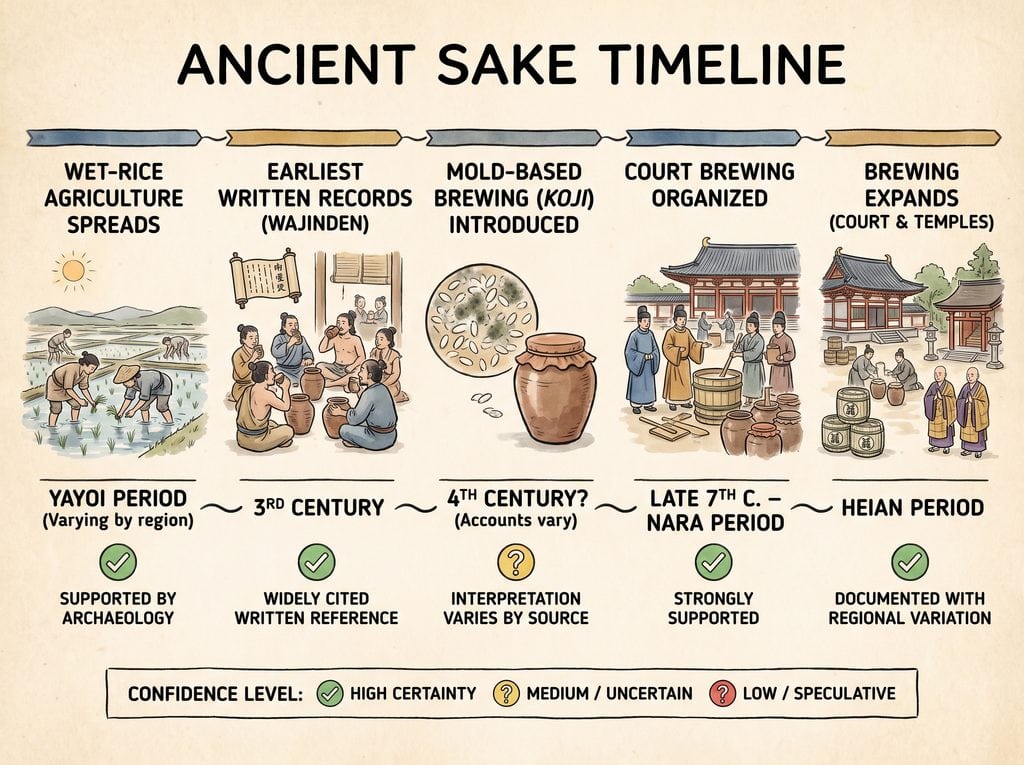
Ancient Sake Timeline
This timeline states its own confidence level, because certainty differs sharply from one line to the next.
| Approximate period | Development | Confidence |
|---|---|---|
| Yayoi period, varying by region | Wet-rice agriculture spreads through the archipelago | Supported by archaeology and historical research |
| Yayoi period | Communities may have produced rice-based alcohol | Plausible, methods and dates uncertain |
| Third century | Chinese records describe drinking among the people of Wa | Earliest widely cited written reference |
| Fourth century in some accounts | Mold-based brewing may have developed or arrived | Interpretation varies by source |
| Late seventh century | Institutional histories link a court brewing division to the administration | Recorded in institutional histories |
| Around 716 | The Harima no Kuni Fudoki links moldy offering rice with brewing | Documented, though the text needs careful reading |
| Nara period | Court production grows more organized and better recorded | Strongly supported |
| Heian period | Court procedures, temples, and shrines expand brewing | Documented, with regional variation |
Read it as a set of overlapping developments rather than a single march forward. Different drinks and methods almost certainly coexisted for centuries.
The confidence column matters as much as the dates. Two entries here rest on a single interpreted passage, and one reflects a tradition rather than a document. Any timeline that presents all of these with equal certainty is quietly overstating its case.
Common Misconceptions About Ancient Sake
Six claims turn up constantly in English writing about early sake. Each deserves a correction.
- Ancient sake was basically today’s sake. Early drinks varied enormously, and most were less refined, less controlled, and far more closely tied to local or ritual production.
- Kuchikamizake was definitely the first sake. It shows a plausible early route from starch to sugar. Nothing establishes it as the first rice alcohol made anywhere in Japan.
- Sake was invented on a specific date. It developed through agricultural, microbial, technological, and institutional change. No surviving record supplies a reliable invention year.
- Ancient sake was always clear. Some sources distinguish clearer drinks, yet many were probably cloudy, thick, or only roughly separated by settling.
- The oldest written record dates the invention. A record proves a practice existed by the time of writing. It says nothing about when that practice began.
- Koji brewing appeared everywhere at once. Knowledge spread unevenly. Villages, the court, and religious institutions adopted and refined techniques at different times.
Final Thoughts
The story of ancient sake is less about finding a first sake than about watching rice, fermentation, ritual, and knowledge gradually converge.
Rice farming supplied a valuable fermentable resource, though it did not automatically produce sake. Kuchikamizake demonstrates one workable method of turning starch into sugar, yet nobody can identify it with certainty as Japan’s first. Early koji dates vary depending on whether a source discusses introduction, tradition, or surviving documentation.
The third-century Chinese record gives us a firm anchor. Alcohol already carried social and ceremonial weight among communities in the archipelago. Eighth-century chronicles, gazetteers, and ledgers then reveal a more complex world, where sake appeared in myth, ritual, local tradition, and organized production.
Ancient sake was probably diverse. Cloudy or partly clear, sweet or sour, weak or strong, made at home or by court specialists. Nobody can reconstruct much of its flavor or technique, and that uncertainty forms part of the evidence rather than a gap in it.
The next chapter belongs to the Nara and Heian courts. There, brewing grew more systematically organized, recipes became visible in written regulation, and offices such as the Miki no Tsukasa turned ancient fermented drinks into something closer to a tradition.
Frequently Asked Questions About Ancient Sake
What is ancient sake?
Ancient sake is a broad label for alcoholic drinks made in early Japan, especially those based on rice and tied to ritual or the emerging court. It does not describe one standardized beverage. Methods, ingredients, and quality varied by region and by century.
When did sake first appear in Japan?
The date is unknown. Rice-based alcohol may well have existed during the Yayoi period, although no evidence pins down a year. The National Research Institute of Brewing states directly that the beginning of sake making is not known precisely.
What is the oldest written record of sake in Japan?
The earliest widely cited reference sits in a third-century Chinese history describing the people of Wa. It notes drinking in social and funerary settings. Because it records use rather than method, it tells us nothing about how anyone brewed.
Does that record prove sake began in the third century?
No. It proves only that alcohol mattered socially by then. Brewing could have started considerably earlier, and the account gives no way to measure how much earlier. Documentation dates evidence, not origins.
What is kuchikamizake?
Kuchikamizake is a drink made by chewing cooked rice or another starchy food before placing it in a vessel. Enzymes in saliva start converting starch into sugars, and wild microorganisms then ferment them. A fragment of the Osumi no Kuni Fudoki describes the practice.
Was kuchikamizake the first Japanese sake?
Possibly, but the evidence falls short of proving it. Chewing offers a workable early method, and similar practices appear across Asia and the Pacific. Nothing shows that it preceded every other form of rice alcohol in Japan.
How could ancient people ferment rice without equipment?
They prepared grain, then exposed it to enzymes through chewing, mold growth, or germinated rice, added water, and let naturally occurring yeast do the rest. Repeated observation would gradually preserve whatever worked. Understanding the biology was never a requirement.
When was koji first used to make sake?
That depends on what you are dating. Some histories associate koji with the fourth century, while most accounts place the surviving written evidence in the eighth. The Japan Sake and Shochu Makers Association marks 715 as an early record of mold-based brewing, which is not proof that the technique began then.
What does the Fudoki say about sake?
The provincial gazetteers preserve regional traditions involving rice and alcohol. Among them, the Harima no Kuni Fudoki matters most, since one passage connects rice offered to a deity, mold growth, and the brewing of sake for a feast.
Did ancient sake look like modern sake?
Usually not. Many early drinks held rice solids and appeared cloudy or thick. Settling let people draw off a clearer portion, though that sits a long way from modern pressing and filtration.
Was ancient sake sweet or strong?
Both varied widely. Sweetness would remain where saccharification outran fermentation, while a longer ferment consumed the sugar. Modern trials of chewed-rice brewing reached roughly one to five percent alcohol, though that reflects laboratory conditions rather than ancient practice.
Was sake used in religious ceremonies?
Yes, and that role shaped its early value. Worshippers presented rice, mochi, and sake together, then shared them in a communal meal called naorai. Turning precious rice into drink made the offering more significant, not less.
What was the Miki no Tsukasa?
The Miki no Tsukasa, also read Sake no Tsukasa, was the court office responsible for brewing and managing alcohol for the imperial household. Its existence shows that sake mattered enough to justify specialized state administration.
How did ancient brewing lead to modern sake?
Early producers established the core relationships between rice, water, saccharification, fermentation, and skilled labor. Court offices later organized that work, and temples, shrines, and commercial brewers refined it over the following centuries.
References
Government and Institutional Sources
- National Research Institute of Brewing, The Story of Sake, No. 2 (Accessed September 2026)
- Japan Sake and Shochu Makers Association, The History of Japanese Sake (Accessed September 2026)
- National Tax Agency of Japan, Koji Mold and Japanese Alcoholic Beverages, Chapter 2: The History of Japanese Sake (Accessed September 2026)
- Japan’s National Tax Agency, Traditional Knowledge and Skills of Sake-Making with Koji Mold in Japan (Accessed September 2026)
- UNESCO Intangible Cultural Heritage, Traditional Knowledge and Skills of Sake-Making with Koji Mold in Japan (Accessed September 2026)
- Government of Japan, Highlighting Japan: The Techniques and Appeal of Traditional Sake-Making, March 2025 (Accessed September 2026)
Journal Articles
- Yamashita, K., Nishiko, S., Inayama, E. and Yoshida, S., Production Test of Kuchikamizake, Journal of the Brewing Society of Japan, Vol. 88, No. 10, pp. 818 to 824, 1993 (Accessed September 2026)
- Yamashita, K., What Is Kuchikamizake, Part 1, Journal of the Brewing Society of Japan, Vol. 94, No. 1, pp. 38 to 46, 1999 (Accessed September 2026)
- Kageyama, K., Ancient Sake Brewing, Journal of the Brewing Society of Japan, Vol. 82, No. 1, p. 29, 1987 (Accessed September 2026)
- Zhang, K., Wu, W. and Yan, Q., Research Advances on Sake Rice, Koji, and Sake Yeast: A Review, Food Science and Nutrition, Vol. 8, No. 7, pp. 2995 to 3003, 2020 (Accessed September 2026)
- Matsumoto, B., Sake as It Appears in the Fudoki, Journal of the Brewing Society of Japan, Vol. 68, No. 7, pp. 493 to 498, 1973 (print edition, Accessed September 2026)
- Ueda, S., Shitogi and Ancient Sake, Part 2, Journal of the Brewing Society of Japan, Vol. 92, No. 10, pp. 725 to 727, 1997 (print edition, Accessed September 2026)
- Sakurai, K., Japanese Fermented Foods from an Archaeological Perspective, Journal of the Brewing Society of Japan, Vol. 68, No. 4, p. 214, 1973 (print edition, Accessed September 2026)
- Hirooka, T., The History of Sake Seen from Archaeology, Shushi Kenkyu, No. 30, pp. 9 to 18, 2014 (print edition, Accessed September 2026)
- Akashi, C., Ancient Alcoholic Beverages from the Perspective of Archaeobotany, Journal of West Asian Archaeology, No. 17, pp. 75 to 88, 2016 (print edition, Accessed September 2026)
- Mifune, T., Nara-Period Sake Seen Through Mokkan, Nihon Rekishi, No. 920, pp. 2 to 9, 2025 (print edition, Accessed September 2026)
Books and Annotated Primary Sources
- Rath, Eric C., Kanpai: The History of Sake, Reaktion Books, 2025 (Accessed September 2026)
- Akimoto, Y. (trans.) and Tetsuno, M. (rev.), Harima no Kuni Fudoki: Complete Annotated Translation, Kodansha, 2024 (Accessed September 2026)
- Kato, M., Nihon no Sake 5000-nen, Gihodo Shuppan, 1987 (Accessed September 2026)
- Nihon Rekishi Editorial Committee (ed.), Nihonshi no Naka no Sake, Yoshikawa Kobunkan, 2026 (Accessed September 2026)
- Kanzaki, N., Sake no Nihon Bunka, Kadokawa Gakugei Shuppan, 2006 (Accessed September 2026)
- Yoshida, Kindai Nihon no Sakezukuri: Bishu Tankyu no Gijutsushi, Iwanami Shoten, 2013, cited in the National Tax Agency bibliography (Accessed September 2026)
Related Articles
- How Sake Is Made: Step-by-Step Japanese Brewing Guide (Surveyed: September 2026)
- Sake Fermentation: How Sake Is Brewed (Surveyed: September 2026)
- Types of Japanese Sake Explained: Junmai, Ginjo, Daiginjo, and More (Surveyed: September 2026)
- Kura: Inside a Traditional Sake Brewery (Surveyed: September 2026)
- Amazake: Japan’s Sweet Fermented Rice Drink Explained (Surveyed: September 2026)
- Alcohol in Japan: A Complete Guide to Drinks, Culture and Izakaya Prices (Surveyed: September 2026)




Comments