


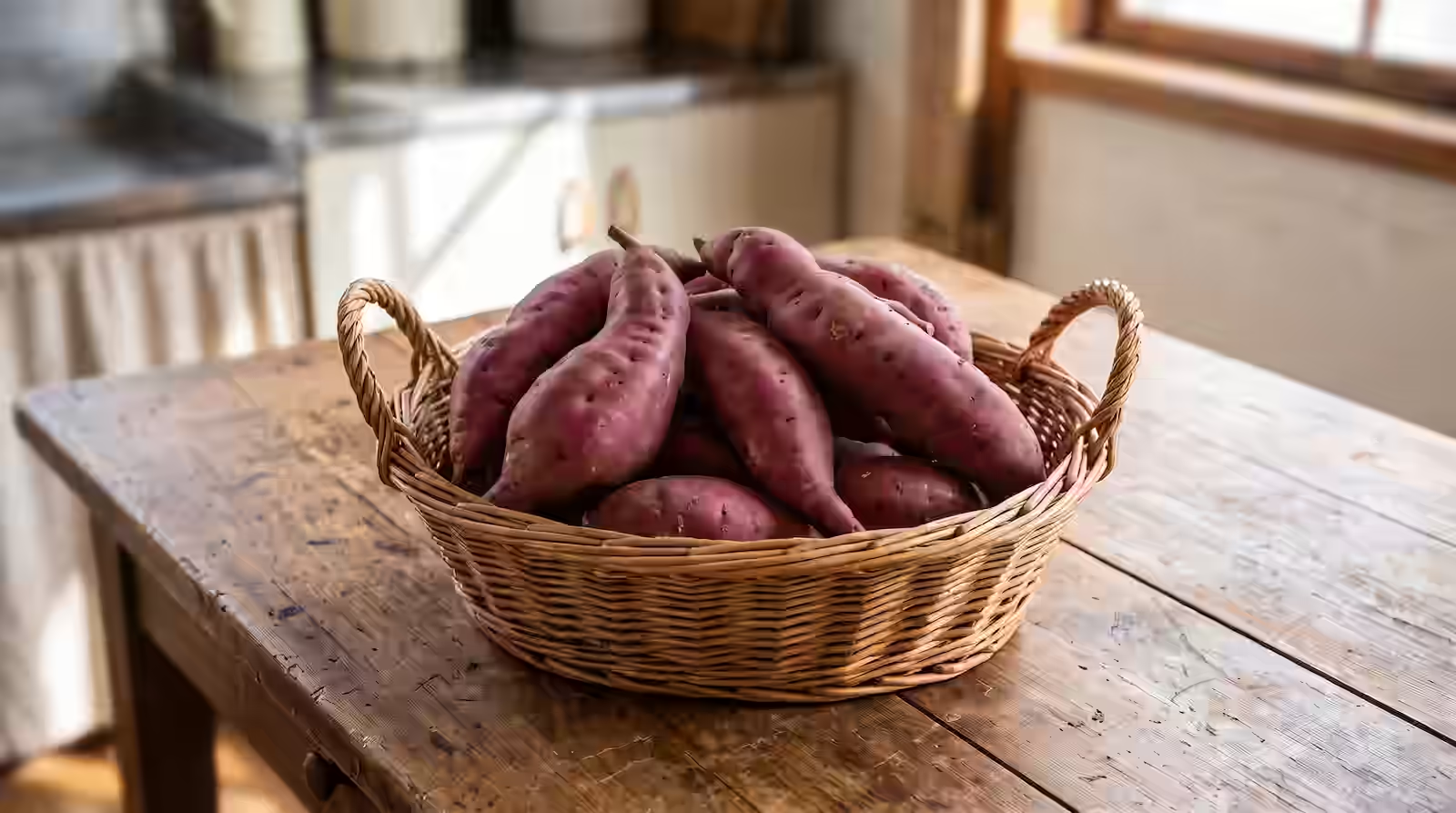

Benikomachi is a Japanese sweet potato cultivar closely associated with Chiba Prefecture. Written 紅小町 in Japanese, it has dark reddish-purple skin and pale yellow flesh. Cooked, it develops a floury, fluffy texture and mild sweetness, a clear contrast to the moist, high-sugar cultivars now common at specialist yakiimo shops. Once a Chiba specialty grown on thousands of hectares, it now comes mainly from one district. That is the Kurimoto area of Katori City, where a roadside station carries its name.
First, this guide explains what Benikomachi is, how it came to be, and why it nearly disappeared. It also covers how it tastes, how to cook it, how it compares with better-known Japanese sweet potatoes, and where a visitor can still find it. This article draws mainly on Chiba Prefecture’s cultivation guidance, national cultivar-area data, official food-composition tables, and local sources from Katori City and Kurimoto.
What Is Benikomachi?
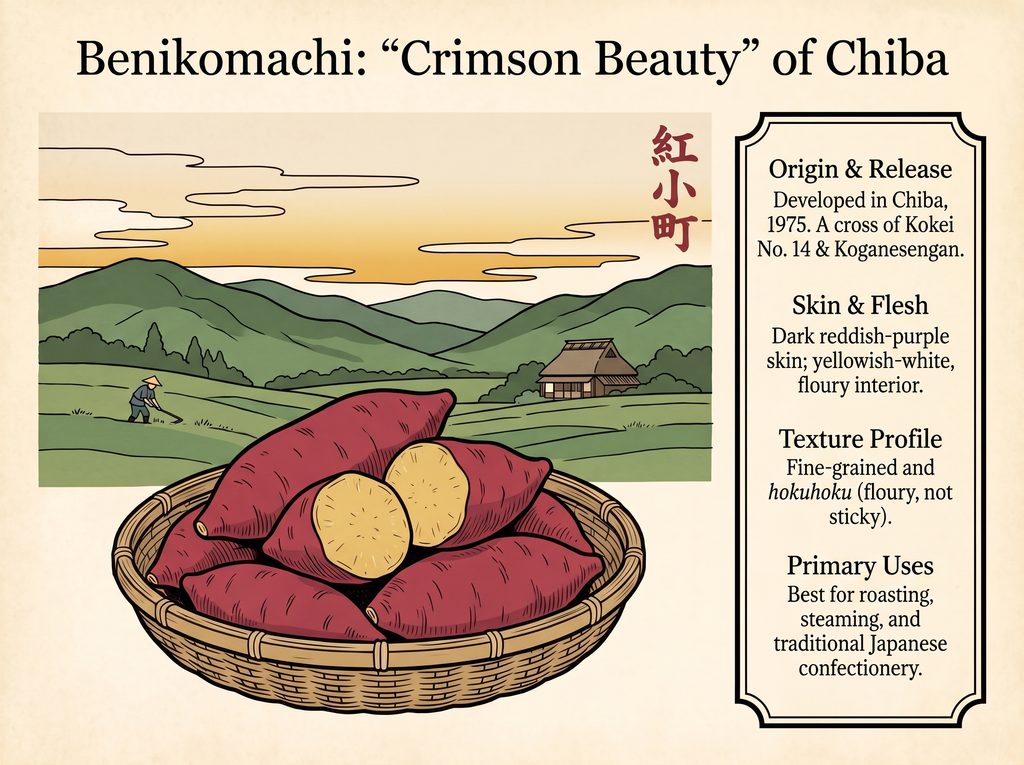
Benikomachi is a table-use cultivar of Japanese sweet potato, or satsumaimo, officially released in 1975 after development through a national breeding program in Chiba Prefecture. Specifically, it crosses Kokei No. 14, the classic western Japanese table cultivar, with Koganesengan, a major cultivar for sweet potato shochu. As a result, it is a slim, red-skinned root with fine-grained, floury flesh that Chiba’s cultivation manual describes as suited to Japanese and Western confectionery.
Quick Facts
- Japanese Name
- 紅小町 (Benikomachi, also written Beni Komachi); listed as ベニコマチ in official tables
- Type
- Table-use sweet potato cultivar (Ipomoea batatas)
- Parents
- Kokei No. 14 (seed parent) and Koganesengan (pollen parent)
- Released
- 1975, as a Norin-registered cultivar from a Ministry of Agriculture research station in Yotsukaido, Chiba
- Skin and Flesh
- Dark reddish-purple skin; yellowish-white flesh
- Texture
- Slightly floury and fine-grained; hokuhoku rather than sticky
- Main Area Today
- Kurimoto district, Katori City, Chiba Prefecture
- Best Known For
- Roasting, steaming, confectionery, kinton, and sweet potato pastes
Name and Classification
Beni (紅) refers to crimson or deep red, reflecting the color of the skin. Komachi (小町) carries a sense of feminine beauty in Japanese, partly through the cultural image of the ninth-century poet Ono no Komachi. The name can therefore be read loosely as “crimson beauty,” although that is an interpretation rather than an official translation. Several Japanese cultivars use the same suffix, including Ayakomachi, an orange-fleshed variety, and Hamakomachi. Meanwhile, in Japanese agricultural tables, the name appears in katakana as ベニコマチ.
Where It Sits Among Japanese Sweet Potatoes
Japan grows dozens of named sweet potato cultivars, and our guide to Japanese sweet potatoes and the many types of satsumaimo introduces the main ones. Benikomachi is an older floury cultivar, similar in texture to varieties such as Kokei No. 14. Newer stars such as Beniharuka and Silk Sweet are moist and intensely sweet. Benikomachi is not. That contrast is exactly why it still has admirers.
What Benikomachi Looks and Tastes Like
Appearance
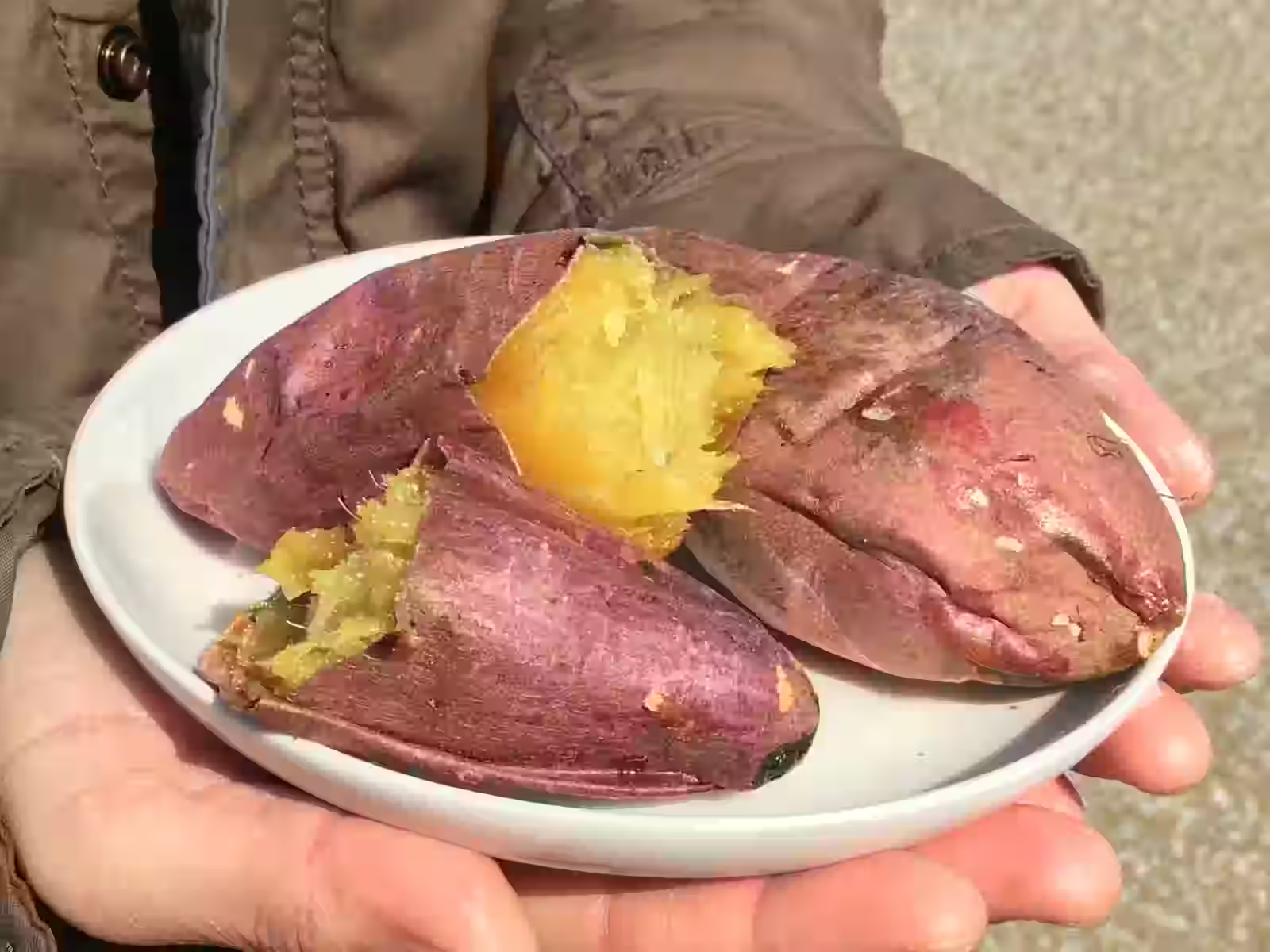
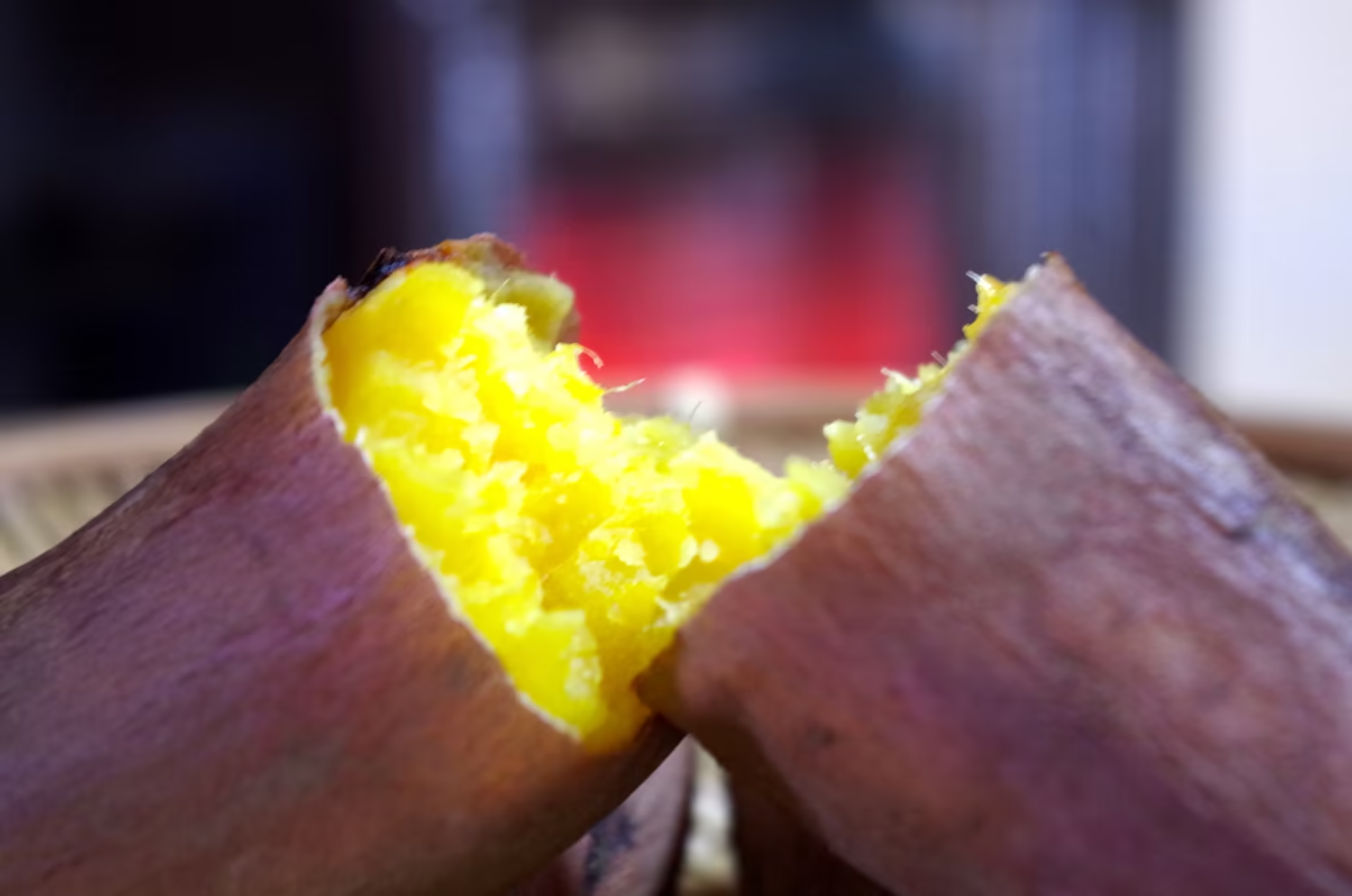
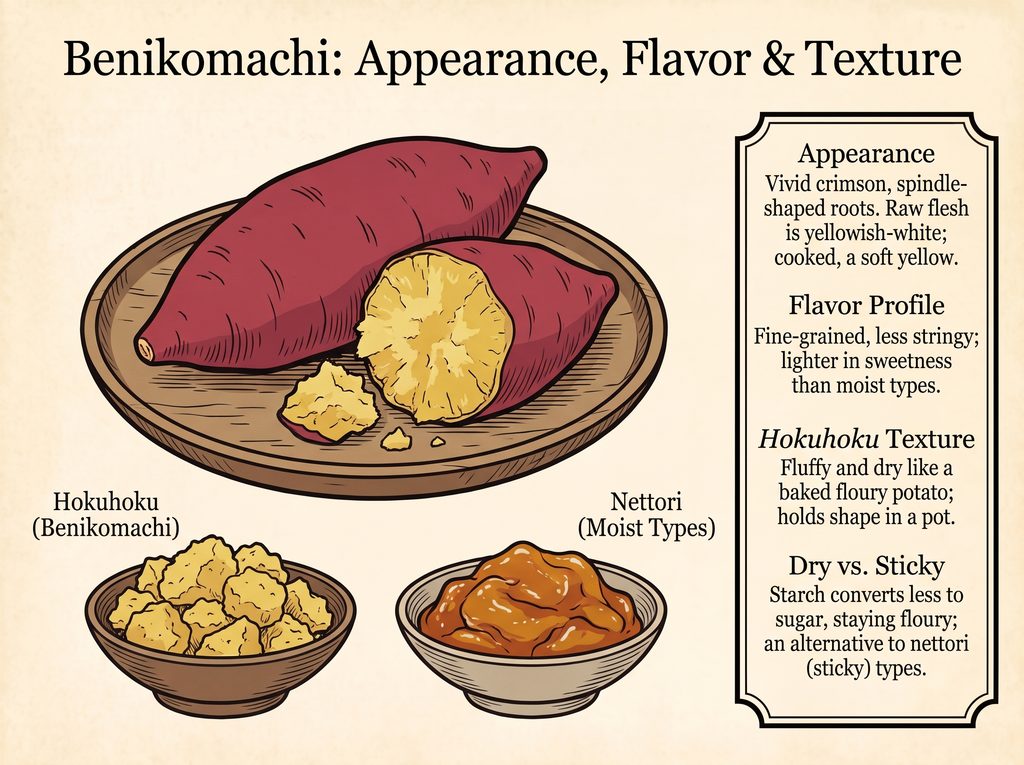
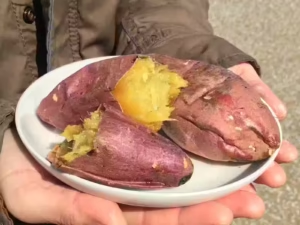
National cultivar tables describe the skin as dark reddish-purple, while the roadside station in Kurimoto calls it a vivid crimson. Roots are spindle-shaped and tend to run long. According to Chiba’s manual, the cultivar sets numerous roots, while individual roots enlarge relatively slowly. Inside, the raw flesh is yellowish white, and then it turns a soft yellow after cooking.
Flavor and Texture
Chiba’s manual rates the steamed flesh as slightly floury and fine-grained, and the roadside station praises its lack of stringiness. Compared with moist cultivars such as Beniharuka, local and prefectural sources present it as lighter in sweetness and less sticky. In practice, that means flesh which breaks apart rather than clinging to the spoon.
Hokuhoku vs Nettori
Generally, Japanese shoppers sort sweet potatoes into two camps. Hokuhoku means fluffy and dry, like a baked floury potato. Nettori, on the other hand, means moist, sticky, and dessert-like. Benikomachi is a hokuhoku potato, so its texture offers an alternative to the moist, high-sugar style now common at specialist yakiimo shops.
Why is it drier? Chiba’s manual explains that a sweet potato’s texture depends mainly on how much starch survives cooking. Cultivars that convert less starch to sugar therefore stay floury. Benikomachi sits at that end of the scale, which also means it holds its shape in a pot. If you prefer the very sticky style, however, you may find it plain.
Benikomachi History and Origin
Bred in Chiba in 1975
Chiba’s cultivation manual records the basics clearly. Benikomachi came from a cross between Kokei No. 14 and Koganesengan, and a Ministry of Agriculture research station in Yotsukaido, Chiba, released it in 1975. A NARO breeding report likewise dates its Norin registration to 1975. National tables also list its breeding line as Kanto No. 82. At the time, Chiba’s table sweet potatoes were mainly Kokei types and the historically important cultivar Beniaka. So a red-skinned variety with cleaner shape and good flavor had obvious appeal.
The Kurimoto roadside station, meanwhile, adds a local detail. According to its history, Chiba’s agricultural extension office brought the new variety to Kurimoto Town in 1968 for trial planting. That was before its official release under the Benikomachi name. The trial may therefore have involved the numbered breeding line, Kanto No. 82, although the local source does not say so. Local farmers evidently liked what they saw. The roots were bright, the flesh was free of fibers, and roasted, the station says, they were superb.
A Chiba Specialty, Then a Steep Decline
For a decade or so, Benikomachi was a real success. National cultivar-area data put it on 2,266 hectares in 1985, about 3.4 percent of Japan’s sweet potato area. Chiba’s manual, meanwhile, calls it a former prefectural specialty alongside Beniaka. Then Beniazuma arrived. Released in 1984, Beniazuma developed marketable roots quickly, resisted soil rot, and performed well in the sandy soils of Kanto. Consequently, its area rose from 1,436 hectares in 1985 to 10,962 hectares in 1990.
2,266 ha
Benikomachi planted area, 1985
22 ha
Benikomachi planted area, 2011
Source: Ministry of Agriculture, Forestry and Fisheries, sweet potato cultivar area data. Beniazuma rose from 1,436 ha in 1985 to 10,962 ha in 1990, and stood at 9,317 ha in 2011. The 2011 figures are the most recent in this series.
Benikomachi went the other way. Its area fell to about 1,040 hectares in 1990, then 220 in 2000, and finally just 22 in 2011. By then it was still on Chiba’s list of recommended cultivars, but in practice only a handful of farms grew it. As of the 2023 manual, production survives only in a small part of the Kurimoto district.
Why It Was Hard to Grow
The manual is blunt about the main cause. Benikomachi is “particularly weak” against Fusarium wilt, a soil-borne fungal disease that Japanese growers call tsuruware-byo, and that weakness is the reason its acreage shrank. It has other drawbacks too. Roots enlarge slowly, the plant sets many of them, and they grow long. Chiba’s manual, on the other hand, rates its storage quality as good. Beniazuma then combined faster root development, stronger market acceptance, and easier cultivation, and those advantages drew growers away.
Why Benikomachi Survives in Kurimoto, Chiba
Kurimoto lies in northeastern Chiba Prefecture, on the Hokuso plateau, inland from Narita Airport and east of Tokyo. It was an independent town until 2006, when it merged with Sawara and two other towns to form Katori City. Older sources therefore call the area Kurimoto Town, Katori District. According to the roadside station, settlers opened much of the district as reclaimed farmland, and sweet potatoes thrived on its poor soil.
How One Town Kept the Variety Alive
While other areas dropped Benikomachi, Kurimoto did the opposite. According to the roadside station’s history, the town worked on selection and growing techniques to protect it. In 1986, Kurimoto launched a “Furusato Imo Matsuri,” a hometown sweet potato festival, complete with a giant roasting ground it billed as the biggest in Japan. A growers’ study group followed in 1993. Then, in 2002, the town opened a roadside station and named it after the potato.
Even here, though, Benikomachi is now a minority crop. In fact, the station’s published account puts it at only about 2 to 3 percent of sweet potato production in Kurimoto. The page gives no survey year, so treat the figure as an approximate local estimate. Across Chiba as a whole, the 2023 manual lists Beniharuka, Beniazuma, and Silk Sweet as the main cultivars. Benikomachi survives primarily as a locally promoted specialty rather than a large-volume crop, which is worth knowing before you go looking for it.
Roadside Station Kurimoto Benikomachi-no-Sato
The station, Michi-no-Eki Kurimoto Benikomachi-no-Sato, sits at Sawa 1372-1 in Katori City. It sells fresh local produce, pork from the area’s well-known Boso Pork brand, and sweet potato products. In autumn, it also runs harvest experiences. If you want to taste Benikomachi in its home district, this is the place to start. Chiba’s official tourism site likewise singles out its fluffy texture and recommends it roasted.
How to Cook Benikomachi
A floury potato calls for slightly different handling than a moist one. Chiba’s cultivation guide explains that slower heating lets more starch turn into sugar, while short, fierce heating leaves the flesh drier and less sweet. Based on that principle, the home methods below use a moderate oven temperature. They are suggestions for a home kitchen rather than official instructions.
Old-Style Yakiimo
First, scrub the root and leave it whole. Then roast at approximately 160°C (320°F) for 60 to 80 minutes, adjusting for the thickness of the root. Benikomachi roots are often slim, so they cook faster than a fat Beniharuka. It is ready when a skewer slides through easily. Split it open, and the flesh should steam and flake rather than ooze. A pinch of salt works well, too. Our guide to yakiimo, Japan’s roasted sweet potato tradition, explains the stone-roasting culture this style comes from.
Steamed, Simmered, and Fried
Because it holds its shape, Benikomachi is a good candidate for dishes where a sticky potato would collapse. For example, steam thick rounds for 20 to 30 minutes and eat them plain, or simmer chunks in dashi and soy sauce. Cut into batons, it also fries well for daigaku imo, the candied sweet potato snack, where its firmer center gives a pleasant bite under the glaze.
Sweets and Pastes
According to Chiba’s manual, confectioners use the fine-grained flesh in both Japanese and Western sweets. Floury cultivars mash into a smooth, dry paste that is easy to shape. That suits kinton, sweet potato buns, and firm confections like imo yokan, the pressed sweet potato jelly. Kurimoto’s station also sells hoshiimo, dried sweet potato slices, although the cultivar behind any given batch is worth asking about.
Simple Recipe
Benikomachi kinton (mashed sweet potato, serves 4)
Ingredients
- 400 g Benikomachi, peeled and cut into rounds
- 2 tablespoons sugar, or to taste
- 1 tablespoon mirin
- A pinch of salt
Steps
- Steam or boil the rounds until a skewer passes through, about 20 minutes.
- Drain well and mash while hot. A floury cultivar mashes almost dry.
- Stir in the sugar, mirin, and salt over low heat for 2 to 3 minutes.
- Shape into small mounds, or squeeze in cloth into chakin shibori twists.
Serve at room temperature. With a moist cultivar, cut the mirin and expect a wetter paste.
Benikomachi vs Other Japanese Sweet Potatoes
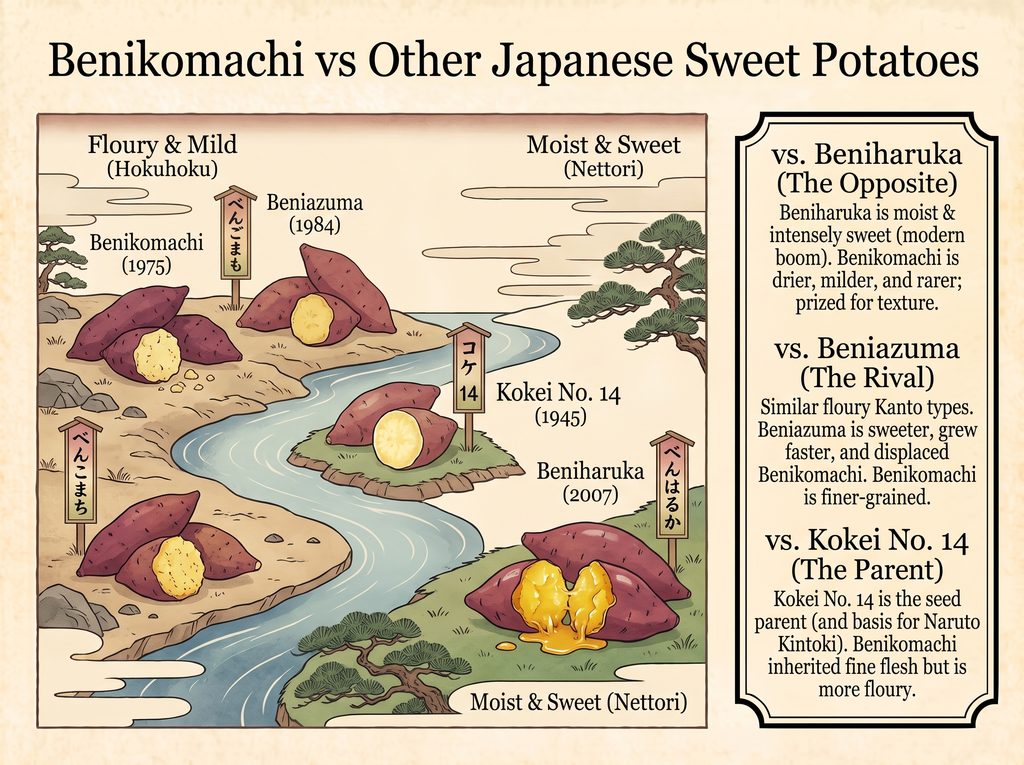
The table below places Benikomachi beside the cultivars a shopper in Chiba is most likely to meet. Descriptions draw mainly on Chiba’s cultivation manual and national cultivar tables. They are relative terms, not laboratory grades, since texture shifts with storage and cooking.
| Cultivar | Released | Texture | Sweetness | Skin and Flesh | Notes |
|---|---|---|---|---|---|
| Benikomachi | 1975 | Slightly floury, fine-grained | Light, clean | Dark red-purple skin, yellowish-white flesh | Stores well; very weak to Fusarium wilt |
| Kokei No. 14 | 1945 | Between floury and moist | Moderate, rises in storage | Steamed flesh bright yellowish-white | Parent of Benikomachi; the genetic basis of regional lines and brands such as Naruto Kintoki |
| Beniazuma | 1984 | Floury | Strong | Red-purple skin, yellow flesh | Replaced Benikomachi in Kanto |
| Beniharuka | 2007 (registered 2010) | Moist, sticky after storage | Very strong | Red-purple skin, yellowish-white flesh | A leading Chiba cultivar in the latest year covered by the prefectural guide |
Benikomachi vs Beniharuka
These two are almost opposites. Beniharuka, the moist, honey-like cultivar behind the modern yakiimo boom, is the one most shoppers meet today. Chiba’s 2023 guide puts it at nearly 40 percent of the prefecture’s sweet potato area, based on cultivar data for 2022. Benikomachi, by contrast, is drier, milder, and far rarer. Is Benikomachi sweeter? Generally no, although sweetness varies with cultivation, storage, and cooking. Its appeal, rather, is texture and restraint.
Benikomachi vs Beniazuma
This is the fairer comparison, since both are floury Kanto potatoes with red-purple skin. Beniazuma, of course, is the one that displaced Benikomachi. Chiba’s manual credits it with fast root growth, easy propagation, strong sweetness, and resistance to soil rot. Benikomachi, by contrast, is finer-grained and less stringy but slower to swell and prone to disease. If you find both, a side-by-side tasting is worth doing.
Benikomachi vs Kokei No. 14
Kokei No. 14 is Benikomachi’s seed parent, and it also underlies regional lines and brands such as Naruto Kintoki, which carry their own local standards. Chiba’s manual places its texture between floury and moist, and notes that its sweetness increases during extended storage. Benikomachi inherited the fine flesh and red skin but leans further toward the floury side. Both, in short, are older-style potatoes that reward patience in the kitchen.
When Is Benikomachi in Season?
In Chiba’s main growing areas, sweet potato harvest runs from late summer to mid-November, and the manual notes that it must finish before the first frost. Kurimoto’s sweet potato festival takes place in autumn, when the new crop is in. Because Benikomachi stores well, though, roots from the roadside station may be available into winter and beyond.
How to Store Benikomachi
Chiba’s manual gives 13 to 16°C with high humidity as the ideal range for sweet potatoes. It also warns that long storage below about 9°C causes chilling injury. At home, that means a cool, dark, airy spot rather than the refrigerator, at least where such a spot exists. Keep whole roots in a paper bag, use damaged ones first, and refrigerate only once they are cut or cooked.
Benikomachi Nutrition
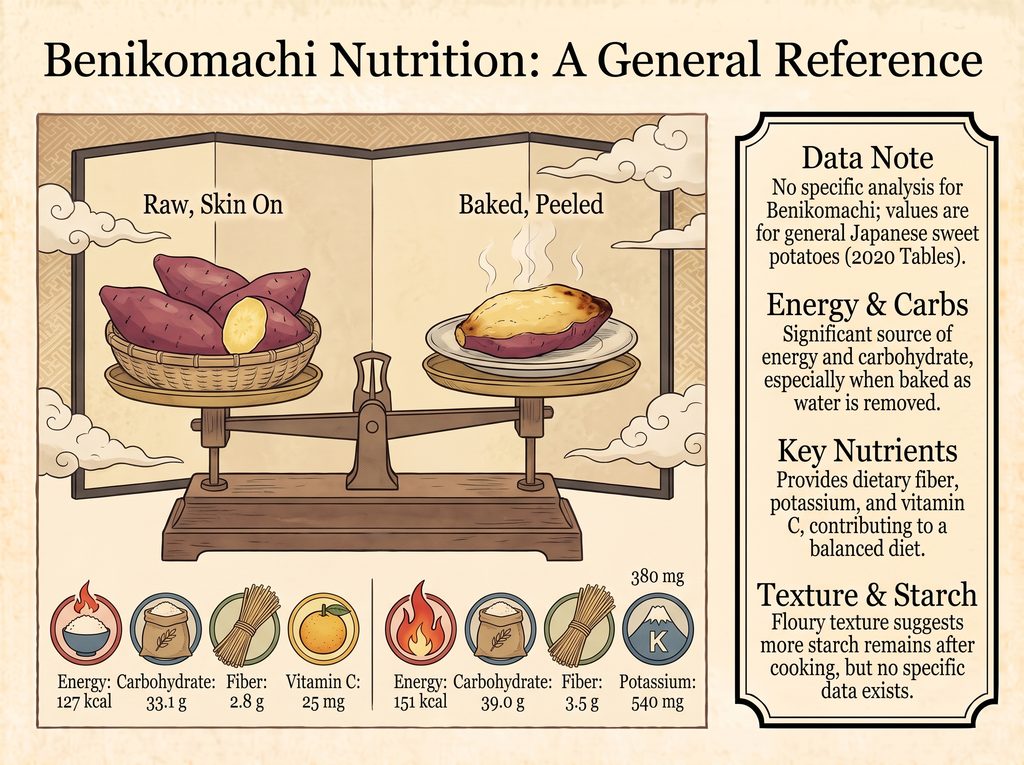
Sweet potato composition varies by cultivar, growing conditions, storage, and cooking. For Benikomachi itself, however, we identified no published analysis. The figures below are therefore for Japanese sweet potatoes in general, from the Standard Tables of Food Composition in Japan 2020.
| Per 100 g | Raw, skin on | Baked, peeled |
|---|---|---|
| Energy | 127 kcal | 151 kcal |
| Carbohydrate | 33.1 g | 39.0 g |
| Dietary fiber | 2.8 g | 3.5 g |
| Potassium | 380 mg | 540 mg |
| Vitamin C | 25 mg | 23 mg |
Values are per 100 g of edible portion, from the sweet potato entries for raw roots with skin and baked roots without skin.
Floury texture generally reflects more starch remaining after cooking, although we identified no cultivar-specific data for Benikomachi. Like other sweet potatoes, it supplies carbohydrate together with fiber, potassium, and vitamin C. Note also that baked values look higher partly because roasting removes water and concentrates the rest.
Where to Find Benikomachi
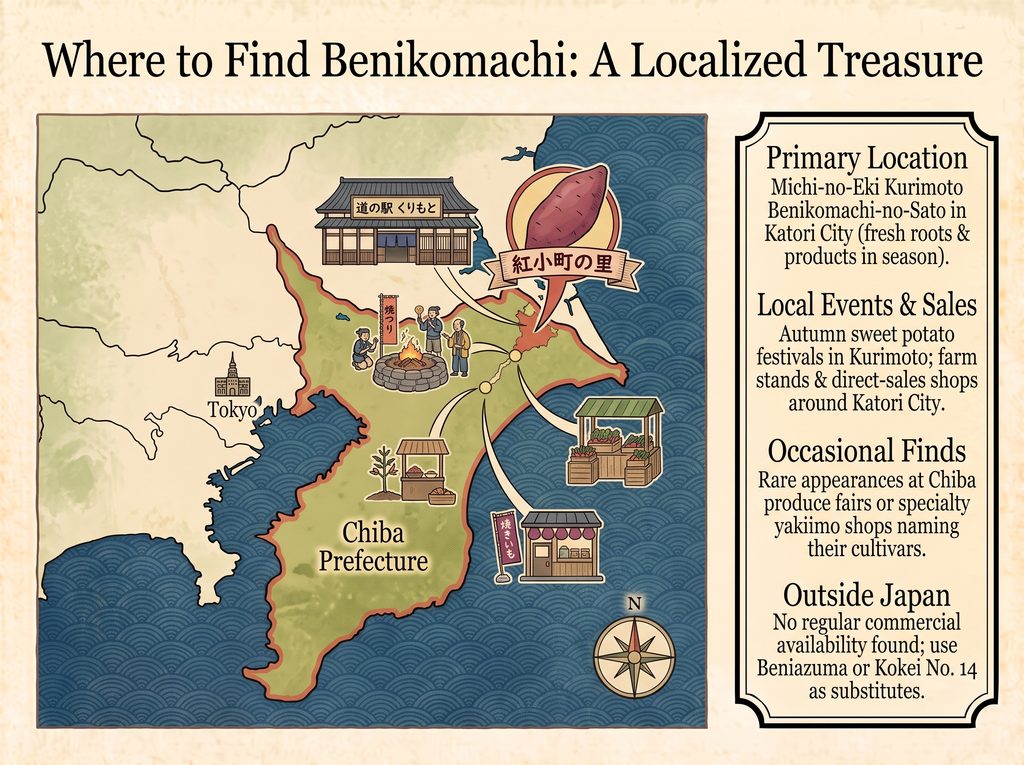
Benikomachi is unlikely to appear regularly in ordinary supermarkets, even in Japan. National data recorded 22 hectares in 2011, the most recent nationwide figure we found, and production now appears highly localized. Your best options are therefore the places below.
- Michi-no-Eki Kurimoto Benikomachi-no-Sato in Katori City, which sells fresh roots and sweet potato products in season
- Autumn sweet potato events in the Kurimoto area, which are worth checking locally before a visit
- Farm stands and direct-sales shops around Katori City, where a few growers still plant it
- Occasional appearances at Chiba produce fairs or specialty yakiimo shops that name their cultivars
Outside Japan, we found no evidence of regular commercial availability in the sources reviewed for this article. Availability may change, and small specialty shipments cannot be ruled out. If you cannot travel to Chiba, the closest stand-in is a floury cultivar such as Beniazuma, or a Kokei No. 14 line sold under a brand name.
Why Benikomachi Deserves Attention
Benikomachi is a reminder that “best” is a moving target. In 1985 it was a Chiba specialty on more than 2,000 hectares. Within five years, a disease-prone plant and a tougher rival had more than halved that area. What saved it was not the market but one town’s decision to keep growing, promoting, and roasting it anyway.
For a visitor, that history is precisely the point. Eating a Benikomachi in Kurimoto means tasting a cultivar from before moist, high-sugar varieties took over the market. Sources describe it as lighter and drier than a Beniharuka, and some people will prefer it for exactly that reason. If your route passes near Narita, the roadside station is an easy detour, and autumn is the time to make it.
Frequently Asked Questions About Benikomachi
Basics and History
- What is Benikomachi sweet potato?
-
Benikomachi (紅小町) is a Japanese sweet potato cultivar released in 1975 from a national breeding program in Chiba. It has dark reddish-purple skin and yellowish-white flesh that cooks up floury and lightly sweet. Growers in the Kurimoto area of Katori City now keep it alive.
- Is Benikomachi sweeter than Beniharuka?
-
Generally no. Sources describe Beniharuka as a high-sugar cultivar after storage and slow cooking. Benikomachi, by contrast, earns its place through floury texture. Actual sweetness still varies with cultivation, storage, and preparation.
- Why did Benikomachi almost disappear?
-
Because it is highly susceptible to Fusarium wilt, a soil disease, and because Beniazuma proved easier to grow after its 1984 release. National data show Benikomachi’s area falling from 2,266 hectares in 1985 to 22 hectares in 2011. Kurimoto Town, however, kept growing it as a local specialty.
Cooking and Buying
- What is the best way to cook Benikomachi?
-
Roast it whole and unwrapped at about 160°C for 60 to 80 minutes, until a skewer slides through. That method suits its floury texture. It also holds its shape well when steamed, simmered, or fried, and its dry flesh mashes into a smooth paste for kinton and other sweets.
- Where can you buy Benikomachi?
-
Mainly at Michi-no-Eki Kurimoto Benikomachi-no-Sato in Katori City, Chiba, and at farm stands nearby. Production is small and local, so it rarely reaches ordinary supermarkets. We found no evidence of regular sales outside Japan. Autumn, right after harvest, is the easiest time to look.
- Is Benikomachi an heirloom variety?
-
Not in the strict sense. Rather, it is a cultivar produced through a formal national breeding program and released in 1975, not a locally evolved landrace. It is, however, an older variety that has largely left commercial use, so local sources often present it as a specialty.
References
- Chiba Prefecture – Sweet Potato Cultivation Technical Guidelines, March 2023 (Chiba Prefectural Council for Agriculture, Forestry and Fisheries Technology) (PDF) (Accessed September 2026)
- Ministry of Agriculture, Forestry and Fisheries (MAFF) – Sweet Potato Cultivar Status: characteristics of major cultivars, prefectural recommended cultivars, and cultivar area trends, 1985 to 2011 (PDF) (Accessed September 2026)
- NARO Repository – Ishiguro, K. et al. Breeding of the sweet potato cultivar “Benimasari,” Bulletin of the National Agricultural Research Center for Kyushu Okinawa Region, No. 43 (PDF; cites Benikomachi’s 1975 Norin registration) (Accessed September 2026)
- Ministry of Education, Culture, Sports, Science and Technology (MEXT) – Food Composition Database, Standard Tables of Food Composition in Japan 2020 (Eighth Revised Edition): sweet potato entries (Accessed September 2026)
- Katori City – Michi-no-Eki Kurimoto Benikomachi-no-Sato (Accessed September 2026)
- Michi-no-Eki Kurimoto Benikomachi-no-Sato – Farm produce shop and the story of Benikomachi in Kurimoto (Accessed September 2026)
- Chiba Prefecture Official Tourism Site (Maruchiba) – Michi-no-Eki Kurimoto Benikomachi-no-Sato (Accessed September 2026)
- National Michi-no-Eki Association – Kurimoto station listing (registered August 2002) (Accessed September 2026)
- Japan Specialty Seed Association – Sweet potato production and cultivar seed supply in Chiba Prefecture, by the Chiba Prefectural Agriculture and Forestry Research Center (PDF) (Accessed September 2026)
Related Articles
- Japanese Sweet Potato (Satsumaimo) (Surveyed: September 2026)
- Yakiimo (焼き芋): Japanese Roasted Sweet Potatoes (Surveyed: September 2026)
- Beniharuka Sweet Potato (紅はるか) (Surveyed: September 2026)
- Anno Imo (安納芋) (Surveyed: September 2026)
- Daigaku Imo (大学芋) (Surveyed: September 2026)
- Imo Youkan (芋ようかん) (Surveyed: September 2026)
- Hoshiimo: Japan’s Dried Sweet Potato Snack (Surveyed: September 2026)
- Imo Kenpi (いもけんぴ) (Surveyed: September 2026)




Comments