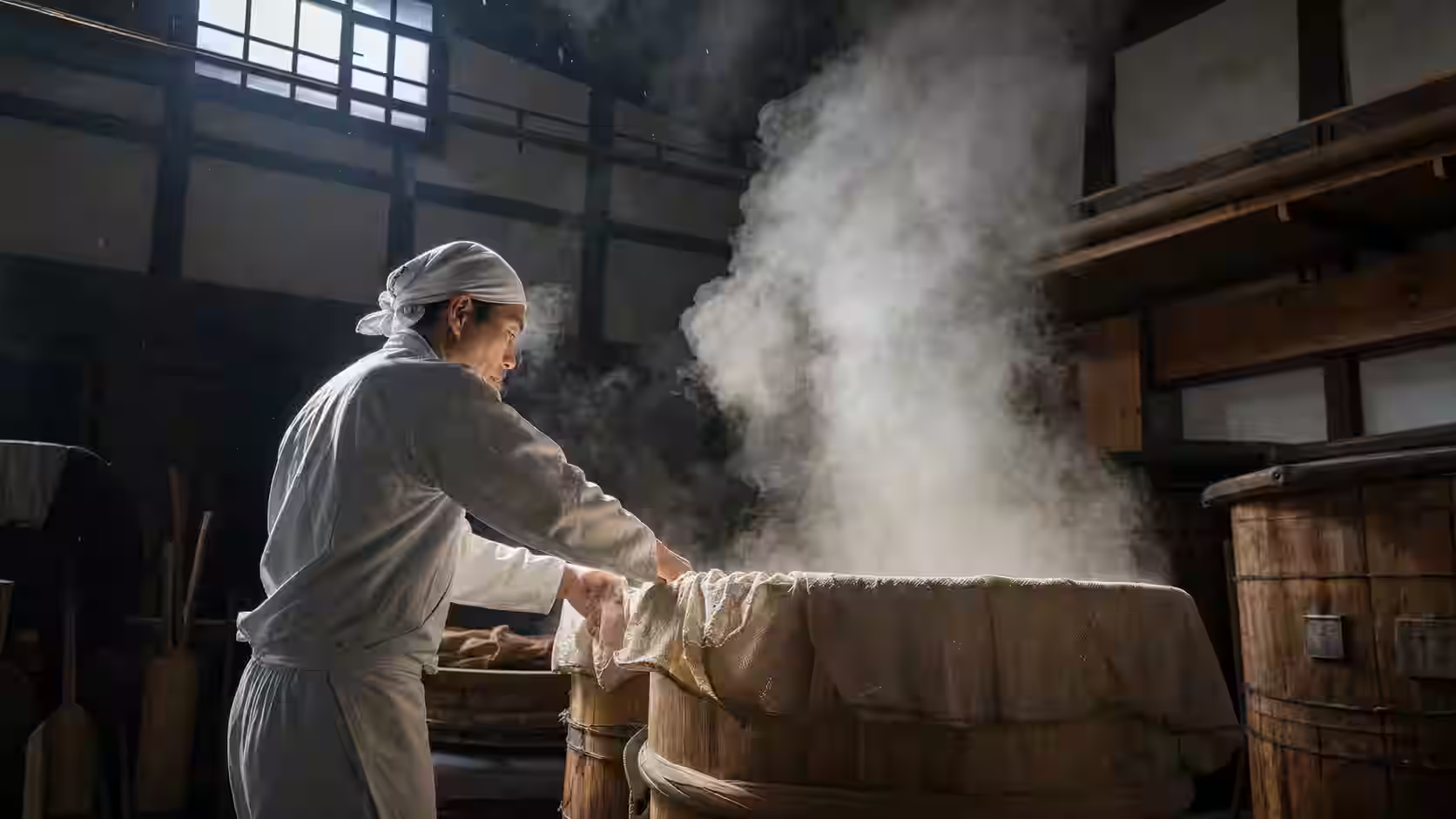
Kan-zukuri is the traditional practice of brewing sake during the coldest months of the year. The cold does real work here. Low temperatures slow fermentation, keep it stable, and hold unwanted microbes in check. For centuries, this made winter the natural season for sake.
The word joins two ideas, kan (the cold) and zukuri (making). So kan-zukuri simply means brewing in the cold. Yet that plain name hides a deep logic. Sake is a living process, driven by yeast and koji mold, and both behave better when the air stays cold and clean.
This guide explains why winter shaped sake so completely. We look at the science of cold fermentation, the history behind the tradition, and the yearly rhythm of a working brewery. We also ask a harder question. In an age of refrigeration and warming winters, does kan-zukuri still matter? The answer turns out to be layered, and a little surprising.
If you have ever wondered why sake brewing follows the calendar so strictly, this is the place to start. Winter brewing is not a quaint custom. It is a piece of applied biology, refined over hundreds of years.
TOC
Quick Facts About Kan-zukuri
Here is a short snapshot before the details begin. Use it as a quick reference while you read.
Japanese Name
寒造り (kan-zukuri)
Literal Meaning
Brewing in the cold
Brewing Season
Winter
Typical Months
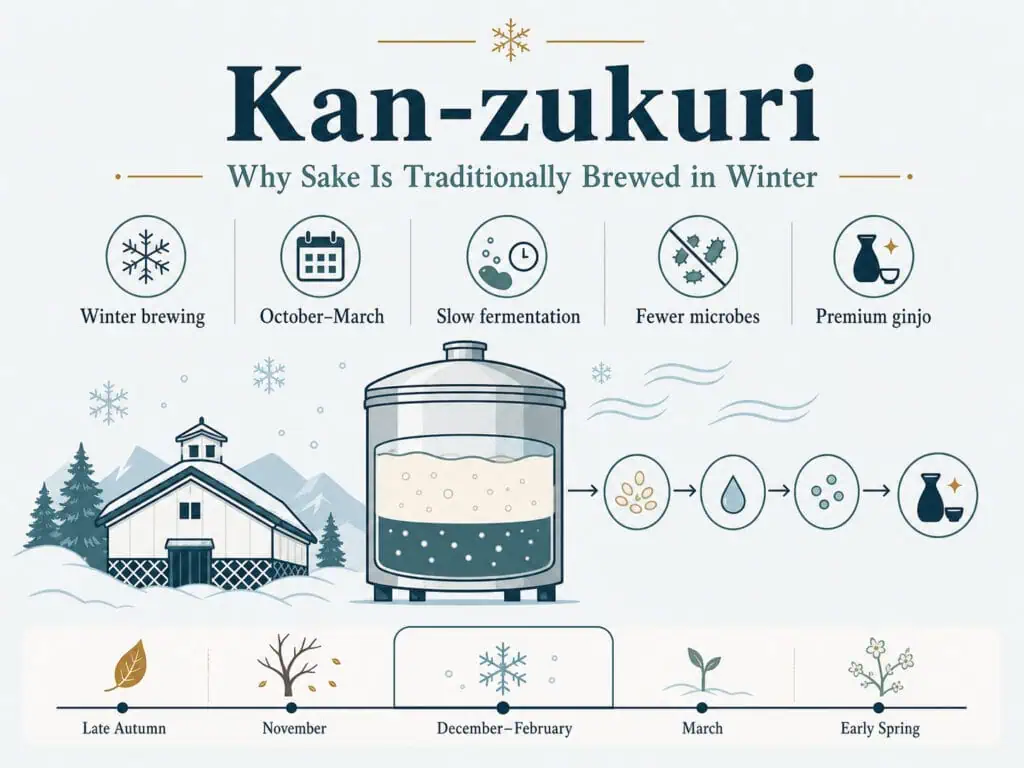
Roughly October to March
Main Purpose
Slow, stable fermentation with fewer unwanted microbes
Peak Cold Work
December to February, ideal for premium ginjo
Historical Origins
Became the standard method in the Edo period
What Is Kan-zukuri?
Kan-zukuri is winter sake brewing, plain and simple. Brewers time the whole season around the cold. They start as autumn ends and finish before spring warms the air. The Japanese word for the deep cold of midwinter is kan, and that word gives the practice its name.
To see why this matters, picture what sake actually is. It is a fermented drink made from rice, water, koji mold, and yeast. Living microbes drive every stage. Koji turns rice starch into sugar. Yeast then turns that sugar into alcohol. Both processes are sensitive to heat, so temperature shapes the final flavor.
How It Differs From General Brewing
In principle, you can brew sake at any time of year. The core steps never change. You wash and steam rice, grow koji, build a yeast starter, and ferment a mash. Kan-zukuri does not change that sequence at all.
What changes is the environment. Cold air gives the brewer far more control. Fermentation runs slowly and gently, which protects delicate aromas. Warm-weather brewing, by contrast, tends to race ahead. It can turn harsh or sour before the brewer can react. So kan-zukuri is less a different recipe than a different set of conditions.
Why It Became the Standard
Over time, winter brewing simply won. The sake tasted cleaner, kept better, and failed less often. Brewers noticed, and the practice spread across the country. By the Edo period, kan-zukuri had become the default way to make quality sake.
There was also a human reason. Winter was the quiet season on the farm. Rice had been harvested, and the fields lay still. Farmers had time and hands to spare, so many travelled to breweries for the season. Nature and labor lined up perfectly, and the tradition set hard.
Why Winter Is Ideal for Brewing
Cold is not just tradition. It is a genuine technical advantage, and several forces work together in the brewer’s favor. Understanding them explains almost everything about the winter season.
Slow, Stable Fermentation
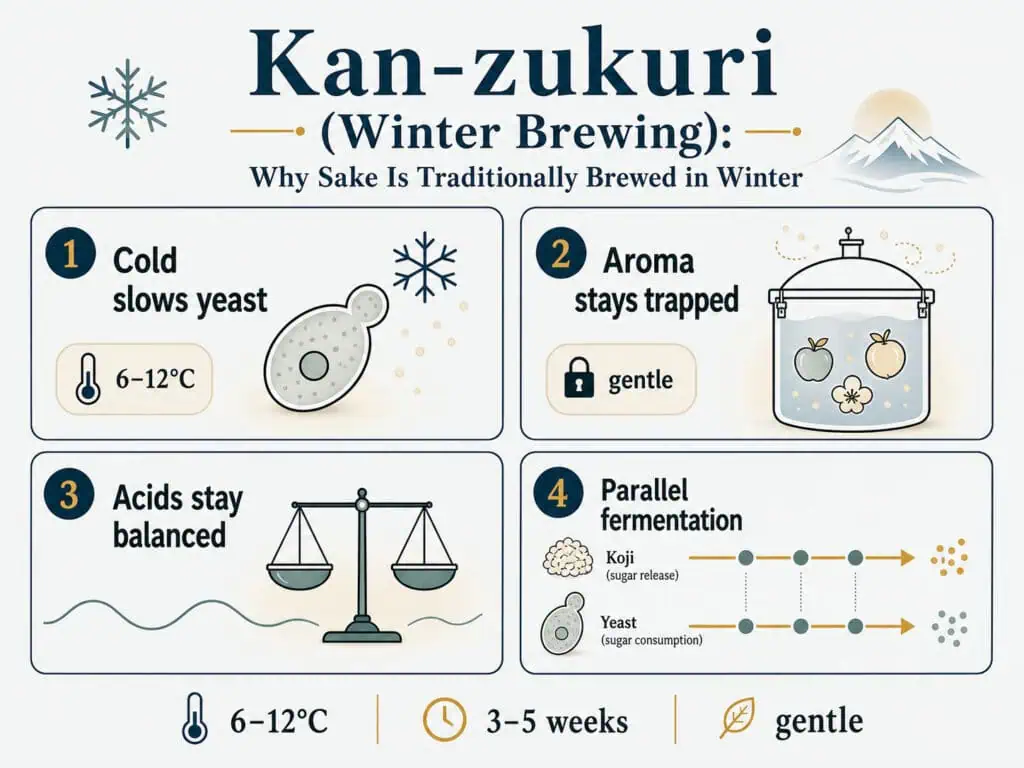
Sake ferments best when it ferments slowly. In the cold, yeast works at a measured pace. The fermentation can then run for weeks without overheating. Premium styles often ferment at only about 6 to 12 degrees Celsius. That patience builds depth, balance, and a clean finish.
Heat has the opposite effect. Warm yeast ferments too fast and burns through its sugar. The mash can spike in temperature and lose control. So cold air acts almost like a brake pedal. It lets the brewer steer, rather than simply hang on.
Fewer Unwanted Microbes
A brewery is full of microbial life. Not all of it is welcome. Stray bacteria and wild yeast can ruin a batch quickly. Cold weather suppresses many of these invaders before they take hold. That protection matters most in the early days of the yeast starter.
The starter, called moto or shubo, is where the risk peaks. Brewers grow a dense yeast culture there before the main mash. Lactic acid guards this batch from spoilage. Traditional methods like kimoto rely on natural lactic acid bacteria to do that job. The modern sokujo method adds lactic acid directly instead. Either way, cold conditions keep the starter safer while that acidity builds.
Better Aroma Development
Here is where cold brewing truly shines. Cool fermentation coaxes out fruity, floral aromas. Two compounds lead the way. Isoamyl acetate gives a soft banana note. Ethyl caproate suggests apple, pear, and melon. Low temperatures raise both, which is why a fragrant ginjo owes so much to careful cooling.
Warm fermentation tends to bury these scents. It pushes rougher, heavier flavors forward instead. The most aromatic sake, therefore, comes from the coldest weeks of the year. Brewers often reserve their finest ginjo for the depths of January and February.
Precise Control Over the Mash
Everything flows into the main mash, called moromi. This is where koji and yeast work side by side. Koji keeps making sugar while yeast keeps eating it. Brewers call this multiple parallel fermentation, and it runs for weeks in one tank.
Such a delicate balance needs a steady hand. Cold air holds the tank at a gentle, even temperature. Brewers can nudge it up or down as the mash demands. That control is nearly impossible in summer heat without heavy machinery. In winter, the weather does much of the work for free.
The Science Behind Cold Fermentation
So far we have said that cold slows fermentation. That is true, but it barely scratches the surface. Underneath sits a web of yeast biology, enzyme chemistry, and aroma physics. Research bodies like Japan’s National Research Institute of Brewing have studied these effects in fine detail. Here is what the cold actually does inside the tank.
Why Yeast Slows Down
Sake yeast is a strain of Saccharomyces cerevisiae. Like all microbes, it speeds up in heat and slows in cold. Lower temperatures reduce its metabolic rate and slow cell division. So the yeast ferments gently over three to five weeks, rather than racing through in days.
This pace protects the yeast itself. A hot, frantic fermentation stresses the cells and can kill them early. Cold conditions keep the culture healthy and steady instead. Many popular association yeast strains brew best at only about 10 to 12 degrees Celsius. Their strength at low temperature is exactly why brewers favor them.
Ester Production and Aroma Enzymes
Aroma is where the chemistry gets beautiful. The fruity scent of ginjo comes from esters, which yeast produces during fermentation. The banana-like note is isoamyl acetate. The apple and melon note is ethyl caproate. Cold conditions raise both, though for slightly different reasons.
Isoamyl acetate depends on a yeast enzyme called alcohol acetyltransferase. This enzyme is fragile and works stably only when it stays cold. Warm it up, and its output falls. Ethyl caproate behaves differently. It escapes easily as vapor, so a warm mash simply loses it to the air. Cold fermentation keeps more of it dissolved in the sake. In both cases, chilly conditions lock the aroma in.
Organic Acids and Balance
Acids give sake its structure and brightness. Yeast forms organic acids as it works, including succinic, malic, and lactic acid. In traditional starters like kimoto, lactic acid bacteria add more of their own. A slow, cold fermentation keeps these acids in gentle balance.
Heat throws that balance off. Fast fermentation can spike acidity or leave harsh, coarse notes. It also invites spoilage bacteria that create sour, unpleasant flavors. Cold brewing avoids most of that trouble. The result tastes clean, rounded, and composed.
The Parallel Fermentation Curve
Recall that sake ferments by multiple parallel fermentation. Koji enzymes keep releasing sugar while yeast keeps consuming it. Both processes must stay in step, or the mash falls out of balance. Temperature is the dial that keeps them aligned.
Cold slows koji’s sugar release and yeast’s appetite together. Neither runs away from the other. Brewers guide the mash along a careful temperature curve for weeks. Premium ginjo often sits near 6 to 12 degrees Celsius. Ordinary sake ferments a little warmer. The colder and slower the curve, generally the more delicate and aromatic the sake. That, in one line, is the science behind kan-zukuri.
The History of Kan-zukuri
Kan-zukuri did not appear overnight. It grew slowly, shaped by climate, farming, and law. The story runs deep into Japan’s past.
Early Brewing Across the Seasons
Sake once followed no single season. Early brewers worked at several points in the year. They gave each batch its own name based on timing. Some sake was brewed in autumn, some in spring, and some in the new year. Quality, however, varied wildly from one season to the next.
Warm-weather batches were the biggest gamble. Without refrigeration, they spoiled easily. Brewers had no reliable way to cool a runaway mash. So the summer and autumn brews often disappointed. Over generations, one lesson became clear. The cold months gave the best and most consistent results.
The Edo-Period Turning Point
During the Edo period, winter brewing became the rule. Quality was one reason, but not the only one. Brewers in Itami refined the cold-brewing method around 1667. A few years later, in 1673, the shogunate banned brewing outside the winter season. The aim was to control rice use, since sake consumed huge amounts of it. Quality and policy together made kan-zukuri the standard.
The great brewing centers of Itami and later Nada thrived under this system. Itami sake became so prized in Edo that it earned its own name, tanjo. Breweries shipped huge volumes of winter sake toward the city, today’s Tokyo. Demand grew, and so did the need for skilled seasonal labor. That need would soon reshape the entire industry.
Farmers, Migration, and the Toji
Winter emptied the rice fields, and that changed everything. Farmers finished the harvest and found themselves free. Many travelled to breweries to earn extra income through the cold months. These seasonal workers became the first true brewing crews.
Over time, they organized into skilled regional guilds. Groups like the Nanbu, Echigo, and Tajima brewers grew famous for their craft. Each guild formed around a master brewer, the toji, who led the team each season. In this way, kan-zukuri built not just a product but a whole social world.
Into the Modern Era
Science arrived in the Meiji period and after. National research institutes studied fermentation in detail. New starter methods, cultured yeasts, and better hygiene followed. Even so, the winter calendar held firm for most of the twentieth century. Tradition and biology still pointed the same way.
In late 2024, UNESCO added traditional Japanese sake brewing to its Intangible Cultural Heritage list. The honor recognized the craft built up over centuries by toji and brewery workers. Kan-zukuri sits at the very heart of that heritage. It is the frame around which the whole tradition was built.
The Meaning of “Kan” in the Japanese Calendar
The word kan is more precise than it first appears. It does not simply mean winter in general. In the old Japanese calendar, kan names a specific stretch of the coldest weeks. Knowing this detail reveals how closely brewing once tracked the seasons.
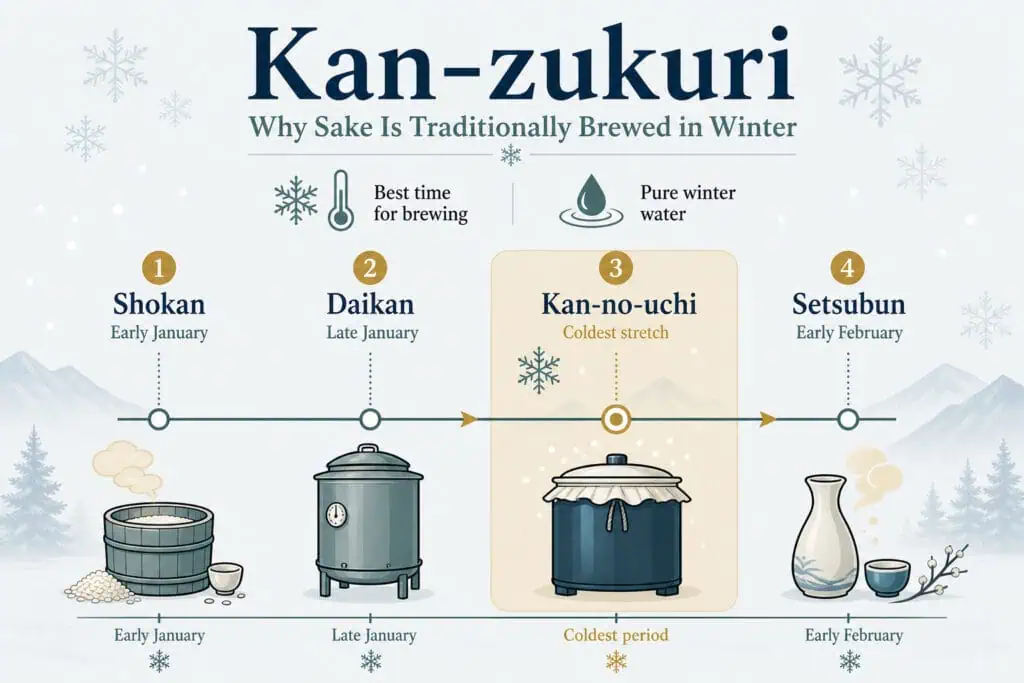
The traditional calendar divides the year into 24 solar terms. Two of them mark the deep cold. Shokan, or “minor cold,” begins around January 5. Daikan, or “major cold,” follows near January 20 and marks the coldest point of the year. The span between them, running to early February, is called kan-no-uchi, the heart of the cold.
This cold period closes at Setsubun, around February 3. The next day is Risshun, the first day of spring in the old calendar. So the true kan season lasts only about a month. That short window was the prized time for brewing and for drawing water.
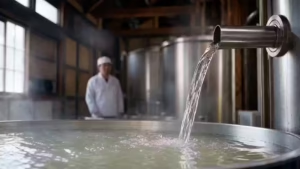
The great Nada brewers timed their year around these terms. They built their yeast starters near the winter solstice. Then they mashed the main moromi from Shokan through to Setsubun. Water drawn during this stretch, called kan-no-mizu, was famous for its purity. An old proverb even claims that the cold-season water is medicine. Science does not quite support that, yet the winter well water really did keep longer. This calendar link is something few foreign guides ever mention.
The Sake Brewing Calendar
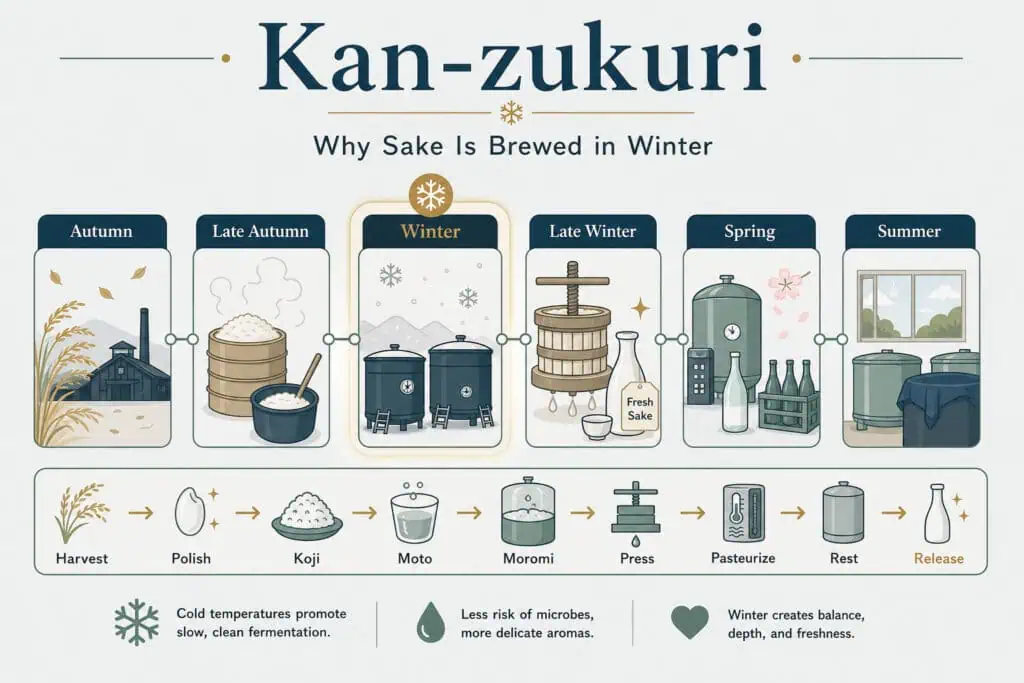
A traditional brewery runs on a tight yearly rhythm. Each month has its own tasks, flowing from harvest to bottle. Before the monthly view, it helps to see the brewing stages as one connected chain. Each step feeds directly into the next.
Harvest: new sake rice comes in from the autumn fields.
Rice polishing: the grain is milled to expose its starchy core.
Koji making: mold grows on steamed rice to create sugar-making enzymes.
Moto (yeast starter): a dense, healthy yeast culture is built up.
Moromi (main mash): koji, rice, water, and starter ferment together for weeks.
Pressing: clear sake is separated from the leftover solids.
Pasteurization: gentle heating stabilizes the sake for storage.
Storage and aging: the sake rests for months and mellows.
Release: the finished sake reaches the shelf, often by spring or autumn.
With that chain in mind, the monthly rhythm makes more sense. The list below walks through a typical season in the northern parts of Japan.
Autumn (September to October): the new rice harvest comes in, and brewers clean and prepare the kura for the season ahead.
Late October to November: brewing begins, with the first rice steaming and the building of the yeast starter.
December to February: the peak of the season, when the coldest air supports the finest ginjo and daiginjo.
February to March: pressing separates fresh sake from the mash, and the first shiboritate is celebrated.
Spring: the sake is pasteurized and moved to tanks, while traditional seasonal crews head home.
Summer: most sake rests and matures quietly, gaining roundness before autumn release.
Harvest and Preparation
Everything starts with the rice. Farmers harvest sake rice in early autumn. Brewers then mill it, a step called rice polishing, to expose the starchy core. Meanwhile, the brewery gets a deep clean. Hygiene is sacred here, since one stray microbe can spoil a batch.
The Heart of the Season
By late autumn, the first rice hits the steamer. The season is now open. Brewers build koji, raise the yeast starter, and start the main mash. Good water underpins every step, since it makes up most of the finished sake. From here, the pace never really slows until spring.
The deepest cold brings the proudest work. In December and January, brewers craft their premium ginjo. The frigid air lets the mash ferment slow and clean. Many say these weeks feel almost sacred inside the kura. The whole year has pointed toward them.
Pressing, Resting, and Release
When a mash finishes, the brewer presses it. This step, called pressing, separates clear sake from the leftover solids. Light filtration often follows to refine clarity. Then most sake goes through pasteurization, a gentle heating that stabilizes it for storage.
After that, patience takes over. The sake rests in tanks for months, mellowing as it ages. Harsh edges fade, and the flavors knit together. By the time it reaches the shelf, spring or summer has often arrived. A brewery, in truth, works a full year for a winter’s brewing.
Kan-zukuri and the Toji
You cannot separate winter brewing from the people who did it. Kan-zukuri shaped an entire way of working. It created roles, careers, and a distinct brewery culture that still echoes today.
Seasonal Work and Migration
The winter-only calendar meant winter-only jobs. Brewing filled the gap in the farming year perfectly. Farmers left their villages and lived at the brewery for months. They returned home in spring to plant the next crop. This pattern of migration, called dekasegi, defined the trade for generations.
The Toji and the Kurabito
Each winter crew followed a master brewer. The toji planned the season and made the key calls. Under this leader worked the kurabito, the skilled brewery hands. They lived together, ate together, and shared long cold days. That closeness built teams that felt almost like families.
Skill flowed down through these tight groups. Senior workers trained the younger ones by hand. Whole regions became known for their brewing style. The famous Nanbu toji of Iwate remain a good example. Their knowledge passed from season to season, carried in people rather than books.
How Brewery Organization Formed
The season also gave the brewery its shape. Roles were ranked clearly, from newcomer to senior specialist. Everyone knew their task in the cold rush of work. This order kept a busy winter kura running smoothly. Much of that structure survives in breweries today, even where the seasons have changed.
Kan-zukuri Around Japan
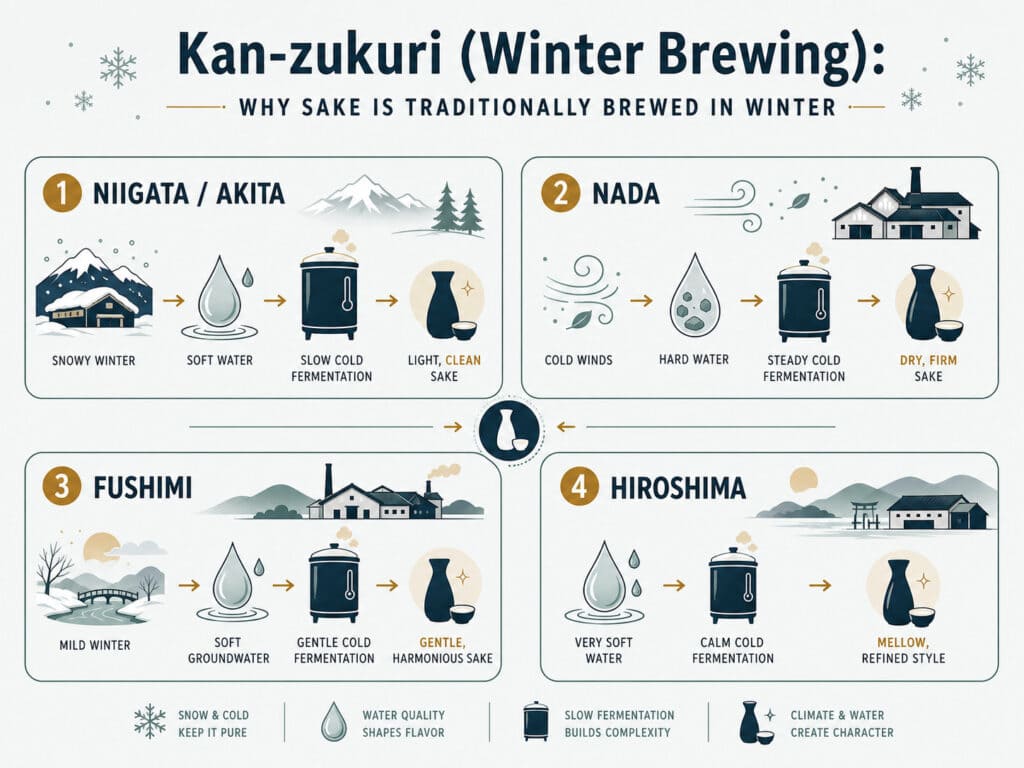
Kan-zukuri looks different from region to region. A brewer’s winter depends on the local climate and water. Cold northern kura brew one way, while milder western ones adapt. The table below sketches how the tradition varies across Japan.
Region
Winter Brewing Character
Niigata
Long, snowy winters and soft water suit slow, low-temperature fermentation
Akita
Heavy snowfall and stable deep cold favor elegant, refined sake
Hyogo (Nada)
Cold Rokko-oroshi winds plus hard Miyamizu water give a dry, firm style
Kyoto (Fushimi)
Milder winters balanced by soft groundwater produce gentler sake
Hiroshima (Saijo)
Soft-water brewing, refined in the late 19th century, yields a mellow style
The Snow Country of the North
Northern regions have the deepest, most reliable cold. Niigata and Akita sit under heavy winter snow. That snow does quiet work for the brewer. It filters dust from the air and keeps the kura clean and cold. Soft snowmelt water then supports long, slow fermentation. The classic result is a light, clean, dry sake.
The Cold Winds of Nada
Western Japan is milder, so brewers there worked with what they had. In Nada, a cold wind saved the day. Known as rokko-oroshi, it rushes down from the Rokko mountains each winter. Old breweries were even built to catch it, in a layout called kasane-gura. Combined with hard Miyamizu water, this cold wind shaped Nada’s firm, dry style.
Milder Regions and Soft Water
Fushimi in Kyoto shows another path. Its winters run milder, and its groundwater is soft. That gentle water gives a smoother, rounder sake. Hiroshima faced a harder challenge with very soft water. Brewers there refined soft-water methods in the late nineteenth century. Today, air conditioning narrows these regional gaps. Yet each area still carries a sense of place in the glass.
Traditional vs Modern Brewing Seasons
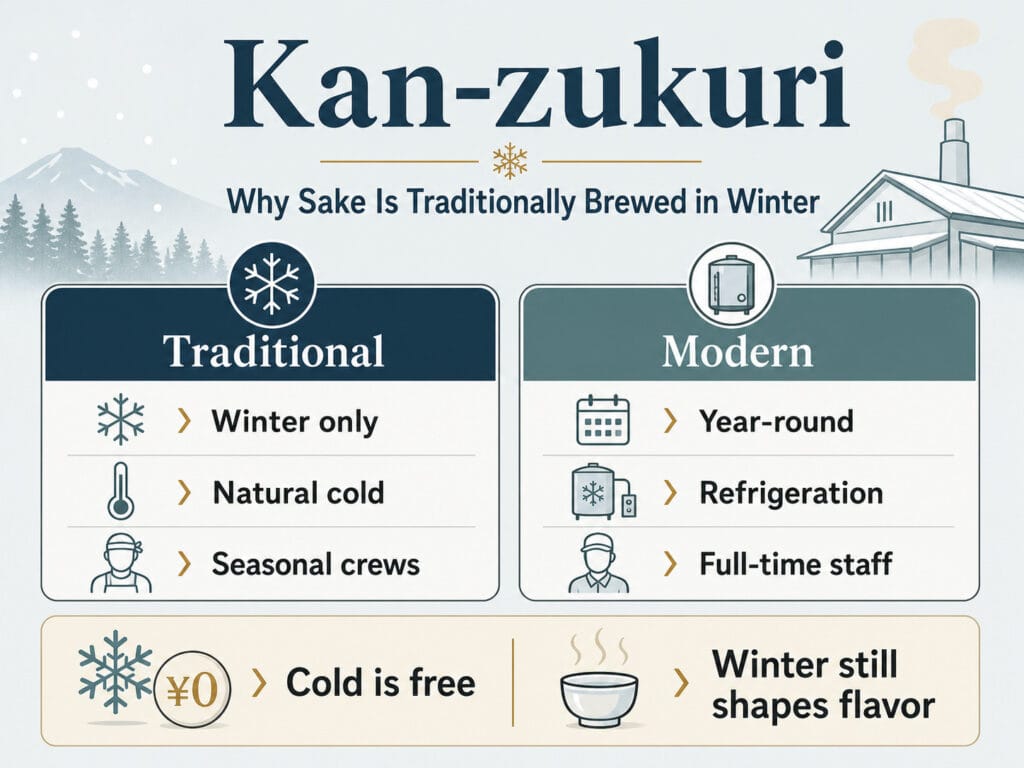
Modern technology reopened a question once settled by nature. Do you really need winter to brew good sake? The honest answer is nuanced. Refrigeration changed what is possible, though it did not erase the old logic. The table below sums up the key differences.
Factor
Traditional Kan-zukuri
Modern Brewing
Source of cold
Natural winter air
Refrigeration and climate control
Brewing season
Winter only
Winter, or year-round in some kura
Staffing
Seasonal migrant crews
Full-time, year-round employees
Temperature control
Depends on the weather
Precise and consistent
Contamination risk
Higher, managed by cold
Lower, managed by equipment
What Refrigeration Changed
Cooling equipment gave brewers a new kind of freedom. They could now chill a room to winter levels in any month. Some breweries used this to brew all year, a practice called shiki-jozo, or four-season brewing. Others simply used it to steady their winter work.
Year-round brewing brought clear benefits. It turned seasonal jobs into stable, full-time careers. It also kept precious skills inside the brewery all year. Fresh sake could reach drinkers in any season, too. For workers, that shift meant a very different life.
Why Many Still Choose Winter
Yet most breweries still brew mainly in winter. Habit is only part of the reason. Natural cold is free, while running chillers costs money. Winter also fits the release calendar that drinkers expect. And many brewers simply believe the season shapes the soul of the sake. Not everyone agrees, but the feeling runs deep.
Shiki-jozo vs Kan-zukuri: Weighing the Trade-offs
Shiki-jozo deserves a closer look, since it is more than a novelty. The word means four-season brewing, or year-round production. Industrial cooling revived it during the Showa era. Neither approach is simply better, and each carries real advantages and costs. It helps to weigh them side by side.
The Case for Shiki-jozo
Year-round brewing solves some old business problems. Its benefits are practical and easy to see.
Steadier cash flow: costs spread across the year, instead of one huge winter outlay.
More output: the same tanks can brew several times a year.
Flexibility: small, frequent batches suit tiny kura and allow more variety.
Stable jobs: seasonal work becomes full-time, year-round employment.
Fresh sake anytime: drinkers can enjoy new releases in any season.
The Costs of Going Year-Round
The trade-offs are just as real, though. Refrigeration is not free, and it changes the craft.
Energy use: chilling a brewery through summer consumes a lot of electricity.
Equipment cost: cooling systems demand investment and steady maintenance.
Lost rhythm: the seasonal story and natural pace of winter fade away.
Environmental footprint: higher power use raises sustainability questions.
Kan-zukuri sits at the opposite balance. Its cooling is free, its story is strong, and its footprint is light. Yet it depends on the weather, offers only seasonal work, and demands one big upfront push. Faced with this, many breweries simply blend the two. They brew their premium sake in the deep cold and use controlled rooms for the rest.
Climate Change and the Future of Kan-zukuri
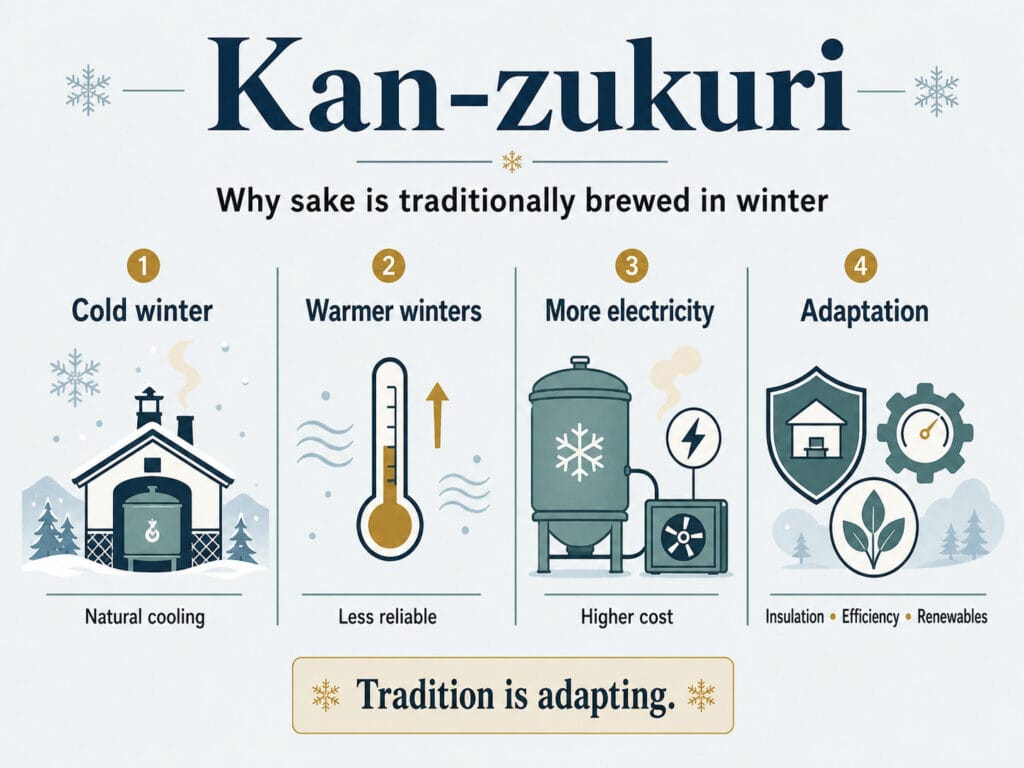
A quiet worry now hangs over the tradition. Winters are getting warmer. That trend touches kan-zukuri at its core, since the practice depends on reliable cold.
Milder winters make natural cooling less dependable. A warm spell can arrive at the worst moment. Brewers then lean harder on refrigeration to hold the line. What was once free now runs on electricity, and the meter keeps ticking.
The cost side of this is easy to underestimate. Cooling a brewery through a warm winter draws serious power. For a small kura, those electricity bills bite hard. The environmental cost matters too. More refrigeration means a larger carbon footprint for each bottle. Sustainability, once a distant concern, has moved much closer to home.
Some brewers are adapting in creative ways. They insulate their kura or install more efficient cooling systems. A few experiment with hardier yeast strains and adjusted schedules. Others move production north, or lean into year-round brewing to spread the risk. A handful explore renewable power to soften the footprint. The craft is bending, though it has not broken.
Whether tradition and climate can stay in step remains an open question. I suspect the answer will vary from kura to kura. Some will guard the old winter calendar closely. Others will embrace technology without apology. Sake has survived far greater upheavals before, and it will likely adapt again.
Common Misconceptions About Kan-zukuri
Winter brewing attracts a few myths. Let us clear up the most common ones.
Is Sake Only Brewed in Winter?
No, not anymore. Winter remains the traditional and most common season. Yet many modern breweries now brew year-round using climate control. Kan-zukuri describes the classic winter method, not an absolute rule for all sake today.
Can Breweries Really Produce Sake in Summer?
Yes, they can. Refrigeration recreates winter conditions inside a temperature-controlled room. Breweries that use shiki-jozo brew fresh sake through the hottest months. The result can be excellent, since the equipment holds the mash exactly where the brewer wants it.
Does Winter Automatically Make Better Sake?
Not by itself. Cold helps, but skill and control matter more. A careless winter brew can still fail badly. A skilled brewer with good equipment can make superb sake in any season. The cold is a tool, not a guarantee.
Final Thoughts
Kan-zukuri is where nature, craft, and science meet. Cold winters gave brewers slow fermentation and clean conditions. The farming calendar gave them willing hands. Centuries of practice turned that lucky alignment into a refined art.
The world has changed around the tradition. Refrigeration freed brewers from the seasons. Warming winters now test the old certainties. Still, the winter kura keeps its quiet pull, and most brewers return to it each year by choice.
Understanding kan-zukuri changes how you taste sake. A cold-brewed bottle carries the memory of a frozen morning in the kura. So the next time you pour a glass, picture the season behind it. That winter chill is part of the flavor.
Kan-zukuri FAQ
What is kan-zukuri?
Kan-zukuri is the traditional practice of brewing sake during the coldest months of the year. The word means brewing in the cold. Winter conditions give slow, stable fermentation and hold unwanted microbes in check. This makes the season ideal for quality sake.
Why is sake brewed in winter?
Winter suits sake because cold air slows and steadies fermentation. Low temperatures also suppress stray bacteria and wild yeast that could spoil a batch. The cold draws out fruity, floral aromas as well. Historically, winter also freed up farm workers to brew.
What months is sake brewed in?
The traditional season runs roughly from October to March. Preparation begins after the autumn rice harvest. The coldest weeks, in December and January, are reserved for premium ginjo. Pressing and finishing usually wrap up by early spring.
What temperature is sake fermented at?
It depends on the style, but cool is the rule. Premium ginjo often ferments at only about 6 to 12 degrees Celsius. Standard sake ferments a little warmer. Cool fermentation runs slowly over several weeks and protects delicate aromas.
Can sake be made in summer?
Yes, with the right equipment. Refrigeration recreates winter conditions inside a controlled room. Breweries that brew year-round use this method, known as shiki-jozo. The sake can be excellent, since the temperature stays exactly where the brewer wants it.
Does cold weather automatically make better sake?
No, cold only creates good conditions. The brewer’s skill still decides the outcome. A careless winter batch can fail, while a skilled brewer can succeed in any season. Think of the cold as a helpful tool rather than a guarantee.
What is shiki-jozo?
Shiki-jozo means four-season brewing, or year-round production. It relies on refrigeration to hold winter-like conditions all year. This approach gives brewers steady, full-time careers instead of seasonal work. It also delivers fresh sake to drinkers in every season.
How did kan-zukuri become the standard?
Winter sake simply tasted cleaner and kept better than other batches. Brewers in Itami refined the method around 1667. In 1673, the shogunate then banned brewing outside winter to manage rice supplies. Quality and policy together made kan-zukuri the norm.
How is kan-zukuri connected to the toji?
Winter brewing created the seasonal work that shaped the toji tradition. Farmers travelled to breweries in the cold months and formed skilled crews. Each crew followed a master brewer, the toji. Famous regional guilds, such as the Nanbu toji, grew from this system.
Is kan-zukuri still used today?
Yes, most breweries still brew mainly in winter. Natural cold is free and fits the release calendar drinkers expect. Many brewers also value the tradition itself. Year-round brewing exists alongside it, but the winter season remains central.
Which sake styles benefit most from kan-zukuri?
Premium aromatic styles gain the most, especially ginjo and daiginjo. These need long, cold, slow fermentation to develop their fruity aromas. The coldest weeks of winter suit them perfectly. Rich, earthy styles like kimoto also reward careful cold brewing.
Is kan-zukuri recognized as cultural heritage?
Winter brewing lies at the core of a UNESCO-recognized tradition. In late 2024, UNESCO listed traditional Japanese sake brewing as Intangible Cultural Heritage. That recognition honors the koji-based craft refined over centuries. Kan-zukuri is a defining part of that heritage.
How does climate change affect kan-zukuri?
Warmer winters make natural cooling less reliable. Brewers then depend more on refrigeration, which raises energy costs. Some adapt with better insulation, new schedules, or year-round brewing. The tradition is under pressure, though brewers keep finding ways to adjust.
Is kan-zukuri the same as kimoto or yamahai?
No, they describe different things. Kan-zukuri refers to the winter brewing season. Kimoto and yamahai are methods for making the yeast starter. A single winter-brewed sake could use any starter method. The terms simply answer different questions about how the sake was made.
Ryo Iwa is the founder and editor of foodinjapan.org. Born and raised in Japan, he writes from regional travel, market visits, and Japanese-language primary sources that rarely reach English readers, including brewing institute publications and industry glossaries. Where a figure cannot be traced to a source, the article says so.
He has been a Google Maps Local Guide for over 10 years, with more than 1,800 reviews and over 41,000 photos viewed hundreds of millions of times. He previously spent two decades as an IT consultant in Japan, the US, and the UK.













Comments