


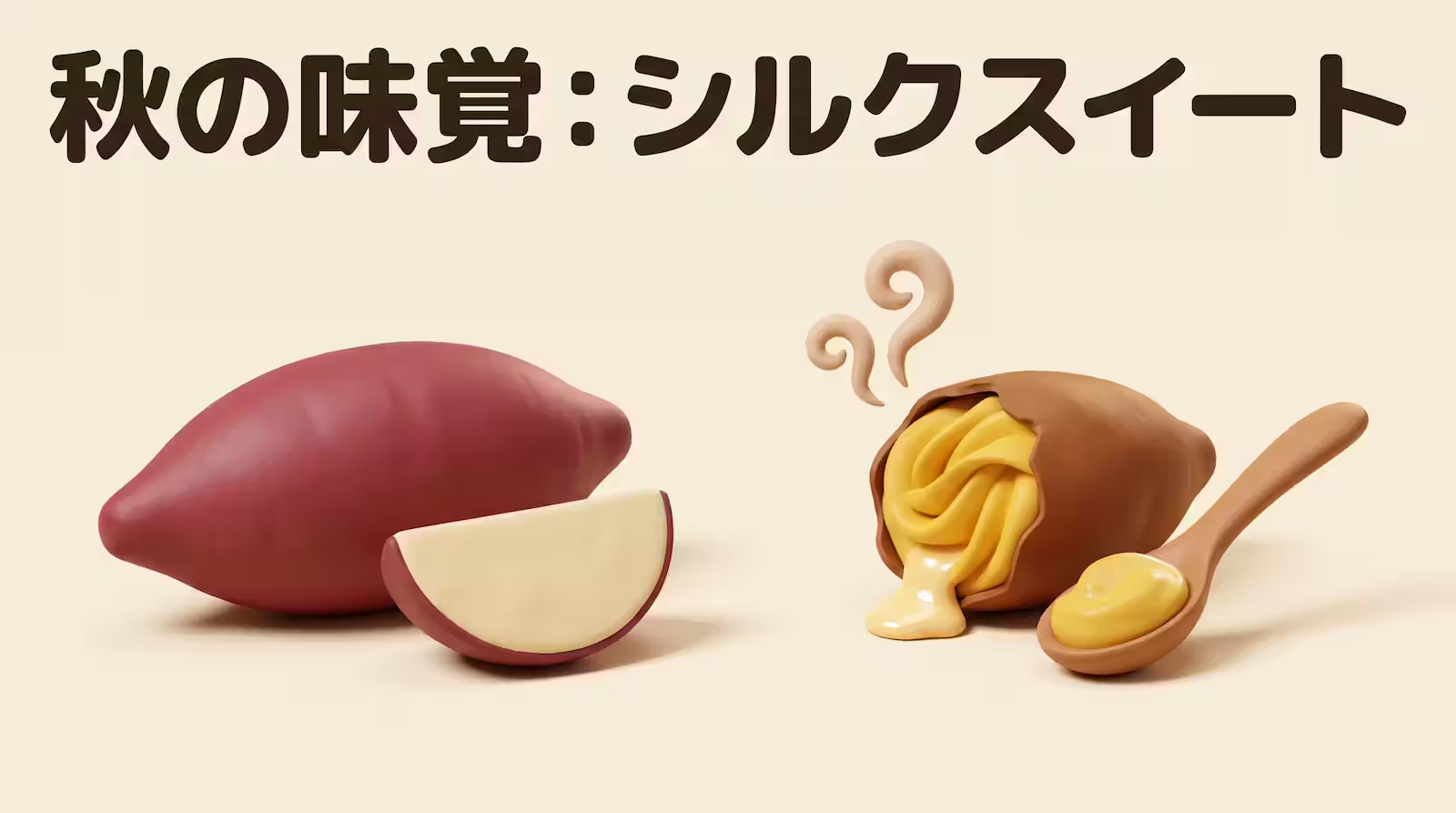

Silk Sweet is a Japanese sweet potato sold under a trademarked name, and the name is a promise about texture rather than sweetness. Its breeder registered it with Japan’s Ministry of Agriculture under the cultivar name HE306, and it then reached the market in the early 2010s. The skin is a deep reddish purple, while the flesh turns a bright yellow once cooked.
Roast one slowly and it can become smooth, moist, and gently sweet. That texture is not automatic, though. It depends heavily on storage after harvest, on the size of the root, and on how you cook it. This guide covers what Silk Sweet is, how it developed, what it tastes like, how it compares with other varieties, and how to choose, store, and cook it at home.
What Is Silk Sweet?
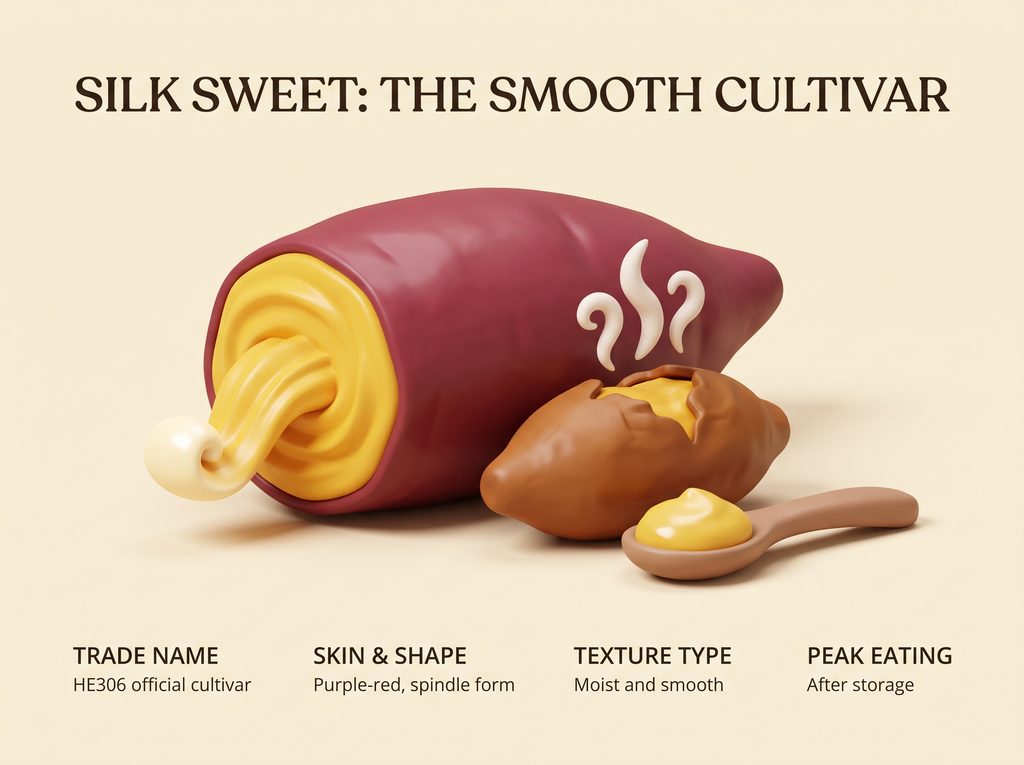
Silk Sweet is a Japanese sweet potato cultivar bred by Kaneko Seeds, a seed company based in Maebashi, Gunma Prefecture. Its official registered cultivar name is HE306, while “Silk Sweet” is the trademark under which it is sold. In practice, growers and shoppers use the trademark almost exclusively.
- Japanese Name
- シルクスイート (Shiruku Suīto), a registered trademark of Kaneko Seeds.
- Registered Cultivar Name
- HE306, registered under Japan’s Plant Variety Protection and Seed Act.
- Species
- Ipomoea batatas, the same species as all sweet potatoes.
- Appearance
- Purple-red skin, yellow flesh, and an egg-shaped to spindle-shaped root of medium size.
- Texture Type
- Moist and smooth, sitting between the floury and the very sticky styles.
- Harvest
- Roughly September to October, with peak eating quality after storage.
- Main Growing Areas
- Chiba, Ibaraki, and Kumamoto, according to the breeder.
Appearance and Basic Characteristics
Japan’s official variety registration record describes the root as egg-shaped, medium in size, with purple-red skin and yellow flesh. The eyes also sit shallow in the surface. Kaneko Seeds adds that the roots are spindle-shaped, uniform in size, and notably smooth-skinned, which matters commercially because appearance drives retail sales.
Raw flesh, though, looks pale cream rather than yellow. The color deepens during cooking, and a roasted Silk Sweet shows a bright golden interior. That shift is one of the easiest ways to recognize it once it is cut open.
Why Is It Called Silk Sweet?
The name points to the smooth, fine texture that gives the variety its selling point. Kaneko Seeds describes the flesh as moist and sticky in the mouth, with a good feel on the tongue and strong sweetness. That is the supplier’s own description, so treat it as a product claim rather than a laboratory measurement.
Does every Silk Sweet taste silky? Not necessarily. A poorly stored root, or one roasted too fast, can come out drier and more ordinary. The name describes potential, and the potential needs the right handling.
Cultivar Name Versus Trademark
This distinction confuses a lot of English-language coverage, so it is worth being precise. HE306 is the name on the plant variety registration. Silk Sweet is the trademark, and Kaneko Seeds registered it for goods in classes 29 and 31. Seed catalogs therefore print both, usually as “Silk Sweet® (registered cultivar name HE306).”
History and Development of Silk Sweet
Silk Sweet is, by sweet potato standards, genuinely young. Most of the sweet potatoes on a Japanese supermarket shelf have decades of history behind them, whereas this one arrived within the last fifteen years.
How the Cultivar Was Developed
Writing in a 2019 article for the Japan Potato and Sweet Potato Promotion Association, a researcher at Kaneko Seeds’ Hashie Research Institute set out the breeding history. The company crossed Harukogane, valued for eating quality and appearance, with Benimasari, valued for uniform shape, yield, and a somewhat moist texture.
That cross took place in 2005. Breeders then selected seedlings from the resulting seed, and selection continued over several years. Notably, the parentage comes from the breeder’s own published account rather than from the registration record, which does not list parent cultivars.
Registration and Trademark
| Item | Detail |
|---|---|
| Marketed name | Silk Sweet (シルクスイート) |
| Registered cultivar name | HE306 |
| Registration number | 26480 |
| Application date | 17 April 2013 |
| Application published | 12 August 2013 |
| Registration date | 30 January 2018 |
| Breeder’s right holder | Kaneko Seeds Co., Ltd., Maebashi, Gunma |
| Term of breeder’s right | 35 years |
| Export restriction | Yes, propagating material may not be taken abroad |
Three dates often get mixed up in English articles, so keep them separate. Seedling sales are widely reported to have begun in 2012, though that figure comes from trade sources rather than an official filing. The registration application followed in 2013, and registration itself only came through in January 2018.
Where It Is Grown in Japan
According to the breeder’s 2019 account, production areas had formed in Chiba, Ibaraki, and Kumamoto, and fruit from those regions circulates nationally. Chiba and Ibaraki rank among Japan’s major sweet potato prefectures, so the concentration makes sense.
Growing conditions also matter more than you might expect. The same account notes that soil type can push roots toward a rounder shape, and that cavities have appeared inside roots grown in sandy soil during dry summers. The variety is also susceptible to fusarium wilt, so growers disinfect cuttings before planting.
What Does Silk Sweet Taste Like?
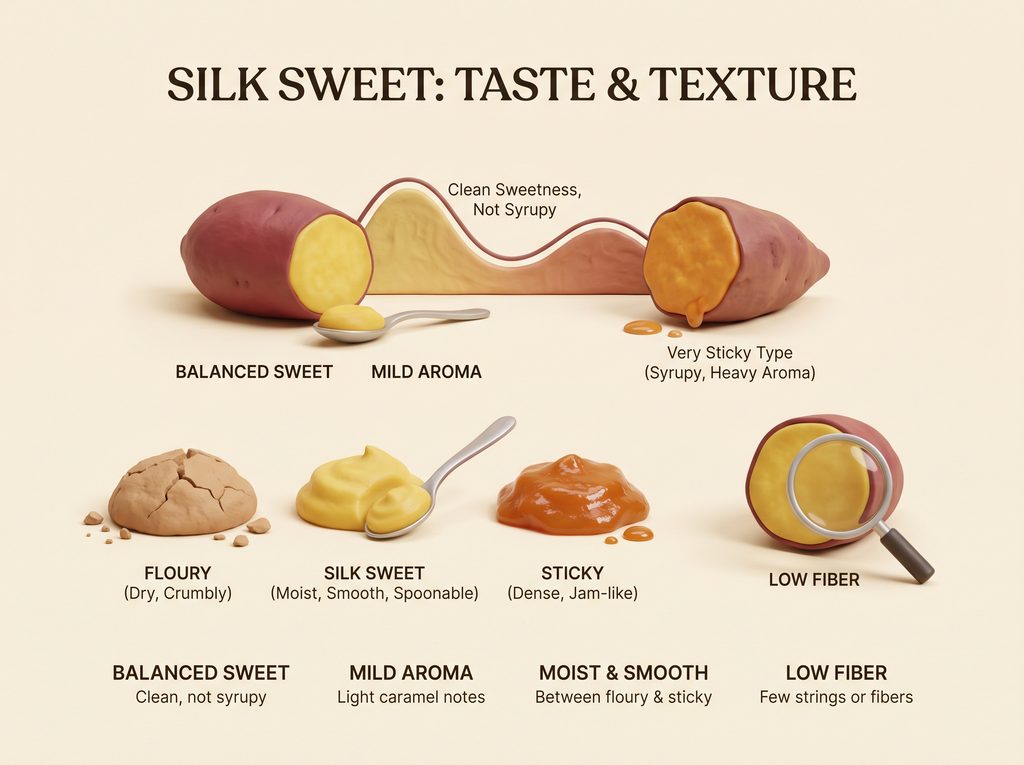
At its best, Silk Sweet tastes clean and clearly sweet, with a smooth texture and very little fibrous feel. It is not the most intense sweet potato you can buy, and that is rather the point.
Sweetness and Aroma
So the sweetness reads as balanced rather than syrupy. Roasting brings out a mild caramel aroma, though nothing as heavy as you get from the stickiest varieties. Individual roots still vary, and the same box can hold one that sings and one that merely behaves.
We avoid sweetness rankings here on purpose. Published sugar figures depend on storage period, root size, and measurement method, so comparing numbers across sources tells you very little.
Smooth, Fine, and Moist Texture
Japanese sweet potatoes are usually sorted into three texture families. Floury types such as Beniazuma break apart in dry, fluffy crumbs. Very sticky types such as Annou Imo turn dense and almost jam-like. Silk Sweet sits between the two, with a soft, moist flesh that spoons cleanly.
The low fiber content is usually what people notice first. There is little of the stringiness that can catch in the teeth with older varieties, which is exactly what the name is selling.
How Storage and Cooking Change It
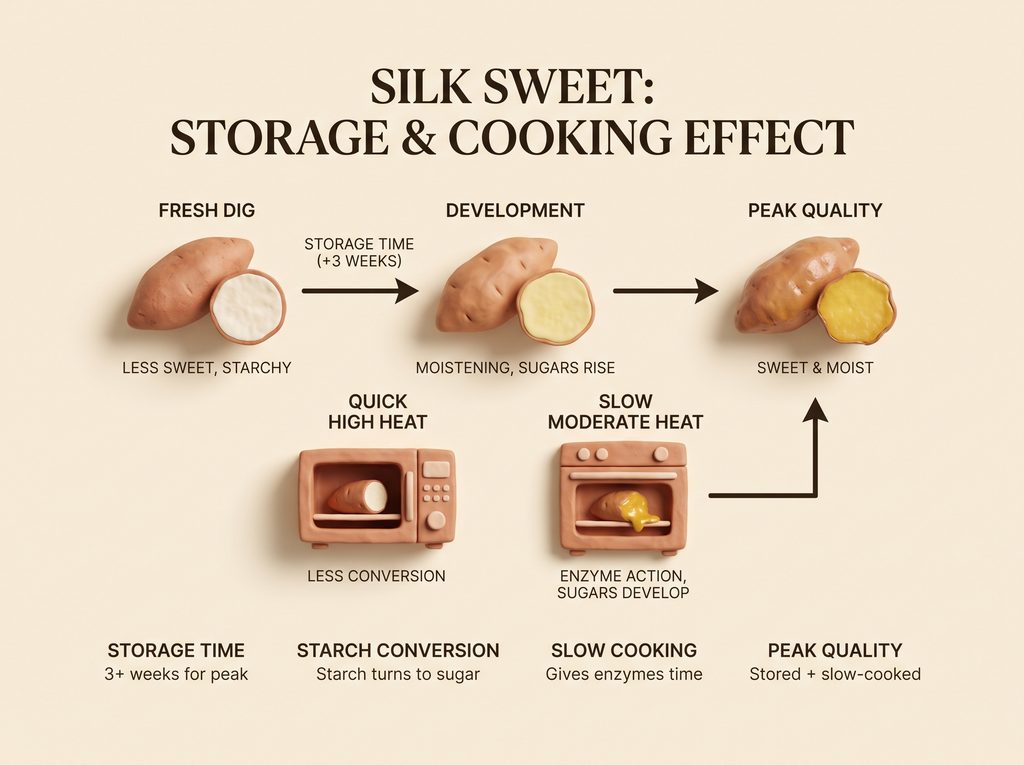
Here is the single most useful fact in this article. Silk Sweet does not reach its best straight out of the field, because the texture and sweetness develop during storage.
Why freshly dug is not best
The breeder reports that from roughly three weeks of storage onward, the flesh becomes moist and the sugar content rises. Sweet potatoes also convert starch into sugars during slow heating, so storage and cooking work on the same result from two directions. A root eaten in October and the same root eaten in December are noticeably different.
Cooking speed, meanwhile, matters just as much. Slow, moderate heat gives enzymes time to break starch down into sugars before the root finishes cooking. Blast it at high heat, or microwave it quickly, and much of that conversion never happens.
Silk Sweet Compared with Other Japanese Sweet Potatoes
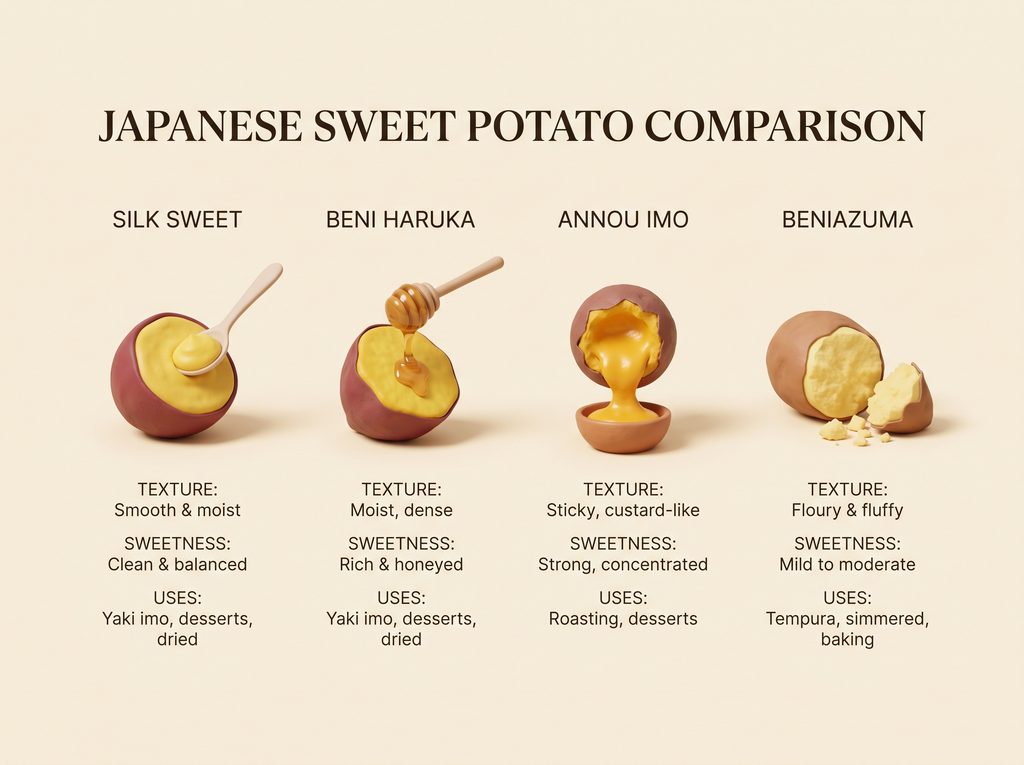
The table below describes general tendencies, not fixed rules. Any of these varieties can disappoint if it was stored badly or cooked too fast.
| Variety | General texture | Sweetness impression | Common uses |
|---|---|---|---|
| Silk Sweet | Smooth and moist when properly stored and cooked | Clean and balanced | Yaki imo, desserts, dried sweet potato |
| Beni Haruka | Moist, often described as dense after roasting | Often perceived as rich and honeyed | Yaki imo, desserts, dried sweet potato |
| Annou Imo | Very sticky and almost custard-like when roasted | Strong, concentrated impression | Roasting, desserts |
| Beniazuma | Floury and fluffy | Mild to moderate | Tempura, simmered dishes, baking |
Silk Sweet vs Beni Haruka
These two dominate the moist end of the market, and they are the comparison most readers actually want. Beni Haruka tends toward a heavier, more honeyed impression. Silk Sweet reads cleaner and lighter, with a finer texture and a shorter finish.
Which is better depends entirely on what you want, of course. If you like dessert-level intensity, Beni Haruka usually wins. If you find that cloying, Silk Sweet is the more comfortable everyday choice.
Silk Sweet vs Annou Imo
Annou Imo, associated with Tanegashima in Kagoshima, goes considerably further toward stickiness. You can eat a well-roasted Annou Imo with a spoon, like custard. Silk Sweet stays firmer and holds its shape better, which makes it easier to slice and use in cooking.
Silk Sweet vs Beniazuma
Beniazuma, by contrast, represents the older floury style that many Japanese households grew up with. It suits tempura, simmered dishes, and baking, where a drier crumb helps. Silk Sweet performs poorly in those same roles precisely because it is moist, so choose by dish rather than by preference.
Season, Selection, and Storage
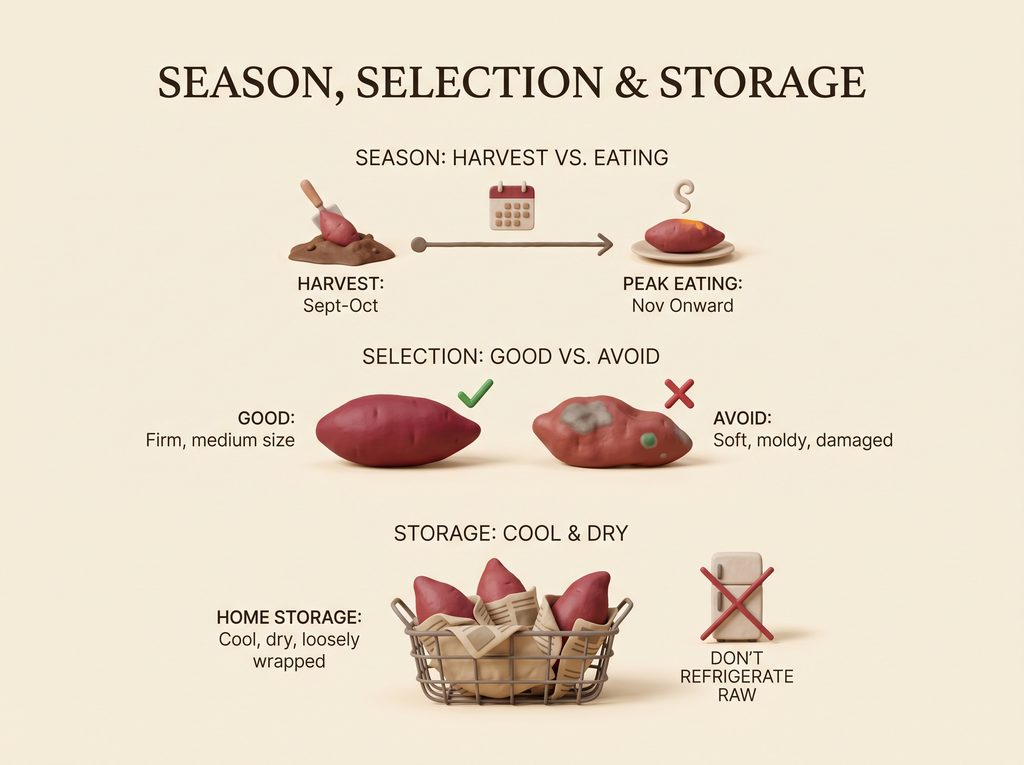
Sweet potato timing catches people out, because harvest season and eating season are not the same thing.
Harvest Season and Best Eating Period
Harvest generally runs from late September into October, and the breeder’s own trial records list harvest dates in early September through late October across Chiba and Ibaraki. Roots then go into storage rather than straight to shelves. Peak eating quality arrives later, so the autumn and winter months from about November onward are the best window.
Silk Sweet also stores well, which the breeder lists among its commercial strengths. As a result, you can find it in shops well past the harvest period.
How to Choose a Good One
First, look for firm roots with even, deep-colored skin and no soft patches. Avoid anything with mold, an off smell, or damaged areas around the ends. A medium root suits roasting better than a very large one, since large roots cook unevenly.
Perfect shape is not a quality marker, incidentally, so do not pay extra for it. Slightly irregular roots often taste identical, and they tend to be cheaper.
How to Store It at Home
Sweet potatoes suffer chilling injury at low temperatures, so the refrigerator is generally the wrong place for raw roots. Keep them somewhere cool but not cold, dry, and out of direct sunlight. Wrapping each root loosely in newspaper helps control humidity and condensation.
Home conditions vary enormously, though, so judge by your own kitchen. In a hot, humid apartment, the practical answer may be buying smaller amounts more often. Cooked sweet potato is a different case entirely, so refrigerate it, or freeze it once cooled.
How to Cook Silk Sweet
Every method below works, but they do not produce the same result. Slow roasting gives the sweetest, smoothest outcome, while speed costs flavor.
Oven-Roasted Silk Sweet
- Wash, do not peel. Scrub the skin well and pat it dry, since the skin holds the shape and is edible.
- Prick the skin. A few holes with a fork let steam escape and reduce splitting.
- Start low. Around 160 to 170°C works as a starting point for a medium root, giving enzymes time to convert starch into sugar.
- Allow an hour or more. A medium root often needs 60 to 90 minutes, and a large one considerably longer.
- Test with a skewer. It should slide through the center with no resistance at all.
- Rest briefly. Five minutes out of the oven lets the interior settle before you cut it.
Treat those times as a starting point rather than a rule. Ovens differ, and root size changes everything, so the skewer test is the only reliable guide.
Air Fryer Method
Air fryers generally suit smaller roots, since the chamber is compact and the airflow is aggressive. Use a moderate temperature rather than a high one, and turn the potato partway through for even cooking. Surface drying is the main risk, so some people wrap the root loosely in foil.
Microwave and Steaming
Microwaving is fast, yet that speed is exactly the problem. High power cooks the root before much starch converts, so the result tastes flat. A lower power setting for longer gets closer, though it still will not match an oven.
Steaming, by contrast, protects moisture beautifully. You lose the roasted aroma, but you gain a soft, evenly cooked flesh that works well for purées, sweet potato paste, and desserts.
Popular Ways to Eat Silk Sweet
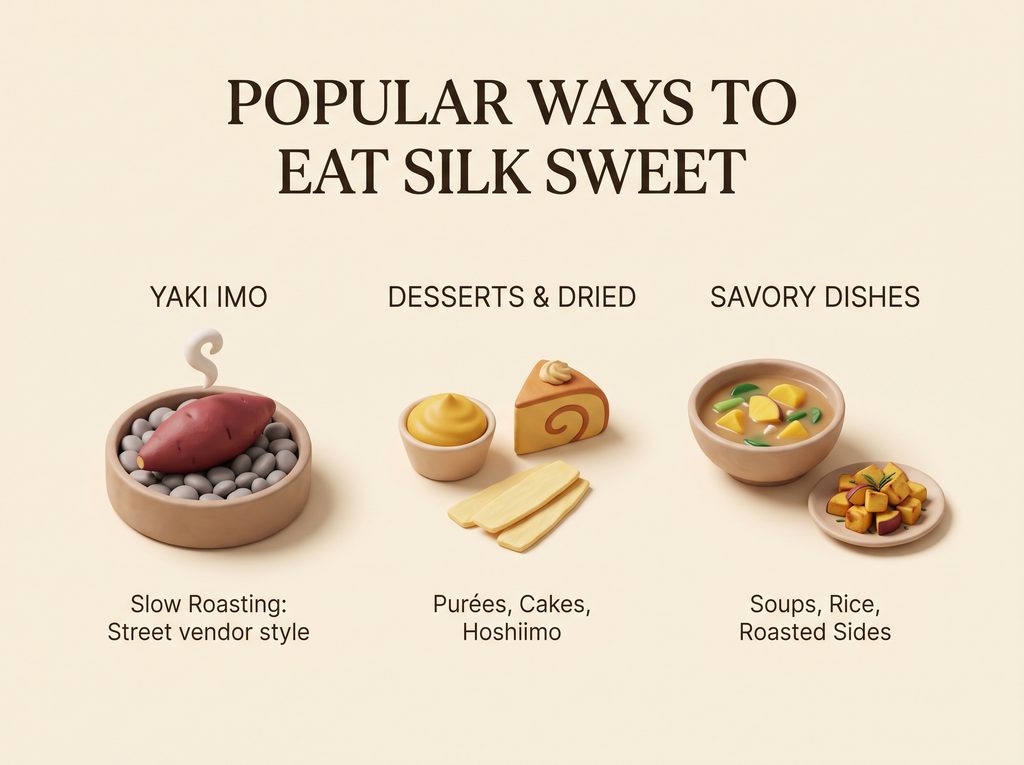
The breeder notes that Silk Sweet has spread beyond fresh sales into confectionery and even shochu production. At home, three uses dominate.
Yaki Imo
Roasted whole, Silk Sweet makes an excellent yaki imo. Street vendors and stone-roasting machines hold a low, steady heat for a long time, which is precisely what this variety wants. Supermarket roasters across Japan now sell it alongside Beni Haruka in winter.
Desserts and Dried Sweet Potato
The fine texture makes puréeing easy, so Silk Sweet suits sweet potato cake, tarts, puddings, and imo yokan. Kaneko Seeds also notes good processing suitability for hoshiimo, the dried sweet potato snack, where it produces a bright yellow result.
Savory Dishes
Silk Sweet works in soups, rice dishes, and roasted vegetable sides, where its moisture is an asset. For daigaku imo and tempura, however, a floury variety usually gives a better contrast between crisp coating and dry interior.
Nutrition and Dietary Notes
Sweet potatoes supply carbohydrate, dietary fiber, vitamin C, and potassium, and the values shift substantially depending on whether the root is raw, steamed, or roasted.
About nutrition figures
Published nutrition values for sweet potatoes are general reference values for the food item listed in Japan’s Standard Tables of Food Composition. They are not cultivar-specific measurements for Silk Sweet. Roasting also reduces water content, which changes every per-100g figure. Anyone managing a medical condition should speak with a qualified professional rather than relying on variety comparisons.
Can You Eat the Skin?
Yes, and many people in Japan prefer it that way. Wash the root thoroughly first, and cut away any bruised or damaged areas. Roasting makes the skin thin and pleasant, whereas steaming leaves it softer and less interesting. It comes down to preference more than anything else.
Where to Find Silk Sweet
Buying It in Japan
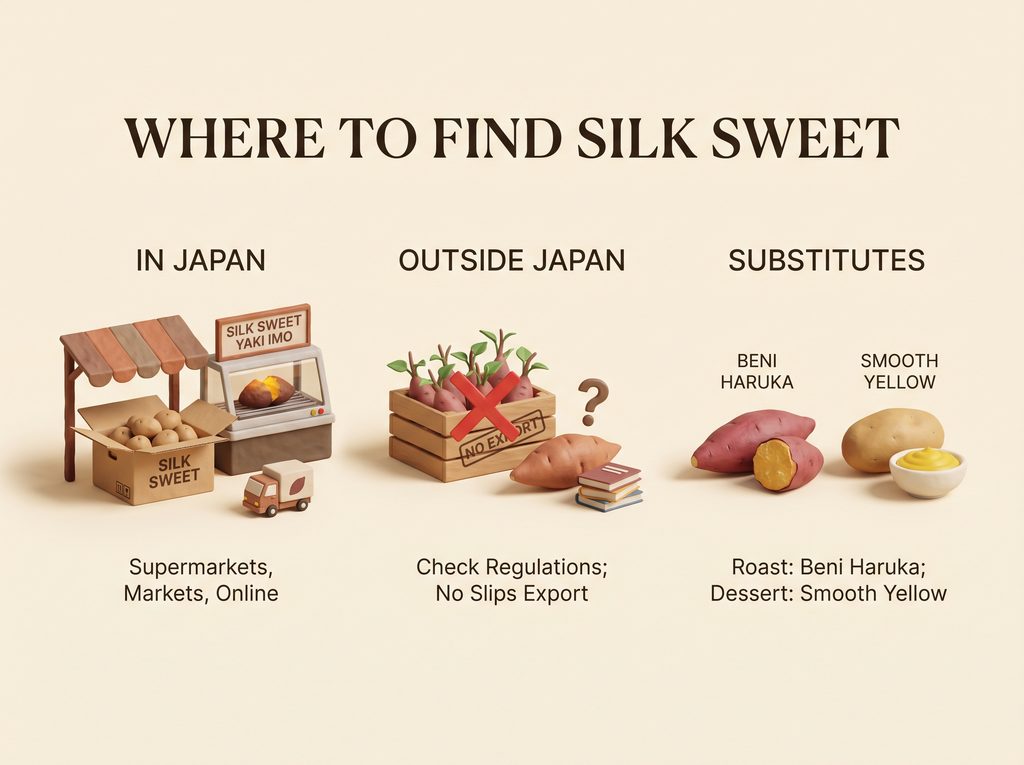
Supermarkets stock Silk Sweet through autumn and winter, usually under the trademark and often with a branded sticker or bag. Greengrocers, farmers’ markets, roadside stations, and department store food halls carry it too. Online produce retailers ship directly from farms in Chiba, Ibaraki, and elsewhere.
Supermarket roasting counters are the easiest option if you just want to try it once. Many display the variety name on the warmer, so you can compare it against Beni Haruka on the spot.
Availability Outside Japan
Availability outside Japan depends on local distribution and plant health regulations. Fresh roots and planting material fall under different import rules, and those rules change, so check with your national plant health authority before bringing anything across a border.
One point, at least, is unambiguous. The variety registration carries an export restriction on propagating material, so slips and cuttings may not legally leave Japan. Growing your own from Japanese stock is therefore not an option, however tempting it sounds.
Recommended Substitutes
For roasting, Beni Haruka is the closest widely available match, because both belong to the moist family. For dessert work, any smooth yellow-fleshed sweet potato will do. Japanese and Asian grocery stores abroad sometimes stock Japanese varieties seasonally, although the same marketing name can refer to different cultivars in different countries.
Frequently Asked Questions About Silk Sweet
Name and Variety
What is Silk Sweet?
Silk Sweet is a Japanese sweet potato bred by Kaneko Seeds in Gunma Prefecture. Its registered cultivar name is HE306, and Silk Sweet is the trademark used in shops. The skin is purple-red and the flesh turns bright yellow when cooked. It is also known for a smooth, moist texture.
Is Silk Sweet a cultivar or a brand name?
Both, in a sense. Japan’s variety protection system registers the plant itself as the cultivar HE306. Silk Sweet is the trademark that Kaneko Seeds uses to sell it. Packaging usually prints both names together.
Why is it called Silk Sweet?
The name refers to the smooth, fine texture that the variety is sold on. Its flesh has relatively little fiber, so it feels soft on the tongue. The description comes from the supplier rather than from independent testing. Storage and cooking still determine whether any individual root delivers it.
When was Silk Sweet developed?
Kaneko Seeds made the original cross in 2005 and selected from the resulting seedlings over following years. The company applied for variety registration in 2013 under the name HE306. Registration finally came through in January 2018. Seedling sales are reported to have started in 2012, ahead of registration.
Taste and Cooking
What does Silk Sweet taste like?
It tastes cleanly sweet rather than heavy, with a mild roasted aroma. The flesh feels smooth and moist once the root has spent time in storage. Individual roots differ, so expect some variation. Sweetness also builds during storage rather than peaking at harvest.
Is Silk Sweet moist or fluffy?
Moist, although not extremely sticky. It sits between floury varieties like Beniazuma and very sticky ones like Annou Imo. That middle position makes it versatile. It spoons easily while still holding its shape when sliced.
Is Silk Sweet good for yaki imo?
Yes, and roasting is its most common use in Japan. Slow, steady heat suits it particularly well. Supermarket roasting counters often carry it through winter. Cook a medium root at moderate heat for an hour or more for the best result.
How does it differ from Beni Haruka?
Both belong to the moist family, so the difference is one of degree. Beni Haruka usually gives a heavier, more honeyed impression. Silk Sweet reads lighter and finer, with a cleaner finish. Neither is objectively sweeter, since storage and cooking affect both.
Buying and Storing
When is Silk Sweet in season?
Harvest generally runs from late September into October. Roots then go into storage, where the flesh becomes moister and sweeter. The best eating period therefore falls from about November through winter. Good storage performance keeps it available for months.
How should Silk Sweet be stored?
Keep raw roots cool but not cold, since sweet potatoes suffer chilling injury in the refrigerator. Choose a dry, dark spot and avoid condensation. Wrapping each root loosely in newspaper helps. Refrigerate or freeze cooked sweet potato instead.
Can you eat the skin?
Yes. Wash the root well and remove any damaged patches first. Roasted skin turns thin and pleasant to eat, while steamed skin stays softer. Plenty of people in Japan eat roasted sweet potatoes whole.
Can you buy Silk Sweet outside Japan?
Availability depends on local distribution and plant health rules, which differ by country. Japanese and Asian grocery stores sometimes carry Japanese varieties seasonally. Propagating material carries an export restriction, so slips and cuttings cannot legally leave Japan. Check your national plant health authority before importing anything.
What is a good substitute?
Beni Haruka is the closest common alternative for roasting, since both are moist types. For desserts, any smooth yellow-fleshed sweet potato works reasonably well. Bear in mind that the same marketing name can cover different cultivars abroad.
Why Silk Sweet Is Worth Trying
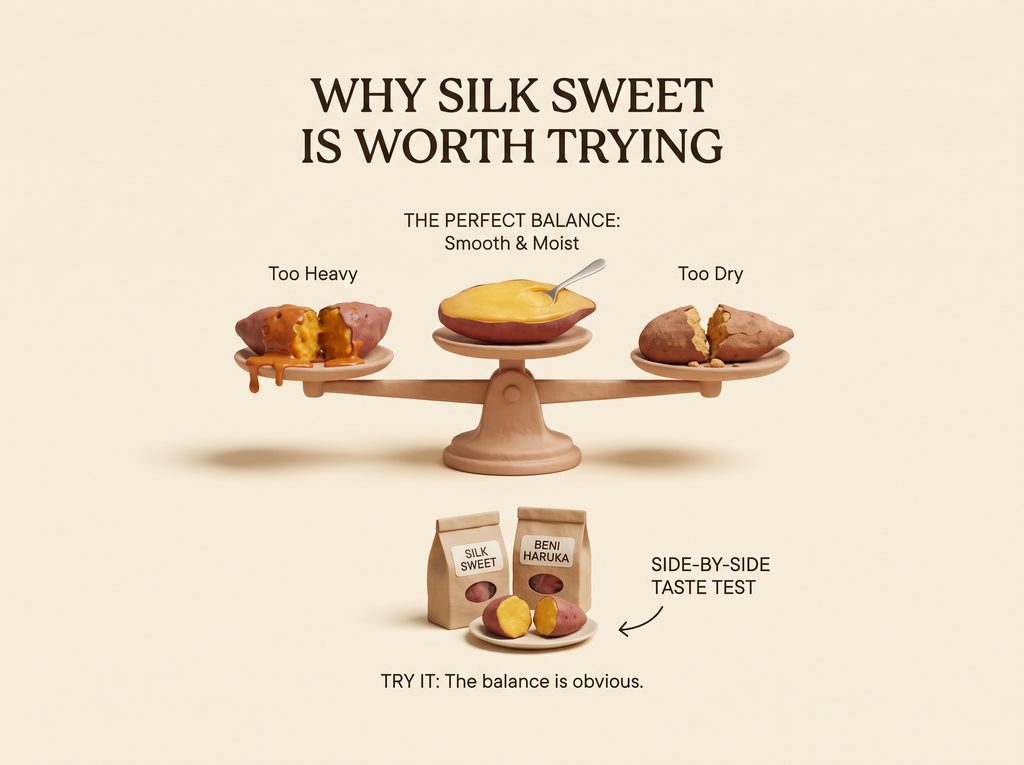
Silk Sweet particularly suits anyone who finds the stickiest sweet potatoes a bit much. It gives you the smooth, moist texture that made those varieties popular, without the dense, jam-like heaviness. That balance explains why it spread so quickly for a variety barely a decade old.
If you are in Japan in winter, the easiest introduction costs a few hundred yen at a supermarket roasting counter. Buy one Silk Sweet and one Beni Haruka, eat them side by side, and the difference becomes obvious immediately. Honestly, that comparison teaches more than any description can.
References
- Registered Variety Database: HE306, registration number 26480, Ministry of Agriculture, Forestry and Fisheries. Accessed September 2026.
- Enomoto, M. (2019). Sweet Potato Silk Sweet (registered variety name HE306): For Fresh Market and Processing. Imorui Shinko Joho, No. 138, Japan Potato and Sweet Potato Promotion Association. Accessed September 2026.
- Silk Sweet Product Page, Kaneko Seeds Co., Ltd. Accessed September 2026.
- List of Registered Varieties and Registration Numbers, Kaneko Seeds Co., Ltd. Accessed September 2026.
- Standard Tables of Food Composition in Japan, Ministry of Education, Culture, Sports, Science and Technology. Accessed September 2026.
- Plant Variety Protection and Seed Act Information, Ministry of Agriculture, Forestry and Fisheries. Accessed September 2026.
Related Articles
- Japanese Sweet Potato (Satsumaimo) (Surveyed: September 2026)
- Yakiimo (Japanese Roasted Sweet Potato) (Surveyed: September 2026)
- Hoshiimo (Dried Sweet Potato) (Surveyed: September 2026)
- Daigaku Imo (Surveyed: September 2026)
- Japanese Sweet Potato Cake (Surveyed: September 2026)
- Imo Youkan (Surveyed: September 2026)
- Best Japanese Winter Foods (Surveyed: September 2026)




Comments