





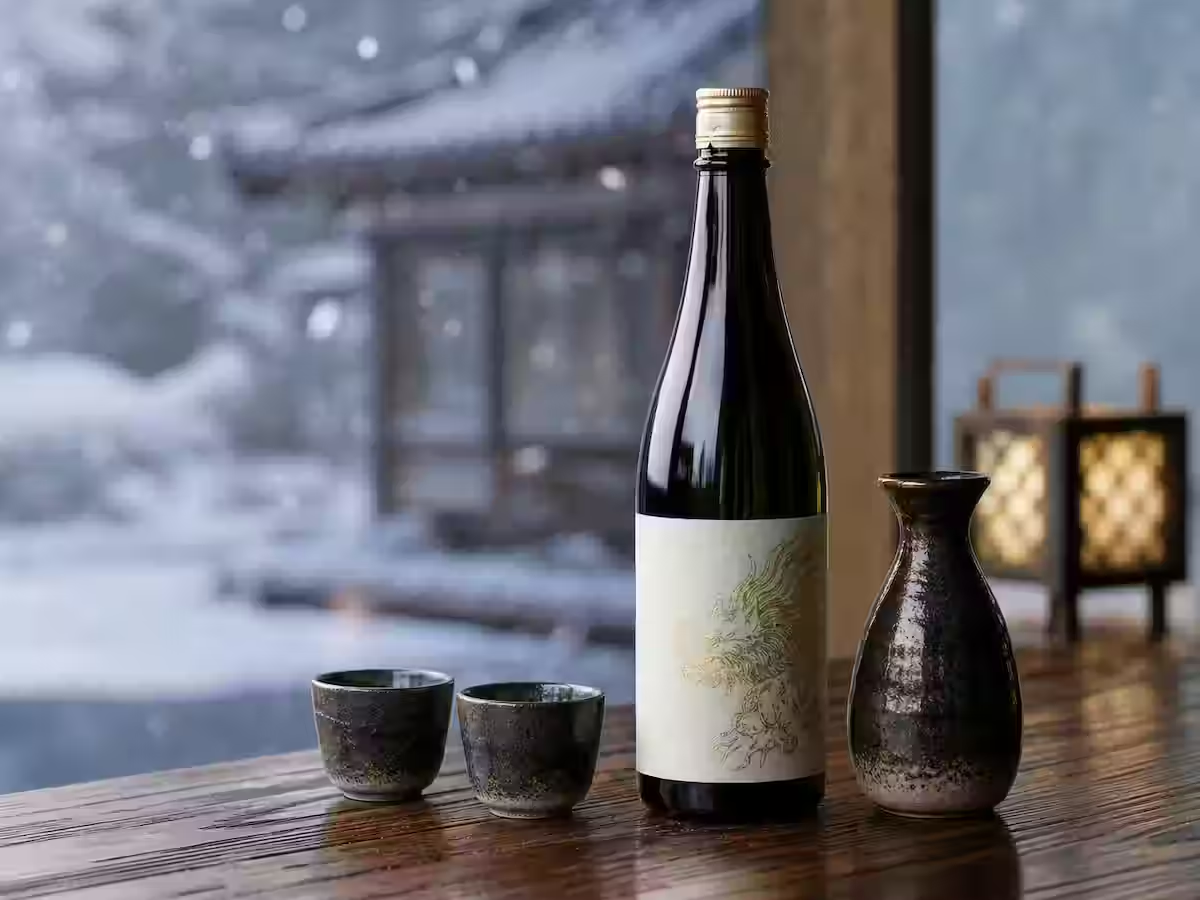
Akita sake is a refined sake culture from northern Japan. It comes from Akita Prefecture, a rice-growing region in Tohoku. Cold winters, abundant water, local rice, and careful brewing shape its character. As a result, the style is often smooth, mellow, and well balanced.
Many bottles from Akita show clean aroma, gentle sweetness, and a soft finish. Moreover, aroma is usually restrained rather than highly expressive. The sake often feels calm and measured. Therefore, Akita sake is often described as refined.
Moreover, To understand Akita sake, it helps to look at rice, climate, fermentation, yeast selection, and food culture. These elements explain why Akita sake is famous. They also show how traditional sake from Akita reflects regional identity. For basic sake terms, see the Japanese sake guide and Types of Japanese Sake.
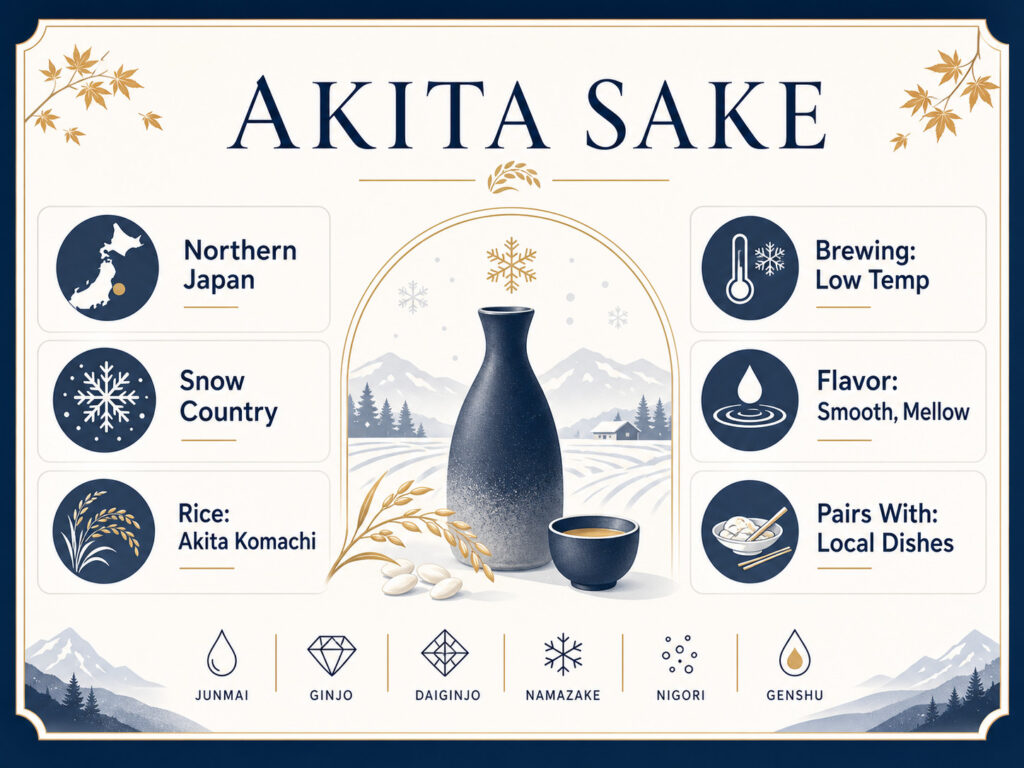
Quick Summary of Akita Sake
| Item | Summary |
| Region | Akita Prefecture, Tohoku, northern Japan |
| Famous for | Smooth texture, mellow sweetness, clean aroma, and cold-climate brewing |
| Climate | Snow country with cold winters suited to seasonal brewing |
| Rice culture | Major rice country with strong rice cultivation traditions |
| Common rice | Akita Sake Komachi, Akita Komachi, Miyama Nishiki, and other local rice |
| Brewing method | Long-term low-temperature fermentation and careful yeast selection |
| Flavor trend | Smooth, mellow, refined, lightly sweet, and food-friendly |
| Key styles | Junmai, Ginjo, Daiginjo, Namazake, Nigori, Genshu, and seasonal sake |
| Best pairings | Kiritanpo, Inaniwa udon, Hinai-jidori, seafood, pickles, and regional cuisine |
In short, Akita sake is shaped by rice, climate, and tradition. It is not only a drink from a cold place. Instead, it is a local brewing culture built around rice farming, winter work, and everyday food.
What Is Akita Sake?
Akita sake refers to Japanese sake brewed in Akita Prefecture. The prefecture lies in Tohoku, a northern region known for snow, rice fields, and rural culture. Consequently, this setting gives Akita sake its basic identity.
The typical image is smooth, mellow, and clean. Some bottles feel lightly sweet. Others are dry and crisp. Yet many share a soft texture and calm aroma. Therefore, Akita sake is easy to pair with food.
In flavor terms, Akita sake often tastes refined, rounded, and gently aromatic. It can show rice sweetness, pear-like aroma, mild acidity, and a clean finish. That description is simple. Still, it helps frame the region.
What Makes Akita Sake Unique?
Akita sake is unique because its brewing culture grows from a rice country in snow country. Rice is the first key. Akita has long been known for rice cultivation. Therefore, rice quality remains central to local brewing.
In addition, Local rice shapes both flavor and texture. Akita Sake Komachi is a well-known sake rice from the prefecture. Akita Komachi also appears in the wider food culture. For a broader example of Japanese sake rice culture, see Food in Japan’s sake rice guide.
Cold weather is the second key. Winter temperatures help brewers manage fermentation slowly. As a result, long-term low-temperature fermentation can create clean aroma and smooth texture. It can also reduce harsh edges when the process works well.
Water is also important. Akita has rivers, snowmelt, and mountain water sources. Brewers use local water with care. In practice, this can support a soft finish and steady fermentation, although each brewery has its own water profile.
Toji and brewery teams form the human side. Akita has local brewery tradition, including San’nai master brewers. Their work connects winter agricultural life with sake brewing. Accordingly, that link still shapes Akita prefecture brewing culture.
Meanwhile, Food culture completes the picture. Akita sake belongs beside rice dishes, hot pots, noodles, seafood, and preserved vegetables. The connection appears in everyday pairings and seasonal brewing. In other words, it is practical rather than decorative.
Rice Culture and Local Sake Rice
Therefore, Akita is often called a rice country. That phrase matters for sake. Rice cultivation supports both daily meals and brewing. In this region, the line between table culture and sake culture can feel thin.
Akita Komachi is famous as table rice. It has sweetness and stickiness, which also appear in dishes such as Kiritanpo. Sake rice works differently. Even so, both show how strongly Akita values rice.
For brewing, Akita Sake Komachi plays an important role. Brewers use it for refined styles, including Ginjo and Daiginjo. Meanwhile, other rice varieties may also appear, depending on the brewery and target flavor.
As a result, What role local rice plays in Akita sake is easy to miss at first. It does not only provide starch. Rather, it gives brewers a regional foundation. When rice, water, and technique align, the sake feels more clearly connected to place.
Cold-Climate Brewing and Low-Temperature Fermentation
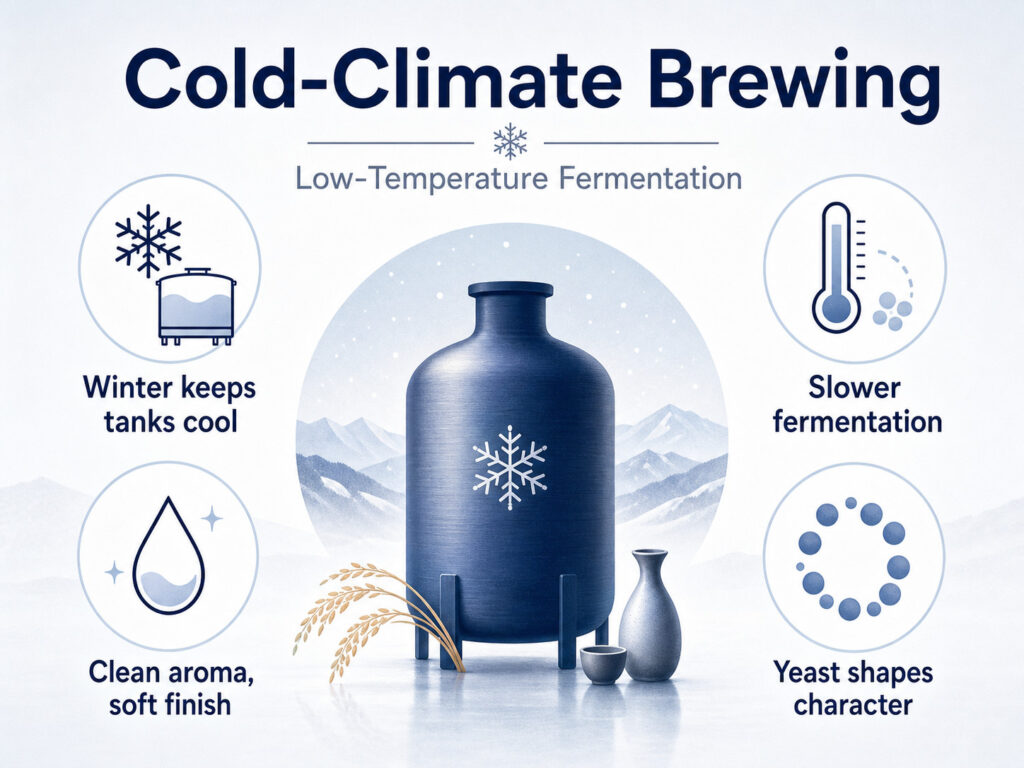
Cold-climate brewing is central to Akita sake. In snow country, winter conditions help breweries keep fermentation cool. Therefore, the region suits seasonal brewing and long, careful tank management.
Long-term low-temperature fermentation affects sake in several ways. The method slows yeast activity. In addition, clean aroma can remain clearer. Brewers may also create smoother texture and a more refined finish. As a result, the sake often shows soft aroma and a clean finish.
This method needs patience. If fermentation is too slow, aroma can feel weak. However, if it moves too quickly, the sake may lose balance. Skilled brewers therefore watch temperature, acidity, sugar, and aroma each day.
Yeast selection adds another layer. Akita is linked with important yeast history, especially No. 6 yeast from Aramasa. Yeast can shape aroma, acidity, and texture. Likewise, it can decide whether a sake feels bright or soft.
Water, Koji, and Fermentation in Akita Brewing
Water does more than dilute sake. It affects fermentation speed, mouthfeel, and finish. Akita’s mountain and river systems provide useful local water sources. Consequently, brewers choose and manage that water carefully.
Koji is another core element. Koji mold converts rice starch into sugar. Yeast then turns that sugar into alcohol and aroma. As a result, this parallel process gives Japanese sake its layered taste.
Akita breweries often aim for clean fermentation. That does not mean neutral flavor. On the contrary, a well-made sake can be mellow, lightly sweet, and expressive. It can still finish softly without feeling heavy.
Why Akita sake is smooth depends on several factors. Polished rice helps. Low-temperature fermentation helps. Good water helps too. Therefore, the final result comes from many small decisions, not one secret ingredient.
Akita Sake Flavor Profile and Characteristics
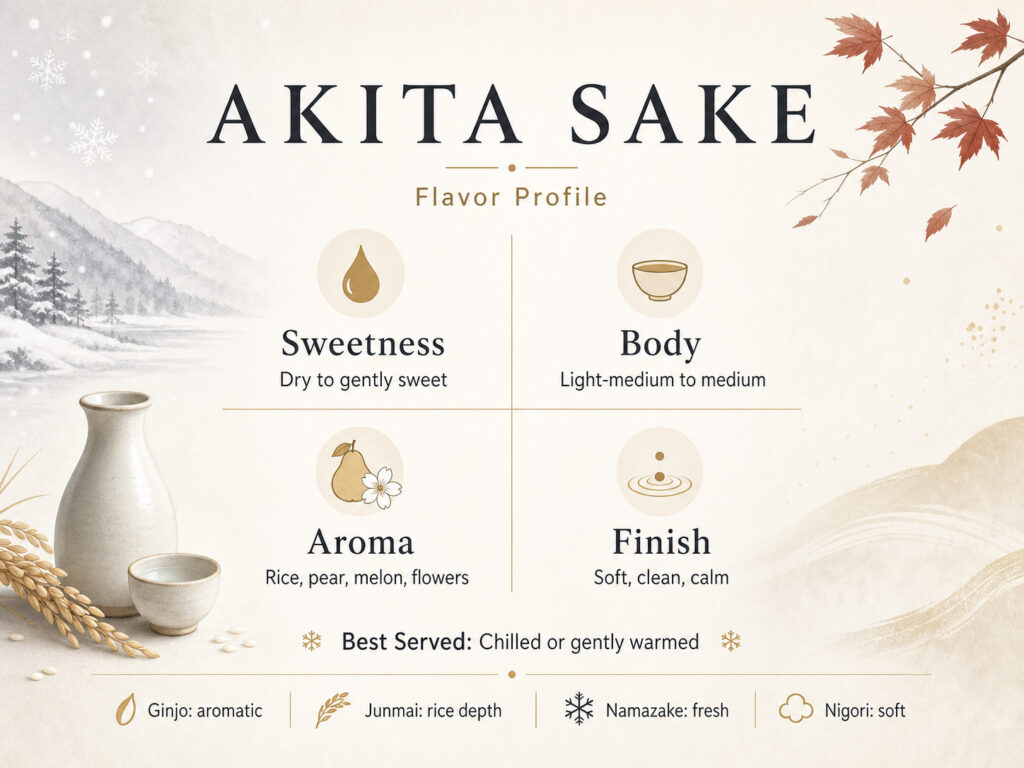
Still, Akita sake flavor profile often centers on smooth texture and mellow sweetness. Many bottles feel medium-light to medium in body. Aromas may include steamed rice, pear, melon, flowers, or soft herbs.
The sweetness is usually controlled. Some sake tastes gently sweet at the front. Then acidity and rice flavor bring balance. Thus, the finish often feels soft, clean, and calm.
Ginjo and Daiginjo styles can show clear aroma. Junmai styles may show more rice depth and umami. Meanwhile, Namazake can feel fresher and brighter. Nigori adds a softer cloudy texture.
Serving temperature depends on style. Aromatic Ginjo and Daiginjo usually work chilled. Junmai can work chilled, room temperature, or gently warm. Moreover, warmed sake can bring out rice sweetness in winter.
| Character | Typical Akita expression |
| Sweetness | Dry to gently sweet, often mellow |
| Body | Light-medium to medium |
| Aroma | Clean, rice-like, fruity, floral, or lightly herbal |
| Texture | Smooth texture with soft finish |
| Acidity | Usually balanced, sometimes bright in modern styles |
| Best serving | Chilled for aromatic sake, warm for some Junmai |
Comparison Table: Akita, Kyoto Fushimi, Hyogo, and Niigata Sake
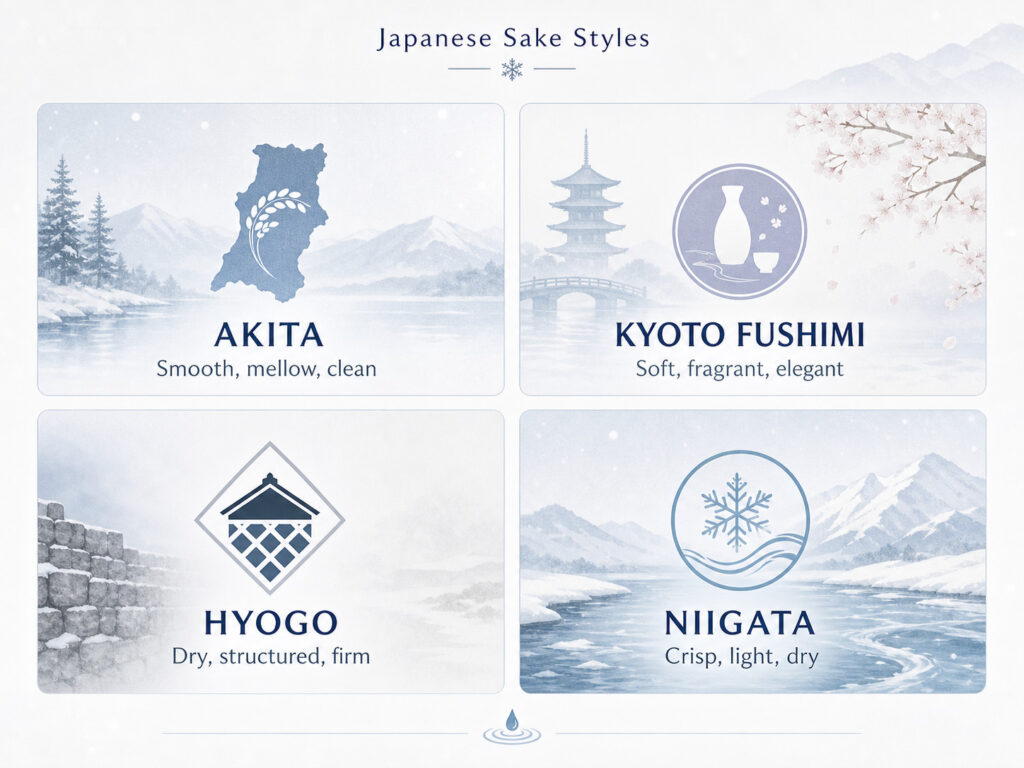
| Region | Typical profile | Main influence | Food direction |
| Akita | Smooth, mellow, clean, and balanced | Rice country, snow climate, and low-temperature fermentation | Kiritanpo, chicken hot pot, noodles, seafood, and pickles |
| Kyoto Fushimi | Smooth, fragrant, soft, and elegant | Fushimi water, Kyoto brewing culture, and refined cuisine | Tofu, yuba, kaiseki, light seafood, and delicate dishes |
| Hyogo | Dry, structured, clean, and firm | Nada Gogo, Miyamizu, Yamadanishiki, and coastal brewing | Seafood, Kobe beef, hot pot, grilled fish, and kaiseki |
| Niigata | Clean, crisp, light, and often dry | Snowy winters, soft water, and tanrei karakuchi culture | Seafood, sushi, grilled fish, and light dishes |
This table is a reference guide, not a rule. Kyoto Fushimi, Hyogo, and Niigata already have separate Food in Japan guides. Therefore, comparing them with Akita helps show how rice, water, climate, and cuisine shape regional sake culture.
History of Akita Sake
Akita sake history connects closely to rice farming and winter life. In older periods, sake brewing supported local agriculture and domain economies. As a result, farmers could work in breweries during the cold season.
The Edo period helped shape Akita’s brewing culture. Rice production, local water, and regional trade all mattered. Consequently, sake became part of everyday sake culture, not only ceremonial drinking.
For example, Modern Akita sake developed through technical study and local leadership. Brewers improved polishing, fermentation control, and yeast selection. Aramasa became especially important because No. 6 yeast was discovered there in 1930.
Akita also built recognition through brewing competitions and technical training. Local breweries now range from long-established producers to smaller modern makers. The region keeps tradition. At the same time, it does not stand still.
The cultural background of sake brewing in Akita is therefore practical. Rice fields, snow, winter labor, yeast research, and local meals all overlap. Together, these factors give Akita sake its regional identity.
Famous Breweries and Brands in Akita
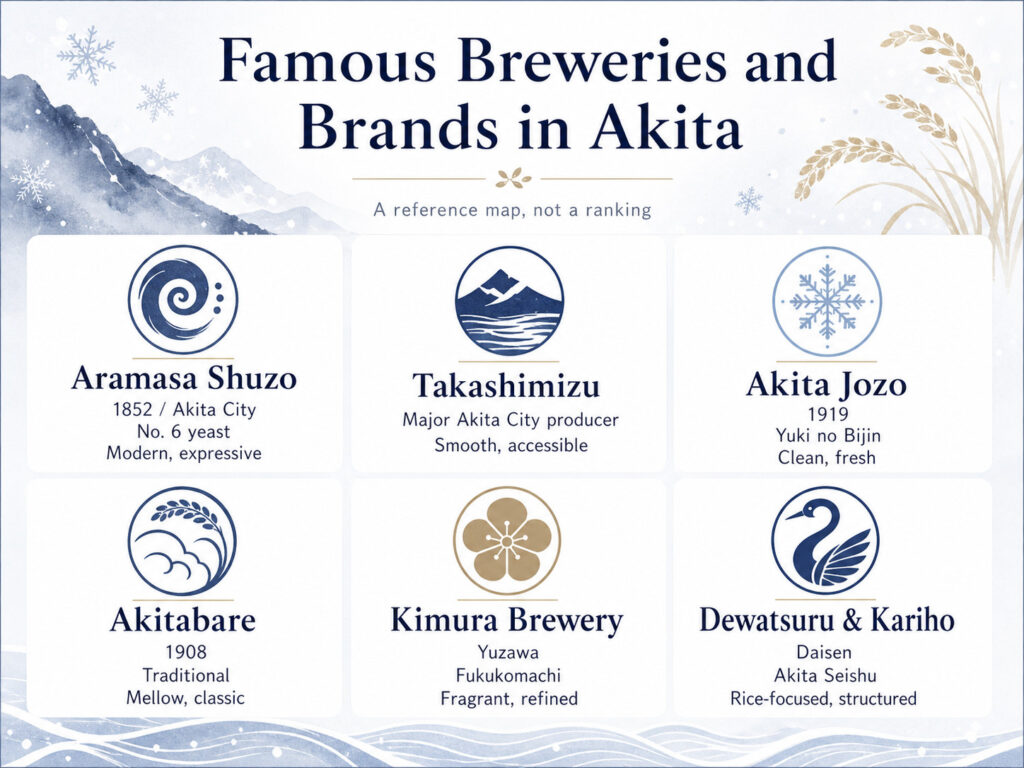
This section is not a ranking. Instead, it gives a reference map for famous sake from Akita. Each brewery shows a different side of local brewery tradition. Some names represent technical innovation. Others show classic local balance or everyday drinkability.
| Brewery or brand | Founded or background | General style |
| Aramasa Shuzo | Founded in 1852 in Akita City | Known for No. 6 yeast, modern acidity, and expressive Junmai styles |
| Takashimizu | Major Akita City producer | Smooth, accessible, and widely recognized Akita sake |
| Akita Jozo | Founded in 1919, known for Yuki no Bijin | Clean, fresh, Junmai-focused, and low-temperature fermentation |
| Akitabare | Founded in 1908 in Akita City | Traditional brewing, mellow aged styles, and classic flavor |
| Kimura Brewery | Yuzawa brewery known for Fukukomachi | Fragrant Ginjo, local rice, and refined premium sake |
| Dewatsuru and Kariho | Daisen area breweries linked with Akita Seishu | Rice-focused brewing and structured local styles |
Aramasa and Modern Technical Identity
Aramasa Shuzo is one of the most influential breweries in modern Akita sake. Founded in 1852, it is the birthplace of Kyokai No. 6 yeast. The brewery now works with Akita-grown rice only and is known for pure-rice brewing with strong individuality. Consequently, its No. 6 series, Colors line, and private releases often show bright acidity, precision, and a modern view of tradition.
This matters for readers trying to understand Akita today. Aramasa does not simply preserve old methods. Rather, it shows how local ingredients and yeast history can support an unmistakably modern sake profile. Therefore, the brewery often acts as a bridge between regional identity and national influence.
Takashimizu and the Everyday Local Base
Takashimizu represents the broad local base of Akita sake. The brewery emphasizes Akita rice, local underground water, and Yamauchi Toji technique. In practical terms, this is one of the labels many people encounter first in Akita. The style often leans approachable, balanced, and reliable. Therefore, it helps explain the role of sake in everyday drinking culture as well as gift markets.
This kind of brewery is easy to underestimate. However, regional sake culture does not survive through prestige labels alone. It also depends on dependable local brands that people actually drink with dinner, seasonal dishes, and social gatherings. Takashimizu helps show that side of Akita very clearly.
Small-Scale Precision and Premium Rice Expression
Akita Jozo, known for Yuki no Bijin, shows what a smaller brewery can do with strict control. The company was founded in 1919 and now focuses on limited-quantity Junmai sake. Its brewing method uses prolonged low-temperature fermentation over more than 30 days. As a result, the sake is usually crisp, clean, and rice-driven, with enough acidity to feel modern without losing regional character.
Kimura Brewery in Yuzawa is useful for understanding premium rice expression. The brewery is known for Fukukomachi and works with Akita Sake Komachi and other local rice. Fragrant Ginjo and polished Daiginjo styles appear often in its lineup. These bottlings therefore show how Akita can produce elegant premium sake without losing softness.
Traditional Breadth and Internal Diversity
By contrast, Akitabare adds another layer to the regional picture. The brewery is often associated with softer traditional styles, mellow maturity, and rice-forward balance. Some bottles show a more classical profile than Akita’s trendier labels. That contrast matters. It reminds readers that Akita sake is not only about innovation, but also about continuity and quiet refinement.
Dewatsuru and Kariho, linked with Akita Seishu in Daisen, help show internal diversity within one producer group. Kariho often appears drier, firmer, and more structured. Dewatsuru can feel broader and more rooted in rice flavor. Looking at these names side by side is useful. Likewise, they show how one prefecture can support both refined mellow styles and more assertive sake.
Aramasa shows Akita’s experimental side. Takashimizu shows the wider everyday sake culture. Yuki no Bijin shows small-scale precision. Meanwhile, Akitabare, Fukukomachi, Dewatsuru, and Kariho complete the picture. Together, they explain why Akita is one of Japan’s respected sake regions.
Famous Local Sake Types
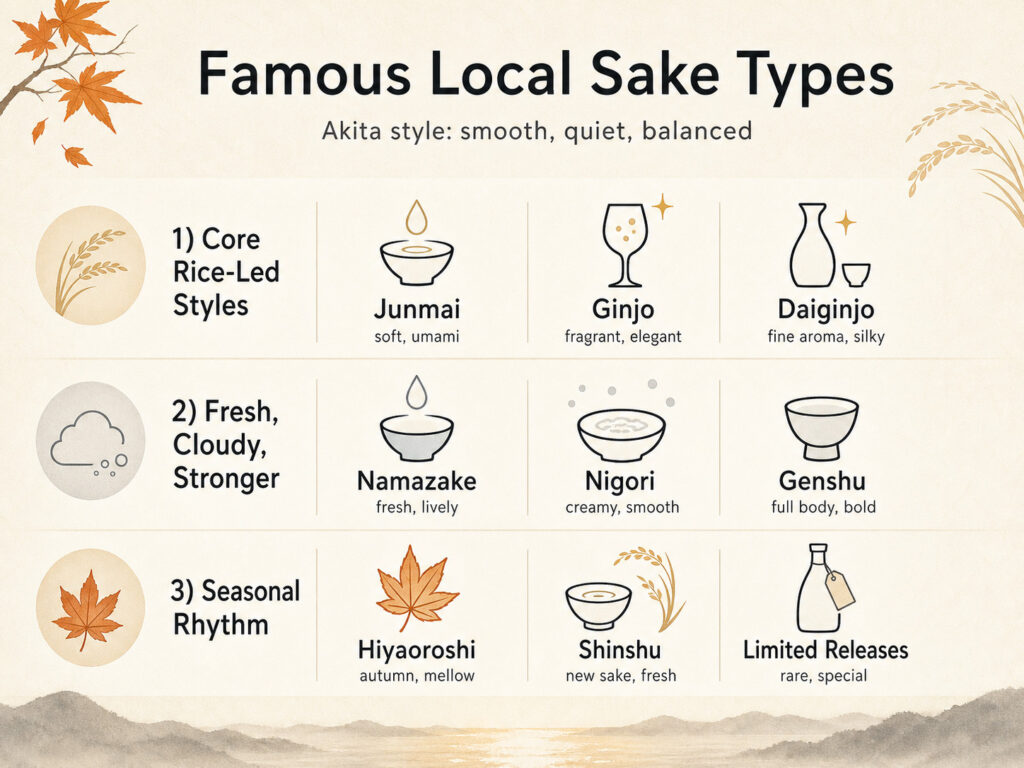
Moreover, Akita breweries make many types of sake. The list below connects common label terms with local character. These categories are national sake types, but Akita’s climate and brewing habits give them a distinct accent. In many cases, the local expression is smoother, quieter, and more balanced than readers expect.
Core Rice-Led Styles
- In addition, Junmai: pure rice sake that can show mellow sweetness, soft umami, and a gentle finish. In Akita, Junmai often works well both chilled and lightly warmed.
- Meanwhile, Ginjo: aromatic sake shaped by polished rice and cool fermentation. Akita Ginjo tends to keep fragrance under control rather than chasing extreme perfume.
- Therefore, Daiginjo: highly polished sake with refined aroma and clean texture. In Akita, this style often shows pear, melon, white flowers, and a silky mouthfeel.
Junmai deserves special attention in Akita because local breweries often use it to show rice depth without heaviness. A polished Junmai from Akita can feel soft, savory, and food-friendly. It may carry more body than Ginjo, yet it rarely becomes rough. Therefore, Junmai remains important in regional dining and cold-weather meals.
Ginjo and Daiginjo styles are also central to Akita’s reputation. Low-temperature fermentation allows the region to produce clean aroma and smooth texture. Yet Akita often resists excessive sweetness or exaggerated fruitiness. Instead, these premium types usually feel restrained, refined, and easy to pair with broth-based dishes, noodles, and seafood.
Fresh, Cloudy, and Stronger Expressions
- As a result, Namazake: fresh unpasteurized sake that can feel lively and seasonal. In Akita, winter and spring releases often show bright freshness with surprisingly fine texture.
- Still, Nigori: cloudy sake with soft texture and gentle sweetness. Akita versions can feel creamy but usually stay cleaner and lighter than heavy dessert-like nigori.
- Genshu: undiluted sake with fuller body and stronger impact. In Akita, genshu can still remain balanced when the brewery keeps acidity and sweetness in check.
Namazake, Nigori, and Genshu show another side of the region. They can feel more vivid, fuller, or texturally softer than standard bottled sake. Even so, Akita brewers usually keep balance in view. As a result, these styles still connect clearly to the prefecture’s broader flavor identity.
Seasonal Releases and Local Rhythm
- For example, Seasonal sake: autumn hiyaoroshi, fresh winter shinshu, and small-lot releases show local brewing rhythm and seasonal identity.
By contrast, For broader category details, see Food in Japan guides to Junmai, Ginjo, Daiginjo, Namazake, Nigori, and Genshu.
Best Food Pairings for Akita Sake
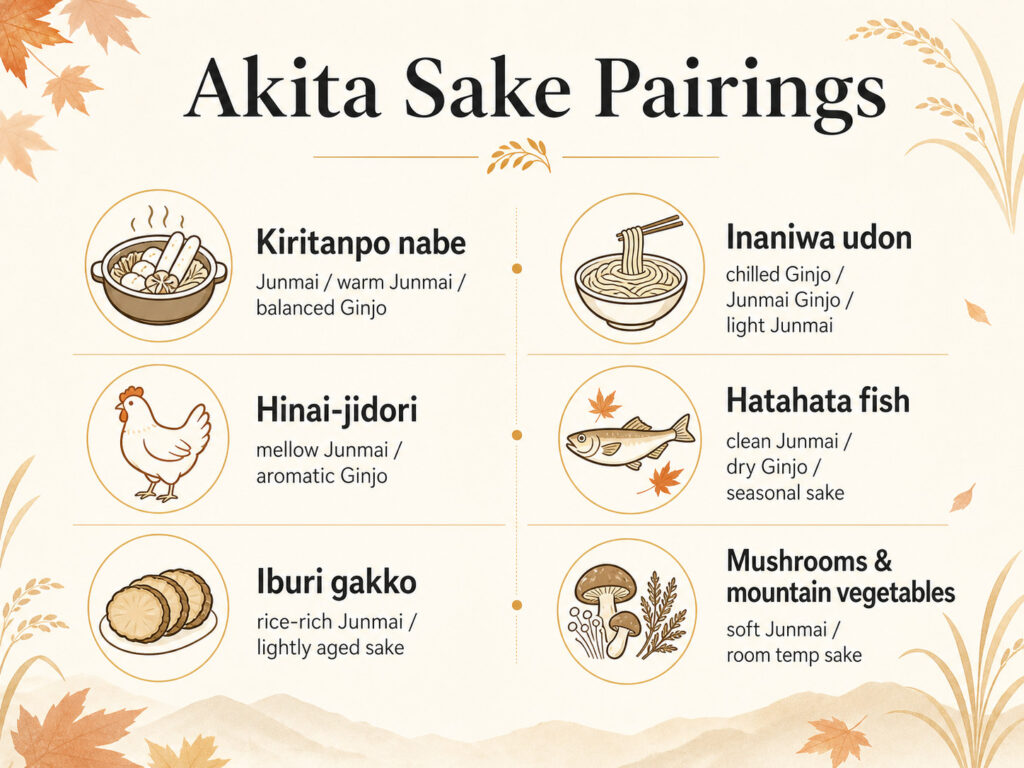
Akita sake pairs well with food because many bottles are smooth and balanced. Mellow sweetness supports savory dishes. Clean aroma keeps the meal from feeling heavy. Therefore, Akita sake works naturally at the table.
Hot Pot and Noodle Pairings
Kiritanpo is the most direct pairing. Toasted rice, chicken broth, burdock, mushrooms, and seri need sake with rice depth. A mellow Junmai works well. Meanwhile, a clean Ginjo can refresh the broth.
Moreover, Inaniwa udon needs a lighter match. Its thin, smooth noodles suit chilled Ginjo or soft Junmai. The sake should not overpower the broth. For background, see Food in Japan’s Inaniwa udon guide.
Smoked, Salty, and Seasonal Foods
In addition, Akita food also includes Hinai-jidori, hatahata fish, iburi gakko, and mountain vegetables. These dishes carry salt, smoke, umami, or broth. Akita sake can meet those flavors without becoming sharp. For wider regional cuisine context, see Food in Japan’s Akita food guide and Japanese regional specialties.
- Meanwhile, Kiritanpo nabe: Junmai, warm Junmai, or balanced Ginjo.
- Therefore, Inaniwa udon: chilled Ginjo, Junmai Ginjo, or light Junmai.
- As a result, Hinai-jidori: mellow Junmai or gently aromatic Ginjo.
- Still, Hatahata fish: clean Junmai, dry Ginjo, or seasonal sake.
- For example, Iburi gakko: rice-rich Junmai or lightly aged sake.
- By contrast, Mushrooms and mountain vegetables: soft Junmai or room-temperature sake.
Best Places to Experience Akita Sake
Moreover, Akita sake is best understood through breweries, local restaurants, and seasonal drinking culture. Akita City offers several historic breweries. Some provide tours or tasting facilities, depending on schedule.
In addition, Takashimizu is a useful starting point because it explains large-scale local brewing. Aramasa gives a different view, focused on yeast, acidity, and modern identity. Akita Jozo shows small-scale precision through Yuki no Bijin.
Meanwhile, Yuzawa and Daisen also matter. These areas connect sake with rice cultivation, water, and inland brewing culture. Brewery towns in Akita often feel closely tied to farming communities. That link is important.
Sake festivals and local events can help visitors compare styles. Still, schedules change by season. Therefore, winter and early spring are especially useful for understanding seasonal brewing and fresh releases.
Akita Sake and Everyday Table Culture
Therefore, Akita sake also belongs to everyday meals, not only formal tastings. In rural culture, rice, pickles, fish, mushrooms, and hot dishes create a practical table. Sake with smooth texture fits that setting because it supports food without taking over.
This point is easy to overlook. A refined sake culture does not always mean delicate food alone. In Akita, refinement can appear in balance, restraint, and seasonal timing. Thus, a soft finish helps the sake move between salty, smoky, and broth-based dishes.
Seasonal brewing also matters at the table. Fresh winter sake can feel lively beside hot pot. A mellow Junmai can suit autumn mushrooms. Meanwhile, chilled Ginjo works with lighter noodles or seafood. These patterns show how Akita sake reflects local traditions through daily food.
FAQ About Akita Sake
What is Akita sake?
As a result, Akita sake is Japanese sake brewed in Akita Prefecture. It is known for smooth texture, mellow sweetness, clean aroma, and cold-climate brewing.
Why is Akita sake famous?
Still, Akita sake is famous because the prefecture combines rice culture, snow country climate, local water, and skilled brewing traditions.
How does Akita sake taste?
For example, Akita sake often tastes smooth, mellow, and balanced. Many bottles show rice sweetness, clean aroma, and a soft finish.
What makes Akita sake unique?
By contrast, Akita sake is unique because rice-growing culture, cold weather, long-term low-temperature fermentation, and yeast selection work together.
Why is Akita sake smooth?
Moreover, Akita sake is smooth because brewers often use careful rice polishing, cool fermentation, clean water, and controlled yeast activity.
What rice is used in Akita sake?
In addition, Akita breweries may use Akita Sake Komachi, Miyama Nishiki, Akita Komachi, or other brewing rice varieties.
What is long-term low-temperature fermentation?
Meanwhile, It is a slow fermentation method at cool temperatures. It can create clean aroma, smooth texture, and refined flavor.
Which Akita sake is famous?
Therefore, Famous names include Aramasa, Takashimizu, Yuki no Bijin, Akitabare, Fukukomachi, Dewatsuru, and Kariho.
What food pairs well with Akita sake?
As a result, Kiritanpo, Inaniwa udon, Hinai-jidori, hatahata fish, iburi gakko, mushrooms, and hot pot pair well.
Is Akita sake dry or sweet?
Still, Both styles exist. Many examples are gently sweet or medium dry, with a clean aroma and soft finish.
Final Thoughts
For example, Akita sake is a gentle expression of Akita’s brewing heritage. It reflects rice, cold weather, water, yeast, and local food culture. The result is often smooth, mellow, and well balanced.
The region does not rely on one flavor alone. Some breweries make bright modern sake. Others keep softer traditional styles. That variety therefore makes Akita more than a simple snow country label.
By contrast, Akita’s position among Japan’s notable sake regions comes from practical foundations. Local rice, seasonal brewing, and careful fermentation developed together over time.
References
Takashimizu official site – https://www.takashimizu.co.jp/ – checked in 2026; Akita rice, underground water, Yamauchi Toji tradition, and current brewery information.
Aramasa official site – http://www.aramasa.jp/ – checked in 2026; founded in 1852, Akita-grown rice only, and Junmai-focused brewing.
Aramasa brewery history – http://www.aramasa.jp/around/ – checked in 2026; Kyokai No. 6 yeast origin, 1930 discovery context, and low-temperature yeast significance.
Akita Jozo – Yuki no Bijin – https://yukinobijin.com/en/ – checked in 2026; founded in 1919, limited Junmai production, and prolonged low-temperature fermentation over 30 days.
Kyoto Sake Fushimi – Food in Japan – https://www.foodinjapan.org/kansai/kyoto/kyoto-sake-fushimi/ – checked in 2026; internal regional sake article for Kyoto Fushimi comparison.
Hyogo Sake Guide – Food in Japan – https://www.foodinjapan.org/kansai/hyougo/hyogo-sake-guide/ – checked in 2026; internal regional sake article for Hyogo comparison.
Niigata Sake – Food in Japan – https://www.foodinjapan.org/chubu/niigata/niigata-sake/ – checked in 2026; internal regional sake article for Niigata comparison.
Akita Food – Food in Japan – https://www.foodinjapan.org/tohoku/akita-en/ – checked in 2026; Akita regional cuisine, rice culture, Kiritanpo, and Inaniwa udon context.
Kiritanpo – Food in Japan – https://www.foodinjapan.org/tohoku/akita-en/kiritanpo/ – checked in 2026; Kiritanpo, Akita Komachi, and local rice culture context.
Inaniwa Udon – Food in Japan – https://www.foodinjapan.org/tohoku/akita-en/inaniwa-udon/ – checked in 2026; Inaniwa udon history, texture, and pairing context.
Japanese Sake Guide – Food in Japan – https://www.foodinjapan.org/japan/sake/ – checked in 2026; internal sake overview and general sake education.
How Sake Is Made – Food in Japan – https://www.foodinjapan.org/japan/how-sake-is-made/ – checked in 2026; koji, fermentation, rice, and brewing process context.
Types of Japanese Sake – Food in Japan – https://www.foodinjapan.org/japan/sake/types/ – checked in 2026; sake categories and label terms.
Junmai Sake – Food in Japan – https://www.foodinjapan.org/japan/junmai-sake/ – checked in 2026; Junmai category and rice-based flavor context.
Junmai Ginjo Sake Guide – Food in Japan – https://www.foodinjapan.org/japan/sake/types/junmai-ginjo-sake-guide/ – checked in 2026; Ginjo aroma, rice polishing, and serving context.
Daiginjo – Food in Japan – https://www.foodinjapan.org/japan/daiginjo/ – checked in 2026; Daiginjo category and polishing context.
Namazake – Food in Japan – https://www.foodinjapan.org/japan/namazake-unpasteurized-sake-japan/ – checked in 2026; fresh unpasteurized sake and serving context.
Nigori Sake – Food in Japan – https://www.foodinjapan.org/japan/nigori-sake/ – checked in 2026; cloudy sake and texture context.
Genshu – Food in Japan – https://www.foodinjapan.org/japan/genshu-undiluted-sake-japan/ – checked in 2026; undiluted sake and flavor structure context.






Comments