


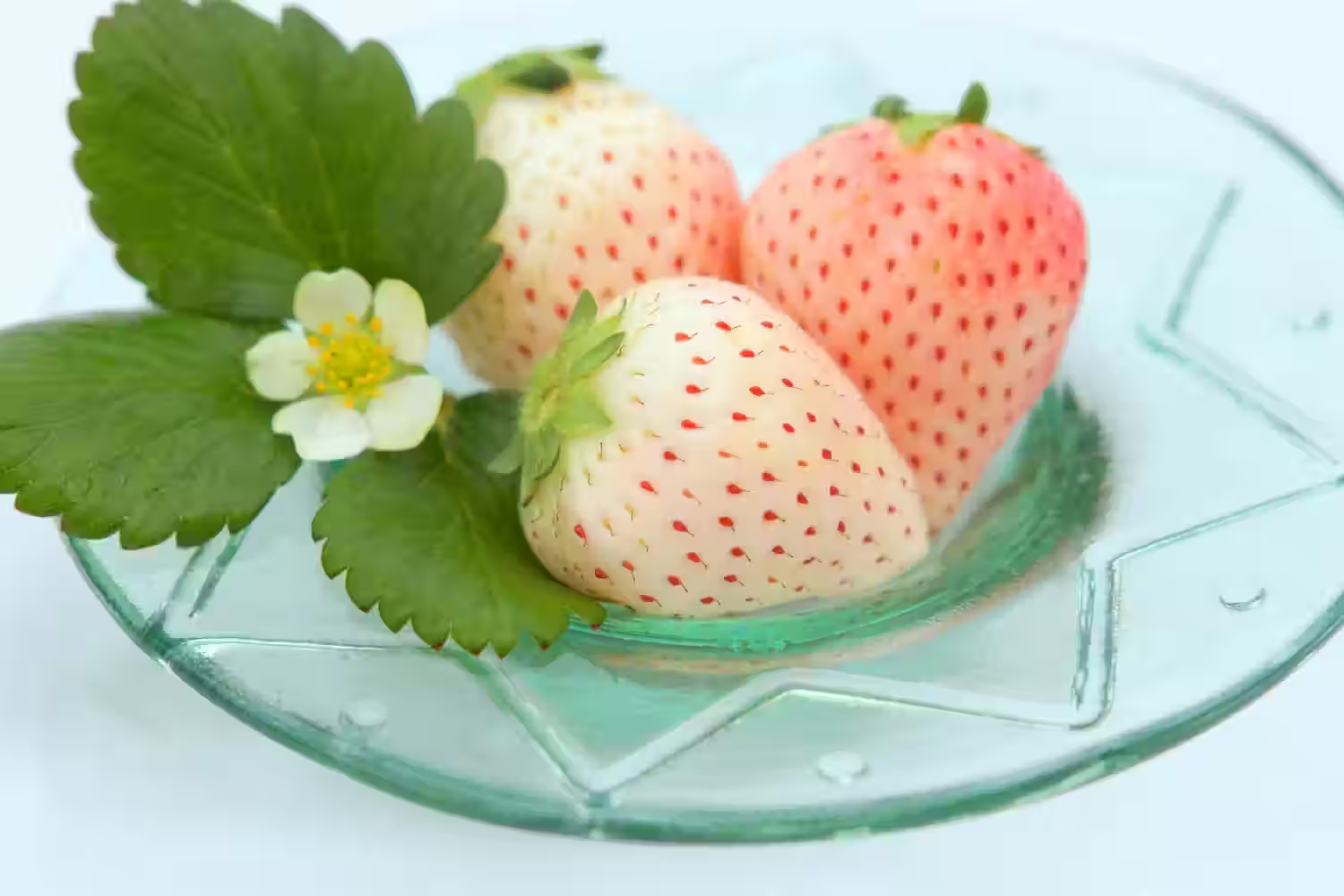

Most strawberries turn bright red when they ripen. Hatsukoi no Kaori (初恋の香り) does the opposite. This rare Japanese white strawberry stays snowy pale with only a touch of pink. Beside an ordinary berry, it looks almost unreal. Yet fans prize it just as much for its strong aroma and gentle sweetness.
Its name translates roughly as “the scent of first love.” So is a white strawberry simply unripe? Not here. This guide explains why it stays pale, how it differs from a pineberry, and where to find it in Japan.
What Is Hatsukoi no Kaori?
Hatsukoi no Kaori is the brand name for a Japanese strawberry registered as Wada Hatsukoi in 2009. Japan’s official variety record describes pale red skin, white flesh, and a slightly soft texture. Meanwhile, its developer, Miyoshi Agritech in Yamanashi Prefecture, highlights its fragrance, sweetness, and low acidity.
Quick Facts: Hatsukoi no Kaori
- Japanese name
- 初恋の香り (Hatsukoi no Kaori), roughly “the scent of first love”
- Registered variety
- Wada Hatsukoi (和田初こい), registration No. 18011
- Registered
- March 19, 2009 (applied for in March 2006)
- Developer
- Miyoshi Agritech Co., Ltd., a seed and seedling company in Yamanashi Prefecture
- Look
- White to pale pink skin, white flesh, long conical shape
- Taste
- Sweet and juicy with low acidity; 12 to 17°Brix by the developer’s figures
- Who grows it
- Contract farmers across Japan; the developer does not sell seedlings
- Typical season
- Mainly December to March; some sources say November to May
- Best way to eat
- Fresh, often paired with red strawberries
What the Name Means
In Japanese, hatsukoi means first love, and kaori means scent or fragrance. According to Miyoshi Agritech, the ripe fruit turns a clear white and then takes on a faint pink. That blush reminded the team of cheeks turning pink with a first crush, so the name stuck.
English media often call it Scent of First Love. However, we found no official English brand name. So treat that phrase as a translation.
Wada Hatsukoi, the Registered Variety
Shoppers see the name Hatsukoi no Kaori on boxes. Japan’s plant variety database, on the other hand, lists the cultivar as Wada Hatsukoi. It shows an application date of March 24, 2006, and registration on March 19, 2009, under number 18011.
The same record also notes a few details that matter at the table. For example, the fruit is slightly large, long and conical, glossy, and slightly soft. It also bears fruit once a year rather than continuously.
What Makes Hatsukoi no Kaori Different?
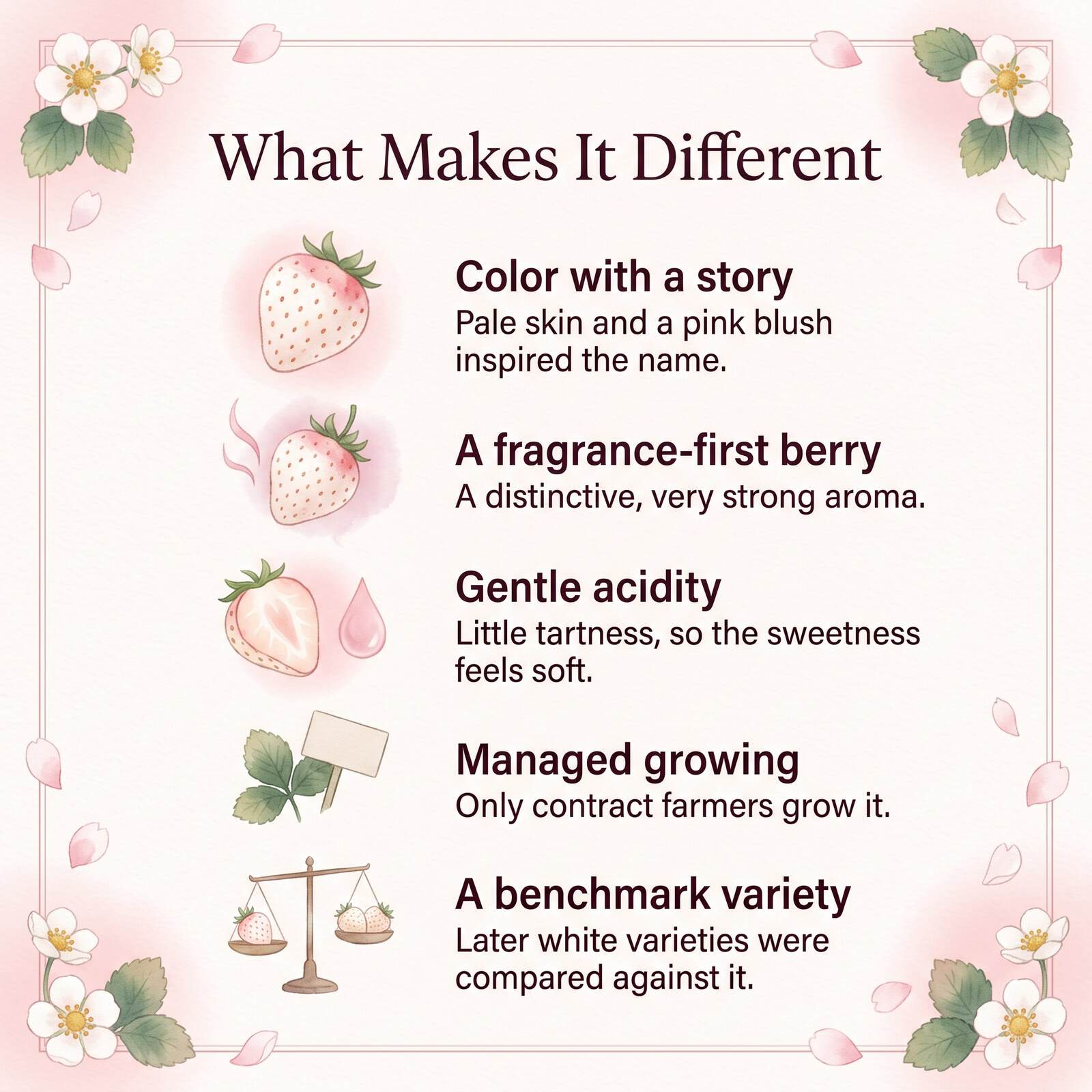
Hatsukoi no Kaori stands out for more than its color. It pairs a pale look with a strong aroma, low acidity, and tight control over who grows it. On top of that, Japan’s variety examiners later used it as the reference point for newer white strawberries.
- Color with a story. The pale skin and pink blush inspired the “first love” name.
- A fragrance-first berry. The developer describes its aroma as distinctive and very strong.
- Gentle acidity. With little tartness, the sweetness feels soft and round.
- Managed growing. Only contract farmers grow it, and the developer does not sell seedlings.
- A benchmark variety. The registration records for Awayuki and Pearl White both compare them against Wada Hatsukoi.
Hatsukoi no Kaori vs Pineberry and Other White Strawberries
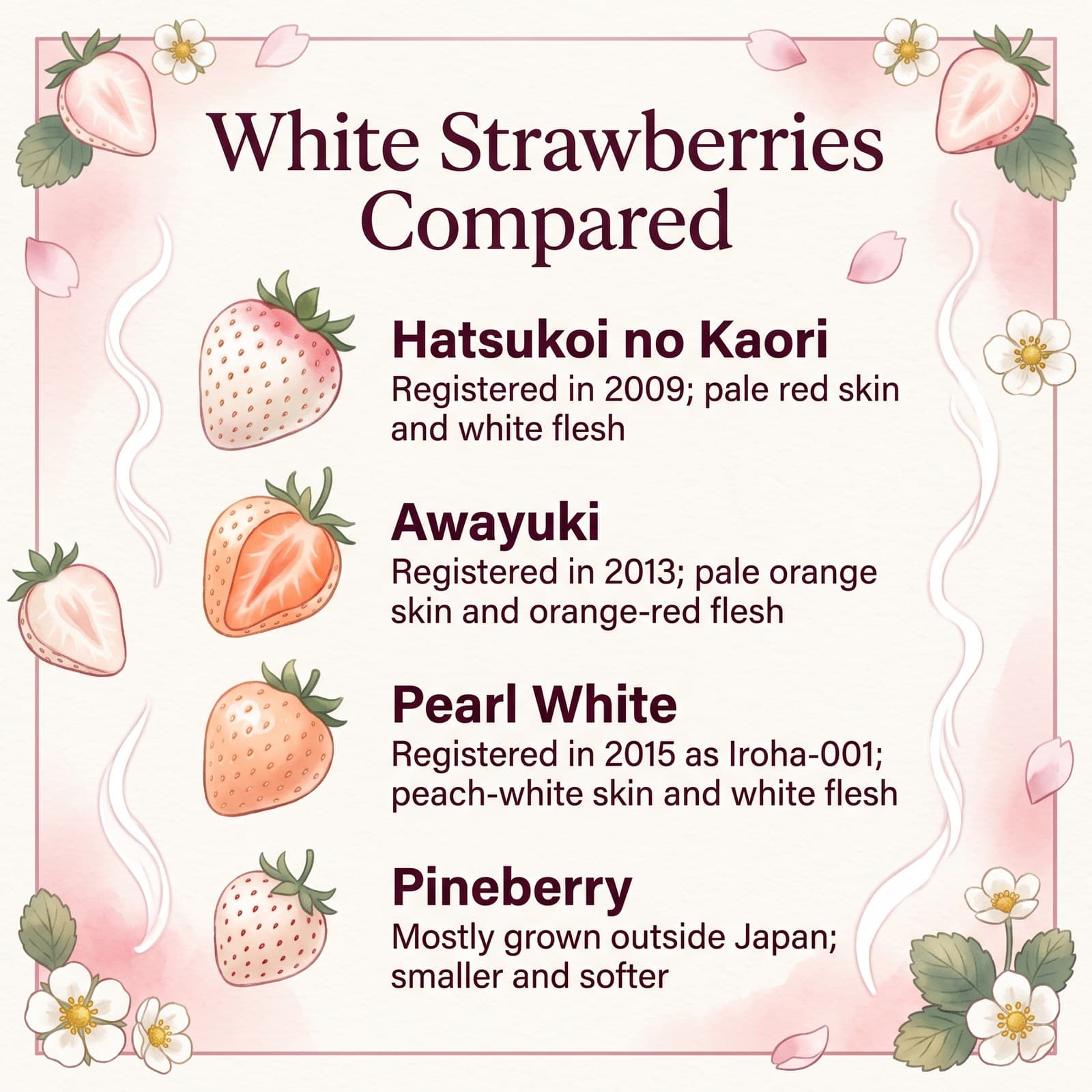
Hatsukoi no Kaori is not a pineberry, and it is not the same as Japan’s other white strawberries. All of them belong to the garden strawberry species. Still, they differ in size, firmness, flavor, and where you can find them.
Hatsukoi no Kaori vs Pineberry
Pineberries are white strawberries grown mostly outside Japan. According to University of Illinois Extension, they are generally smaller and softer than standard strawberries. Growers also market them for a pineapple-like flavor, although tasters do not always agree on that.
Hatsukoi no Kaori, by contrast, is a large Japanese cultivar. Japan’s variety record lists its fruit as slightly large, and the developer says big berries reach egg size. In short, expect a fuller, sweeter berry rather than a tart, pineapple-like one.
Hatsukoi no Kaori vs Awayuki and Pearl White
Inside Japan, two later white varieties often appear beside it. For the three Japanese cultivars, the table uses Japan’s official registration records. The pineberry column draws on University of Illinois Extension.
| Point | Hatsukoi no Kaori | Awayuki | Pearl White | Pineberry |
|---|---|---|---|---|
| Registered name | Wada Hatsukoi (No. 18011) | Awayuki (No. 22821) | Iroha-001 (No. 24429) | Varies by grower |
| Registered in Japan | 2009 | 2013 | 2015 | Not applicable |
| Skin color | Pale red | Pale orange | Peach-white | White with red achenes |
| Flesh color | White | Orange-red | White | White |
| Firmness | Slightly soft | Slightly firm | Firm | Softer than standard berries |
| Size | Slightly large | Slightly large | Medium | Smaller than standard berries |
Interestingly, the Awayuki record lists orange-red flesh. Shoppers may see it described differently, so our Awayuki guide is worth a look for the eating experience. Pearl White, meanwhile, is the trade name for the registered variety Iroha-001. A Nara Prefecture farm newsletter credits a private breeder with developing it.
Why Is Hatsukoi no Kaori White?
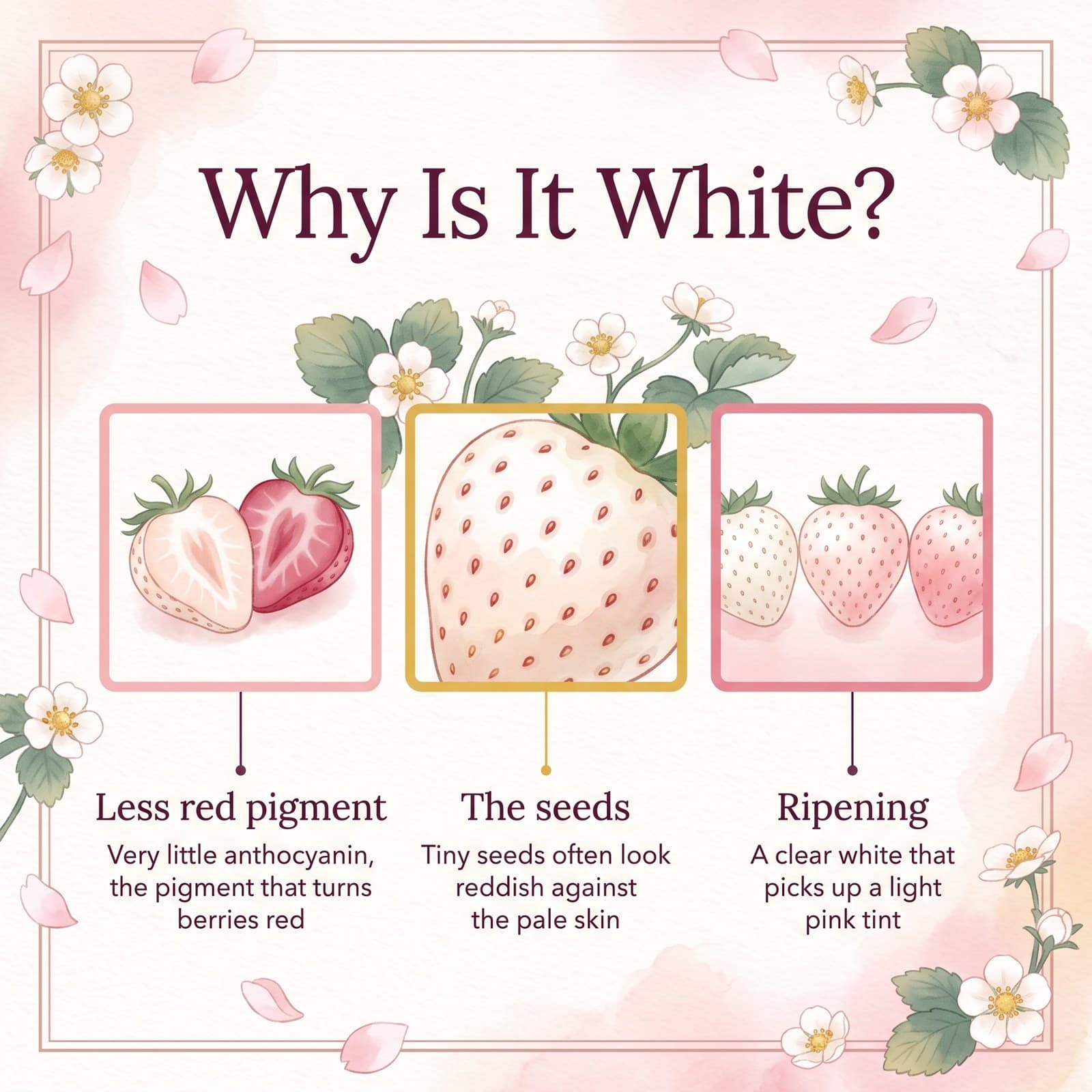
Hatsukoi no Kaori is naturally white because the fruit produces very little anthocyanin, the pigment that turns ordinary strawberries red. Growers do not hide it from the sun, as some readers assume. Instead, the pale color comes from the plant itself.
Less Red Pigment
First, red strawberries get their color from anthocyanins, a group of plant pigments. A 2024 study in the journal Foods notes that white strawberries contain markedly lower amounts than red ones. Miyoshi Agritech also says its fruit and juice contain almost none. That is why the berry stays white all the way through.
Why would a strawberry lose its pigment? In general, a gene called MYB10 switches anthocyanin production on. For instance, a 2022 study in Frontiers in Plant Science tied one faulty copy of that gene to white strawberry flesh. That study did not test Hatsukoi no Kaori, though, so read it as background rather than a diagnosis.
What About the Seeds?
Look closely, and the tiny seeds on the surface often appear reddish against the pale skin. Botanically, each one is an achene, the plant’s true fruit. In contrast, the part we eat is the swollen base of the flower. For pineberries, University of Illinois Extension calls achenes turning from green to red a reliable ripeness sign. We found no such study for Hatsukoi no Kaori, though, so use the seeds as one clue among several.
How the Color Changes as It Ripens
Ripening shows up as a soft blush rather than a jump to red. The developer describes a clear white that later picks up a light pink tint. Because of that, color alone can mislead you. The 2024 Foods study makes the same point about white strawberries in general.
What Does Hatsukoi no Kaori Taste Like?
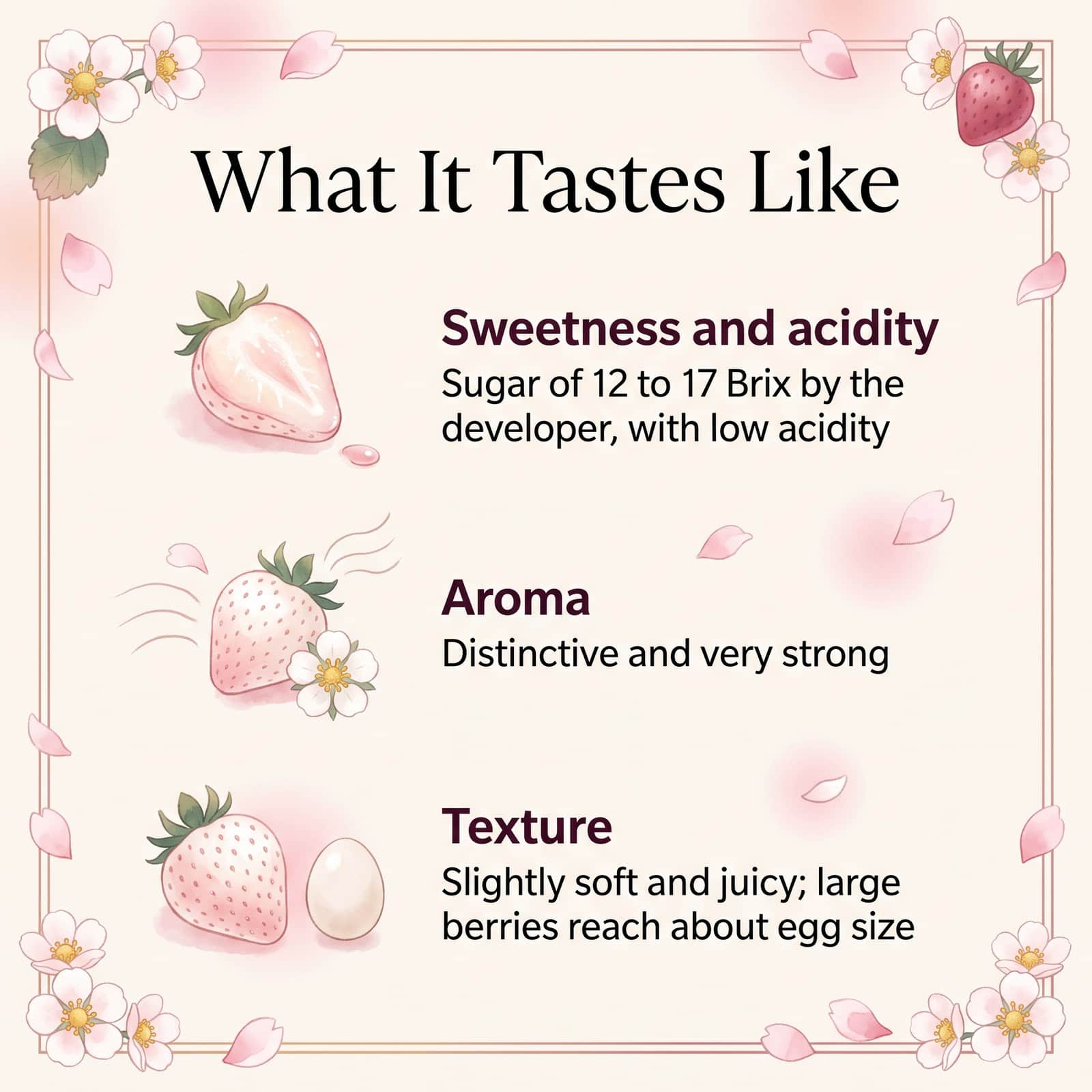
Hatsukoi no Kaori is a sweet Japanese white strawberry known for its strong aroma, low acidity, and juicy texture. Because the tartness is so mild, it can taste sweeter than its sugar figures alone suggest. Of course, flavor shifts with the farm, the month, and how ripe the berry is.
Sweetness and Acidity
For its part, Miyoshi Agritech lists sugar readings of 12 to 17°Brix and describes the acidity as low. It also says the fruit holds a good balance of fructose, glucose, and sucrose. These are company figures without a published method, so treat them as a range rather than a guarantee.
Low acidity, however, changes how sweetness lands on the tongue. With less tang to cut through it, the sugar reads as soft and round. Some people love that. Others, though, miss the bright, sharp edge of a red berry, and both reactions make sense.
Aroma
The name promises fragrance, and the developer leans into that. In fact, it calls the aroma distinctive and very strong. According to the developer, pollinating bees may also visit these plants more often than nearby red varieties. We found no independent study confirming that observation.
Texture
The official record calls the flesh slightly soft, and the center has only a small hollow. In practice, that means a tender, juicy bite rather than a crunchy one. Large berries can also reach roughly the size of an egg, according to the developer.
History and Origin of Hatsukoi no Kaori
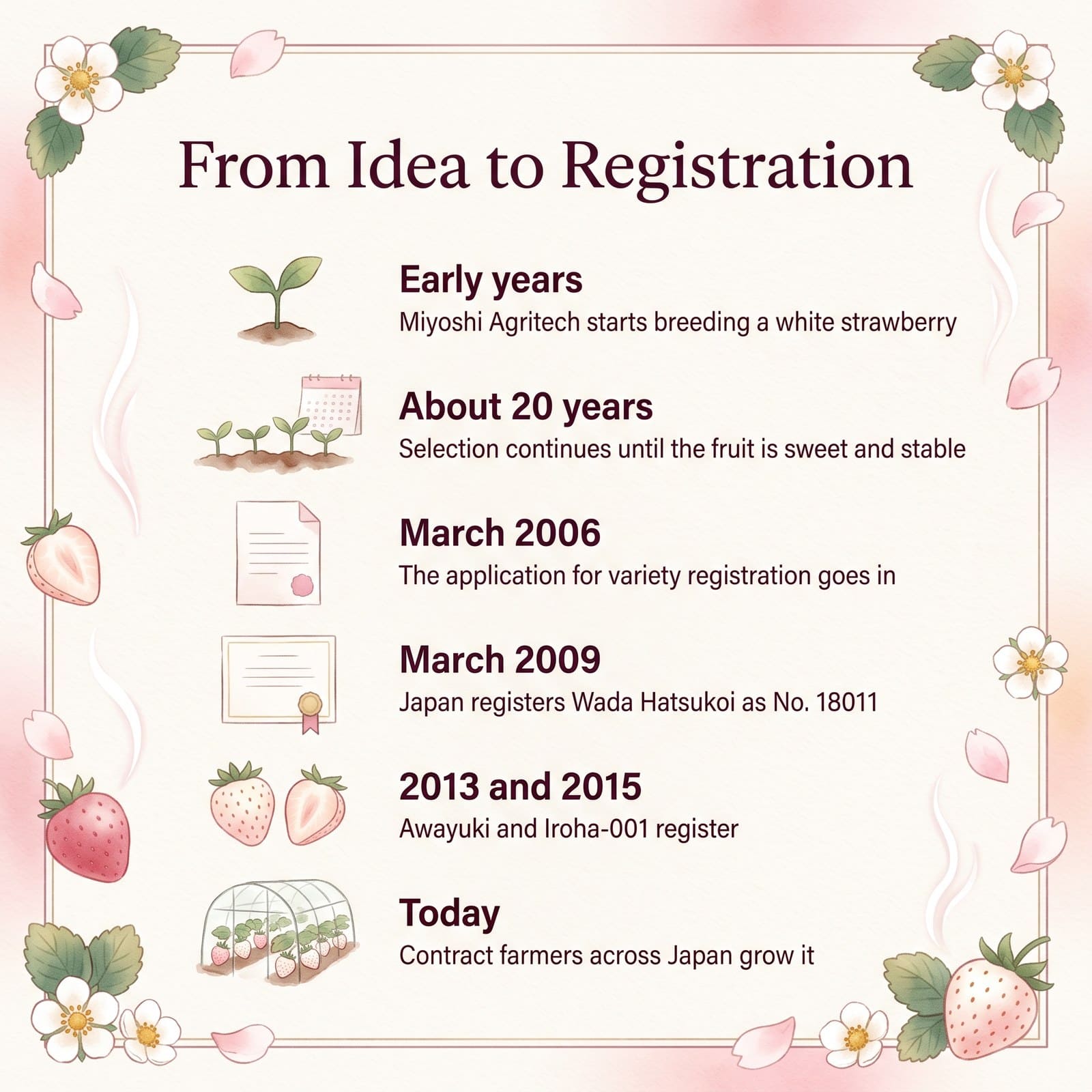
Miyoshi Agritech says it developed Hatsukoi no Kaori as a new project to revitalize the strawberry industry. Breeding a white berry with real sweetness and aroma, it adds, took 20 years. Kudamono Navi, a Japanese fruit site, adds one detail. It says the first pale fruit appeared by chance during work on a red variety.
Early on, some people doubted that anyone would buy a white strawberry. Still, the company stuck with the playful idea of red-and-white pairs, and growers came on board.
- Early yearsMiyoshi Agritech starts breeding a white strawberry.
- About 20 yearsSelection continues until the fruit is sweet, fragrant, and stable.
- March 2006The application for variety registration goes in.
- March 2009Japan registers Wada Hatsukoi as No. 18011.
- 2013 and 2015Awayuki and Iroha-001 (Pearl White) register, both compared against it.
- TodayContract farmers across Japan grow it for business buyers.
Miyoshi Agritech markets Hatsukoi no Kaori as the world’s first white strawberry. However, we could not verify this claim through academic or government sources. What the records do show is that later white cultivars used it as their point of comparison.
When Is Hatsukoi no Kaori in Season?
The surest time to find Hatsukoi no Kaori is December to March. Kudamono Navi lists a wider window from around November to May, depending on region and weather. In 2021, however, a fruit shop in Mitsukoshi’s Nihonbashi store listed its sales period as December to March. The developer itself publishes no harvest calendar.
In addition, the developer notes that acidity and sweetness shift through the season. A berry in December may therefore taste a little different from one in March. If you get the chance, comparing two months could be a fun experiment.
Why Is Hatsukoi no Kaori So Expensive?
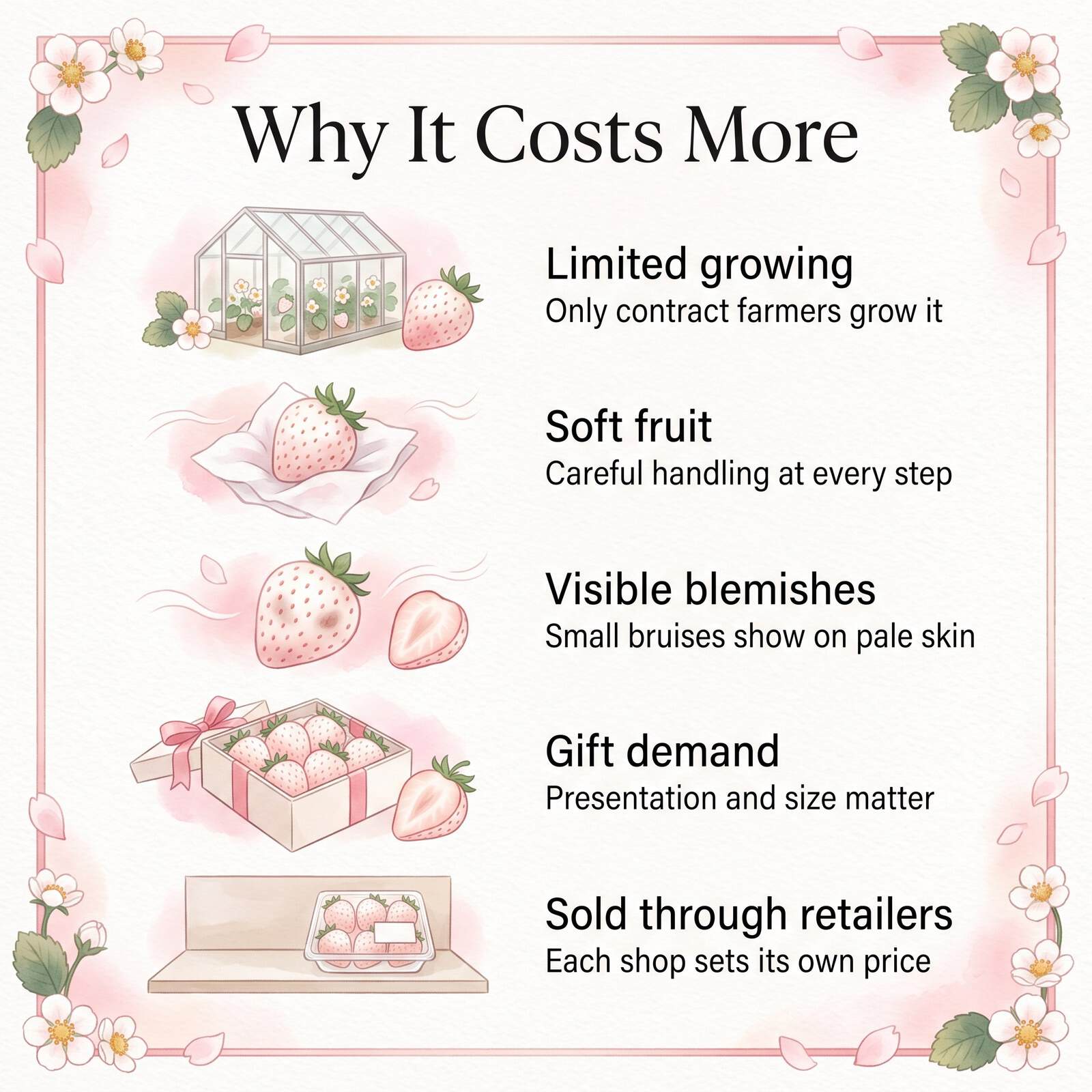
Prices for Hatsukoi no Kaori sit well above everyday strawberries, and several practical reasons explain the gap.
- Limited growing. Only farmers under contract with Miyoshi Agritech grow it, and the company does not sell the seedlings.
- Soft fruit. The official record calls the flesh slightly soft, so careful handling matters at every step.
- Visible blemishes. On pale skin, small bruises can be easier to see than on a red berry.
- Gift demand. Many buyers choose it for presents, where presentation and size matter.
- Sold through retailers. Consumers usually buy it from shops rather than from the breeder, so each retailer sets its own price.
For a sense of scale, here is one dated example. In February 2021, Isetan Mitsukoshi’s food magazine listed a single Hatsukoi no Kaori at ¥648 including tax. The shop was Sun Fruits in the Nihonbashi Mitsukoshi main store. It also noted that prices change with size and timing.
That 2021 figure is historical, not a current price. Today’s prices vary with grade, berry count, store, and season, so check the label in the shop.
How to Choose a Ripe White Strawberry
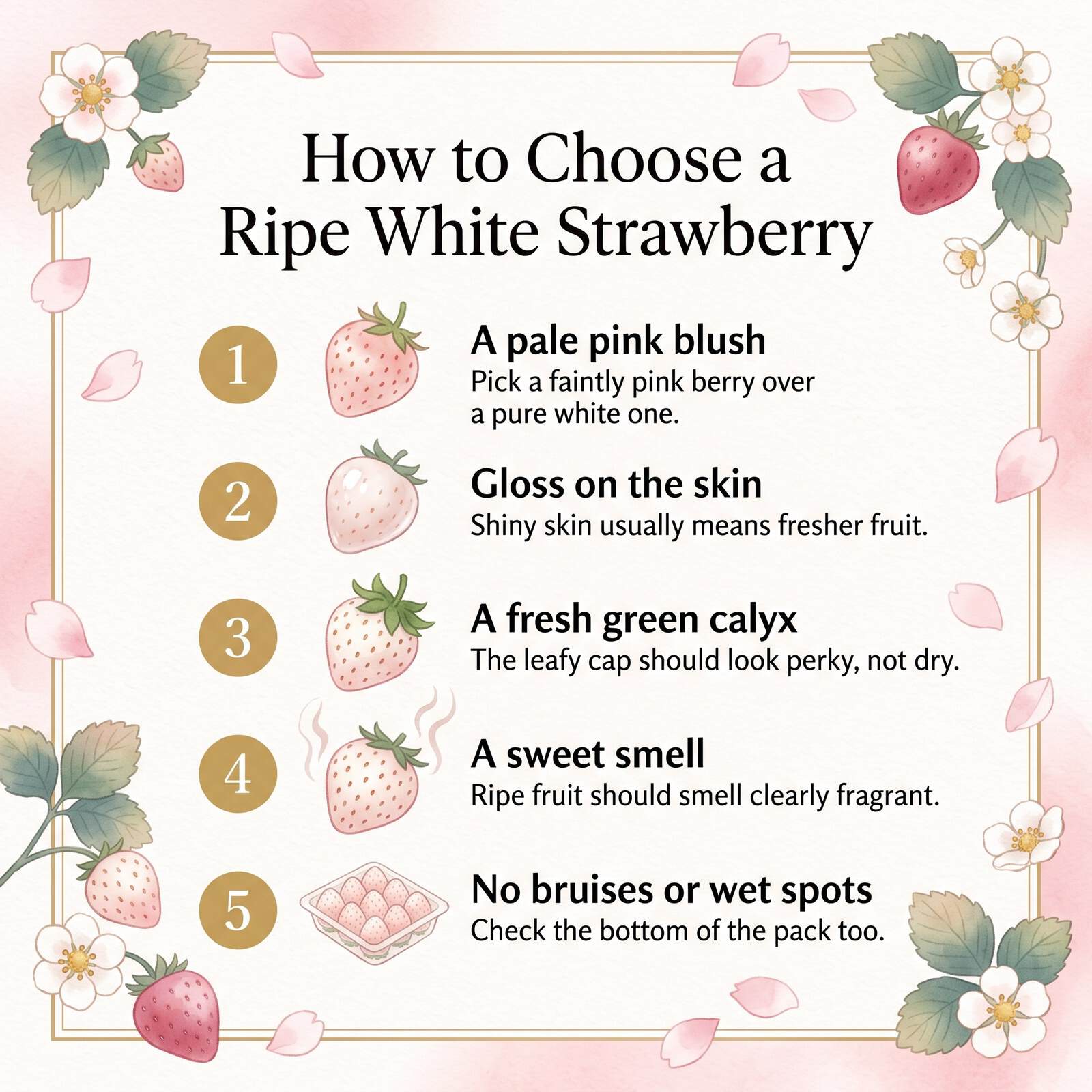
Choosing a white strawberry feels odd at first, since the usual red signal is missing. Instead, look for these signs.
- A pale pink blushKudamono Navi suggests picking a faintly pink berry over a pure white one.
- Gloss on the skinShiny skin usually means fresher fruit, and the official record lists strong gloss.
- A fresh green calyxThe leafy cap should look perky, not dry or wilted.
- A sweet smellBring the pack close; ripe fruit should smell clearly fragrant.
- No bruises or wet spotsSoft fruit dents easily, so check the bottom of the pack too.
How to Eat Hatsukoi no Kaori
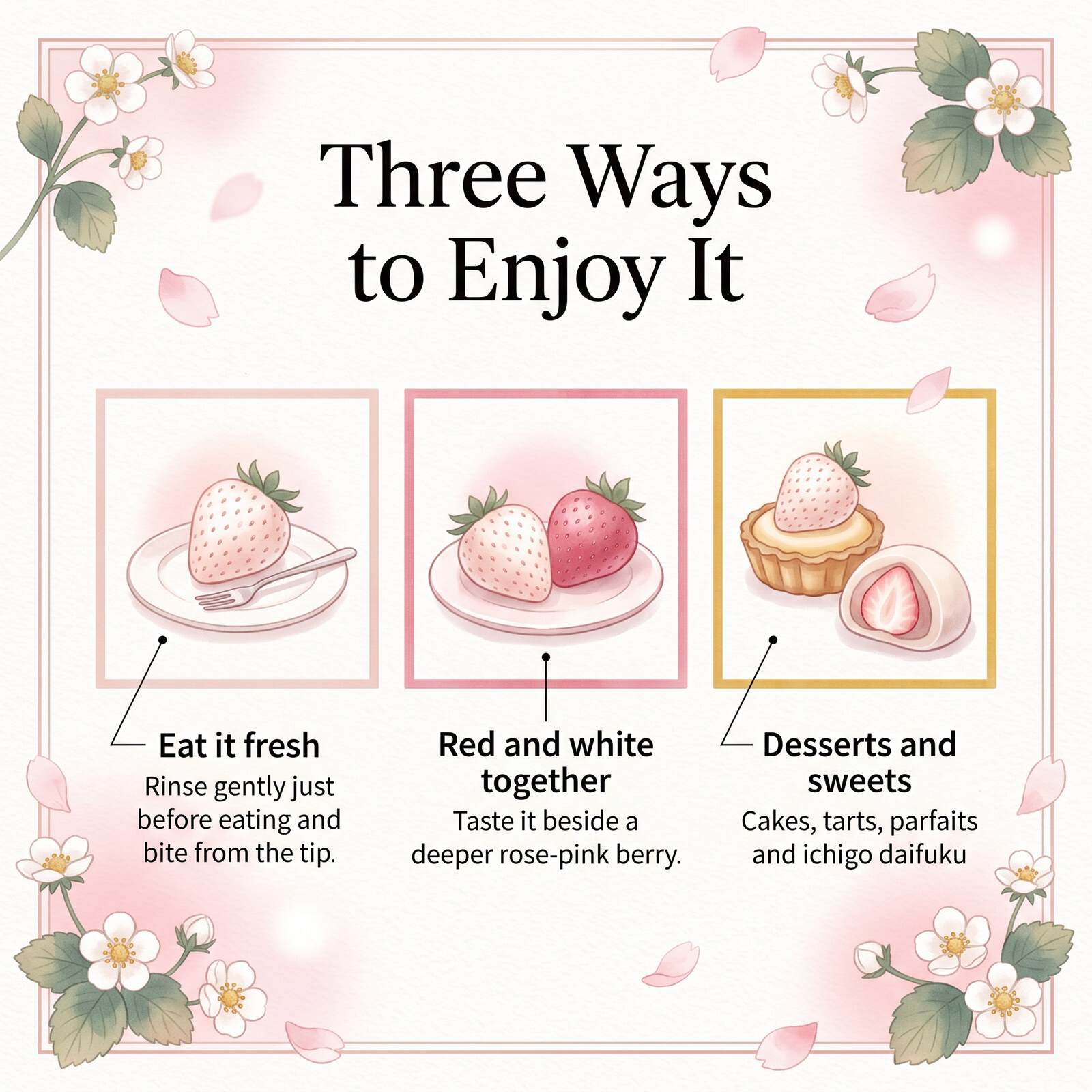
Eating It Fresh
The simplest way is the best way. If you like, take the berries out of the fridge a few minutes early. Very cold fruit tends to smell less. Then rinse them gently just before eating, with the cap still on, and bite from the tip.
Pairing White and Red Strawberries
Red-and-white sets are part of the brand story. Try one next to a red variety such as Amaou or Tochiotome. The contrast in color is striking. Moreover, the side-by-side tasting shows how much acidity shapes a strawberry.
Desserts and Sweets
Pastry shops sometimes use white strawberries in cakes, tarts, and parfaits. They also suit ichigo daifuku, where a whole berry hides inside soft mochi. Honestly, though, heavy cream can drown the delicate aroma. With a fruit this pricey, eating at least a few plain seems wise.
How to Store Hatsukoi no Kaori
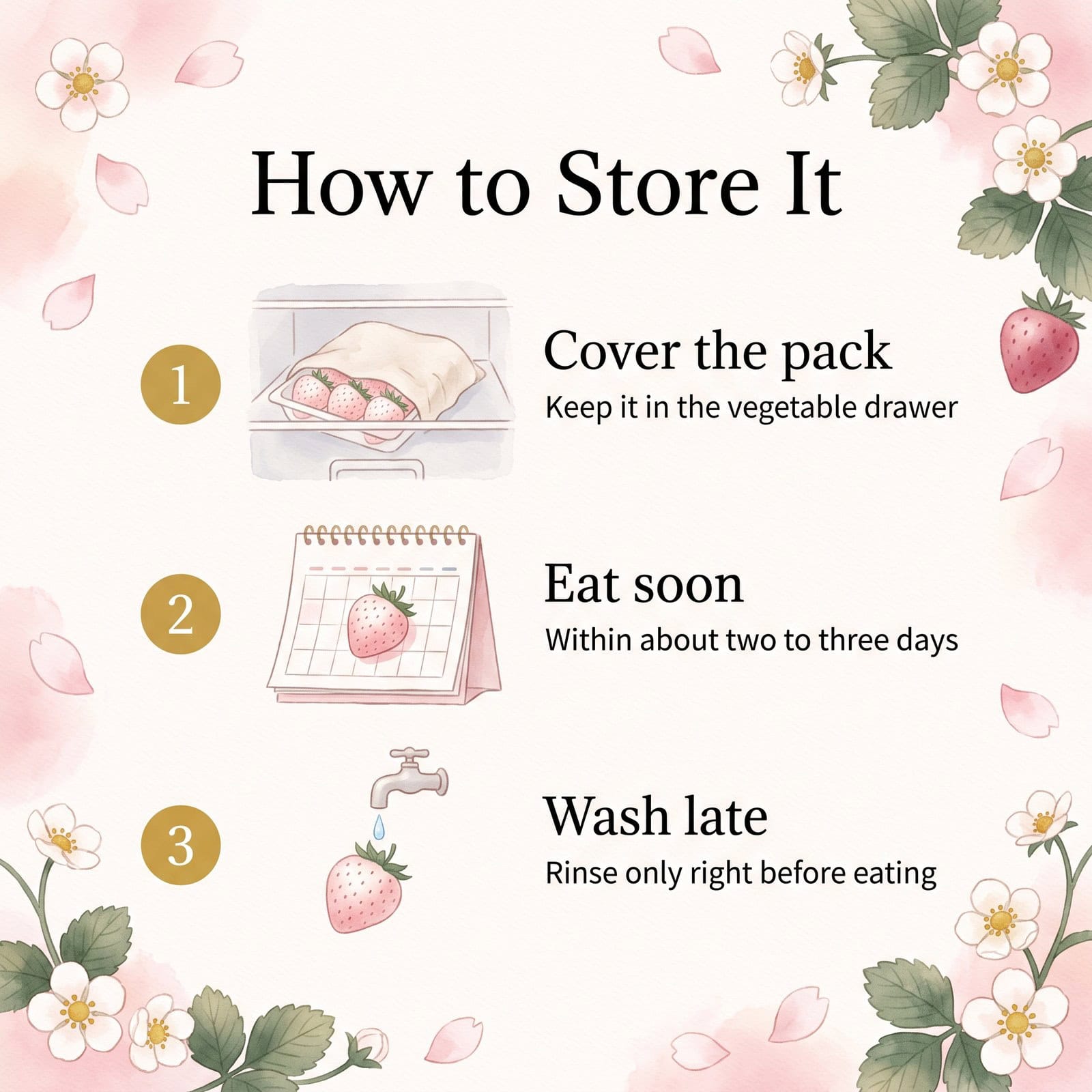
Soft fruit does not keep long. For this reason, Kudamono Navi recommends covering the pack and keeping it in the vegetable drawer. It also suggests eating the berries within about two to three days.
Leave the berries unwashed until you eat them, because moisture speeds spoilage. Also, keep them in a single layer if you can, since stacking presses on the soft flesh.
Where to Buy Hatsukoi no Kaori
Shopping in Japan
Consumers usually buy Hatsukoi no Kaori through retailers rather than directly from the breeder. In Tokyo, good places to start are department-store food halls and specialist fruit shops. For example, Shinjuku Takano features it on its strawberry page. Sun Fruits in Nihonbashi Mitsukoshi has also sold it by the piece. Even so, stock depends on the season and the store, so it may not appear every week.
Labels can be confusing, too. Several white strawberry varieties now exist in Japan, so look for 初恋の香り or “Hatsukoi no Kaori” on the box. If you only see a white strawberry label, then ask the staff which variety it is.
Can You Take Them Home Abroad?
Usually, enjoying them in Japan is the better plan. After all, rules for carrying fresh fruit depend on the destination country and the item. Japan’s Plant Protection Station advises contacting it well before departure, since some trips need an export inspection booked in advance.
The agency also warns that foreign rules can change without notice. Therefore, check with your home country’s plant quarantine authority before packing any strawberries.
Red and White: Gift Use in Japan
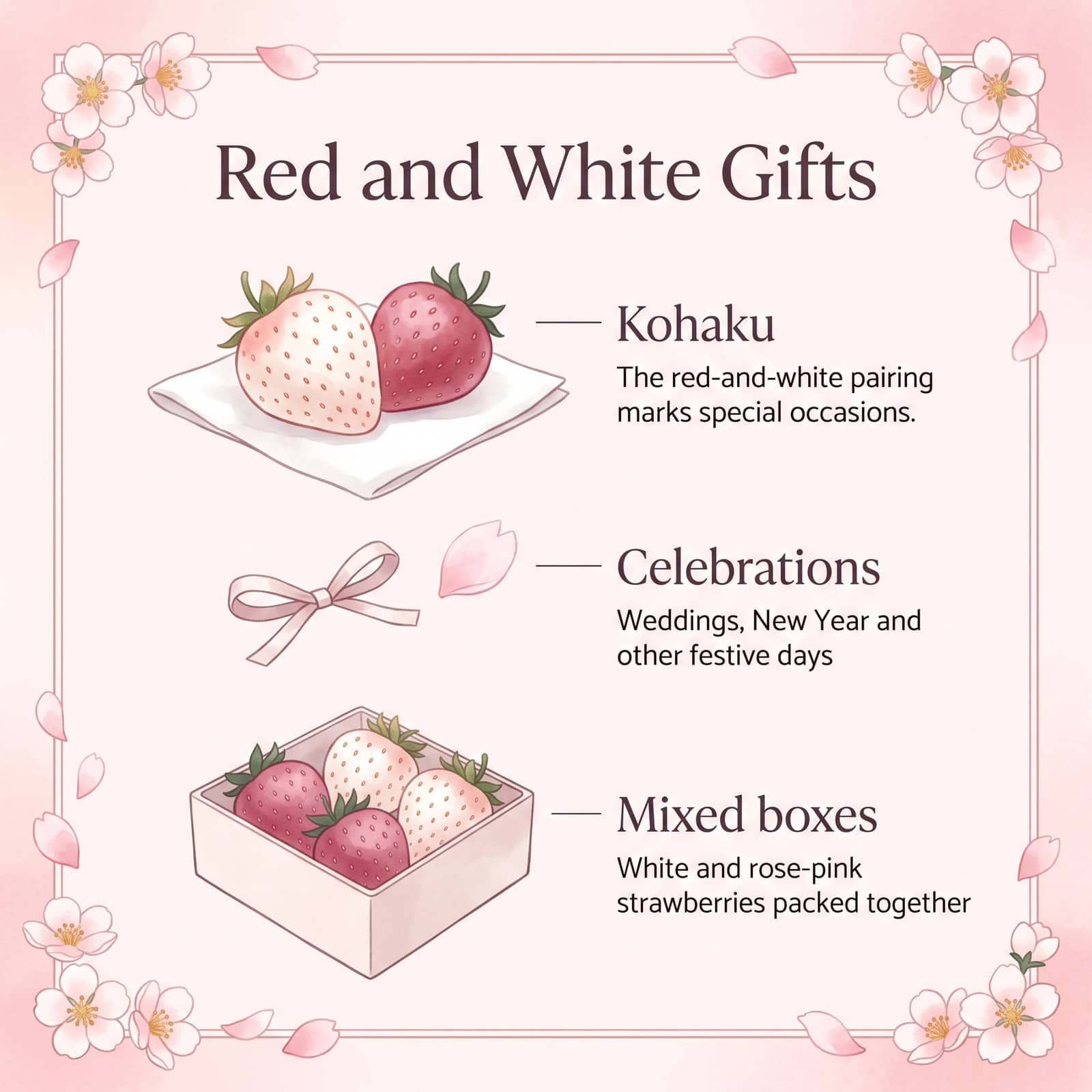
In Japan, red and white together carry a festive feeling. Think of how red and green signal Christmas in many Western countries. Color researchers Kohji Yoshimura and Yuko Yamada link kohaku, the red-and-white pairing, to special occasions called hare. As a result, it shows up at weddings, New Year, and other celebrations.
That is why a box of white and red strawberries makes a natural gift. The same fruit site notes that people often pack Hatsukoi no Kaori with red berries for exactly this purpose. Fruit gifts in general carry weight in Japan. For a closer look, see our guides to Shine Muscat grapes and Yubari melon.
Nutrition Notes
Unfortunately, no official nutrition data exists for Hatsukoi no Kaori alone. Japan’s food composition database does list raw strawberries in general, per 100 g of edible portion.
| Nutrient | Raw strawberries, per 100 g |
|---|---|
| Energy | 31 kcal |
| Water | 90.0 g |
| Carbohydrate | 8.5 g |
| Dietary fiber | 1.4 g |
| Potassium | 170 mg |
| Vitamin C | 62 mg |
| Folate | 90 µg |
Keep in mind that these figures describe strawberries in general. Values also vary with cultivar and harvest month, and a white berry carries far fewer anthocyanins than a red one.
Is Hatsukoi no Kaori Worth Trying?
Hatsukoi no Kaori is not just a novelty color. Rather, it is a registered cultivar with a strong aroma, low acidity, and a soft, juicy bite. It also carries a gentle story, from a chance white fruit to a red-and-white gift.
Is it worth the price? For a special occasion, probably yes, especially if you taste it next to a red berry. So if you visit Japan in winter or spring, look for it in a department-store food hall. Then continue with other Japanese strawberries such as Tochihime or browse our full Japanese fruit guide.
Frequently Asked Questions About Hatsukoi no Kaori
The Strawberry Itself
- Is a white strawberry unripe?
-
Not in this case. Hatsukoi no Kaori stays pale because it makes very little red pigment. When ripe, it usually shows a faint pink blush and a strong fragrance.
- Are white strawberries genetically modified?
-
The developer describes about 20 years of breeding and selection, not genetic engineering. We found no indication that Hatsukoi no Kaori is a genetically modified crop. Its pale color comes from very low pigment levels in the fruit.
- Are white strawberries healthier than red ones?
-
No official nutrition data exists for Hatsukoi no Kaori alone. White berries contain far fewer anthocyanins than red ones, so they are not a better source of those pigments. Otherwise, treat them like any other fresh strawberry.
Taste and Gifts
- Is it sweeter than a red strawberry?
-
It often tastes sweeter because its acidity is low. The developer reports sugar levels of 12 to 17°Brix, although actual readings vary by season and growing conditions. So the soft, round taste comes largely from the low acidity, not from sugar alone.
- Why are white strawberries popular as gifts in Japan?
-
Red and white together signal celebration in Japan, so mixed boxes suit weddings, birthdays, and New Year. The pale berries also look unusual and special. Retailers often pack them with red varieties for exactly this reason.
Buying, Storing and Growing
- Is it available outside Japan?
-
Unfortunately, we found no official overseas sales channel, and the developer sells mainly to businesses in Japan. Fresh fruit also faces strict import rules in many countries. For most visitors, the realistic option is to enjoy it during a trip to Japan.
- How long does it keep?
-
Not long, because the flesh is soft. Kudamono Navi, a Japanese fruit site, suggests refrigerating it and eating it within about two to three days. Wash it only right before eating.
- Can you grow Hatsukoi no Kaori at home?
-
Probably not, because the developer does not sell seedlings to the public. Only farmers under contract with the developer grow it, so home gardeners have no official source of plants.
References
Government, Industry and Retail Sources
- Ministry of Agriculture, Forestry and Fisheries – Plant Variety Database: Wada Hatsukoi, Registration No. 18011 (Accessed October 2026)
- Miyoshi Agritech Co., Ltd. – Hatsukoi no Kaori Brand Page (Accessed October 2026)
- Ministry of Agriculture, Forestry and Fisheries – Plant Variety Registration Gazette, 219th Registration (March 19, 2009) (Accessed October 2026)
- Isetan Mitsukoshi FOODIE – White and Red Strawberry Feature, February 2021 (Accessed October 2026)
- Ministry of Agriculture, Forestry and Fisheries – Plant Variety Database: Awayuki, Registration No. 22821 (Accessed October 2026)
- Shinjuku Takano – Strawberry Varieties Page (Accessed October 2026)
- Ministry of Agriculture, Forestry and Fisheries – Plant Variety Database: Iroha-001, Registration No. 24429 (Accessed October 2026)
- Kudamono Navi – Hatsukoi no Kaori Variety Guide (Accessed October 2026)
- Plant Protection Station, MAFF – Export Quarantine Counters for Travelers (Accessed October 2026)
- University of Illinois Extension – Swihart, E. (2026). The Curious Case of the Pineberry (Accessed October 2026)
- Ministry of Education, Culture, Sports, Science and Technology – Food Composition Database: Strawberries, Raw, No. 07012 (Accessed October 2026)
- Nara Prefecture – Farm Newsletter Vol. 29: White Strawberry Grower Profile (Accessed October 2026)
Academic Literature
- Foods (MDPI) – Seki, H., Murakami, H., Ma, T., Tsuchikawa, S. & Inagaki, T. (2024). Evaluating Soluble Solids in White Strawberries: A Comparative Analysis of Vis-NIR and NIR Spectroscopy, 13(14), 2274 (Accessed October 2026)
- Frontiers in Plant Science – Yuan, H. et al. (2022). Heterozygous Frameshift Mutation in FaMYB10 Is Responsible for the Natural Formation of Red and White-Fleshed Strawberry, 13 (Accessed October 2026)
- Journal of the Color Science Association of Japan (J-STAGE) – Yoshimura, K. & Yamada, Y. (2019). The Meaning of Red and White (Ko-haku) in Japanese Culture, 43(3+), 47 (Accessed October 2026)
Related Articles
- Awayuki Strawberries (淡雪いちご) (Surveyed: October 2026)
- Amaou Strawberry (あまおう): Japan’s King of Fruits (Surveyed: October 2026)
- Tochi otome (とちおとめ) (Surveyed: October 2026)
- Tochihime (とちひめ) (Surveyed: October 2026)
- Ichigo Daifuku: Japan’s Strawberry Mochi Sweet (Surveyed: October 2026)
- Shine Muscat (シャインマスカット) (Surveyed: October 2026)




Comments