


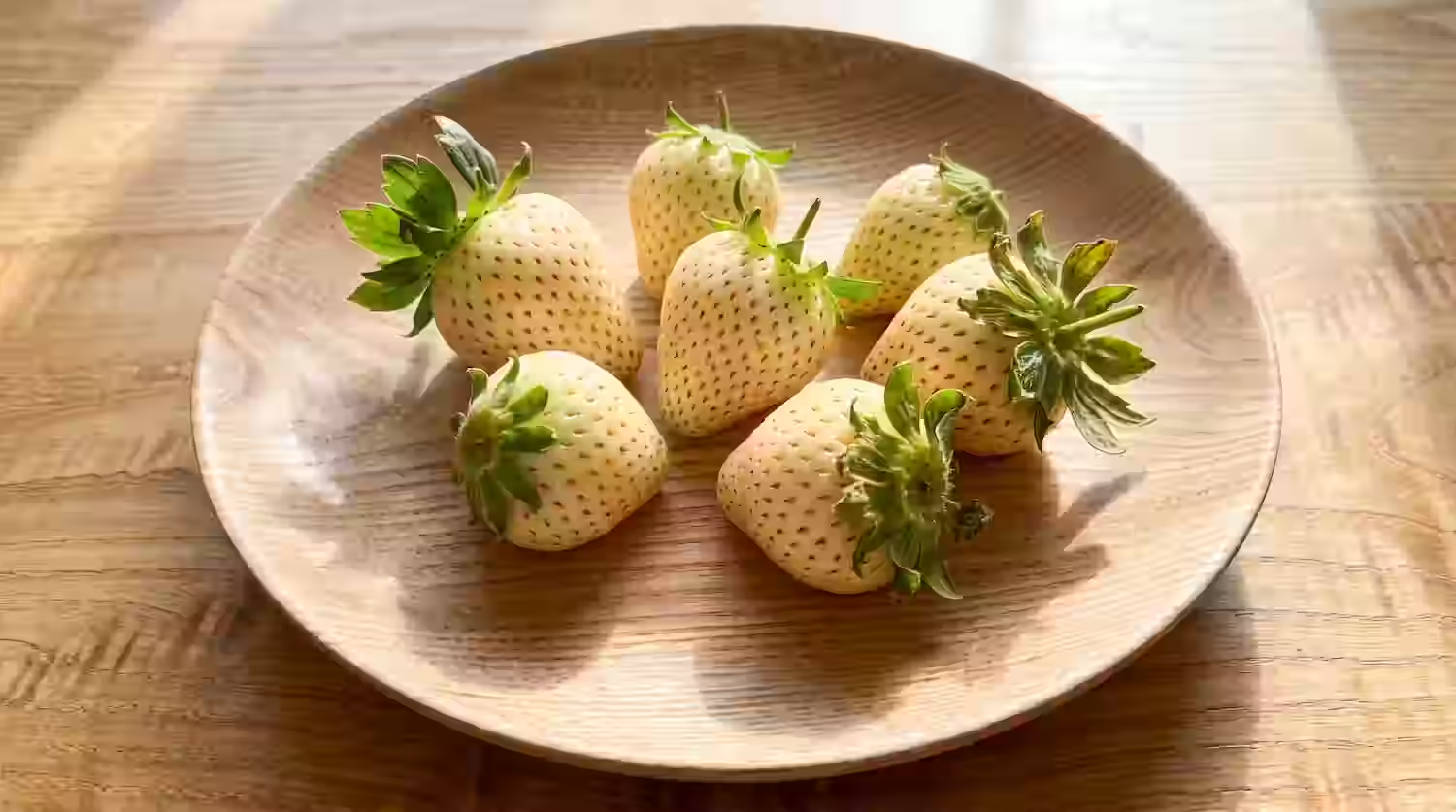
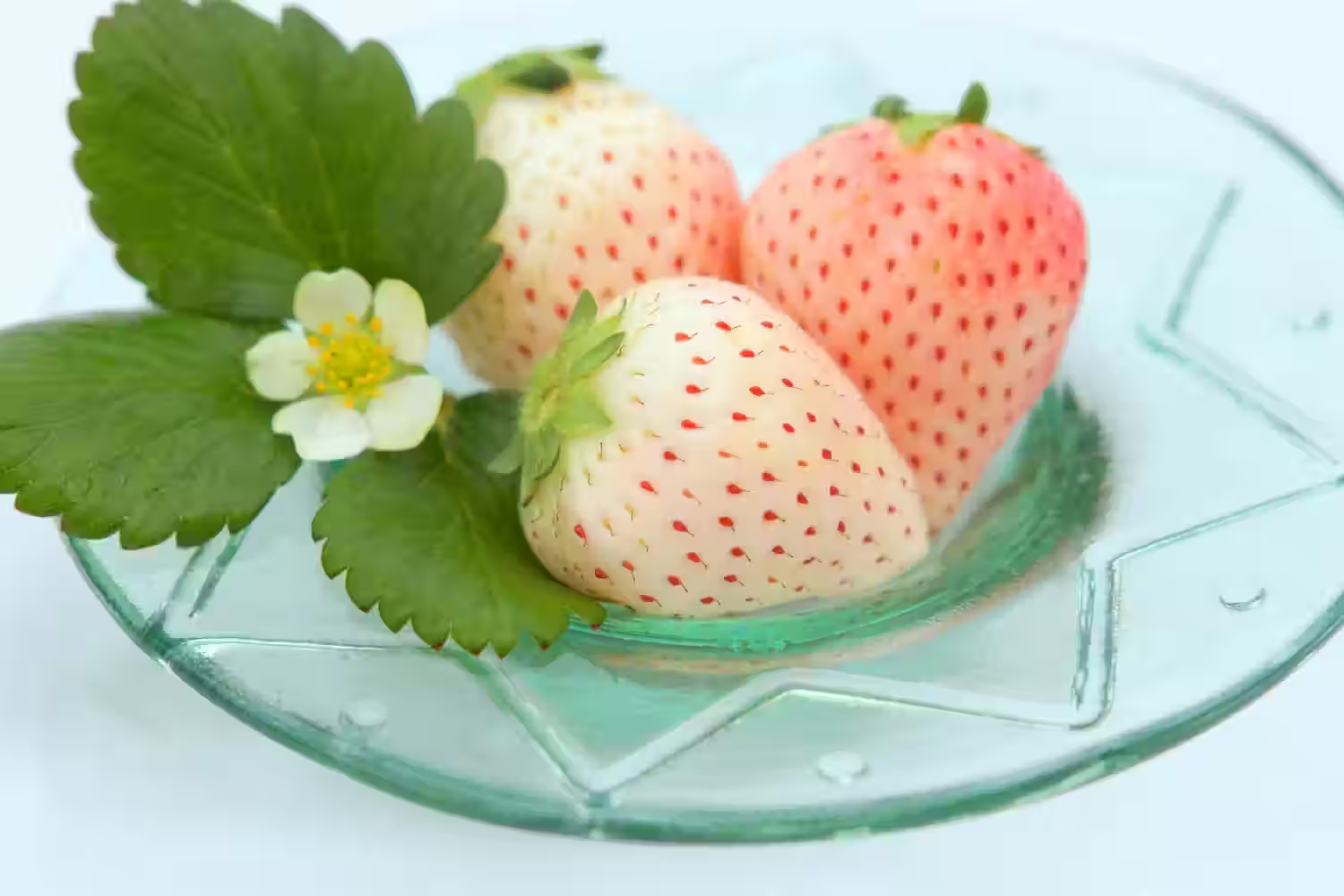

Imagine a strawberry that looks almost like porcelain, pale and creamy, dotted with tiny red seeds. That is the Milky Berry strawberry (ミルキーベリー), a Japanese white strawberry from Tochigi Prefecture. It is not an unripe red berry. Instead, it was bred to stay pale, with a mellow sweetness and gentle acidity.
This guide covers where Milky Berry came from, why it stays white, and what it tastes like. It also explains how to spot a ripe one, when the season runs, and where you can actually find it.
What Is a Milky Berry Strawberry?
Milky Berry is the trademark name for Tochigi iW1, a white-fruited strawberry cultivar developed by Tochigi Prefecture. You may also see it written online as “Milkyberry.” According to the prefecture, it was the first white strawberry developed in Tochigi, a region famous for strawberry breeding.
Quick Facts: Milky Berry
- Japanese name
- ミルキーベリー (Milky Berry)
- Registered variety name
- Tochigi iW1 (栃木iW1号)
- Developer
- Tochigi Prefecture (Agricultural Experiment Station, Strawberry Research Institute)
- Variety registration
- Filed in 2018; registered in Japan on June 3, 2024
- Trademark
- “Milky Berry” registered on June 21, 2019
- Appearance
- Yellowish-white skin, white flesh, achenes (seeds) that turn red when ripe
- Average weight
- About 20 g per berry
- Taste
- Sugar similar to Tochiotome, lower acidity, mellow and sweet
- Shipping season
- Roughly December to May
Milky Berry and the Tochigi iW1 Cultivar
Basically, the two names do different jobs. Tochigi iW1 is the official name in Japan’s plant variety register. Milky Berry, by contrast, is the trademark that Tochigi uses on the fruit you buy. Growers who receive plants from the prefecture must sell the fruit under that trademark.
Why It Is Called “Milky Berry”
Tochigi’s strawberry research institute says the name comes from the fruit’s milk-like whiteness and its mellow texture and sweetness. So “milky” simply describes the look and feel. It does not mean the strawberry contains milk, which is worth knowing if you shop for someone with a dairy allergy. Processed sweets made with it are another matter, so always check their labels.
Is It Really a White Strawberry?
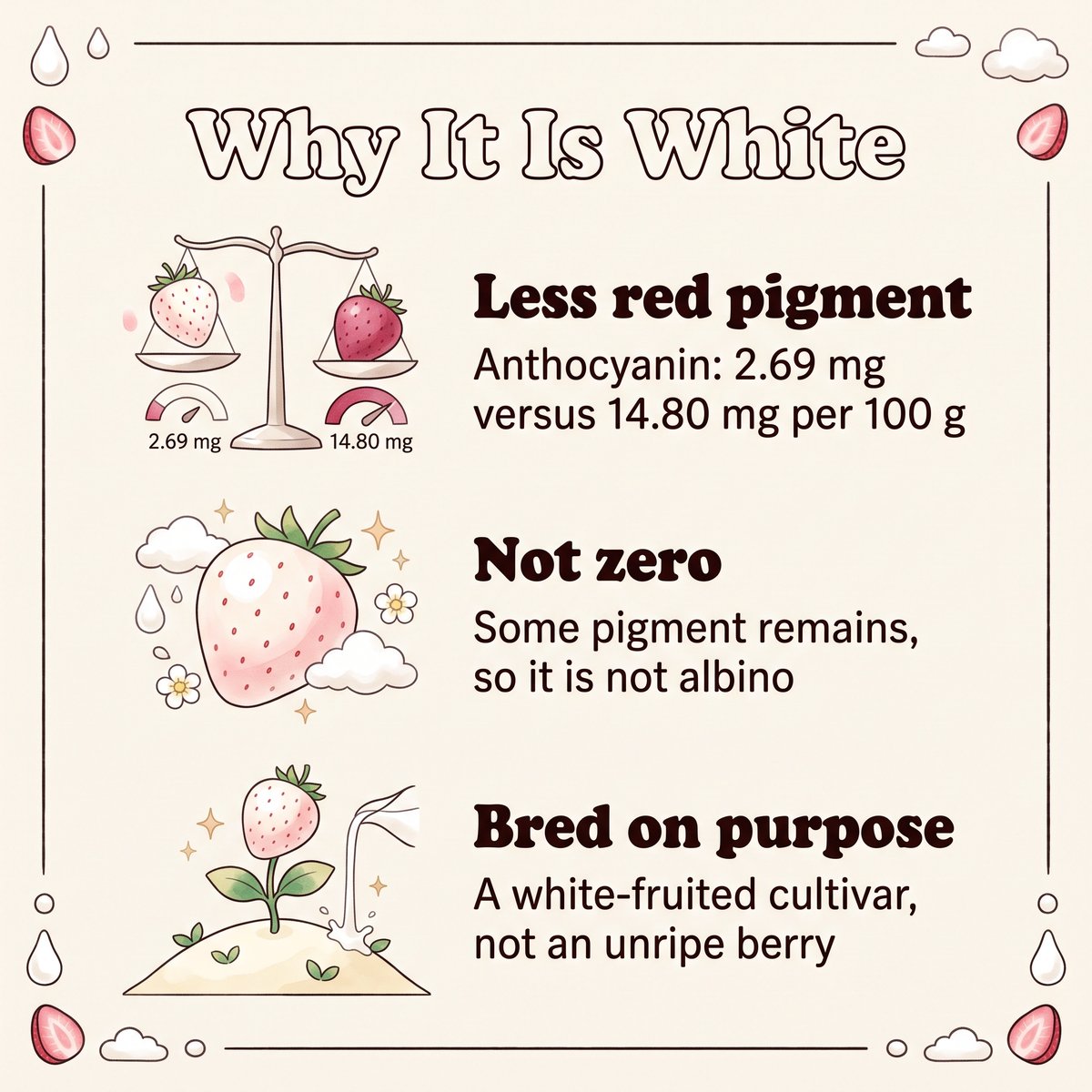
Yes, and the reason is pigment. Red strawberries get their color from anthocyanins. In a Tochigi test, Milky Berry contained far less of them than the red Tochiotome: 2.69 mg versus 14.80 mg per 100 g of fruit. That gap helps explain the pale skin and white flesh.
Notice, though, that the figure is not zero. For that reason, saying Milky Berry has “no red pigment” would be wrong. Tochigi’s materials describe it as a white-fruited cultivar, bred that way on purpose, rather than an “albino” strawberry.
Where Did Milky Berry Come From?
Milky Berry was developed by Tochigi Prefecture’s strawberry research institute, north of Tokyo. Initially, breeders started from seedlings of Hatsukoi no Kaori fruit, and Japan officially registered the result as Tochigi iW1 in 2024. Tochigi calls itself the “Strawberry Kingdom,” and its research institute has bred well-known varieties such as Tochiotome and Skyberry. Milky Berry added something new to that lineup: a white berry.
How the Variety Was Bred
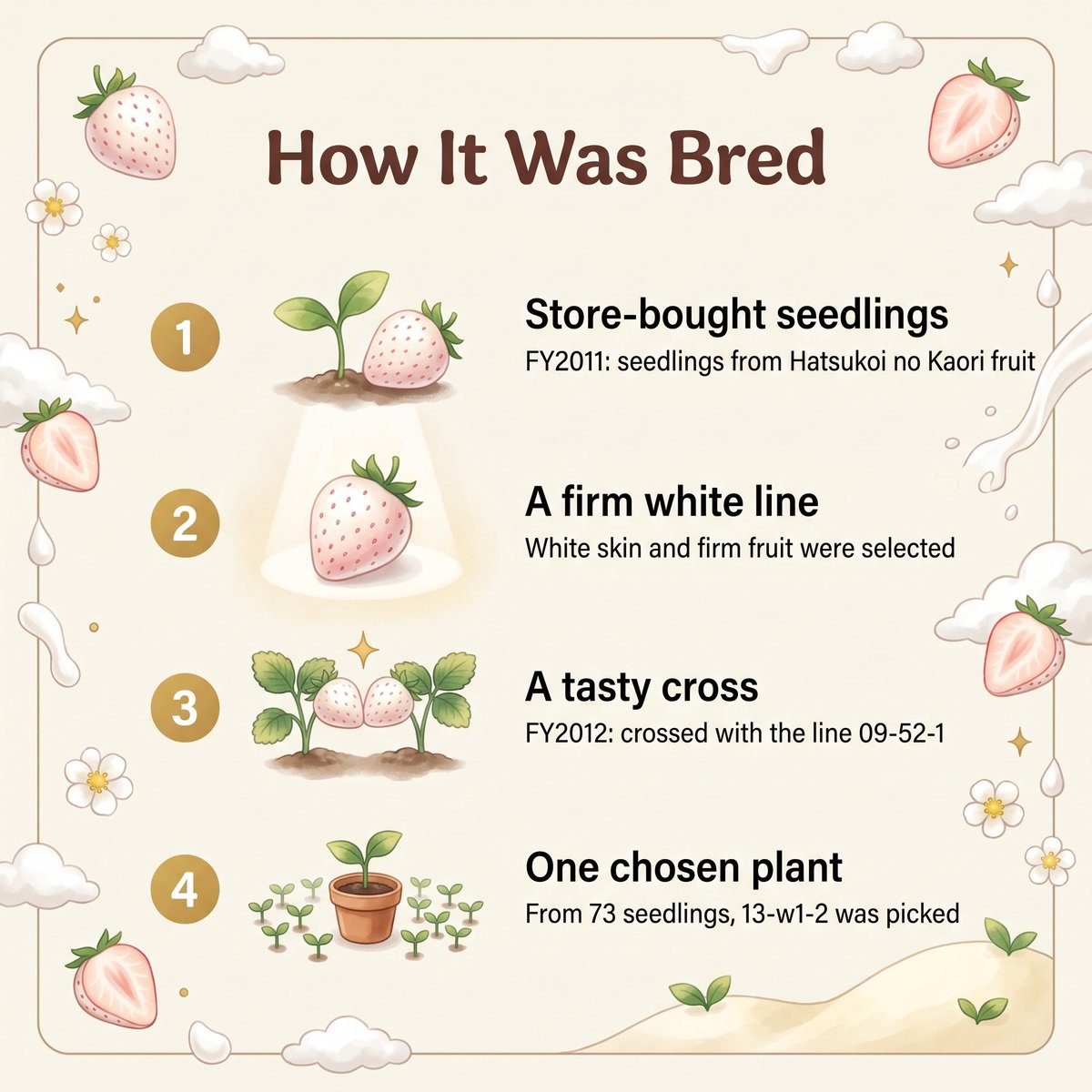
The story starts, interestingly, with a store-bought strawberry. In fiscal 2011, breeders grew seedlings from purchased fruit of Hatsukoi no Kaori, the white strawberry sold under that name. From those seedlings, they picked a line with white skin and firm fruit.
After that, they crossed that line with 09-52-1, a pale-red breeding line known for good flavor. The institute’s results summary dates the cross to fiscal 2012. From 73 seedlings, the team then selected a promising plant called 13-w1-2. In other words, Milky Berry is not a copy of Hatsukoi no Kaori. It is a new cultivar with its own parents and traits.
When Milky Berry Was Introduced
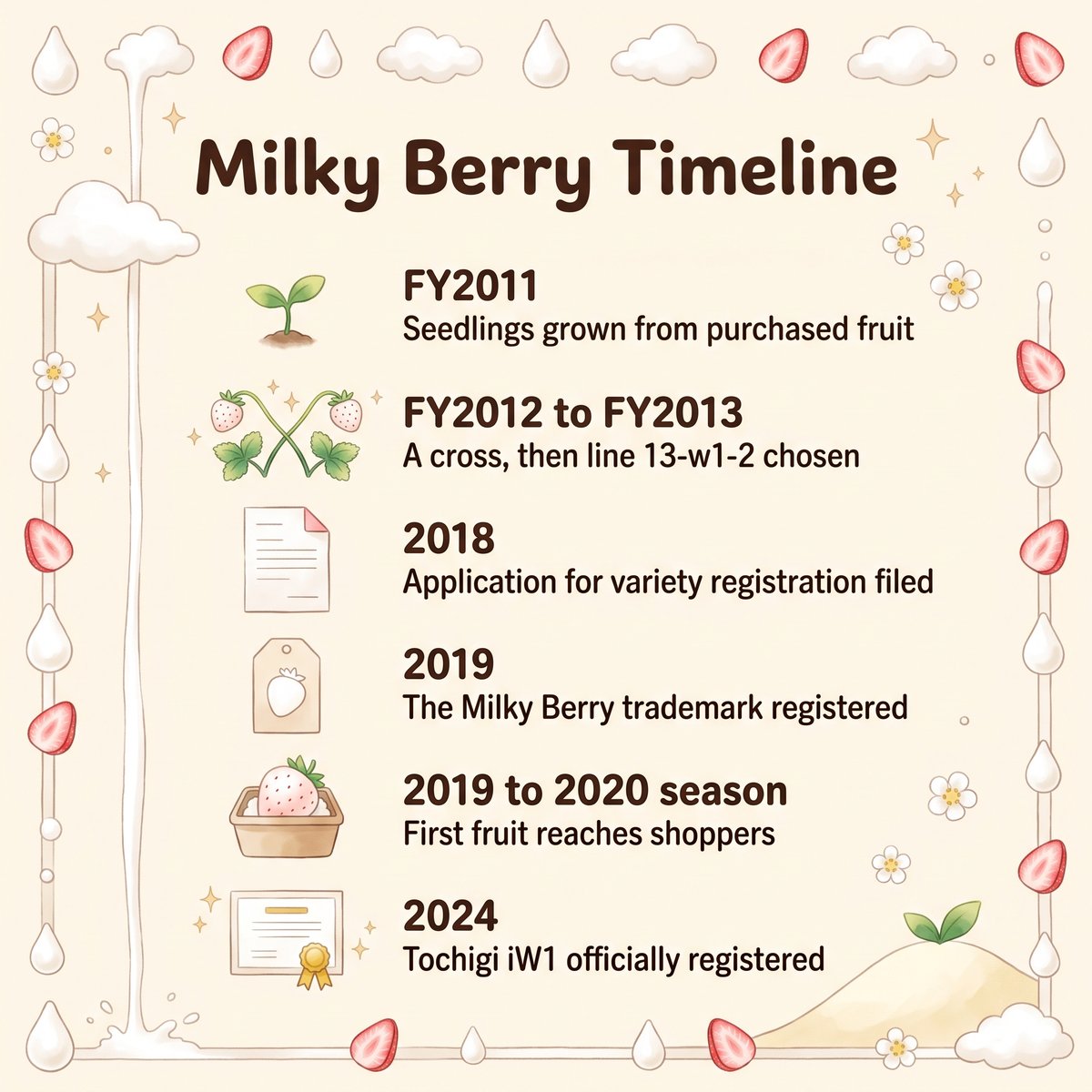
At first, the dates can look confusing, because several different milestones exist. This timeline separates them.
FY2011
Seedlings are grown from purchased Hatsukoi no Kaori fruit, and a white, firm line is selected.
FY2012 to FY2013
That line is crossed with 09-52-1, and the line 13-w1-2 is selected.
2018
Tochigi files for variety registration on January 29, and the application is published on April 24.
2019
“Milky Berry” becomes a registered trademark on June 21.
2019 to 2020 season
The berry reaches consumers, with general cultivation starting for the 2020 crop.
2024
Tochigi iW1 is officially registered as a plant variety on June 3.
So if you read that Milky Berry was “registered in 2018,” that is not quite right. The application came in 2018, and formal registration followed in 2024.
What Does Milky Berry Taste Like?
In short, Milky Berry tastes mellow and sweet, with less sourness than a typical red strawberry. The surprise is that it is not much higher in sugar. Instead, its lower acidity lets the sweetness stand out.
Sweetness and Low Acidity
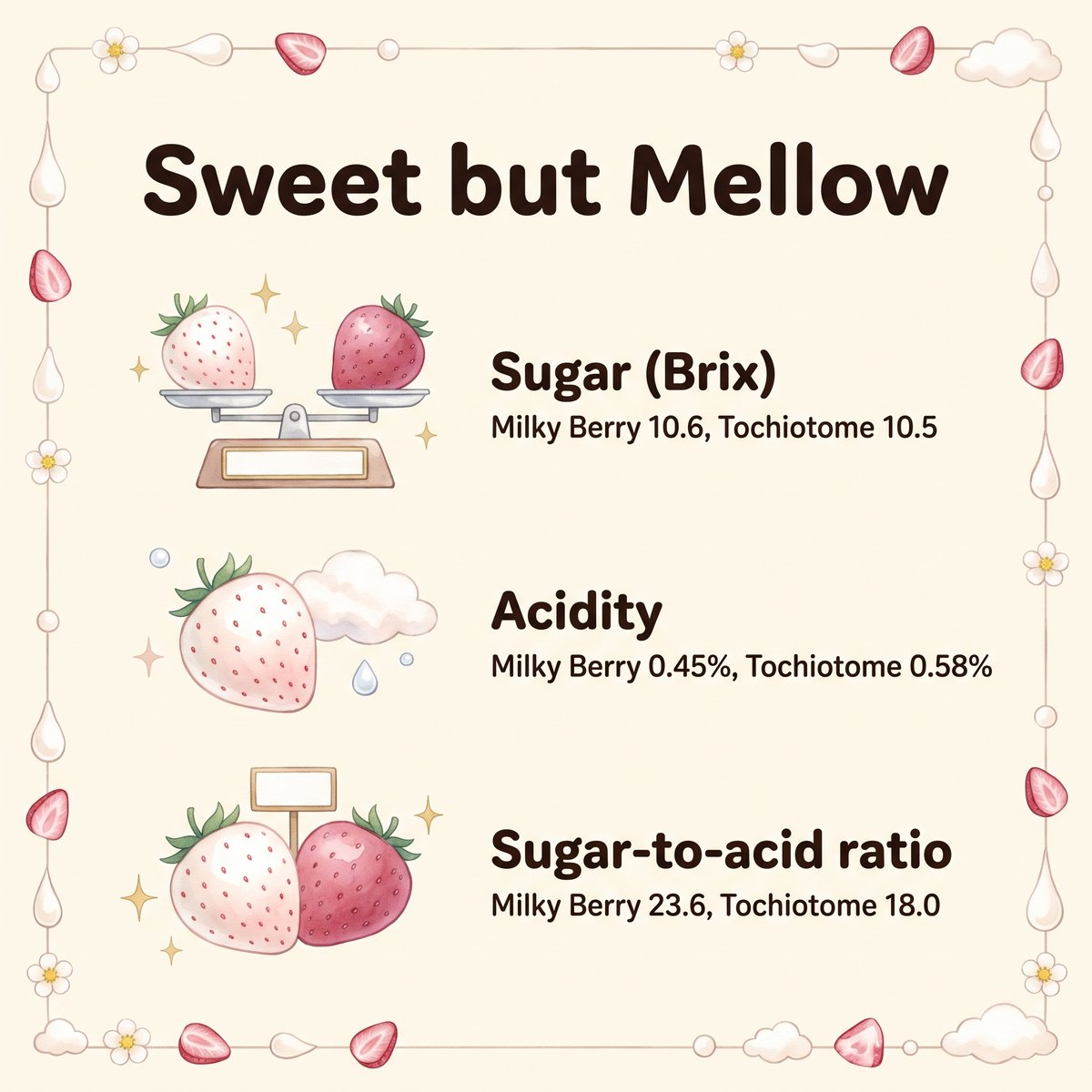
A 2018 Tochigi trial compared Milky Berry side by side with Tochiotome, the prefecture’s classic red strawberry. The results look like this.
| Measure (2018 trial) | Milky Berry | Tochiotome |
|---|---|---|
| Sugar content (Brix) | 10.6 | 10.5 |
| Acidity | 0.45% | 0.58% |
| Sugar-to-acid ratio | 23.6 | 18.0 |
| Marketable yield (Tochiotome = 100) | 113 | 100 |
As you can see, the sugar levels are almost identical. However, the acidity is clearly lower, so the ratio between sugar and acid rises. That helps explain why Tochigi describes it as mellow and sweet, even though the Brix figure is ordinary. Keep in mind that these are trial results, not guaranteed numbers for every berry. A later cultivation study, for example, recorded acidity between 0.55% and 0.58%.
Texture and Aroma
Texture, meanwhile, is where Milky Berry feels different. Tochigi’s breeders describe the flesh as slightly sticky, and that dense, smooth quality grows as the fruit ripens. It is less crisp than some red varieties, more like a soft, creamy bite.
As for aroma, the breeders’ tasting panel found ripe fruit fragrant and well balanced between fruity, sweet, and sour notes. Their notes say its flavor reminded them of apple or pear. Fully mature fruit showed a richer, pear-like sweetness. That comparison sounds a little unexpected for a strawberry, but it does fit the “mellow” label. Of course, these are sensory comparisons. The berry still tastes like a strawberry, not like an apple or pear.
How It Differs From Red Strawberries
Generally, red strawberries such as Tochiotome offer a brighter, tangier balance. Milky Berry, on the other hand, leans gentle. If you love a sharp, sour strawberry, you may find it almost too soft. If tartness bothers you, though, it could be exactly what you want.
What Does Milky Berry Look Like?
A ripe Milky Berry has yellowish-white skin, white flesh, and red achenes on the surface. Achenes are the small structures most people call seeds. Their color matters, because it is one of the best ripeness clues.
White Skin, White Flesh, and Red Seeds
Tochigi describes the skin as a strongly whitish yellow-white, with white flesh inside. If you cut one open, you will not see the red core of a typical strawberry. The red dots on the outside are natural, too. They come from the achenes changing color as the fruit matures, not from any dye.
Size and Shape
On average, Milky Berry weighs about 20 g per berry, larger than Tochiotome on average. According to the prefecture’s 2020 magazine, its size sits between Tochiotome and the very large Skyberry. Tochigi’s breeding report describes the main fruit as conical, with some longer, cone-shaped fruit later in the season.
Interestingly, Japan’s variety register uses a different word. It lists “wedge-shaped” fruit as one trait that sets Tochigi iW1 apart from Wada Hatsukoi. That reflects the register’s formal comparison system, so for everyday purposes, “conical” works well.
Why Some Fruits Develop a Pink Blush
Later in the season, however, some Milky Berries turn pink on the side facing the sun. Tochigi’s researchers recorded this from the warmer months onward. It is a normal color change, not a sign of a different variety or spoilage. Still, it can cause confusion, because other pale strawberries such as Awayuki are known for a pink blush. Those are separate cultivars.
How Can You Tell When Milky Berry Is Ripe?
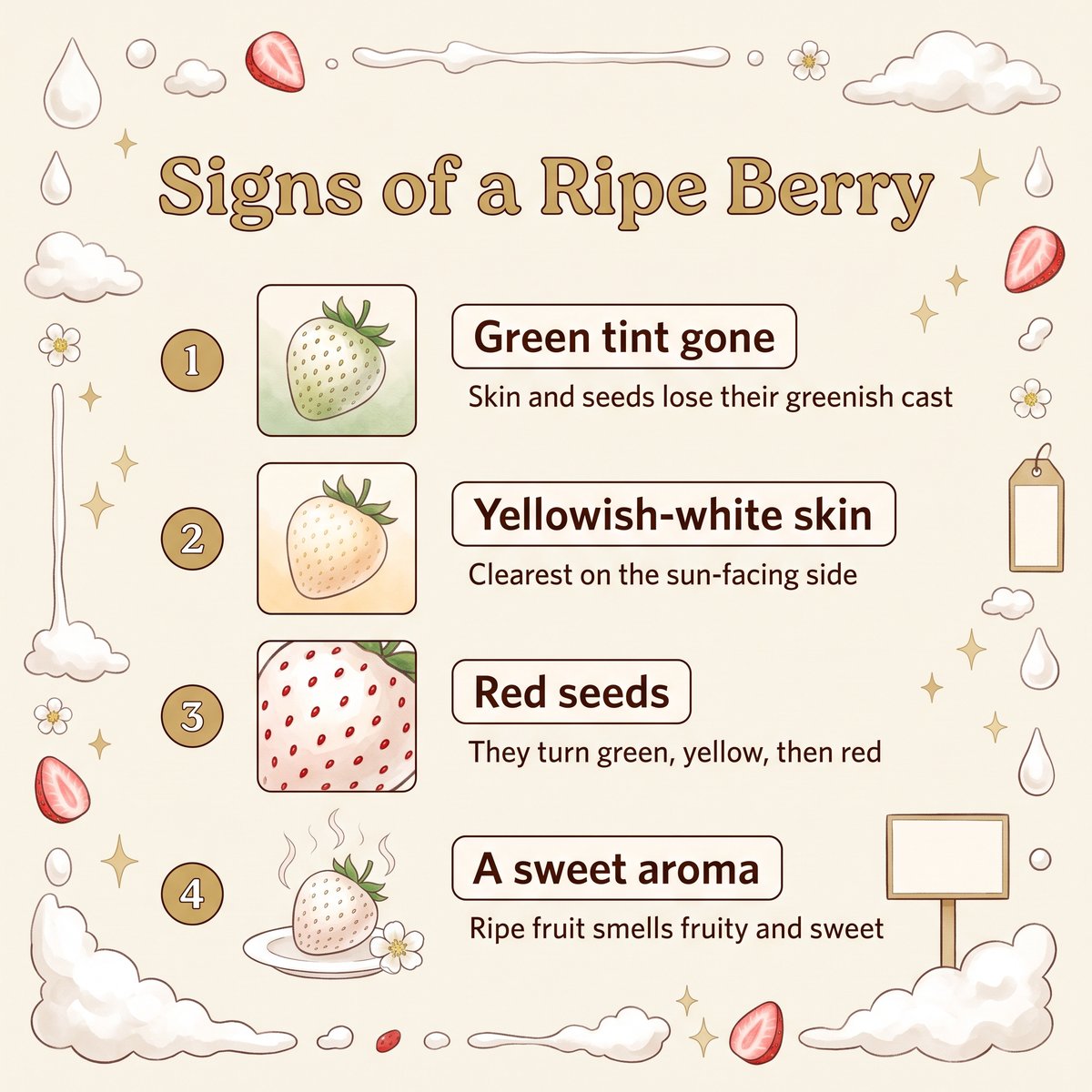
Normally, with a red strawberry, color tells you almost everything. A white strawberry is trickier, since it never turns red. Tochigi’s researchers say harvest timing depends on two signs together: skin color and achene color.
- The green tint is gone. Unripe fruit has a greenish cast on both skin and achenes.
- The skin looks yellowish white. This shows most clearly on the side that faced the sun.
- The achenes have turned red. They shift from green to yellow and then to red as the berry matures.
- The aroma is noticeable. Ripe fruit smells sweet and fruity, according to the breeders’ tasting panel.
Yellow or Brown Patches Are Not Ripeness
Next, here is a detail many shoppers miss. An even, yellowish-white skin is normal. Local yellow or brown marks, however, often come from rubbing or pressure during handling. In Tochigi’s transport trials, fruit that touched its container tended to yellow where it was rubbed.
As a result, the prefecture asks growers to use cushioning and to avoid gift fruit with yellow or brown skin. If you see such marks, the berry is still a strawberry. It just shows that pale skin reveals every bump. Mold, leaking juice, or an off smell are different, though, so discard fruit with those signs.
When Is Milky Berry Strawberry Season?
When Milky Berry debuted in the 2019 to 2020 season, Tochigi listed its harvest period as roughly December to May. That window, in turn, matches Japan’s greenhouse strawberry season, which runs through winter and spring rather than summer.
Growers raise Milky Berry using forcing culture, a heated greenhouse method that brings fruit in early. Notably, Tochigi’s trials found that high temperatures in the warm season softened the fruit and increased damage. That may be one reason late-season berries need extra care. Exact timing still varies by farm and weather, so check before you plan a trip around it.
How to Eat Milky Berry Strawberries
Honestly, the simplest way is best. Eat Milky Berry fresh, rinsed just before serving, so you can notice its soft texture and gentle sweetness. Because the flavor is delicate, strong sauces or heavy cream can easily hide it.
Pairing White and Red Strawberries
One idea comes from Tochigi itself. The prefecture’s history of its strawberry breeding notes that Milky Berry was expected to sell in sets with red Skyberry. Red and white together is also a celebratory color pair in Japan. In fact, several Tochigi hometown tax listings offer “kohaku,” or red-and-white, strawberry sets.
At home, for example, try a simple tasting. Put a white and a red strawberry side by side, then eat them one after another. The difference in acidity becomes surprisingly clear.
Desserts and Serving Ideas
Visually, Milky Berry looks striking on a cake or a fruit plate, especially next to red berries. Strawberries also play a big role in Japanese sweets, such as ichigo daifuku, a whole strawberry wrapped in sweet bean paste and mochi. That said, a white berry hidden inside a dessert loses its visual charm. So show it off where people can see it.
How to Store Milky Berry Strawberries
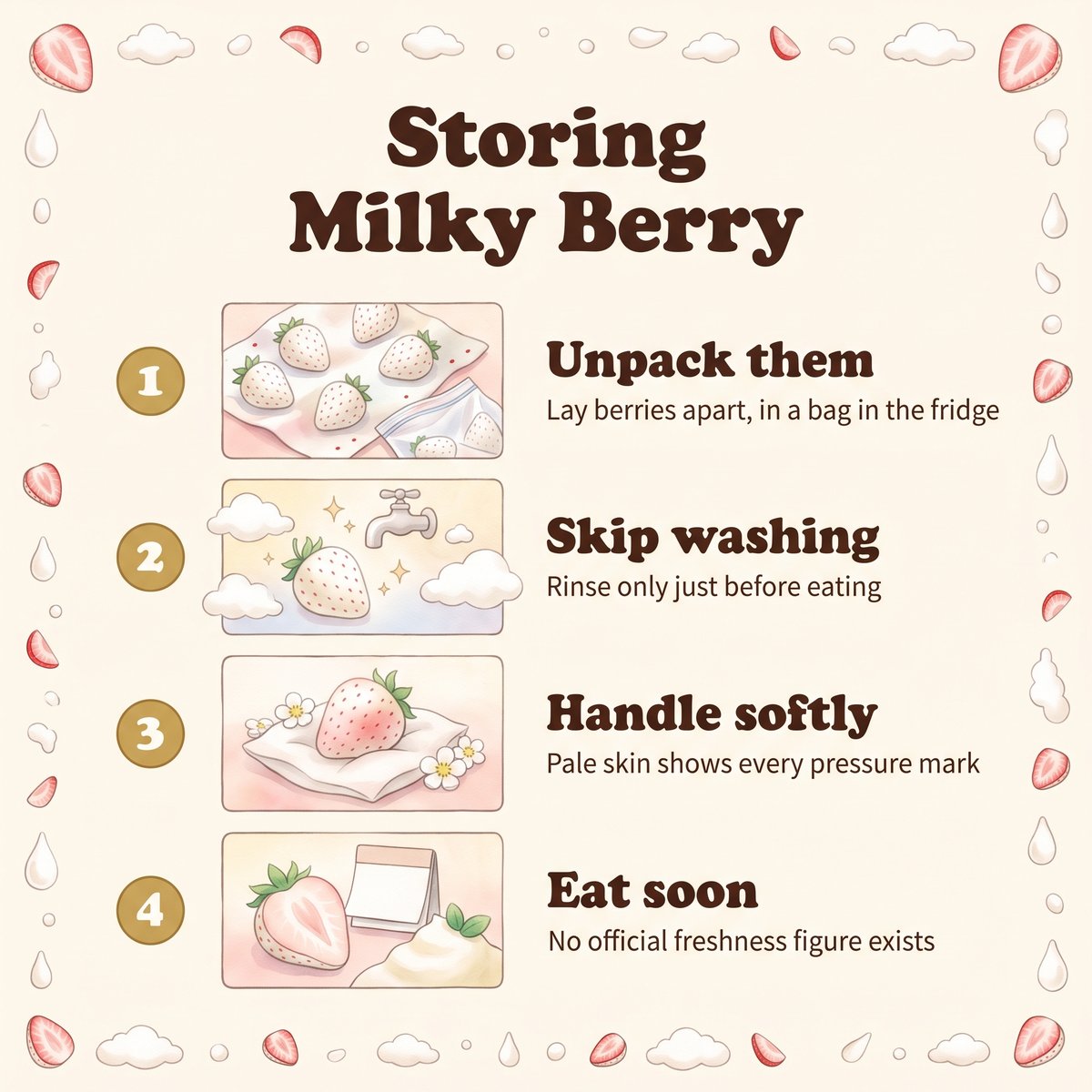
In general, treat Milky Berry like any fresh strawberry, only a little more gently. The first two tips below come from Japan’s agriculture ministry advice for strawberries in general. The last two are our own practical notes.
- Take them out of the pack. Arrange the berries so they do not overlap, then keep them in a plastic bag in the fridge.
- Do not wash before storing. Leftover water can encourage mold. If you do rinse them, dry them well first.
- Handle them softly. Pale skin shows marks from pressure, so avoid stacking or squeezing.
- Eat them soon. We found no official figure for how many days Milky Berry stays fresh, so sooner is safer.
For shipping, Tochigi’s researchers found that chilling fruit right after harvest and using fruit caps reduced yellowing. Those are commercial methods, though, not rules for your kitchen. At home, the fridge and careful handling are enough.
Milky Berry vs Other Japanese Strawberries
Milky Berry is easier to understand next to its neighbors. The table first compares it with two other strawberries bred in Tochigi.
| Variety | Origin | Color | Key traits |
|---|---|---|---|
| Milky Berry (Tochigi iW1) | Tochigi | Yellowish-white skin, white flesh | About 20 g; sugar like Tochiotome; lower acidity |
| Tochiotome | Tochigi | Red | Tochigi’s classic variety; brighter acidity in the 2018 trial |
| Skyberry (Tochigi i27) | Tochigi | Glossy deep orange-red | Very large; about 60% of fruit weigh 25 g or more; balanced sugar and acid |
Milky Berry vs Tochiotome and Skyberry
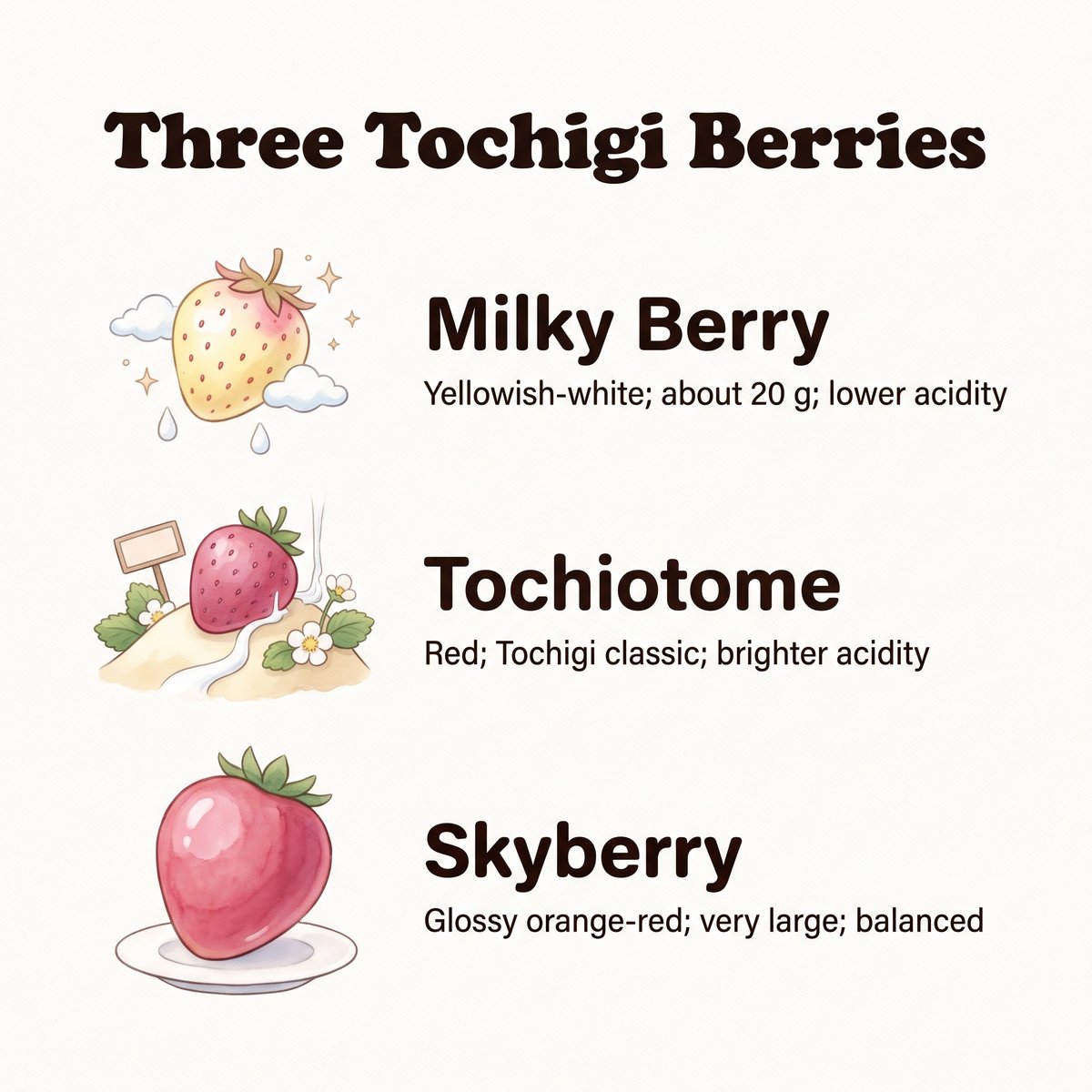
All three come from Tochigi’s research institute. Even so, they aim at different goals. Tochiotome is the familiar red standard. Skyberry, meanwhile, is known for exceptionally large, glossy fruit. Milky Berry stands apart mainly through its pale color and gentle acidity. We found no direct trial comparing Milky Berry with Skyberry, so we will not rank them by sweetness.
Another Tochigi variety worth knowing is Tochihime. According to the prefecture, its soft skin makes it unsuitable for shipping, so it is grown for pick-your-own farms rather than markets.
Milky Berry vs Other White Strawberries
Milky Berry and Hatsukoi no Kaori are related, but not the same. Hatsukoi no Kaori is the trade name of Wada Hatsukoi, an older registered cultivar. Milky Berry’s seed parent came from seedlings of its fruit. After crossing and selection, though, Milky Berry became a distinct variety. Its seed parent was chosen for firm fruit, and the final berry is larger than Tochiotome.
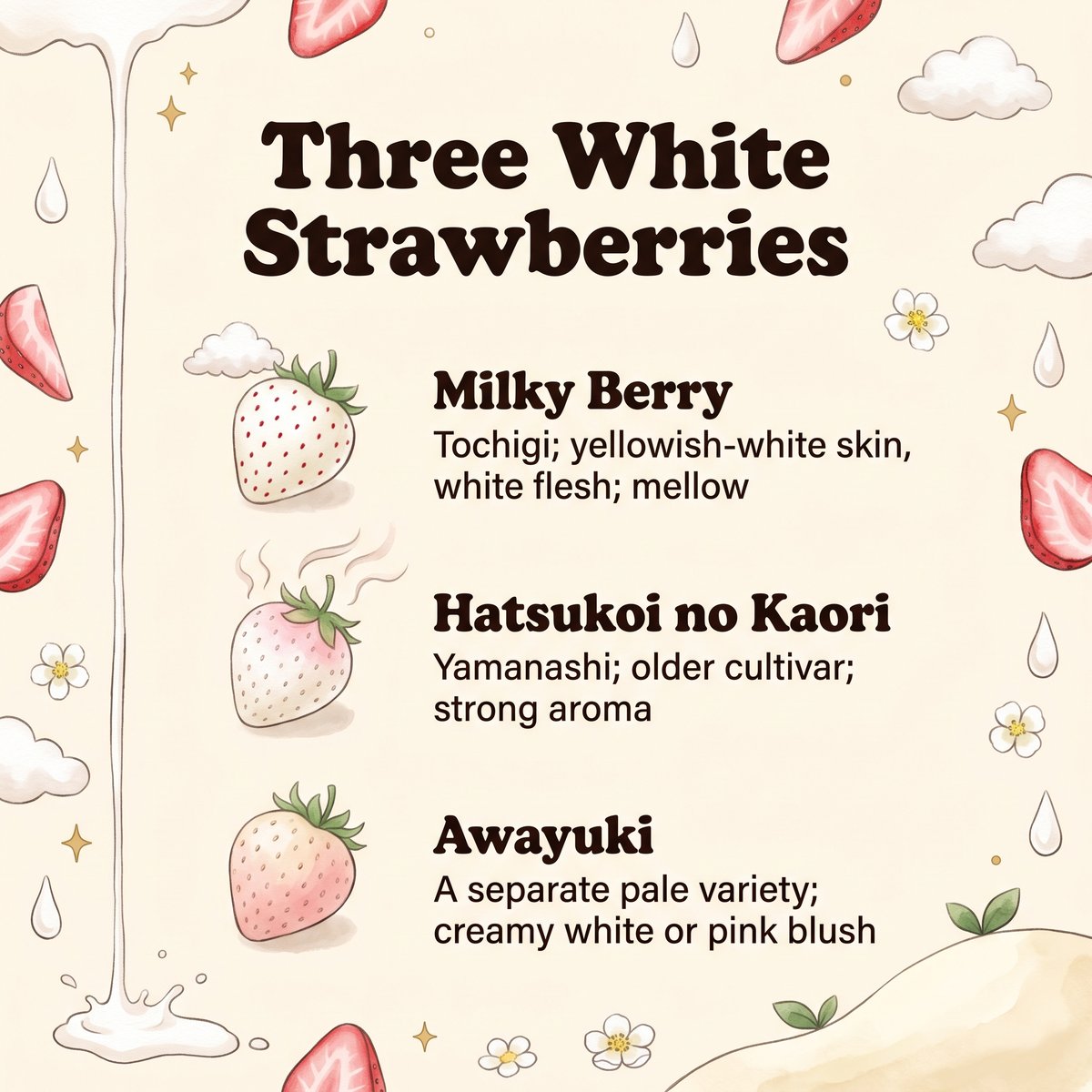
In fact, pale strawberries from Japan are not all the same cultivar. Here is how the three most often mentioned on our site differ.
| Name | Origin | Typical color | Taste profile | Worth knowing |
|---|---|---|---|---|
| Milky Berry | Tochigi Prefecture | Yellowish-white skin, white flesh, red seeds | Mellow and sweet, with lower acidity than Tochiotome | About 20 g; registered in 2024 |
| Hatsukoi no Kaori | Yamanashi Prefecture | Pale red skin and white flesh in its official record | Strong aroma and low acidity, per its developer | Older cultivar; its fruit gave rise to Milky Berry’s seed parent |
| Awayuki | See our Awayuki guide | Creamy white to soft pink blush | Not compared here | A separate pale variety, often confused with other white berries |
What about White Jewel? The name appears in English articles about Japanese white strawberries. It seems to work as a product name in some markets rather than a clearly identified cultivar, and we could not match it to a registered variety. For that reason, we left it out of the table. Also note that no trial has compared the sweetness of these white strawberries directly, so we do not rank them.
Where to Buy or Try Milky Berry in Japan
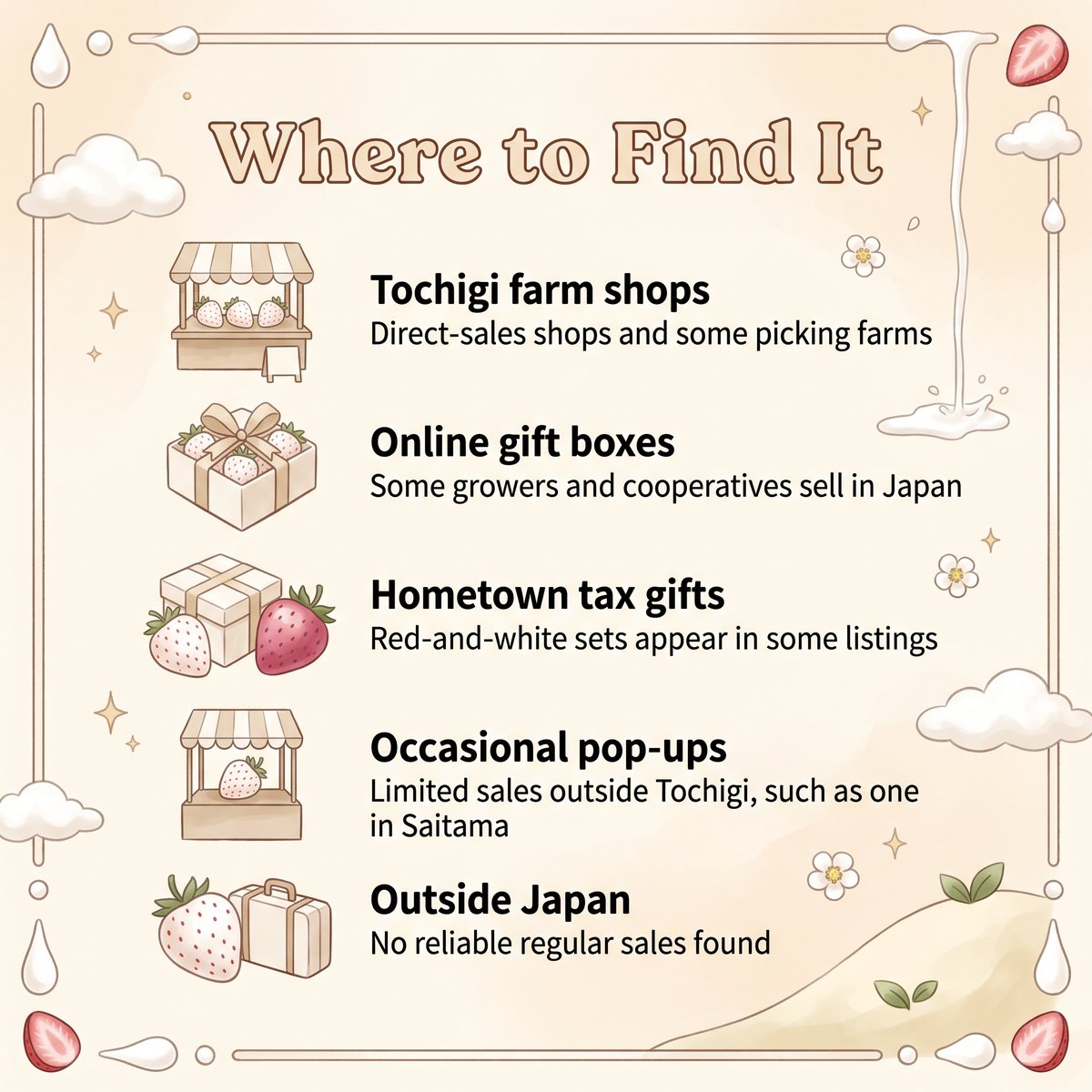
Overall, your best chance is in Tochigi itself. When Milky Berry debuted, the prefecture said it would be sold at some farm direct-sales shops and strawberry-picking farms in the prefecture. Availability is limited and changes by farm and harvest day.
Farms and Direct-Sales Shops in Tochigi
Each year, Tochigi’s farm tourism council publishes a list of strawberry-picking farms, including the varieties they grow. The 2026 edition is available as a PDF from the prefecture. Even so, a farm that grows Milky Berry may not offer it for picking every day. Therefore, contact the farm before you travel, especially if Milky Berry is the main reason for your trip.
Can You Pick Milky Berry Yourself?
Yes, at some farms. When it debuted, the prefecture said Milky Berry would appear at strawberry-picking farms as well as direct-sales shops. Some farms, however, sell it only in their shops. So when you book, ask whether Milky Berry is included in the picking plan that day.
What about hotel strawberry buffets? They are popular in Japan, yet we found no reliable listing that features Milky Berry. Buffet menus change every season, so check the hotel’s current lineup if a white strawberry matters to you.
Online Shops and Hometown Tax Gifts
Within Japan, some growers and agricultural cooperatives sell Milky Berry online, often as gift boxes. In addition, red-and-white sets appear as furusato nozei (hometown tax) gifts. For example, a listing from Yaita City in Tochigi offers a Skyberry and Milky Berry set for January delivery.
Can You Buy It in Tokyo?
We could not verify regular, year-round availability at Tokyo department stores or fruit parlors. Milky Berry does appear at limited pop-up sales outside Tochigi, however. In February 2026, for instance, a station shop at JR Kuki Station in Saitama held a one-day sale that included it. Such events are occasional, though, so do not count on finding it in central Tokyo.
Can You Find Milky Berry Outside Japan?
As of October 2026, we found no reliable evidence of regular sales abroad. Japan’s variety register shows a restriction on exporting the cultivar, but that concerns plants and other propagating material. It is not the same as a ban on exporting harvested fruit. For now, though, a trip to Tochigi is the surest way to taste one.
How Much Does Milky Berry Cost?
Milky Berry is generally sold as a premium gift strawberry, and prices vary widely by season, size, and seller. Still, two examples checked in October 2026 give a rough idea. They illustrate Milky Berry’s place in the premium market rather than fixed prices.
| Example (checked October 2026) | Contents | Price |
|---|---|---|
| JA Sano online gift box | Two packs, about 560 g in total | ¥4,500 as listed, shipping included |
| Yaita City hometown tax gift | 6 to 10 Milky Berry plus 12 to 20 Skyberry | ¥24,000 donation |
A hometown tax donation is not a store price, so compare it with care. Likewise, prices at farm shops in Tochigi may differ from online prices. Always check the seller’s current listing before you order.
Why Can Milky Berry Cost More?
Several factors play a part, although none is unique to one shop. First, pale skin shows every bruise. Tochigi asks growers to use cushioning and to keep yellow or brown fruit out of gift packs, which adds work and cost.
Second, supply is narrow. Only growers in Tochigi’s official program receive plants, and the fruit is sold mainly through farm shops, online gift boxes, and similar channels. Interestingly, low yield does not seem to be the reason. In early trials, Milky Berry produced as much as or more than Tochiotome.
Gift packing matters, too. In Japan, premium fruit is often bought as a present, so presentation affects price. Our Japanese fruit guide explains more about that culture.
Can You Grow Milky Berry at Home?
Probably not easily. Tochigi distributes Milky Berry mother plants through an official program, but only to eligible strawberry growers in the prefecture. Applicants must join a growers’ council, follow the cultivation manual, and use the plants only for their own farming in Tochigi.
Furthermore, the program bans passing plants to anyone else, paid or free. In addition, the registered variety’s rights run for 35 years from registration. This does not prove that no plant ever reaches a home gardener. It does show, however, that the official route is for commercial growers only.
Common Misconceptions About Milky Berry
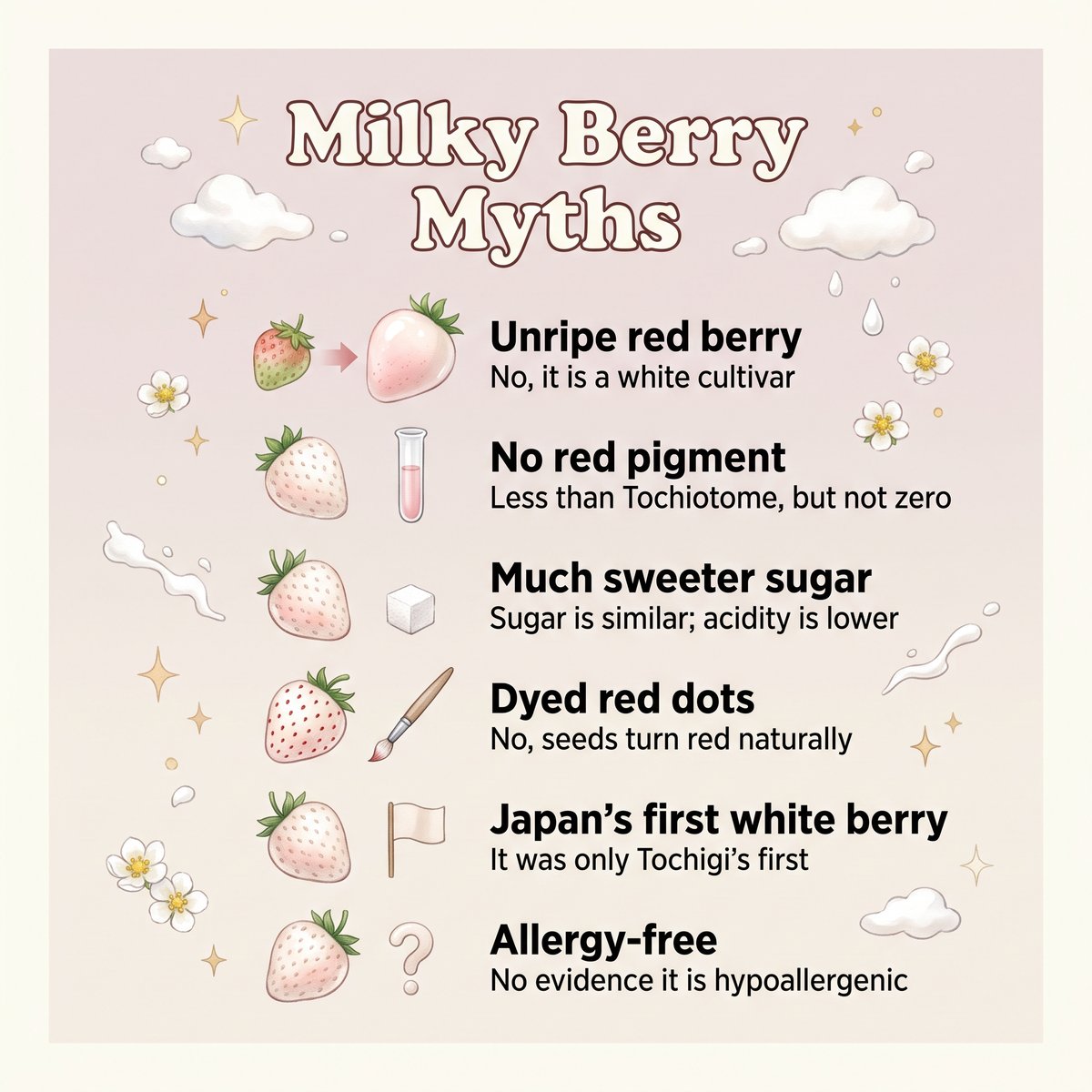
A white strawberry invites a few myths. Here are the ones worth clearing up before you buy.
Myth: It is an unripe red strawberry.
Fact: It is a white-fruited cultivar that stays pale when ripe.
Myth: It contains no red pigment.
Fact: It contains much less anthocyanin than Tochiotome, but not zero.
Myth: It is much higher in sugar.
Fact: Sugar was similar to Tochiotome; lower acidity makes it taste sweeter.
Myth: The red dots are dye.
Fact: They are achenes that turn red naturally as the berry ripens.
Myth: It is Japan’s first white strawberry.
Fact: It was Tochigi’s first; older white varieties such as Hatsukoi no Kaori came earlier.
Myth: White strawberries are allergy-free.
Fact: We found no evidence that Milky Berry is hypoallergenic.
That last point deserves care. Less red pigment is not the same as lower allergy risk. Anyone with a strawberry allergy should treat Milky Berry like any other strawberry.
Why Milky Berry Is Worth Trying
Above all, Milky Berry is more than a novelty color. It shows how Tochigi’s breeders turned a store-bought white strawberry into a firmer, larger cultivar with a softer acid profile. Its yellowish-white skin and red seeds look memorable, and the mellow taste offers a real contrast to red berries.
If you visit Tochigi between December and May, look for it at farm shops, and try it beside a red berry. If you want the sweetest strawberry in Japan, it may not be your answer, admittedly. Its sugar level is ordinary, and some people prefer a tangier berry. Still, it is one of the easiest ways to see how much thought goes into a single Japanese fruit. For more regional dishes, see our Tochigi food guide and our wider Japanese fruit guide.
Frequently Asked Questions About Milky Berry
The Variety and Its Color
- What is a Milky Berry strawberry?
-
Milky Berry is a white strawberry developed by Tochigi Prefecture in Japan. Its registered variety name is Tochigi iW1, and Milky Berry is its trademark. It has yellowish-white skin, white flesh, and red seeds when ripe.
- Why is Milky Berry white?
-
Milky Berry contains much less anthocyanin, the red pigment in strawberries, than red varieties. In a Tochigi test, it held 2.69 mg per 100 g versus 14.80 mg for Tochiotome. The low pigment level keeps its skin and flesh pale, even when ripe. It is not dyed, bleached, or picked unripe.
- Is Milky Berry different from Hatsukoi no Kaori?
-
Yes, Milky Berry is a separate cultivar. Its breeding began with seedlings from Hatsukoi no Kaori fruit. Tochigi then crossed a selected seedling with another breeding line and chose a new plant. The result was registered on its own as Tochigi iW1.
- Why does my Milky Berry have yellow or brown patches?
-
An even, yellowish-white skin is normal. Local yellow or brown marks, however, usually come from rubbing or pressure in handling. Tochigi’s transport trials found that cooling and protective packing reduced these marks.
Eating, Season, and Buying
- Does Milky Berry contain milk?
-
No, the fresh fruit is simply a strawberry. The name refers to its milk-like color and mellow texture. Sweets made with it may contain dairy, though, so read their labels.
- When is Milky Berry strawberry season?
-
Tochigi gave the harvest period as roughly December to May when the berry debuted. Timing varies by farm and weather. Contact farms directly before a special trip.
- Where can you buy Milky Berry strawberries?
-
Look first at farm direct-sales shops and strawberry-picking farms in Tochigi. Some growers also sell online within Japan, and hometown tax gift listings sometimes include it. Availability changes by season and harvest day.
- How much do Milky Berry strawberries cost?
-
Prices vary by season, size, and seller. In October 2026, for example, one cooperative listed a gift box of about 560 g for ¥4,500 with shipping. Check the seller’s current listing before ordering.
References
Official and Government Sources
- Ministry of Agriculture, Forestry and Fisheries (MAFF) – Plant Variety Registration Database: Tochigi iW1 (Accessed October 2026)
- Tochigi Prefecture Strawberry Research Institute – Tochigi iW1 (Trademark: Milky Berry) (Accessed October 2026)
- Tochigi Prefecture – Registered Trademarks for Tochigi Strawberries (Accessed October 2026)
- Strawberry Kingdom Tochigi – Strawberry Lineup (Accessed October 2026)
- Tochigi Prefecture – Prefectural Public Relations Magazine, February 2020 (Accessed October 2026)
- Tochigi Prefecture Strawberry Research Institute – 50 Years of Strawberry Variety Development, November 2020 (Accessed October 2026)
- Ministry of Agriculture, Forestry and Fisheries (MAFF) – aff Magazine, December 2019: Strawberry Tips (Accessed October 2026)
- Tochigi Prefecture – Call for Applicants for Milky Berry Mother Plants, 2028 Crop (Accessed October 2026)
- Tochigi Tourist Strawberry Farm Council – List of Tochigi Strawberry-Picking Farms, 2026 Crop (Accessed October 2026)
- Furusato Choice – Yaita City Skyberry and Milky Berry Set (Accessed October 2026)
- Tochigi Prefecture Strawberry Research Institute – Tochigi i27 (Trademark: Skyberry) (Accessed October 2026)
- JA Sano (Yahoo! Shopping) – Milky Berry Gift Box, 280 g × 2 Packs (Accessed October 2026)
- JR East Media – Strawberry Sale at Kuki Station NewDays, February 2026 (Accessed October 2026)
Research Reports
- Tochigi Prefectural Agricultural Experiment Station – Tsurumi, R., et al. (2020). Breeding of a New White Strawberry Cultivar “Tochigi iW1.” Bulletin of the Tochigi Agricultural Experiment Station, 81, 67–82 (Accessed October 2026)
- Agricultural Experiment Station, Tochigi Prefecture – Breeding of the New White Strawberry “Tochigi iW1 (Milky Berry),” Research Results No. 38 (Accessed October 2026)
- Tochigi Prefectural Agricultural Experiment Station – Establishing Cultivation Techniques for the White Strawberry “Tochigi iW1 (Milky Berry),” Research Results No. 41 (Accessed October 2026)
Related Articles
- Tochi otome (とちおとめ) (Surveyed: October 2026)
- Tochihime(とちひめ): The Rare Strawberry Treasure You Can Only Find in Tochigi Prefecture (Surveyed: October 2026)
- Hatsukoi no Kaori (初恋の香り) (Surveyed: October 2026)
- Awayuki Strawberries (淡雪いちご) (Surveyed: October 2026)
- Tochigi Food Guide (Surveyed: October 2026)
- Ichigo Daifuku (いちご大福) (Surveyed: October 2026)




Comments