


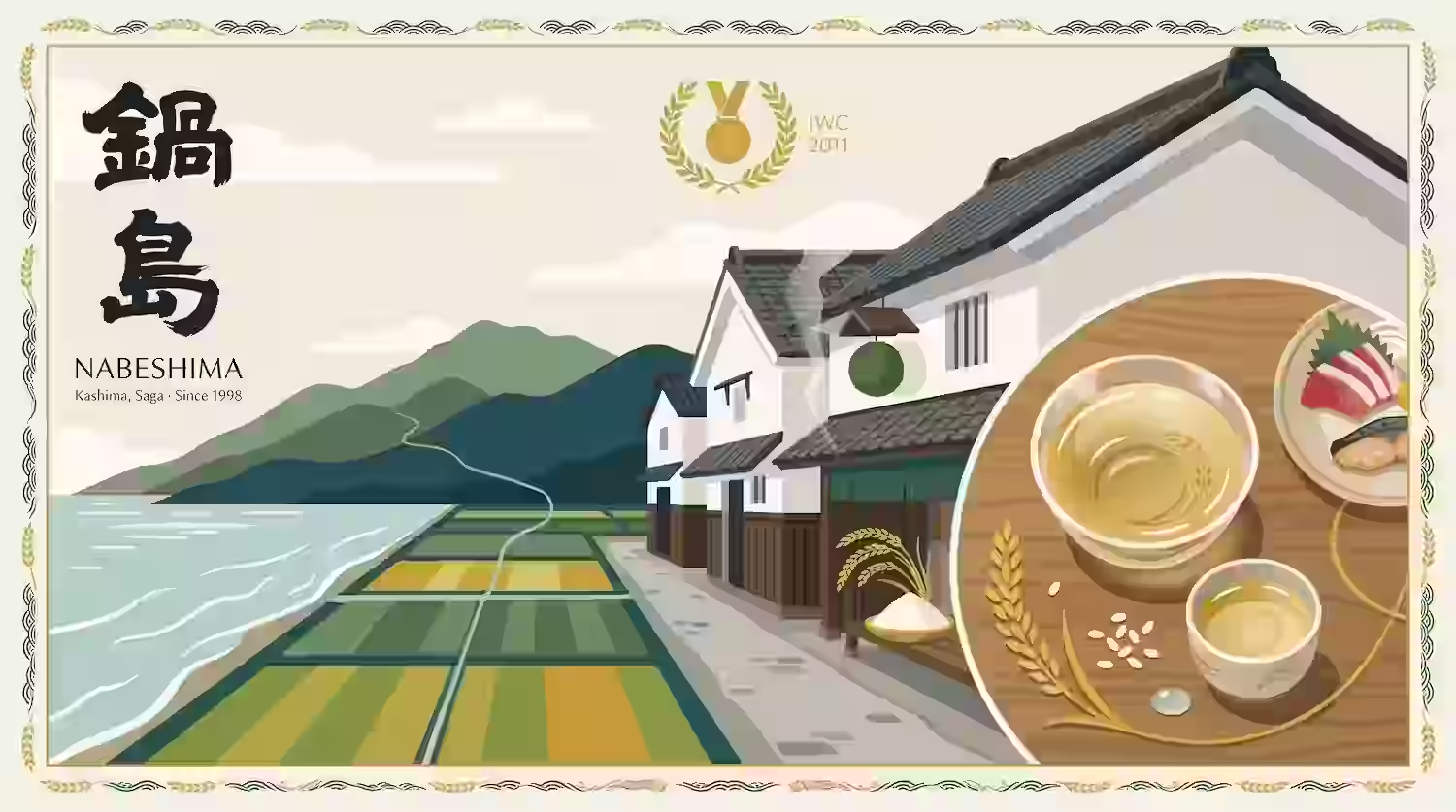

Picture a quiet brewing street near the Ariake Sea, lined with white-walled storehouses. In 2011, a sake from one of those breweries took the top sake prize at the International Wine Challenge in London. The bottle was a Nabeshima sake (鍋島), Nabeshima Daiginjo, made by Fukuchiyo Shuzo in Kashima, Saga Prefecture. For many drinkers outside Japan, that result was probably the first time they heard the name.
Yet the award is only part of the story. Nabeshima is a young brand from an older brewery, rooted in a town that has made sake for centuries. This guide follows that path, then turns practical: what the sake tastes like, what it costs, where to find it, and which bottle to try first.
What Is Nabeshima Sake?
Nabeshima is a Japanese sake brand, not a style or category of sake. Fukuchiyo Shuzo, a brewery founded in 1923, launched it in 1998. The label now covers dozens of bottlings, from junmai daiginjo to everyday honjozo, made with several rice varieties.
Quick Facts: Nabeshima Sake
- Japanese name
- 鍋島 (Nabeshima)
- Brewery
- Fukuchiyo Shuzo Co., Ltd. (富久千代酒造)
- Location
- Hamamachi, Kashima City, Saga Prefecture, Kyushu
- Brewery founded
- 1923
- Brand launched
- 1998
- Best-known award
- Champion Sake, International Wine Challenge 2011, for Nabeshima Daiginjo
- Main categories
- Junmai daiginjo, daiginjo, junmai ginjo, ginjo, tokubetsu junmai, junmai, tokubetsu honjozo
- Rice varieties named
- Yamada Nishiki, Akaiwa Omachi, Aiyama, Yamadaho, Tankan Watabune, Kitashizuku, Gohyakumangoku, Shiragiku
- Brewery’s stated aim
- A balanced sake in which no single trait dominates
A Brand, a Brewery, and a Region
Three names are easy to confuse here. First, Nabeshima is the brand on the label. Second, Fukuchiyo Shuzo is the company that brews it. Saga sake, meanwhile, is the wider regional tradition, and Nabeshima is only one of many labels within it.
So when someone says they love Nabeshima, they mean one brewery’s range. After all, other Kashima breweries make very different sake, a point worth keeping in mind when you shop.
Fukuchiyo Shuzo: The Brewery Behind Nabeshima
Fukuchiyo Shuzo is a family brewery in the Hamamachi district of Kashima. According to its official materials, the company dates to 1923, and it marked its 100th anniversary in 2023. For most of that century, however, the brewery did not sell sake under the Nabeshima name.
Before Nabeshima
Earlier, the brewery’s sake carried a different label, Izumi Nishiki (泉錦). The brewery mentions it in the story behind its Kakushi-zake bottling. That detail matters, because it shows Nabeshima as a deliberate new start rather than an old name revived.
Starting From Scratch in 1998
In 1998, the brewery’s third-generation head launched Nabeshima as a brand-new label within the existing brewery, building it, in the brewery’s words, from zero. His stated goal was a one-of-a-kind local sake that people in the area would love and feel proud of. Today, moreover, the official site names Naoki Iimori as the third-generation head and toji (master brewer).
The brewery also describes a hope that Nabeshima will one day represent Saga, and then Japan. In other words, that is an aspiration, not a description of Saga sake as a whole.
Key Dates at a Glance
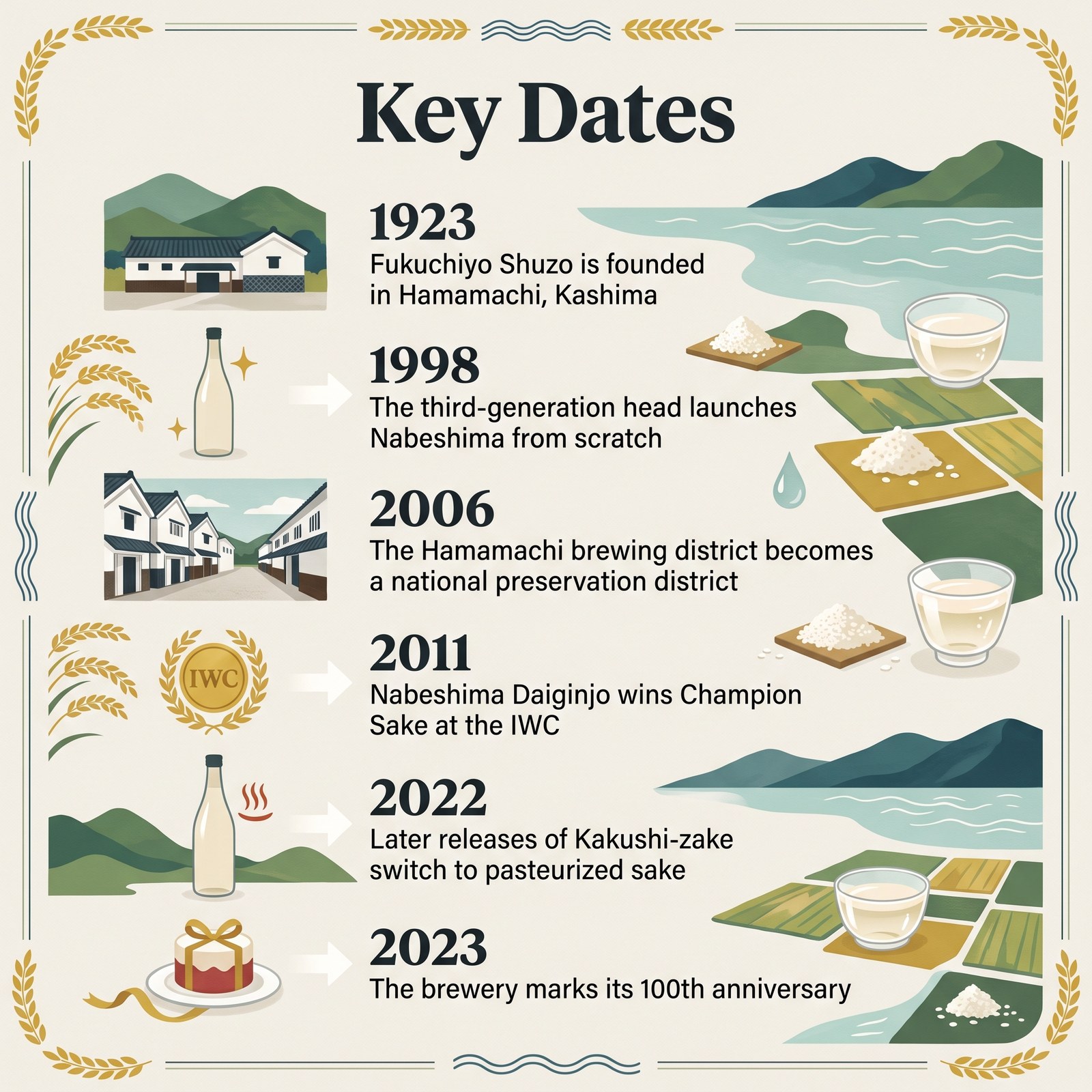
1923
Fukuchiyo Shuzo is founded in Hamamachi, Kashima.
1998
The third-generation head launches the Nabeshima brand from scratch.
2006
The Hamamachi brewing district becomes a national preservation district.
2011
Nabeshima Daiginjo wins Champion Sake at the International Wine Challenge.
2022
Later releases of Kakushi-zake switch to pasteurized sake.
2023
The brewery marks its 100th anniversary.
Why the Name Nabeshima?
Nabeshima shares its name with the Nabeshima family, who ruled the Saga domain during the Edo period. So the link to local history is clear. However, the brewery has not published an explanation of exactly how or why it chose the name.
The Edo period ran from 1603 to 1868, and the family’s name still carries weight in the region today. For a Saga brewery, therefore, it is an instantly regional name. Japanese readers connect it with the area’s history, much as Western readers might link a wine to an old estate.
Admittedly, some secondary sources mention a public naming process or permission from the family. We could not confirm either claim, so this guide does not repeat them as fact.
Interestingly, the brewery admits to some hesitation about the lord’s name. Discussing one label that prints the name in mirror writing, it says it honestly felt reluctant before going ahead. That small remark shows how seriously the name still weighs in Saga.
Kashima: The Regional Home of Nabeshima
Kashima sits in southwestern Saga Prefecture, on the shore of the Ariake Sea. Meanwhile, behind the town rise the Tara mountains, which straddle the border with Nagasaki. Saga itself lies in northwest Kyushu, between Fukuoka and Nagasaki.
Water, Rice, and a Long Brewing History
Local tourism materials tie Kashima’s brewing to two things: good rice and clear spring water from the Tara mountain range. They also say sake making has thrived here since the Edo period. Today, the area counts six brewing sites run by five sake companies in Kashima, plus three more in neighboring Ureshino.
Does Tara water shape Nabeshima’s taste? It is a tempting idea. Still, the brewery only says it uses carefully chosen rice and water, without naming a source. So treat the mountain water as regional background, not a proven recipe.
Hizen Hamashuku, a Protected Brewing Town
Fukuchiyo Shuzo stands in the Hamamachi area, part of the old post town known as Hizen Hamashuku. On July 5, 2006, Japan selected the Hamanakamachi Hachihongi-shuku district as an Important Preservation District for Groups of Traditional Buildings. In fact, its official type is a “brewing town.”
According to Japan’s cultural heritage database, brewing grew here from around the mid-Edo period. By the late Edo period, the district had more than ten sake makers. For visitors, that history still shows in the white-walled storehouses along the street.
Saga’s Sake Culture and Local Identity
Saga is a rice-growing prefecture, and its breweries draw on that farm base. Even so, Saga sake does not share one single taste. Instead, each brewery follows its own direction, and Nabeshima is one useful example rather than the whole picture.
Beyond that, Kashima’s breweries also work together. The town hosts Kashima Sakagura Tourism, a joint open-brewery event usually held in spring. Organizers have already announced a 2027 edition, though you should confirm the dates before planning a trip. For a wider view of the prefecture, see our guide to Saga sake.
The 2011 International Wine Challenge Award
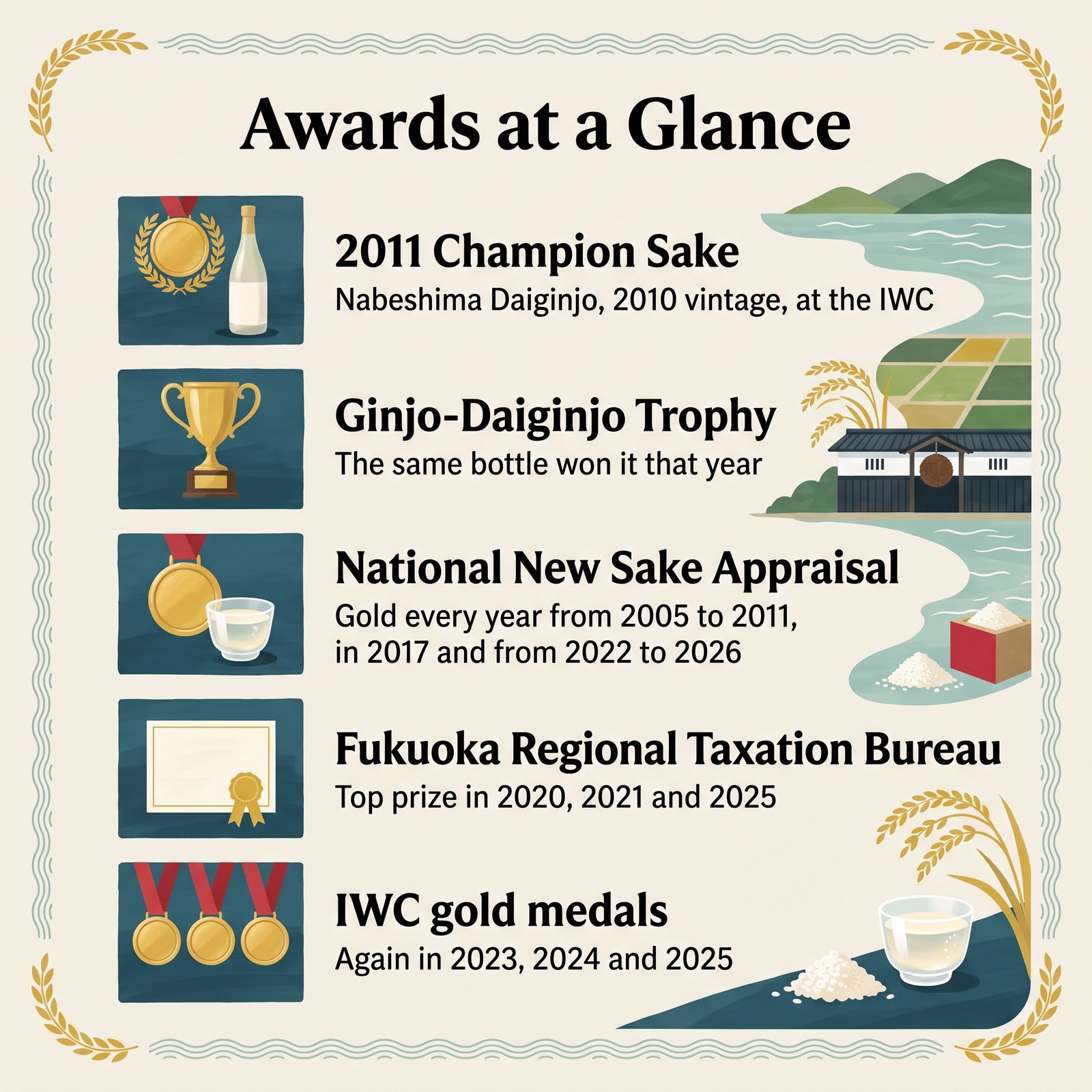
In 2011, Nabeshima Daiginjo was named Champion Sake at the International Wine Challenge (IWC), a London-based wine and sake competition. The IWC lists the winning entry as Nabeshima Daiginjo, 2010 vintage, from Fukuchiyo Shuzo. The same bottle also took the Ginjo-Daiginjo Trophy that year.
A Common Mix-Up
Some articles say a Nabeshima junmai ginjo made with Yamada Nishiki won in 2011. The official IWC results, the brewery’s award page, and a 2011 regional news report all name the daiginjo instead.
Why the Award Mattered
Simply put, the Champion Sake title is the top sake award at the IWC. For a brewery founded in a small Saga town, it put the Nabeshima name in front of buyers and writers who rarely looked at regional Kyushu sake. It also gave local tourism a strong story to tell.
That said, it is worth being careful with the meaning. The award honored one bottling in one year. It does not prove that every Nabeshima product tastes the same, or that it is the best sake for every drinker. We also found no sales data showing exactly how much the award changed the brand’s business.
Life After the Trophy
Still, consistency after a big win is the harder test. At home, many brewers value the National New Sake Appraisal just as much, since it is Japan’s long-running national tasting of newly made sake. According to the brewery, Nabeshima earned gold awards there every year from 2005 to 2011, again in 2017, and each year from 2022 to 2026.
The brewery also lists the top prize at the Fukuoka Regional Taxation Bureau’s sake appraisal in 2020, 2021, and 2025. Taken together, that is a remarkably steady record.
Abroad, the brewery lists IWC gold medals again in 2023, 2024, and 2025. Notably, it says it has not entered The Joy of Sake in the United States since 2016.
Rice Varieties and the Character of Nabeshima
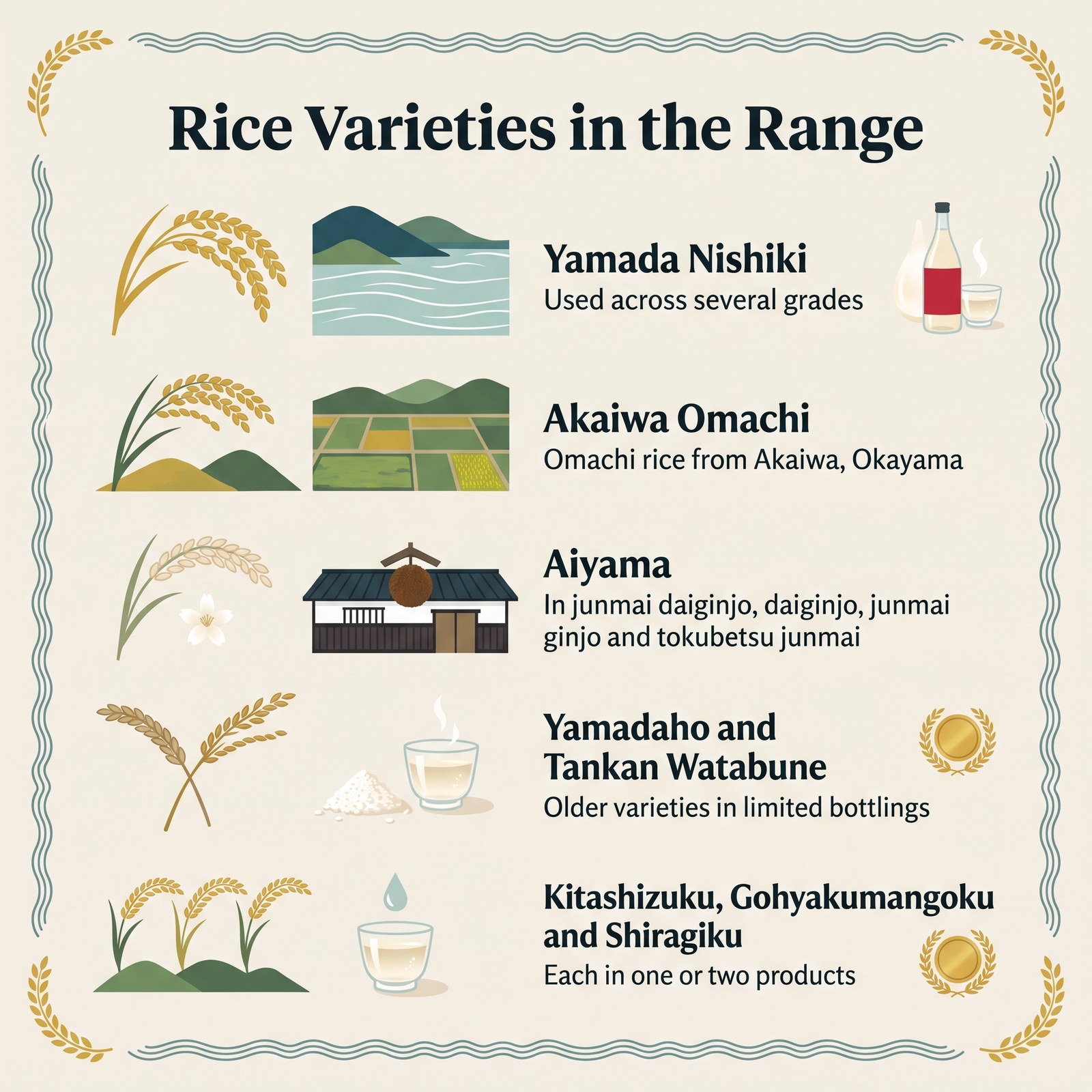
Nabeshima does not rely on a single rice. The official lineup names at least eight varieties, and each bottle states its rice on the label. Indeed, that variety is a big part of what makes the range interesting to explore.
- Yamada Nishiki (山田錦). Used across several grades, including bottles that name rice grown in Yokawa, Hyogo Prefecture.
- Akaiwa Omachi (赤磐雄町米). The brewery writes the full name, pointing to Omachi rice from Akaiwa in Okayama Prefecture.
- Aiyama (愛山). Appears in junmai daiginjo, daiginjo, junmai ginjo, and tokubetsu junmai bottlings.
- Yamadaho (山田穂) and Tankan Watabune (短稈渡船). Older sake rice varieties used in limited bottlings.
- Kitashizuku, Gohyakumangoku, and Shiragiku. Each appears in one or two products in the current range.
Why Rice Alone Does Not Decide the Taste
It is tempting to say Omachi tastes rich and Yamada Nishiki tastes elegant. In practice, the brewer’s choices matter just as much. For instance, polishing, koji making, yeast, and fermentation all change the result.
Even the same rice variety can change with the weather. For example, a study by Japan’s agriculture research agency, NARO, found that temperatures during the middle of ripening affected Yamada Nishiki’s protein makeup. Protein in turn can influence flavor and how the rice behaves in the brewery. So a rice name on a label is a clue, not a full description.
What Many Drinkers Expect From Different Rice Varieties
Across the sake industry, people often link Yamada Nishiki with balance and elegance. Omachi, meanwhile, tends to suggest deeper umami and complexity, while Aiyama is often tied to richer sweetness and fragrance. However, these are broad tendencies rather than rules. In fact, Fukuchiyo Shuzo does not publish official tasting comparisons for its Nabeshima bottlings, so treat these notes as a starting point for your own tasting.
Water, Koji, Yeast, and Fermentation
Fukuchiyo Shuzo describes its approach in broad terms rather than technical figures. It says it makes koji by hand and prepares each batch with care. It also says the team adjusts the work by watching how the koji turns out and how fermentation is going, aiming for brewing that is never forced.
What about yeast strains, water hardness, or fermentation temperatures? The brewery does not publish them, and we found no reliable source that does. That gap, incidentally, is common among Japanese breweries. If those details matter to you, the back label of a specific bottle is the best place to look.
For the basics behind these steps, our guides to koji, sake yeast, and moromi fermentation explain the process in more detail.
Understanding the Nabeshima Product Range
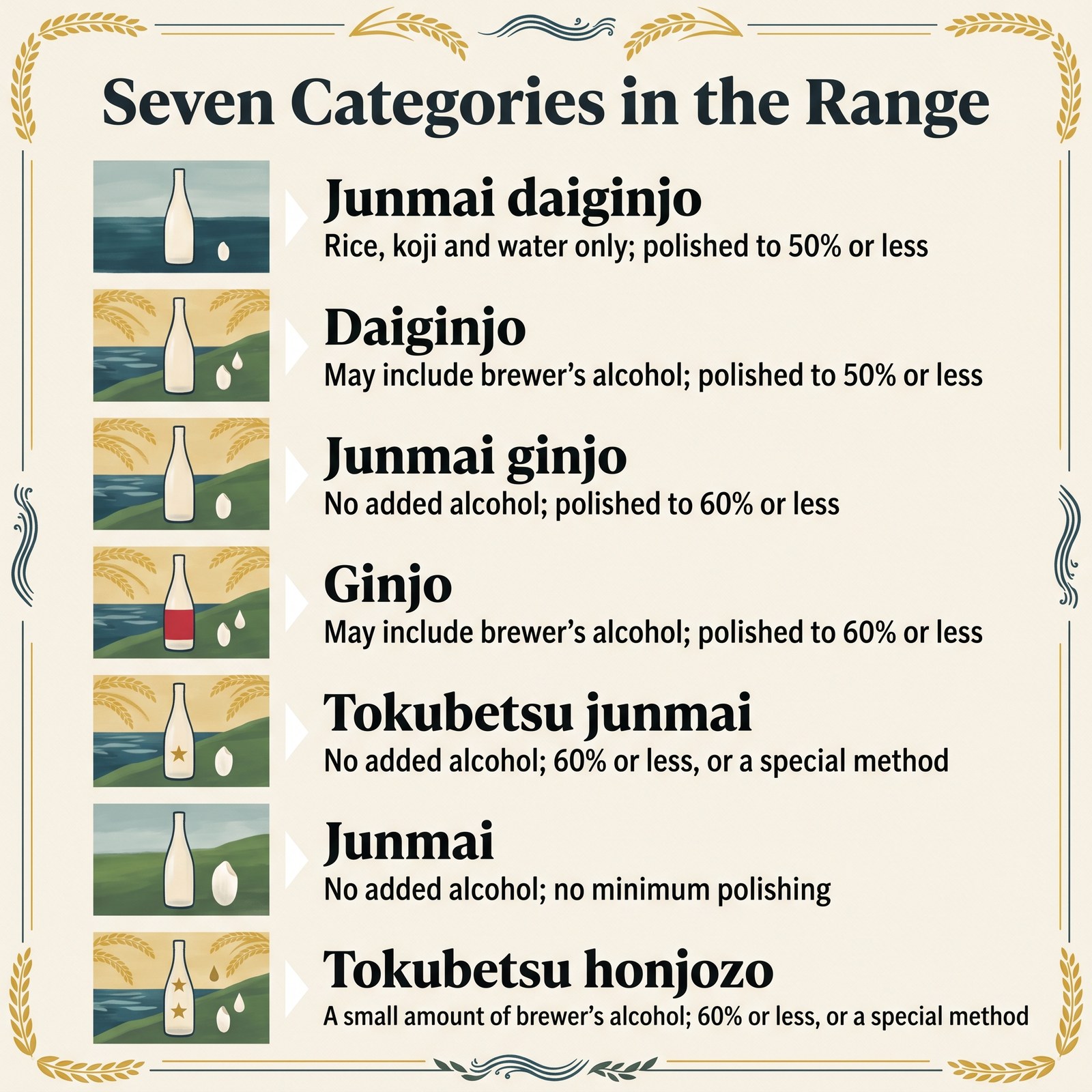
Nabeshima’s range is wide, and that can feel overwhelming at first. In October 2026, the official lineup page listed about three dozen bottlings. The table groups them by category, using the definitions in Japan’s sake labeling rules.
| Category | What the rules require | Examples in the Nabeshima range |
|---|---|---|
| Junmai daiginjo | Rice, koji, and water only; rice polished to 50% or less | Yamada Nishiki 35%, Yamada Nishiki 45%, Akaiwa Omachi, Aiyama, Yamadaho, Tankan Watabune, Kitashizuku |
| Daiginjo | May include brewer’s alcohol; rice polished to 50% or less | Daiginjo, Daiginjo Aiyama |
| Junmai ginjo | No added alcohol; rice polished to 60% or less | Yamada Nishiki, Akaiwa Omachi, Aiyama, Kitashizuku, Kakushi-zake, seasonal Moon series |
| Ginjo | May include brewer’s alcohol; rice polished to 60% or less | Summer Moon |
| Tokubetsu junmai | No added alcohol; 60% or less, or a special method | Tokubetsu Junmai, plus Classic bottlings with Omachi, Aiyama, and Yamadaho |
| Junmai | No added alcohol; no minimum polishing | Harvest Moon, Classic Shiragiku |
| Tokubetsu honjozo | Small amount of brewer’s alcohol; 60% or less, or a special method | Tokubetsu Honjozo |
Product names and seasonal releases change, so check the brewery’s lineup before you shop. Also note that a higher category does not automatically mean a better sake. The rules define how a sake is made, not how good it tastes.
The Moon Series and Other Limited Releases
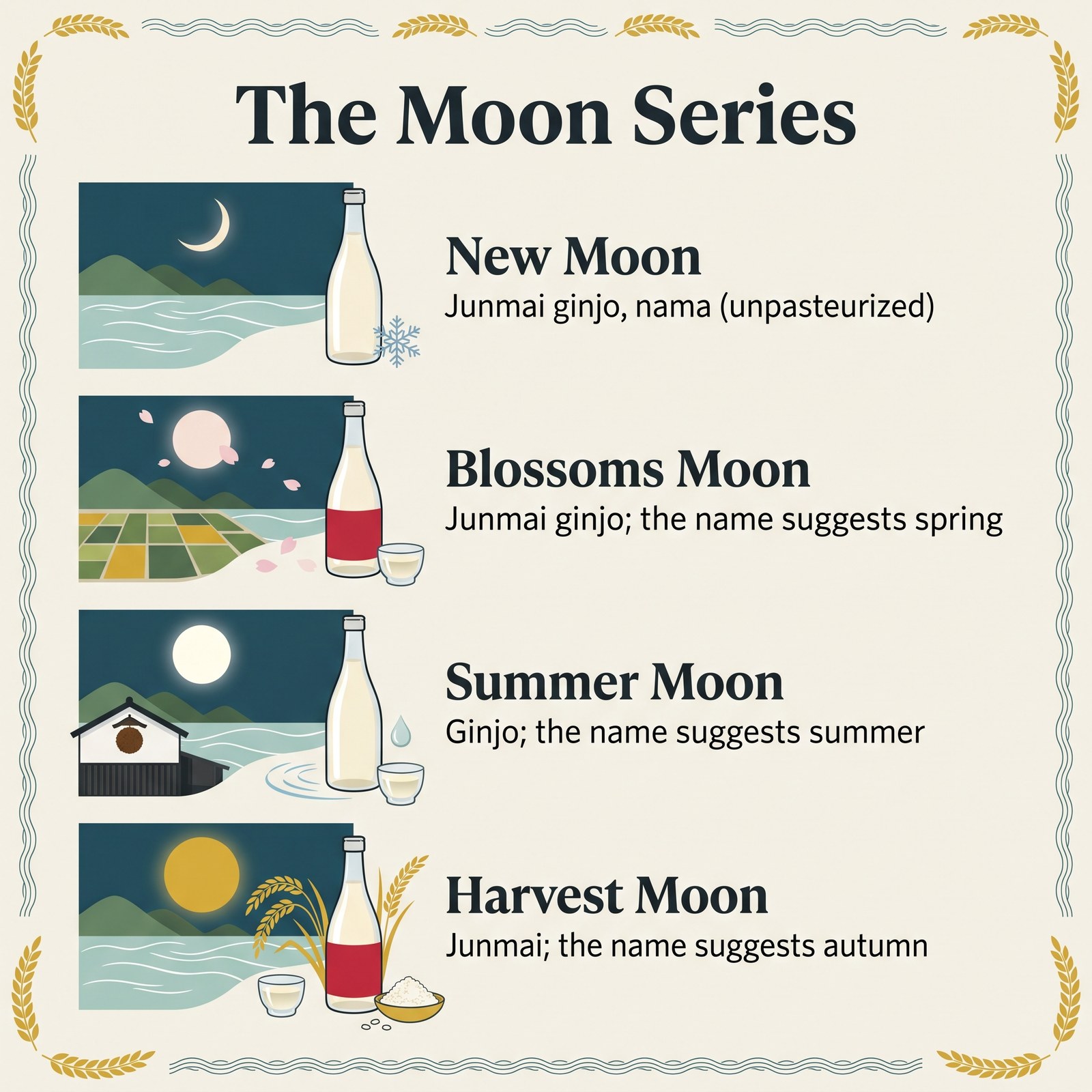
Among the most talked-about bottles, for instance, are the Moon series. The lineup lists New Moon, Blossoms Moon, Summer Moon, and Harvest Moon, spread across junmai ginjo, ginjo, and junmai. Their names hint at the seasons, although availability and timing can shift from year to year.
| Release | Category on the lineup | Season the name suggests |
|---|---|---|
| New Moon | Junmai ginjo, nama (unpasteurized) | Not clear from the name |
| Blossoms Moon | Junmai ginjo | Spring |
| Summer Moon | Ginjo | Summer |
| Harvest Moon | Junmai (labeled “60% Junmai”) | Autumn |
Note, however, that the brewery’s lineup page does not list release dates, so the season column reflects the names only. Seasonal timing and specifications may also vary from year to year. For that reason, check the brewery’s latest lineup, or ask your retailer, for current releases.
Besides those, the range includes a Classic line built around older rice varieties, plus small runs such as Black Label and The Third Brewing. Keeping track of every release is hard, admittedly, even for regular fans. A good local sake shop, or the brewery’s own lineup page, is the most reliable guide to what is out right now.
Namazake versions deserve a special note. Because they skip pasteurization, they taste fresher, yet they also need steady refrigeration. If you buy one as a gift or souvenir, keep it cold and drink it fairly soon.
Kakushi-zake, the “Hidden” Bottle
One bottling has an unusual backstory. About twenty years ago, a partner retailer in Tochigi suggested selling the first and last runs of the junmai ginjo pressing. Until then, the brewery had blended them into its everyday Izumi Nishiki sake. The bottle became known as Ura Nabeshima, or “reverse Nabeshima,” and its label prints the name in mirror writing.
Later, the brewery began blending in regular junmai ginjo as well, and it now adjusts the blend for each release. Since 2022, it has pasteurized the later releases each year, because more drinkers were storing the raw version for a long time. It is a small, human detail that says a lot about how the brewery listens.
What Does Nabeshima Sake Taste Like?
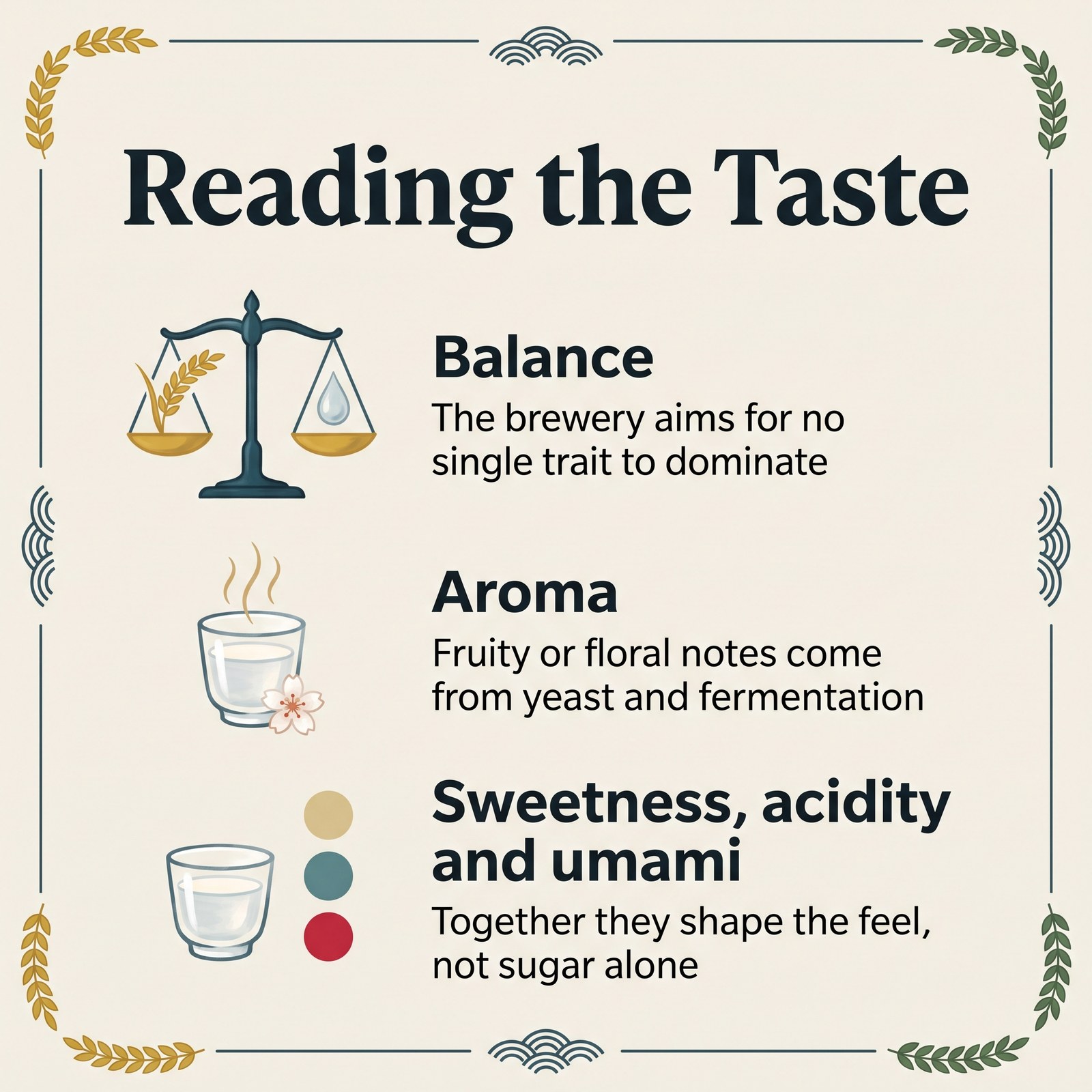
In short, Nabeshima aims for balance. The brewery describes its goal as a sake in which aroma, sweetness, acidity, and umami stay in harmony, with no single trait taking over. Its Japanese term for this is shizentai (自然体), meaning relaxed and unforced. That is a brewing philosophy, by the way, not a link to the “natural wine” movement.
What do drinkers actually notice? For the popular junmai ginjo, Japanese retailers’ notes often mention a sweet, fresh aroma, a juicy feel, and a clean balance of umami and acidity. One shop, for example, notes a faint natural fizz. Similarly, a US retailer describes the same style as tropical, with pineapple-like tartness.
Beyond that, honest generalizations get difficult. The range runs from aromatic junmai daiginjo to everyday honjozo, so a single tasting note would mislead you. Instead, here is a more useful way to think about it.
Aroma
Ginjo-grade sake often shows fruity or floral notes, and that comes from yeast and fermentation, not from added fruit. In Nabeshima’s higher grades, you may notice that kind of aroma. In the junmai and honjozo bottles, by contrast, expect something quieter and more rice-led.
Sweetness, Acidity, and Umami
First of all, sweetness in sake is a feeling, not just a sugar number. Good acidity can make a slightly sweet sake taste fresh, while umami, the savory taste from rice and fermentation, adds depth. That is why labels such as “sweet” or “dry” rarely tell the whole story.
So is Nabeshima sweet or dry? Honestly, it depends on the bottle. The brewery’s own balanced philosophy suggests that few Nabeshima bottles sit at either extreme. Even so, trying two different bottles side by side is the clearest way to find out.
Nabeshima With Food
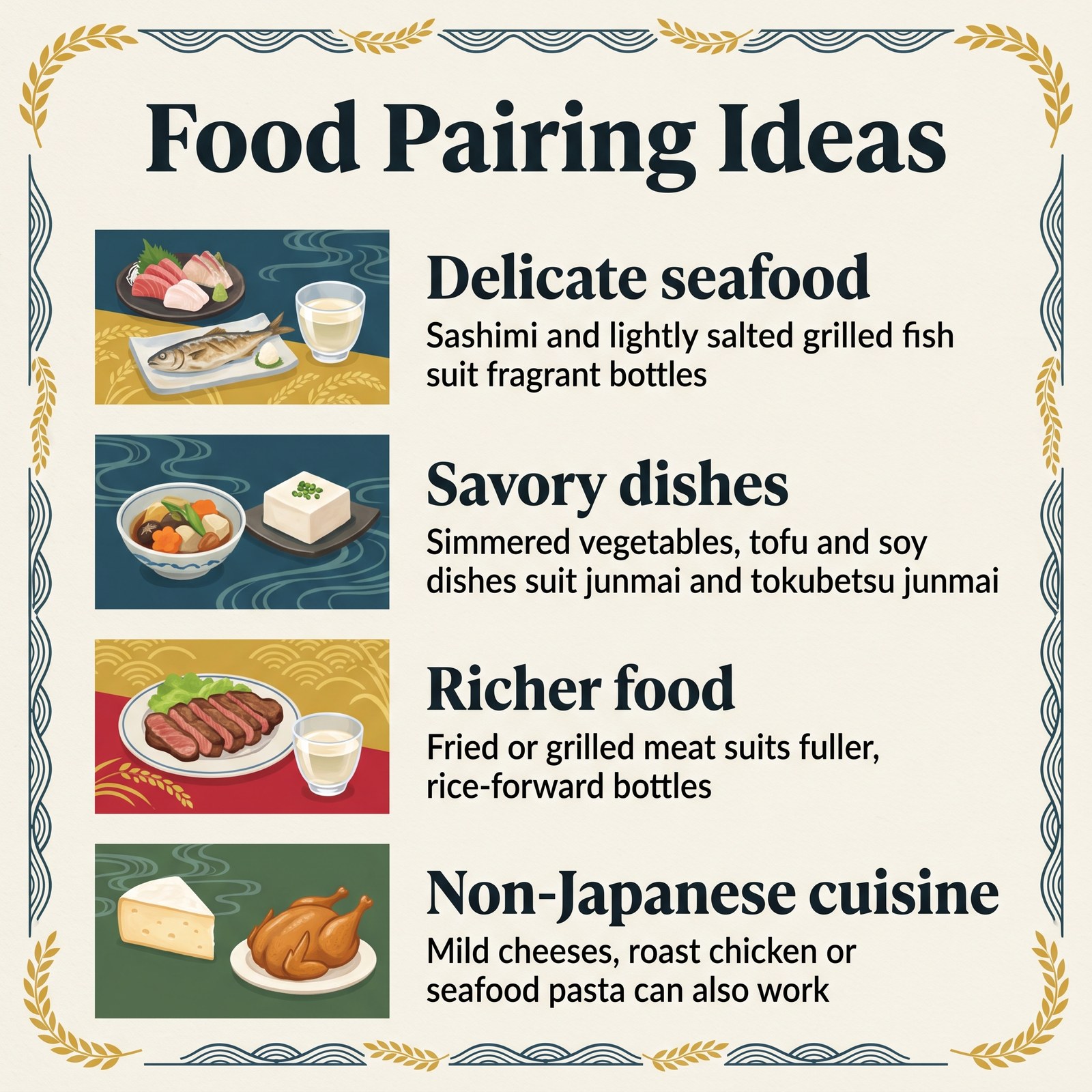
The brewery does not publish an official pairing chart, so treat these as general suggestions. A balanced sake tends to work with food because no single trait overwhelms the dish. Generally, matching weight and intensity is a good place to start.
- Delicate seafood. Sashimi and lightly salted grilled fish suit the more fragrant junmai ginjo and junmai daiginjo bottlings.
- Savory dishes. Simmered vegetables, tofu, and soy-based dishes often pair well with junmai and tokubetsu junmai.
- Richer food. Fried or grilled meat can stand up to fuller, rice-forward bottles.
- Non-Japanese cuisine. Mild cheeses, roast chicken, or seafood pasta can also work with a balanced sake.
In Kashima itself, it is natural to try it with local food, including seafood from the Ariake Sea. For more ideas, see our full guide to sake and food pairing.
Serving Nabeshima: Temperature and Glassware
To begin with, there is no single correct way to serve Nabeshima. As a general rule, many drinkers chill fragrant ginjo-style sake, which keeps the aroma lively. Fuller junmai styles, on the other hand, can open up at cool room temperature or even when gently warmed.
Glass shape matters as well. A wider glass, even a wine glass, lets you notice the aroma more easily. A small ceramic cup, by contrast, feels more traditional and focuses attention on the taste. Our guide to sake glasses and cups covers the options. Whatever you choose, check the bottle’s own advice first, especially for unpasteurized namazake.
How to Choose a Nabeshima Sake
With so many bottles, it helps to start from what you want, not from the price. These approaches can make the choice easier.
For a fragrant style
Look at junmai ginjo or junmai daiginjo, and serve it chilled.
For a rice-focused taste
Try a tokubetsu junmai or junmai, such as one of the Classic bottlings.
For a hot day
Look for Summer Moon, a seasonal ginjo, and serve it well chilled.
For a fresh, lively taste
Try a nama (unpasteurized) bottling, such as New Moon, and keep it refrigerated.
A Path Through the Range
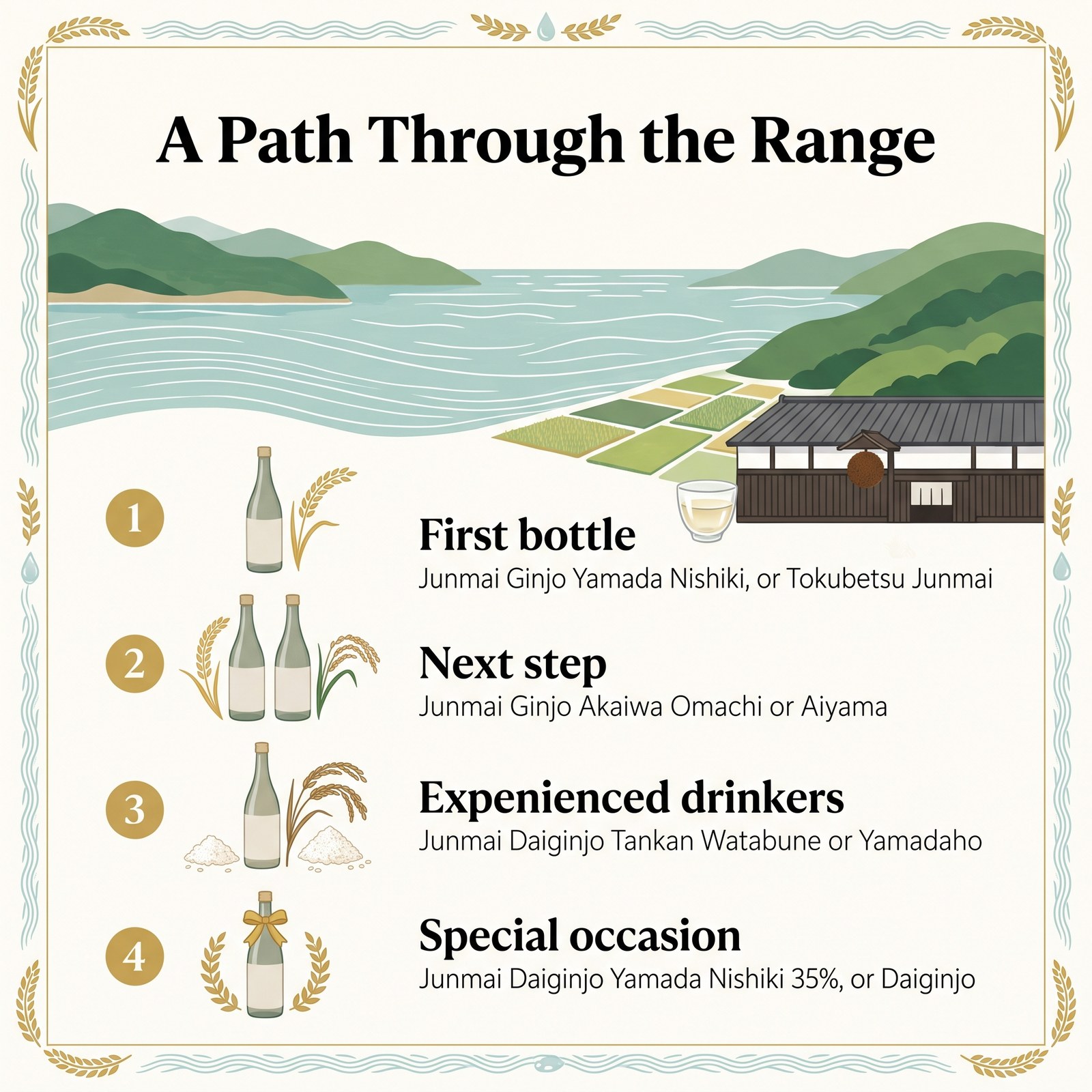
Still, many readers simply want a starting point. Here is one way to plan a path through the range.
| Your level | Bottles to look for | Why |
|---|---|---|
| First bottle | Junmai Ginjo Yamada Nishiki, or Tokubetsu Junmai | Core bottlings, moderately priced, and relatively easy to find |
| Next step | Junmai Ginjo Akaiwa Omachi or Aiyama | Same category, different rice, so you can compare directly |
| Experienced drinkers | Junmai Daiginjo Tankan Watabune or Yamadaho | Older rice varieties in limited bottlings |
| Special occasion | Junmai Daiginjo Yamada Nishiki 35%, or Daiginjo | Top grades, and the daiginjo category won the 2011 award |
Can you still buy the exact 2011 winner? Not really, because it was a 2010 vintage. The current Daiginjo carries the same name. Even so, each year’s sake is a new batch.
Whichever you pick, read the label closely, because the details count. The category, rice variety, and polishing ratio tell you far more than the brand name alone. Our guide on how to read a Japanese sake label walks through each term.
Also note that “premium” is a marketing word, not an official category. Japan’s labeling rules instead define terms such as junmai ginjo and daiginjo. Once opened, keep the bottle in the fridge, and see our guide on how to store sake for details.
Reading a Nabeshima Label, Step by Step
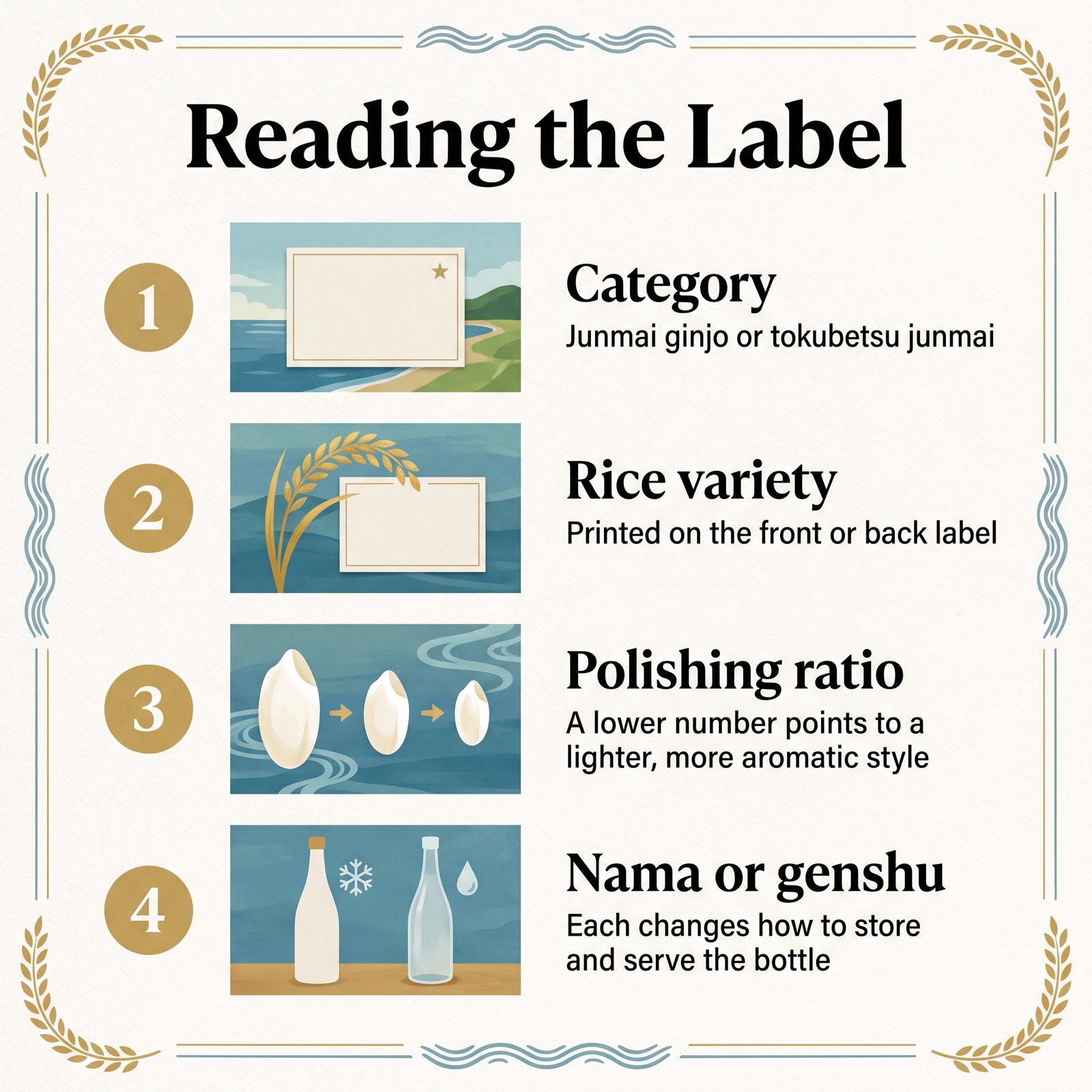
First, find the category, such as junmai ginjo or tokubetsu junmai. That single term tells you whether brewer’s alcohol was added and roughly how much the rice was polished. Next, look for the rice variety, which Nabeshima usually prints clearly on the front or back label.
After that, check the polishing ratio. A figure like 35% means only about a third of each grain remains after milling. In general, lower numbers point toward a lighter, more aromatic style, although the brewer’s choices still matter. Finally, look for words such as nama (unpasteurized) or genshu (undiluted). Each one changes how you should store and serve the bottle.
If you want to go further, our guides to namazake and genshu explain both terms. Likewise, the rice polishing guide covers what those percentages really mean.
How Much Does Nabeshima Cost?
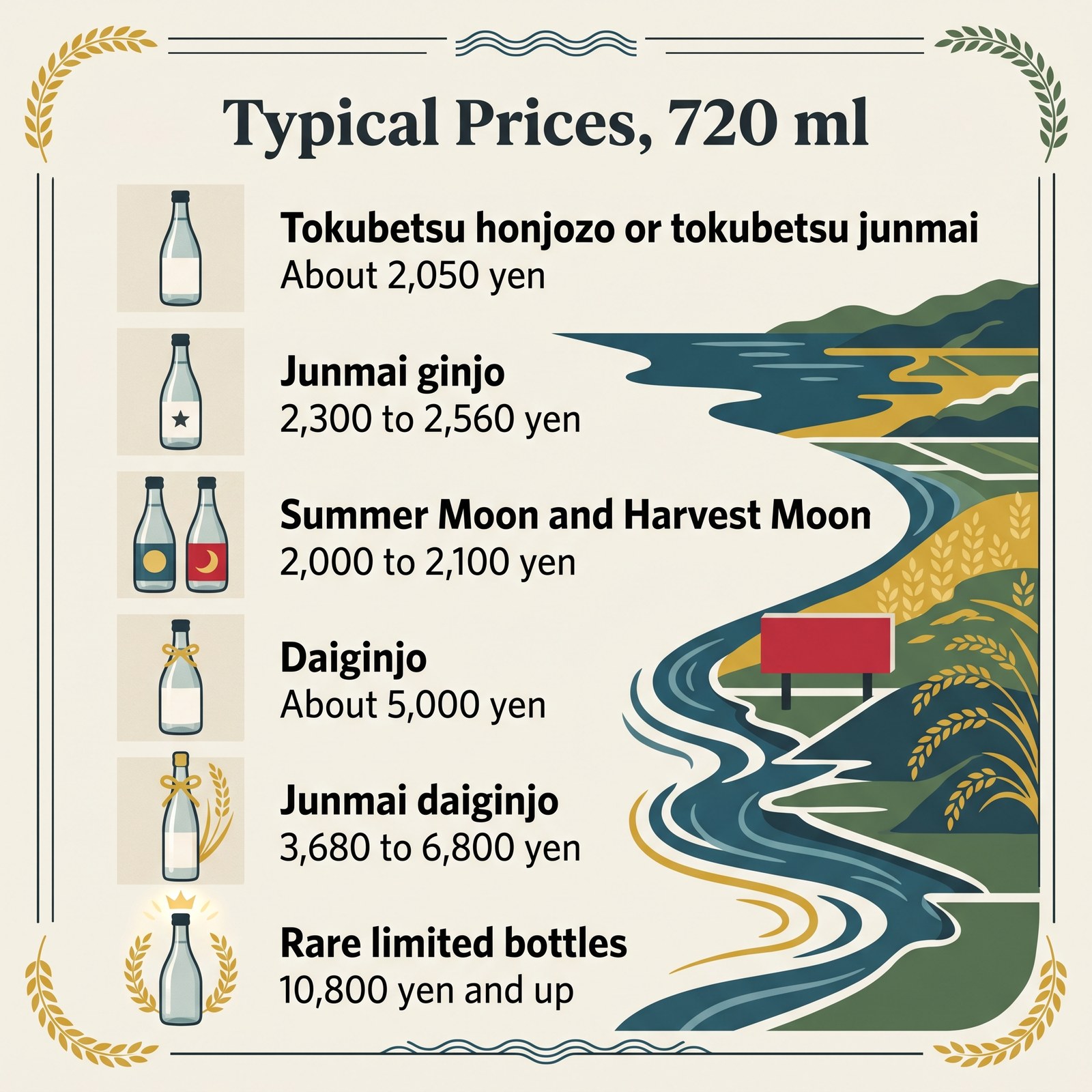
In Japan, most Nabeshima bottles cost roughly ¥2,000 to ¥7,000 for a 720 ml bottle. However, limited releases can cost far more. Below, the table shows typical prices at two Japanese specialty sake shops, checked in October 2026, including tax.
| Category | 720 ml (approx.) | 1.8 L (approx.) |
|---|---|---|
| Tokubetsu honjozo / tokubetsu junmai | About ¥2,050 (Yokawa Yamada Nishiki) | ¥2,980 to ¥3,980 |
| Junmai ginjo, incl. New Moon and Blossoms Moon | ¥2,300 to ¥2,560 | ¥4,300 to ¥4,770 |
| Summer Moon (ginjo) and Harvest Moon (junmai) | ¥2,000 to ¥2,100 | ¥3,950 to ¥4,200 |
| Daiginjo | About ¥5,000 | About ¥10,000 |
| Junmai daiginjo | ¥3,680 to ¥6,800 | ¥6,820 to ¥12,650 |
| Rare limited bottles | ¥10,800 and up | Varies |
Of course, prices change, and some shops stock certain bottles only in the 1.8 L size. Outside Japan, meanwhile, expect to pay much more once import costs and taxes are added. In October 2026, for example, one US shop listed the junmai ginjo at $30, and another listed an Aiyama junmai daiginjo at $79.
Where Can You Buy Nabeshima?
In Japan, Nabeshima is typically sold through authorized specialty sake shops, often called tokuyakuten (特約店). Many of these shops also sell online within Japan, which helps if you live there. Department stores and restaurants may also carry it, but supply is uneven.
Why Can It Be Hard to Find?
Several things play a part, in fact. First, seasonal and single-rice bottlings are released in limited amounts, and popular ones sell out quickly. In addition, sales through selected retailers mean you will not find every bottle everywhere. Even back in 2011, a regional news report noted that the brewery had only a few bottles left after the award.
Buying Outside Japan
Some Nabeshima bottles do reach overseas markets. In October 2026, we found them at specialty sake shops in the United States, and Norway’s state retailer also lists a Nabeshima ginjo. However, we found no official export list from the brewery, and the range abroad is much smaller than in Japan. Therefore, your best bet is a dedicated sake shop or a Japanese restaurant with a serious sake list.
Nabeshima vs Dassai: What’s the Difference?
Both brands are frequently named among Japan’s best-known modern sake. Yet they follow very different paths, as the comparison shows.
| Aspect | Nabeshima | Dassai |
|---|---|---|
| Region | Kashima, Saga (Kyushu) | Iwakuni, Yamaguchi (western Honshu) |
| Brand launched | 1998 | 1990 |
| Range | Many categories, from junmai daiginjo to tokubetsu honjozo | Core range is junmai daiginjo only |
| Rice | At least eight varieties | Yamada Nishiki |
| Scale and exports | Family brewery; limited overseas presence | Large producer; sold in over 30 countries and regions |
| Stated style | Balance, with no single trait dominating | Fruity, fragrant, and smooth, per the producer |
Ultimately, neither is “better.” Dassai offers a focused, widely available style. Nabeshima, by contrast, rewards drinkers who enjoy comparing rice and categories. For the full story, read our guide to Dassai sake.
Common Misconceptions About Nabeshima
Naturally, a famous award attracts a few myths. Here are the ones worth clearing up.
Myth: A junmai ginjo won the 2011 Champion Sake.
Fact: The winner was Nabeshima Daiginjo, 2010 vintage.
Myth: Nabeshima is a type of sake.
Fact: It is a brand made by one brewery, Fukuchiyo Shuzo.
Myth: Every Nabeshima tastes the same.
Fact: The range covers many categories and at least eight rice varieties.
Myth: A fruity aroma means fruit was added.
Fact: Those notes come from yeast and fermentation.
Myth: Junmai daiginjo is always better than junmai ginjo.
Fact: The categories describe production, not quality or personal taste.
Myth: Nabeshima represents all Saga sake.
Fact: Saga’s breweries each follow their own style.
Visiting Kashima for Sake
For travelers, Kashima offers something a bottle cannot. Along the Hamamachi streets, old storehouses and merchant houses still line the road, and several breweries sit within walking distance. As a result, the town feels less like a museum and more like a working brewing district.
The spring Sakagura Tourism event is the easiest time to visit, because breweries open their doors together. At other times, however, access varies by brewery, and some may not offer tours at all. So check each brewery’s own site before you go. Nearby Ureshino, known for its hot springs and tea, also has breweries, which makes a two-town trip quite practical.
Above all, drink responsibly and plan your transport in advance. Rural Saga, after all, is easier with trains or a designated driver. If you are new to drinking etiquette in Japan, our guide on how to drink sake in Japan is a helpful start.
What Makes Nabeshima Different?
Of course, many Japanese sake brands have long histories, and many have won medals. Nabeshima stands out for a particular combination. It is a young brand, launched in 1998, from a family brewery inside a protected brewing town. Within roughly thirteen years of the launch, one Nabeshima bottling won the IWC Champion Sake title.
Just as important, it offers a wide range built on many rice varieties, under a philosophy of balance rather than extremes. That mix of place, ambition, and range is what makes it worth exploring. Compare it with the food-friendly ginjo style of Isojiman or the snow-country style of Hakkaisan, and the contrast becomes clear.
Final Thoughts
In the end, the story of Nabeshima sake runs from Kashima’s old brewing streets to a family brewery’s fresh start in 1998, and then to London in 2011. Clearly, the award opened doors. Still, the brand’s real interest lies in what came after: steady medals, a wide range, and a clear aim for balance.
If possible, taste it in Saga, perhaps during the spring brewery festival in Kashima. Otherwise, pick two bottles with different rice and compare them at home. Either way, you will taste why this Kyushu label earned its place on the world stage.
Frequently Asked Questions About Nabeshima Sake
The Brand and the Award
- What is Nabeshima sake?
-
Nabeshima is a sake brand from Fukuchiyo Shuzo in Kashima, Saga Prefecture. The brewery launched it in 1998. It covers many styles and rice varieties rather than one single sake.
- Which Nabeshima sake won the International Wine Challenge?
-
Nabeshima Daiginjo, 2010 vintage, won Champion Sake at the IWC in 2011. It also won the Ginjo-Daiginjo Trophy that year. The award applied to that bottling, not to the whole range.
- Is Nabeshima named after the Saga lords?
-
The name recalls the Nabeshima family, who ruled the Saga domain in the Edo period. However, we found no official account of how the brewery chose it. Claims about a naming contest or family permission remain unconfirmed.
Taste and Drinking
- Is Nabeshima sweet or dry?
-
It depends on the bottle. The brewery aims for balance, so few products sit at either extreme. Check the specific bottle’s label, and if possible compare two styles.
- Is Nabeshima good for beginners?
-
Yes, a balanced junmai ginjo is an easy place to start. Serve it chilled in a wine glass to notice the aroma. Then try a junmai or tokubetsu junmai to see how the style changes.
- Does every Nabeshima use the same rice?
-
No, the lineup names at least eight varieties. Yamada Nishiki appears most often across the range, with Akaiwa Omachi and Aiyama also common. The rice appears on each bottle’s label.
Visiting and Buying
- Can you visit Kashima’s breweries?
-
Yes, especially during Kashima Sakagura Tourism, a joint open-brewery event usually held in spring. A 2027 edition has been announced. Check the official event site for dates before you travel.
- What should I check before buying a bottle?
-
Look at the category, rice variety, and polishing ratio on the label. Also check whether it is namazake, which needs refrigeration. These details tell you more than the brand name or the award history.
- How much does Nabeshima cost?
-
In Japanese specialty shops, most 720 ml bottles cost about ¥2,000 to ¥7,000, as of October 2026. Limited releases can cost much more. Abroad, prices are higher because of import costs and taxes.
- Why is Nabeshima hard to find?
-
Many bottlings are seasonal or limited, and popular ones sell out fast. The brand is also sold mainly through selected specialty retailers. As a result, availability varies by shop and by season.
- Is Nabeshima available in the United States?
-
Yes, some bottles appear at US specialty sake shops, though the selection is small. We found no official export list from the brewery. Ask a dedicated sake retailer what they can source.
References
Official, Government, and Retail Sources
- International Wine Challenge – Trophy Results 2011 (Accessed October 2026)
- Fukuchiyo Shuzo – Nabeshima Official Website (Accessed October 2026)
- National Tax Agency Japan – Overview of Labeling Standards for Sake Production Methods and Quality (Accessed October 2026)
- Fukuchiyo Shuzo – Nabeshima Product Lineup (Accessed October 2026)
- Agency for Cultural Affairs, Cultural Heritage Online – Kashima City Hamanakamachi Hachihongi-shuku (Accessed October 2026)
- Fukuchiyo Shuzo – Sake Nabeshima Story (Accessed October 2026)
- Agency for Cultural Affairs – Preservation District Profile: Kashima City Hamanakamachi Hachihongi-shuku (Accessed October 2026)
- Fukuchiyo Shuzo – Brewing Philosophy (Accessed October 2026)
- Kashima Sakagura Tourism – Official Event Website (Accessed October 2026)
- Fukuchiyo Shuzo – Awards History (Accessed October 2026)
- Nabeshima Auberge – About Sake Nabeshima (Accessed October 2026)
- Tajimaya Saketen – Nabeshima Product and Price List (Accessed October 2026)
- Urano Saketen – Nabeshima Junmai Ginjo Yamada Nishiki 720ml (Accessed October 2026)
- Umami Mart – Nabeshima Junmai Ginjo Sake 720ml (Accessed October 2026)
- Palate Project – Fukuchiyo Brewing Company Collection (Accessed October 2026)
- Vinmonopolet – Nabeshima Ginjo (Accessed October 2026)
- Fukuoka Now – Saga Sake Wins International Awards (Accessed October 2026)
Research Sources
- National Agriculture and Food Research Organization (NARO) – Mean Temperature During Mid-Ripening Affects the Protein Composition of Sake Rice Yamada Nishiki, 2012 Research Results (Accessed October 2026)
Related Articles
- Saga sake (佐賀の酒) (Surveyed: October 2026)
- Daiginjo (大吟醸) (Surveyed: October 2026)
- Junmai Ginjo (純米吟醸) (Surveyed: October 2026)
- Junmai Daiginjo (純米大吟醸) (Surveyed: October 2026)
- Rice Polishing (精米歩合) (Surveyed: October 2026)
- Isojiman Sake: Shizuoka’s Pursuit of Premium Japanese Sake (Surveyed: October 2026)
- Kokuryu Sake: The Fukui Brewery That Helped Pioneer Premium Daiginjo (Surveyed: October 2026)
- Fukuoka Sake (福岡の酒) (Surveyed: October 2026)






Comments