


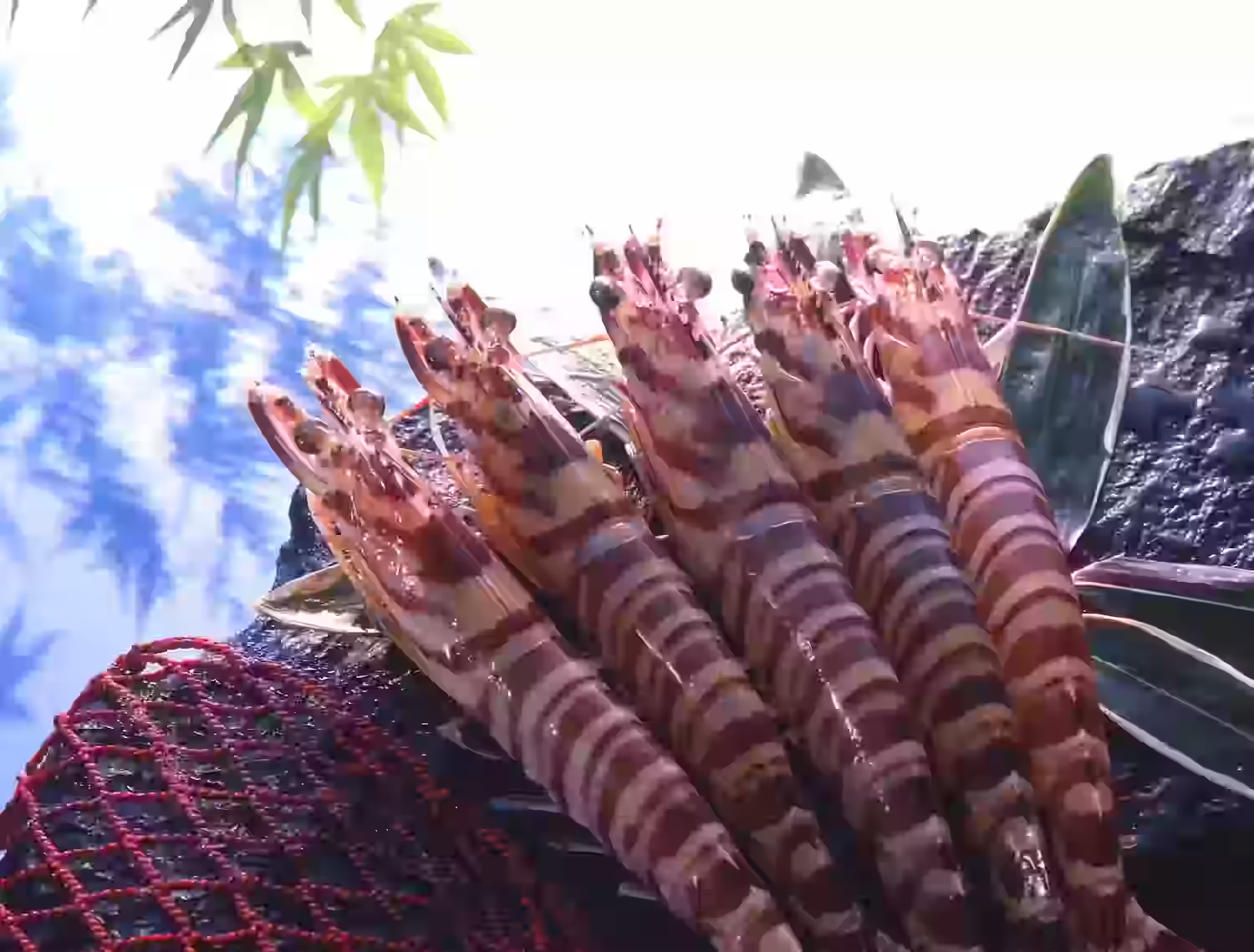

Open a box of live Himeshima kuruma prawns, and the sawdust inside may suddenly move. The striped prawns come from a small island off Oita Prefecture, on the island of Kyushu. There, land once used for salt making gave way to seawater ponds when the local salt industry ended.
Sweet, firm, and prized both raw and cooked, Himeshima Kuruma Prawn (姫島車えび) is now one of the island’s most valuable products. This guide explains how it differs from black tiger shrimp, when to eat it, and which products suit sashimi. It also covers how to visit Himeshima or order the prawns within Japan.
What Is Himeshima Kuruma Prawn?
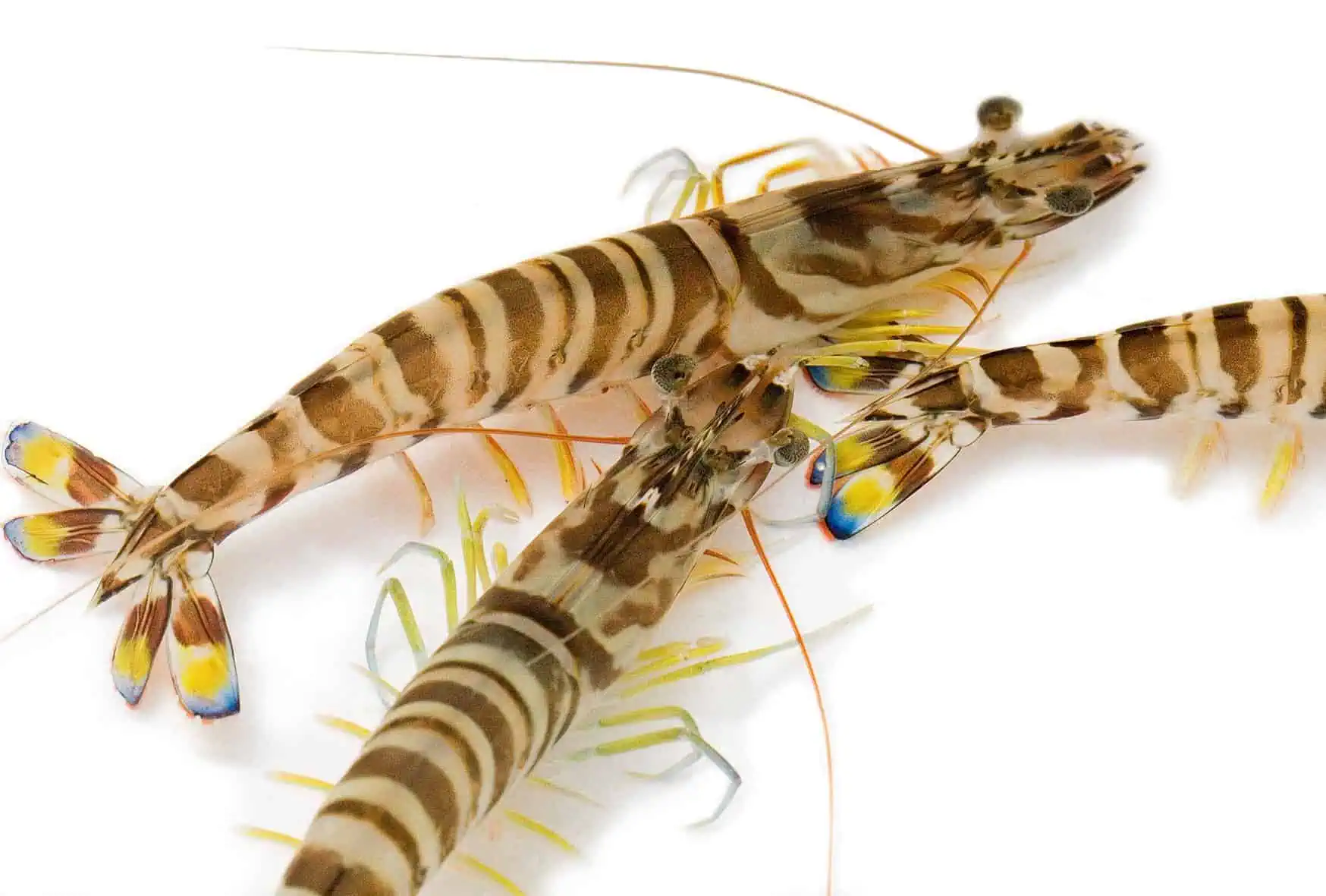
Himeshima Kuruma Prawn is the regional name for kuruma prawns from Himeshima, a one-island village in Oita Prefecture. Most are farm-raised in large seawater ponds on the island, especially by Himeshima Kuruma Ebi Yoshoku Co., Ltd. The village’s own food page also counts wild kuruma prawns caught off Himeshima under the same name.
Quick Facts: Himeshima Kuruma Prawn
- Japanese name
- 姫島車えび (Himeshima kuruma ebi)
- Species
- Kuruma prawn, Marsupenaeus japonicus (also listed as Penaeus japonicus)
- Where
- Himeshima Village, Oita Prefecture, Kyushu
- Main producer
- Himeshima Kuruma Ebi Yoshoku Co., Ltd., founded in 1965
- Taste
- Gently sweet and clean, with firm, springy flesh
- Local season
- July to October; live prawns sold mainly October to December
- Popular dishes
- Odori-gui (raw), shabu-shabu, salt-grilled, tempura, ebi fry
- Eating raw
- Only products the seller supplies for raw consumption
- Where to try it
- On the island, at the late-October festival, or by mail order within Japan
English and Japanese Names
English names vary, such as kuruma prawn, kuruma shrimp, and Japanese tiger prawn. Despite the similar names, Japanese tiger prawn and black tiger shrimp are different species. Japan’s official food composition table lists this one as Marsupenaeus japonicus. Some international databases, though, now file it under Penaeus.
On Japanese menus, then, look for 車えび or 車海老. Both read kuruma ebi, so either spelling points to the same prawn.
Kuruma Prawn vs Black Tiger Shrimp
Both prawns have striped shells, which explains the mix-up. Still, the table shows how differently Japan names and treats them.
| Point | Kuruma prawn | Black tiger shrimp |
|---|---|---|
| Scientific name | Marsupenaeus japonicus | Penaeus monodon |
| Japanese name | 車えび (kuruma ebi) | ウシエビ (ushi-ebi), sold as “black tiger” |
| Japanese farming in a 2005 review | Nearly all marine shrimp farming in Japan | Not a major farmed species in Japan |
| Menu wording | 車えび / 車海老 | ブラックタイガー |
Still, that 2005 review in Fish Pathology described the industry at the time, not today’s menus. So check the wording on a menu or package rather than guessing the species.
What Makes Himeshima Kuruma Prawn Special?

Three things stand out about Himeshima kuruma prawns. They grow on former salt-field land, they move quickly from pond to box, and the island has farmed them for over sixty years. The producer ships live prawns the same day it packs them. It also offers frozen products for raw or cooked use.
They are still the same species as other kuruma prawns. The difference lies in how the island raises, handles, and ships them.
What Does Himeshima Kuruma Prawn Taste Like?
Himeshima kuruma prawn tastes gently sweet and clean, with firm, springy flesh. Raw prawn looks translucent and feels slightly sticky, while cooking makes it denser and more savory. Of course, the exact taste shifts with freshness, season, size, and cooking method.
Sweetness and the Seasons
Oita Prefecture also describes fresh kuruma prawns as very sweet and springy. Where does that sweetness come from? A 1972 Kinki University study measured amino acids in shrimp muscle. Glycine came out as the most abundant one, which matters because it tastes clean and sweet.
The same researchers saw glycine in kuruma prawns rise in winter and drop during the summer spawning period. Their samples did not come from Himeshima, though, so read this as background rather than proof.
Texture, Raw and Cooked
Heat changes the prawn quickly. The gray, striped shell turns bright red, and the meat becomes whiter and more savory. Which version is better? Honestly, it depends on the eater. Many Japanese diners rank raw kuruma prawn first, while others prefer the aroma of a light grill.
The Head and Shell
The head, though, carries the strongest shellfish flavor. Inside sits ebi miso, a rich, soft paste made of the prawn’s internal organs. The producer leaves heads on its frozen ebi fry and says the fried head turns crunchy. Not everyone wants to bite into a prawn head, and that hesitation is normal. So try a small piece first.
When Is Himeshima Kuruma Prawn in Season?
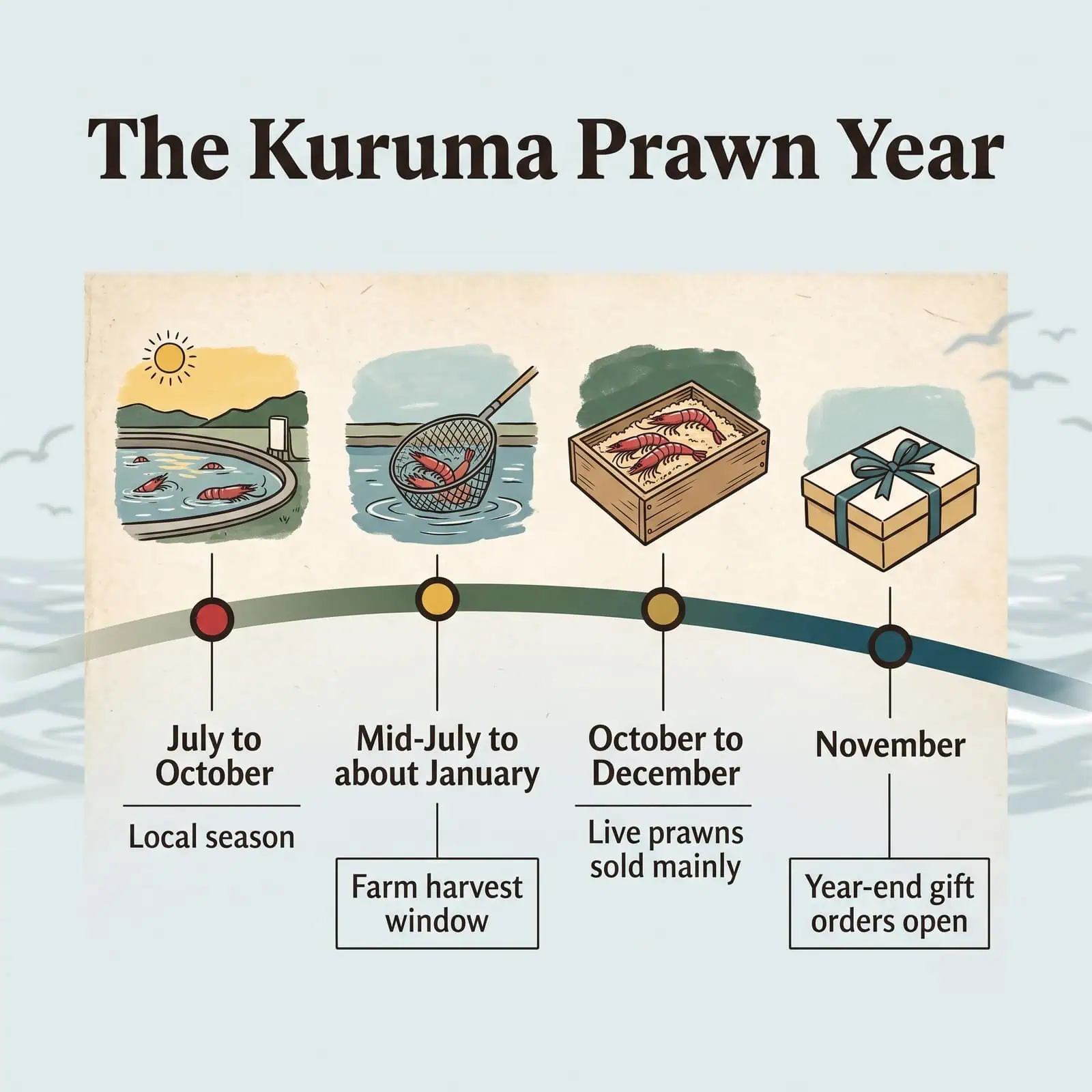
The simplest answer is that July to October is the locally listed season. The farm harvests from mid-July to around January, while live gift prawns sell mainly from October through December. Frozen products are generally available year-round, according to the producer, although stock varies.
| What it measures | Period | Source |
|---|---|---|
| Local season for Himeshima kuruma ebi | July to October | Oita Prefecture, eastern region food list |
| Season for Oita kuruma prawns in general | July to December | Oita Prefecture specialty overview (2012) |
| Farm harvest window | Mid-July to about January | Producer’s farming cycle |
| Live prawns sold on the island | October to late December | Himeshima Village souvenir page |
| Live shipping start in 2026 | October 13, 2026 | Producer’s online shop notice |
Late autumn is also gift season in Japan. Prawns are a classic part of osechi ryori, the New Year feast. For this reason, the producer opens year-end gift orders each November.
How to Eat Himeshima Kuruma Prawn
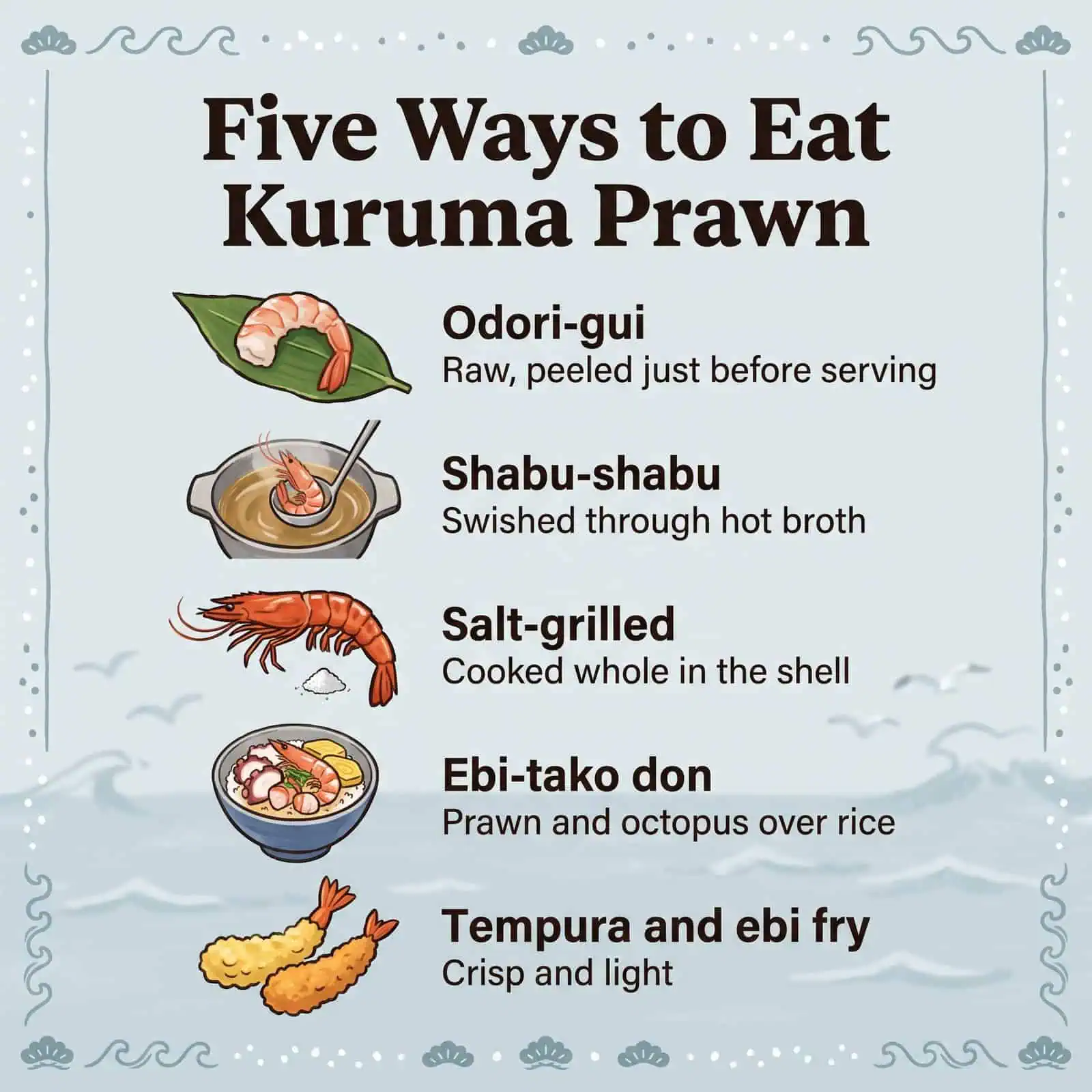
Oita Prefecture lists odori-gui, tempura, salt-grilling, and sake-steaming as classic kuruma prawn dishes. On Himeshima, shabu-shabu and a local rice bowl also stand out.
Odori-gui and Sashimi
Odori-gui literally means “dancing eating.” The name comes from the movement of a live prawn that the cook peels just before serving. For a gentler start, ask instead for plain prawn sashimi. At sushi counters in the Edomae style, chefs also serve kuruma prawn boiled as nigiri.
Shabu-Shabu
Himeshima Village also promotes prawn shabu-shabu as a newer local favorite. You swish each peeled prawn through hot broth until it reaches the doneness that suits the product. Prawns labeled 加熱用, meaning for cooking, need full cooking rather than a raw center.
Salt-Grilled, Sake-Steamed and Fried
Shioyaki, or salt-grilling, cooks the prawn whole in its shell until it browns. The shell traps moisture and also adds a toasty aroma, while sake-steaming keeps the flavor soft and clean. For something crisp, try a light tempura batter, or ebi fry with its breadcrumb coat.
Ebi-Tako Don, an Island Bowl
The village also lists a dish you are unlikely to see elsewhere. Ebi-tako don combines chunks of kuruma prawn and octopus, simmered in dashi and bound with egg over rice. The prawn brings sweetness, while the octopus adds chew.
On the New Year Table
A cooked prawn’s curved back suggests old age in Japan, so the prawn stands for a long life. That is why it appears in osechi boxes and among other Japanese New Year foods.
Is It Safe to Eat Kuruma Prawn Raw?
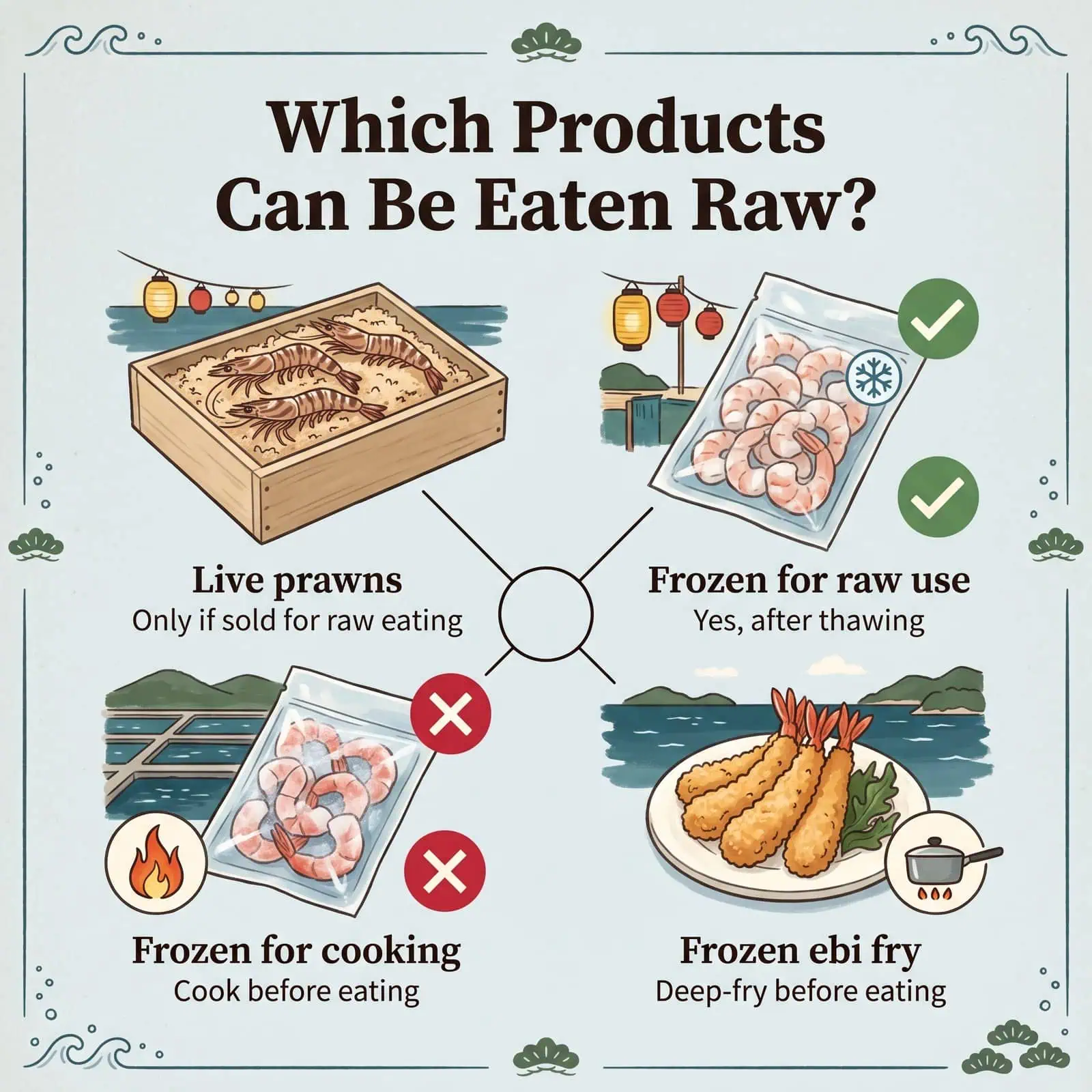
It can be, but only with the right product. Eat kuruma prawn raw when the seller explicitly supplies it for raw consumption and gives raw-use handling instructions. Being alive, after all, does not replace that safety designation.
Which Products Can Be Eaten Raw?
The producer sells several products, and each carries its own instructions. Here, “sashimi-grade” simply describes a product sold for raw eating. In other words, it is not a universal legal grade.
| Product | How the producer prepares it | Raw use |
|---|---|---|
| Live farmed prawns | Chilled to calm them, packed in sawdust, shipped the same day | Only when the seller supplies them for raw eating |
| Frozen for raw use (生食用凍眠凍結) | Killed fresh, vacuum-packed, quick-frozen in a −30°C alcohol bath | Yes, labeled for raw eating after thawing |
| Frozen for cooking (加熱用) | Killed in ice water, vacuum-packed, then frozen | No, cook before eating |
| Frozen ebi fry | Breaded with the head on, then frozen | No, deep-fry |
| Frozen peeled prawns | Peeled, vacuum-packed, then frozen | No, cook before eating |
The raw-use frozen line dates to fiscal 2012, when the farm installed an alcohol-bath freezer. The village fisheries plan says it keeps freshness close to that of live prawns, so it sells well.
Who Should Choose Cooked Prawns
- People at higher risk from foodborne illness should choose fully cooked prawns. That includes pregnant people, young children, older adults, and anyone with weakened immunity.
- Follow any medical or public-health guidance that applies to you.
- Prawns are a common shellfish allergen, so ask about ingredients whenever allergies apply.
- Japan sets microbial standards for seafood sold for raw eating, so the label carries real meaning.
How to Store and Thaw Himeshima Kuruma Prawns
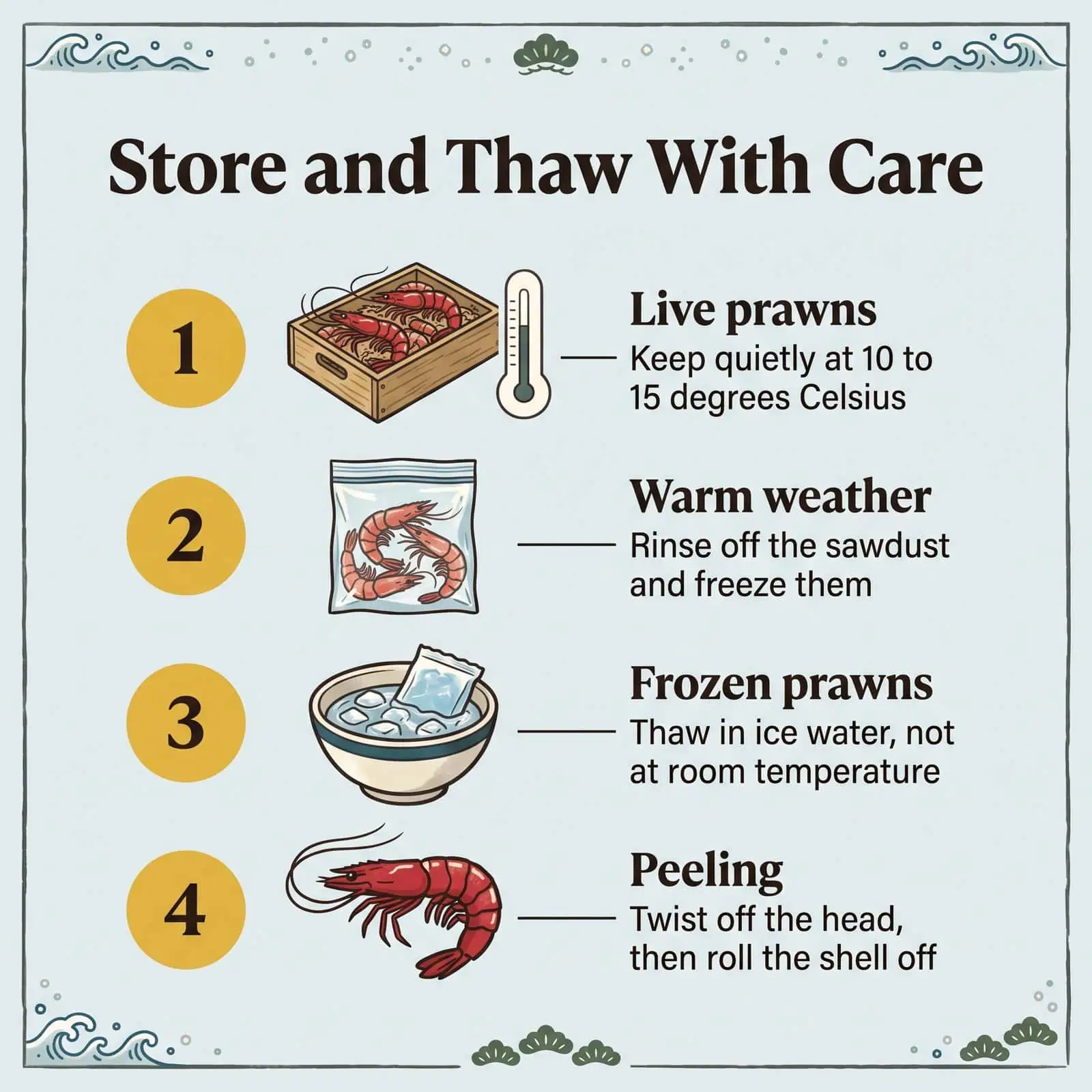
Storage depends on the product, so start with the instructions that arrive in the box. Do not treat “alive,” “fresh,” and “approved for raw consumption” as the same thing.
Live Prawns
Temperature matters most, because live prawns need cool but not cold air. The producer recommends keeping them quietly at 10 to 15°C. At that temperature they survive several days, although a few die each day. A refrigerator is too cold for them, so in winter an unheated room works better.
In warm weather, the producer suggests freezing them promptly instead. Rinse off the sawdust first, then wrap them or seal them in freezer bags. The producer also notes that a few prawns may not arrive alive.
Frozen Prawns
First, thaw frozen prawns in ice water, or under running water if you are short on time. Avoid thawing at room temperature, because the producer says the shells can turn black.
The producer does not publish a general time limit for eating the raw-use frozen product after thawing. So follow the instructions and dates supplied with your package, and thaw only what you plan to eat right away. Also, do not apply the FAQ’s “about ten days” to prawns that are already thawed, since it refers to home-frozen live prawns.
What about live prawns you froze at home? Here the producer’s guidance varies, so read your package first. Its FAQ says you may still eat home-frozen live prawns raw if you thaw them within about ten days of freezing. However, a hometown tax gift listing says to cook home-frozen prawns after thawing. Because the guidance conflicts, cooking is the safer choice unless your product’s instructions explicitly approve raw use.
Peeling and Deveining
Peeling takes less effort than you might expect. Following the producer’s method, twist off the head first, and the dark vein usually comes out with it. Then remove the legs and roll the shell off from the belly side.
Where to Eat and Buy Himeshima Kuruma Prawns
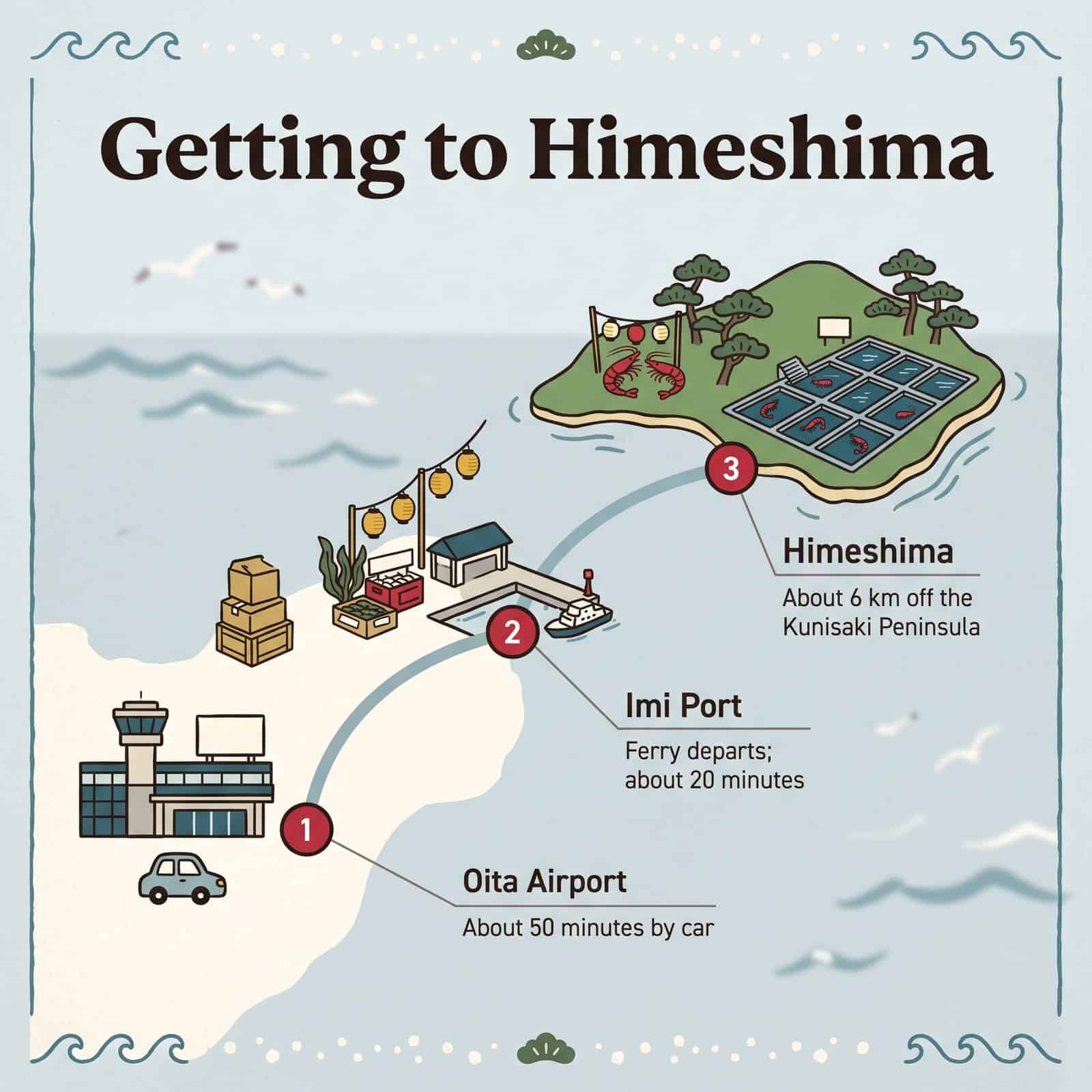
Getting to Himeshima
Himeshima sits about 6 km off the Kunisaki Peninsula, at the western end of the Seto Inland Sea. Ferries leave from Imi Port and take about 20 minutes. To reach Imi Port, allow about 50 minutes by car from Oita Airport. From Usa Station, the drive takes about an hour.
The village timetable lists 12 sailings a day each way, though one runs only outside winter. Check the day’s ferry status before you travel, especially in rough weather.
Eating on the Island and at the Festival
Tasting the prawns on Himeshima itself is still the most rewarding option. The village website also lists island restaurants and inns. Menus, prices, and opening days change, so call ahead before you plan a meal around prawns.
Better still, time a visit for the Himeshima Kuruma Ebi Festival. The village holds it in late October at the ferry plaza by Himeshima Port. Visitors buy prawn bento with sashimi, fry, and simmered prawns, then enter a seafood prize draw. Afterward, local dancers perform the island’s fox dance and Aya dance.
2026 Festival Note
A third-party event listing shows the 23rd festival on Sunday, October 18, 2026, from 9:00 to 14:00. It also says bento sell first-come, first-served. Because this is not the village’s own notice, confirm the details on the Himeshima Village official site before you travel.
Pair It with Other Oita Seafood
A trip to Himeshima fits easily into a wider seafood route through Oita. During summer, try Sekiaji, the hook-and-line horse mackerel from Saganoseki. Hiji, a town on Beppu Bay, also offers Shiroshita Karei. Local sources tie this flounder to freshwater springs below its castle ruins. Hiji also lies between Oita Airport and Beppu, so it makes an easy stop on the way back from Himeshima.
Buying in Japan
The village souvenir page lists the following prices. It was last updated on July 23, 2025. We checked it in October 2026, so confirm current prices with the seller.
- Live prawns, 300 g (6 to 15 prawns): from ¥4,500
- Vacuum-packed frozen prawns, 200 g: from ¥1,400
- Vacuum-packed prawns for raw use, 200 g: from ¥1,500
- Frozen ebi fry, 190 to 210 g: ¥1,400
Six to 15 prawns in 300 g works out to roughly 20 to 50 g per prawn. Buyers cannot choose the count, since the producer packs by weight. As a rough guide, larger prawns make a showier salt-grill, while smaller ones fry quickly as tempura.
Box Sizes and Edible Yield
A 300 g box contains 6 to 15 whole prawns. Japan’s food composition database lists a standard 55% waste rate for whole farmed kuruma prawns. On that basis, the box works out to roughly 135 g of edible flesh. Actual yield still varies with prawn size and whether you use the head and shell.
Inside Japan, you can also order from the producer’s online shop, which is in Japanese only. Live prawns ship separately from frozen goods, and couriers cannot reach some regions. Because every parcel leaves the island by ferry, rough weather can also delay shipping. The village also offers the prawns as hometown tax (furusato nozei) gifts.
Ordering from Overseas
The producer’s materials do not mention international shipping, and seafood import rules differ by country. So the realistic plan is to enjoy them in Japan. That could mean the island itself, or delivery to a hotel or a friend.
Editorial note: We checked this guide in October 2026 against village, prefectural, producer, and national government sources. Prices, shipping areas, and festival details can change, so confirm them with the official source before ordering or traveling.
From Salt Fields to Prawn Ponds
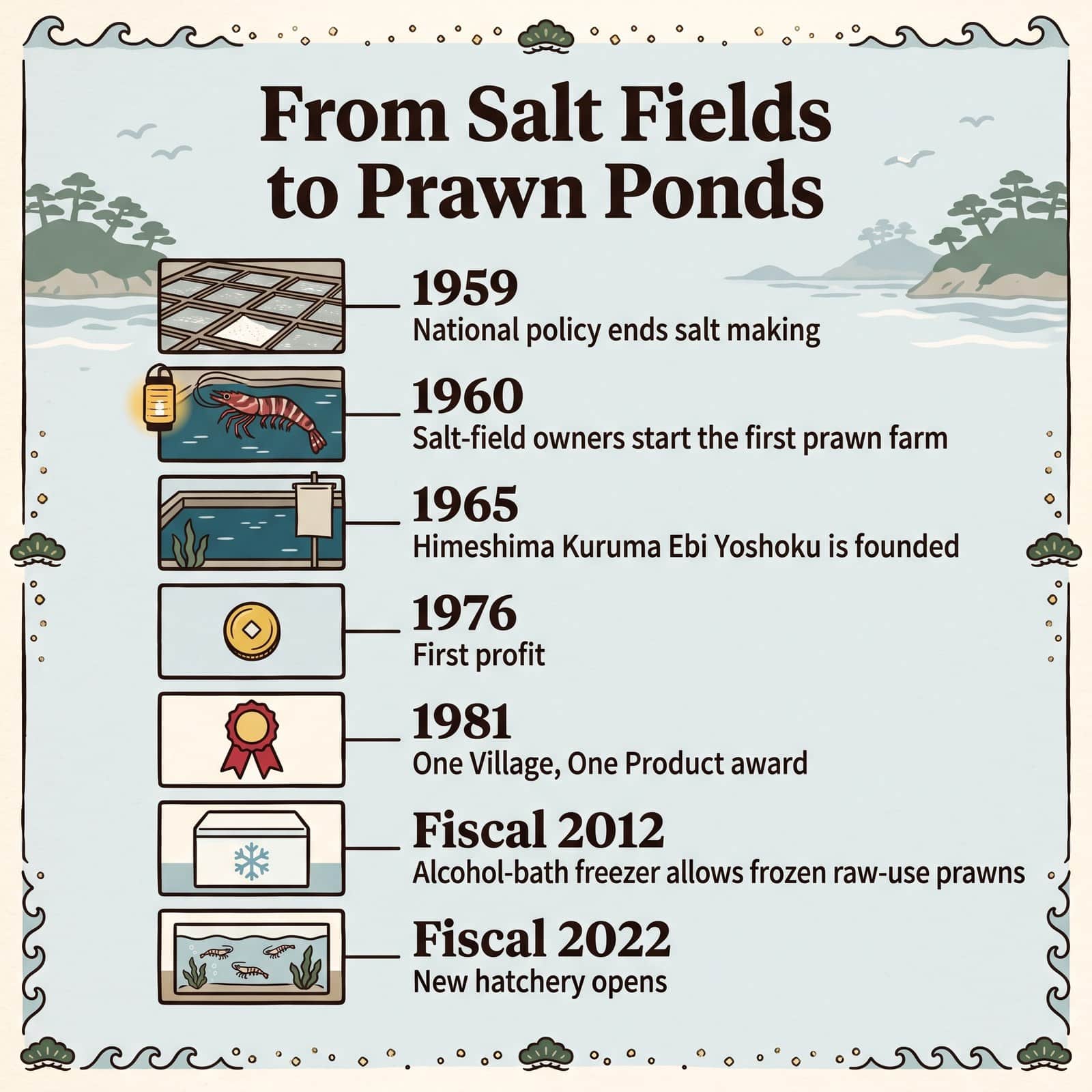
Himeshima turned to prawn farming once national policy ended its centuries-old salt industry in 1959. The industry grew from efforts to reuse former salt-field land and to keep islanders employed. Two early private ventures failed, but the village did not abandon the idea.
On June 17, 1965, the village helped launch the present company as a joint public and private venture. The village is still the principal shareholder. At first, cold snaps, droughts, low oxygen, disease, and predators all caused losses. The farm finally recorded its first profit in 1976.
- 1959National policy ends salt making on the island.
- 1960Former salt-field owners start the first prawn farm.
- 1965The village helps launch Himeshima Kuruma Ebi Yoshoku.
- 1976The company records its first profit.
- 1981Oita Prefecture gives a One Village, One Product award.
- FY2012An alcohol-bath freezer allows frozen prawns for raw use.
- FY2022A new hatchery for juvenile prawns opens.
The Farm in the Island Economy
In fiscal 2024, the farm produced 150 metric tons of kuruma prawns worth about ¥941 million. By the village fisheries plan’s figures, that was about 2.2 times the value of the wild catch that year. No wonder, then, that the plan calls prawn farming a base industry.
Disease and the New Hatchery
In 1993, a viral disease killed many farmed kuruma prawns across western Japan, including farms in Oita. Afterward, researchers linked the outbreak to juveniles imported from China. Even now, the village’s fisheries plan says disease control is not fully solved.
That is why the new hatchery matters. It lets the farm raise its own juveniles instead of buying them in. The village also releases some into the sea to support the wild catch.
How the Farm Raises Its Prawns
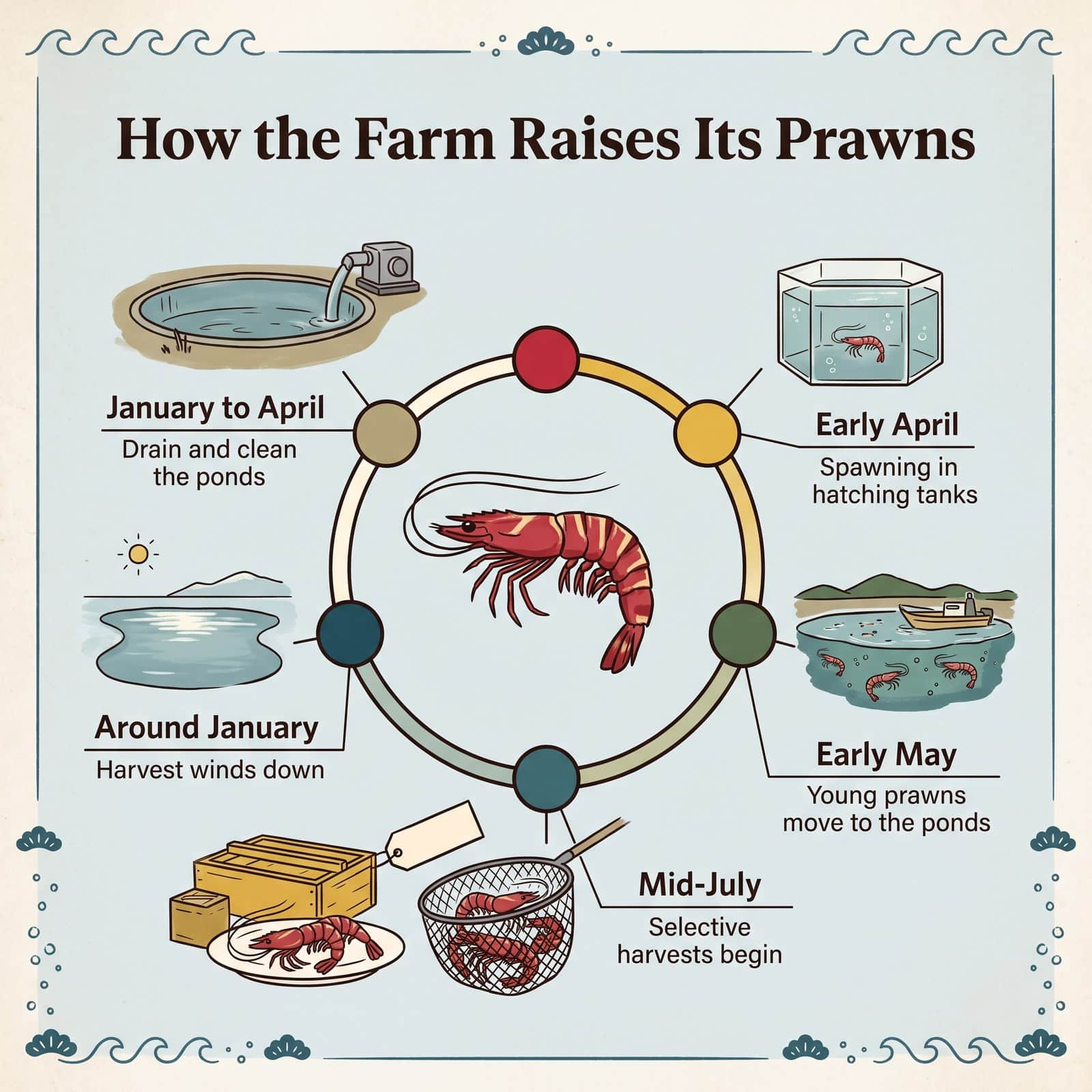
The farm raises prawns in large seawater grow-out ponds on the island, on a one-year cycle. It runs 15 ponds at three sites, each between 7,700 m² and 63,300 m². The producer describes the year as follows.
- January to AprilStaff drain and clean the ponds.
- Early AprilEgg-bearing prawns spawn in hatching tanks, and the larvae eat formulated feed.
- Early MayYoung prawns move to the ponds for daily feeding and seawater exchange.
- Mid-JulySelective harvests begin, taking larger prawns first.
- Around JanuaryHarvesting winds down, and pond cleaning starts again.
A village feature on the farm reports that staff dive into the ponds every day. While underwater, they check feeding, look for leftover food, and confirm that the prawns are molting normally.
Research helps at the hatchery stage too. A 2020 study tested spawning conditions for farm-raised kuruma prawns. It found 24°C the most efficient of four temperatures. That kind of work matters because the village aims to breed prawns from its own parent stock.
Nutrition Facts
Japan’s food composition database has no separate entry for Himeshima prawns. Instead, the figures below describe raw farmed kuruma prawn in general, per 100 g of edible portion.
| Nutrient | Per 100 g edible portion |
|---|---|
| Energy | 90 kcal |
| Protein | 21.6 g |
| Fat | 0.6 g |
| Cholesterol | 170 mg |
| Sodium | 170 mg (salt equivalent 0.4 g) |
| Potassium | 430 mg |
| Zinc | 1.4 mg |
| Vitamin B12 | 1.9 µg |
Keep in mind that the database counts 55% of a whole prawn as waste, mostly head and shell. So 100 g of meat takes a little over 200 g of whole prawns.
Why Himeshima Kuruma Prawn Is Worth Trying
Himeshima Kuruma Prawn is more than an expensive seafood. It reflects a village that lost its salt trade and chose to farm prawns, then kept going through decades of setbacks. Because the village held on, those ponds now count among the island’s main sources of income.
On the plate, expect a sweet, springy prawn that shines raw, grilled, or swished through broth. If you can, visit in autumn and catch the festival, then continue through Oita’s food scene or the wider Kyushu food guide.
Frequently Asked Questions About Himeshima Kuruma Prawn
The Prawn Itself
- What makes Himeshima kuruma prawns special?
-
The main differences are their island origin, farming history, rapid handling after harvest, and live shipping. They are the same species as other kuruma prawns, though. Himeshima’s reputation rests on how it produces and ships them.
- How big is a Himeshima kuruma prawn?
-
Sizes vary within each box, though. A 300 g pack of live prawns holds 6 to 15 prawns, or roughly 20 to 50 g each. Even so, the producer does not let buyers choose the count.
- Is “sashimi-grade” an official grade?
-
No, it is not a universal grading system. In this guide, it simply means a product the seller supplies for raw eating. Instead, always follow the label on your own package.
Preparing and Eating
- Do you need to devein kuruma prawns?
-
Usually not as a separate step. According to the producer’s peeling guide, the dark vein comes out when you twist off the head. That makes cleaning fast, even for a first-timer.
- Can you eat the head and shell?
-
Yes, once you cook it until crisp. The producer sells its ebi fry with heads on and says the fried head turns crunchy. If that feels like too much, simply set the head aside.
- Can I eat live prawns raw after freezing them at home?
-
The producer gives mixed guidance on this point. Its FAQ says they may stay suitable for raw eating for about ten days while frozen, but a gift listing says to cook them after thawing. So follow your package, and cook them unless it explicitly approves raw consumption.
Buying and Visiting
- Can you buy live prawns in spring or summer?
-
No, live shipping runs from autumn into winter. The producer sells frozen products all year, so those are the option outside the live season. Stock still varies by product and size.
- Can bad weather delay an order?
-
Yes, because every shipment leaves the island by ferry. In December 2022, the producer skipped a day’s shipping when the ferry canceled every sailing. So order early during the year-end rush if timing matters.
References
Government and Municipal Sources
- Fisheries Agency of Japan – Himeshima Village Fisheries Revitalization Plan, 3rd Period, FY2024–2028 (Accessed October 2026)
- Oita Prefecture – Oita Specialty Products: Kuruma Prawn (Accessed October 2026)
- Fisheries Agency of Japan – Himeshima Wide-Area Fisheries Revitalization Plan, 3rd Period, FY2026–2030 (Accessed October 2026)
- Himeshima Village – Local Specialties (Accessed October 2026)
- Fisheries Agency of Japan – Himeshima Wide-Area Fisheries Revitalization Plan, 2nd Period (Accessed October 2026)
- Himeshima Village – Himeshima Souvenirs (Accessed October 2026)
- Oita Prefecture – Eastern Region Local Food and Seasons List (Accessed October 2026)
- Himeshima Village – Himeshima Kuruma Ebi Festival (Accessed October 2026)
- Oita Prefecture – Digital Archive: Himeshima Kuruma Prawns, Koho Oita, December 1980 (Accessed October 2026)
- Ministry of Education, Culture, Sports, Science and Technology – Food Composition Database: Kuruma Prawn, Cultured, Raw, No. 10321 (Accessed October 2026)
- Himeshima Village – Access and Ferry Timetable (Accessed October 2026)
- Ministry of Health, Labour and Welfare – Measures Against Vibrio parahaemolyticus in Raw Seafood (Accessed October 2026)
Producer and Other Sources
- Himeshima Kuruma Ebi Yoshoku Co., Ltd. – Company Profile and History (Accessed October 2026)
- Oita Himeshima Kuruma Prawn Online Shop – Online Shop Product Lineup and News (Accessed October 2026)
- Suntory Foundation for Arts – Suntory Prize for Community Cultural Activities 1988: Himeshima Kuruma Prawn Farming (Accessed October 2026)
- Himeshima Kuruma Ebi Yoshoku Co., Ltd. – About Our Kuruma Prawn Farming (Accessed October 2026)
- Oita Himeshima Kuruma Prawn Online Shop – Frequently Asked Questions on Storage and Thawing (Accessed October 2026)
- GBIF – Penaeus japonicus Spence Bate, 1888 (Accessed October 2026)
- Oita Himeshima Kuruma Prawn Online Shop – Live Farmed Kuruma Prawns Product Page (Accessed October 2026)
- Himeshima IT Island – Himeshima Kuruma Ebi, the Island’s Signature Brand (Accessed October 2026)
- Oita Himeshima Kuruma Prawn Online Shop – How to Peel Kuruma Prawns (Accessed October 2026)
- Furusato Choice – Himeshima Live Kuruma Prawns, Storage Notes (Accessed October 2026)
- Oita Himeshima Kuruma Prawn Online Shop – Notice of Shipping Suspension Due to Ferry Cancellation, December 2022 (Accessed October 2026)
- Nippon Travel Agency – 23rd Himeshima Kuruma Ebi Festival Event Listing (Accessed October 2026)
Academic Literature
- Fish Pathology (J-STAGE) – Momoyama, K. & Muroga, K. (2005). Diseases of Cultured Kuruma Shrimp in Japan: A Review, 40(1), 1–14 (Accessed October 2026)
- Cefas International Database on Aquatic Animal Diseases – Nakano, H. et al. (1994). Mass Mortalities of Cultured Kuruma Shrimp in Japan in 1993: Epizootiological Survey and Infection Trials, Fish Pathology, 29(2) (Accessed October 2026)
- Nippon Suisan Gakkaishi – Fuseya, R. et al. (2020). Efficient Spawning Conditions of Kuruma Prawn Marsupenaeus japonicus to Induce Maturation, 86(5), 395–401 (Accessed October 2026)
- Kindai University Repository – Fujita, M., Endo, K. & Shimizu, W. (1972). Free Amino Acids, Trimethylamine Oxide and Betaine in Shrimp Muscle, Memoirs of the Faculty of Agriculture of Kinki University, 5, 61–65 (Accessed October 2026)
Related Articles
- Sekiaji: Japan’s Premium Seki Horse Mackerel (Surveyed: October 2026)
- Seki saba (関サバ) (Surveyed: October 2026)
- Shiroshita Karei (城下かれい) (Surveyed: October 2026)
- Hyugadon (ひゅうが丼) (Surveyed: October 2026)
- Toriten (とり天) (Surveyed: October 2026)
- Osechi Ryori (おせち料理) (Surveyed: October 2026)
- Tempura (天ぷら) (Surveyed: October 2026)




Comments