


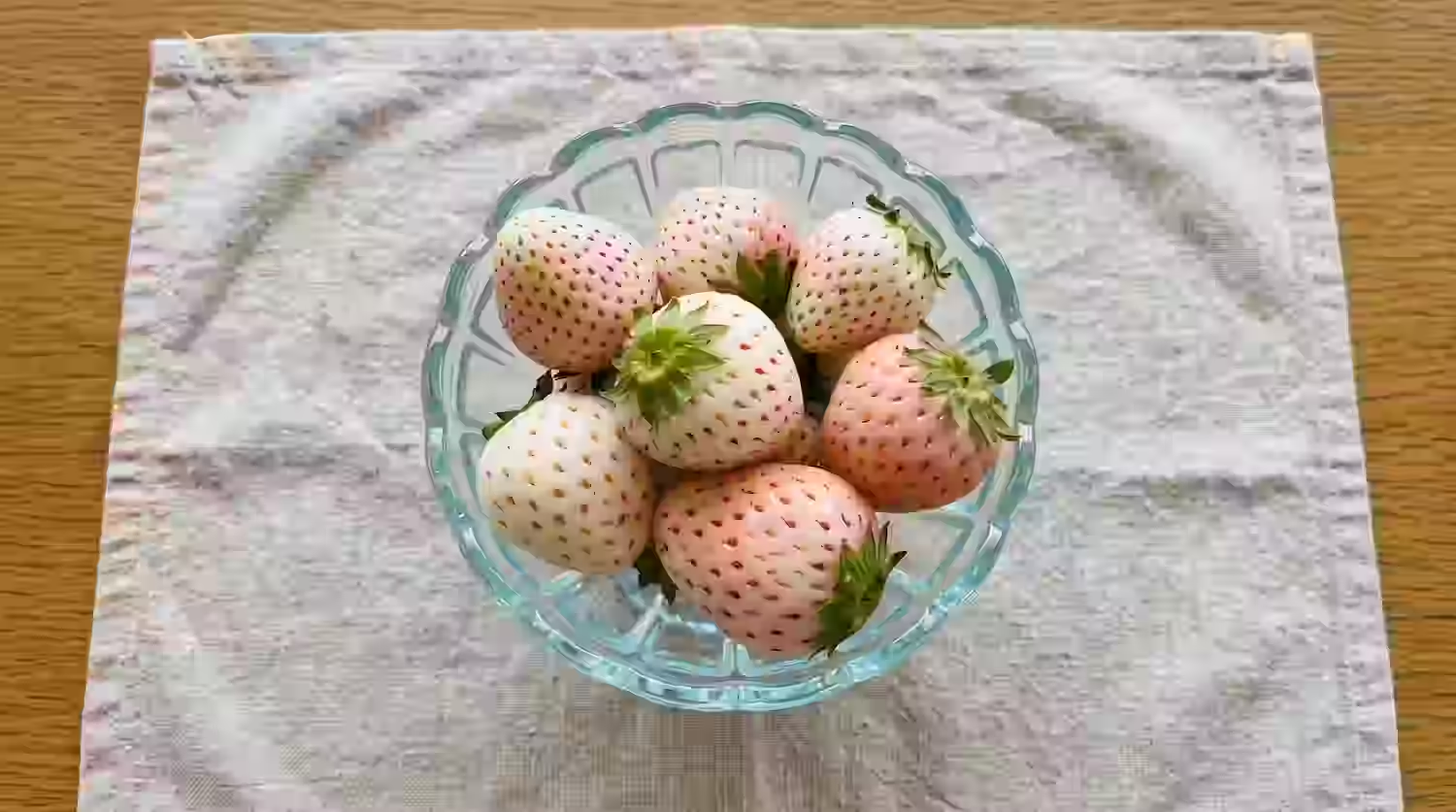
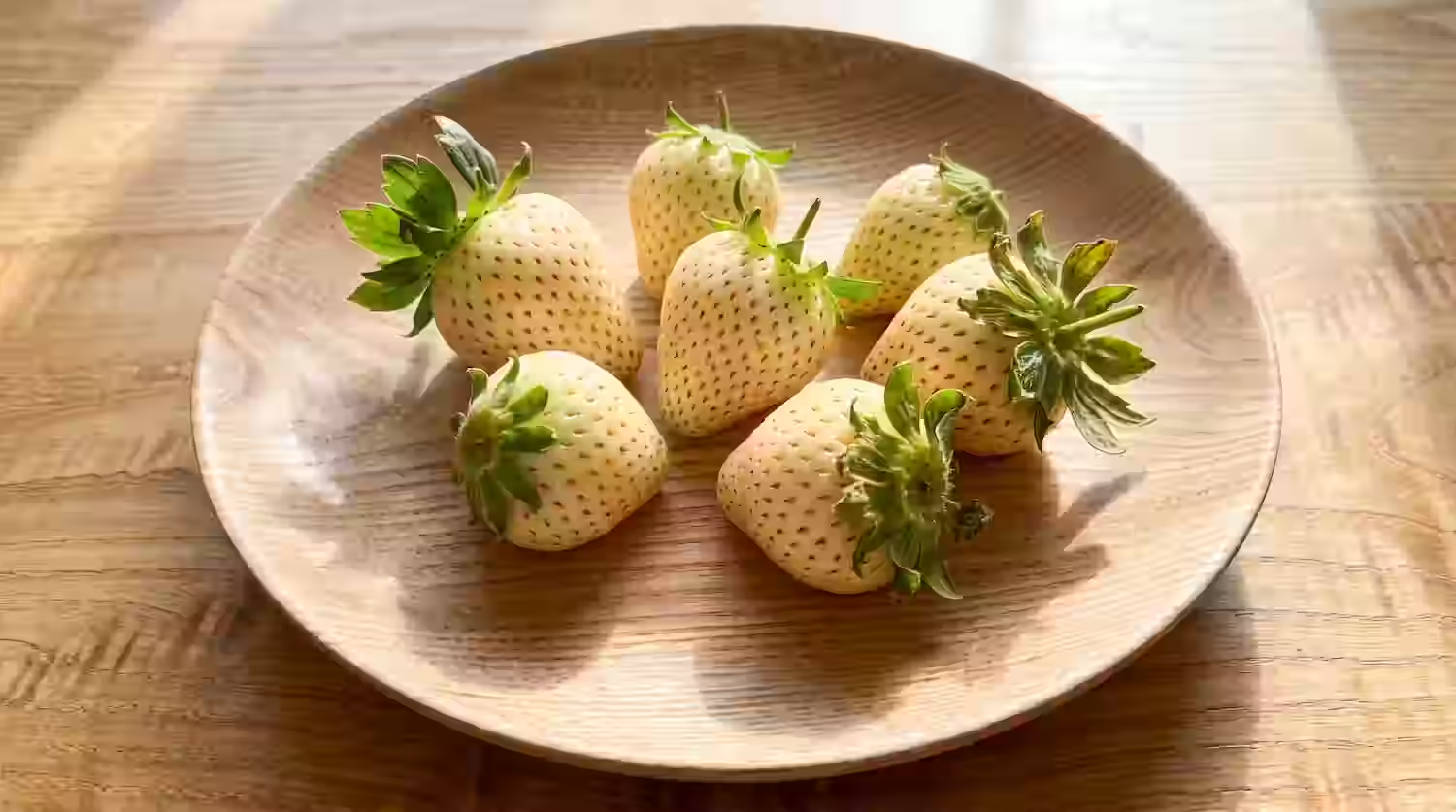

Imagine biting into a strawberry that looks almost like a pearl, pale with a faint pink blush and dotted with tiny red seeds. That is the Pearl White strawberry (パールホワイト), a Japanese white strawberry developed in Nara Prefecture. Sellers describe it as softer and less acidic than most red berries, with a gentle, fragrant sweetness.
Shops call it Pearl White, yet its registered name is something very different: Iroha-001. This guide covers how it tastes, why it is white, why Japan treats it as a premium fruit, and how it differs from other pale strawberries. It also explains the season, prices, and where to find it.
What Is a Pearl White Strawberry?
Pearl White is a premium Japanese white strawberry from Nara Prefecture. Its registered cultivar name is Iroha-001, approved in 2015. Japan’s official variety database records a firm, egg-shaped berry with pinkish-white skin, white flesh, and a white core, and sellers describe low acidity and a mild sweetness.
Quick Facts: Pearl White Strawberry
- Japanese name
- パールホワイト (Pearl White)
- Registered variety name
- Iroha-001 (イロハ-001)
- Registration
- Filed May 31, 2013; registered August 27, 2015 (No. 24429)
- Origin
- Bred by Maeda (前田光樹), a grower-breeder with Nara Strawberry Lab
- Official traits
- Pinkish-white skin, white flesh and core, medium size, egg-shaped, firm
- Seeds
- Usually described as red against the pale skin
- Taste
- Moderate sweetness, low acidity, mild flavor (seller descriptions)
- Where it is grown
- Nara Prefecture; producers in Saga Prefecture also sell it
- Typical season
- About December to April
- Market position
- Premium gift fruit, sold in limited seasonal quantities
Iroha-001, the Registered Cultivar Name
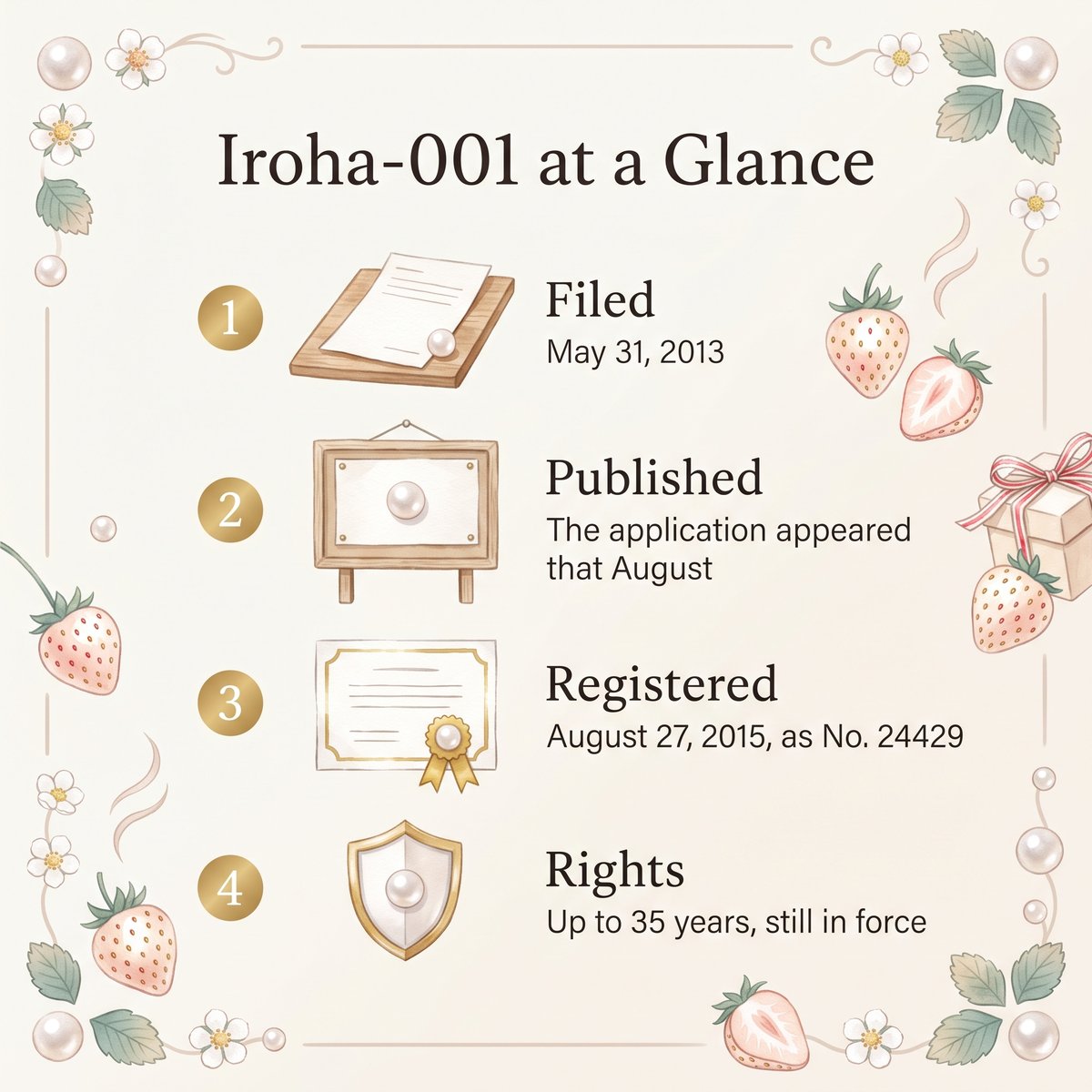
In Japan, breeders register new plant varieties under official names. For this berry, that name is Iroha-001. The breeder applied on May 31, 2013, the application appeared publicly that August, and approval came on August 27, 2015. The record lists a breeder’s-rights protection period of up to 35 years, and the rights are still in force.
To set it apart from older cultivars, the register compares it with two other strawberry varieties, Wada Hatsukoi and Asono Koyuki. According to the record, fruit shape is one trait that separates Iroha-001 from both.
Is Pearl White a Variety or a Brand Name?
Pearl White is the name most people meet in shops, while Iroha-001 is the official name in Japan’s plant variety register. Therefore, if you see either name, you are looking at the same strawberry.
What Does the Name Mean?
Of course, the name suggests the soft luster of a pearl. That fits the look of the fruit well. However, we found no official explanation of the name’s origin, so we will not guess at the story behind it.
Where Does Pearl White Strawberry Come From?
Pearl White comes from Nara Prefecture, the region around the ancient capital of Nara in western Japan. According to a 2024 field report by Japan’s agriculture ministry, Maeda (前田光樹) bred it. He handles breeding for a group of growers called Nara Strawberry Lab (奈良いちごラボ).
The Breeder and Nara Strawberry Lab
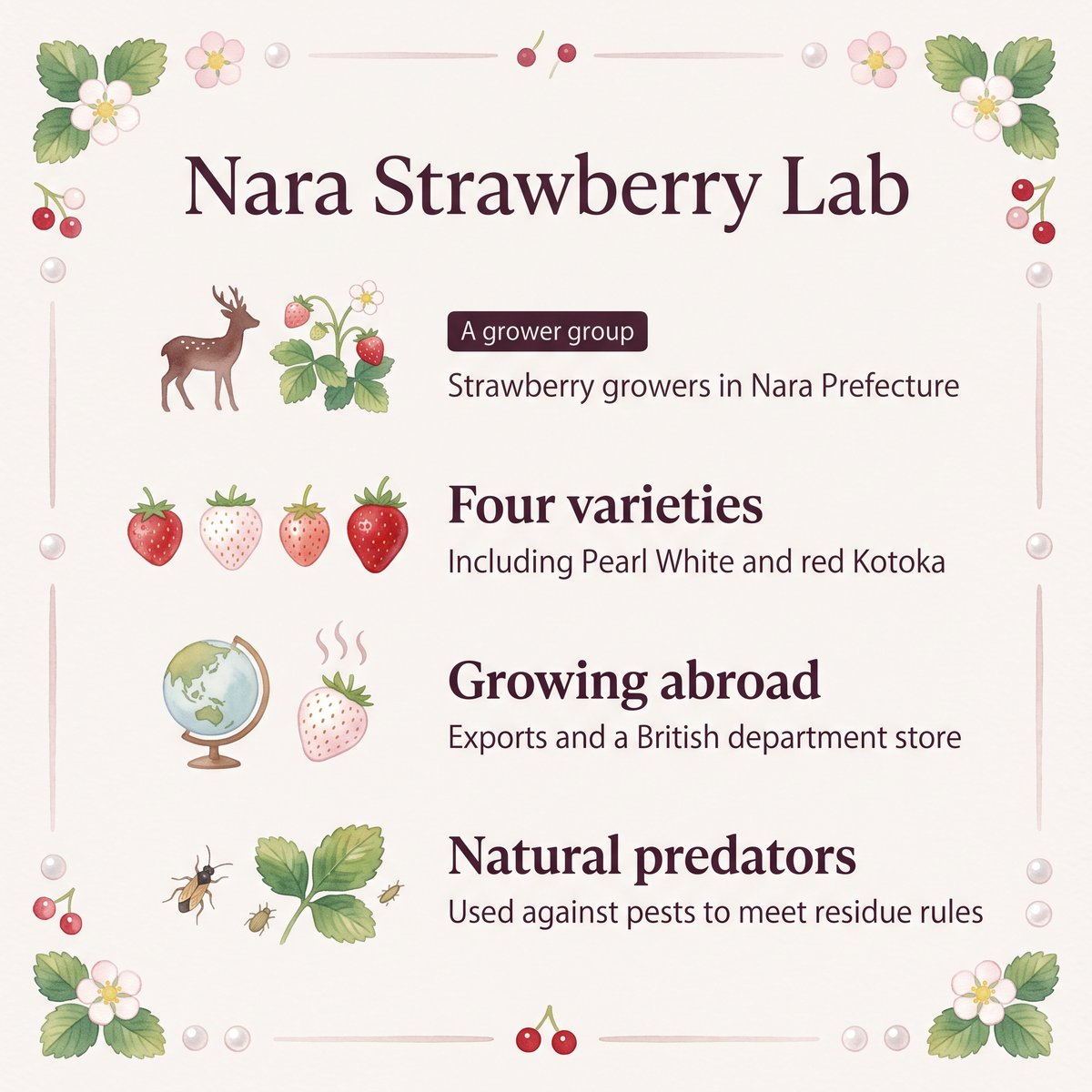
Nara Strawberry Lab, in turn, is a group of strawberry growers in Nara Prefecture. The ministry report says the group grows four varieties, including Pearl White and the red Kotoka. The same breeder also developed another white strawberry sold as Shinju Hime.
Interestingly, the group looks well beyond Japan. The ministry report notes that it has been increasing exports, and that it opened a route into a high-end British department store with help from JETRO. It also uses natural predators against pests, partly to meet each destination’s pesticide-residue rules.
Where Pearl White Strawberries Are Grown Today
The 2024 ministry report confirms commercial production by growers in Nara, and producers in Saga Prefecture also sell it. Saga is in Kyushu, Japan’s southwestern main island, far from Nara. For example, a farm in Saga City offers Pearl White through the hometown tax gift system. Nationwide production figures and grower numbers, however, are not publicly available.
How Was It Bred?
No public source indicates that Pearl White is genetically modified. The cultivar went through Japan’s plant variety registration system, but the public record does not list its parents or breeding method. Unlike some white strawberries bred by prefectural research stations, it also has no published breeding report. So its exact parentage remains unknown to outsiders.
Why Is Pearl White Strawberry White?
Pearl White is pale because it is a white-fruited cultivar, not because it is picked unripe. No published scientific study appears to have measured its pigments. Research on strawberries in general, however, links paler fruit with lower levels of red anthocyanin pigments.
What Science Says About Strawberry Color
A 2002 study in the Journal of the Japanese Society for Horticultural Science examined 20 Japanese strawberry cultivars. It found that fruit color was linked to total anthocyanin concentration, and that pelargonidin 3-glucoside was the main red pigment. In simple terms, less pigment usually means paler fruit. That is useful background, but Pearl White was not part of that study, so treat it as general science only.
White Skin, White Flesh, and Red Achenes
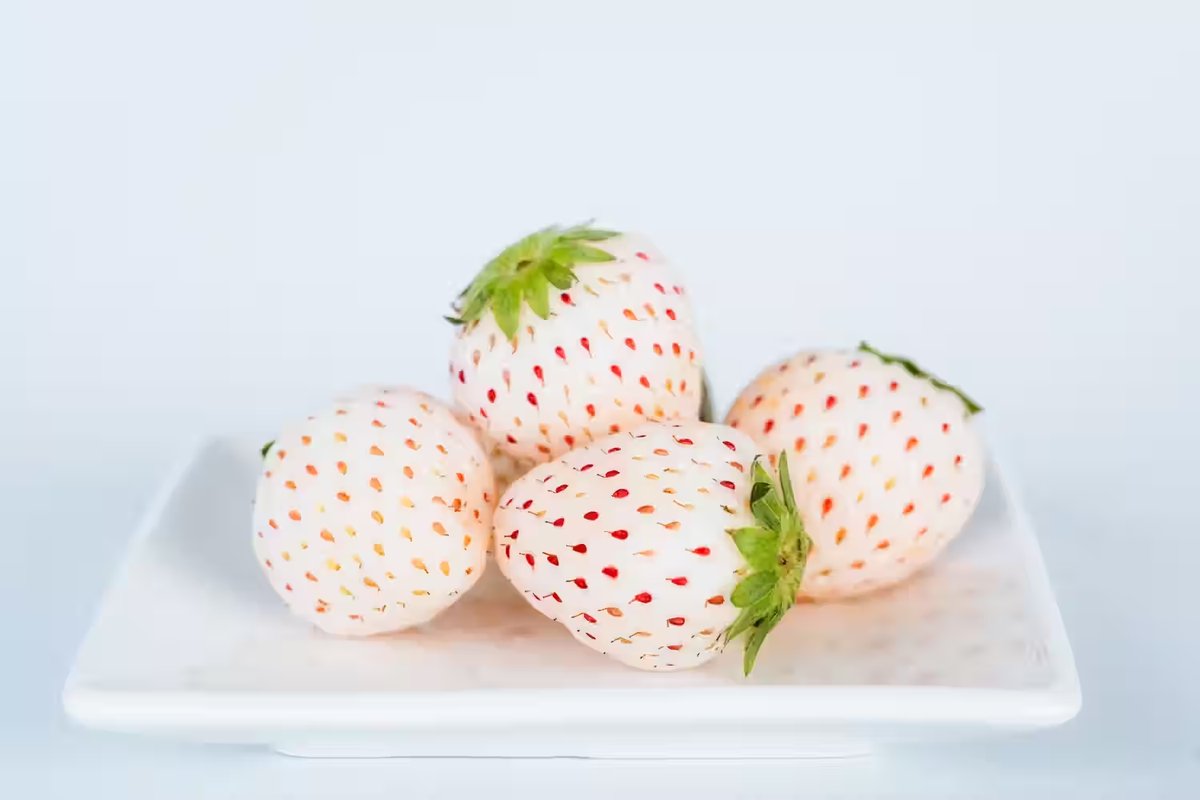
To begin with, the official record describes pinkish-white skin with white flesh and a white core. Fruit guides add that the skin turns white to pinkish white as it ripens, while the surface seeds turn red. Those “seeds” are actually achenes, small dry fruits that each hold a seed. Against the pale skin, they look like tiny red jewels.
Most descriptions, including a Saga grower’s listing, mention red seeds. The official record, however, does not describe achene color. So expect red or reddish achenes, with some natural variation between berries.
What Does Pearl White Strawberry Taste Like?
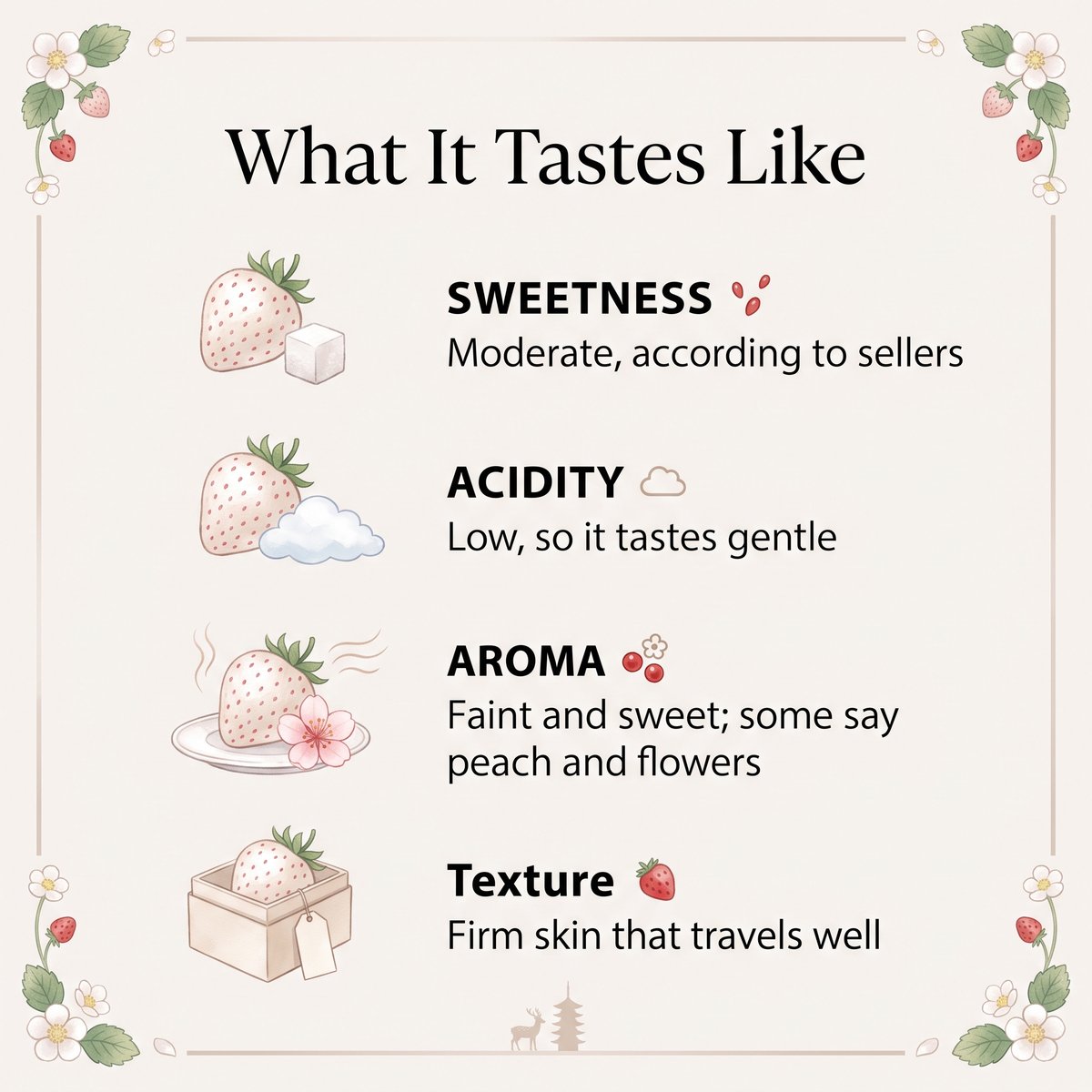
Compared with many bright, tangy red strawberries, Pearl White is usually described as softer, sweeter-tasting, and less acidic. Its appeal lies in gentle sweetness and fragrance rather than punch. Note that these descriptions come from growers and sellers, because nobody has published laboratory taste data.
Sweetness and Mild Acidity
Fruit guides describe the sweetness as moderate and the acidity as low. Likewise, a Saga grower says it has less sourness than ordinary red strawberries and a sweet, refined aftertaste. However, nobody has published sugar or acid figures for Pearl White. As a result, we cannot rank it in numbers against Amaou or other famous red varieties.
Aroma and Texture
Aroma comes up again and again in descriptions. The Saga grower mentions a faint, sweet fragrance. Meanwhile, a jam maker that used Pearl White described a spring-like scent reminiscent of peach and flowers. Those are sellers’ words, not lab results, but they give a sense of what people notice.
As for texture, meanwhile, the official record classes the fruit as firm. Fruit guides add that the fairly firm skin helps it travel well. That is one reason it suits mail-order gifts, which matter a lot in Japan’s premium fruit market.
How It Compares With Red Strawberries
If you love a bright, tart strawberry, Pearl White may feel almost too gentle. On the other hand, if acidity bothers you, it could be a pleasant surprise. Its color also changes the experience. A first-time taster may expect a white berry to taste unripe, so the sweetness can come as a surprise.
Pearl White vs Other White Strawberries
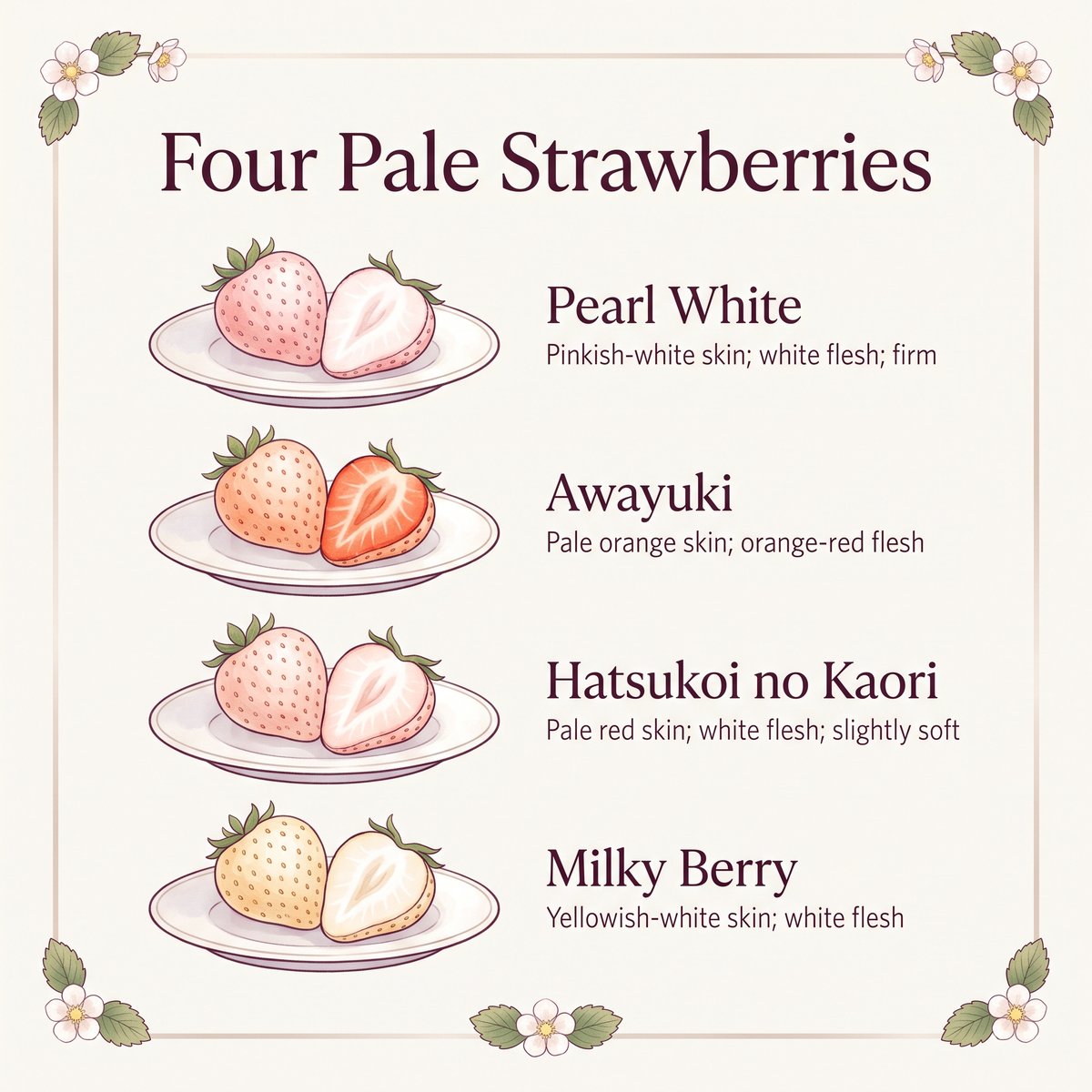
Japan has several pale strawberries, and they are easy to mix up. Japan’s variety register helps, because it records skin, flesh, and core colors using the same system. Here is how Pearl White compares with three others.
| Variety (registered name) | Registered | Skin | Flesh and core | Firmness |
|---|---|---|---|---|
| Pearl White (Iroha-001) | 2015 | Pinkish white | White flesh, white core | Firm |
| Awayuki (淡雪) | 2013 | Pale orange | Orange-red flesh, pale red core | Slightly firm |
| Hatsukoi no Kaori (Wada Hatsukoi) | 2009 | Pale red | White flesh | Slightly soft |
| Milky Berry (Tochigi iW1) | 2024 | Yellowish white | White flesh | Not compared here |
Skin, flesh, and core colors for the first three come from Japan’s variety register. Milky Berry’s colors come from Tochigi Prefecture’s own description. Keep in mind that real fruit varies with ripeness, light, and growing conditions.
Pearl White vs Awayuki
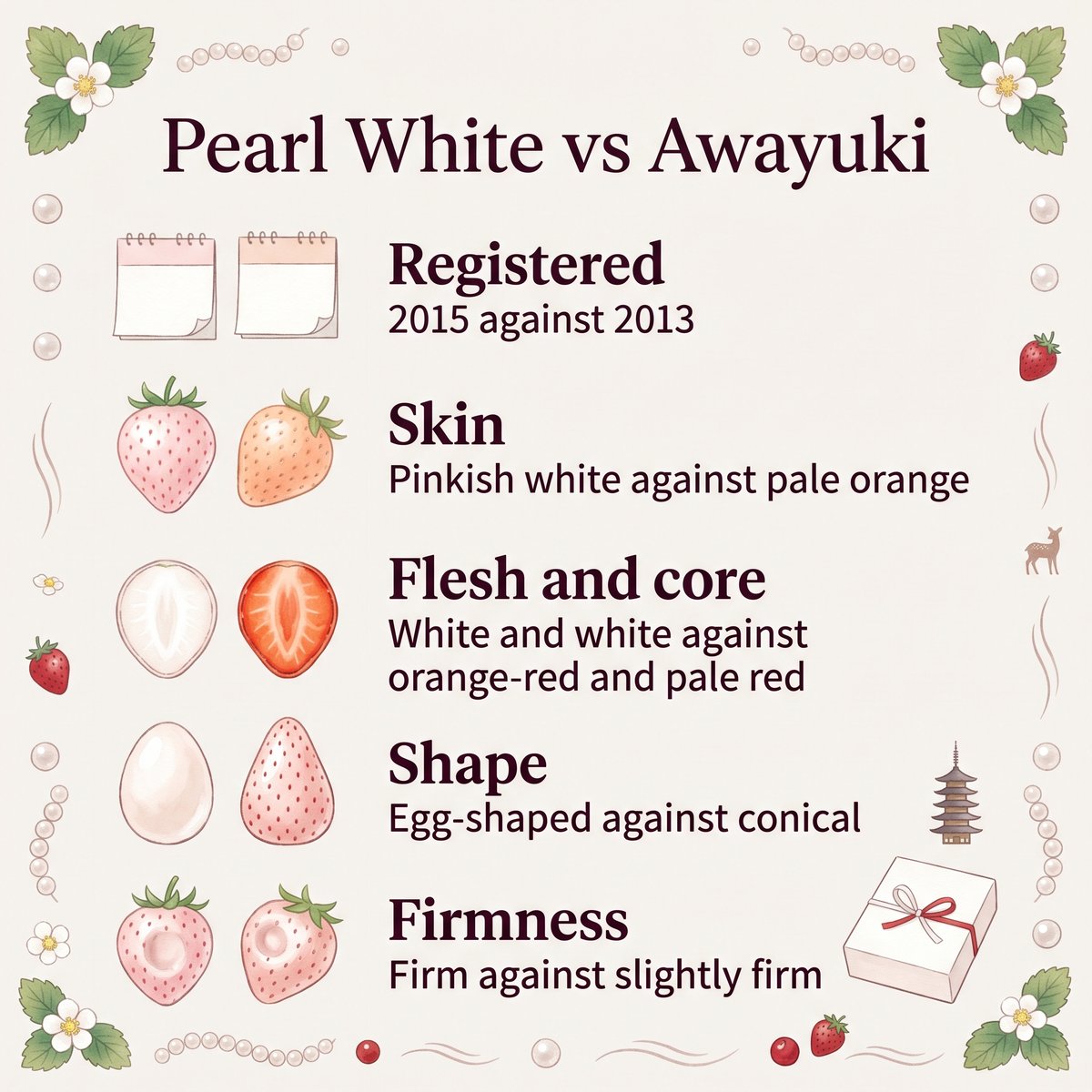
Above all, this is the comparison people ask about most. On paper, the two are clearly different. Pearl White has white flesh and a white core, while Awayuki is recorded with orange-red flesh and a pale red core. Awayuki’s registered shape is also conical, not egg-shaped. No study has compared their sweetness or aroma under the same conditions, so we will not rank them.
| Registry record | Pearl White (Iroha-001) | Awayuki |
|---|---|---|
| Registration number | 24429 | 22821 |
| Registered | August 27, 2015 | December 5, 2013 |
| Skin | Pinkish white | Pale orange |
| Flesh / core | White / white | Orange-red / pale red |
| Size | Medium | Slightly large |
| Shape | Egg-shaped | Conical |
| Firmness | Firm | Slightly firm |
Sellers market both as premium pale strawberries, often in gift boxes. Interestingly, a Saga farm sells the two together as a tasting set, which is a handy way to judge the difference yourself.
Pearl White vs Hatsukoi no Kaori
Hatsukoi no Kaori is the trade name of Wada Hatsukoi, an older white strawberry registered in 2009. In fact, the register used Wada Hatsukoi as one of the comparison varieties when it approved Iroha-001. Both have white flesh, but Wada Hatsukoi is recorded as slightly soft, while Pearl White is recorded as firm.
Pearl White vs Shinju Hime and Pineberry
Shinju Hime (“pearl princess”) is another white strawberry from the same Nara breeder. However, we could not match that name to a registered strawberry variety, so we left it out of the table. Pineberry, by contrast, is trickier still. The name is used abroad for pale strawberries with red seeds, and it may cover more than one cultivar. Pearl White is not simply another name for pineberry, but we found no data comparing them directly.
When Is Pearl White Strawberry in Season?
Fruit guides list Pearl White as available from about December to April. That fits Japan’s main greenhouse strawberry season, which runs through winter and spring. For instance, a Saga City hometown tax gift that includes Pearl White ships between January and April.
Still, these dates are a guide, not a promise. Weather, farm, and region all shift the timing, and some sellers announce dates only shortly before shipping. If you are planning a trip or a gift around it, check with the seller first.
How to Choose a Ripe Pearl White Strawberry
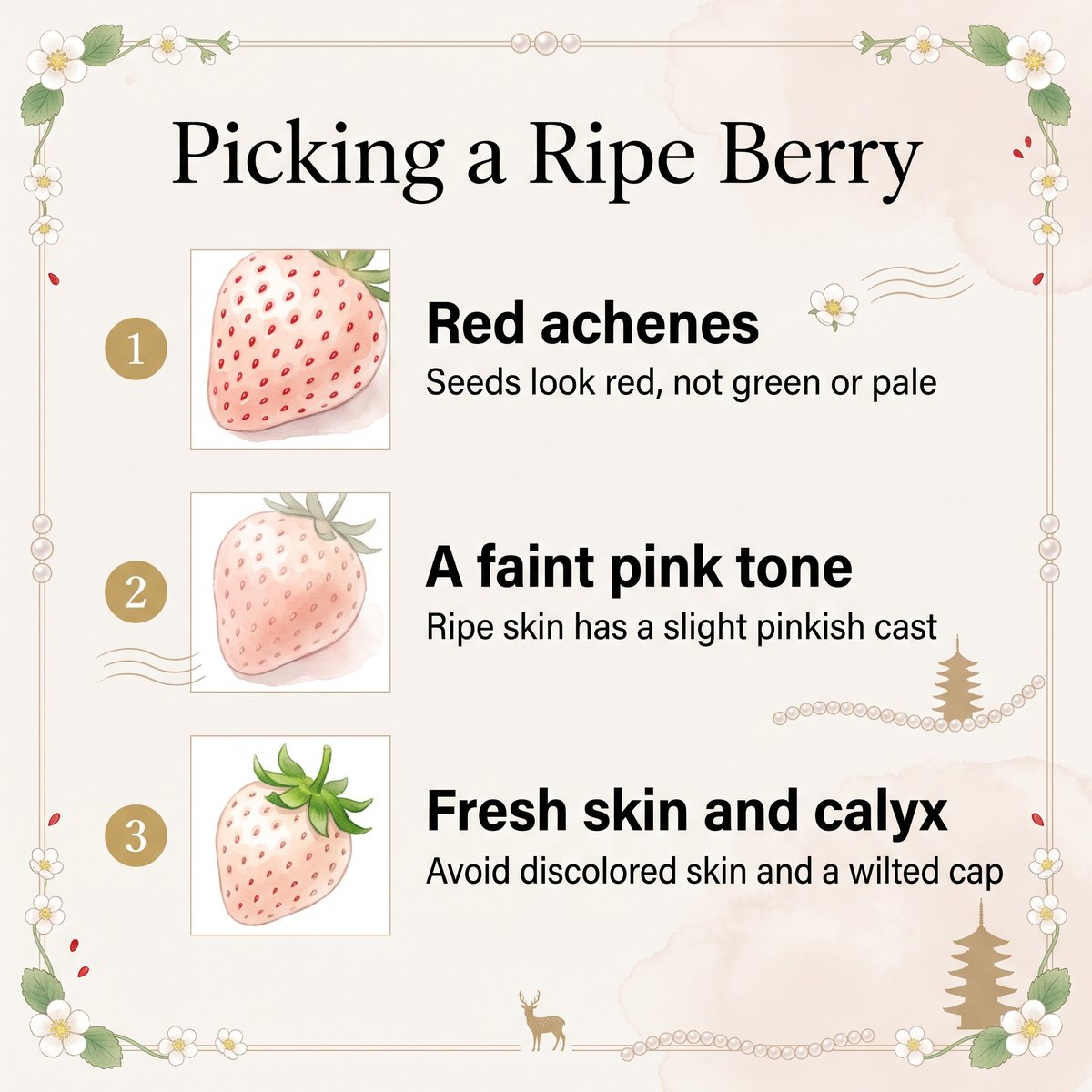
Since a white strawberry never turns red, you need other clues. Fruit guides suggest looking at three things together.
- Red achenes. The seeds on the surface should look red rather than green or pale.
- A faint pink tone. Ripe skin is often white with a slight pinkish cast.
- Taut, fresh skin and calyx. Avoid berries with discolored skin or a wilted, faded green cap.
We could not find a formal harvest standard from growers, so treat these as practical tips rather than rules. Also, pale fruit shows small color differences easily, so a little unevenness is normal.
How to Store and Eat Pearl White Strawberries
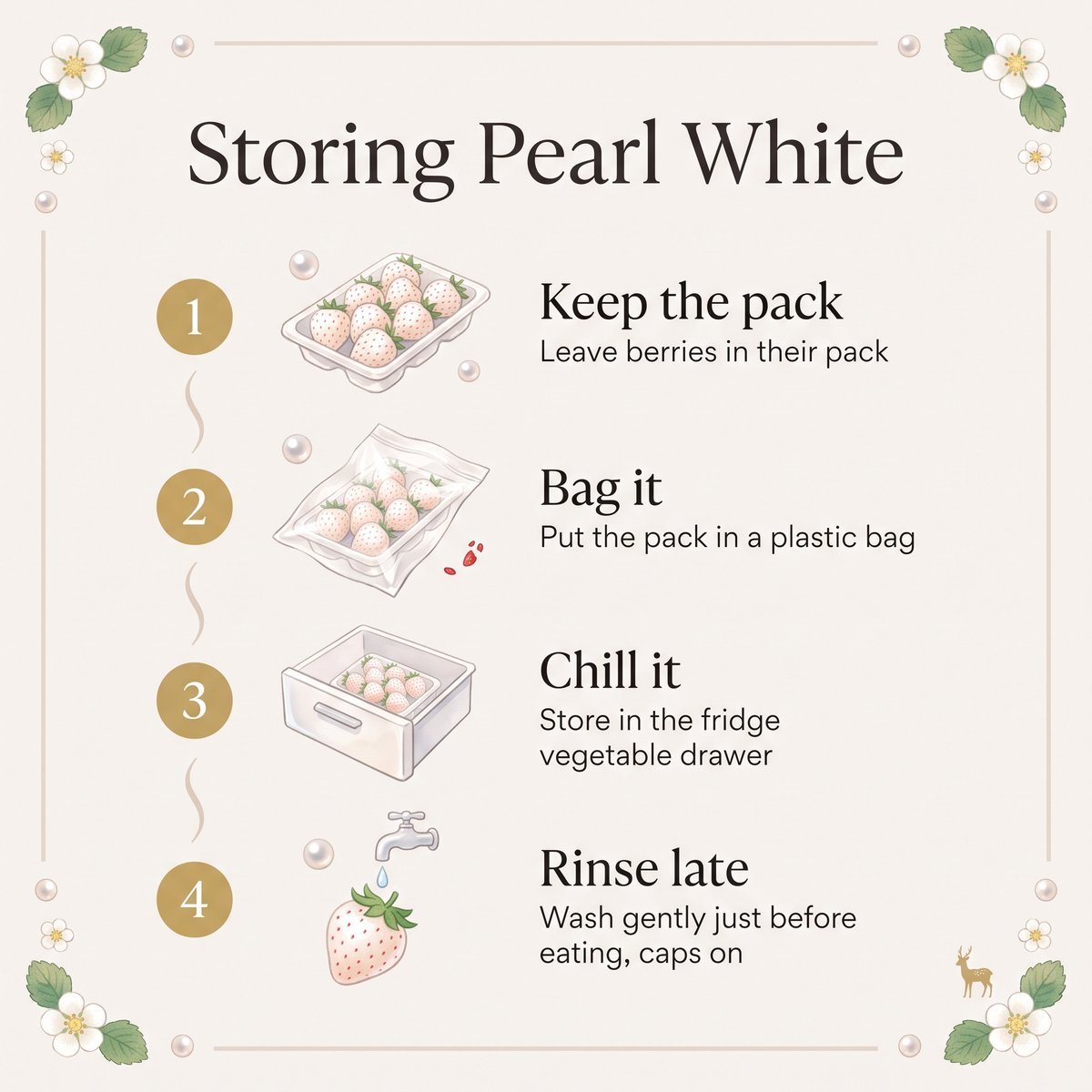
In short, keep Pearl White cold and eat it soon. Fruit guides suggest leaving the berries in their pack, putting the pack in a plastic bag so it does not dry out, and storing it in the fridge’s vegetable drawer. Firm skin helps, but freshness still fades quickly.
Best Way to Serve Them
Ideally, rinse the berries gently just before eating, with the caps still on. After that, let the flavor speak for itself. A gentle, low-acid berry is easy to overwhelm, so heavy cream or sweet sauces can hide what makes it special. If you want a dessert, use it where people can see it, on top of a cake or a fruit plate.
Pearl White also appears in processed foods. For example, a jam made from it went on sale nationwide in Japan in January 2025 as a limited product. Strawberries are also central to Japanese sweets such as ichigo daifuku, though we found no evidence that Pearl White is commonly used in them.
Pairing Pearl White With Red Kotoka
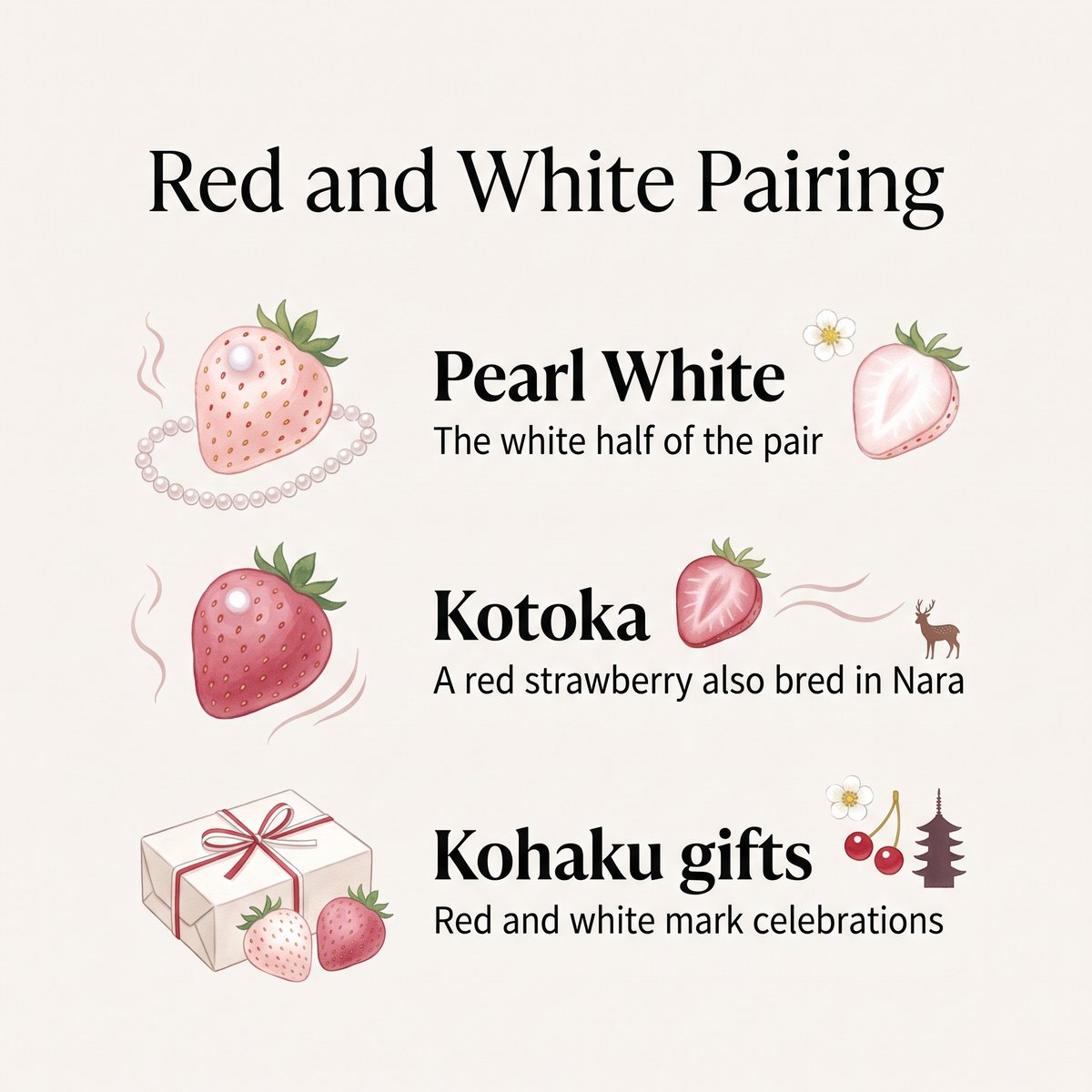
In Nara, Pearl White is sometimes paired with Kotoka, a red strawberry also developed in the prefecture. Fruit guides note that sellers offer red-and-white boxes of the two as gifts. A Nara prefectural profile of one grower even describes a three-color set of red Kotoka, Awayuki, and Pearl White.
In Japan, red and white together, called kohaku, signal celebration and good fortune. The pairing appears in wedding decorations, New Year events, and the cords tied on formal gifts. So a red-and-white strawberry box works naturally for New Year, weddings, or thank-you gifts. At home, eating the two side by side also shows the difference in acidity very clearly.
Do White Strawberries Have Different Nutrition?
So far, nobody has published a nutrition analysis specific to Pearl White. Still, it is a strawberry, so general strawberry figures are a reasonable guide. Japan’s standard food composition tables, as cited by Tochigi’s strawberry research institute, list raw strawberries at about 62 mg of vitamin C and 1.4 g of dietary fiber per 100 g.
Do not assume a white berry is healthier or less healthy than a red one, however. Without measurements for Pearl White itself, any such claim would be a guess. Likewise, anyone with a strawberry allergy should treat it like any other strawberry.
Are Pearl White Strawberries Rare?
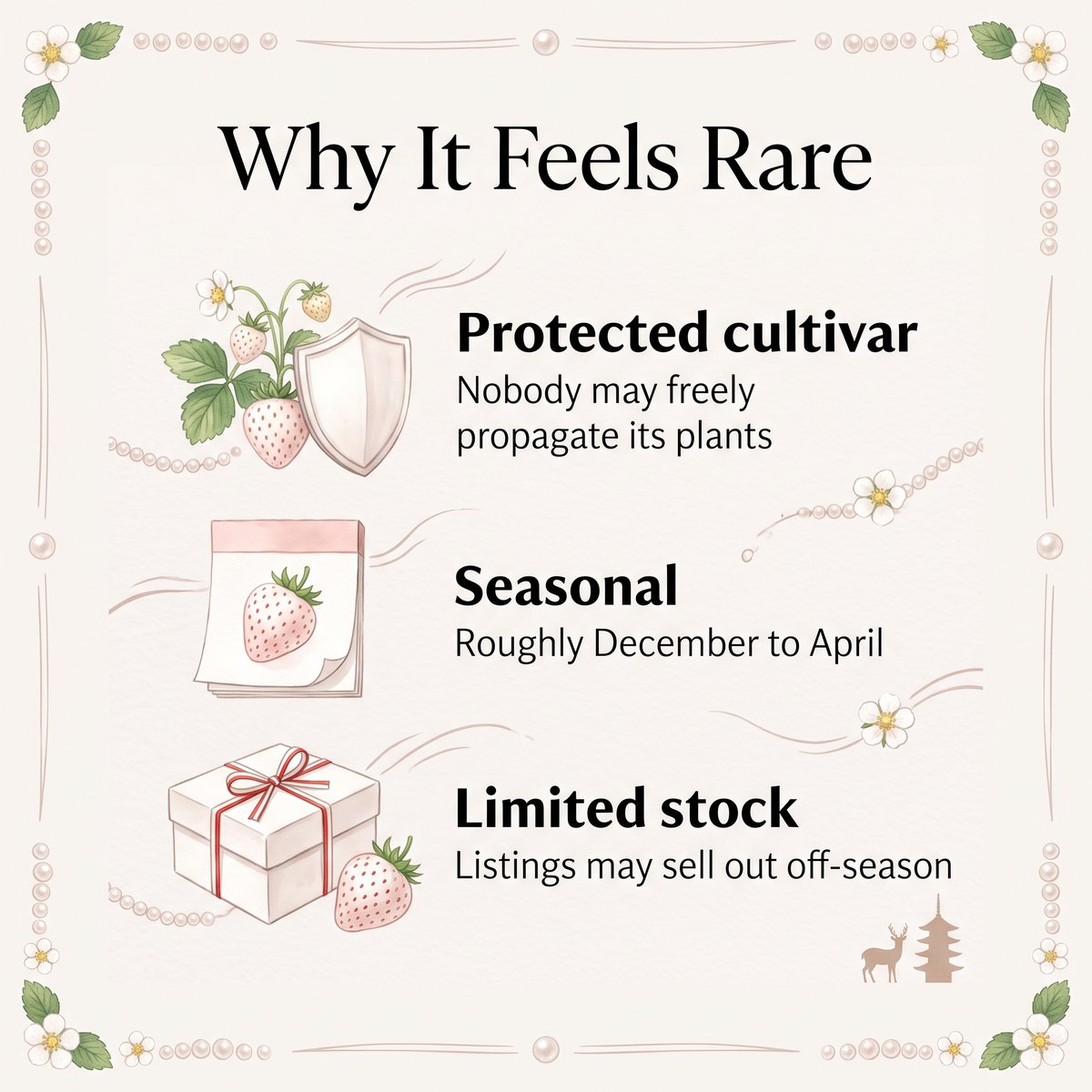
In a practical sense, yes. Sellers offer Pearl White in limited quantities, mostly from winter to spring, and usually as a premium gift fruit rather than a supermarket staple. One Saga grower openly markets it as a rare, unusual white strawberry.
Indeed, a few facts support that picture. First, it is a protected cultivar, so nobody may freely propagate its plants. Second, it is seasonal, available roughly from December to April. Third, online listings may show it as sold out outside that window. Exact production volumes are not public, though, so we cannot say how rare it is in numbers, or compare it with Awayuki on that point.
Pearl White and Japan’s Luxury Fruit Culture
Moreover, Pearl White fits into a long Japanese tradition of premium fruit, from melons to grapes to strawberries. Fruit like this is often bought as a gift, so appearance, uniform size, and careful packing tend to matter alongside flavor. Famous examples include Yubari melon and Amaou strawberries.
Clearly, Nara Strawberry Lab works in that space. The 2024 ministry report says the group sells to a high-end British department store and that its strawberries are popular with affluent buyers in several Asian markets and the United States.
How Much Does Pearl White Strawberry Cost?
Sellers market Pearl White as a premium strawberry, and prices vary a lot by size, season, and seller. Rather than quote a “typical” price, here are two verified examples, checked in October 2026.
| Example (checked October 2026) | Contents | Amount |
|---|---|---|
| Saga City hometown tax gift | 220 g Pearl White plus 220 g Awayuki | ¥18,000 donation |
| Saga City hometown tax subscription | Three deliveries, one of them 2 packs of Pearl White (220 g each) | ¥39,500 donation |
These examples reflect Japan’s hometown tax donation program, not retail prices. Treat them as a rough signal of the premium market only. Prices at farm stands and department stores may be quite different. Always check the current listing before you buy.
Why Is Pearl White Strawberry Expensive?
The honest answer is that public cost data do not exist. We found no figures for yield, growing difficulty, or grower numbers. Still, a few factors seem clear. It is sold in limited, seasonal quantities, it frequently appears in gift boxes, and premium fruit in Japan is often bought as a present. Our Japanese fruit guide explains more about that gift culture.
Interestingly, a Nara prefectural profile notes that the grower’s three-color set fetched a high price at its first auction at Tokyo’s Ota Market. That says something about demand. It does not, however, tell you what a box costs in a shop today.
Where Can You Buy Pearl White Strawberries?
Within Japan, the main routes are farm-direct sales, online shops, and hometown tax gifts from Nara and Saga. Gift boxes, including red-and-white sets with Kotoka, are one format sellers use. Stock is seasonal and limited, so check availability before you plan a purchase.
Can Pearl White Be Shipped Outside Japan?
Possibly, but not freely, because rules apply. Fresh strawberries must meet each destination’s plant-quarantine and pesticide-residue rules. Japan’s agricultural research agency, NARO, stresses that exporters must check the importing country’s latest rules. So “international shipping” is never a simple yes or no.
That said, Nara Strawberry Lab does export some of its strawberries. The ministry report mentions sales to a British department store, and says its berries are popular in Hong Kong, Thailand, Taiwan, Singapore, and the United States. The report does not break this down by variety, so availability of Pearl White abroad is unclear.
Can You Grow Pearl White Strawberries at Home?
Not easily, and not from unauthorized plants. Iroha-001 is a protected variety in Japan, and its breeder’s rights are still in force. Japan’s agriculture ministry warns that propagating a registered variety’s plants without the rights holder’s permission infringes those rights. It also warns that strawberry runner plants of unknown origin can spread diseases such as anthracnose and powdery mildew.
Similarly, you may see “Pearl White seeds” for sale online. However, there is no guarantee that such seeds are genuine or authorized, and seedlings do not necessarily grow true to the parent. For those reasons, we do not recommend them as a way to grow this cultivar.
Common Misconceptions About Pearl White
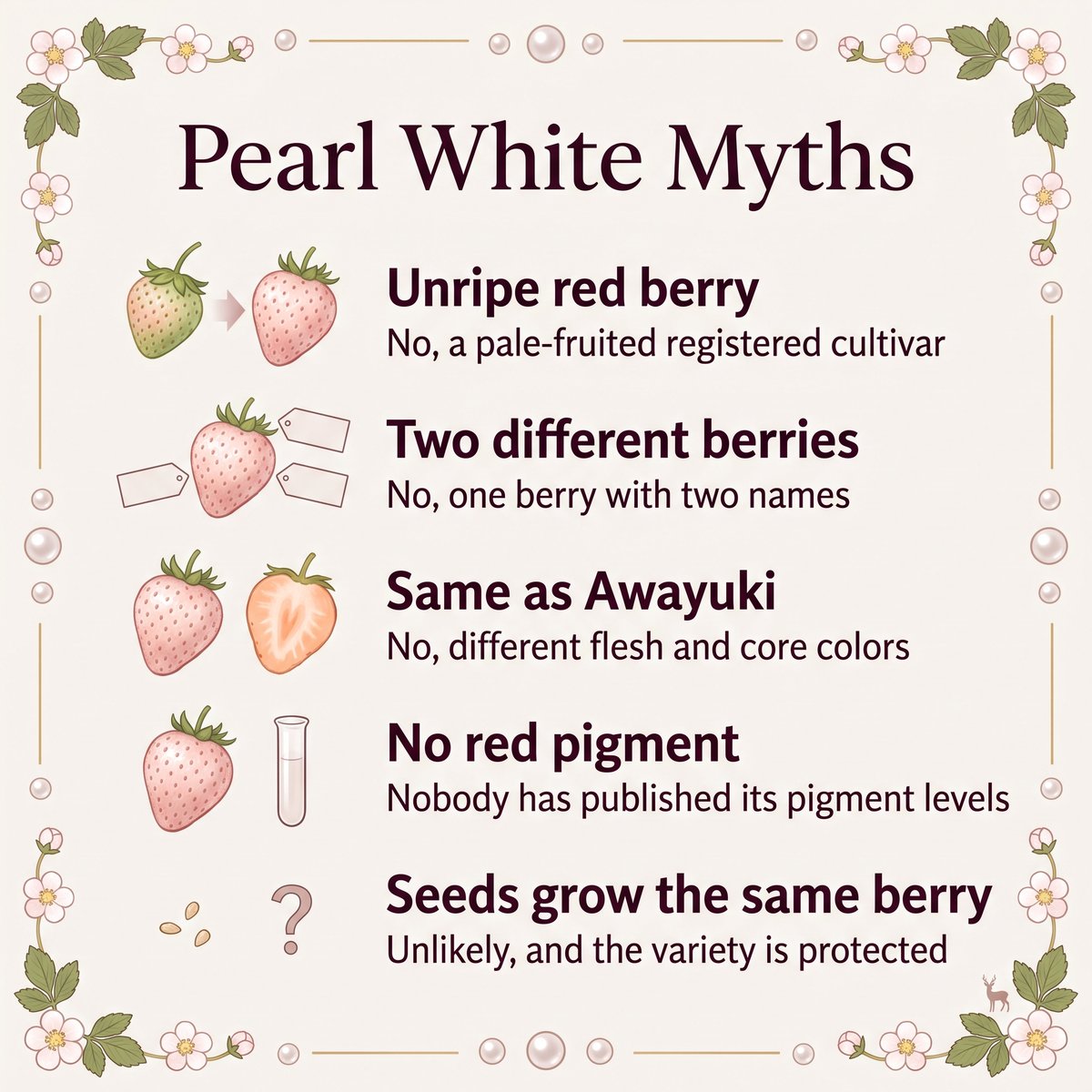
Myth: It is an unripe red strawberry.
Fact: It is a registered pale-fruited cultivar with white flesh.
Myth: Pearl White and Iroha-001 are different berries.
Fact: Pearl White is the market name; Iroha-001 is the registered variety.
Myth: It is the same as Awayuki.
Fact: The register records different skin, flesh, and core colors for each.
Myth: It contains no red pigment at all.
Fact: Nobody has published its pigment levels, so no one can confirm this.
Myth: “Pearl White seeds” grow the same berry.
Fact: Seeds are unlikely to reproduce the cultivar, and the variety is protected.
Final Thoughts on Pearl White Strawberry
Pearl White stands out not only for its unusual look but also for its place in Japan’s premium fruit culture. A Nara grower bred it and registered it as Iroha-001 in 2015. Its white flesh, red seeds, protected-variety status, and gentle, low-acid sweetness give it a distinct place among modern Japanese strawberries.
If you visit Japan between December and April, look for a red-and-white box with Kotoka and taste them side by side. That simple comparison shows what makes a white strawberry different. For more food from the region, see what to eat in Nara.
Frequently Asked Questions About Pearl White Strawberry
The Variety
- What is a Pearl White strawberry?
-
Pearl White is a Japanese white strawberry from Nara Prefecture. Its registered variety name is Iroha-001, approved in 2015. Japan’s variety database records pinkish-white skin, white flesh, and firm, egg-shaped fruit.
- What is the difference between Pearl White and Awayuki?
-
Japan’s variety register records them differently. Pearl White has pinkish-white skin with white flesh and a white core. Awayuki is recorded with pale orange skin, orange-red flesh, and a pale red core.
- Are Pearl White strawberries genetically modified?
-
No public source indicates that they are. Pearl White went through Japan’s plant variety system as Iroha-001. However, its parentage and breeding method remain unpublished.
- Why do Pearl White strawberries have red seeds?
-
The red dots are achenes, the small seed-bearing fruits on the surface. Sellers and fruit guides describe them turning red as the berry ripens, while the skin stays pale.
- How sweet is Pearl White?
-
No published sugar-content data exist for Pearl White. Growers and sellers describe moderate sweetness with low acidity, which makes it taste gentle rather than tart. Therefore, no one can rank it against Amaou or other varieties in numbers.
Buying, Storing, and Growing
- When are Pearl White strawberries in season?
-
Fruit guides list roughly December to April. Timing shifts with weather and farm. Check with the seller before planning a trip or a gift.
- Can Pearl White strawberries be shipped overseas?
-
Only where the destination’s quarantine and pesticide-residue rules allow it. Rules differ by country and change over time. Ask the seller, and check your own country’s import rules first.
- Can you grow Pearl White from seed?
-
Not reliably. Iroha-001 is a protected variety in Japan, and seeds sold online under the name may not be genuine. Seedlings also may not match the parent plant.
References
Official and Government Sources
- Ministry of Agriculture, Forestry and Fisheries (MAFF) – Plant Variety Registration Database: Iroha-001 (Accessed October 2026)
- Ministry of Agriculture, Forestry and Fisheries (MAFF) – Plant Variety Registration Database: Awayuki (Accessed October 2026)
- Kinki Regional Agricultural Administration Office, MAFF – Field Report on Nara Strawberry Lab, 2024 (Accessed October 2026)
- Ministry of Agriculture, Forestry and Fisheries (MAFF) – Plant Variety Registration Database: Wada Hatsukoi (Accessed October 2026)
- Nara Prefecture – Hardworking Farmers of Nara, Vol. 29 (Accessed October 2026)
- Ministry of Agriculture, Forestry and Fisheries (MAFF) – Is That Seed Really Safe? On Breeder’s Rights Infringement (Accessed October 2026)
- National Agriculture and Food Research Organization (NARO) – Pest Control Manual for Exporting Fresh Strawberries (Accessed October 2026)
Producer, Retail, and Guide Sources
- Kudamono Navi – Pearl White (Iroha-001) Strawberry (Accessed October 2026)
- Furusato Choice – Saga City Pearl White and Awayuki Set (Accessed October 2026)
- Furusato Choice – Saga City Red-and-White Strawberry Subscription with Pearl White (Accessed October 2026)
- Tochigi Prefecture Strawberry Research Institute – Strawberry Nutrition (Accessed October 2026)
- Zaikei Shimbun – Kuzefuku Shoten Launches Nara Strawberry Jams, January 2025 (Accessed October 2026)
Academic Research
- J-STAGE – Yoshida, Y., Koyama, N., & Tamura, H. (2002). Color and Anthocyanin Composition of Strawberry Fruit: Changes during Fruit Development and Differences among Cultivars. Journal of the Japanese Society for Horticultural Science, 71(3), 355–361 (Accessed October 2026)
Related Articles
- Awayuki Strawberries (淡雪いちご) (Surveyed: October 2026)
- Hatsukoi no Kaori (初恋の香り) (Surveyed: October 2026)
- Amaou Strawberry(あまおう): Japan’s King of Fruits (Surveyed: October 2026)
- What to Eat in Nara: 20 Must-Try Foods for Every Visitor (Surveyed: October 2026)
- Nara’s Food Culture: Flavors Nurtured by History and Climate (Surveyed: October 2026)
- Ichigo Daifuku (いちご大福) (Surveyed: October 2026)




Comments