



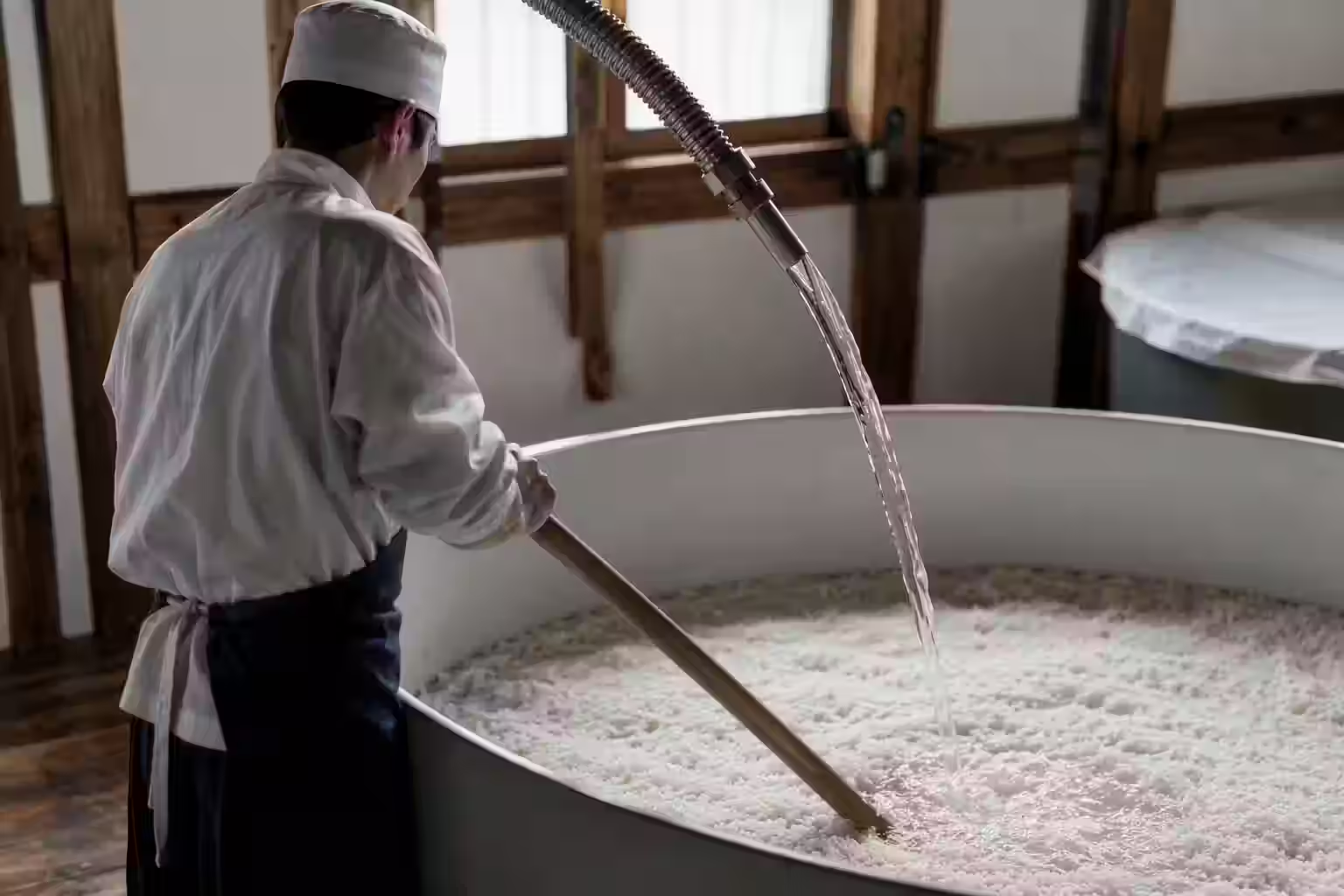
Kumimizu buai (汲水歩合) is sake’s water-to-rice ratio. Brewers calculate it by dividing the brewing water in liters by the total rice in kilograms, then multiplying by 100. Most breweries work somewhere between 125 and 135 percent.
That single number decides a great deal. It sets how thick the mash runs, how hard the yeast has to work, and whether the finished sake lands rich or crisp. Brewers fix it before a single grain enters the tank.
The Japan Sake and Shochu Makers Association defines the term as the percentage of water relative to total polished rice weight. Their glossary gives 130 percent as the usual figure. The Nada Sake Research Association, working from Hyogo brewing practice, cites a slightly wider band of 125 to 135 percent.
So why does almost nobody outside Japan discuss it? Partly because breweries never print it on labels. Partly because English guides jump straight from rice polishing to tasting notes, skipping the mash entirely.
Yet anyone who opens a Japanese brewing textbook meets kumimizu buai within the first few pages. It sits alongside polishing ratio and koji ratio as one of the three numbers that define a recipe.
This article covers the formula, the values brewers actually use, and the science behind them. It also follows the parameter through history, across sake styles, and into the glass. By the end, a plain percentage should look less like arithmetic and more like a design decision.
Quick Facts About Kumimizu Buai
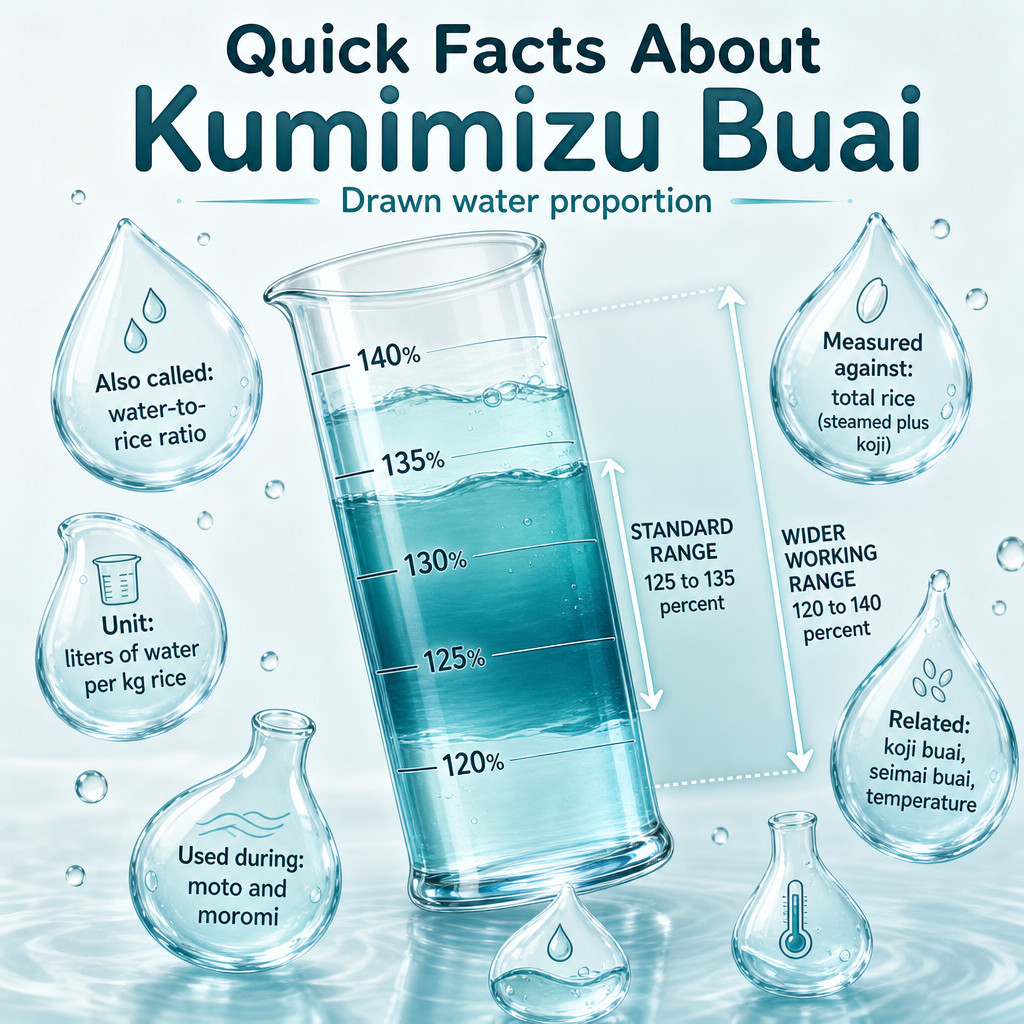
Here is the shape of the term at a glance, before we get into detail.
- Japanese name: 汲水歩合 (kumimizu buai)
- Literal meaning: “drawn water proportion”
- English translation: water-to-rice ratio, or brewing water ratio
- Unit: percentage, calculated as liters of water per kilogram of rice
- Standard range: 125 to 135 percent, according to Japanese brewing references
- Wider working range: roughly 120 to 140 percent across styles
- Used during: the moto (yeast starter) and the moromi (main mash)
- Measured against: total rice, meaning steamed rice plus koji rice, counted as polished white rice weight
- Related parameters: koji buai (koji ratio), seimai buai (polishing ratio), mash temperature
- Shown on labels: no, and Japanese labeling rules do not require it
Which Number Is Which: Four Sake Ratios Compared
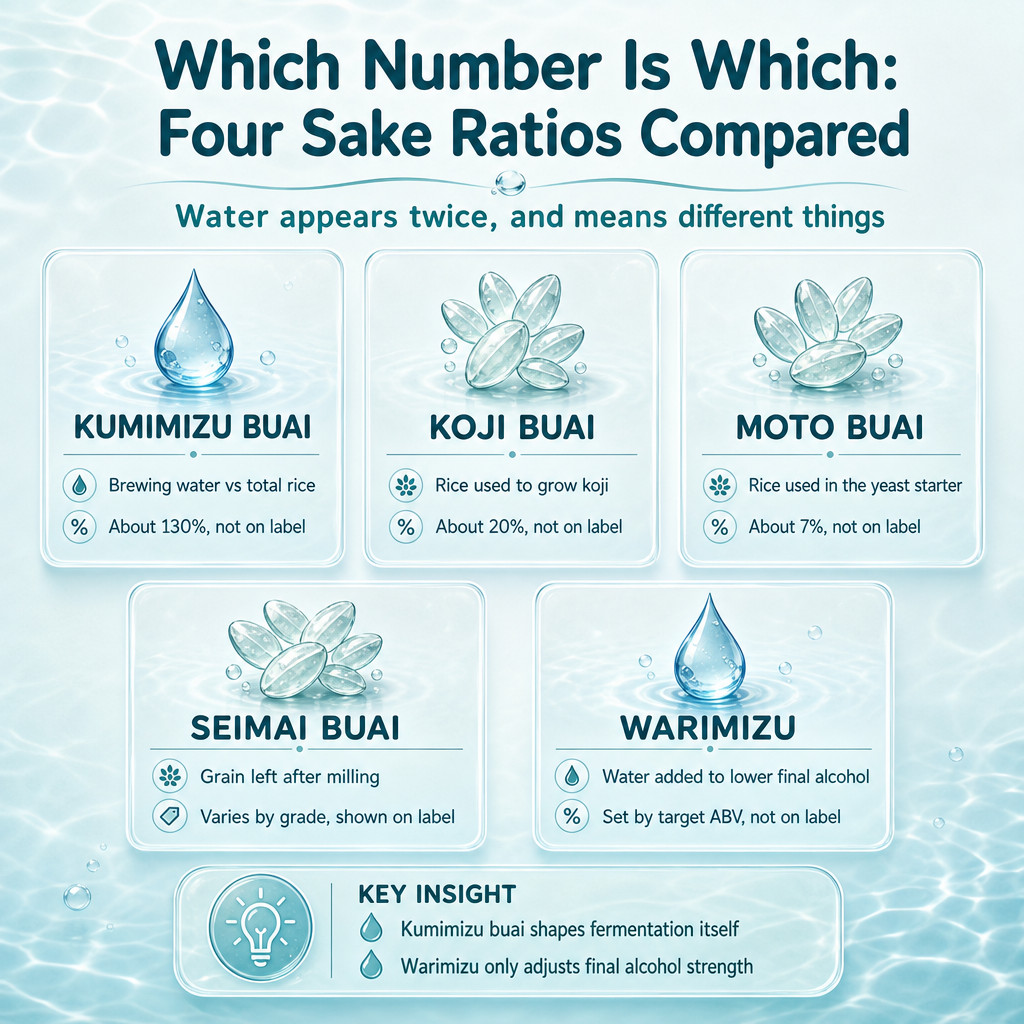
Sake brewing uses several percentages, and English writing mixes them up constantly. The most frequent confusion involves kumimizu buai and warimizu, since both concern water. Sorting them out first makes everything afterwards easier.
| Term | What it measures | Standard value | On the label? |
|---|---|---|---|
| Kumimizu buai (汲水歩合) | Brewing water against total rice | About 130% | No |
| Koji buai (麹歩合) | Share of total rice used to grow koji | About 20% | No |
| Moto buai (酒母歩合) | Share of total rice used in the yeast starter | About 7% | No |
| Seimai buai (精米歩合) | Share of the grain remaining after milling | Varies by grade | Yes, for tokutei meisho-shu |
| Warimizu (割水) | Water added to lower final alcohol | Set by target ABV | No |
The first three figures come from Japan’s National Tax Agency, which lists them together as the standard raw material proportions for a modern mash. Notice how they interlock. Roughly a fifth of the rice becomes koji, a much smaller share feeds the starter, and water outweighs the whole lot.
One point deserves emphasis. Kumimizu buai shapes how the sake ferments, while warimizu only adjusts the finished liquid. Mixing the two produces the single most common error in English sake writing.
What Is Kumimizu Buai?
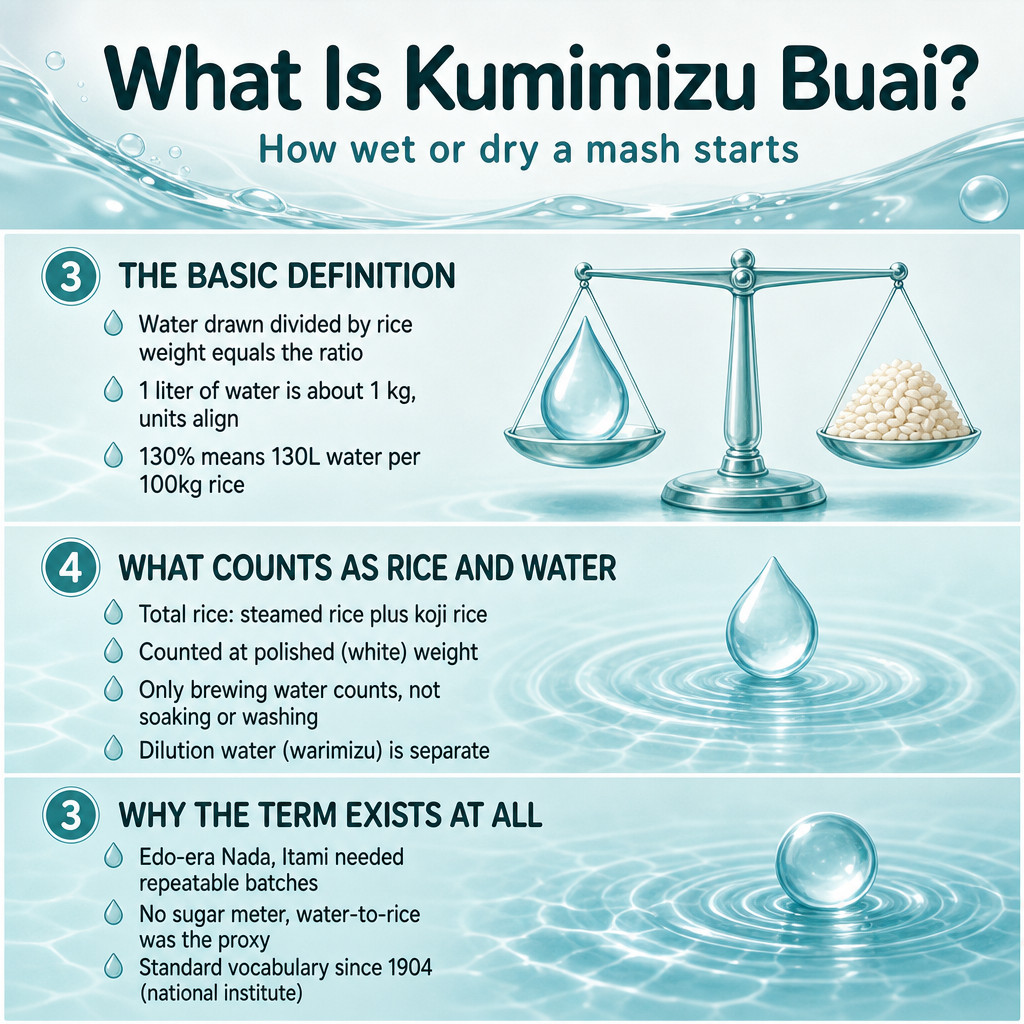
In short, kumimizu buai tells you how wet or dry a sake mash starts out. The rest of this section explains what goes into that measurement and why brewers bothered to name it.
The Basic Definition
Kumimizu means the water drawn for a batch. Buai means proportion or ratio. Together they describe how much brewing water a batch receives against the weight of rice it uses.
The comparison mixes units, which surprises newcomers. Water gets counted in liters, while rice gets counted in kilograms. Because one liter of water weighs about one kilogram, the mismatch causes no real trouble in practice.
A ratio of 130 percent therefore means 130 liters of water for every 100 kilograms of rice. That sentence covers most of what a beginner needs. Everything else builds on it.
What Counts as Rice, and What Counts as Water
Total rice, or somai in Japanese, includes both the steamed rice added directly and the rice used to grow koji. Both get counted at their polished white weight, not their brown weight. Brewers therefore weigh rice after milling, not before.
The water side counts only the brewing water added to the mash. Soaking water and washing water sit outside the calculation, since those get drained away. Dilution water added at the very end also stays outside, because that step belongs to warimizu.
Standard practice measures the ratio up to the final addition of the three-stage build, known as tome-zoe. Some breweries also track a separate figure for the yeast starter alone. Both numbers appear in brewing records, so context matters when comparing one brewery with another.
Why the Term Exists At All
Sake brewing scaled up early. By the Edo period, large operations in Nada and Itami were producing at commercial volume, and repeatability became a business necessity. A shared vocabulary for mash proportions let brewers reproduce a good batch.
Before modern chemistry, nobody could measure sugar concentration directly. However, anyone could measure a bucket of water against a sack of rice. The ratio became a proxy for everything downstream, which is precisely why it survived into the laboratory era.
The National Research Institute of Brewing, Japan’s national alcohol research body since 1904, treats kumimizu buai as standard technical vocabulary. So do prefectural brewing laboratories and practical training courses. The term is textbook material, not brewery jargon.
How Kumimizu Buai Is Calculated
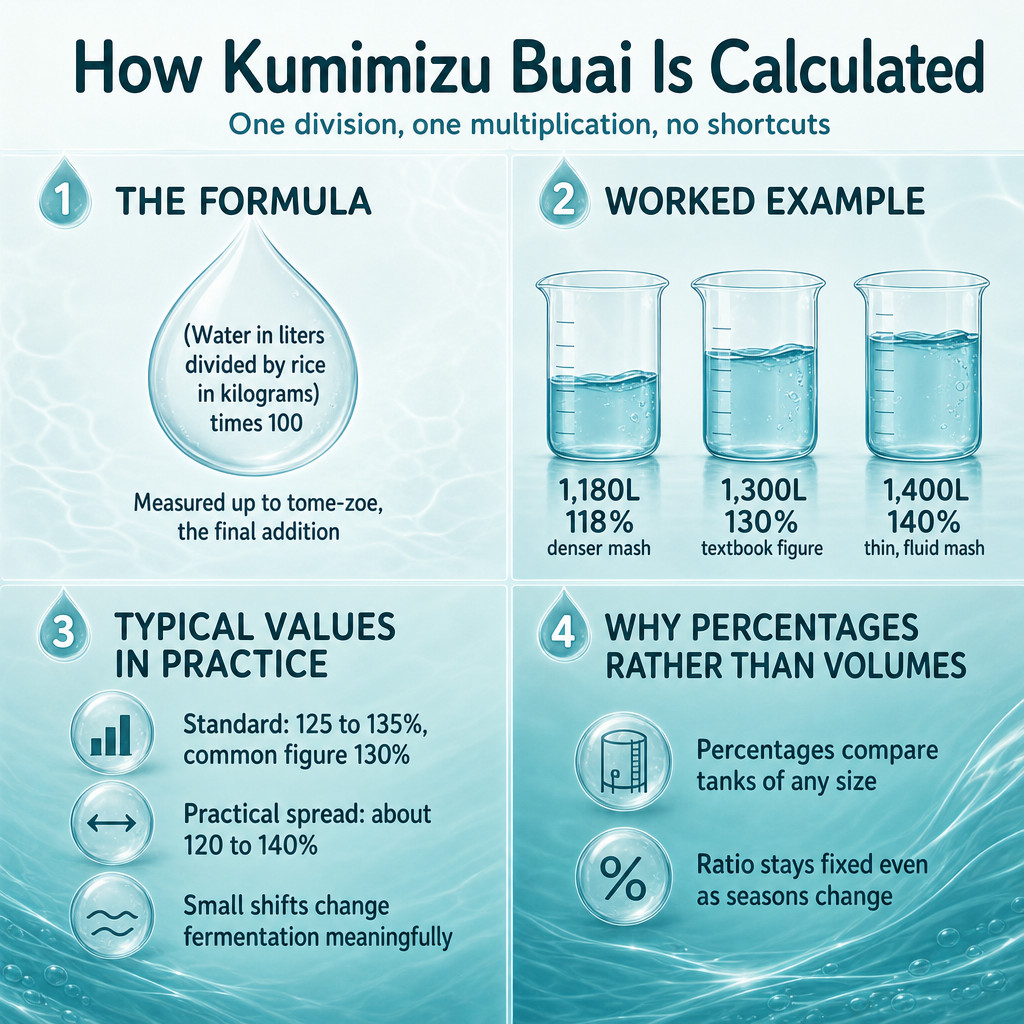
The calculation involves one division and one multiplication. No correction factors, no temperature adjustments, no hidden constants.
The Formula
Kumimizu buai (%) = (brewing water in liters ÷ total rice in kilograms) × 100
Both figures run up to tome-zoe, the third and final addition. Nothing else enters the equation.
A Worked Example
Imagine a mid-size batch built on 1,000 kilograms of total rice. Of that, 200 kilograms becomes koji and 800 kilograms goes in as steamed rice. The brewery draws 1,300 liters of water across the three additions.
Divide 1,300 by 1,000, then multiply by 100. The result is 130 percent, a textbook figure.
Now change one variable. Keep the rice at 1,000 kilograms, but draw only 1,180 liters. The ratio drops to 118 percent, and the mash becomes noticeably denser from day one.
Push the other way instead, to 1,400 liters. That gives 140 percent, a thin and fluid mash. Between those two figures lies almost every sake on the market.
Typical Values in Practice
Japanese brewing references converge on a narrow band. The Nada Sake Research Association gives 125 to 135 percent as standard, while the Japan Sake and Shochu Makers Association cites 130 percent as the usual figure. Industry writing generally puts the practical spread at roughly 120 to 140 percent.
Individual breweries do move outside that spread, though published figures are scarce. Formulations are usually treated as internal information, so precise outliers are hard to verify. Anyone quoting a very low or very high number should be able to name the brewery and the product.
Small adjustments matter more than they look. A shift from 128 to 134 percent changes the starting sugar concentration measurably. Consequently, the yeast experiences a different environment from the very first day.
Why Percentages Rather Than Volumes
A percentage travels between tank sizes without breaking. A small brewery running 300 kilogram batches and a large one running 6,000 kilogram batches can compare notes directly. Raw liter counts would tell them nothing useful.
The ratio also survives across seasons. Rice absorbs water differently in cold weather, yet the target ratio stays fixed while the brewer adjusts elsewhere. In short, the percentage acts as a stable reference point in an unstable process.
Why the Water-to-Rice Ratio Matters
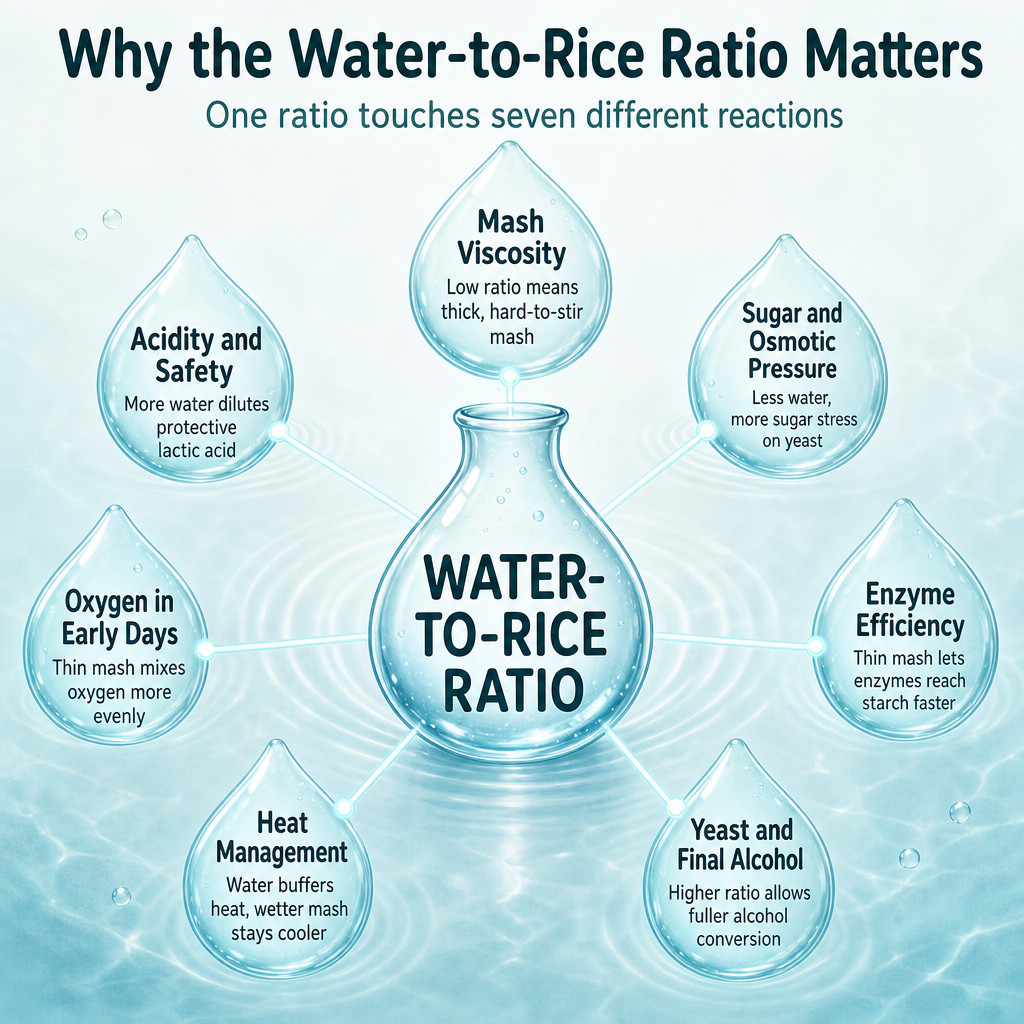
This is where a simple number turns into chemistry. Sake ferments through multiple parallel fermentation, described in our guide to sake fermentation. Koji enzymes release sugar while yeast consumes it, both at once, inside the same tank.
Water is the medium in which that double act takes place. Change the amount of water, and you change every reaction rate involved.
Mash Viscosity and Physical Handling
A low ratio produces a heavy, porridge-like mash. Stirring it takes real effort, especially in the first days before the rice dissolves. Brewery workers feel this immediately in their arms and shoulders.
Thick mash also traps carbon dioxide. Foam rises higher and behaves less predictably, so tanks need more headspace. Some breweries simply cannot run very low ratios because their equipment will not cope.
Sugar Concentration and Osmotic Pressure
Less water means a higher sugar concentration once saccharification begins. Yeast cells sitting in concentrated sugar face osmotic stress, so they work more slowly. That stress is not automatically bad, since a slower fermentation often builds finer aroma.
More water dilutes the sugar and eases that pressure. Yeast then multiplies and ferments more freely. As a result, more of the available sugar converts to alcohol, and less remains as sweetness.
Enzyme Efficiency and Saccharification
Koji enzymes need water to reach starch. In a very thick mash, enzymes and substrate meet less efficiently, and saccharification lags. Meanwhile, in a thin mash the enzymes disperse widely and act quickly.
Speed alone does not decide quality. If sugar appears faster than yeast can use it, the mash grows sweet and sluggish. Balance between the two rates is the real goal, and kumimizu buai is one lever for tuning it.
Yeast Activity and Final Alcohol
Sake yeast tolerates alcohol levels that would kill most wine strains. Undiluted mash can approach 20 percent alcohol, which is remarkable for any fermented drink. Water ratio influences how close a batch gets to that ceiling.
Higher ratios generally allow fuller attenuation, so more sugar disappears. Lower ratios often leave residual sweetness behind. Still, yeast strain and temperature can override this tendency completely, which is why brewers never treat the ratio in isolation.
Heat Management Inside the Tank
Fermentation releases heat, and a lot of it. Water absorbs that heat and buffers temperature swings, so a wetter mash tends to be more stable. Conversely, a dense mash heats up faster and holds warmth in pockets.
Temperature control is central to premium brewing. Cold, slow fermentation produces the floral aromatics that define ginjo styles. Because of that, ratio and cooling capacity get planned together rather than separately.
Oxygen in the Early Days
Yeast needs a little oxygen early on to build healthy cell membranes. Stirring introduces that oxygen, and mash thickness changes how effectively stirring works. A thin mash mixes evenly with modest effort.
Thicker mash resists mixing, so oxygen distributes unevenly. Skilled workers compensate through timing and technique. This is one of many places where a number on paper becomes a physical skill on the brewery floor.
Acidity and Microbial Safety
Sake mash defends itself chemically rather than through sterilization. Lactic acid from the starter keeps the pH low, which discourages unwanted bacteria. Water dilutes that acid, so a very wet mash offers slightly weaker protection.
Brewery microbiology research describes a crowded environment. Lactic acid bacteria, wild yeast, and spoilage organisms all inhabit working breweries, and the mash competes with them from day one. Brewers therefore treat early acidity as a safety margin, not merely a flavor choice.
The three-stage build exists partly for this reason. Adding water gradually lets acidity stay concentrated while the yeast population establishes itself. Only afterwards does the mash reach its full, diluted volume.
Low Versus High Kumimizu Buai
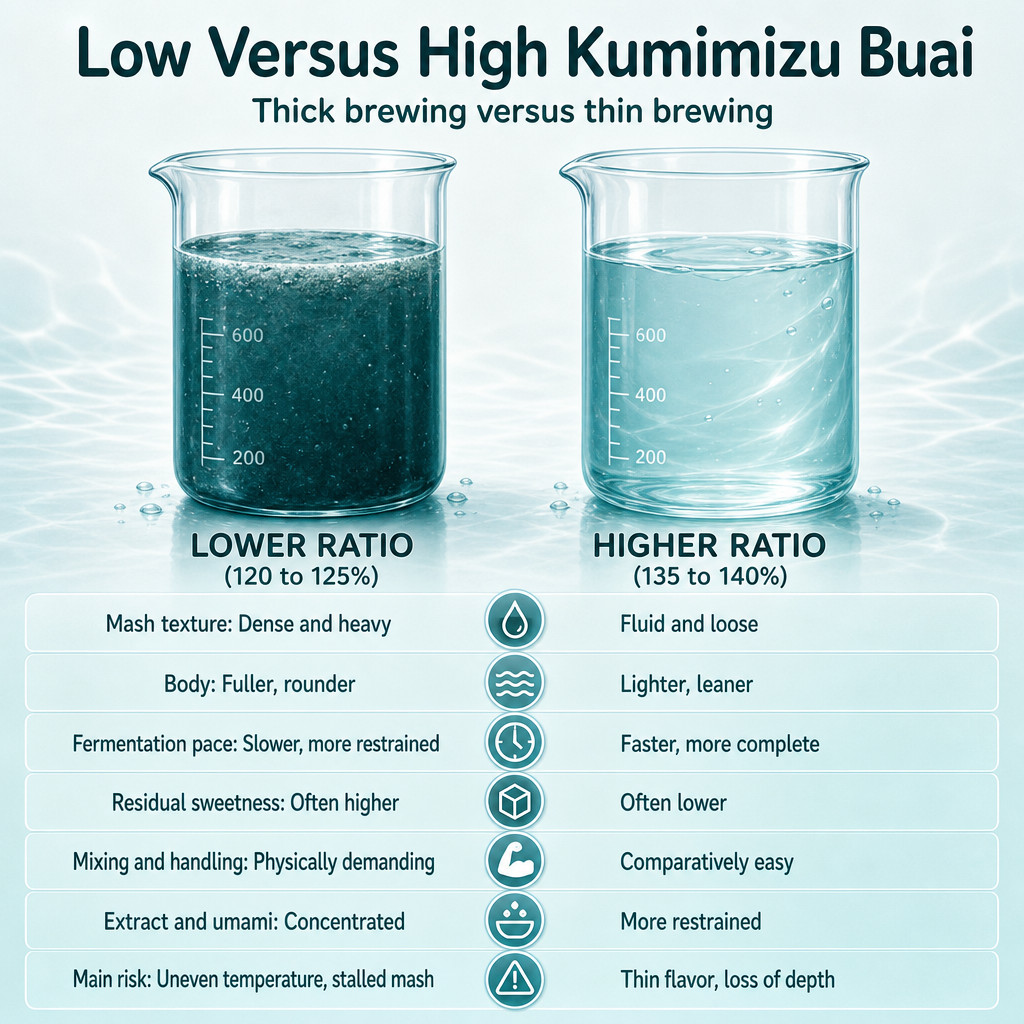
Brewers talk about thick brewing and thin brewing almost as personality types. The vocabulary is loose, yet the tendencies are consistent. Here is a compact comparison.
| Aspect | Lower ratio (around 120 to 125%) | Higher ratio (around 135 to 140%) |
|---|---|---|
| Mash texture | Dense and heavy | Fluid and loose |
| Body in the glass | Fuller, rounder | Lighter, leaner |
| Fermentation pace | Slower, more restrained | Faster, more complete |
| Residual sweetness | Often higher | Often lower |
| Mixing and handling | Physically demanding | Comparatively easy |
| Extract and umami | Concentrated | More restrained |
| Main risk | Uneven temperature, stalled mash | Thin flavor, loss of depth |
The Case for a Lower Ratio
Concentration is the obvious attraction. Amino acids, sugars, and aromatic compounds all end up less diluted, so the sake carries more weight. Brewers chasing umami-driven, food-friendly styles often work down here.
There is a cost, though. Fermentation can stall, temperature can spike locally, and the physical work multiplies. Small breweries with hand-mixed tanks feel every one of those costs directly.
The Case for a Higher Ratio
A wetter mash behaves predictably. Yeast works cleanly, temperature stays manageable, and the fermentation curve looks tidy in the logs. For crisp, dry regional styles, that predictability is exactly the goal.
Push too far, however, and the sake thins out. Aromatic intensity fades and the finish grows short. Water is a tool, not a shortcut, and every brewer learns that lesson eventually.
Neither Number Is Correct
It would be convenient if one figure produced better sake. Reality refuses to cooperate. A 122 percent junmai and a 138 percent honjozo can both be excellent, because each serves a different intention.
The right ratio depends on the rice, the water, the yeast, and the flavor the brewery wants. That is why brewing logs matter more than rules of thumb. Experience fills the gap that arithmetic leaves open.
How Kumimizu Buai Works With Other Parameters
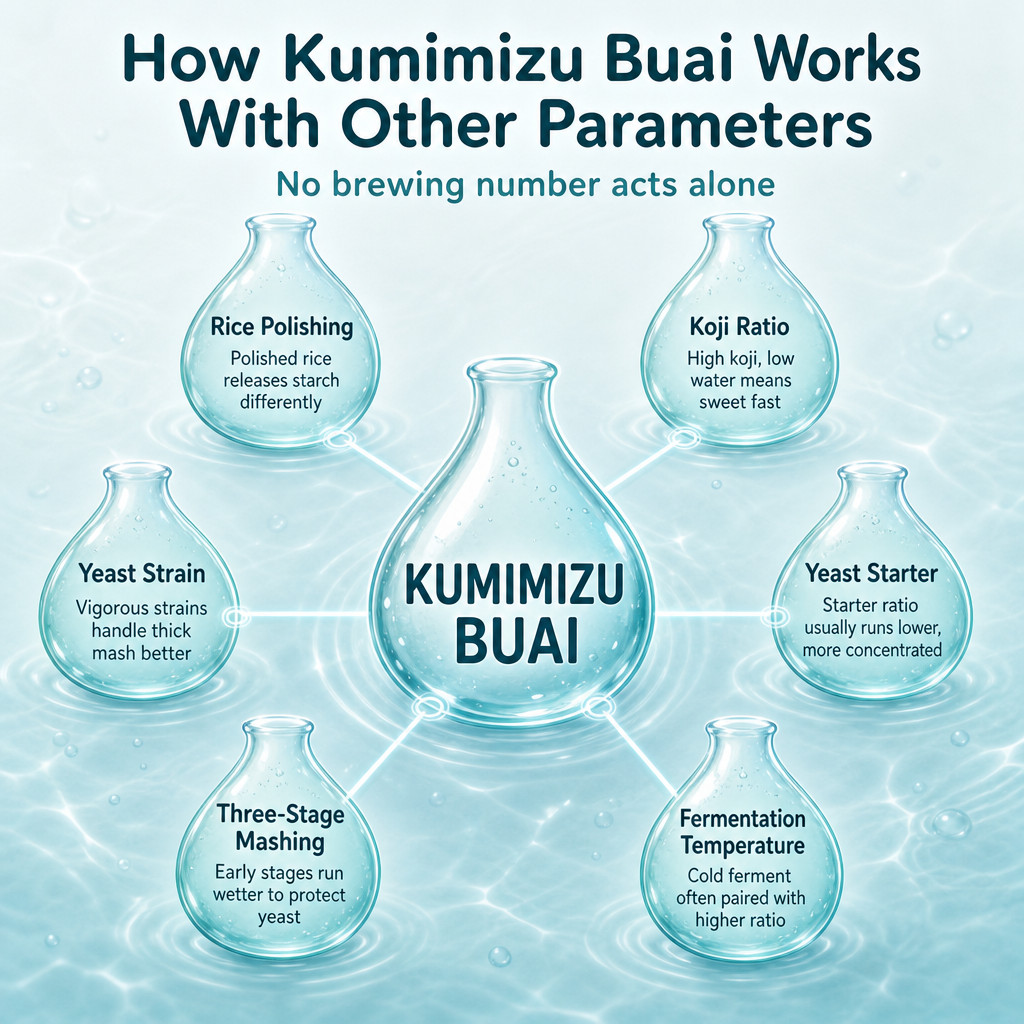
No brewing number acts alone. Kumimizu buai belongs to a cluster of decisions collectively called the shikomi haigo, or mash formulation. Each element pulls on the others.
Rice Polishing Ratio
Highly polished rice dissolves differently from lightly polished rice. It carries less protein and fat, and it releases starch more readily. Brewers therefore adjust water to match how the grain behaves.
Published research supports the broader point that milling shapes fermentation. One study of commercial mashes linked polishing ratio to peak mash gravity, peak temperature, and final alcohol. It did not examine water ratio directly, yet it shows how sensitive the mash is to raw material changes.
Koji Ratio (Koji Buai)
Koji buai is the share of total rice used for koji, usually around 20 percent. More koji means more enzymes and faster sugar release. Combine a high koji ratio with a low water ratio, and the mash can turn very sweet very quickly.
Brewers therefore treat the pair as a balance. Raising one often means moderating the other. This interaction is arguably the most important relationship in mash design.
Yeast Strain
Different strains handle sugar pressure differently. Some ferment vigorously and shrug off concentrated mash. Others are aroma-focused, delicate, and happier in a thinner environment.
Choosing yeast first and water second is common. Equally, some breweries fix the water ratio by tradition and then select a strain to suit. Either order works, provided the two agree.
The Yeast Starter
The moto has its own water ratio, and it usually runs lower than the main mash. A concentrated starter builds acidity and protects the yeast population. Traditional methods such as kimoto and yamahai depend on that concentration.
Modern sokujo starters add lactic acid directly, which loosens the constraint somewhat. Even so, starter and main mash ratios get planned as a pair. The starter is where yeast first meets the conditions it will face later.
Three-Stage Mashing
The total ratio hides an internal rhythm. Brewers build the mash across three additions, a method called sandan jikomi, and each addition carries its own share of water. Early stages usually run wetter to protect the young yeast.
Later additions bring the mash toward its target. Consequently, two batches with identical final ratios can still ferment very differently. The distribution across stages is its own craft.
Fermentation Temperature
Temperature and water ratio work as partners. Cold fermentation slows everything, so a brewer may compensate with a slightly higher ratio. Warmer fermentation moves fast, and a denser mash can rein it in.
Winter brewing, or kan-zukuri, exists partly for this reason. Cold air gives brewers control that no formula can supply on its own.
Reading the Number in a Brewing Record
Seeing kumimizu buai in context makes it far easier to understand. Every batch generates a formulation sheet, and the ratio sits near the top of it.
What a Formulation Sheet Contains
A typical sheet lists total rice, the split between koji and steamed rice, and the water drawn at each stage. Below that come target temperatures for each day of fermentation. Finally, the brewer records the intended alcohol, acidity, and sweetness level.
Nothing on the sheet stands alone. A ratio of 132 percent means one thing beside a 20 percent koji ratio, and something different beside 23 percent. Reading a single figure without its neighbours tells you very little.
Adjusting Through the Season
Rice does not behave identically from October to March. New-crop grain absorbs water eagerly, while later batches can turn stubborn. Brewers therefore tweak the ratio slightly as the season progresses.
Steaming quality also shifts the picture. Firmer steamed rice dissolves slowly, so the effective concentration runs higher than the paper figure suggests. Experienced brewers read that difference within the first two days and often adjust their cooling schedule rather than the recipe.
Weather intervenes as well. A mild winter forces more aggressive temperature management, and some breweries respond by loosening the mash a little. Others hold the ratio fixed and fight the weather with equipment.
The Link to Sake Meter Value and Acidity
Two numbers appear on many sake labels, and both connect back to the mash. Sake meter value indicates residual sugar, while acidity indicates acid content. A concentrated mash often trends toward a sweeter reading with firmer acidity.
That link is a tendency, not a formula. Yeast strain, koji enzymes, and fermentation length all interfere with the pattern. Nevertheless, if you know a brewery’s house style, the label numbers hint at how they build their mash.
Kumimizu Buai Across Sake Styles
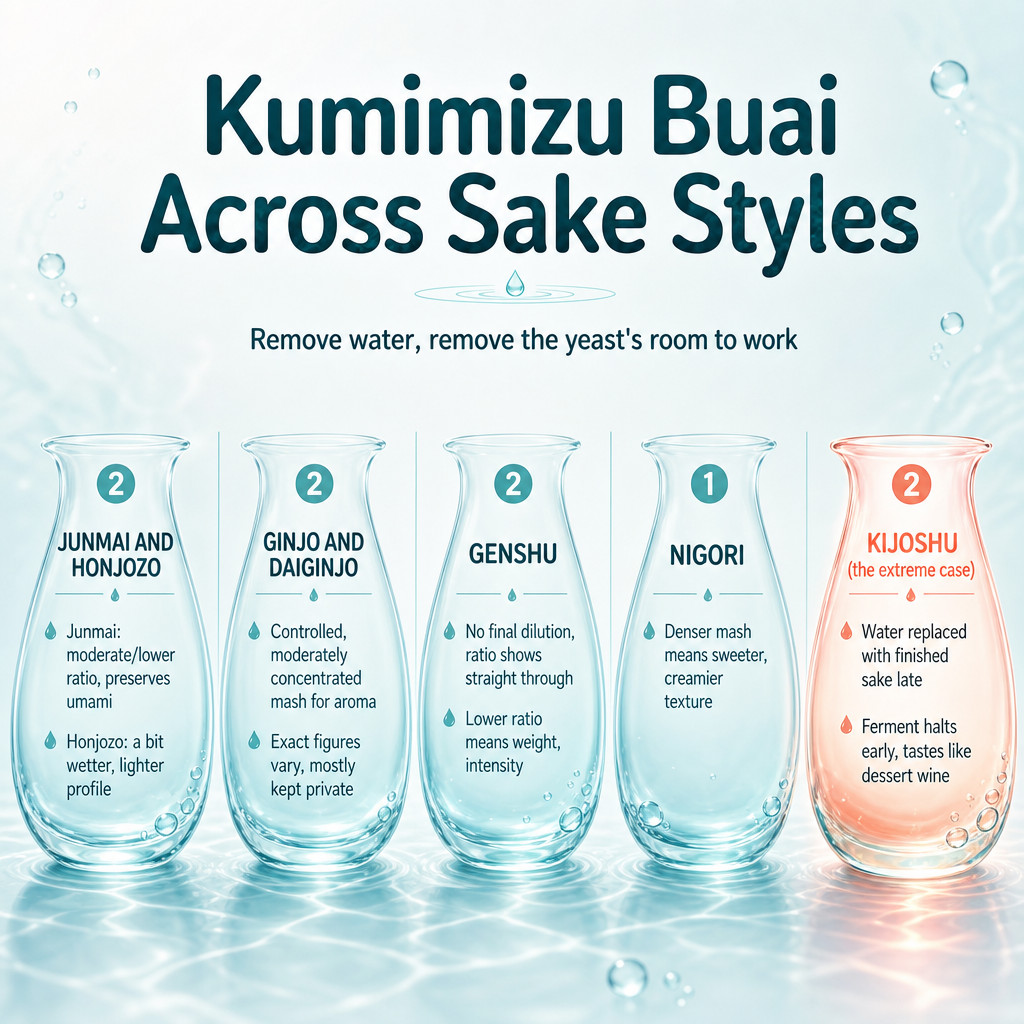
Styles do not have fixed ratios, and any brewery may break the pattern. The tendencies below come from general brewing practice rather than from published brewery data. Still, they help explain why categories taste the way they do.
Junmai and Honjozo
Rice-forward junmai often leans toward moderate or lower ratios. That choice preserves extract and amino acid content, which supports umami. Honjozo styles, aiming for a lighter profile, frequently run a little wetter.
Ginjo and Daiginjo
Highly polished rice ferments cleanly and slowly at low temperature. Many daiginjo recipes therefore use a controlled, moderately concentrated mash to build aroma without overstressing the yeast. Specific numbers vary widely between breweries, and most keep them private.
Genshu
Genshu skips the final dilution, so the mash ratio survives into the bottle unchanged. A lower kumimizu buai therefore shows up very directly as weight and intensity. Drinkers who find genshu overwhelming are often reacting to that concentration.
Nigori
Nigori keeps rice solids in suspension, and texture becomes part of the appeal. Water ratio influences how thick that texture feels. Sweeter, creamier nigori usually starts from a denser mash.
Kijoshu, the Extreme Case
Kijoshu replaces part of the brewing water with finished sake at the final addition. In effect, the water ratio drops sharply for that stage. Fermentation halts early, sugar remains, and the result tastes closer to a dessert wine.
That style demonstrates the principle better than any chart. Remove water, and you remove the yeast’s room to work.
A Short History of Water Ratios
Here the story gets genuinely surprising. Old brewing manuals record their formulations, and historians have converted them into modern percentages. Those numbers show that sake was once brewed with roughly half the water used today.
Muromachi Temple Brewing: Around 75 Percent
The Goshu no Nikki, a brewing memorandum from the Nanbokucho and early Muromachi eras, describes a two-stage winter method. Analysis of its formulation gives a koji ratio near 37.5 percent and a water ratio of about 75 percent.
Both figures sit far outside modern practice. The historian Shuji Horie concludes that such a mash produced a rich, sweet sake heavy in amino acids. Picture something closer to a thick amazake than to a bottle on a shop shelf today.
Early Edo: Still Below 70 Percent
The Domo Shuzoki, an early Edo technical manual describing brewing at Konoike, records a cold-season three-stage method. Its starter ratio runs near 8 percent and its koji ratio near 23 percent, both close to modern values. Its water ratio, however, sits at only 66 to 70 percent.
So the koji and starter proportions settled centuries before the water did. Sake of this period was correspondingly sweet. Sugar was still scarce and expensive, which likely shaped what drinkers expected.
Late Edo Nada: The Jump to 120 Percent
By 1848, formulations recorded in Nada show a water ratio of 120 percent. Koji and starter proportions had barely moved, yet the water had nearly doubled. The resulting sake was much drier.
Two explanations are usually offered. Technically, the mineral-rich miyamizu of Nada Gogo drove vigorous fermentation, which a wetter mash could support. Culturally, sugar had become widely available, so cooking turned sweeter and drinkers wanted a drier counterpart.
The Tomizu Vocabulary
That 120 percent figure has an old name. Before metric units, one koku of white rice weighed roughly 150 kilograms while one koku of water measured about 180 liters. A batch drawing exactly that much water was called tomizu, written 十水.
Adding another to of water gave juichi-mizu at roughly 132 percent, with an intermediate setting near 126 percent. Late Edo Nada, in other words, had arrived at exactly tomizu. The vocabulary and the practice line up neatly.
Meiji Science and Soft-Water Brewing
The brewing research institute that became the NRIB opened in 1904 under the Ministry of Finance. Researchers began measuring mash gravity, acidity, and alcohol systematically. Standard values emerged, along with an explanation for why very low ratios stalled fermentation.
One earlier breakthrough deserves particular attention. Senzaburo Miura published his soft-water brewing method in Hiroshima in 1898, after years of frustration with local water. Soft water lacks the minerals that feed yeast, so his mashes had repeatedly lagged.
Part of his solution was more water, not less. He extended the first two additions out to juyon-mizu, fourteen measures, which converts to roughly 168 percent for those stages. Combined with a lower koji ratio and cold fermentation, the method finally let soft water yield clean, competitive sake.
The Picture Since the Late Twentieth Century
Lighter, drier sake gained ground from the 1980s onward, and brewing practice followed consumer taste. More recently, the craft revival has pulled some breweries back toward denser mashes and traditional starters. Both approaches now sit side by side on shop shelves.
A handful of producers have also begun publishing their formulations openly. That transparency remains uncommon, yet it is a genuine change from a few decades ago.
Traditional and Modern Brewing Practice

The same percentage means different daily work depending on the brewery. Scale, equipment, and local water all change what the number demands.
Small Breweries and Hand Work
In a small kura, the water ratio is a physical reality. Workers mix by hand with long wooden poles, and a dense mash punishes them for it. The toji weighs flavor goals against what the team can realistically manage.
Judgment also happens by feel. Experienced kurabito read the mash by the sound of stirring and the drag on the pole. Numbers guide them, yet the hands make the final call.
Larger Breweries and Precision
Bigger operations meter water automatically and log every figure. Temperature sensors track the mash continuously, and jacketed tanks correct drift within hours. Under those conditions, a brewery can hold a ratio very tightly indeed.
Precision brings its own advantage. Reproducing last year’s best batch becomes realistic rather than aspirational. Consistency, after all, is what large-scale brewing sells.
Regional Habits and Local Water
Local water chemistry shapes these decisions quietly. Water makes up roughly 80 percent of finished sake, so its mineral profile is never a minor detail. Hard, mineral-rich water such as miyamizu drives vigorous fermentation, while soft water ferments more gently.
Brewers adjust their ratios to compensate, exactly as Miura did in Hiroshima. A soft-water region may run wetter in the early additions to keep fermentation moving. Regions known for crisp, dry styles, including Niigata, have built house traditions around such choices.
Water Ratio and Brewing Economics
There is a commercial side to all this, and brewers do not pretend otherwise. Tank capacity is finite, so mash volume determines how many batches a season allows. A higher ratio fills tanks faster with the same rice.
Yield per kilogram of rice also shifts. More water generally means more finished liquid, though not necessarily more flavor. Breweries balance that trade-off against their pricing and their reputation.
The lees ratio moves too. Dense mashes tend to leave more sake kasu behind at pressing, which reduces liquid yield. Many breweries sell those lees as a product, so the loss is not total.
Then comes dilution at the end. Since most sake gets watered down before bottling anyway, part of the economic argument evens out. Undiluted styles are the exception that proves the rule.
Water Ratios in Other Drinks
Comparison helps put the number in perspective. Beer brewers use a liquor-to-grist ratio during mashing, commonly around two to four liters per kilogram of malt. That is far wetter than any sake mash.
Winemakers add no water at all in most jurisdictions. Grapes arrive already full of juice, so dilution is unnecessary and frequently prohibited. The contrast highlights how unusual grain-based brewing really is.
Shochu producers work with their own ratios during primary and secondary mashing. Their goal differs, since distillation follows fermentation. Sake sits at the concentrated end of the fermented drinks spectrum, which explains its unusually high natural alcohol.
The comparison also reveals why sake needs koji at all. Beer wort separates sugar from grain before fermentation begins, so the yeast meets a clean liquid. Sake keeps rice, enzymes, and yeast together in one dense suspension for weeks.
That single design choice makes water ratio disproportionately powerful. In beer, water mostly determines extraction efficiency. In sake, it governs the entire environment where two organisms work side by side.
What Kumimizu Buai Tastes Like in the Glass
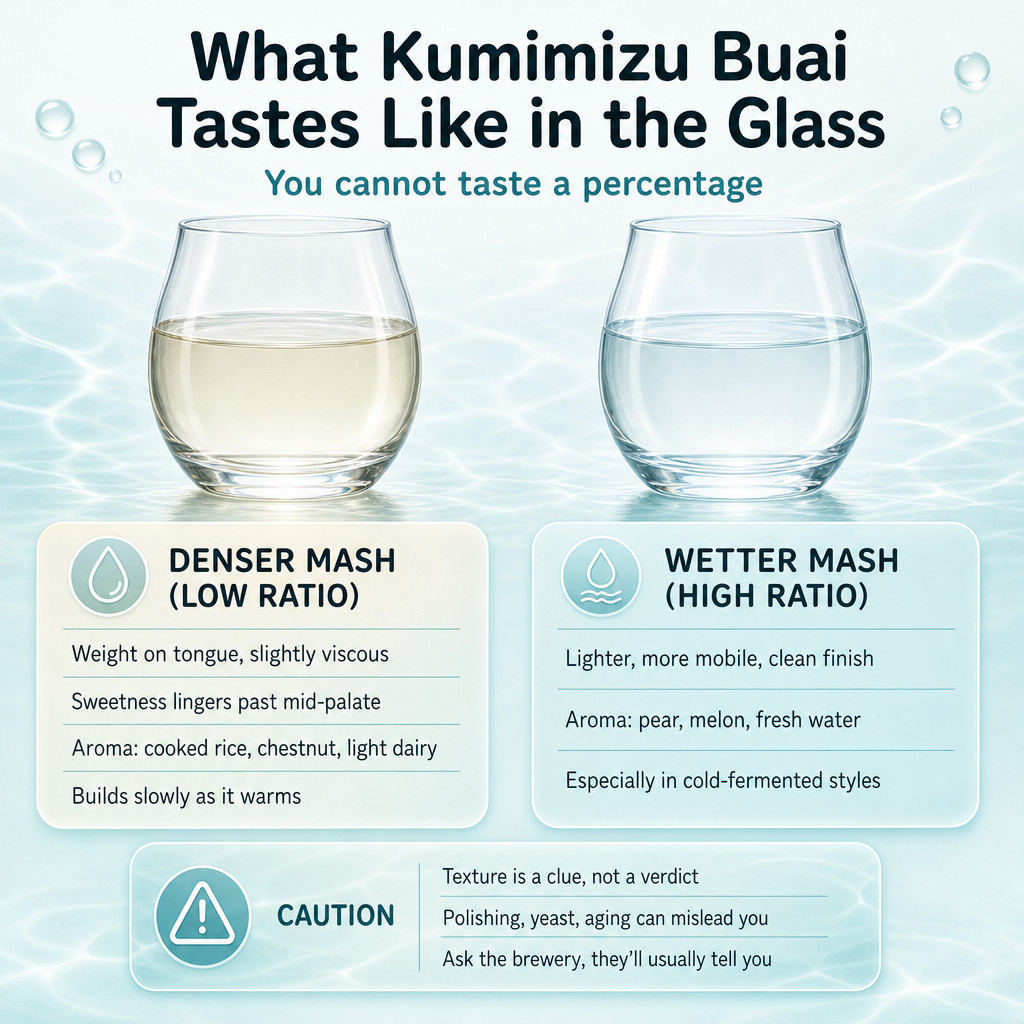
Here is the honest part. You cannot taste a percentage, and anyone who claims otherwise is guessing. What follows describes tendencies our editors have noticed, offered as tasting impressions rather than verified fact.
Sake from a denser mash usually arrives with weight on the tongue. The texture feels slightly viscous, almost coating, and sweetness lingers past the mid-palate. Rice character comes forward, sometimes with a nutty or grain-porridge warmth behind it.
Aromatically, those sakes tend toward cooked rice, steamed chestnut, and light dairy notes. They rarely leap out of the glass. Instead, the aroma builds slowly as the liquid warms in your hand.
Sake from a wetter mash behaves differently. It feels lighter and more mobile, and the finish cuts away cleanly. Aromas skew toward pear, melon, and fresh water, especially in cold-fermented styles.
A word of caution belongs here. Tasting blind, our team has called a sake thickly brewed and turned out completely wrong, because a low-temperature ferment had thinned the impression. Polishing ratio, yeast, and aging all muddy the signal.
So treat texture as a clue rather than a verdict. If a sake feels dense and sweet-edged with low acidity, a concentrated mash is a reasonable guess. Ask the brewery, though, because they will usually tell you.
Common Misconceptions
Four ideas about water ratio circulate widely in English sake writing. Each contains a grain of truth, and each misleads in practice.
“More Water Means Weaker Sake”
This sounds obvious and is frequently wrong. Adding water to the mash gives yeast a friendlier environment, so fermentation often runs further. Higher ratios can therefore produce sake with equal or greater alcohol, just less residual sugar.
Dilution before bottling is a separate step entirely. Confusing warimizu with kumimizu buai remains the single most common mistake among English-language readers.
“Water Ratio Alone Sets the Alcohol Level”
Alcohol depends on total fermentable sugar and on how much of it the yeast consumes. Water ratio influences both, yet so do koji activity, strain choice, and temperature. Treating it as a single dial oversimplifies badly.
“A Higher Ratio Always Improves Fermentation”
Up to a point, extra water genuinely helps. Beyond that point, the mash grows too dilute, acidity drops, and spoilage risk climbs. Balance beats maximization, as it does almost everywhere in brewing.
“You Can Read It From the Label”
Japanese rules require the polishing ratio on tokutei meisho-shu, the special designation categories. Kumimizu buai appears in no labeling requirement at all. If you want the figure, a brewery tour or a direct question is your only reliable route.
Final Thoughts
Kumimizu buai looks like accounting and behaves like architecture. It sets the space in which yeast, enzymes, and rice negotiate with each other for a month. Every other decision in the tank happens inside that space.
What makes it fascinating is how far the number has travelled. Muromachi temple brewers worked near 75 percent, early Edo brewers near 70, late Edo Nada at 120, and modern breweries at about 130. Sake did not simply get better over those centuries. It got drier, and this ratio is where that shift is written down.
Three practical steps follow from all this. First, stop treating warimizu and kumimizu buai as the same thing. Second, when a sake feels unexpectedly dense or surprisingly light, read that texture as a deliberate choice rather than an accident.
Third, ask directly. On a brewery tour, a simple question works well: what water ratio do you use for this product, and why that number? Most brewers enjoy the question, because visitors almost never ask it.
If you want to follow the thread further, our guides to how sake is made and the wider world of Japanese sake pick up where this one stops.
Kumimizu Buai FAQ
How do brewers calculate kumimizu buai?
They divide the brewing water in liters by the total rice in kilograms, then multiply by 100. Total rice includes both steamed rice and the rice used for koji, counted at polished weight. Both figures run up to tome-zoe, the final addition of the three-stage build. Washing water and final dilution water stay outside the formula.
What is a typical kumimizu buai value?
Japanese brewing references give 125 to 135 percent as standard, and 130 percent appears most often. Industry writing puts the wider practical spread at roughly 120 to 140 percent. Richer styles sit lower, while light and dry styles sit higher. Breweries rarely publish their exact figures.
Does more water make sake weaker?
Not usually, and this surprises many people. Extra water in the mash reduces osmotic stress, so yeast ferments more completely. The result often carries similar alcohol with less residual sweetness. Dilution that actually lowers alcohol happens later, at the warimizu stage.
Is kumimizu buai the same as warimizu?
No, and confusing the two causes real misunderstanding. Kumimizu buai describes water added before and during fermentation. Warimizu describes water added after pressing to adjust the final alcohol level. One shapes how the sake ferments, while the other adjusts the finished product.
How does kumimizu buai affect the taste of sake?
Lower ratios concentrate sugars, amino acids, and aroma compounds, so the sake tends to taste fuller and rounder. Higher ratios spread those compounds through more liquid, giving a lighter and crisper impression. Texture shifts noticeably as well. Yeast strain and fermentation temperature can override these tendencies entirely.
How does kumimizu buai relate to koji buai?
Koji buai is the share of total rice devoted to koji, commonly around 20 percent. More koji means faster sugar release, while less water means higher sugar concentration. Combine both, and the mash can turn very sweet very quickly. Brewers therefore adjust the two together rather than independently.
What happens if the ratio goes too low?
The mash becomes extremely thick and difficult to stir. Heat builds unevenly, so cold spots can form beside warm ones. Yeast may also stall under heavy osmotic pressure, leaving unfermented sugar behind. Kijoshu pushes this principle deliberately by replacing water with finished sake.
Was sake brewed with less water in the past?
Yes, and the difference is dramatic. Muromachi temple brewing manuals point to a ratio near 75 percent, while an early Edo manual records only 66 to 70 percent. Those sakes were thick, sweet, and high in amino acids. Nada had reached 120 percent by 1848, and modern practice sits near 130 percent.
Can I find kumimizu buai on a sake label?
Almost never. Japanese labeling rules cover the polishing ratio for special designation sake, alcohol content, and ingredients, but not mash formulation. A few craft breweries publish their figures voluntarily on websites or technical sheets. Otherwise, a brewery tour or a direct enquiry is the reliable route.
References
- Japan Sake and Shochu Makers Association, Glossary of Sake Terms, https://japansake.or.jp/sake/en/basic/glossary/ (Surveyed: August 2026)
- Japan Sake and Shochu Makers Association, Sake Brewing Processes and Flavor, https://japansake.or.jp/sake/en/professional/sake-brewing-processes-flavor/ (Surveyed: August 2026)
- National Tax Agency of Japan, Koji Mold and Japanese Sake: History and Technology (PDF), https://www.nta.go.jp/taxes/sake/koujikin/pdf/0021012-102_03.pdf (Surveyed: August 2026)
- Nada Sake Research Association, Nada Sake Glossary: Kumimizu Buai, http://www.nada-ken.com/main/jp/index_ku/504.html (Surveyed: August 2026)
- Nada Sake Research Association, Nada Sake Glossary: Kumimizu, http://www.nada-ken.com/main/jp/index_ku/248.html (Surveyed: August 2026)
- National Research Institute of Brewing, About Sake etc., https://www.nrib.go.jp/English/sake/sakeinfo.html (Surveyed: August 2026)
- National Research Institute of Brewing, History of NRIB, https://www.nrib.go.jp/English/about/history.html (Surveyed: August 2026)
- J-Stage, Analysis of Sake Moromi Fermentation by Using the Polishing Ratio of Rice Material, https://www.jstage.jst.go.jp/article/jhej/66/10/66_507/_article/-char/en (Surveyed: August 2026)
- J-Stage, Fermentability of Sake Moromi Prepared with Shochu, Wine, Brewer’s, Alcohol, or Sake Strains of Saccharomyces cerevisiae, https://www.jstage.jst.go.jp/article/jbrewsocjapan1988/93/10/93_10_833/_article (Surveyed: August 2026)
- Frontiers in Microbiology, Sake Brewing and Bacteria Inhabiting Sake Breweries, https://www.frontiersin.org/journals/microbiology/articles/10.3389/fmicb.2021.602380/full (Surveyed: August 2026)
- Bioscience, Biotechnology, and Biochemistry, Rice Used for Japanese Sake Making, https://www.tandfonline.com/doi/full/10.1080/09168451.2019.1574552 (Surveyed: August 2026)
- Molecules (MDPI), The Use of Non-Conventional Yeast in Sake Production, https://www.mdpi.com/1420-3049/30/18/3786 (Surveyed: August 2026)
- Horie, Shuji, Nihonshu no Kita Michi: Rekishi kara Mita Nihonshu Seizoho no Hensen (The Path of Sake: Changes in Brewing Method Seen Through History), Imai Shuppan, 2012 (print, no online edition)
- Yoshida, Hajime, Kindai Nihon no Sakedukuri: Bishu Tankyu no Gijutsushi (Sake Brewing in Modern Japan: A Technical History), Iwanami Shoten, 2013 (print, no online edition)
- Yoshida, Hajime, Sake (Mono to Ningen no Bunkashi 172), Hosei University Press, 2015 (print, no online edition)
- Koizumi, Takeo, Nihonshu Hyakumi Hyakudai, Shibata Shoten, 2000 (print, no online edition)
Related Articles
- Water (水 / Mizu) in Sake Brewing (Surveyed: August 2026)
- Warimizu (割水): Why Water Is Added Before Bottling Sake (Surveyed: August 2026)
- Rice Polishing (精米歩合) (Surveyed: August 2026)
- Koji (麹) in Sake Brewing (Surveyed: August 2026)
- Yeast (酵母) in Sake Brewing (Surveyed: August 2026)
- Moto (酒母): The Yeast Starter of Sake (Surveyed: August 2026)
- Moromi (醪): The Main Fermentation Mash (Surveyed: August 2026)
- Sake Fermentation (発酵) (Surveyed: August 2026)
- Sandan Jikomi: Sake’s Three-Step Mashing Method (Surveyed: August 2026)
- Kimoto (生酛): The Traditional Yeast Starter (Surveyed: August 2026)
- Sokujo (速醸): The Modern Yeast Starter (Surveyed: August 2026)
- Sake Kasu (酒粕): Sake Lees from Brewing to Table (Surveyed: August 2026)
- How Sake Is Made: Step-by-Step Japanese Brewing Guide (Surveyed: August 2026)
- Genshu (原酒): Undiluted Sake (Surveyed: August 2026)
- Types of Japanese Sake (Surveyed: August 2026)
- Japanese Sake Guide (Surveyed: August 2026)





Comments