




Karashi (枯らし) is a conditioning period in sake brewing, and it happens three separate times. Rice rests after polishing, koji rests after leaving the koji room, and the finished starter rests before it enters the main mash. Japanese brewers use the same word for all three pauses, even though the three do quite different things.
English writing usually renders it as drying, which is not quite wrong yet rarely right either. The National Research Institute of Brewing, Japan’s national brewing research body, translates karashi three different ways depending on what is resting. Rice gets a conditioning period. Koji gets cooling and drying. The starter gets storage.
So this guide treats karashi as three related ideas rather than one process. We will follow the same order the brewery does: rice first, then koji, then moto. Along the way, you will see why the brewer waits at all, and why a single translation keeps failing.
Quick Facts About Karashi
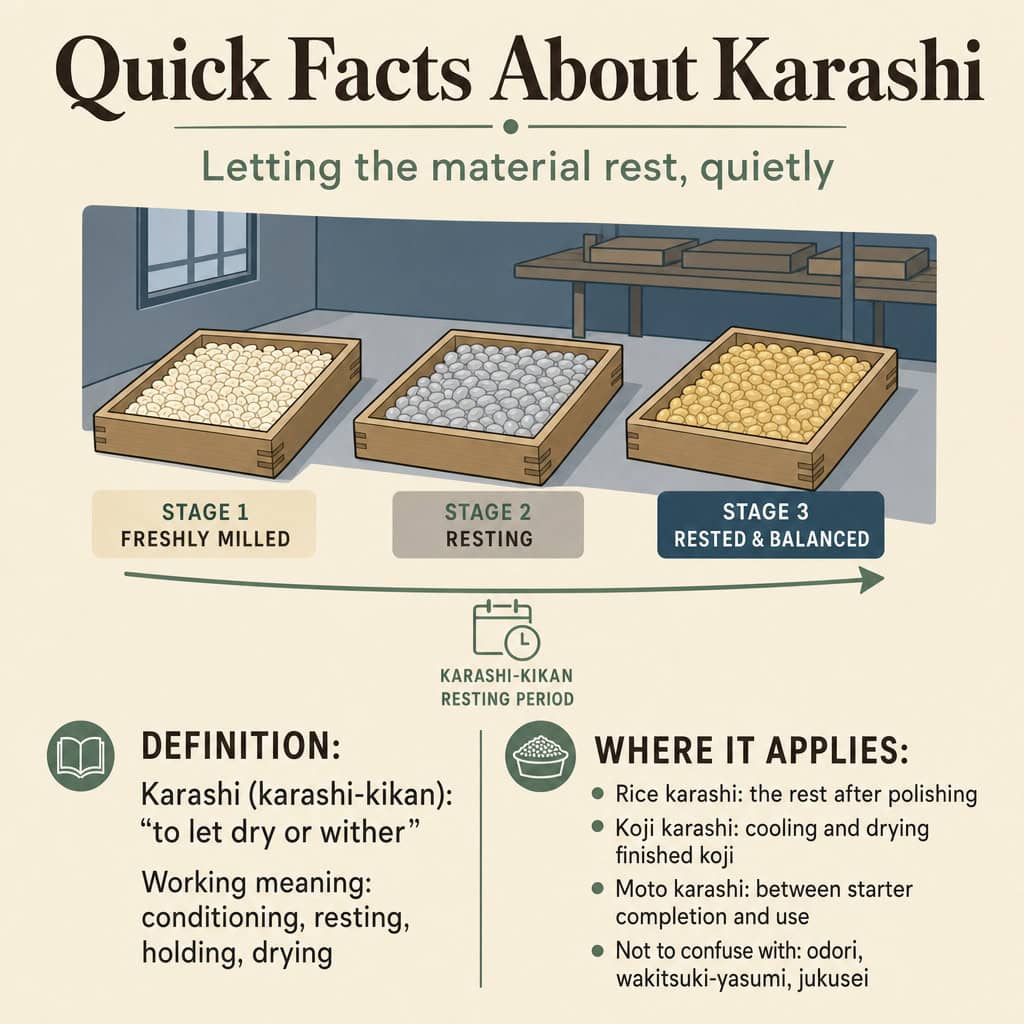
Here is a snapshot before the detail begins. Definitions below follow the NRIB terminology list, cited at the end.
| Japanese | 枯らし, and 枯らし期間 for polished rice |
|---|---|
| Romanization | Karashi, karashi-kikan |
| Literal sense | To let something dry or wither |
| Working meaning | Conditioning, resting, holding, or drying |
| Applications | Polished rice, finished koji, completed moto |
| Rice karashi | Conditioning period after rice polishing |
| Koji karashi | Period to cool and dry finished koji |
| Moto karashi | Period between completion of a starter and its use |
| Shared purpose | Bringing material into the right state for the next stage |
| Not to confuse with | Odori, wakitsuki-yasumi, jukusei |
Notice one small detail in that table. For polished rice, the standard term carries the suffix kikan, meaning period. Koji and moto simply take karashi on its own.
Why Karashi Is a Difficult Term
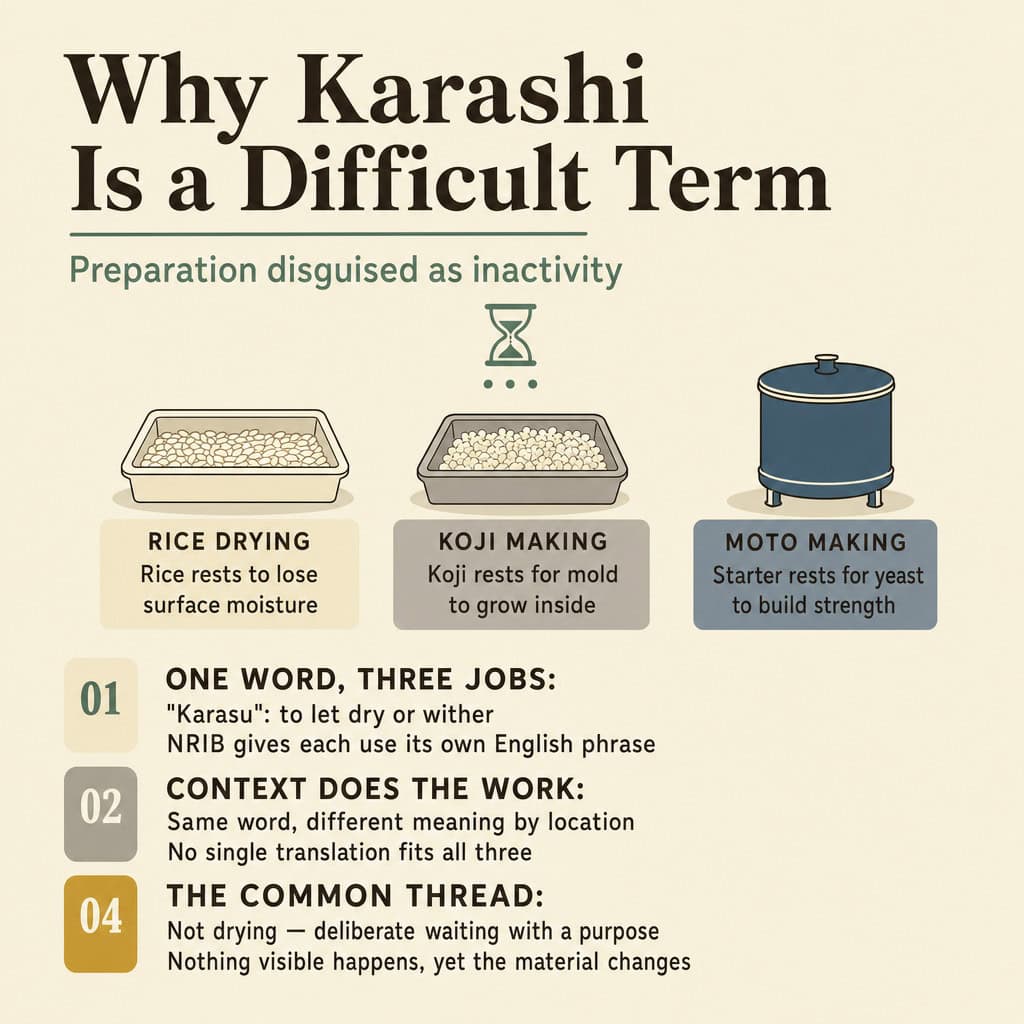
Most brewing vocabulary maps cleanly into English. Karashi does not, and that resistance is worth examining rather than smoothing over.
One Word, Three Jobs
The Japanese verb karasu means to let something dry or wither. Applied to rice, it fits reasonably well. Applied to a finished moto, however, it fits poorly, since nothing dries at all there.
NRIB handles this by giving each use its own English phrase. Their list offers conditioning period, cooling and drying of koji, and storage of a starter culture. All three sit under the same Japanese headword. Consequently, a translator who picks one English word for karashi will misdescribe the other two.
Context Does the Work
Japanese brewing vocabulary leans heavily on context, and karashi is a clear example. A brewer saying karashi in the rice storeroom means something different from a brewer saying it beside the starter tanks. Nobody needs to specify, because the location already has.
English readers find this frustrating at first. I certainly did. Yet the pattern makes sense once you stop looking for a noun and start looking for a shared function.
The Common Thread
What unites the three is not drying. Rather, it is deliberate waiting with a purpose. In each case, a material has finished one stage but is not yet suited to the next. Karashi is the interval that closes that gap.
Think of it as preparation disguised as inactivity. Nothing visible happens, and yet the material changes.
The Three Types of Karashi
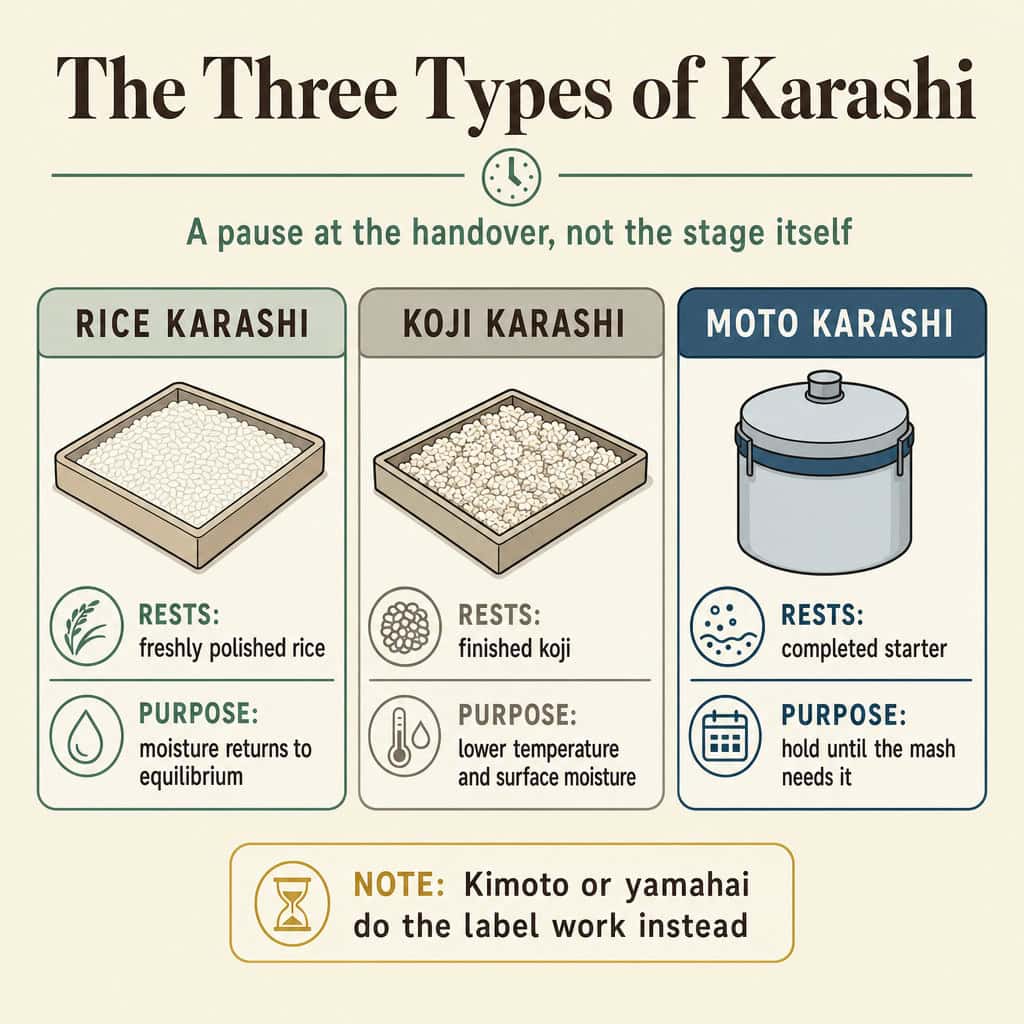
Before going deeper, a side-by-side view helps. The table sets out what each type conditions and why.
| Type | Japanese | What rests | NRIB English | Main purpose |
|---|---|---|---|---|
| Rice karashi | 白米の枯らし期間 | Freshly polished rice | Conditioning period after rice polishing | Moisture returns toward equilibrium |
| Koji karashi | 麴の枯らし | Finished koji | Cooling and drying of koji | Lower temperature and surface moisture |
| Moto karashi | 酒母の枯らし | Completed starter culture | Storage of a starter culture | Hold the starter until the mash needs it |
Reading the Table
Two of the three involve moisture directly. Only the moto version does not, and that exception causes most of the confusion in English sources. Notice also that each type sits at a boundary between stages.
Rice karashi bridges polishing and washing. Koji karashi bridges the koji room and the tank. Moto karashi bridges the starter and the main mash. In every case, the pause belongs to the handover rather than to either stage on its own.
Does Karashi Appear on a Label?
Almost never, and that is worth saying plainly. Sake labels carry the polishing ratio, the grade, and sometimes the starter method. Karashi belongs to the workshop rather than the marketing copy.
You may still meet the word on a brewery tour or in technical writing. Knowing which of the three is meant then depends entirely on where you are standing. A guide pointing at the rice store means one thing, and a guide beside the starter tanks means another.
So treat karashi as vocabulary for understanding production, not for choosing a bottle. Terms like kimoto or yamahai do the label work instead.
Rice Karashi: Conditioning Polished Rice
This is the karashi most people meet first, and it has the clearest physical explanation.
What Polishing Does to the Grain
Rice polishing, or seimai, scrapes away the outer layers of brown rice. NRIB describes it as removing lipids and proteins from the grain surface. Premium sake removes a great deal, sometimes half the grain or more.
That process is not gentle. Friction generates heat, and heat drives moisture out of the grain. Freshly polished rice therefore leaves the mill warm and drier than it was.
The Moisture Problem
Here is where the NRIB definition earns its place. Their glossary states plainly that rice grains dry during polishing, and that the polished rice gains moisture toward equilibrium during the conditioning period.
Two words in that sentence matter most. Equilibrium implies balance between the grain and the surrounding air. Gains implies the grain takes moisture back rather than losing it. So rice karashi is a rehydration period, not a drying one, which reverses what the literal translation suggests.
Inside the Grain
Drying during milling is uneven, since the surface loses water faster than the core. A grain leaving the mill can therefore hold a dry shell around a moister center. Left alone, moisture redistributes and the gradient flattens.
Ambient humidity also plays a part, so the grain exchanges water with the storeroom air. Breweries consequently store polished rice in cool, stable conditions rather than anywhere convenient.
Where the Rice Actually Waits
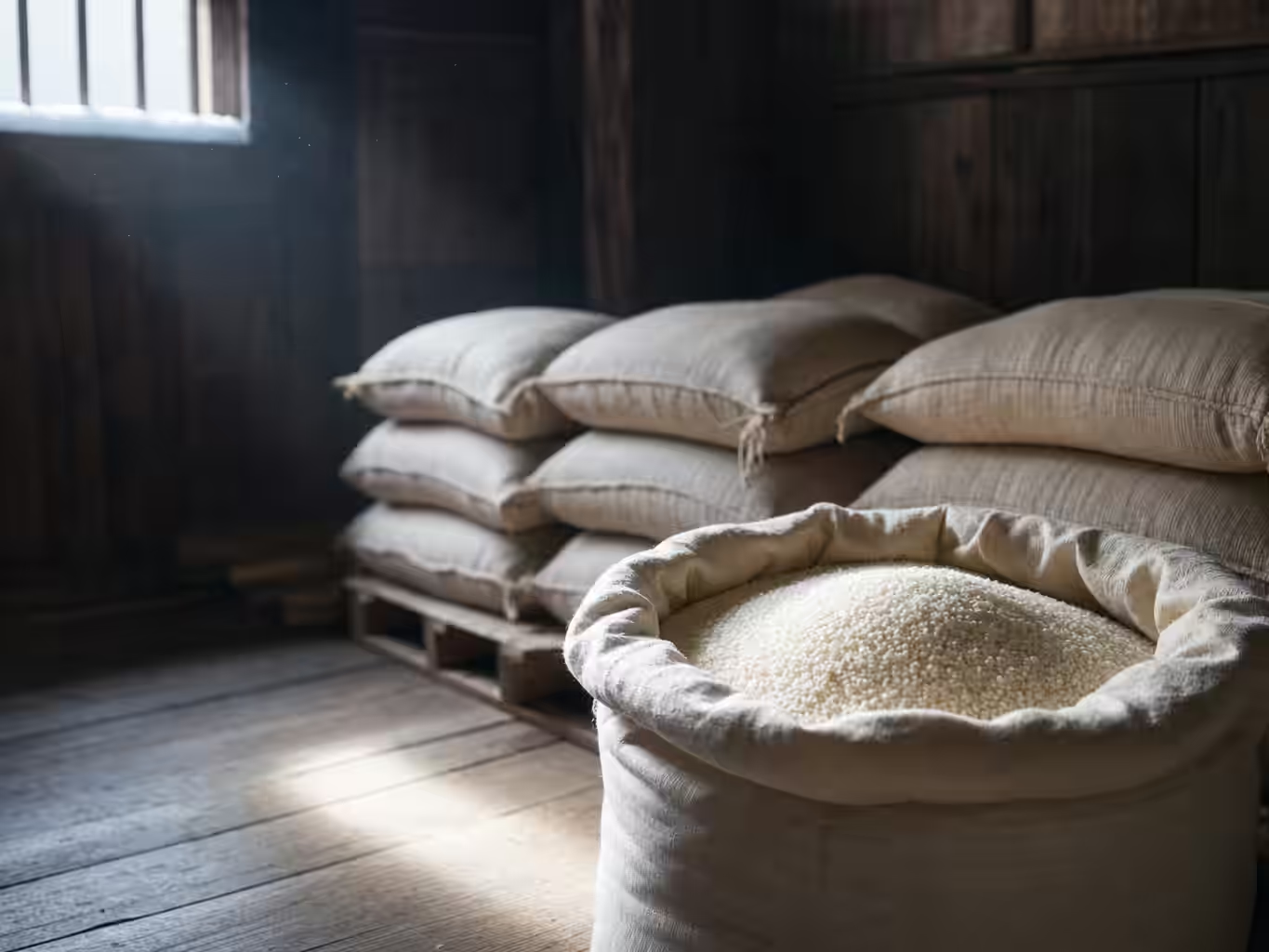
Storage conditions matter as much as duration. Breweries keep polished rice in cool rooms with steady humidity, often in breathable bags rather than sealed containers. Air needs to reach the grain, since equilibrium works in both directions.
Winter helps considerably here. Cold air holds less moisture and stays more stable, so the storeroom behaves predictably. This is one of several quiet reasons the brewing season sits where it does.
Rice also arrives at the brewery already stored as brown rice, sometimes for months. Polishing then happens close to when the rice is needed. Consequently the karashi period follows milling rather than harvest.
How Long, and Why Nobody Will Say
Published sources describe rice karashi as lasting days to weeks. Precise figures vary by brewery, rice variety, polishing ratio, and season, so a single number would be misleading. Some breweries measure grain moisture directly and decide from that.
I have seen confident numbers quoted online without any source attached. Treat those cautiously. The honest answer is that the brewery decides, and the target is a condition rather than a calendar date.
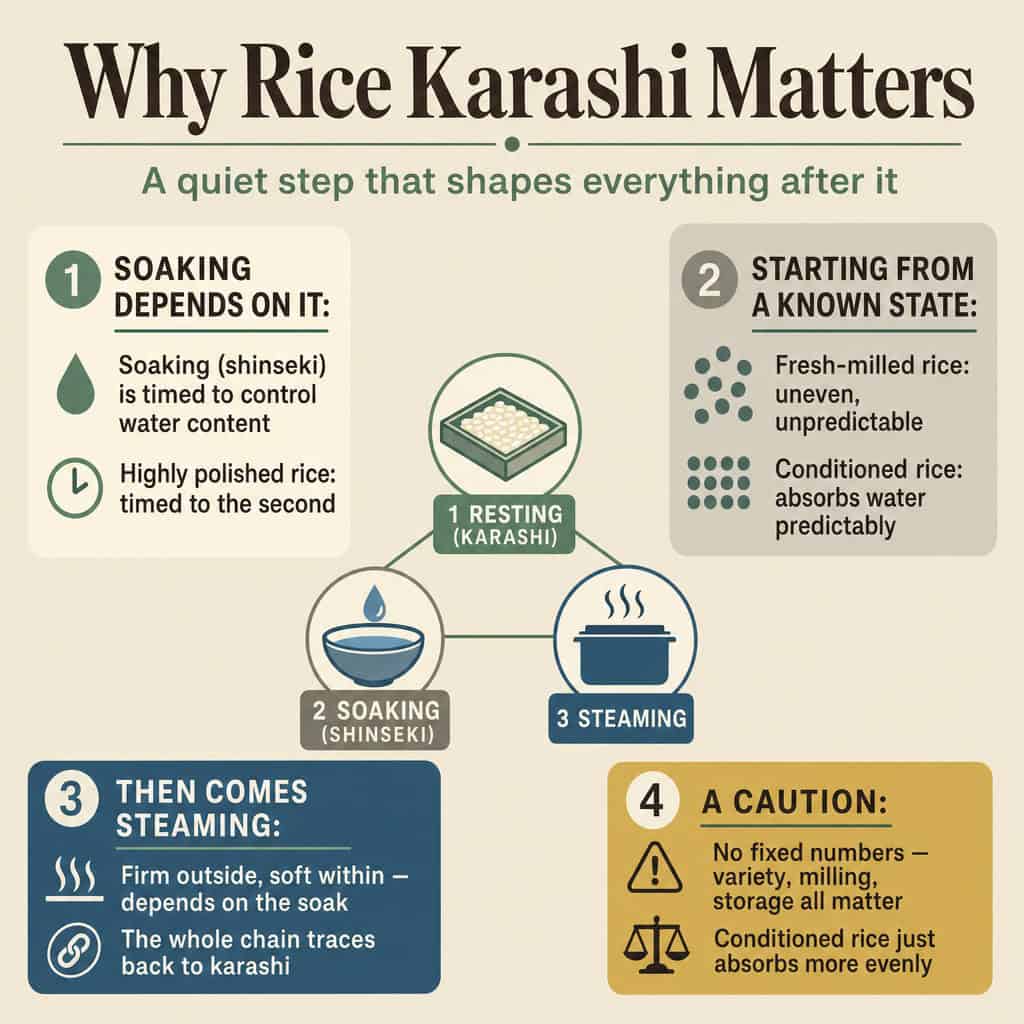
Why Rice Karashi Matters
A rest period sounds passive. In practice, it shapes one of brewing’s most tightly controlled steps.
The Soaking Step Depends on It
After polishing and washing comes soaking, called shinseki. NRIB defines it as steeping white rice in water so that it absorbs adequate moisture. Sounds simple enough, and yet this is where breweries reach for stopwatches.
For highly polished rice, brewers often use gentei-kyusui, which NRIB describes as controlling water content by curtailing soaking time. Premium batches can be timed to the second. Because the target is a specific water content, the rice must start from a known state.
Starting from a Known State
Rice that has just left the mill is not in a known state. Its moisture is low and unevenly distributed, and it is still warm. Soaking such rice would give results that drift batch to batch.
Conditioned rice behaves more predictably instead. That predictability is the real prize, since consistency underpins everything downstream.
Then Comes Steaming
Steaming follows soaking, and its goal is textural. NRIB notes that rice is steamed so the starch can be broken down easily by koji enzymes. Brewers want grains firm outside and soft within.
Water content at soaking determines whether that texture arrives. Consequently the chain runs backwards to karashi, which is why brewers treat a quiet storeroom as part of the process.
A Caution About Cause and Effect
It would be tidy to claim that a set rest produces a set absorption rate. Unfortunately the published evidence does not support numbers that specific. Variety, milling ratio, storage conditions, and equipment all intervene.
What can be said is directional. Conditioned rice absorbs water more evenly and more predictably than rice used straight from the mill.
Karashi and Highly Polished Rice
Premium brewing pushes polishing much further, and that raises the stakes for conditioning.
More Polishing, More Stress
A daiginjo may remove half the grain or more before brewing starts. Milling that deep takes longer and generates more friction. As a result, the grain leaves the machine warmer and drier than lightly polished rice would.
Highly polished grains are also smaller and more fragile. Cracked or broken grains behave differently during soaking, so millers work slowly to limit damage. Careful milling and careful conditioning tend to go together.
Faster Absorption, Tighter Timing
Heavily polished rice absorbs water faster than lightly polished rice. That is exactly why brewers time premium soaking so precisely, sometimes counting seconds with a stopwatch. A few seconds of overshoot can push the grain past its target.
Such tight control only works from a stable starting point, though. Uneven moisture inside the grain would scatter the results. So the conditioning period matters most precisely where the margins are thinnest.
A Reasonable Inference, Not a Rule
It seems fair to say conditioning carries more weight for premium batches. Beyond that, I would resist stronger claims. Published sources describe the general principle without assigning specific durations to specific polishing ratios.
Breweries also differ in how they handle premium rice. Some rest it longer, while others rely on measurement and adjust soaking instead. Both routes aim at the same target.
Koji Karashi: Cooling and Drying Finished Koji
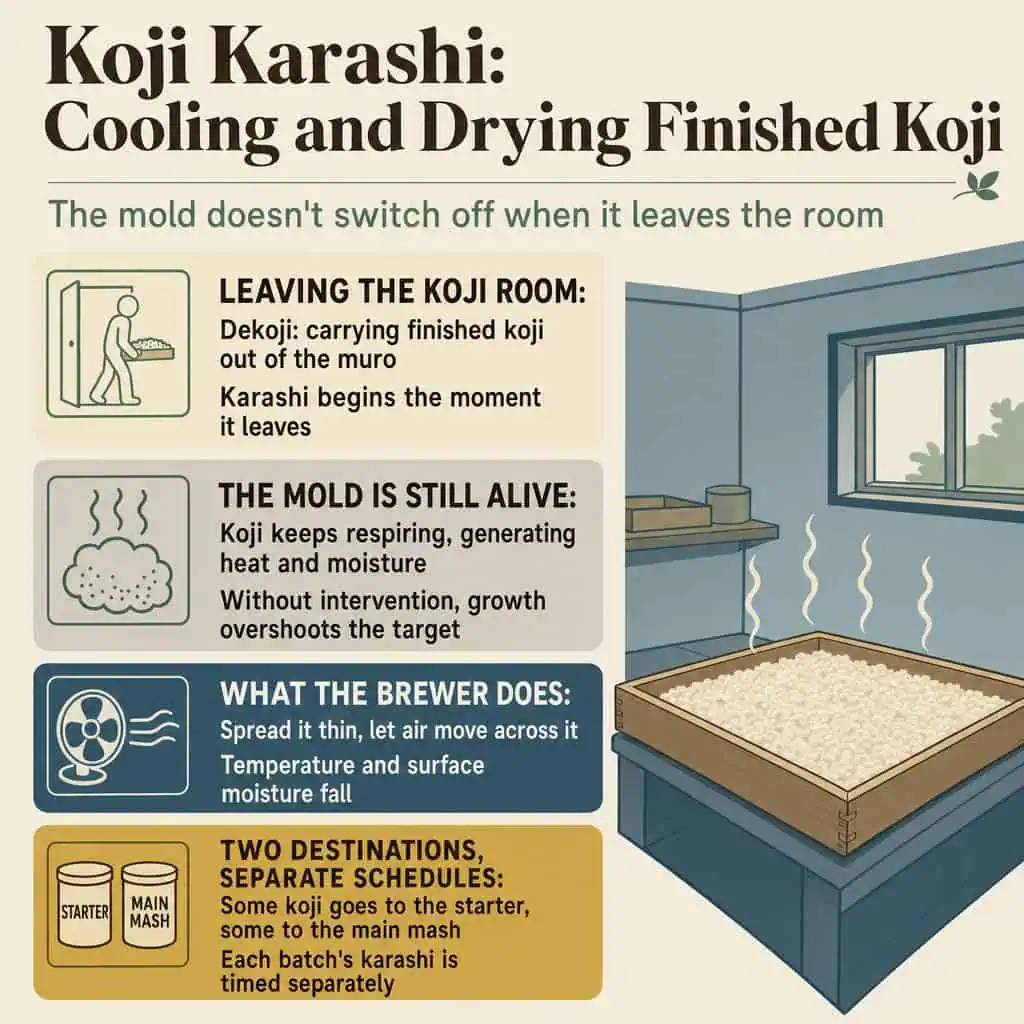
The second karashi happens roughly two days into koji making, and it closes that stage rather than following it.
Leaving the Koji Room
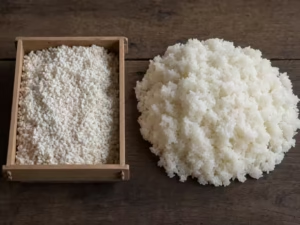
Koji is steamed rice colonised by Aspergillus oryzae. Brewers grow it in a warm, humid room called the muro, where temperature and moisture are managed hour by hour.
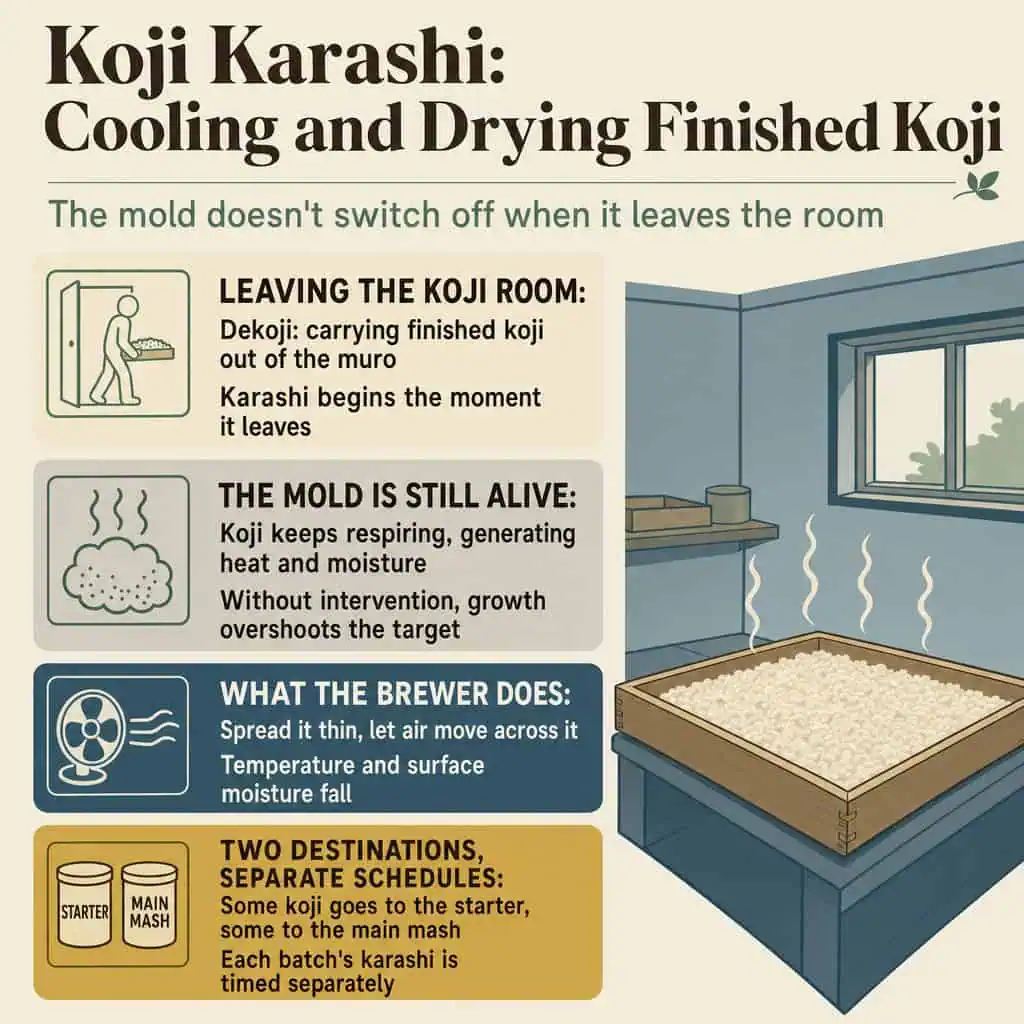
Carrying finished koji out of that room is called dekoji. NRIB glosses it as taking just finished koji out of the koji room. Karashi begins at that moment, and the definition NRIB gives is direct: the period to cool and dry finished koji.
The Mold Is Still Alive
Here is the point most explanations skip. Koji does not switch off when it leaves the muro. The mold keeps respiring, generating heat and moisture, and it keeps growing where conditions allow.
A warm, damp heap of koji will therefore continue changing. Without intervention, growth pushes past the point the brewer aimed at. Karashi is the intervention.
What the Brewer Actually Does
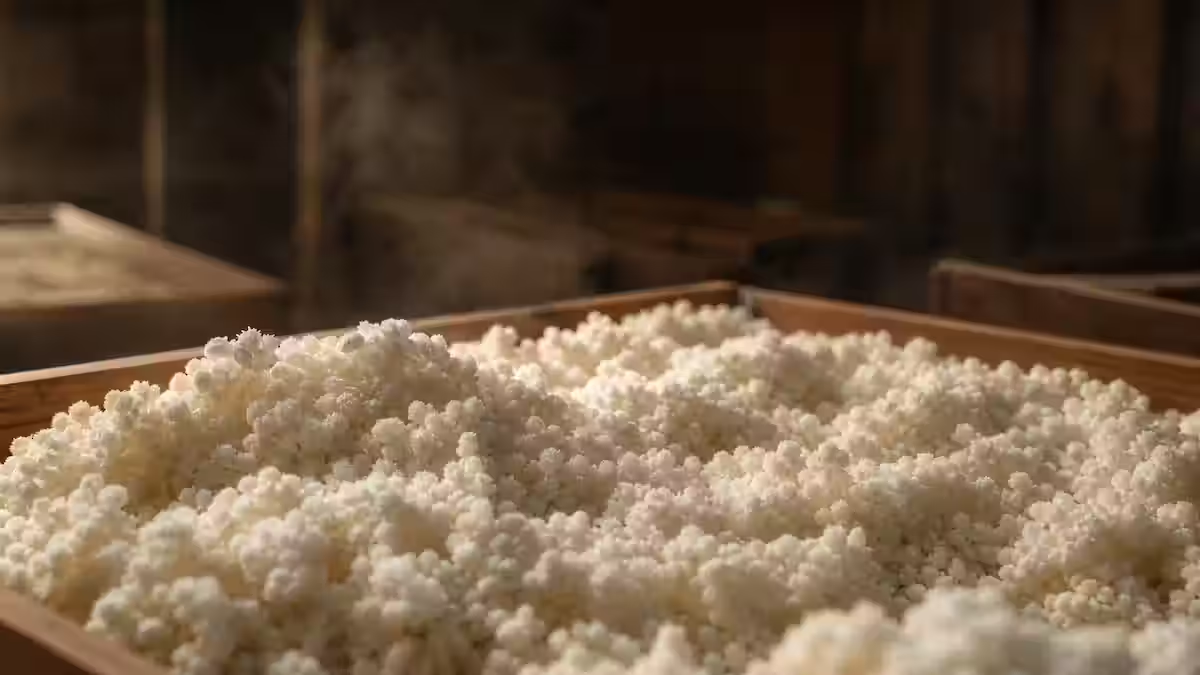
Practice varies between breweries, though the principle stays constant. Koji is spread out to increase surface area and release heat. Air moves across it, and both temperature and surface moisture fall.
Traditional breweries use shallow wooden trays and cool rooms. Modern ones may use dedicated cooling spaces with regulated air. Either way, the aim matches: bring the koji down and steady it.
Handling and Storage
Conditioned koji also becomes easier to work with. Grains separate rather than clumping, so measuring and moving them gets simpler. Drier koji stores better in the short term too.
Storage here means hours or days, not months. Brewers make koji to a schedule, and it goes into the moto or the moromi soon afterwards.
Koji Goes to Two Different Places
Not all koji has the same destination. Some goes into the starter, and the rest goes into the main mash. Brewers plan koji production around both demands.
The proportion of koji rice to total rice has its own term, koji-buai. That ratio shapes how much sugar the mash can generate. Conditioned koji makes those calculations meaningful, since clumped or damp koji is harder to weigh accurately.
Timing differs too. Koji for the starter is needed earlier than koji for the mash, therefore the karashi periods are scheduled separately. A brewery may hold several batches at once at different points.
Beyond Sake
Koji appears well beyond sake, and so does the habit of cooling it. Miso, soy sauce, and shochu all rely on koji, though each uses different molds and different rice or grain preparations.
Terminology shifts between industries, however. NRIB publishes a separate standard terminology list for shochu, which is a useful reminder that a word learned in one context may not transfer cleanly to another.
Why Finished Koji Is Cooled and Dried
Cooling sounds like housekeeping. In fact it protects everything the koji stage was built to achieve.
Koji Making Does Not End with the Mold
The point of koji is enzymes, not mold growth for its own sake. Those enzymes break rice starch into sugar, which yeast then ferments. Brewers therefore aim at a particular enzyme profile.
Reaching that profile takes precise timing across roughly two days. Letting the mold run on afterwards would undo the targeting. So the stage ends deliberately rather than simply stopping.
Temperature, Moisture, and Growth
Mold growth depends on warmth and available water. Remove either, and growth slows sharply. Cooling and drying remove both at once, which is why the two travel together in the NRIB definition.
Enzymes already produced remain in the koji, meanwhile. The goal is to keep what was made while halting further change.
Aroma and Contamination
Overgrown koji can develop aromas brewers describe as musty or unpleasantly mold-forward. Good koji, by contrast, smells sweet and faintly of chestnut. Ending growth at the right moment protects that character.
Warm, damp material also invites unwanted microbes. Cooling reduces that risk, which matters because koji goes on to seed a fermentation that must stay clean.
Feeding the Next Stage
Koji added to a tank changes that tank’s temperature. Hot koji would disturb a carefully planned curve, especially in cold ginjo-style brewing. Conditioned koji arrives at a workable temperature instead.
Our guide to fermentation covers why those curves are watched so closely.
Moto Karashi: Holding the Finished Starter
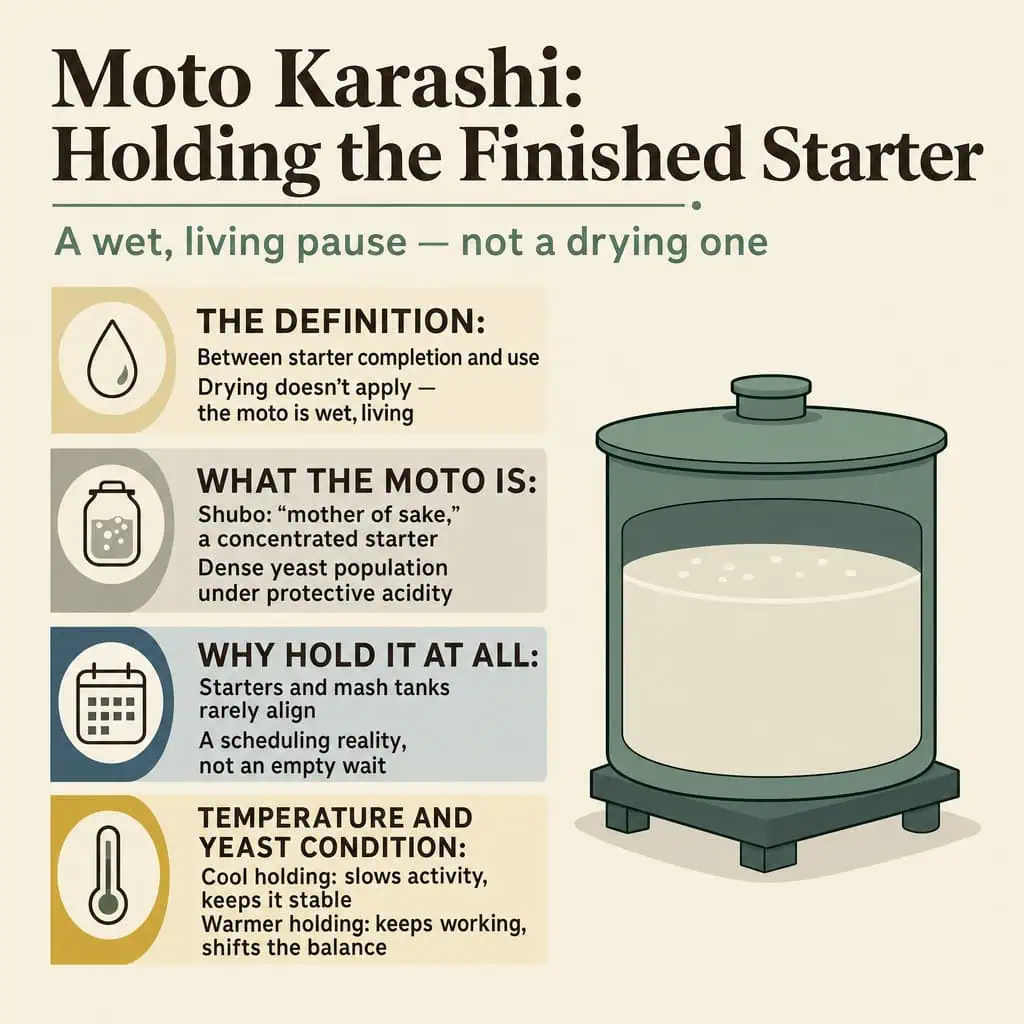
The third karashi breaks the pattern, and understanding why is the key to the whole term.
The NRIB Definition
NRIB defines moto karashi as the period between completion of a starter culture and use of it. Their English headings include conditioning of a starter culture and storage of a starter culture.
Read that definition again and notice what is absent. Drying does not appear anywhere, and it could not, because the moto is a wet, living mash. Anyone translating this instance as drying has simply misread it.
What the Moto Is
The moto, also called shubo, is a small concentrated starter. NRIB notes that shubo means mother of sake. Inside it, brewers grow a dense, healthy yeast population under protective acidity.
When it reaches its target, the moto is finished. It is not yet needed, though, since the main mash follows its own schedule.
Why Hold It at All
Breweries run many tanks against a fixed calendar. Starters and mash tanks rarely align perfectly, therefore a finished moto often waits. Holding it is a scheduling reality as much as a technique.
The wait is not empty, however. Yeast condition continues to change, and brewers use the interval to let the starter settle into the state they want.
Temperature and Yeast Condition
Cool holding slows yeast activity and keeps the starter stable. Warmer holding lets it keep working, which changes the cell population and the acid balance. Brewers choose accordingly.
A starter held too long can lose vigour, and one used too early may lack strength. Judgment therefore sits at the center of this step, rather than any fixed rule.
Karashi in Kimoto, Yamahai, and Sokujo
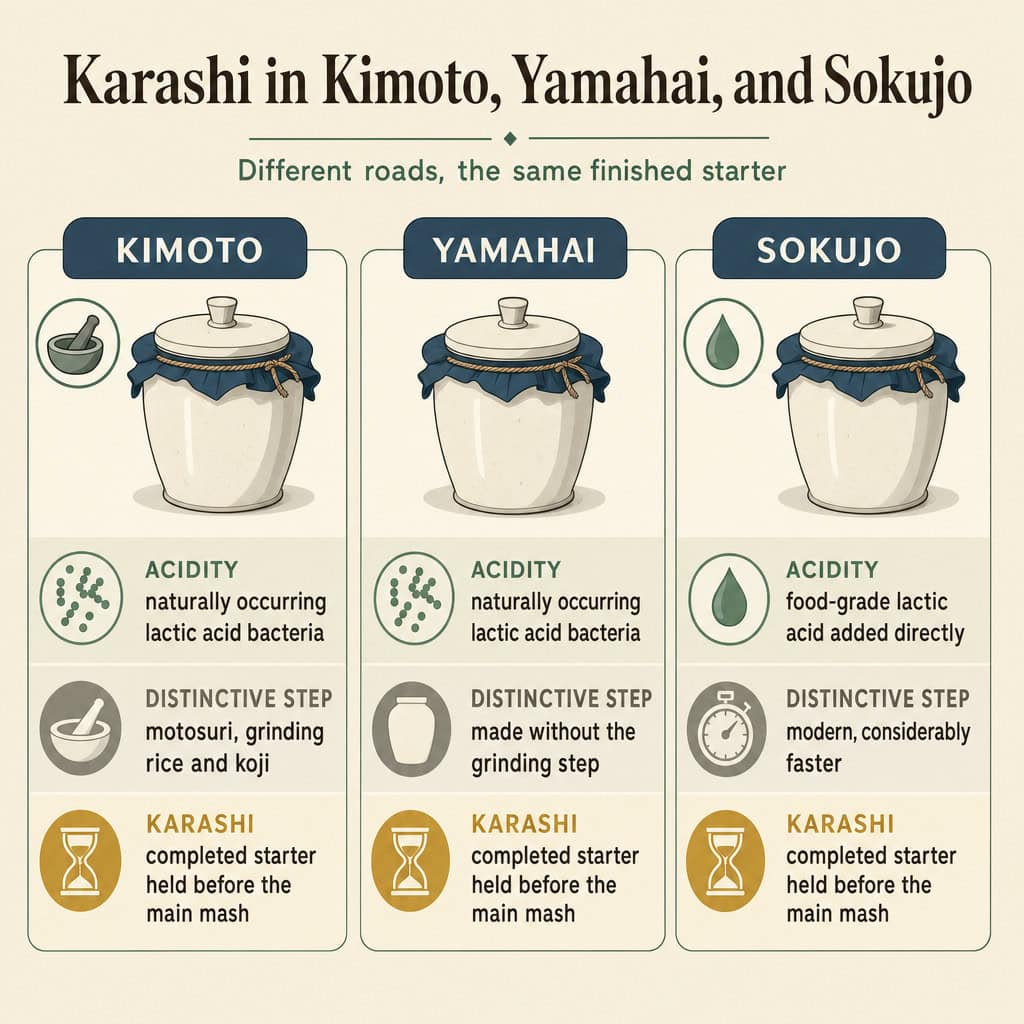
All three starter methods reach a finished moto, so all three can involve a holding period. What differs is the road there.
| Method | How acidity arrives | Distinctive step | Karashi context |
|---|---|---|---|
| Kimoto | Naturally occurring lactic acid bacteria | Motosuri, grinding rice and koji | Completed starter held before the main mash |
| Yamahai | Naturally occurring lactic acid bacteria | Made without the grinding step | Completed starter held before the main mash |
| Sokujo | Food-grade lactic acid added directly | Modern, considerably faster | Completed starter held before the main mash |
Traditional Starters
Kimoto is described by NRIB as a traditional starter culture using natural lactic acid fermentation, with a grinding step called motosuri. Yamahai follows the same microbial route while dropping that grinding work.
Both take longer to build than the modern method. Their microbial succession is genuinely complex, and studies sequencing yamahai starters have tracked lactic acid bacteria dominating throughout.
The Modern Starter
Sokujo adds lactic acid at the outset, which NRIB records in its definition. Protection therefore arrives immediately rather than developing over weeks.
This method dominates modern brewing by a wide margin. Its finished starter still waits for the mash, so karashi applies here as much as anywhere.
What Not to Assume
It is tempting to assign each method a characteristic holding time or temperature. Published sources do not support that, so this guide will not do it. Practice varies by brewery, season, and target style.
What holds true across all three is structural. A finished starter exists, the mash is not ready, and the gap has a name.
How Brewers Judge When Karashi Is Done
Every karashi ends at a condition rather than a clock time. Reading that condition is where skill enters.
Judging Rice
Experienced hands assess polished rice by feel, sound, and appearance. Grains that are still dry behave differently in the hand from conditioned ones. Many breweries now confirm that impression with a moisture meter.
The decisive test comes at soaking, though. Brewers watch how quickly the rice takes up water and adjust from there. A batch that absorbs unexpectedly fast reveals something about its prior condition.
Judging Koji
Koji is judged largely by touch and smell. Well-conditioned koji feels dry on the surface yet retains softness inside. Good koji smells sweet with a chestnut note, whereas overgrown koji turns musty.
Temperature gets checked directly as well. Brewers want the koji down to a workable level before it meets a cold tank.
Judging the Starter
A finished moto is assessed through analysis and taste together. Acidity, alcohol, and the sake meter value all get measured. Brewers also smell and taste the starter, since numbers alone miss a great deal.
Deciding when to use it involves the mash schedule too. So the judgment blends biology with logistics, which is true of much brewery work.
Karashi and Brewing Timing
Seen together, the three karashi points share a rhythm. Each one sits at a handover between stages.
The Three Handovers
- Rice karashi: polishing ends, and washing and soaking wait until moisture settles
- Koji karashi: koji leaves the muro, then cools before joining a tank
- Moto karashi: the starter finishes, and the main mash calls for it later
Each pause therefore ends when the following stage begins. None of them is open-ended, and none is decorative.
Scheduling a Brewery
A brewery runs several processes at once during the season. Rice moves through milling and storage, koji rooms cycle every couple of days, and starter tanks fill and empty on their own rhythm.
Karashi periods absorb the mismatches between those rhythms. Without them, the whole schedule would have to run in lockstep, which no brewery could manage.
The Seasonal Frame
Traditional brewing happens in winter, a practice called kan-zukuri. NRIB explains that brewing in the coldest season helps prevent microbial contamination.
Cold air makes every karashi easier. Koji cools faster, starters hold more safely, and storerooms stay stable. So the season and the technique reinforce each other.
Karashi Compared with Drying, Resting, and Storage
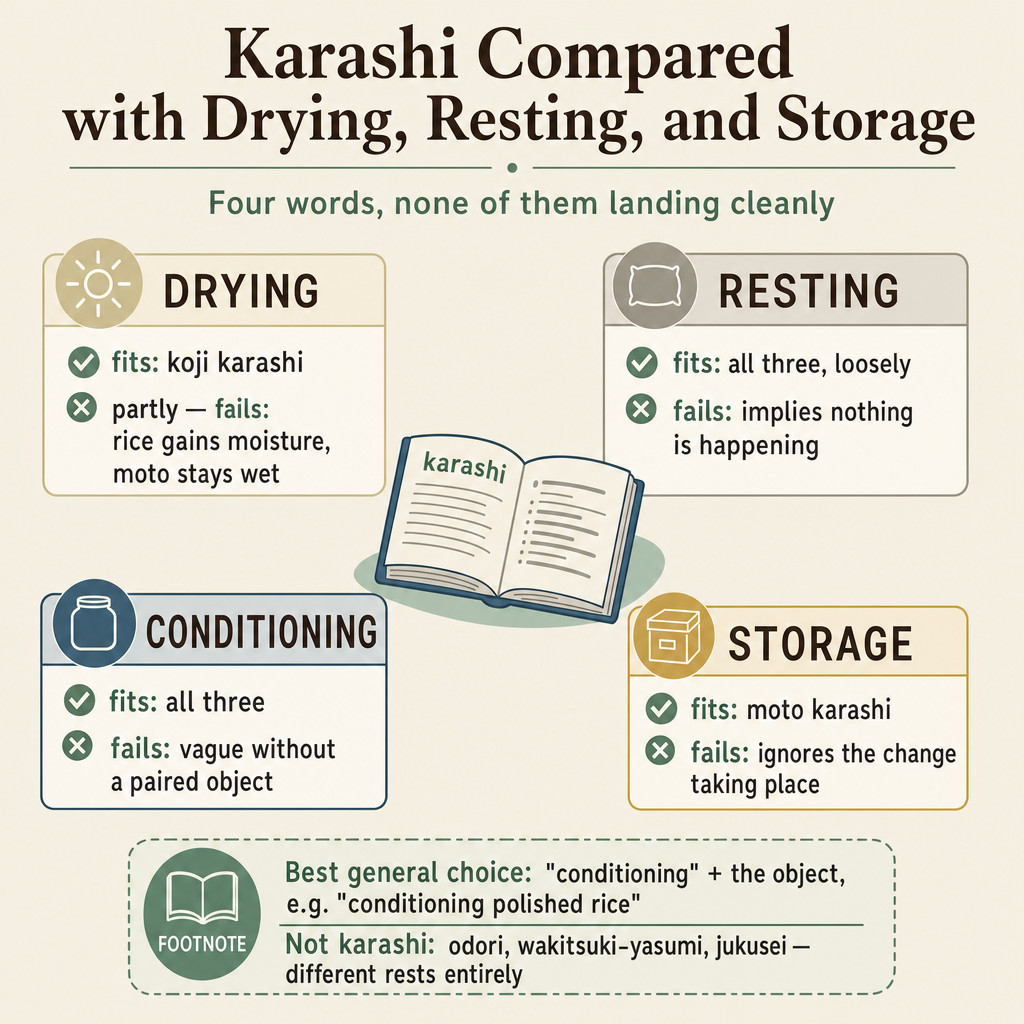
Four English words orbit this term. None of them lands cleanly, though each captures part of it.
| English word | Core meaning | Fits which karashi? | Where it fails |
|---|---|---|---|
| Drying | Removing moisture | Koji karashi, partly | Rice gains moisture; moto stays wet |
| Resting | Leaving something alone | All three, loosely | Implies nothing is happening |
| Conditioning | Preparing for the next stage | All three | Vague without further explanation |
| Storage | Keeping until needed | Moto karashi | Ignores the change taking place |
The Best General Choice
Conditioning covers the most ground, which is presumably why NRIB uses conditioning period across more than one entry. It carries the sense of a material being brought into a required state.
Even so, conditioning alone tells a reader very little. Pairing it with the object works better, as in conditioning polished rice or conditioning the starter.
Terms That Are Not Karashi
Japanese has several other words for waiting in a brewery, and mixing them up is easy. Odori is the rest day on the second day of three-stage mashing, when no rice is added so yeast can multiply. Wakitsuki-yasumi refers to a resting period in the starter culture.
Jukusei means maturation or aging, and it happens after pressing rather than between raw-material stages. None of these is karashi, although English writing sometimes blurs them together.
Traditional and Modern Practice
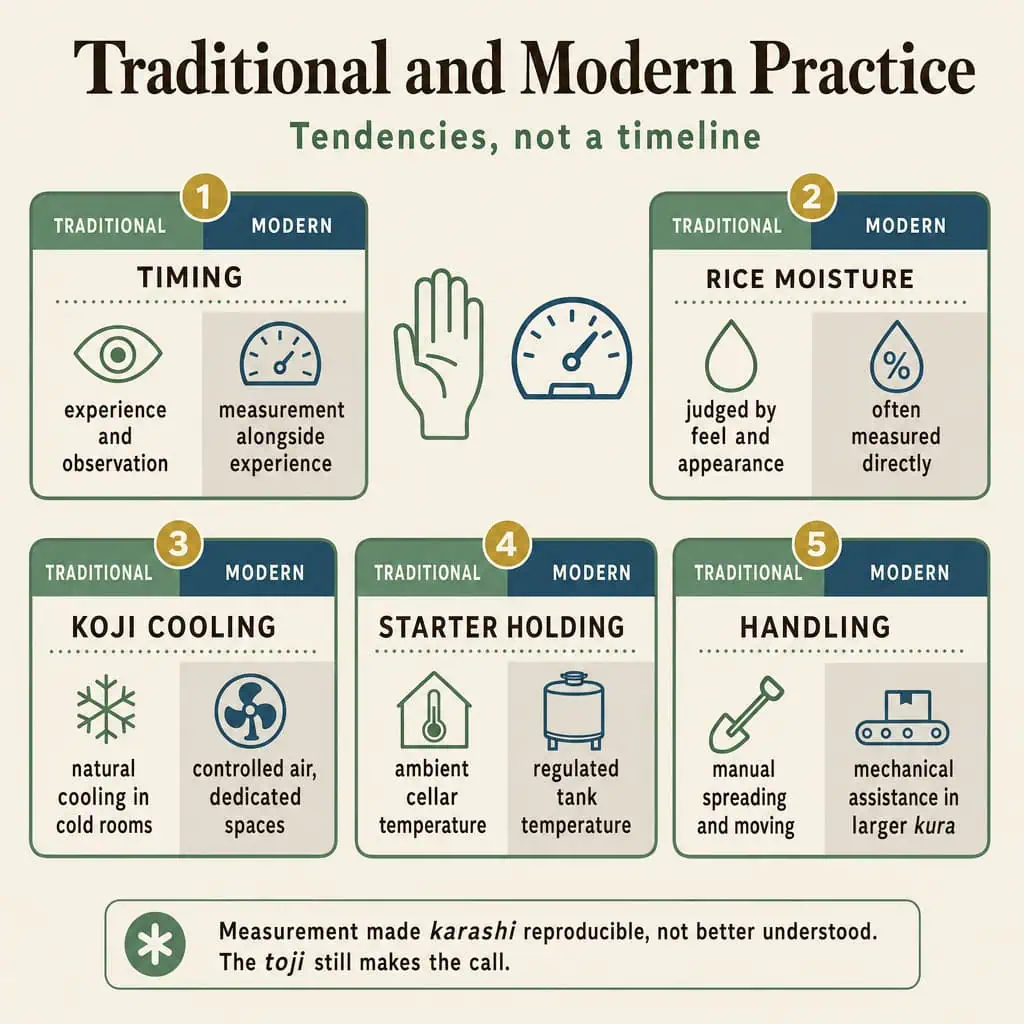
Karashi has always existed. How brewers judge it has shifted, though the change is less dramatic than it sounds.
| Aspect | Traditional approach | Modern approach |
|---|---|---|
| Timing | Experience and observation | Measurement alongside experience |
| Rice moisture | Judged by feel and appearance | Often measured directly |
| Koji cooling | Natural cooling in cold rooms | Controlled air and dedicated spaces |
| Starter holding | Ambient cellar temperature | Regulated tank temperature |
| Handling | Manual spreading and moving | Mechanical assistance in larger kura |
Reading This Table Carefully
The two columns are tendencies, not a timeline. Plenty of small breweries still work largely by hand, while some large ones keep traditional koji trays for premium batches.
Regional practice varies too, and brewer training shapes decisions as much as equipment does. So resist reading modern as better, or traditional as more authentic.
What Measurement Changed
Instruments made karashi easier to reproduce rather than easier to understand. A moisture reading confirms what an experienced hand already suspected. Records then let a brewery repeat a good season deliberately.
The toji still makes the call, however. Numbers inform that judgment without replacing it.
Karashi and Sake Quality
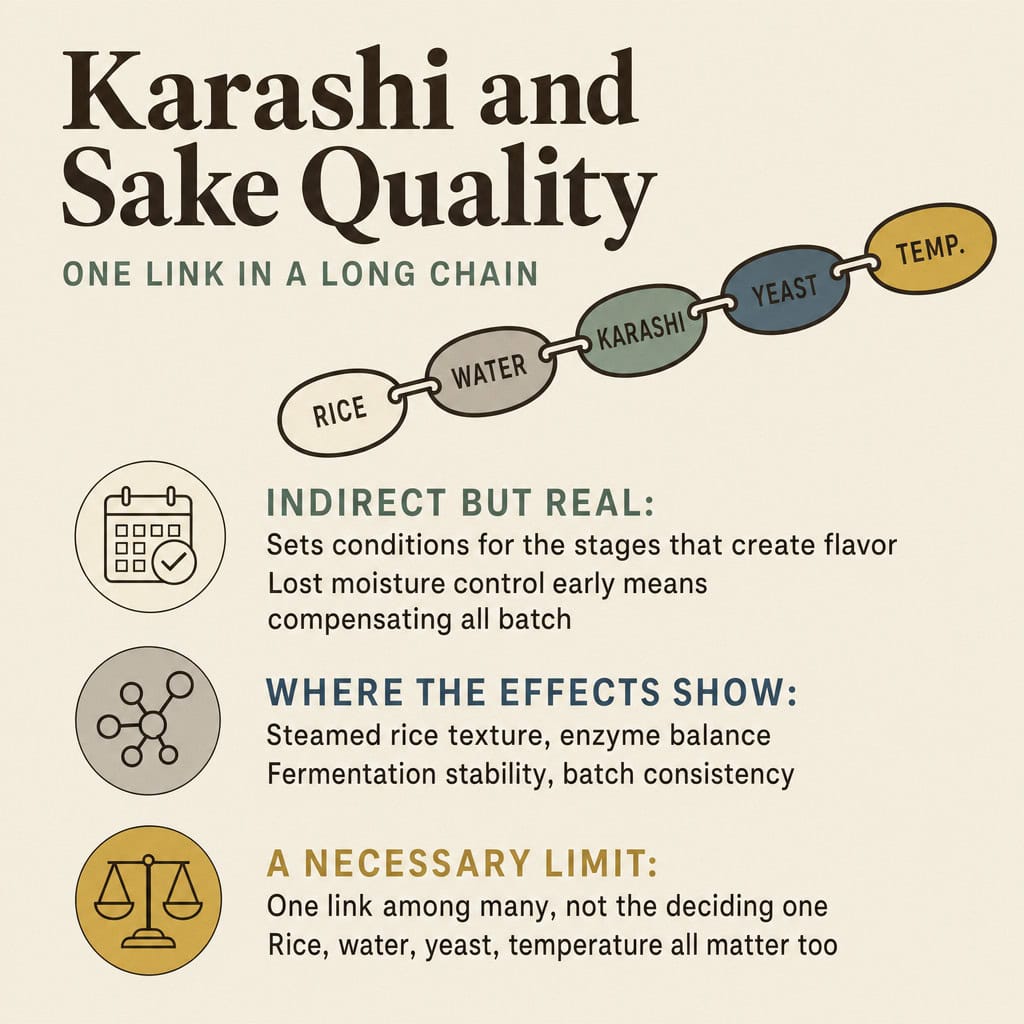
Now the practical question. Does any of this reach the glass?
Indirect but Real
Karashi does not create flavor by itself. Instead, it sets conditions for stages that do. Rice absorption, koji enzyme profile, and starter vigour all trace back to it in part.
That indirectness is easy to undersell. A brewer who loses control of moisture at the start spends the rest of the batch compensating.
Where the Effects Show
- Steamed rice texture: firm outside and soft within, or disappointingly uneven
- Rice dissolution: how readily grains break down in the mash
- Enzyme balance: koji halted at the intended point rather than beyond it
- Fermentation stability: fewer surprises in the temperature curve
- Batch consistency: the same recipe behaving the same way twice
Consistency deserves particular emphasis. Much of modern brewing skill lies in repeating a result, and karashi contributes directly to that.
A Necessary Limit
No honest account claims karashi determines quality. Rice variety, water, yeast, water ratio, fermentation temperature, and pressing all matter enormously.
Karashi is one link in a long chain. Weak links show, and strong ones rarely get credit, which is roughly the fate of every quiet step in brewing.
Common Misconceptions
Five errors turn up repeatedly in English writing about karashi. Each is worth naming plainly.
Karashi Simply Means Drying
Incorrect, and misleading in the rice case especially. NRIB describes polished rice gaining moisture toward equilibrium during its conditioning period. Drying describes the koji version reasonably, and it fails for the other two.
All Breweries Do Karashi the Same Way
Also incorrect. Duration, temperature, and method differ by brewery, rice, season, and target style. Published sources describe ranges rather than standards, so a single recipe would be an invention.
Karashi Only Applies to Rice
This is the most common gap. Rice karashi dominates English explanations because it is easiest to picture. NRIB nonetheless lists koji and starter uses as separate entries, each with its own definition.
Moto Karashi Means Drying the Starter
Definitely not. The moto is a wet mash, and NRIB defines its karashi as the period between completion and use. Storage and conditioning are the appropriate English words here.
Longer Karashi Is Always Better
No evidence supports that. Each karashi has a target condition, and passing it brings its own problems. Rice can dry out in storage, and a starter held too long can lose vigour.
Karashi in the Full Brewing Sequence
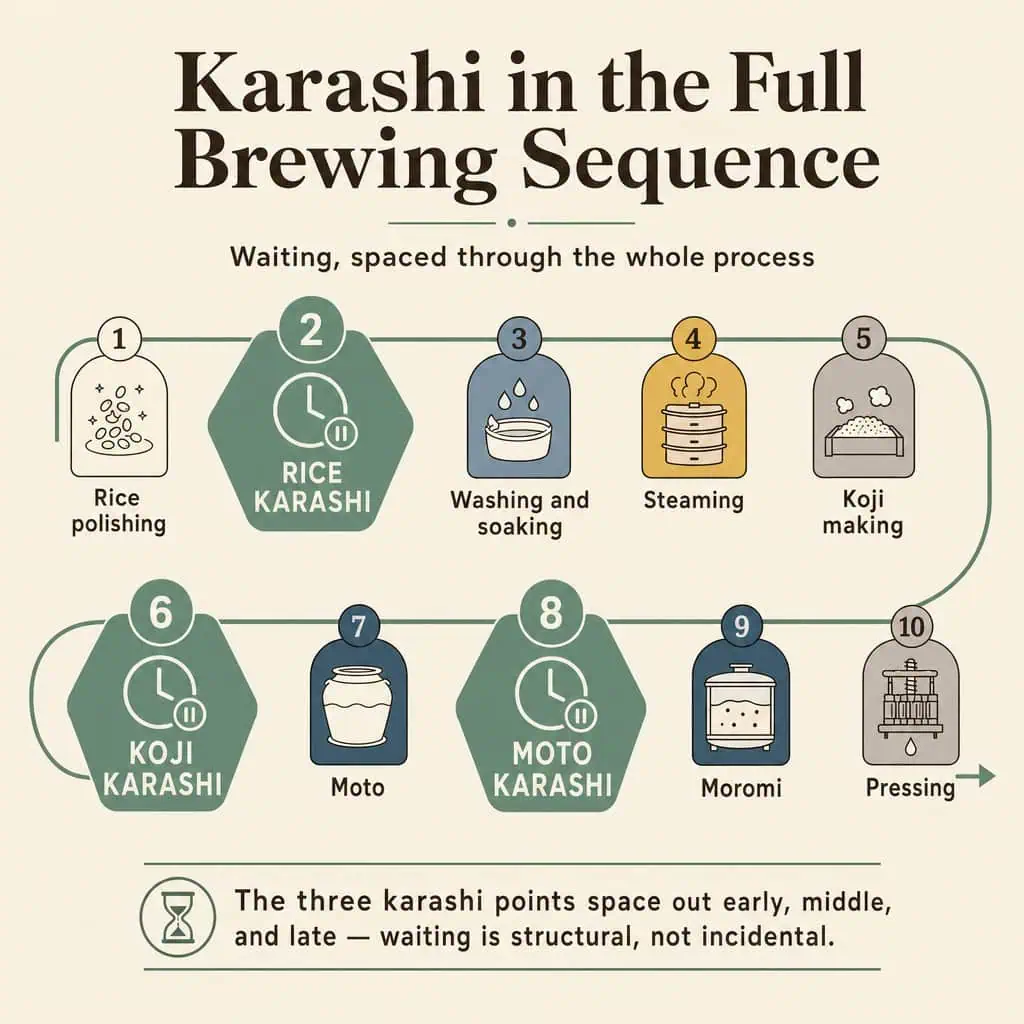
Placing all three in order shows how thoroughly karashi is woven through production.
- Rice polishing: outer layers removed, and the grain dries from friction
- Rice karashi: moisture returns toward equilibrium in storage
- Washing and soaking: water content brought to the target, sometimes timed to the second
- Steaming: starch made accessible to enzymes
- Koji making: mold grown on part of the steamed rice
- Koji karashi: finished koji cooled and dried after leaving the muro
- Moto: a small starter built to grow dense, healthy yeast
- Moto karashi: the completed starter held until the mash needs it
- Moromi: the main mash, built in three stages over four days
- Pressing: sake separated from the solids
Following the Chain
Notice how the three karashi points space themselves out. One sits early in raw-material handling, one in the middle, and one just before full-scale fermentation. Our guide to how sake is made walks the same route at a broader level.
The sandan jikomi method then contains its own rest day, the odori. Waiting, clearly, is structural in sake rather than incidental.
Final Thoughts
Karashi rewards attention precisely because it looks like nothing. Rice sits in a storeroom, koji cools on a tray, and a finished starter waits in its tank. In each case, the material is changing quietly toward the state the next stage requires.
So the useful mental model is not waiting. It is preparation that happens to take time. Once you see karashi that way, the three uses stop competing and start looking like variations on a single habit of mind.
That habit runs through Japanese brewing generally. Brewers let the season do work, let material settle, and intervene only when intervention helps. If you want to follow the chain further, our guides to shikomi haigo and sake pick up where this one ends.
Karashi FAQ
What does karashi mean in sake brewing?
Karashi is a conditioning period between brewing stages, and its exact meaning depends on the material. Brewers apply it to polished rice, to finished koji, and to a completed starter culture. Japan’s National Research Institute of Brewing gives each use a separate English definition. So karashi describes a shared function rather than one fixed operation.
Does karashi mean drying?
Not always, and the assumption causes real confusion. Drying describes the koji version reasonably well, since finished koji is cooled and dried. Polished rice, however, gains moisture during its conditioning period. A completed starter stays wet throughout, so nothing dries there at all.
What is rice karashi?
Rice karashi is the conditioning period after polishing, written karashi-kikan in Japanese. Milling generates friction and heat, which dries the grain unevenly. During the rest, moisture redistributes and moves back toward equilibrium with the surrounding air. Only then does the rice go on to washing and soaking.
Why is polished rice rested after polishing?
Because soaking demands a predictable starting point. Brewers control water absorption tightly, sometimes timing premium batches to the second. Rice straight from the mill is warm, dry, and uneven inside, so it behaves inconsistently. Conditioned rice absorbs water far more predictably instead.
What is koji karashi?
Koji karashi is the period spent cooling and drying finished koji. It begins when the koji leaves the warm koji room, a step called dekoji. Brewers spread the koji out so heat and surface moisture escape. The mold then stops growing, which locks in the enzyme profile they aimed for.
Why is finished koji cooled?
Because the mold is still alive when it leaves the room. Warmth and moisture would let it keep growing past the intended point. Cooling removes both conditions and halts that growth. It also lowers contamination risk and prevents hot koji from disturbing tank temperatures later.
What is moto karashi?
Moto karashi is the period between completion of a starter culture and its use. NRIB translates it as conditioning or storage of a starter culture. Breweries run starters and mash tanks on separate schedules, so a finished moto commonly waits. Temperature during that hold shapes the yeast’s condition.
Is moto karashi the same as drying?
No, and this is the clearest example of why the drying translation fails. A moto is a wet, living mash of rice, koji, water, and yeast. Nothing is dried during the holding period. The official definition refers only to the interval between completion and use.
How long does karashi take?
Duration varies by type and by brewery. Rice karashi is generally described as days to weeks, while koji karashi is far shorter. Moto holding depends entirely on the mash schedule. Because published sources give ranges rather than standards, treat any single figure with caution.
Does every brewery use karashi?
The underlying steps are standard, though practice differs considerably. Every brewery stores polished rice before use and cools finished koji. Starter holding depends on how tightly the schedule runs. Methods, durations, and equipment then vary by brewery, season, and target style.
Does karashi affect sake flavor?
Indirectly rather than directly. Karashi shapes rice absorption, steamed rice texture, koji enzyme balance, and starter condition. Those factors then influence fermentation and the finished taste. No serious account claims karashi alone determines quality, since many other variables intervene.
What is the difference between karashi and jukusei?
Jukusei means maturation or aging, and it happens after the sake is pressed. Karashi happens earlier, between raw-material stages, and never involves finished sake. Jukusei develops flavor in the bottle or tank. Karashi prepares rice, koji, or starter for the step that follows.
Is karashi written on a sake label?
No, and you should not expect to find it there. Labels carry the polishing ratio, the grade, and occasionally the starter method. Karashi is production vocabulary rather than a marketing term. You are far more likely to hear it on a brewery tour or read it in technical writing.
How is karashi different from storage?
Storage simply means keeping something until needed. Karashi implies a target condition and an intended change. Polished rice is not merely stored, since its moisture is meant to equilibrate. For the starter, admittedly, storage comes closest of the available English words.
How is karashi related to kimoto and yamahai?
Both methods produce a finished starter, so both can involve a holding period afterwards. Kimoto uses natural lactic acid fermentation with a grinding step called motosuri. Yamahai follows the same microbial route without that grinding. Neither method has a fixed karashi duration attached to it.
How is karashi related to sokujo?
Sokujo is the modern starter method, using added food-grade lactic acid for immediate protection. It reaches completion considerably faster than the traditional methods. Once finished, however, the starter still waits for the main mash. So moto karashi applies here exactly as it does elsewhere.
References
Terminology and Institutional Sources
- National Research Institute of Brewing – List of Standard English Expressions for Sake Terminology, trial English edition (definitions of karashi for polished rice, koji, and starter culture) (Accessed August 2026)
- National Research Institute of Brewing – Standard English Expressions for Sake Terms, Japanese index page (Accessed August 2026)
- National Research Institute of Brewing – Sake Terms trial edition ver.7, Japanese and English terminology list (Accessed August 2026)
- National Research Institute of Brewing – Sake FAQ: brewing rice, starter culture, and pressing (Accessed August 2026)
- National Research Institute of Brewing – Institutional homepage and brewing research publications (Accessed August 2026)
Academic Literature
- Food Science & Nutrition – Zhang, K., Wu, W., and Yan, Q., Research advances on sake rice, koji, and sake yeast: A review, Vol. 8, No. 7, pp. 2995-3003 (2020) (Accessed August 2026)
- Food Science & Nutrition – Fujiwara, H., Watanabe, K., and Wakai, Y., Combination of four bacterial strains isolated from yamahai-shubo in traditional Japanese sake brewing (2023) (Accessed August 2026)
- Scientific Reports – Metabolite profiling of the fermentation process of yamahai-ginjo-shikomi Japanese sake (Accessed August 2026)
Related Articles
- How Sake Is Made (Surveyed: August 2026)
- Rice Polishing (精米歩合) (Surveyed: August 2026)
- Koji (麹) (Surveyed: August 2026)
- Yeast (酵母) (Surveyed: August 2026)
- Moto (酒母) (Surveyed: August 2026)
- Moromi (醪) (Surveyed: August 2026)
- Fermentation (発酵) (Surveyed: August 2026)
- Kimoto (生酛) (Surveyed: August 2026)
- Yamahai (山廃) (Surveyed: August 2026)
- Sokujo (速醸) (Surveyed: August 2026)
- Sandan Jikomi (三段仕込) (Surveyed: August 2026)
- Shikomi Haigo (仕込配合) (Surveyed: August 2026)
- Kumimizu Buai (汲水歩合) (Surveyed: August 2026)
- Kan-zukuri (寒造り) (Surveyed: August 2026)
- Jukusei (熟成) (Surveyed: August 2026)
- Toji (杜氏) (Surveyed: August 2026)
- Kura (酒蔵) (Surveyed: August 2026)
- Sake Rice (酒米) (Surveyed: August 2026)
- Water in Sake Brewing (Surveyed: August 2026)
- Types of Japanese Sake (Surveyed: August 2026)
-300x169.avif "Moto (酒母): The Yeast Starter of Sake")





Comments