


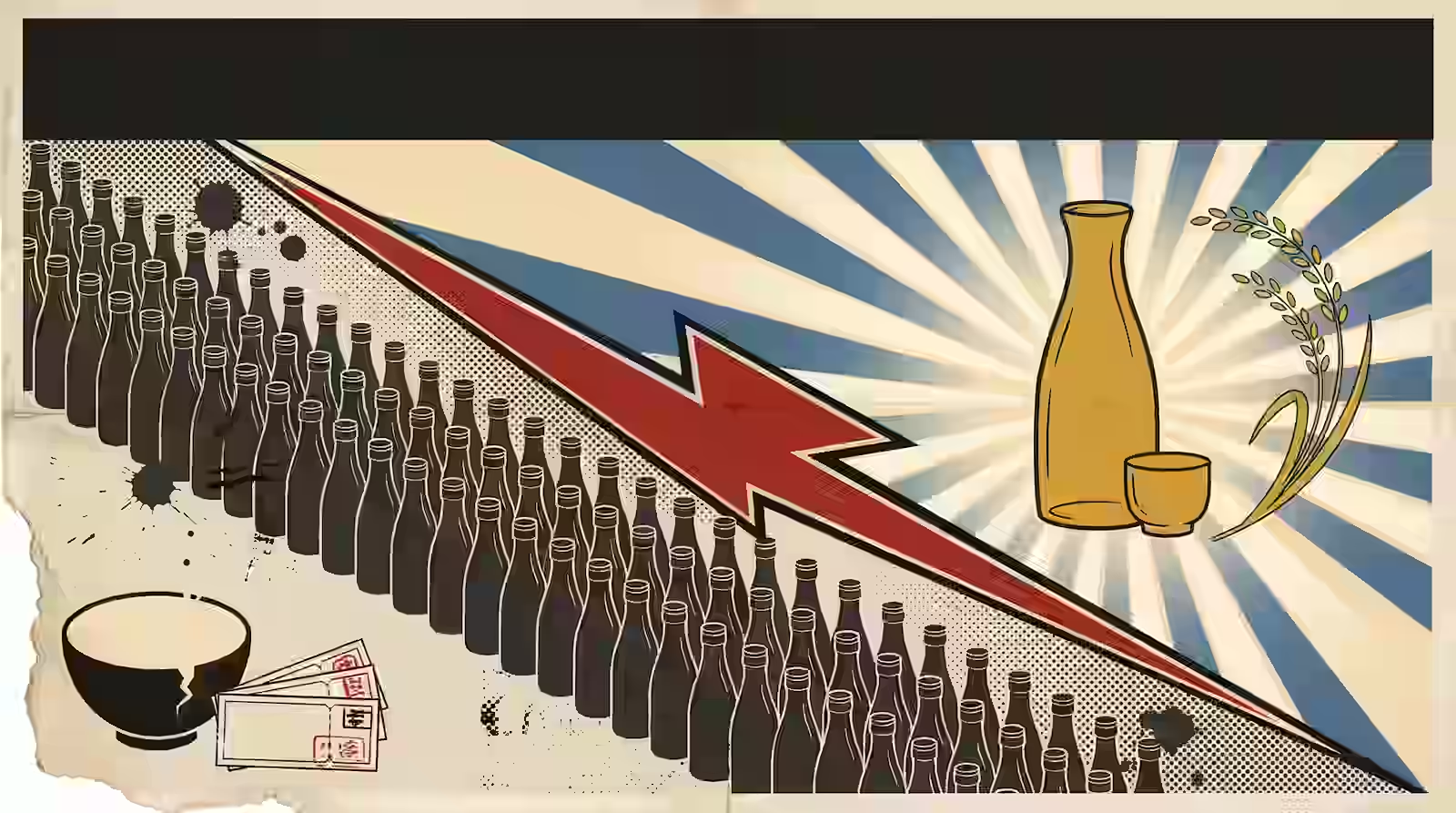

In fiscal 1973, Japan’s breweries shipped about 1.77 million kiloliters of sake, more than in any year before or since. Fifty years later, the figure was under 400,000. Modern sake is the story of how Japan got from one number to the other, and why the drop is only half the story.
First, this guide covers sake in the twentieth century: the spread of laboratory yeast, wartime rationing, alcohol-added “sanbai” sake, the postwar boom, and the ginjo revival. It ends with the 1990 labeling reform that still shapes every sake label you read today.
What Is Modern Sake?
In this article, modern sake means sake made in Japan from roughly 1912 to the late 1990s, when production, taxation, grading, and taste all changed on an industrial scale. In other words, it is a historical period, not a style of sake. The Meiji era built the scientific tools; the twentieth century put them to work in factories, under wartime controls, and finally in the premium bottles that define sake today.
Period Covered
1912 to 1999
From the end of the Meiji era to the end of the twentieth century
Peak Year
1973
About 1.77 million kL of taxable shipments
Wartime Grading
1943
Four tax grades introduced
Alcohol Addition
1943
Approved as rice ran short
Key Yeast
No. 7
Kyokai No. 7, distributed from 1946
The Big Reform
1989 to 1992
Labeling standards set in 1989 and applied from 1990; the old grades ended in 1992
Did sake suddenly “become modern” in 1912? No. The long history of Japanese sake shows change arriving in layers. What makes the twentieth century different, then, is scale. For the first time, Japan made, taxed, and sold sake as a national industry. Then, late in the century, sake began to sell itself on craft again.
From Meiji Brewing Science to the Twentieth Century
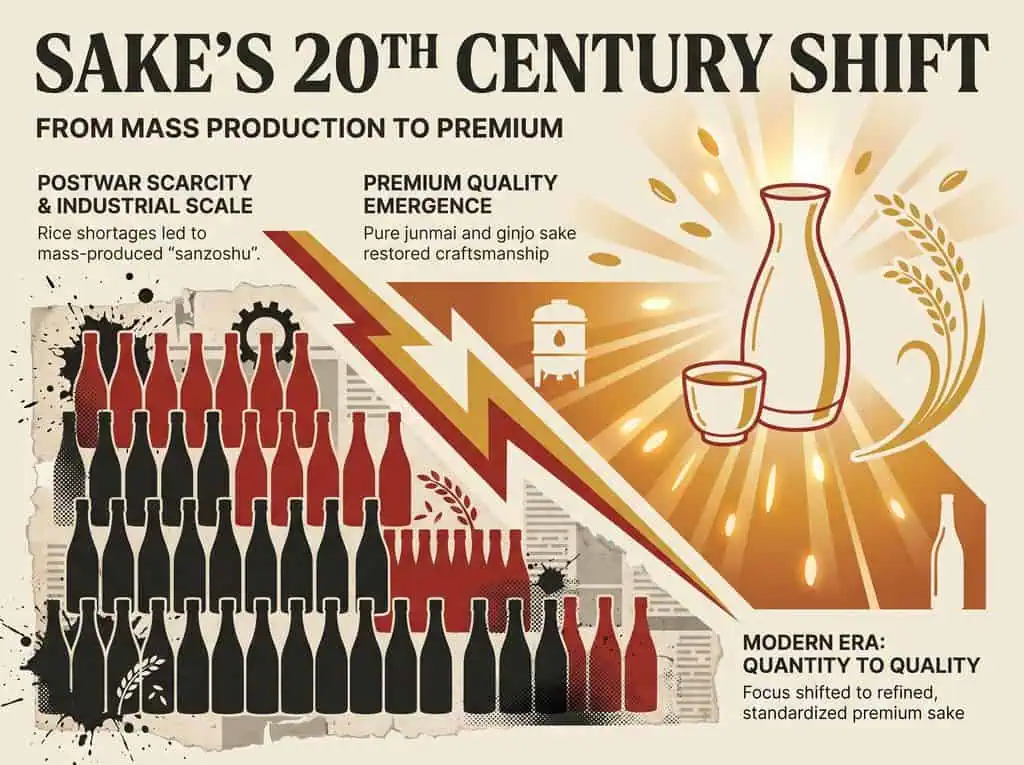
By 1912, the groundwork was already in place. The Ministry of Finance had opened its Brewing Experimental Station in 1904. Its researchers had developed the yamahai starter in 1909 and the sokujo starter in 1910, and the station had held the first national appraisal of new sake in 1911. Our guide to Meiji era sake and the birth of brewing science tells that story in detail.
Put simply, Meiji created the tools. The twentieth century then put them into widespread industrial use. Yet it did so slowly, and brewers mixed new equipment with old habits for decades. A toji in 1925 might use a thermometer and a laboratory yeast while still brewing only in winter, as his grandfather had.
New Equipment in the Brewery
For example, the National Tax Agency’s history exhibit lists the changes compactly. The 1.8-liter isshobin bottle, developed in the Meiji era, spread during the Taisho era. Later, in the early Showa period, vertical rice-polishing machines appeared. At the same time, enamel-lined tanks began replacing wooden vessels, because they were far easier to keep clean and cool.
Each change may appear minor on its own. Together, however, they made brewing more standardized, measurable, and scalable. Enamel tanks cut contamination. Standardized bottles also let branded sake travel through the expanding rail network with a recognizable label. And a machine that could polish rice evenly opened doors that brewers would walk through fifty years later. Our explainer on sake bottling covers how that last step works today.
The Spread of Kyokai Sake Yeast
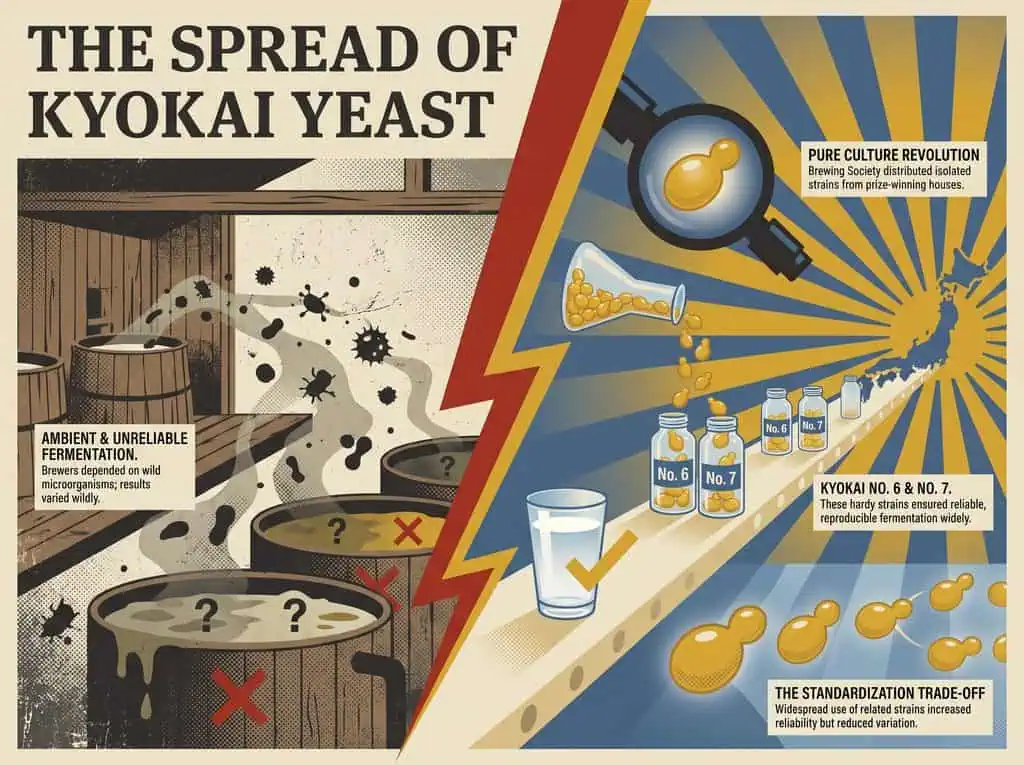
Before pure cultures became widely available, brewers depended largely on microorganisms established in the brewery and carried from one batch to the next. Sometimes that yeast made superb sake. Sometimes it failed. However, the Brewing Society of Japan changed that equation by distributing pure yeast cultures, called Kyokai (Association) yeasts, beginning with a strain isolated in 1906 from a Nada brewery.
Why Selected Yeast Mattered
Typically, a selected yeast came from a brewery that was already making excellent sake. So a small brewer in a remote valley could now start fermentation with the same organism as a prize-winning house. As a result, fermentation became more predictable, spoilage less common, and quality more consistent across regions. For more detail, our guide to yeast in sake brewing explains how these strains behave in the tank.
Kyokai No. 6 and No. 7
Two strains stand out. Kyokai No. 6, selected from Aramasa in Akita, entered distribution in 1935 and ferments strongly even at low temperatures. It was also, remarkably, the only Kyokai yeast the society distributed during the Pacific War. Then Kyokai No. 7 followed in 1946, from Miyasaka Brewing, maker of Masumi in Nagano. Together, they became central to the spread of reliable, reproducible fermentation.
The Trade-off
Later genetic research found that many widely used Kyokai sake yeasts, including Nos. 6, 7, 9, and 10, belong to a closely related group commonly called the K7 group. Selected yeast made fermentation more reliable and reproducible. At the same time, some observers argue that the spread of closely related strains reduced one source of brewery-to-brewery variation.
That tension, between reliability and individuality, runs through the rest of the century. It would return, in particular, in the premium sake movement of the 1980s.
The Rise of Machine Rice Polishing
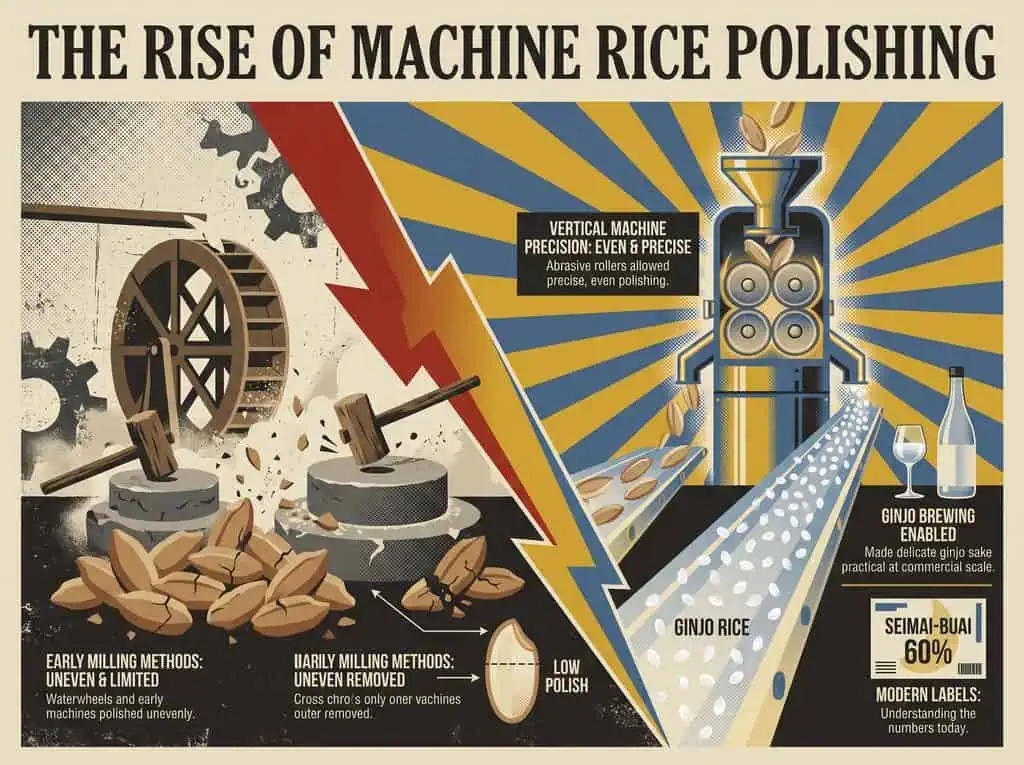
According to the Japan Sake and Shochu Makers Association’s chronology, a vertical rice-polishing machine appeared in 1933. Earlier machines and waterwheels could remove the outer layers of rice, but only so far and only so evenly. By contrast, the vertical design used an abrasive roller that could polish grains far more precisely.
Why did that matter? Polishing reduces the fats, proteins, and minerals in the outer layers of the grain, and more precise polishing let brewers pursue lighter, more delicate flavors. At first, it simply raised capacity. In the long run, it made ginjo brewing, with rice polished to 60 percent or less of its original weight, practical at commercial scale. Today, our guide to rice polishing explains the numbers on a modern label.
The Sake Industry Before Wartime Controls
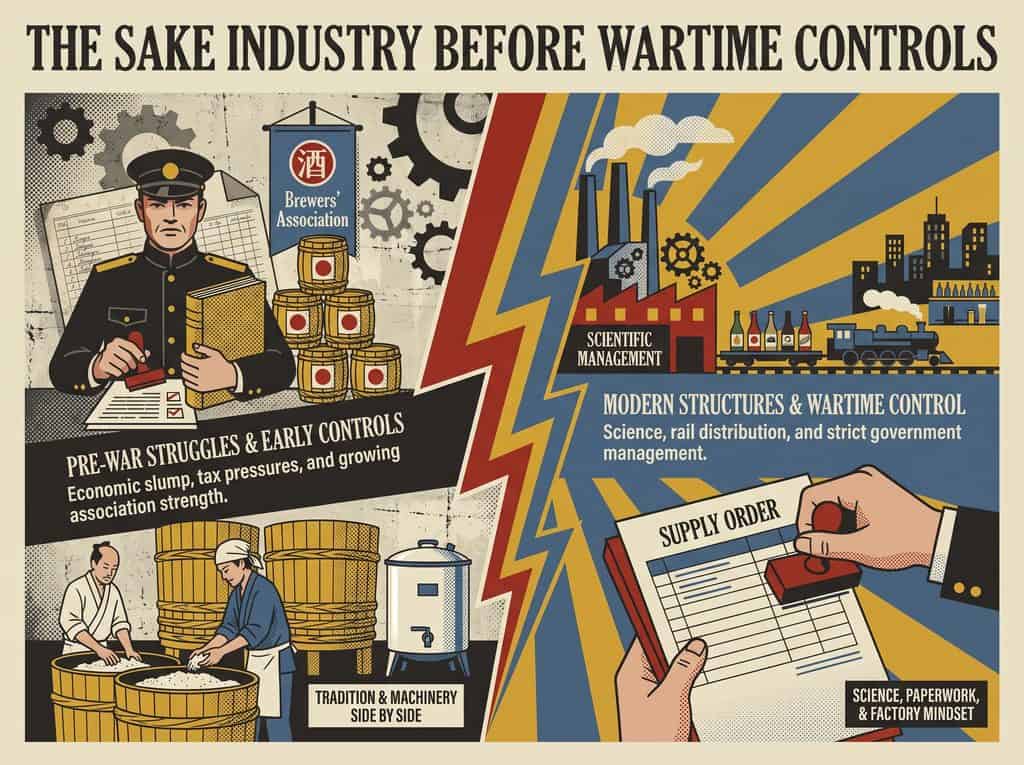
The 1920s and early 1930s were not easy for brewers. The National Tax Agency notes that the economic slump after World War I dragged on into the Showa era. One trade publisher of the period, whose appeal the agency preserves, pressed for a tax levied at shipment and for the brewers’ central association to coordinate production.
Still, this was also the period when sake became recognizably modern as a product. At the same time, bottled brands, rail distribution, city bars, and national appraisals all grew. Brewing associations also became stronger, and the tax office kept close watch. In other words, the structures that wartime planners would soon take over were already in place.
Science, Paperwork, and the Factory Mindset
The agency’s exhibit also preserves a guide on the scientific management of sake plants, published by a regional branch of the Brewing Society of Japan. Its focus on scientific plant management shows how brewers had begun to think of their work. Labor law, by contrast, lagged behind. The Factory Act gave workers only limited protection, far less than they enjoy today.
Records mattered more and more, too. Once wartime distribution controls began, a notice preserved by the agency shows Tokyo’s tax supervision bureau telling a producer how much sake it could supply to other brewers and to sellers. Producers then reported their monthly deliveries to the local tax office. So by the early 1940s, a brewer’s ledger had become part of the national supply system.
Tradition and Machinery Side by Side
It would be wrong to picture this era as a contest between old craft and new machines. Instead, in most breweries, the two simply worked together. Seasonal crews under a toji still steamed rice, made koji by hand, and judged the mash by smell and touch. Meanwhile, the same breweries adopted enamel tanks, selected yeast, and polishing machines whenever the numbers made sense. The mix varied from one brewery to the next, which is exactly why regional character survived the arrival of industry.
War Changes Everything
The Second Sino-Japanese War began in 1937 and widened into the Pacific War in 1941. For brewers, however, the effect was a slow tightening of every lever the state could pull: rice, prices, sales, taxes, and even the number of breweries. Quality work did not stop, but securing rice and keeping production going became more urgent. The question was how a craft industry could keep operating inside a planned wartime economy.
1937
War with China begins, and controls on rice and prices start to tighten.
1939
A price control order under the National Mobilization Law brings sake under state pricing.
1940
A single Liquor Tax Act replaces separate laws and adds a tax at shipment.
1943
Grading by tax class begins, and the state approves alcohol addition.
Rice, Prices, and Distribution
According to the National Tax Agency, state control of sake began in 1939 with a price control order issued under the National Mobilization Law. Controls on distribution, including rationing, lasted until after the war. Then, in 1940, the Liquor Tax Act gathered separate alcohol taxes into one law. It also added a tax charged when sake left the brewery, and from 1944 that shipment tax became the only one.
Rice was the other lever. The government allocated brewing rice to each producer, but the allocation shrank as the war went on. Consequently, many breweries merged or closed, sometimes under official consolidation plans. What survived was an industry run less by market demand than by quotas.
Goldfish Sake and the Price Freeze
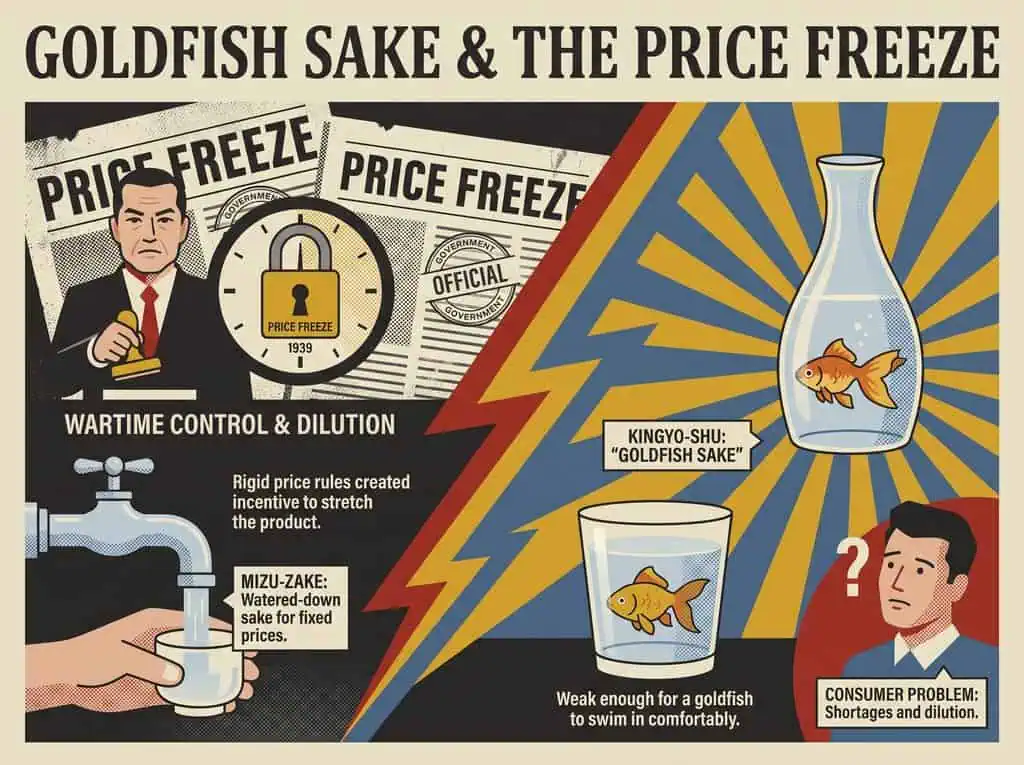
One wartime nickname has outlived the era: kingyo-shu, or “goldfish sake.” Where did it come from? The National Tax College’s historical commentary links it to the price freeze of September 18, 1939. Because prices were fixed by date, some sellers reasoned that only the price mattered, not the contents. Watered-down “mizu-zake” spread, weak enough, people joked, for a goldfish to swim in comfortably.
The dilution behind the nickname became a genuine problem for consumers and regulators. It also shows something easy to miss. In fact, wartime sake shortages were not only about missing rice. Rigid price rules created their own incentive to stretch the product.
Alcohol Addition During Wartime
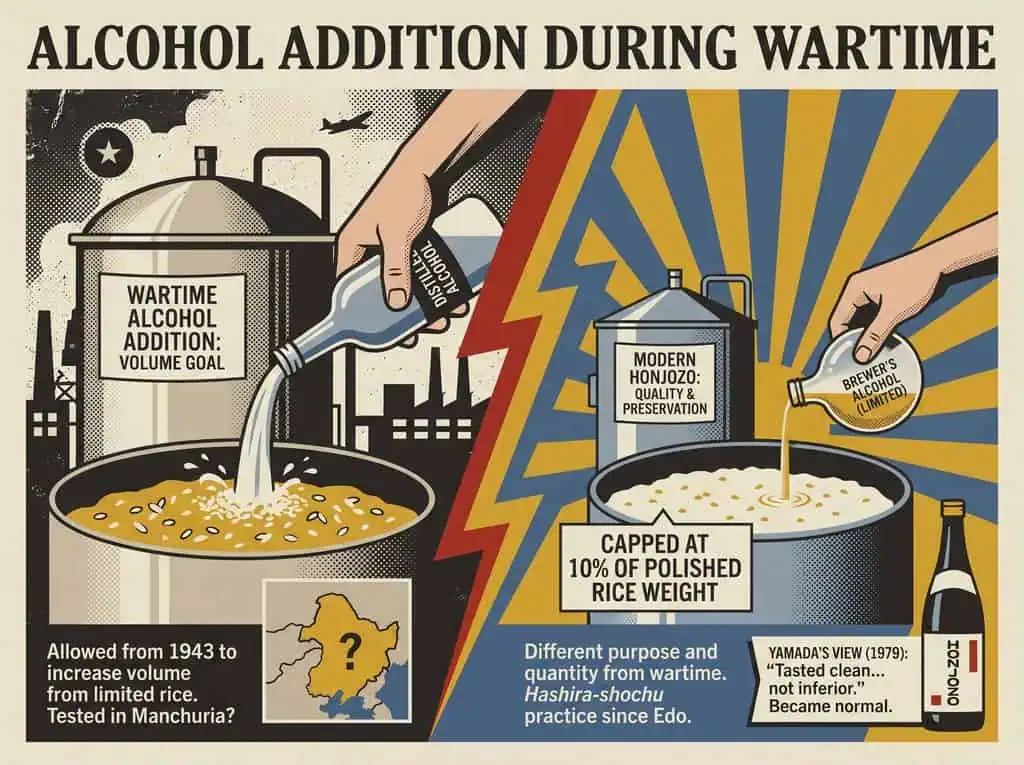
From January 1943, the authorities officially allowed brewers to add distilled alcohol to the fermenting mash. The immediate goal was to increase the volume of sake obtainable from a limited rice allocation. Shoichi Yamada, a brewing specialist who worked through the period, later recalled that researchers first tested related methods in Japanese-controlled Manchuria. However, he wrote this as secondhand knowledge.
Not the Same as Modern Honjozo
This, however, is where many histories go wrong. Brewers had added small amounts of distilled spirit since the Edo period, a practice called hashira-shochu, mainly to protect sake from spoilage. Today’s honjozo and ginjo also use a little brewer’s alcohol, but the National Tax Agency caps it at 10 percent of the weight of the polished rice. Wartime addition, by contrast, aimed at volume. In short, the purpose, the quantity, and the legal category were all different.
The people who lived through it did not all regret it. Writing in 1979, Yamada noted that most sake then on sale contained added alcohol. In his view, it tasted clean and was not inferior to the junmai sake that a few brewers were starting to revive. That opinion now sounds dated, yet it reminds us how normal alcohol-added sake had become.
The Wartime Grading System
In April 1943, the government divided sake into four grades, First through Fourth, and each grade paid a different shipment tax. The National Tax College’s documents list rates from 470 yen per koku for First Grade down to 155 yen for Fourth Grade. For reference, a koku is a traditional unit of about 180 liters.
So was a grade a quality ranking? Partly. Officials did assess sake before assigning a grade, and drinkers came to read the grade as a sign of quality. Yet the system’s immediate administrative purpose was taxation. After the war, the four grades became Special, First, and Second Class, and that structure would last until 1992.
Sake After 1945: Shortage Before Recovery
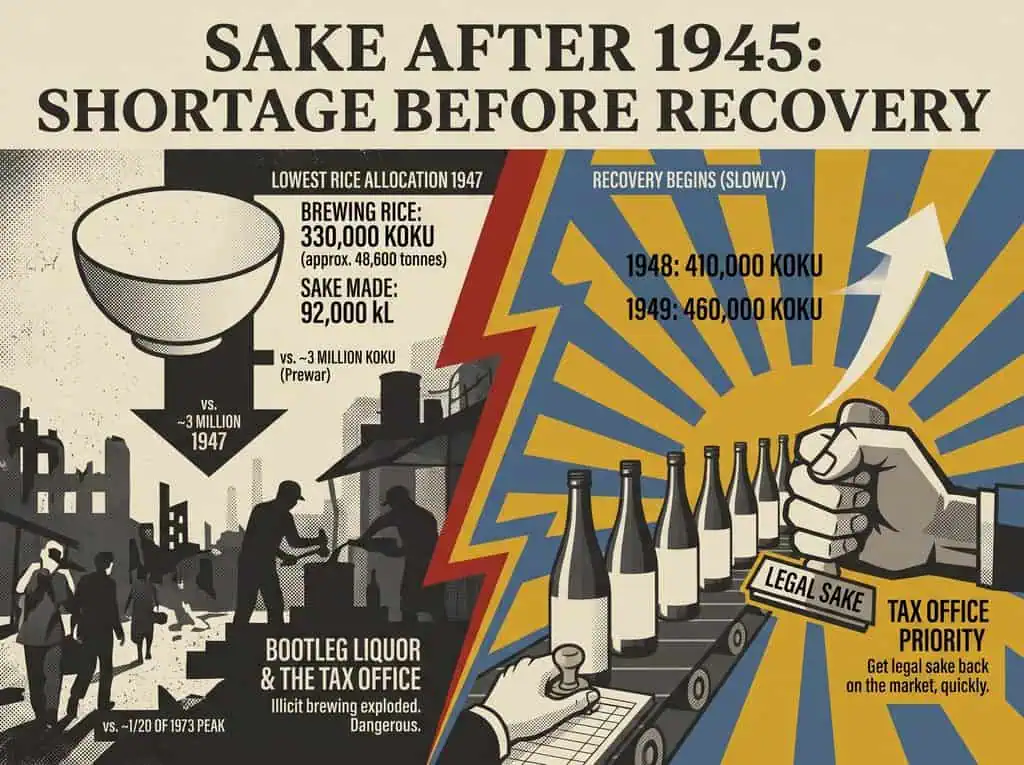
Unfortunately, peace did not bring sake back. If anything, the first postwar years were worse. After all, the loss of food-supplying colonies and the return of millions of soldiers and settlers squeezed Japan’s rice supply. According to the National Tax College, the 1947 brewing year saw the lowest rice allocation in the entire history of controls.
Brewing Rice, 1947
330,000 koku
About 48,600 tonnes, against roughly 3 million koku in a normal prewar year, as Yamada recalled
Sake Made
92,000 kL
Roughly one twentieth of the 1973 peak
Demand, however, did not wait. Allocations then rose again, to about 410,000 koku in the 1948 brewing year and 460,000 the following year. Recovery had begun, but slowly.
Bootleg Liquor and the Tax Office
Illicit brewing was not new. Japan had banned home brewing for personal use back in 1899, yet rural moonshine never entirely vanished. After 1945, however, the scale changed. According to the National Tax Agency, many people who had lost their jobs made bootleg liquor in the cities to survive, and some of it was dangerous to drink. For tax officials, the priority was clear: get legal sake back on the market, and quickly. That urgency explains a great deal about the choices of the next few years.
Sanbai Brewing and the Era of Cheap Sake
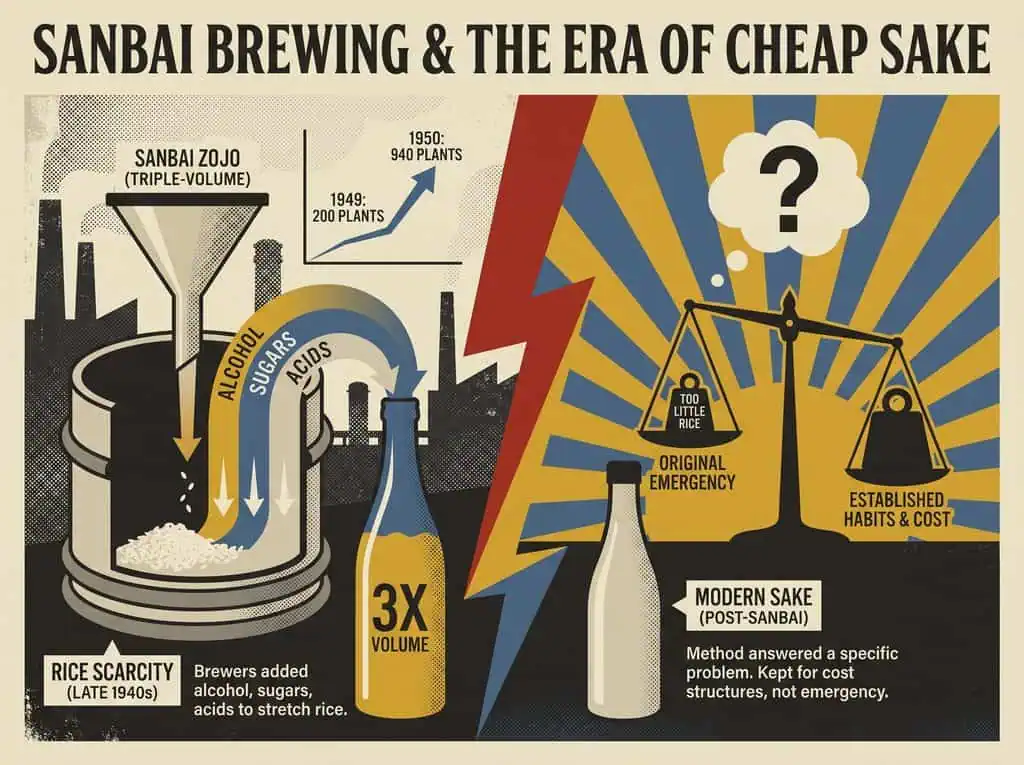
Rice was still scarce in the late 1940s, so officials and brewers looked for a way to stretch it further. The answer was sanbai zojo, or “triple-volume brewing,” often shortened to sanzo. Specifically, brewers added a prepared liquid of alcohol, sugars, and acids to the mash, which roughly tripled the sake produced from the same rice.
Yamada’s account gives the rollout. Early in 1949, about 200 plants tried the method, and the following year it spread to 940. Meanwhile, contemporary technical papers show researchers adjusting sugars, acids, and amino acids to make the result taste more like sake. Technical accounts also indicate that sanbai-produced sake was often blended with conventionally brewed sake rather than sold on its own.
How Should We Judge It?
Sanbai sake has a poor reputation today, and engineers of the time were already experimenting to fix its thin taste. Still, “all postwar sake was bad” is too simple. The method answered a specific problem: too little rice, too much demand, and a treasury that depended on sake tax. Once rice was plentiful again, its reason for being faded, although brewers kept making sanbai sake for decades. Its long afterlife, however, reflected cost structures and established business habits more than the original emergency.
The Postwar Brewing Boom
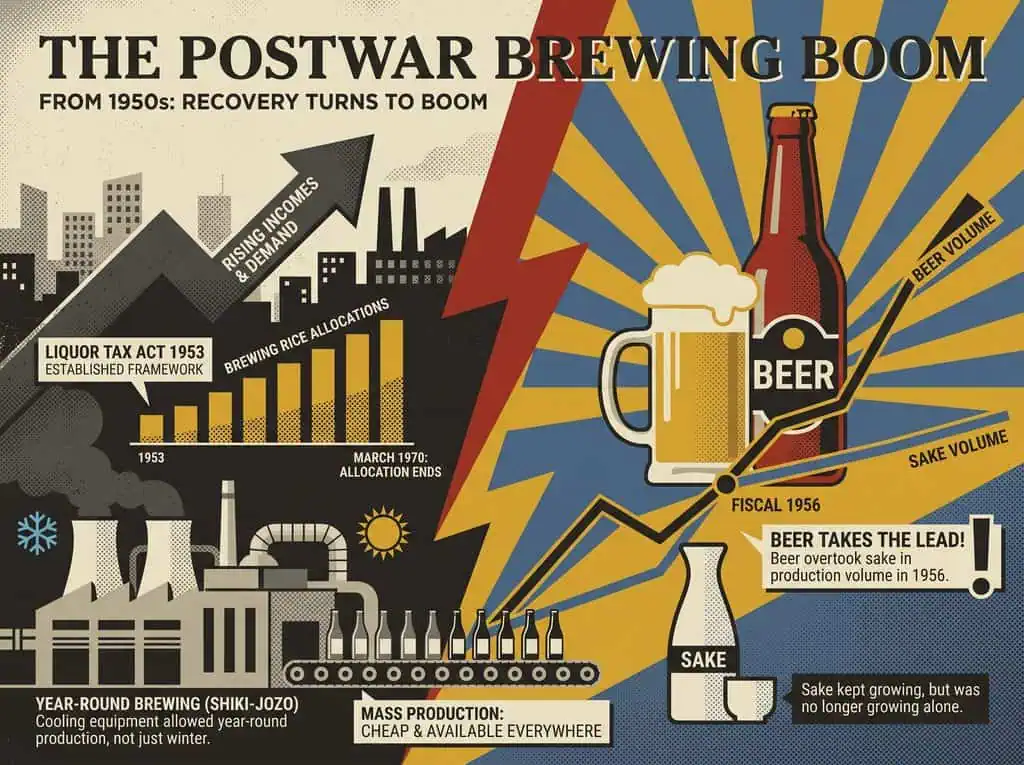
From the 1950s, however, the recovery turned into a boom. As incomes rose and cities grew, eating and drinking out became part of ordinary life. The fully revised Liquor Tax Act of 1953 established the basic framework of Japan’s present liquor tax system, although the law has since been amended many times. Brewing rice allocations grew year after year until the allocation system itself ended in March 1970.
Technology kept pace. Many larger brewers installed cooling and air-handling equipment that allowed shiki-jozo, or year-round brewing, instead of relying on winter cold alone. The traditional practice of kan-zukuri, or winter brewing, did not disappear, but it was no longer the only option for a big company. Mass production, in other words, was not simply a decline in quality. Instead, it was the system that made sake cheap and available everywhere.
Beer Takes the Lead
Here, though, is a detail that surprises many readers. According to the National Tax Agency, beer overtook sake in production volume in fiscal 1956. So sake’s position as Japan’s leading drink was already slipping during its own boom. Sake kept growing in absolute terms, but it was no longer growing alone.
The Cost of Mass Production
Growth also brought a new structure to the industry. Large national brands could not always brew enough to meet demand, so they bought bulk sake from smaller regional breweries in a practice called oke-uri, or “barrel selling.” The practice itself was older. It expanded sharply after the war, however, and many small breweries came to depend on it.
For the small brewer, oke-uri meant a steady buyer. For the drinker, by contrast, it meant that a famous label might contain sake made far away by someone else. And when demand slowed in the 1970s, the big buyers held the power. As a result, brewers that had never built their own brands suddenly had to. That pressure, more than nostalgia, fed the later rise of regional sake.
The 1970s: The Peak of Mass-Market Sake
Sake reached its high point in fiscal 1973, at about 1.77 million kiloliters of taxable shipments, the volume leaving breweries for sale. The figure measures shipments rather than drinking, but it tracks demand closely. After that year, the line turned down and never recovered.
All-Time Peak, FY1973
1.77M kL
Taxable shipments of sake, the highest ever recorded by the National Tax Agency
FY1970
1.60M kL
FY1980
1.47M kL
FY1998
1.09M kL
End of the modern era
FY2023
0.39M kL
About a fifth of the peak
Why 1973? Several factors probably converged: demographic conditions, the final years of rapid economic growth before the oil shock, and intensifying competition from beer, whisky, and later shochu and wine. In the same year, the use of preservatives in sake ended, another sign that quality and consumer confidence were becoming major concerns.
Why Drinkers Started Looking for Something Different
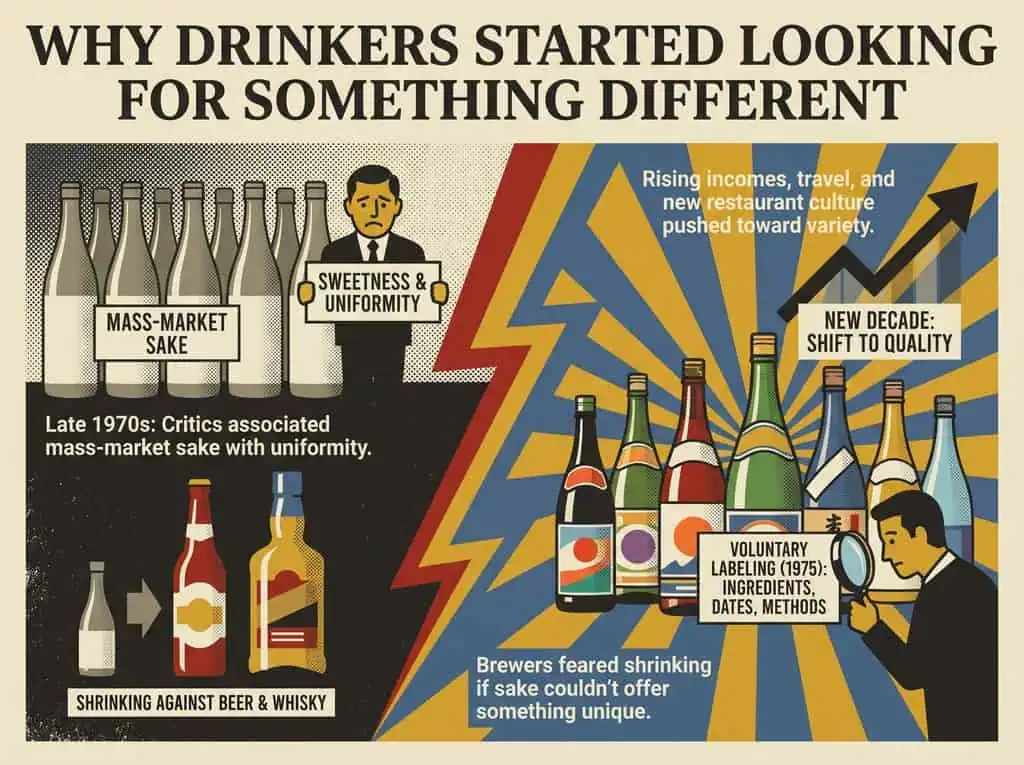
By the late 1970s, however, critics and a growing group of consumers associated mass-market sake with sweetness and uniformity. Moreover, rising incomes, travel within Japan, and new restaurant culture all pushed toward variety. In 1975, the industry expanded voluntary labeling of production dates, ingredients, and brewing methods, which gave curious drinkers something to compare.
Brewers felt the shift too. Some industry writers around 1980 already described the 1950s and 1960s as decades of volume, and the new decade as one of quality. Behind that phrase, though, was a practical fear. If sake could not offer something beer and whisky could not, it would keep shrinking.
The Ginjo Revival of the 1980s
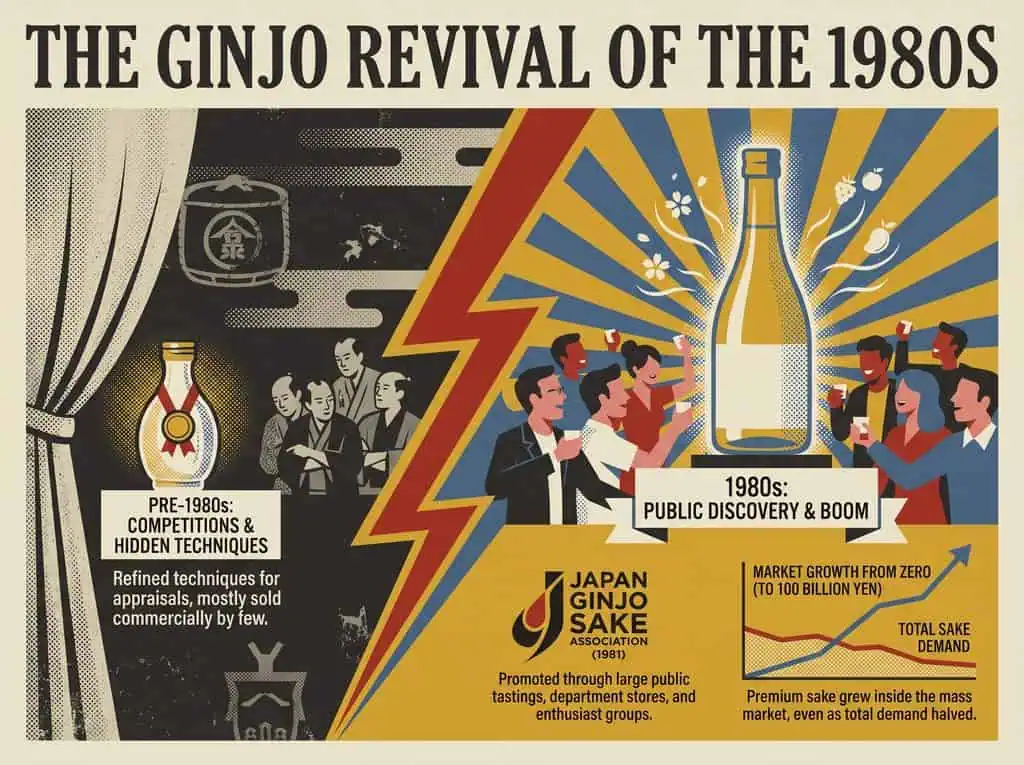
Brewers make ginjo sake from highly polished rice and ferment it slowly at low temperatures, which draws out fruity, floral aromas. Even so, it was not invented in the 1980s. Brewers had refined ginjo techniques for decades, mostly for competitions such as the national new-sake appraisal, and some breweries sold it commercially well before 1980. What changed in the 1980s was that ordinary drinkers discovered it.
Several forces, in turn, pushed it into the open. Enthusiast tasting groups spread, and department stores and restaurants began stocking ginjo. In 1981, according to one of its later chairmen, 43 breweries founded the Japan Ginjo Sake Association to promote the style through large public tastings. The Japan Sake and Shochu Makers Association’s chronology also marks the 1980s as the decade when ginjo and namazake, or unpasteurized sake, gained popularity. For more, our guides to ginjo sake and daiginjo sake explain how these styles are made.
A Market Built from Zero
Writing in 2005, sake author Jiro Shinoda described ginjo as a market that grew from almost nothing to about 100 billion yen in thirty years, even as total sake demand halved. Premium sake did not replace the mass market. Instead, it grew inside it.
New Yeasts and the Aroma Revolution
Ginjo’s fragrance depends heavily on yeast. A strain isolated in Kumamoto, later distributed as Kyokai No. 9, became the classic ginjo yeast because of its lively, fruity aromas at low temperatures. Other strains, such as Kyokai No. 10, offered lower acidity and a lighter style. In practice, choosing a yeast became one of the main ways a brewer shaped a sake’s personality.
Here the trade-off from earlier returns. The same K7-family yeasts that made brewing reliable, some observers argue, also made many sakes resemble each other. Later genetic research linked the family’s strong fermentation partly to a mutation affecting how the yeast enters a resting state. Some brewers later went looking for distinctive regional strains, a story that continues into the twenty-first century.
The End of the Old Sake Grading System
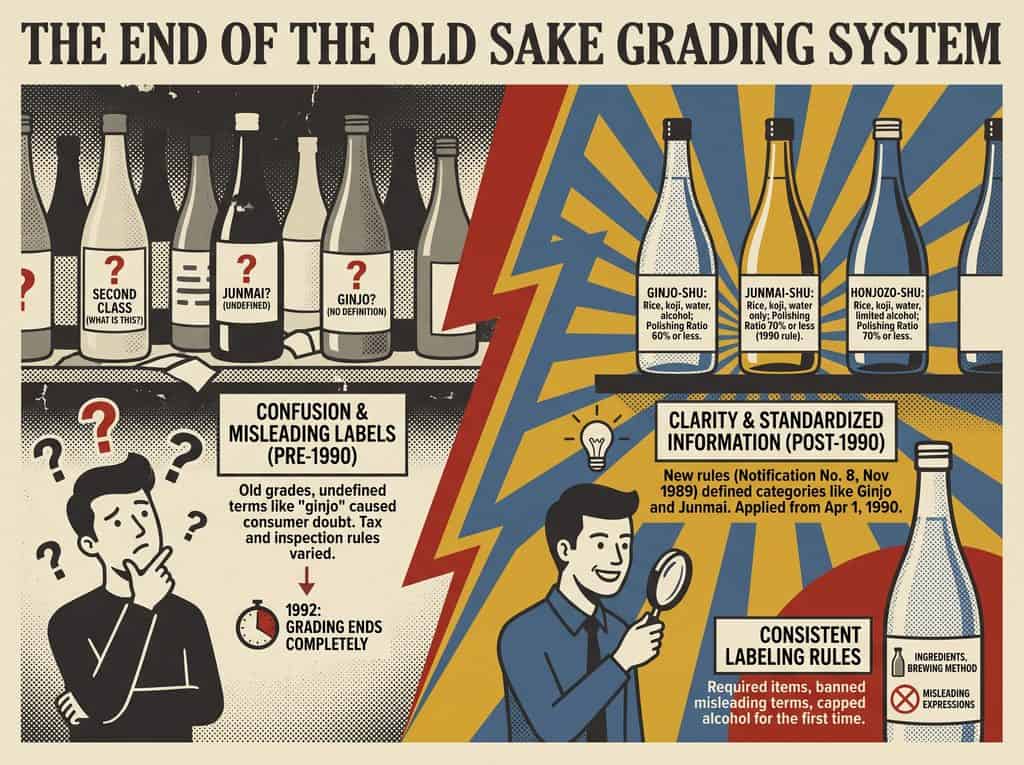
By the late 1980s, the shelves were confusing. Because a higher grade meant an inspection and a higher tax, some brewers did not seek one, so a Second Class label said little about what was inside. Meanwhile, words like ginjo and junmai had no legal definition at all. The National Tax Agency later explained that consumers increasingly said they could not tell what they were buying.
The response came in stages. On November 22, 1989, the agency issued Notification No. 8, the Sake Production and Quality Labeling Standards. They applied from April 1, 1990. The old grading system then ended completely in 1992, after nearly half a century.
| Category (1990 rules) | Ingredients | Rice Polishing Ratio |
|---|---|---|
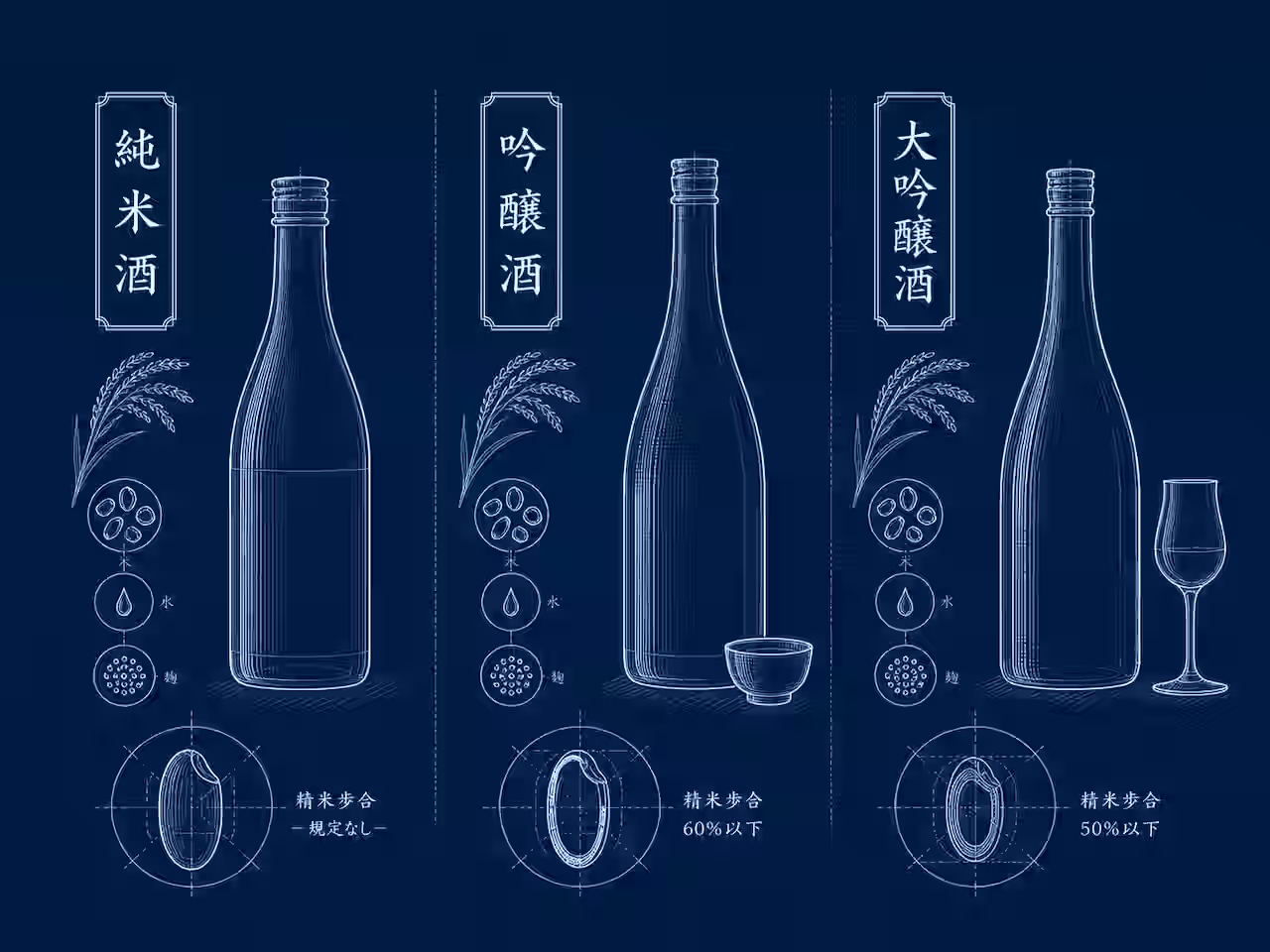
| Ginjo-shu | Rice, koji, water; brewer’s alcohol allowed | 60% or less |
| Junmai-shu | Rice, koji, water only | 70% or less (requirement removed in 2003) |
| Honjozo-shu | Rice, koji, water, limited brewer’s alcohol | 70% or less |
These 1990 categories formed the basis of today’s tokutei meisho-shu, or “special designation sake,” although some requirements were later revised. Most notably, the polishing-ratio requirement for junmai-shu was removed in 2003. Daiginjo and junmai daiginjo, for rice polished to 50 percent or less, sit within the ginjo family.
More Than New Category Names
The 1990 standards did more than name categories. According to the National Tax Agency’s later summary, they also listed items every sake label had to show, set rules for optional claims, and banned certain misleading expressions. The original notice even capped brewer’s alcohol at 10 percent of the weight of the polished rice. So, for the first time, a bottle had to explain itself in a consistent way.
From “Grade” to “Method”
In practice, the reform changed more than label wording. It changed the question a label answers. Under the old system, the label told you a tax class. Under the new one, by contrast, the label described key aspects of how the sake was made: its ingredients, its polishing ratio, and whether brewer’s alcohol was used.
Old System, 1943 to 1992
Grade
- Special, First, and Second Class after the war
- Assigned through inspection and tied to tax rates
- Said little about ingredients or brewing
New System, from 1990
Method
- Ginjo, junmai, honjozo, and related categories
- Defined by ingredients, polishing ratio, and alcohol addition
- Lets drinkers compare brewing methods
That is a real shift in philosophy, from a label designed for the tax office to one designed for the drinker. It is also, admittedly, not a guarantee of quality. A special designation tells you the method, not whether you will like the sake. Even so, it gave premium brewers a shared language, and they used it.
Why Sake Consumption Declined
Overall, shipments fell from about 1.47 million kiloliters in fiscal 1980 to about 1.09 million by fiscal 1998. No single cause explains it. Beer, then whisky, then shochu and wine competed for the same glass. Changes in diet and dining culture may also have influenced what people drank with meals, and an aging core of sake drinkers was not fully replaced by younger ones.
The decline was not a straight line, though. National Tax Agency figures show shipments of about 1.35 million kiloliters in fiscal 1989, then a small rise to about 1.42 million in fiscal 1993. After that, the fall resumed and steepened, reaching about 1.09 million by fiscal 1998. The late 1990s, in other words, were when the long contraction became impossible to ignore.
Similarly, the number of breweries fell as well. Many small firms that had lived on bulk sales could not build their own brands in time. Still, the decline was not the whole picture, because the premium share of a shrinking market kept growing.
The Rise of Regional and Premium Sake
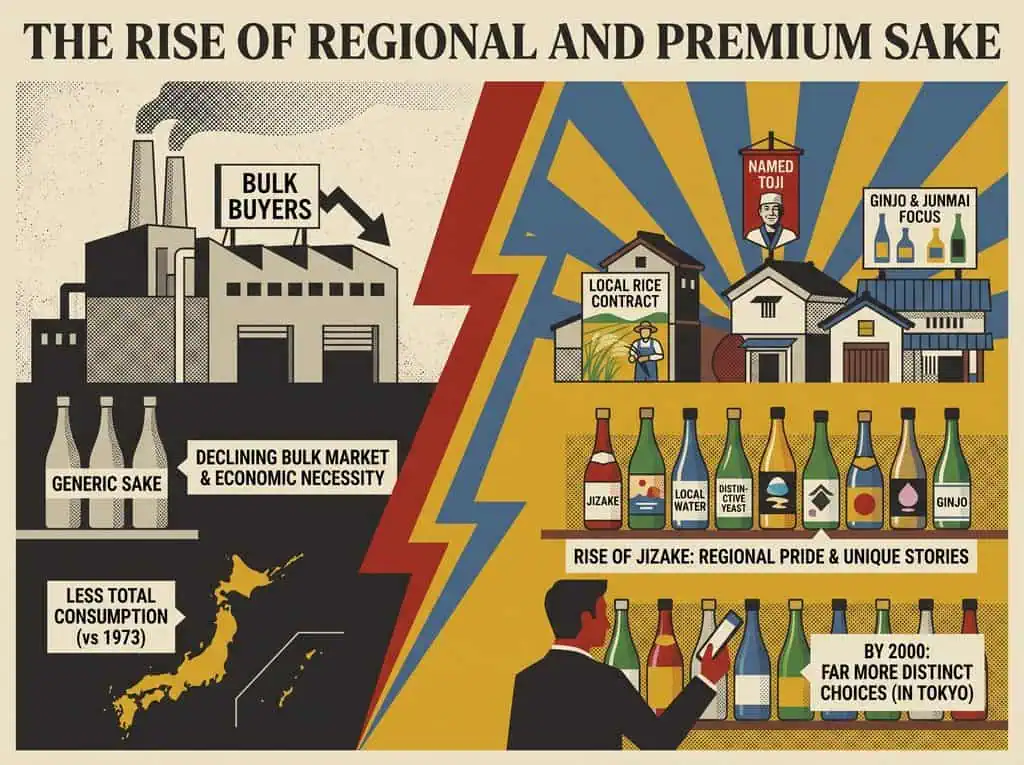
Out of that pressure, eventually, came jizake, or local sake. Regional breweries that could no longer rely on bulk buyers began telling their own stories: local rice, local water, a named toji, a distinctive yeast. For example, some signed contracts with nearby farmers to grow sake rice. Others staked their future on ginjo and junmai. Our look at the toji, the master brewers behind each sake, explains why their names began to matter to buyers.
Economic necessity and regional pride were probably both at work, and it is hard to separate them. Either way, what matters is the result. By 2000, a drinker in Tokyo could likely choose from far more distinct sakes than in 1973, even though Japan as a whole was drinking much less.
What Changed, and What Survived?
What Changed
- Machine polishing, enamel tanks, and cooling equipment
- Selected Kyokai yeasts and scientific fermentation control
- Wartime controls, alcohol addition, and sanbai brewing
- Mass production, bulk trading, and national brands
- Labels based on method instead of tax grade
What Survived
- Rice, koji, and water at the heart of every batch
- Hand koji-making and the toji system
- Winter brewing at many breweries
- Traditional kimoto and yamahai starters
- Regional styles, shrine offerings, and sake at the table
In short, the century changed the tools and institutions far more than the basic logic of brewing. The traditional sake brewery, or kura, often looks old from the outside and modern within.
From Modern Sake to Contemporary Sake
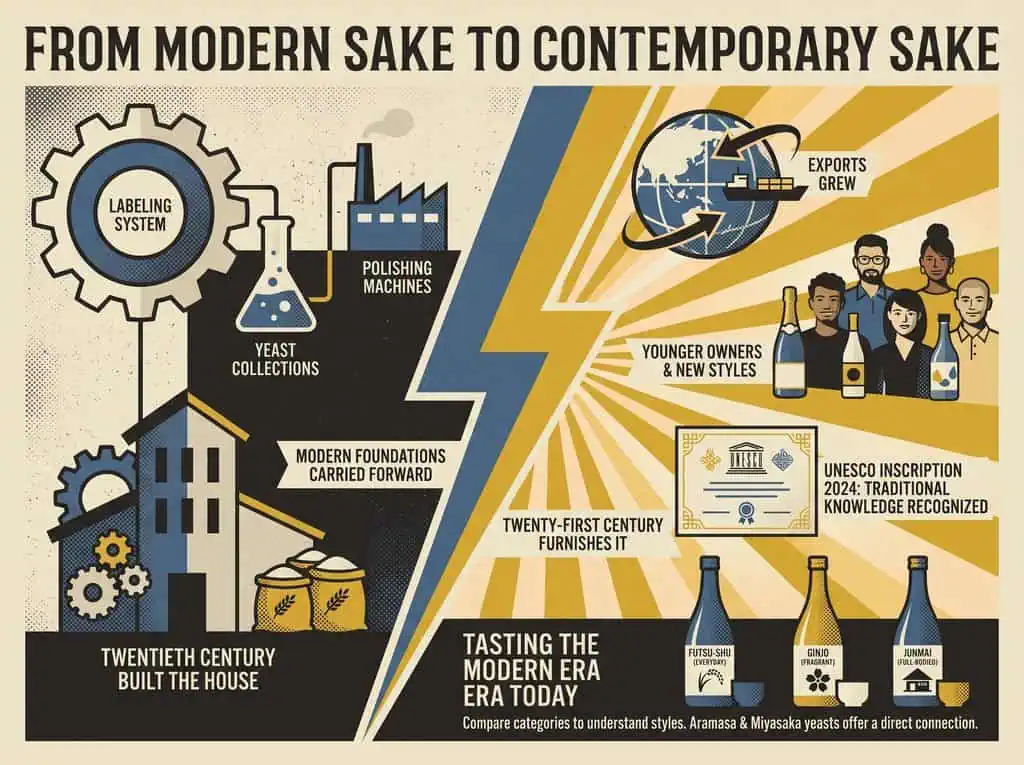
In the end, the twentieth century left sake smaller in volume but sharper in identity. What came next belongs to another chapter. For instance, exports grew, younger brewery owners took over family firms, and new styles such as sparkling and low-alcohol sake appeared. On December 4, 2024, UNESCO inscribed the traditional knowledge and skills of sake-making with koji mold in Japan on its Representative List of the Intangible Cultural Heritage of Humanity.
None of that would have been possible without the modern era. The labeling system, the yeast collections, the polishing machines, and even the hard lessons of mass production all carried forward. So if Meiji built the foundation, the twentieth century built the house, and the twenty-first is still deciding how to furnish it.
Tasting the Modern Era Today
Some of this history can still be explored through comparative tasting. Compare an everyday futsu-shu with a fragrant ginjo and a fuller-bodied junmai. The categories are not a simple ladder of quality, but they show how ingredients, polishing, yeast, and fermentation goals produce different styles. Both Aramasa in Akita and Miyasaka Brewing in Nagano, where Kyokai Nos. 6 and 7 were identified, remain active today. Bottles that name these yeasts on the label offer a direct connection to the story.
Modern Sake Timeline
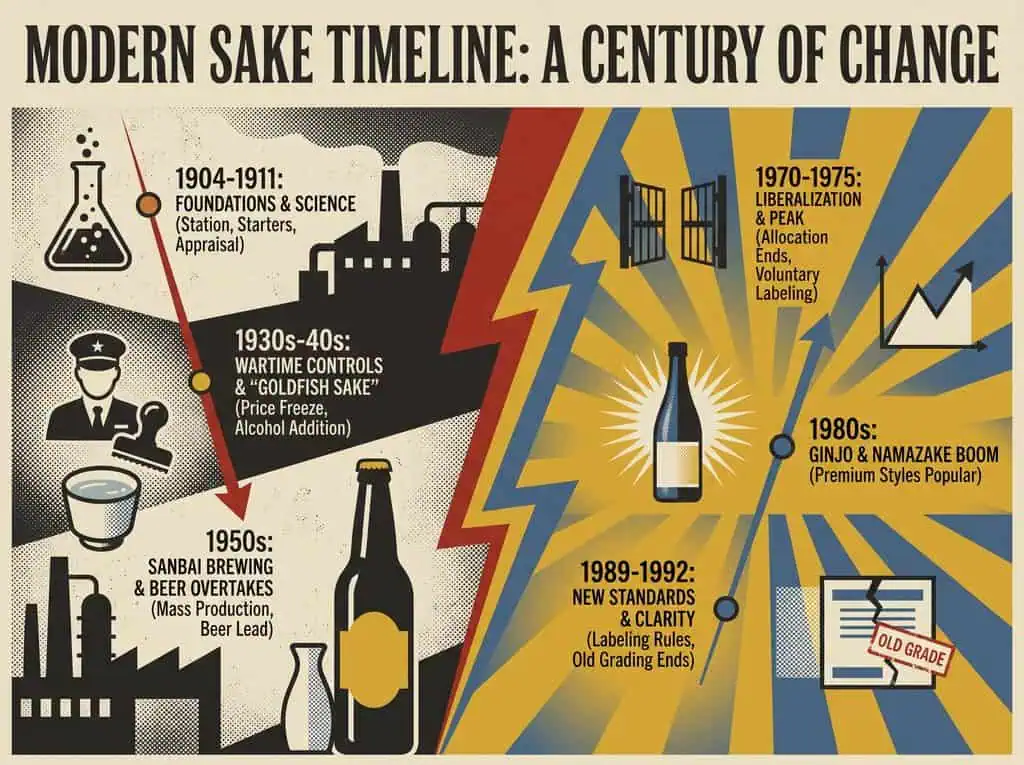
| Year | Development |
|---|---|
| 1904 to 1911 | Brewing Experimental Station (1904), yamahai and sokujo starters (1909 and 1910), and the first national appraisal (1911) |
| 1906 | The Brewing Society of Japan begins distributing selected Kyokai yeast |
| Taisho era | The 1.8-liter isshobin bottle spreads |
| 1933 | A vertical rice-polishing machine appears |
| 1935 | Kyokai No. 6 enters distribution |
| 1937 | The Second Sino-Japanese War begins and controls tighten |
| 1939 | State price controls cover sake; “goldfish sake” appears |
| 1940 | The Liquor Tax Act unifies alcohol taxes |
| 1941 | The Pacific War begins |
| 1943 | Four-grade taxation and alcohol addition begin |
| 1946 | Kyokai No. 7 enters distribution |
| 1947 | Brewing rice allocation hits its lowest level |
| 1949 to 1950 | Brewers test sanbai brewing, then adopt it widely |
| 1953 | The fully revised Liquor Tax Act lays the basis of today’s system |
| 1956 | Beer overtakes sake in production volume |
| 1970 | The brewing rice allocation system ends |
| 1973 | Sake shipments peak, and the use of preservatives in sake ends |
| 1975 | Voluntary labeling of dates and ingredients expands |
| 1980s | Ginjo and namazake gain popularity |
| 1989 | The National Tax Agency issues labeling standards on November 22 |
| 1990 | The standards take effect on April 1 |
| 1992 | The old grading system ends |
Common Misconceptions About Modern Sake
- “Wartime alcohol-added sake is the same as modern honjozo.” The goals, amounts, and legal rules were different.
- “Ginjo was invented in the 1980s.” Its techniques are much older, while the 1980s brought public recognition.
- “The old grades were quality categories like today’s labels.” They were tax classes first, and they said little about ingredients or method.
Final Thoughts
Seen from a distance, then, sake’s century has three movements. The Meiji era gave brewers science and national regulation. The modern era turned that into industry, first under the pressure of war and then in the service of mass demand. And by the 1990s, the industry was turning again, back toward craft, place, and method.
It would be easy to tell this as a fall and a rescue. The record is more interesting than that. Wartime shortages certainly produced methods that outlived their purpose, but the same decades also produced Kyokai No. 7 and the machinery that made ginjo possible. The next time you read “junmai ginjo” on a label, you are looking at a small legal answer to a very large twentieth-century question: after quantity, what?
Frequently Asked Questions About Modern Sake
War and Postwar Years
- How did World War II affect Japanese sake?
-
The war brought sake under state control. From 1939, the state fixed prices, allocated rice to each brewery, and rationed distribution. In 1943, it also taxed sake in four grades and allowed brewers to add distilled alcohol to stretch scarce rice.
- What was kingyo-shu, or goldfish sake?
-
Kingyo-shu was a mocking wartime name for heavily watered sake. After prices were frozen in September 1939, some sellers diluted sake while keeping the fixed price. People joked it was weak enough for a goldfish to swim in, and it became a real social problem.
- What is sanbai sake?
-
Sanbai zojo, or triple-volume brewing, added a mix of alcohol, sugars, and acids to the mash to make about three times as much sake from the same rice. Brewers tested it in 1949, and it then spread quickly as a response to the postwar rice shortage.
Grades, Labels, and Premium Sake
- What was the old sake grading system?
-
It was a tax-based grading system introduced in 1943 with four grades, later reorganized into Special, First, and Second Class. Each grade paid a different tax rate. It ended in 1992, after labeling rules based on brewing method took effect in 1990.
- What is special designation sake (tokutei meisho-shu)?
-
Special designation sake is the legal group of categories, such as ginjo, junmai, and honjozo, defined by ingredients and rice polishing. Labeling standards issued in 1989 and applied from 1990 created the categories. Drinkers often call sake outside them futsu-shu, or ordinary sake.
Yeast and the Bigger Picture
- What is Kyokai No. 7 yeast?
-
Kyokai No. 7 is a sake yeast selected from Miyasaka Brewing, the maker of Masumi in Nagano, and distributed from 1946. It ferments reliably and became one of the most widely used sake yeasts. Many widely used Kyokai sake yeasts belong to the same broad genetic group.
- How is modern sake different from Edo-period sake?
-
Modern brewers use selected yeast, machine-polished rice, and temperature-controlled tanks, and they sell under national tax and labeling rules. Edo-period sake relied on house yeast, lighter polishing, and wooden vessels. The core process of koji, starter, and staged mashing is the same.
References
Government and Official Sources
- National Tax Agency – Special Exhibit: Sake Tax in the Prewar Showa Period (Accessed September 2026)
- National Tax Agency – Special Exhibit: Postwar Sake and Liquor Tax (Accessed September 2026)
- National Tax Agency – Special Exhibit: Liquor Tax Administration and Sake Tax (Accessed September 2026)
- National Tax College – Tax History Materials Series, Volume V: Commentary on Sake Tax Materials, 1912 to 1949 (Accessed September 2026)
- National Tax Agency – Notification No. 8 (November 22, 1989): Sake Production and Quality Labeling Standards, original text (Accessed September 2026)
- National Tax Agency – Sake Handbook 2002: Outline of the Sake Production and Quality Labeling Standards (PDF) (Accessed September 2026)
- National Tax Agency – Council materials: Trends in taxable volume by type of alcoholic beverage, showing the FY1973 sake peak (PDF) (Accessed September 2026)
- National Tax Agency – Sake Handbook 2025: Taxable volume of alcoholic beverages by fiscal year (PDF) (Accessed September 2026)
- UNESCO – Traditional knowledge and skills of sake-making with koji mold in Japan, inscribed in 2024 (Accessed September 2026)
- Japan Sake and Shochu Makers Association – History of Sake: chronology (Accessed September 2026)
- Japan Sake and Shochu Makers Association – The History of Japanese Sake (Accessed September 2026)
Academic and Technical Literature
- Journal of the Brewing Society of Japan (J-STAGE) – Yamada, S. (1979). Alcohol addition and sanbai brewing (title translated), 74(2): 92 (PDF) (Accessed September 2026)
- Journal of the Brewing Society of Japan (J-STAGE) – Kitagaki, H., Yamazaki, M., and Kitamoto, K. (2004). Genome analysis of sake yeast and the origins of Kyokai No. 6, 7, 9, and 10 (title translated), 99(11): 767–772 (Accessed September 2026)
- Journal of the Brewing Society of Japan (J-STAGE) – DNA markers for identifying the K7 group of Kyokai sake yeasts (title translated), 113(10) (Accessed September 2026)
- Journal of the Brewing Society of Japan (J-STAGE) – Shinoda, J. (2005). An overview of the ginjo sake market (title translated), 100(1): 2–8 (Accessed September 2026)
Industry and Background Sources
- Kyoto Chie Sangyo Center – Notes on the history of Kyokai No. 6 and No. 7 yeasts (Accessed September 2026)
- All Japan News – Kuji, K. The Japan Ginjo Sake Association and its history (Accessed September 2026)
Related Articles
- History of Sake: From Ancient Rice Fermentation to Modern Nihonshu (Surveyed: September 2026)
- Meiji Era Sake: How Tax and Science Modernized Japanese Brewing (Surveyed: September 2026)
- Yeast in Sake Brewing: Alcohol and Aroma (Surveyed: September 2026)
- Rice Polishing (精米歩合) (Surveyed: September 2026)
- Ginjo (Surveyed: September 2026)
- Daiginjo (Surveyed: September 2026)
- Toji (杜氏): The Master Brewer Behind Every Bottle of Sake (Surveyed: September 2026)
- Kura: Inside a Traditional Sake Brewery (Surveyed: September 2026)
- Kan-zukuri (寒造り): Why Sake Is Traditionally Brewed in Winter (Surveyed: September 2026)



Comments