


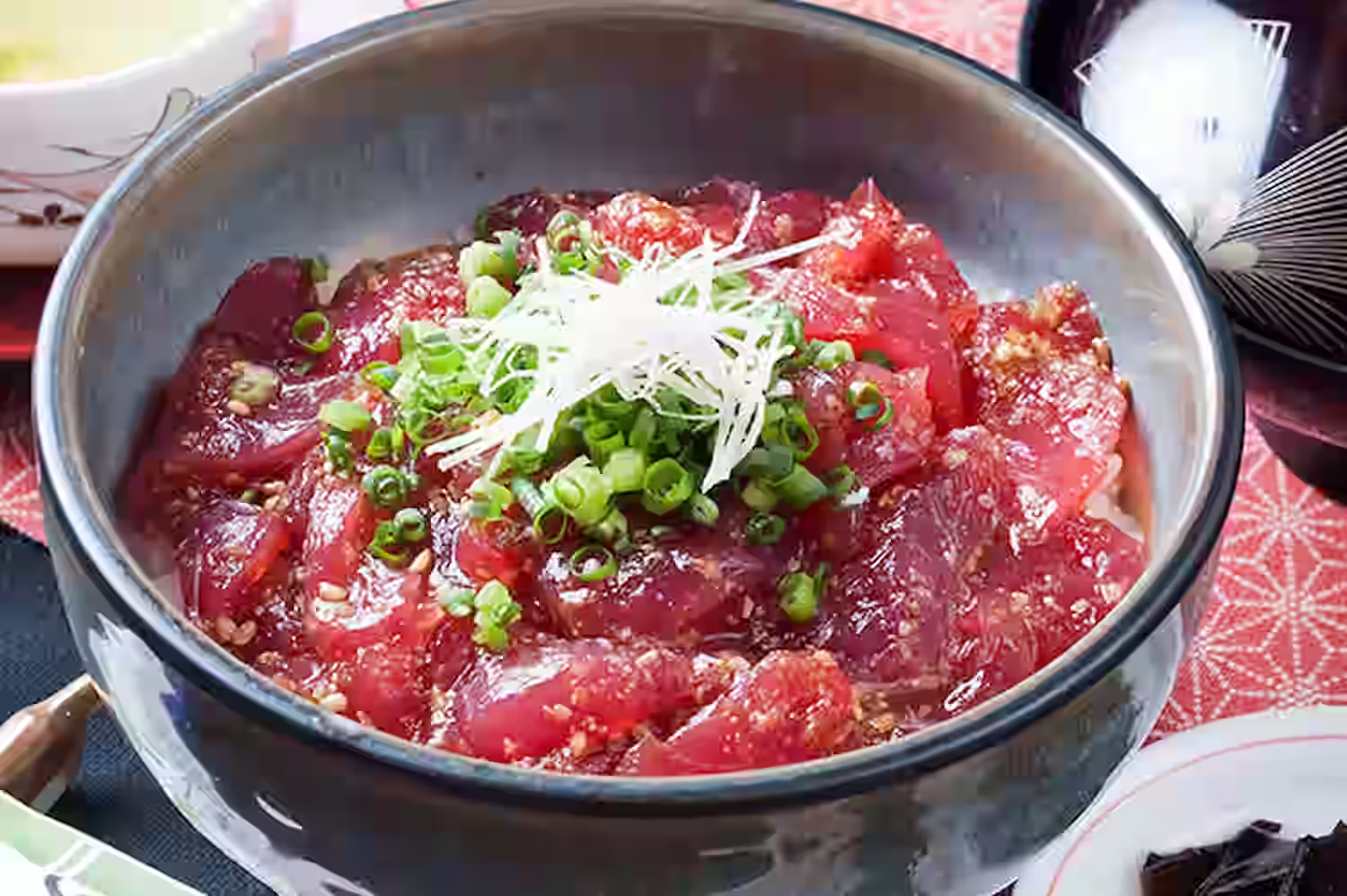

A bowl of hot rice arrives topped with slices of raw tuna, glossy with a sweet sesame-soy sauce. That bowl is Hyugadon (ひゅうが丼), a Japanese marinated tuna rice bowl from Tsukumi in Oita Prefecture, on the island of Kyushu. People also write it as Hyuga don or Hyūga-don.
This guide explains what goes into the bowl, how it tastes and where its name may come from. It also compares the dish with similar tuna bowls, and it lists places in Tsukumi that serve it. Because the dish uses raw fish and raw egg, a short safety section appears near the end.
What Is Hyugadon?
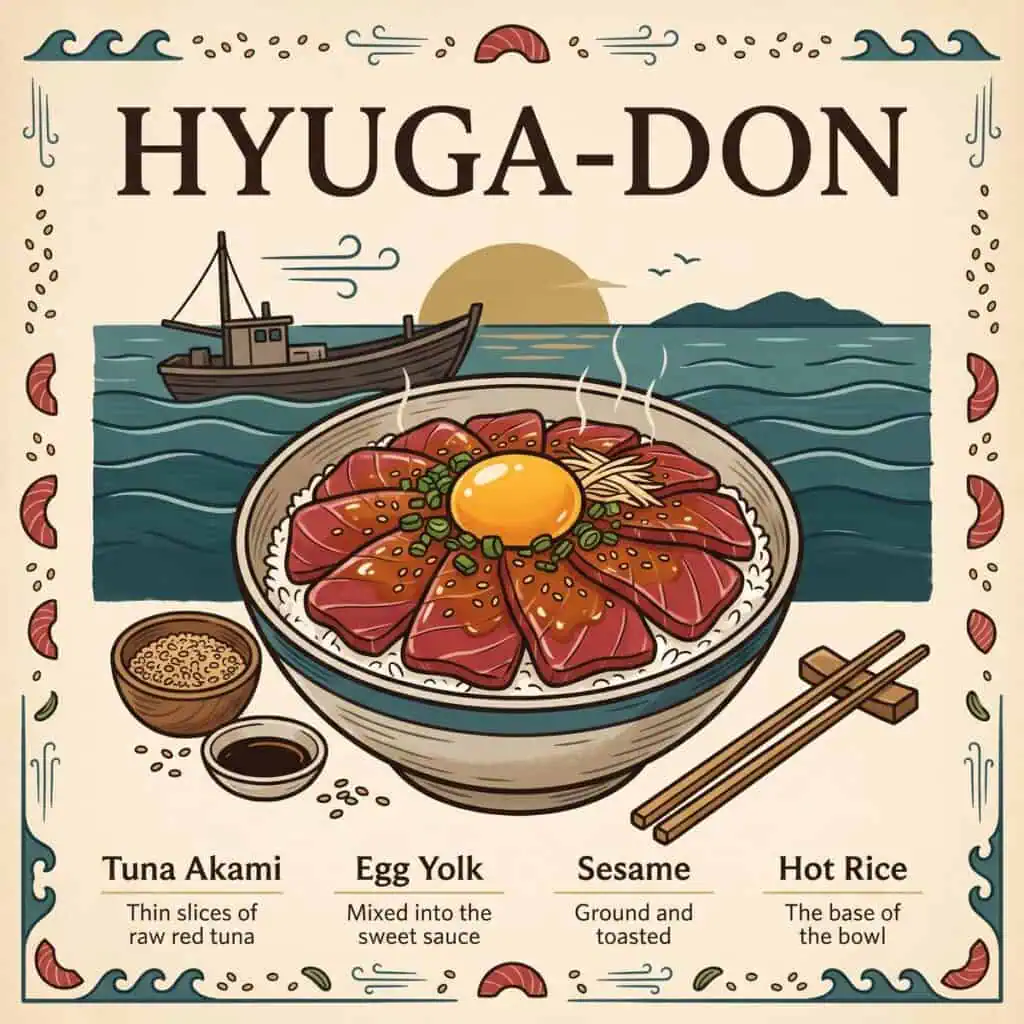
Hyugadon is thinly sliced raw tuna mixed with a sweet sauce of ground sesame, soy sauce, sugar and egg yolk, then served over hot rice. Japan’s Ministry of Agriculture, Forestry and Fisheries (MAFF) lists it as a local dish of Tsukumi City. In addition, the ministry associates the dish particularly with Hoto Island, a small fishing island off the coast.
Quick Facts
- Japanese name
- ひゅうが丼 (Hyugadon)
- Type
- Marinated tuna rice bowl (donburi)
- Home area
- Tsukumi City and Hoto Island, Oita Prefecture, Kyushu
- Main ingredients
- Tuna, rice, sesame, egg, soy sauce
- Flavor
- Sweet soy, toasted sesame, rich egg yolk
- Served
- Raw fish over hot rice, often finished with green tea
- Origin of the name
- Uncertain; at least two explanations exist
- Where to try it
- Restaurants in Tsukumi and on Hoto Island
In English, the ministry calls it a “rice bowl with marinated tuna sashimi.” That label is accurate, although it hides the detail that matters most. Unlike many soy-marinated fish bowls, this one adds egg yolk to the sauce itself. If you already know kaisendon, think of this as a sweeter, sesame-heavy tuna donburi.
What Does Hyugadon Taste Like?
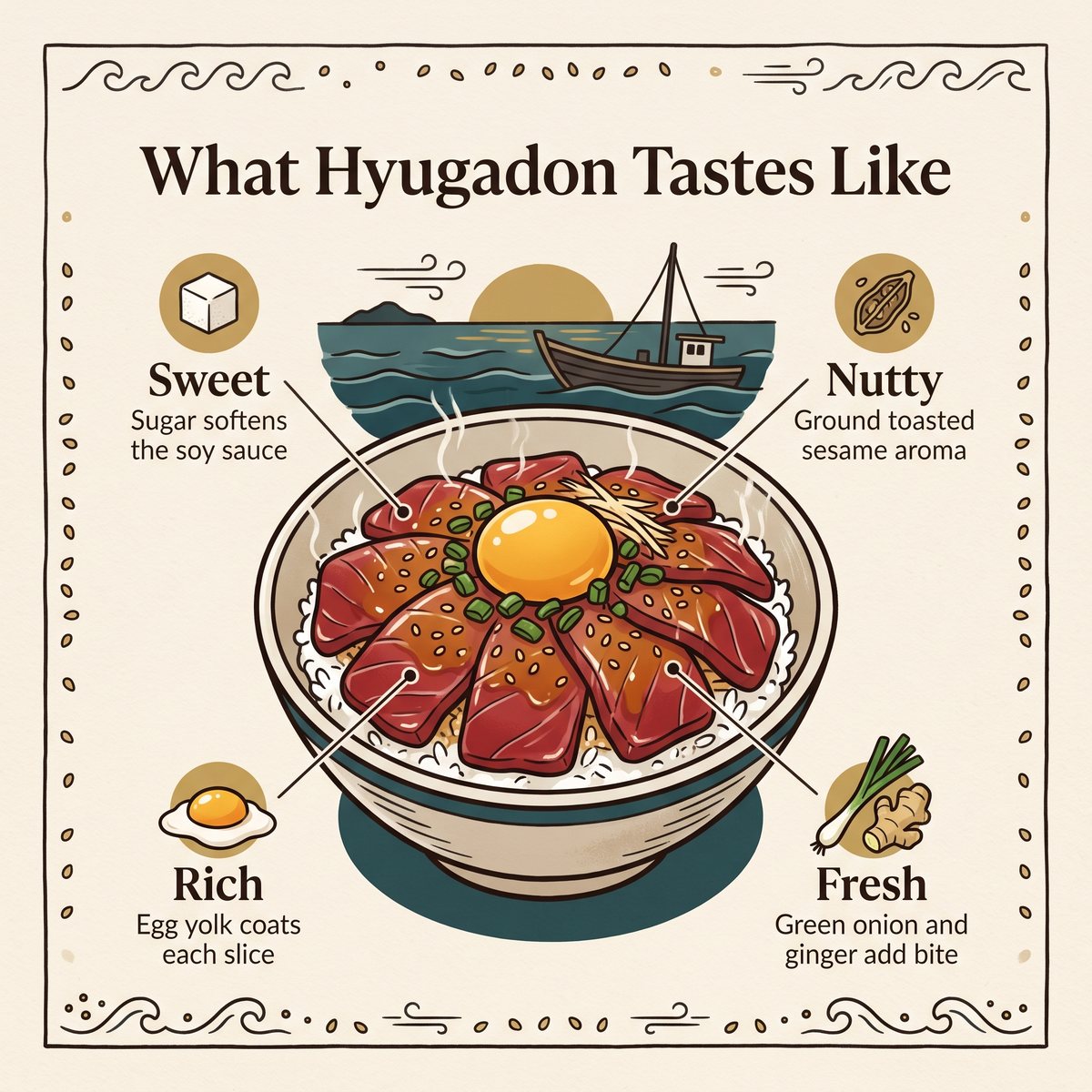
The first impression is sweetness. MAFF describes the sauce as slightly sweeter than the one for ryukyu, a related Oita dish. Sugar softens the salt of the soy sauce, so the tuna tastes mellow rather than sharp.
Ground toasted sesame then gives the sauce a warm, nutty aroma. Meanwhile, the egg yolk coats each slice and adds body. The ministry notes that this coating is what makes the flavor richer.
Texture matters too. Specifically, the tuna is cut thin, so the sauce clings to each slice. The fish then goes over hot rice. Finally, green onion and ginger add a fresh bite.
The overall balance is sweet, savory and led by sesame. Diners who prefer less-sweet marinades may therefore find it sweeter than a typical soy-based tuna dressing. According to a Hoto Island community website, the sauce also made freshly caught tuna, which can be chewy, tastier to eat.
Where Does Hyugadon Come From?
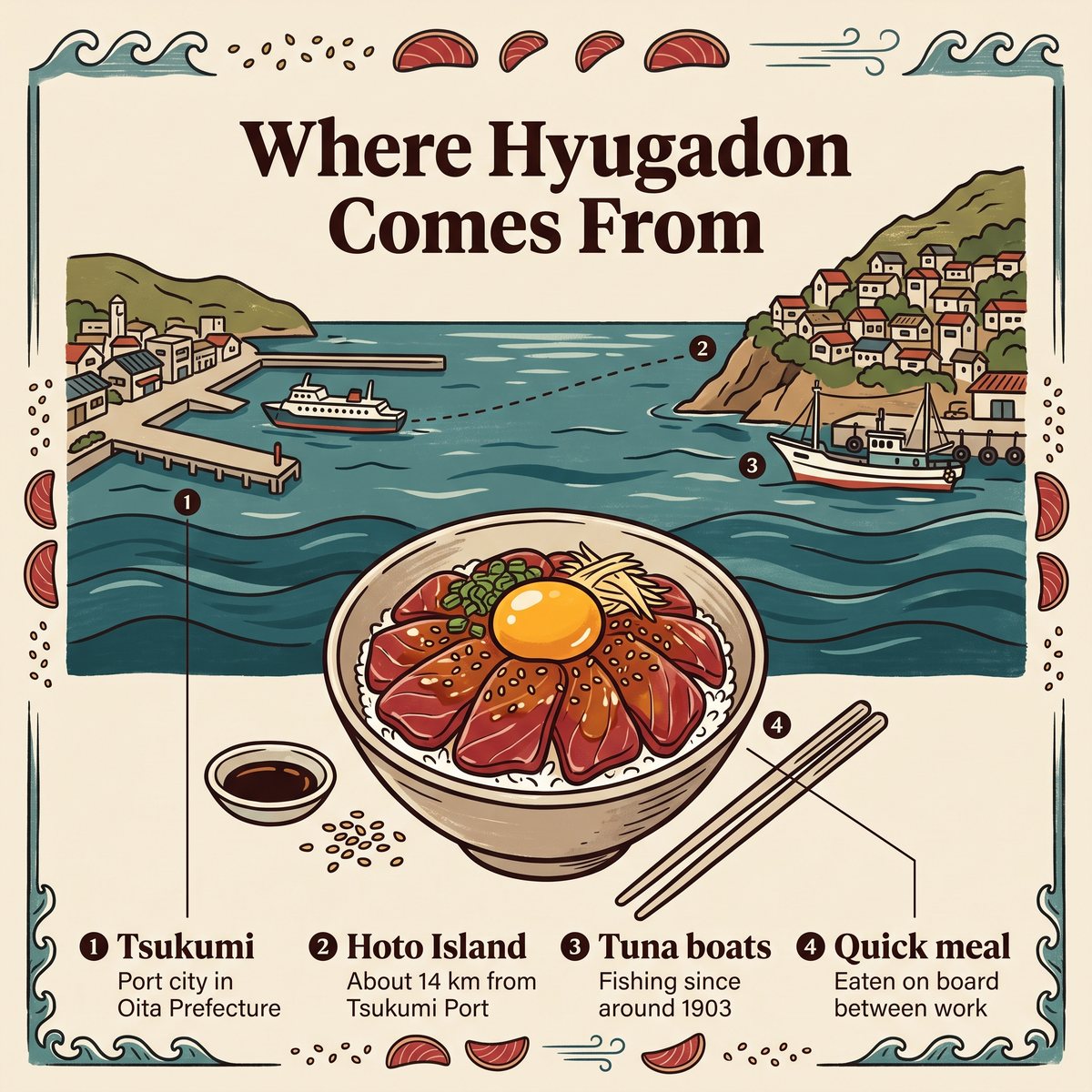
Hyugadon belongs to Tsukumi, a port city on the southeastern coast of Oita Prefecture. Within the city, however, it is especially associated with Hoto Island and its tuna-fishing community. MAFF says the dish later spread from the island through the wider Tsukumi area.
Tsukumi City and Hoto Island
Hoto Island lies about 14 kilometers from Tsukumi Port in the Bungo Channel, the strait between Kyushu and Shikoku. Moreover, it measures only about 4 kilometers around. Because flat land is scarce, three- and four-story houses crowd the steep slope above the harbor, as the city’s own guide describes.
The island is small, yet its fishing history is large. Tsukumi City dates the start of its tuna fishery to around 1903. In addition, a Fisheries Agency heritage program selected the island. Its title translates roughly as “100 Historical and Cultural Assets of Fishing and Fishing Villages.”
A Meal Shaped by Tuna Boats
Local accounts agree on the setting. For example, Oita Prefecture’s recipe sheet calls the dish a makanai meal, meaning food that workers cook for themselves. In its telling, tuna fishermen ate it quickly on board between rounds of work. MAFF also adds that it was easy to prepare and nourishing.
How large was that fishing community? A later fisheries-history report gives a sense of scale. It states that the island had 80 tuna boats and about 1,000 crew members in 1933. They worked from waters off Hokkaido to seas near the Philippines. Still, these figures describe the fishery, not the age of the dish.
No source reviewed here gives a year when Hyugadon was first made, and none names an inventor. The city dates the tuna fishery to around 1903, but the age of the dish itself is unknown.
One more detail comes from MAFF alone. The ministry records that people once served the dish at weddings and other celebrations. However, it does not state when, or how often.
Why Is It Called Hyugadon?
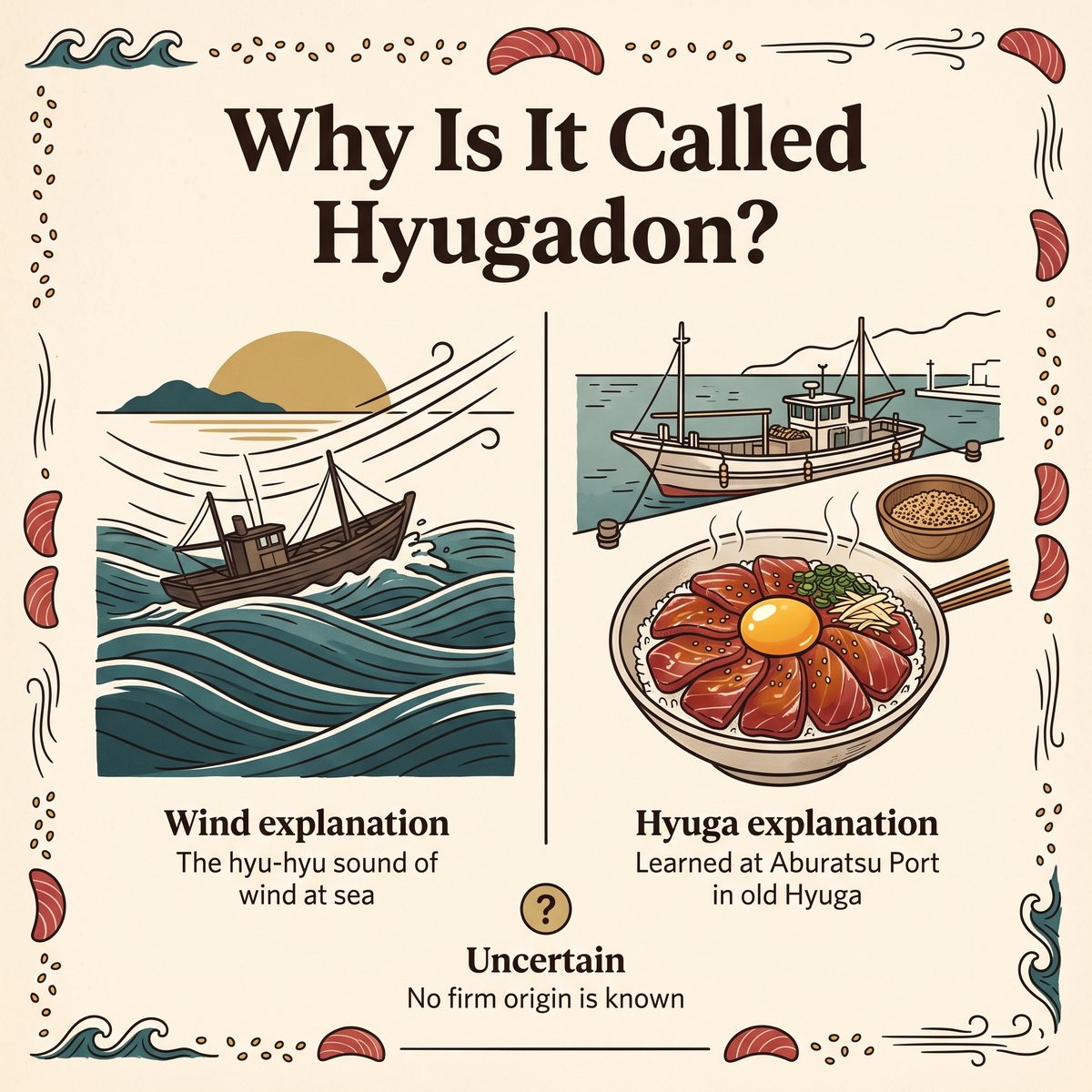
Nobody knows for certain. Two explanations are commonly repeated, but the origin of the name remains uncertain. MAFF states plainly that no firm origin is known, and the Tsukumi City Tourism Association agrees.
The wind explanation
Strong wind makes a “hyu-hyu” sound at sea. In this account, crews named the dish after that sound, because they could eat it on a windy deck without lighting a fire.
The Hyuga explanation
Hyuga is the old name for the Miyazaki region. In this account, Hoto Island tuna boats called at Aburatsu Port there, and crews learned the preparation from locals.
The second account also appears in Oita Prefecture’s recipe sheet. Even so, no voyage log or port record was located in the sources reviewed for this article. A note on geography also helps: Aburatsu Port lies in today’s Nichinan City, not in the modern city called Hyuga.
Other stories circulate locally as well. For example, similar names exist across the channel in Ehime, where our Uwajima taimeshi article mentions a dish called hyugameshi. Whether the two names share a root is unclear, so we leave the question open.
What Goes Into Hyugadon?
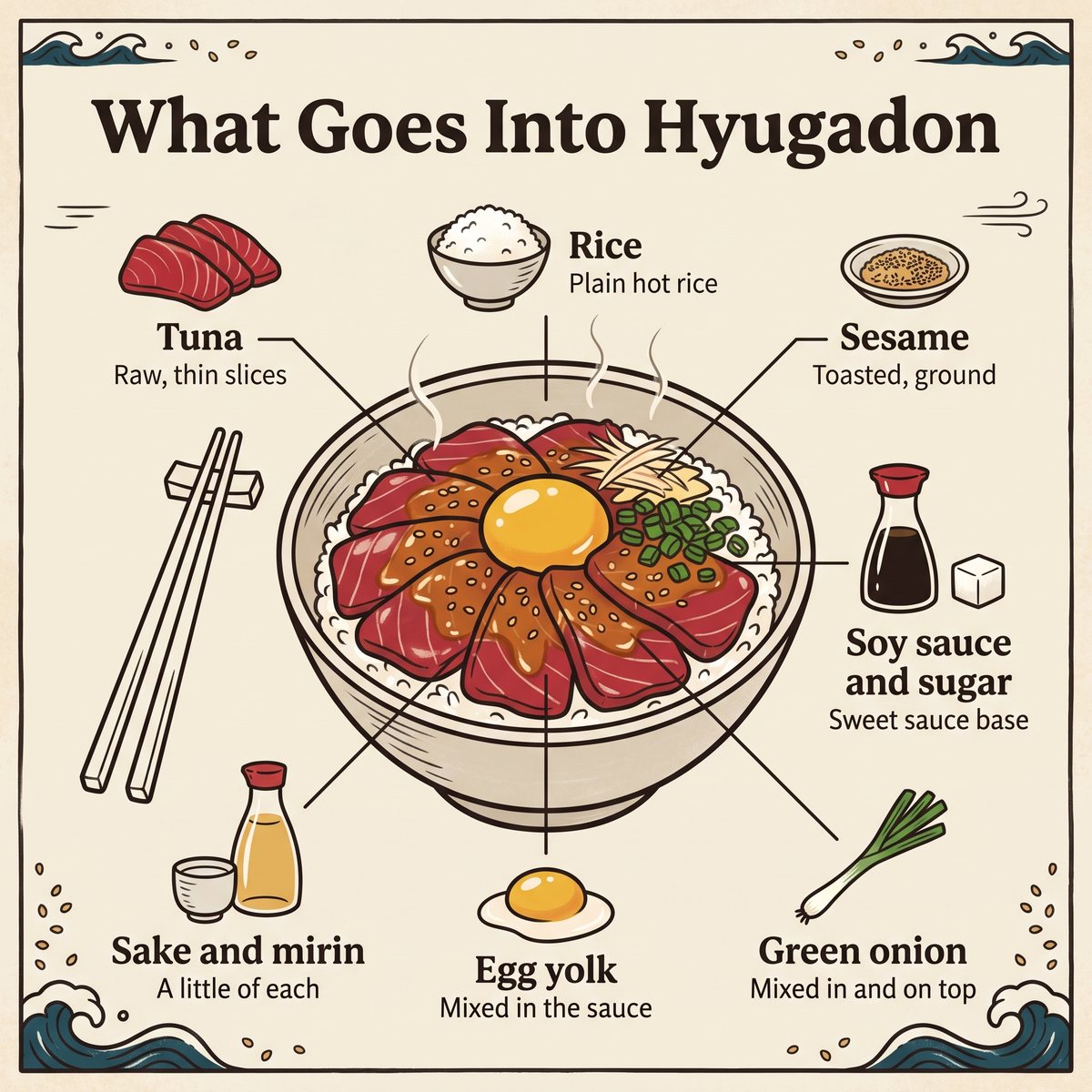
The ingredient list is short. In fact, MAFF and Oita Prefecture publish the same recipe, which uses the following items.
- Tuna: Raw tuna cut into thin slices.
- Rice: Plain Japanese rice, served hot.
- Toasted sesame seeds: Ground until fragrant.
- Soy sauce and sugar: The base of the sweet sauce.
- Sake and mirin: A small amount of each. Mirin is a sweet rice seasoning.
- Egg yolk: Mixed into the sauce.
- Green onion: Chopped, both in the mix and on top.
Ginger does not appear in that ingredient list. However, the ministry’s description of how to eat the dish mentions mixing in green onion and ginger. Recipes also differ by area and household, as the ministry itself points out.
How Cooks Prepare the Sauce
The official method follows a clear order. First, the cook grinds toasted sesame seeds, then adds sugar and grinds again. Next comes the egg yolk. After that, sake, mirin and soy sauce go in, and everything blends into a thick sauce.
The tuna follows. The cook then adds the sliced fish and some chopped green onion and coats them with the sauce. Finally, the fish goes over hot rice with more green onion on top. The tuna itself is not cooked, which fits the description of a quick meal for fishermen.
We describe the official method but do not print a tested recipe with our own measurements. For quantities, see the MAFF page in the references.
How to Eat Hyugadon
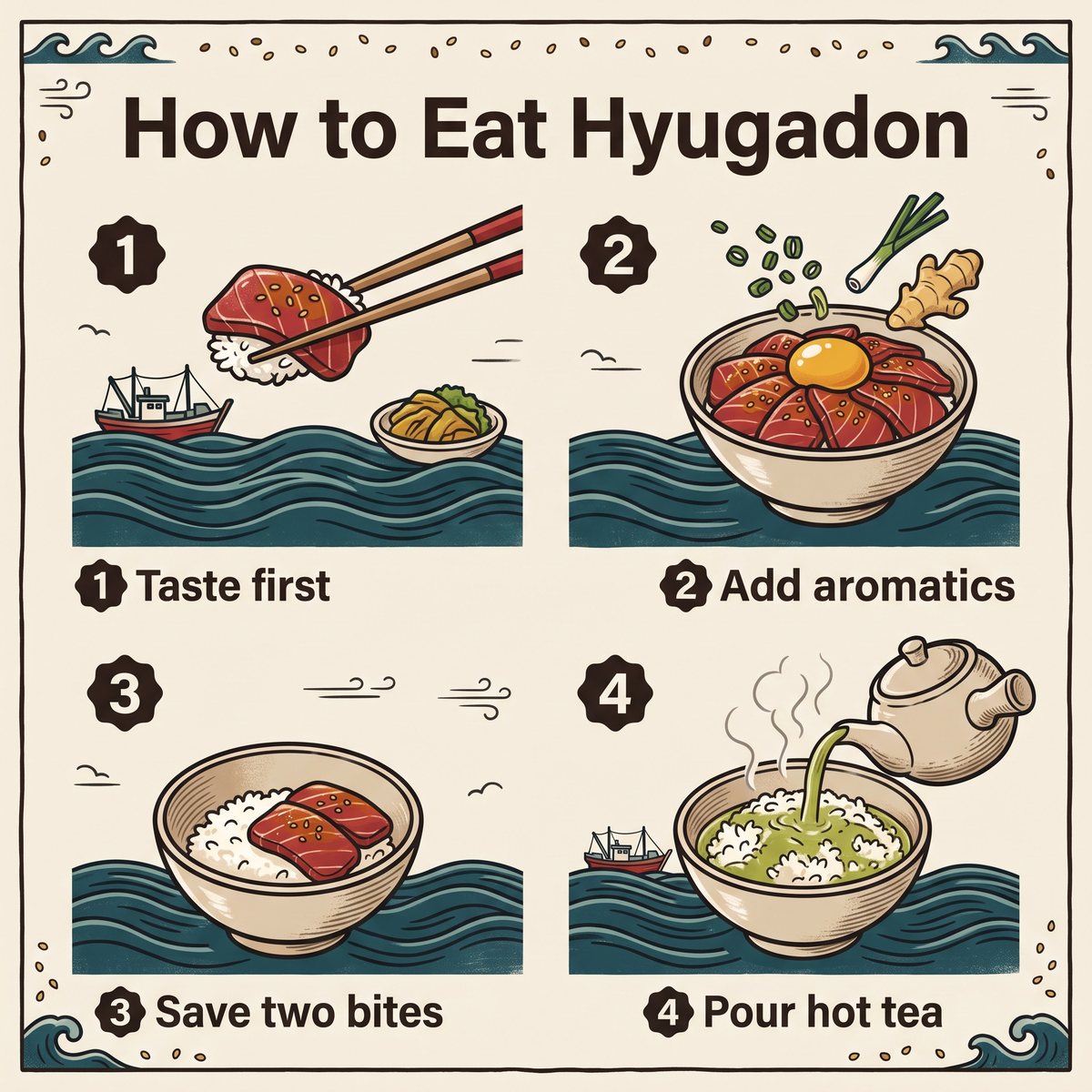
Eat Hyugadon as a rice bowl first, then finish the last bites with hot green tea. The steps below follow the official descriptions.
- Start with the bowl as served. Take tuna and rice together so the sauce seasons each bite.
- Add the aromatics. Mix in green onion and ginger if the shop provides them.
- Save the last two bites. Oita Prefecture records a local practice of leaving a little at the end.
- Pour hot green tea over it. The leftovers become ochazuke, a rice-and-tea dish.
That final step changes the bowl completely, because hot tea warms the tuna and thins the sauce into a savory broth. MAFF says the dish can be enjoyed twice this way. Our guide to ochazuke explains the wider custom, and Oita has another version in tai chazuke Ureshino.
The fish arrives already seasoned by its sauce. Therefore, taste it first before you add anything.
Hyugadon vs Ryukyu, Tekka Don and Zuke Don
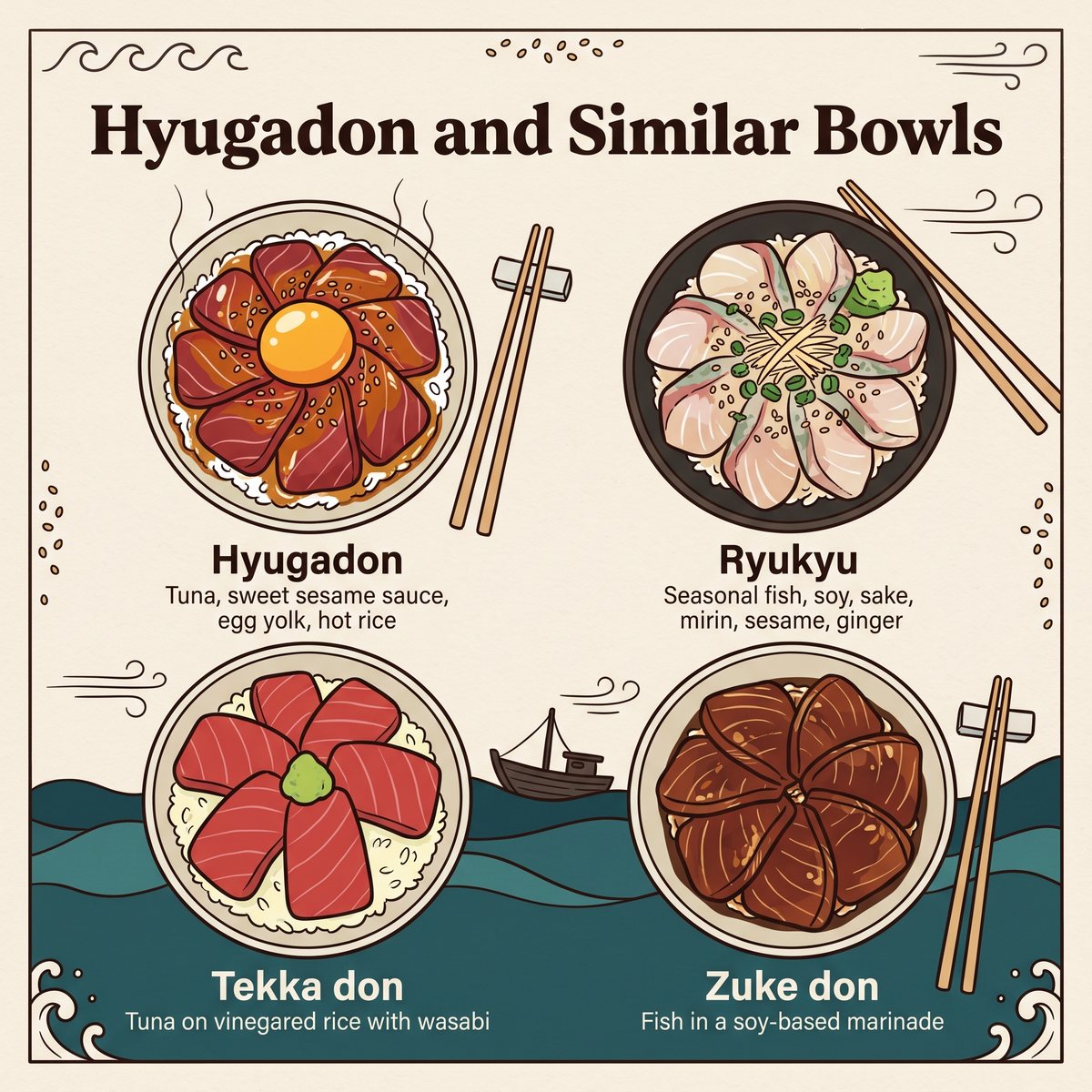
Several Japanese dishes pair seasoned raw fish with rice, so confusion is natural. The table below sets out the usual differences.
| Dish | Fish | Seasoning | Rice | Area |
|---|---|---|---|---|
| Hyugadon | Tuna | Sweet soy sauce with ground sesame and egg yolk | Hot plain rice | Tsukumi and Hoto Island, Oita |
| Ryukyu | Seasonal fish such as horse mackerel, sea bream, mackerel or yellowtail | Soy sauce, sake, mirin, sesame and ginger | Eaten alone, on rice or as ochazuke | Southern coast of Oita, now the whole prefecture |
| Tekka don | Tuna | Usually served with wasabi and nori | Usually vinegared sushi rice | Nationwide |
| Zuke don | Tuna or other fish | Soy-based marinade | Varies | Nationwide |
These are common culinary patterns, not legally standardized categories. Ingredients, rice and names vary by region, household and restaurant.
Hyugadon and Ryukyu
Ryukyu is the closest relative. MAFF describes it as seasonal fish dressed in soy sauce, sake, mirin, sesame and ginger. In the ministry’s descriptions, Hyugadon instead centers on tuna. Its distinguishing feature is a slightly sweet ground-sesame sauce enriched with egg yolk.
The line is not rigid, though. MAFF notes that some areas call this kind of bowl ryukyu don or atsumeshi. Therefore, treat the names as related local labels rather than strict categories.
Hyugadon, Tekka Don and Zuke Don
Dictionaries generally define tekka don as tuna over vinegared rice with wasabi and nori. Zuke don is a broader term for fish marinated or coated in a soy-based seasoning, similar in idea to shoyuzuke.
By that logic, Hyugadon is a regional kind of marinated tuna bowl. What sets it apart is the combination of place, ground sesame, sweetness and egg yolk. For tuna in its sushi form, see our maguro sushi article.
Where to Eat Hyugadon in Tsukumi
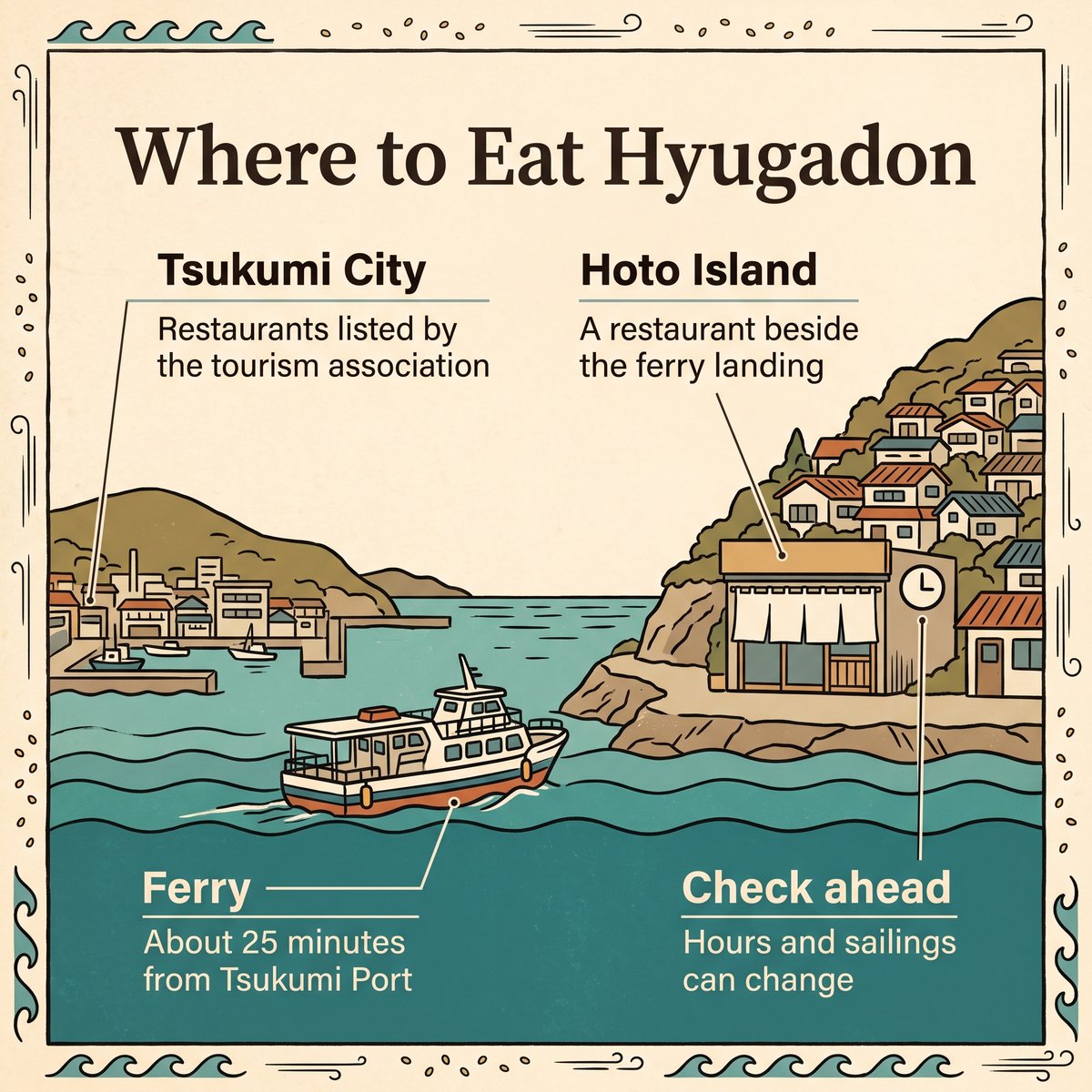
Tsukumi promotes the dish as “Tsukumi Hyugadon,” and the city’s tourism association lists restaurants that serve it. The table shows published closing information, cross-checked on October 10, 2026. We compared restaurant, operator, tourism-association and restaurant-association pages. Some sources conflict, particularly for Cafe Nabe Mokuren and Hamachaya, so confirm directly before you go. Restaurant names are romanized for this article. On menus, look for ひゅうが丼 or 津久見ひゅうが丼.
| Restaurant | Address in Tsukumi City | Published closing information |
|---|---|---|
| Shikisai Genbei (四季彩 源兵衛) | 8-30 Chuo-machi | Tuesday |
| Shin Mikaku Sushi (新美賀久寿し) | 23-5 Chuo-machi | Wednesday; occasional irregular closures |
| Bistro Cafe Hana Usagi (ビストロカフェ 華うさぎ) | 10-8 Chuo-machi | Monday; temporary closures possible |
| Cafe Nabe Mokuren (cafe・鍋 もくれん) | 21-6 Takasu-machi | Listings conflict between Sunday and Monday |
| Kamekichi (亀吉), Takasu-machi location | 3824 Takasu-machi | Thursday, except public holidays |
| Shio no Oto (汐の音) | 3824-69 Takasu-machi | Irregular |
| Hamachaya (浜茶屋) | 6029-1 Chinu | Tuesday; Monday evenings may also be unavailable |
| HOTOJIMA Kaido (HOTOJIMA 海道) | Yamamaru ferry waiting building, 1F, Hoto Island | Thursday |
Seasonal events also feature the dish. In 2025, for example, a tuna food festival ran in participating restaurants from August 2 to September 30. However, dates differ each year, so check current listings.
Getting to Hoto Island
A regular ferry links Tsukumi Port and Hoto Island in about 25 minutes. The city’s ferry page, accessed on October 10, 2026, showed five round trips on weekdays and Saturdays. It showed four on Sundays and holidays, and an adult one-way fare of 880 yen (about $5.6). However, the posted timetable carries a 2022 revision date, so check live operating information. (Approximate US dollar amounts use the October 10, 2026 exchange rate of 1 yen ≈ 0.00632 US dollars; exchange rates change.)
Weather can also cancel sailings at short notice. Therefore, call the ferry office if conditions look rough. In addition, the island restaurant recommends reservations, according to the tourism association.
Planning a wider trip? Oita also offers toriten and Seki saba, and our Kyushu food guide covers the rest of the island of Kyushu.
Raw Fish and Raw Egg: Safety Notes
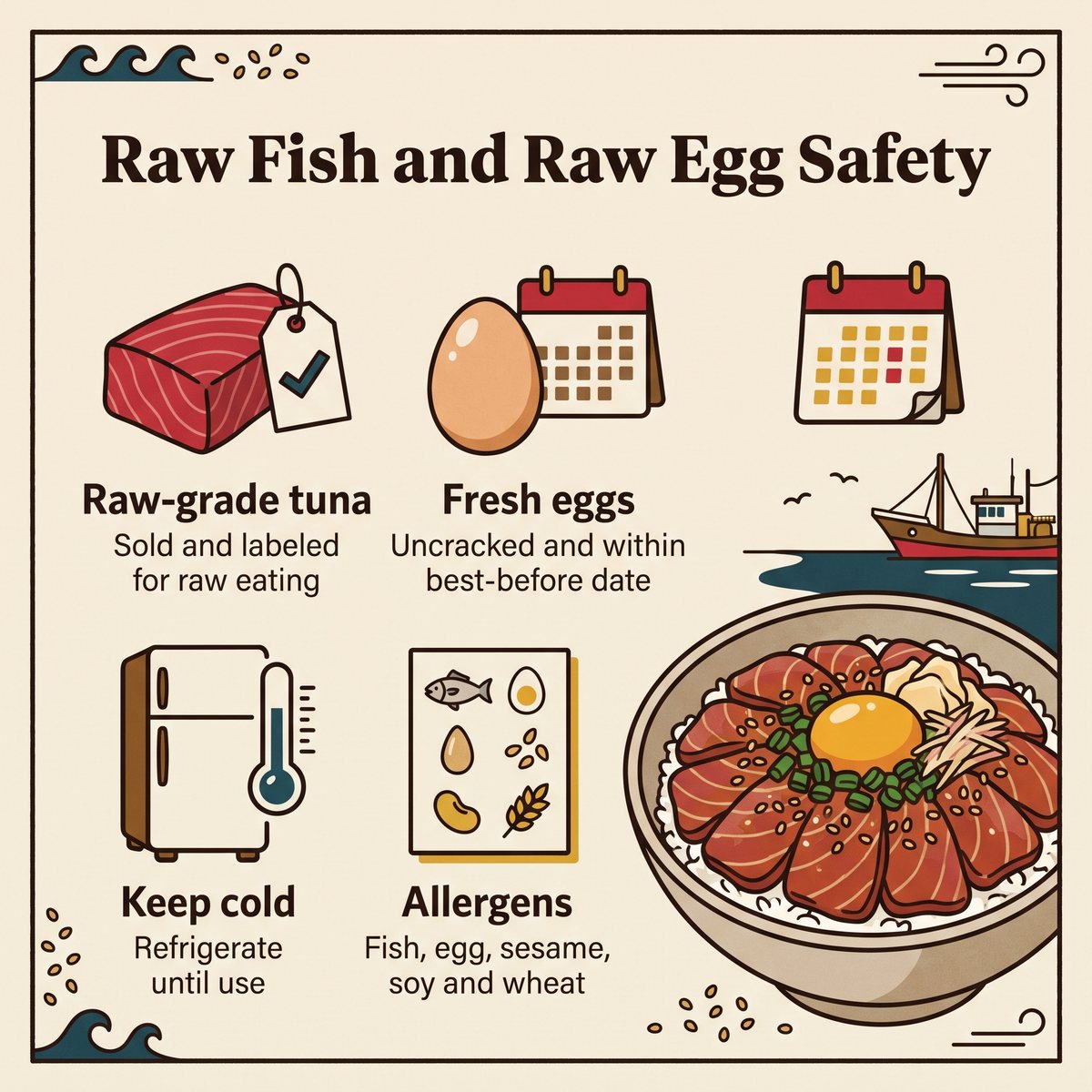
Hyugadon is uncooked, so ingredient choice matters. In Japan, seafood sold for raw eating carries a label saying so. Japanese standards also set sanitary conditions for it, including storage at 10°C or below. Therefore, use tuna sold and labeled for raw consumption, and follow the storage instructions on its label. The phrase “sashimi-grade” is common abroad, but it is not an official Japanese grade.
Eggs need the same care. Specifically, Japanese rules call for a sound, uncracked shell egg intended for raw consumption and still within its best-before date. Outside Japan, follow local food-safety guidance. Pasteurized egg yolk is a prudent option where eggs lack approval for raw eating. Our articles on Japanese eggs and tamago kake gohan explain the raw-egg custom.
- Keep fish and eggs refrigerated until you use them.
- For allergies, note that the dish contains fish, egg, sesame and soy. Soy sauce also usually contains wheat.
- Do not use cracked eggs raw.
- Young children, older adults and people with weakened immune systems should follow official guidance on raw fish and raw eggs. They may need to avoid them.
- The published recipe adds small amounts of sake and mirin without a cooking step. Readers who avoid alcohol should keep that in mind.
Is the dish healthy? We would rather not label it. After all, it combines lean fish, egg, sesame, rice and a fair amount of sugar and soy sauce. Pregnant readers and people with medical conditions should follow local public-health guidance or a qualified healthcare professional.
Final Thoughts
Hyugadon is a simple bowl with a specific home. Tuna, sesame, sweet soy sauce and egg yolk meet over hot rice. Then a splash of tea finishes the meal. Its history, however, is less tidy than its recipe. The sources reviewed here neither date the dish nor settle the origin of its name.
That uncertainty is part of its charm. If your route through Kyushu passes Oita, Tsukumi is the place to try it. Otherwise, the official recipe gives home cooks a clear starting point.
Frequently Asked Questions About Hyugadon
The Dish
- Does Hyugadon contain raw fish?
-
Yes. The tuna is raw, and the sauce seasons it without heat. Choose fish sold for raw eating, and keep it cold until serving.
- Does Hyugadon contain egg?
-
The government-listed recipe for five servings mixes one raw egg yolk into the sauce. MAFF names this yolk as a defining feature. However, recipes vary by household, so ask the restaurant if you avoid egg.
- Is Hyugadon served hot or cold?
-
It combines raw tuna with hot rice. In addition, some diners add hot green tea at the end.
- Is Hyugadon the same as ryukyu don?
-
Not quite. Ryukyu uses many kinds of seasonal fish, whereas Hyugadon centers on tuna with a sweeter, yolk-enriched sesame sauce. Even so, the names overlap in some areas.
Eating and Travel
- Can Hyugadon be eaten as ochazuke?
-
Yes. Oita Prefecture’s recipe sheet describes a local practice of saving the last two bites and adding hot tea. MAFF describes this as a way to enjoy the dish twice.
- Where can I eat Hyugadon?
-
Restaurants in Tsukumi City serve it, and the tourism association also lists one beside the ferry landing on Hoto Island. The tourism association publishes a current list. Confirm hours before visiting, because they change.
- How do I get to Hoto Island?
-
Take the regular ferry from Tsukumi Port, which takes about 25 minutes. The city’s page listed an adult one-way fare of 880 yen (about $5.6) when accessed on October 10, 2026. Bad weather can cancel sailings, so check ahead. (Approximate US dollar amounts use the October 10, 2026 exchange rate of 1 yen ≈ 0.00632 US dollars; exchange rates change.)
- What allergens does Hyugadon contain?
-
The official recipe contains fish, egg, sesame and soy. Soy sauce also usually contains wheat. Recipes vary by shop, so ask staff if you have an allergy.
References
- Ministry of Agriculture, Forestry and Fisheries – Our Regional Cuisines: Hyugadon, Oita Prefecture (Japanese) (Accessed October 2026)
- Ministry of Agriculture, Forestry and Fisheries – Our Regional Cuisines: Hyugadon (Rice Bowl with Marinated Tuna Sashimi) (Accessed October 2026)
- Ministry of Agriculture, Forestry and Fisheries – Our Regional Cuisines: Ryukyu, Oita Prefecture (Japanese) (Accessed October 2026)
- Oita Prefecture – Maguro no Hyugadon (Tsukumi City) Recipe Sheet (Accessed October 2026)
- Tsukumi City – Hoto Island (Accessed October 2026)
- Tsukumi City – Tuna (Accessed October 2026)
- Tsukumi City – Remote Island Route: Hoto Island (Accessed October 2026)
- Tsukumi City Tourism Association – Tsukumi Hyugadon (Accessed October 2026)
- Tourism Oita – Tsukumi Hyugadon: Tuna Gourmet Festa (2025) (Accessed October 2026)
- Hotojima.com – Hoto Island Specialties (Accessed October 2026)
- Ministry of Health, Labour and Welfare – Measures to Prevent Vibrio parahaemolyticus Food Poisoning from Seafood for Raw Consumption (Accessed October 2026)
- Ministry of Health, Labour and Welfare – Measures to Prevent Salmonella Food Poisoning from Eggs and Egg Products (Accessed October 2026)
- Akashi City Library Digital Archive – Akashi-gata Namasen Chosa Hokokusho Vol. 2, Chapter 3, Section 1: Hoto Island (Accessed October 2026)
- Ministry of Land, Infrastructure, Transport and Tourism – Cruise Port Guide of Japan: Aburatsu Port (Accessed October 2026)
- Kotobank – Tekka Donburi (dictionary entries from Shogakukan and Kodansha) (Accessed October 2026)
- National Diet Library Search – Gyoko no Ritchi to Hendo: Doi Senkichi Chirigaku Ronbunshu (Kobunkan, 1985), background reading; contains a chapter on tuna longline fishing on Hoto Island, catalog record only (Accessed October 2026)
Related Articles
- Atsumeshi (あつめし) (Surveyed: October 2026)
- Kaisen don (海鮮丼) (Surveyed: October 2026)
- Ochazuke (お茶漬け) (Surveyed: October 2026)
- Tai Chazuke Ureshino (鯛茶漬けうれしの) (Surveyed: October 2026)
- Seki saba (関サバ) (Surveyed: October 2026)
- Toriten (とり天) (Surveyed: October 2026)
- Uwajima Taimeshi (宇和島鯛めし) (Surveyed: October 2026)
- The Ultimate Kyushu Food Guide: 10 Local Dishes You Must Eat (Surveyed: October 2026)




Comments