



You sit down at a small izakaya counter, and the staff slide over a menu with a long column of kanji. Some words look familiar from bottle labels, while others do not. Meanwhile, someone nearby is sipping something warm from a tiny cup, and you wonder whether to ask for that too.
This guide explains how to drink sake in Japan in the order you will meet things: where to go, how to read the menu, what to order, how it is served and what matters at the table.
How to Drink Sake in Japan: The Short Answer
To drink sake in Japan, choose a place, order a glass or a small flask, and decide whether you want it chilled, at room temperature or warm. Then sip it slowly with food and a glass of water. You do not need Japanese or any formal training.
Most restaurants also make ordering fairly simple. Many list sake by the glass, and staff are used to guests who know very little, so asking for a recommendation is one of the most normal things you can do. Once you know a handful of words, such as the names for chilled and warm sake, the menu stops looking like a wall of kanji.
Sake in Japan: Quick Facts
- Japanese name
- 日本酒 (nihonshu) or 清酒 (seishu); “sake” can also mean alcohol in general
- Typical strength
- Usually about 15% to 16% alcohol
- Serving temperatures
- Chilled, room temperature or warm (kan)
- Common serving unit
- One gō (一合), about 180 ml
- Where to try it
- Izakaya, sake bars, Japanese restaurants and breweries
- Legal drinking age
- 20 in Japan
- Easiest first order
- A glass of the house recommendation, with water on the side
There Is No Single Correct Way to Drink Sake
The same bottle might arrive chilled in a wine glass at one bar and warm in a ceramic flask at another. Neither is wrong. According to a guide published by the Japan Sake and Shochu Makers Association (JSS) with the National Research Institute of Brewing (NRIB), people in Japan have warmed sake since the ninth century. Yet light, fresh styles that suit chilling have spread since the 1980s, so both habits are genuinely traditional.
So start with a few basic choices, notice what you enjoy, and adjust the next order. That small loop teaches more than any chart.
Where to Drink Sake in Japan
Where you drink shapes how you drink. An izakaya feels loose and noisy, while a kaiseki dinner moves at a careful pace.
Izakaya
居酒屋
Casual pubs where drinks and shared plates arrive together. The easiest place to start.
Sake bar
日本酒バー
Longer lists, smaller pours and staff who expect questions. Good for comparing styles.
Japanese restaurant
和食店
A shorter list chosen to suit the food, from sushi to regional cooking.
Kaiseki and fine dining
懐石
Course meals where sake may be matched to each dish as a set pairing.
Brewery
酒蔵
Tours, tastings and rare bottles. Usually needs a reservation.
Liquor store
酒屋
Bottles to take away, from 300 ml to 1.8 liters.
For most travelers, the izakaya is the natural first stop, because you can order a drink and small dishes and keep going at your own pace. Our guide to alcohol in Japan and izakaya culture covers the wider pub experience, including the small starter dish many places serve. At a formal restaurant, by contrast, sake tends to follow the food, and staff will often guide you if you say whether you prefer something light or rich.
Sake bars feel different again. The list is longer, and some run on a counter format where you order one glass at a time, which suits travelers who want to compare a few styles in a short visit. For bottles to take away, liquor stores and department store food halls often stock regional sake, and many sell 300 ml sizes that are easy to carry.
How to Read a Sake Menu
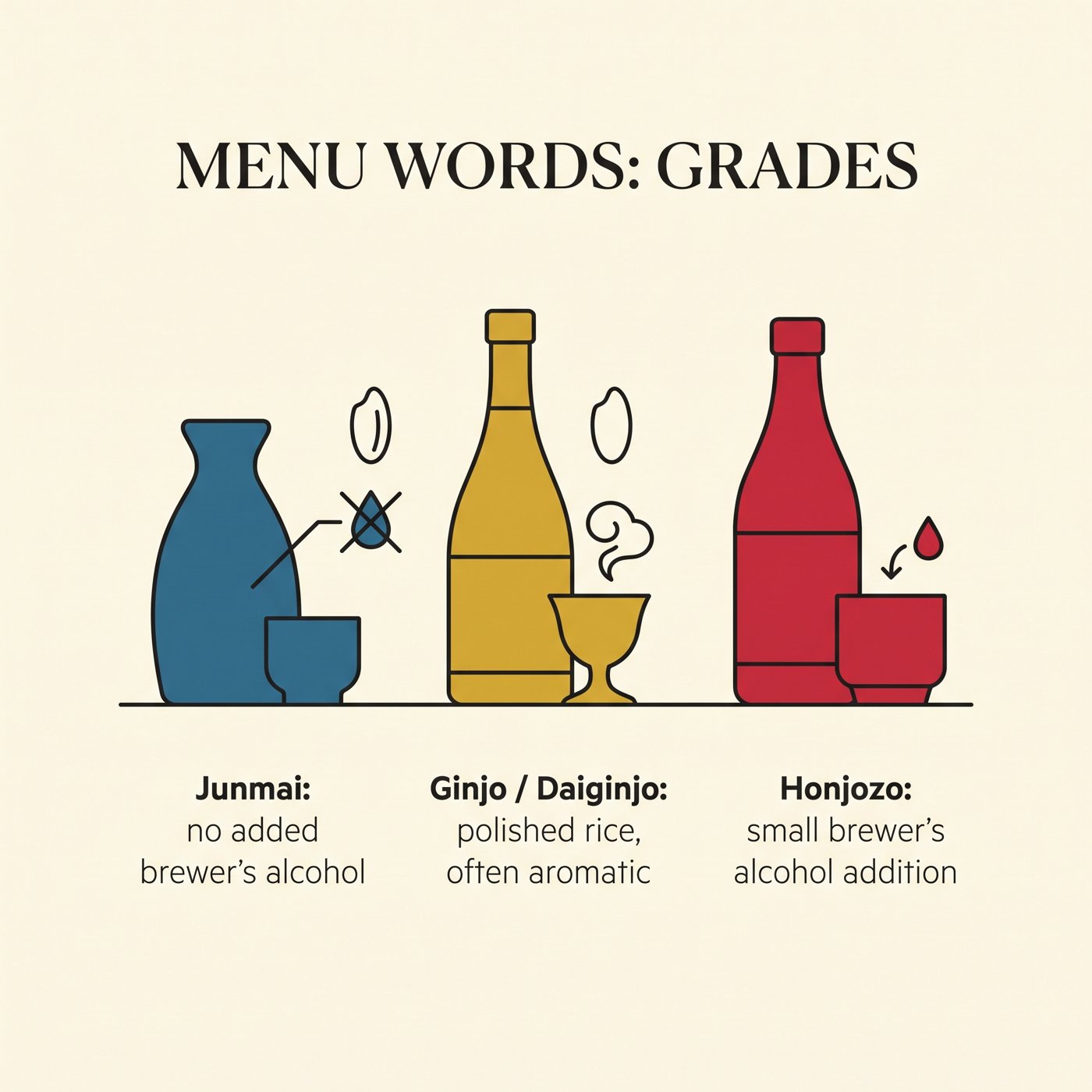
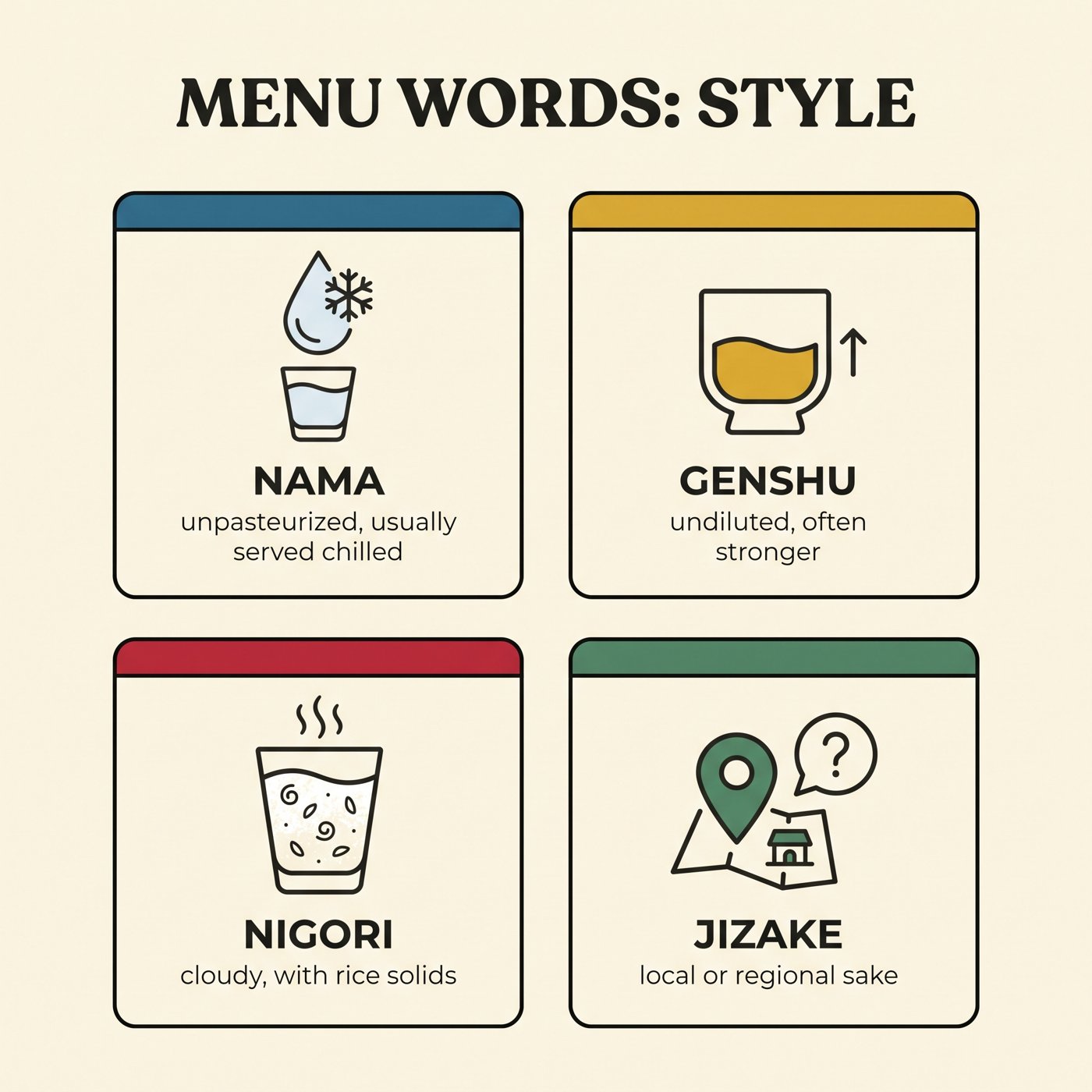
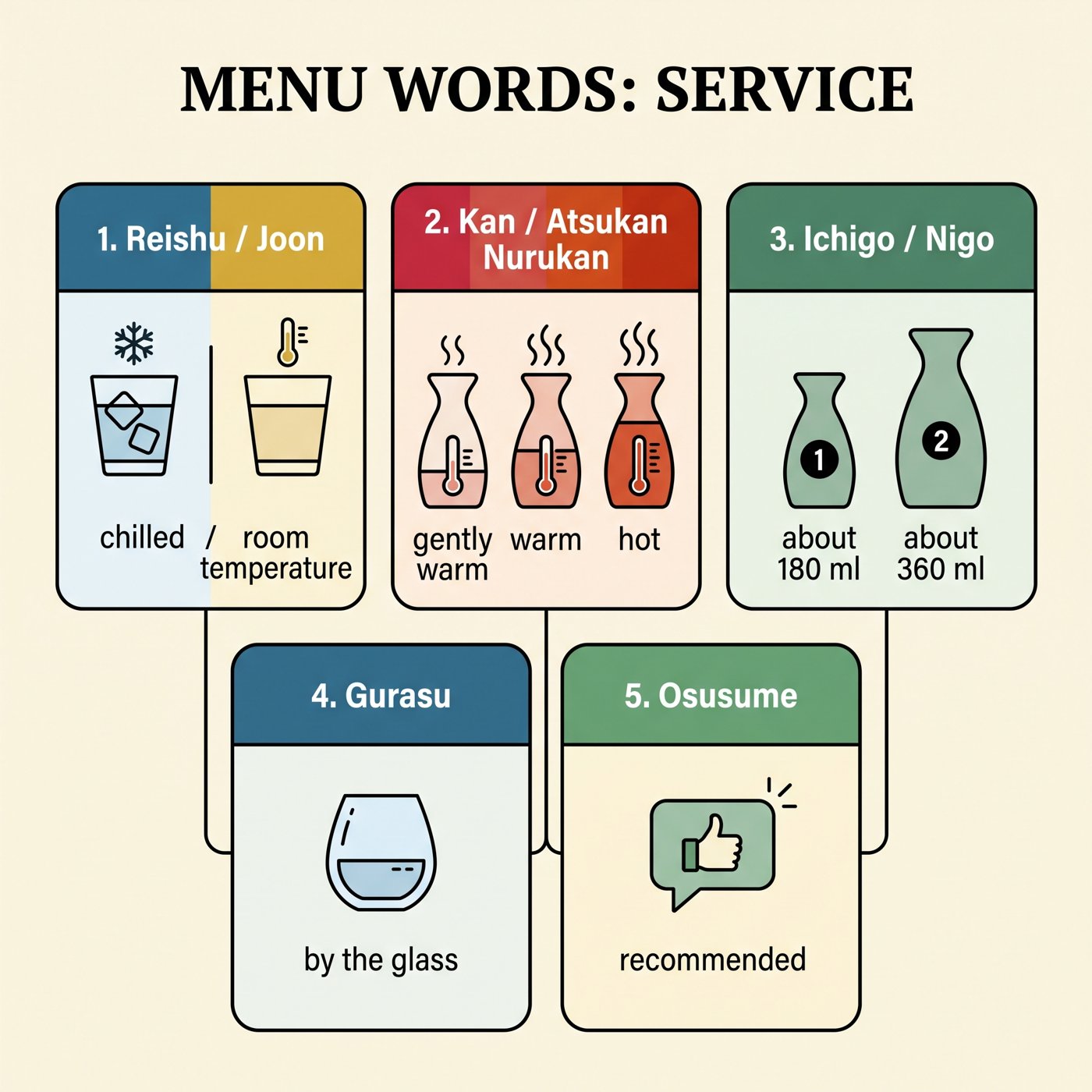
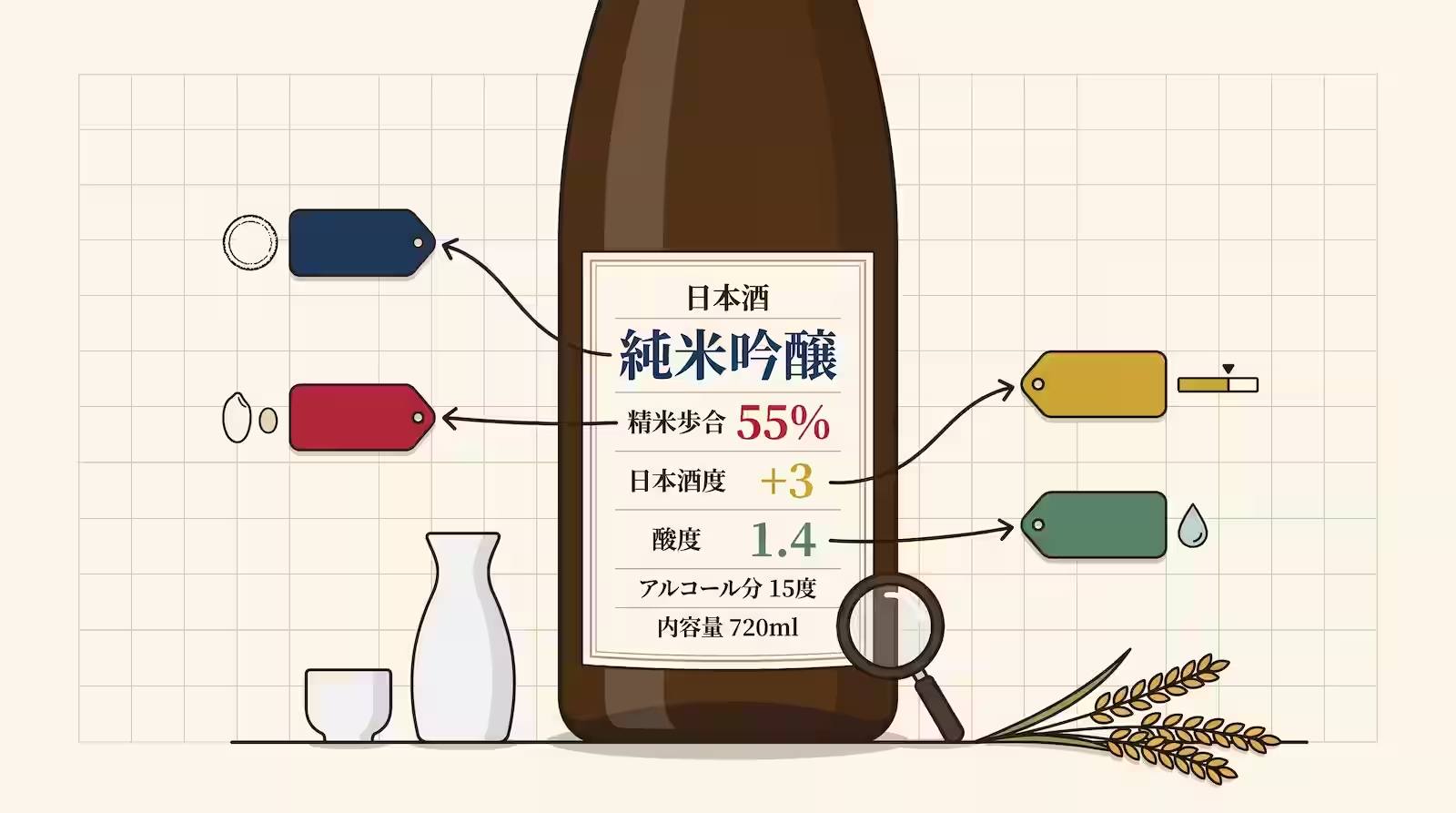
A bottle label tells you about the product, while a restaurant menu tells you how to order it. Our guide on how to read a Japanese sake label covers the label in depth. Here, the focus stays on the words you will see when ordering.
| Menu word | Reading | What it tells you when ordering |
|---|---|---|
| 純米 | junmai | Made without added brewer’s alcohol |
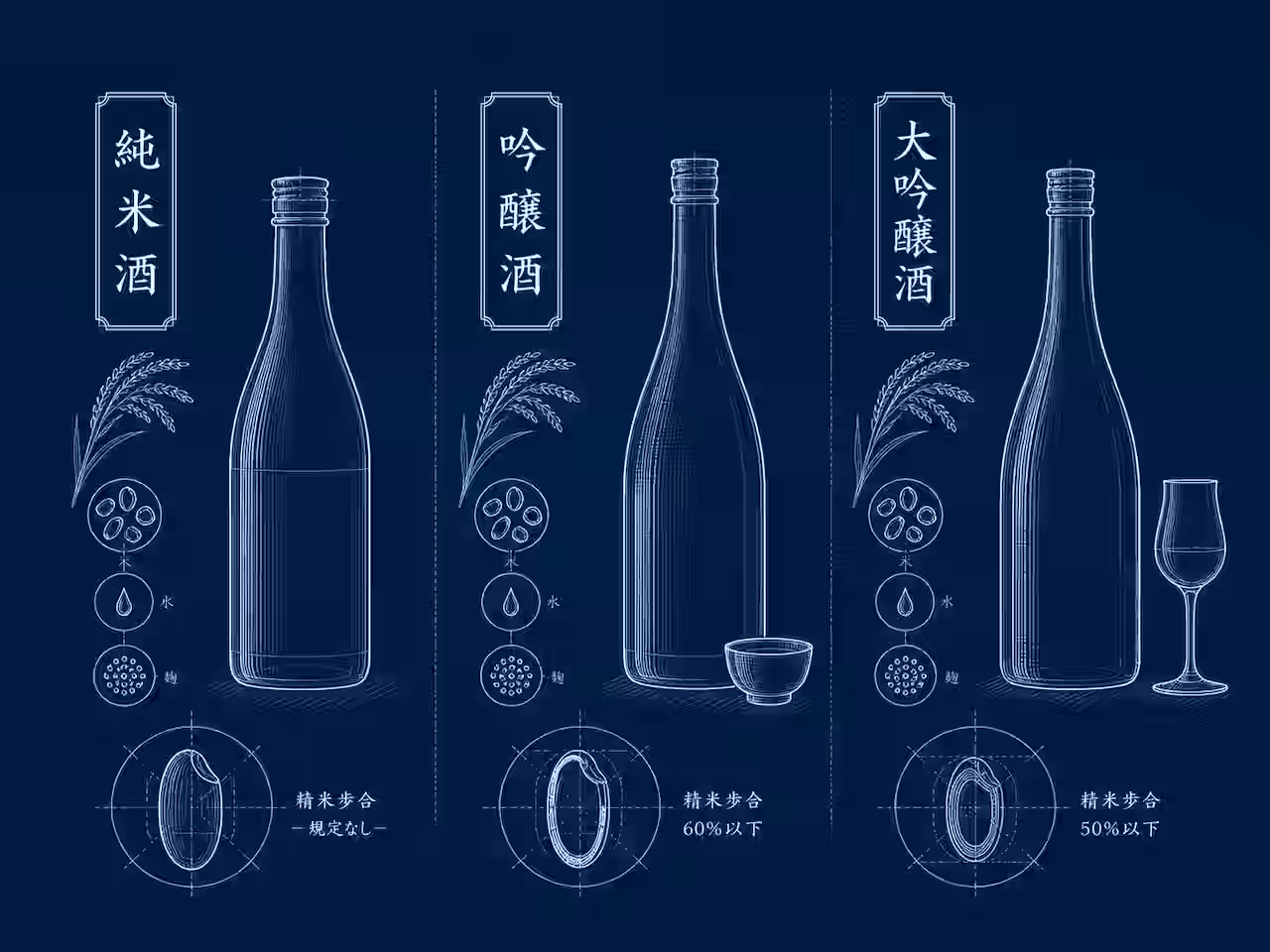
| 吟醸 / 大吟醸 | ginjo / daiginjo | Made with highly polished rice using ginjo brewing methods; often aromatic |
| 本醸造 | honjozo | Small addition of brewer’s alcohol |
| 生 | nama | Unpasteurized, usually served chilled |
| 原酒 | genshu | Undiluted, so often stronger |
| にごり | nigori | Cloudy, with rice solids |
| 地酒 | jizake | Local or regional sake |
| 冷酒 / 常温 | reishu / jōon | Chilled / room temperature |
| 燗 / 熱燗 / ぬる燗 | kan / atsukan / nurukan | Warm / hot / gently warm |
| 一合 / 二合 | ichigō / nigō | About 180 ml / about 360 ml |
| グラス | gurasu | By the glass |
| おすすめ | osusume | Recommended |
Notice that half the table is about service rather than the sake itself. For example, words like 一合, グラス and 燗 tell you how much arrives and at what temperature. Note, too, that ginjo and daiginjo are not automatically additive-free: unless the word junmai also appears, a small amount of brewer’s alcohol may be used.
Taste Notes and Unfamiliar Menus
Some menus add taste notes such as 辛口 (karakuchi, dry) or 甘口 (amakuchi, sweet), or flag seasonal and limited releases with 季節 (kisetsu) and 限定 (gentei). Treat these as the shop’s own hints rather than promises. If the menu has no English, point at a line and ask, “Kore wa donna osake desu ka?” (これはどんなお酒ですか), meaning “What kind of sake is this?”
A photo of a label you liked earlier can also be a surprisingly good tool. Show it to the staff and ask for something similar. In fact, many sake lovers in Japan do exactly the same thing with their own phones.
How to Choose Your First Sake
There is no single perfect sake for beginners. A better question is which direction sounds appealing. The groups below describe broad tendencies, and every brewery has its own style, so expect exceptions.
Light and aromatic
Often ginjo or daiginjo
Frequently fruity on the nose. A good fit if you like delicate flavors.
Often fuller and rice-forward
Many junmai
Styles vary widely, but many show noticeable acidity, umami and savory depth.
Approachable with food
Many honjozo and futsushu
Often clean and easy to pair, although everyday styles vary widely.
Fresh and lively
Namazake
Unpasteurized and usually chilled.
Strong and bold
Genshu
Undiluted, so higher in alcohol. Small sips work best.
Light, Aromatic Styles
The NRIB guide describes ginjo sake as having a fruity aroma called ginjo-ka, with notes such as apple, pear, banana or melon. According to the National Tax Agency (NTA), that aroma comes from esters produced in fermentation, not from fruit. Daiginjo uses rice polished even further. Fragrant does not automatically mean better, though, and some drinkers find these styles too perfumed with food.
Fuller, Food-Friendly Styles
Junmai sake, by definition, is made only from rice, rice koji and water. The NTA reports that junmai generally contains more acidity than other categories, and that acidity makes sake taste drier and richer. Still, junmai also includes light and fragrant bottles. Many honjozo and everyday futsushu are designed to be clean and approachable with food, although these categories cover a wide range.
You may also see kimoto or yamahai on a menu. These words refer to traditional yeast starters, and sakes made this way often bring more acidity and savory depth. Many of them are also offered warm, so they are worth noticing if you like fuller flavors.
Fresh and Strong Styles
Namazake skips pasteurization, so it often tastes fresh and lively. Genshu skips the final dilution, so many bottles run 17% to 20% alcohol. For something different, nigori is cloudy and often softer, while taruzake picks up a cedar aroma from wooden casks. Our guide to sake types explains every style in more detail.
How Much Sake to Order
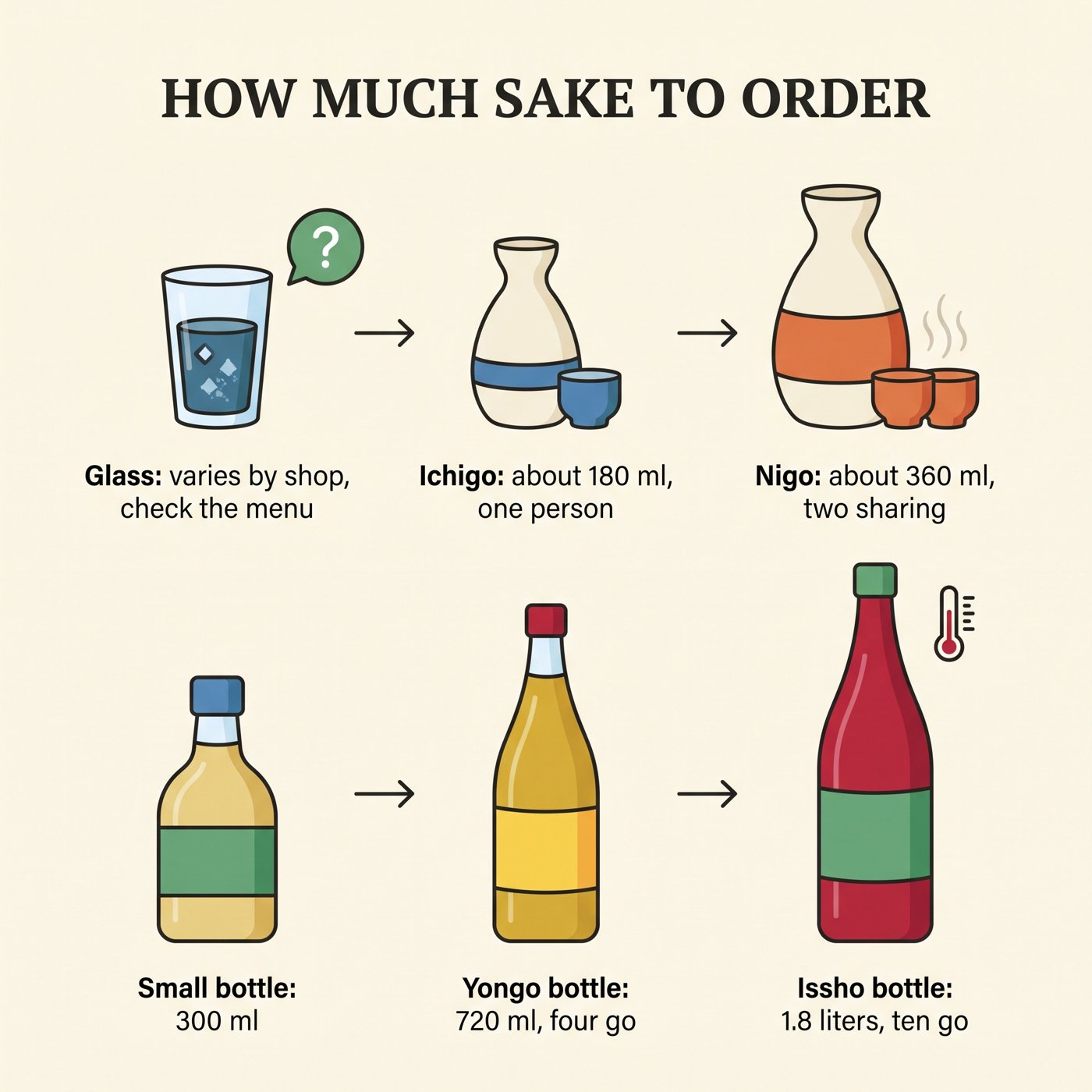
The key word is gō (合). One gō is about 180 ml, and many menus price sake per gō as well as per glass.
| Size | Approximate amount | Good for |
|---|---|---|
| Glass (グラス) | Varies by shop; check the menu | Trying several styles |
| Ichigō (一合) | About 180 ml | One person, or two sharing a taste |
| Nigō (二合) | About 360 ml | Two people sharing |
| Small bottle | 300 ml | Trying a bottle from a liquor store, or sharing between two |
| Yongōbin (四合瓶) | 720 ml, or four gō | A group, or a gift |
| Isshōbin (一升瓶) | 1.8 liters, or ten gō | Parties and celebrations |
Ordering one glass or one gō at a time is the easiest way to explore, because you can simply order again if you like it. Keep in mind that a gō looks small in the flask. Yet a 15% sake at that size holds about 20 grams of pure alcohol, according to materials from Japan’s Ministry of Health, Labour and Welfare.
Sharing changes the math, too. If two people split one gō, each gets roughly a glass, while a group of four might share a 720 ml bottle. Either way, check the price per serving before you order, because premium bottles can be costly by the glass.
Masu and the Overflowing Glass
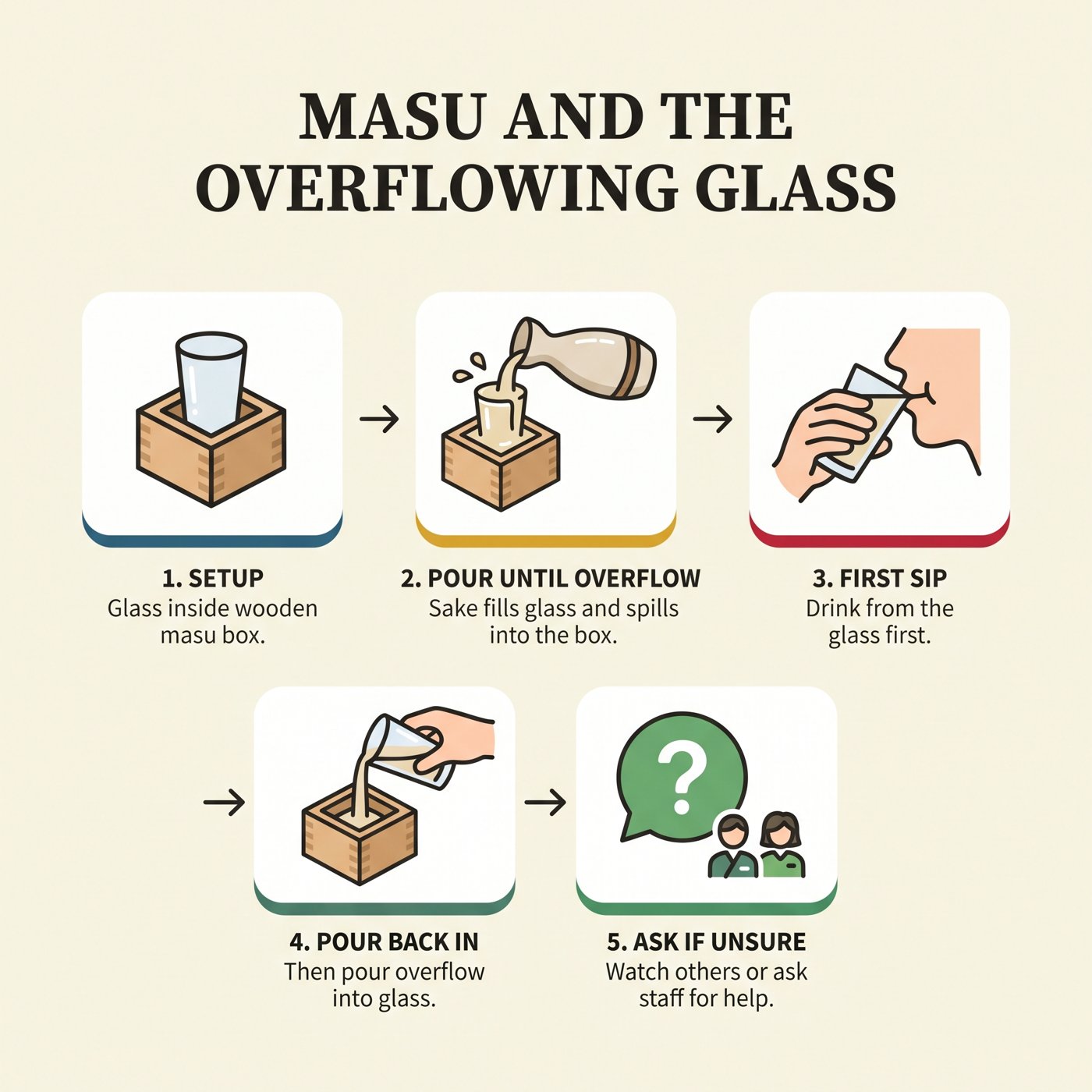
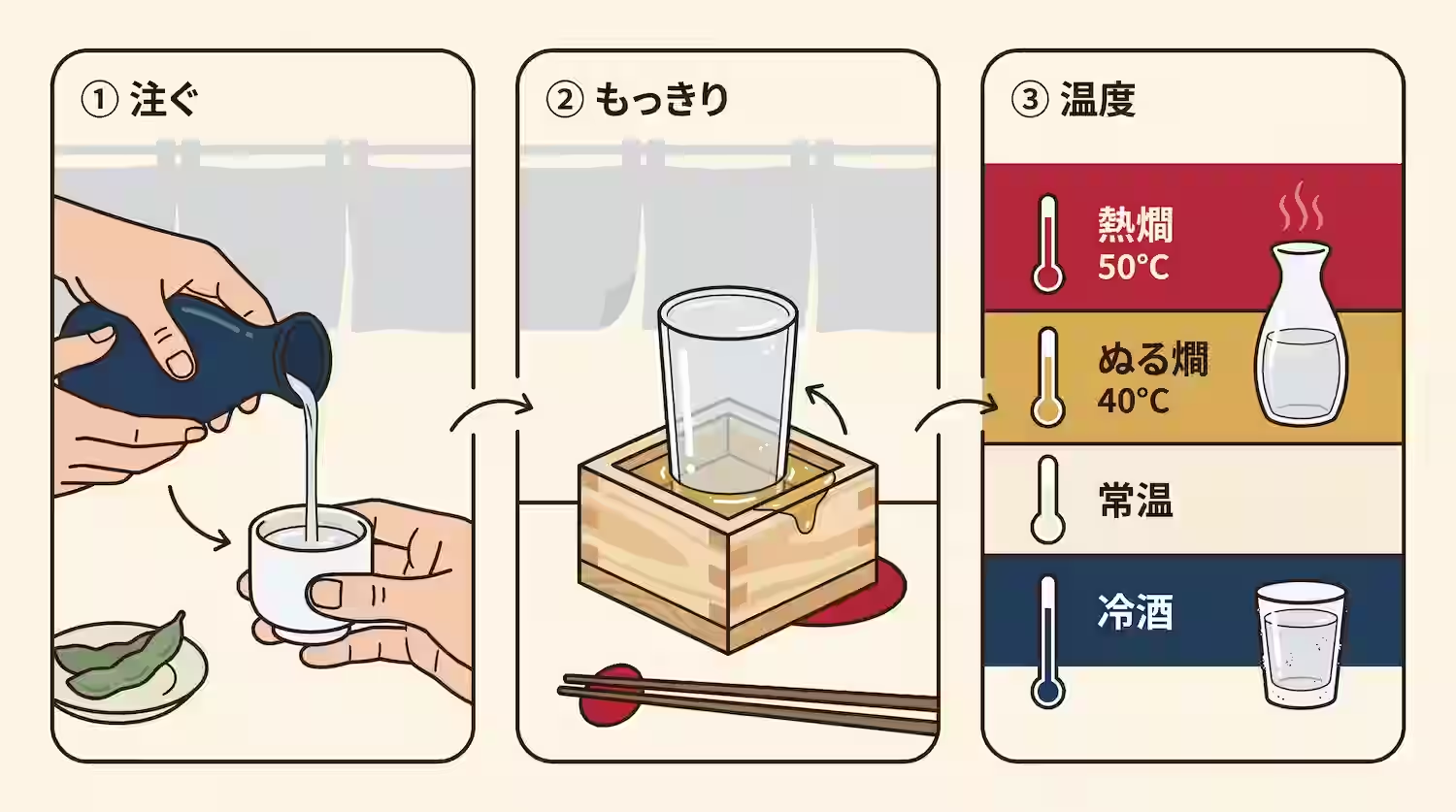
Some izakaya serve sake in a glass set inside a square wooden box called a masu, pouring until it spills over into the box. Customs vary from place to place. Many people sip from the glass first, then pour the overflow back in. If you are unsure, though, watch your neighbors or ask the staff.
Sake Cups and Serving Vessels
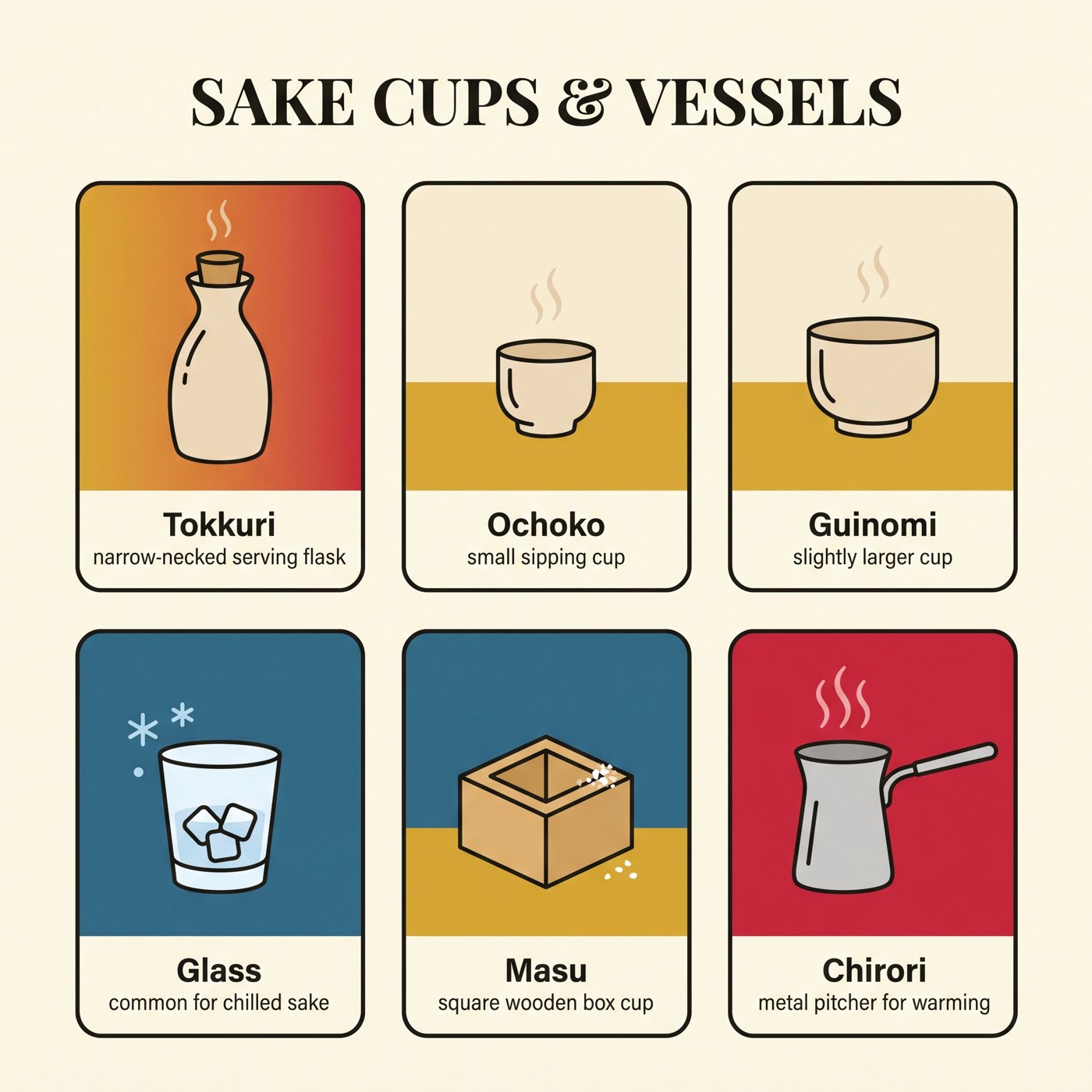
Next, sake comes with its own vessels, and their names appear on menus all the time. You only need a few.
Tokkuri
徳利 (also o-chōshi)
A narrow-necked serving flask of up to about 300 ml.
Ochoko
お猪口
A small cup for sipping, often ceramic.
Guinomi
ぐい呑み
A slightly larger cup, sometimes chosen from a tray of handmade pieces.
Glass
グラス
Common for chilled sake, from small glasses to wine glasses.
Masu
枡
A square wooden box, originally a rice measure, now used as a cup or to hold a glass.
Chirori
ちろり
A metal pitcher used to warm sake.
A tokkuri is a serving vessel, not a cup. Instead, you pour from it into a small ochoko and refill as you go. Glass tokkuri also exist for chilled sake, so a flask on your table does not automatically mean warm sake. Sometimes the sake arrives in a katakuchi instead, a small bowl with a spout.
Some shops also bring a tray of handmade cups and let each guest choose one. It is a small ritual, but it makes the table feel personal, and there is no wrong pick.
Why the Cup Matters
Overall, JSS states there are no strict rules about which cup goes with which sake. However, it notes that shape and thickness affect taste: a cylinder-shaped cup with a thick lip tends to make sake taste richer, while a shallow, thin-lipped cup makes it taste lighter. JSS adds that small glasses of up to 110 ml are most common for chilled sake, and that wooden cups such as the masu add a woody aroma.
Should You Order Sake Chilled, Warm or at Room Temperature?
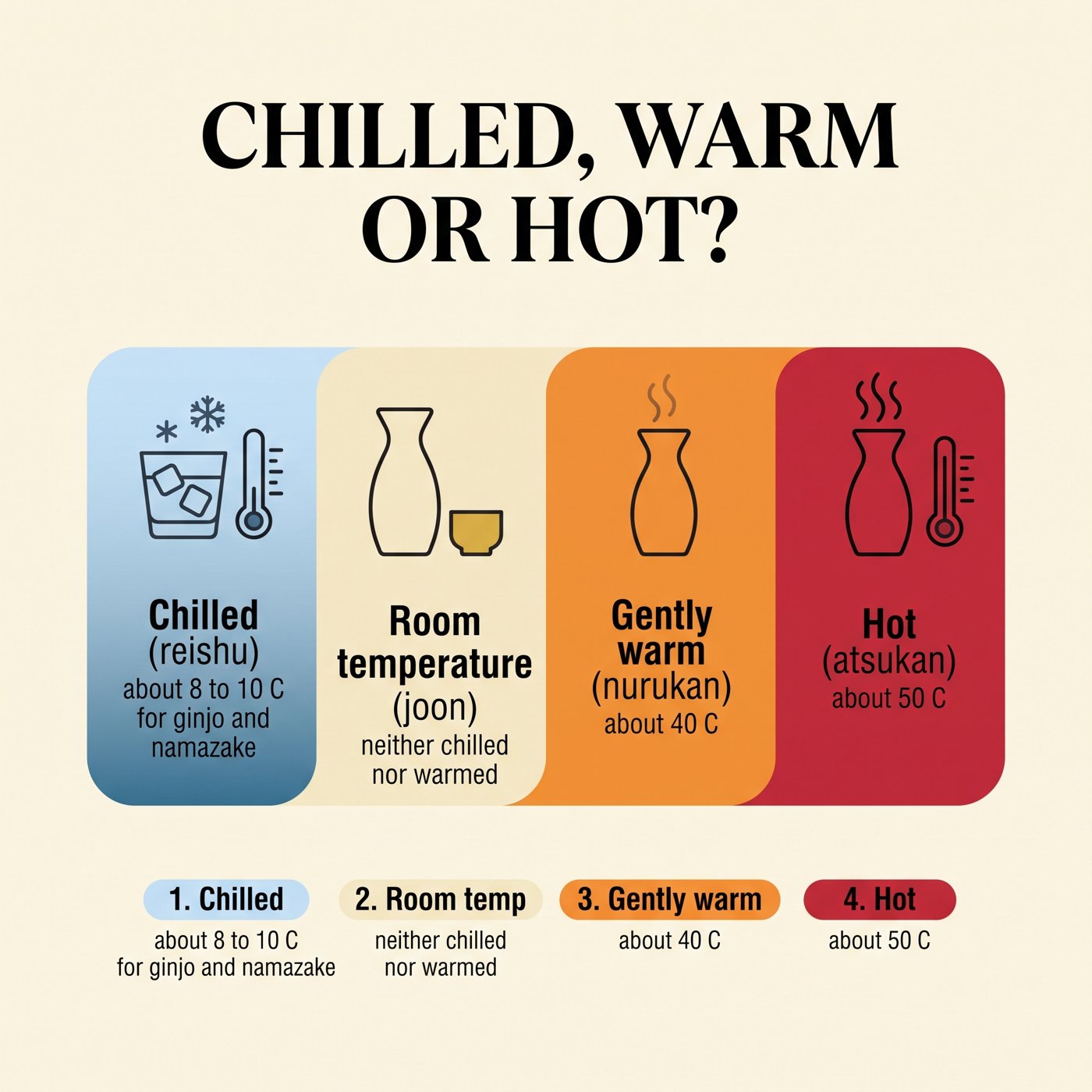
Sake is not always served hot. Instead, it covers a wide range of temperatures, and the right one depends on the sake and on you.
Chilled
冷酒 reishu
About 8 to 10°C for ginjo and namazake
Room temperature
常温 jōon
Neither chilled nor warmed
Gently warm
ぬる燗 nurukan
About 40°C
Hot
熱燗 atsukan
About 50°C
Chilled Sake
The NRIB guide suggests serving ginjo and namazake slightly chilled, at around 8 to 10°C, because warmth can mute their aroma and freshness. However, it also warns that taste is hard to sense below about 5°C. If a glass feels too cold, wait a few minutes, since the aroma often opens up as it warms.
Room Temperature
Meanwhile, room temperature shows a sake without the sharpening effect of cold or the softening effect of heat. Be aware that on some menus, 冷や (hiya) means room temperature rather than chilled. So if you want cold sake, the clearer word is 冷酒 (reishu).
For example, a junmai served at room temperature can feel rounder than the same sake straight from the fridge. So if you want to understand a bottle better, ask whether you can try it both ways. Some bars are happy to show the difference.
Warm Sake
Warm sake is called kan, or politely okan. The NRIB guide notes that it is usually heated to around 42 to 45°C, and that sweetness is sensed more strongly near body temperature, which helps sakes like junmai feel more balanced. A 2011 study in the Journal of the Brewing Society of Japan also found that perceived sourness shifted as serving temperature changed. For the full story, see our article on hot sake.
When should you choose warm sake? For example, cold evenings, simmered dishes and fuller styles are all good reasons. On a hot summer night, however, many people prefer something chilled, even if the same bottle would shine warm in winter. Your mood is a perfectly good guide.
How to Order Warm Sake
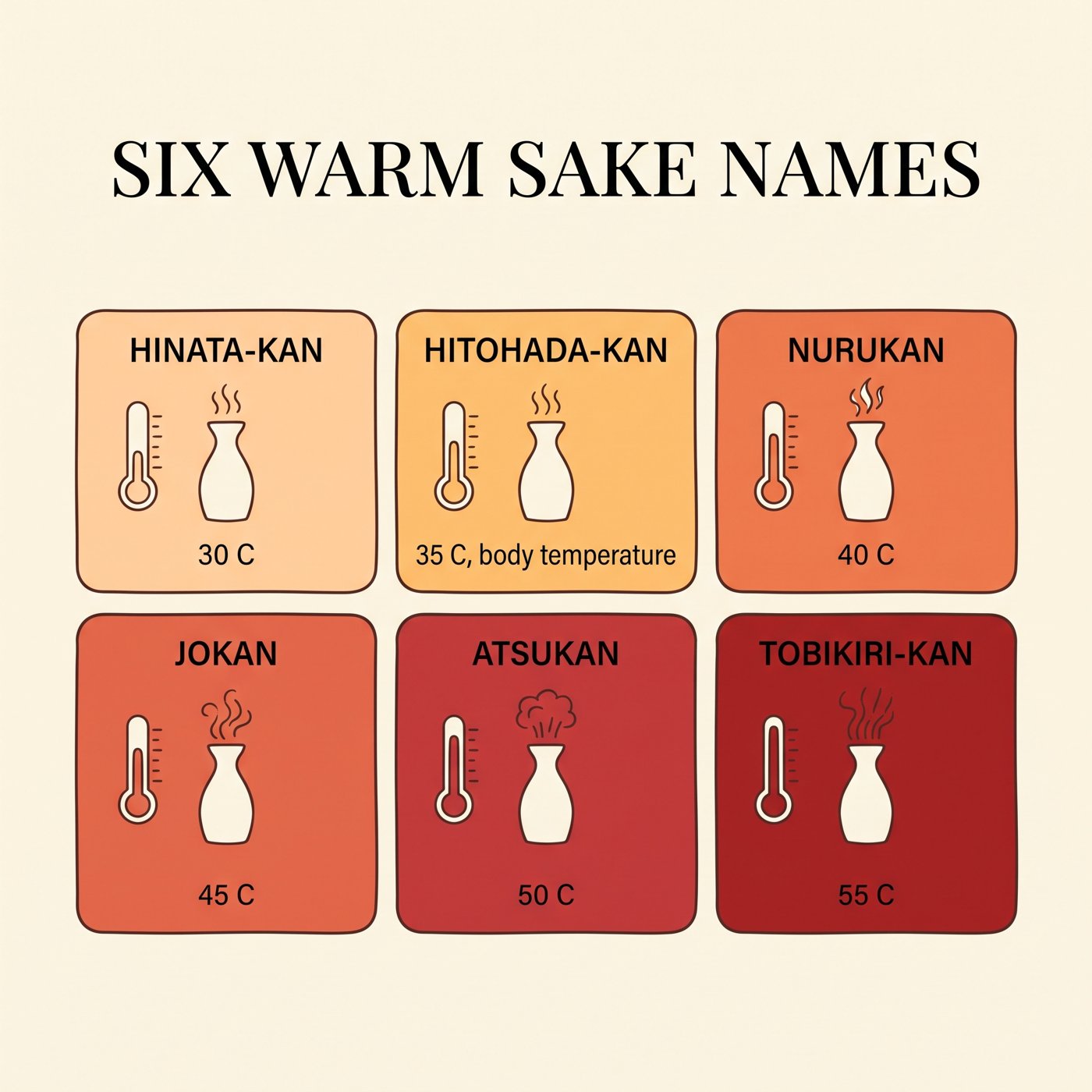
Many visitors use atsukan for all warm sake. Strictly, though, atsukan (熱燗) means hot, at about 50°C, while nurukan (ぬる燗), at about 40°C, is noticeably gentler.
| Name | Japanese | Approximate temperature |
|---|---|---|
| Hinata-kan | 日向燗 | 30°C |
| Hitohada-kan | 人肌燗 | 35°C, body temperature |
| Nurukan | ぬる燗 | 40°C |
| Jōkan | 上燗 | 45°C |
| Atsukan | 熱燗 | 50°C |
| Tobikiri-kan | 飛び切り燗 | 55°C |
For instance, Kobe brewer Sawanotsuru says the taste of warm sake changes roughly every 5°C. Even so, you only need to remember nurukan and atsukan to order with some control. Some shops let you choose a temperature, while others have a single okan setting. Fragrant or unpasteurized styles are usually kept cold, so if you want a particular bottle warmed, ask first: “Kore wa okan ni dekimasu ka?” (これはお燗にできますか), meaning “Can this one be warmed?”
Also remember that warm sake cools as it sits in the flask, so the first cup and the last can taste quite different. In fact, some people enjoy watching that change through the evening.
How to Order Sake at an Izakaya
An izakaya visit usually starts with a drink order, then food, then more drinks. Below, then, is a sample exchange you can borrow almost word for word.
YouJizake wa arimasu ka? (地酒はありますか) Do you have any local sake?
StaffHai. Kochira no mittsu desu. Yes, we have these three.
YouKarakuchi wa dore desu ka? (辛口はどれですか) Which one is dry?
StaffKore desu. Reishu demo okan demo daijōbu desu. This one. It works well chilled or warm.
YouJa, kore o gurasu de onegaishimasu. Then a glass of this one, please.
Useful Phrases
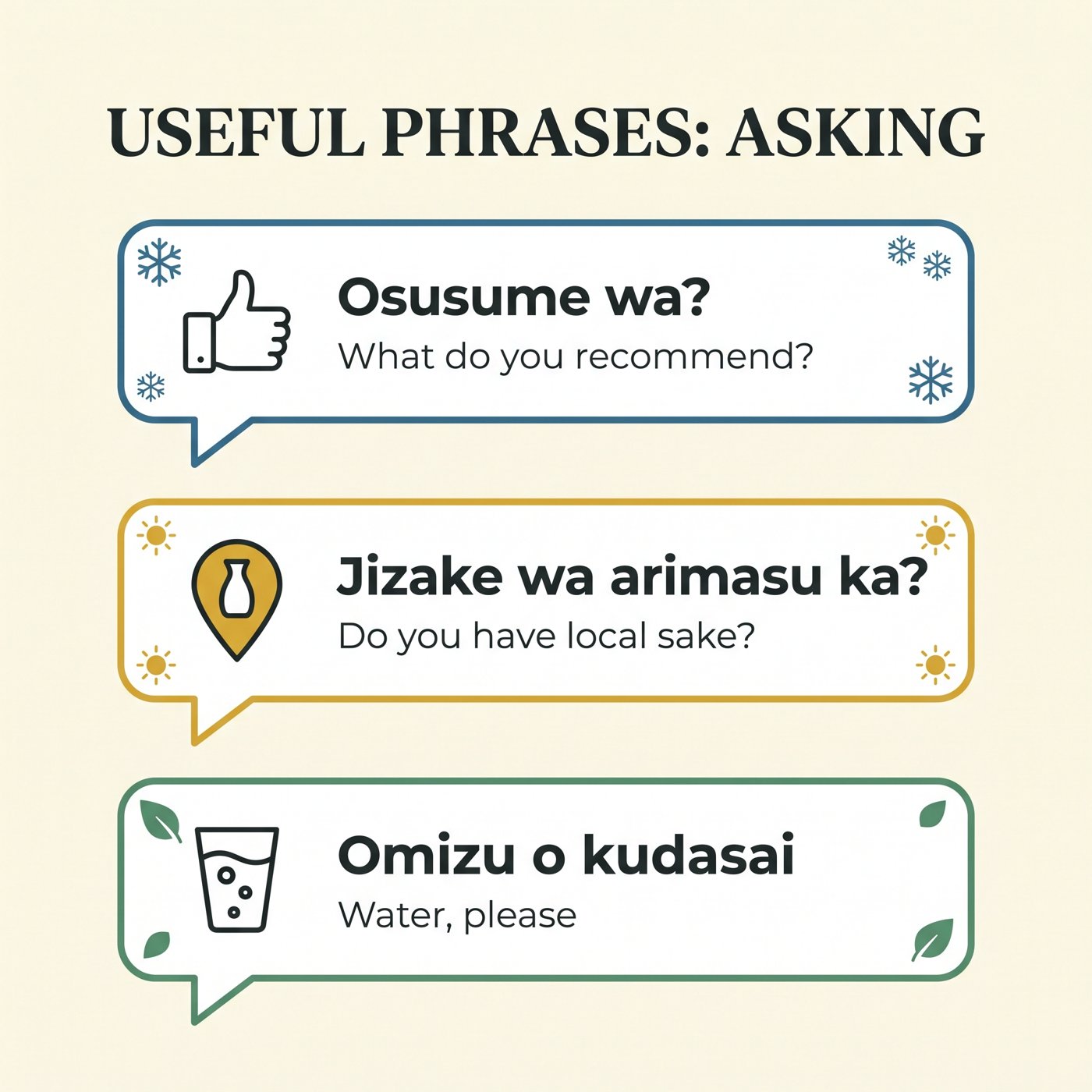
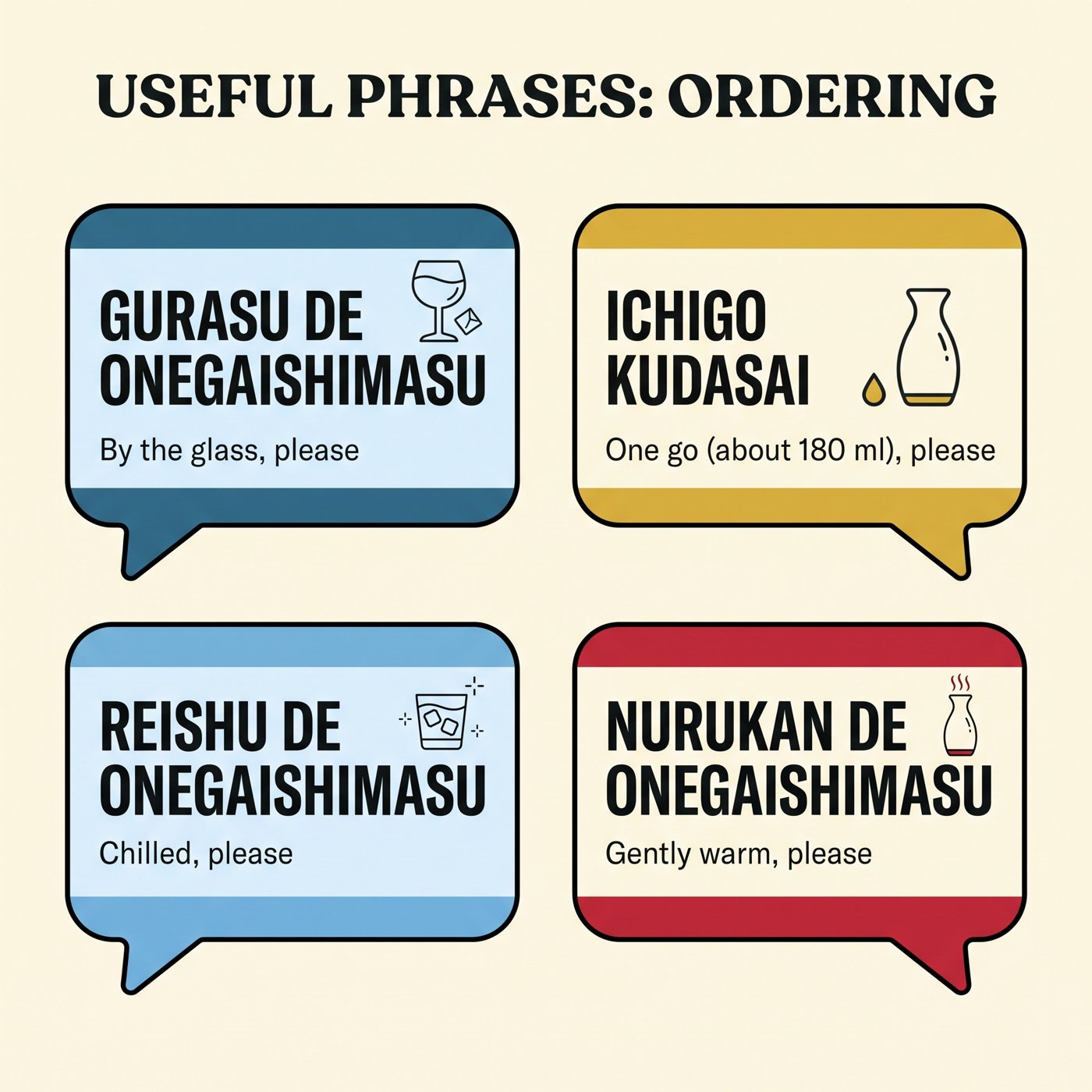
| Phrase | Japanese | Meaning |
|---|---|---|
| Osusume wa? | おすすめは? | What do you recommend? |
| Jizake wa arimasu ka? | 地酒はありますか | Do you have local sake? |
| Gurasu de onegaishimasu | グラスでお願いします | By the glass, please |
| Ichigō kudasai | 一合ください | One gō, please |
| Reishu de onegaishimasu | 冷酒でお願いします | Chilled, please |
| Nurukan de onegaishimasu | ぬる燗でお願いします | Gently warm, please |
| Omizu o kudasai | お水をください | Water, please |
Some sake bars offer small tasting pours or flights of three, although many izakaya sell only by the glass or by the gō. If you are unsure, then, ask politely and accept the answer either way. Pointing at the menu and saying “kore” (this) also works perfectly well.
Two of the phrases above also combine neatly. “Osusume no jizake wa?” (おすすめの地酒は?) asks for a recommended local sake in one short line, and it is easy to say even with a strong accent. Izakaya staff are busy, but they are used to guests who need a moment, so do not feel rushed.
Asking for a Recommendation
For first-time drinkers, asking the staff is often the easiest route to a good bottle. After all, they know their list, their food and how each bottle is drinking right now. Tell them what you like, such as “Karakuchi ga suki desu” (辛口が好きです, I like dry sake) or “Furūtī na no ga suki desu” (I like fruity sake), and mention what you are eating.
Keep in mind that “dry” is not a single measurement. The NRIB guide explains that sweetness or dryness depends on the balance of sugars and acids, and the NTA publishes an index, amakara-do, that combines the sake meter value with acidity for this reason. Our sake label guide explains these numbers if you are curious.
Ordering Local Sake
First, jizake (地酒) means local sake, made by breweries in a particular region. Specifically, the NRIB guide links regional character to local rice, water, climate and taste preferences. Jizake describes where a sake comes from rather than its quality grade, so it can be anything from a refined daiginjo to an everyday table sake. Our regional sake guides cover several areas, including Yamagata, Hyogo and Nagano.
How to Drink Sake With Food
In Japan, sake and food usually arrive together. The NRIB guide lists four ways sake can work with a dish: matching it, creating a new taste, bringing out hidden flavors and cleansing the palate.
- Sashimi: clean, fragrant or lightly chilled styles often work well.
- Grilled fish and yakitori: junmai or honjozo, chilled or gently warm.
- Tempura: a crisp, dry-leaning sake can cut through the batter.
- Hot pot and miso dishes: fuller styles, often warmed.
- Cheese: some sakes, especially aged sake, according to the NRIB guide.
Seafood is the classic partner. According to the NRIB guide, sake can suppress fishy smells, soften saltiness and let umami spread across the mouth. The guide also suggests starting the evening with a light sake and moving to fuller ones, with slightly sweet koshu, or aged sake, working well after dinner. Treat these as ideas to test rather than rules.
Salt plays a role as well. The NRIB guide notes that salt can intensify the umami of amino acids, which sake contains in good amounts. That helps explain why salty snacks, such as pickles or salt-grilled skewers, work so well with a cup of sake. Some memorable pairings come from contrast too, like a crisp sake beside fried food.
A Simple Way to Taste
- LookMost sake is clear, while nigori is cloudy on purpose and aged sake can turn gold or amber.
- SmellFruit, rice, cedar or caramel notes may appear.
- SipLet it spread across your tongue and notice sweetness, sourness and umami.
- FinishNotice how the taste fades after you swallow.
Notably, many traditional sake styles prize a clean finish called kire. That does not mean every good sake must finish quickly, because rich, aged and aromatic styles may leave a longer impression. Try a second sip after a bite of food, since the same sake can taste quite different.
Sake Etiquette in Japan
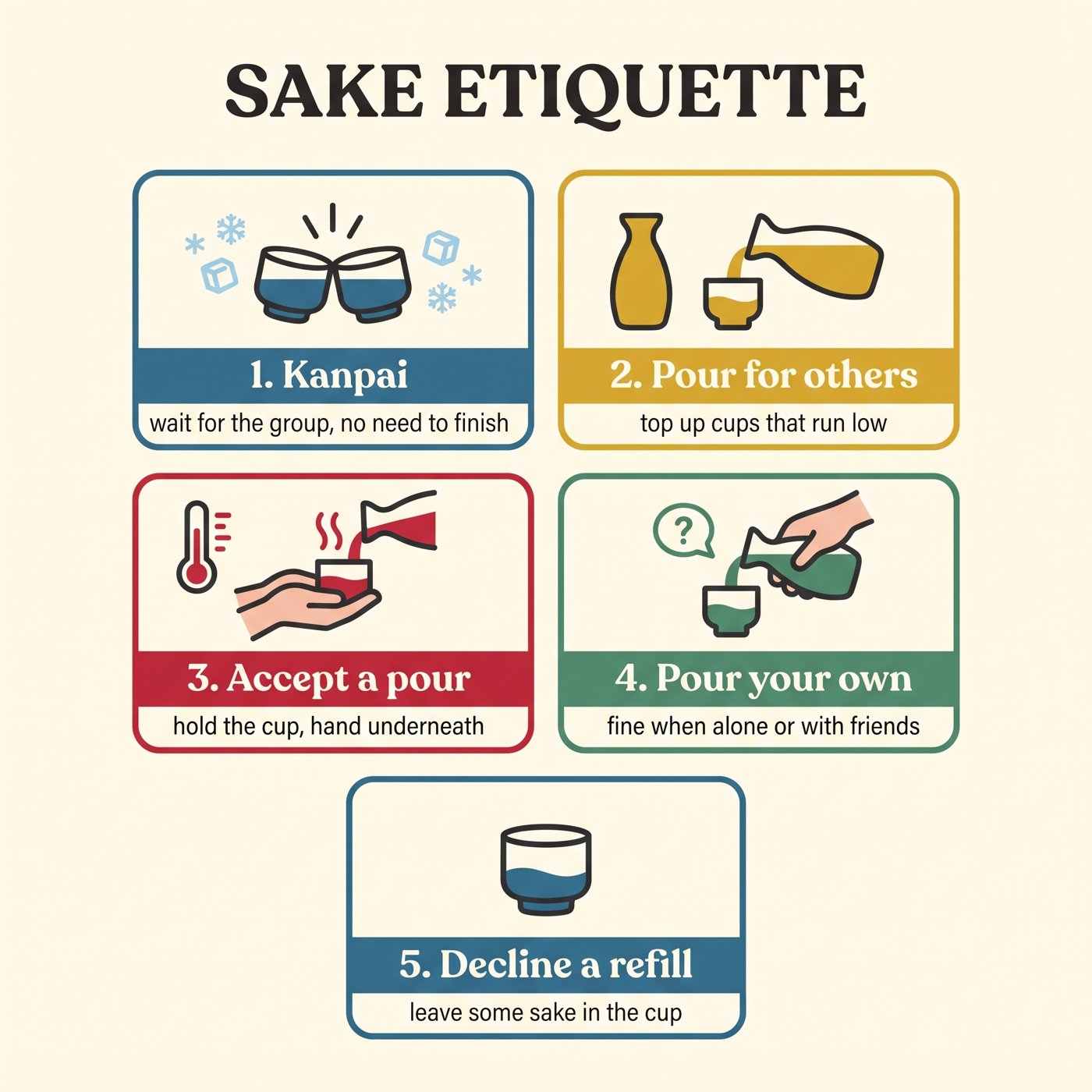
Above all, sake etiquette comes down to looking after the people at your table. JSS says there are no strict rules for drinking or serving sake, especially in casual situations. For wider drinking customs, see our guide to alcohol in Japan.
Pouring for others
When sharing a flask, offer to top up others’ cups.
Accepting a pour
Hold the cup with three fingers and support it underneath with your other hand.
Kanpai
Literally “dry the cup,” but you are not expected to finish your drink.
Saying no
Declining a refill or choosing a soft drink is generally fine.
Waiting for Kanpai
In a group, especially at a formal or business dinner, people usually wait until everyone has a drink and someone leads the kanpai (乾杯). Japan Airlines’ etiquette guide gives the same advice. Although the word means “dry the cup,” JSS points out that no one expects you to finish your drink. Alone at a counter, simply drink when your sake arrives.
Business dinners deserve a little more care. Often, the host or someone senior gives a short greeting before the toast, so let them lead and follow their timing. At a casual izakaya with a friend, the mood is looser, although saying kanpai together still feels friendly.
Pouring for Others
When a group shares a tokkuri, JSS suggests keeping an eye on others’ cups and offering a top-up when one is nearly empty. To pour, hold the neck of the flask with your dominant hand and steady the bottom with the other. Then, when someone pours for you, JSS describes holding the cup between the thumb, forefinger and middle finger, with your other hand underneath.
Pouring Your Own Sake
You may often read that you must never pour your own drink in Japan. However, that advice fits formal company, where pouring for each other is part of the occasion. Pouring your own even has a name, tejaku (手酌), and it is common when drinking alone or with close friends. So offer to pour for others first, and if no one is watching your cup, quietly topping it up is usually fine.
Declining a Refill
If you want to slow down, leave some sake in your cup, since a full cup signals you do not need a refill yet. A polite “Mō daijōbu desu” (I am fine now) also works. Japan Airlines’ guide notes that saying you do not want alcohol is acceptable, and most restaurants offer non-alcoholic choices.
Visiting a Sake Brewery
A brewery visit lets you taste sake where it is made. Japan’s sake brewery tourism council, run through the Japan Travel and Tourism Association, describes these visits as a way to explore local food and traditions as well as sake. They take more planning than a bar, though.
- Book ahead: many breweries require reservations, some with several days’ notice.
- Check the language: some tours run only in Japanese.
- Know the season: brewing usually runs in the colder months.
- Plan transport: do not drive or cycle after tasting.
Do not assume walk-in tastings. For example, a brewery tour listed by the Japan National Tourism Organization (JNTO) asks visitors to book at least a day ahead and notes that brewers may be at work from November to March. Tokyo’s official tourism site also says English tours at one Fussa brewery require reservations. Also, to find breweries by region, JSS runs an English Sakagura Search tool.
Once you are there, ask questions, since brewery staff often enjoy explaining their rice, water or yeast. Tastings are usually small pours, so you can try several styles. Many breweries also sell bottles that are hard to find elsewhere, which makes a visit a good chance to pick a favorite to take home.
Drinking Sake Responsibly
Sake can be stronger than it tastes. It usually sits around 15% to 16% alcohol, according to NTA data, and genshu can reach 17% to 20%.
Japanese health ministry materials treat one gō (180 ml) of 15% sake as about 20 grams of pure alcohol. Drink water alongside sake, eat while you drink, and never drive after drinking.
The NRIB guide recommends serving water with sake, a habit called yawaragi-mizu (和らぎ水), meaning water that eases things off. JSS likewise advises water between servings to help prevent overdrinking and hangovers. Eating while you drink also helps, and Japanese drinking culture makes that easy.
The legal drinking age in Japan is 20. Driving after drinking is prohibited, and according to the National Police Agency, a breath alcohol concentration of 0.15 mg per liter or more meets the legal threshold for driving under the influence. Penalties may also apply to people who provide the vehicle or alcohol, or who knowingly ride with the driver.
It is also fine to switch to tea or a soft drink for part of the evening. After all, pacing yourself is normal in Japan, and nobody expects a visitor to keep up with every round.
Three Easy Sake Orders for Beginners
Finally, here are three common situations, with phrases you can say as written.
At an izakaya
“Jizake no junmai o gurasu de onegaishimasu.”
地酒の純米をグラスでお願いします
A glass of local junmai, please.
With sashimi
“Sashimi ni au, kaori no ii ginjo wa arimasu ka?”
刺身に合う、香りのいい吟醸はありますか
Do you have a fragrant ginjo that goes well with sashimi?
On a cold night
“Kore o nurukan de ichigō onegaishimasu.”
これをぬる燗で一合お願いします
One gō of this, gently warmed, please.
The first order names a style, asks for local sake and keeps the size small. Meanwhile, the second hands the staff a clear goal by describing the food and the aroma you want. Finally, the third picks a temperature and a size at once, and if the sake cannot be warmed, the staff will suggest another.
Common Misconceptions About Drinking Sake
MythSake is always served hot.
RealityIt is served chilled, at room temperature or warm, and many styles are mainly drunk cold.
MythSake must be drunk from an ochoko.
RealityGlasses, wine glasses and masu are all common, and JSS says there are no strict rules.
MythGinjo is always better.
RealityGinjo is a style with brewing requirements, not a ranking of taste.
MythDry sake has no sweetness.
RealityDryness depends on the balance of sugar and acid, not one number.
MythJizake means premium sake.
RealityJizake means local sake, and it can be any grade.
Final Thoughts
Learning sake can feel like a lot at first, with grade names, temperatures, vessels and manners arriving at once. Yet the path is short: the menu tells you how to order, you pick a temperature, and you taste it with food. Each step gets easier with every glass.
So on your next trip, ask for the local sake, try it two ways and drink water in between. When you want to go deeper, our hot sake guide and guide to sake types are good next stops. Kanpai.
Sake Drinking FAQ
Ordering
- How do you drink sake in Japan?
-
Choose a style and a temperature, then order a glass or a small flask. Sip it slowly, ideally with food, and drink water alongside it. In groups, wait for the kanpai toast before your first sip.
- What sake should I try first in Japan?
-
Try the local sake, or jizake, wherever you are. Ask the staff for a recommendation and say whether you prefer something fruity, dry or light. That gives you a sake that suits both the place and your taste.
- How do I ask for dry sake in Japanese?
-
Say “Karakuchi no nihonshu wa arimasu ka?” (辛口の日本酒はありますか), meaning “Do you have dry sake?” Dryness depends on sugar, acidity and temperature together, so a dry sake can still taste soft or rounded.
Temperature
- Can you ask for sake to be warmed?
-
Yes, at many izakaya and restaurants you can ask for okan, or warm sake. Some bottles, especially fragrant or unpasteurized ones, may be offered only chilled. Ask “Kore wa okan ni dekimasu ka?” to check.
- What does hiya mean on a sake menu?
-
Hiya (冷や) often means room temperature rather than chilled. If you want cold sake, ask for reishu (冷酒) instead. When in doubt, ask the staff how it will be served.
Etiquette and Safety
- Do I have to finish my drink after kanpai?
-
No. Kanpai literally means “dry the cup,” but JSS notes that no one expects you to finish your drink. Sipping at your own pace is perfectly fine.
- Is sake stronger than beer or wine?
-
Usually, yes. Sake typically contains about 15% to 16% alcohol, and undiluted genshu can reach 17% to 20%. Drinking water alongside it and eating while you drink both help you pace yourself.
- Can I visit a sake brewery without a reservation?
-
Sometimes, but do not count on it. Many breweries require reservations for tours and tastings, and some tours run only in Japanese. Check each brewery’s website before you go.
References
Government and Official Sources
- National Research Institute of Brewing (NRIB) – A Comprehensive Guide to Japanese Sake (Japan Sake and Shochu Makers Association and NRIB, 2011) (Accessed October 2026)
- Japan National Tourism Organization (JNTO) – Savor the Flavor of Premium Sake: Tour an Authentic Sake Brewery (Accessed October 2026)
- National Tax Agency (NTA) – Components of Japanese Sake (Accessed October 2026)
- Japan Sake and Shochu Makers Association (JSS) – How to Read Sake Bottle Labels (Accessed October 2026)
- National Police Agency – Eradication of Drinking and Driving (Accessed October 2026)
- Japan Travel and Tourism Association – What Is Sake Brewery Tourism? (Japan Council for Promotion of Sake Brewery Tourism) (Accessed October 2026)
- Ministry of Health, Labour and Welfare (e-healthnet) – Alcohol Self-Check Leaflet: What Is 20 g of Alcohol? (あなたが決める、お酒のたしなみ方) (Accessed October 2026)
- Japan Sake and Shochu Makers Association (JSS) – Sake Cups and Vessels (Accessed October 2026)
- GO TOKYO (Tokyo Convention and Visitors Bureau) – Sake Brewery Tour: Ishikawa Brewery (Accessed October 2026)
Industry and Academic Sources
- Japan Sake and Shochu Makers Association (JSS) – Basic Sake Etiquette (Accessed October 2026)
- J-STAGE – Relationship Between the Sourness of Organic Acids in Sake and Serving Temperature, Journal of the Brewing Society of Japan 106(11), 2011 (清酒に含まれる有機酸の酸味と飲用温度の関係) (Accessed October 2026)
- Japan Airlines Guide to Japan – Guide to Japanese Table Manners (Accessed October 2026)
- Japan Sake and Shochu Makers Association (JSS) – Sakagura Search (Accessed October 2026)
- Sawanotsuru – Warm Sake: Sake That Changes With Temperature (Accessed October 2026)
Related Articles
- How to Read a Japanese Sake Label: A Beginner’s Guide (Surveyed: October 2026)
- Hot Sake (熱燗) (Surveyed: October 2026)
- Alcohol in Japan: A Complete Guide to Drinks, Culture and Izakaya Prices (Surveyed: October 2026)
- Types of Japanese Sake (Surveyed: October 2026)
- Junmai Sake (純米酒) (Surveyed: October 2026)
- Ginjo (吟醸酒) (Surveyed: October 2026)
- Namazake (生酒) (Surveyed: October 2026)
- Genshu (原酒) (Surveyed: October 2026)
- Contemporary Sake in Japan: Craft, Globalization, and a Living Tradition (Surveyed: October 2026)
- Japan Food Bucket List: 15 Must-Try Foods for Your First Trip (Surveyed: October 2026)





Comments