


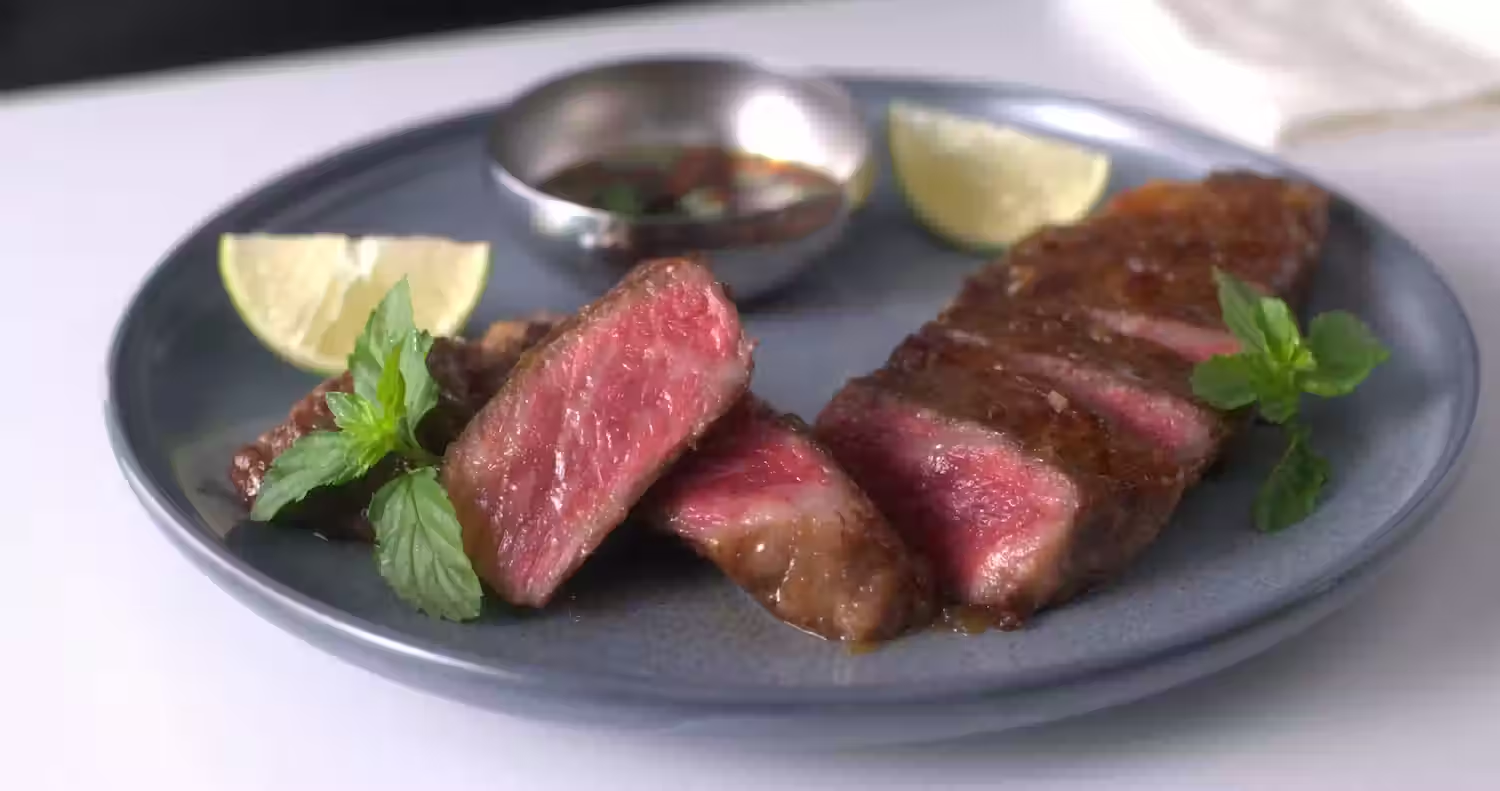

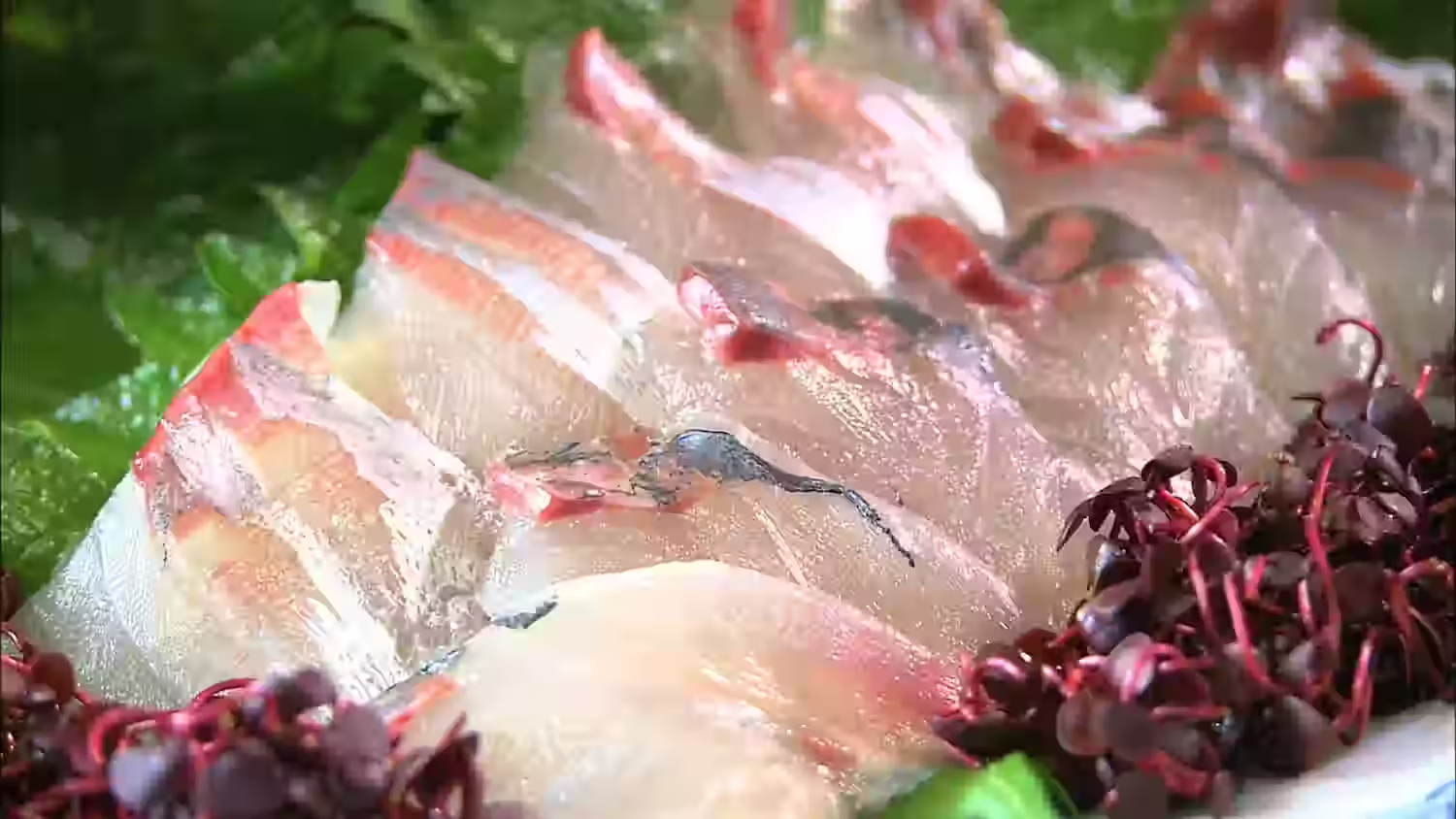


Oita Wagyu (おおいた和牛) is a premium certification for selected Oita Bungo Beef from Oita Prefecture, on the island of Kyushu. It is not a separate breed. To qualify, the beef must reach meat quality Grade 4 or 5. It must also come from a participating farm whose flavor-focused feeding program includes rice, beer lees, or similar ingredients.
The brand launched on September 4, 2018. Its roots, however, reach back to 1918, when Oita began standardizing Bungo cattle. Maybe you saw “Bungo beef” on a menu in Beppu and wondered how it differs. Or maybe you assumed Oita Wagyu is always A5. This guide answers both questions, then covers taste, cuts, and where to try it.
Quick Facts: Oita Wagyu
- Japanese name
- おおいた和牛 (Ōita wagyū), pronounced oh-ee-tah wah-gyoo
- What it is
- A premium certification within Oita Bungo Beef, not a separate breed
- Breed
- Japanese Black cattle (Kuroge Washu)
- Base requirement
- Must first qualify as Oita Bungo Beef: Japanese Black cattle fattened longest in Oita; female cattle must never have calved
- Quality rule
- Meat quality Grade 4 or 5; the yield grade (A, B, or C) is not specified
- Farm and feed rules
- Participating farms whose flavor-focused feeding includes rice, beer lees, or similar ingredients
- Launched
- September 4, 2018 (now “Oita Wagyu Day”)
- Heritage
- Formal standardization of Bungo cattle began in 1918
- Managed by
- Oita Prefecture Bungogyu Beef Marketing Council
What Is Oita Wagyu?
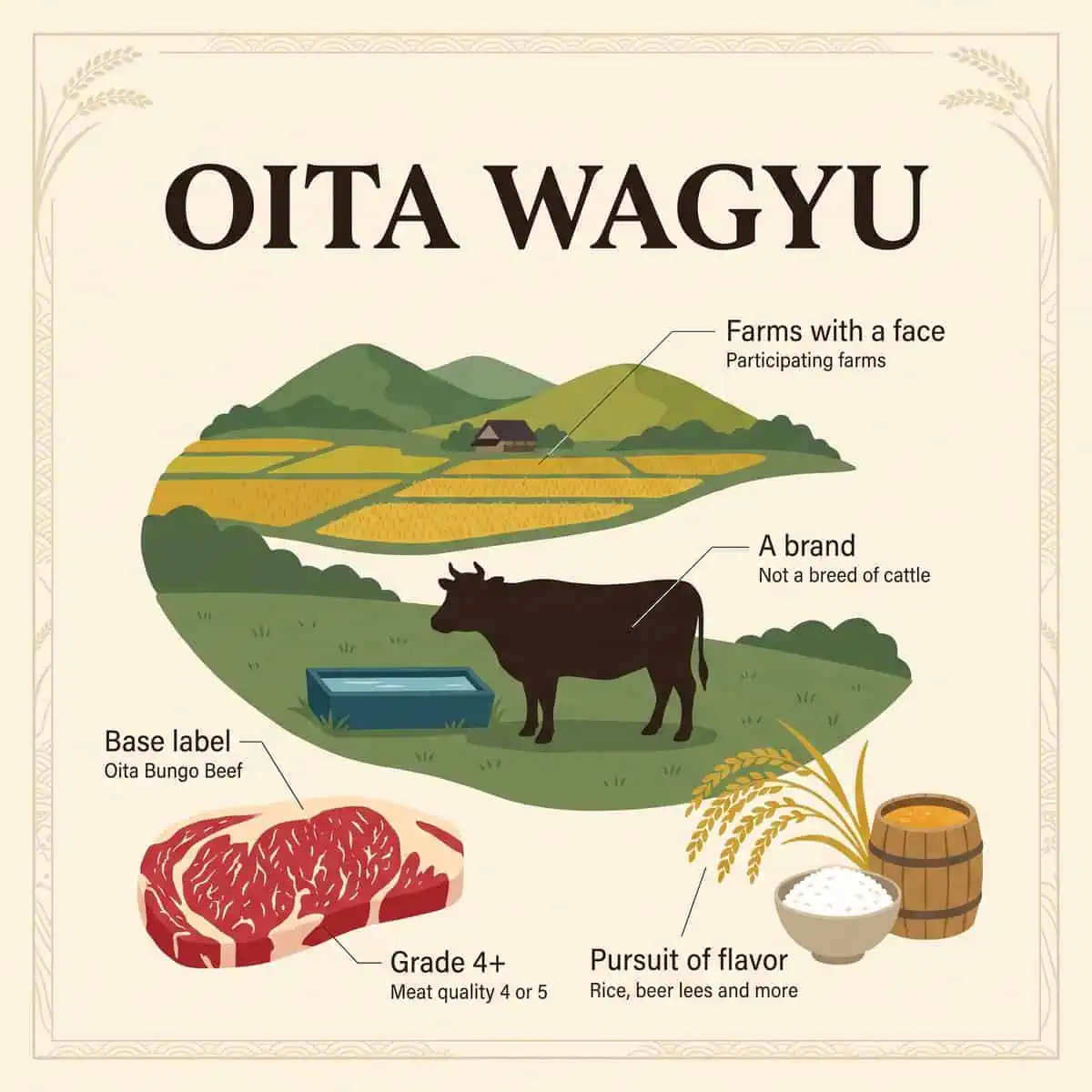
Oita Wagyu is a certified beef brand from Oita Prefecture, not a breed of cattle. Every product sold as Oita Wagyu beef must first meet the definition of Oita Bungo Beef. That is the prefecture’s unified label for its Japanese Black beef. Only part of that beef then meets the extra rules for Oita Wagyu.
The Official Definition
The brand council’s certification guidelines list three conditions. First, the beef must grade 4 or higher for meat quality. Second, it must come from a participating farm that presents itself to the public, for example through a website. Third, that farm must pursue flavor through feeding that includes rice, beer lees, or similar ingredients.
Oita Prefecture, meanwhile, puts it more plainly. In a 2021 reply to a resident, it described Oita Wagyu as top-grade Bungo beef. That meant Grade 4 or above, from certified farms that give the cattle feed rice or beer lees.
Where Oita Wagyu Comes From
Oita sits on the northeast coast of Kyushu, facing the Seto Inland Sea. Most visitors, of course, know it for the hot springs of Beppu and Yufuin. Meanwhile, the cattle are raised on farms around the prefecture, from coastal areas to the Kuju highlands.
One detail surprises people: the definition of Oita Bungo Beef does not say the animal must be born in Oita. Rather, it says the animal must have been fattened longest in Oita. In the case of females, the cattle must never have calved.
How Oita Wagyu Relates to Oita Bungo Beef
Think of two circles, one inside the other. Oita Bungo Beef is the large circle, and it became the prefecture’s unified brand in 2013. Oita Wagyu, then, is the smaller circle inside it, launched in 2018 as the “leading brand.”
So all Oita Wagyu is Oita Bungo Beef. The reverse is not true. For instance, a carcass graded 3 may still qualify as Oita Bungo Beef, but it cannot carry the Oita Wagyu label. The same applies to beef from a farm outside the program.
The History of Oita Wagyu
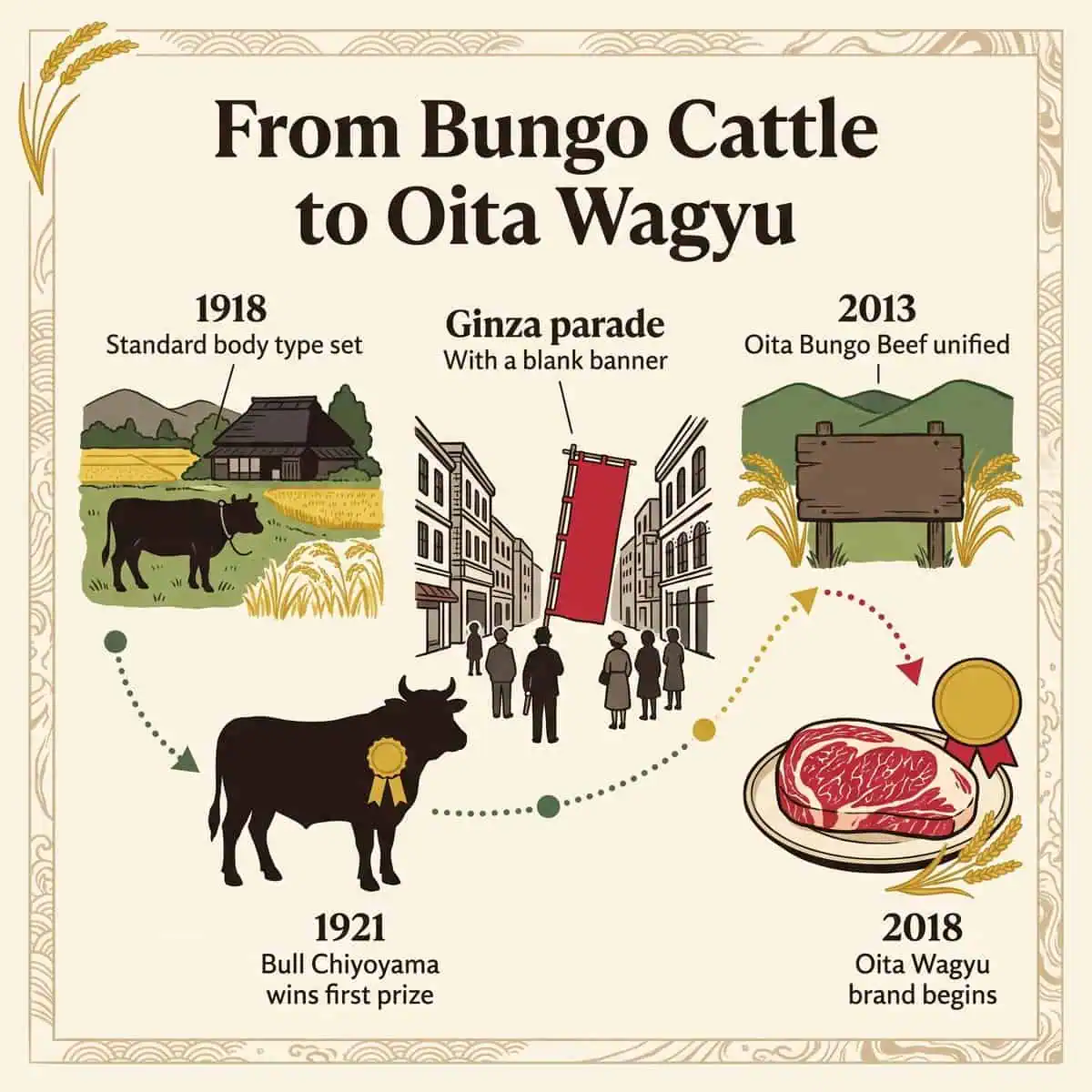
Strictly speaking, Oita Wagyu has a short history. The century-long story belongs to Bungo cattle, the region’s Japanese Black herd. Bungo, by the way, is the old provincial name for most of present-day Oita.
The Origins of Bungo Cattle
The brand’s timeline starts in 1918. That year, Oita set a standard body type for Bungo cattle, and breeders began fixing the bloodline. At the time, cattle were bred for farm work as well as meat.
Then came 1921. According to the brand’s history, a bull named Chiyoyama (千代山) won first prize at a national livestock exhibition in Tokyo. Supporters then paraded through Ginza with a banner. It read “Ushi wa Bungo ga Nihon-ichi,” meaning “Bungo has Japan’s best cattle.” The story is memorable, although official brand and prefectural histories appear to be the main sources for the parade account.
Oita’s Award-Winning Wagyu Heritage
The National Wagyu Show (全国和牛能力共進会) is held roughly every five years. In English, it is sometimes called the “Wagyu Olympics.” The timeline below lists Oita’s major milestones, including its show results.
- 1918Oita sets a standard body type for Bungo cattle and starts fixing the bloodline.
- 1921The bull Chiyoyama wins first prize at a national livestock exhibition in Tokyo.
- 2002Offspring of an Oita sire win the Prime Minister’s Award in the meat cattle section of the 8th National Wagyu Show.
- 2007The Oita Prefecture Bungogyu Beef Marketing Council is formed.
- 2013Oita Bungo Beef becomes the prefecture’s unified beef brand.
- 2017An Oita breeding-cow group wins the Prime Minister’s Award in the breeding cattle section.
- 2018Oita Wagyu launches on September 4 as the leading brand.
- 2021September 4 is named “Oita Wagyu Day.”
The 2017 result deserves a closer look, because it is often overstated. At the 11th show in Miyagi, a group of related breeding cows from the Hohi Wagyu Breeding Association won Zone 4. That entry then took the Prime Minister’s Award for the breeding cattle section. The Agriculture and Livestock Industries Corporation (ALIC) noted it was Oita’s first such award in 47 years.
Still, two caveats apply. For one, the award judged breeding cattle, not the flavor of beef. Also, it came a year before the Oita Wagyu label existed. Overall, Oita placed third among the prefectures that year.
The Launch of the Oita Wagyu Brand in 2018
Why create a new name at all? Oita had tried branding before. For example, ALIC reported in 2013 that an earlier label, “The Oita Bungo Beef,” covered beef of Grade 3 or above. A sub-brand added an oleic acid target of 55%, but under 20% of qualifying beef met it at that time.
For the new brand, Oita Prefecture says it worked with farmers, distributors, and restaurants. The result made its debut on September 4, 2018, exactly a century after the 1918 start, by the brand’s count. In 2021, the council named that date “Oita Wagyu Day.” Notably, many visitors never link the historical name “Bungo” to Oita. A plain place name probably helps, too.
What Makes Oita Wagyu Special?
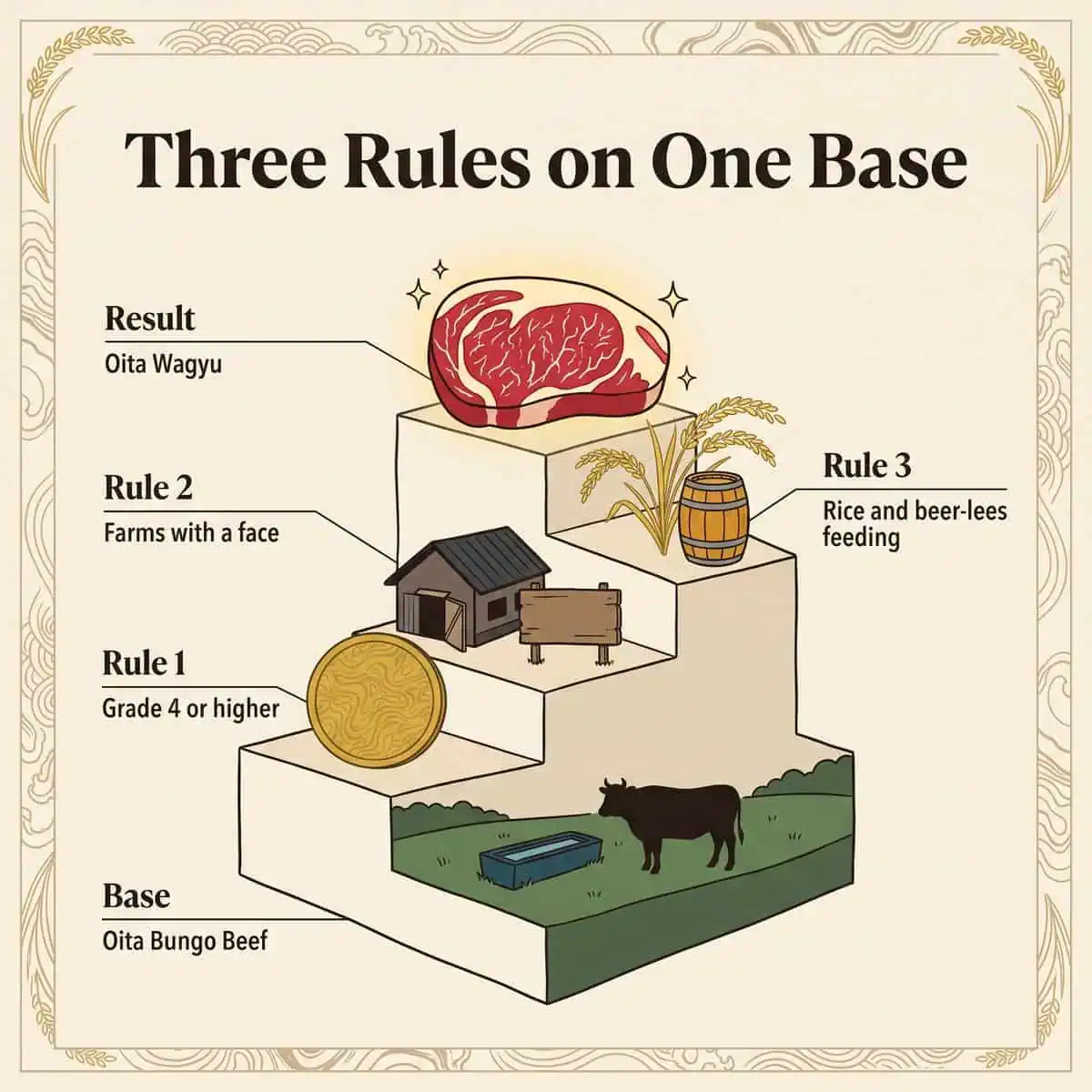
In short, the answer sits in three rules on top of one base requirement. Here is how they stack up.
- Grade 4 or higherMeat quality Grade 4 or 5 under the national carcass standard.
- Farms with a faceBeef from participating farms that show the public who they are and how they work.
- Pursuit of flavorA feeding program that includes rice, beer lees, or similar ingredients.
Base requirement: Oita Bungo Beef (Japanese Black cattle fattened longest in Oita)
Meat Quality Grade 4 or Higher
This rule uses Japan’s national carcass grading scale. The grading section below explains what Grade 4 and Grade 5 measure, and why neither is the same as “A5.”
Farms You Can Put a Face To
The Japanese phrase is kao ga mieru, literally “you can see the face.” In the guidelines, it means participating farms promote themselves, for example on websites. In October 2026, the official producer page listed dozens of participating farms, plus several public institutions. One of them is a prefectural agricultural high school.
Also, some farm profiles describe their feeding in their own words. One farm, for instance, says it uses Oita-grown rice and rice straw to reduce its reliance on imported feed.
Rice, Beer Lees and Feeding Practices
Beer lees are the spent grain left after brewing beer. Feed rice, on the other hand, is rice grown for livestock rather than people. The rules say “rice or beer lees, etc.,” but the public documents give no minimum amount or feeding period.
So does this feed change the taste? No publicly available study appears to have isolated that effect in Oita Wagyu. Instead, related research gives mixed signals, as the box below shows.
Worth Knowing
In a 2015 to 2016 Oita trial on crossbred cattle, not Japanese Black, feed rice replaced part of the grain feed. Marbling and firmness tended to improve, but rice alone did not raise oleic acid. Separately, small studies of Wagyu steers fed whole-crop rice silage found better meat color stability. These results hint at possibilities, yet none of them tested Oita Wagyu directly.
Traceability: Brand Rules vs National Law
In Japan, cattle covered by the national traceability system receive individual identification numbers. Retailers selling covered domestic beef cuts must display the number. Restaurants serving designated dishes, namely yakiniku, shabu-shabu, sukiyaki, and steak, must also display it for covered beef. Also, anyone can enter that number on a government-linked website to look up the animal’s basic history. In other words, traceability is not unique to Oita Wagyu.
On top of that, the council sets its own rules for certified member inns and restaurants. These rules cover both Oita Bungo Beef and Oita Wagyu. They must post the ID number where customers can easily see it, and keep invoices showing the carcass grade. They must also display the official certificate.
What Does Oita Wagyu Taste Like?
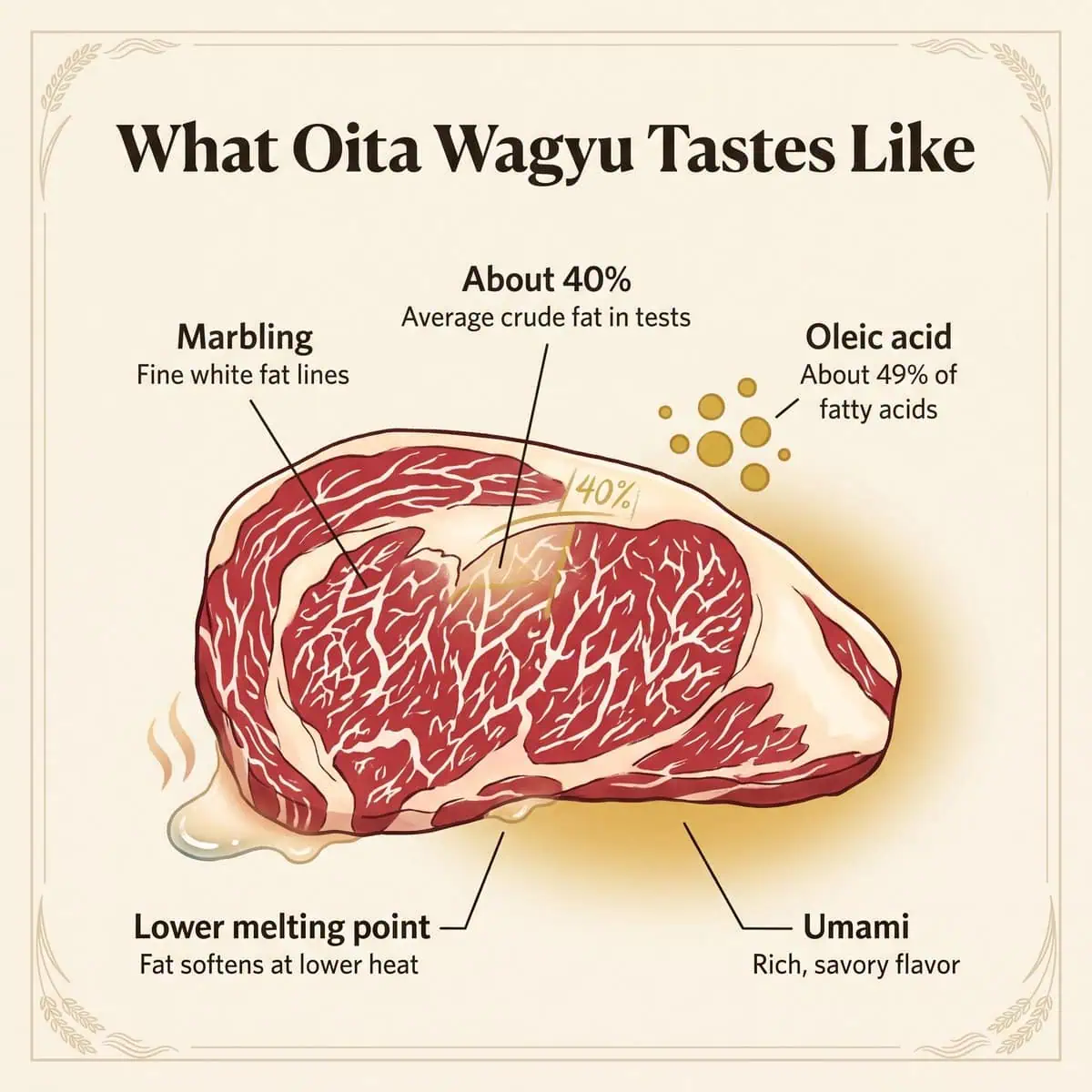
The official site describes Oita Wagyu as beautifully marbled, rich in flavor, and very tender. Those are brand words, of course. Fortunately, there is also some lab data, which is rarer than you might expect for a regional beef.
Marbling and Melt-in-the-Mouth Texture
For example, Oita Prefecture’s Industrial Science and Technology Center studied rib-eye samples from 32 cattle over three years. Most were Oita Wagyu, with a few out-of-prefecture Wagyu for comparison. On average, crude fat made up about 40% of the meat. Oleic acid made up about 49% of the fatty acids.
Why does oleic acid matter? For one, a 2018 review of the Wagyu industry links it to Wagyu aroma. Monounsaturated fats like oleic acid also lower the melting point of fat. As a result, the fat softens at a lower temperature, which helps explain that melting feel.
Umami, Texture and Aroma
The same Oita study also used a trained panel of eight tasters. Steaks scored best overall when two things were strong together. The first was the soft, rich texture that comes from fat. The second was umami along with a roasted, beefy aroma.
Interestingly, umami tracked compounds such as inosinic acid and glutamic acid. However, the panel found no difference between cattle from Oita-bred sires and those from other sires. So the study describes good Wagyu in general terms, rather than proving a unique Oita flavor.
How the Flavor Compares with Other Wagyu
Here, caution helps. We could not find any public blind test comparing Oita Wagyu with Kobe or Miyazaki beef. After all, they are all Japanese Black beef judged on the same national scale. Grade, cut, aging, and cooking will likely shape your plate more than the brand name does.
Oita Wagyu Grades Explained
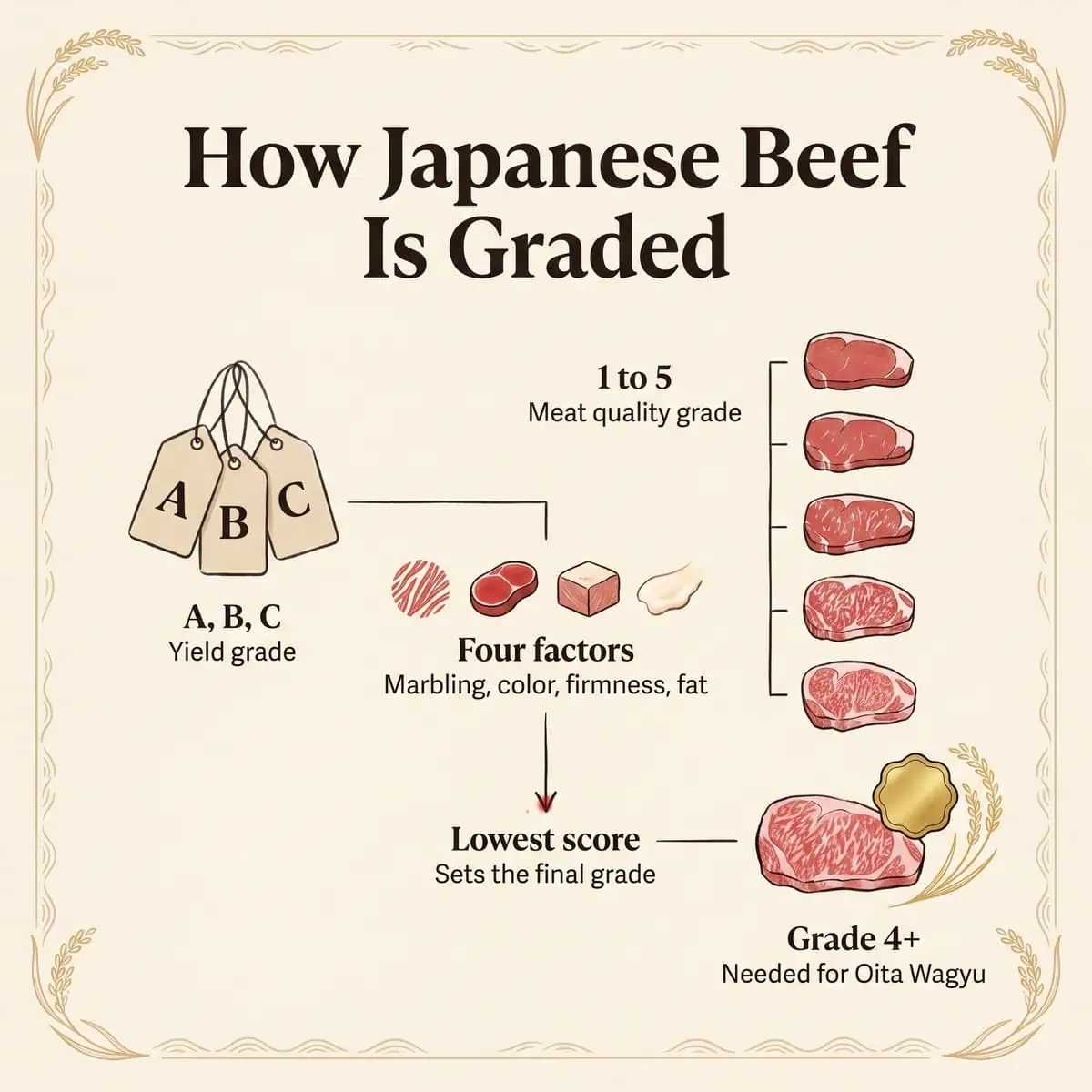
Grading confuses many first-time buyers, and the term “A5” makes it worse. The good news is that the system is simple once you split it in two.
Understanding Japan’s Beef Grading System
First, the Japan Meat Grading Association gives each carcass two separate grades. The letter, A, B, or C, is the yield grade. It estimates how much usable meat the carcass gives. The number, by contrast, is the meat quality grade, from 1 to 5.
Meat quality is judged on four factors: marbling, meat color, firmness and texture, and fat color and quality. Then the lowest of the four becomes the final grade. So a beautifully marbled carcass with weaker meat color can still end up at Grade 4.
| Factor | Grade 5 | Grade 4 |
|---|---|---|
| Marbling (BMS) | No. 8 to No. 12 | No. 5 to No. 7 |
| Meat color (BCS) | No. 3 to No. 5, very good luster | No. 2 to No. 6, fairly good luster |
| Firmness and texture | Very firm, very fine texture | Fairly firm, fairly fine texture |
| Fat color and quality (BFS) | No. 1 to No. 4, very good | No. 1 to No. 5, fairly good |
Based on the Japan Meat Grading Association’s beef carcass standard. Oita Wagyu accepts both columns.
Is Oita Wagyu Always A5?
No. The rule is meat quality Grade 4 or higher, so Grade 4 beef qualifies. Besides, the rules mention no yield grade at all. On paper, then, the letter is not fixed, even though some shops advertise A4 or A5 Oita Wagyu.
This matters, especially if you shop by label. “A5 Oita Wagyu” is accurate for some beef. Still, “Oita Wagyu” alone tells you Grade 4 or 5, nothing more specific.
Grade 4 vs Grade 5 Oita Wagyu: What About A4 and A5?
Shops often market these grades as A4 and A5. The brand itself, however, specifies only the meat quality number, not the A, B, or C yield grade. Grade 5 must meet a higher marbling threshold, BMS No. 8 or above. Grade 4, by comparison, covers No. 5 to No. 7. Yet the final grade also depends on meat color, firmness, texture, and fat quality.
So Grade 5 is often richer, but eating quality still varies by cut, animal, aging, and cooking. Neither is simply better. Diners who prefer a larger steak may find Grade 4 more balanced. Those seeking a very rich bite may prefer a smaller portion of Grade 5.
Oita Wagyu vs Bungo Beef
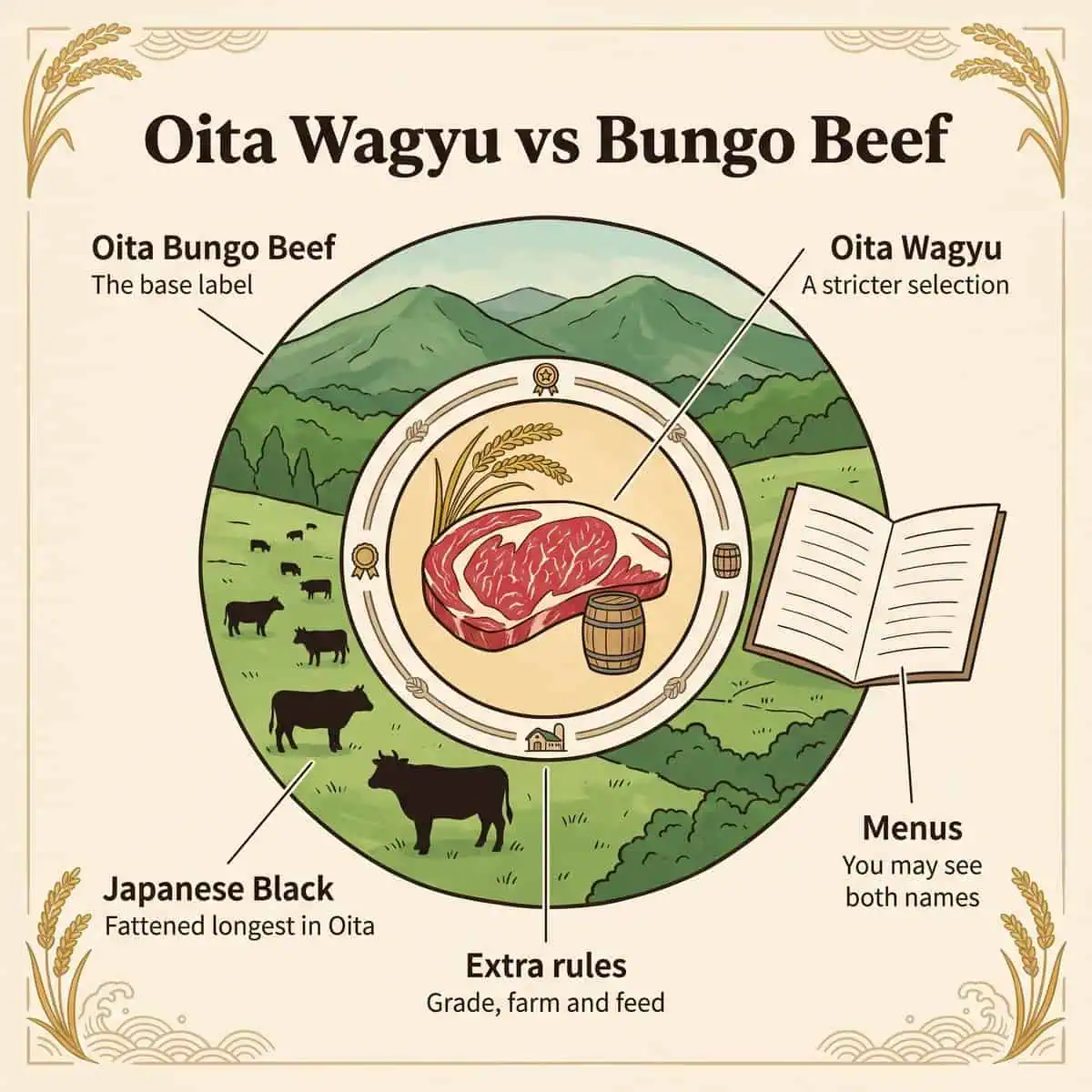
Oita Bungo Beef is the base label, and Oita Wagyu is a stricter selection from it. Of all the labels, these two names cause the most confusion for visitors.
| Point | Oita Bungo Beef | Oita Wagyu |
|---|---|---|
| Breed | Japanese Black | Japanese Black |
| Where raised | Fattened longest in Oita | Same, since it must first qualify as Bungo Beef |
| Female cattle | Must never have calved | Must never have calved |
| Meat quality grade | Not part of the core definition | Grade 4 or 5 |
| Farm rule | None beyond the definition | Participating farm that presents itself publicly |
| Feed rule | None in the definition | Feeding that includes rice, beer lees, or similar ingredients |
| Unified brand since | 2013 | 2018 |
Based on the official Oita Wagyu site and the council’s certification guidelines (revised November 2020).
Which Name Will Visitors See in Japan?
In practice, you will likely see both. Menus often say 豊後牛 (Bungo-gyu) in kanji, while おおいた和牛 starts with “Oita” in hiragana. In 2021, Oita Prefecture even changed its tourism site’s listing from Bungo beef to Oita Wagyu after a resident’s suggestion.
If a menu only says “Bungo beef,” do not assume it is Oita Wagyu. Ask, or look for the certificate on the wall.
Oita Wagyu vs Kobe Beef
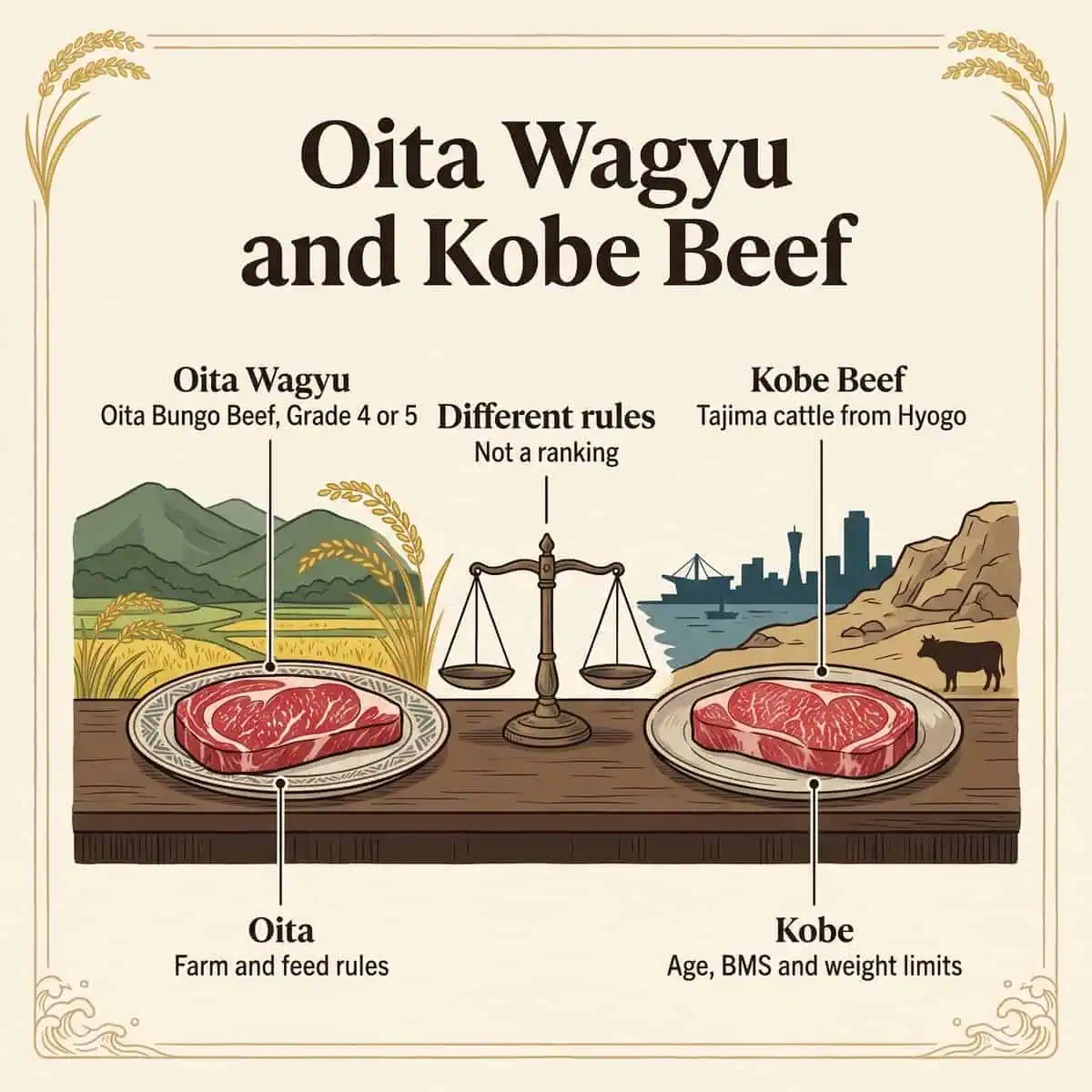
The main difference lies in the rules. Kobe Beef comes from Tajima cattle raised in Hyogo, with limits on age, yield grade, marbling, and carcass weight. Oita Wagyu, by contrast, is Oita Bungo Beef of Grade 4 or 5 from participating farms. The table below compares the rules, not which beef is “better.”
| Point | Oita Wagyu | Kobe Beef |
|---|---|---|
| Base cattle | Oita Bungo Beef (Japanese Black fattened longest in Oita) | Tajima cattle raised in Hyogo Prefecture |
| Sex | Females must never have calved | Heifers that have never calved, or steers |
| Age | Not set in the public rules | 28 to 60 months |
| Grade | Meat quality 4 or 5 | Yield A or B, meat quality 4 or 5, BMS No. 6 or higher |
| Carcass weight | Not set in the public rules | 270 to 499.9 kg for heifers; 300 to 499.9 kg for steers |
| Extra rules | Participating farms; feeding with rice, beer lees, or similar | Detailed lineage, age, and weight limits |
| Legal status | Brand certification by the Oita council | Registered Geographical Indication (GI) in Japan |
Kobe Beef data from its GI specification published by Japan’s Ministry of Agriculture, Forestry and Fisheries.
Flavor, Marbling and Availability
On paper, Kobe Beef’s marbling floor, BMS No. 6, sits one step above the BMS No. 5 that Grade 4 Oita Wagyu allows. However, both brands accept plenty of very heavily marbled beef. As for taste and price, no public data supports a fair ranking. Still, Kobe Beef is far better known abroad, which can affect demand and menu prices.
Which Wagyu Should You Choose?
If you are in Kobe, try Kobe Beef there. Likewise, if you are in Oita, Beppu, or Yufuin, Oita Wagyu is the natural local choice. For more Kyushu context, our guide to Miyazaki beef covers a neighboring prefecture’s brand.
The Best Cuts of Oita Wagyu
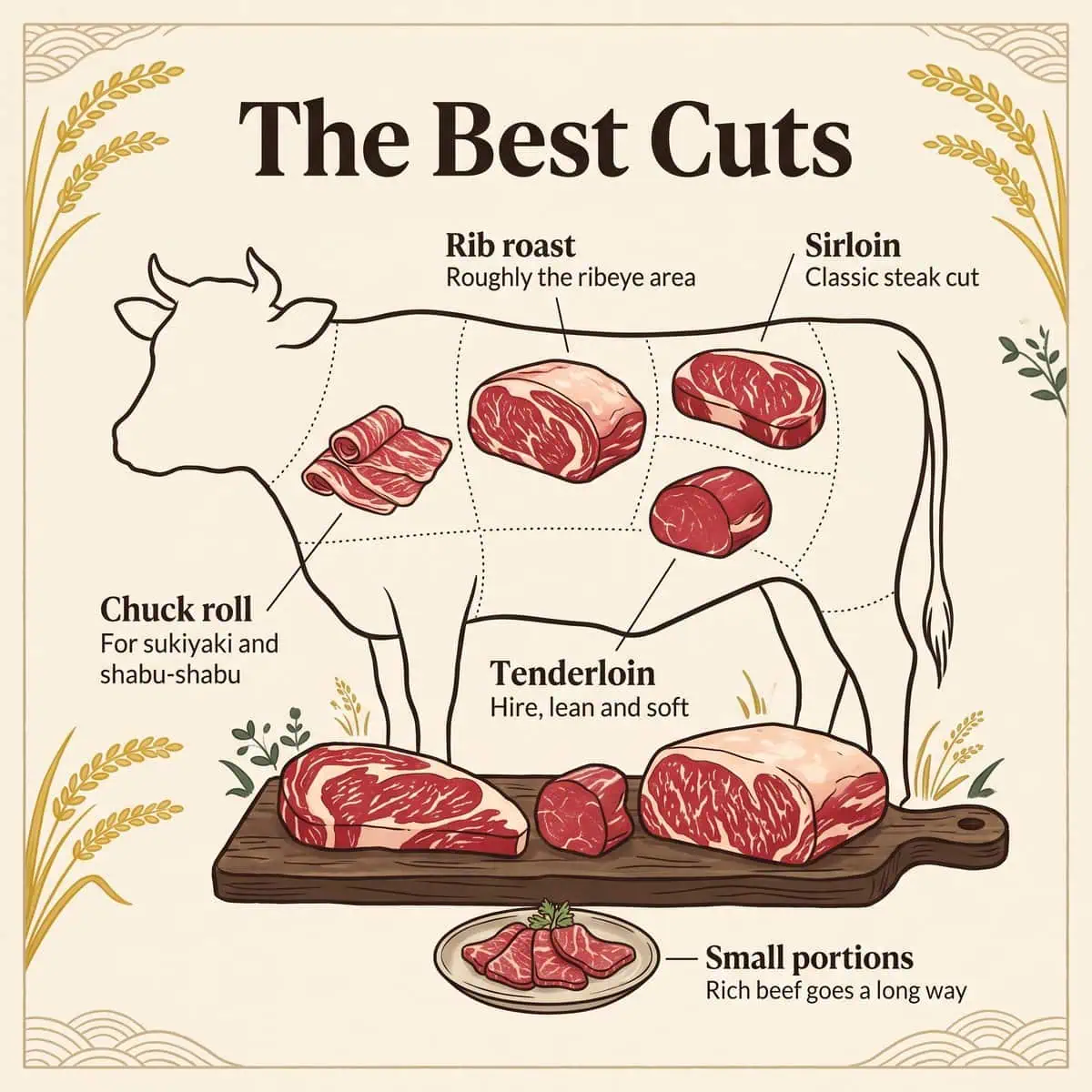
Cut names in Japan differ a little from Western butcher terms. Even so, knowing a few of them makes menus much easier to read.
Sirloin and Rib Roast
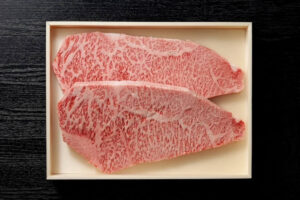
Sirloin (サーロイン) is the classic steak cut and one of the most richly marbled. Meanwhile, rib roast (リブロース, ribu rōsu) is roughly the ribeye area. Both suit steak and teppanyaki, though A5 versions are best in modest portions.
Tenderloin
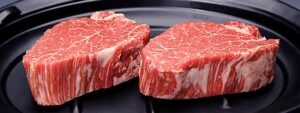
Tenderloin is called hire (ヒレ) in Japan. Compared with sirloin, it has less fat and a very soft bite. If heavy marbling feels like too much, hire steak is a good middle ground.
Thinly Sliced Cuts for Hot Pot
Chuck roll, or kata rōsu (肩ロース), is a favorite for sukiyaki and shabu-shabu. Thin slices cook in seconds, so the fat melts without the meat toughening.
How to Eat Oita Wagyu
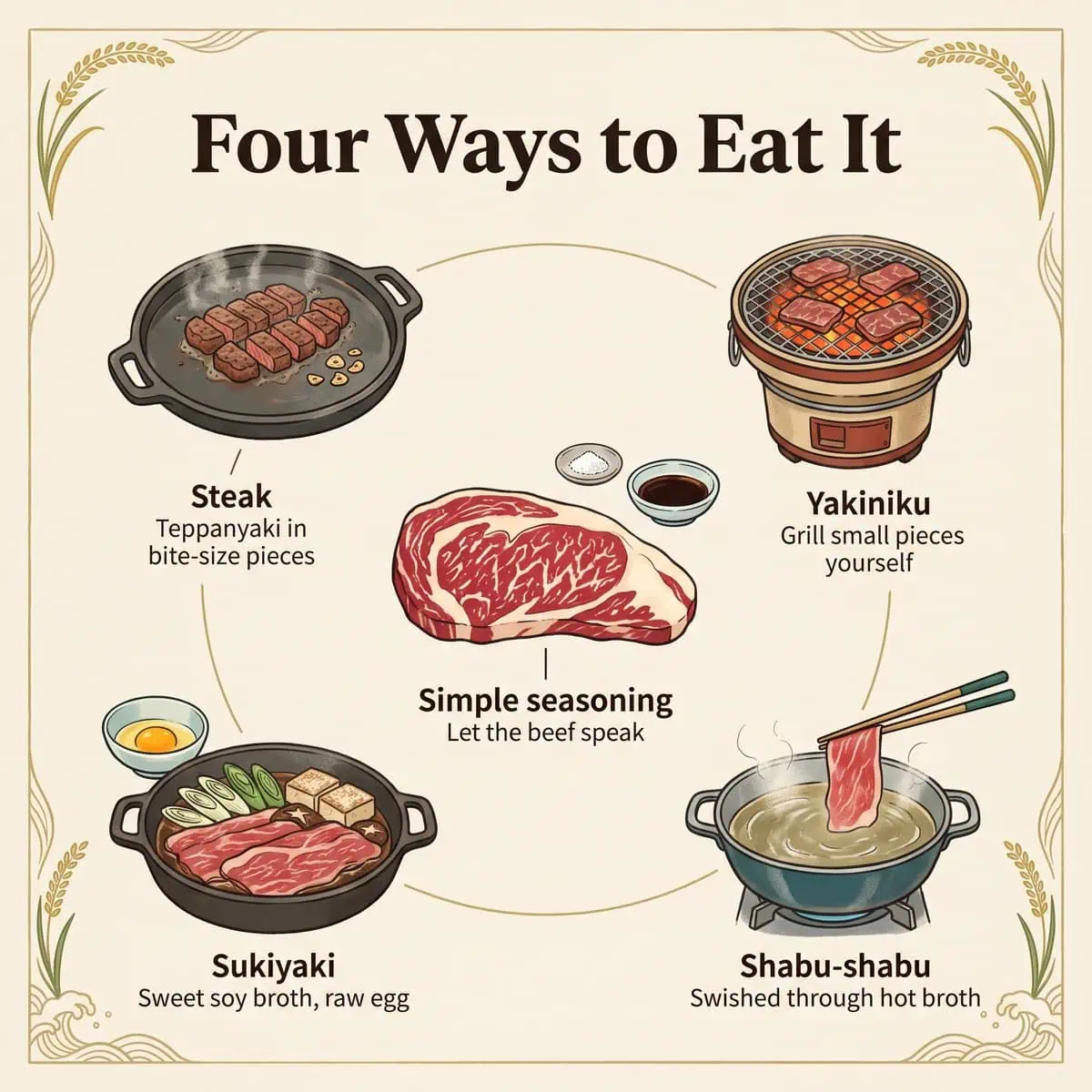
In restaurants, you will most often meet it in four styles. Each one, however, shows the beef a little differently.
Oita Wagyu Steak
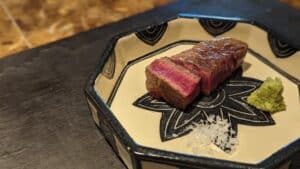
Above all, steak and teppanyaki let the beef speak for itself. At teppanyaki counters, chefs often cook it on an iron griddle in front of you and serve it in bite-size pieces. Our guide to teppanyaki in Japan explains how that kind of meal usually works.
Yakiniku
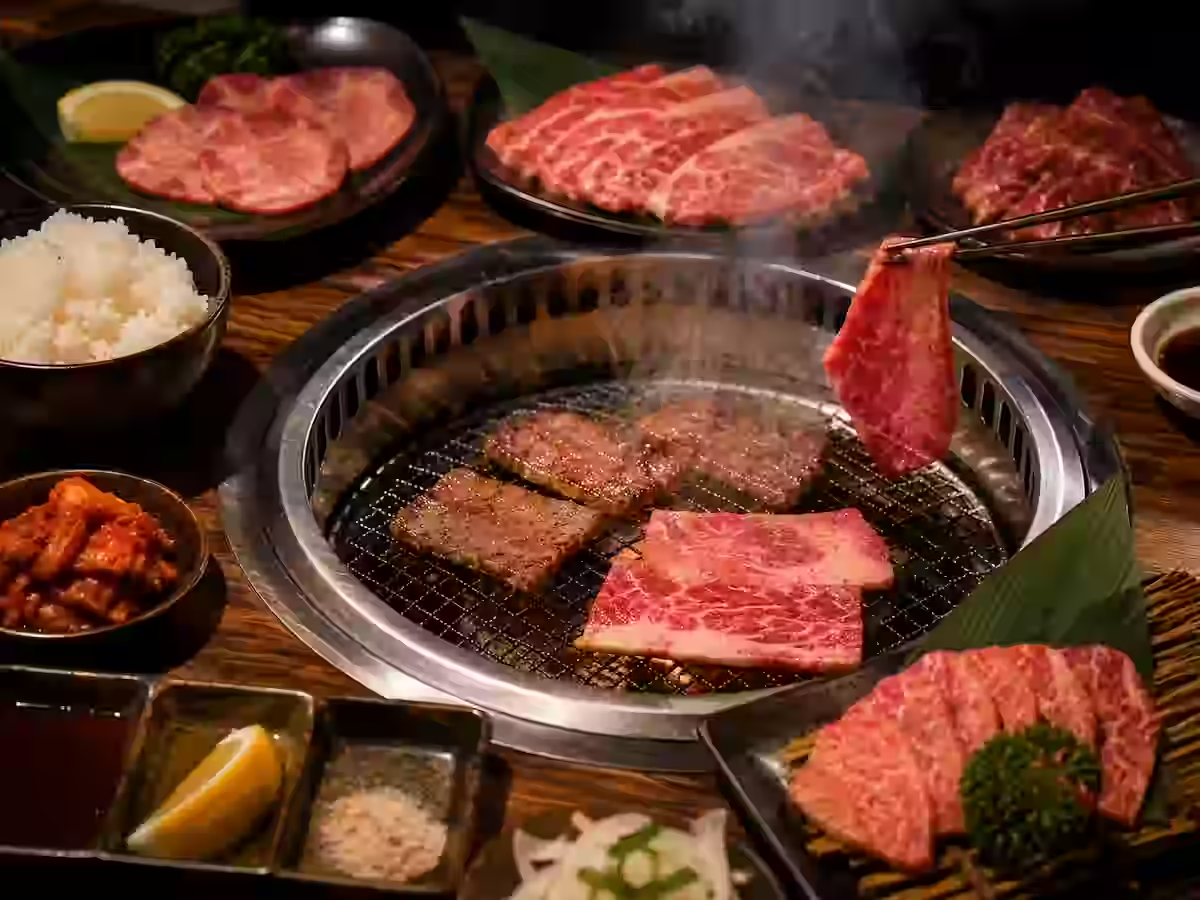
In yakiniku, you grill small pieces yourself at the table. It suits both Grade 4 and Grade 5 beef, since each slice takes only a few seconds. The Japanese yakiniku guide covers cuts, sauces, and table manners.
Sukiyaki and Shabu-Shabu
In sukiyaki, thin beef cooks with soy sauce and sugar, or in a sweet soy broth, before you dip it in raw egg. In shabu-shabu, by contrast, you swish slices through hot broth for a lighter result. See our pages on Kansai-style sukiyaki and shabu-shabu for the basics.
Recommended Sauces and Condiments
Generally, simple seasonings work best with rich beef. Try a pinch of salt, a dab of wasabi, or grated daikon with ponzu. In Oita, a squeeze of kabosu, the prefecture’s signature citrus, adds a bright, sour lift.
The official site’s recipe list goes further than you might expect. For example, it includes tataki, a chilled shabu-shabu salad, steak with chimichurri, and beef simmered in beer.
How to Cook Oita Wagyu at Home
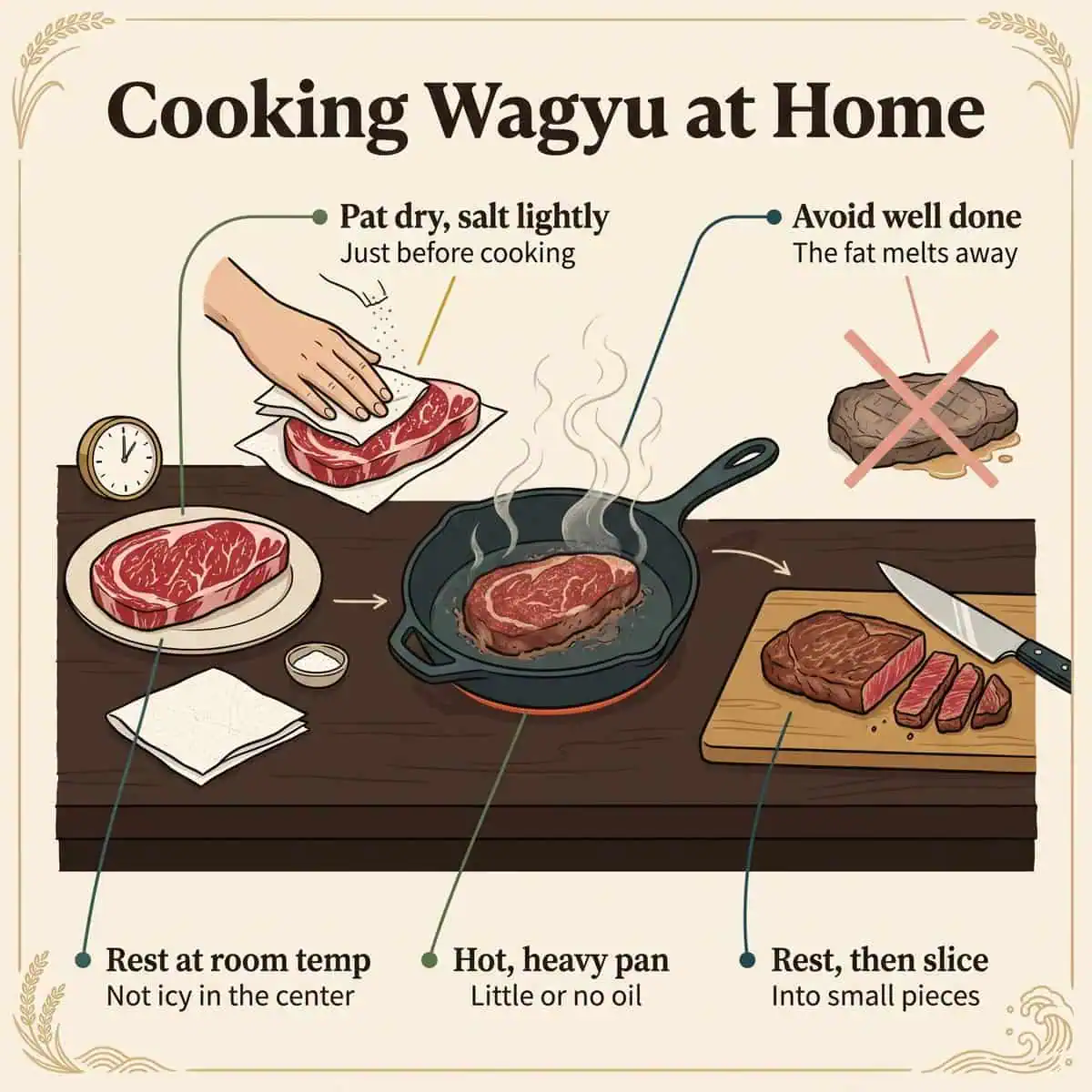
Cooking Wagyu at home is less scary than it sounds. The main risk is overcooking, because the fat renders fast. For a full walkthrough, see how to cook Japanese-style steak at home.
Prepping, Searing and Resting
Take the steak out of the fridge a little ahead of time, so the center is not icy. Then pat it dry. Salt it just before cooking, and keep the seasoning light so the beef’s flavor stays in front.
Use a hot, heavy pan, and you rarely need extra oil, since the fat will render. Also, thin Wagyu steaks cook in very little time. Afterward, rest the meat briefly before slicing, so the juices settle. Then slice it into small pieces, as Japanese steak houses do.
Common Mistakes to Avoid
- Cooking A5 beef well done, which melts away much of the fat
- Using a pan that is not hot enough, so the meat steams instead of searing
- Drowning the beef in heavy sauce before tasting it plain
- Serving huge portions of A5 steak, which can feel heavy
- Cutting thick slabs instead of small, easy bites
Where to Eat Oita Wagyu in Japan
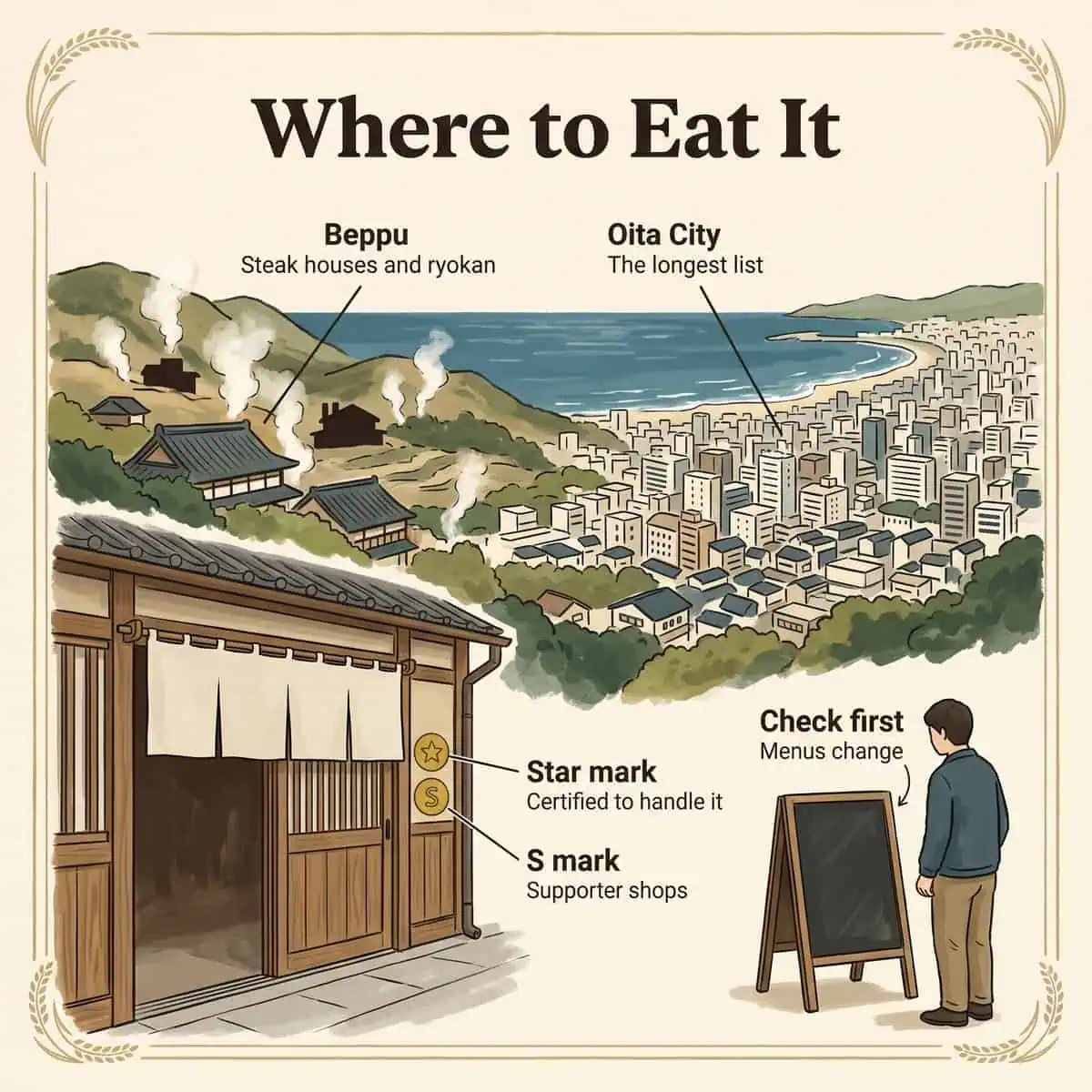
The safest starting point is the official directory of shops and restaurants. Places marked with a star (★) are certified to handle Oita Wagyu. Places marked [S] are “supporter shops,” chosen from among the certified ones. Restaurant and retailer information was last checked on October 13, 2026. Menus change, so confirm before you go.
Oita City
Not surprisingly, Oita City has the longest list. Certified restaurants include the yakiniku house Nikunokura Yakiniku Ginzantei, a supporter shop, and Bungo Steak Somuri’s Oita branch. Teppanyaki Steak Nanbantei and the French restaurant Chambre a Sourire also appear. For something casual, the directory lists several yakiniku chains with multiple branches around the city.
Beppu
In Beppu, certified places include Grill Mitsuba and the main Beppu branch of Bungo Steak Somuri. Several ryokan and hotels are listed too, such as Suginoi Hotel. At hotels, though, availability may depend on the restaurant or accommodation plan.
Yufuin
The Yufuin area falls within Yufu City in the directory. Its list includes Roast Beef 1129 and a long line of ryokan, too. At an inn, the beef may come as part of a set dinner, so check the plan details when booking.
How to Identify an Authorized Restaurant
Under the council’s guidelines, certified restaurants must serve Oita Wagyu dishes regularly and show that on the menu. Here is a quick checklist.
- A certificate with the official brand mark hangs inside
- The menu names Oita Wagyu, not just “wagyu” or “local beef”
- A cattle identification number is posted where you can see it
- The restaurant appears with a ★ in the official directory
Where to Buy Oita Wagyu
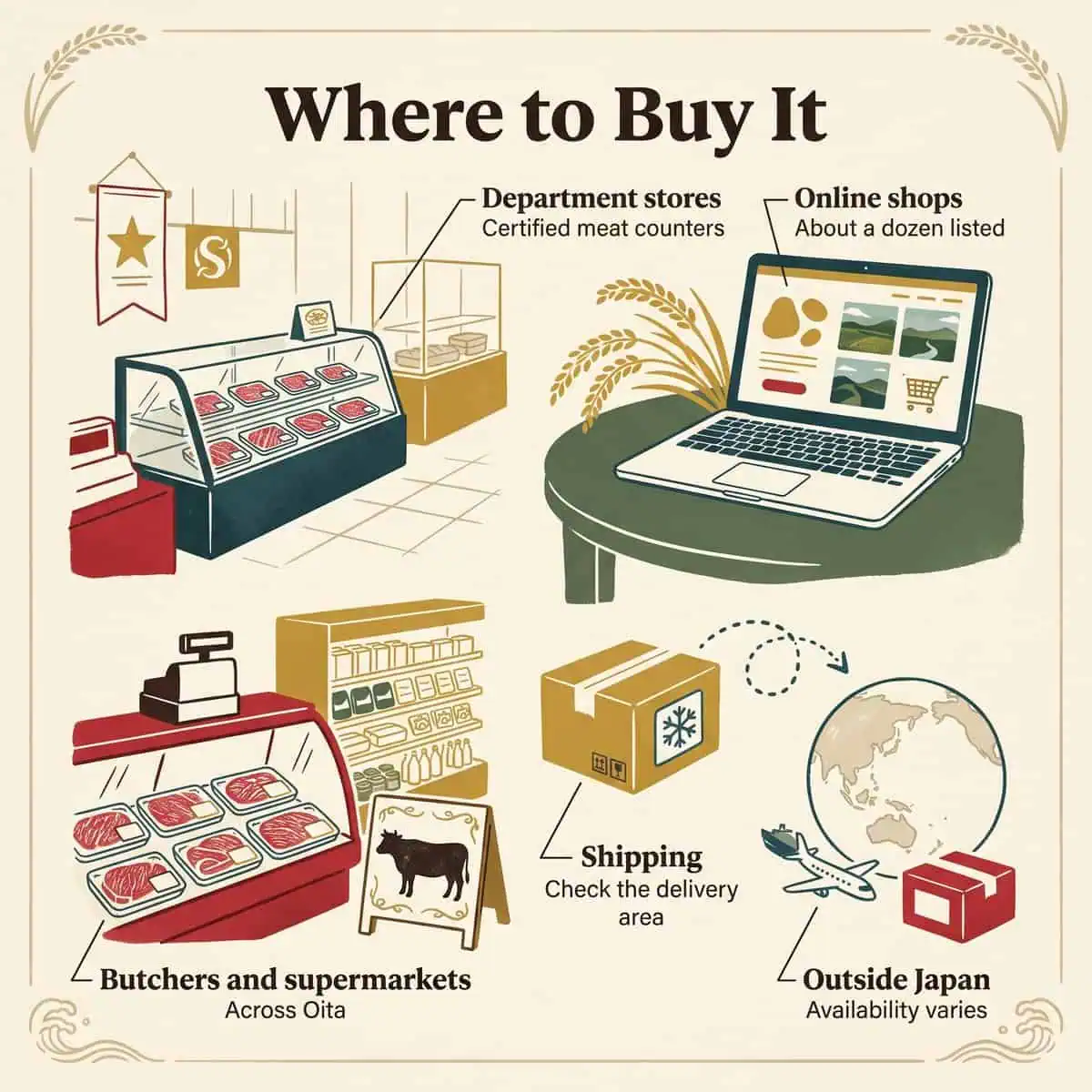
Buying raw beef is easier inside Oita than anywhere else. Even so, there are a few options for travelers and for people in other parts of Japan.
Buying Oita Wagyu in Oita Prefecture
Within the prefecture, the directory lists department store counters, butchers, and supermarkets. In Oita City, for example, Tokiwa’s main department store has certified meat counters. Local supermarket chains such as Marushoku appear in both Oita City and Beppu. In Yufuin, a few shops, including a local butcher, are listed.
Buying Oita Wagyu Online
The official site links to about a dozen online stores. For instance, they include Tokiwa’s online shop and Zen-Noh Oita’s store on JA Town. Several butchers and yakiniku restaurants sell online as well. Most are Japanese-language stores, so check each one’s shipping area before ordering.
Availability Outside Japan
The directory also has a short overseas section, mostly businesses listed under Traditional Chinese names. Exports, however, do not mean you can order it online from abroad. Many countries also restrict bringing meat home in luggage, so check your own customs rules first.
How Much Does Oita Wagyu Cost?
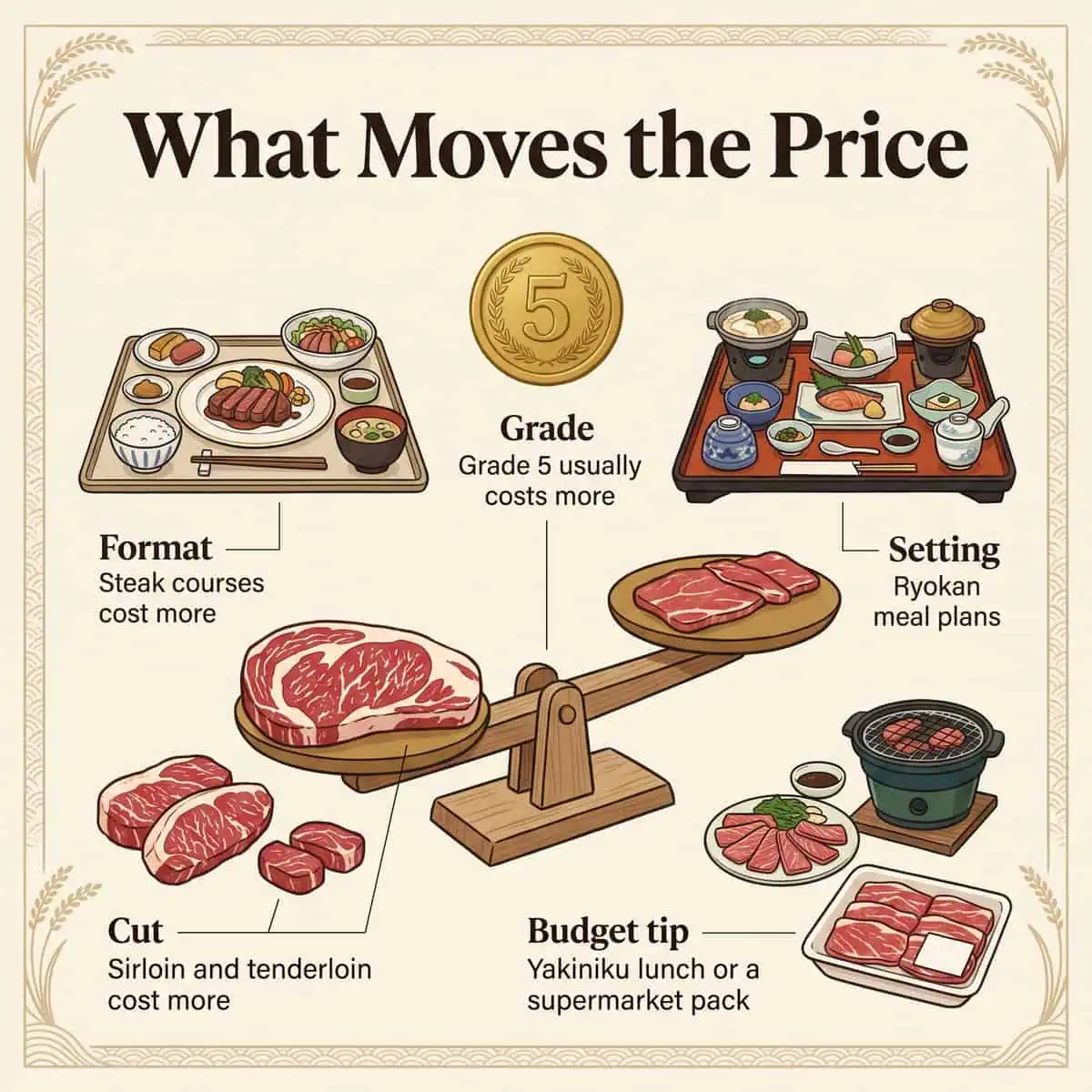
Unfortunately, there is no official price list, and prices change often. Rather than quote numbers that may be out of date, it helps to know what moves the price.
- Grade: Grade 5 usually costs more than Grade 4
- Cut: sirloin and tenderloin cost more than shoulder or thin slices
- Format: steak courses cost more than yakiniku or sukiyaki sets
- Setting: ryokan dinners bundle the beef into a full meal plan
- Location: buying in Oita gives the widest range of choices
As a rough guide, restaurant meals usually cost more per gram than retail cuts, since cooking and service are included. On a budget? Then a yakiniku lunch or a supermarket pack in Oita is a good place to start.
Why Oita Wagyu Is Worth Trying
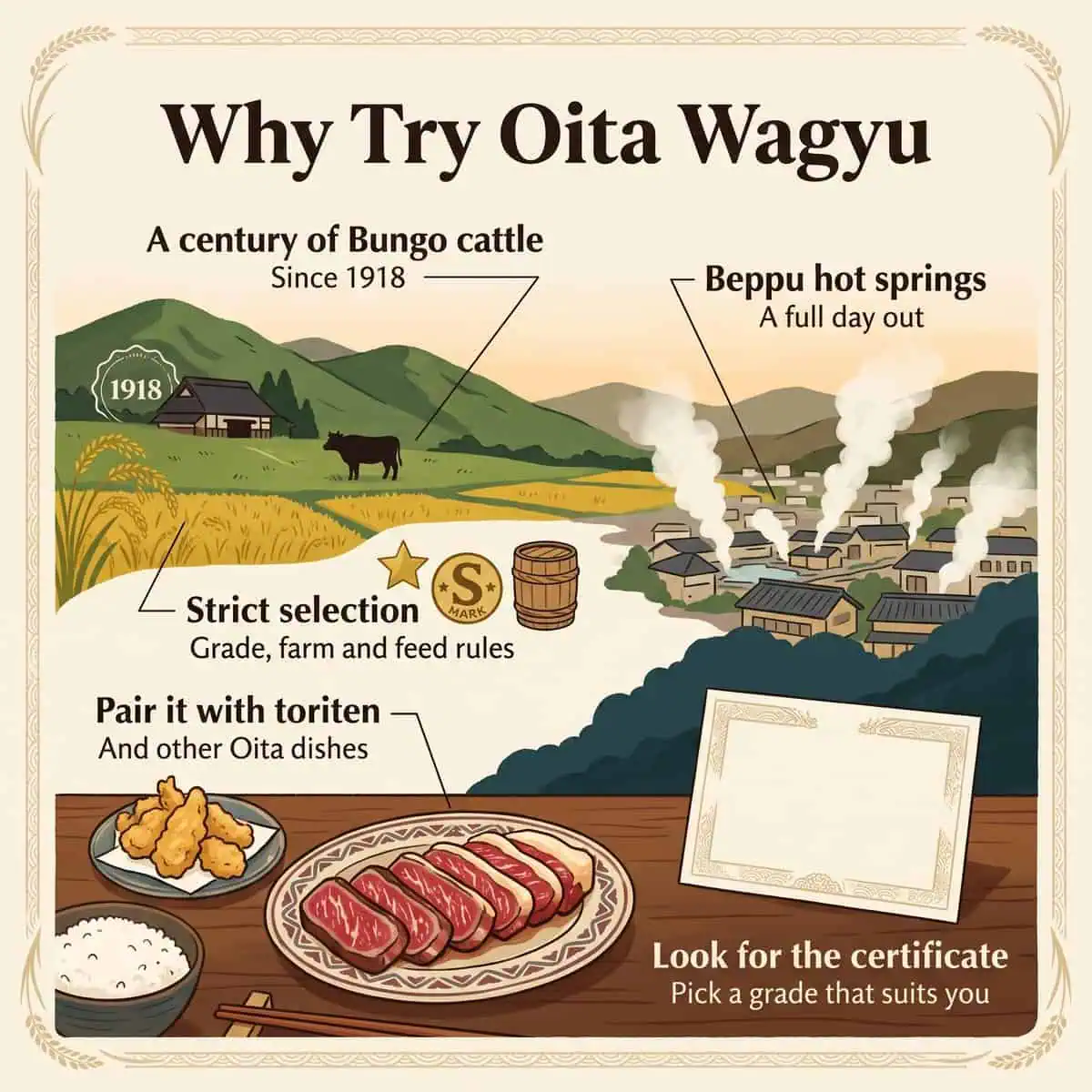
Oita Wagyu is easy to misread. After all, it is not a new breed, and it is not automatically A5. Instead, it is a strict selection of Oita’s Japanese Black beef, with grade, farm, and feed rules on top.
What makes it worth seeking out is the setting, too. You can pair a plate of it with toriten and a soak in Beppu’s hot springs. For the bigger picture, our guide to wagyu beef and the Kyushu food guide fill in the rest.
The century-old Bungo story also gives the first bite a stronger sense of place. So look for the certificate, pick a grade that suits you, and keep the seasoning simple.
Frequently Asked Questions About Oita Wagyu
- What is Oita Wagyu?
-
It is a premium certification for selected Oita Bungo Beef. To qualify, the beef must reach meat quality Grade 4 or 5. It must also come from a participating farm whose feeding includes rice, beer lees, or similar ingredients.
- Is Oita Wagyu the same as Bungo beef?
-
Not exactly. All Oita Wagyu is Oita Bungo Beef, but not all Bungo beef becomes Oita Wagyu. The brand adds rules on grade, farms, and feed.
- Is all Oita Wagyu graded A5?
-
No. Grade 4 beef also qualifies. The letter in A4 or A5 is a separate yield grade, and the brand rules do not specify it.
- Does Oita Wagyu have to be born in Oita?
-
The published rule says the cattle must be fattened longest in Oita. It does not say they must be born there.
- How is Oita Wagyu different from Kobe beef?
-
Kobe Beef comes from Tajima cattle raised in Hyogo, with limits on age, grade, and carcass weight. Oita Wagyu, instead, adds grade, farm, and feed rules to Oita Bungo Beef.
- What does Oita Wagyu taste like?
-
The brand calls it finely marbled, rich, and very tender. In an Oita study, tasters rated steaks highest when rich texture and umami were both strong.
- How can you identify authentic Oita Wagyu?
-
Look for the official certificate, a menu that names Oita Wagyu, and a posted cattle ID number. Also, check the official directory for a star.
References
- Oita Wagyu (Oita Prefecture Bungogyu Beef Marketing Council) – About Oita Wagyu: Certification Criteria and 100-Year History (Accessed October 2026)
- Oita Wagyu (Oita Prefecture Bungogyu Beef Marketing Council) – What Is Oita Bungo Beef? (Accessed October 2026)
- Oita Wagyu (Oita Prefecture Bungogyu Beef Marketing Council) – What is Oita Bungogyu? (English page) (Accessed October 2026)
- Oita Wagyu (Oita Prefecture Bungogyu Beef Marketing Council) – Certification Guidelines for Oita Bungo Beef Member Inns and Restaurants (revised November 5, 2020) (Accessed October 2026)
- Oita Wagyu (Oita Prefecture Bungogyu Beef Marketing Council) – September 4 Designated as Oita Wagyu Day (August 16, 2021) (Accessed October 2026)
- Oita Wagyu (Oita Prefecture Bungogyu Beef Marketing Council) – Where to Buy and Eat Oita Wagyu (checked October 2026) (Accessed October 2026)
- Oita Wagyu (Oita Prefecture Bungogyu Beef Marketing Council) – Online Shops (Accessed October 2026)
- Oita Wagyu (Oita Prefecture Bungogyu Beef Marketing Council) – Producers Behind the Flavor (Accessed October 2026)
- Oita Wagyu (Oita Prefecture Bungogyu Beef Marketing Council) – How to Enjoy Oita Wagyu (recipes) (Accessed October 2026)
- Oita Prefecture – On Promoting Oita Wagyu (reply of May 2021) (Accessed October 2026)
- Kyodo News PR Wire – Oita Prefecture Press Release: September Guide from Oita (September 5, 2018) (Accessed October 2026)
- Agriculture and Livestock Industries Corporation (ALIC) – Report: Oita Prefecture’s Efforts to Establish the Bungo Beef Brand (May 2013) (Accessed October 2026)
- Agriculture and Livestock Industries Corporation (ALIC) – Yonemoto, K. (2018). Team Kagoshima’s Path to the 11th National Wagyu Show. Livestock Industry Information, June 2018, 51–68 (Accessed October 2026)
- Oita Prefecture – Usa Livestock Hygiene Service Center: Oita’s Approach to the Meat Cattle Section of the 11th National Wagyu Show (Accessed October 2026)
- Japan Meat Grading Association – Beef Carcass Trading Standards (Accessed October 2026)
- Ministry of Agriculture, Forestry and Fisheries – Traceability of Cattle and Beef (updated September 15, 2026) (Accessed October 2026)
- Ministry of Agriculture, Forestry and Fisheries – GI Registration No. 3: Kobe Beef Specification (Accessed October 2026)
- Oita Prefecture Industrial Science and Technology Center – Tsuruoka, K., Gotoh, Y., & Yamamoto, N. Study on the Taste of Livestock Products in Oita Prefecture (FY2022 research report, published 2024) (Accessed October 2026)
- NARO Kyushu Okinawa Agricultural Research Center – Oita Prefectural Research Center: Using Feed Rice and Rice WCS to Strengthen Bungo Kome-shiage Beef (Accessed October 2026)
- Oita Prefectural Agriculture, Forestry and Fisheries Research Center – Research Now Vol. 61: Bungo Kome-shiage Beef Using Rice WCS and Feed Rice (February 2017) (Accessed October 2026)
- PubMed Central – Gotoh, T., Nishimura, T., Kuchida, K., & Mannen, H. (2018). The Japanese Wagyu beef industry: current situation and future prospects. A review. Asian-Australasian Journal of Animal Sciences, 31(7), 933–950 (Accessed October 2026)
- JIRCAS – Yamada, T., Higuchi, M., & Nakanishi, N. (2017). Effects of Whole Crop Rice Silage on Meat Quality and Adipokine Gene Expression in Fattening Wagyu Cattle. JARQ, 51(1), 27–30 (Accessed October 2026)
Related Articles
- Wagyu Beef (和牛) (Surveyed: October 2026)
- Kobe Beef (神戸牛) (Surveyed: October 2026)
- Japanese Wagyu Miyazaki Beef (宮崎牛) (Surveyed: October 2026)
- Tajima Beef (但馬牛) (Surveyed: October 2026)
- Ōmi Gyu / Omi Beef (近江牛) (Surveyed: October 2026)
- From Supreme to Sublime: Wagyu Ranking Echelons (Surveyed: October 2026)
- Japanese Yakiniku Guide: How to Eat Japanese BBQ, Cuts, Sauces & Best Regional Styles (Surveyed: October 2026)
- How to Cook Japanese-Style Steak at Home (Surveyed: October 2026)
- Toriten (とり天) (Surveyed: October 2026)
- Shio Tomato (潮トマト) (Surveyed: October 2026)
- Complete Guide to Kyushu Food: Must-Try Dishes and Culinary Culture (Surveyed: October 2026)




Comments