


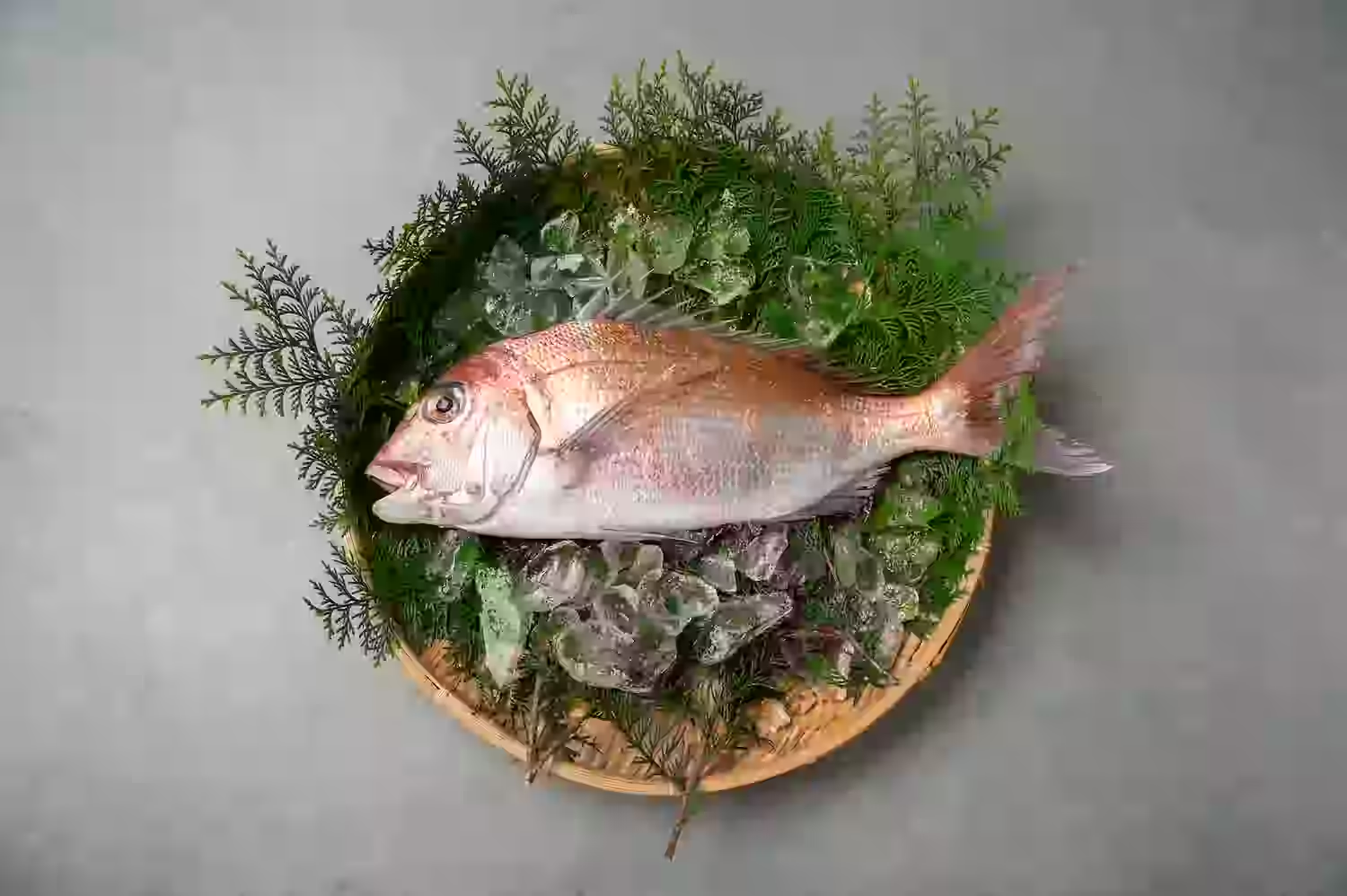

Order sashimi in Naruto and the white fish on your plate may push back a little when you bite. That fish is often Naruto sea bream (鳴門鯛), known locally as Narutodai. It is Japanese red sea bream, or madai, from the fast waters around the Naruto Strait in Tokushima Prefecture.
So what makes it different from any other sea bream? This guide explains the name, the currents, the taste, the seasons and the dishes. It also separates what local sources claim from what researchers have confirmed.
What Is Naruto Sea Bream?
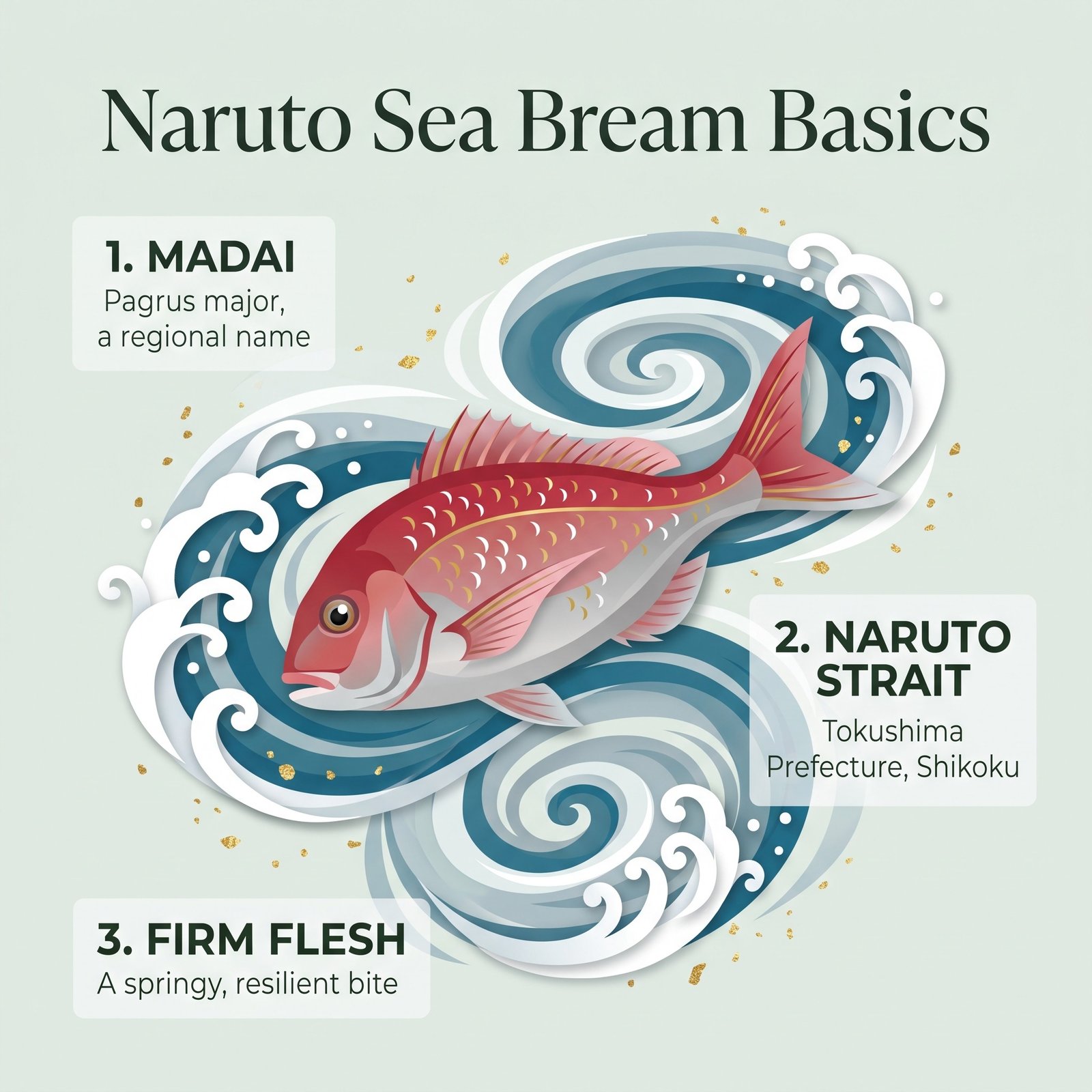
Naruto sea bream is not a separate species. Instead, the name works as a regional label for madai (Pagrus major) from the Naruto area. Japan’s Fisheries Agency lists madai under that scientific name, and Tokushima’s fisheries bodies apply the Naruto name to it.
Quick Facts
- Japanese name
- 鳴門鯛 (Narutodai, Naruto-dai)
- Species
- Japanese red sea bream, madai (Pagrus major)
- Area
- Naruto Strait, Naruto City, Tokushima Prefecture, Shikoku
- Known for
- Firm flesh and a resilient bite
- Prized seasons
- Especially spring (sakuradai) and autumn (momijidai)
- Fishing methods
- Maki-e line fishing and small fixed nets (tai-ami)
- Typical dishes
- Sashimi, blanched or seared sashimi, tai meshi, grilled and simmered fish, soup
Meaning of the Name Narutodai
The name combines Naruto with tai, the Japanese word commonly used for sea bream. In this compound, the initial t changes to d, so you will see Narutodai and Naruto-dai. Because a well-known Tokushima sake shares the name, this article always says Naruto sea bream for the fish.
Is It the Same as Red Snapper?
Not exactly. English menus sometimes translate madai as red snapper, but that wording is loose. Under FDA labeling policy in the United States, for example, red snapper refers to Lutjanus campechanus. Therefore, red sea bream is the more accurate term here.
Where Naruto Sea Bream Is Caught
Fishers catch it around the Naruto Strait and land it at ports in Naruto City, according to the Pride Fish program run by Japan’s fisheries cooperatives. The same waters also produce Naruto wakame, another local product tied to the currents.
Why Naruto Sea Bream Is Special
The short answer is the water. However, the link between current and texture deserves a careful look, because not every popular claim has hard data behind it.
The Strong Currents of Naruto Strait
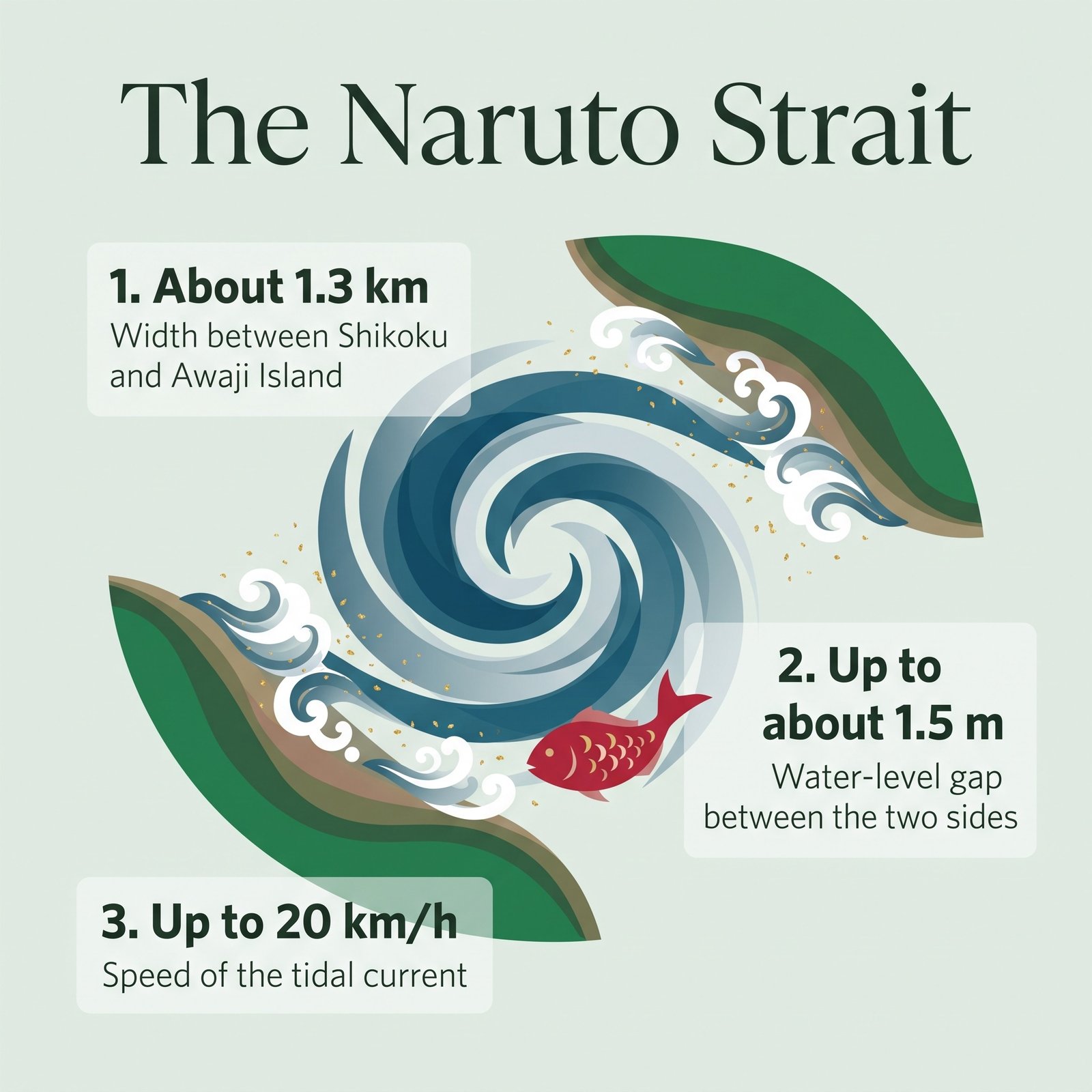
The strait narrows to about 1.3 kilometers between Shikoku and Awaji Island. Meanwhile, differences in tidal timing create a water-level gap of up to about 1.5 meters. As a result, water rushes through the channel at up to 20 kilometers per hour. Those figures come from the Japan Tourism Agency’s official interpretive text. Japan Coast Guard surveyors likewise describe the fastest tidal current in the country here. A 1990 oceanography paper also reports a strong tidal jet.
Firm Flesh and Springy Texture
Tokushima’s fisheries researchers and the Pride Fish program both pass on the local view. Hard swimming, people say, builds a muscular body and tight flesh. Still, treat that link as a widely repeated local explanation. Comparative experiments have not established it.
Diet, Color and the Whirlpools
Food matters too. A Tokushima fisheries bulletin notes that these fish feed on small shrimp and sand eels. It also credits shrimp pigment for the bright cherry-pink color. Meanwhile, the same tides create the famous whirlpools, so the fish and the tourist sight share one address.
What the evidence does not show
Public sources give no single rule for using the Naruto sea bream name. They also offer no direct comparison of flesh firmness with fish from calmer waters. Finally, they include no seasonal fat measurements.
What Does Naruto Sea Bream Taste Like?
Texture is the main attraction. Tokushima’s tourism site, Awa Navi, describes thick, firm flesh with real bite. A Naruto restaurant it interviewed also calls the fat sweet-tasting. None of our sources describe the aroma, so this guide leaves that for you to judge.
Texture and Fat
Local descriptions agree on firmness first. Pride Fish, for example, praises a pleasant, springy bite. Fat gets less consistent treatment, because sources describe it differently by season. Therefore, expect a fish that people value for its bite more than for richness.
Raw vs Cooked
Fresh sashimi shows the firm, resilient bite most directly. Cooking, on the other hand, gives a softer, flakier texture. It also lets the head, skin and bones add flavor to rice and soup dishes. If you are unsure which side you prefer, a meal with both is the honest test.
When Is Naruto Sea Bream in Season?
Naruto sea bream is especially prized in spring and autumn. Sources disagree on the exact months, though. Pride Fish lists March and April, while the prefectural fisheries federation simply files wild madai under spring. Therefore, the seasons themselves are a safer guide than a calendar date.
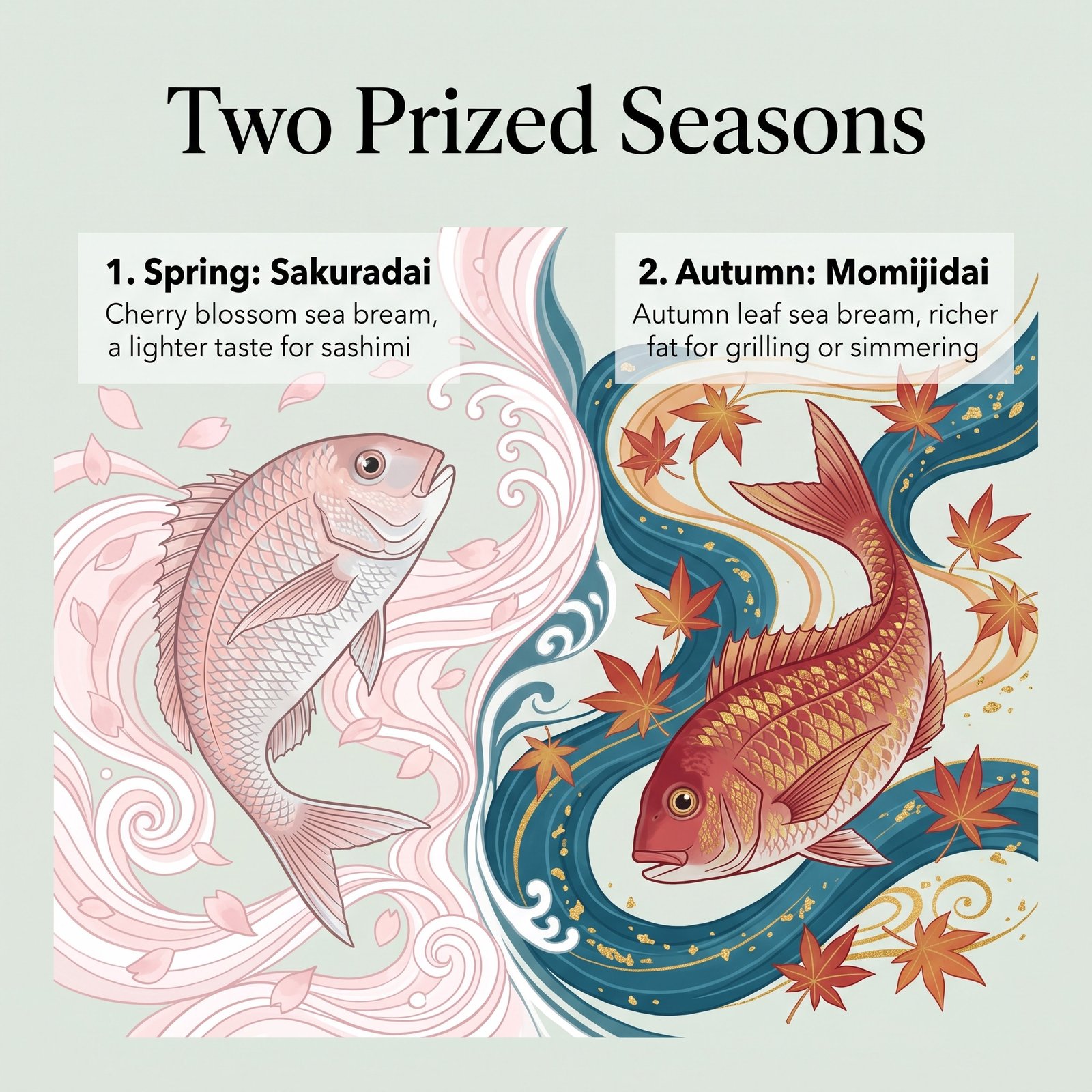
Spring: Sakuradai
桜鯛
Cherry blossom sea bream. Spring fish earn this name for their vivid pink look in cherry blossom season. A Naruto restaurant describes a lighter taste that suits sashimi.
Autumn: Momijidai
紅葉鯛
Autumn leaf sea bream. The same restaurant describes richer fat and more sweetness, and suggests grilling or simmering.
How Flavor Changes by Season
The seasonal notes above come from a Naruto restaurant quoted by Awa Navi. In other words, they reflect a cook’s experience. However, the sources do not fully agree. Pride Fish and the Japan Tourism Agency both describe spring sakuradai as carrying extra fat. So please do not treat either season as scientifically fattier.
Can You Eat It Throughout the Year?
Yes. Awa Navi says boats catch it all year, and Japan’s agriculture ministry notes that restaurants offer tai meshi year-round. Even so, spring and autumn remain the times when locals talk about it most.
How Naruto Sea Bream Is Caught
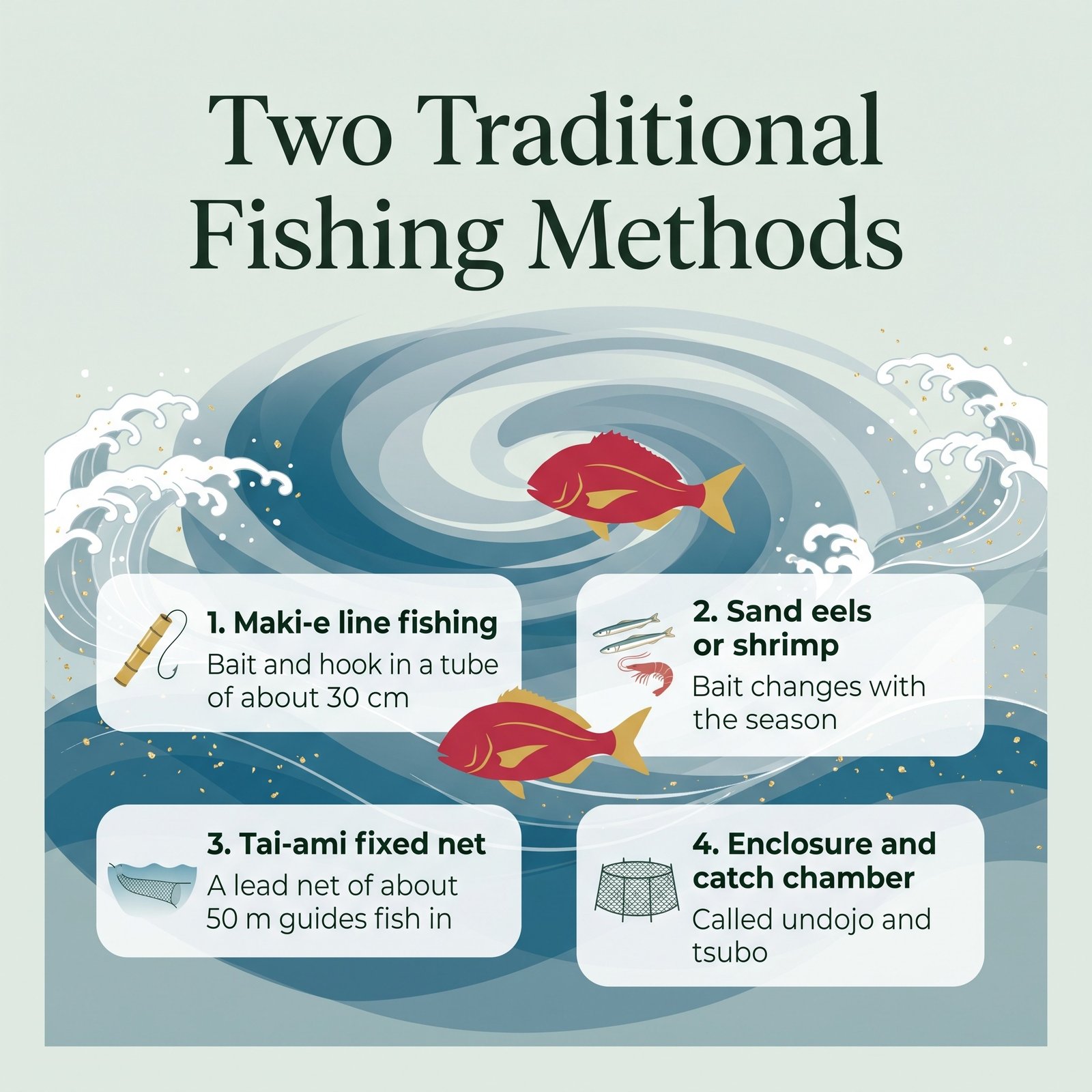
Local sources describe two traditional methods in particular: maki-e line fishing and small fixed nets. The details below come from the Pride Fish program.
Traditional Maki-e Line Fishing
Maki-e is a traditional hook-and-line method used in Naruto. First, the fisher loads live bait and a hook into a plastic tube about 30 centimeters long. Then the tube sinks to the seabed, where its bottom cap opens and releases everything. Bait changes with the season: sand eels in spring and shrimp in autumn.
Fixed-Net Fishing
The second method uses a small fixed net called a tai-ami. A roughly 50-meter lead net first guides fish into an enclosure known as the undōjō. That enclosure then leads to a smaller catch chamber called the tsubo.
What Is the Naruto Bone?
Some sea bream develop hard swellings on bony structures along the backbone. People in Tokushima call them Naruto bones (鳴門骨), and the folklore around them is charming. The science, however, is far less settled.
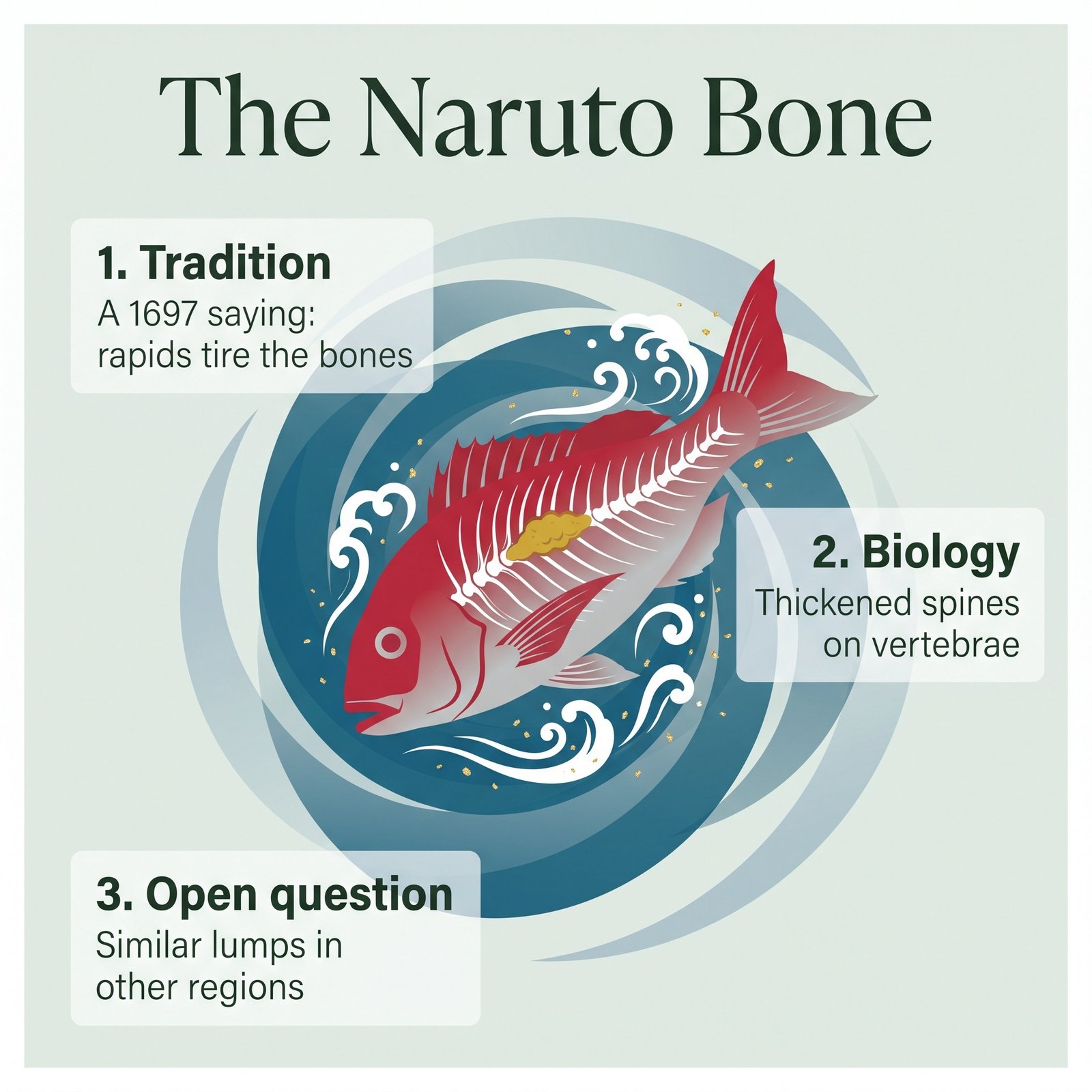
Tradition
A food encyclopedia from 1697 records a popular saying. Sea bream that fight through the Naruto rapids tire their bones, and lumps form.
Biology
Tokushima’s fisheries researchers describe the lumps as thickened spines on vertebrae in the rear half of the backbone.
Open question
Researchers have reported similar lumps in sea bream from other regions, and nobody has confirmed the cause.
Is It Unique to Naruto Sea Bream?
Probably not. The author of the same 2008 bulletin concludes that the lump is not exclusive to Naruto fish. He cites a 1962 report of similar bones in madai from other Japanese waters and from Australia. The bulletin’s own sample was small, and the author asks for more comparative data. So if you find one while eating, enjoy the story, but do not take it as proof of origin.
How to Eat Naruto Sea Bream
Almost the whole fish ends up on the table. The table below matches each dish with what it shows off best.
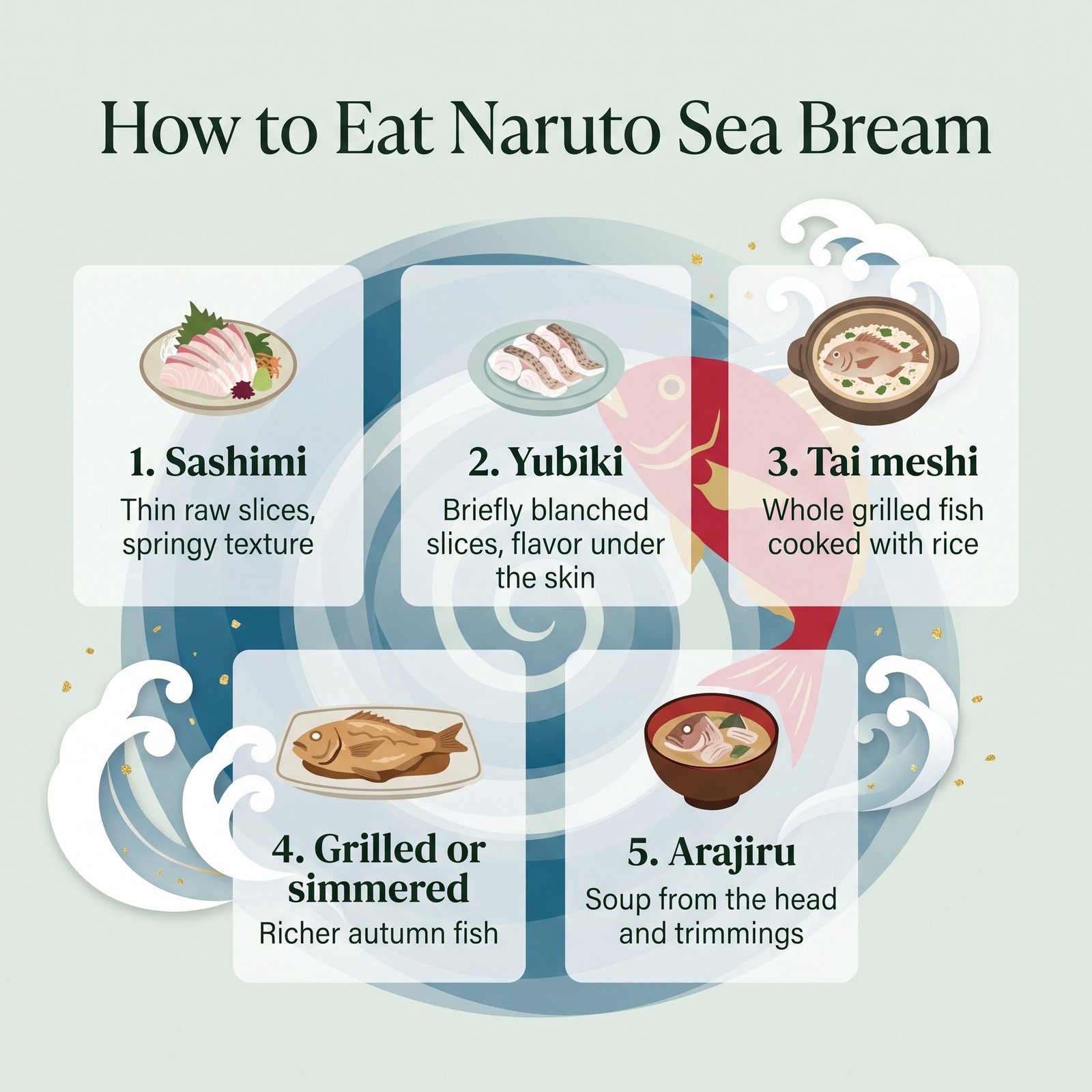
| Dish | What it is | Best for |
|---|---|---|
| Sashimi | Thin raw slices with soy sauce | Springy texture |
| Yubiki | Skin-on slices, briefly blanched and chilled | Flavor under the skin |
| Tai meshi | Whole grilled fish cooked with rice | Umami in every grain |
| Grilled or simmered | Salt-grilled fillets or soy-simmered cuts | Richer autumn fish |
| Arajiru | Soup from the head and trimmings | Deep, savory broth |
Sashimi and Blanched Skin-On Slices
Start with sashimi if texture is what you came for. Pride Fish also recommends yubiki, where the cook briefly blanches the skin, and lightly seared slices. Both let you enjoy the skin as well as the flesh. The program even suggests piling slices on a rice bowl.
Tai Meshi
In one documented Tokushima preparation, the cook grills a whole sea bream and sets it on washed rice. Next, everything cooks together, and the flaked meat goes back into the pot. Other local versions may differ. The ministry’s regional cuisine database notes that households rarely make it. Restaurants, on the other hand, offer it year-round. Ehime has its own famous styles, including taimeshi and raw-topped Uwajima taimeshi.
Grilled, Simmered and Soup
Fattier fish stands up well to heat. Therefore, the Naruto restaurant quoted by Awa Navi suggests simmering or grilling in autumn. For background on the grilled style, see our guide to tai no yakimono. Finally, the head and other trimmings can go into arajiru, a rich soup.
Naruto Sea Bream in Japanese Culture
Sea bream is Japan’s celebration fish, and Naruto’s version carries that role in Tokushima.
Why Sea Bream Is Considered Auspicious
Fisheries Agency material notes that whole sea bream appears at weddings and coming-of-age ceremonies. In addition, the Japan Tourism Agency links the custom to wordplay with medetai, meaning joyful. Whether the pun started the tradition is hard to prove, so treat it as a popular explanation.
Tokushima’s Regional Food Identity
Locally, the fish sits beside Naruto Kintoki sweet potatoes and Sudachi Buri yellowtail as a signature product. Tokushima’s tai meshi is also popular as a gift, because people see it as a lucky dish. Our Tokushima food page lists more regional specialties.
Wild and Farmed Sea Bream Around Naruto
Pride Fish describes line and net fishing, and the prefectural federation lists the fish as wild madai. However, no public rule appears to restrict the name to wild fish. A menu may also not specify the production method. So ask the restaurant or seller if the distinction matters to you.
- Is this sea bream wild (tennen) or farmed (yoshoku)?
- Was it caught around the Naruto Strait?
- Is Naruto sea bream the restaurant’s own description, or a named local brand?
- Is it available as sashimi today?
Where to Eat Naruto Sea Bream
-1024x681.jpg)
Naruto City is the obvious base, especially because the whirlpool viewpoints sit nearby. The Pride Fish program and Tokushima tourism sources list selected restaurants and fisheries-related outlets. For example, Awa Navi profiles Ajidokoro Arashi (味処 あらし), a restaurant in Muya-cho, Naruto City. It offers sashimi, grilled fish, pot rice and arajiru.
Awa Navi also keeps a Naruto sea bream spot list. In October 2026, it showed 14 places in eastern Tokushima, including restaurants, hotel dining rooms and souvenir shops. Because the page is in Japanese, a browser translation tool helps.
One Confirmed Option
Aoawo Naruto Resort (アオアヲ ナルト リゾート) sits in Naruto-cho, Naruto City. Its official sea bream page names three in-house restaurants that serve the fish. Dishes listed there include sashimi, tai meshi, tai chazuke and shabu-shabu. However, the page does not say whether the fish is wild or farmed.
Tips for International Visitors
First, look for 鳴門鯛 on the menu, since English translations vary. Second, consider a set meal, which may let you compare sashimi with cooked dishes and soup. Finally, check details before you go.
Before you visit
Restaurants open, close and change their menus over time, so the places named here may differ when you travel. For that reason, this article lists no prices or opening hours. Please check each official website first. If anything is unclear, the local tourism association is the most reliable place to ask.
Why Naruto Sea Bream Is Worth Trying
Naruto sea bream rewards people who like texture and subtlety. It is familiar madai, yet the place gives it a clear identity: fast water, patient fishing and a long local story. Not every legend holds up, and that is fine. The Naruto bone adds an intriguing story. Even so, it is neither proof of origin nor the reason to value the fish.
For the texture, try sashimi when it is available. For something warmer and more savory, choose tai meshi, grilled sea bream or arajiru. Local chefs particularly link spring fish with sashimi and autumn fish with grilled or simmered dishes. Either way, pair the meal with a walk to the whirlpools. Our Shikoku food guide can help you plan the rest of the trip.
Frequently Asked Questions
Basics
- What is Naruto sea bream?
-
It is a regional name for Japanese red sea bream, or madai. The name refers to fish associated with the waters around the Naruto Strait in Tokushima. Locals call it Narutodai, and local sources emphasize its firm flesh.
- Is Naruto sea bream a separate species?
-
No. It belongs to the same species as other madai, Pagrus major. The Naruto name points to the area, not to a different fish. Therefore, think of it as a regional name.
- Is Japanese red sea bream the same as red snapper?
-
No, although menus sometimes use that translation. Under FDA labeling policy, red snapper refers to Lutjanus campechanus. Madai is Pagrus major, a different species. So red sea bream is the more accurate English name.
Season and Eating
- When is Naruto sea bream in season?
-
People prize it most in spring and autumn. Sources give different months, so the season names are more reliable. Local tourism information also says boats catch it throughout the year.
- How do people eat Naruto sea bream?
-
Sashimi is the classic choice, because it shows the firm bite. Restaurants also serve blanched skin-on slices, seared cuts, tai meshi and grilled or simmered fish. In addition, the head and trimmings can become arajiru soup.
Buying and the Naruto Bone
- Is Naruto sea bream wild or farmed?
-
The prefectural fisheries federation lists wild madai, and Pride Fish describes line and net fishing. Still, no public rule appears to limit the name to wild fish. So ask the restaurant or seller if it matters to you.
- What is a Naruto bone?
-
It is a thickening of a bony spine attached to a vertebra in some sea bream. A traditional explanation connects it with strong currents. However, researchers have reported similar structures in fish from other regions. The cause therefore remains uncertain.
References
- Tokushima Prefecture Fisheries Research – Tokushima Suiken Dayori No. 67, 2008: Tai-no-tai and the Naruto Bone of Naruto Sea Bream (Accessed October 2026)
- Pride Fish (JF Zengyoren) – Naruto Sea Bream, Tokushima Prefecture (Accessed October 2026)
- Japan Tourism Agency – Fish in the Naruto Strait: Red Sea Bream (official interpretive text, FY2019) (Accessed October 2026)
- Japan Tourism Agency – Tides in the Naruto Strait (official interpretive text, FY2019) (Accessed October 2026)
- Japan Coast Guard Hydrographic and Oceanographic Department – Technical Bulletin No. 23, 2005: Tidal Current Observation in the Naruto Strait (observations in fiscal 2002 and 2003) (Accessed October 2026)
- Journal of the Oceanographical Society of Japan – Structure of the Strong Tidal Jet in the Naruto Strait, Vol. 46, 1990 (Accessed October 2026)
- Ministry of Agriculture, Forestry and Fisheries – Our Regional Cuisines: Tai Meshi, Tokushima Prefecture (Accessed October 2026)
- Fisheries Agency of Japan – Guidelines on the Names of Fish and Shellfish, Interim Summary, 2003 (standard names, local names and brand names) (Accessed October 2026)
- Fisheries Agency of Japan – Fisheries Policy Council, January 2008: Passing On Fish-Eating Culture (Accessed October 2026)
- Awa Navi (Tokushima Prefecture Tourism) – Tasting Naruto Sea Bream and Hamo (Accessed October 2026)
- Awa Navi (Tokushima Prefecture Tourism) – Spot Search: Naruto Sea Bream, 14 listings (Accessed October 2026)
- Awa Navi (Tokushima Prefecture Tourism) – Ajidokoro Arashi (Accessed October 2026)
- Aoawo Naruto Resort – Naruto Sea Bream Dishes (official site) (Accessed October 2026)
- Tokushima Prefectural Federation of Fisheries Cooperatives – Seasonal Fish of Tokushima (Accessed October 2026)
- U.S. Food and Drug Administration – CPG Sec. 540.475 Snapper Labeling (Accessed October 2026)
Related Articles
- Naruto Wakame (鳴門わかめ) (Surveyed: October 2026)
- Sudachi Buri (すだちぶり) (Surveyed: October 2026)
- Naruto Kintoki (なると金時) (Surveyed: October 2026)
- Taimeshi (鯛めし) (Surveyed: October 2026)
- Tai no yakimono (鯛の焼き物) (Surveyed: October 2026)
- Sashimi (刺身) (Surveyed: October 2026)
- Hamo (ハモ) (Surveyed: October 2026)




Comments