


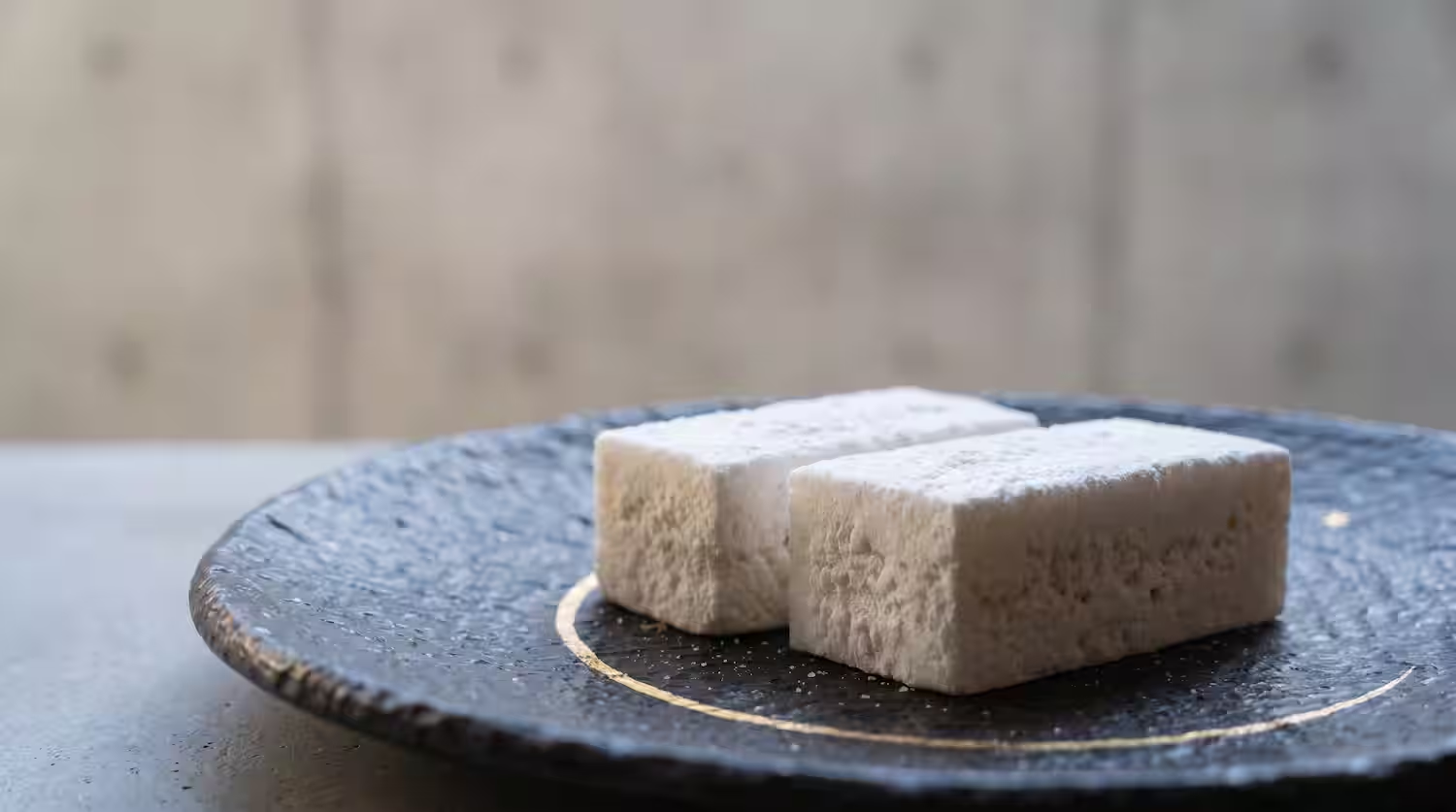

Picture a small, plain white rectangle sitting on a plate next to a cup of tea. At first, it looks almost too simple to be a famous sweet. Then you bite into it. Local sources describe a light, crisp bite, and according to the maker, the piece then dissolves gently in the mouth.
That sweet is Tsukisekai (月世界), a traditional Japanese confection from Toyama made with eggs, wasanbon sugar, agar and a cooked sugar syrup. This guide covers its name, history, ingredients and taste, plus how to eat it and where to buy it in Toyama.
What Is Tsukisekai?
Tsukisekai is the signature confection of Tsukisekai Honpo, a wagashi maker in Toyama City. In other words, the name refers to this specific product rather than a broad category of Japanese sweets. The maker calls it one of Toyama’s representative sweets, and the city’s tourism association lists it among its recommended local souvenirs.
Tsukisekai Quick Facts
- Japanese name
- 月世界, read Tsukisekai
- Type
- A dried traditional Japanese confection with a light, low-moisture texture
- Origin
- Toyama City, Toyama Prefecture
- Maker
- Tsukisekai Honpo, which officially dates its founding to 1897
- Main ingredients
- Fresh eggs, wasanbon sugar, agar and syrup made from hakuzarato sugar
- Texture
- Crisp at first, then a soft, melting finish, according to the maker and local tourism sources
- Shelf life
- About 30 days at room temperature from production, per the Toyama City Tourism Association
- Recommended drinks
- Japanese tea and black coffee (the maker); black tea too (Toyama City tourism)
You may also see the name written as “Gessekai.” That is a possible misreading of the kanji, since the first character can also be read “getsu.” However, the Toyama City Tourism Association gives the reading as Tsukisekai, and the company itself is read Tsukisekai Honpo. So we use that spelling throughout.
How to Pronounce Tsukisekai
Pronounce it roughly as tsoo-kee-seh-kai, as a start. In Japanese, the word has five short beats, or morae: tsu-ki-se-ka-i. The first sound is “tsu,” with a brief vowel after the “ts,” and the ending rhymes with “sky.” Japanese words carry no heavy stress, so keep the rhythm even.
What the Name “Tsukisekai” Means
Taken word by word, tsuki means moon and sekai means world. So a literal translation is “moon world,” although that is our translation rather than an official English name. According to the maker, the sweet earned its name because it resembles the pale moon still hanging in the dawn sky. In a 2013 interview, the company president added that the founder came up with the idea after seeing that moon while rising early to make sweets.
The packaging plays along with that image. According to the Toyama City Tourism Association, the familiar box shows a rabbit and the moon, which makes it easy to spot in a crowded souvenir shop. In addition, photos published by the maker and retailers show a white surface with tiny pores, which fits the moon theme well.
Is Tsukisekai Considered Wagashi?
Yes. Wagashi is the broad Japanese word for traditional confectionery, and Tsukisekai Honpo describes its business as making and selling wagashi. Because the sweet is dried and holds little moisture, it is often discussed alongside higashi, the family of dry sweets. A 2020 study in the Journal of Cookery Science of Japan defines higashi as a general term for low-moisture, dried wagashi. That said, the maker does not label it a higashi on its own product page.
Most higashi you meet in Japan are pressed sugar shapes, such as rakugan. Tsukisekai takes a different path, since it is built on eggs. If you are new to the topic, our guide to Japanese sweets gives a wider picture of the category.
The History and Origin of Tsukisekai
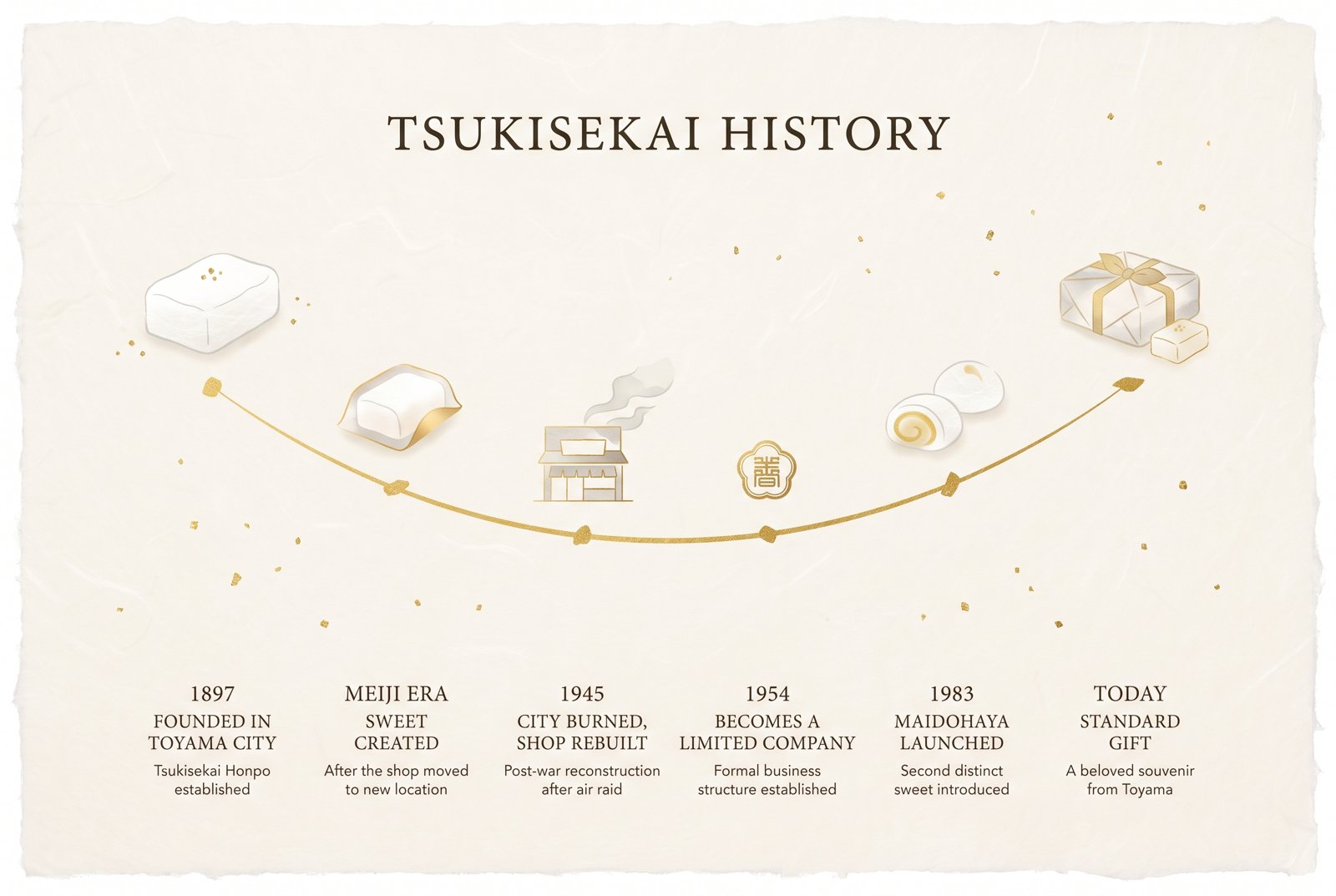
The story starts with a family business in the center of Toyama City. Most of what is known about its early years comes from two places: the maker’s own website and a 2013 interview with the company president, published by the Toyama Chamber of Commerce and Industry.
The Founding of Tsukisekai Honpo
Tsukisekai Honpo’s current company profile gives 1897, the 30th year of the Meiji era, as its founding year. However, a 2013 interview published by the Toyama Chamber of Commerce and Industry states that the founder, Yoshida Eikichi, opened his original shop in 1900. Historical accounts therefore differ slightly, and this article follows the maker’s current official date while noting the gap.
According to that interview, Yoshida Eikichi came from a farming family in what is now Oyabe City, Toyama Prefecture, and trained at a confectionery shop in Kanazawa before opening his own business in Toyama City. Within two or three years, the shop moved to its present site, and it has stayed there for more than a century.
Today, its main store stands in Kamihommachi, a short walk from the Nishicho tram stop in central Toyama, and the company names wagashi production and sales as its line of business.
Neither source gives the exact year Tsukisekai first went on sale. The president said only that he believed his grandfather created it not long after the shop moved, during the Meiji era. In other words, the sweet has deep Meiji-era roots, but the precise launch date remains unconfirmed. The interview also notes that it went on to win various awards at confectionery exhibitions.
How the Sweet Became a Toyama Specialty
The road was not always smooth. According to the same Chamber of Commerce interview, sugar was rationed during and after the war, and for a time the shop could not make sweets at all. The 1945 air raid on Toyama burned much of the city center, and the second-generation owner rebuilt the shop after returning from military service.
After the war, the business narrowed its lineup and focused on Tsukisekai. It became a limited company, Tsukisekai Honpo, in 1954. Then, in 1983, it launched a second sweet, Maidohaya, to mark the 100th anniversary of Toyama Prefecture.
Today, Tsukisekai is a standard gift from Toyama. The Toyama City Tourism Association features it in its souvenir guide, and Toyama Prefecture’s official tourism site calls Tsukisekai Honpo a long-established confectioner known nationwide. The maker itself describes the sweet as a classic that lives on in modern times.
Its reach now goes beyond the city, too. The maker’s public retailer list names selected department stores in Tokyo, Osaka, Nagoya and Kyoto, along with Toyama’s regional-product shops in Tokyo. Because such lists and stock can change, confirm availability directly before visiting a store outside Toyama.
What Is Tsukisekai Made Of?
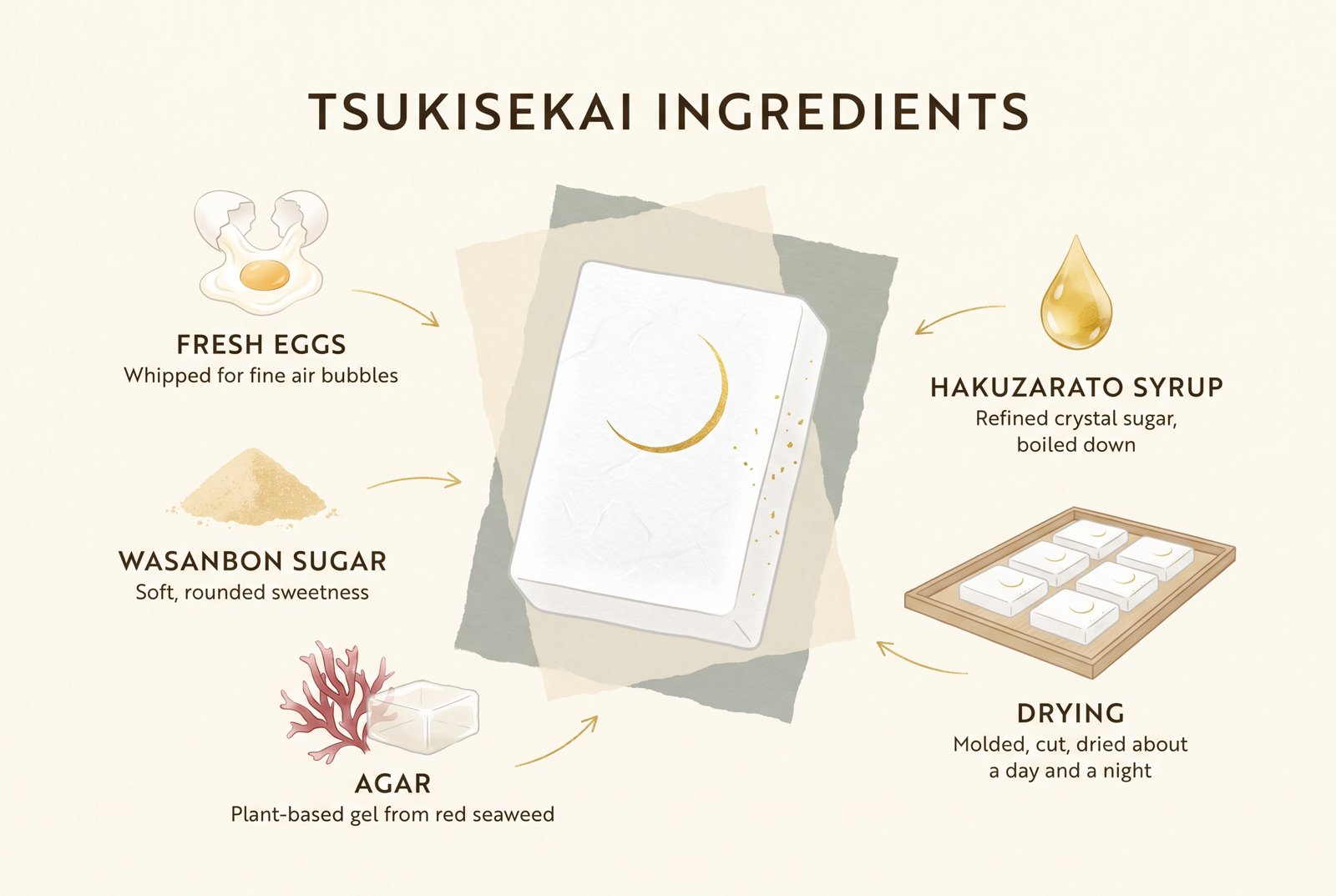
The ingredient list is short, and that simplicity is the point. According to the maker, Tsukisekai combines fresh eggs and wasanbon sugar with agar and a syrup boiled down from hakuzarato sugar. Then the mixture goes through a drying stage.
Fresh eggs
鶏卵
The base of the confection, listed first by the maker.
Wasanbon sugar
和三盆糖
A fine, traditional Japanese sugar with a soft, rounded sweetness.
Agar
寒天
A plant-based gelling agent made from red seaweed.
Hakuzarato syrup
白双糖の糖蜜
A highly refined crystal sugar, boiled down into a thick syrup.
Eggs and Their Role in the Texture
The maker’s product page refers simply to fresh eggs. In a 2013 interview with the Toyama Chamber of Commerce and Industry, however, the company president explained that the shop whips the egg whites and yolks separately before combining them with the syrup. Whipping incorporates small air bubbles, which likely explains the fine pores visible in the dried confection. That last point is our reading of the process rather than a published finding.
Wasanbon and Refined Japanese Sugar
Wasanbon is a traditional fine sugar made in Shikoku, including Kagawa Prefecture, from locally grown sugarcane. Mitani Seito, a wasanbon maker in Kagawa, explains that artisans knead and press the sugar repeatedly to drain away molasses. The name itself refers to polishing the sugar on a tray.
The result is a pale, powdery sugar that melts fast and tastes gentle rather than sharp. Meanwhile, hakuzarato, the second sugar, is a very pure crystal sugar that gives a clean, bright sweetness. If you enjoy wasanbon, you may also like Seki no To, a Mie sweet dusted in the same sugar.
Why Agar Is Used
Agar, called kanten in Japanese, sets liquids into a firm gel, like gelatin does. According to the Chamber of Commerce interview, the agar goes into the syrup itself, together with the two sugars. In this sweet, it may help hold the egg foam and syrup together before drying, although the maker does not explain the role of each ingredient.
A close relative helps here. Awayuki-kan, a classic wagashi of agar, sugar and whipped egg white, uses the same idea in a moist, jelly form. A 1984 paper in the journal Cookery Science notes that the whipped whites can separate from the agar syrup into two layers. Clearly, mixing such a foam evenly takes real skill.
The Drying Process
Finally, drying is the step that turns the mixture into a crisp sweet that keeps for weeks. The maker’s product page says only that the mixture is dried. The Chamber of Commerce interview fills in the outline: the shop mixes the whipped eggs with the syrup, pours the mixture into molds, cuts it into pieces once cool, and dries it for about a day and a night. In addition, the president said the blend changes slightly with the seasons.
Some confectionery retailers describe the result as something like a dried awayuki. The maker has not published exact ratios, temperatures or drying conditions, so the finer details remain the shop’s own.
What Does Tsukisekai Taste Like?
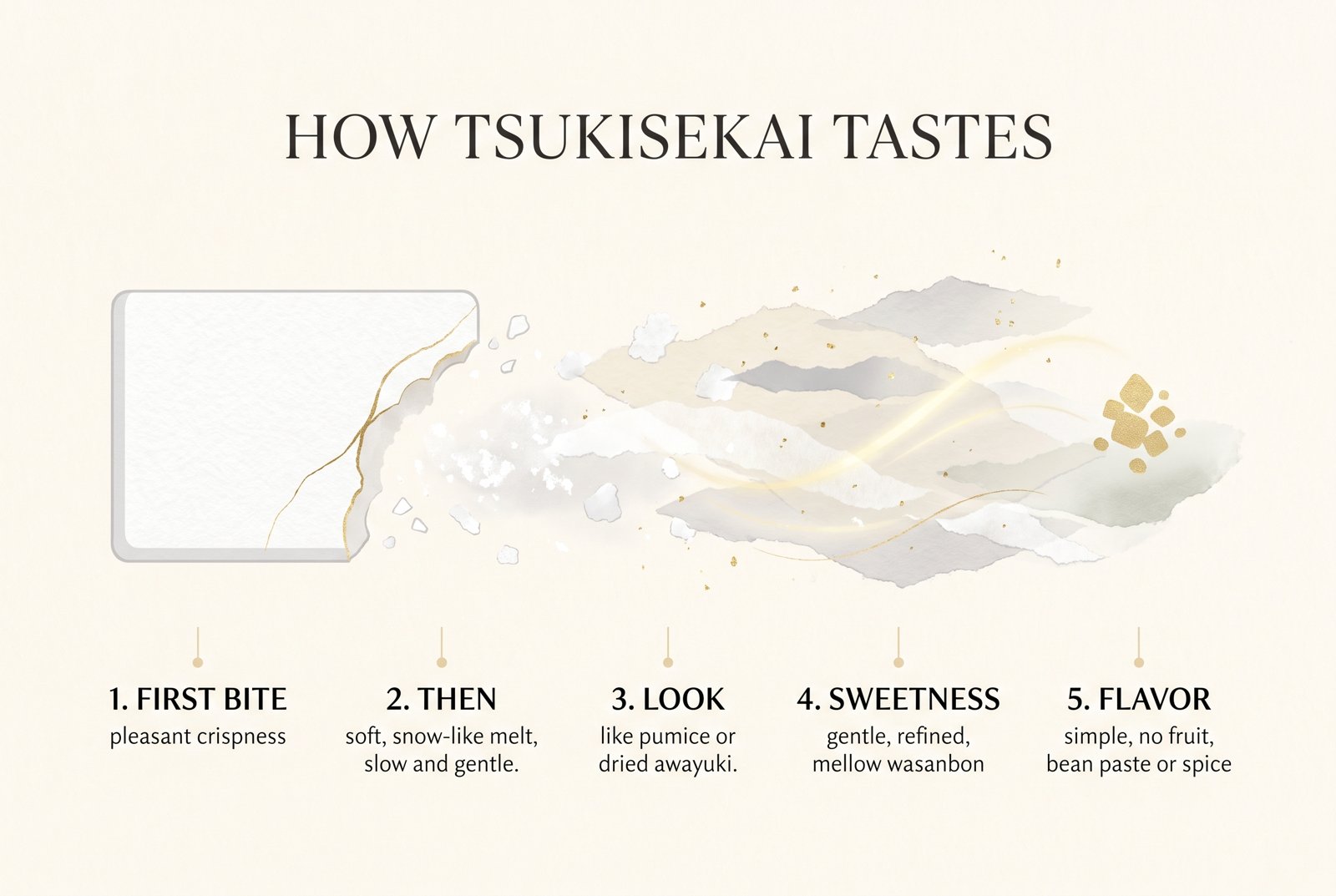
Tsukisekai’s texture is easier to experience than to describe. The maker describes a distinctive flavor that dissolves gently once it enters your mouth. Toyama City’s tourism page adds a pleasant crispness at first, followed by a soft, snow-like melt. We have not tasted it for this article, so the descriptions below come from the maker, local tourism sources and retailers.
Light, Crisp and Snow-Like Texture
For example, the shop inside Toyama Station describes a crisp bite followed by a smooth melt. Likewise, one online retailer, Hyakusen Yokocho, says the piece has some bite but then dissolves softly in the mouth. Another retailer, Okashi-net, compares the look to pumice or a dried awayuki, and says the dry texture gives way to a slow melt.
Japan has a few other sweets famous for melting away, such as Oiri from Kagawa. Even so, the sources above describe Tsukisekai’s melt as slow and gentle rather than a quick crunch.
Sweetness and Flavor Profile
Overall, expect a gentle sweetness rather than a sugary rush. The Toyama City Tourism Association describes the sweetness as refined, and retailers often point to the mellow character of wasanbon. There is no fruit, no bean paste and no spice in the listed ingredients, so the flavor stays simple.
Some visitors may find such a plain sweet surprising at first. That quietness, though, is exactly why the maker pairs it with strong drinks, which brings us to how locals enjoy it.
How Tsukisekai Differs From Other Wagashi
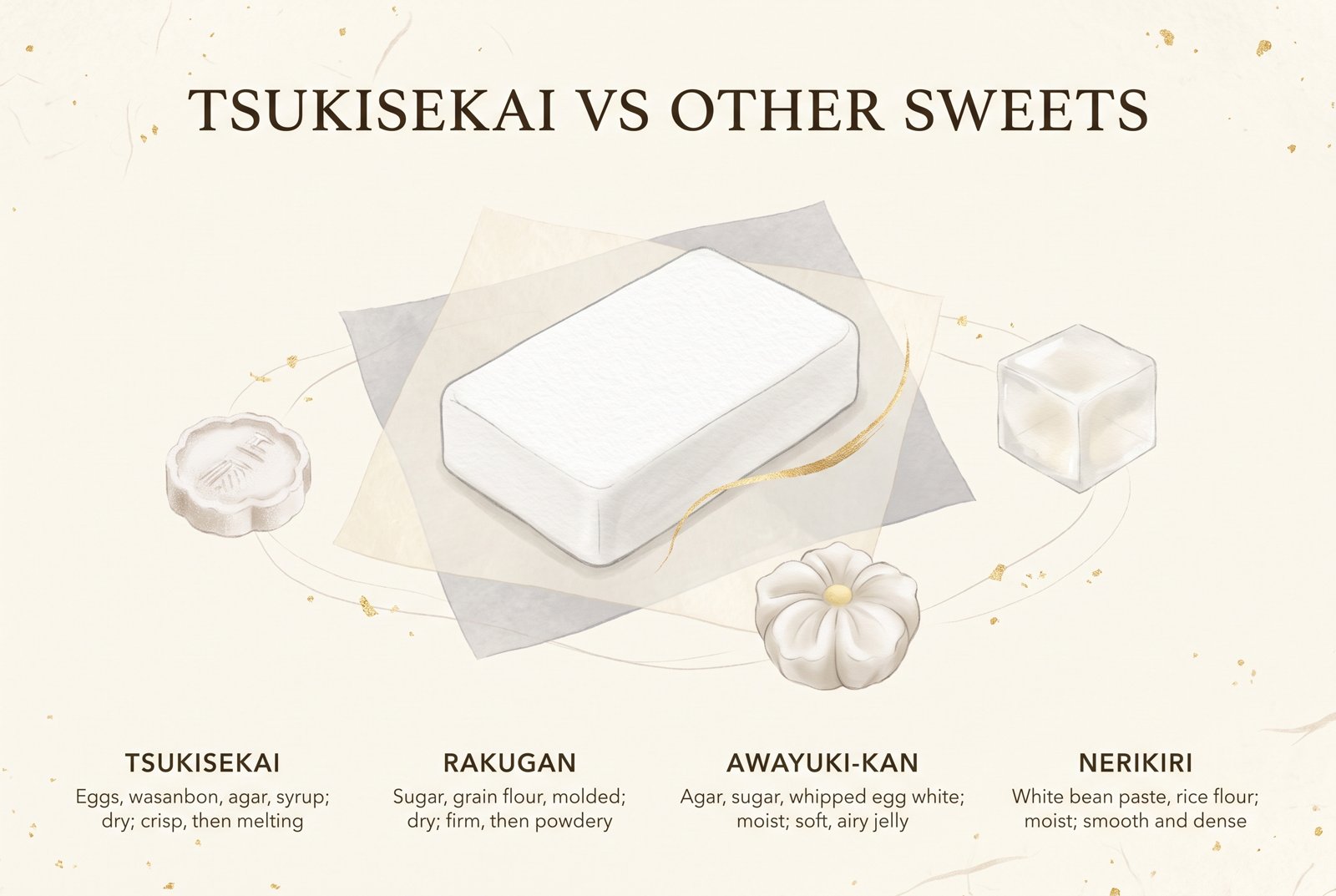
The table below compares Tsukisekai with three better-known Japanese sweets. It focuses on ingredients and texture, which are the biggest differences.
| Sweet | Main ingredients | Moisture | Texture |
|---|---|---|---|
| Tsukisekai (月世界) | Eggs, wasanbon, agar, sugar syrup | Dry | Crisp, then melting |
| Rakugan (落雁) | Sugar and grain flour, pressed in molds | Dry | Firm, then powdery |
| Awayuki-kan (淡雪かん) | Agar, sugar, whipped egg white | Moist | Soft, airy jelly |
| Nerikiri (練り切り) | White bean paste and rice flour | Moist | Smooth and dense |
Tsukisekai sits between two worlds. It shares the egg base of awayuki-kan, yet it keeps the dryness of rakugan. For a moist, sculpted contrast, see our guide to Nerikiri.
How to Eat Tsukisekai
Each stick-shaped package holds four small packets, and one retailer listing gives two pieces per packet, about 10 grams in total. Then place one or two pieces on a small plate, and take small bites so the melt has time to show itself. Beyond that, there are no special rules.
Japanese green tea
Recommended by the maker. A slightly bitter sencha offers a pleasant contrast.
Black tea
Toyama City’s tourism page calls it an excellent match for an afternoon cup.
Black coffee
The maker itself recommends it, and the contrast is surprisingly good.
Serving Tsukisekai With Japanese Green Tea
The maker recommends Japanese tea as well as black coffee. A cup of sencha is an easy choice, since its slight bitterness can provide a pleasant contrast to the sweetness. For a broader look at teas, our Japanese green tea guide is a good starting point.
Pairing It With Black Tea or Coffee
This pairing may surprise first-time visitors. The maker says Tsukisekai goes well with black coffee, while the Toyama City Tourism Association suggests black tea or coffee too. Both the 2013 interview and a Hokuriku regional information center have described a coffee corner at the main shop, although you should confirm current café service with the shop directly.
Best Serving Temperature
The maker gives no serving temperature. Since the product is stored at room temperature, serving it as it comes, with a hot drink, is the simplest approach. If the package carries any handling notes, follow those first.
Is Tsukisekai a Good Japanese Souvenir?
For most travelers, yes. It is light, keeps for weeks at room temperature and comes in tidy packaging that suits gifts. That said, a few practical points are worth checking before you buy.
- Lightweight: a six-stick box weighs under 500 grams, according to one retailer listing.
- Travel-friendly: the Toyama City Tourism Association lists a room-temperature shelf life of about 30 days from production.
- Gift-ready: boxes range from a single stick to large assortments.
- Delicate: a dried, airy sweet, so pack it where nothing heavy presses on it.
- Contains eggs: so it is not suitable for anyone with an egg allergy.
Packaging and Portability
The basic unit is one stick-shaped package, and the maker also sells boxes that step up in size for larger gifts. Its rabbit-and-moon design is also easy to recognize, which helps if you are hunting for it in a busy station shop.
Shelf Life and Storage
The Toyama City Tourism Association gives a guideline of 30 days at room temperature from the production date. One authorized online retailer lists about one month normally, and about three weeks during Japan’s humid rainy season. Either way, follow the storage instructions and the date printed on your own package.
Allergy and Dietary Considerations
The maker states that Tsukisekai contains eggs, wasanbon sugar, agar and syrup made with refined white sugar. However, its public product page does not provide a complete allergen statement, a gluten-free certification or a vegetarian policy. Anyone with allergies, celiac disease or strict dietary requirements should check the current package label or contact the maker.
Where to Buy Tsukisekai
The easiest places to find it are in Toyama City itself. Stock and store lists change over time, however, so a quick check with the maker before a special trip is wise.
Tsukisekai Honpo Main Shop (月世界本舗)
- Address
- 8-6 Kamihommachi, Toyama City, Toyama 930-0057
- Access
- About 5 minutes south on foot from Exit 2 of the Nishicho tram stop
- Hours
- 9:00 to 18:00, closed Sundays (per the Toyama City Tourism Association)
- Phone
- +81 76-421-2398
Tsukisekai Honpo in Toyama
Above all, the main shop is the most complete place to buy it. The maker’s product page lists the full range of box sizes there, and some sets that include the shop’s other sweet, Maidohaya, are listed for the main shop only. Hours and holidays can change, so check before a special trip.
Buying It at Toyama Station or Toyama Airport
If you are short on time, the station is the obvious choice. The Toyama City Tourism Association lists Toyamarche and Omiyagedokoro Toyama inside Toyama Station, along with the Daiwa department store and the shop at Toyama Airport. Stock may vary by location, however, so treat the list as a guide rather than a guarantee.
Can You Order Tsukisekai Online?
Yes, within Japan. The maker points online shoppers to two Japanese retail sites, Hyakusen Yokocho and Okashi-net, and it also accepts orders by fax. One of these retailers says it makes the sweets after receiving each order, so delivery can take about a week.
Tips for International Visitors
Overseas shipping does not appear on the maker’s public pages, so plan to buy it during your trip. Most station shops display prices clearly, which makes the purchase easy even without Japanese. Before you leave, also check your home country’s rules on bringing in egg-based foods. Rules differ, and some places restrict them.
Other Traditional Sweets and Foods From Toyama
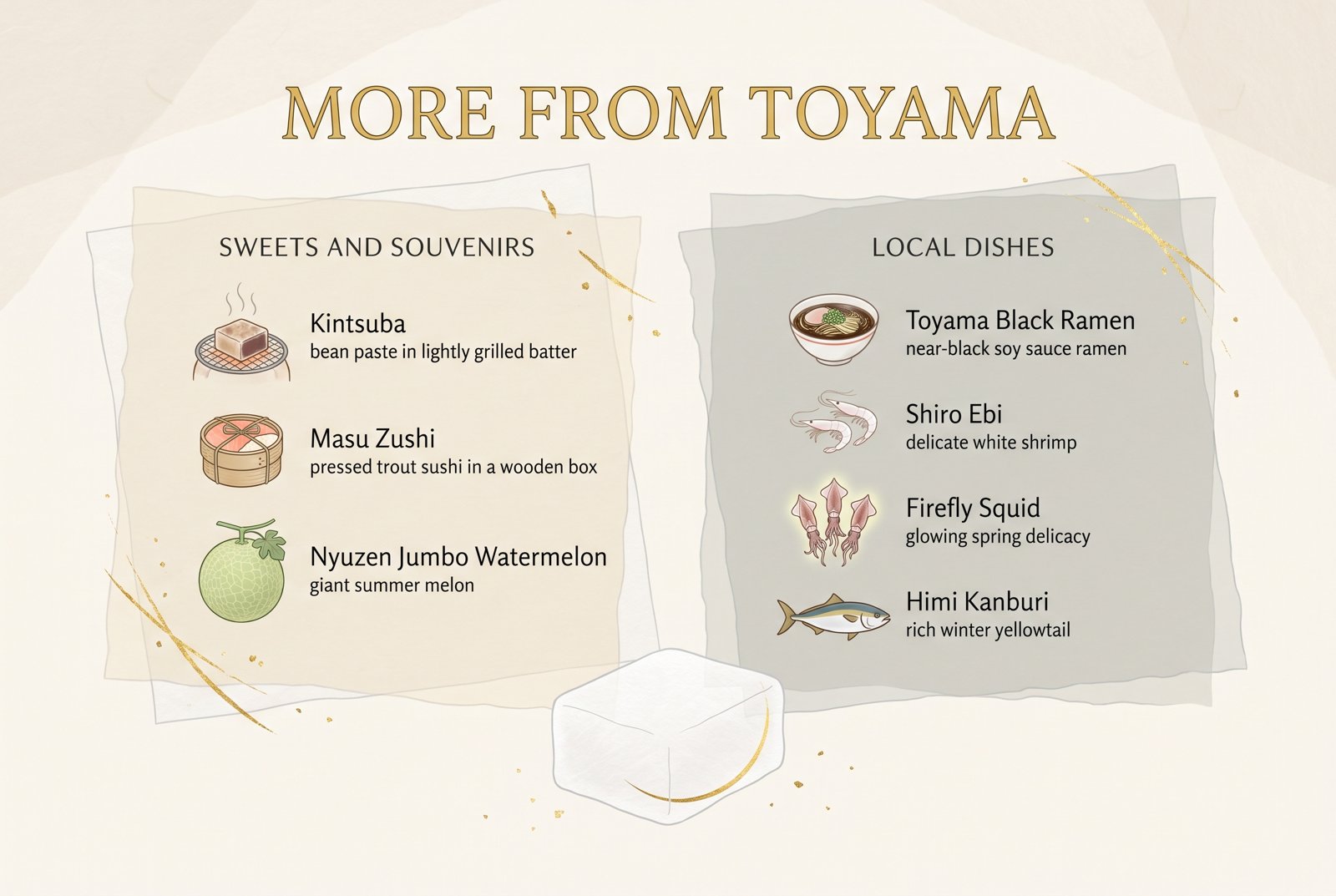
Tsukisekai is only one part of Toyama’s food culture. The prefecture faces Toyama Bay, so much of its fame comes from the sea. Our Toyama food guide covers the full picture, while the list below picks a few highlights.
Sweets and Souvenirs to Look For
- Kintsuba: a square sweet of bean paste wrapped in a thin, lightly grilled batter.
- Masu Zushi: pressed trout sushi in a round wooden box, Toyama’s best-known food souvenir.
- Nyuzen Jumbo Watermelon: a giant summer watermelon, wrapped in straw for gifting.
Local Dishes to Try During Your Visit
- Toyama Black Ramen: a bold, near-black soy sauce ramen born in downtown Toyama.
- Shiro Ebi: delicate white shrimp, often called the jewel of Toyama Bay.
- Firefly Squid: a glowing spring delicacy from Toyama Bay.
- Himi Kanburi: rich winter yellowtail from the fishing town of Himi.
Why Tsukisekai Is Worth Trying
Tsukisekai rewards a little patience. On the surface, it is just a white block of eggs and sugar. Yet three things make it memorable.
- A rare texture: crisp at first, then a soft melt, in the words of the maker and local tourism sources.
- A long local story: it comes from a Toyama shop founded in 1897.
- An easy gift: it is light, keeps for weeks and pairs with tea or coffee.
If you pass through Toyama Station, pick up a stick and try it with a hot drink. Then, while you are in town, explore the rest of the food of Toyama, from black ramen to white shrimp. You may come home with a new favorite wagashi.
Tsukisekai FAQ
About the Sweet
- What is Tsukisekai?
-
Tsukisekai (月世界) is a traditional dried Japanese sweet from Toyama City. Tsukisekai Honpo, a confectioner that dates its founding to 1897, makes it from eggs, wasanbon sugar, agar and sugar syrup. According to the maker, it dissolves gently in the mouth.
- Is it pronounced Tsukisekai or Gessekai?
-
The standard reading is Tsukisekai, pronounced roughly tsoo-kee-seh-kai with five even beats. The Toyama City Tourism Association uses this reading, and the company name is read Tsukisekai Honpo. Gessekai is a possible misreading, because the first kanji can also be read “getsu.”
- Is Tsukisekai a type of wagashi?
-
Yes, it is a wagashi, or traditional Japanese confection. Because it is dried and low in moisture, it is often discussed alongside higashi, the dry sweets, although the maker does not use that label on its product page. Unlike most pressed-sugar higashi, it is built on eggs.
Ingredients and Diet
- Does Tsukisekai contain eggs?
-
Yes. The maker lists fresh eggs as a main ingredient, together with wasanbon sugar, agar and sugar syrup. Anyone with an egg allergy should avoid it. Always check the package label for the latest allergen information.
- Is Tsukisekai gluten-free?
-
The maker lists eggs, wasanbon sugar, agar and sugar syrup, and no wheat appears among them. However, the maker has not published a gluten-free certification or a full allergen statement covering additives and shared equipment. Anyone with celiac disease should check the package label or contact the maker before eating it.
- Is Tsukisekai vegetarian?
-
It contains eggs, so it is not vegan. The gelling agent is agar, which comes from seaweed, rather than animal gelatin. Even so, the maker states no vegetarian policy, so people with strict requirements should confirm with the shop.
Buying and Storage
- How long does Tsukisekai last?
-
The Toyama City Tourism Association gives about 30 days at room temperature from the production date. One authorized online retailer lists about one month, or three weeks in the rainy season. Follow the date and storage instructions printed on your own package.
- Where can you buy Tsukisekai in Toyama?
-
You can buy it at the Tsukisekai Honpo main shop in central Toyama City. The Toyama City Tourism Association also lists shops inside Toyama Station, the Daiwa department store and the Toyama Airport shop. Store lists and stock can change, so confirm with the maker before a special trip.
- Can you buy Tsukisekai online?
-
Within Japan, yes. The maker sells through two Japanese online retailers and also takes orders by fax. Its public pages do not mention international shipping, so buying it in Toyama is the safest option for overseas visitors.
References
Official and Tourism Sources
- Tsukisekai Honpo – Company Information (会社情報) (Accessed October 2026)
- Toyama City Tourism Association – Tsukisekai / Tsukisekai Honpo (月世界/月世界本舗) (Accessed October 2026)
- Tsukisekai Honpo – Products: Meika Tsukisekai (商品) (Accessed October 2026)
- Toyama Tourism Navi (Toyama Prefectural Tourism Association) – Meika Tsukisekai (銘菓 月世界) (Accessed October 2026)
- Tsukisekai Honpo – Access and Contact (アクセス・お問い合わせ) (Accessed October 2026)
- Toyama Chamber of Commerce and Industry – Shoko Toyama, October 2013: Learning from Long-Established Companies 7, Tsukisekai Honpo (会報「商工とやま」平成25年10月号 シリーズ/老舗企業に学ぶ7) (Accessed October 2026)
- Hokuriku Plus (Toyama, Ishikawa and Fukui Information Center) – Tsukisekai (月世界) (Accessed October 2026)
Industry and Academic Sources
- Hyakusen Yokocho (Hokuden Sangyo) – Mail Order: Tsukisekai Honpo (お取り寄せ 月世界本舗) (Accessed October 2026)
- Hyakusen Yokocho – Meika Tsukisekai, 6-Stick Box: Ingredients, Shelf Life and Weight (月世界 6本入り) (Accessed October 2026)
- Toyama Station City – Tsukisekai Honpo (Toyama Meika) at Toyamarche (月世界本舗) (Accessed October 2026)
- Okashi-net – Tsukisekai: Tsukisekai Honpo, Toyama (名匠菓子の旅) (Accessed October 2026)
- Mitani Seito Hane Sanuki Honpo – How Wasanbon Is Made (和三盆の製法) (Accessed October 2026)
- J-STAGE – Murakami, Y. (2020). Effect of Preparation Methods on the Physical Properties of the Uchimono Wasanbon. Journal of Cookery Science of Japan, 53(1), 18–24 (調製方法が打ち物「和三盆」の物理特性に及ぼす影響) (Accessed October 2026)
- J-STAGE – Ito, K. (1984). Teaching Material Study: Awayuki-kan. Cookery Science, 17(1), 35 (教材研究 淡雪かん) (Accessed October 2026)
Related Articles
- Toyama Food: Seafood Cuisine from Toyama Bay (Surveyed: October 2026)
- Kintsuba (きんつば) (Surveyed: October 2026)
- Masu Zushi (鱒寿司) (Surveyed: October 2026)
- Toyama Black Ramen (富山ブラックラーメン) (Surveyed: October 2026)
- White Shrimp (白エビ) (Surveyed: October 2026)
- Toyama Firefly Squid (ホタルイカ) (Surveyed: October 2026)
- Seki no To (関の戸) (Surveyed: October 2026)
- Oiri (おいり) (Surveyed: October 2026)
- Nerikiri (練り切り) (Surveyed: October 2026)
- Sencha (煎茶) (Surveyed: October 2026)




Comments