You can usually order at Japanese restaurants without speaking Japanese. Pointing at a menu photo, tapping a tablet or buying a meal ticket is usually enough. What confuses first-time visitors is rarely the language. It is the process, because some places seat you, some take payment before you eat, and others send you to a register afterwards.
Here is how to order food in Japan from start to finish, including seating, ticket machines, payment, useful phrases, otoshi charges and allergy precautions.
TOC
The Short Answer
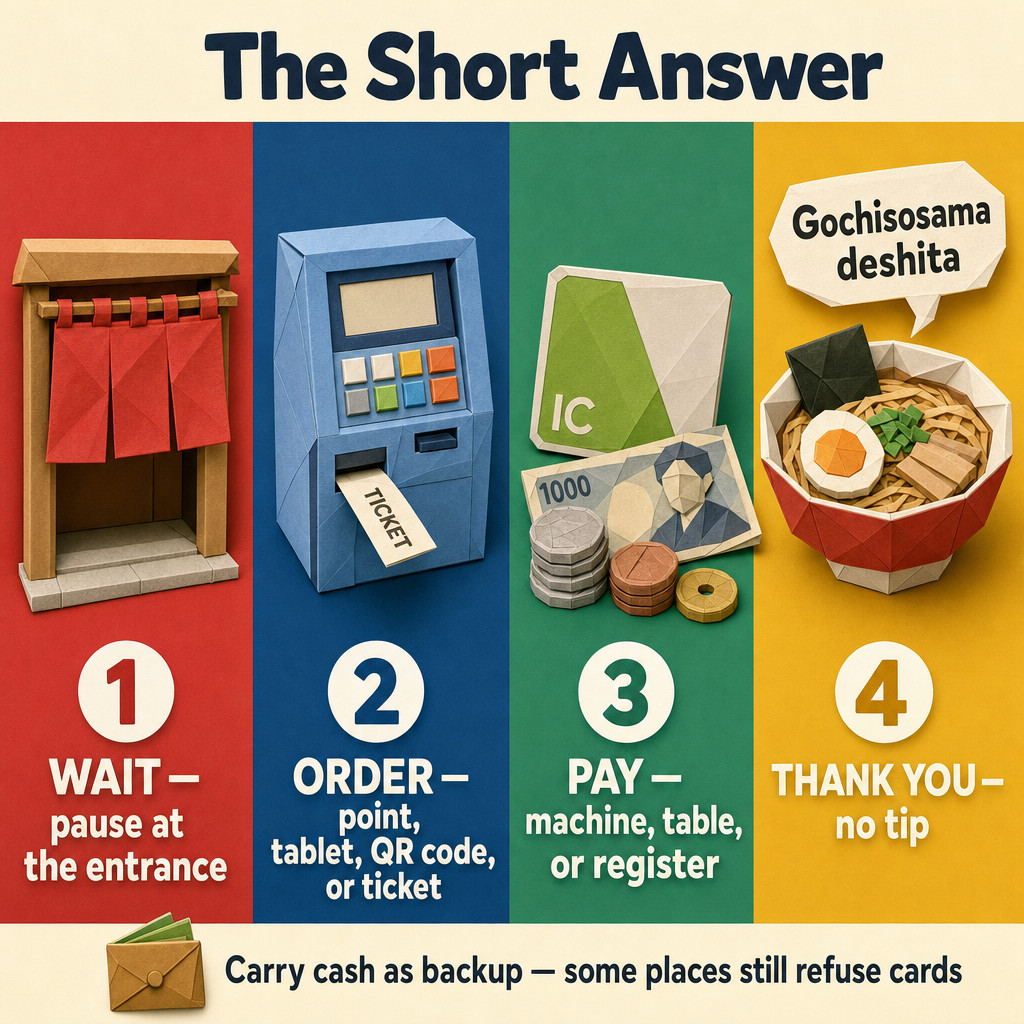
In general, how to order food in Japan comes down to four steps.
Wait at the entrance, unless a sign or a ticket machine tells you otherwise.
Order by pointing, using a tablet, scanning a QR code or buying a meal ticket.
Pay where the shop tells you: the machine, the table or the register.
Say “gochisosama deshita”, meaning thank you for the meal, and leave no tip.
Carry some cash as a backup too. Smaller restaurants and older ticket machines still refuse cards.
Before You Enter
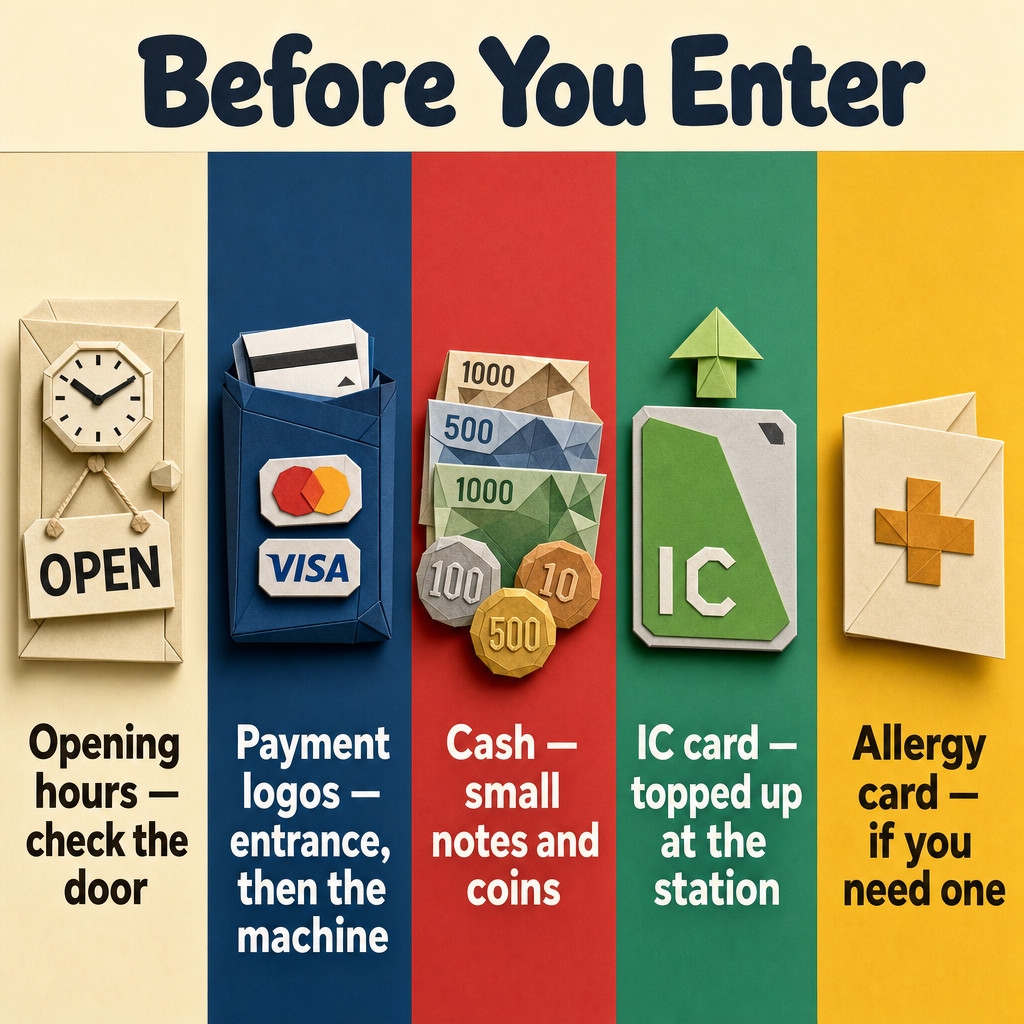
Check the opening hours, the payment logos and your cash before stepping inside.
Opening hours on the door, or a sign reading 営業中, meaning open
Payment logos at the entrance, then again on the ticket machine
Some cash, especially in small notes and coins
An IC card balance topped up at a station, not at the restaurant
An allergy card or translated note, whenever you need one
A noren curtain across the doorway is another useful clue at traditional restaurants. It is not a universal rule. Plenty of shops never use one, and a few leave theirs out during preparation hours.
How to Get a Seat
Most restaurants seat you, so pause at the entrance until someone appears.
Wait, or seat yourself?
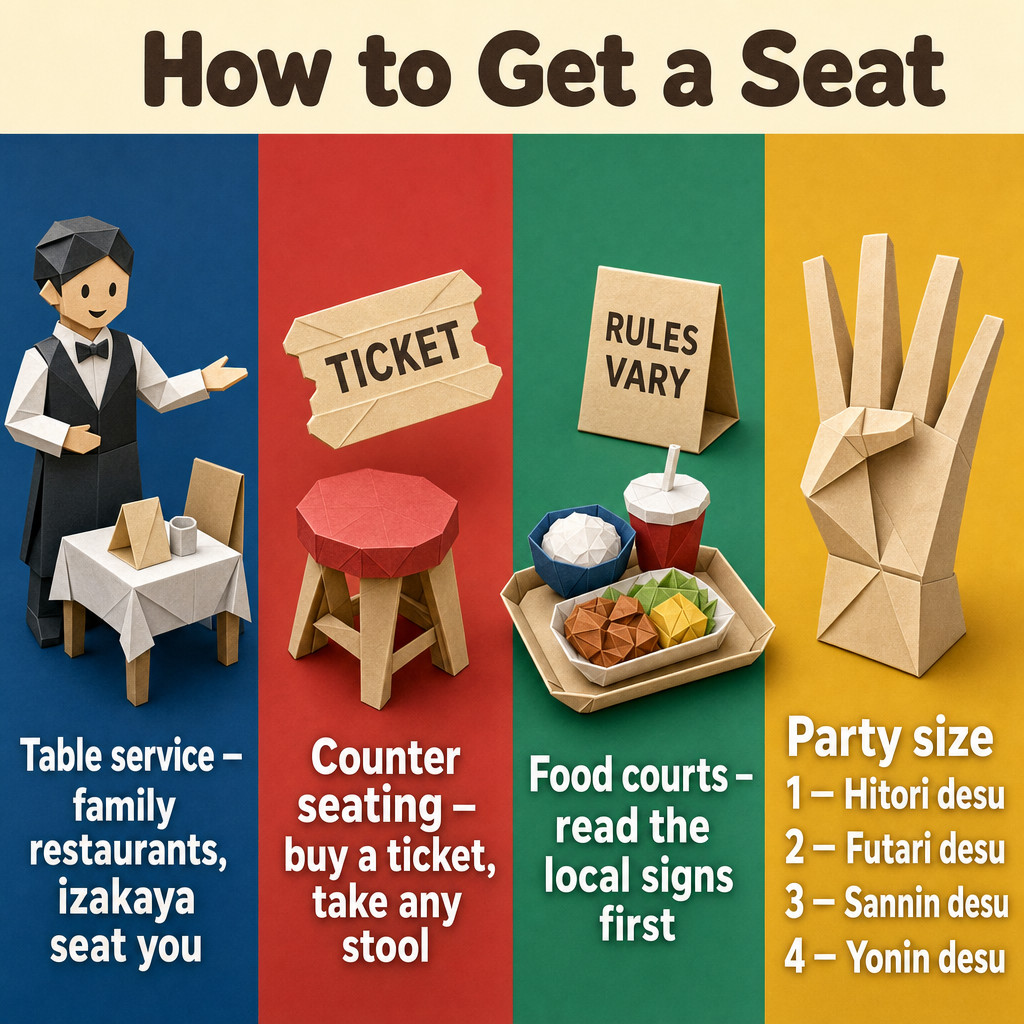
Family restaurants and izakaya usually show you to a table. Ramen counters and standing soba shops work differently. There you buy a ticket first, then take any free stool. So watch what the person ahead of you does.
Busy shops occasionally run a written waiting list, or hand out numbered slips. Add your name, take the slip, and stay within earshot.
Food courts
Rules differ by building, so read the local signs before putting a bag on a chair. Some people secure a seat first, while others do not. Other facilities ask customers to order before finding a table, and several shopping centers limit seat-saving during peak hours.
Telling staff how many people
Holding up fingers usually works. One word helps as well.
People
Japanese
Romaji
One
一人です
Hitori desu
Two
二人です
Futari desu
Three
三人です
Sannin desu
Four
四人です
Yonin desu
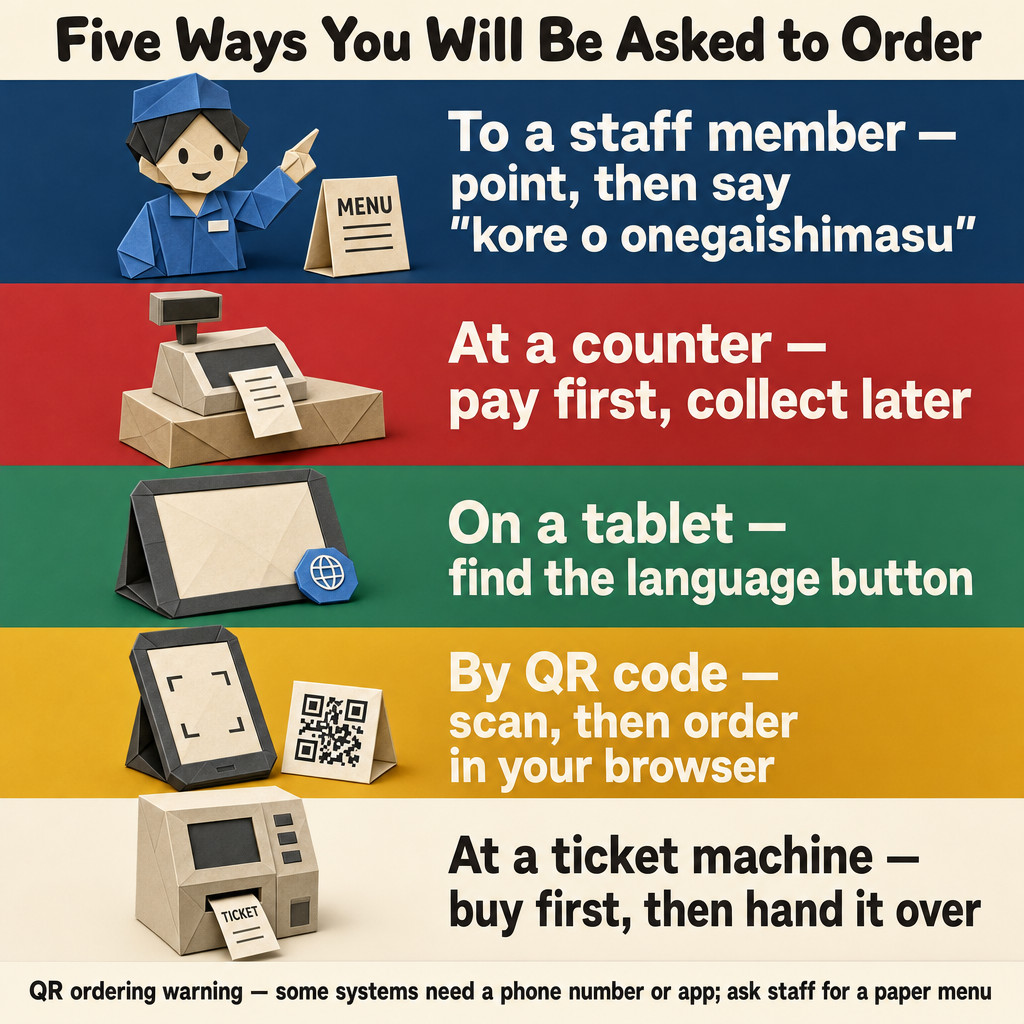
Five Ways You Will Be Asked to Order
Japanese restaurants rarely explain their system, so recognizing it on sight saves time.
To a staff member Point at a photo or a number, then say “kore o onegaishimasu”
At a counter Common in cafes and fast food, where you pay first and collect later
On a tablet Look for the language button, usually top right or bottom left
By QR code Scan the code on the table, then order in your own browser
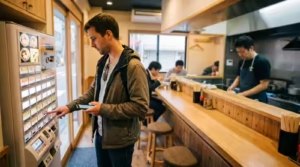
At a ticket machine Buy a meal ticket before sitting down, then hand it over
QR ordering deserves a warning, though. Some systems ask for a phone number or an app account, and a few pages will not load on a foreign SIM. Ask staff for a paper menu whenever that happens.
How to Use a Ticket Machine
Insert cash first on older button machines, since the buttons stay dark. On most touchscreens, choose the dish first and pay at the end.
What the machine does
A ticket machine takes your money, then prints a small paper ticket. That ticket then becomes your order. Newer machines send the order straight to the kitchen and print a number instead. You will generally meet them at ramen, soba, udon and curry shops, plus teishoku diners serving set meals.
Older button machines
Decide what you want from the menu board before reaching the machine.
Insert cash, then watch the available buttons light up.
Press the lit button for your dish, then add toppings.
Take the printed ticket from the slot.
Push the return lever afterwards, and your change drops into the tray.
Hand the ticket to staff, or place it on the counter.
Touchscreen machines
Modern screens usually reverse the order. Choose a language, then dine-in or takeout, then the dish. Payment comes last, and the machine shows the total before you commit. Photographs make the whole thing easier, although the language button is sometimes small.
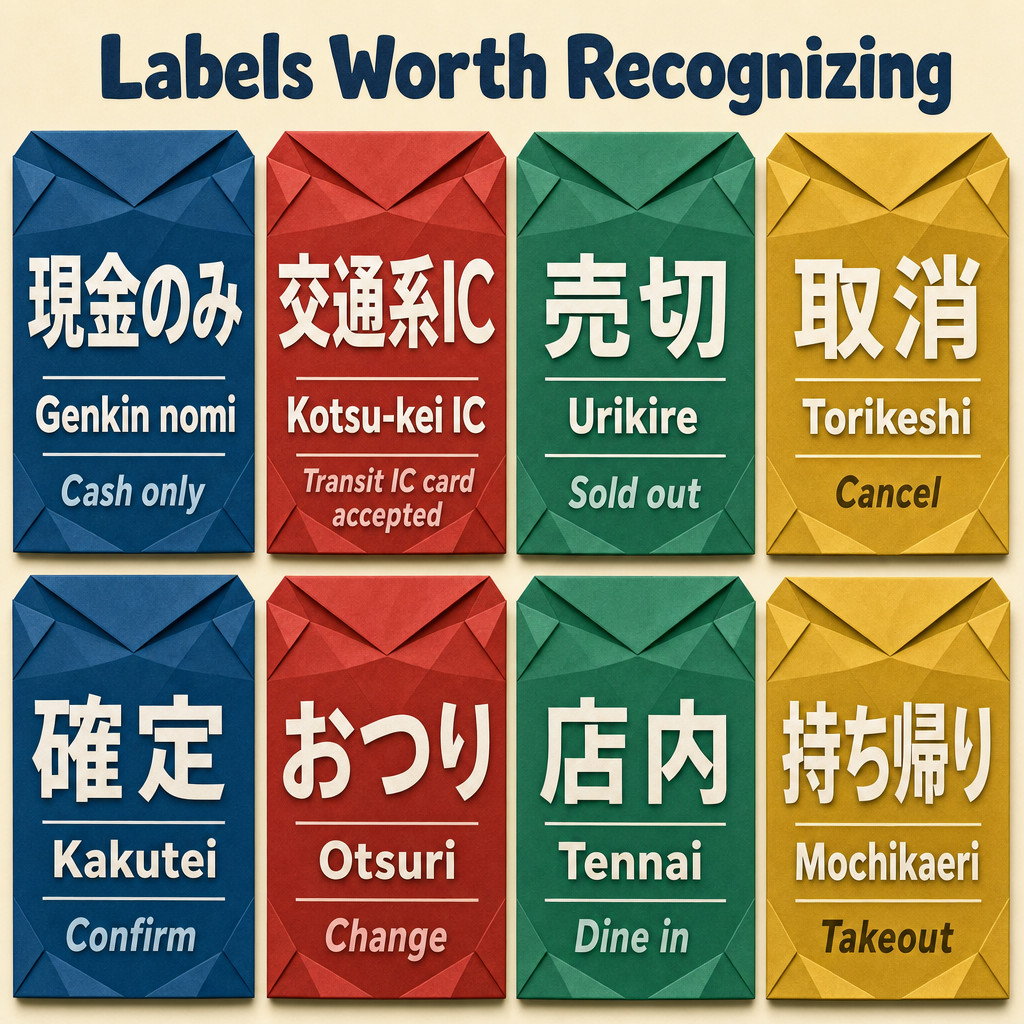
Labels worth recognizing
Japanese
Romaji
Meaning
現金のみ
Genkin nomi
Cash only
交通系IC
Kotsu-kei IC
Transit IC card accepted
売切
Urikire
Sold out
取消
Torikeshi
Cancel
確定
Kakutei
Confirm
おつり
Otsuri
Change
店内
Tennai
Dine in
持ち帰り
Mochikaeri
Takeout
What to do with the ticket
Four things can happen, and none are complicated. Staff may take the ticket from you, or not. You may leave it on the counter. Occasionally you keep a stub. Sometimes no paper appears at all, because the order already reached the kitchen, so watch the screen for a number.
Made a mistake? Press 取消 or 戻る before paying. Those two buttons cancel and go back. After payment, take the ticket to a staff member and say “sumimasen, machigaemashita”. Once cooking starts, changes may not be possible.
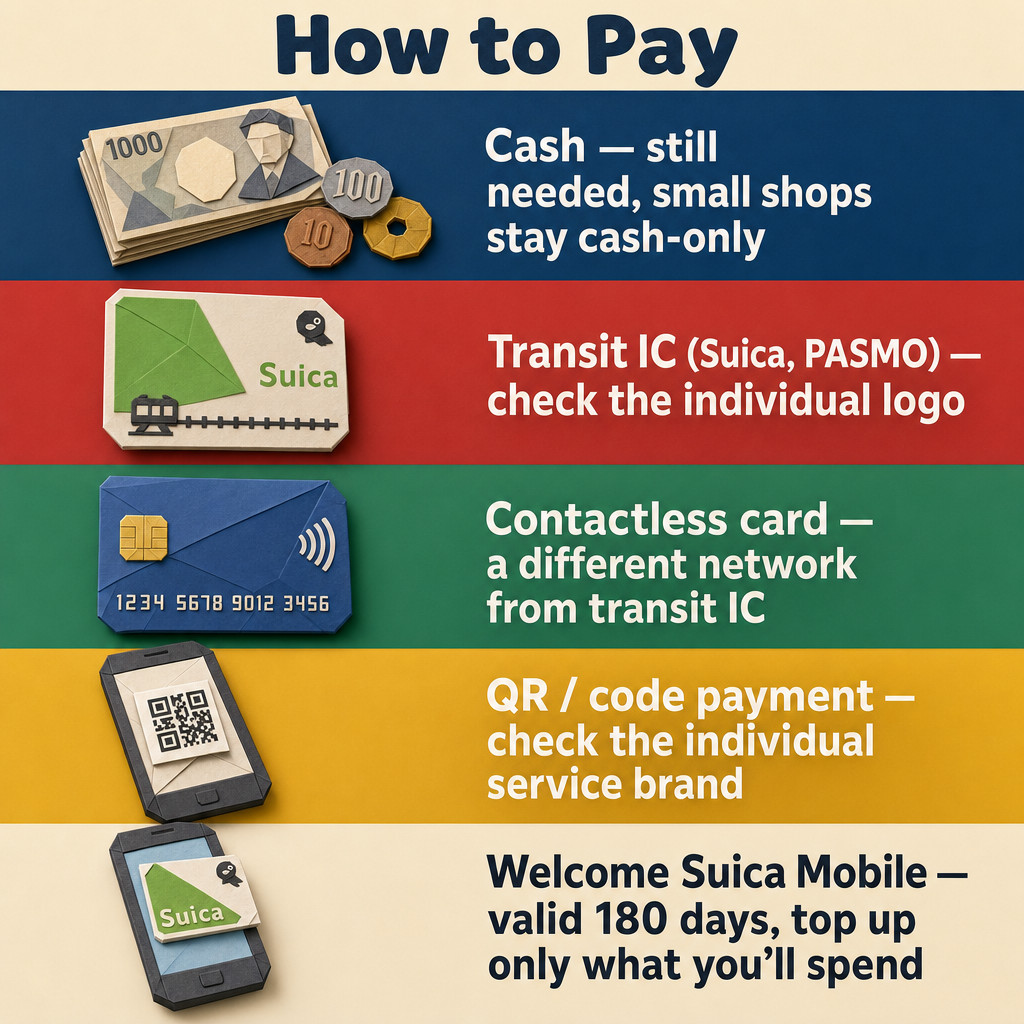
How to Pay
Payment can come before or after the meal, so follow the machine, the bill slip or the staff.
Is Japan still a cash country?
Less than it used to be. Japan’s Ministry of Economy, Trade and Industry reported in March 2026 that cashless payments reached 58.0 percent of consumer payment value nationwide during 2025. That figure measures value, rather than the share of restaurants accepting cards.
The gap matters on the ground. Small independent restaurants, older ticket machines and market stalls, for example, often stay cash-only. Keeping a few thousand yen in small notes remains sensible, even in central Tokyo.
Transit IC is not the same as contactless
This distinction still confuses many first-time visitors. Suica and its relatives run on a transit IC system, while Visa or Mastercard contactless runs on a card network. A machine can therefore accept one and refuse the other. Read the individual logos rather than assuming.
What you see
Payment route
How to check
Suica, PASMO, 交通系IC
Transit IC
Look for the individual IC logo
Visa or Mastercard with a wave symbol
Card network
Look for the brand plus the contactless mark
Suica inside a phone wallet
Transit IC
The shop still needs IC support
QR or code payment logo
Code payment
Check the individual service brand
Asking “Apple Pay wa tsukaemasu ka” will not settle the question. Your phone might hold a Suica, a Visa card, or both, while the shop’s terminal may handle only one of them.
Welcome Suica Mobile
Welcome Suica Mobile is basically an iOS service for overseas visitors using eligible Apple Pay compatible devices. It issues and tops up a Suica, which works on transport and also as prepaid money in shops. Restaurants and ticket machines accept it wherever they accept Suica or compatible transit IC payments, so the shop’s equipment decides, not your phone.
Two things to know first. JR East states that the issued Suica stays valid for 180 days. Any balance left when that period ends may not be refundable, so add only what you expect to spend. Depending on your country or region, you may also be unable to issue or top up the Suica until you arrive in Japan. Check the official page while planning, because conditions change.
Cards, codes and low balances
Credit cards work widely at registers, though far less often at ticket machines. Some foreign-issued cards also fail on Japanese terminals for no obvious reason, so bring a second card. QR services present another hurdle, because several require a Japanese phone number or a domestic payment method.
An insufficient IC balance can still cause an awkward payment problem mid-meal. Many restaurant machines cannot top up a card, and mixing IC balance with cash rarely works. Check your balance before walking in.
Useful Japanese Phrases
Eight short phrases cover almost every restaurant situation, at least on a first visit.
Sumimasen Excuse me, and also how you call a staff member
Kore o onegaishimasu This one, please, while pointing at the menu
Eigo no menyu wa arimasu ka Do you have an English menu?
Osusume wa nan desu ka What do you recommend?
Kaado wa tsukaemasu ka Can I use a card?
Okaikei onegaishimasu The bill, please
Mochikaeri de To go, as opposed to tennai de for here
Gochisosama deshita Thank you for the meal, said on the way out
Use okaikei when you need to ask for the bill. At many casual restaurants you can simply carry the bill slip from your table to the register instead.
Portion labels also vary between shops. Common ones include 小 or 小盛り for small, 並 or 普通 for regular, and 大 or 大盛り for large.
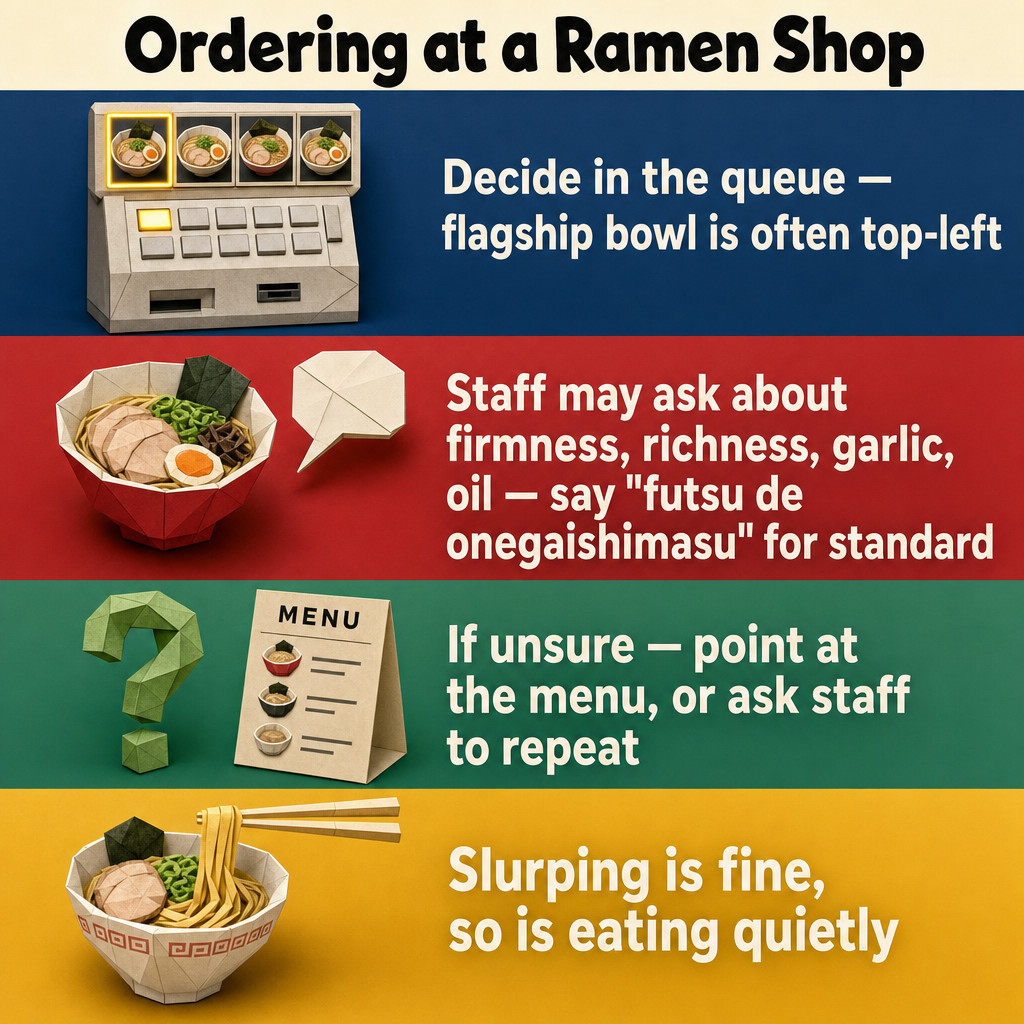
Ordering at a Ramen Shop
Decide while you queue, because ramen counters move quickly.
Photographs usually sit above the machine, and the flagship bowl often occupies the top left button. Staff may then ask questions once you sit down. Noodle firmness, broth richness, garlic and oil, for instance, come up most often.
If the question concerns firmness, richness or a similar preference, “futsu de onegaishimasu” means standard, please. When you cannot tell what the question means, point at the menu or ask staff to repeat it. Spice levels and allergy questions deserve a clearer answer than standard.
Slurping causes no offense at casual noodle shops, although nobody requires it. Eating quietly is fine too. Our Japanese noodles guide also covers the regional styles.
Ordering at an Izakaya
Order in small rounds, and expect an otoshi charge on the bill.
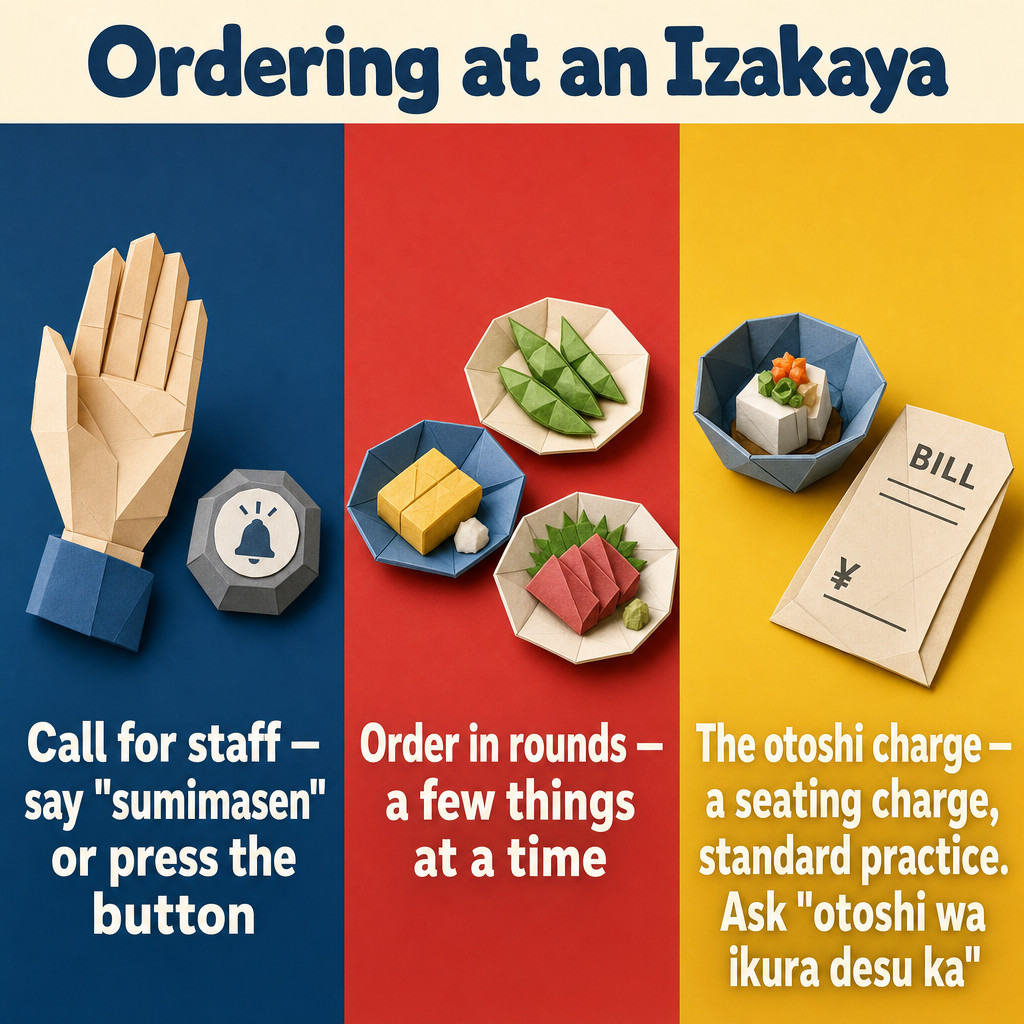
An izakaya is a Japanese pub, and it generally runs on small shared plates and repeated ordering. Raise a hand and say “sumimasen”, or press the call button on the table. Order a few things at a time rather than everything at once.
Then there is otoshi. A small appetizer arrives without any order, then it appears on the bill. At many izakaya it functions as a seating charge, commonly a few hundred yen per person. This is standard practice rather than a scam, though the amount and the policy vary.
Refusing it is not always possible, because some shops build it into their pricing. Asking at the door is usually cleaner. Try “otoshi wa ikura desu ka”, meaning how much is the otoshi.
Allergies and Dietary Restrictions
Name the exact ingredient, and never rely on a single phrase for a severe allergy.
Vague requests generally get vague answers. Dashi made from fish appears in dishes that look entirely vegetable, and soy sauce commonly contains wheat. Shared fryers cause frequent problems too.
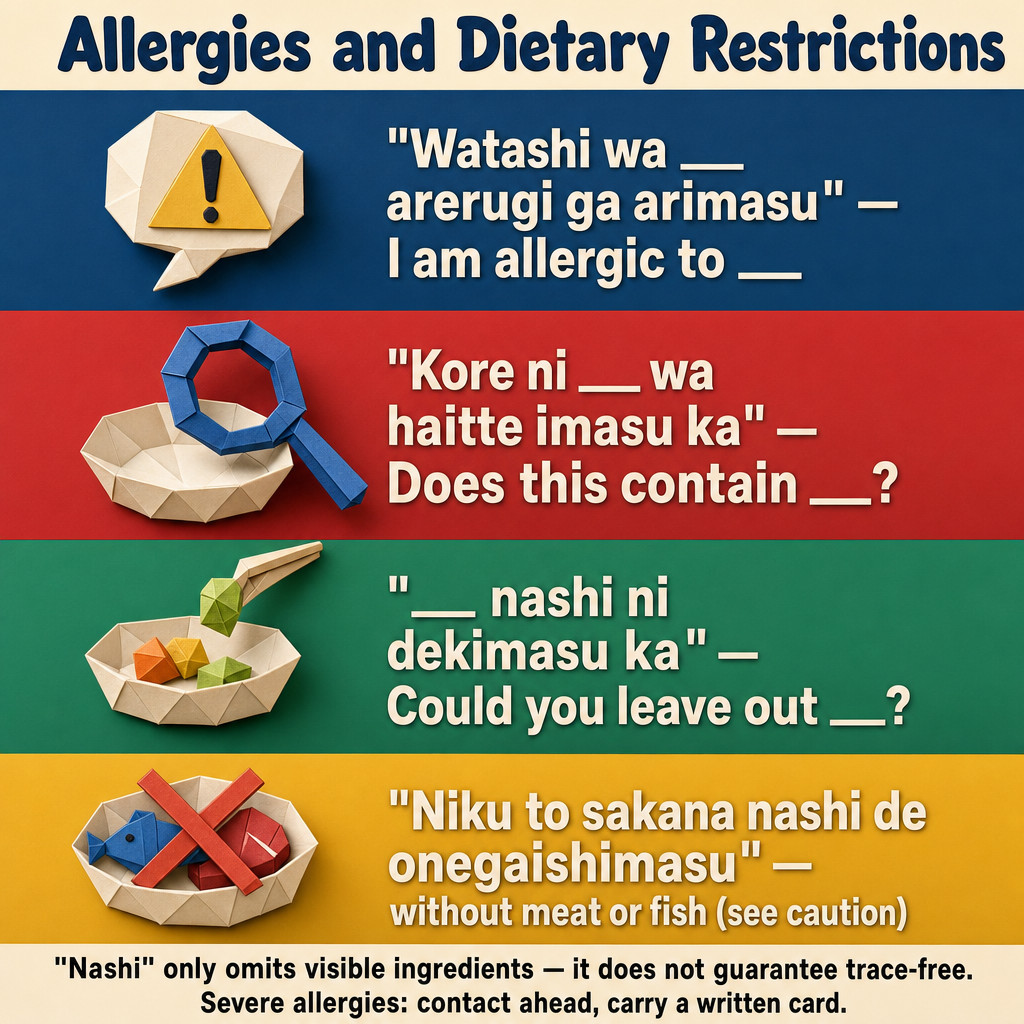
Watashi wa ___ arerugi ga arimasu I am allergic to ___
Kore ni ___ wa haitte imasu ka Does this contain ___?
___ nashi ni dekimasu ka Could you leave out ___?
Niku to sakana nashi de onegaishimasu Without meat or fish, please, although see the caution below
Adding “nashi” simply asks the kitchen to omit an ingredient. It does not guarantee that the dish is free from traces, stock, sauces or cross-contact. The meat and fish phrase has the same limit, because it excludes visible pieces rather than fish stock, bonito flakes or lard. Anyone with a severe allergy should therefore contact the restaurant in advance, and carry a written card in Japanese.
For strict vegetarian or vegan diets, confirm stock, sauces and cooking oil separately as well. Travelers following strict halal or vegan requirements will usually find it easier to choose restaurants that advertise appropriate menus or certification.
Restaurant Etiquette
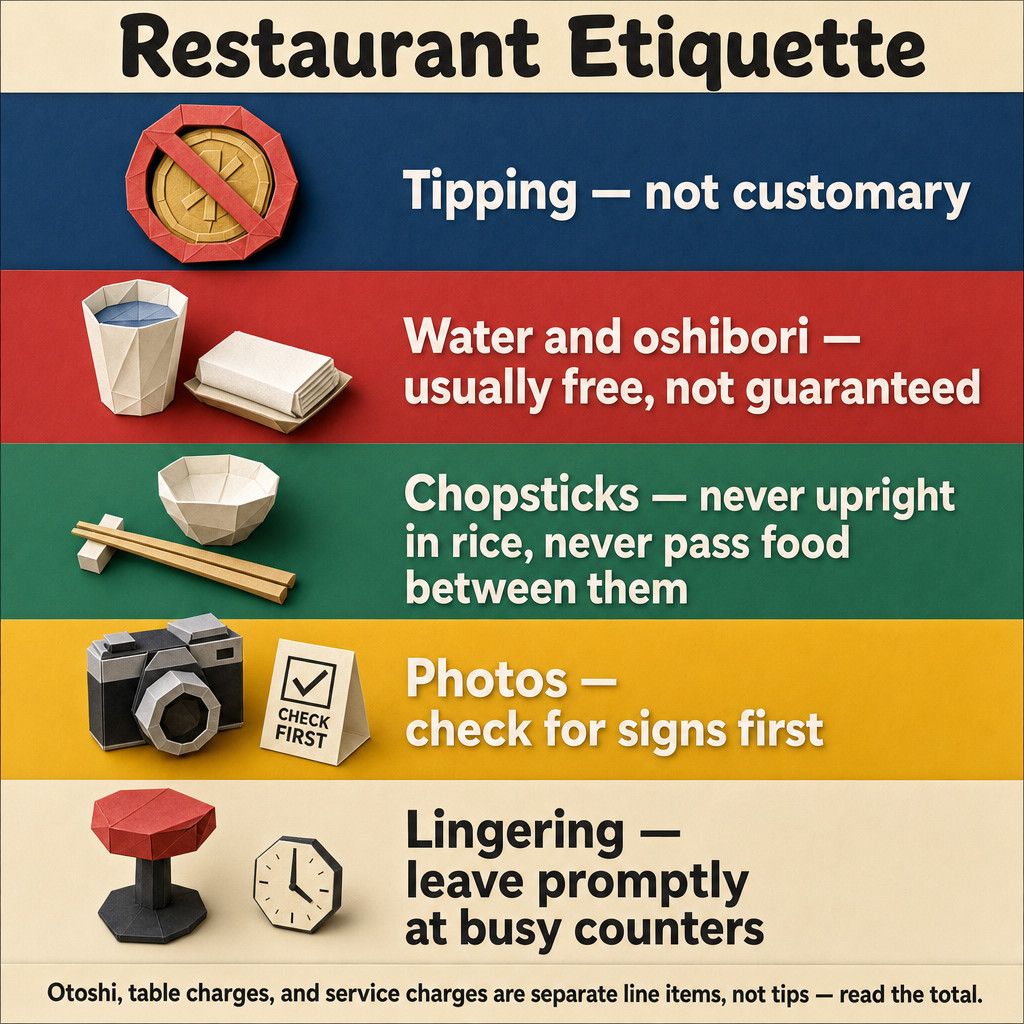
Tipping is generally not customary at ordinary restaurants in Japan.
Tipping Not customary, and staff may assume you forgot the cash
Water and oshibori The wet hand towel and the water are usually free, though not guaranteed
Chopsticks Never stand them upright in rice, and never pass food between them
Photos Check for signs first, particularly at counter restaurants
Lingering Leave promptly at busy counters, because seats turn over quickly
Otoshi, table charges and service charges all sit outside the tipping question. They appear on the bill as line items, so read the total rather than assuming an error.
If Something Goes Wrong
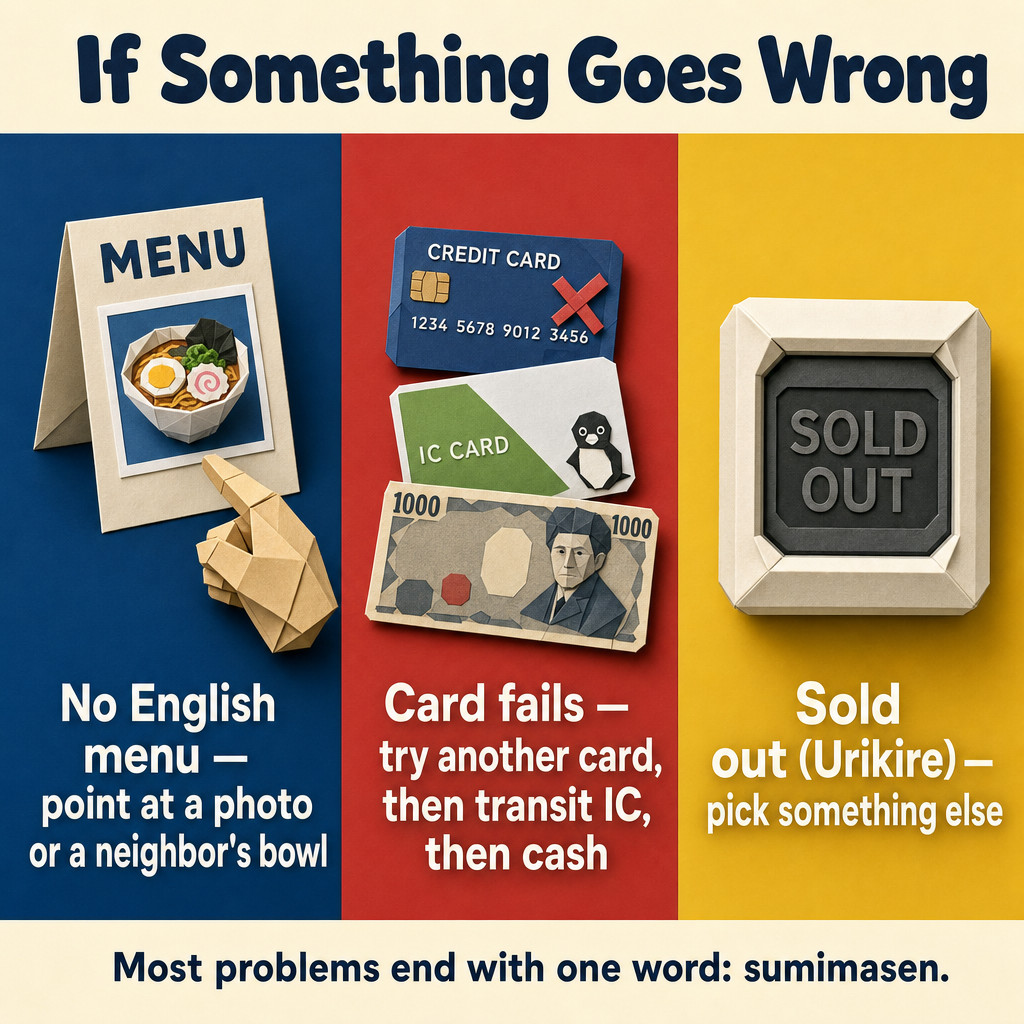
Most problems end with one word: sumimasen.
The menu has no English, so point at a photo or at a neighbor’s bowl. Your card fails, so try another card, then transit IC, then cash. The machine rejects your note, so smooth out the creases or try a different denomination.
Sold-out items show as 売切, although sometimes the button simply goes dark. Pick something else rather than pressing harder. Staff would rather help than watch you struggle.
How to Order Food in Japan with Confidence
None of this is really about Japanese ability, though. Ordering here rewards observation, so watch the person ahead of you and copy what they do. Machines look intimidating for about thirty seconds, then stop mattering.
Ready to plan the eating itself? Our Japan food guide sorts dishes by region and type, while cheap eats in Japan covers where the ticket machines usually are.
Ordering Food in Japan FAQ
How do you order food in Japan without speaking Japanese?
Pointing works at most restaurants, because menus usually carry photographs or numbers. Add “kore o onegaishimasu” and then the order is complete. Ticket machines and tablets also include an English button. Staff generally expect visitors, so nobody minds a few gestures.
Should you insert money before selecting food?
On older button machines, yes. The buttons stay unlit until money goes in. Touchscreen machines usually reverse that order, so you choose first and pay afterwards. Watch the screen prompts, which normally indicate the next step.
Do Japanese food ticket machines accept credit cards?
Some do, although plenty remain cash-only. A restaurant that takes cards at the register may still run a cash-only machine. Check for brand logos directly on the machine rather than at the door. Keeping cash as a backup therefore avoids the problem.
Can you use Suica or PASMO at restaurant ticket machines?
Yes, if the machine displays a Suica, PASMO or 交通系IC logo. Acceptance depends on the individual machine, and retail compatibility is not identical for every card. Look for the specific logo rather than assuming. Cash-only machines, of course, will not work.
Can tourists use Welcome Suica Mobile at restaurants?
Yes, at places accepting Suica or compatible transit IC payments. Remember that transit IC and contactless card payment are different systems, so a terminal may take one and refuse the other. Carrying cash is still a sensible backup, particularly at older machines. A flat phone battery causes the same problem too.
Do you pay at the table or at the register?
At the register, in most casual restaurants at least. Take the small slip from your table, then carry it over. Izakaya and family restaurants sometimes settle at the table instead. Ticket machine shops take payment before you eat.
Can restaurants in Japan split the bill?
Sometimes, although busy shops often decline. Splitting is easier at chains and family restaurants than at small counters. Settling as one group, then dividing afterwards, is usually faster. Ask with “betsubetsu ni dekimasu ka” if you want to try.
How do you tell restaurant staff about a food allergy?
Name the specific ingredient, using “watashi wa ___ arerugi ga arimasu”. Show a written card in Japanese as well, because spoken requests can be misheard. Ask about stock, sauces and shared fryers separately as well. For a severe allergy, contact the restaurant before visiting.
Ryo Iwa is the founder and editor of foodinjapan.org. Born and raised in Japan, he writes from regional travel, market visits, and Japanese-language primary sources that rarely reach English readers, including brewing institute publications and industry glossaries. Where a figure cannot be traced to a source, the article says so.
He has been a Google Maps Local Guide for over 10 years, with more than 1,800 reviews and over 41,000 photos viewed hundreds of millions of times. He previously spent two decades as an IT consultant in Japan, the US, and the UK.










Comments