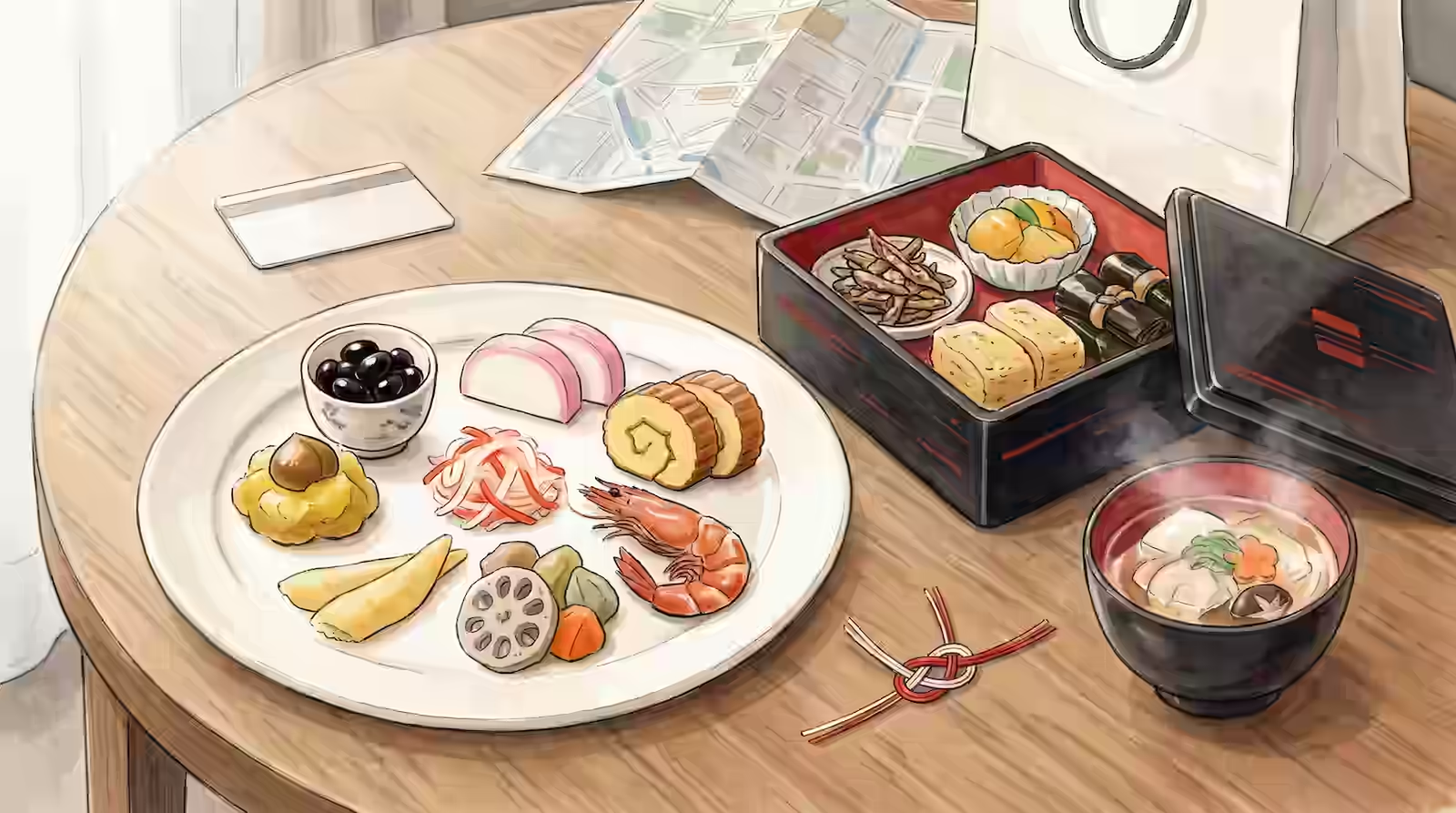
It is December 30, and the department store food hall is packed. Lacquered boxes glow under the lights in black, red, and gold. Inside sit glossy black soybeans, golden chestnut paste, pink and white fish cake, bright prawns, and small dishes you may never have tasted. Each one carries a wish for the year ahead, making the box part meal, part New Year ritual.
You want to try it. But nearly every sign mentions reservations, and the staff are moving fast. Osechi is Japan’s New Year feast, and cooks arrange it in stacked lacquer boxes called jubako. This guide covers what it tastes like, where to look, what it costs, and how to keep it cold in a hotel room.
TOC
Can Travelers Buy Osechi in Japan Without a Reservation?
Yes, within limits. Luxury multi-tier boxes are pre-order products, so walk-in shoppers rarely get one. However, department store food halls and large supermarkets sell individual New Year dishes and small assortments in late December. Hotels and ryokan also serve New Year meals to their guests. So aim for a tasting rather than a trophy box.
Quick Facts
What it is
Japan’s New Year feast of small symbolic dishes in stacked jubako boxes
Best days to shop
December 29 to 31, ideally soon after opening
Best walk-in spots
Department store food halls and large supermarkets
Reservation season
Early September through mid-December
Budget tasting
Roughly ¥1,000 to ¥3,000 for four to six single dishes
Family box
Roughly ¥15,000 to ¥30,000, usually by reservation
How you eat it
Chilled or slightly warmed toward room temperature
Storage
Follow the package label, and measure your hotel fridge first
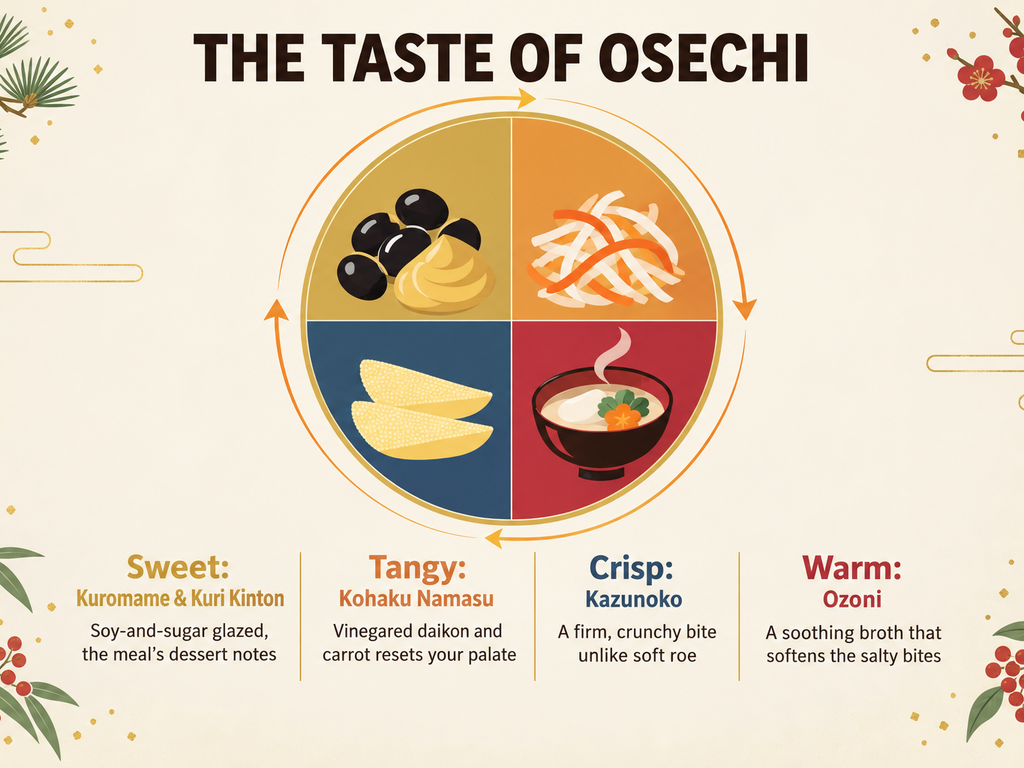
Osechi is not one dish with a single flavor. It is a tasting collection built around contrasts. Expect sweet soy-glazed dishes, bright vinegar pickles, gently savory seafood, soft egg dishes, and rich chestnut sweets. Some bites run sweeter or saltier than first-time visitors expect. For a first tasting, small portions make it easier to explore the range without committing to a full box.
Why Osechi Tastes Sweet, Salty, and Tangy
Cooks traditionally prepared many osechi dishes in advance, using sugar, salt, vinegar, soy sauce, and thorough cooking to help them keep during the New Year holiday. That heritage explains the flavor balance you taste today. Modern products, however, still need storing exactly as the package instructs.
Texture Is Part of the Experience
Kamaboko has a clean, springy bite. Kuri kinton turns smooth and dense, more like a chestnut dessert than a side dish. Kazunoko has a firm, crisp crunch that feels unlike softer fish roe. You may not love every item, though finding your favorites is half the fun.
Build Your First Osechi Plate
Rather than guessing at a shop counter, shop by contrast. A handful of small dishes can cover the whole range.
Warm, alongside:ozoni, bought separately or served at your hotel
Set the five osechi dishes beside a bowl of ozoni, and the logic of the meal suddenly makes sense. Sweet kuromame leads into springy kamaboko. Sharp namasu resets your palate, while warm ozoni softens the saltier bites. You are not eating unrelated snacks. Instead, you are tasting the contrasts many Japanese families bring together on the New Year table.
What Is One-Plate Osechi?
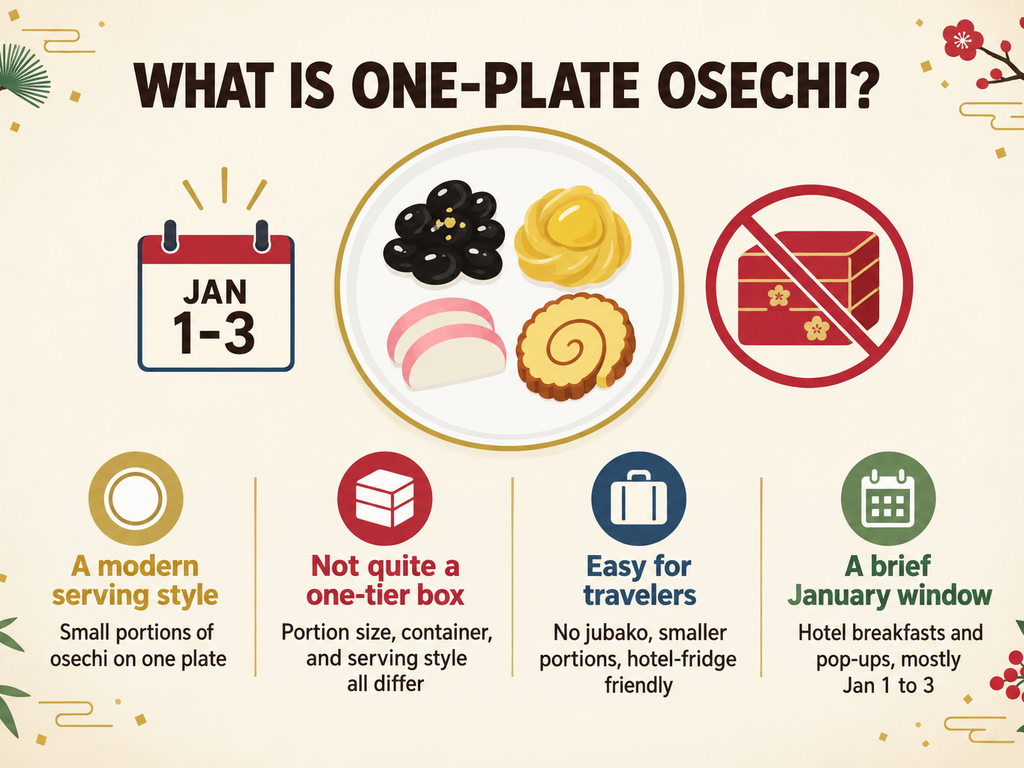
A one-plate osechi is not a separate kind of New Year food. Rather, it is a modern serving style, where several osechi dishes sit in individual portions on one plate instead of a shared jubako. Odakyu Department Store describes it simply as putting a little of each dish on a single plate. Because it needs no lacquer box, the format suits travelers unusually well.
Is It the Same as a One-Person Osechi Box?
Not quite, although the three overlap. Portion size defines a one-person osechi. The container defines a one-tier osechi. Serving style defines a one-plate osechi. So a small single-tier box turns into a one-plate osechi the moment you move the food onto a dish.
Kibun Foods shows the same idea using ordinary supermarket products. Kamaboko, kuri kinton, black soybeans, and datemaki go onto an everyday plate, and the New Year table appears without a single piece of lacquerware.
Why It Works So Well for Travelers
No jubako, no big table, and no group of eight to feed.
Smaller volume, so it fits a hotel refrigerator far more easily.
You skip the dishes you already suspect you will dislike.
Unopened packs stay sealed until you actually want them.
Usually it costs a fraction of a reserved family box.
Finally, it photographs beautifully, even on a plain white hotel plate.
Where Can Travelers Eat One-Plate Osechi?
Not as a permanent restaurant dish, honestly. One-plate osechi surfaces mostly between January 1 and 3, at hotel breakfasts, New Year accommodation plans, seasonal cafe menus, and short events in shopping complexes. So treat past examples as a pattern, never as a guarantee.
Two documented cases show the shape of it. Hotel 1899 Tokyo added an osechi plate of six dishes to its breakfast buffet from January 1 to 3, 2026, serving one plate per guest. Earlier, HAMACHO HOTEL TOKYO ran a guests-only osechi plate breakfast at its restaurant SESSiON on January 1, 2024, limited to 60 servings at ¥4,800 and bookable through a dedicated form. That plate mixed kuromame and kuri kinton with roast beef, smoked duck, and marinated salmon, which makes such menus a gentle entry point for unfamiliar palates.
Resort hotels outside Tokyo and department store event floors run similar plates too. Venues announce them late, however, so time your research rather than searching in October.
When New Year menus get announced
Early November: hotel accommodation plans for the New Year period.
Late November to early December: hotel New Year breakfasts.
Mid to late December: cafes, restaurants, and shopping complexes.
After December 25: final opening hours, walk-in availability, quantity limits.
Search a venue’s official site using おせちプレート, 元旦 朝食, お正月 朝食, or 新春メニュー.
If nothing turns up for your dates, the fallback still works. Buy several single dishes at a supermarket or food hall, then build the plate yourself.
Plating One in Your Hotel Room
Buying the dishes is the easy part. Arranging them well takes about five minutes, and a few Japanese conventions help.
Plating tips from Japanese kitchens
Use a paper cup, teacup, or sake cup for black beans, kuri kinton, and namasu, because their juices spread.
Keep similar colors apart, so set dark kuromame beside pink and white kamaboko.
Leave some empty space rather than covering the whole plate.
Place taller items toward the back, and flat slices at the front.
An odd number of dishes, five or seven, follows the traditional convention.
Serve only what you will finish, and reseal the rest as the label directs.
Skip the hunt for decorative pine or nandina leaves. A folded paper napkin under the food does the same job, and foraging plants outdoors is never a good idea. Your plate will not look like a formal family jubako, and it does not need to. Five or six small dishes still carry the colors, the contrasts, and the New Year wishes.
First, Decide Which Osechi Experience You Want
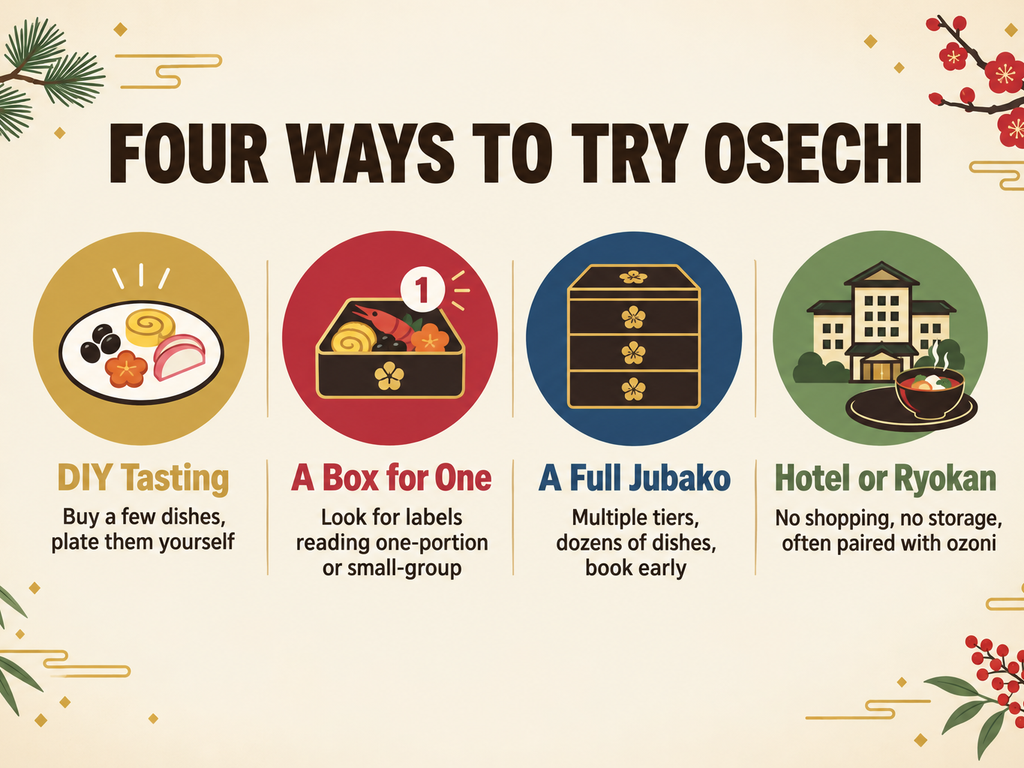
For practical purposes, travelers have four workable ways to experience osechi. Your budget, your group size, and your hotel room decide which one fits. Pick the route before you pick the shop.
A Do-It-Yourself Tasting
This is the route I would suggest to most first-time visitors. Instead of chasing a box, you buy four to six individual dishes. Then you arrange them on whatever plates your accommodation provides. You do not normally need a reservation, little goes to waste, and you can build a wide range of flavors.
A Small Box for One or Two People
Single-tier boxes have grown popular as Japanese households shrink. Generally they are easier to manage in a hotel room, and more realistic for one person to finish than a family-size jubako. Look for the labels 一人前 and 少人数用, meaning one portion and for small groups. Isetan’s 2027 early-order lineup, for instance, listed a frozen individual-portion set with hors d’oeuvres at ¥17,820.
A Complete Traditional Jubako
This suits families, groups, and anyone chasing the full ritual. You get two or three tiers, dozens of dishes, and a proper celebration table. Because these sell out early, you almost certainly need a reservation. Real refrigerator space matters too, which makes a full box impractical in many standard hotel rooms.
A Hotel or Ryokan New Year Meal
Some hotels and ryokan include osechi in a New Year stay. You skip the shopping, the storage, and the washing up entirely. Often a bowl of ozoni arrives alongside it, which is the warm counterpoint the chilled dishes need. Ozoni may in fact hold the firmer grip on households: one 2005 study of 569 students in Tohoku, surveyed from 1999 to 2004, recorded 78.9 percent eating it yearly against 47.8 percent for osechi. Still, confirm the menu before booking, because New Year plans vary enormously.
Choose your route
No reservation? Build a tasting from individual dishes.
Traveling alone? Search for a single-tier or one-portion set.
Want the full ritual? Reserve a complete box in autumn.
No fridge? Book a hotel or ryokan New Year meal.
Do You Need to Reserve Osechi in Advance?
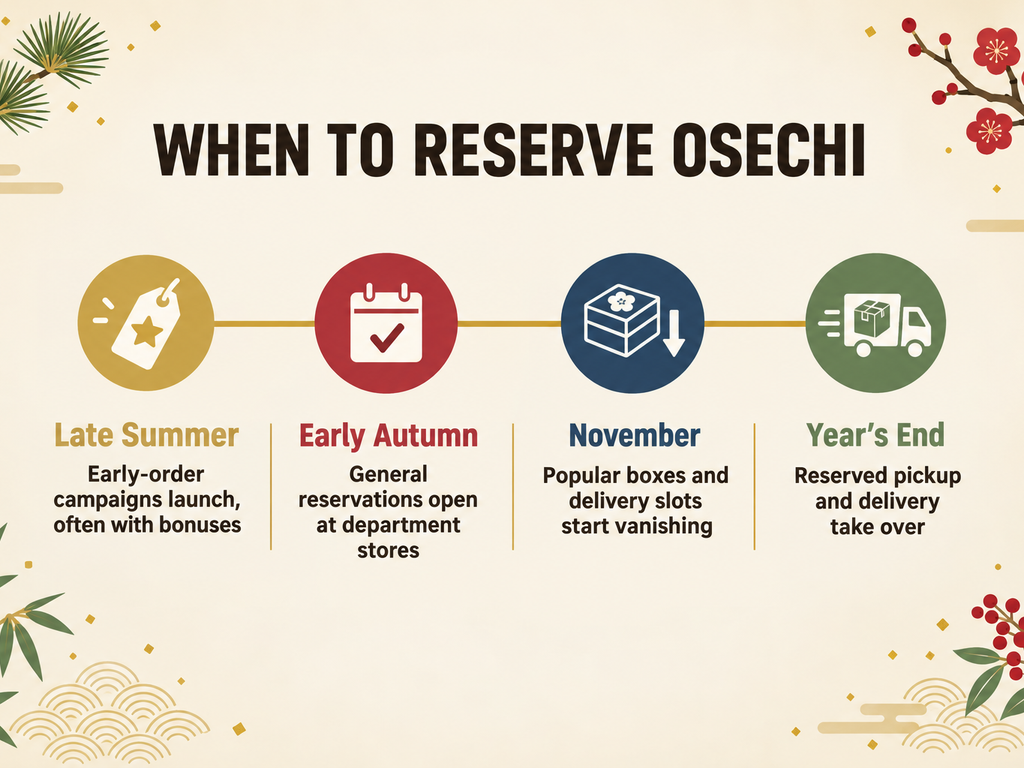
For anything premium, yes. Department store boxes, restaurant-supervised sets, and store-exclusive products run on a reservation calendar that opens in early autumn. Individual dishes and small supermarket packs, by contrast, need no reservation at all. So the answer depends entirely on which route you chose above.
The Reservation Calendar
Take the 2027 New Year season as an example. Isetan Mitsukoshi opened an early-reservation campaign on September 9, 2026. Mitsukoshi then began general reservations on September 23, and Isetan followed on September 30. December is therefore the tail end of the season, not the start.
Late August to September: early-order campaigns appear, often with point bonuses.
September to October: department stores and convenience chains open general reservations.
November: many products remain available, although popular boxes and preferred delivery slots can begin selling out.
Early December: deadlines arrive, and choice narrows quickly.
December 29 to 31: most activity shifts to delivery and reserved pickup, while some stores also offer limited walk-in assortments.
Dates shift every year, so read this as a rhythm rather than a schedule. Always check the retailer’s own page for the current season.
2027 Season Update
Checked September 2026
Early campaign: Isetan Mitsukoshi opened early orders on September 9, 2026.
Mitsukoshi: general reservations from September 23, 2026, with the full lineup shown from September 16.
Isetan: general reservations from September 30, 2026, with the full lineup shown from September 23.
Pickup change: Isetan Shinjuku online orders now ship by delivery only.
Delivery areas: chilled boxes often cover Kanto only, while frozen boxes ship nationwide.
Retailers revise these rules annually, sometimes with little notice. Before you plan around any date above, open the retailer’s own osechi page and confirm.
Hurdles Visitors Run Into
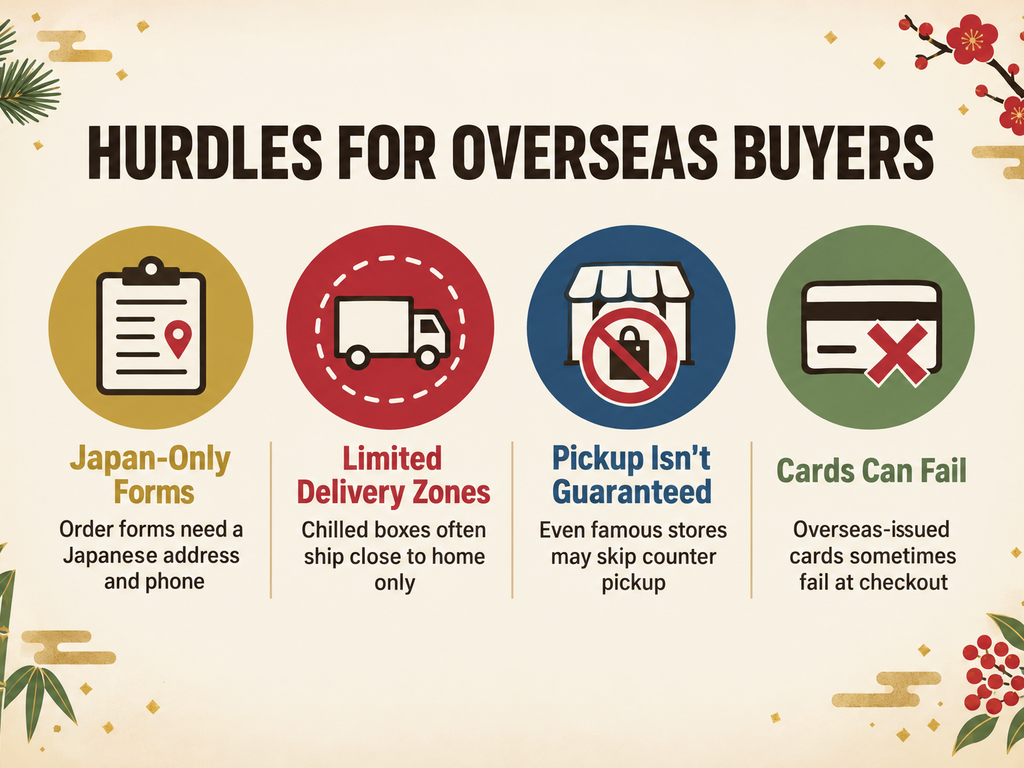
Reserving from overseas, or even from a hotel, gets complicated quickly. Several practical barriers catch people out.
Normally, order forms require a Japanese address and phone number.
Chilled boxes often ship to a narrow region only.
Often, retailers require free membership registration before checkout.
Store pickup is not always an option, even at famous stores.
Hotels may decline refrigerated food deliveries.
Further, overseas-issued cards sometimes fail at Japanese checkout pages.
Two real examples show how uneven the rules are. Isetan announced that from the 2027 season, online osechi orders at the Shinjuku store go out by delivery only, so counter pickup has ended. Meanwhile, Mitsukoshi’s Nihombashi chilled osechi covers Tokyo plus seven neighboring prefectures, while frozen products ship nationwide instead. Daimaru Matsuzakaya tags each product too, with notes such as nationwide delivery and no store pickup. Read those tags before you fall for a photograph.
Where to Buy Osechi in Japan
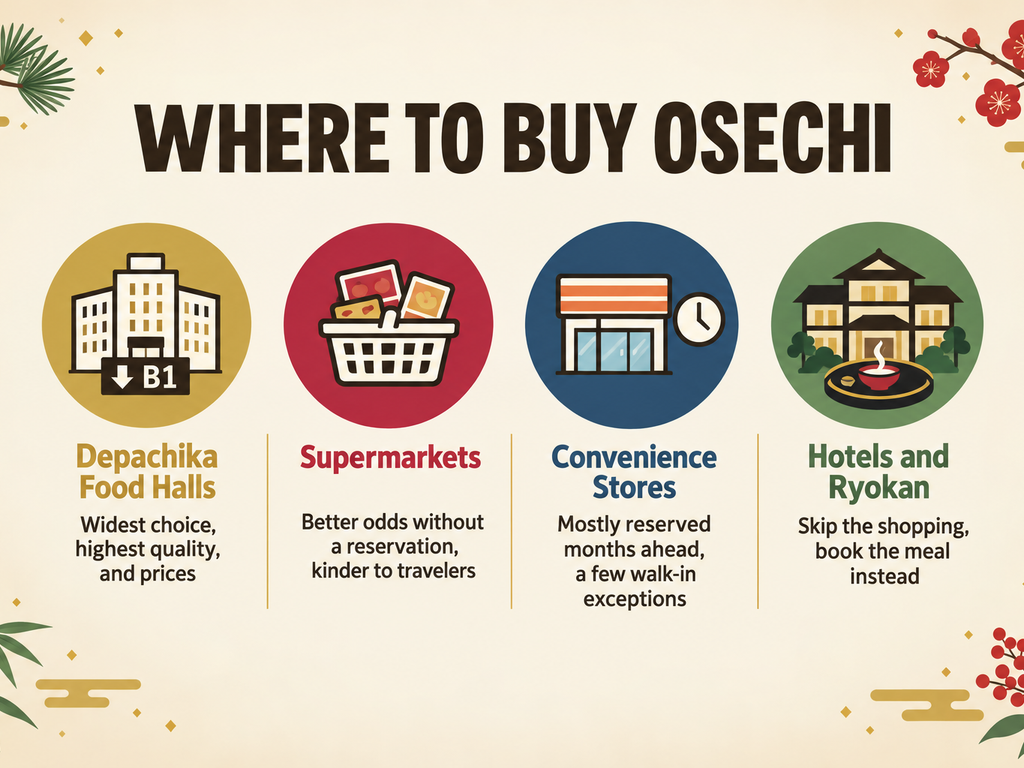
Department store food halls give you the widest choice, and large supermarkets give you the best odds without a reservation. Convenience stores mainly hand over boxes that customers ordered months earlier. Hotels and ryokan remove the shopping problem altogether. Naturally, each option behaves differently during the final days of December.
Department Store Food Halls
Depachika, the basement food halls, let you compare many brands in one stop. You may also find individual New Year dishes sold in small packs, fixed portions, or deli-counter assortments. Quality runs high, though prices do too. Crowds build through the afternoon, so arrive soon after opening on December 30 or 31.
One warning matters here. Reserved-pickup counters and walk-in counters often sit side by side, which confuses visitors constantly. If a display looks unavailable, simply ask before queuing.
Supermarkets
Honestly, supermarkets suit travelers better than department stores do. Prices tend to be lower, portions tend to be smaller, and many larger branches expand their selection of individual New Year dishes during the final days of December. Small urban stores stock far less, so size matters. Look for these items in particular.
Small cups of sweet black soybeans, usually near the chilled deli
Sliced datemaki, the sweet rolled omelet
Red and white kamaboko fish cake
Kohaku namasu, a sweet vinegared salad
Kazunoko, salted herring roe
Kuri kinton, candied chestnut and sweet potato
Small packs of simmered vegetables
Convenience Stores
Major convenience store chains mainly treat complete osechi boxes as advance-order products. For walk-in shoppers, individual seasonal foods are far more realistic than a full box. Lawson, for example, takes reservations months ahead and hands boxes over on December 30 or 31, from 2pm onward.
One useful exception exists. Lawson Store 100 put an unreserved range called 選べるおせち on shelves from December 25, 2025, with 43 single-dish items to mix and match. That format backs up the DIY tasting idea neatly. However, note the conditions: regular Lawson and Natural Lawson branches did not carry it, quantities were limited, ranges differed by store, and nothing guarantees a repeat next season.
Hotels and Ryokan
If you would rather not carry food around Tokyo, book the meal instead. Many properties run New Year plans from December 31 to January 2. Ask these questions before you commit.
Does the New Year breakfast actually include osechi and ozoni?
Is the meal inside the plan price, or billed separately?
Can the front desk refrigerate a food box for me?
Is there a freezer anywhere in the guest room?
Will the hotel accept a chilled delivery before check-in?
Your Last-Minute Osechi Plan
Arrived in Japan with no reservation and three days left? Work through these six steps in order.
Six steps, no reservation needed
Check the year-end opening hours of a large department store or supermarket.
Go on December 30, or early on December 31.
Ask staff which New Year foods are available without a reservation.
Scan labels for 一人前, 少人数用, 一段重, and single dishes.
Confirm whether each item is chilled, frozen, or shelf-stable.
Buy only what your accommodation can store safely.
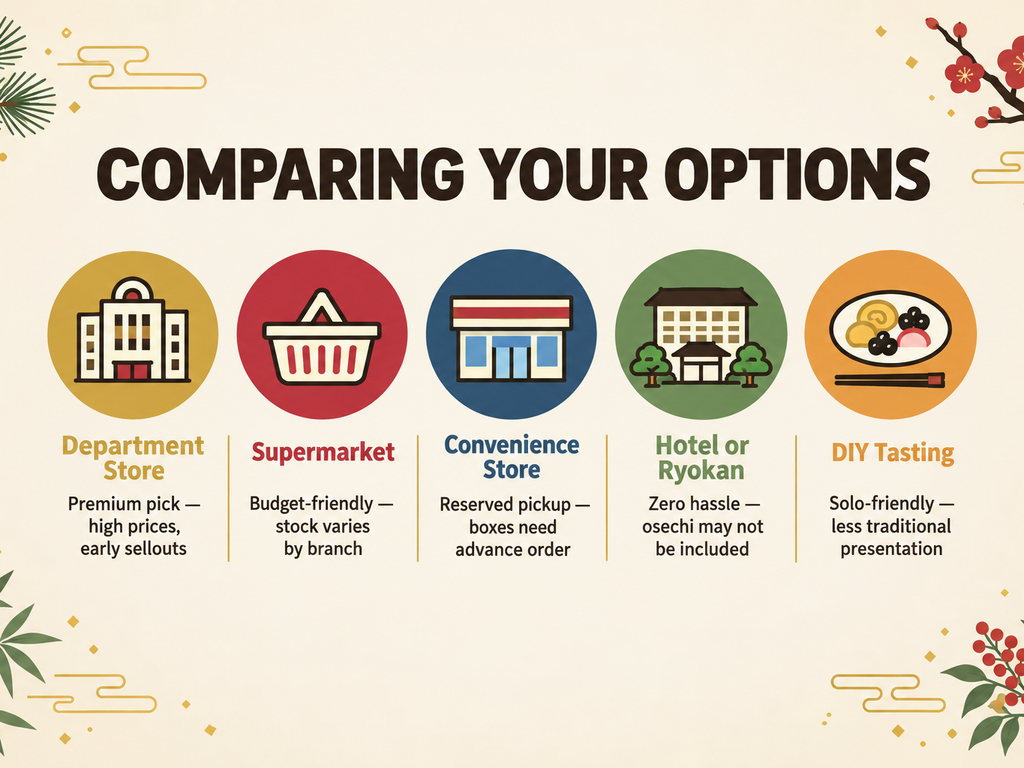
Comparing Your Options Side by Side
Option
Best for
Reservation
Typical buy
Main risk
Department store
Premium experience
Usually needed
Full box or small assortment
High price, early sellouts
Supermarket
Budget and flexibility
Not needed for single dishes
Small packs, single foods
Stock varies by branch
Convenience store
Reserved pickup
Needed for boxes
Single New Year foods
Full boxes are usually reservation-only
Hotel or ryokan
Zero hassle
Usually required
New Year breakfast, dinner, or buffet
Osechi may not be included
DIY tasting
Solo travelers
None
Four to six single dishes
Less traditional presentation
No single row wins for everyone. Still, if you are reading this in late December without a reservation, the last two rows are your friends.
How Much Does Osechi Cost?
Osechi ranges from about ¥1,000 for a do-it-yourself tasting to ¥30,000 or more for a premium family box. Portion size, ingredients, the supervising restaurant, the presentation, and chilled or frozen packing all move the figure. Because that spread is so wide, decide your budget before you walk in.
Rough price bands
DIY tasting, four to six dishes¥1,000 – ¥3,000
Supermarket assortment pack¥2,000 – ¥6,000
Single-tier or one-person box¥5,000 – ¥15,000
Standard family box¥15,000 – ¥30,000
Premium department store box¥30,000 and up
Real 2027 listings show that spread clearly. Daimaru Matsuzakaya listed a two-person, two-tier box at ¥11,880 and a frozen two-tier at ¥12,960. Isetan’s early-order frozen range ran from ¥24,300 to ¥36,720, while one original three-tier box reached ¥59,400. A six-dish tasting, meanwhile, often comes together for ¥1,000 to ¥3,000, depending on the store and your choices.
Should Travelers Buy Chilled, Frozen, or Individually Packed Osechi?
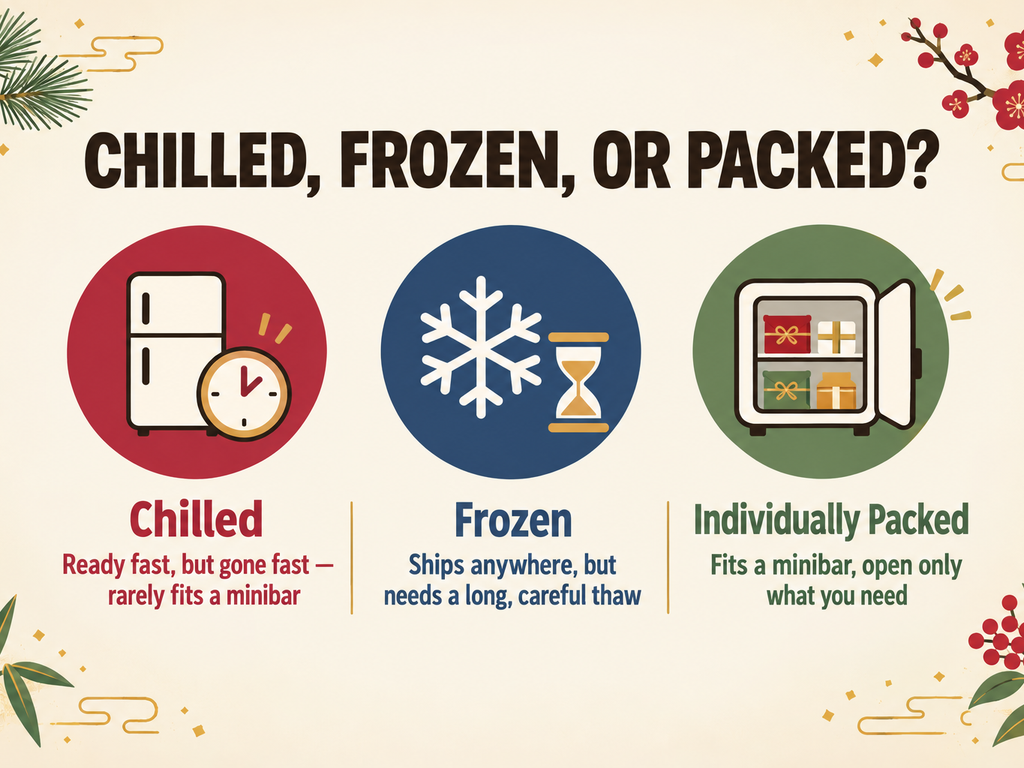
Individually packed osechi is usually easiest for travelers, since it needs less refrigerator space and lets you open only what you plan to eat. Chilled boxes suit same-day meals in a room with a proper fridge. Frozen boxes are hardest, because they demand freezer space and a long, controlled thaw.
Chilled Osechi
Chilled boxes arrive ready to eat, which feels convenient. However, the use-by window is short, often only a day or two. They are also wide, and a full jubako rarely fits a minibar shelf. Choose this when you plan to eat quickly.
Frozen Osechi
Frozen products ship nationwide, so they solve the delivery-area problem neatly. The catch is thawing. Makers usually specify many hours in a refrigerator, and most hotel rooms offer neither a freezer nor the space. Follow the maker’s instructions too, including any warning against refreezing after thawing.
Individually Packed Dishes
For many travelers, this is the easiest option. Small sealed packs are more likely to fit a minibar than a full jubako, and you can open only the portions you intend to eat, which may reduce waste. Some shelf-stable packs need no refrigeration until opening. Storage conditions and use-by dates still differ by product, so read each one.
Read the date, not the guess
Japan uses two date labels. 消費期限 marks a safety deadline on perishable food, while 賞味期限 marks best quality. MAFF explains that the printed date generally assumes an unopened package stored as directed. After opening or thawing, follow any separate instructions and eat the food promptly.
Is Osechi Always Eaten Cold?
Mostly, yes. Most osechi dishes arrive chilled, or come closer to room temperature before serving. Kazunoko, namasu, and kamaboko normally go onto the plate without any reheating.
Some people prefer selected meat, fish, or simmered vegetable dishes gently warmed, though. If the label permits reheating, transfer only that portion to a microwave-safe plate. Do not microwave the jubako unless the packaging states that the container is microwave-safe. Traditional lacquerware and boxes with metallic decoration must never go into a microwave. Frozen products follow their own thawing instructions instead.
How to Store Osechi in a Hotel Room
Measure the fridge before you buy anything, because hotel refrigerators are built for drinks rather than for a 30-centimeter lacquer box. Individually sealed dishes and small chilled assortments travel best. Large frozen boxes rank last for anyone in a standard room. Run this quick check at the shop.
Before you buy: a 60-second check
Measure the box, then measure the fridge shelf.
Confirm whether the product is chilled or frozen.
Look for a freezer compartment, since many rooms lack one.
Read the use-by date, and note the storage temperature.
Finally, ask whether the front desk can hold chilled items.
Check that you have plates and disposable chopsticks.
Vegetarian, Vegan, and Allergy Notes
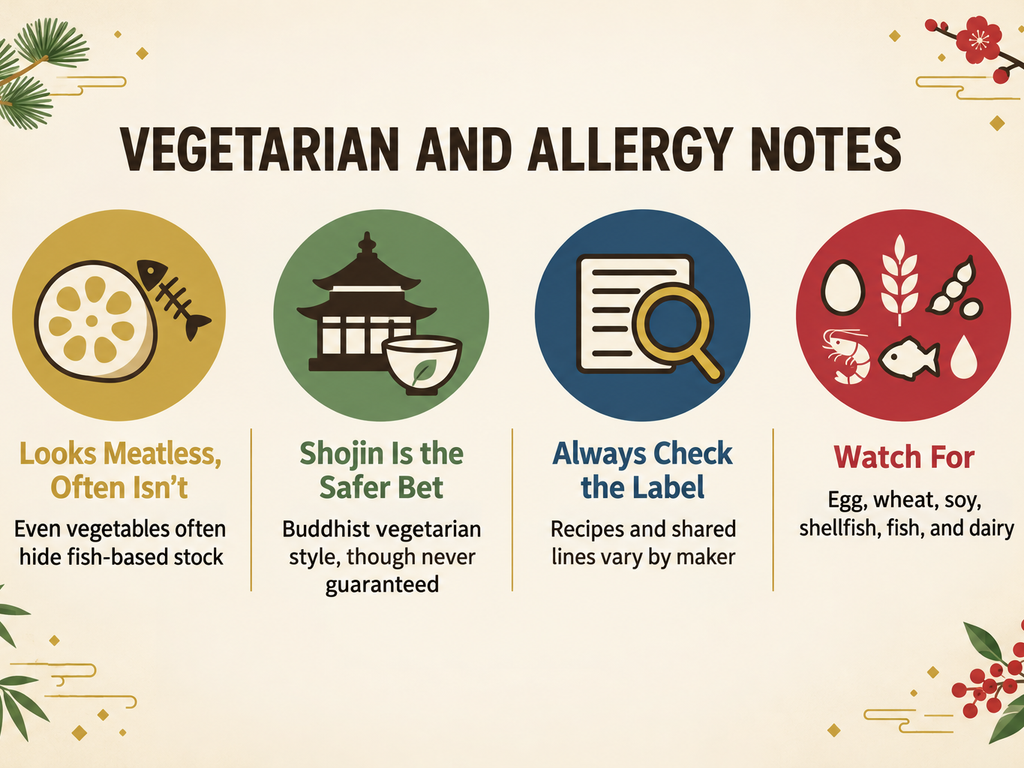
Osechi looks vegetable-heavy, yet appearances mislead. Simmered vegetables may carry bonito or dried sardine stock, even when no fish is visible. Kombu rolls sometimes hide fish inside. Sweet omelets contain egg, obviously, and many colorful items start life as fish paste.
Shojin-style osechi builds on Buddhist vegetarian cooking, so it is more likely to avoid meat and seafood. Even so, commercial definitions, seasonings, and shared production lines vary widely between makers. Vegan travelers should therefore check the full ingredient and allergen panel every time. Search product pages for these terms as well: ヴィーガン, ベジタリアン, 精進おせち, 動物性原料不使用, and 魚介だし不使用. Common allergens here include egg, wheat, soy, shrimp, crab, fish, and dairy in Western-style boxes.
Useful Japanese Phrases for the Counter
Staff are helpful, but December 31 is not the day for long conversations. Short questions work best.
予約なしで買えますか?Yoyaku nashi de kaemasu ka?
Can I buy this without a reservation?
一人前のおせちはありますか?Ichinin-mae no osechi wa arimasu ka?
Do you have osechi for one person?
今日持ち帰れるおせちはありますか?Kyo mochikaereru osechi wa arimasu ka?
Is there any osechi I can take home today?
これは冷蔵ですか、冷凍ですか?Kore wa reizo desu ka, reito desu ka?
Is this chilled or frozen?
いつまでに食べればいいですか?Itsu made ni tabereba ii desu ka?
When should I eat this by?
魚の出汁は入っていますか?Sakana no dashi wa haitte imasu ka?
Does this contain fish stock?
温めても大丈夫ですか?Atatamete mo daijobu desu ka?
Is it safe to heat this up?
Frequently Asked Questions About Buying Osechi
Buying Without a Reservation
Can tourists buy osechi without a reservation?
Often yes, though rarely as a complete multi-tier box. Department store food halls and supermarkets sell individual New Year dishes and small assortments in the final days of December. Single-portion boxes sometimes remain on the shelf too. Arrive early, because stock thins out through the afternoon.
Where should I look for osechi on December 31?
Head for a large department store food hall or a big supermarket. Both stock New Year foods heavily on that day. Check year-end opening hours first, because many shops close earlier than usual. If the boxes have gone, buy single dishes instead.
Portions and One-Plate Osechi
Can I buy osechi for just one person?
Yes, and the choice keeps growing. These days retailers list single-tier boxes, one-portion sets, and small-group products, including frozen sets that pair individual portions with hors d’oeuvres. Alternatively, assemble your own tasting from four to six supermarket packs.
What is one-plate osechi?
It is a serving style rather than a separate dish. Several New Year foods sit in individual portions on one plate, instead of being shared from a stacked jubako. Japanese households adopted it as box-free, small-portion eating grew more common. For travelers, it turns a hotel plate into a workable New Year table.
Can I order one-plate osechi at a restaurant?
Sometimes, though rarely as a standing menu item. Hotels and cafes may serve an osechi plate during the first few days of January, often for guests only or by advance booking. Outside that window, it disappears. Because venues publish these menus only in November or December, check the current New Year announcement before making the trip.
Storage, Diet, and Serving
Does osechi need refrigeration?
It depends entirely on the product. Chilled boxes need a cold fridge, while frozen ones need freezer space and a long thaw. Some individually sealed dishes keep at room temperature until you open them. Follow the storage line on the label rather than a general rule.
Can I store osechi in a hotel minibar?
Sometimes, but measure before buying. Minibar shelves are narrow, and a standard jubako is wide. Some units cool drinks without reaching a safe food temperature. Ask the front desk whether staff can refrigerate the box for you.
Is osechi vegetarian or vegan friendly?
Most traditional osechi is not fully vegetarian or vegan, despite all the vegetables. Bonito or sardine stock may flavor simmered dishes, and fish paste appears in many colorful items. Shojin-style osechi draws on Buddhist vegetarian cooking, so it more often avoids meat and seafood. Even then, check the ingredient and allergen panel, because recipes and production lines vary.
Should I heat osechi before eating it?
Usually not, since most dishes taste right chilled or near room temperature. Some people warm selected meat, fish, or simmered vegetables gently. If the label permits reheating, move only that portion onto a microwave-safe plate. Leave the lacquer box out of the microwave, and thaw frozen products exactly as the maker specifies.
Conclusion
Osechi does not have to mean a ¥30,000 box or months of planning. A few carefully chosen dishes still carry the essence of the tradition: sweetness for celebration, bright vinegar for contrast, seafood for abundance, and foods shaped by wishes for the coming year.
Choose a portion you can finish, follow the storage label, and add a warm bowl of ozoni if you can. Pair it with toshikoshi soba on New Year’s Eve, and the holiday reads as a sequence rather than a single meal. The goal is not to reproduce a formal Japanese family table perfectly. Rather, it is to join the New Year ritual, one small dish at a time.
Ryo Iwa is the founder and editor of foodinjapan.org. Born and raised in Japan, he writes from regional travel, market visits, and Japanese-language primary sources that rarely reach English readers, including brewing institute publications and industry glossaries. Where a figure cannot be traced to a source, the article says so.
He has been a Google Maps Local Guide for over 10 years, with more than 1,800 reviews and over 41,000 photos viewed hundreds of millions of times. He previously spent two decades as an IT consultant in Japan, the US, and the UK.














Comments