


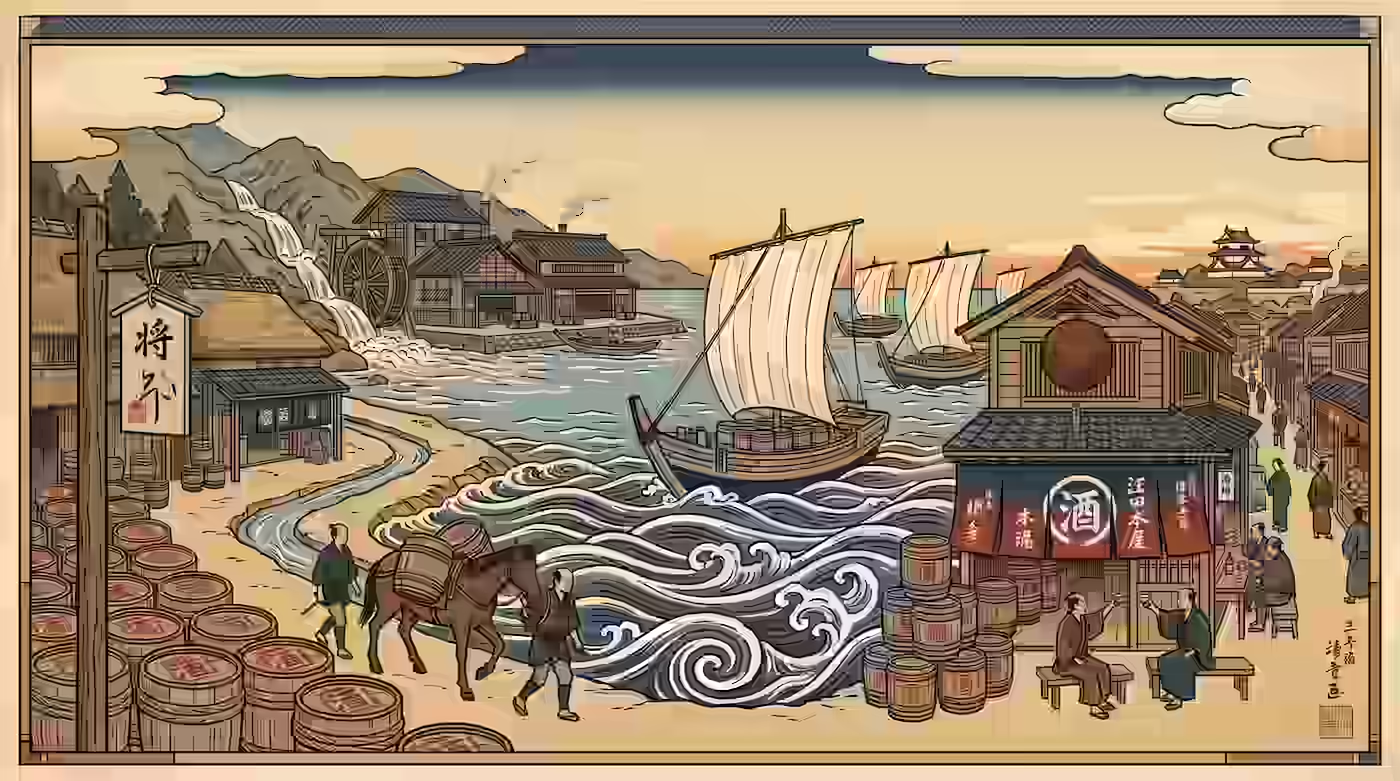

In 1697, roughly 640,000 casks of sake arrived in Edo by sea. Almost none of it came from Nada, although that district later dominated Japanese brewing. Edo period sake is not really a story about better brewing, since most of the key techniques already existed by 1600. What changed was everything around them.
That leaves two questions. How did Japan build a system capable of supplying 640,000 casks to one city? And why did Nada, absent from that trade in 1697, end up controlling it? This article follows licences, rice policy, seasonal labor, shipping fleets, and wholesalers to answer both.
What Was Edo Period Sake?
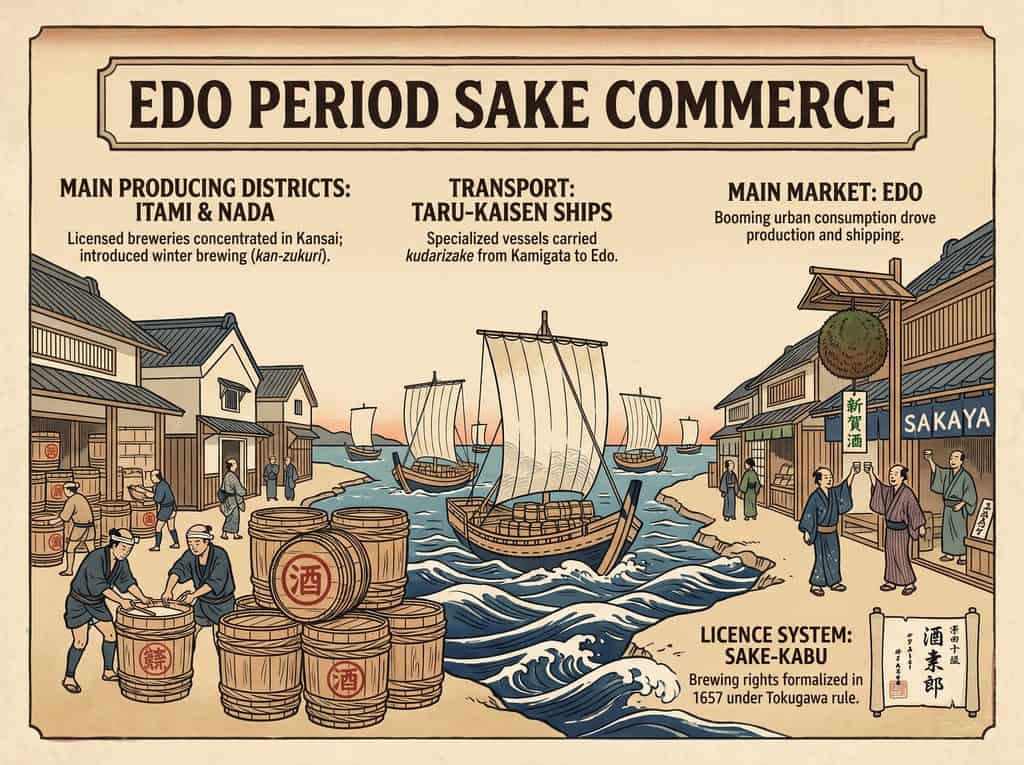
Edo period sake refers to sake brewed in Japan between 1603 and 1868, under Tokugawa rule. For the Edo market, production increasingly centered on licensed commercial brewers in and around the Kansai region. Regulation, winter brewing, and long-distance shipping developed alongside that concentration.
- Period
- 1603 to 1868, the Tokugawa or Edo period.
- Licence System
- Sake-kabu (酒株), brewing rights formalized in 1657.
- Main Producing Districts
- Itami and Ikeda early on, then Nada from the eighteenth century.
- Main Market
- Edo, supplied with kudarizake shipped from the Kamigata region.
- Transport
- Higaki-kaisen mixed cargo ships, then taru-kaisen built around cask freight.
- Brewing Season
- Increasingly restricted to winter, the practice known as kan-zukuri.
- Key Text
- Dōmō Shuzōki, a brewing manual traditionally dated to 1687.
One term recurs throughout this article. A koku is an old volume measure of roughly 180 liters, used for both rice and sake, and Edo regulation counted almost everything in it. None of these systems appeared at once. Before looking at the industry, we first need to see what brewers already knew in 1600.
What Sake Was Already Like in 1600
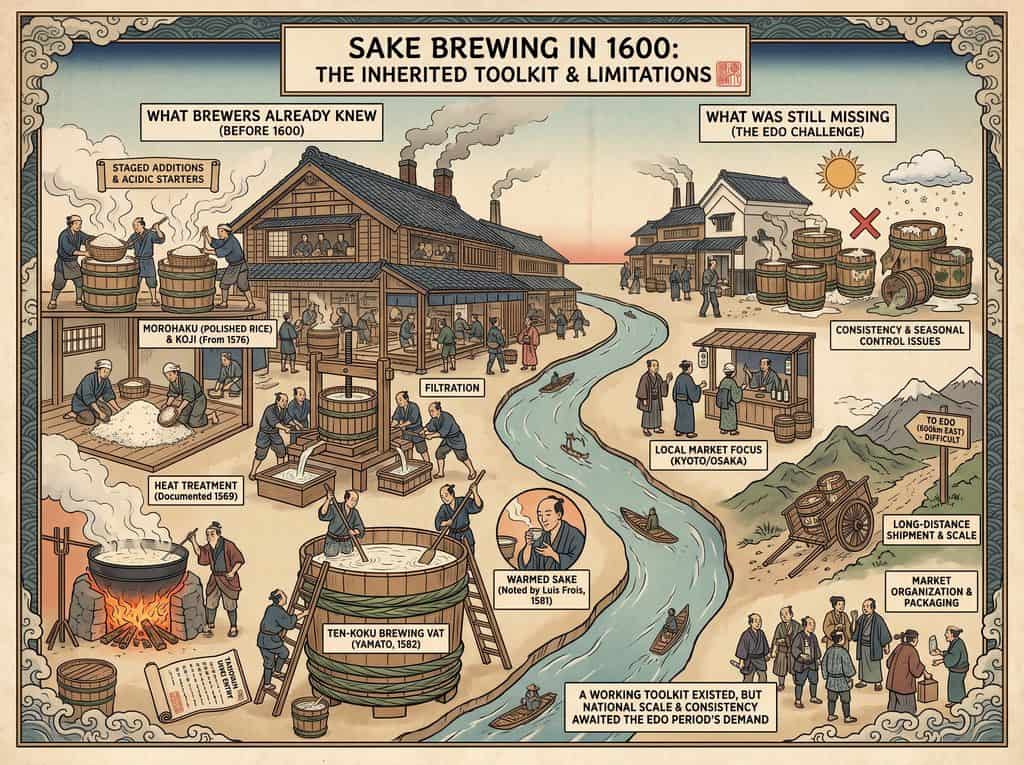
Still, Edo did not invent modern sake from scratch. Plenty of popular accounts skip straight from “rice wine” to “Edo perfection” without pausing, and that leap loses the real story.
What Brewers Already Knew
The National Tax Agency’s chronology of traditional koji-based brewing places several milestones before 1600. A 1569 entry in the Tamon’in Nikki appears to describe heat treatment. The word morohaku, meaning polished rice for both koji and mash, shows up from 1576. By 1582, a ten-koku brewing vat was in use in Yamato, now Nara Prefecture.
Medieval temple and commercial brewers had already developed acidic starters, staged additions, filtration, and heat treatment. These did not all mature at the same moment, yet by 1600 a brewer inherited a working toolkit rather than a blank sheet. A 1581 account by the Jesuit missionary Luís Fróis even notes that Japanese people warmed their sake.
What Was Still Missing
Consistency was one weak point, since brewing ran across several seasons and warm-weather batches proved hard to control. Scale was another.
Sake could travel before 1600, but regular high-volume shipment over long distances remained difficult. Preservation was only one problem. Packaging, credit, freight, and market organization all mattered too, and none of them yet existed at the scale a national market would demand.
There was no obvious reason to solve those problems either. Kyoto and Osaka were the great consumer cities of the age, and they sat close to the brewing districts. Only when a new capital appeared six hundred kilometers to the east did long-distance supply become worth the trouble.
Why Edo Created Such a Huge Market
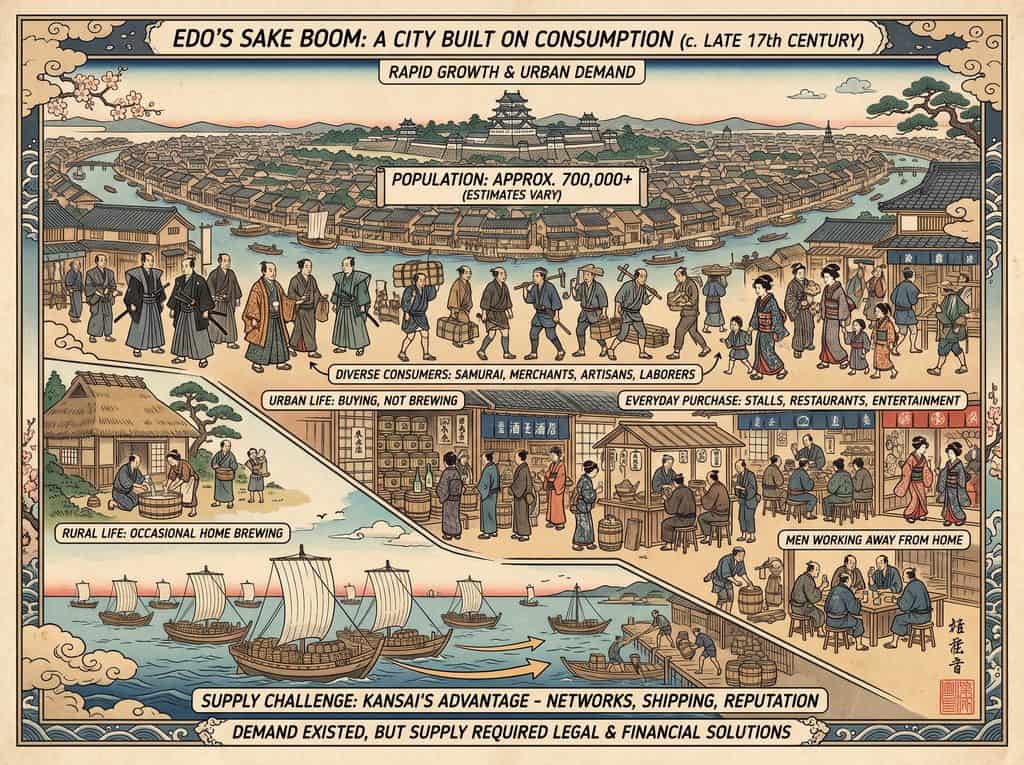
Demand came first, and production followed.
A City Built on Consumption
Edo then grew extraordinarily fast after 1603. Research on the Genroku-era sake trade treats it as a consumer market of roughly 700,000 people by the late seventeenth century. Estimates vary a great deal by year and by which districts are counted, so treat any single figure with care.
The composition mattered as much as the size, though. Samurai on stipends, merchants, artisans, laborers, and servants all lived in the city, and most of them bought their food rather than growing it.
Why Urban Life Meant Buying
Rural households typically brewed a little for themselves and for festivals. City households could not, because they lacked the rice, the space, and eventually the legal right. They bought instead.
Add the sheer number of men working away from home, plus food stalls, restaurants, and entertainment districts. Sake stopped being occasional and became an everyday purchase. Yet Edo’s growth did not automatically favor Kansai sake. That advantage came from existing brewing reputations, merchant networks, and reliable shipping routes, all of which had to be built.
So demand existed. The harder question was who could legally and financially supply it.
From Local Brewing to Commercial Brewing Houses
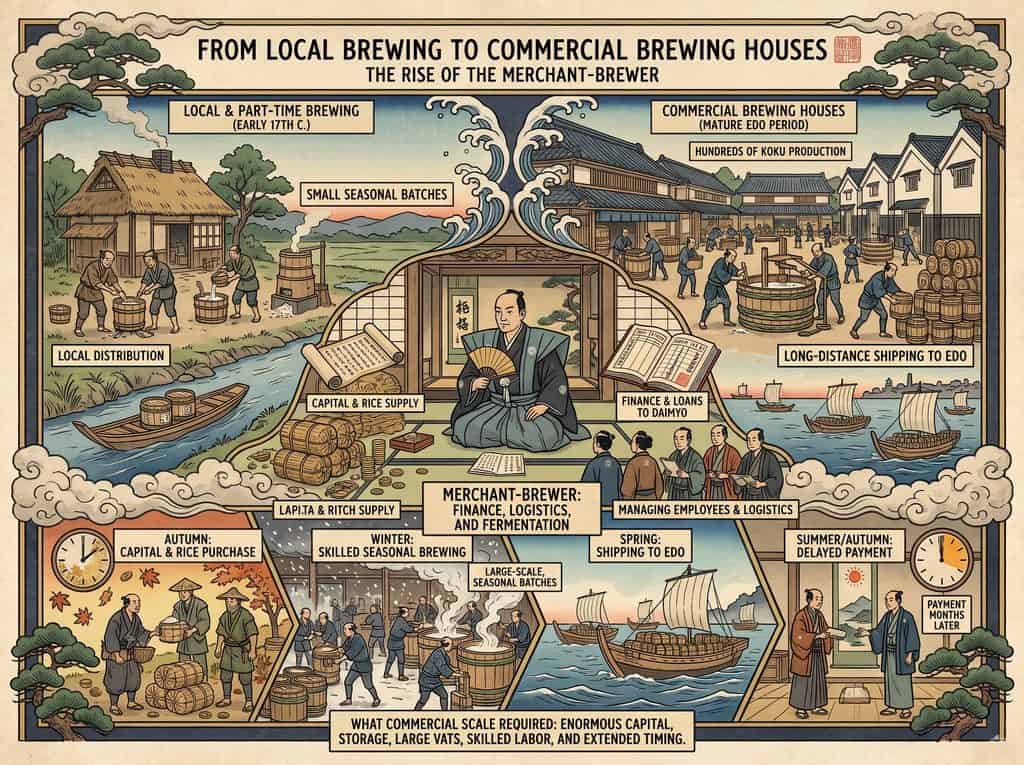
It is tempting to picture a modern kura when reading about seventeenth-century producers. Yet that image is misleading.
Merchant-Brewers, Not Just Brewers
Later records from the Shibata family show what a mature Edo-period brewing house could become. Held by Kobe City Archives, they cover a business active from 1736 to 1929, and they record far more than brewing. The family arranged rice supply, managed employees, organized shipping, and lent money, including loans to domain lords.
So “brewery” undersells these operations. Merchant-brewer fits better, since finance and logistics sat alongside fermentation.
What Commercial Scale Required
Because a house bought hundreds of koku of rice before selling a single cask, capital mattered enormously. Storage buildings, large vats, and casks added still more. Skilled seasonal workers, carters, boatmen, and wholesalers followed at each stage.
Timing then sharpened the problem. Rice was bought in autumn, brewing ran through winter, and payment for cargo sold in Edo might arrive months later. In the major Edo-bound districts, production therefore concentrated in houses able to finance large seasonal batches. Small and part-time brewing continued elsewhere.
Sake-kabu: The Brewing Rights System
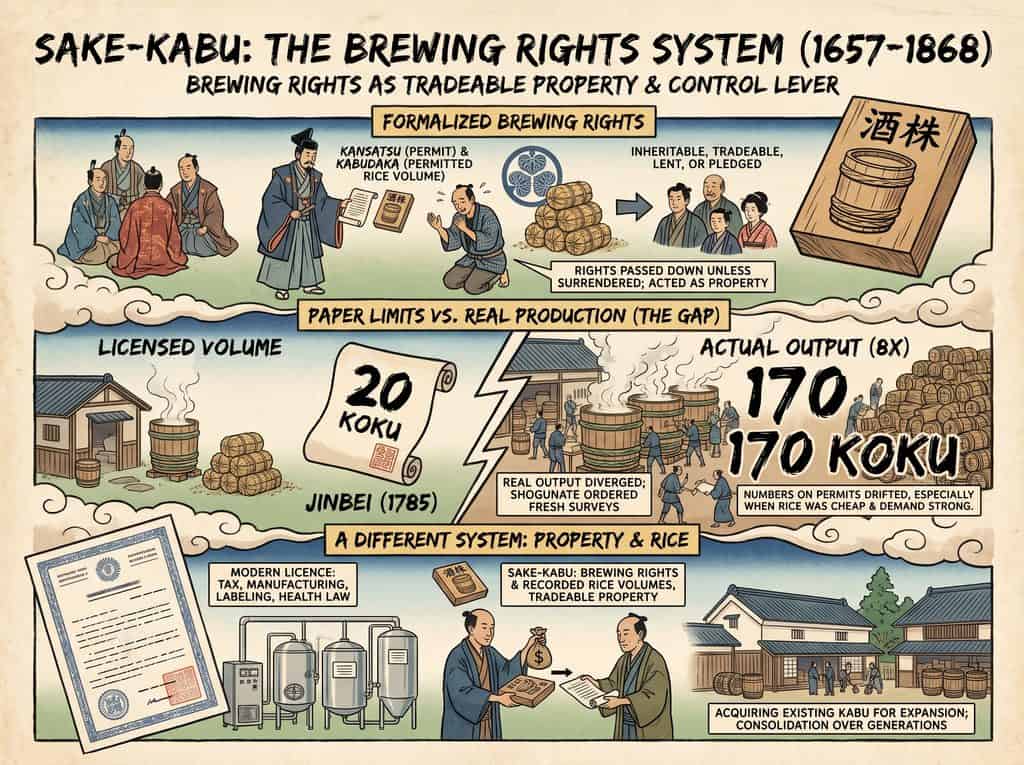
Sake-kabu (酒株) is usually translated as a brewing licence. The translation works, although it hides some important differences.
How the System Worked
So in 1657 the shogunate formalized brewing rights. According to the National Tax College, approved operators received a brewing permit, the kansatsu, which recorded a kabudaka: the permitted volume of brewing rice. That figure became the control lever for the whole industry.
Rights also passed down through families unless surrendered. They could be transferred, lent, or pledged as security. Village documents from Ikeda likewise include deeds of transfer, perpetual assignments, and loan agreements involving brewing rights, which shows how thoroughly they behaved as property.
Paper Limits Versus Real Production
A telling gap, recorded in 1785
The National Tax College cites a reply submitted by a brewer named Jinbei, from Minami-Imaichi village in Yamato Province. His registered kabudaka was 20 koku of brewing rice. His actual use came to around 170 koku, roughly eight times the permitted figure. Licensed volume and real output clearly diverged in practice, which is one reason Edo-period statistics need careful handling.
That gap explains why the shogunate kept ordering fresh surveys. Numbers on permits drifted away from what brewers actually did, especially when rice was cheap and demand was strong.
A Different System, Not an Early Licence
A modern licence operates within national tax, manufacturing, labeling, and public-health law. Sake-kabu belonged to a different system, centered on brewing rights and recorded rice volumes. It also worked as inheritable, tradeable property with real market value.
In periods when new rights were restricted, acquiring or leasing existing kabu became one route to expansion. Established houses could consolidate quietly over generations as a result.
Rice, Taxation, and Alcohol Policy
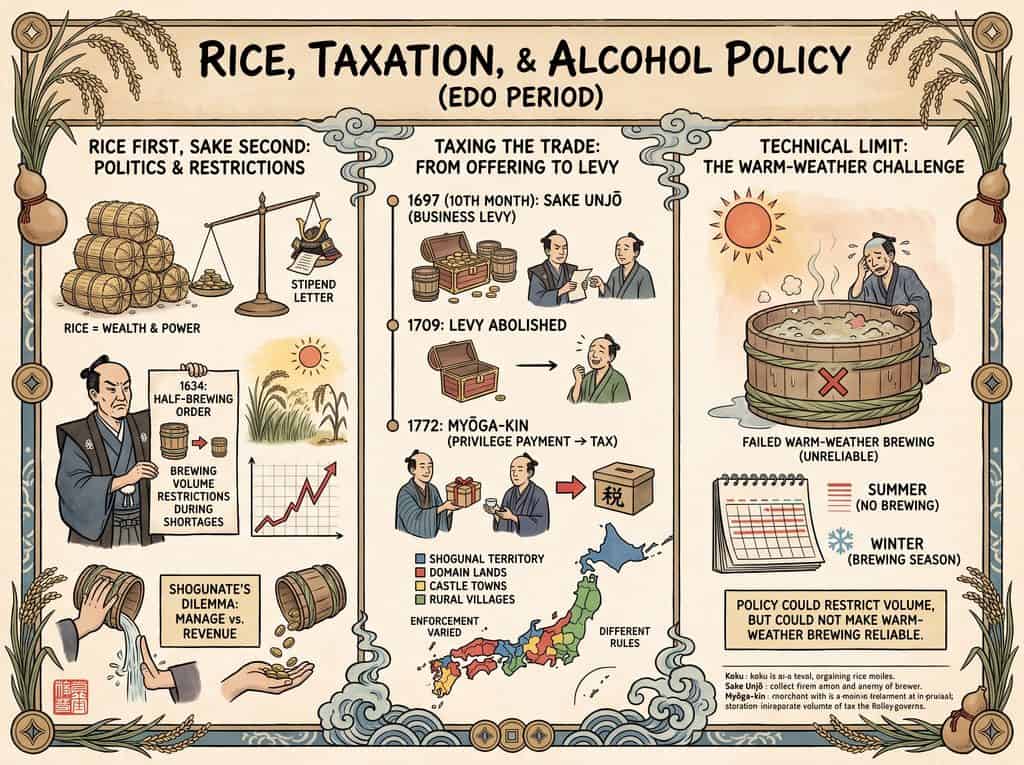
Nearly every regulation in this section leads back, in the end, to rice.
Rice First, Sake Second
Domains assessed wealth in rice and commonly based samurai stipends on rice values. Brewing therefore remained politically sensitive, especially during shortages and price rises. In 1634, a half-brewing order cut permitted volumes, and similar restrictions recurred throughout the period.
Yet the shogunate never simply banned the trade. It tried to manage an activity it also drew revenue from, which is a rather different proposition.
Taxing the Trade
In the tenth month of 1697, the shogunate imposed the sake unjō, a levy on brewing businesses. It abolished that levy in 1709, then revived a charge in 1772 as myōga-kin. Originally a payment offered in return for privilege, myōga gradually took on the character of a tax.
Policy therefore swung back and forth rather than tightening steadily. Enforcement varied as well, since shogunal territory, domain lands, castle towns, and rural brewing villages did not experience the same rules in the same way.
The shogunate could restrict how much brewers made. It could not make warm-weather brewing reliable.
Why Winter Brewing Became the Standard
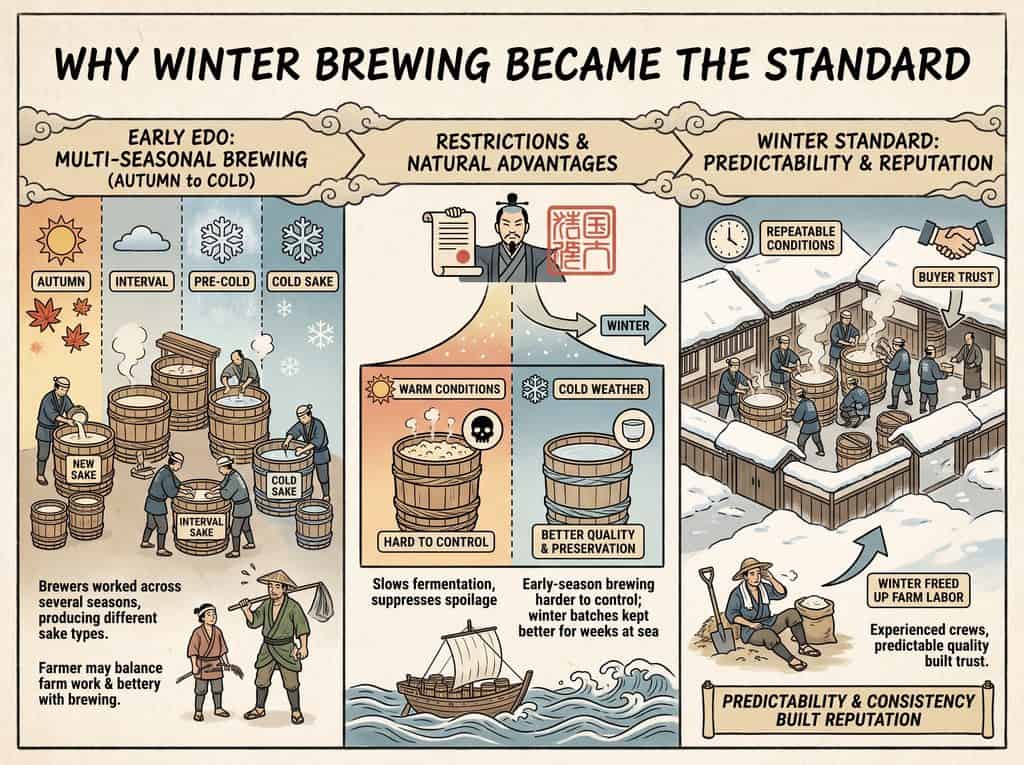
Early Edo brewers, however, still worked across several seasons. Manuals distinguish new sake brewed after the autumn equinox, then interval sake, pre-cold sake, and finally cold sake.
Restrictions Narrowing the Season
From the late seventeenth century, repeated orders narrowed the permitted brewing season. Autumn brewing came under restriction first, while later measures pushed production further into the cold months. Published dates for these orders differ between sources, so this article avoids pinning them to a single year.
Why Cold Weather Won
Low temperatures also slow fermentation and suppress spoilage organisms. Warm conditions made early-season brewing harder to control, and contemporary writers often ranked cold-season sake more highly. Winter batches also kept better, which mattered enormously when cargo faced weeks at sea.
A narrower season made working conditions more repeatable and encouraged experienced crews to return together. Predictability, rather than any single technique, is what let a brewing house build a reputation that buyers could trust. Winter also freed up farm labor, and that coincidence shaped the whole workforce.
Toji and Kurabito: A Seasonal Workforce
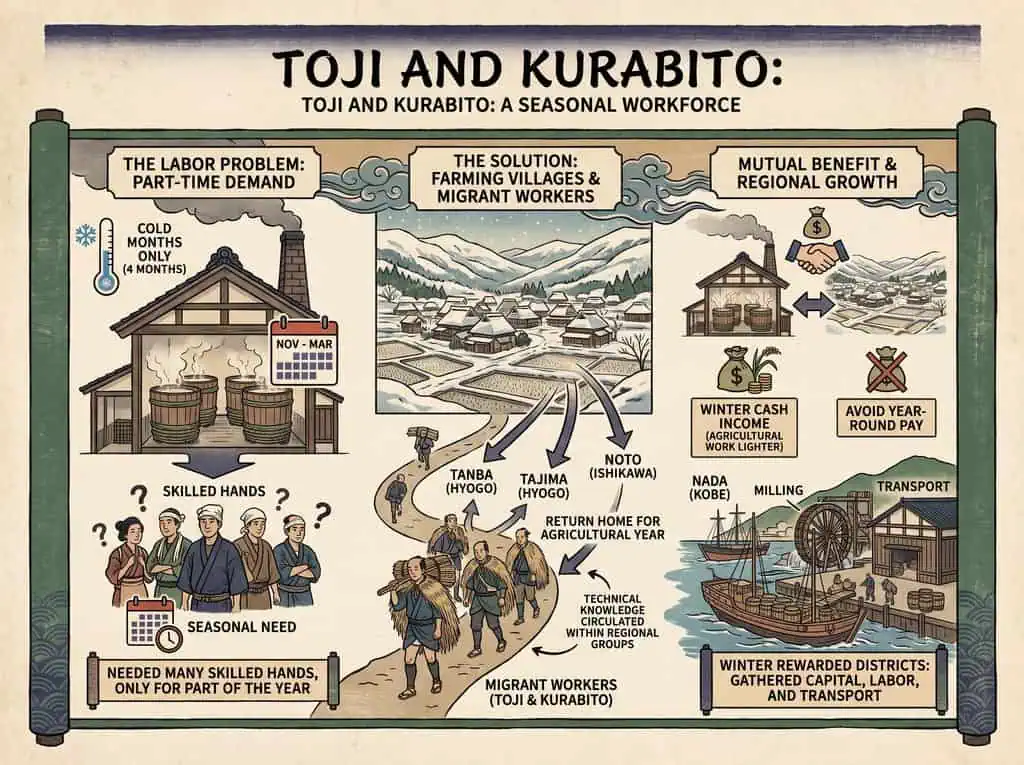
Concentrating production into four cold months created an odd labor problem. Breweries needed many skilled hands, but only for part of the year.
Farming villages, meanwhile, supplied the answer. Men travelled from Tanba and Tajima, in modern Hyogo Prefecture, and from Noto in Ishikawa, to work a brewing season before returning home for the agricultural year. Groups formed around home districts, and technical knowledge circulated within them rather than across the country.
The arrangement suited both sides. Villages gained winter cash income when agricultural work was lighter, while breweries avoided paying a year-round workforce. What existed were regional labor traditions, some of which later developed into recognized toji groups, rather than one national system from the start. You can read more in our guide to the kura.
Distance shaped these links. Tanba lies directly behind the Rokkō range, so its villages could reach the coastal breweries on foot in a day or two. Kobe City Archives treat that migrant labor as one of the structural conditions behind Nada’s growth, alongside milling and transport.
Winter solved part of the brewing problem. It also rewarded districts that could gather capital, labor, and transport in one place.
Itami and Ikeda: The First Edo-Bound Centers
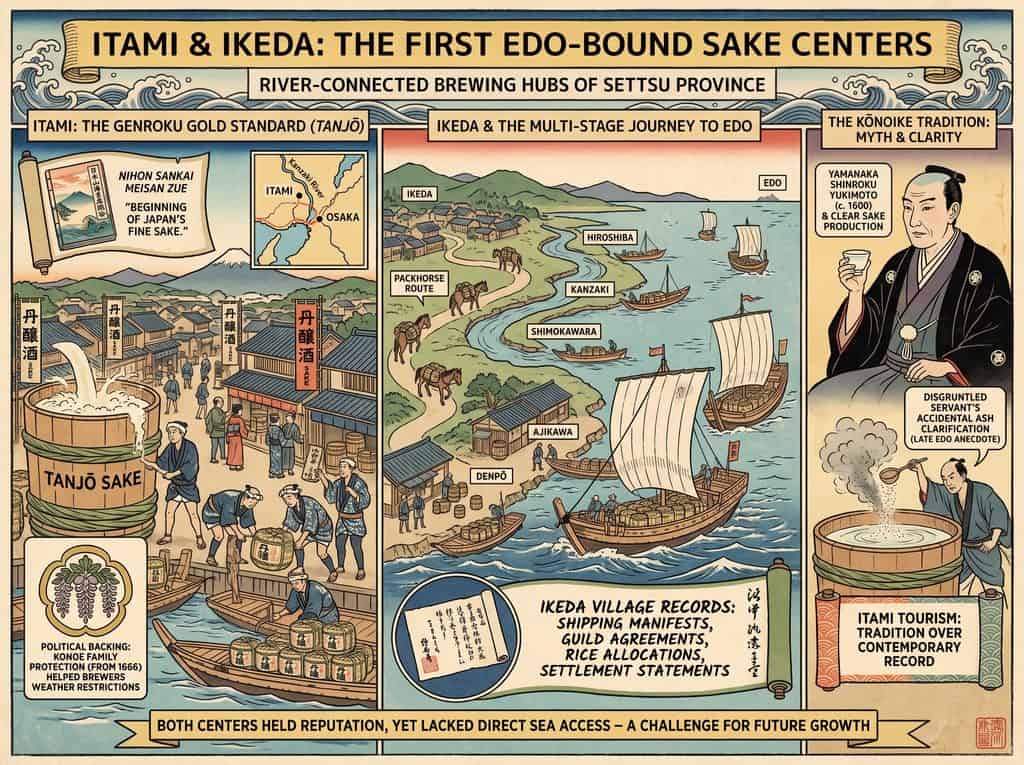
Itami and Ikeda, in Settsu Province across modern Hyogo and Osaka, were among the leading early centers of the Edo-bound trade. Both sat on rivers, so Osaka’s ports lay within reach.
Itami and the Reputation of Tanjō
Itami sake, marketed as tanjō, held the highest reputation during the Genroku era. The late Edo gazetteer Nihon Sankai Meisan Zue called Itami the beginning of Japan’s fine sake. Settsu Meisho Zue describes more than sixty brewing houses there, sending branded straw-wrapped casks to Kanzaki for shipment toward Kanto.
Itami also had a protector. From 1666 the Konoe family held the district, and their support helped local brewers weather restrictions. Brewing declined in several neighboring districts under the same pressures, which suggests that political backing mattered as much as technical skill.
Ikeda and Its Shipping Route
Ikeda brewers shipped by a chain of stages that Ikeda City has documented from village records. Casks travelled by packhorse to Hiroshiba, Kanzaki, and Shimokawara. Small coastal boats carried them onward to Ajikawa and Denpō, where taru-kaisen loaded them for Edo.
Those Ikeda records are unusually rich. They include brewing rice allocation papers, guild agreements, shipping manifests, and settlement statements for cargo sent east, which lets historians reconstruct many stages in a cask’s journey.
The Kōnoike Story, and How to Read It
A famous tale credits Yamanaka Shinroku Yukimoto, of Kōnoike village near Itami, with producing clear sake around 1600. A related anecdote has a disgruntled servant throwing ash into a vat, accidentally clarifying it. Both stories appear in late Edo writings rather than contemporary records, and Itami’s own tourism materials present them as tradition.
Their sake had reputation. What these districts lacked was a brewery door opening almost directly onto the sea.
Nada and the Rise of a New Brewing District
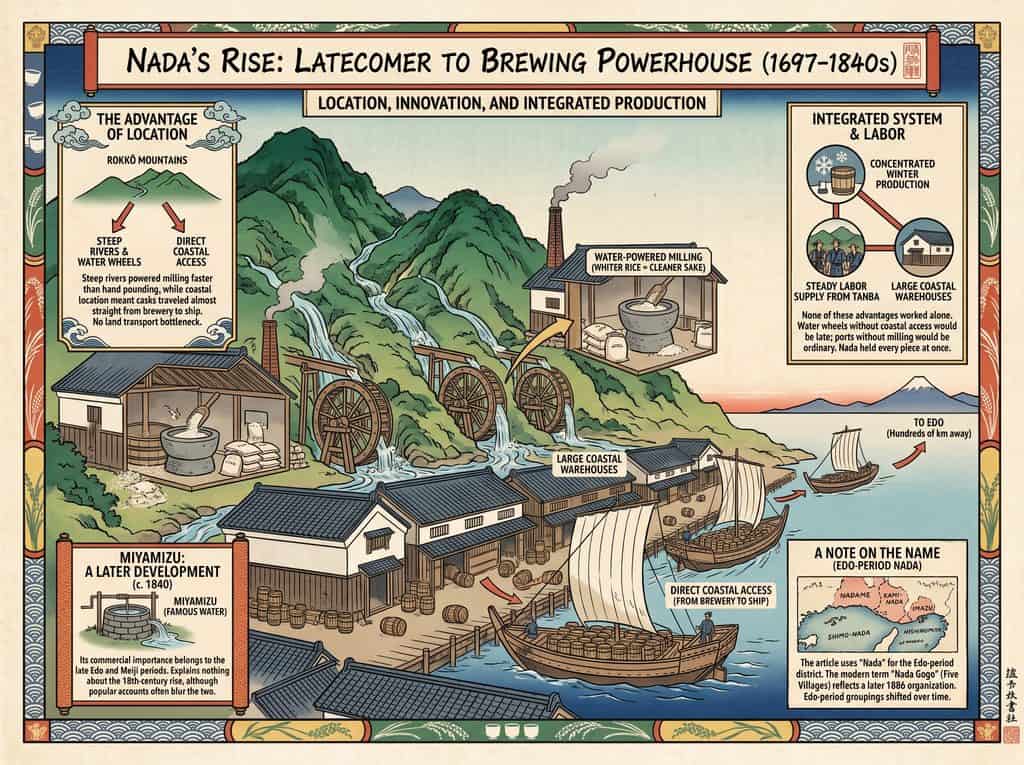
Nada arrived late, yet it then took over. Kobe City Archives record that when about 640,000 casks reached Edo in 1697, Nada sake was not yet among them. By 1724, twenty-six brewing houses in the Nada area were shipping east.
Why Nada Overtook the Inland Districts
Location, above all, did much of the work. Nada sits on the coast, so casks travelled almost straight from brewery to ship. Steep rivers running off the Rokkō mountains powered water wheels, and those wheels drove rice milling faster than hand pounding could manage.
Water-powered milling increased throughput and may have reduced labor costs per unit. Better milling meant whiter rice, and whiter rice meant cleaner sake. Large coastal warehouses, concentrated winter production, and a steady labor supply from Tanba completed the package.
None of these advantages worked alone. Water wheels without coastal access would have produced excellent sake that arrived late, while ports without milling would have shipped ordinary sake quickly. Nada held every piece at once.
Miyamizu Came Later
Miyamizu, Nada’s famous brewing water, is traditionally associated with a discovery around 1840. Its broader commercial importance belongs to the late Edo and Meiji periods. It therefore explains nothing about the district’s eighteenth-century rise, although popular accounts often blur the two.
A Note on the Name
This article deliberately uses “Nada” for the Edo-period brewing district. The modern term Nada Gogo, meaning the Five Villages of Nada, reflects a later regional organization dating from 1886. Edo-period documents instead use names such as Nadame, Kami-nada, Shimo-nada, Imazu, and Nishinomiya, and those groupings shifted over time.
Nada solved production. Edo still lay hundreds of kilometers away.
Kudarizake: Sake Flowing Down to Edo
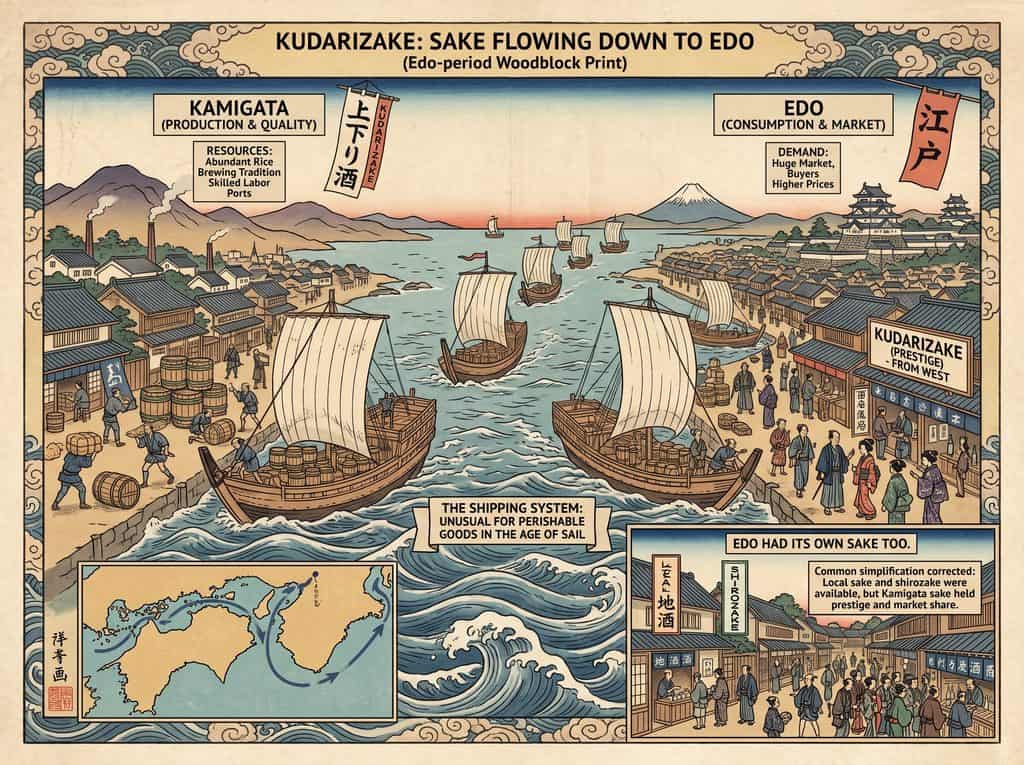
Kudarizake (下り酒) means sake that came down to Edo from the Kamigata region around Osaka and Kyoto. The phrase carried a second meaning too, since kudarimono, or goods from the west, implied quality in Edo usage.
Why Production and Consumption Split Apart
Kansai had the rice, the brewing tradition, the skilled labor, and, crucially, the ports. Edo, on the other hand, had the buyers. Rather than closing that gap, the industry built a shipping system across it, which is unusual for a perishable product in the age of sail.
Edo and the surrounding region did brew sake. Yet matching Kamigata’s accumulated skills, reputations, and shipping networks proved difficult, and higher prices in Edo gave western brewers every reason to ship.
Edo Had Its Own Sake Too
Here a common simplification needs correcting. Edo did not drink only kudarizake. Edo-Tokyo Museum reference material notes that local sake and shirozake were also available in the city. Kamigata sake held the prestige and a very large share of the market, but it was never the only option.
Higaki-kaisen and Taru-kaisen
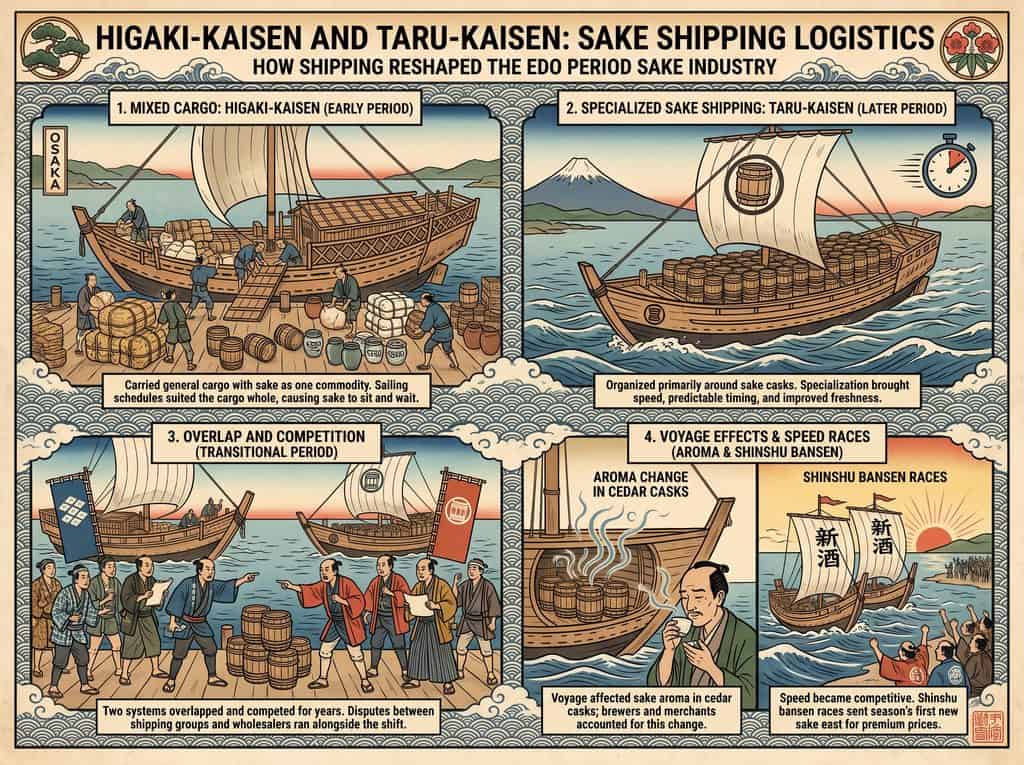
Shipping deserves its own section, since logistics reshaped the industry as much as any brewing technique did.
Mixed Cargo First
Higaki-kaisen initially carried general cargo between Osaka and Edo, with sake as one commodity among many. That worked, up to a point. Sailing schedules suited the cargo as a whole rather than the casks specifically, so sake sat waiting while other goods loaded.
Shipping Organized Around Casks
Taru-kaisen emerged as shipping services organized primarily around sake casks. Specialization brought speed, more predictable timing, and handling suited to a dominant product. Freshness improved as a result.
The change was not a clean swap. The two systems overlapped and competed for years, with disputes between shipping groups and wholesalers running alongside the shift.
Because sake remained in cedar casks during transport, the voyage could affect its aroma. Brewers and merchants had to account for that change, even if they did not explain it in modern chemical terms. Speed also became competitive, and the shinshu bansen races sent the season’s first new sake east as fast as possible, since early arrivals fetched premium prices.
Wholesalers and the Edo Distribution Chain
Many hands stood between the brewer and the drinker, after all. Each took a margin, and each added a function.
- Brewing house in Itami, Ikeda, or Nada brews and casks the sake.
- Carters and river boats move casks to a loading port.
- Taru-kaisen operators ship the casks east along the coast.
- Edo sake wholesalers receive, store, and allocate the cargo.
- Retailers and drinking shops sell by the cask, measured container, or cup.
- Drinkers buy sake at home, at a stall, or at a shop counter.
Wholesalers held real power in this chain. They controlled storage, credit, and access to retailers, so brewers depended on them heavily. Some brewing houses maintained Edo branches to gain closer control over sales and market information, while Kansai brewing groups negotiated freight and shipping arrangements collectively rather than one by one.
Those groups had a name. The Settsu and Izumi districts shipping to Edo organized as the Sensen Jūnigō, the twelve brewing districts, which dealt with shipping and trade questions as a bloc. Collective bargaining of this kind is another sign that brewing had become an industry rather than a collection of workshops.
Cask Marks and Early Branding
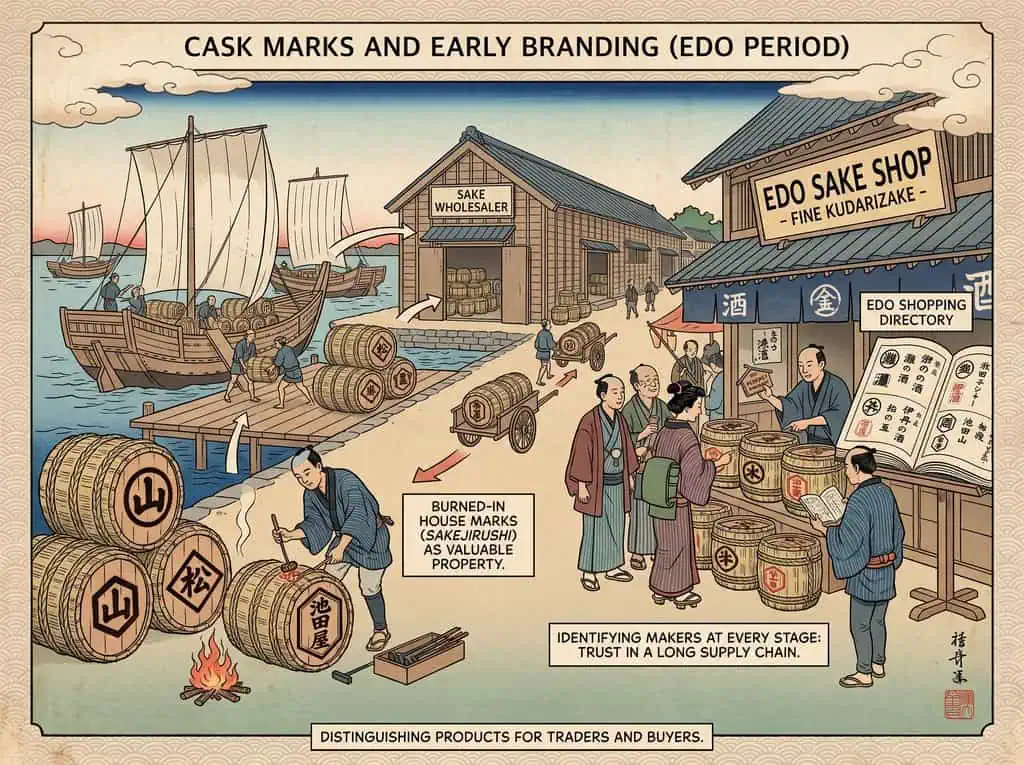
Once sake travelled hundreds of kilometers, buyers naturally needed a way to know what they were getting. Brewing houses answered with marks.
Casks and their straw wrappings generally carried burned-in house marks, known as sakejirushi. Ikeda village documents even include a record concerning the safekeeping of cask branding irons, which tells you the marks were treated as valuable property.
Cask marks, house names, and named products helped merchants distinguish one brewer’s sake from another. Edo shopping directories listed sellers and brands for customers to compare, so the information reached buyers as well as traders.
Marks also solved a practical problem. A cask that changed hands four or five times between Settsu and an Edo shop counter needed something that identified its maker at every stage. Branding here began as a matter of trust in a long supply chain, rather than as advertising.
The Scale of the Edo Sake Industry
Numbers help, so long as they come with their caveats attached.
A nationwide survey compiled around 1698 recorded roughly 27,000 licensed brewing households. Published figures differ slightly, with totals such as 27,226 and 27,251 appearing in later accounts. The survey itself was ordered in 1697, and the results are usually cited under the following year.
What that number actually counts
A licensed brewing household in 1698 is not the same unit as a modern brewery. Many held small rights and brewed modest volumes, sometimes seasonally or as one activity among several. The survey records holders of brewing rights, not industrial facilities, and registered volumes rarely matched actual production. Treat Edo statistics as indicators of scale rather than precise accounting.
Shipping volumes tell a similar story. Around 640,000 casks reached Edo by sea in 1697, according to Kobe City Archives. Cask sizes were not standardized in the way modern containers are, yet the figure still describes a genuinely industrial trade.
What the Technology Changed Commercially
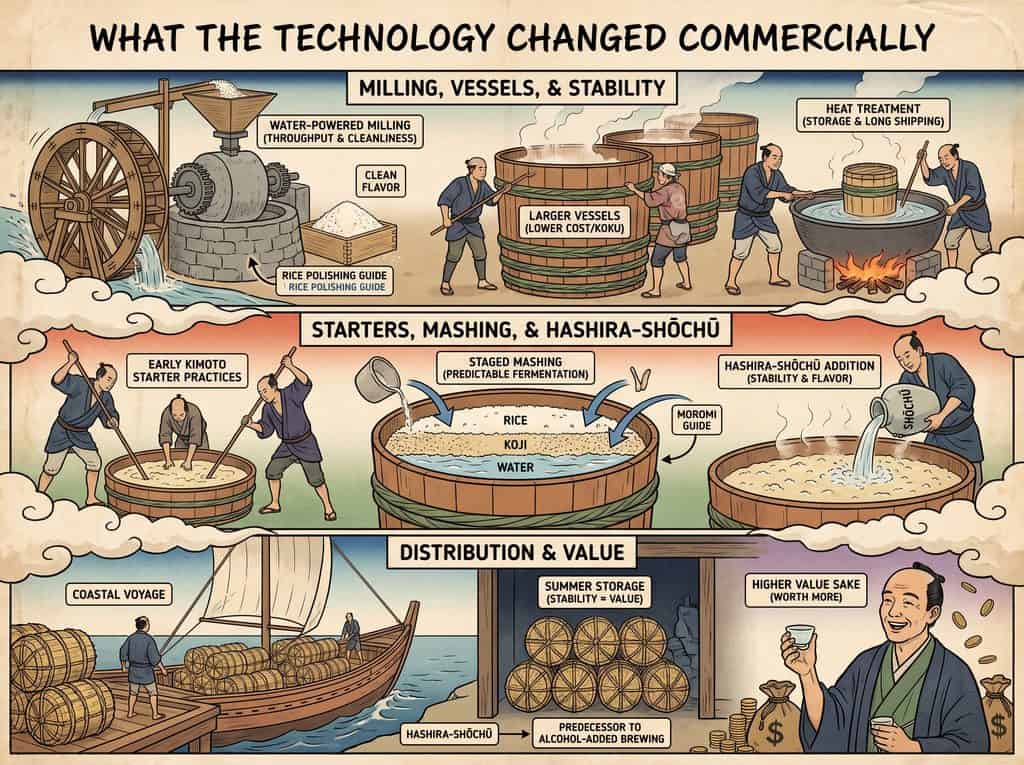
Technology did advance, although the commercially significant changes concerned scale and reliability rather than novelty. Each one solved a business problem.
Milling, Vessels, and Stability
Water-powered milling raised throughput and let a district differentiate its product on cleanliness of flavor. Larger vessels increased batch size, which lowered the labor and fuel cost of each koku. Heat treatment made storage and long shipping runs viable, and our rice polishing guide explains why the degree of milling shapes flavor.
Starters, Mashing, and Hashira-shōchū
Edo brewers developed starter practices later associated with early forms of kimoto brewing. Staged mashing supported larger and more predictable fermentations in bigger vessels, as our moromi guide describes in modern terms.
Brewers also added distilled shōchū to the mash, a practice called hashira-shōchū. It raised alcohol content and could change flavor as well as improve stability. A sake that survived a coastal voyage and a summer in a wholesaler’s storehouse was worth more, so technique followed the demands of distribution. Hashira-shōchū is an important predecessor to later alcohol-added brewing, although the scale, materials, and commercial purposes were not identical.
Written Brewing Manuals
Dōmō Shuzōki is certainly the brewing text most often associated with this period. The National Diet Library holds manuscript copies in three volumes, and its author, copying date, and date of composition are not settled bibliographically. Sources traditionally date it to 1687.
Brewing procedures had been recorded before, so its importance lies in the detail and organization of the surviving written material. Knowledge that passed mainly by apprenticeship could now travel between houses and survive a generation.
The text distinguishes seasonal brewing types, which tells us that season was already understood as a variable to manage. That shows a systematic approach to production, even without modern science.
Written procedure had a commercial value as well. A house that could describe its method could train new workers each winter, keep results steady across seasons, and pass the business to the next generation intact. Documentation, in that sense, belongs with capital and shipping rather than with pure craft.
Sake in Everyday Edo Life
Production changed largely because consumption changed. So it is worth looking at how people actually drank.
By the eighteenth century, shops selling warmed sake and prepared food had become a familiar part of Edo street life. Edo-Tokyo Museum reference material points to period illustrations showing customers seated on benches or on the floor, drinking sake warmed in a chirori. Do not picture a modern izakaya with tables and chairs, because the furniture, the service, and the social rules were all different.
Warming sake was, by then, already an established habit, as the 1581 Fróis account shows. Our guide to warmed sake covers how it works. Price also created different markets, with everyday sake and prestigious named products serving different customers.
What Edo Sake Was Still Not
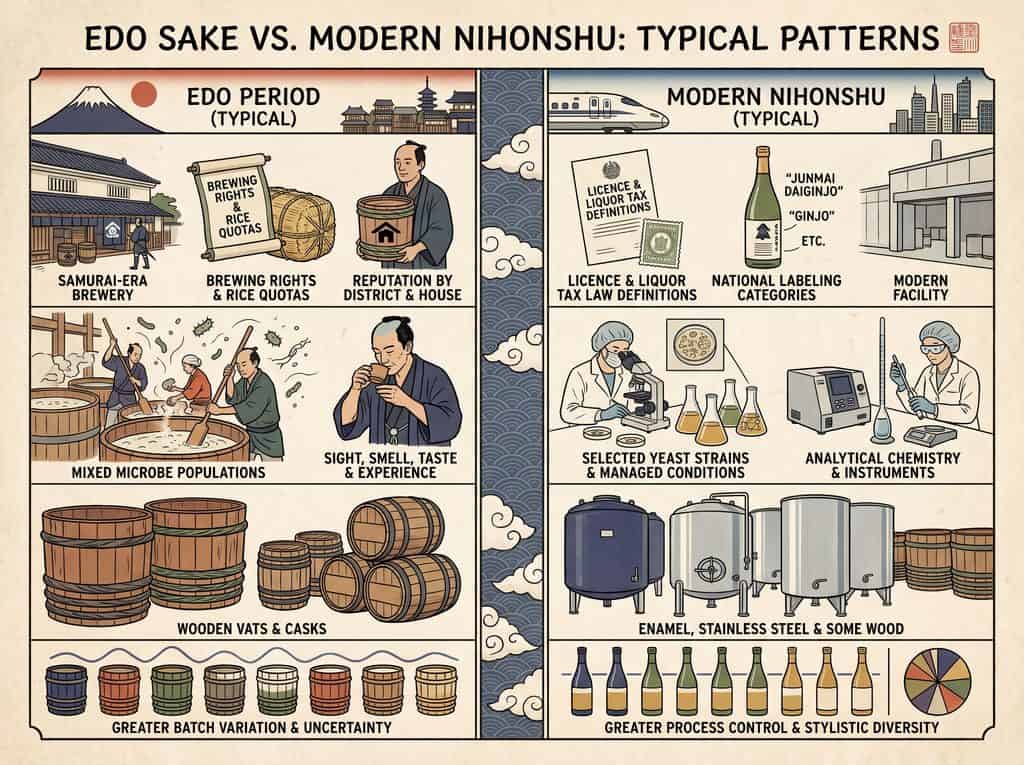
Japanese tourism writing sometimes claims that modern sake was already complete by the eighteenth century. The table below sets out typical patterns rather than two uniform systems, since exceptions existed on both sides.
| Point | Edo period (typical) | Modern nihonshu (typical) |
|---|---|---|
| Legal status | Brewing rights and rice quotas | Licence plus liquor tax law definitions |
| Quality grades | Reputation by district and house | National labeling categories |
| Microbes | Mixed populations from ingredients, tools, and buildings | Selected yeast strains and managed koji conditions |
| Measurement | Experience, sight, smell, and taste | Analytical chemistry and instruments |
| Vessels | Wooden vats and shipping casks | Enamel and stainless steel, with some wooden vats |
| Variation | Greater batch-to-batch uncertainty and local variation | Greater process control, alongside deliberate stylistic diversity |
Edo brewers established many foundations of later sake production. Their products, however, lacked modern legal definitions, microbiology, standardized yeast cultures, and national quality categories.
The Late Edo Period and the Road to Meiji
By the early nineteenth century, then, the structure had matured. Large houses in Nada dominated the Edo trade, while wholesalers ran established networks and brewing families accumulated capital across generations.
Policy kept shifting even so. The Tenpō reforms dissolved merchant guilds and reorganized brewing regulation. Then came 1868, and with it a new state.
Itami and Ikeda did not vanish, incidentally. Both continued brewing, and Itami still supports breweries today. What they lost was their command of the Edo trade, which is a narrower defeat than the phrase “decline” usually suggests.
The handover is neat when you put it plainly. Edo created the industrial structure, while Meiji would create the modern regulatory and scientific framework around it.
Edo Period Sake Timeline
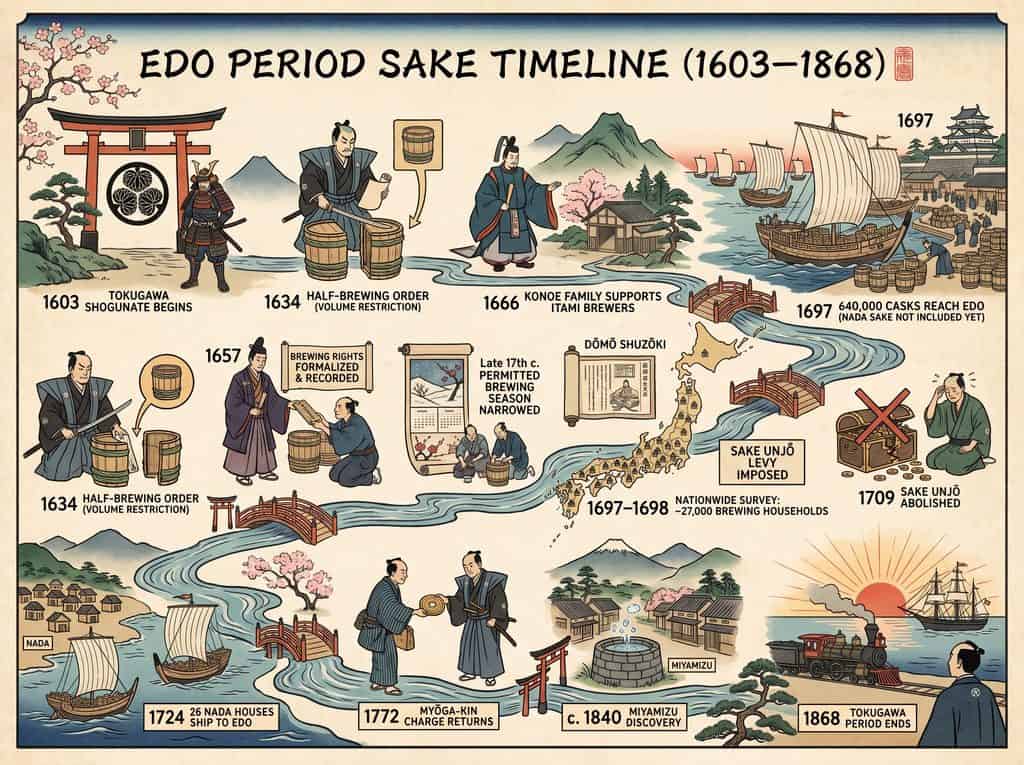
Dates below rest on institutional research or surviving documents, and a few carry acknowledged uncertainty.
| Year | Development |
|---|---|
| 1603 | The Tokugawa shogunate begins |
| 1634 | A half-brewing order restricts permitted volumes |
| 1657 | Brewing rights are formalized and recorded on permits |
| 1666 | The Konoe family takes Itami, supporting its brewers |
| Late 17th c. | Repeated orders narrow the permitted brewing season |
| c. 1687 | Dōmō Shuzōki, traditionally dated to this year |
| 1697 | Around 640,000 casks reach Edo; Nada sake not yet included |
| 1697 | The sake unjō levy is imposed |
| 1697–1698 | A nationwide survey records roughly 27,000 brewing households |
| 1709 | The sake unjō is abolished |
| 1724 | Twenty-six Nada brewing houses ship to Edo |
| 1772 | A charge returns in the form of myōga-kin |
| c. 1840 | Miyamizu is associated with discovery at Nishinomiya |
| 1868 | The Tokugawa period ends |
Common Misconceptions
Four claims circulate widely, so each one deserves a correction.
- “Modern sake was invented in the Edo period.” Many foundations were laid then. The legal categories, the microbiology, and the analytical tools all came later.
- “Japanese sake was always brewed in winter.” Early Edo brewers worked several seasons. Winter became standard only after repeated restrictions and hard experience.
- “Edo drank only sake shipped from Kansai.” Kudarizake held prestige and volume, yet local sake and shirozake also circulated in the city.
- “The shogunate simply tried to stop sake production.” It restricted volumes during shortages, but it also licensed brewers and drew revenue from the trade.
Final Thoughts
In short, Edo created demand. Regulation defined the producers. Winter organized labor. Brewing districts concentrated capital. Shipping connected production to consumption, and wholesalers and cask marks turned sake into a dependable commercial product.
So the Edo period did not simply improve sake. It created an economic system in which brewing rights, rice policy, seasonal labor, milling technology, shipping fleets, merchants, and urban demand all worked on each other.
That system was never uniform, since shogunal territory, domain lands, cities, and brewing districts all ran it differently. Even so, the arc holds. Medieval brewers supplied the technique, Edo built the industry around it, and Meiji would bring the science and the modern state.
Frequently Asked Questions About Edo Period Sake
The Industry
- What was sake like in the Edo period?
Most of it was clear sake made with polished rice and staged mashing. Quality varied widely between districts and houses. Premium Kamigata sake shipped to Edo carried real reputations, while cheaper local products filled the everyday market. Modern legal categories did not exist.
- Why did sake production grow so much during the Edo period?
Edo became an enormous consumer city where most people bought rather than brewed. Kansai districts had rice, skilled labor, and ports, so they supplied that demand. Shipping, wholesaling, and licensing systems then grew around the trade. Demand drove the industry, not the reverse.
- What was sake-kabu?
Sake-kabu was the brewing right formalized in 1657. Approved brewers held a permit recording their allowed volume of brewing rice. Families inherited these rights, and they could also transfer or pledge them. Actual production often exceeded the registered figure.
- How many sake breweries were there in Edo-period Japan?
A survey around 1698 recorded roughly 27,000 licensed brewing households. Totals such as 27,226 and 27,251 appear in different accounts. These were rights holders rather than modern breweries, and many worked at a very small scale. Direct comparison with today’s figures does not work.
Regions and Shipping
- What was kudarizake?
Kudarizake was sake shipped to Edo from the Kamigata region around Osaka and Kyoto. It commanded higher prices and stronger reputations than most local products. Casks travelled by sea in large volumes through the seventeenth and eighteenth centuries. The trade shaped the whole industry.
- What was taru-kaisen?
Taru-kaisen were shipping services organized primarily around sake casks. Earlier higaki-kaisen carried mixed cargo, which slowed sake down. Cask-centered shipping brought faster, more predictable delivery. The two systems overlapped and competed rather than replacing each other cleanly.
- Did sea transport affect the sake?
Sake travelled in cedar casks, so the voyage could affect its aroma. Brewers and merchants had to account for that, even without a chemical explanation. Heat treatment and higher alcohol content both helped the sake survive the trip. Long voyages shaped what brewers chose to make.
- Why was Nada important for sake?
Nada combined coastal location, water-powered rice milling, concentrated winter production, and seasonal labor from Tanba. Those advantages let it outcompete inland districts during the eighteenth century. Miyamizu, its famous brewing water, is associated with a discovery around 1840. Its commercial importance belongs to the late Edo and Meiji periods.
- What were Itami and Ikeda known for?
Both were among the leading Edo-bound brewing districts before Nada rose. Itami sake, called tanjō, held the highest reputation in the Genroku era. Ikeda shipped through a chain of packhorses and river boats to reach the sea. Neither had direct coastal access, which eventually cost them.
Drinking and Daily Life
- Did people drink sake warm in Edo?
Yes, and the habit was already old. A 1581 account by Luís Fróis records Japanese people warming their drink. Period illustrations show Edo customers drinking sake warmed in a metal chirori. Warm sake was ordinary rather than special.
- When did winter brewing become common?
Winter brewing spread through the later seventeenth century. Repeated shogunal orders narrowed the permitted season, and cold-weather batches kept better. Published dates for individual orders differ between sources. By the eighteenth century, winter production had become the commercial standard.
- What was the role of the toji in Edo sake brewing?
Seasonal brewing needed skilled workers for only part of the year. Farming villages in Tanba, Tajima, Noto, and elsewhere supplied them. Regional groups formed, and technical knowledge passed within them. Titles and job divisions varied by region and period rather than following one national system.
- How was Edo sake different from modern sake?
Edo brewers worked without microbiology, isolated yeast strains, or analytical instruments. No national quality categories existed, so reputation rested on district and house names. Wooden vessels and casks shaped the flavor. Batch-to-batch uncertainty was much greater than it is today.
References
- Chronology of Traditional Japanese Alcoholic Beverages Made with Koji Mold, National Tax Agency. Accessed September 2026.
- Sake Brewing Rice Surveys and Taxes in the Edo Period, National Tax College. Accessed September 2026.
- The Tokugawa Shogunate’s Sake Tax, National Tax College. Accessed September 2026.
- Commentary on Historical Tax Materials, Volume 4, National Tax College. Accessed September 2026.
- The Edo-Bound Sake Brewing Industry of Nada, Kobe City Archives. Accessed September 2026.
- The Shibata Family Documents and Loans to Daimyo, Kobe City Archives. Accessed September 2026.
- Ikeda Sake and Ikeda Charcoal, Ikeda City Museum of History and Folklore. Accessed September 2026.
- Ikeda Village Documents 23: Sake Brewing Records, Ikeda City Museum of History and Folklore. Accessed September 2026.
- Itami Morohaku and Nada Kiippon: The Kudarizake Story, Japan Heritage Portal, Agency for Cultural Affairs. Accessed September 2026.
- Itami, the Birthplace of Clear Sake, Itami Tourism and Products Association. Accessed September 2026.
- What Were Edo-Period Drinking Establishments Like?, Edo-Tokyo Museum. Accessed September 2026.
- What Kinds of Sake Were Available in Edo?, Edo-Tokyo Museum. Accessed September 2026.
- Dōmō Shuzōki, National Diet Library. Accessed September 2026.
- Morisada Mankō, National Diet Library Digital Collections. Accessed September 2026.
- Nagakura, T. The Edo-Bound Sake Brewing Industry in the Genroku Period, Part 1. Journal of the Brewing Society of Japan, 68(10), 723. Accessed September 2026.
- Yunoki, M. The Historical Background of a Traditional Industry. Journal of the Brewing Society of Japan, 74(4), 202. Accessed September 2026.
- Ono, Y. Innovation in the Sake Brewing Industry II. Faculty of Economics, Shiga University. Accessed September 2026.
Related Articles
- Japanese Sake Guide (Surveyed: September 2026)
- How Sake Is Made: Step-by-Step Japanese Brewing Guide (Surveyed: September 2026)
- Rice Polishing in Sake: Seimai Buai Explained (Surveyed: September 2026)
- Kimoto Sake Brewing (Surveyed: September 2026)
- What Is Moromi? The Main Sake Fermentation Mash (Surveyed: September 2026)
- Kura: Inside a Traditional Sake Brewery (Surveyed: September 2026)
- Warmed Sake (Kanzake) (Surveyed: September 2026)






Comments