


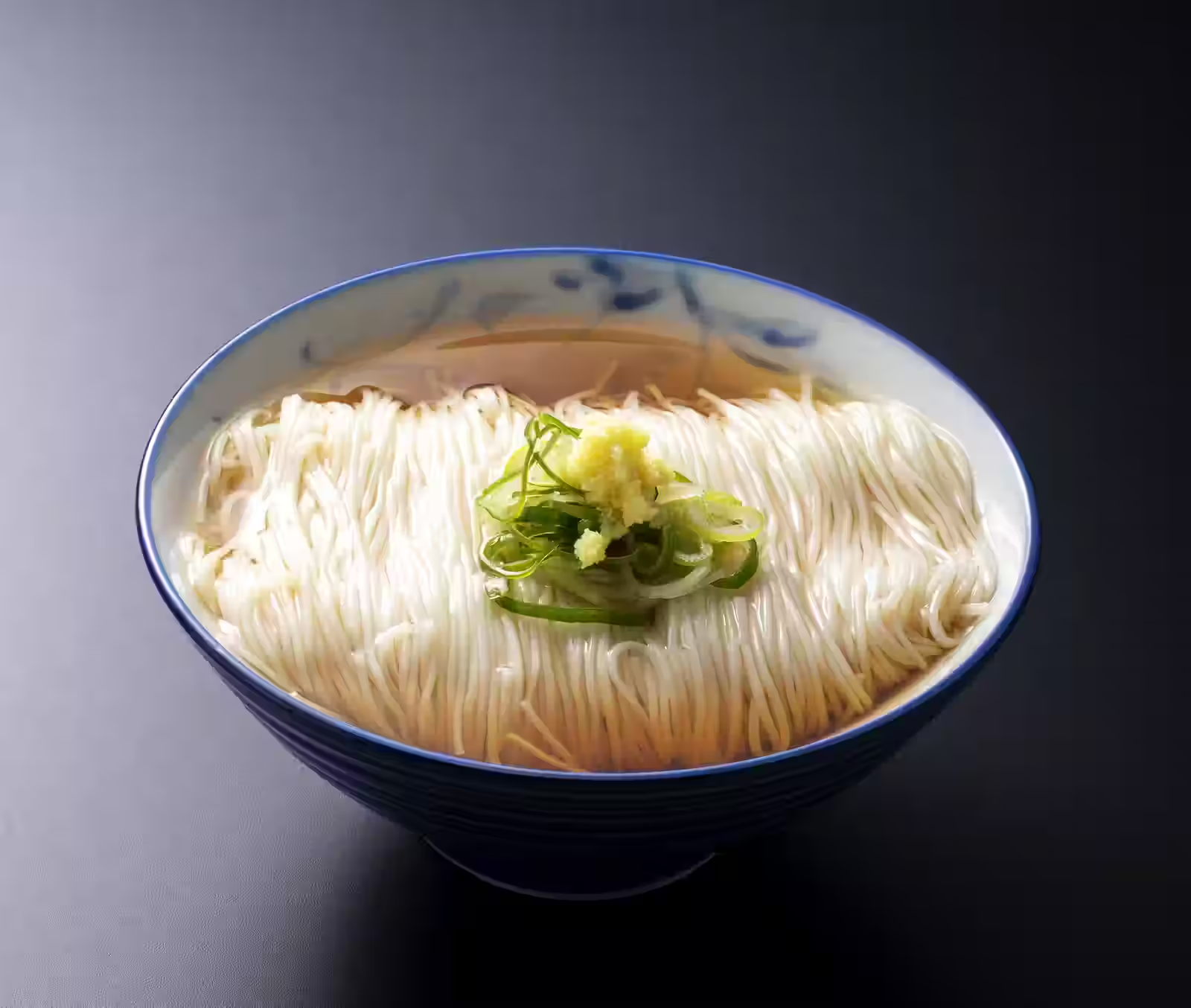
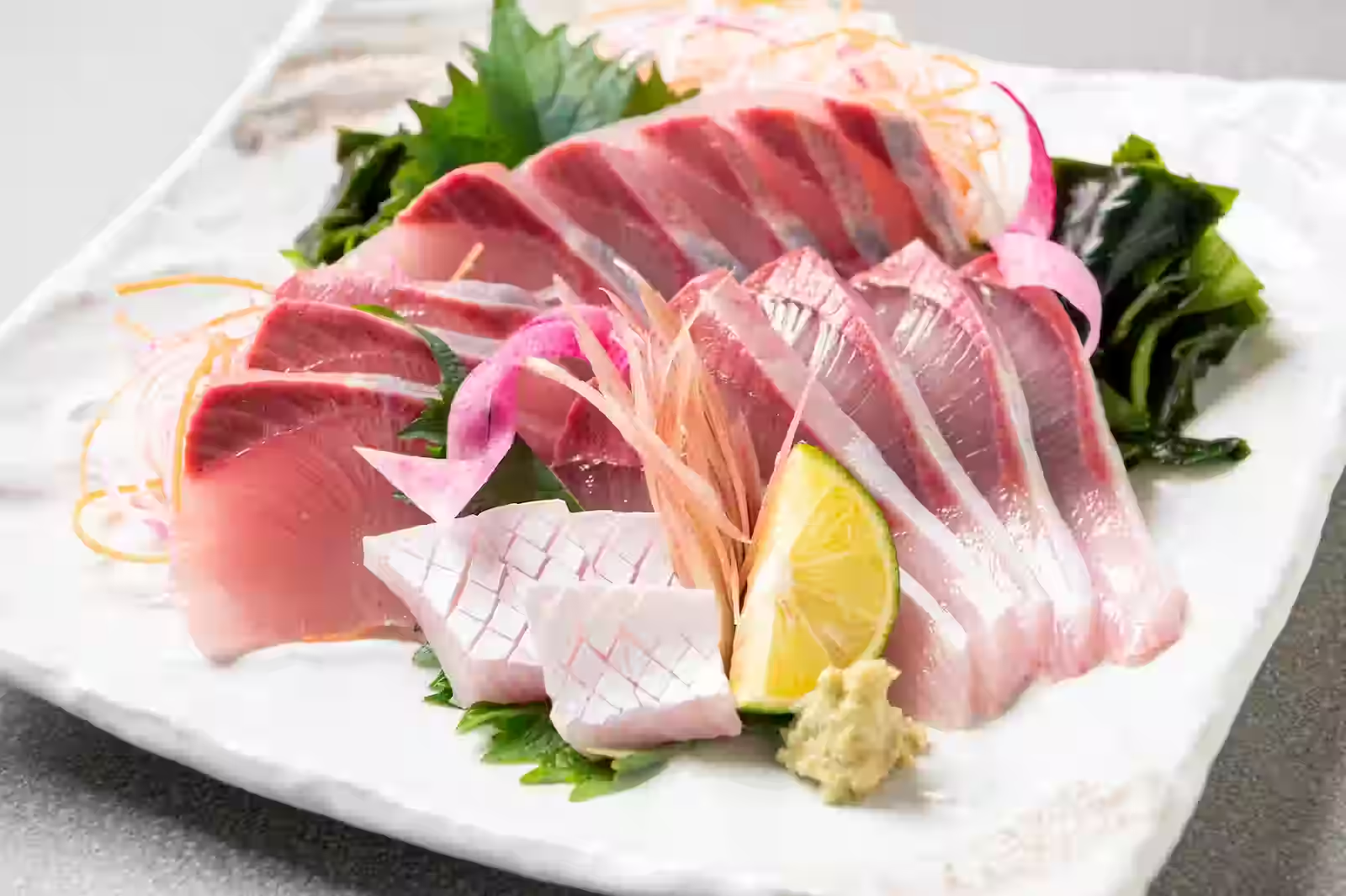
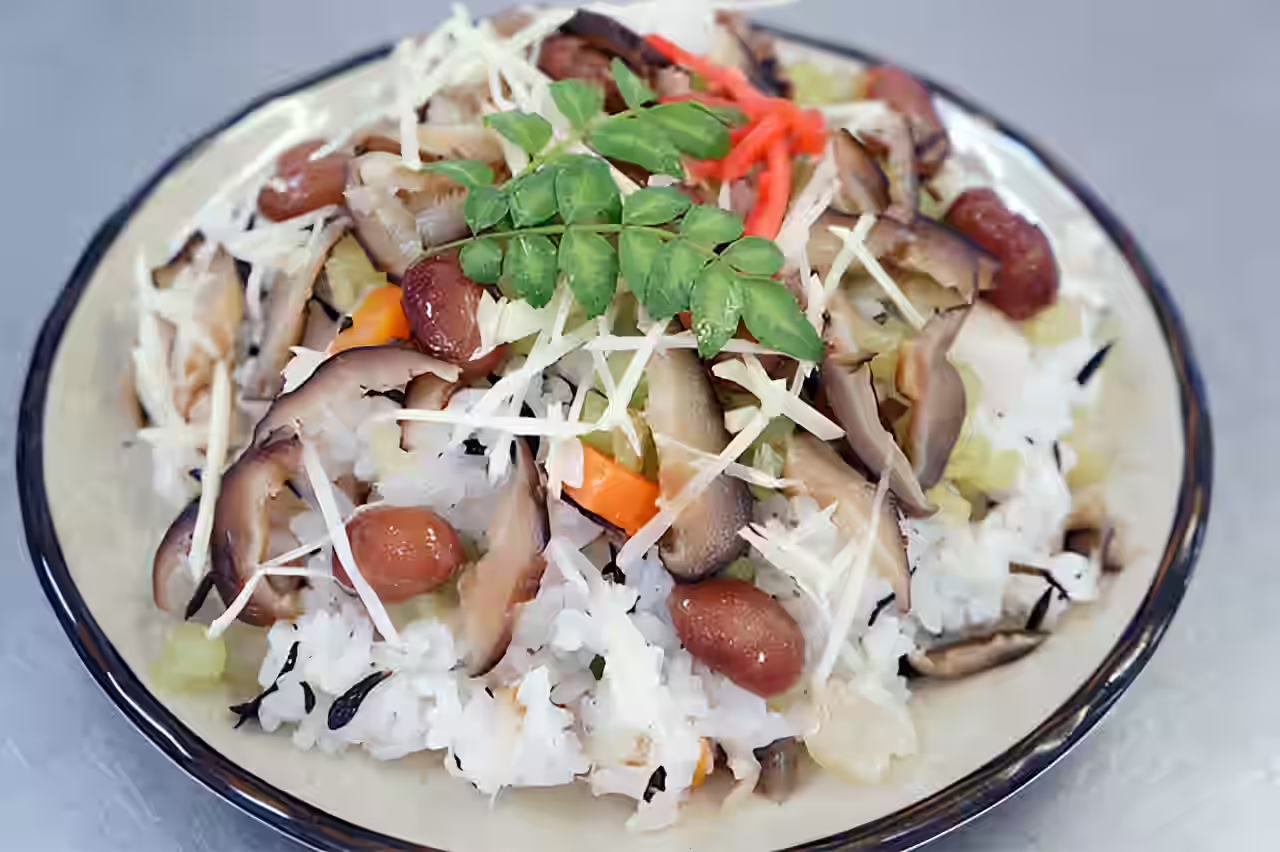


Climb the hundred stone steps at Oiwasan Nissekiji Temple, and the smell that reaches you is dashi. Oiwa somen is the noodle specialty of the Oiwa district in Kamiichi Town, Toyama Prefecture. A small cluster of shops around the temple approach still serves it. Toyama’s official tourism site describes the dish as a local specialty with more than 70 years of history.
Traditional Oiwa somen begins with three-year-aged hand-stretched noodles, chilled in cold local spring water and laid out in neat parallel rows. This guide covers what the dish is, how each shop prepares it, and where to eat it. It also explains how to reach a village that public transport serves only a few times a day.
Quick Facts About Oiwa Somen
Oiwa somen is not a branded product sold in supermarkets. Instead, it is a way of serving somen that belongs to one small temple town. First, here are the essentials.
- Region
- Oiwa district (大岩), Kamiichi Town, Toyama Prefecture.
- Dish Type
- Somen (素麺), thin hand-stretched wheat noodles, served with the broth already poured over them.
- Traditional Noodle
- Hand-stretched somen aged for three years, known as ōhine (大古). Ryokan Dangoya also offers its own fresh, undried version.
- Finishing Method
- Chilled in cold local spring water, which the shops credit for the firm bite and smooth texture.
- Broth
- A clear golden dashi that each shop prepares differently.
- Where to Eat
- Toyama’s official tourism site currently identifies three shops in the gate-front district around Hyakudan-zaka.
- Best Season
- Summer, when queues form. Opening periods vary by shop, so check before traveling.
What Is Oiwa Somen?
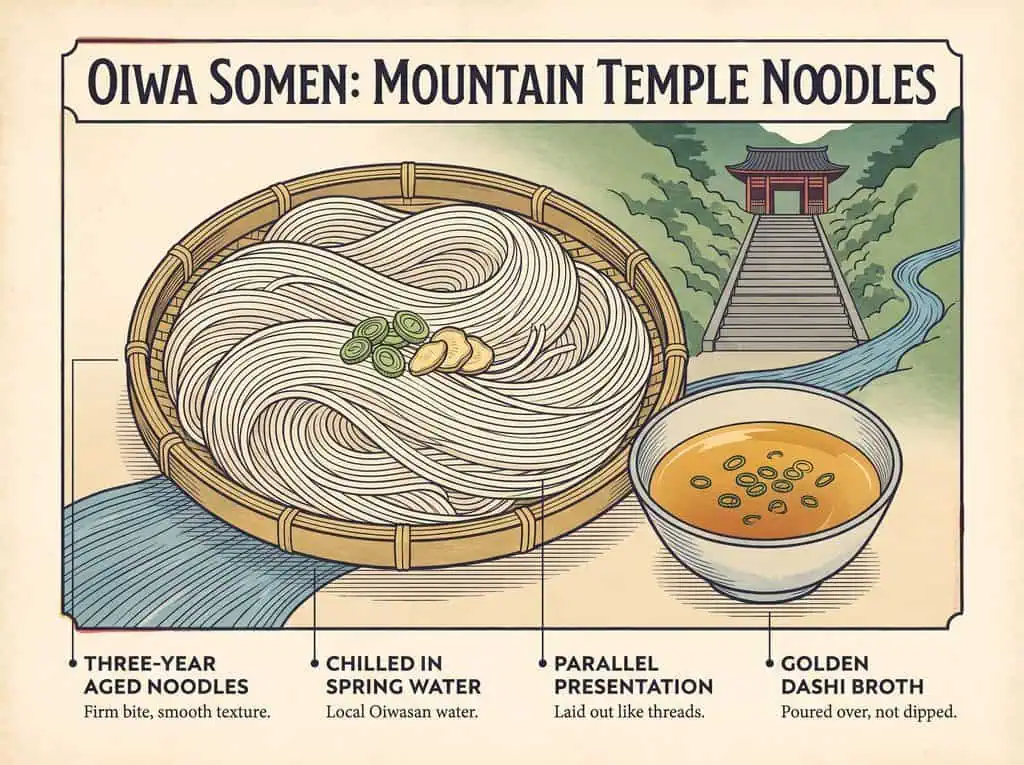
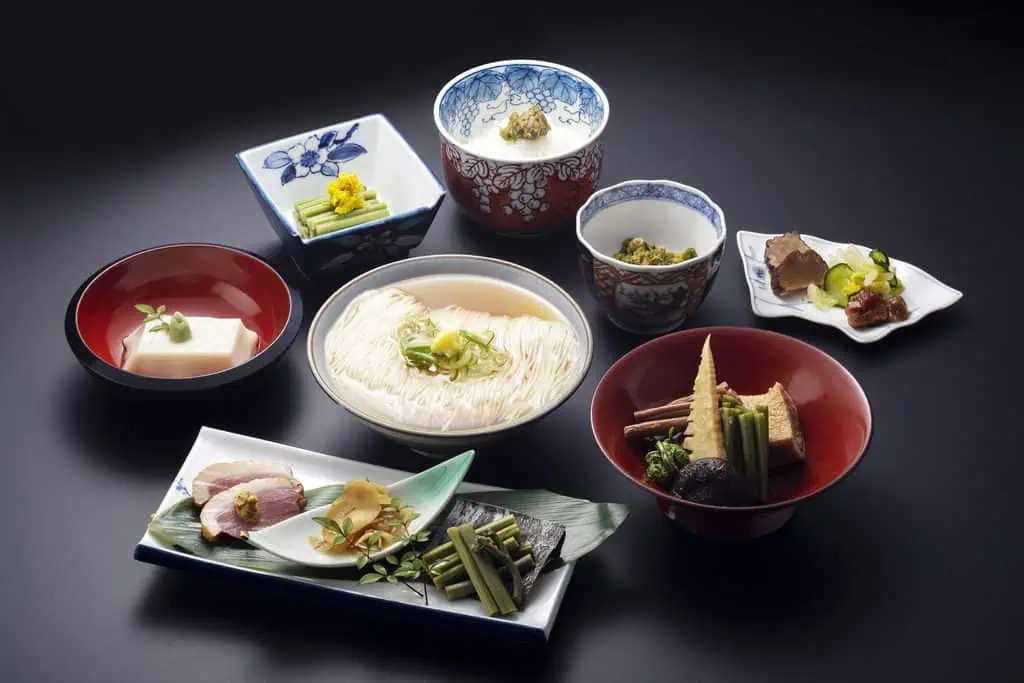
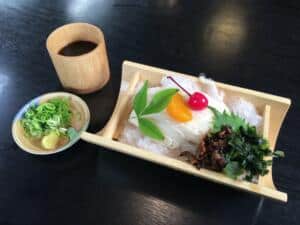
Oiwa somen refers to the somen served at the gate-front shops of Oiwasan Nissekiji Temple in Kamiichi Town, Toyama. The traditional version uses hand-stretched noodles aged for three years, chilled in cold local spring water and arranged in parallel rows. A golden dashi broth then goes over the top, rather than into a separate dipping cup.
A Noodle Specialty of One Small District
Just three shops currently serve it, and all of them sit within a few minutes’ walk of each other. In fact, that concentration is part of what makes the dish worth a detour. You are not ordering a variation available across the prefecture. You are eating something tied to one hillside.
Toyama’s tourism site reports that summer queues form at every shop, and that some visitors come to Oiwa for the noodles alone. Locals therefore treat the dish as a seasonal marker, much as other regions treat a particular festival or fruit.
What Makes It Different from Everyday Somen
Three things stand out. First, the traditional noodles are aged for about three years, a grade the trade calls ōhine. Shops then chill them in cold local water. Both the shops and Toyama’s tourism site credit that step with the firm bite that defines the dish. Finally, the broth arrives already poured over the noodles.
Moreover, the presentation matters. Shops lay the strands out in long parallel lines, an arrangement local sources describe as looking like laid-out threads. It seems almost a shame to break it, and yet you have to.
What Does It Taste Like?
Local shops describe the traditional noodles as firm yet smooth, with a clean finish despite their thinness. Kinryū uses the word shikoshiko, a Japanese term for a springy, resilient bite. Toyama’s tourism site similarly emphasizes strong body and a slippery texture in the throat.
Broths differ, so descriptions differ too. Official tourism information stresses clear dashi, balanced flavor, and gentle sweetness rather than intensity. Because the noodles sit in the broth from the moment they arrive, the shops treat the aging as central to how the dish holds up.
Where Oiwa Somen Comes From
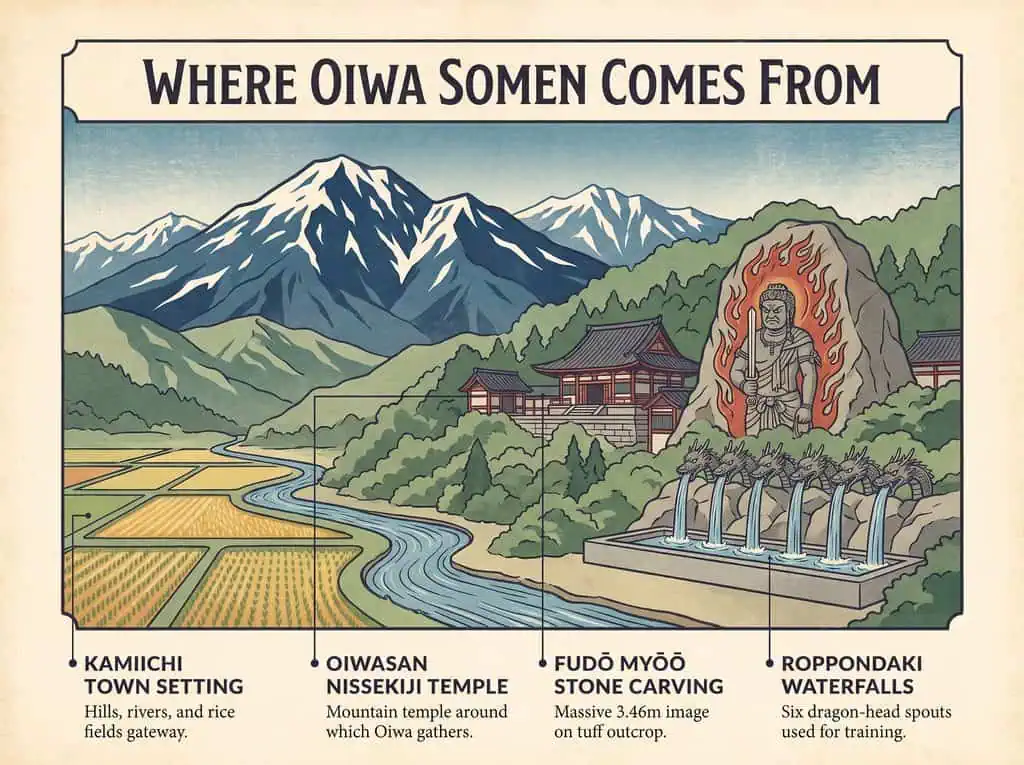
Oiwa sits in the foothills east of Toyama City, specifically in a valley below the Tateyama mountains. In practice, the setting explains the dish better than any recipe does.
Kamiichi Town and the Oiwa District
Kamiichi is a small town of hills, rivers, and rice fields, and it serves as one gateway toward Mount Tsurugi. Oiwa lies at its inland edge, gathered around a temple rather than a station. Consequently, the village has the feel of a place people visit deliberately.
Oiwasan Nissekiji Temple and Its Gate-Front District
Kamiichi Town’s official information describes Nissekiji as a head temple of Shingon Mikkyō Buddhism. Temple tradition attributes the origin to the monk Gyōki in 725. However, the town also notes that specialists date the surviving carvings later on stylistic grounds. Some figures came later still, between the late Heian and Kamakura periods.
Specifically, the principal Fudō Myōō image measures 3.46 meters high. Four accompanying figures share the same tuff outcrop, and the group has held Important Cultural Property status since 1930. Beneath the main hall, water falls from six dragon-head spouts at the Roppondaki, where cold-water training still takes place.
The History and Background of Oiwa Somen
Here it helps to separate what official sources state from what people in the area say.
More Than Seventy Years as a Local Specialty
Official tourism and shop sources describe Oiwa somen as a local specialty with a history of more than 70 years. Dangoya states that it has carried an unchanged flavor and method across that span. Kinryū, meanwhile, dates its own founding to 1960 and says its broth-making and noodle-boiling methods have passed through successive generations.
Older Origin Stories
Some local accounts connect somen in Oiwa with the area’s older temple and market history, and a few trace it to the medieval period. One long-established shop suggests that hand-stretched somen from Banshū reached the area through medieval markets. Kamiichi Town does document that Nissekiji once supported many subsidiary halls and warrior monks.
Still, the available sources do not establish an unbroken noodle tradition running from that period to the present dish. Treat these accounts as local origin stories rather than documented history. The temple’s antiquity is well recorded; the noodle lineage is not.
How Oiwa Somen Is Prepared
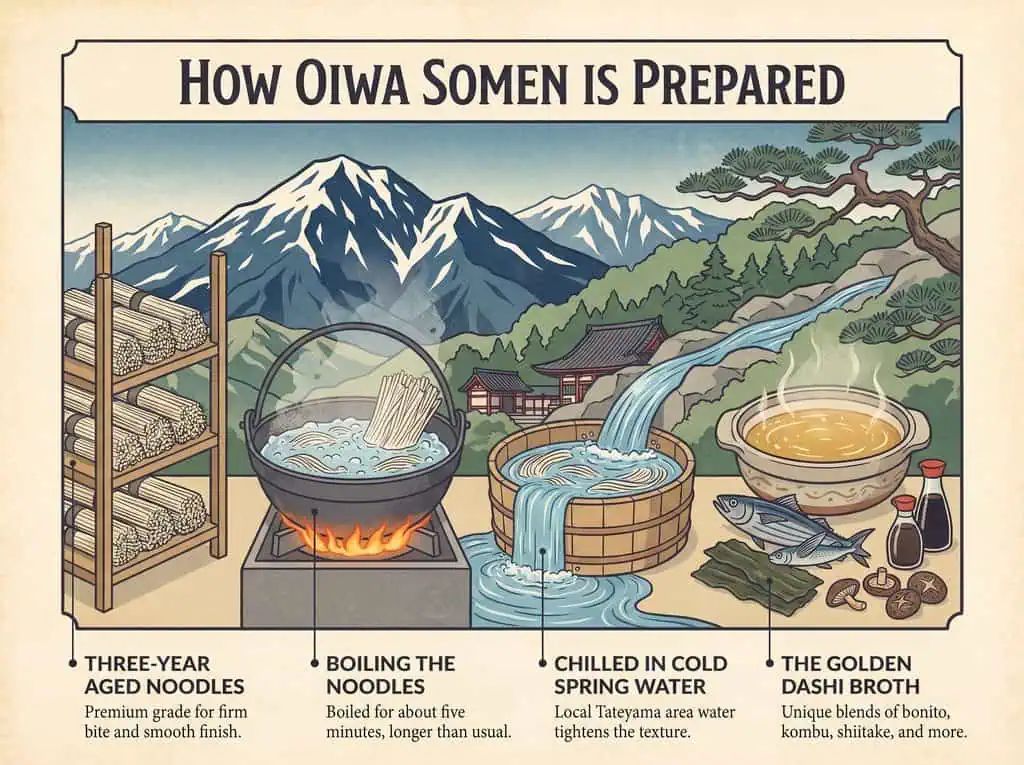
No single official recipe governs the dish. Still, the shops share a common framework, and the differences between them are part of the appeal.
Three-Year-Aged Noodles (Ōhine)
Somen producers grade aged noodles by year. Dangoya describes ōhine (大古) as a premium three-year-aged grade, and in the Banshū somen trade the same term covers somen held across multiple seasons. Local shops therefore value that grade for its firm bite and smooth finish after boiling.
Sourcing varies by shop. Kinryū states that it buys hand-stretched somen from Awaji Island. The surface carries a little oil, and the noodles then age for three years. Dangoya also developed its own fresh, undried somen, so the traditional aged noodle is not the only option in the village.
Cold Spring Water
After boiling, the noodles go into cold local spring water. Kinryū says it boils its oil-coated noodles for about five minutes, longer than usual. It then tightens them in spring water from the Tateyama area. Both the shops and Toyama’s official tourism site credit this step with the firm bite and smooth texture of Oiwa somen.
The Golden Dashi
Each shop prepares its own broth, so this is where the differences show most clearly. Toyama’s tourism site describes Kinryū’s version as drawing on bonito, kombu, shiitake, and flying fish. A mildly sweet soy sauce from Tonami then seasons it. Dangoya, by contrast, lists Rishiri kombu, dried shiitake, and round herring among its own ingredients.
How Oiwa Somen Is Served
Unlike the common dipping style, Oiwa somen arrives with the broth already poured over the noodles. This is one of the dish’s most recognizable features, although the available sources do not clearly document when or why the serving style began.
Tips for Enjoying Oiwa Somen
- Look before you lift. You may want to appreciate the parallel arrangement before taking the first noodles.
- Try the broth first. Taste it before adding any available condiments, so you notice each shop’s own balance of dashi and seasoning.
- Compare if you can. Broths differ between shops, so a second bowl elsewhere tells you more than a larger portion at one.
- Ask about the day’s menu. Seasonal dishes such as mountain vegetables or river fish often sit alongside the noodles.
Oiwa Somen Compared with Everyday Somen
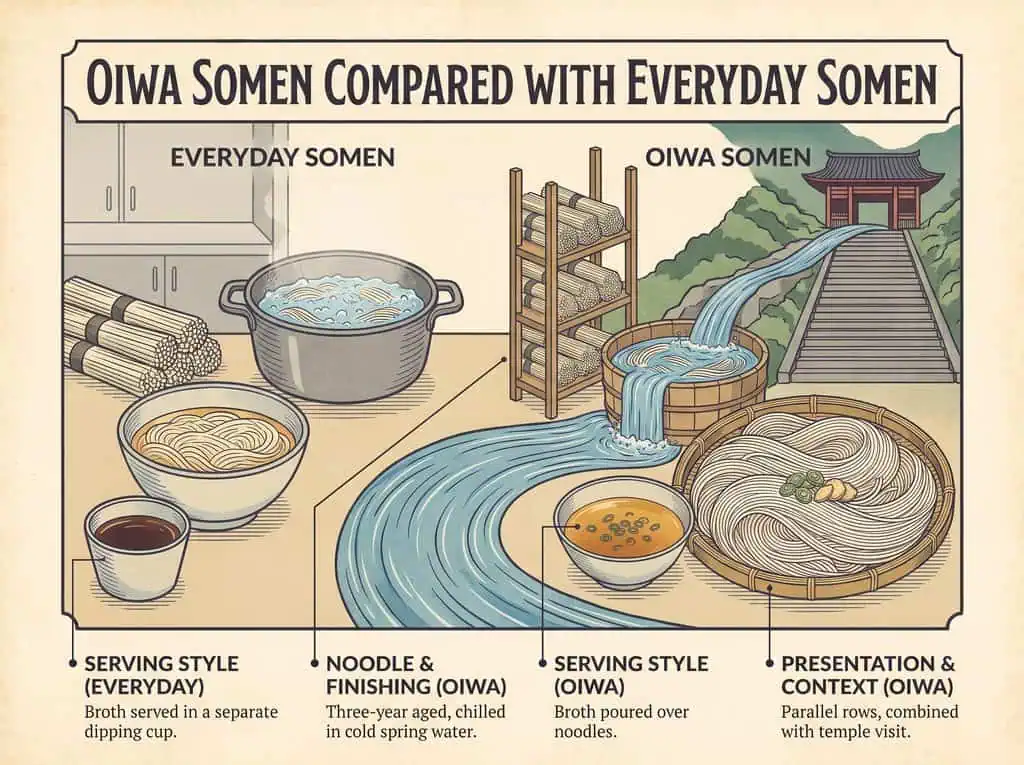
The table below sets out what distinguishes the Oiwa version. It describes a difference in context and handling, rather than a claim that the noodles themselves come from a unique process.
| Point | Oiwa Somen |
|---|---|
| Place | Served at a small group of shops in one gate-front district in Kamiichi |
| Noodle | Traditionally hand-stretched somen aged for three years (ōhine) |
| Finishing | Chilled in cold local spring water, which the shops credit for the texture |
| Serving style | Broth poured over the noodles rather than served in a dipping cup |
| Presentation | Strands arranged in neat parallel rows, described locally as laid-out threads |
| Context | Commonly combined with a visit to Oiwasan Nissekiji Temple |
Where to Eat Oiwa Somen
Toyama’s official tourism site currently identifies three shops, all in the compact gate-front district around Hyakudan-zaka. Each has its own broth and menu, and some use different noodle types or sources.
- Soumen Kinryū, Oiwa branch (そうめん金龍 大岩店) stands near the foot of the approach and dates its founding to 1960. It sources hand-stretched somen from Awaji Island, ages it three years, and chills the cooked noodles in Tateyama spring water. The menu also lists a warm somen, eaten with pepper.
- Ryokan Dangoya (旅館だんごや) dates from the mid-Meiji period and still operates in its historic wooden building. Alongside three-year-aged ōhine, it serves an independently developed fresh, undried somen, with a different broth for each.
- Oiwakan (大岩館) is, by local account, the oldest eatery of the three. It serves handmade mountain-vegetable and river-fish dishes, plus a sudachi somen using citrus grown at Nissekiji.
Still, opening periods are the thing to watch. Hours and seasonal closures differ by shop, and at least one restricts restaurant service to part of the year. Therefore check the shop’s own site or phone ahead on the day, especially outside summer.
Visitors interested in comparing the different broths and noodles can try more than one shop. Summer queues and seasonal opening periods do make advance planning useful, though.
How to Get to Oiwa
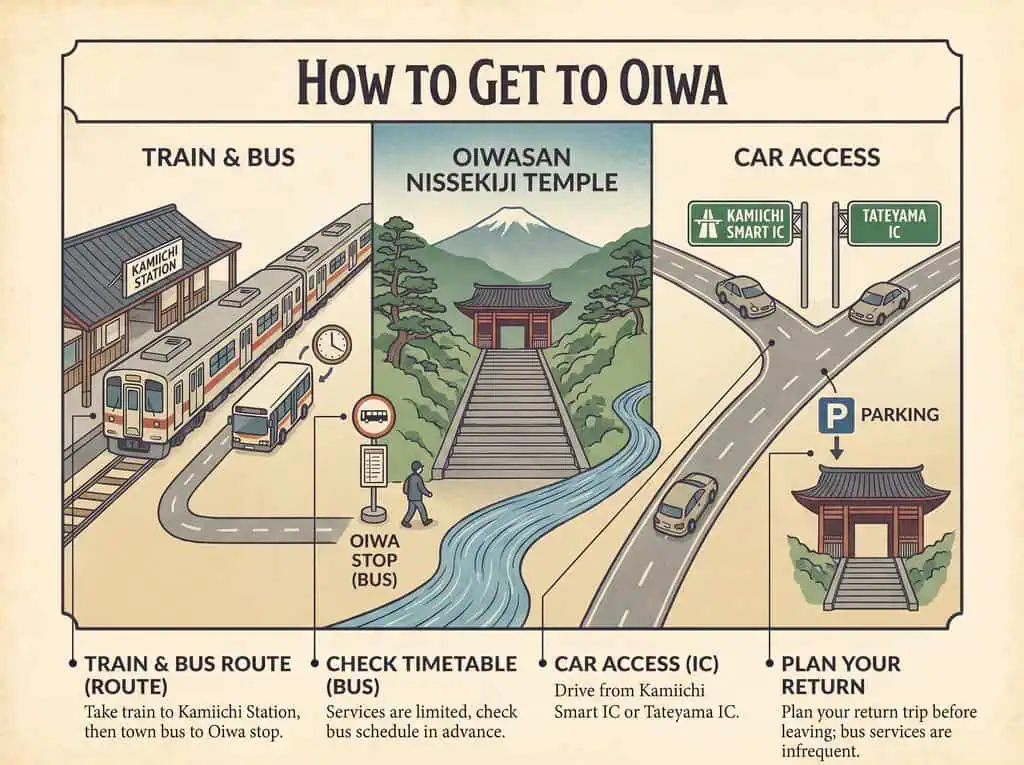
Kamiichi Town’s official guidance gives two routes. By train, take the Toyama Chihō Railway to Kamiichi Station. Then catch the town bus toward Kakizawa and Oiwa, which reaches the Oiwa stop in about 23 minutes. From there it is a three-minute walk.
The town explicitly advises checking the timetable first, because the bus runs only a few times a day. By car, the temple lies 8.8 kilometers from the Kamiichi Smart Interchange, about 17 minutes. From the Tateyama Interchange it is 7.2 kilometers, or roughly 13 minutes. Parking sits near the approach.
Finally, save the current bus timetable and plan your return before leaving Kamiichi Station. Because services are limited, missing your planned departure may leave no convenient public-transport connection back.
What to See Around Oiwa
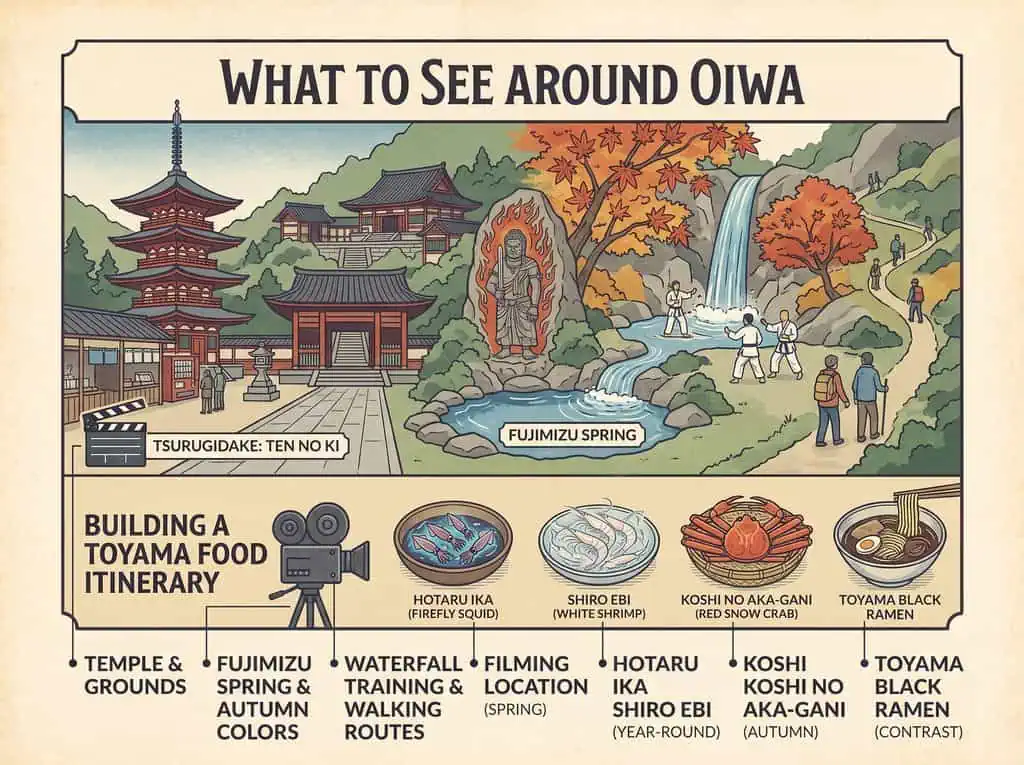
Certainly the temple alone justifies the trip. Beyond the carved Fudō Myōō, the grounds hold a town-designated three-story pagoda and a mountain gate. The Fujimizu spring is here too, and it appears on Toyama’s list of noted waters. Autumn colors along the approach also draw their own crowds.
Waterfall training is also held at the Roppondaki, including events involving general participants. Check the temple’s current schedule and participation requirements before visiting. Meanwhile the surrounding hills open onto walking routes. The gate-front district itself also served as a filming location for the Japanese film Tsurugidake: Ten no Ki (劔岳 点の記).
Building a Toyama Food Itinerary
Oiwa pairs well with the coastal side of the prefecture. Spring brings Hotaru Ika (firefly squid), while Shiro Ebi (white shrimp) appears across much of the year. Autumn adds Koshi no Aka-gani (Toyama Bay red snow crab), and Toyama Black Ramen offers the loudest possible contrast to a quiet bowl of somen.
Dietary and Allergy Notes
Somen contains wheat, so the dish is not gluten free. Moreover, traditional noodle broth commonly contains soy sauce. The documented broths at Kinryū and Dangoya also use fish-based ingredients, so travelers should not assume the dish is vegetarian or vegan.
Because each shop builds its own broth, the only reliable answer comes from the shop itself. Menus are in Japanese, and English support also varies. These phrases help.
- 魚のだしは入っていますか?Does this contain fish-based dashi?
- 大豆や醤油は入っていますか?Does this contain soy or soy sauce?
- 小麦アレルギーがあります。I have a wheat allergy.
- 肉や魚を使っていますか?Does this contain meat or fish?
Still, a translated phrase is not a safety guarantee. If your allergy is serious, ask the staff to confirm both the ingredients and the risk of cross-contact in the kitchen.
Frequently Asked Questions About Oiwa Somen
The Dish
What is Oiwa somen?
Oiwa somen is the noodle specialty of the Oiwa district in Kamiichi Town, Toyama. The traditional version uses hand-stretched somen aged for three years and chilled in cold local spring water. A golden dashi broth goes over the top. Three shops near Oiwasan Nissekiji Temple serve it.
Is Oiwa somen served hot or cold?
Shops serve the best-known traditional version cold, and summer is its season. Kinryū’s menu also lists a warm somen. Seasonal menus vary, so check directly with each shop if you are looking for a warm noodle dish.
Do Oiwa somen noodles ripen or soften after cooking?
The aging happens long before cooking, not at the table. Shops use somen held for about three years, then boil and chill it to order. Local sources credit that combination with the dish’s firm bite.
Does Oiwa somen contain fish or gluten?
Yes on gluten, since somen is a wheat noodle. The documented broths at Kinryū and Dangoya both use fish-based ingredients, so the dish is not reliably vegetarian. Confirm with the individual shop, because each one builds its broth differently.
Visiting
Where can I eat Oiwa somen?
Toyama’s official tourism site currently lists three shops in the gate-front district at Oiwasan Nissekiji Temple: Soumen Kinryū, Ryokan Dangoya, and Oiwakan. Each prepares its own broth. Walking between them takes only a few minutes.
When is the best time to visit?
Summer suits the cold version best, though queues form on hot weekends. Spring brings mountain vegetables to the menus, and autumn brings foliage along the temple approach. Opening periods vary by shop, so check first.
Can I reach Oiwa without a car?
Yes. Take the Toyama Chihō Railway to Kamiichi Station. The town bus toward Kakizawa and Oiwa then takes about 23 minutes, and the shops sit a three-minute walk from the stop. Buses run infrequently, so check the current timetable and plan your return.
What else is worth seeing nearby?
Oiwasan Nissekiji Temple is the main draw, with its rock-carved Fudō Myōō, a three-story pagoda, and the Roppondaki waterfalls. The Fujimizu spring appears on Toyama’s list of noted waters. Walking routes climb into the hills behind the temple.
Can I buy Oiwa somen as a souvenir?
Take-home availability varies. Dangoya offers its fresh somen through Kamiichi’s hometown-tax program. Confirm direct shop sales and seasonal products with each business. The broth is the harder part to reproduce at home.
Why Oiwa Somen Is Worth the Detour
Toyama is known for what comes out of its bay, and rightly so. Oiwa offers the opposite picture. Here you get a mountain valley, a temple carved into rock, and noodles that a handful of families have refined over seventy years. The dish is simple to describe, yet it carries the shape of the place it comes from.
So take the slow bus, climb the steps, and order before the queue builds. Sit down, look at those laid-out threads for a moment, and then ruin the arrangement. That is the whole point of it.
References
- Oiwasan Nissekiji Temple, Kamiichi Town, Toyama Prefecture. Accessed September 2026.
- Shingon Mikkyō Head Temple Oiwasan Nissekiji, official temple site. Accessed September 2026.
- Oiwa Somen: A Guide to All Three Shops, Toyama Tourism Organization. Accessed September 2026.
- About Kinryū, Soumen Kinryū. Accessed September 2026.
- Menu, Soumen Kinryū. Accessed September 2026.
- Meibutsu Oiwa Somen, Ryokan Dangoya. Accessed September 2026.
- Waterfall Training at Oiwasan Nissekiji, with Somen and Mountain Vegetables, Toyama Tourism Organization. Accessed September 2026.
- The Oiwa Area of Kamiichi: Nature and Local Food, Toyama Tourism Organization. Accessed September 2026.
Image Credits
- Photographs of firefly squid and Toyama Bay: ©公益社団法人とやま観光推進機構 (Toyama Tourism Organization), https://www.info-toyama.com/ (Surveyed: August 2026)
- Photo library and usage terms: Toyama Tourism Organization Photo Library, https://www.info-toyama.com/business/images (Surveyed: August 2026)
Related Articles
- Toyama Black Ramen
- White Shrimp (Shiro Ebi)
- Firefly Squid (Hotaru Ika)
- Koshi no Aka-gani (Toyama Bay Red Snow Crab)




Comments