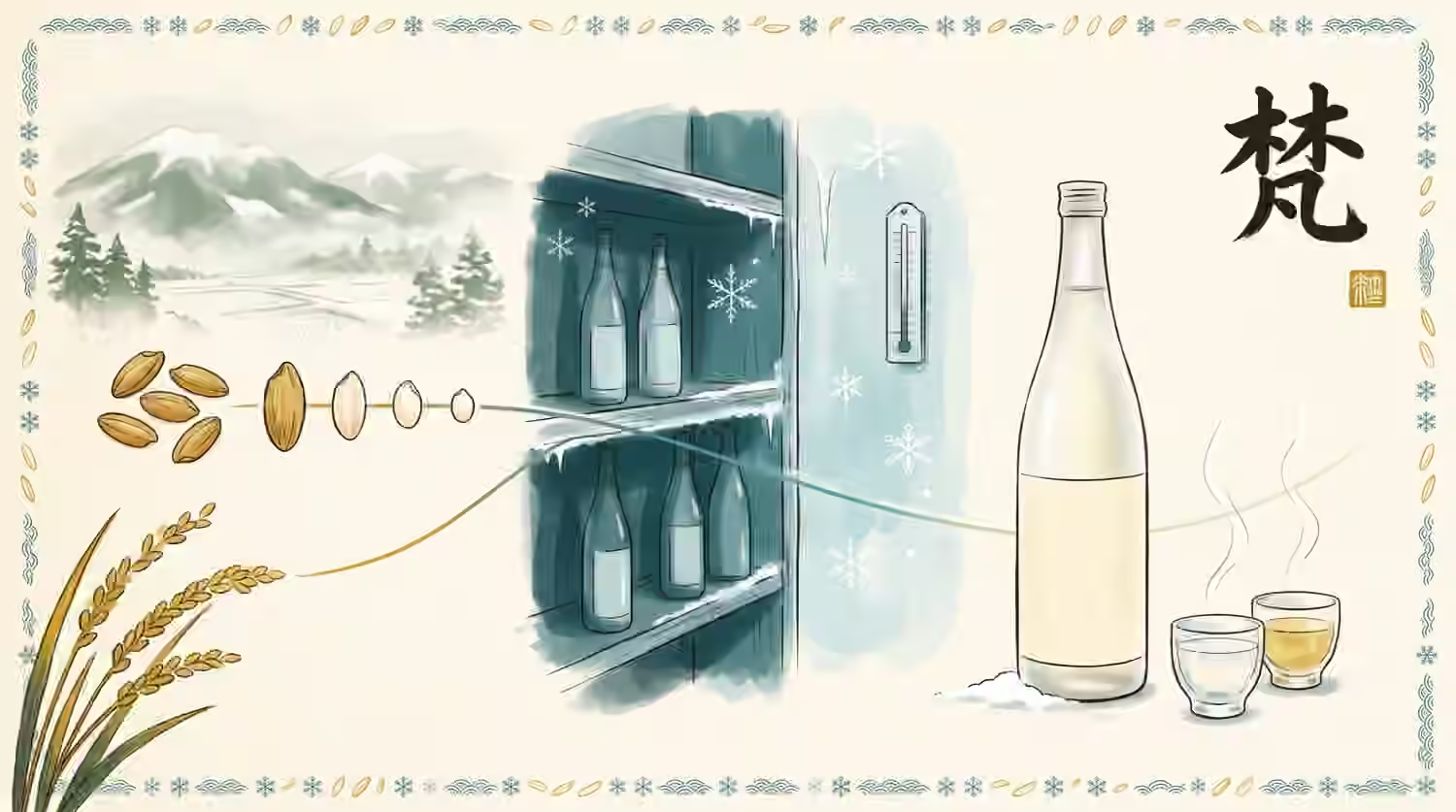
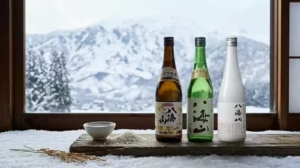
Across the Born range, one bottle may be clear and fruit-led, while another, such as Tokishirazu, shows a pale-gold color and a more mature aroma. What connects them is time. The brewery matures its sake at subzero temperatures before release.
Katoukichibee Shouten makes Born (梵, pronounced “bon”) in Sabae, Fukui Prefecture. First, this guide covers the bottles and how to choose one. After that, it explains the cold aging, deep rice polishing and junmai brewing behind them.
TOC
What Is Born Sake?
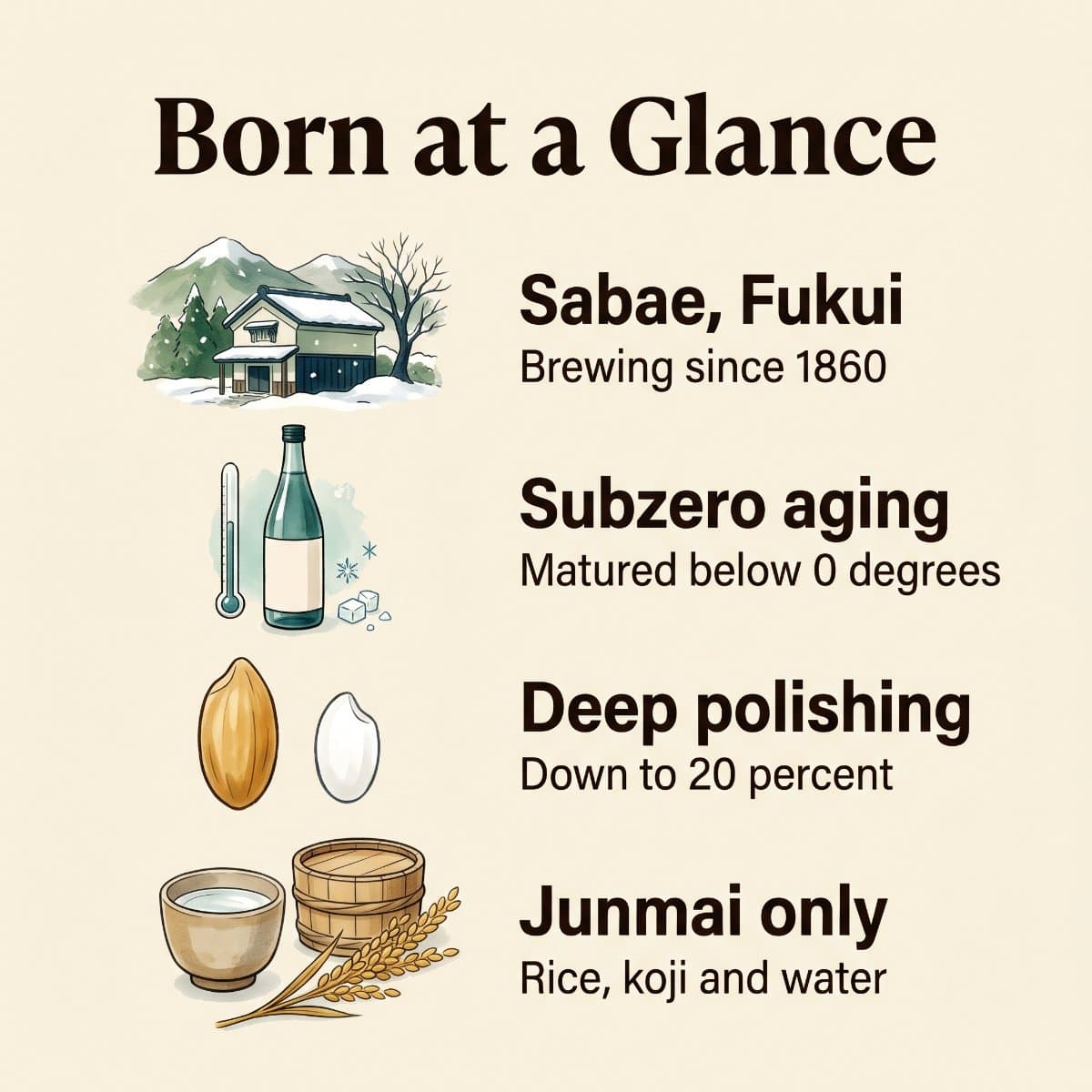
Born is a sake brand made by Katoukichibee Shouten in Sabae, Fukui Prefecture, which began brewing in 1860. The brewery produces only junmai sake and matures every release at subzero temperatures before sale. Its range runs from the approachable Junmai 55 to the flagship Chogin, made with rice polished to 20 percent.
❄Born at a Glance
Japanese name
梵, pronounced “bon”; written BORN in English
Brewery
Katoukichibee Shouten (加藤吉平商店)
Location
Yoshie-cho, Sabae City, Fukui Prefecture, in the Hokuriku region
Brewing since
1860; sake names unified under the Born label in 1963
Sake styles
Junmai only, from Junmai to Junmai Daiginjo
Signature methods
Subzero maturation for at least one year, per the brewery; brewery-reported average polishing ratio of 34.5%
Our first-bottle pick
Ginsen, a moderately priced junmai daiginjo
Rice
Yamada Nishiki, Gohyakumangoku and Fukui’s Sakahomare
What Makes Born Different?
Many breweries use highly polished rice, and many make junmai sake. Born stands out for combining both with long, cold maturation across its whole range. The table shows what each choice means and what it is likely to contribute.
01Subzero maturationFinished sake changes slowly before release. Intended to build smoothness and an integrated aroma.
02Deep rice polishingMore of each grain’s outer layer is removed. Supports a clean, refined profile.
03Junmai onlyNo added brewing alcohol. Rice, koji and water carry the style.
Popular Born Sake Bottles to Know
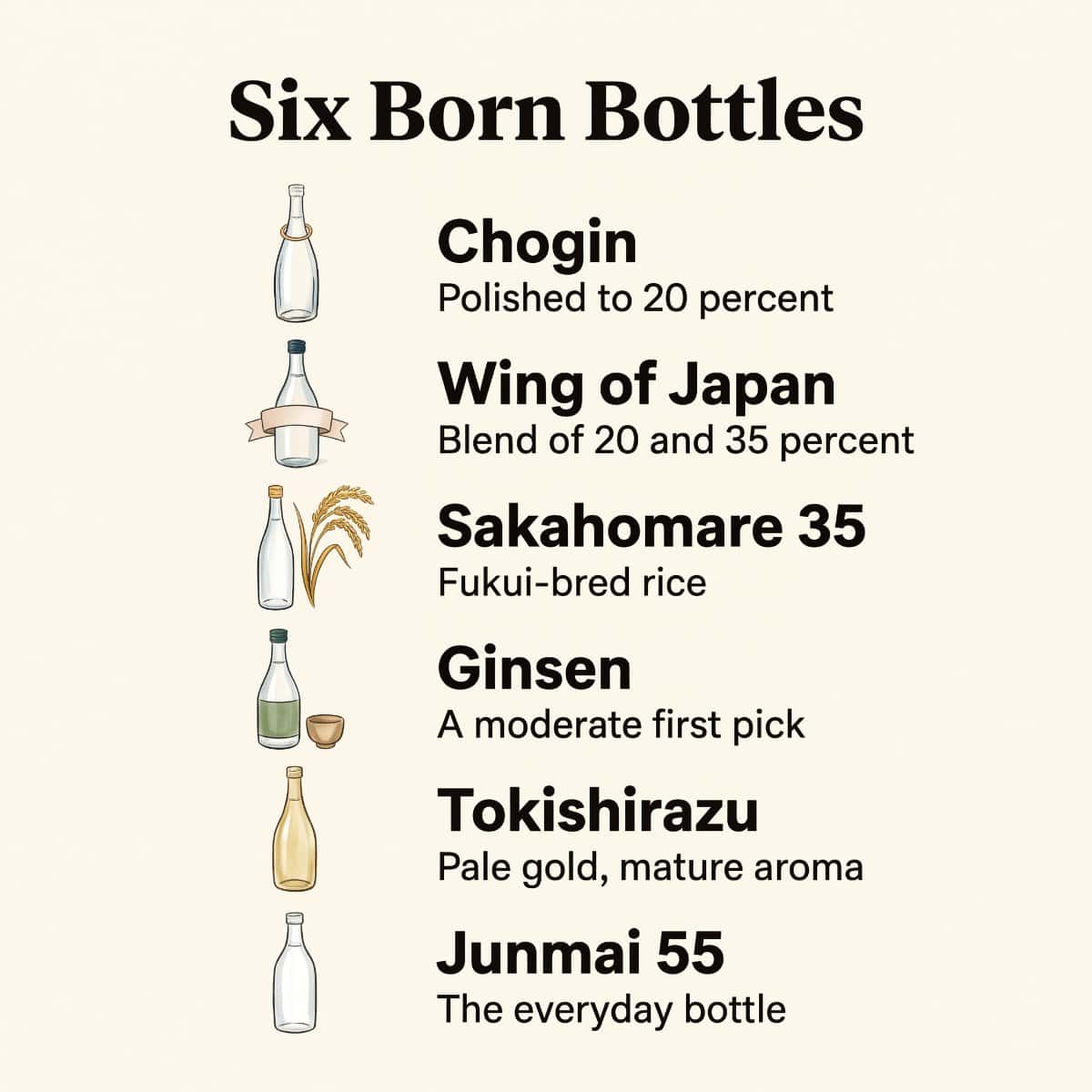
Born has a broad lineup, but these six bottles show its main range, from an everyday junmai to the reservation-only flagship. Together, the official prices show how wide Born’s Japanese range is.
Bottle
Type
Rice
Polish
ABV
Blend / maturation note
Official price, 720 ml
Chogin (超吟)
Junmai Daiginjo
Yamada Nishiki
20%
16%
Centered on sake aged about 5 years at -10°C
¥18,700
Wing of Japan (日本の翼)
Junmai Daiginjo
Yamada Nishiki
20% + 35% blend
16%
Includes sake aged about 2 years at 0°C or below
¥6,600
Sakahomare 35
Junmai Daiginjo
Sakahomare
35%
16%
Not specified
¥5,500
Ginsen (吟撰)
Junmai Daiginjo
Yamada Nishiki
50%
15%
Product page: “up to 1 year” at 0°C or below
¥2,200
Tokishirazu (ときしらず)
Junmai Ginjo
Yamada Nishiki, Gohyakumangoku
55%
15%
Blended with long-term ice-temperature-aged sake
¥1,870
Junmai 55
Junmai
Yamada Nishiki, Gohyakumangoku
55%
14%
Not specified
¥1,540
Specs and Japanese retail prices including tax from the brewery’s product pages, checked October 2026. Aging notes describe each released blend, not a single batch held for exactly that period. Prices, specs and availability may change, so check the official site before buying.
Born Chogin: The Flagship
Chogin is where Born’s ideas meet in one bottle. First, it uses contract-grown Yamada Nishiki from Hyogo, polished to 20 percent. Then the blend centers on sake aged about five years at -10°C. Because it sells by advance reservation only, it also feels like an event bottle.
Born Wing of Japan
Wing of Japan blends junmai daiginjo polished to 20 and 35 percent, including sake aged about two years. According to the brewery, it is the official in-flight sake of Japan’s government aircraft. The brewery also says state welcome banquets have used it for toasts. In the glass, expect a fragrant aroma, a soft mouthfeel and a clean, crisp finish.
Born Ginsen
Ginsen is a junmai daiginjo polished to 50 percent, and it costs far less than Chogin. In 2010, Born Ginsen won the IWC Champion Junmai title at the International Wine Challenge. That was one of several sake-category champion awards that year. The brewery’s page calls it “Champion Sake,” but the IWC lists no single overall winner.
Born Sakahomare 35
This junmai daiginjo uses only Sakahomare, Fukui’s own sake rice, polished to 35 percent. The brewery describes a fruity aroma that turns grape-like in the mouth, with a clear outline and depth. It also suggests local seafood, mountain produce and Wakasa beef as partners.
Born Tokishirazu
Tokishirazu is a junmai ginjo. The brewery describes it as pale gold with a mature aroma and notes that the blend includes long-term ice-temperature-aged sake. It is one of the easiest ways to taste what aging adds, especially gently warmed.
Born Junmai 55
Junmai 55 is the everyday bottle. Even so, the brewery describes a fresh aroma, solid body and a sharp finish. It also says warming brings out acidity and depth, and suggests it with home cooking and Western dishes alike.
Which Born Sake Should You Buy First?
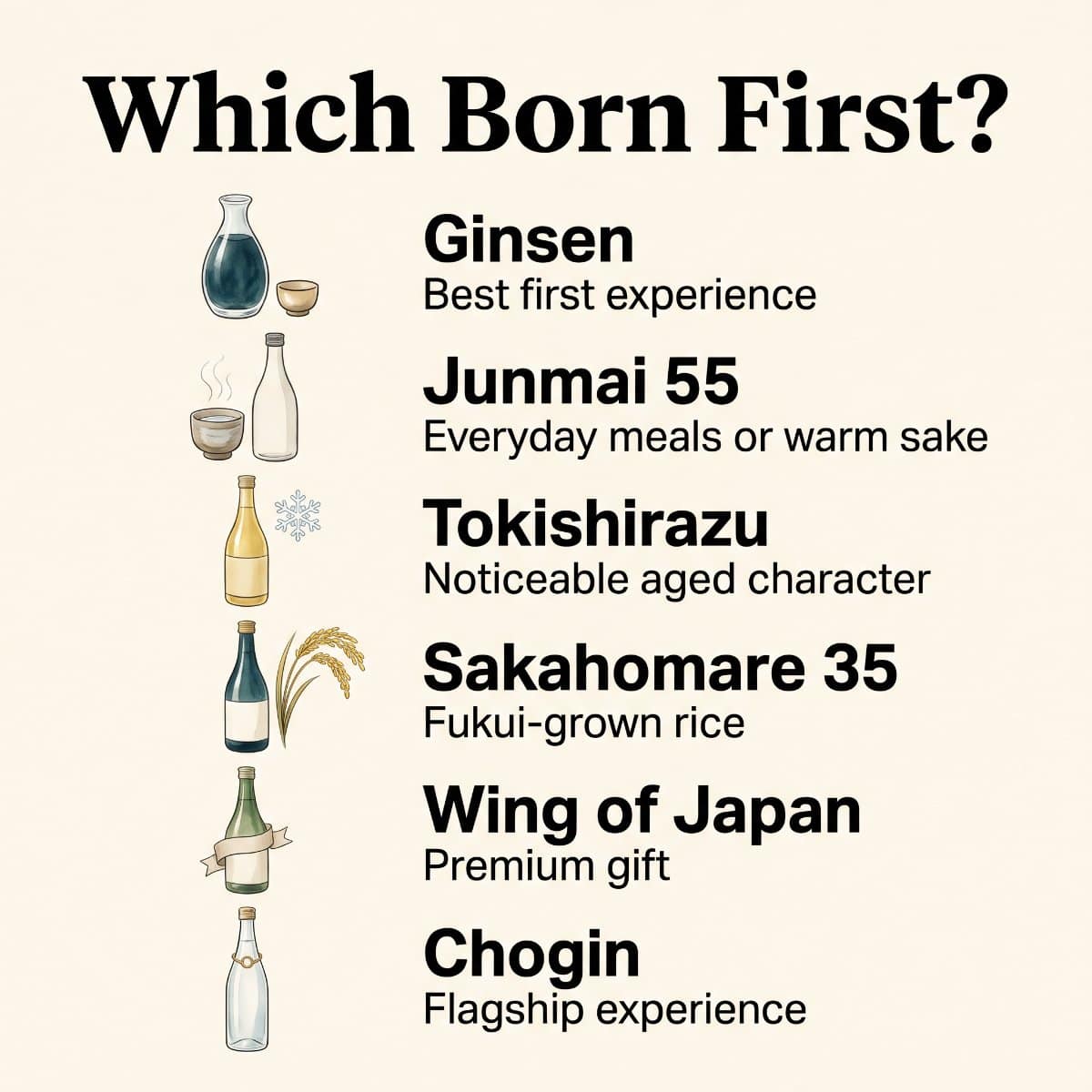
If you want to start with Born’s junmai daiginjo style, Ginsen is our first pick. For a less expensive and more temperature-flexible introduction, choose Junmai 55 instead. From there, choose by what you want to explore. The comparisons below draw on the brewery’s product notes rather than our own tasting.
First experienceGinsenJunmai daiginjo character at a moderate price
Everyday meals or warm sakeJunmai 55Firmer structure and the widest serving range
Noticeable aged characterTokishirazuMature aroma and a pale-gold color
Fukui-grown riceSakahomare 35Made only with Fukui-bred Sakahomare
Premium giftWing of JapanA strong story, a refined profile and a lower price than Chogin
Flagship experienceChogin20% polishing and a blend centered on five-year sake
Born Chogin vs Wing of Japan: What Is the Difference?
Chogin is the more exclusive and extensively polished flagship. It uses Yamada Nishiki polished to 20 percent and is blended around sake aged about five years at -10°C. Wing of Japan, by contrast, combines junmai daiginjo polished to 20 and 35 percent, including sake aged about two years. As a result, it costs about a third as much.
Ginsen, Junmai 55 or Tokishirazu?
Based on the brewery’s descriptions, Ginsen is the step into junmai daiginjo, polished to 50 percent at a moderate price. Tokishirazu, by contrast, is visibly more mature, so it suits savory dishes and gentle warming. Junmai 55 is the least expensive of the three and offers the broadest serving range, from chilled to hot.
What Does Born Sake Taste Like?
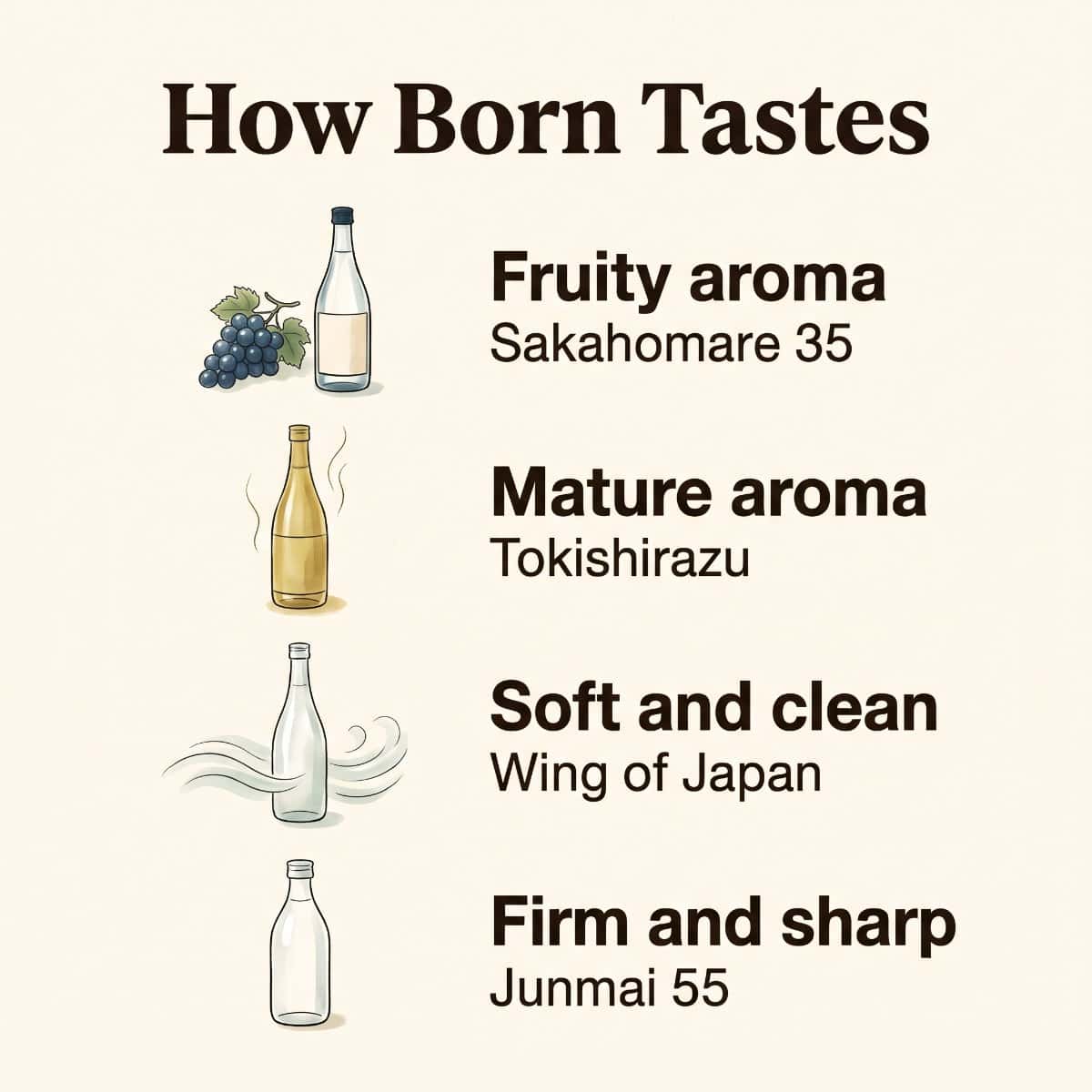
Born generally leans full and flavorful rather than sharply dry. For example, the brewery describes many bottles as hōjun umakuchi (芳醇旨口), meaning full-bodied, aromatic and flavorful rather than simply dry. Still, rice, polishing and aging time change a lot, so the axes below help more than a single brand flavor.
Fruity aromaSakahomare 35 ⟷ TokishirazuMature aroma, pale gold
Best chilledWing of Japan ⟷ Junmai 55, TokishirazuGood warm
These positions are our editorial reading of the brewery’s product notes, not lab measurements or results from our own side-by-side tasting.
Aroma and Color
For its premium bottles, the brewery describes an aroma like ripe fruit and links it to subzero maturation. Sakahomare 35, for example, turns grape-like in the mouth. Tokishirazu, meanwhile, shows a mature aroma and a pale-gold color, according to the brewery.
Texture and Finish
According to the brewery, Wing of Japan has a soft mouthfeel and a clean, crisp finish. Junmai 55, on the other hand, has firmer body and a sharp finish. Warming it, the brewery says, brings acidity and depth forward.
How Does Born Differ from Warm-Aged Koshu?
Born’s cold maturation differs from the warmer aging behind some amber-colored koshu. Those styles may develop nutty or caramel-like aromas. Born’s official notes, by contrast, stress fruit and smoothness, plus a pale-gold color and mature aroma in Tokishirazu. Still, neither all koshu nor all Born bottles follow one pattern.
Ice-Temperature Aging: Born’s Signature Technique
Born’s ice-temperature aging is the controlled maturation of finished sake at subzero temperatures, meaning below 0°C, before release. It is a stage after brewing, not part of fermentation. The brewery says every release goes through it for at least one year, with periods varying by product and blend.
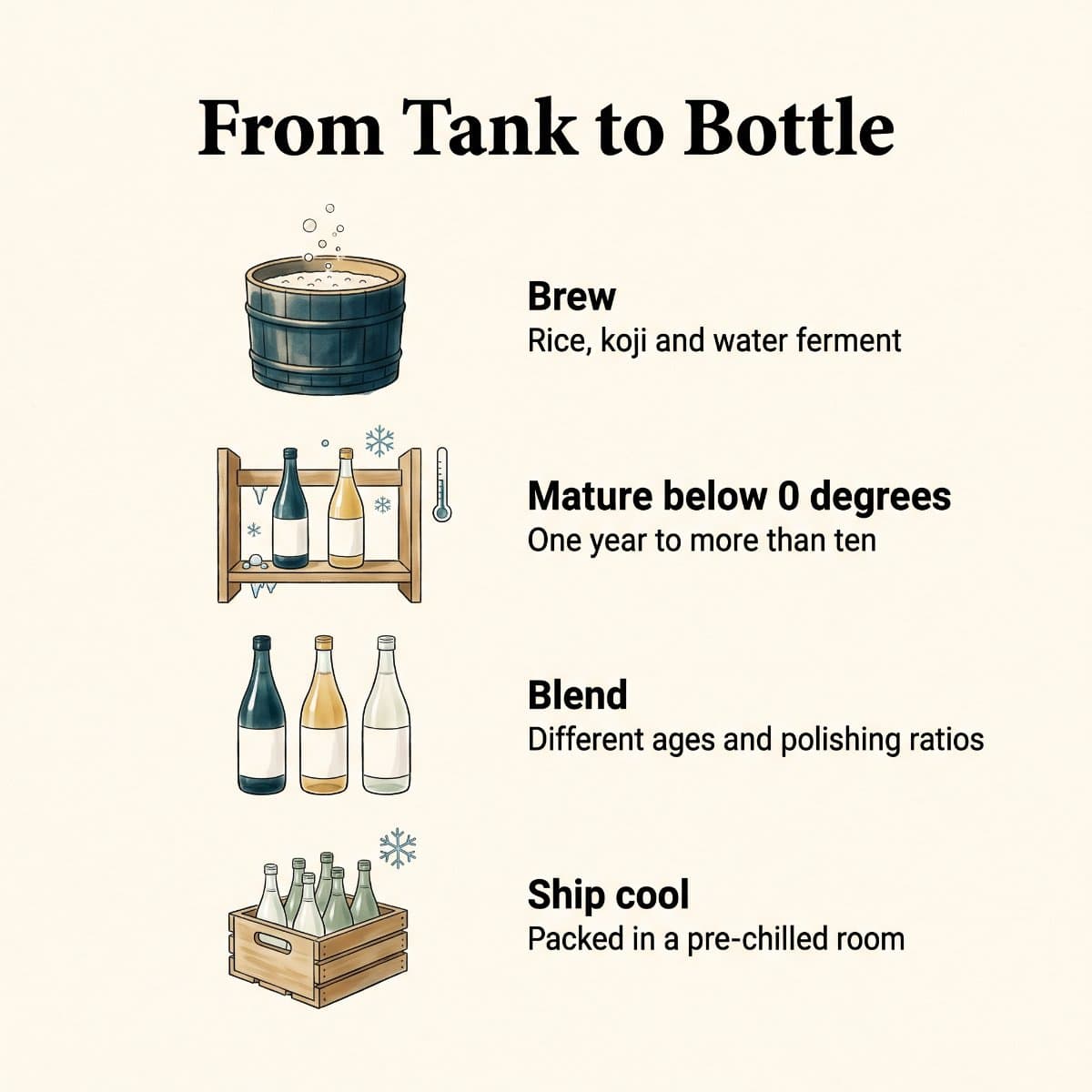
From tank to bottle: where the cold comes in
BrewRice, koji and water ferment into sake.
Mature below 0°CThe brewery says this lasts from one year to more than ten.
BlendThe brewery combines sake of different ages and polishing ratios for each label.
Ship coolStaff pack bottles in a pre-chilled room and ship them in the evening.
The brewery calls this process hyōon jukusei (氷温熟成), or ice-temperature aging, and this guide also calls it subzero maturation. This term describes the temperature range used for maturation. Notably, the brewery does not describe freezing the rice or freeze-concentrating the sake. For a broader look at maturation, see our guide to sake aging (jukusei).
Why Mature Sake Below 0°C?
Above all, temperature controls how fast sake changes. In a 2022 study, Gifu Prefecture’s food research institute stored junmai daiginjo at 15 to 60°C. Tasters judged samples at 30°C or above as overaged or deteriorated, so the authors recommend 15°C or lower to keep quality.
That supports the general point that warmth speeds up unwanted change. However, the study did not test subzero temperatures or Born’s method. So the brewery says its process brings a ripe-fruit aroma and a smooth texture. Treat that as its own description, though, rather than a proven result.
How Long and How Cold?
Conditions differ by bottle. For example, Chogin is blended around sake aged about five years at -10°C. Meanwhile, Wing of Japan includes sake aged about two years at 0°C or below. For Ginsen, the product page says “up to one year” at 0°C or below. However, that wording differs from the brewery’s general “at least one year” statement. We could not confirm how the two fit together.
Keep in mind that these figures describe the blend. Chogin, for instance, is not one batch held for exactly five years. Instead, the brewery builds it around five-year sake.
Is this just refrigeration?
No. Home refrigeration is storage after purchase. Born’s process is a planned production stage, with controlled subzero maturation, product-specific aging periods and blending before release. Keeping a bottle in your fridge does not recreate or continue it.
Rice Polishing and Junmai Brewing
Born polishes rice deeply to reduce the proteins, fats and other compounds concentrated in the outer layers. That helps the brewery pursue a clean, refined style. Even so, a lower polishing ratio does not automatically make a sake better.
What Is a Rice Polishing Ratio?
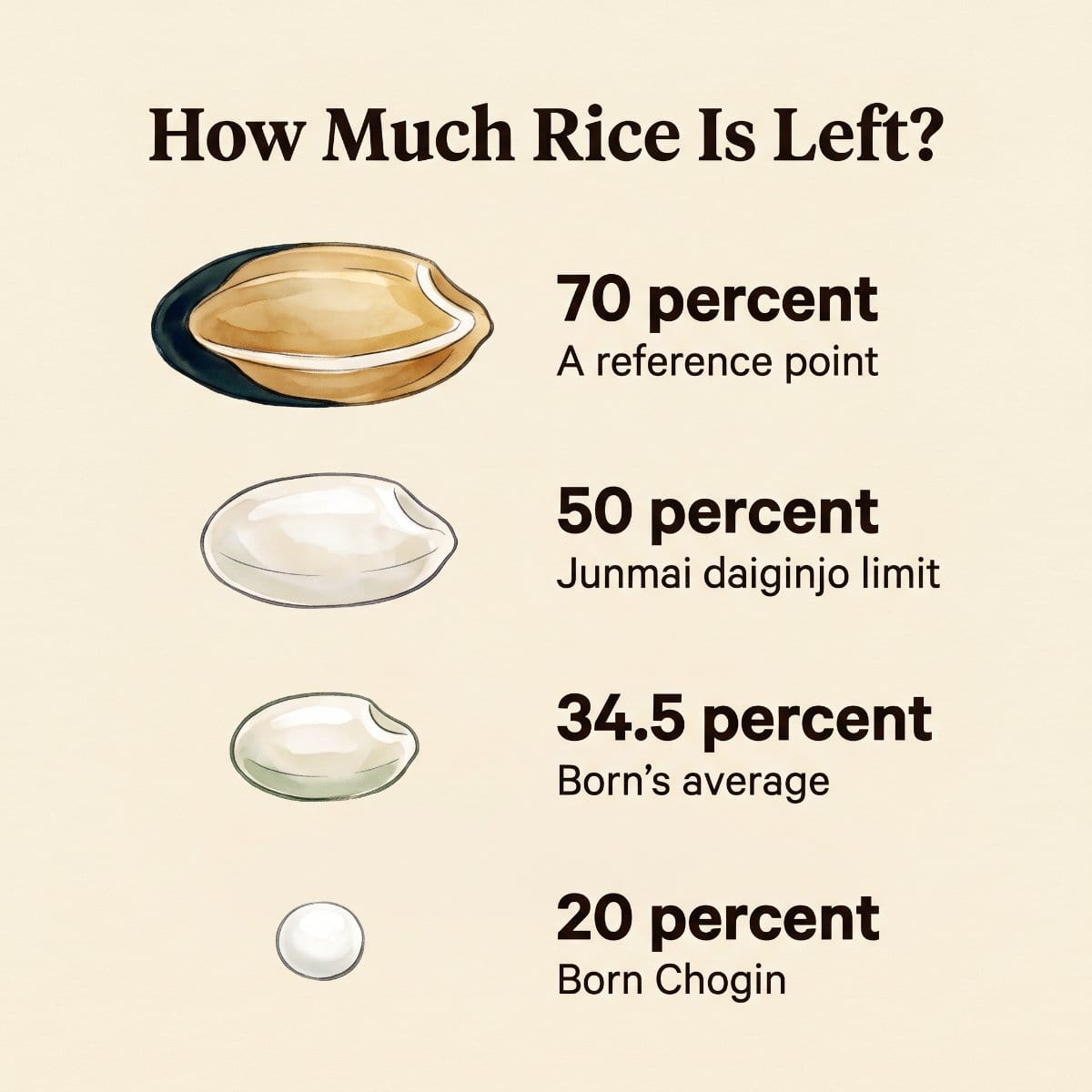
Japan’s National Tax Agency defines the polishing ratio as the weight of polished rice compared with the original brown rice. So the number tells you what remains, not what was removed. Our page on rice polishing covers the details.
How much of each grain is left? (visual example)
70%A reference point, not a quality threshold
50%50% or lower is required for junmai daiginjo
34.5%Born’s brewery-reported average
20%Born Chogin
Born’s 34.5 Percent Average
The brewery reports a brewery-wide average polishing ratio of 34.5 percent, although it does not explain how that average is calculated. In addition, it polishes its own rice. According to the brewery, the eleventh-generation head designed its latest polishing machine himself, starting from the control board.
Why go so far? The National Tax Agency explains that the outer layers of rice hold more protein, fat, ash and vitamins. Sake needs these, but too much can spoil its aroma and taste. Still, many excellent sakes use rice polished to 60 or 70 percent, so polishing ratio is not a quality ranking.
What Does Junmai Mean?
Junmai means sake made without added brewing alcohol. Katoukichibee Shouten makes only junmai sake. Both the Japan Sake and Shochu Makers Association and Sabae City also describe it that way. Its labeled ingredients are rice, rice koji and water.
Under Japan’s labeling standards, junmai daiginjo goes further. It must use rice and rice koji with no added alcohol and a polishing ratio of 50 percent or lower. It also needs at least 15 percent koji rice and must meet the standards for ginjo brewing, aroma and appearance.
That said, junmai is a production category, not a promise of flavor. A small amount of added brewing alcohol is a legitimate technique, and many fine honjozo and ginjo sakes use it.
Food Pairings: What Goes Well with Born Sake?
Born’s smooth, rounded style suits food with clear but gentle flavors. The brewery names traditional Japanese cuisine for Tokishirazu and Fukui’s seafood and beef for Sakahomare 35. However, the other suggestions below are our own starting points, not rules.
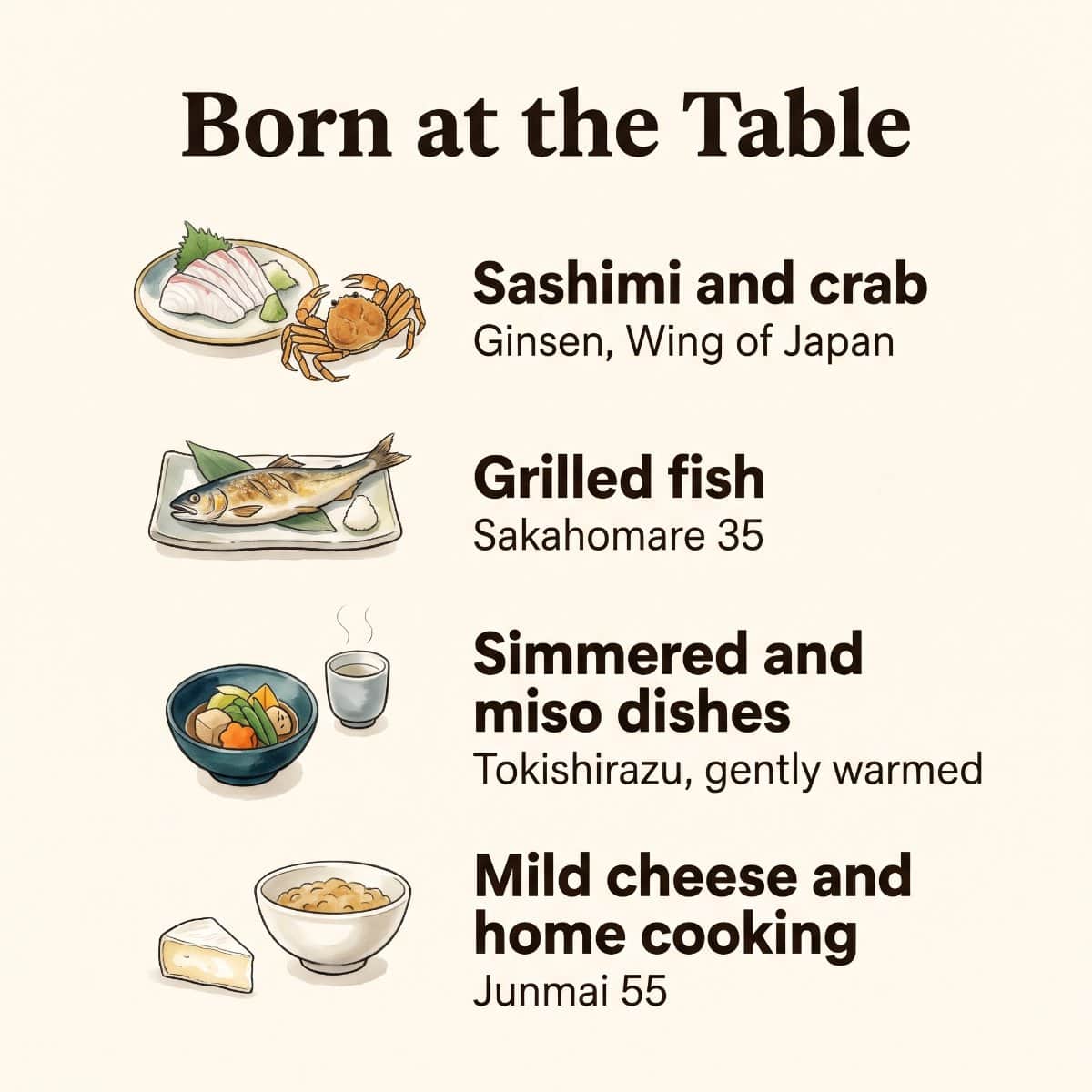
Sashimi and crabGinsen, Wing of JapanA clean finish lets delicate seafood sweetness come through.
Grilled fish and seasonal dishesSakahomare 35Fruit and depth stand up to salt and char.
Mild cheese and home cookingJunmai 55Firm body and acidity cut through fat.
Seafood and Fine Japanese Dishes
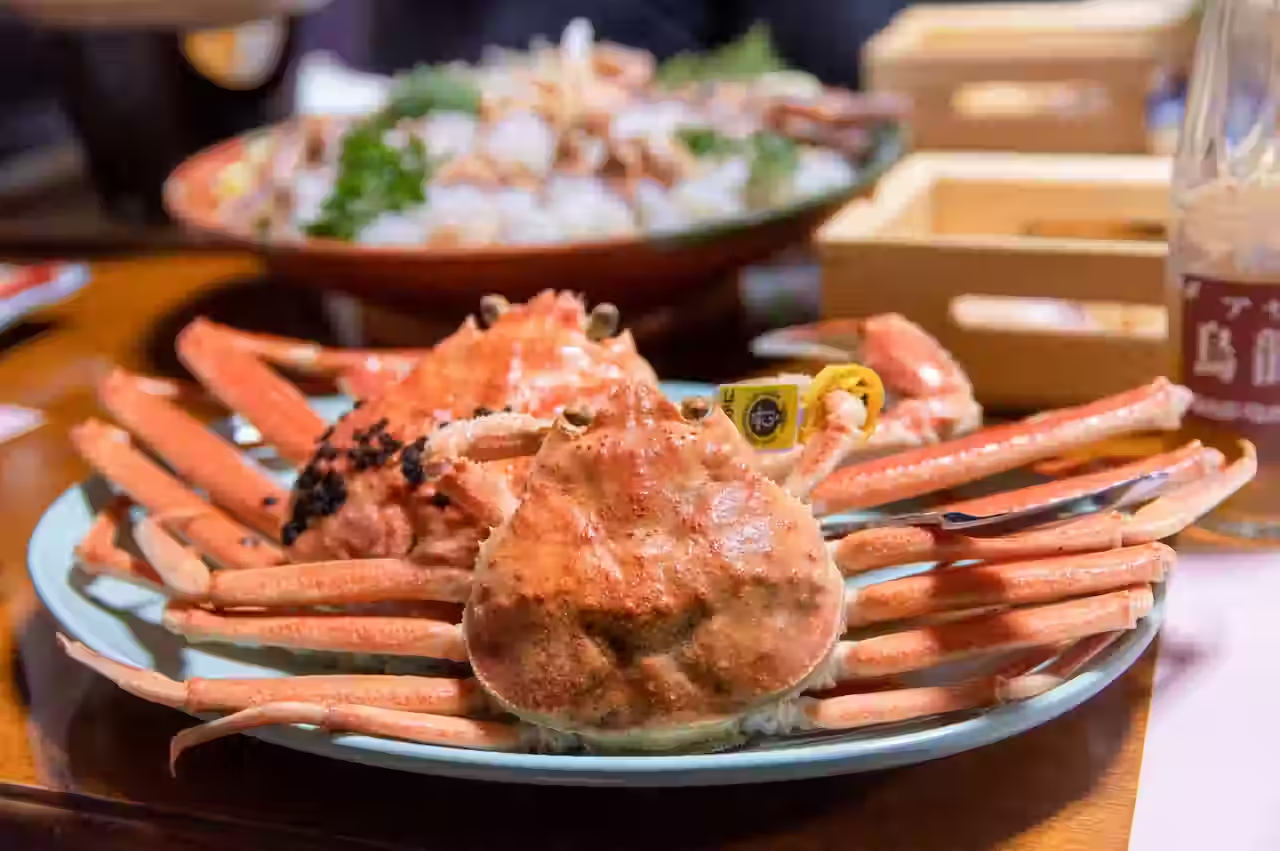
Fukui sits on the Sea of Japan, so seafood is the natural place to start. Here, a cleaner Born junmai daiginjo works with white fish sashimi or lightly seasoned Echizen crab. Strong soy sauce or wasabi can flatten a delicate sake, so go easy.
Richer Dishes and International Food
For deeper flavors, an aged blend like Tokishirazu makes more sense. Meanwhile, Junmai 55 is the brewery’s pick for both home cooking and Western dishes, so mild cheese or roast chicken are fair game. For the general principles, see our guide to sake and food pairing.
How to Serve and Store Born Sake
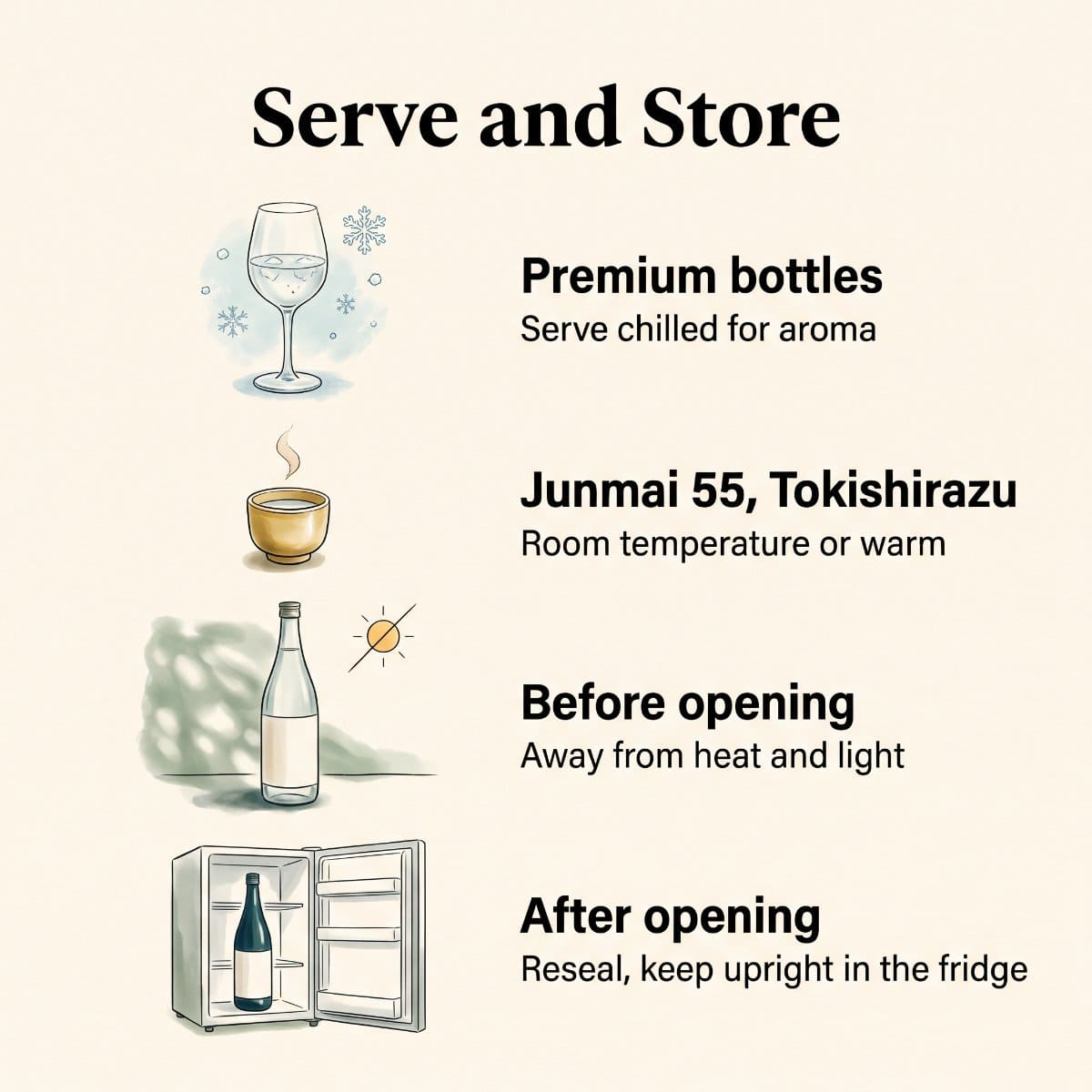
Serve premium Born bottles chilled to bring out aroma, while Junmai 55 and Tokishirazu work at room temperature or warm too. For storage, protect bottles from heat, light and sudden temperature changes, then refrigerate after opening. Above all, follow any instruction on the bottle or importer label.
Serving Temperature and Glassware
Born’s product pages list chilled, room temperature and warm ranges, but the recommendations differ by bottle. For example, Wing of Japan is marked mainly for chilled serving. Tokishirazu, on the other hand, is suggested chilled, at room temperature or gently warmed.
If you want warm sake, start with Junmai 55 or Tokishirazu. Meanwhile, for premium bottles, a wine glass helps you catch the aroma. Our page on sake glasses and cups compares the options.
Storage Before and After Opening
The brewery has already done the careful aging, so try not to undo it at home. Before opening, keep the bottle away from heat, direct light and rapid temperature changes. Refrigeration is a conservative choice, especially for delicate premium sake. However, follow the storage instructions on the bottle or importer label, because requirements may differ by product.
After opening, reseal the bottle, store it upright in the fridge and compare its aroma over the next several days. There is no single deadline for every bottle. Instead, fading fruit aroma or a loss of freshness is a better guide than a fixed date. Our guide on how to store sake goes into more detail.
Care Before It Reaches You
The brewery treats shipping as part of its temperature control. Staff pack bottles in a pre-chilled room and dispatch them in the evening, when temperature changes are smaller. As a result, deliveries arrive early the next morning.
Rice, Water and Fukui Roots
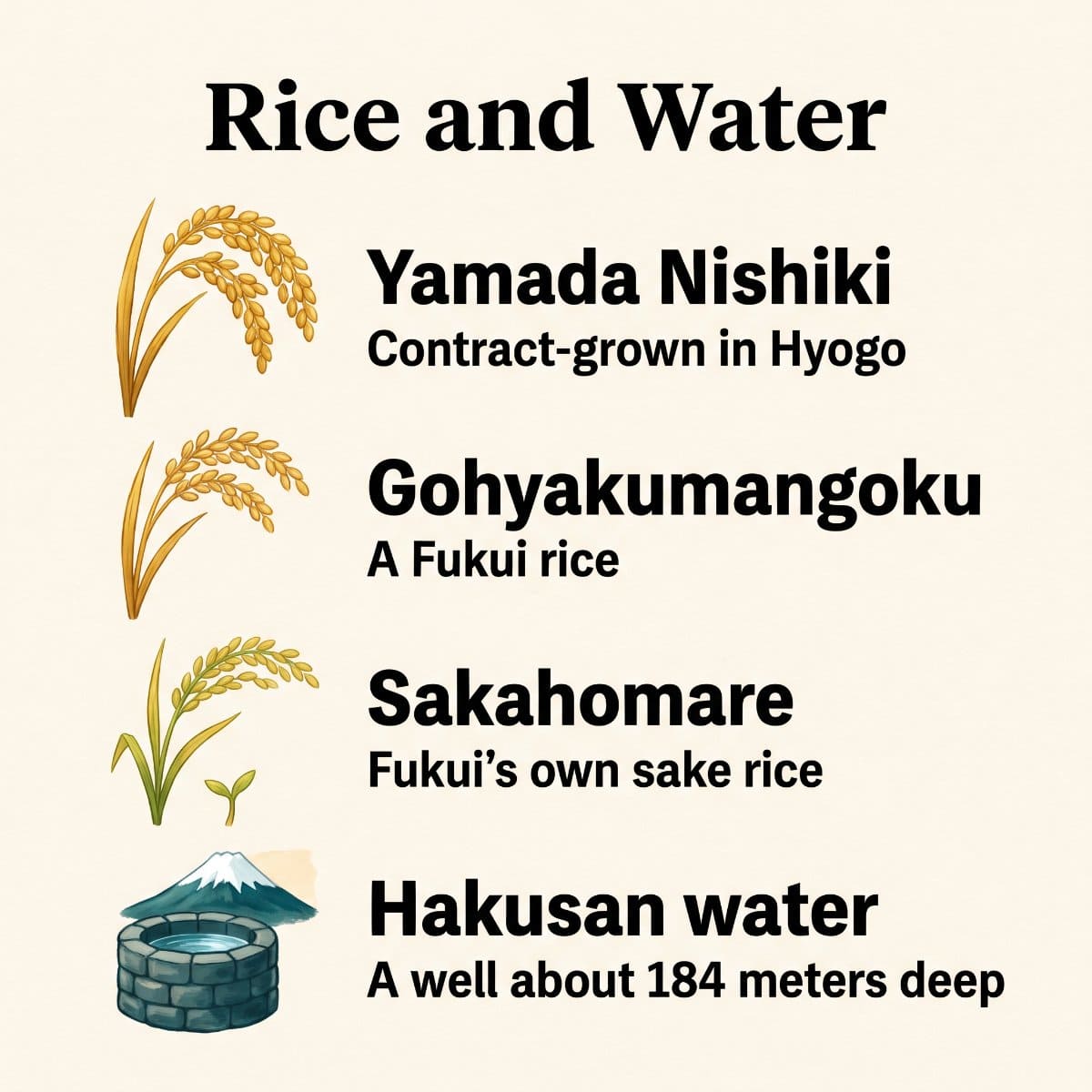
Born’s regional identity comes from its Fukui brewery, its well water and Fukui-grown Gohyakumangoku and Sakahomare. However, its premium bottles also rely on contract-grown Yamada Nishiki from Hyogo. So the brand combines Fukui resources with rice from one of Japan’s most respected sake-rice regions. Our guide to sake rice explains how these varieties differ from table rice.
Yamada Nishiki and Gohyakumangoku
First, Born’s Yamada Nishiki is contract-grown in Hyogo’s top-rated “Special A” districts. Gohyakumangoku, meanwhile, ties the brewery to home. According to MAFF estimates for the 2025 crop, Fukui grew about 14 percent of Japan’s Gohyakumangoku. Together, the two varieties make up more than half of national sake rice production.
Sakahomare: Fukui’s Own Sake Rice
Sakahomare is a sake rice bred by Fukui Prefecture. According to its variety registration, it comes from a cross of Yamada Nishiki and Koshinoshizuku, and it was registered on January 18, 2023. Also, Fukui’s agricultural experiment station reports that millers can take it down to 35 percent, which suits daiginjo.
Water from the Hakusan Mountain Range
The brewery draws its water from a well about 184 meters deep. Specifically, it identifies the source as underground water from the Hakusan mountain range. Water matters for fermentation, but it is only one part of the picture alongside rice, polishing and aging.
The History of Katoukichibee Shouten Since 1860
The brewery’s story runs through several eras, and the Born name came quite late in it. Here, then, are the key moments, as the brewery tells them.
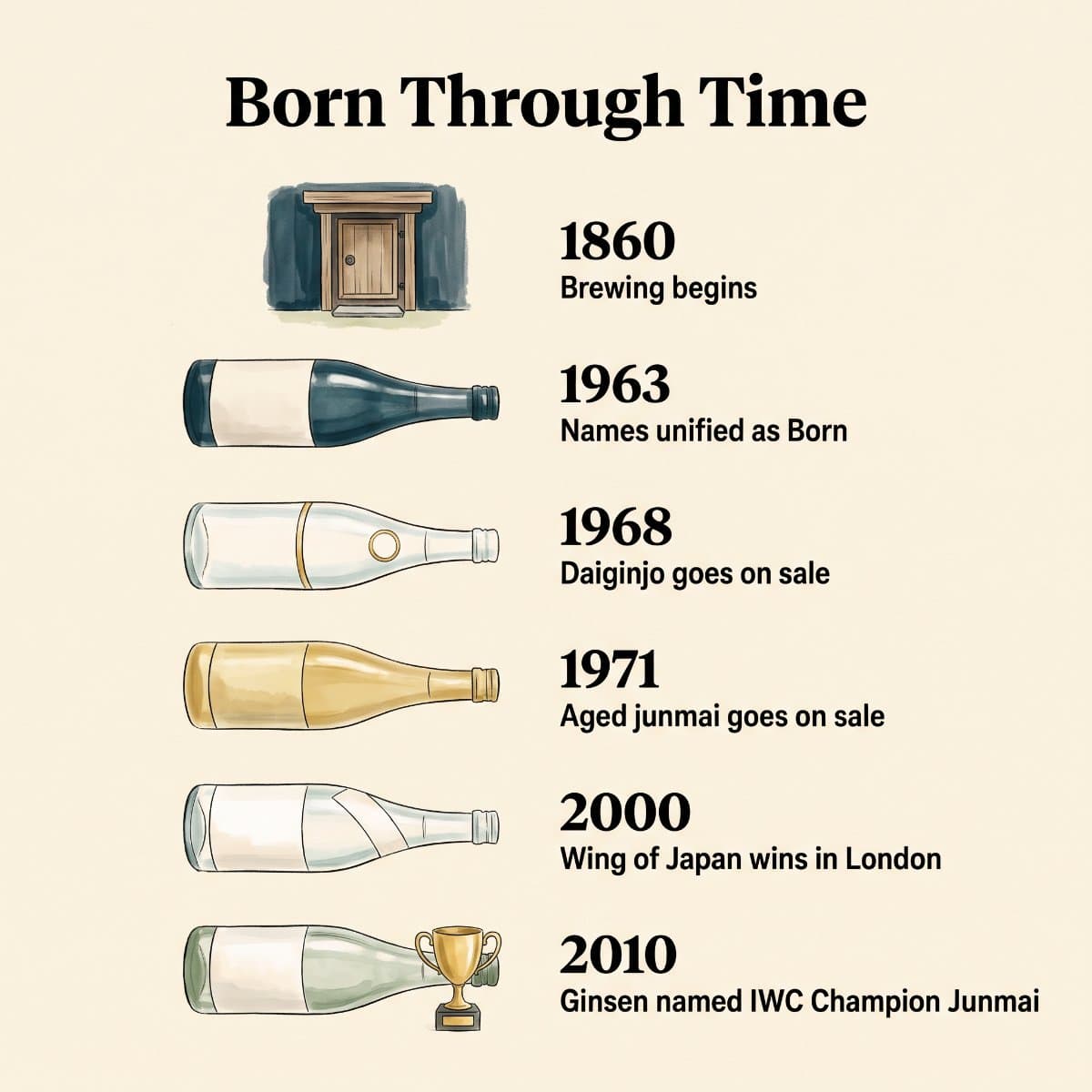
1860Ancestors who worked as money changers and village heads start brewing sake.
Early ShōwaSold as Koshinoi, the sake wins top prize at the Hokuriku sake appraisal four years running.
1963The brewery brings its sake names together under the Born (梵) label.
1968Full-scale commercial release of daiginjo begins.
1971Born Sannen-shu Old, a three-year aged junmai, goes on sale.
2000Gin no Tsubasa wins first place in London and is renamed Wing of Japan.
2010Born Ginsen is named IWC Champion Junmai.
From Koshinoi to Born
Before Born, the brewery sold its sake as Koshinoi. By the brewery’s account, it was also chosen as a regional sake for Emperor Shōwa’s enthronement ceremonies. Then, in 1963, the family brought its sake names together under the Born label and registered the trademark in Japan in 1966.
Early Daiginjo and Aged Sake
The brewery says it began selling daiginjo commercially in 1968. It also describes its 1969 Chotokusen Deluxe as Japan’s first daiginjo product. Other breweries have their own early daiginjo stories, though, including Fukui neighbor Kokuryu. So treat “first” here as the brewery’s claim.
Likewise, the brewery calls its 1971 Sannen-shu Old Japan’s first commercially sold aged sake. Aged sake itself existed long before, so the claim is about a modern retail product. Either way, it shows the brewery was thinking about maturation decades ago. Read more about modern sake history for the wider context.
International Recognition
Later, Born began winning abroad in the late 1990s. According to the brewery, Born Hyōzan took first place at a sake festival in Toronto in 1998. Two years later, Gin no Tsubasa won in London. Today the brewery says it exports to 118 countries. Sabae City’s profile lists 108, and neither source explains whether update dates or counting methods differ.
What Does the Name Born Mean?
The Japanese character 梵 is read “bon” and comes from Buddhist vocabulary. Bimeguri Fukui, a regional profile, says it represents the Sanskrit idea of truth. Meanwhile, the same profile says the English spelling BORN expresses creation. So BORN is a brand expression, not a literal translation of 梵.
Visiting the Born Brewery in Fukui
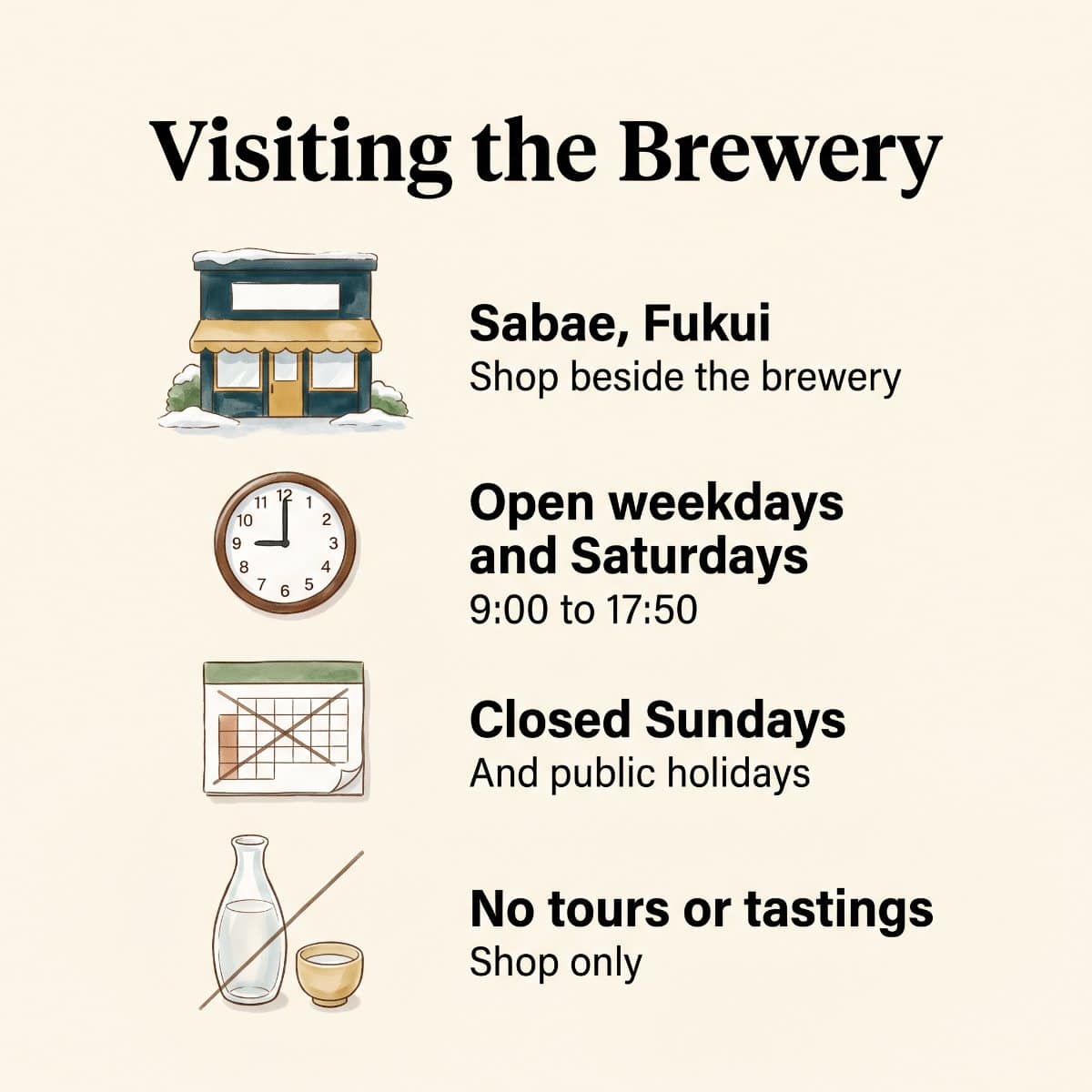
The brewery stands in Yoshie-cho, Sabae, and it also runs a retail shop on site. However, the Japan Sake and Shochu Makers Association states that the brewery does not offer tours or tastings. So plan to shop, not to tour.
Katoukichibee Shouten shop (as of October 2026)
Address
1-11 Yoshie-cho, Sabae City, Fukui Prefecture
Shop hours
9:00 to 17:50 on weekdays and Saturdays, per the brewery (Sabae City lists 9:00 to 18:00; use the brewery’s hours)
Closed
Sundays and public holidays, with irregular closures at New Year and Obon
Tours and tastings
Not offered
Details may change. Please check the official website or call before you travel.
While you are in Fukui, the local food is worth the trip on its own. Try Fukui’s oroshi soba, cold buckwheat noodles with grated daikon, before or after your shop visit.
Common Misconceptions About Born Sake
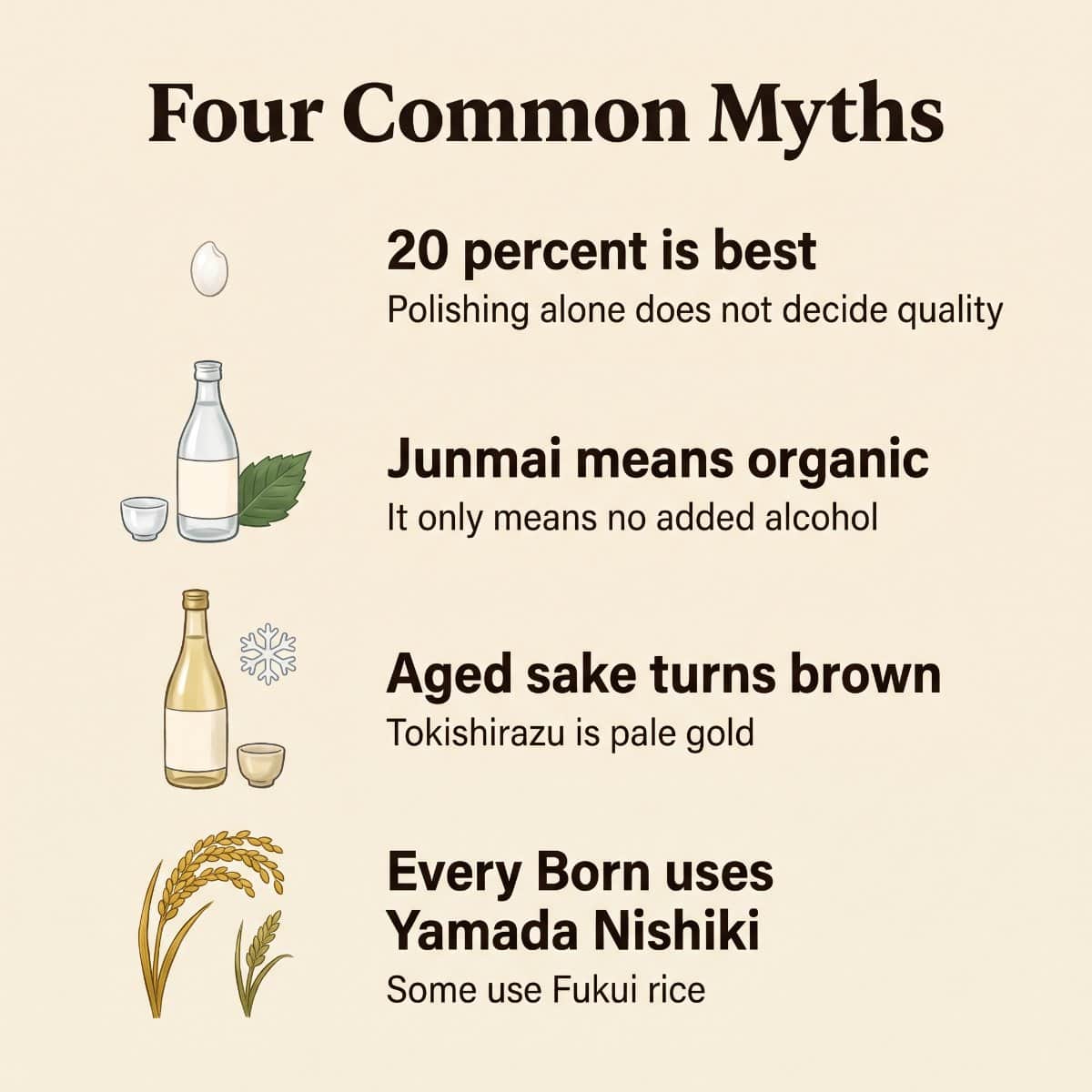
“20% polishing means the best sake.”
It supports a refined style, but polishing ratio alone does not decide quality.
“Junmai means organic or additive-free.”
Junmai means no added brewing alcohol. It is a production category, not an organic label.
“All aged sake turns brown.”
Color depends on time and temperature. Tokishirazu is pale gold, not brown.
“Every Born uses Yamada Nishiki.”
Some bottles use Gohyakumangoku or Fukui’s Sakahomare instead.
Final Thoughts: Which Born Is Right for You?
If you are new to Born, start with Ginsen; we suggest serving it lightly chilled. Next, try Tokishirazu gently warmed to taste what time adds. Save Chogin or Wing of Japan for a celebration, and look for Sakahomare 35 if Fukui’s own rice interests you. For more breweries with a clear identity, browse our Japanese sake brands section.
Editorial note: Specifications, Japanese retail prices and brewery details were checked against Katoukichibee Shouten’s official website in October 2026. Taste descriptions attributed to the brewery reflect its official product notes. Food-pairing suggestions not attributed to the brewery are our own recommendations.
Frequently Asked Questions About Born Sake
About the Brand
What is Born sake?
Born is a junmai-only sake brand from Katoukichibee Shouten in Sabae, Fukui Prefecture. The brewery matures every release below 0°C before sale. Its flagship, Born Chogin, uses rice polished to 20 percent.
How do you pronounce Born sake?
The Japanese name 梵 is pronounced “bon.” BORN is the English brand spelling, and both names refer to the same sake.
When was Born founded?
The brewery began making sake in 1860. It brought its sake names together under the Born label in 1963 and registered the trademark in Japan in 1966.
Aging and Bottles
Does ice-temperature aging mean freeze concentration?
No. Born uses “ice-temperature aging” to describe subzero maturation of finished sake after fermentation. The brewery does not describe it as freeze concentration or as brewing from frozen rice. However, its public explanation does not specify the physical state of the sake at every maturation temperature.
Is all Born sake aged for the same length of time?
No. The brewery says its whole range undergoes subzero maturation, but periods and blends differ by release. Chogin centers on sake aged about five years, while Wing of Japan includes sake aged about two years. Also, the Ginsen page says “up to one year,” which differs from the brewery’s general “at least one year” statement.
Is Born Chogin worth the higher price?
That depends on what you want. Chogin is Born’s flagship expression rather than simply a better Ginsen. Its price reflects 20 percent polishing, long cold maturation, blending and limited advance-reservation sales. For most buyers, Ginsen is the more practical first bottle.
Is Born sake sweet or dry?
It depends on the bottle. The brewery describes many of its sakes as full-bodied and flavorful rather than sharply dry. Rice, polishing and aging time all change the balance, so compare individual bottles.
What is Sakahomare rice?
Sakahomare is a sake rice bred by Fukui Prefecture from Yamada Nishiki and Koshinoshizuku. Japan registered it as a variety in 2023, and Born uses it in Sakahomare 35.
Buying and Visiting
Can you visit the Born brewery?
You can visit the shop at the brewery in Sabae, but tours and tastings are not offered. Also, the shop closes on Sundays and public holidays, so check hours before you travel.
Is Born sake available outside Japan?
Yes, in many markets. The brewery currently says it exports to 118 countries, while Sabae City lists 108; the sources do not explain the gap. Abroad, search for both “Born” and 梵, and check the importer label and bottle size before comparing prices with Japanese retail.
Gifu Prefectural Research Institute for Food Sciences – 澤井美伯, 久松賢太郎, 神山真一, 横山哲也, 安部貴大 (2022). Study on Improving Quality of Sake Using IoT: Development of Quality Control Technology to Index the Time to Drink. Reports of the Gifu Prefectural Research Institute for Food Sciences, 4, 6–8 (Accessed October 2026)
Ryo Iwa is the founder and editor of foodinjapan.org. Born and raised in Japan, he writes from regional travel, market visits, and Japanese-language primary sources that rarely reach English readers, including brewing institute publications and industry glossaries. Where a figure cannot be traced to a source, the article says so.
He has been a Google Maps Local Guide for over 10 years, with more than 1,850 reviews and over 42,000 photos viewed hundreds of millions of times. He previously spent two decades as an IT consultant in Japan, the US, and the UK.











Comments