


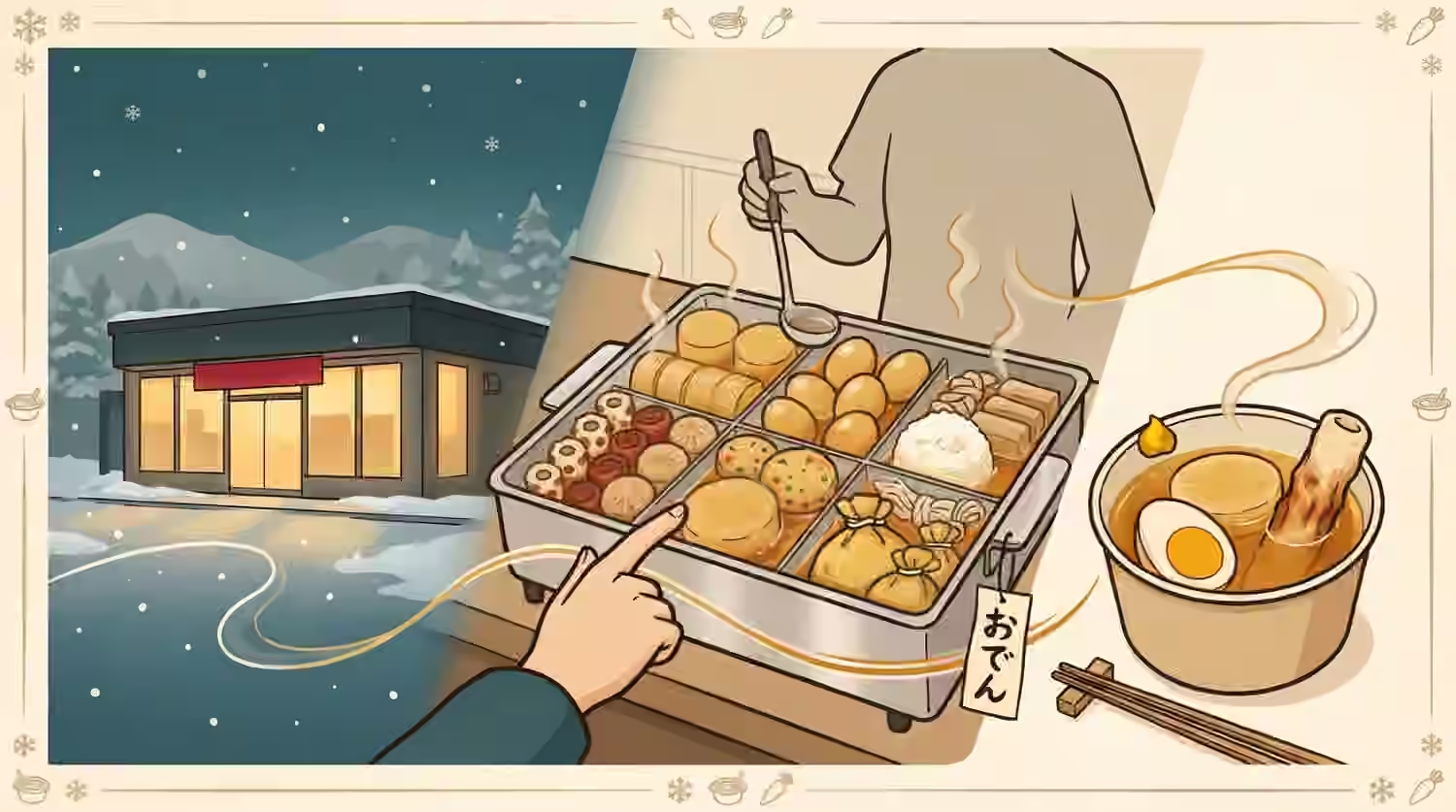


On a cold day in Japan, you may notice an oden display near a convenience-store register. Inside sit daikon, eggs and a few unfamiliar fish cakes, meaning savory fish-paste products rather than anything sweet. Some stores use a heated counter setup, while others may offer sealed products or no oden at all. Either way, ordering is usually much easier than the unfamiliar ingredients suggest.
Still, the setup varies from store to store, so a little preparation helps. This guide shows you how to order oden: what to look for, what to say and which pieces to try first. After that, it covers prices, dietary pitfalls and two classic Tokyo oden shops.
What Is Oden?
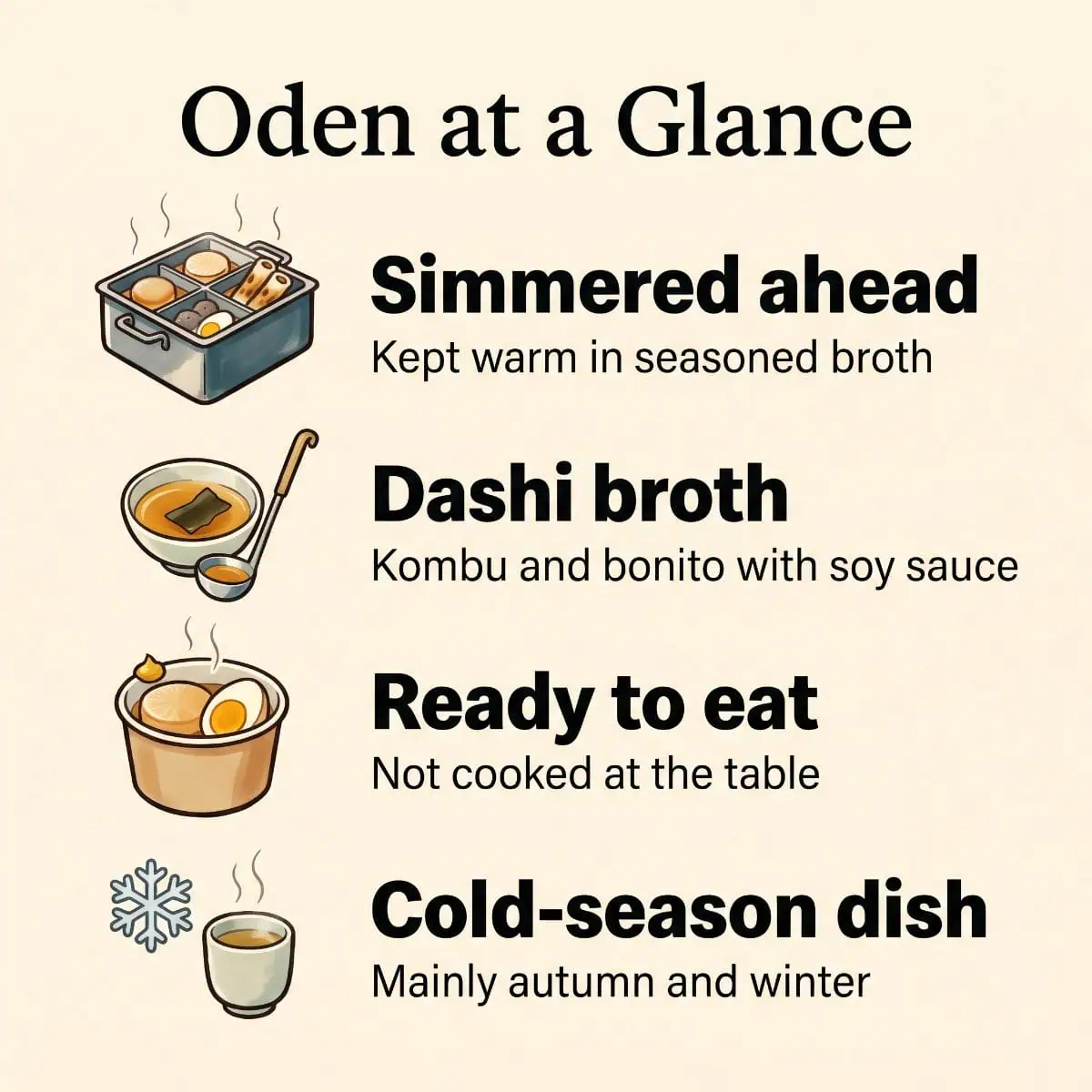
Oden (おでん) is a Japanese dish of ingredients simmered ahead of time and kept warm in a seasoned broth. For Tokyo, MAFF describes a dashi of kombu and katsuobushi seasoned with soy sauce. Common pieces usually include daikon, boiled eggs, konnyaku and fish cakes. Unlike a nabe hot pot cooked at the table, the pieces are sold ready to eat. For a wider overview, see our main oden guide.
Oden at a Glance
- Japanese name
- おでん (oden)
- Dish type
- Precooked ingredients kept warm in seasoned dashi
- Typical broth
- Kombu and katsuobushi with soy sauce, varying by region
- Common ingredients
- Daikon, eggs, konnyaku, chikuwa and other fish-paste products
- Flavor
- Usually mild and savory; mustard and regional sauces may add heat
- Main season
- Autumn and winter, though some Tokyo shops serve it all year
- Where to eat
- Convenience stores, oden shops, izakaya and home kitchens
- Chain-store price
- Most pieces roughly ¥120 to ¥200; see the dated price tables below
Quick answer: how to order
First, look for an oden pot or display near the register. If you see one, ask for oden, then point to each piece and give the quantity. Service varies, so follow the store’s signs or ask the clerk.
おでんをください。Oden o kudasai.I’d like some oden.
これを2つください。Kore o futatsu kudasai.Two of these, please.
What Does Oden Taste Like?
Oden is mild, savory and broth-forward rather than spicy. Tokyo-style broth carries soy sauce, kombu and bonito, so expect gentle saltiness and deep umami. Each piece then adds its own note. For example, daikon turns juicy, and egg whites absorb the broth’s color. Fried fish cakes, meanwhile, give the broth a richer finish.
SavorySoy sauce and dashi
Umami-richKombu, bonito and soy sauce
Broth-soakedJuicy, warm pieces
Usually mildCondiments may add heat
10 Oden Ingredients You Are Likely to Encounter
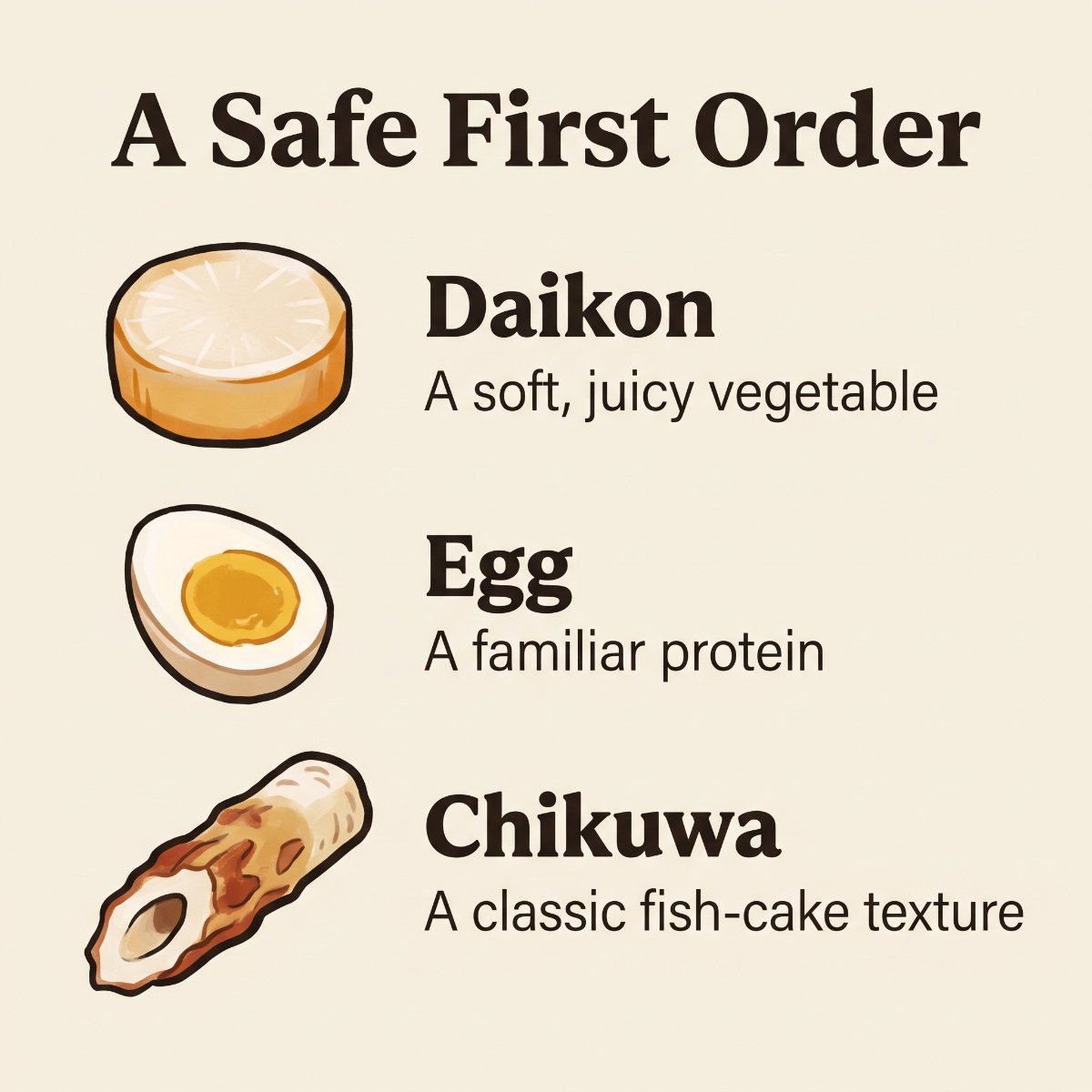
Not sure where to start? A safe first order is one daikon, one egg and one chikuwa. Together, they give you a soft vegetable, a familiar protein and a classic fish-cake texture. Yet the cup stays fairly light.
Beginner’s starter set
大根Daikon
玉子Egg
ちくわChikuwa
¥440 at FamilyMart; ¥426.60 at Seven-Eleven where all three are sold
Sums of listed takeout prices on November 1, 2026. Seven-Eleven’s grilled chikuwa was not listed for every region, and its register total may differ slightly.
The cards below, for example, follow Kibun Foods’ 2025 survey of 4,700 married women across all 47 prefectures. Because it asked which ingredients households add most often to homemade oden, it is not a popularity or sales ranking. In order, they are chikuwa, konnyaku, daikon, egg, satsuma-age, mochi kinchaku, hanpen, atsuage, gobo-maki and shirataki. Many of them also appear on current convenience-store lists. Selection still varies by chain and region.
Older surveys, different results
Earlier household surveys often placed daikon and egg near the top. However, survey designs and samples differ, so their results should not be compared directly with the 2025 list.
Five Ingredients Most Often Added to Home Oden (Kibun 2025)
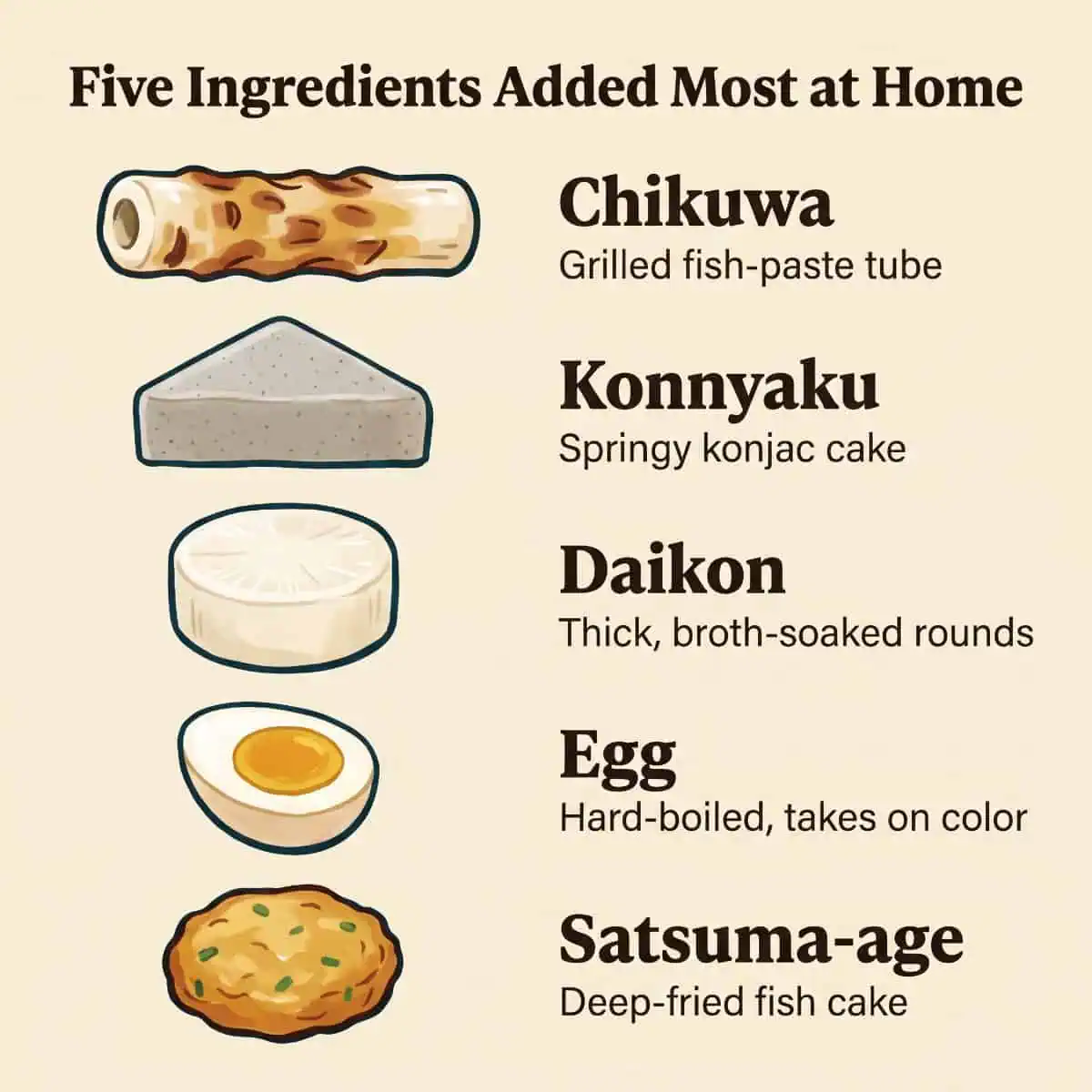
ちくわChikuwa
Grilled fish-paste tube
Makers wrap fish paste around a stick and grill it, so a hollow center remains. It adds a gentle seafood note to the broth.
こんにゃくKonnyaku
Konjac cake
A firm, springy block made from konjac. Because its own flavor is very mild, the appeal lies in its springy texture and the broth.
大根Daikon
Japanese white radish
Thick rounds simmer slowly until soft and soaked through. Its familiar shape and juicy texture make it an easy first choice.
玉子Tamago
Hard-boiled egg
Over time, the white picks up color and flavor from the broth. Then cut it in half and let the yolk absorb a spoonful of soup.
さつま揚げSatsuma-age
Deep-fried fish cake
Fried fish paste, sometimes mixed with vegetables. In parts of Kansai, people call fried fish cakes tempura, so read labels in context.
For more on the fish-paste side, our guides to chikuwa and satsuma-age explain how people eat them outside the oden pot.
Five More Common Ingredients from the Same Survey
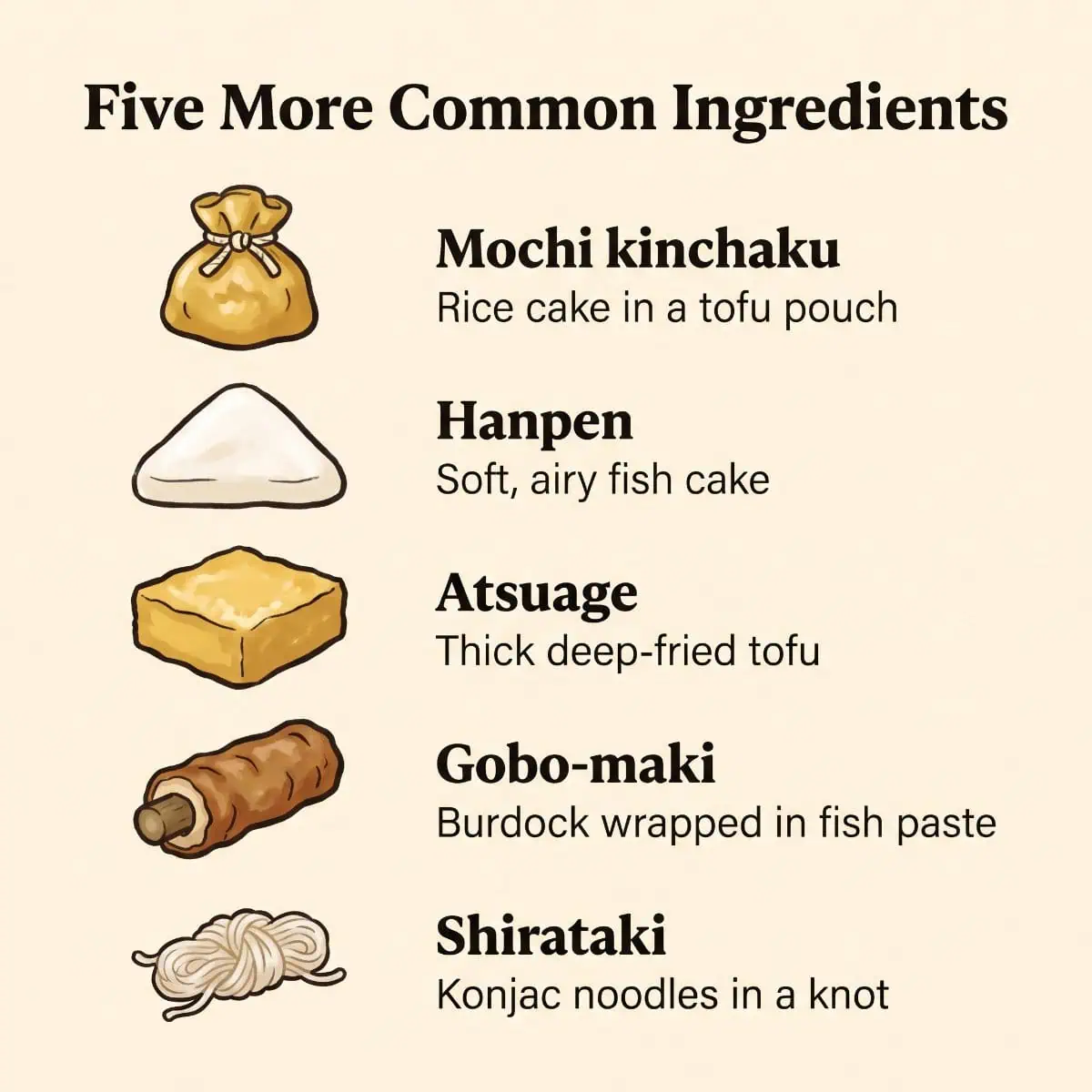
餅入り巾着Mochi kinchaku
Rice cake in a tofu pouch
When you bite through the fried tofu pouch, you reach soft mochi. It gets extremely hot and sticky, so let it cool, take small bites and chew well.
はんぺんHanpen
Soft fish cake cooked by boiling
Airy, springy and slightly porous, a bit like a savory marshmallow. On FamilyMart’s 2026 listing, however, it appears only in Hokkaido, Tohoku and Kanto.
厚揚げAtsuage
Thick deep-fried tofu
Golden outside and soft inside. It is filling, and it holds plenty of broth too.
ごぼう巻Gobo-maki
Burdock wrapped in fish paste
A crunchy burdock core inside fried fish paste. In particular, FamilyMart’s November 2026 listing sells it in Tokai, Hokuriku and regions further west.
しらたきShirataki
Konjac noodles
Thin, translucent noodles, often tied into a little knot. They are light and slurpable, so they make a nice break between richer pieces.
If one of these wins you over, we have separate guides to hanpen, shirataki, tofu and mochi.
Grilled, Fried or Boiled? Why Fish Cakes Differ
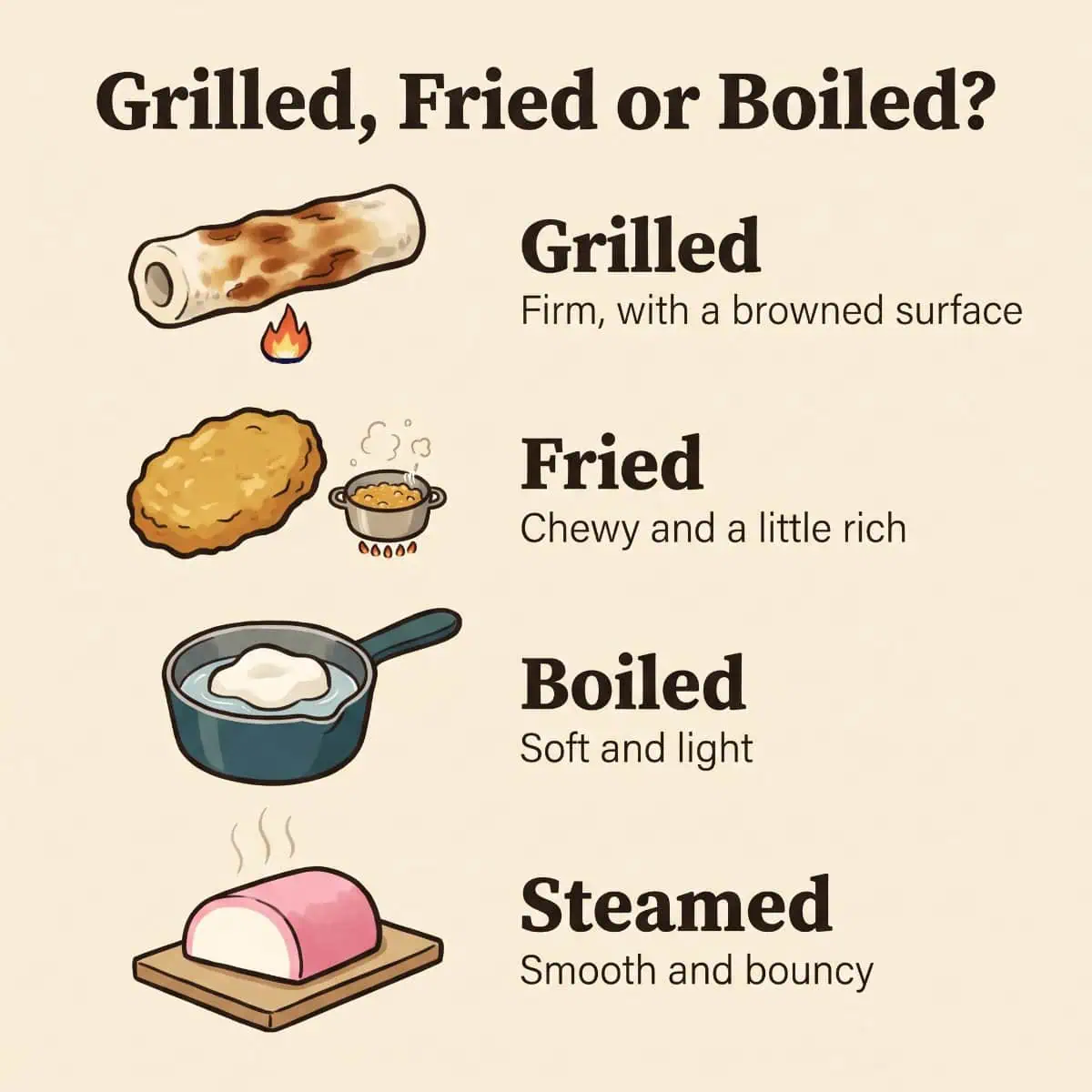
In fact, many oden ingredients belong to one family: fish-paste products, or neri-mono. According to the Japan Kamaboko Association, makers knead fish meat with salt and seasonings, shape it and then heat it. The heating method, however, changes the texture completely.
| Heating method | Oden examples | Typical texture |
|---|---|---|
| Grilled | Chikuwa | Firm, with a browned surface |
| Fried | Satsuma-age, gobo-maki | Chewy and a little rich |
| Boiled | Hanpen, tsumire | Soft and light |
| Steamed | Kamaboko | Smooth and bouncy |
Heating categories based on the Japan Kamaboko Association. Recipes and fish species vary by product.
If you are curious about the steamed branch, our kamaboko guide covers it in detail.
Chikuwa vs Chikuwabu: Not the Same Thing
The names look similar, but the ingredients are completely different. So if you avoid wheat, or assume every chikuwa-like item contains fish, the difference matters.
ちくわ Chikuwa
Made from fish paste and then grilled into a hollow tube. You will find it in oden across Japan.
ちくわぶ Chikuwabu
A dense, chewy tube made from wheat rather than fish, tied especially to Tokyo-style oden. However, it usually sits in a shared broth that may contain fish or meat.
Other Ingredients You May Spot
- Gyūsuji (牛すじ): beef tendon on a skewer, simmered until rich and gelatinous, from chewy to tender. FamilyMart, for example, lists it at ¥198.
- Sausages (ウインナー): a Western-style pick at chains such as FamilyMart.
- Dashimaki tamago (だし巻玉子): a rolled omelet, also on FamilyMart’s list.
- Ganmodoki (がんも): a fried tofu fritter from MAFF’s Tokyo recipe.
- Potatoes (じゃがいも): another item in that Tokyo recipe, soft and starchy once simmered.
- Pork cartilage (豚なんこつ): a Seven-Eleven item, though listed only for Miyazaki and Kagoshima.
How to Order Oden at a Japanese Convenience Store
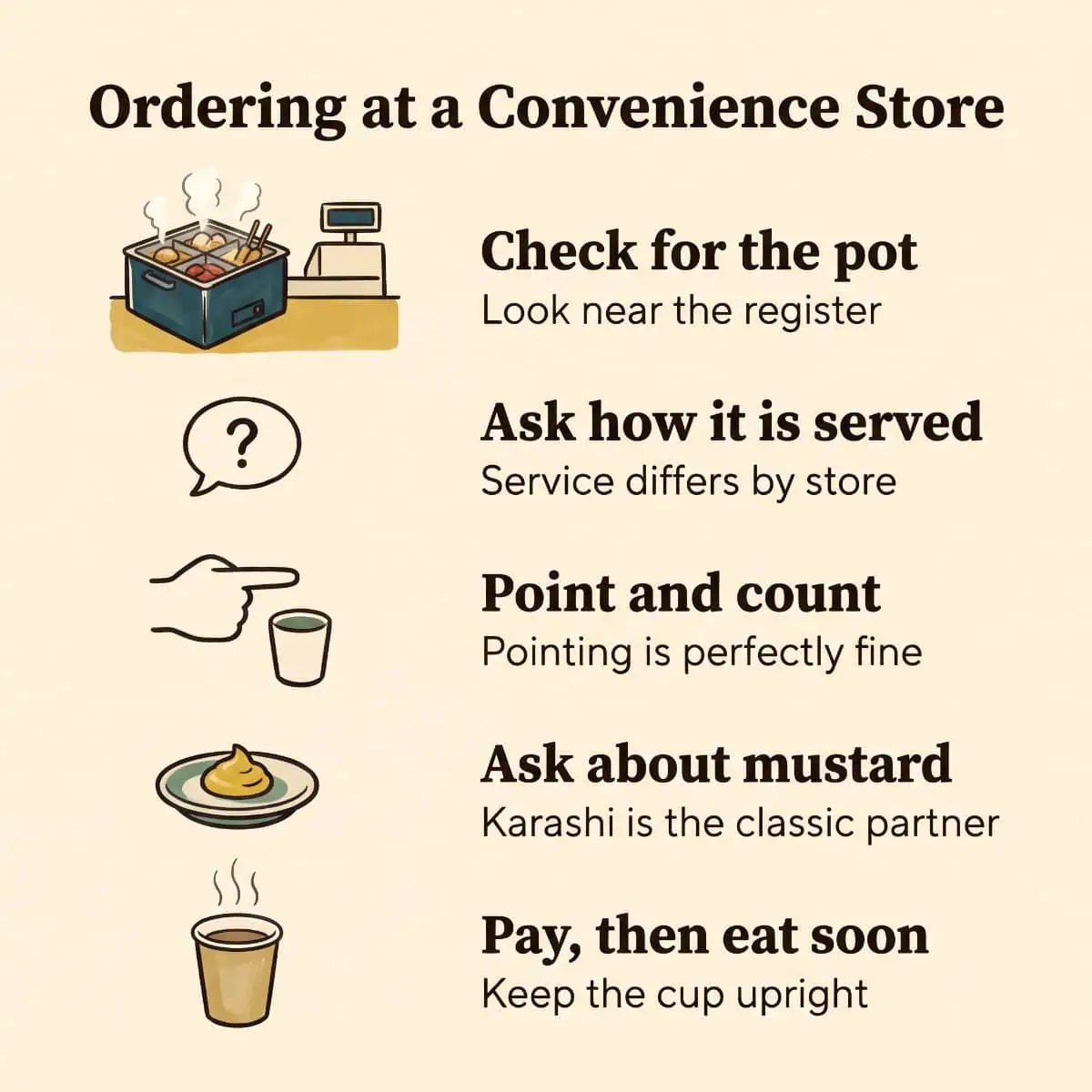
To order oden at a Japanese convenience store, first check the area near the register. If counter oden is available, ask the clerk for oden, then point to the pieces and say how many. Store formats vary, so follow the signs at that location.
Check for the pot
Look near the register first. Not every store sells counter oden, and chain listings note that items vary by store and region. If you see no pot, just ask.
おでんはありますか?Oden wa arimasu ka?Do you have oden?
Find out how this store serves it
Service methods differ by store. So follow the display instructions, or ask the clerk before touching the pot or utensils.
おでんはどこで注文しますか?Oden wa doko de chūmon shimasu ka?Where do I order the oden?
Point and count
Next, point to each item and give a number. Pointing is perfectly fine if you can’t read the labels.
これを2つください。Kore o futatsu kudasai.Two of these, please.
Ask about mustard
Karashi mustard is the classic partner, so ask if you don’t see any packets.
からしはありますか?Karashi wa arimasu ka?Do you have mustard?
Pay, then eat it soon
Tell staff whether you will eat in or take it out, then pay. Keep the cup upright, and eat it soon while it is still hot.
持ち帰りです。Mochikaeri desu.It’s to go.
Quick Phrase Sheet
| Japanese | Romaji | Meaning |
|---|---|---|
| これとこれをお願いします。 | Kore to kore o onegaishimasu. | This one and this one, please. |
| 大根を1つと、玉子を1つお願いします。 | Daikon o hitotsu to, tamago o hitotsu onegaishimasu. | One daikon and one egg, please. |
| これは何ですか? | Kore wa nan desu ka? | What is this one? |
| これは一ついくらですか? | Kore wa hitotsu ikura desu ka? | How much is one piece? |
| 肉や魚は入っていますか? | Niku ya sakana wa haitte imasu ka? | Does it contain meat or fish? |
| 店内で食べます。 | Tennai de tabemasu. | I’ll eat it here. |
Nervous? Show this screen at the register
おでんをお願いします。
指さした具を1つずつください。
I’d like oden, please. One of each item I point to.
How Many Pieces Should You Order?
There is no rule, but here is a practical rule of thumb. Two or three standard pieces make a snack, while four to six pieces plus rice can make a light meal. Portion size varies a lot, though. An egg or atsuage, for example, fills you up more than shirataki or konnyaku. For rice, simply add a convenience store onigiri on the side.
Oden Prices and Availability
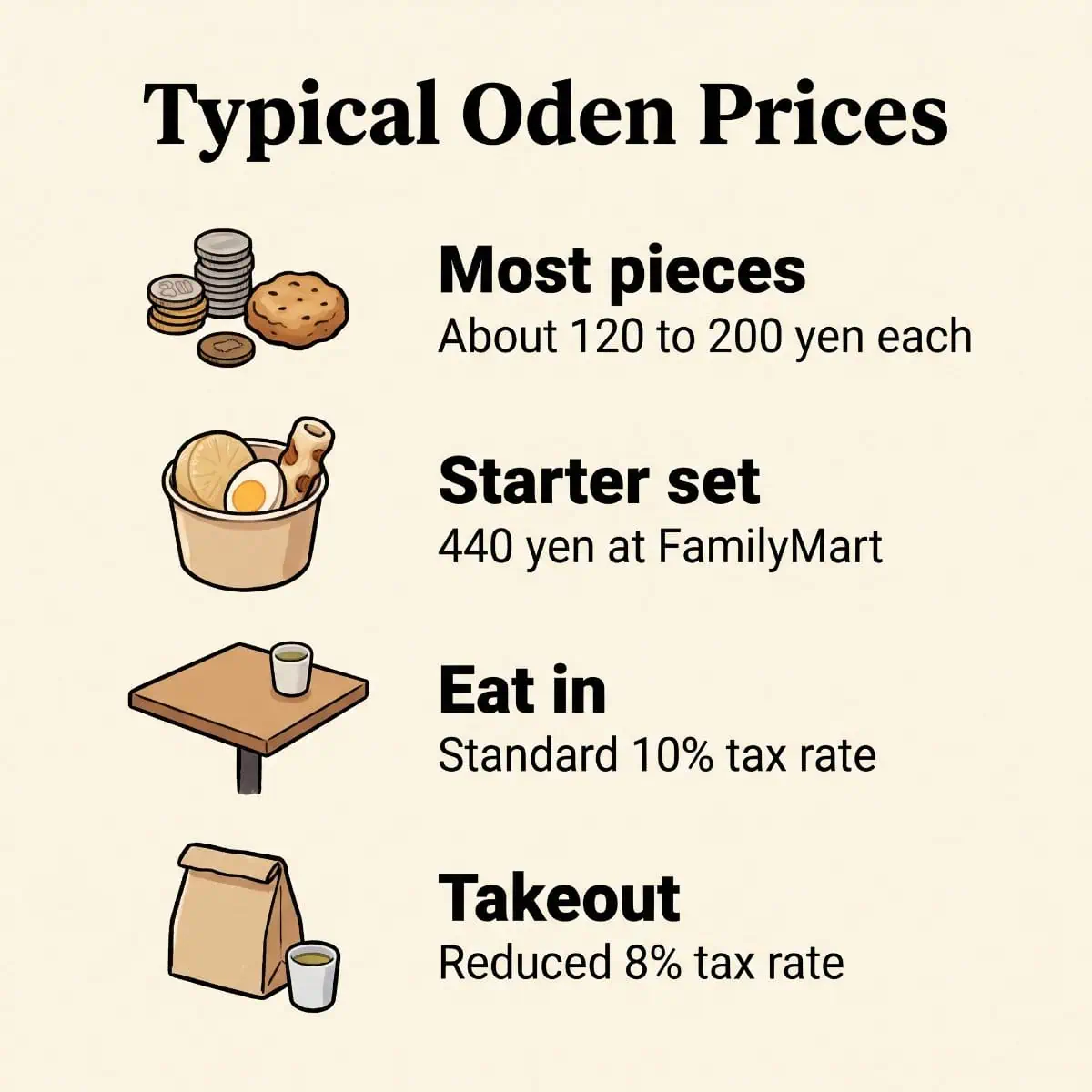
At the two chains we checked, most standard pieces cost about ¥120 to ¥200 each. The listed prices for daikon, egg and chikuwa total ¥440 at FamilyMart. At Seven-Eleven, they total ¥426.60 in regions where all three are sold. Products and prices differ by region, though, so treat these figures as examples.
Price-check method
First, we checked the official FamilyMart and Seven-Eleven Japan product pages on November 1, 2026. We recorded each item’s tax-included takeout price and listed sales regions, using Japan’s reduced 8% rate. However, an item listed for a region may still be unavailable at an individual store. Also, Seven-Eleven calculates tax on the pre-tax subtotal and drops fractions below ¥1, so register totals may differ slightly.
FamilyMart Oden Prices
| Item | Price | Listed sales regions |
|---|---|---|
| Daikon | ¥145 | Listed for every chain region; store stock varies |
| Egg | ¥150 | Listed for every chain region; store stock varies |
| Konnyaku | ¥145 | Listed for every chain region; store stock varies |
| Grilled chikuwa | ¥145 | Listed for every chain region; store stock varies |
| Knotted shirataki | ¥145 | Listed for every chain region; store stock varies |
| Atsuage | ¥150 | All except Okinawa |
| Mochi kinchaku | ¥185 | Listed for every chain region; store stock varies |
| Beef tendon skewer | ¥198 | All except Okinawa |
| Hanpen | ¥145 | Hokkaido, Tohoku and Kanto |
| Gobo-maki | ¥145 | Tokai, Hokuriku, Kansai and westward, including Okinawa |
Checked November 1, 2026. Tax-included takeout prices. Some stores may not carry every item.
Seven-Eleven Oden Prices
| Item | Price | Listed sales regions |
|---|---|---|
| Egg | ¥150.12 | Listed nationwide; stores may not carry it |
| Daikon | ¥130.68 | Listed nationwide under two regional entries |
| Konnyaku | ¥130.68 | Tohoku to Okinawa; Hokkaido lists white konnyaku |
| Shirataki | ¥120.96 | All regions except Kinki, which lists ito-konnyaku instead |
| Atsuage | ¥140.40 | Silken or firm tofu, depending on the region |
| Grilled chikuwa | ¥145.80 | Hokkaido to Tokai, plus Kinki and Okinawa; not listed for Chugoku, Shikoku or Kyushu |
| Pork cartilage | ¥270 | Miyazaki and Kagoshima only |
Checked November 1, 2026. Selected items from Seven-Eleven’s oden listing, which shows tax-included prices to two decimal places.
Eating in? Japan’s Ministry of Finance says food eaten in a store’s eating space, including at convenience stores, is taxed at the standard 10% rate. Takeout food, by contrast, falls under the reduced 8% rate. If you want more budget ideas, see our roundup of cheap eats in Japan.
When Can You Buy It?
Oden is mainly a cold-weather food. According to MAFF, people tend to eat it from autumn into winter. A separate 2025 Kibun survey covered 1,400 married women in seven major regions. There, 82.2% said they think of making oden when it is cold. Seven-Eleven had new oden items listed in late October 2026, but counter pots still depend on each store. Planning the rest of your basket? Our Japanese convenience store food guide can help.
Is Oden Vegetarian? Diet and Allergy Notes
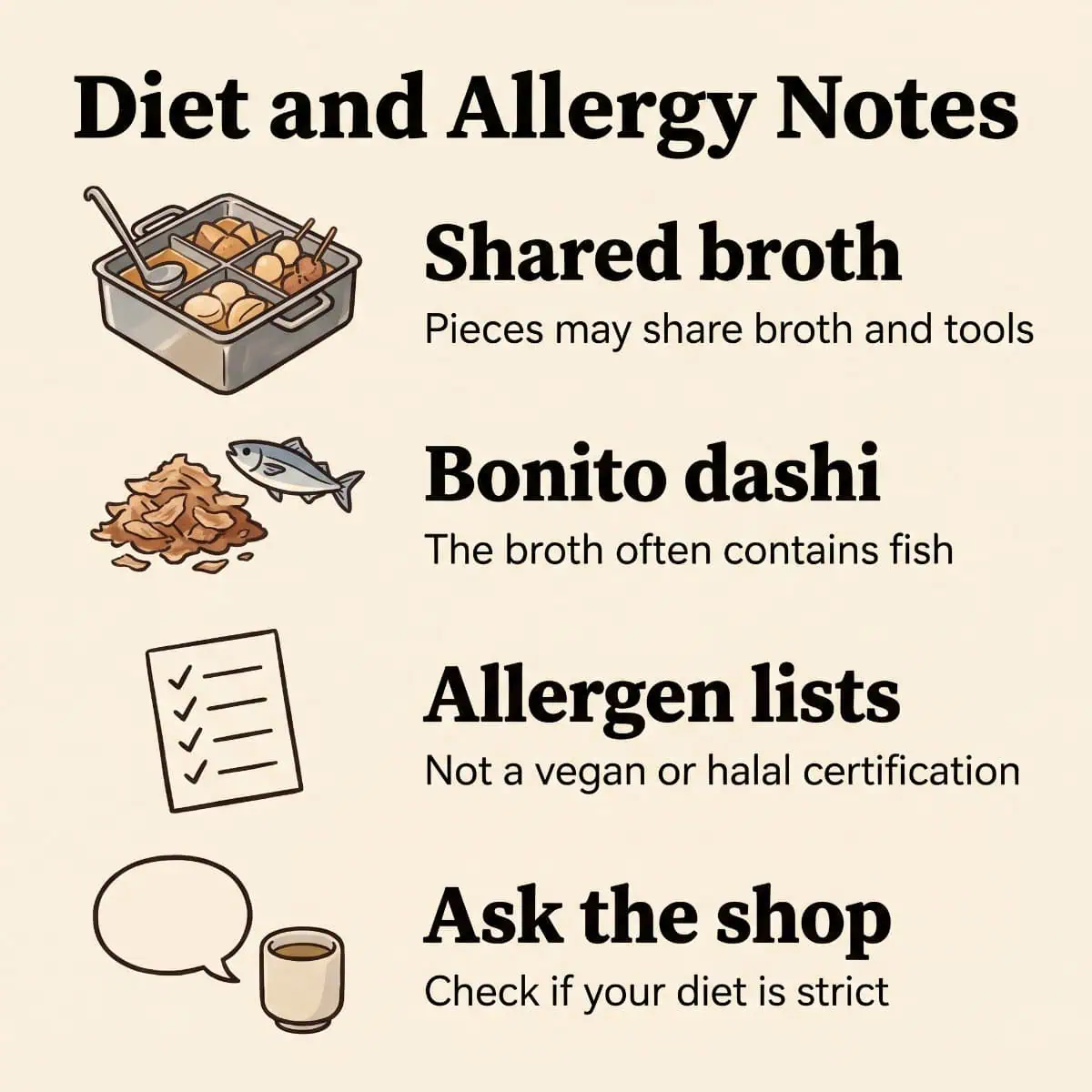
Most standard oden is not vegetarian, even when you pick only vegetables. That is because the shared broth may contain bonito, and chain allergen lists for broth include items such as beef, chicken, pork or gelatin, depending on the region.
Dietary suitability
- In counter-oden setups, vegetable pieces may share broth or serving tools with fish-paste, egg or meat items.
- Many broths also use katsuobushi, which comes from fish.
- An allergen list is not a vegan or halal certification.
- If you need certified food, ask each shop directly.
Allergens listed for Seven-Eleven’s regional broths
- Wheat, beef, soy and chicken are listed for every region.
- Gelatin is listed for Kanto and Yamanashi, Hokuriku and Kinki, Chugoku and Shikoku.
- Pork is listed for Kyushu and Okinawa.
- Each piece has its own allergens; Seven-Eleven’s grilled chikuwa, for example, lists egg, and wheat in Kinki and Okinawa.
Also, keep in mind that an allergen list is not a complete ingredient list. The broth table does not replace the allergen information for each piece, either. So check both if your needs are strict. With counter oden, several ingredients may share broth or serving tools, so cross-contact with fish, egg or wheat may be possible. If you buy a sealed product instead, read its label individually.
How to Eat Oden: Broth, Mustard and Hot Mochi
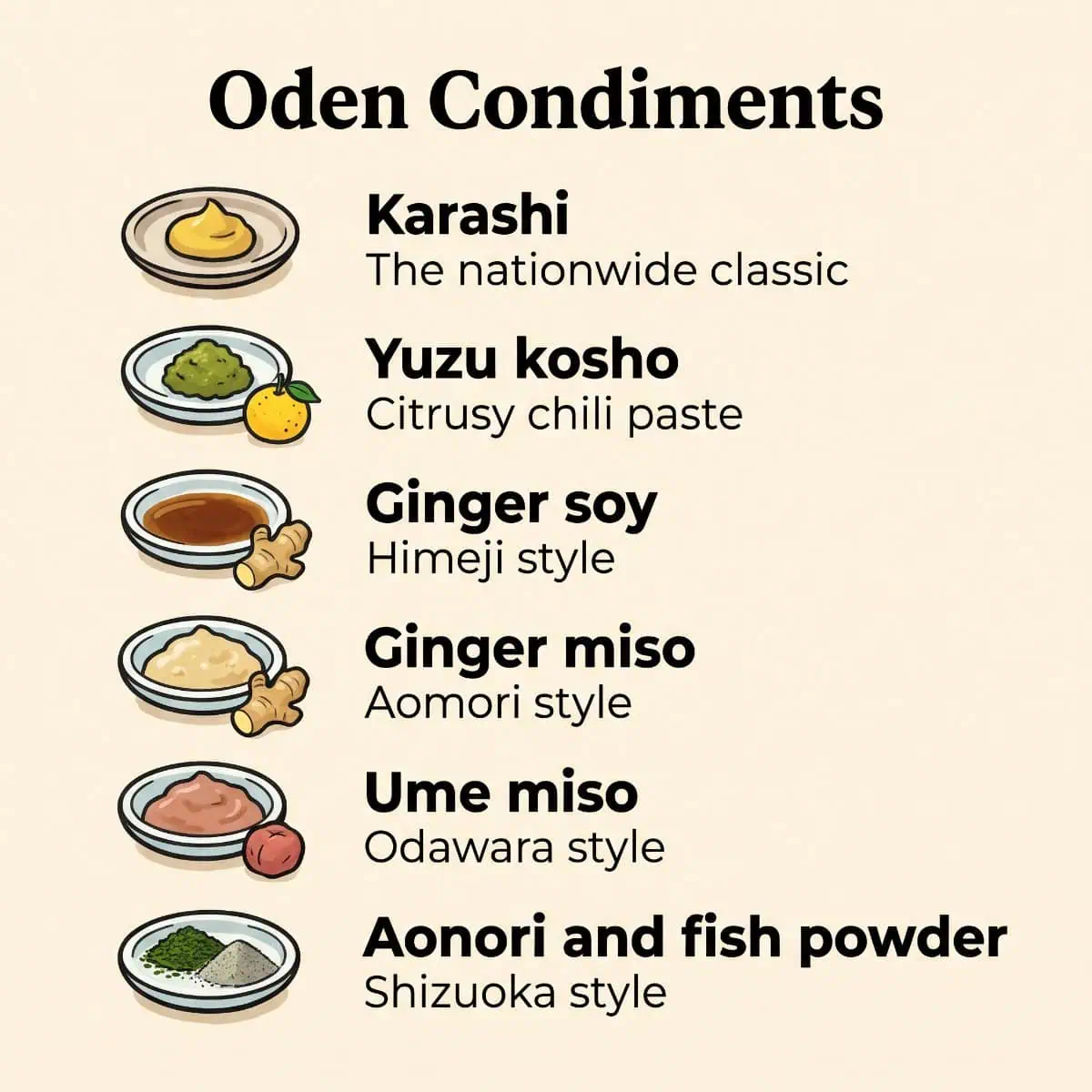
Eat oden with chopsticks, and feel free to sip the broth between bites. It can be salty, though, so you don’t need to finish it. MAFF notes that karashi, a Japanese mustard, is a common partner. Its sharp, nose-clearing heat may remind you of wasabi, although karashi comes from mustard seed and tastes different. So start with a dab.
Hot tip
Daikon and mochi kinchaku hold heat for a long time. So split them with your chopsticks, let the steam escape and take small bites.
KarashiThe nationwide classic
Yuzu koshoCitrusy chili paste
Ginger soyPoured or dipped, Himeji
Ginger misoAomori style
Ume misoOdawara style
Aonori and fish powderShizuoka style
Yuzu kosho, a citrusy chili paste, is another option if you want a brighter kind of heat. Our pages on yuzu kosho and yakumi explain how Japanese condiments work.
Does Oden Taste Better After It Cools?
Kitchen myth check
“Simmered food soaks up flavor as it cools.”
A 2012 Japanese study found that higher holding temperatures, not cooling itself, moved more salt into daikon, potato and konjac. So the saying probably reflects the time that passes while food cools.
Beyond the Konbini: Eating at an Oden Shop
At an oden shop, first check whether the menu offers individual pieces, an assortment or a set meal. Then order a few items, ask for the house recommendation and add more later. Some izakaya-style shops may serve a charged appetizer or set their own drink policy, so check the menu rather than assuming. MAFF also notes that some long-running Tokyo shops serve oden all year.
| Feature | Convenience store | Oden shop |
|---|---|---|
| How you order | Ordered or selected near the register, depending on the store; takeout is common | Seated, from a menu or by asking for suggestions |
| Broth | Chain recipe that varies by region | Each shop’s own broth; Otako Honten has topped up its broth for over 50 years |
| Price | About ¥120 to ¥200 per piece (November 2026) | Varies by shop, so check the menu or ask |
| Extra charges | No restaurant-style cover charge; tax depends on takeout or eat-in | Some izakaya-style shops may serve a charged appetizer (otōshi); amount and policy vary |
| Season | Mainly the colder months, depending on the store | Some Tokyo shops serve it all year |
How to Order at an Oden Shop
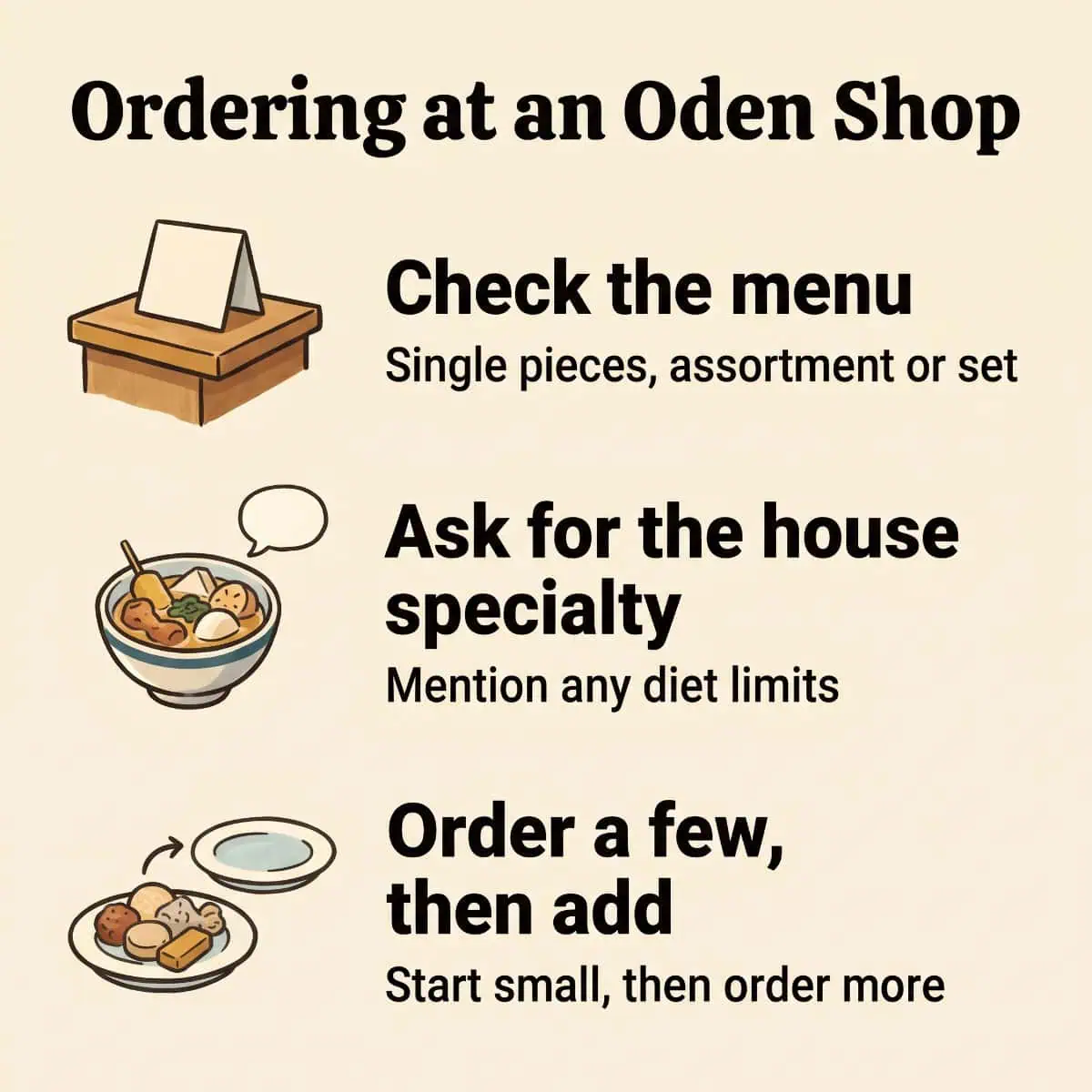
Check the menu and extra charges
First, see which formats this shop offers: single pieces, an assortment or a set meal. Some izakaya-style shops may also have an otōshi charge or their own drink policy, so check the menu. If prices are missing, ask before ordering.
Ask for the house specialty
Long-running shops usually have a signature piece. Ask what the staff recommend, and mention any meat, fish or wheat limits too.
Order a few pieces, then add more
Start with a small assortment or a few pieces. Then order more once you know what you like.
Handy phrases at an oden shop
おすすめは何ですか?Osusume wa nan desu ka?What do you recommend?
これは一ついくらですか?Kore wa hitotsu ikura desu ka?How much is one piece?
予算は一人三千円くらいです。Yosan wa hitori sanzen-en kurai desu.Our budget is about ¥3,000 per person.
Two Long-Running Tokyo Oden Shops
MAFF names Otako Honten, Ōtafuku and Takohachi among the Tokyo shops keeping the Edo taste alive. The first two are easy starting points, and Tokyo’s official tourism site featured both in December 2024.
Asakusa Oden Ōtafuku (浅草おでん 大多福)
According to Tokyo’s tourism site, it offers more than 30 ingredients in a kombu and bonito broth. Its daikon, for instance, is prepared over roughly three days so the broth can soak in. Cabbage rolls and octopus are on the menu too.
Otako Honten (お多幸本店)
A Kanto-style shop known for a dark, soy-based broth topped up for over half a century. If available, consider tōmeshi, its signature rice-and-tofu dish.
Hours, prices and menus change, so check each shop’s latest information before you go.
Dashi-wari: Oden Broth Meets Sake
Off-menu drink
Here is a bonus for curious drinkers. Some shops offer dashi-wari, a drink that combines oden broth with alcohol. For example, Kanagawa’s official tourism site describes oden broth mixed with sake in Odawara, though it is an off-menu item. Ratios and styles vary by shop, so ask politely, and accept a no at busy times.
Oden and warm sake have long gone together. Kibun Foods notes that the 1837 record Morisada Mankō contains the phrase “jōkan oden,” linking warmed sake with oden vendors. That shows a historical pairing, not the modern dashi-wari. If you are new to warm sake, our guide to hot sake explains serving temperatures, and our sake basics cover the rest.
Regional Oden Styles Worth Knowing
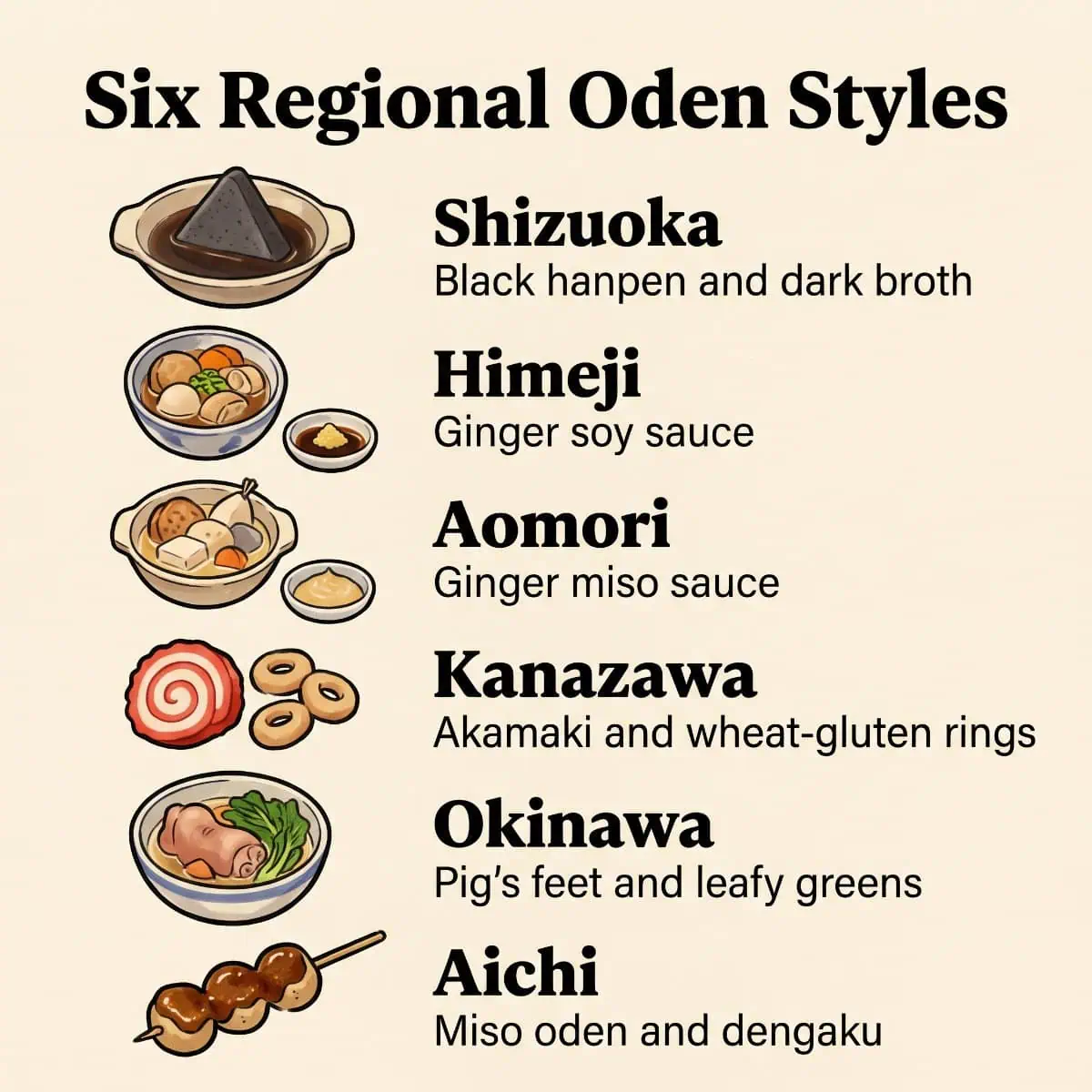
Oden changes as you travel. Broadly speaking, Tokyo-style oden tends to look darker and taste more soy-forward, while many Kansai broths look lighter and stress dashi. These are tendencies, not rules, and sauces and ingredients also shift, as MAFF’s overview shows. Here are six styles in one line each.
Osaka, meanwhile, keeps light Kansai oden alongside kanto-daki, simmered with katsuobushi and soy sauce. In Kyushu, however, cooks often use chicken broth and slightly sweet soy sauce.
Where Did Oden Come From? A Short History
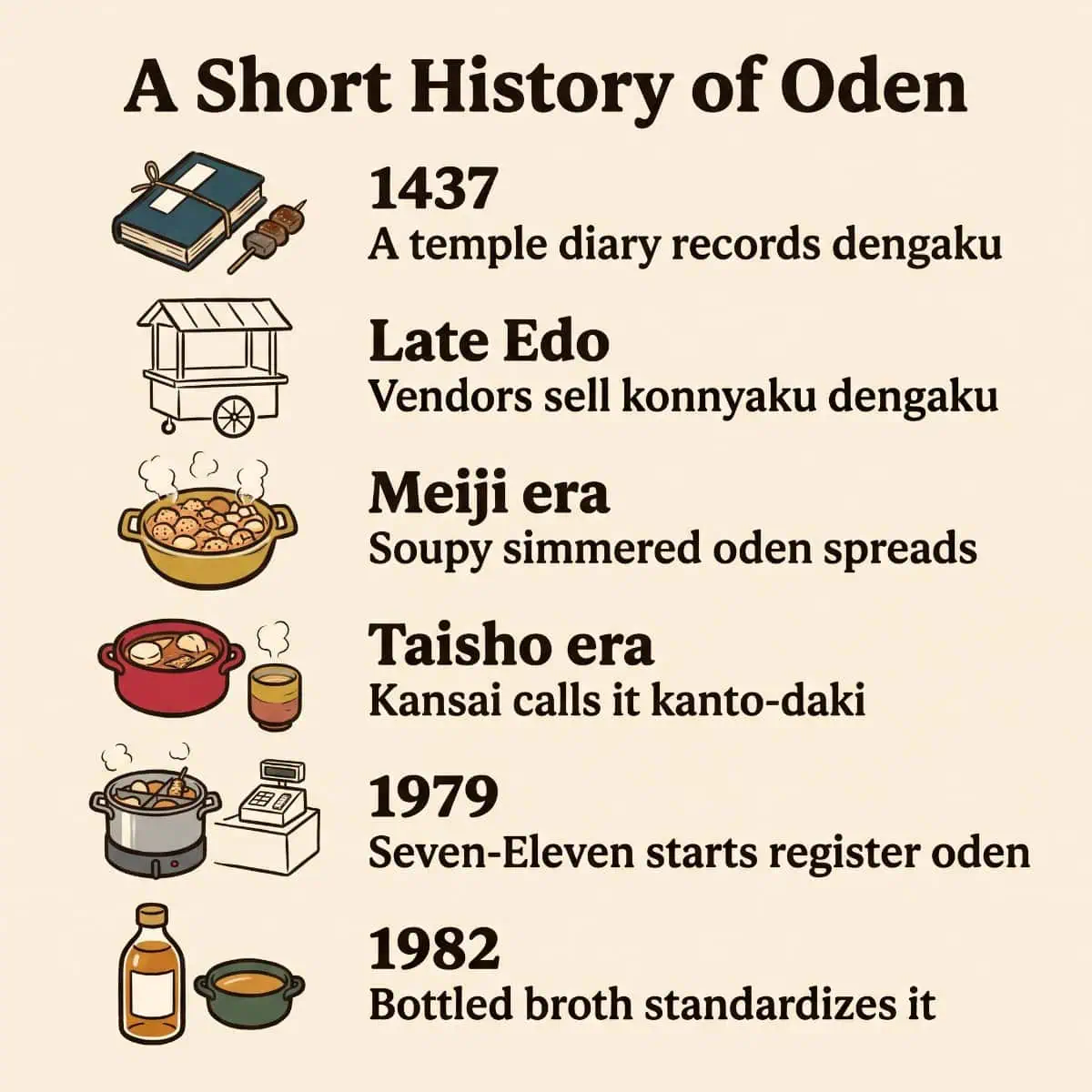
Oden traces its name and distant roots to dengaku, skewered tofu grilled with miso. According to MAFF, the name likely came from court ladies. They added the polite “o” and dropped the end of the word. However, the brothy dish you see today came much later.
When did simmered oden begin? Here the record gets fuzzy. One theory points to the late Edo period. Yet Professor Emeritus Sachiko Matsushita of Chiba University finds no firm proof of it then. So Kibun Foods presents both views, while MAFF dates its wider spread to the modern era.
Final Thoughts: Start Small, Then Explore
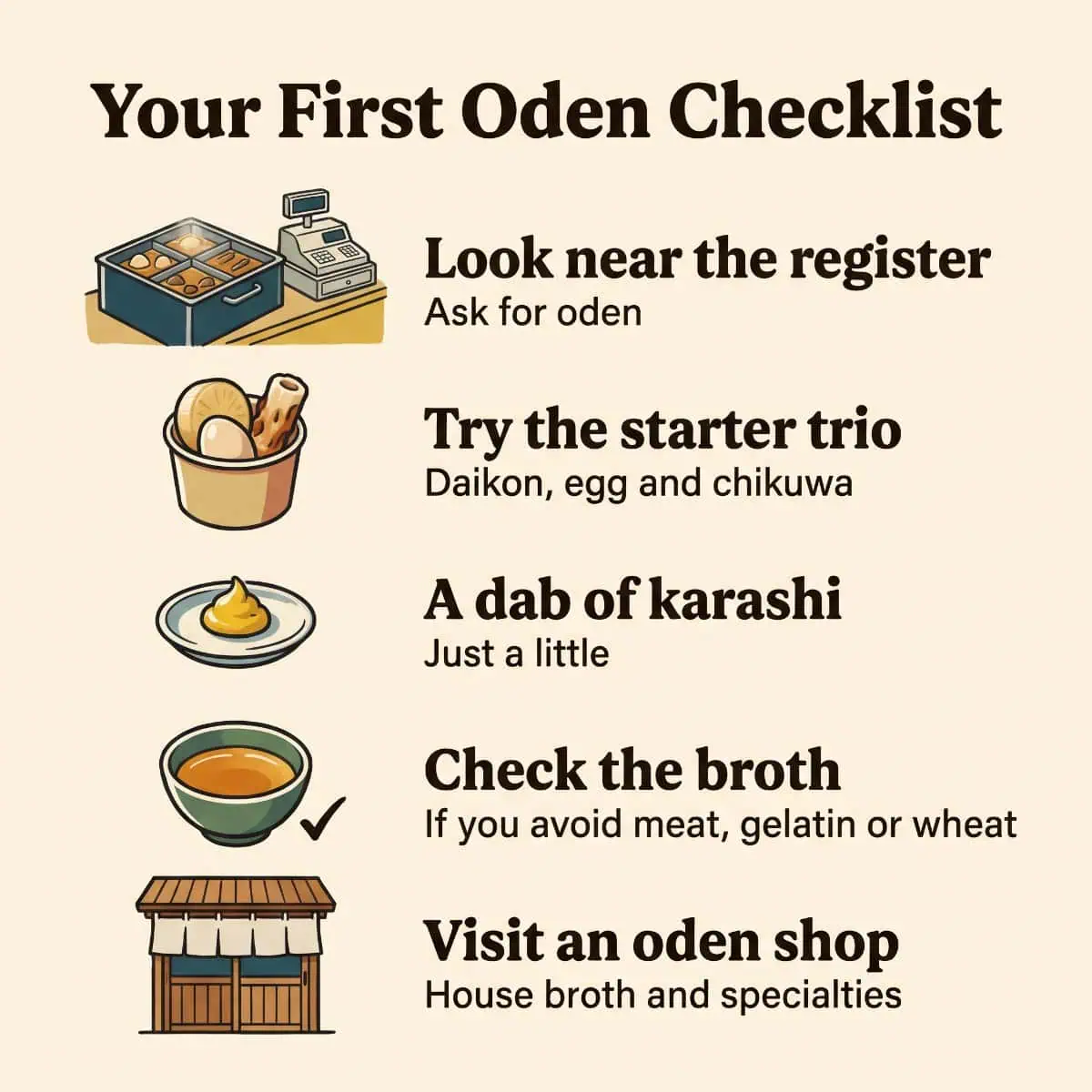
Start with daikon, an egg and chikuwa, then add a little karashi. If you avoid fish, meat, wheat or gelatin, check the broth and current product information before ordering.
Your first oden checklist
- First, look near the register and ask for oden.
- Then try daikon, an egg and chikuwa.
- Ask for karashi, but use just a dab.
- Check the broth if you avoid meat, gelatin or wheat.
- Finally, try an oden shop for house broth and specialties.
Frequently Asked Questions About Oden
Ordering and Prices
- Is convenience-store oden self-service?
-
Service methods differ by store. Follow the display near the register, or ask the clerk before touching the pot or utensils.
- What if there is no oden pot at the register?
-
Ask the clerk first, because not every store sells counter oden. Some stores may carry sealed oden in the refrigerated or packaged-food area. Don’t assume it is microwave-safe; follow the heating instructions on the package or ask the clerk.
- Can I order oden without speaking Japanese?
-
Yes. Just point at each item, then hold up fingers for the number. A short Japanese note on your phone also helps.
Taste, Ingredients and Diet
- Is oden spicy?
-
Usually not. Standard oden broth is generally mild and savory, but karashi, ginger-based sauces and some regional condiments can add noticeable heat.
- Can I drink the oden broth, and do I need to finish it?
-
You can sip it with the ingredients, but there is no need to finish the cup. Flavor and saltiness vary by chain, region and shop.
- Is oden vegetarian?
-
Usually not. Standard broth commonly uses fish-based dashi or animal-derived seasonings, and pieces may share it. An allergen list is not a full ingredient list or vegan certification, so check current product information if your diet is strict.
- Is oden gluten-free?
-
Not reliably. Seven-Eleven lists wheat in its oden broth for every region, and chikuwabu is wheat-based.
Culture and History
- What is kanto-daki?
-
It is a Kansai name for simmered oden. In Osaka, kanto-daki made with katsuobushi and soy sauce still sits alongside lighter Kansai-style oden.
- What drink goes well with oden?
-
Warm sake is a classic choice, and Edo-period records already link the two. Some shops also mix alcohol with oden broth, a drink often called dashi-wari.
References
Show all 14 references
- Ministry of Agriculture, Forestry and Fisheries (MAFF) – Our Regional Cuisines: Oden, Tokyo (Accessed November 2026)
- Ministry of Agriculture, Forestry and Fisheries (MAFF) – Perfect for Cold Winters: Learn About and Enjoy Oden (Accessed November 2026)
- Agriculture and Livestock Industries Corporation (ALIC) – Oden Culture and Oden Today, Sugar and Starch Information (2017) (Accessed November 2026)
- Ministry of Finance Japan – Consumption Tax Rate Hike (October 1, 2019) (Accessed November 2026)
- GO TOKYO, Tokyo Convention and Visitors Bureau – Warm Up with Tokyo Oden, from Long-Established Flavors to New Shops (2024) (Accessed November 2026)
- Kanagawa NOW, Kanagawa Tourism Association – Hakone Area: Odawara Oden and Sake (Accessed November 2026)
- Japan Kamaboko Association – How Kamaboko Is Made: Manufacturing Methods and Types (Accessed November 2026)
- Hatae, K., & Okumoto, M. (2012). Effect of holding temperature on salt diffusion in foods. Journal of Cookery Science of Japan, 45(2), 133–140. https://doi.org/10.11402/cookeryscience.45.133 (Accessed November 2026)
- Kibun Foods – Kibun Nabe White Paper: Hot Pot and Oden Rankings (2025) (Accessed November 2026)
- Kibun Foods – The History of Oden (Accessed November 2026)
- Seven-Eleven Japan – 50th Archive: The Early Years (Accessed November 2026)
- Seven-Eleven Japan – Oden Product Listing (Accessed November 2026)
- Seven-Eleven Japan – Allergens in Oden Broth (Accessed November 2026)
- FamilyMart – Oden Product Information (Accessed November 2026)
Related Articles
 Shizuoka
 Oden (静岡おでん)
Surveyed: November 2026
 Article
What to Buy at a Japanese Convenience Store: Complete Food Guide for Travelers
Surveyed: November 2026
 Japan
Hot sake (熱燗)
Surveyed: November 2026
 Tottori
Tofu chikuwa (とうふちくわ)
Surveyed: November 2026





Comments