



In Himi, the fish market usually steals the show. Toyama Bay sits right there, and the morning catch is hard to ignore. Yet the town keeps a quieter specialty on the souvenir shelf. Himi udon is a hand-stretched wheat noodle from Himi City in Toyama Prefecture, made without the vegetable oil that most tenobe noodles rely on.
Thin, glossy, and firmer than it looks, it eats nothing like the thick udon many visitors expect. This guide covers its history and its oil-free making process. It also compares the noodle with Sanuki and Inaniwa udon, then points you toward places to eat and buy it in Toyama.
Quick Facts About Himi Udon
Before the details, here is the short version for travelers who want the essentials first.
- Origin
- Himi City, Toyama Prefecture. Local accounts trace it to 1751.
- Dough method
- Oil-free tenobe (hand-stretching), combined with hand kneading and twisting.
- Texture
- Thin and glossy, smooth on the throat, with a springy, almost mochi-like chew.
- Key pairings
- Cold tsuyu, hot Toyama-style dashi, kakiage tempura, white shrimp, Himi beef.
What Is Himi Udon?
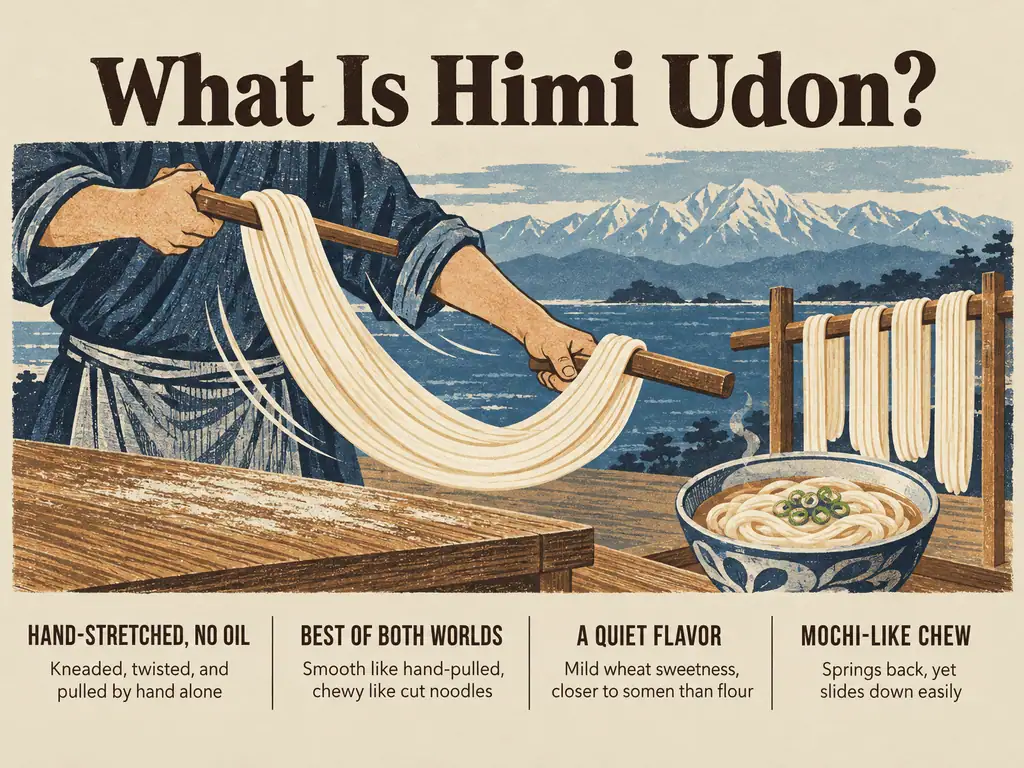
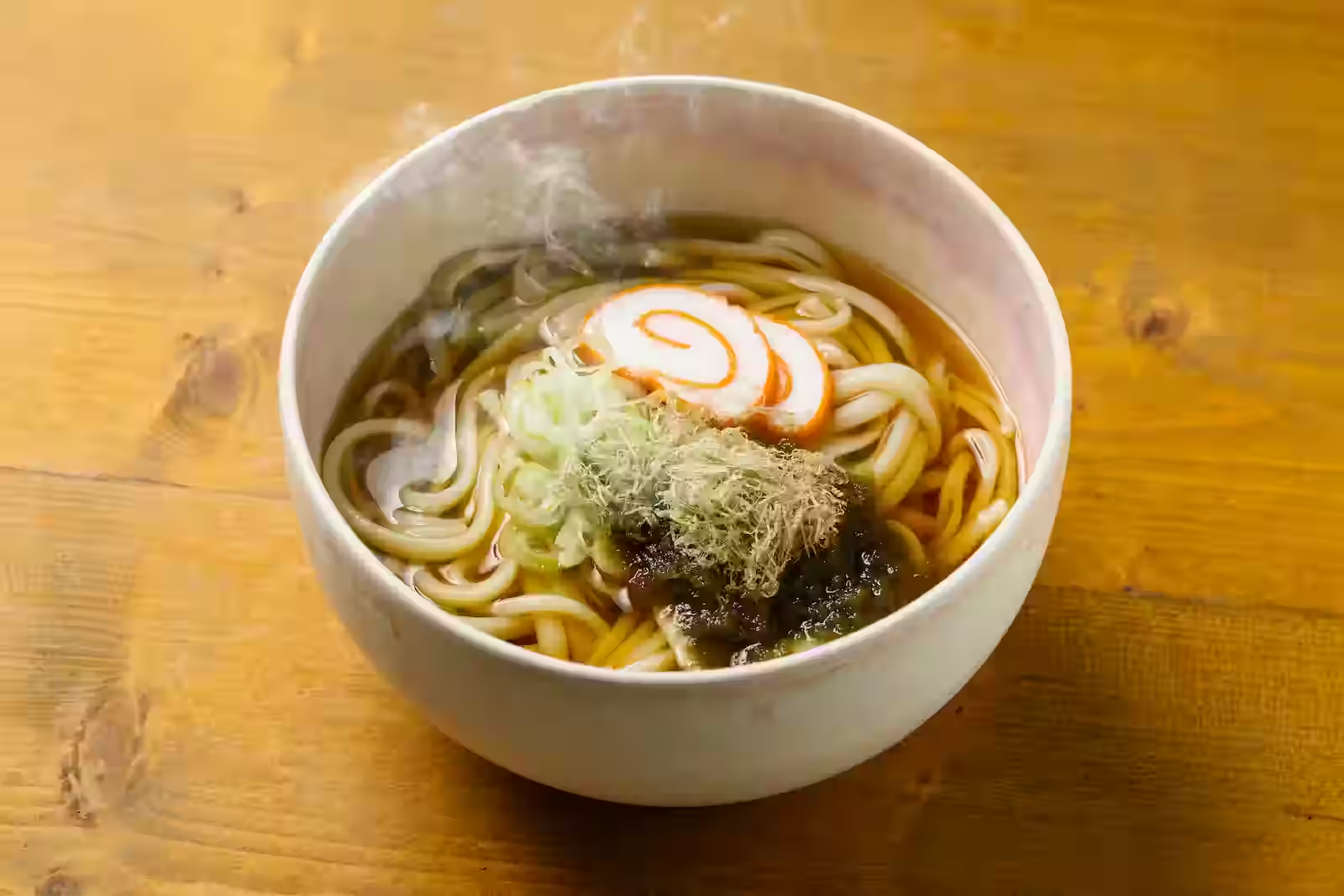
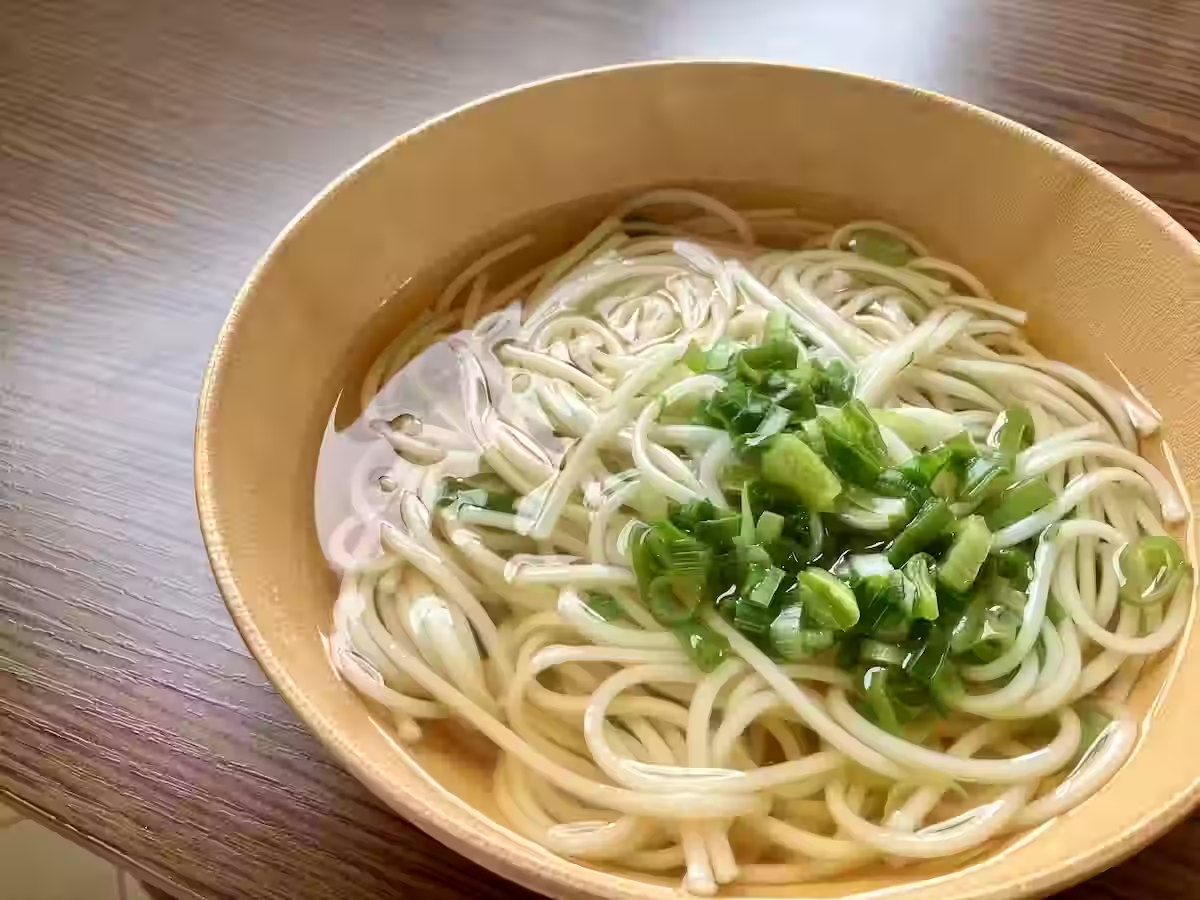
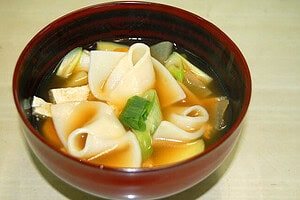
Himi udon is a traditional hand-stretched udon from Himi City in Toyama Prefecture. Makers knead, twist, and pull the dough by hand, and they never coat it in oil. The result is a thin, round noodle with a glassy surface and a firm bite. Locals also know it as Himi ito udon, meaning thread udon.
Most noodles force a trade-off between smoothness and chew. Hand-stretching gives you one, while kneading and cutting gives you the other. Himi makers chase both at once, because they borrow steps from each tradition. Scanning electron microscopy research in the journal of the Japanese Society for Food Science and Technology looked at exactly this. Hand-stretched noodles carried fibrous gluten aligned along the strand. Machine-cut noodles showed no such structure.
That aligned structure explains the slippery mouthfeel. Meanwhile, the heavy kneading stage builds the elasticity that Japanese cooks call koshi. Skip either half and the noodle loses its character.
What Does Himi Udon Taste Like?
The flavor is quiet rather than bold. Without oil, what comes through is plain wheat sweetness and a faint saltiness from the dough. The aroma is soft, closer to fresh somen than to a heavy flour scent. If you arrive expecting the chewy heft of Sanuki udon, the first mouthful can honestly feel a little thin.
Then the second bite lands differently. The noodle springs back against your teeth, yet it still slides down easily. Because the strands are fine, broth clings to them instead of pooling at the bottom of the bowl. Many first-timers describe the chew as mochi-like, and that comparison fits well.
History and Cultural Heritage
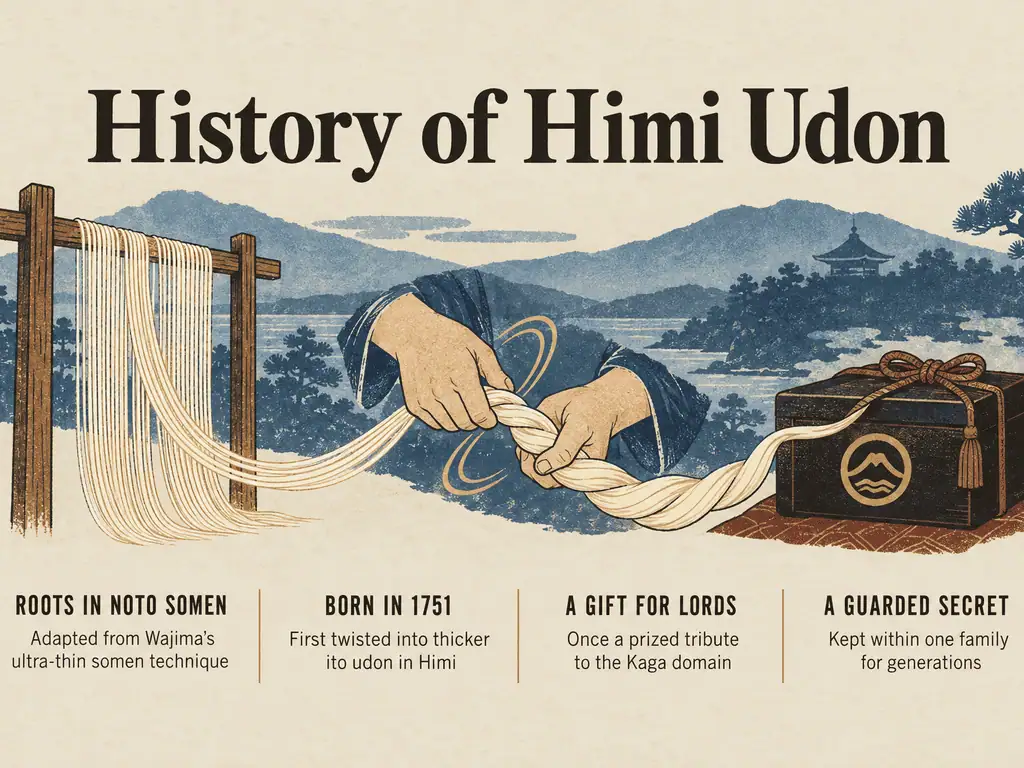
The story starts across the prefectural border. Before Wajima lacquerware took over as the region’s signature craft, Noto was known for fine somen, including an ultra-thin style called shiraga somen. Temple life helped too, since monks training at Sojiji in Noto traditionally ate udon on set days of the month.
From Wajima Somen to Himi Ito Udon
By the maker’s own account, the first head of Takaokaya learned those Noto techniques. He then adapted them in Himi in 1751, the first year of the Horeki era. He did not simply copy somen, though. Instead, he worked the method into a thicker thread called ito udon, named for the way the dough was twisted like spun yarn.
A Noodle Fit for the Kaga Domain
Local records say the Maeda lords of the Kaga domain received the noodle as tribute. That connection gave it real prestige in the Edo period. Because the technique stayed inside one family, the recipe was treated as a closely guarded inheritance rather than common knowledge. Takaokaya still sells a line under the name Isshi Denshou, a nod to that unbroken thread.
The name Himi udon itself is surprisingly modern. Demand grew sharply in the postwar decades, and customers outside the prefecture simply started calling it after the town. Today several makers in Himi carry the tradition forward, so the noodle is no longer a single household secret.
The Tenobe Making Process: Craftsmanship Without Oil
Tenobe means hand-stretched, and the word hides a lot of labor. Production runs across two days in most workshops, since the dough needs repeated rest between each pull. Makers also adjust salt and water daily, because temperature and humidity change how the gluten behaves.
- Mixing and kneading. Wheat flour meets salted water. Workers then knead the dough and press it underfoot until it turns smooth and elastic.
- First rest. The dough relaxes so the gluten can settle, which makes the later stretching possible.
- Twisting (yori). Workers cut the dough into bands and twist them by hand into ropes, coiling them as they go.
- Figure-eight hanging (ayagake). Workers loop the rope between two rods in a figure eight. They tune the spacing and tension for even thickness.
- Small pulls (kobiki). Short stretches alternate with more resting, so the strands lengthen without tearing.
- Final stretch on the frame. The noodles hang on a rack called a hata and stretch down to their finished width.
- Drying and cutting. After drying, workers cut the strands to length and box them. Some shops also sell a half-dried version.
Why No Oil?
Most tenobe somen makers brush vegetable oil onto the strands, since oil keeps them from sticking during the long stretch. Himi makers refuse that shortcut and rely on twisting, dusting, and timing instead. As a result, the noodle tastes of wheat rather than of anything added.
Worth knowing
Oil is not a flaw in other noodles. Still, research on hand-stretched somen links storage changes partly to lipid changes over time. An oil-free noodle therefore behaves differently on the shelf.
Hand-Stretched (Tenobe) vs. Hand-Cut (Teuchi) Udon
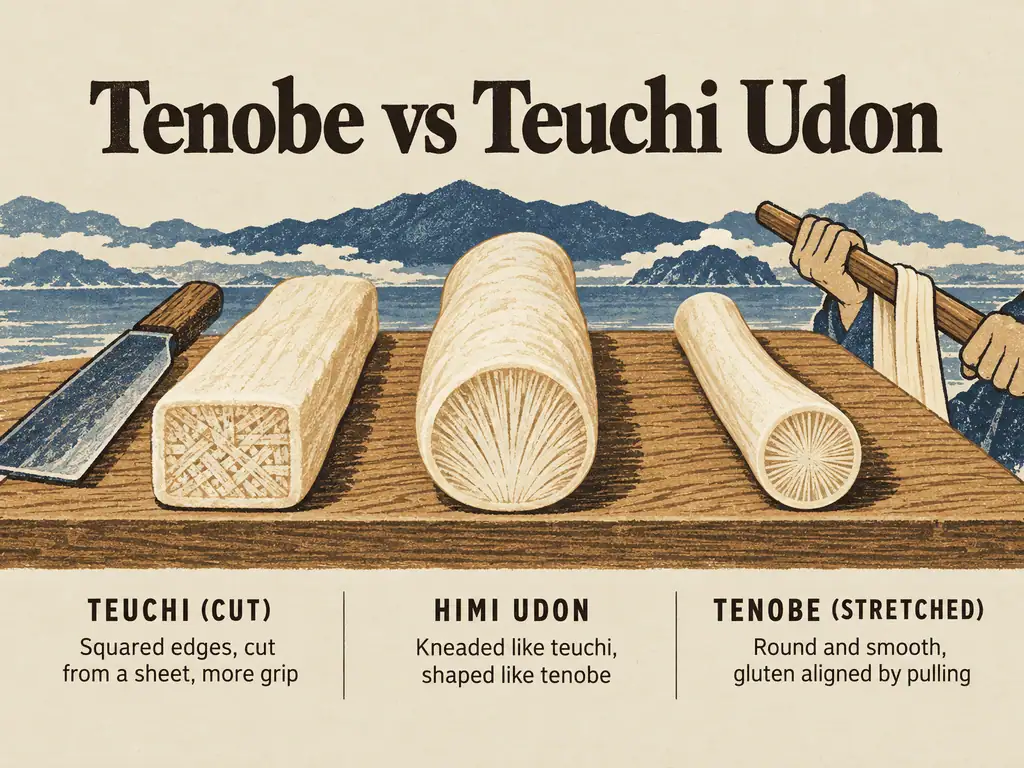
Teuchi udon starts as a flat sheet, and a blade turns that sheet into noodles. Each strand therefore has four corners and a squared profile. Those edges catch the tongue, which is exactly why thick hand-cut udon feels so substantial.
Tenobe noodles take the opposite route. Gravity and repeated pulling draw the dough out, so the strand stays round and the surface never gets cut open. The gluten lines up along the length of the noodle as it stretches, and starch granules sit inside that framework instead of being crushed flat.
You can feel the difference before you taste it. Round noodles slip past the lips, while cut noodles land with more grip. Himi udon sits in between, because the kneading stage borrows from the teuchi playbook even though the shaping does not.
Himi Udon vs. Sanuki Udon vs. Inaniwa Udon
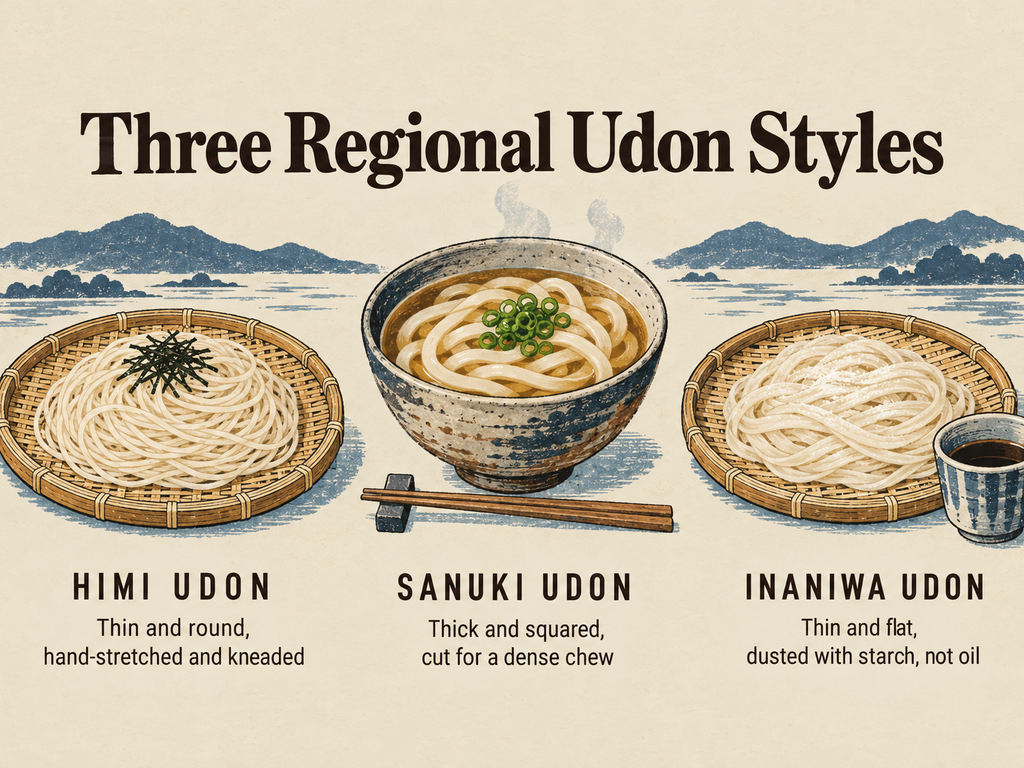
These three names come up together constantly, yet they are genuinely different noodles. The table below lines up the points that matter most at the table.
| Point | Himi Udon | Sanuki Udon | Inaniwa Udon |
|---|---|---|---|
| Home region | Himi, Toyama | Kagawa | Yuzawa, Akita |
| Shape | Thin and round | Thick and squared | Thin and slightly flat |
| Method | Hand-stretched plus hand kneading | Kneaded, rolled, then cut | Hand-stretched |
| Oil in the process | None | None | None, starch dusting instead |
| Texture | Smooth with springy chew | Dense and very chewy | Silky and delicate |
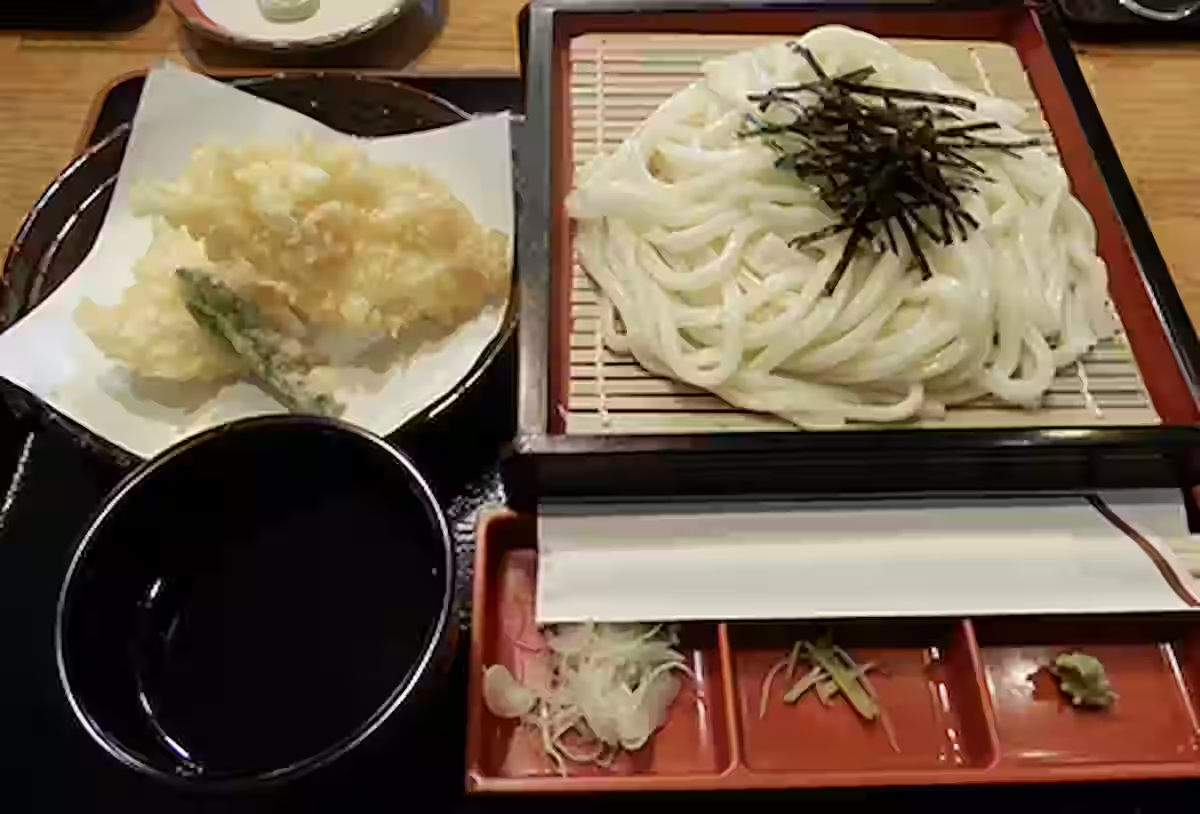
| Classic serving | Cold zaru or hot kake | Kake, bukkake, kamatama | Usually cold with tsuyu |
One clarification helps here. The oil-free point matters most when you compare Himi udon with tenobe somen, since many somen makers do use oil during stretching.
The Debate: Is Himi Udon One of Japan’s Three Great Udon?
You will see the claim printed on packaging and on tourism pages alike. Unfortunately, no official body maintains such a ranking. The phrase circulates through guidebooks, marketing copy, and local pride, so treat it as a popular label rather than a verdict.
Two seats are rarely contested. Sanuki udon and Inaniwa udon appear on almost every list, because one dominates by volume and the other by refinement. After that, the third seat moves around. Himi udon, Mizusawa udon from Gunma, Goto udon from Nagasaki, and Aichi’s kishimen all attract nominations, depending on who is counting.
Some writers dodge the argument entirely by listing five great udon instead of three. That is probably the fairer framing. Either way, Himi udon ranks among Japan’s most respected regional noodles. The label matters far less than the bowl in front of you.
How to Eat Himi Udon: Serving Styles
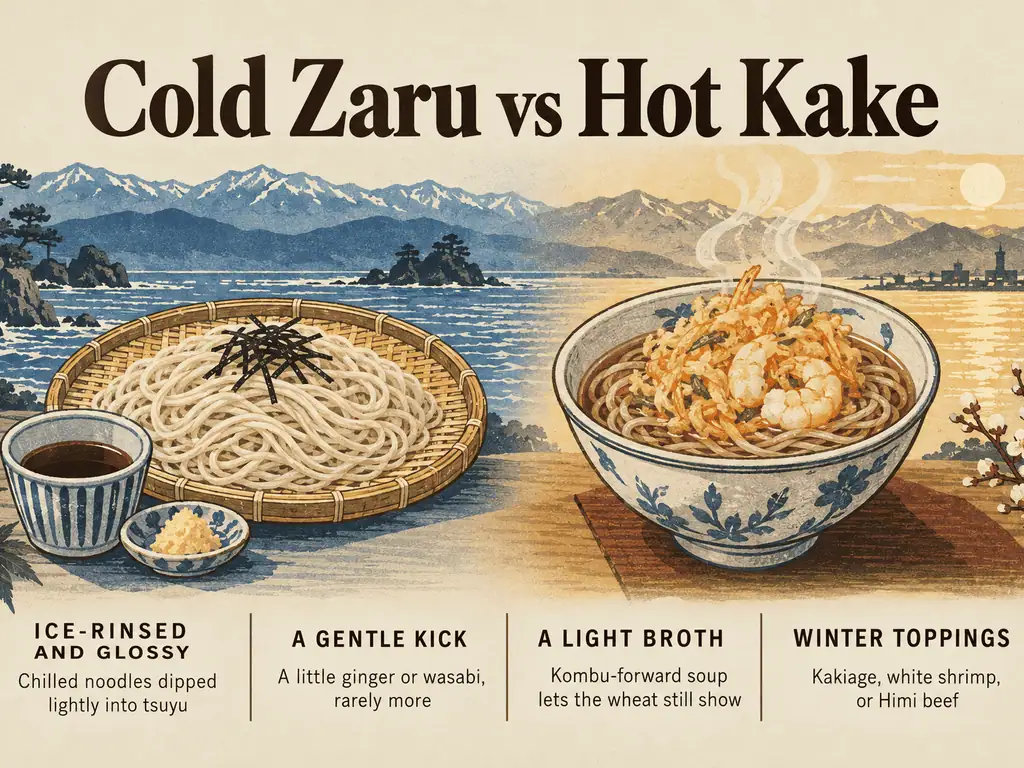
Shops in Himi serve the noodle both ways, and neither version is a tourist compromise. Your choice mostly depends on the season.
Cold (Zaru): The Purist Route
Chilled noodles on a bamboo tray show the texture at full strength. After an ice water rinse, the surface tightens and the strands gleam. Dip a small bundle into tsuyu, then let it slide rather than chewing it hard. Locals often add grated ginger or a little wasabi, though the noodle needs very little help.
Hot (Kake): Broth and Bay Flavors
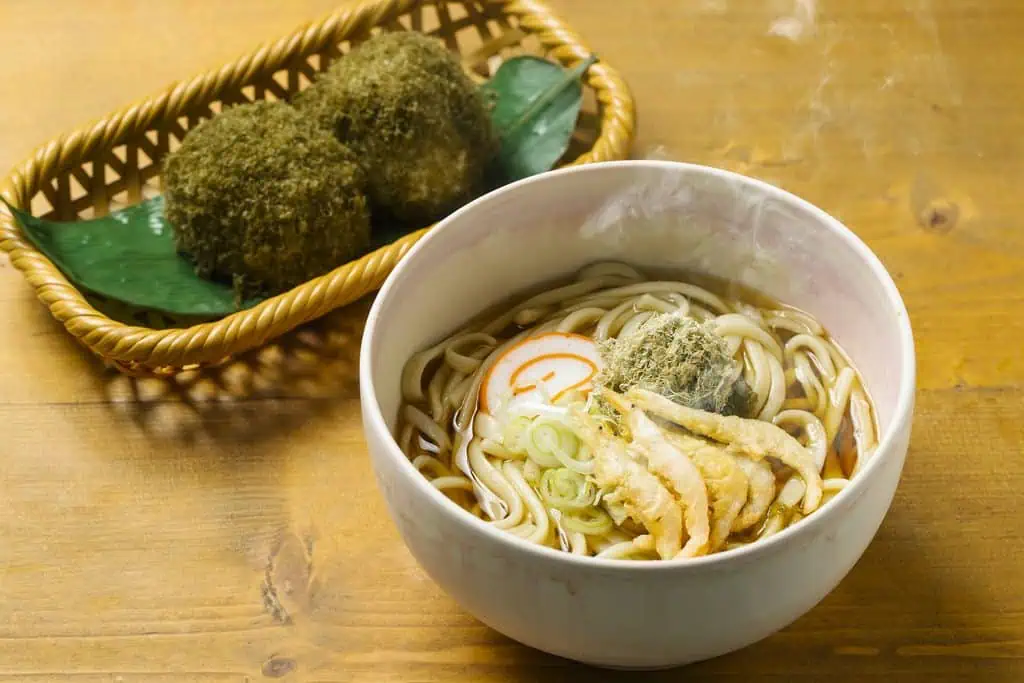
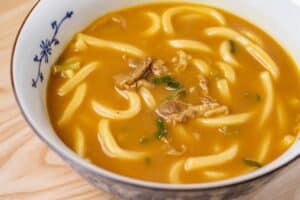
In cold months, a hot bowl makes more sense. Toyama broths lean light and kombu forward, so the wheat flavor still comes through. Kakiage tempura is the standard topping, while white shrimp, local mushrooms, or Himi beef turn the bowl into a full meal. Nabeyaki style also appears on winter menus, and thicker noodle grades handle that heat well.
How to Cook Dried Himi Udon at Home
Dried Himi udon is thin, so it cooks faster than ordinary udon. Rushing the water, however, is the usual mistake.
- Use a big pot. Allow roughly two liters of water for every 100 grams of dried noodles, since crowding makes them gummy.
- Skip the salt. The dough already contains salt, so plain boiling water is correct.
- Follow the package. Times vary by thickness, though thin grades often need only four to six minutes.
- Stir gently. Loosen the strands early, then keep the boil steady rather than violent.
- Rinse and rub. Drain the noodles, then wash them under cold running water while rubbing lightly to remove surface starch.
- Finish by style. For cold service, shock the noodles in ice water and drain well. For hot service, dip them briefly in hot broth instead.
That cold water rinse is not optional. Without it, the surface stays slack and the famous throat feel disappears.
Where to Eat Himi Udon in Toyama
Himi City is the obvious base. Kaizuya, one of the main makers, runs a sit-down shop called Udon Chaya Kaizuya. You will find it near the Kamiizumi intersection on Route 160, and it draws lines at lunch. Takaokaya, the original house, also sells directly in town, so noodle shopping and eating can happen in the same trip.
Small noodle shops near the Himi fish market are worth a look too. Several of them stock udon from more than one local maker, which turns lunch into a side-by-side tasting. Ordering is easy if you remember two words, since zaru means cold and kake means hot.
Toyama City makes a reasonable fallback when your schedule is tight. Restaurants around Toyama Station and inside department store dining floors sometimes list Himi udon by name, although availability shifts. Calling ahead never hurts, and lunch hours run short in this part of Japan.
Where to Buy Himi Udon Souvenirs
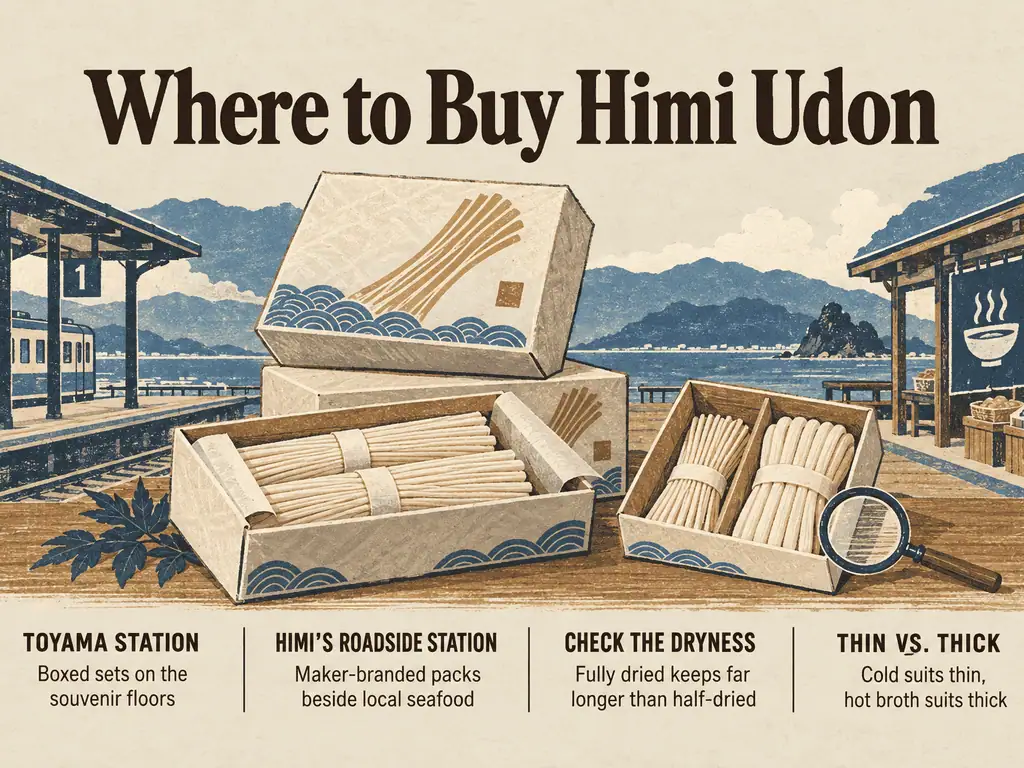
Dried Himi udon travels beautifully, which makes it one of Toyama’s easiest gifts. Souvenir floors at Toyama Station stock boxed sets. The roadside station complex in Himi also carries maker-branded packs alongside seafood products. Maker shops themselves usually offer the widest range of thicknesses.
Check two things before you buy. First, check whether the pack is fully dried or half-dried. The half-dried type has a much shorter shelf life. Second, confirm your own country’s rules on bringing in wheat products, since dried noodles are normally fine but regulations differ.
Buy the thin grade if you plan to eat the noodles cold. Thicker grades suit hot broth and stews better, so many visitors simply take one box of each.
Other Local Foods to Try in Toyama
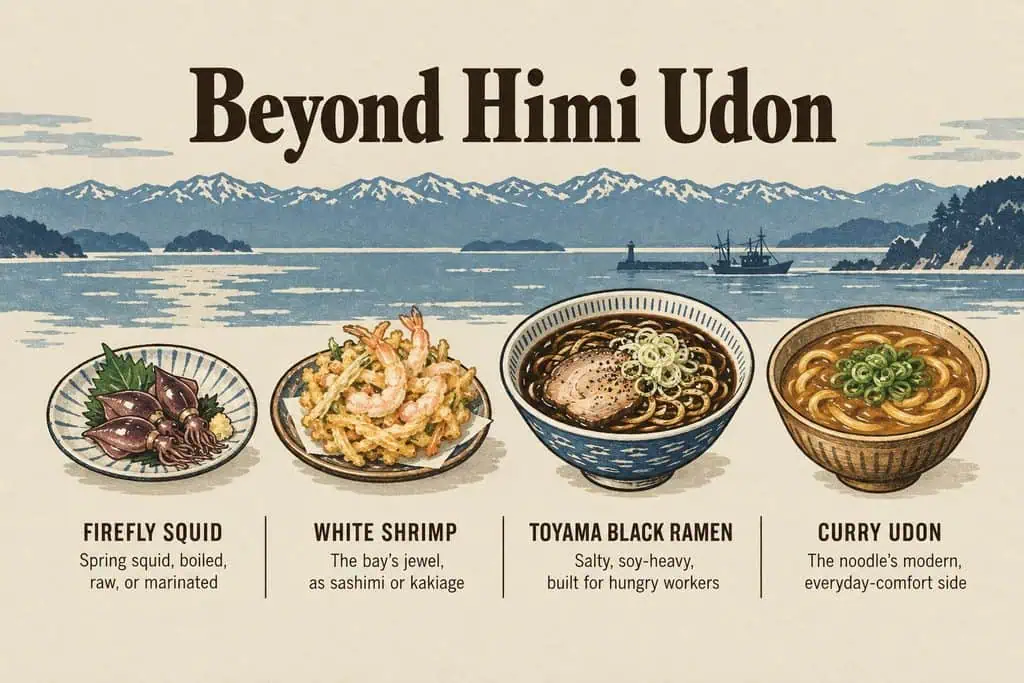
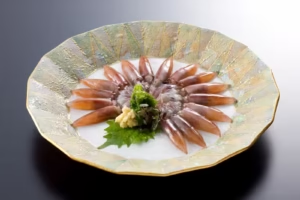
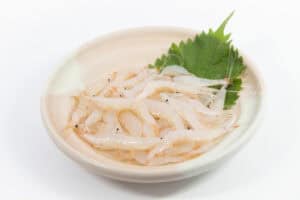
Toyama Bay does a lot of the cooking for this prefecture. In spring, firefly squid arrive in huge numbers and turn up boiled, raw, or marinated. White shrimp, often called the jewel of the bay, appear as sashimi and as kakiage that pairs neatly with udon.
Noodle fans have more to chase after Himi. Toyama black ramen delivers a famously salty, soy-heavy bowl that was built for workers rather than tourists. If you want a broader map of the category, our guide to Japanese noodles covers the main families in one place.
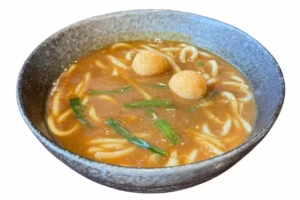
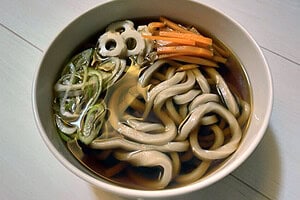
Udon itself keeps changing shape around the country. Curry udon shows the modern side of the noodle, while noshikomi udon shows a rustic, home-cooked one.
Summary
Himi udon rewards attention. It is thin where other udon are thick, and it stays smooth without giving up its bite. The oil-free tenobe method takes two days and a lot of hands, yet the payoff shows up in the first mouthful.
Whether it belongs in a top three list matters less than most articles suggest. Eat it cold in summer, hot in winter, and take a box home either way. Himi is an easy detour from Takaoka or Toyama, so the noodle fits into almost any Hokuriku itinerary.
Frequently Asked Questions About Himi Udon
What is Himi Udon?
Himi udon is a hand-stretched wheat noodle from Himi City in Toyama Prefecture. Makers knead the dough hard, twist it by hand, and stretch it over two days without using oil. The finished noodle is thin, round, and glossy. Locals also call it Himi ito udon, meaning thread udon.
How is Himi Udon different from regular udon?
Ordinary udon starts as a rolled sheet that a blade cuts into squared strands. Himi udon instead gets pulled into shape, so each strand stays round and smooth. Because makers also knead the dough thoroughly, the noodle keeps a firm bite. In short, it combines the slipperiness of stretched noodles with the elasticity of cut ones.
What is the difference between Himi Udon and Sanuki Udon?
Sanuki udon comes from Kagawa and arrives thick, squared, and famously chewy. Himi udon comes from Toyama and arrives thin, round, and comparatively delicate. Sanuki shops cut their noodles, while Himi makers stretch theirs by hand. Both taste excellent, though they suit different broths and different moods.
Is Himi Udon one of Japan’s three great udon?
No official ranking of Japan’s great udon exists. Sanuki and Inaniwa appear on nearly every informal list, yet the third slot stays contested. Himi udon competes for it alongside Mizusawa udon, Goto udon, and kishimen, so some writers simply name five instead. The claim therefore works as marketing shorthand rather than fact.
Where can you eat Himi Udon in Toyama?
Himi City offers the best selection. Kaizuya runs a dedicated udon restaurant on Route 160, and small shops near the fish market serve noodles from several local makers. Toyama City works as a backup, since some restaurants near Toyama Station list it by name. Check opening hours first, because many shops close early in the afternoon.
Does Himi Udon really contain no oil?
Correct, the traditional method uses no vegetable oil at all. Many tenobe somen producers brush oil on the strands to stop them sticking during stretching. Himi makers rely on twisting, dusting, and careful resting instead. As a result, the noodle carries a cleaner wheat flavor.
Can you take Himi Udon home as a souvenir?
Dried Himi udon suits travel well, since it is light and keeps for months. Souvenir shops at Toyama Station and the roadside station in Himi both stock boxed sets. Avoid half-dried packs unless you fly home quickly, because they spoil far sooner. Confirm your own country’s import rules on wheat products before you pack them.
References
Show all 7 references
- Visit Toyama (Official Tourism Website of Toyama Prefecture): Restaurants Guide (Surveyed: September 2026)
- Toyama Tourism Navi (Toyama Prefecture Tourism Association): Himi Udon Feature (Surveyed: September 2026)
- Himi Udon Takaokaya Honpo: Origin and Production Method of Himi Ito Udon (Surveyed: September 2026)
- Himi Udon Kaizuya: About Himi Udon and the Hand-Stretching Process (Surveyed: September 2026)
- Toyama Muslim Friendly Restaurants (Toyama Prefecture Project): Himiudon Kaizuya (Surveyed: September 2026)
- J-STAGE: Nippon Shokuhin Kogyo Gakkaishi, Vol. 39 No. 6 (1992), pp. 471–476: “Scanning Electron Microscopy of Hand-Stretched Noodles (Tenobe-men) and Machine-Made Noodles (Kikai-men)” (Surveyed: September 2026)
- J-STAGE: Journal of Cookery Science of Japan, Vol. 52 No. 6 (2019), pp. 386–394: “Properties and Structure of Hand-Stretched Somen Held for Different Storage Periods” (Surveyed: September 2026)
Photo Credits
- Main image: ©公益社団法人とやま観光推進機構 (Toyama Tourism Organization), https://www.info-toyama.com/ (Surveyed: September 2026)
- Photo library and usage terms: Toyama Tourism Organization Photo Library, https://www.info-toyama.com/business/images (Surveyed: September 2026)





Comments