


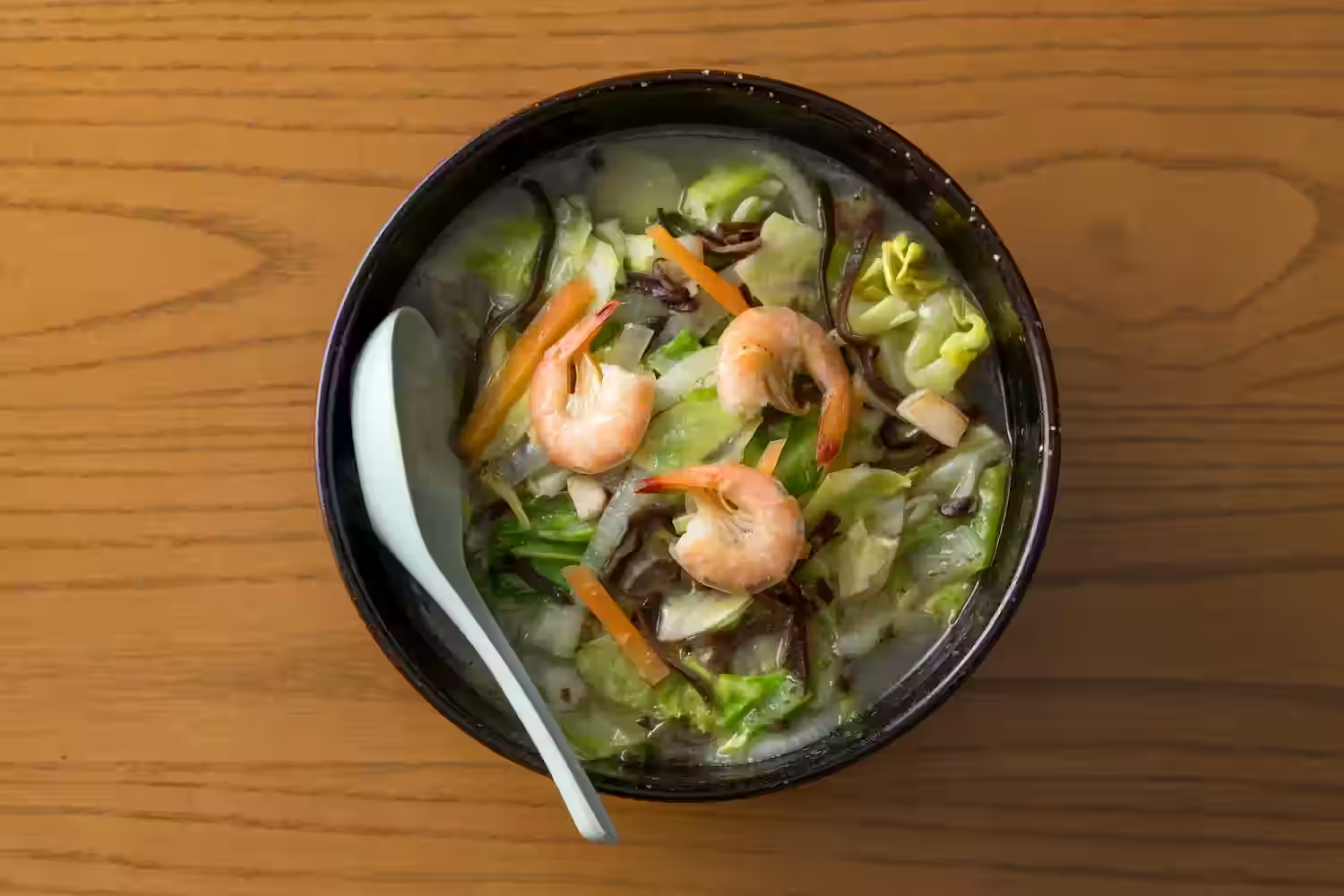



In Omachi, a former coal-mining town in Saga Prefecture, Taromen (たろめん) arrives looking almost like champon: a steaming bowl crowded with pork, shrimp, cabbage, onion, carrot, and wood ear mushrooms. Then the ginger hits. Beneath the vegetables sit udon noodles in a savory broth simmered from beef bones.
The dish once fed local miners before and after their shifts. It disappeared when Taromen Shokudo closed in 2000, then returned in 2010 after residents learned the recipe from the former owner. Today, taromen is both a meal and an edible record of Omachi’s mining past. Three local restaurants were serving it as of the latest official listing.
What Is Taromen?
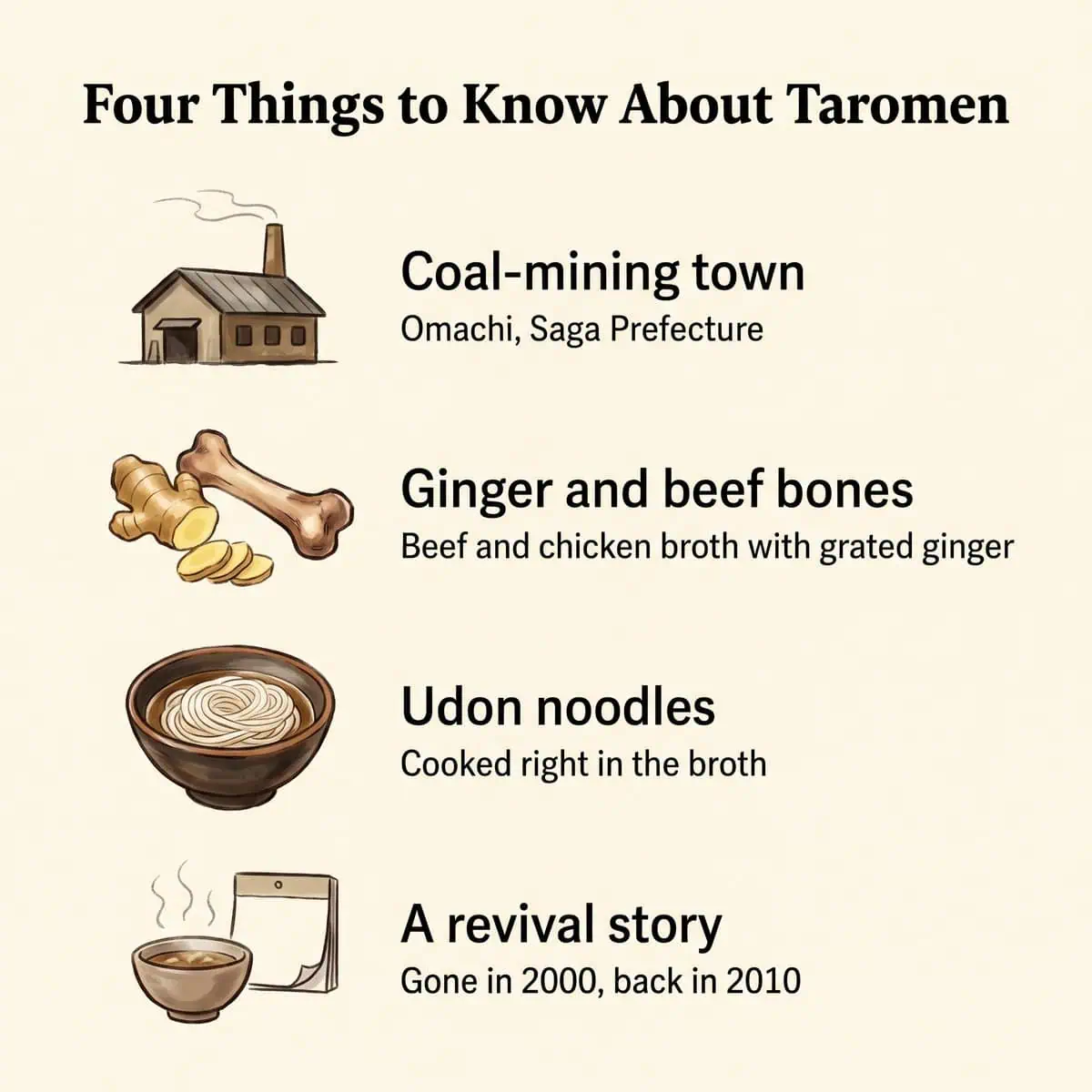
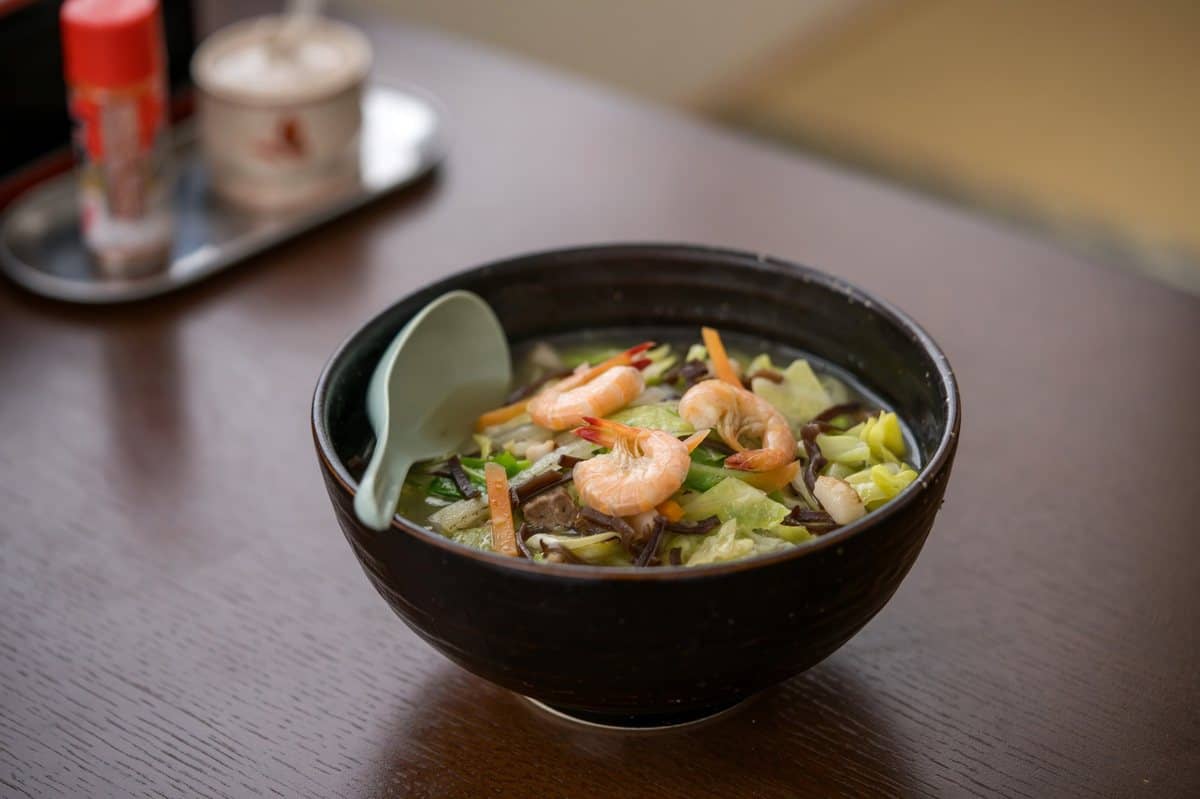
Taromen is an udon noodle soup associated with Omachi Town in Saga Prefecture. Omachi lies on Kyushu, the southwesternmost of Japan’s four main islands. Its defining features are a beef-bone-based broth, ginger, pork, shrimp, and vegetables. The dish was eaten in the town’s coal-mining era, disappeared after Taromen Shokudo closed in 2000, and was revived by local residents in 2010.
Quick Facts
- Japanese name
- たろめん (taromen), also branded 大町たろめん (Omachi Taromen)
- Where
- Omachi Town, Kishima District, Saga Prefecture, Kyushu
- Noodles
- Udon. Local promotional material describes the classic noodle as thin and slightly flat, but current restaurants use different noodles, including medium-thick fresh noodles and dried udon
- Broth
- Beef bones simmered for hours, deepened with chicken bones and pork
- Toppings
- Diced pork head meat, shrimp, cabbage, onion, carrot, wood ear mushroom (details vary by restaurant)
- Signature flavor
- Grated ginger
- Story
- Loved by coal miners; disappeared in 2000; revived in 2010
- Where to eat
- Three restaurants in Omachi, per a Saga Prefecture listing of December 2025
- Allergens
- Wheat, beef, chicken, pork, and shrimp; not vegetarian
Is Taromen Ramen or Udon?
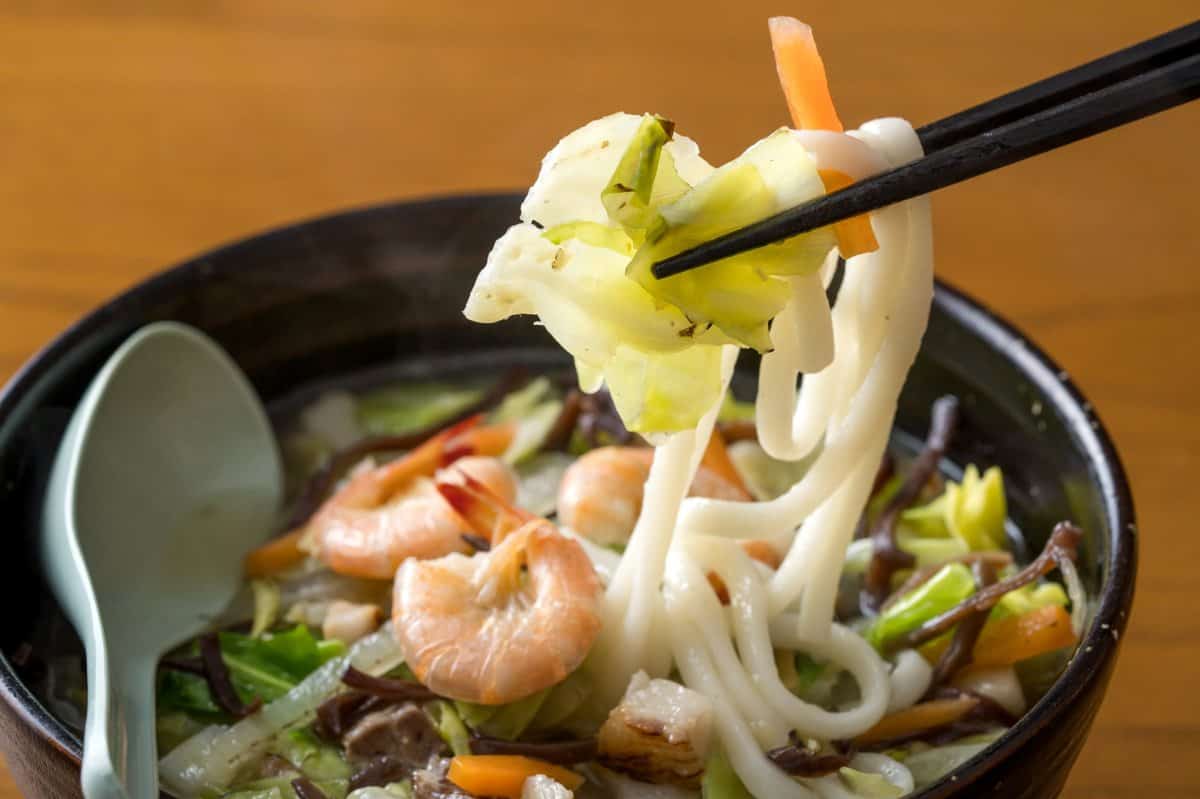
It is udon, not ramen. The noodles are made from wheat flour, salt, and water, without the alkaline water that gives ramen noodles their yellow color and springy bite. Local sources traditionally describe taromen’s udon as thin and slightly flat, which is unusual for udon. Today, though, each restaurant chooses its own noodle, and one serves a custom-made medium-thick fresh noodle.
The broth is the other big difference. Most ramen in this part of Kyushu, including Saga ramen, starts with pork bones. Taromen starts with beef bones instead, so do not expect the milky pork flavor you might know from Hakata.
Why “Taromen”?
The origin of the name is not documented in the local official sources we reviewed. A 2020 television report from Kyushu Asahi Broadcasting mentions one theory: the dish was named after an udon-loving man called Taro. We could not find a town record that confirms the origin, so treat the name as a small local mystery. The “men” part, at least, is simple: it means noodles.
What Does Taromen Taste Like?
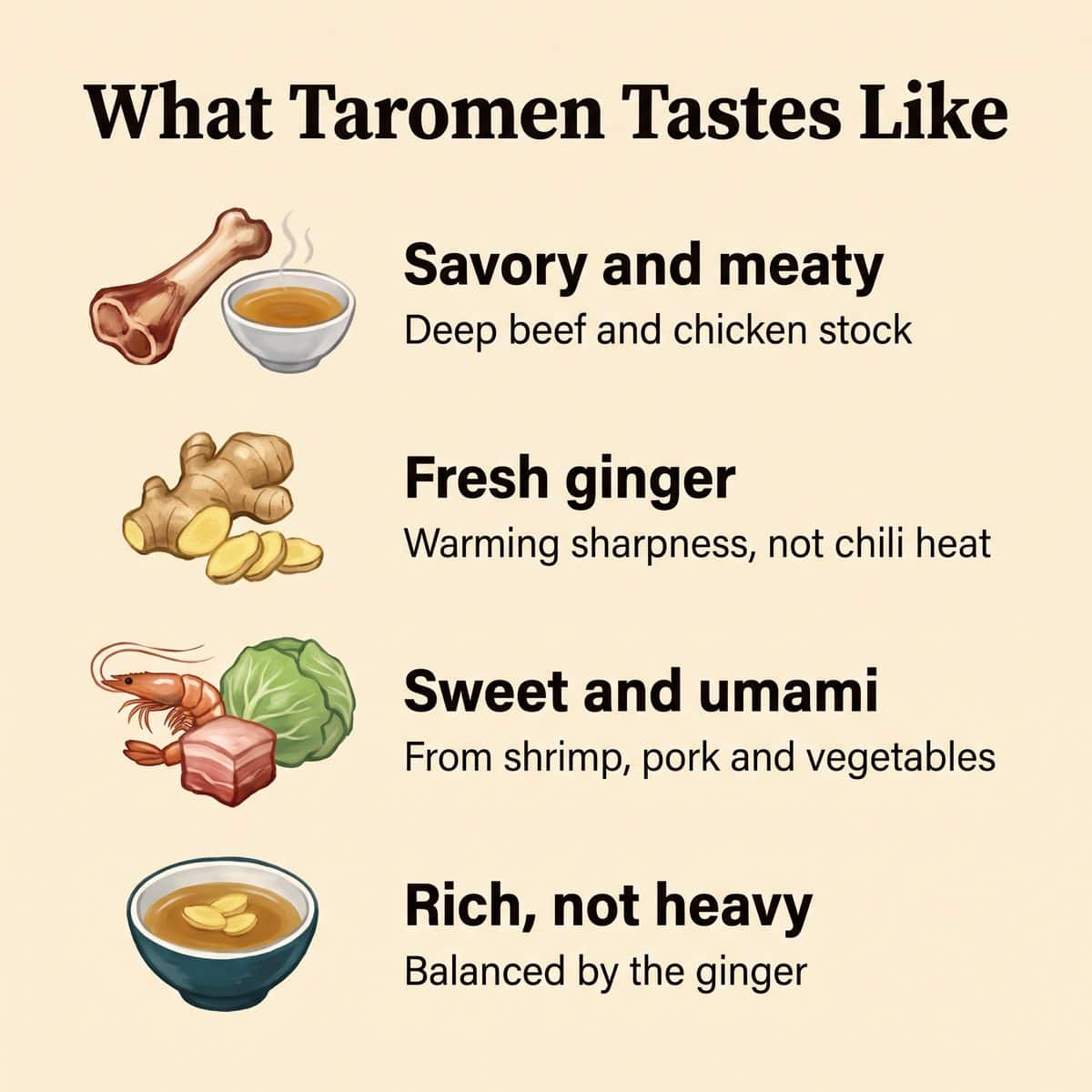
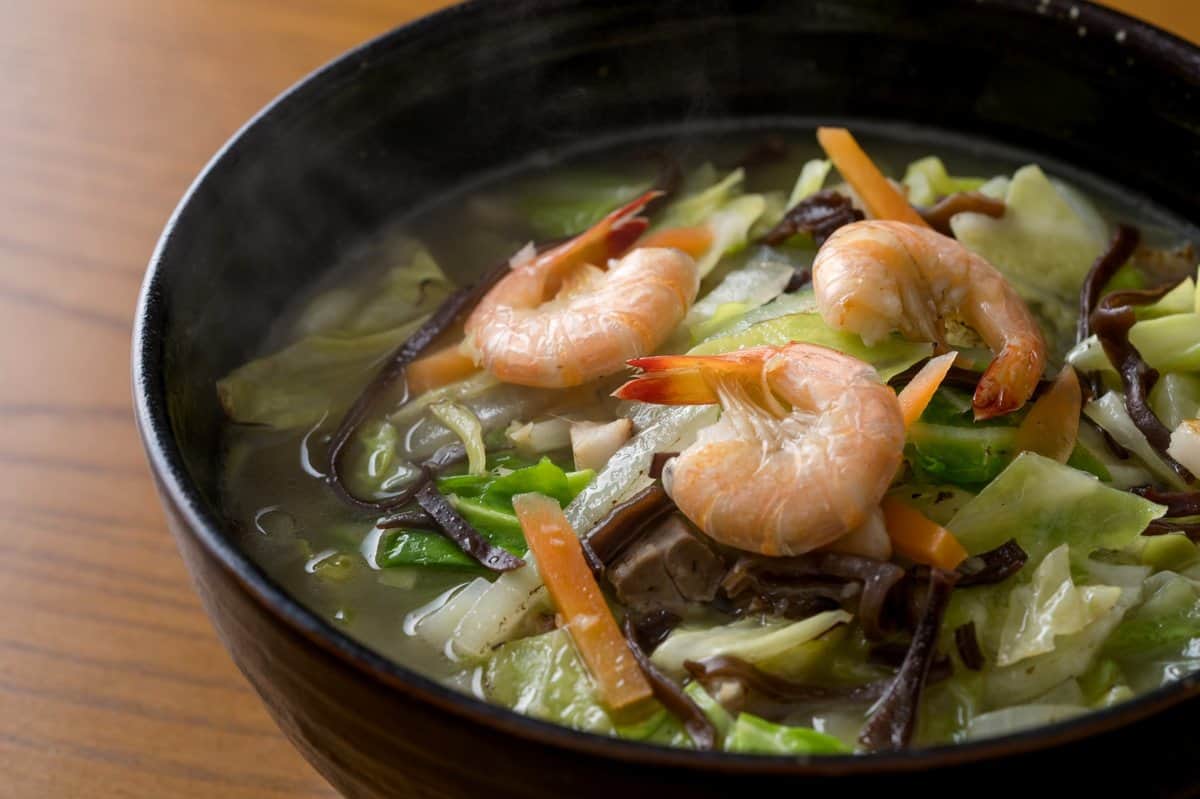
Taromen tastes savory and meaty rather than creamy or pork-heavy. Beef and chicken bones give the soup depth, while shrimp, pork, and stir-fried vegetables add sweetness and umami. Ginger provides a fresh, warming sharpness that cuts through the fat. “Rich, but not heavy” is how local descriptions keep putting it. A regional food feature by the shochu maker Kirishima describes a broth with body and depth from the meat, shrimp, and vegetables. The ginger then spreads through it and keeps the bowl refreshing. A Saga TV segment calls the soup punchy and full of umami, with the ginger aroma rising off it.
The ginger is not a garnish you stir in at the end. At Furusato Dining, the cooks stir-fry fresh ginger with the vegetables, so its heat runs through the whole bowl. Local descriptions consistently stress that lingering ginger aroma. Its warm, slightly sharp character balances the beef-based soup and explains why the bowl is often called full-bodied yet refreshing.
Texture comes from the toppings as much as the noodles. Diced pork head meat, called kashira, generally comes from the cheek and temple area and has a firmer, chewier bite than belly. Wood ear mushroom adds a crunch, and the cabbage softens into the soup. Each restaurant varies the noodles, salt level, ginger preparation, fat, and stock handling. So one bowl may taste saltier or more gingery than the next, and that variety is part of the fun.
Taromen Ingredients
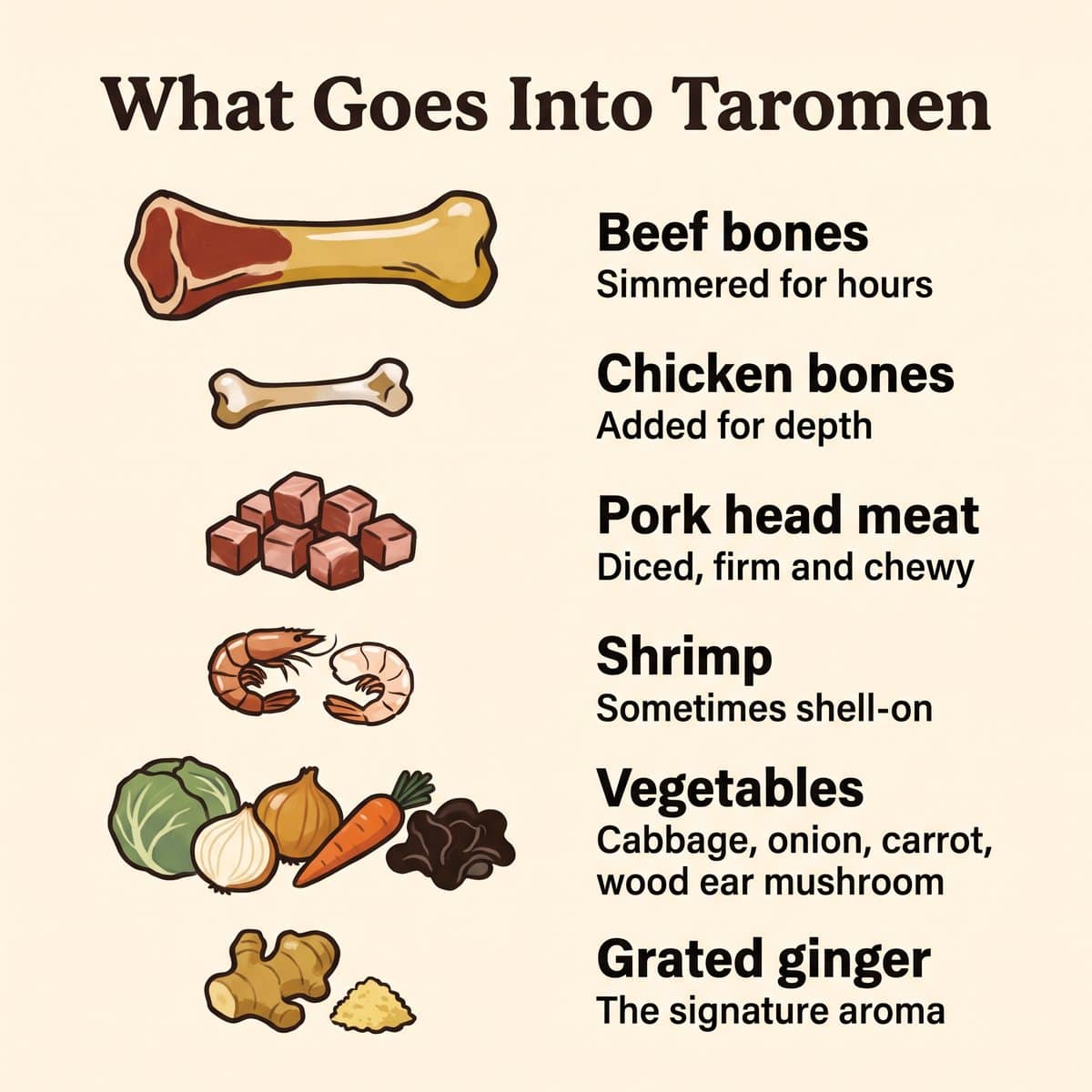
Taromen’s ingredient list is longer than its humble looks suggest. The Omachi chamber of commerce describes a soup built on beef bones simmered for a long time. Chicken bones, pork head meat, shrimp, vegetables, and seasonings then deepen it. Grated ginger tightens the flavor at the end.
The broth
- Beef bones, simmered for hours
- Chicken bones for extra depth
- Salt and mirin, a sweet rice wine, for seasoning
- Grated ginger for the signature aroma
The toppings
- Diced pork head meat (kashira)
- Small shrimp, sometimes shell-on
- Cabbage, onion, and carrot
- Wood ear mushroom (kikurage)
How Ingredients Vary by Restaurant
The core is shared, but the details are not. The chamber of commerce notes that Kazokuan simmers its beef bones for about 10 hours and grates the ginger coarsely. Its owner also keeps the salt at roughly 70 percent of the version he remembers from childhood. Sanyushi rests its soup overnight, then cooks it for about three more hours. It also uses a little beef fat instead of lard and adds Ariake Sea shrimp with the shells on.
Noodles differ as well. Kazokuan sources its udon from Kanzaki, a Saga city known for noodle making, and boils it ahead so it soaks up the soup. Sanyushi uses dried noodles from Kumamoto Prefecture, while Furusato Dining uses a custom fresh noodle with a chewy bite. So if you have time for two bowls, you will taste two interpretations of the same memory.
How Taromen Is Made
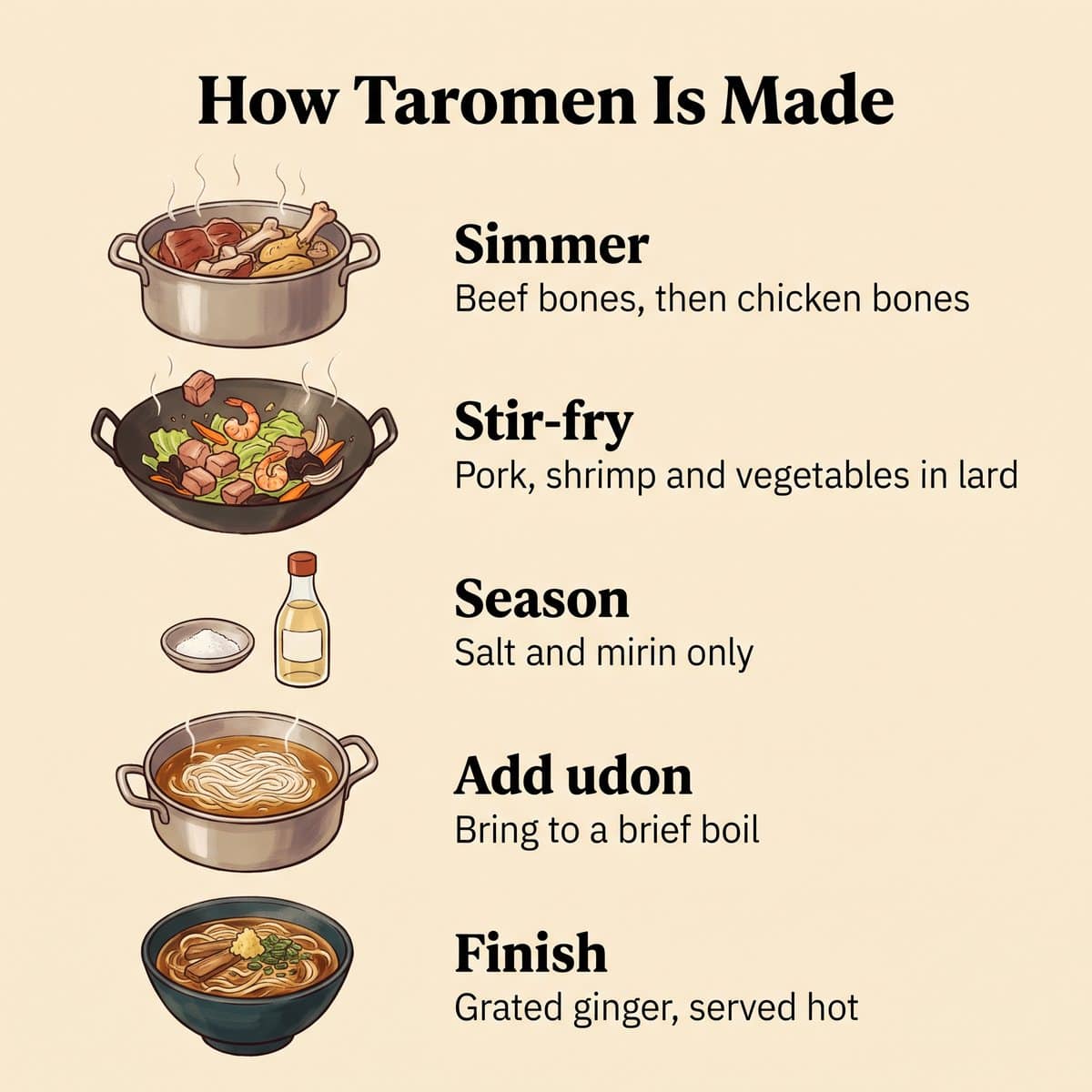
One published local-food account, by the shochu maker Kirishima, describes the traditional-style process below. Methods vary among today’s restaurants, and no standardized public recipe specifies exact quantities. We have not tested a home version ourselves, so treat this as a description rather than a recipe.
A documented traditional-style method
- 1Simmer beef bones for hours, then add chicken bones to build the stock.
- 2Stir-fry diced pork, shrimp, cabbage, onion, carrot, and wood ear mushroom in lard.
- 3Pour in the stock and season it with salt and mirin only.
- 4Add the udon and bring everything to a brief boil.
- 5Finish with grated ginger and serve hot.
Cooking the noodles in the broth, rather than separately, lets the udon take on the beef flavor. Any effect on the soup’s thickness depends on the noodle and whether it was boiled beforehand. If you try something similar at home, pork shoulder approximates the pork more easily than head meat, though not its firmness. A commercial unsalted beef stock simplifies the broth, but call the result taromen-inspired rather than Omachi taromen. Ginger is essential, since leaving it out removes the feature that sets taromen apart from similar soups.
Taromen vs. Saga Ramen vs. Nagasaki Champon
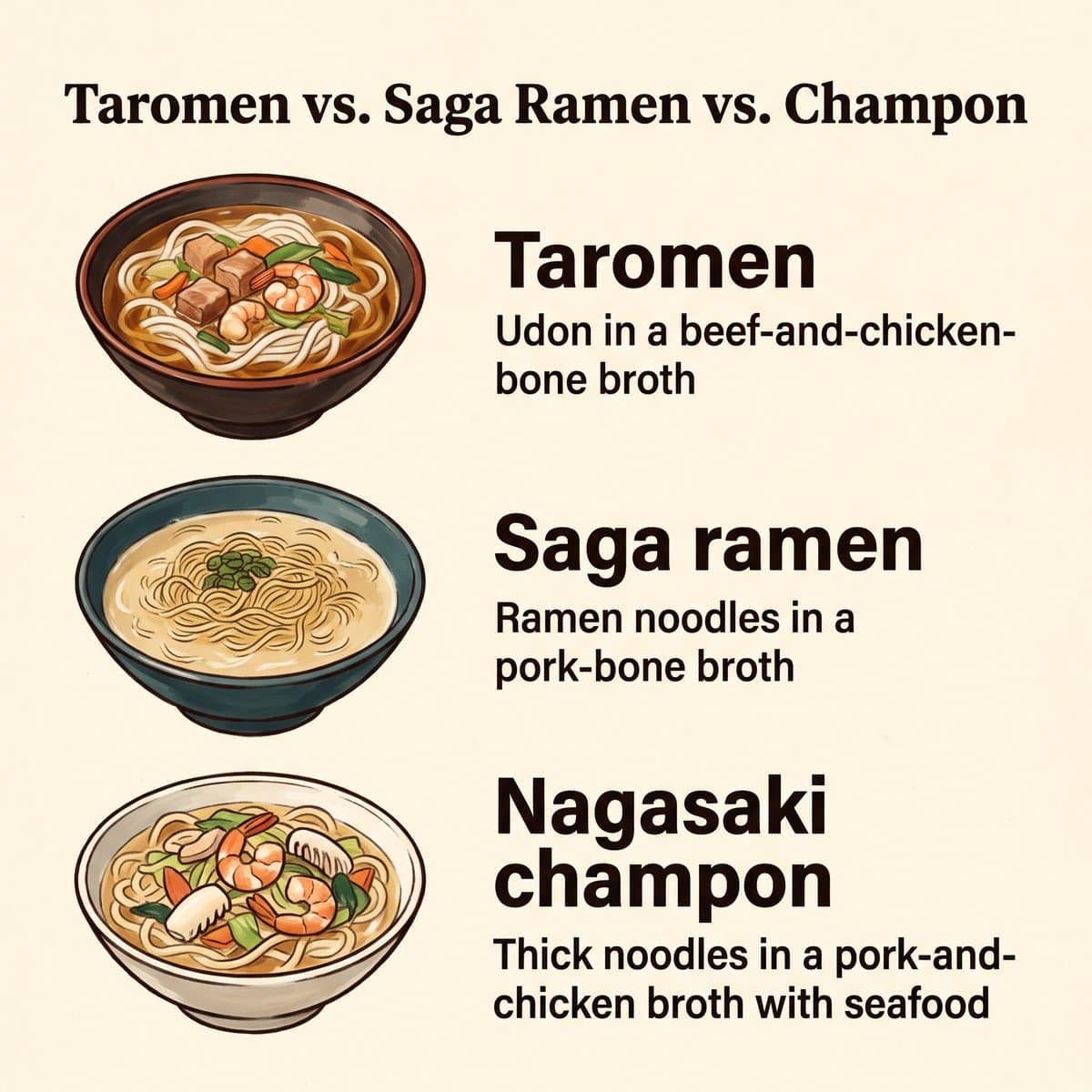
Visitors often confuse these three Kyushu bowls, and the confusion is understandable. All three pile meat and vegetables onto noodles in a cloudy broth. The table shows where they part ways.
| Point | Taromen | Saga ramen | Nagasaki champon |
|---|---|---|---|
| Home | Omachi, Saga | Saga City area | Nagasaki City |
| Noodles | Udon, often thin and slightly flat | Ramen noodles, slightly thick and straight | Thick Chinese-style noodles |
| Broth base | Beef bones and chicken bones | Pork bones | Pork and chicken bones, with seafood |
| Signature touch | Grated ginger | A raw egg at many shops | Stir-fried seafood and vegetables |
| Noodles cooked | In the broth | Separately | In the broth |
Do not confuse taromen with Saga ramen, even though both come from the same prefecture. Saga ramen typically uses a mild pork-bone broth, and a raw egg is a well-known topping at many shops, as our Saga ramen guide explains. Taromen’s closest cousin is really Nagasaki champon, since both cook the noodles in the soup. Swap champon’s Chinese noodles for udon and its seafood for beef and ginger, and you are close.
The History of Taromen: A Coal Town’s Comfort Food
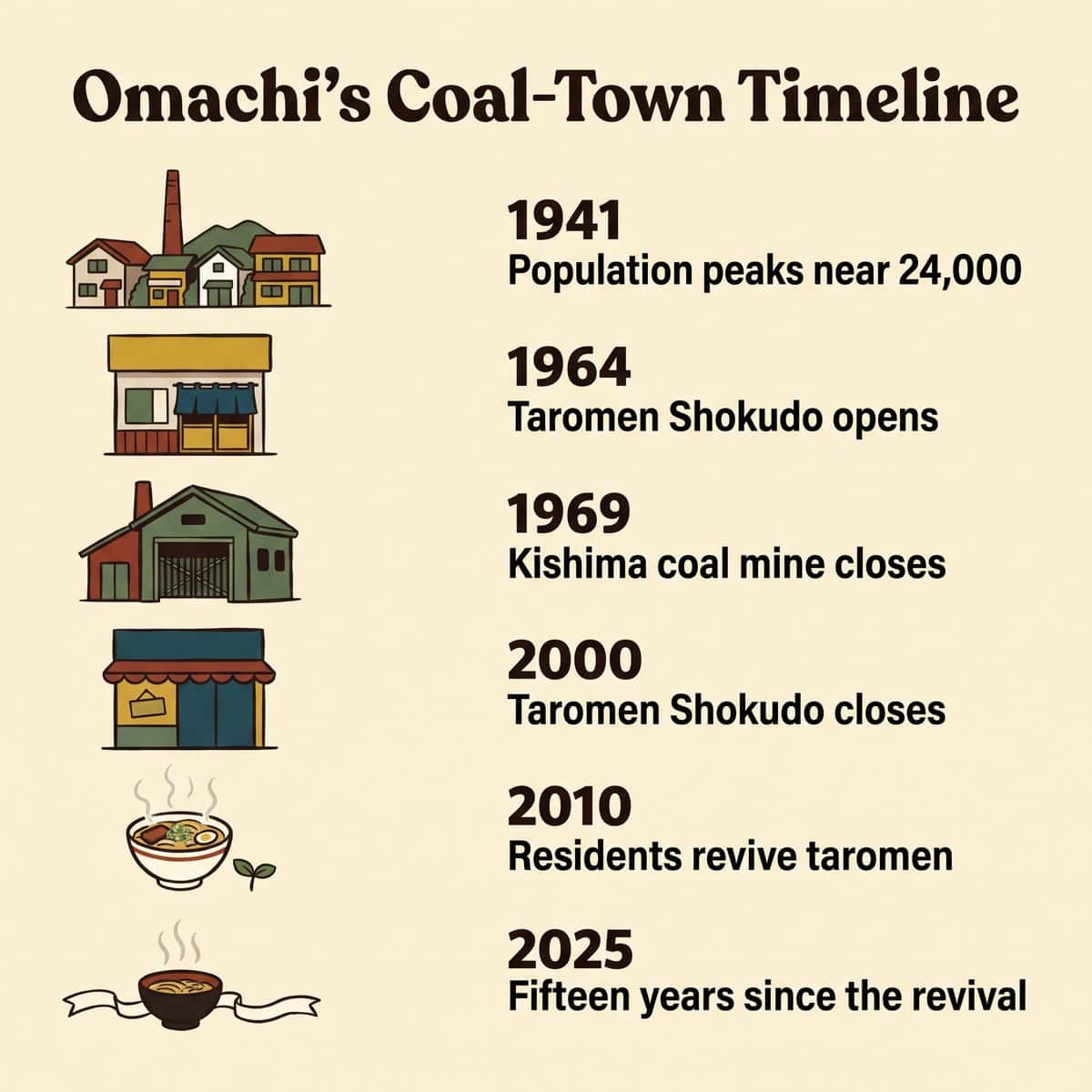
Taromen’s story follows the rise and fall of the Kishima coal mine. Coal mining developed in Omachi in the early twentieth century and grew into the Kishima mine complex, drawing workers from across the country. Official tourism and education materials give slightly different opening years, so we leave the exact date aside. What they agree on is the peak. Omachi’s population reached about 24,000 in 1941, and roughly six in ten residents were reportedly tied to the mine. In that crowded town, a noodle soup rich enough to fuel a shift found its audience.
Taromen Timeline
- Early 1900sCoal mining expands in Omachi, drawing workers and transforming the town.
- 1941The town’s population peaks at around 24,000.
- 1964The Yamamoto couple open Taromen Shokudo, carrying on an earlier generation’s recipe.
- 1969The Kishima coal mine closes.
- 2000Taromen Shokudo closes, and the dish disappears from the town.
- 2010Local volunteers revive it as Omachi Taromen with the former owner’s help.
- 2025The town marks 15 years since the revival.
Why Coal Miners Loved It
Mining was brutal work, and a bowl of taromen delivered meat, vegetables, and hot broth in one sitting. Kirishima’s feature says miners ate it before and after work, and sometimes enjoyed it as a snack with drinks afterward. The ginger gives the soup a warming quality, which may have been welcome in cold weather. That is our guess, though, rather than a documented reason.
The Closure in 2000
The chamber of commerce records that a couple named Yamamoto opened Taromen Shokudo in 1964, carrying on the flavor of the previous generation. They ran it until 2000. When that restaurant closed, the Saga tourism federation’s travel feature notes, there was nowhere left in Omachi to eat taromen. By then the Kishima mine had been closed since 1969, and the town had shrunk. For a while, the dish lived only in memory.
The Revival in 2010
Residents kept asking for it back. In 2010, a group of local volunteers stepped up, and the former owner of Taromen Shokudo helped by passing on the recipe. The dish returned under the name Omachi Taromen, and several restaurants began serving their own versions. In 2025, the town celebrated 15 years since the revival, with the three current restaurants running a joint campaign.
It is worth being precise here. This was a revival guided by the original cook, not a perfect copy of a lost recipe. Each restaurant now adjusts the salt, the ginger, and the noodles. So what you eat today is a living version of the miners’ bowl, not a museum piece.
Where to Eat Taromen in Omachi
How to Get to Omachi
Omachi is a small town in central Saga Prefecture on JR Kyushu’s Sasebo Line, between Saga City and Takeo Onsen. JR Omachi Station is the most useful arrival point without a car. Furusato Dining is about a minute’s walk from it, and Sanyushi is in the same Fukumo district. Kazokuan sits on Route 34 in the Kami-Omachi area, farther from the station. Check each restaurant’s current hours before making a special trip.
The Three Restaurants
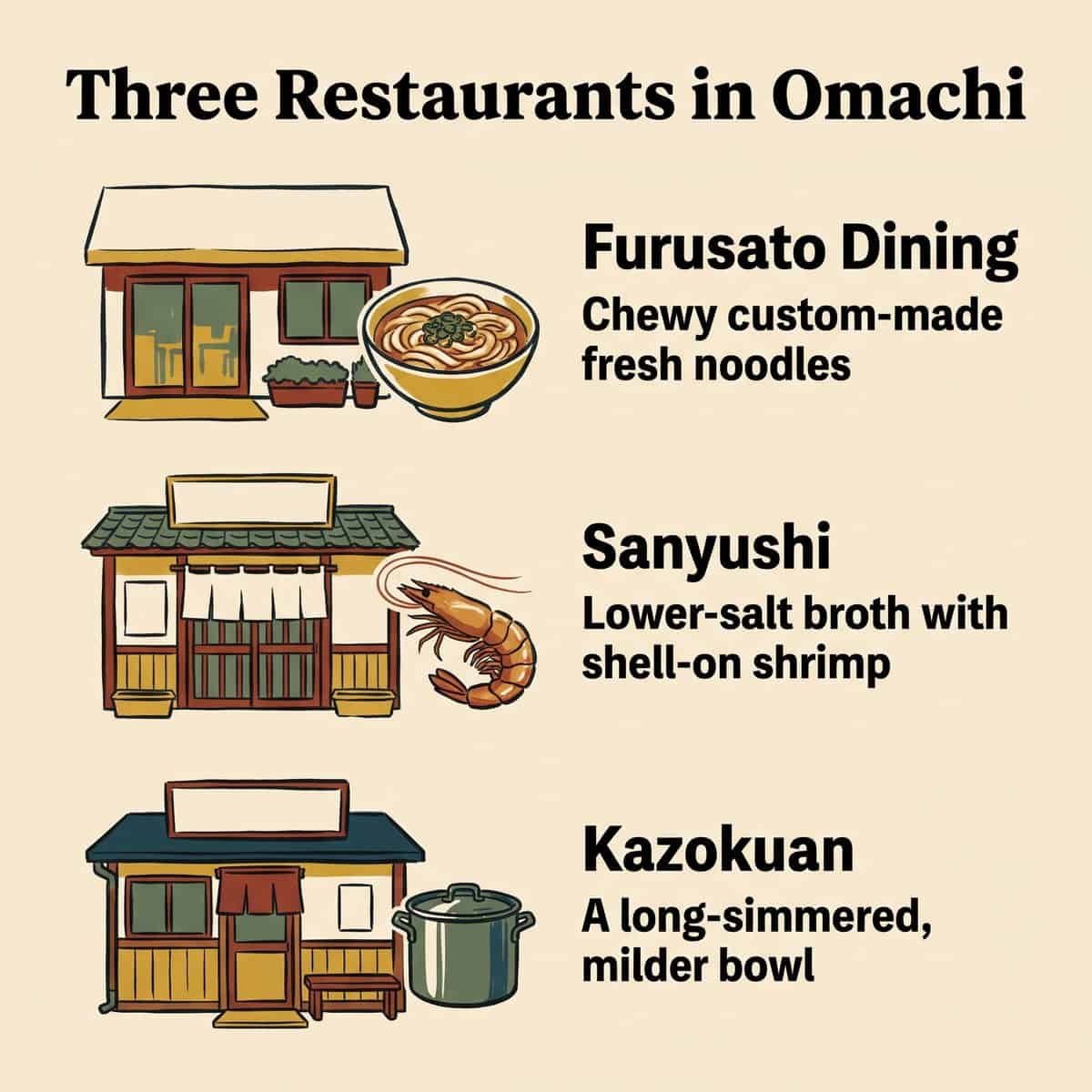
On December 25, 2025, Saga Prefecture’s regional site Sagajikan listed three Omachi restaurants serving taromen: Furusato Dining, Sanyushi, and Kazokuan. Each place has its own character.
Furusato Dining (ふるさとダイニング)
Best for: chewy custom-made fresh noodles and bowls served in Arita ware. Inside Omachi Furusato-kan, a community facility on National Route 34, about a 1-minute walk from JR Omachi Station. It also offers a spicy “red” taromen with chili bean paste and a “black” version with black sesame. Listed hours for the dining room are 11:00 to 14:00, closed Mondays.
Sanyushi (さんゆうし)
Best for: a lower-salt, lower-oil broth with shell-on Ariake Sea shrimp. Founded in 1920 and now run by its fourth generation, in a residential corner of the Fukumo district. Its soup rests overnight and uses a little beef fat rather than lard. Listed lunch hours differ by source (11:30 or 12:00 to 14:00), closed Mondays; the chamber of commerce notes evenings are by reservation. The beef-bone curry, made from the same stock, is a local favorite.
Kazokuan (家族庵)
Best for: a long-simmered, milder bowl. Opened in 1985 on Route 34 in the Kami-Omachi area, so plan on a taxi or car from the station. Simmers its beef bones for about 10 hours, grates the ginger coarsely, and uses udon from Kanzaki. Its ojiya udon, a rice-porridge-style dish, is another specialty. The chamber of commerce lists lunch and dinner service, closed Tuesdays and Fridays.
Last checked: October 27, 2026, against Sagajikan (December 25, 2025), Asobo Saga (January 10, 2025), Sagastyle, and the Omachi chamber of commerce site. Sources do not always agree on hours. We did not find dated prices, card-payment details, or reservation policies. Please confirm hours, prices, and payment with each restaurant before you go.
A Note on Restaurant Names
One caution about names. A 2020 broadcast and a January 2025 tourism article name a restaurant at 297-4 Fukumo, beside JR Omachi Station, as Fukumo Shokudo. The December 2025 listing gives the same address as Omachi Furusato-kan and names its restaurant Furusato Dining. We could not confirm whether this reflects a renaming, a change of operator, or a different business at the same facility.
How to Enjoy Taromen
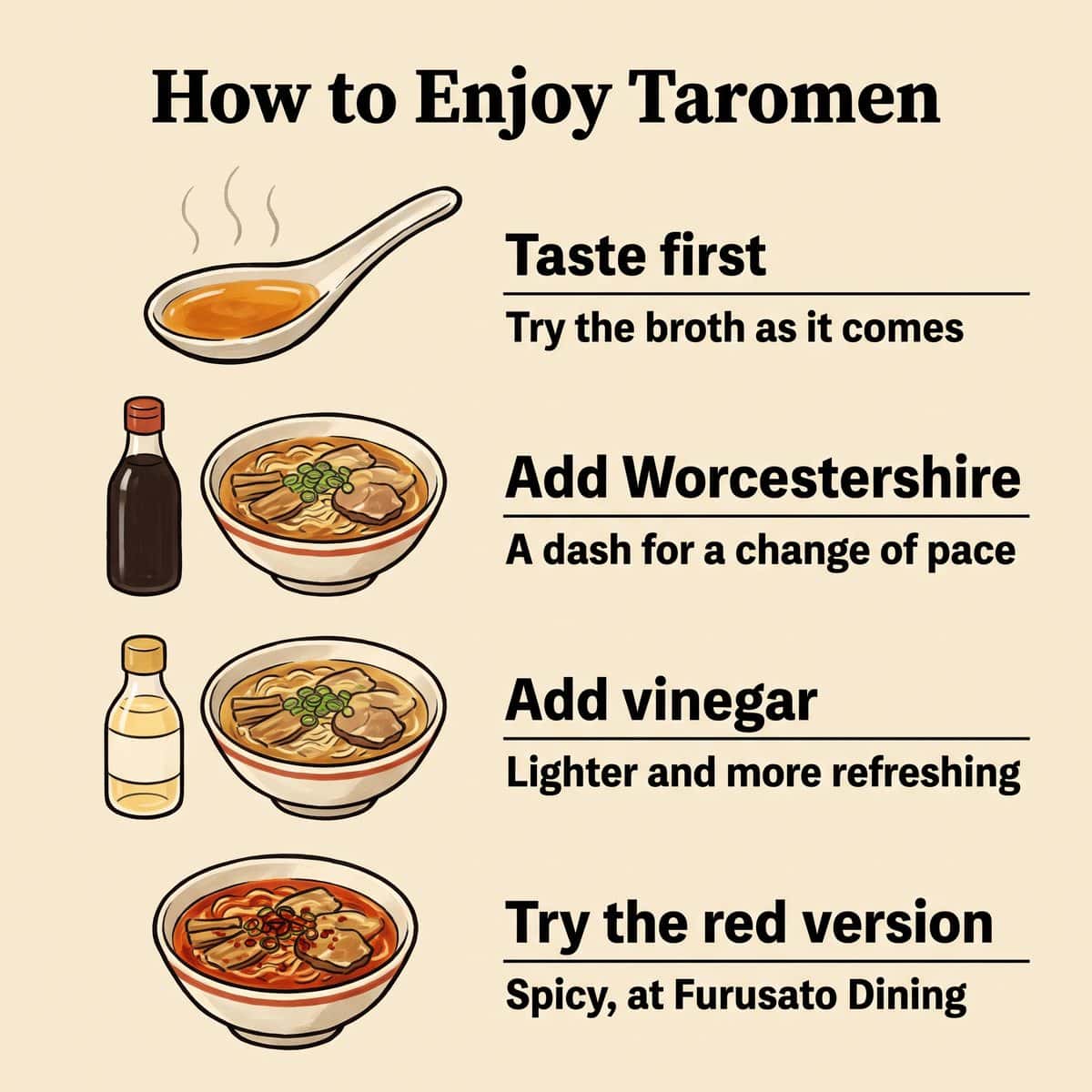
Start with the broth as it comes. Furusato Dining’s own advice, reported by Saga TV, is to taste the beef and ginger first before changing anything. After a few bites, try a dash of Worcestershire sauce, which the restaurant suggests for a change of pace. A splash of vinegar, it adds, turns the bowl lighter and more refreshing.
Note that a standard bowl contains wheat, beef, chicken, pork, and shrimp, so it is neither vegetarian nor shellfish-free. Removing visible toppings does not change the broth. Adding rice to the last of the soup is a natural move with a broth this rich, though it is our suggestion rather than a local rule. If you want heat, the spicy “red” version at Furusato Dining does the job without you adding anything.
Taromen also fits neatly into a wider Saga food trip. Pair it with the town’s coal-heritage sites, such as the red-brick former substation of the Kishima mine, which dates to 1927. Then continue to Takeo or Ureshino for hot springs and Ureshino’s hot-spring tofu. Our Kyushu food guide has more ideas for the region.
Why Taromen Matters to Omachi
Omachi is a small town with a big past. The mine that once drew 24,000 people is long gone. According to the Saga tourism federation, the brick substation is the only mining-era building still standing. In that context, taromen does more than fill stomachs. It keeps the memory of the mining years alive in a form anyone can share.
The revival also shows how a food can be rescued. It took a willing former owner, volunteers ready to learn, and restaurants prepared to keep cooking a dish most of Japan has never heard of. Fifteen years on, the bowl is still on the menu.
Takeaway: A Mining Town in a Bowl
Taromen is Omachi’s beef-bone udon, distinguished by ginger, pork, shrimp, and vegetables. Its present-day significance comes from both its coal-mining roots and its 2010 revival. For travelers, the best way to understand the dish is to compare the versions now served in Omachi. Do not expect one fixed recipe. If you visit Saga Prefecture, travel to Omachi and eat taromen where its coal-mining story began.
Frequently Asked Questions about Taromen
The Dish
- What is taromen?
-
Taromen is a local noodle soup from Omachi, Saga Prefecture. It uses udon noodles in a beef-bone and chicken broth with pork, shrimp, vegetables, and grated ginger. Coal miners in the town once ate it before and after work.
- What is taromen broth made from?
-
Beef bones simmered for hours form the base. Chicken bones, pork head meat, shrimp, and vegetables deepen it, and cooks season it with salt and mirin. Grated ginger gives the broth its signature aroma.
- Is taromen spicy?
-
Not in the chili sense. The ginger gives it a warm, gentle sharpness rather than heat. If you want real spice, Furusato Dining serves a “red” version made with chili bean paste.
- Can I make taromen at home?
-
You can follow the traditional method: stir-fry the toppings in lard, add beef-and-chicken stock, season with salt and mirin, and simmer udon in it. No official recipe gives exact amounts, so you will need to adjust by taste.
Visiting and Dietary Notes
- Is taromen suitable for vegetarians?
-
No. Standard taromen uses a broth made with beef and chicken bones, along with pork and shrimp. Even with the visible toppings removed, the soup is not vegetarian, and halal versions are not something we found offered.
- Does taromen contain shellfish?
-
Usually, yes. Shrimp is one of its characteristic ingredients, and one restaurant cooks it shell-on. Diners with a shellfish allergy should contact the restaurant before visiting.
- Where can I eat taromen?
-
In Omachi, Saga Prefecture. As of December 2025, Furusato Dining, Sanyushi, and Kazokuan serve it. Check each restaurant’s hours before visiting, because they change.
- Is taromen available outside Saga Prefecture?
-
It is closely tied to Omachi, and we found no regular restaurants serving it elsewhere. We also could not confirm any instant or packaged version for sale. Occasional event appearances are possible, but Omachi remains the reliable place to try it.
- What other local foods should I try in Saga?
-
Saga ramen with its raw egg, Saga beef, Yobuko squid, and Ureshino’s hot-spring tofu are all within a day’s travel. Our Saga articles cover each of them in detail.
References
- Omachi Chamber of Commerce (Saga Federation of Societies of Commerce) – Omachi Taromen (Accessed October 2026)
- Sagajikan, Saga Prefecture Regional Development Site – Omachi Town Side-Trip Spots and Taromen, December 25, 2025 (Accessed October 2026)
- Asobo Saga, Saga Prefectural Tourism Federation – Touring Omachi, Once Called One of Japan’s Leading Coal Towns (Accessed October 2026)
- Saga Prefecture – Omachi Town Board of Education: Initiatives to Foster Love of Hometown, FY2025 (PDF) (Accessed October 2026)
- Kirishima Shuzo, Kyushu Food Features – Taromen (Accessed October 2026)
- Saga TV, Kachi Kachi Plus – Omachi’s Soul Food Taromen and Recommended Ways to Eat It, June 2024 (Accessed October 2026)
- Kyushu Asahi Broadcasting, Furusato Wish – Taromen, the Coal Miners’ Noodles Revived, 2020 (Accessed October 2026)
- Kazokuan – Omachi Taromen (Accessed October 2026)
- Sagastyle, Saga Prefecture Shop Directory – Omachi Furusato-kan (Furusato Dining) (Accessed October 2026)
Related Articles
- Saga Ramen (佐賀ラーメン) (Surveyed: October 2026)
- Nagasaki Champon (長崎ちゃんぽん) (Surveyed: October 2026)
- Ureshino Onsen Yudofu (嬉野温泉湯どうふ) (Surveyed: October 2026)
- Saga Beef (佐賀牛) (Surveyed: October 2026)
- Yobuko Ika (呼子イカ) (Surveyed: October 2026)
- Amegata (あめがた) (Surveyed: October 2026)
- Sanuki Udon (讃岐うどん) (Surveyed: October 2026)
- The Ultimate Kyushu Food Guide: 10 Local Dishes You Must Eat (Surveyed: October 2026)
Photo Credits
- Saga Prefectural Cultural Tourism Federation – Photo Gallery: ©Saga Prefectural Cultural Tourism Federation (写真提供:佐賀県文化観光連盟 ©佐賀県文化観光連盟)




Comments