




Dashi is a Japanese stock made from kombu, katsuobushi, or other umami-rich ingredients. Cooks steep these in hot water to draw out a clear, savory broth. It forms the base of soups, noodle broths, and simmered dishes.
So why does it matter so much? This stock delivers umami, the deep savory taste behind Japanese food. You can make it in minutes, and it needs only one or two ingredients. This complete guide covers what it is, the science of its flavor, every main type, how to prepare each one, how to use it, and where to find it.
What Is Dashi?
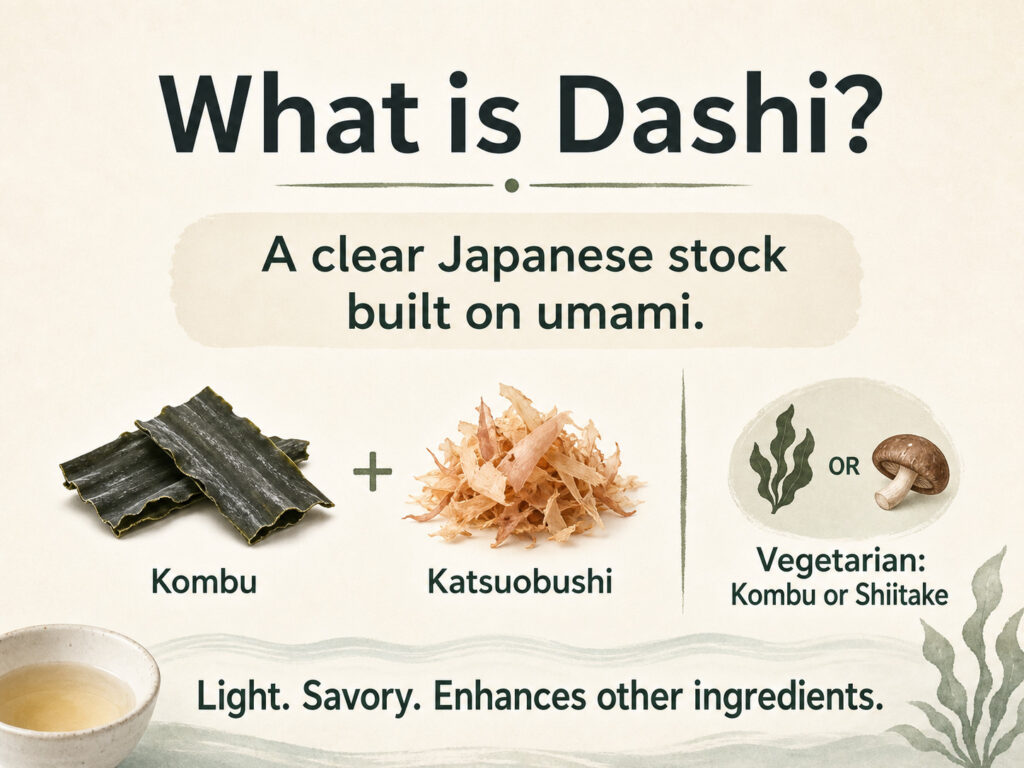
At its core, dashi is a crystal-clear stock built on umami. Umami is the fifth basic taste, alongside sweet, sour, bitter, and salty. This broth is much lighter than Western stock. Cooks usually make it with one or two ingredients steeped in hot water. The result tastes clean and deeply savory.
The most common version combines kombu (dried kelp) and katsuobushi (dried bonito flakes). Vegetarian cooks often use only kombu or dried shiitake instead. What makes this stock special is simple. It lifts other ingredients without ever covering them up.
A First Taste
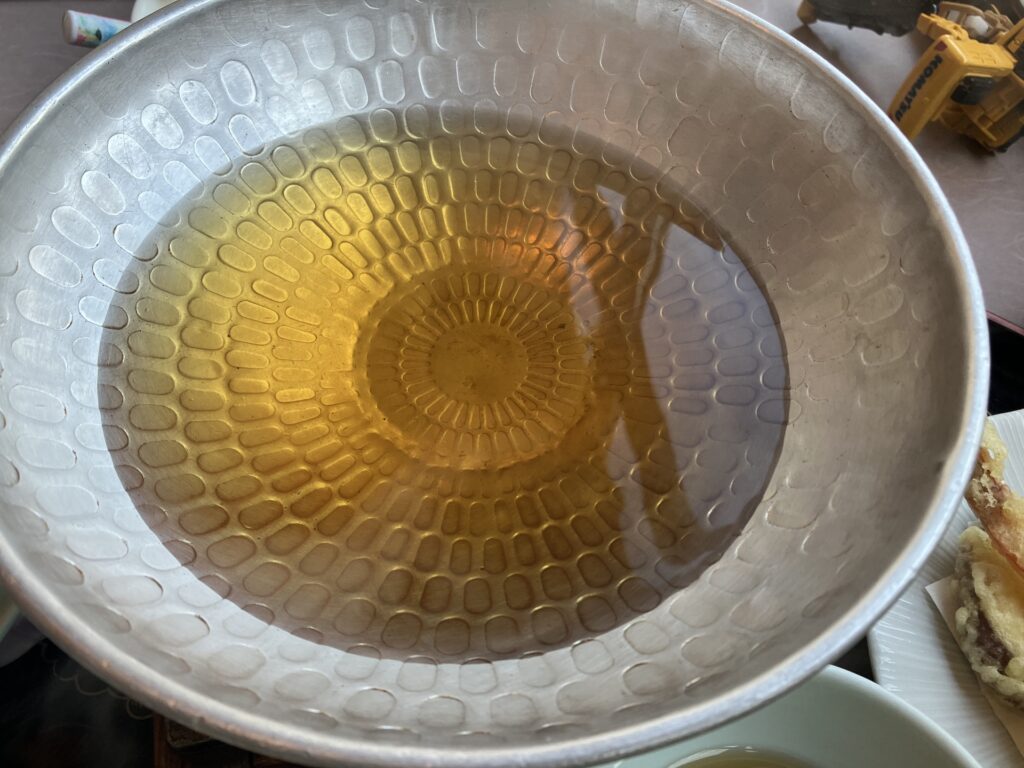
Honestly, the first sip surprised me. The broth arrived clear, with a faint golden color. I expected something watery, yet the aroma said otherwise. A gentle smokiness from the bonito met a soft sea scent from the kombu.
The flavor was not loud or sharp. Instead, a quiet wave of savoriness spread across my tongue. It lingered for a moment, then faded, and left me wanting more. After that, it made sense why this stock anchors so many Japanese dishes.
Understanding Umami
To understand this broth, you first need to understand umami. Umami is the deep, savory taste that makes food feel satisfying. It joins sweet, sour, bitter, and salty as the fifth basic taste. Japanese cooks deliver it mainly through stock.
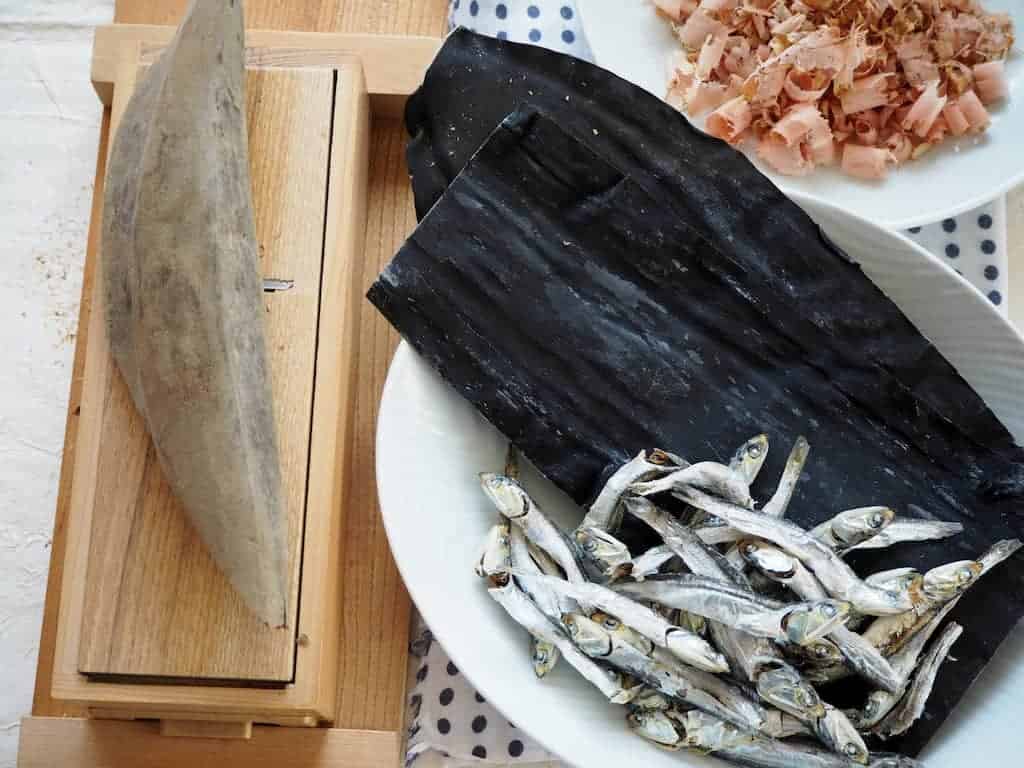
Three compounds create most of the umami here. Kombu supplies glutamic acid. Katsuobushi and niboshi supply inosinic acid. Dried shiitake supplies guanylic acid. Each one tastes savory on its own.
Here is the interesting part. When you combine glutamate with inosinate, the umami jumps far higher. The two compounds boost each other, sometimes several times over. This synergy explains why the awase style tastes so rich, even though it stays light.
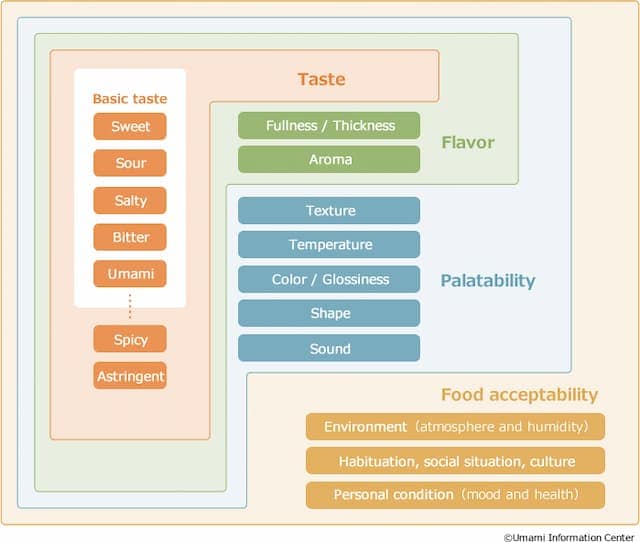
How Umami Was Discovered
Umami is an old taste, yet a fairly new word. In 1908, Professor Kikunae Ikeda studied kombu stock at Tokyo Imperial University. He noticed a savory taste that did not fit the known four. So he isolated glutamate and named the taste umami. Later, other Japanese scientists identified inosinate and guanylate.
Dashi vs Western Stock
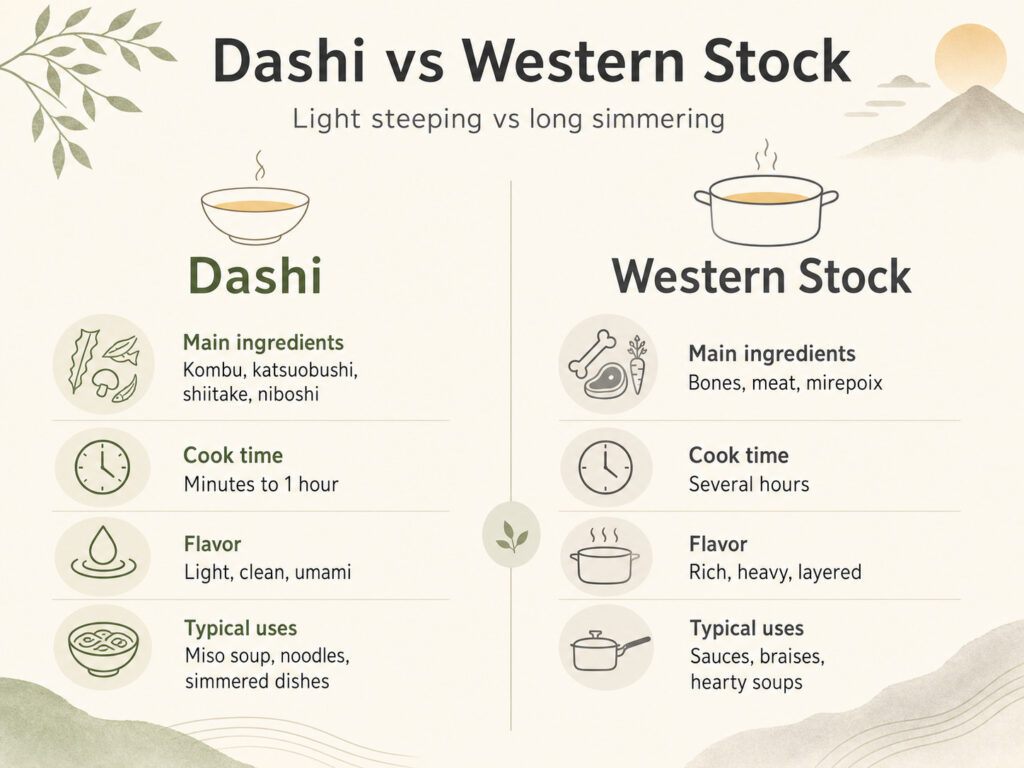
How does it differ from a Western stock? The gap is bigger than it looks. Western stock simmers bones and vegetables for hours. The Japanese version steeps light ingredients for minutes. As a result, the two taste and behave very differently.
| Dashi | Western Stock | |
|---|---|---|
| Main ingredients | Kombu, katsuobushi, shiitake, or niboshi | Bones, meat, mirepoix vegetables |
| Cooking time | A few minutes to one hour | Several hours of simmering |
| Flavor | Light, clean, umami-forward | Rich, heavy, layered |
| Texture | Thin and clear | Fuller, sometimes gelatinous |
| Typical uses | Miso soup, noodle broth, simmered dishes | Sauces, braises, hearty soups |
Types of Dashi
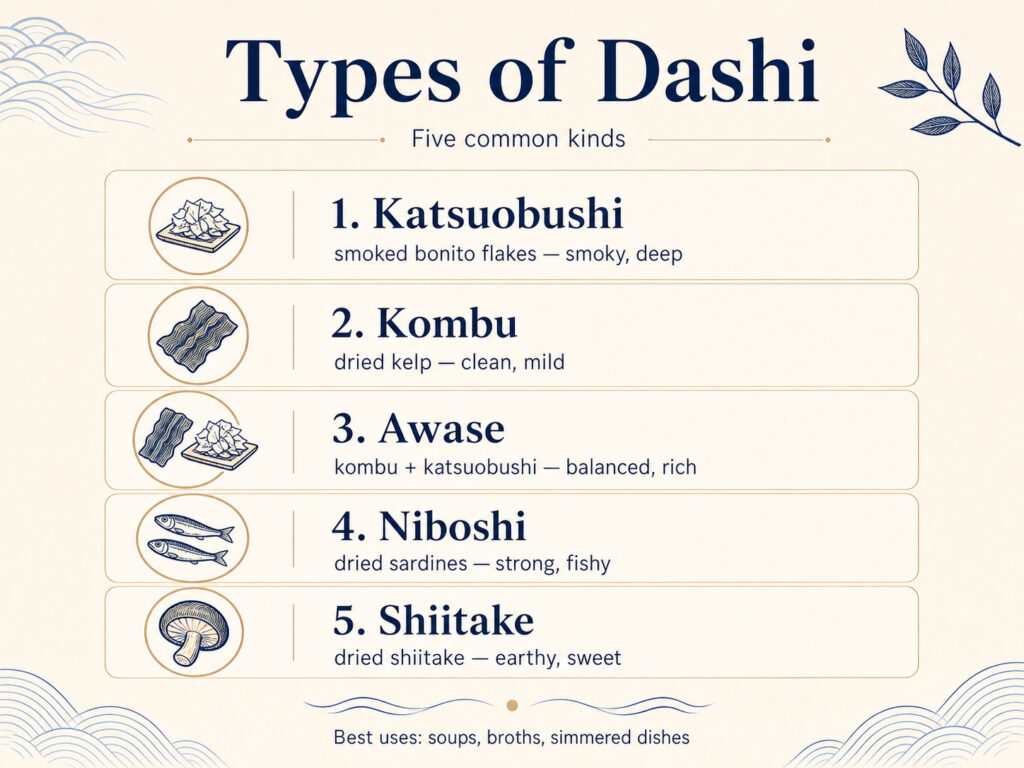
There are several types of dashi, and each one suits different cooking. Some lean delicate, while others taste bold and fishy. Below is a quick overview of the five most common kinds.
| Type | Main ingredient | Umami compound | Flavor | Best for |
|---|---|---|---|---|
| Katsuobushi | Dried bonito flakes | Inosinic acid | Smoky, deep | Clear soups, chawanmushi |
| Kombu | Dried kelp | Glutamic acid | Clean, mild | Vegetarian and delicate dishes |
| Awase | Kombu and katsuobushi | Both combined | Balanced, rich umami | Everyday Japanese cooking |
| Niboshi | Dried sardines | Inosinic acid | Strong, fishy | Miso soup, noodle broth |
| Shiitake | Dried shiitake | Guanylic acid | Earthy, sweet | Simmered and vegan dishes |
Notice the pattern here? Kombu carries glutamic acid, while katsuobushi and niboshi carry inosinic acid. Shiitake adds guanylic acid instead. When you combine two of these, the umami multiplies. That synergy is exactly why the awase style tastes so full.
Katsuobushi (かつおだし)
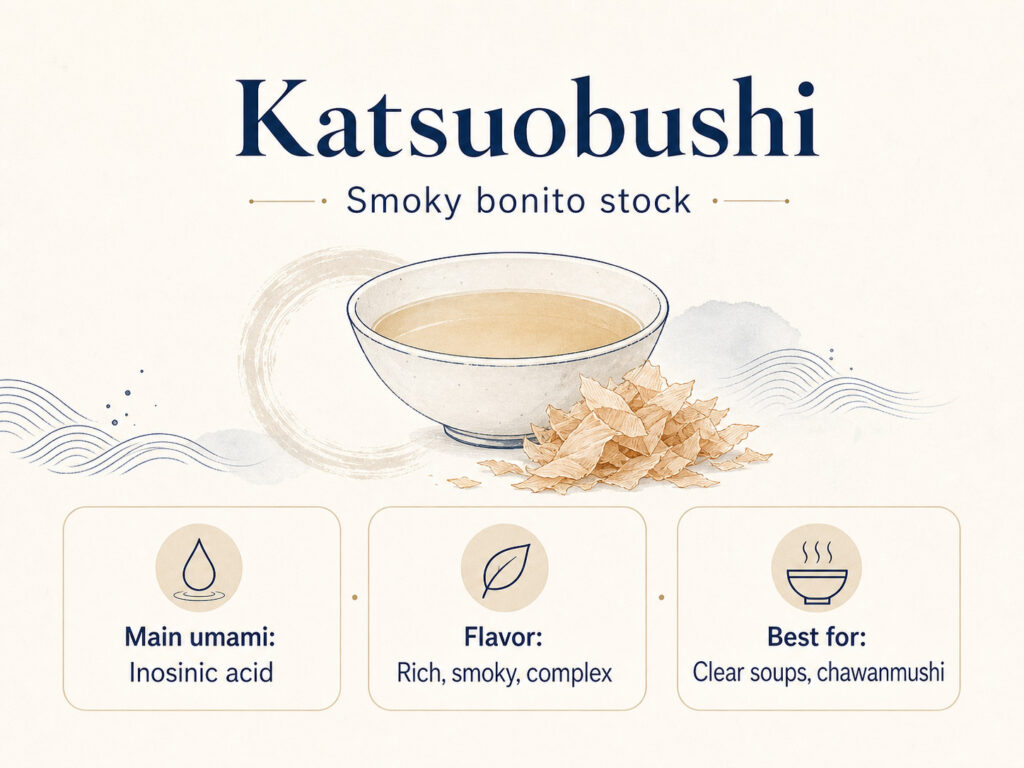
Cooks often call katsuobushi the soul food of Japanese cuisine. The stock made from it forms the backbone of countless dishes. It carries a smoky aroma and a deep, clean umami.
- Main umami component: inosinic acid
- Characteristics: rich, smoky flavor with a complex aroma
- Best dishes: clear soups, chawanmushi, and any dish where the stock is the star
Kombu (昆布だし)
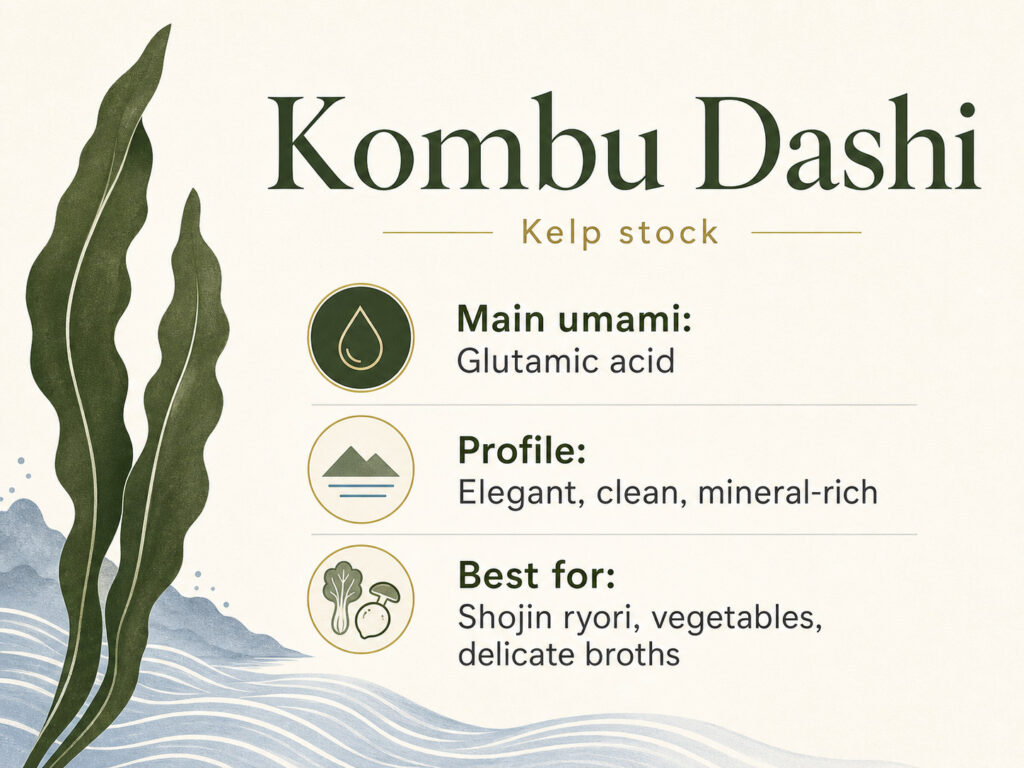
Kombu is the other cornerstone of Japanese stock. Its flavor changes with the harvest area and year. So tasting a few varieties is half the fun.
- Main umami component: glutamic acid
- Characteristics: elegant, clean, and mineral-rich
- Best dishes: shojin ryori, vegetable dishes, and delicate broths
Awase (合わせだし)
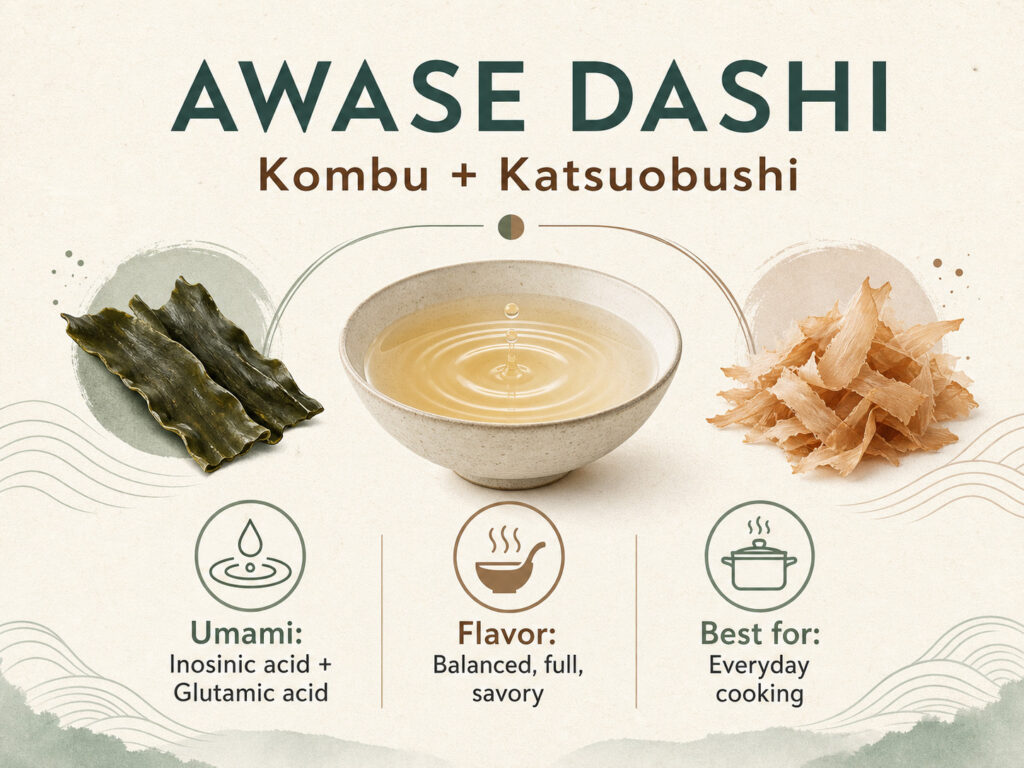
Awase blends kombu and katsuobushi into one stock. The two umami compounds combine and amplify each other. This makes it the most versatile choice of all.
- Main umami component: inosinic acid plus glutamic acid
- Characteristics: balanced, full, and powerfully savory
- Best dishes: most traditional recipes and everyday home cooking
Niboshi (煮干しだし)
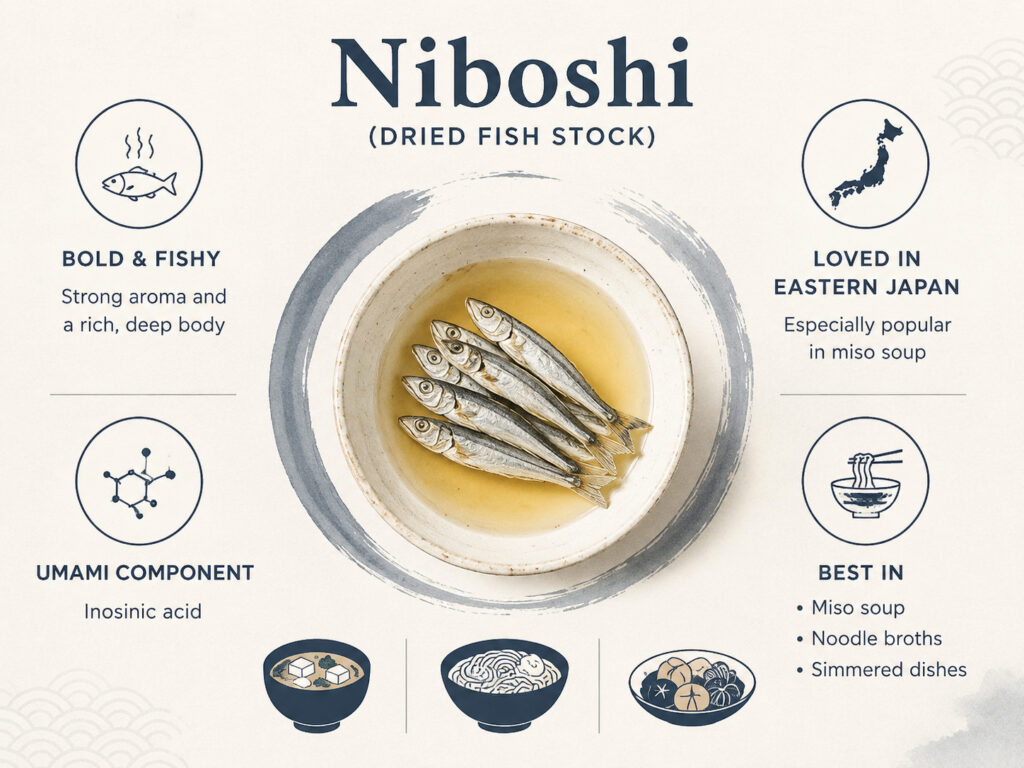
Niboshi stock comes from small dried sardines or anchovies. It tastes bold, with a clear fishy edge. Eastern Japan especially loves it in miso soup.
- Main umami component: inosinic acid
- Characteristics: strong aroma and a rich, deep body
- Best dishes: miso soup, noodle broths, and simmered dishes
Shiitake (椎茸だし)
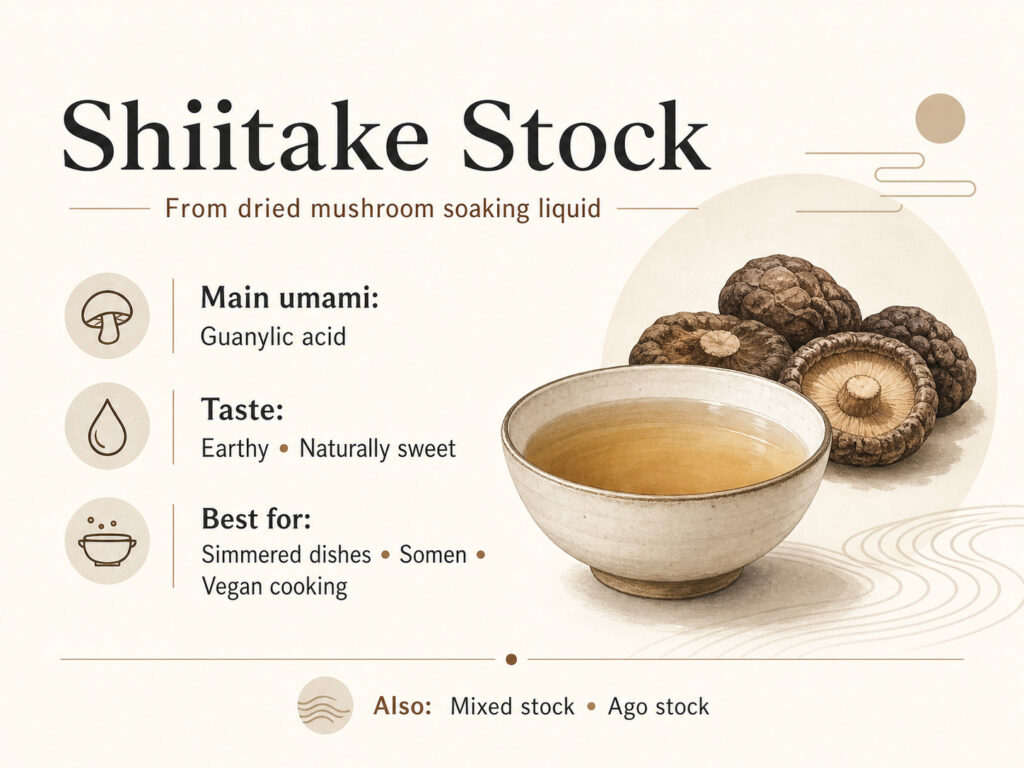
Shiitake stock comes from the soaking liquid of dried mushrooms. It brings an earthy, almost meaty depth. For the best result, always soak the mushrooms in cold water.
- Main umami component: guanylic acid
- Characteristics: earthy notes with a natural sweetness
- Best dishes: simmered dishes, somen, and vegan cooking
A few other styles exist too. Mixed stock blends several dried fish, such as mackerel and horse mackerel, for extra depth. Ago stock uses grilled flying fish for a refined, low-fat broth. Both add variety once you know the basics.
Ichiban vs Niban Dashi
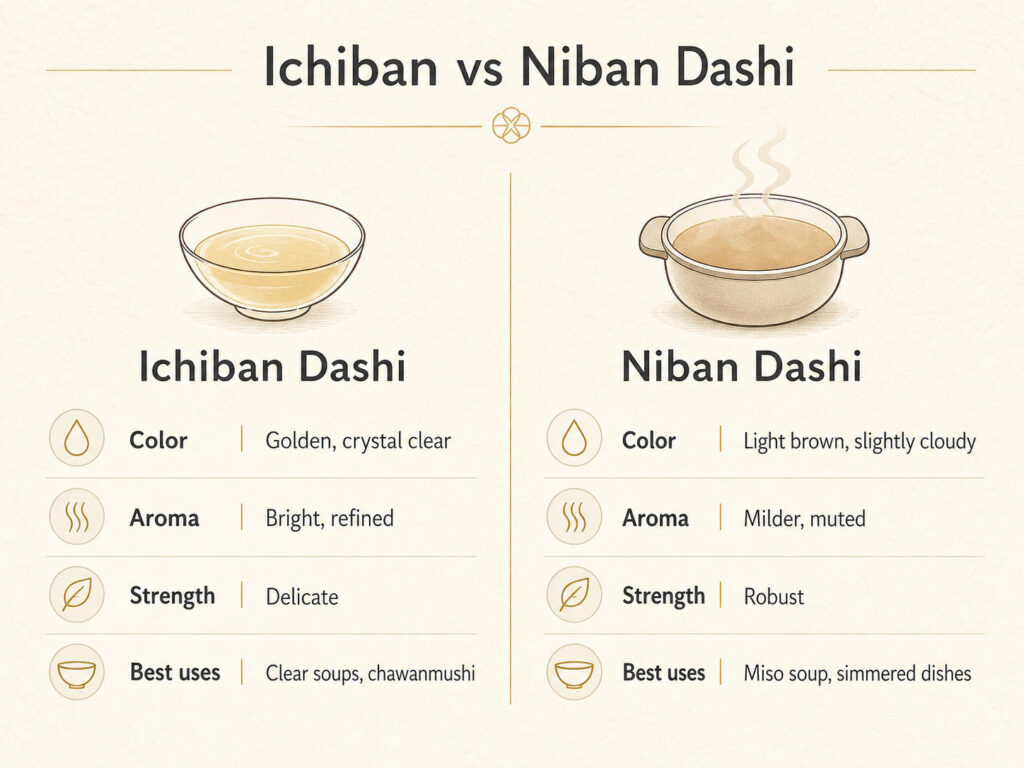
Many cooks pull two extractions from the same ingredients. The first is ichiban dashi, and the second is niban dashi. The first stays delicate and clear, so it shines in light soups. The second is stronger and slightly cloudy, so it suits bolder dishes.
| Ichiban (一番だし) | Niban (二番だし) | |
|---|---|---|
| Color | Golden, crystal clear | Light brown, slightly cloudy |
| Aroma | Bright and refined | Milder, more muted |
| Strength | Delicate, subtle | Concentrated, robust |
| Best uses | Clear soups, chawanmushi | Miso soup, simmered dishes |
The Key Ingredients
The flavor of this stock starts with its raw materials. Each one carries a different kind of umami. Here is what the main ingredients bring to the pot.
Kombu (Kelp)
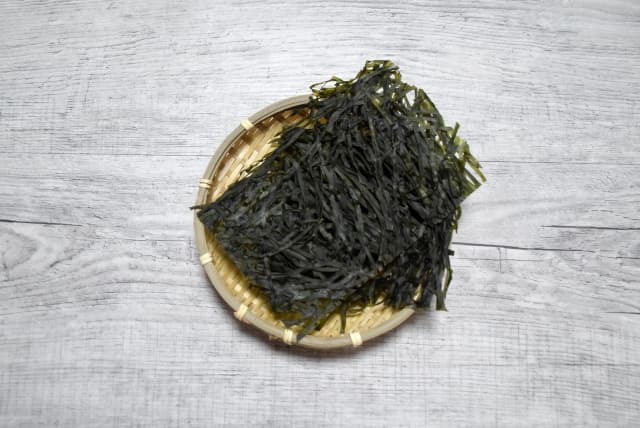
Kombu (dried kelp) gives a clean, mineral-rich umami. Cooks prize kelp from Hokkaido’s cold waters. Common types include Ma-kombu, Rishiri, and Rausu. Older, aged kombu holds more glutamic acid, so it tastes deeper. Producers dry and age the kelp carefully before it reaches the market.
Katsuobushi (Dried Bonito)
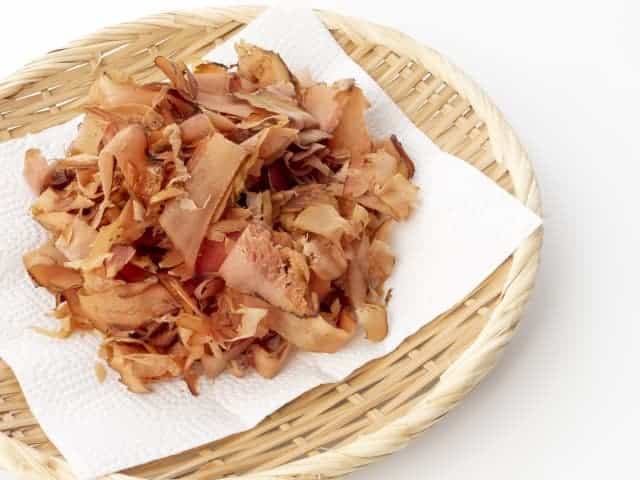
Katsuobushi (dried bonito flakes) is the smoky heart of many broths. Makers dry, smoke, and ferment the bonito with mold. This long process concentrates inosinic acid. The flakes then release a deep, savory aroma within seconds. Some producers apply the same method to tuna, mackerel, or sardines.
Niboshi (Dried Sardines)
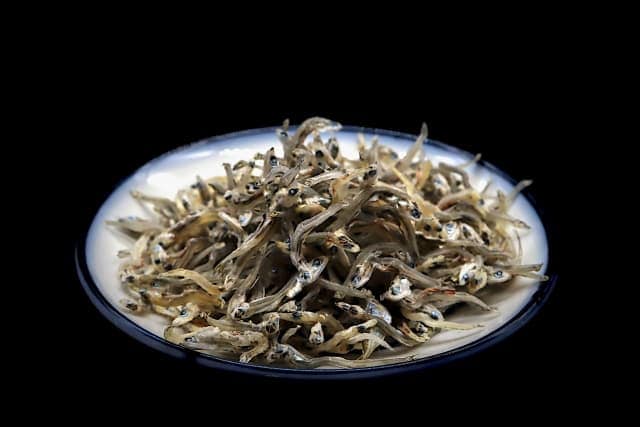
Niboshi (dried baby sardines) make a bold, fishy stock. They work well in miso soup and hearty noodle broths. Some cooks remove the heads and guts first. That small step keeps the broth from turning bitter. The drying process also concentrates the inosinic acid inside.
Ago (Flying Fish)

Ago (flying fish) gives a refined, low-fat broth. Producers grill the fish, then dry it for several days. The flavor stays light but clearly savory. Ago stock is a specialty of Kyushu, especially around Nagasaki. Careful drying keeps mold away and protects its subtle taste.
Dried Shiitake Mushrooms
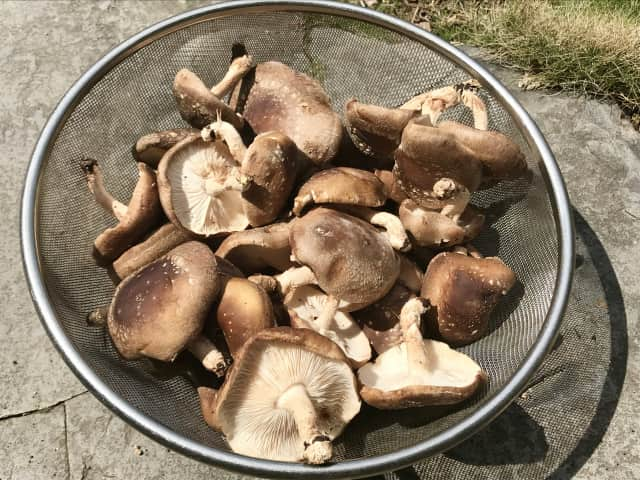
Dried shiitake mushrooms create a plant-based stock full of earthy sweetness. They rank second only to kombu among vegetarian options. Buddhist temple cooks rely on them heavily. Soak them in cold water, not hot, since cold water keeps the broth smooth and avoids bitterness.
Which Dashi Should I Choose?
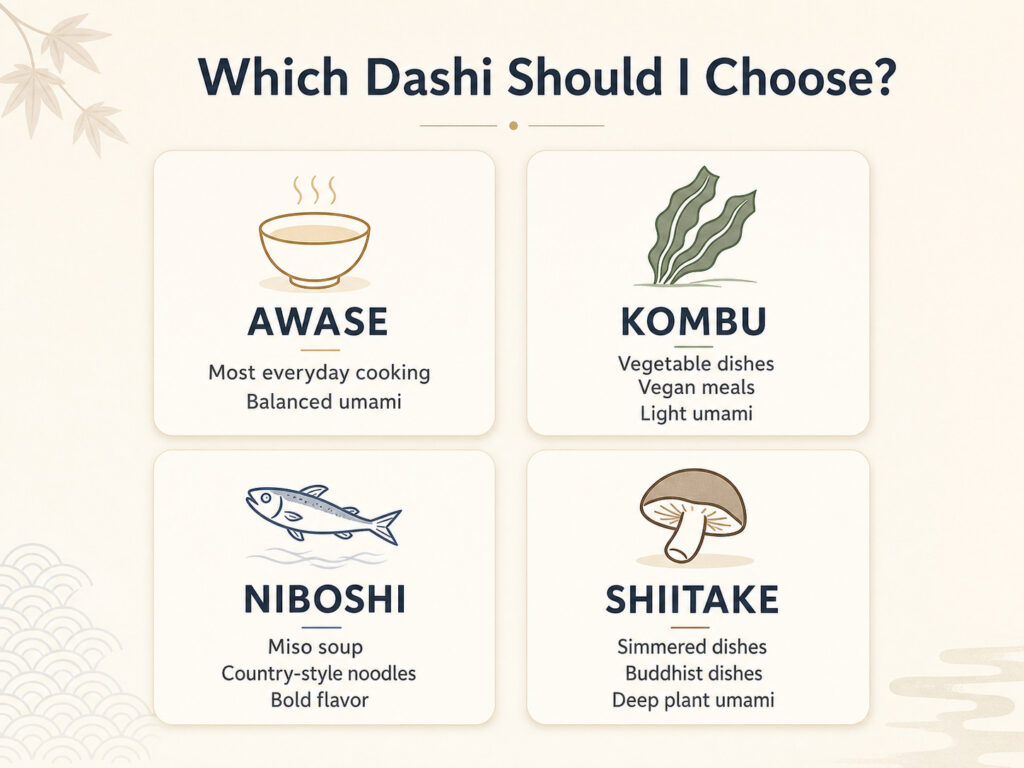
Still unsure which stock to use? Match it to the dish. The table below pairs each type with the food it suits best.
| Type | Best dishes | Why it works |
|---|---|---|
| Awase | Most everyday cooking | Balanced, all-purpose umami |
| Kombu | Vegetable dishes, vegan meals | Light and meat-free |
| Niboshi | Miso soup, country-style noodles | Strong, punchy flavor |
| Shiitake | Simmered and Buddhist dishes | Deep, plant-based umami |
If you are just starting out, begin with awase dashi. It works almost everywhere. Later, you can branch out to kombu or shiitake for specific recipes.
A History of Dashi
This stock has a long history, though its early form looked rough. Cooks in the Kamakura era simmered dried bonito in water. Over the centuries, kombu and shiitake joined the lineup. Trade routes then carried regional styles across the country.
Early Origins
The story begins in the temples. Around the 13th century, Zen monks made broth from dried shiitake. The monk Dogen even mentioned shiitake stock in a 1237 text. Buddhist vegetarian cooking, or shojin ryori, helped spread these meat-free broths. Kombu followed soon after, and records from the 14th century praise high-grade kelp.
The Edo Period and the Konbu Road
By the Edo period, this stock appeared often in cookbooks. The famous “Ryori Monogatari” described both first and second extractions. In the mid-to-late Edo period, the Konbu Road helped move high-quality kelp from Hokkaido to the rest of Japan. This trade route shaped regional styles. Eastern Japan leaned toward katsuobushi, while western Japan favored kombu.
The Modern Era
The Meiji era brought this stock into everyday homes. Home cookbooks explained katsuobushi and kombu broths in plain language. They also standardized the first and second extraction methods. Over time, it shifted from a chef’s secret to a daily habit. Today, instant versions sit on every supermarket shelf.
The stock through the ages:
- 13th century: Shiitake and early bonito broths appear in temple cooking.
- 14th century: Kombu becomes a recognized stock ingredient.
- 15th to 17th century: Katsuobushi spreads, and the ichiban and niban methods take shape.
- Edo period: The Konbu Road sets eastern and western styles.
- Meiji era onward: Home cookbooks standardize the recipe for daily use.
How to Make Dashi
Making this stock at home is easier than most people expect. We will start with awase dashi, the all-purpose first stock. Then we will cover niban, kombu, shiitake, and niboshi versions. Pick whichever batch size and style fit your kitchen.
The Basic Awase Recipe: Ingredients
| Ingredient | 1 liter (metric) | 4 cups (US) |
|---|---|---|
| Filtered water | 1 liter | 4 cups |
| Kombu | 10 g | 1 piece, about 10 cm (4 in) |
| Katsuobushi | 20 g | 2 large handfuls, about 20 g |
Equipment: a pot, a fine-mesh strainer, a clean cloth, and a timer. A kitchen thermometer helps, though it stays optional.
Step-by-Step Instructions
Wipe the kombu with a damp cloth, but do not rinse it. Put it in the water and let it rest.
- Time: 30 minutes
- Temperature: room temperature
- Common mistake: scrubbing off the white powder, which holds umami
Place the pot on low heat. Bring it close to a simmer, yet never let it boil.
- Time: about 10 minutes
- Temperature: around 60°C (140°F)
- Common mistake: boiling the kombu, which turns the broth bitter and slimy
Lift out the kombu just before the water boils. Keep it if you plan to make niban dashi.
- Time: right at the first bubbles
- Temperature: just under boiling
- Common mistake: leaving kombu in too long, which adds a heavy edge
Turn off the heat first. Then scatter the flakes over the surface and let them sink on their own.
- Time: steep 1 to 2 minutes
- Temperature: just off the boil, about 85°C (185°F)
- Common mistake: stirring the flakes, which clouds the broth
Line a strainer with a clean cloth. Pour the liquid through and let it drip naturally.
- Time: a few minutes
- Temperature: warm
- Common mistake: squeezing the cloth, which presses out bitter, cloudy liquid
Making Niban Dashi
Do not toss the used kombu and katsuobushi. They still hold plenty of flavor. Niban dashi is the second extraction, and it tastes stronger and rougher. It works beautifully in miso soup and simmered dishes.
- Return the used kombu and flakes to the pot.
- Add about 1 liter of fresh water.
- Bring it to a gentle simmer, then cook for 10 minutes.
- Add a small handful of fresh katsuobushi at the end for aroma.
- Strain it gently, just as before.
Kombu Stock (Vegan)
Kombu stock is the simplest of all. It uses just kelp and water, so vegans love it. The cold-soak method gives the cleanest taste.
- Wipe 10 g of kombu, then place it in 1 liter of water.
- Soak it in the fridge for at least 3 hours, or overnight.
- Remove the kombu, and the stock is ready.
- For a faster batch, heat slowly and pull the kombu just before boiling.
Shiitake Stock (Vegan)
Shiitake stock adds a deep, earthy note. Cold water is the key here. It draws out flavor slowly and avoids bitterness.
- Rinse 3 to 4 dried shiitake briefly.
- Soak them in 500 ml of cold water.
- Chill for 6 hours or overnight.
- Strain, then save the soft mushrooms for cooking.
Niboshi Stock
Niboshi stock brings a bold, fishy punch. A little prep keeps it from turning bitter. It really shines in country-style miso soup.
- Remove the heads and guts from about 20 g of niboshi.
- Soak them in 1 liter of water for 30 minutes.
- Heat slowly, then simmer for 5 minutes.
- Skim off any foam, then strain.
Tips for success:
- Use filtered water for the cleanest taste.
- Never let the kombu boil, since it creates bitter flavors.
- Time the katsuobushi steep, then strain gently.
- Use it fresh, or store it within three days.
How to Use Dashi
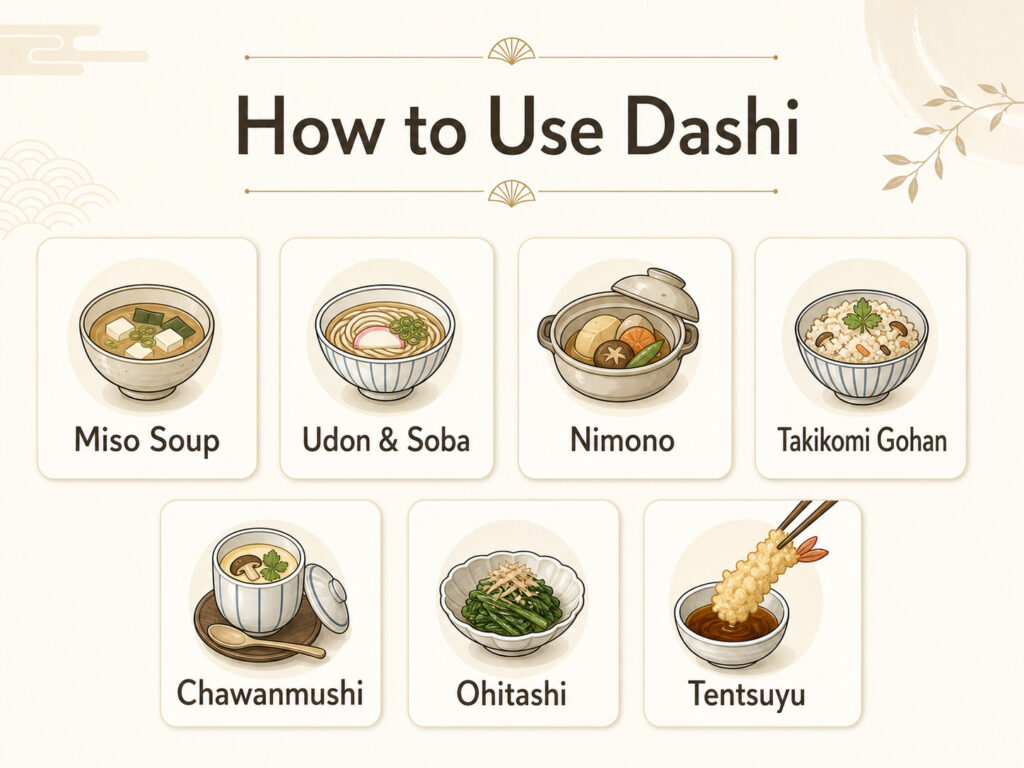
This stock appears in a huge range of Japanese dishes. Sometimes it is the star, and sometimes a quiet background note. Here are the most common ways cooks use it.
- Miso soup: kombu-katsuobushi stock plus miso paste, the classic daily bowl.
- Udon and soba broths: light stock mixed with soy sauce and mirin.
- Nimono (simmered dishes): vegetables or fish cooked gently in seasoned stock.
- Takikomi gohan: rice cooked in dashi with mixed ingredients.
- Chawanmushi: a savory steamed egg custard set with the stock.
- Ohitashi: blanched greens dressed in a light, seasoned broth.
- Tentsuyu: a tempura dipping sauce of stock, soy sauce, and mirin.
Want a few real examples? Below are three classic dishes that lean on this broth.
Senbajiru: Mackerel Soup with Vegetables
Senbajiru is a hearty soup built on salted mackerel and kombu. Cooks use the whole fish, including the head and bones, for a full-bodied broth. Then they add vegetables and turn it into a complete, flavorful meal that many households enjoy across Japan.
Tai Ushiojiru: Sea Bream Soup
Ushiojiru is a delicate, clear soup made with sea bream and a little salt. Cooks briefly boil the fish, then cool it to remove any fishy odor. The result is a clean broth that highlights the sweet white fish. Families often serve it at celebratory meals.
Age Ebi Shinjo: Deep-fried Prawn Dumplings
Shinjo are dumplings made from prawns or white-fleshed fish. Cooks steam or fry these dumplings. They often add them to soups, but they also serve them in several other ways. The finely chopped prawn filling gives a lovely contrast of textures in every bite.
For a wider look at broth-based cooking, see our guide to traditional Japanese soups and broths.
Vegetarian and Vegan Dashi
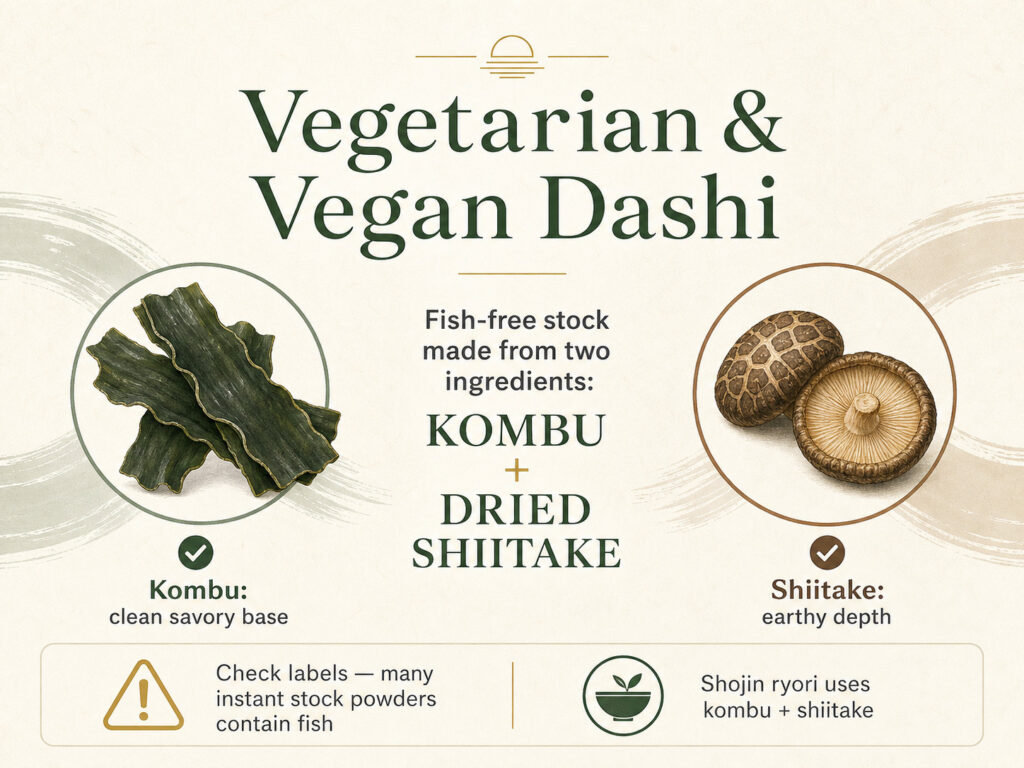
Can you make this stock without fish? Yes, and it tastes great. Two ingredients carry the plant-based version: kombu and dried shiitake. Kombu gives a clean, savory base. Shiitake adds an earthy, almost meaty depth.
One caution matters here. Many instant stock powders contain bonito or sardine. So vegans should always check the label. For temple-style cooking, shojin ryori relies on exactly this kombu-and-shiitake base. You will find more ideas in our guide to Japan’s plant-based dishes.
Where to Buy and Store Dashi
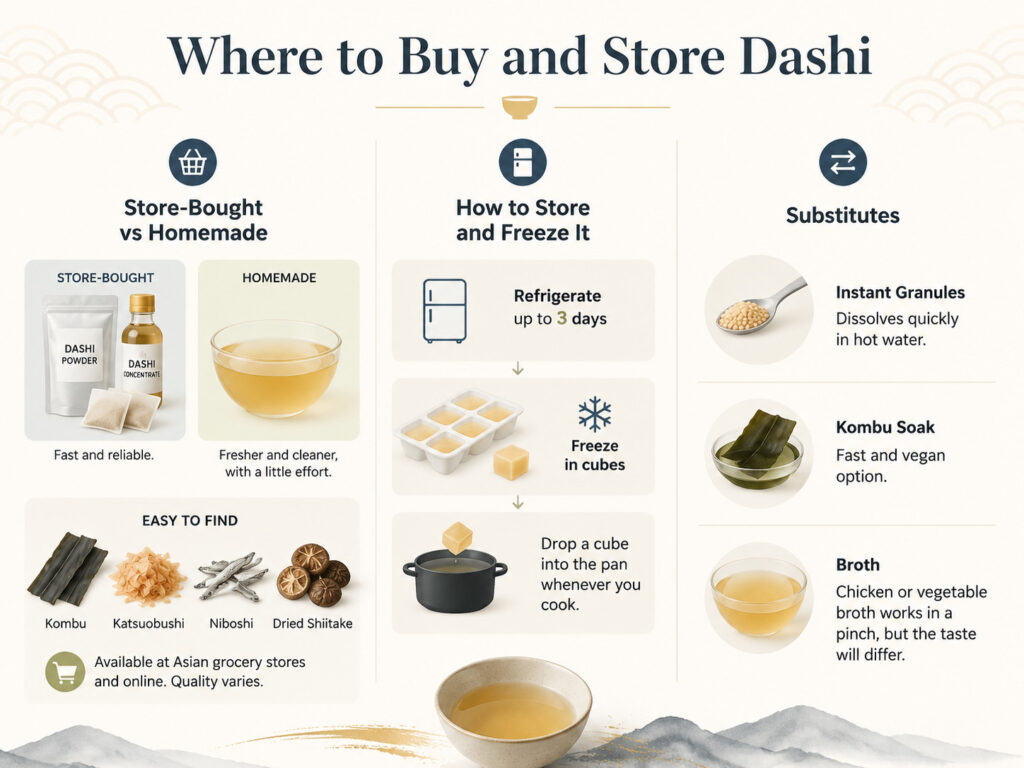
Store-Bought vs Homemade
You can buy this stock as powder, concentrate, or tea-style bags. Store-bought versions are fast and reliable. Homemade tastes fresher and cleaner, though it takes a little effort. For busy weeknights, many home cooks happily mix both.
The ingredients are easy to find. Kombu, katsuobushi, niboshi, and dried shiitake fill the shelves of Asian grocery stores and online shops. Quality varies a lot, so it is worth comparing a few brands.
How to Store and Freeze It
Fresh stock tastes best on the day you make it. Still, it keeps in the fridge for up to three days. For longer storage, freeze it. Pour the cooled liquid into ice cube trays, then drop a cube into the pan whenever you cook.
Substitutes
Out of stock at home? A few swaps work in a pinch. Instant granules dissolve quickly in hot water. A simple kombu soak makes a fast vegan option. In an emergency, a light chicken or vegetable broth can fill in, though the taste shifts noticeably.
Where to Taste It in Tokyo
Curious to taste expert stock? Tokyo offers several standout spots. Here are three places where the broth truly takes center stage.
Kayanoya Shiruya, Tokyo Station
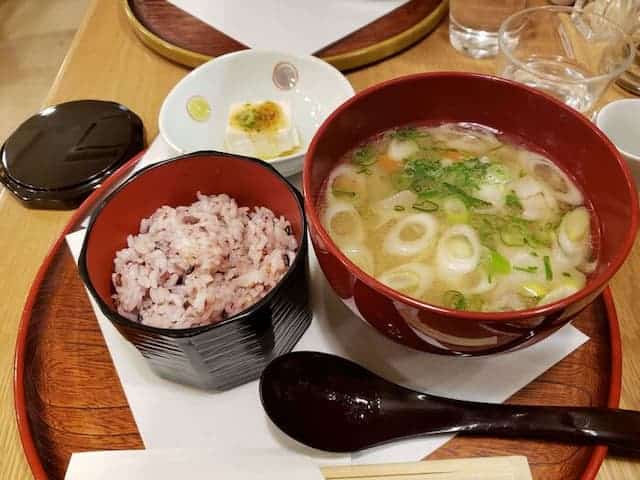
Kayanoya brings its famous Fukuoka stock to central Tokyo. The shop sits inside GranSta Marunouchi at Tokyo Station. Its signature dish is the Kyushu pork soup set. Cooks blend the house stock with niboshi broth, then add Kirishima pork and root vegetables.
Nihonbashi Dashiba Hanare
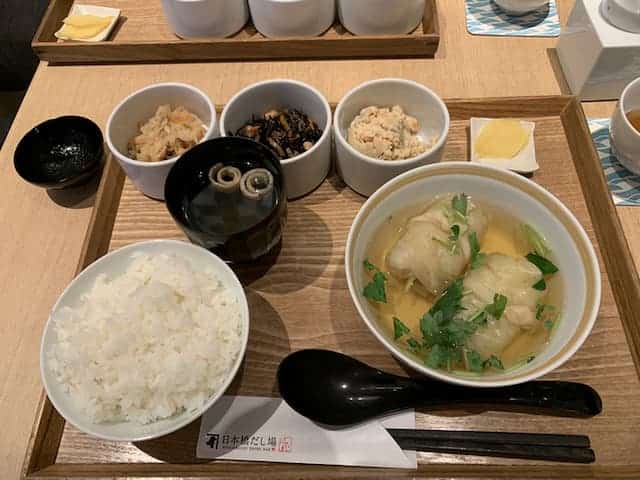
Nihonbashi Dashiba Hanare pairs traditional stock with a calm, modern interior. The lunch menu centers on a soup-focused set. Diners pick two soups from several styles. One option even blends katsuobushi stock with a Western-style base.
Fukutora Akasaka Mitsuke
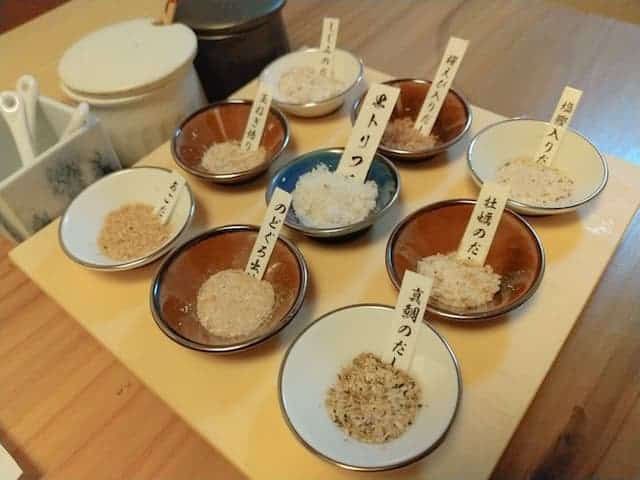
Fukutora in Akasaka serves a rich broth with wagyu shabu-shabu. The star is a rare cut of Matsusaka beef. A private room lets you slow down and savor it. Try adding a tiny pinch of salt to the broth, which lifts the flavor even further.
Conclusion
This stock sits at the heart of Japanese cooking, yet it stays beautifully simple. From morning miso soup to evening hot pots, it adds quiet depth to almost everything. The history is long, but the method is quick.
If you remember one thing, make it this. Dashi is light, fast to prepare, and essential to Japanese flavor. Start with awase dashi first. Then try kombu or shiitake, depending on the dish.
Dashi FAQ
Is dashi vegetarian?
Most traditional versions are not, because they usually contain katsuobushi or niboshi. However, you can easily make a vegetarian one. Kombu and shiitake versions use no animal products at all. Just remember to check instant labels, since many include fish.
What is awase dashi?
This style blends kombu and katsuobushi into one stock. The glutamate and inosinate combine and amplify each other. This gives it a balanced, powerful umami. Cooks reach for it in most everyday Japanese dishes.
Can I use instant dashi?
Yes, instant granules work well for everyday cooking. You simply dissolve them in hot water. The flavor is convenient and consistent, though slightly less fresh than homemade. For special dishes, a freshly made batch still tastes best.
How long does dashi last?
Fresh stock tastes best on the same day you make it. Stored in the fridge, it keeps for about three days. For longer storage, freeze it in ice cube trays. Frozen, it holds its flavor for roughly one month.
Why should kombu not boil?
Boiling kombu releases bitter and slimy compounds. These muddy both the flavor and the clarity. So you heat the kelp slowly and remove it just before the water boils. This keeps the broth clean and elegant.
Can I reuse the ingredients?
Yes, and you should. The used kombu and katsuobushi still hold flavor. Simmer them again in fresh water to make niban dashi, the second extraction. This stronger batch suits miso soup and simmered dishes nicely.
What dishes use dashi?
Cooks use it across a wide range of Japanese dishes. It forms the base of miso soup, clear soups, and noodle broths. It also flavors simmered dishes, chawanmushi, and seasoned rice like takikomi gohan. In short, this stock appears almost everywhere.
How is it different from Western stock?
It steeps light ingredients for just minutes. Western stock simmers bones and vegetables for hours. As a result, the Japanese version tastes clean and umami-forward, while stock tastes rich and heavy. The two suit very different recipes.
Which type is best for beginners?
Awase is the easiest starting point. It blends kombu and katsuobushi for a balanced, all-purpose flavor. You can use it in soups, noodles, and simmered dishes alike. Once comfortable, you can explore kombu or shiitake versions.
Reference
- Umami Information Center – What Is Umami (Surveyed: June 2026)
- National Diet Library – The History of Japanese Stock (Surveyed: June 2026)
- Kobayashi Foods – Washoku no Umami (Surveyed: June 2026)
Related Articles
- Katsuobushi: Dried Bonito Flakes (Surveyed: June 2026)
- The Complete Guide to Miso Soup (Surveyed: June 2026)
- Traditional Japanese Soups and Broths (Surveyed: June 2026)
- Japan’s Vegetarian Delights: Top Plant-Based Dishes to Try (Surveyed: June 2026)
- Shojin Ryori: Buddhist Vegetarian Cuisine (Surveyed: June 2026)



Comments