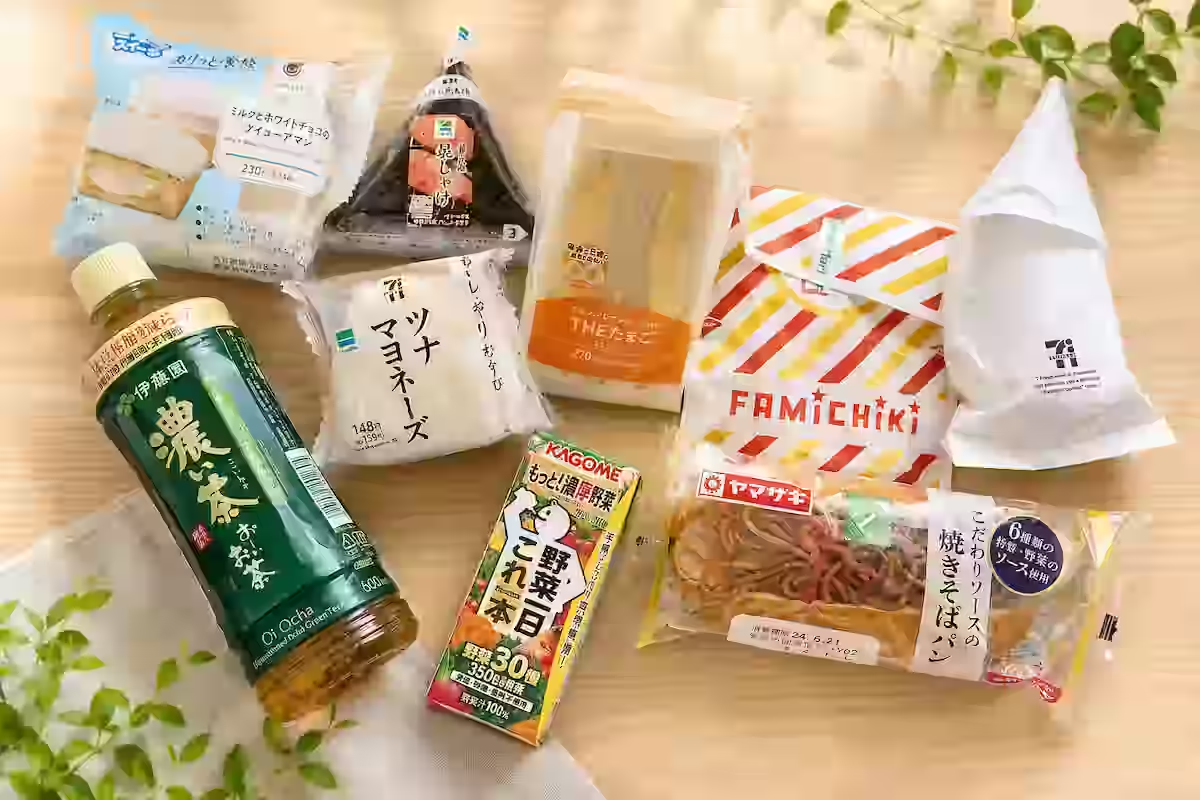
Japanese convenience store food is one of the cheapest pleasures of a trip to Japan, and for many visitors it becomes a daily habit. Japanese convenience stores are commonly called konbini, a shortened form of the Japanese pronunciation of “convenience store.” They sit on almost every corner, they open early, and many of them never close. For a traveller, they are far more than a place to grab a bottle of water.
Walk into any branch and you will find rice balls, egg sandwiches, boxed meals, chilled noodles, hot fried chicken and freshly brewed coffee. The dessert shelf changes with the seasons. The food is genuinely good, and it costs a fraction of a restaurant meal. However, the first visit can feel confusing. Labels are mostly in Japanese, staff may ask an unexpected question, and the packaging opens in ways that are not obvious.
This guide fixes that. It explains what to buy, how the three largest chains differ, and what makes several smaller chains worth visiting. It also covers how to order, how to open an onigiri without shredding the seaweed, and how to read labels if you avoid certain ingredients. By the end of this guide, you should be able to walk in, choose confidently, and eat well.
Quick answer
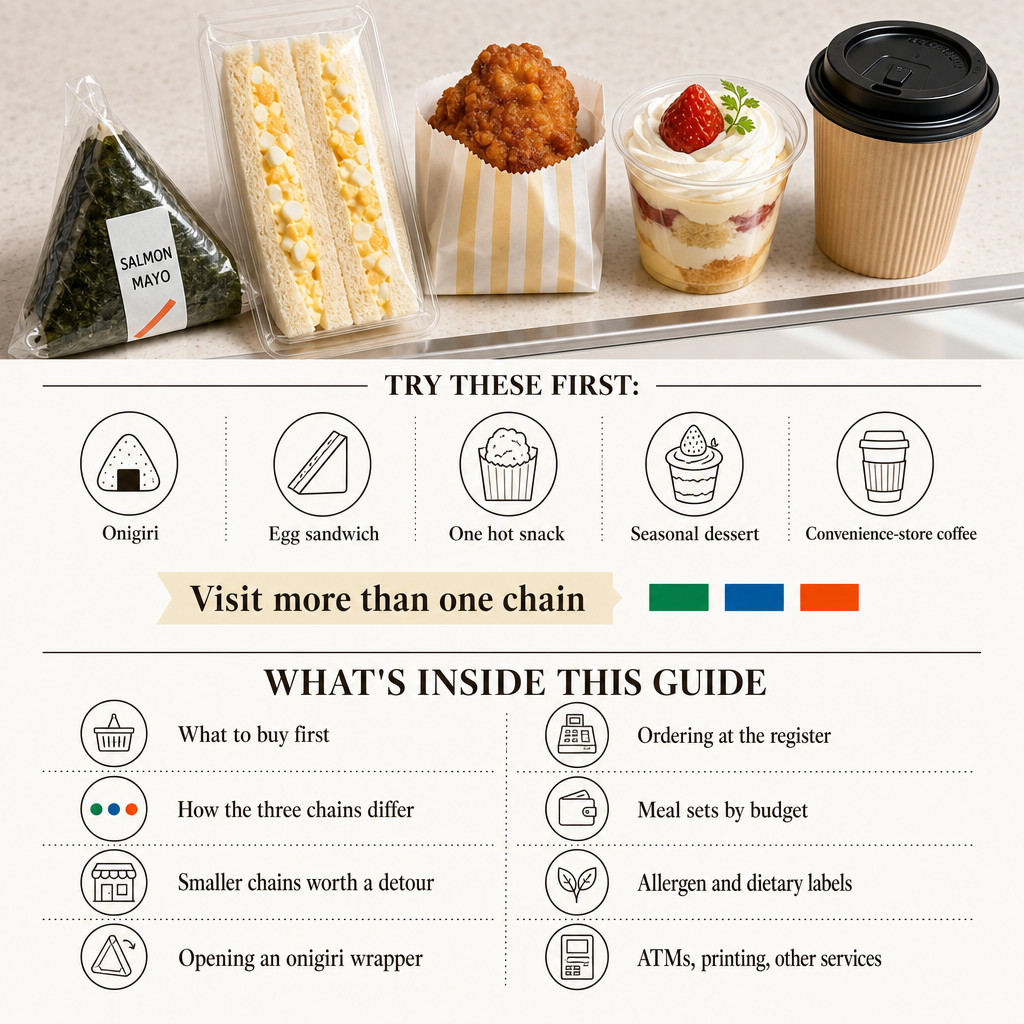
First-time visitors should try an onigiri, an egg sandwich, one hot snack, a seasonal dessert and a convenience-store coffee. Visit more than one chain, because 7-Eleven, Lawson and FamilyMart each have different signature products.
What this guide covers
What to buy on a first visit
How 7-Eleven, Lawson and FamilyMart differ
Smaller chains worth a detour
How to open an onigiri wrapper
How to order at the register
Meal sets by situation and budget
Allergen and dietary labelling
ATMs, printing and other services
TOC
Quick Guide: What Should You Buy at a Japanese Convenience Store?
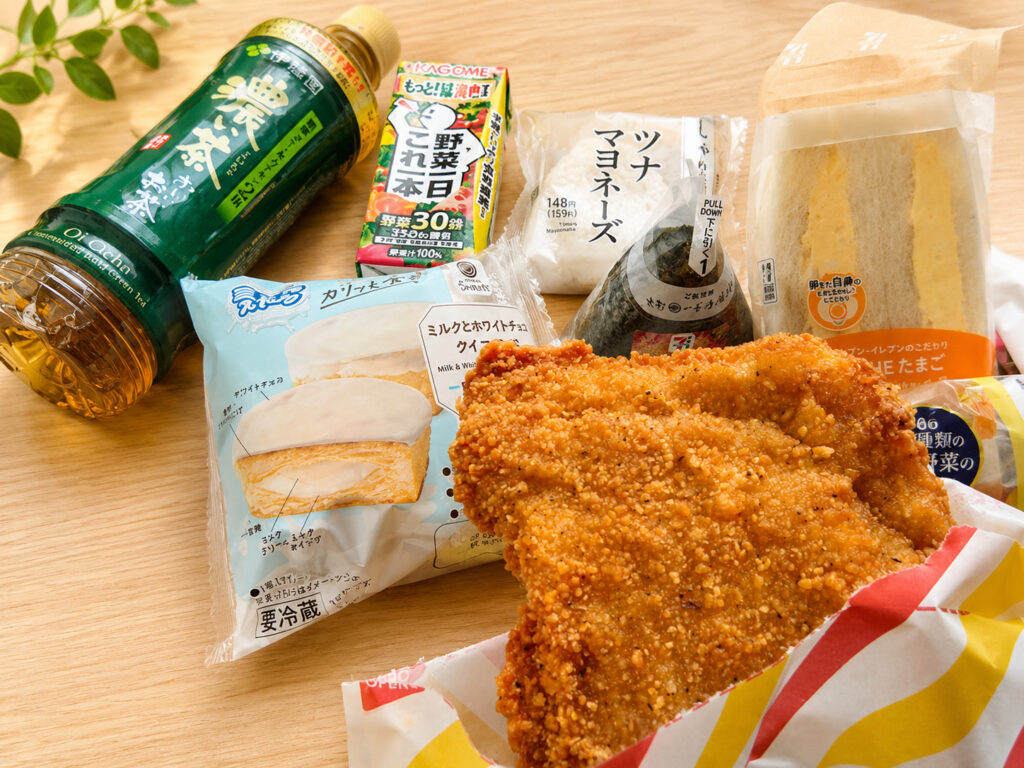
At a Japanese convenience store, buy one rice item, one bread item, one hot item from the register counter, one dessert and one drink. That combination covers the whole range of Japanese convenience store food for very little money. If you only have five minutes, the list below gives you a safe pick in every category, plus a note on where to find it in the store.
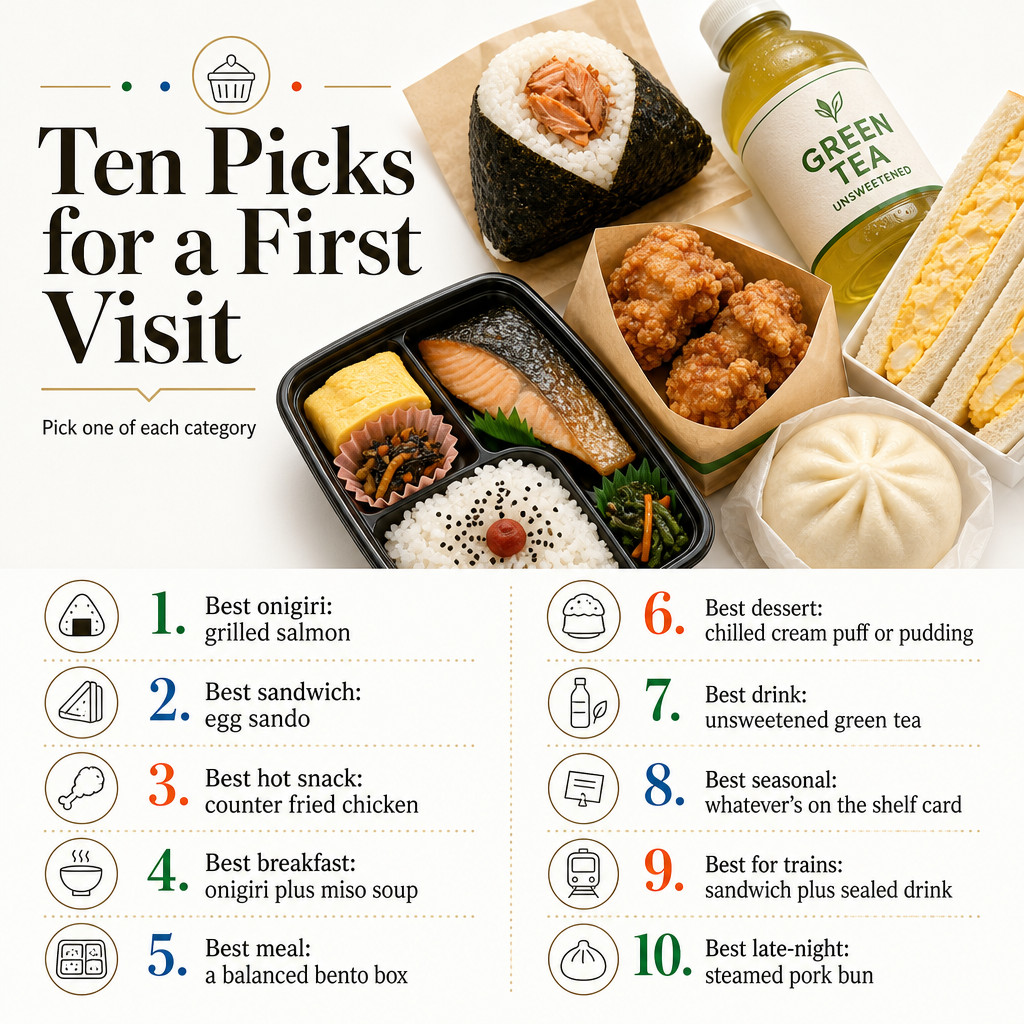
Ten Picks for a First Visit
Best first onigiri
Grilled salmon
Why try it
Lightly salted salmon flakes sit inside soft seasoned rice, so the flavour feels familiar even to first-timers.
Where to look
The chilled rice shelf, usually near the sandwiches.
Availability
Fillings and recipes vary by chain, store and season.
Best classic sandwich
Egg sandwich (tamago sando)
Why try it
Soft white shokupan bread and a creamy egg filling make it easy to enjoy, and the crusts are already trimmed off.
Where to look
The refrigerated sandwich section, sold in a triangular plastic wrapper.
Availability
Every major chain sells a version, though the egg texture differs.
Best hot snack
Fried chicken from the heated case
Why try it
The counter chicken comes out crisp, well seasoned and hot, and you order it by pointing.
Where to look
The glass case beside the register, not the shelves.
Availability
Each chain has its own recipe and its own name for it.
Best quick breakfast
Onigiri plus instant miso soup
Why try it
This is what many Japanese commuters actually eat, and it takes two minutes to assemble.
Where to look
Rice shelf plus the dry soup aisle, with hot water available in some stores.
Availability
Hot water service is not offered everywhere, so check first.
Best complete meal
A bento box
Why try it
One tray gives you rice, a main protein and two or three side dishes, all balanced on purpose.
Where to look
The open chilled cabinet, often at the back of the store.
Availability
Staff will normally offer to microwave it for you.
Best dessert
Chilled cream puff or pudding
Why try it
Many visitors find these sweets less intensely sweet than comparable products at home, with the dairy flavour more prominent.
Where to look
The chilled dessert shelf, usually low down near the drinks.
Availability
The line-up rotates constantly, and popular items sell out by evening.
Best drink
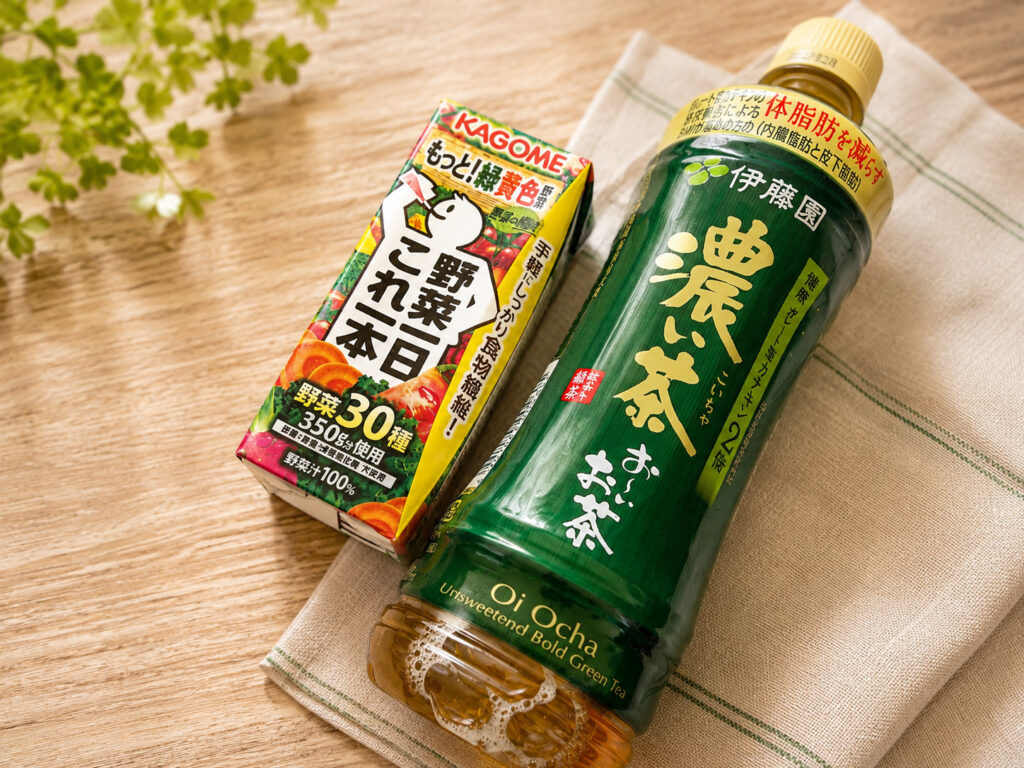
Unsweetened bottled green tea
Why try it
It costs very little, it cuts through fried food, and it contains no sugar at all.
Where to look
The long refrigerated drinks wall.
Availability
Sold nationwide in several brands and bottle sizes.
Best seasonal pick
Whatever the shelf card is promoting
Why try it
Seasonal products are where the product developers show off, and they disappear quickly.
Where to look
End-cap displays and the dessert shelf, marked with bright limited-edition tags.
Availability
Seasonal products change frequently and may vanish without notice.
Best option for a train journey
Sandwich plus a sealed bottled drink
Why try it
Nothing spills, nothing smells strongly, and the wrapper folds down into a small piece of rubbish.
Where to look
Sandwich shelf and drinks wall.
Availability
Widely stocked, though station branches sell out at peak times.
Best late-night snack
Steamed bun (nikuman) in colder months
Why try it
A soft steamed bun filled with seasoned pork is exactly right on a cold walk back to the hotel.
Where to look
The heated steam cabinet at the counter, usually from autumn to early spring.
Availability
Mostly a cold-season item, so summer visitors will not find it.
Prices move, and they differ between regions and store formats. For that reason, treat the shelf label as the only reliable price and expect small variations between a city-centre branch and a rural one.
What Does Japanese Convenience Store Food Taste Like?
Savoury items lean on dashi, soy sauce and salt rather than heavy spice, so the flavours feel gentle but layered. Aromas stay mild, which suits food designed to be eaten on a train. Texture carries much of the appeal, and the packaging often exists to protect it. Chilled rice stays slightly soft rather than hard, and a separately wrapped nori sheet crackles when you bite it.
Hot food from the counter case is the loudest flavour in the store. Fried chicken there smells of soy, ginger and pepper, and the coating shatters when it is fresh. I will admit I hesitated the first time I ordered from a heated case, because I assumed anything sitting under a lamp would be tired. It was not. That said, timing matters, and a piece that has waited too long loses its crunch. If the case looks freshly stocked, order without worrying.
Sweets are where expectations shift most. Many visitors find some Japanese convenience-store desserts less intensely sweet than comparable products at home, with more emphasis on cream, custard, matcha or fruit. If the first one seems restrained, try a second. Most people adjust quickly, and the sections below cover each category in detail.
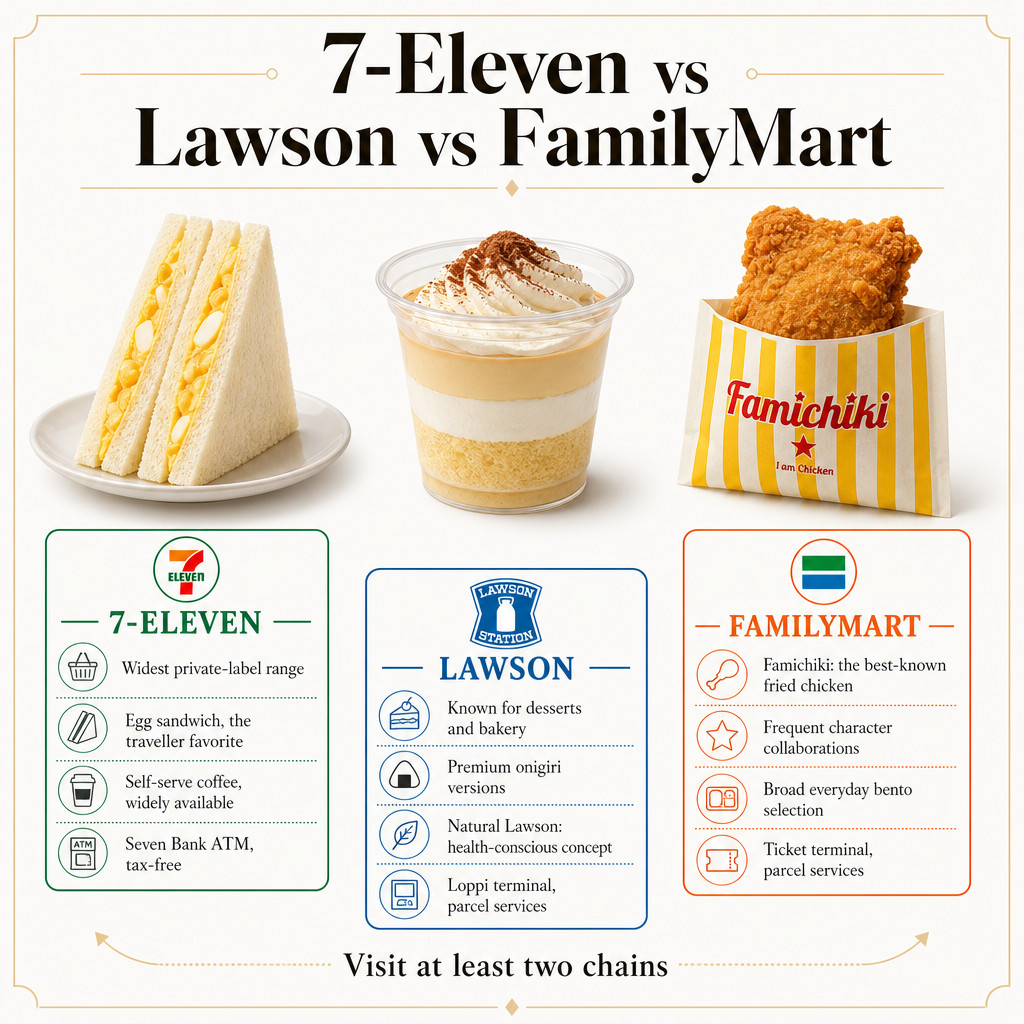
7-Eleven vs Lawson vs FamilyMart: Which One Should You Visit?
No single chain wins outright, because each one is strongest in a different category. 7-Eleven has the broadest private-label range and the most consistent traveller services. Lawson leans towards desserts, baked goods and health-conscious lines. FamilyMart is best known among visitors for its counter fried chicken. For the best introduction, visit at least two chains rather than choosing one.
Category
7-Eleven
Lawson
FamilyMart
Onigiri
Very wide range, strong tuna mayo
Solid range, frequent premium versions
Solid range, frequent collaborations
Sandwiches
Egg sandwich is the traveller favourite
Good bread quality, more bakery items
Reliable core line-up
Bento and ready meals
Large fresh-food range
Good rice bowls and noodle sets
Broad everyday selection
Hot snacks
Chain-specific fried chicken
Bite-sized fried chicken in several flavours
Famichiki, the best known of the three
Desserts
Strong private-label sweets
Especially well known for sweets and rolls
Frequent seasonal and character tie-ins
Coffee
Self-serve machine, widely available
Ordering method varies: self-service at many stores, staff-assisted at some
Self-serve machine, widely available
Health-conscious lines
Salads, protein items, soups
Natural Lawson concept stores, bran bread
Salads and lighter meal sets
Traveller services
Seven Bank ATM, tax-free at eligible stores
Loppi terminal, parcel services
Ticket terminal, parcel services
Read that table as a general orientation, not as a verdict. Product ranges change several times a year, and individual branches stock differently depending on their size and location. Above all, service availability depends on the specific store, so never assume that every branch of a chain offers the same facilities.
7-Eleven
Best for: A first konbini visit and for practical travel needs in one stop.
Signature products: Tuna mayonnaise onigiri, the egg sandwich, in-store smoothies, counter fried chicken and machine coffee. The chain’s own traveller information page highlights exactly these items, which tells you what the company itself considers its calling card.
Strengths: The private-label range is deep, covering fresh food, frozen meals, snacks and drinks under a single quality standard. Fresh-food deliveries arrive several times a day, so the rice and sandwich shelves usually look full. In addition, 7-Eleven stores host Seven Bank ATMs, which matter a great deal if you are travelling with a foreign card.
What first-time visitors should try: Start with the egg sandwich and a tuna mayonnaise onigiri, then add a machine coffee. That trio costs very little and it shows you the chain’s core competence.
Possible limitations: The sheer size of the range can overwhelm a first-time shopper. Some smaller branches carry a reduced fresh-food selection, and popular desserts sell out during the evening rush.
Who should choose this chain: Travellers who want one dependable stop for food, cash and payment options.
Lawson
Best for: Sweets, bread and lighter or health-conscious choices.
Signature products: Karaage-kun, the chain’s bite-sized fried chicken snack, plus a large chilled dessert range and its own bakery line. Lawson also runs Natural Lawson stores, a separate concept aimed at organic and lower-calorie products, and Lawson Store 100, a low-price format. The Lawson corporate site outlines these formats and its in-store services.
Strengths: Lawson has built a strong reputation among Japanese shoppers for chilled sweets, and its rolled cakes and cream-filled items appear constantly in seasonal campaigns. Bran-based breads and lower-sugar snacks also appear more prominently here than at rival chains. Meanwhile, the Loppi terminal handles event tickets and various bookings.
What first-time visitors should try: Order Karaage-kun at the counter, then pick one item from the chilled dessert shelf. Ask for the flavour by pointing, since the varieties rotate.
Points to note: Lawson’s coffee process varies by branch. At many stores you order and pay at the register, receive a cup and use the machine yourself, while some locations provide staff-assisted service. Natural Lawson and Lawson Store 100 branches also carry different ranges, so do not expect the standard line-up in every blue-signed store.
Who should choose this chain: Anyone with a sweet tooth, and anyone looking for lighter options between heavy restaurant meals.
FamilyMart
Best for: Counter fried chicken and quick, filling snacks.
Signature products: Famichiki, a boneless fried chicken fillet sold from the heated case, alongside a broad everyday food range and frequent character collaborations. The FamilyMart English corporate page covers its product and service lines.
Strengths: FamilyMart is particularly well known among travellers for Famichiki, which has become a shorthand for Japanese convenience store snacking. The chain also runs regular tie-ins with anime, music and fashion brands, so the shelves feel playful. Its own-brand clothing and travel basics are unusually useful if you forgot socks or an umbrella.
What first-time visitors should try: Say “Famichiki hitotsu kudasai” at the register, then pair it with a rice ball for a cheap, satisfying lunch.
Possible limitations: Famichiki sells out at busy hours, especially near stations at lunchtime. The dessert range is respectable but generally less celebrated than Lawson’s.
Who should choose this chain: Travellers who want one memorable hot item and a fast, informal meal.
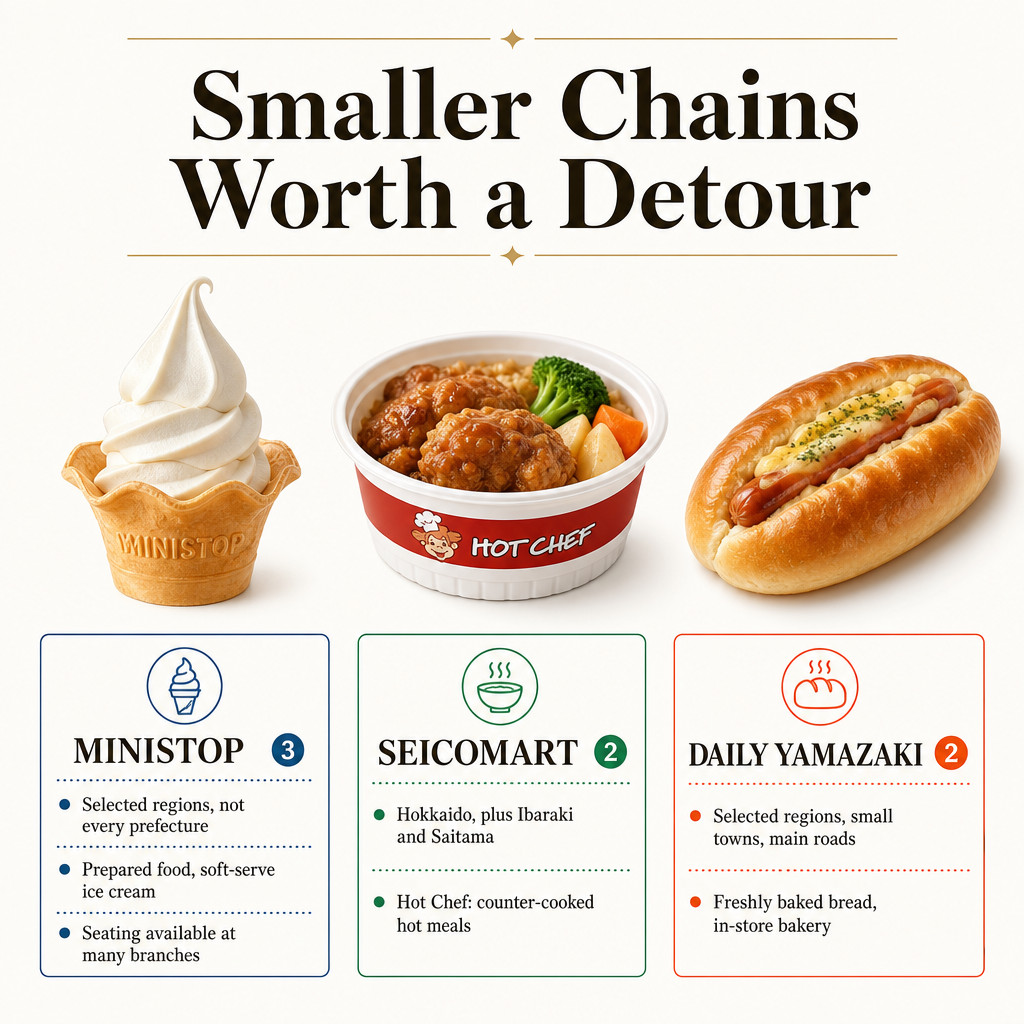
Beyond the Big Three: Ministop, Seicomart and Daily Yamazaki
Beyond the big three, Japan also has several smaller national and regional chains, including Ministop, Daily Yamazaki and Seicomart. Each offers something the three largest chains generally do not: freshly prepared desserts, in-store cooking or bakery-focused products. All three are far smaller in scale, so treat a branch as a welcome find rather than a fixed plan.
Chain
Where you will find it
What makes it different
Ministop
Selected regions across Japan; not present in every prefecture
In-store prepared food, soft-serve ice cream and seating at many branches
Seicomart
Hokkaido, plus Ibaraki and Saitama
Hot Chef counter cooking hot meals in the shop
Daily Yamazaki
Selected regions, often smaller towns and main roads
Freshly baked bread from an in-store bakery at some branches
Do not plan a route around these chains, since you cannot rely on finding one. However, when you walk past a branch, go in. The food is often better than the equivalent item at a national chain.
Ministop: Soft-Serve Ice Cream and In-Store Preparation
Best for: Dessert, freshly prepared food, and a rest stop where seating is more likely.
Ministop opened its first store in 1980 and belongs to the Aeon group. Many Ministop branches follow a “combo store” concept that combines convenience retail with freshly prepared food. Seating is more common than at most rival chains, although facilities vary by location. On a long sightseeing day, that possibility of sitting down makes a real difference.
Preparation is the other difference. Many branches prepare or finish selected fast-food and dessert items in the store, although the process and waiting time vary by product and location. Where an item is finished to order, the texture usually holds up better than a pre-cooked equivalent.
Soft-serve ice cream is the signature product, and the chain has sold vanilla since it opened. It added Halo Halo shaved-ice desserts in 1995, flavoured soft-serve in 1998, parfaits in 2000 and a premium soft-serve range in 2013. Seasonal flavours rotate through the year, often built around Japanese fruit. Ask for a lid if you want to walk with it.
Points to note: Ministop does not operate in every prefecture, and seating, kitchen facilities and Aeon Bank ATMs all vary by branch. Remember also that eating at a seating area applies the standard tax rate rather than the reduced takeaway rate.
Who should choose this chain: Families with children, anyone hoping to sit down, and anyone who rates ice cream highly.
Seicomart: Hokkaido’s Own Chain and the Hot Chef Counter
Best for: Travel in Hokkaido, and the best-cooked food you will find in any Japanese convenience store.
Seicomart began in Sapporo in 1971, which makes it one of the oldest surviving convenience store chains in Japan. It has stayed regional deliberately. As of mid-2025 the chain ran roughly 1,200 stores, and around 1,090 of those stood in Hokkaido, with small clusters in Ibaraki and Saitama prefectures. Locals in Hokkaido usually call it Seicomart or simply Seicoma.
Hot Chef explains the affection. Rather than trucking in factory-made meals, Hot Chef branches cook food in a kitchen inside the shop and hold it on a warm counter. Katsudon, a breaded pork cutlet served over rice, is the best-known item. You will also find butadon pork rice bowls, large hand-formed onigiri, zangi Hokkaido-style fried chicken, and age-pan, a fried bread roll rolled in sugar. Eating a Hot Chef onigiri does genuinely reset your expectations of convenience store rice.
The rest of the shop stays just as regional. Seicomart sells its own Secoma private-label range, Hokkaido dairy products, melon jelly, guarana soda, and local wine and beer. Prices generally sit below those of the national chains. If you visit only one non-national chain on your whole trip, make it this one.
Points to note: Not every branch has a Hot Chef counter, so look for the sign before you plan a meal there. Menus also differ slightly between the Hokkaido stores and the Kanto ones.
Who should choose this chain: Anyone travelling in Hokkaido, and anyone who wants a hot meal rather than a reheated one.
Daily Yamazaki: Freshly Baked Bread
Best for: Bread, pastries and an early breakfast.
Yamazaki Baking, Japan’s largest bread manufacturer, runs Daily Yamazaki as an internal division of the company. That parentage shapes the shelves completely. Bread occupies more space here than at any other convenience store chain, and the quality reflects a baker’s priorities rather than a retailer’s.
Selected branches operate an in-store system branded Daily Hot, which bakes bread and prepares bento, onigiri and sandwiches on the premises. Look for a bakery counter with warm rolls, curry buns and melon pan behind glass. Individual stores sometimes develop their own recipes, so the line-up varies from town to town. In addition, the snack aisle carries plenty from Yamazaki group companies including Fujiya, Tohato and Yamazaki Biscuits.
Points to note: Only some branches have the in-store bakery, and store numbers have been shrinking. Branches cluster in smaller towns and along main roads, so treat finding one as a bonus.
Who should choose this chain: Bread lovers, and anyone who wants a warm pastry before an early train.
One more group deserves a mention. Railway operators run their own small station chains, and NewDays inside JR East stations is the one you will meet most often. These branches stock a reduced range aimed at commuters, so use them for speed rather than for choice.
Best Japanese Convenience Store Foods to Try
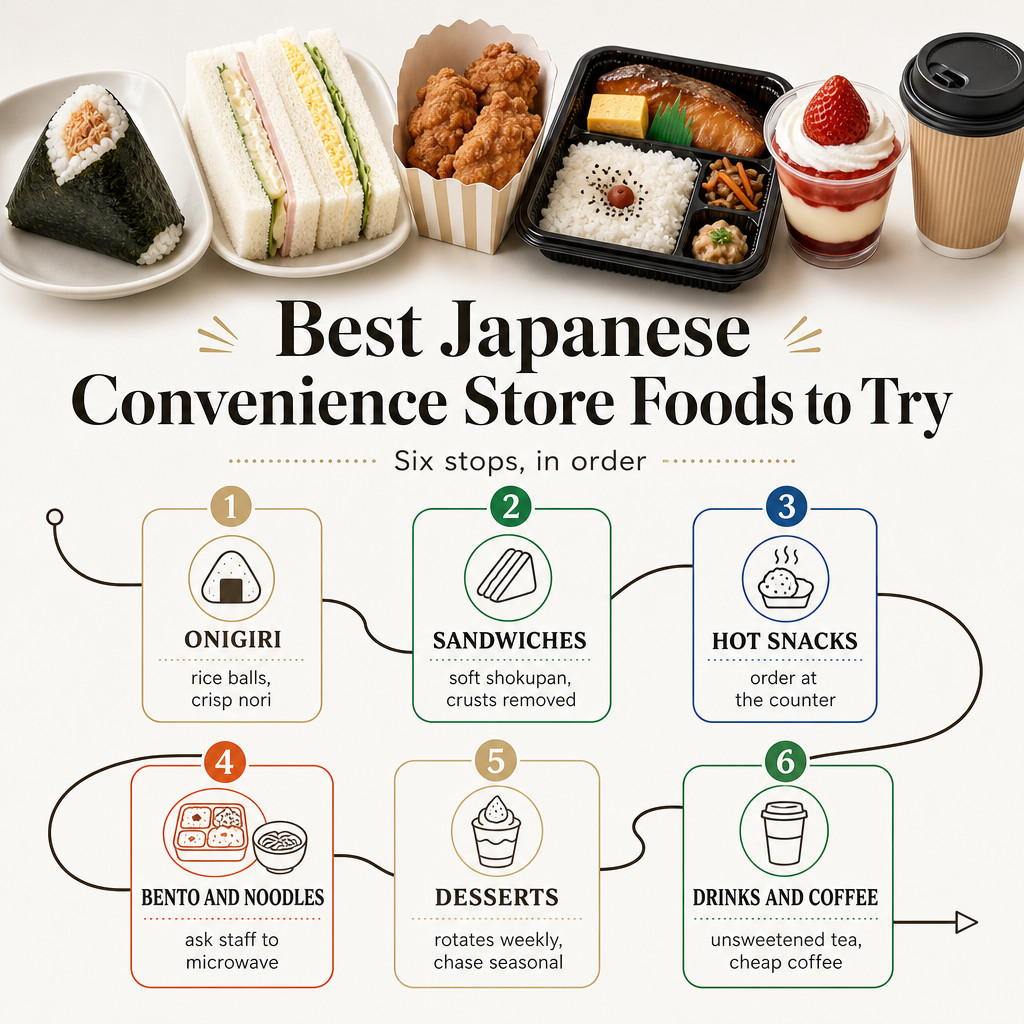
The categories below cover almost everything worth eating in a Japanese convenience store: rice balls, sandwiches, counter hot snacks, boxed meals and noodles, desserts and drinks. Work through them in that order on your first visit. Each section explains what the food is, how it tastes, whether to heat it, and what to watch out for.
Onigiri
Onigiri, or Japanese rice balls, are hand-sized portions of cooked rice, usually shaped into a triangle or oval and often wrapped in nori seaweed. Many contain a filling in the centre. They are among the most affordable and portable ready-to-eat foods in the store, which explains why they anchor the chilled shelf. Our separate guide to convenience store onigiri goes deeper into the filling range.
Reliable fillings to start with include grilled salmon, tuna with mayonnaise, umeboshi pickled plum, simmered kombu kelp and mentaiko pollock roe. Salmon and tuna mayonnaise suit almost everyone. Umeboshi tastes intensely sour and salty, so treat it as an experiment rather than a safe choice. Seasonal and regional fillings appear too, and they are usually flagged with a coloured shelf card.
The packaging deserves its own explanation, because the seaweed is stored separately from the rice inside the same wrapper. This keeps the nori dry and crisp until the moment you eat. Most onigiri use a three-step wrapper with numbered tabs printed on the film.
Pull the tab marked 1 straight down the centre and remove that strip completely.
Hold the rice through the film and pull the side marked 2 away from the triangle.
Pull the side marked 3 away in the same manner, and the nori will wrap itself around the rice.
Work slowly the first time, because rushing tears the seaweed and scatters rice. Most onigiri are designed to eat cold, and staff will not normally offer to heat them. Grilled rice balls, called yaki onigiri, are the exception and taste much better warm. If you avoid fish, roe or mayonnaise, check the label carefully, since several of the most popular fillings contain all three.
Japanese Sandwiches
Japanese convenience-store sandwiches typically use soft, finely textured white shokupan, usually with the crusts removed. The bread is light and faintly sweet, and the fillings are generous but never sloppy. Each sandwich comes cut into two triangles inside a clear wrapper with a single tear-open seam.
The egg sandwich is the one to buy first. Its filling combines chopped boiled egg with Japanese mayonnaise, which is typically richer and more yolk-forward than many Western styles, giving the filling a smooth, savoury character. Some chains add a slice of thick omelette instead, closer in spirit to tamagoyaki. Either way, the texture is smooth and the flavour is mild, which makes it a good breakfast.
A katsu sando gives you a breaded pork cutlet with tonkatsu sauce and sometimes shredded cabbage. It eats like a proper meal rather than a snack, and the sauce keeps the bread moist. Fruit sandwiches, filled with whipped cream and pieces of strawberry, kiwi or mandarin, split opinion. They taste like dessert, so buy one as a treat and not as lunch. Ham and vegetable sandwiches round out the shelf for anyone who wants something plain and cool.
None of these need heating. Sandwiches also carry short shelf lives, so check the printed date on the wrapper if you plan to eat later in the day.
Hot Snacks at the Register
The heated glass case beside the register holds the most distinctive food in a Japanese convenience store, and it is not self-service. You order these items from the staff, who will pick them up with tongs and bag them for you. Because of this small barrier, many visitors walk past the best thing on offer.
Fried chicken leads the category. Famichiki, FamilyMart’s boneless fried chicken fillet, is thin, wide and heavily seasoned, and it fits neatly into its paper sleeve. Karaage-kun, Lawson’s bite-sized fried chicken snack, comes in a small box with several pieces and rotates through flavours such as red pepper and cheese. 7-Eleven sells its own counter chicken under a chain-specific name. All three descend from karaage, the Japanese technique of marinating small pieces of meat and frying them in a starch coating.
Other items in the case reward attention. Croquettes, or korokke, hide mashed potato inside a crisp panko shell. American dogs are battered sausages on a stick, and children love them. From roughly October to March, steam cabinets appear with nikuman, soft steamed buns filled with seasoned pork, plus curry and pizza variants. Skewered chicken and pork also appear at larger branches, usually in the evening.
Ordering is simple once you know the shape of the sentence. Point at the case and say the following.
Say this at the counterFamichiki, hitotsu kudasai.One Famichiki, please.
Replace the product name with whatever you want, or simply say “kore o hitotsu kudasai” while pointing. Staff will ask whether you want it in a separate bag, and a nod works fine. Eat hot snacks quickly, because the coating softens within about ten minutes.
Bento, Curry, Pasta and Noodles
The open chilled cabinet holds full meals. One tray of Japanese convenience store bento gives you rice, a main dish and several small sides, making it a convenient complete meal. Curry rice, gratin, doria and pasta sit alongside them in sealed trays. Staff will almost always offer to microwave these, and you should accept.
Noodles split into two groups, and confusing them leads to disappointment. Hot noodle dishes such as yakisoba and warm udon need heating. Cold noodle dishes, including chilled soba, zaru udon and summer hiyashi chuka, come with a separate sauce sachet and should stay cold. Look at the packaging: a tray with a small sealed pouch of dark liquid is nearly always a cold dish.
Handling matters too. Most heated trays have a film lid that you peel back before microwaving, and the packaging usually shows a small diagram. Sauces and toppings often sit in separate compartments, so open everything and look before you pour. Cup ramen deserves a mention as well, since the range in Japan is enormous, though you will need hot water and a fork or chopsticks.
One courtesy point applies here. Strongly scented food such as curry or grilled fish is not welcome on a crowded train or bus, so save those for your hotel room. Japanese passengers are quietly sensitive about food smells in enclosed spaces.
Desserts and Ice Cream
The dessert shelf changes faster than anything else in the store, and it is where Japanese convenience stores most clearly outperform their overseas equivalents. Pudding, cream puffs, rolled sponge cakes, mochi-style sweets and layered cups appear and disappear on a weekly cycle. Our overview of Japanese food trends explains how seriously the chains treat this development work.
Seasonal flavours follow the calendar closely. Strawberry dominates late winter and early spring, sakura appears briefly around the cherry blossom season, and matcha runs through much of the year. Autumn brings chestnut, sweet potato and pumpkin. Summer pushes citrus, melon and shaved-ice textures. Because these products rotate so quickly, treat any specific recommendation as a snapshot rather than a permanent tip.
The freezer cabinet is worth opening as well. Convenience-store-exclusive ice cream bars, monaka wafers filled with vanilla, and cups of matcha or hojicha ice cream all sit there at low prices. Ministop, which prepares food in-store, is additionally known for soft-serve.
Seasonal products change frequently and may disappear without notice. If you find something you love, buy a second one, because it may be gone the following week.
Drinks and Japanese Convenience Store Coffee
The drinks wall runs the length of most Japanese convenience stores and it holds hundreds of options. Bottled green tea, barley tea and oolong tea come unsweetened, which surprises visitors who expect sugar. Fruit drinks, milk teas, sports drinks and vitamin waters fill the rest of the space, and seasonal flavours arrive constantly.
Coffee is the quiet highlight. Freshly ground machine coffee costs a fraction of café prices and it genuinely tastes good. However, the process differs by chain and even by branch. In some stores you take an empty cup from a rack, pay for it, then place it in the machine yourself. In others you pay first and the staff hand you a cup, or they pour the drink behind the counter.
Two details prevent mistakes. First, cup size and drink type are linked, so an iced cup and a hot cup are different products with different buttons. Second, the machine buttons are usually labelled in Japanese with small English text underneath. Check the cup you were given, then match it to the button. If you look unsure, staff will normally step in and help.
Café latte, iced coffee and occasional seasonal drinks round out the menu. In addition, 7-Eleven branches often run a smoothie machine that blends frozen fruit cups on the spot.
Best Japanese Convenience Store Meals by Situation
Combinations work better than single items. A Japanese convenience store meal usually needs one carbohydrate, one protein, one vegetable or fruit element and one drink. The five situations below cover most of what travellers actually need: breakfast before sightseeing, a cheap lunch, food for the train, a late meal at the hotel and a park picnic.
Quick Japanese Breakfast
Build this one around rice. Take one salmon onigiri, one instant miso soup, a small yogurt or a cup of cut fruit, and a hot tea or machine coffee. The whole set costs far less than a hotel breakfast buffet, and it resembles what many Japanese office workers eat at their desks. Instant miso soup needs hot water, which not every store provides, so ask before you rely on it.
An alternative version swaps the rice for bread. Choose an egg sandwich, a carton of milk tea and a banana. That combination requires no heating at all and travels easily to a park bench.
Affordable Lunch Set
Aim for one main, one side, one drink and one small dessert. A practical set looks like this: a bento or a large onigiri as the main, a boiled egg or a small salad as the side, unsweetened tea as the drink, and a chilled pudding as the dessert. Ask for the main to be heated and eat it soon afterwards.
Budget headings age badly, because prices change and consumption tax applies differently to takeaway and eat-in purchases. For that reason, plan around the structure rather than a fixed number. Check each shelf label, add the items up on your phone, and adjust the dessert if you want to spend less.
Food for the Shinkansen
Choose by four criteria: easy to eat one-handed, unlikely to leak, mild in smell, and simple to bag up as rubbish afterwards. Sandwiches, onigiri, dry snacks, a sealed bottled drink and a packaged dessert all pass. Curry, ramen and grilled fish do not.
Eating on a long-distance train is completely normal in Japan, and seat-back tables exist for that purpose. Eating on a crowded local commuter train is not. Take your rubbish with you, since bins on platforms have become scarce. Our guide to what to eat in Tokyo covers station food options if you want something more elaborate than konbini fare.
Late-Night Hotel Meal
Late-night shopping needs a little planning, because your room may not have what the food assumes. Many Japanese business hotels provide a kettle but no microwave, though some place a shared microwave near the lifts or in the lobby. Ask at reception before you buy a bento that must be heated.
A safe late-night set includes cup ramen or instant soup, a piece of counter fried chicken, a small salad and a beer or soft drink. Accept the chopsticks or spoon at the register, since discovering you have none at midnight is a genuinely annoying way to end a day. Sort your rubbish according to the labels on the hotel bins, and keep food smells out of the corridor by closing the packaging.
Convenience Store Picnic
A park picnic assembled from a konbini is one of the cheapest pleasures in Japan. Pick a mix of textures: two or three onigiri, a piece of fried chicken, a small potato salad, a fruit cup and a bottle of tea. Add wet wipes, which most stores sell near the register.
Check the rules of the park before you settle in, because some sites restrict eating, alcohol or sitting on the grass during busy seasons. Carry your rubbish out with you as a default. During cherry blossom season, popular parks fill quickly, so buy your food early in the day.
How to Use a Japanese Convenience Store
Walk in, take a basket if you are buying several items, choose your food, then queue at the register. Staff will ask whether you want hot items heated and whether you need a bag or cutlery. Pay by cash, card or code payment, then eat outside, at an eat-in counter if the store has one, or back at your accommodation.
The Nine Steps in Order
Enter. A chime sounds and staff will greet you. No response is expected.
Choose your food. Baskets sit near the entrance if you need one.
Order counter items. Hot snacks and some coffees come from the staff, not the shelf.
Queue at the register. Follow the floor markings, since some stores queue to a single point.
Answer the heating question. Staff will ask about bento, noodles and similar items.
Answer about bags and cutlery. Plastic bags carry a small charge, and chopsticks or spoons are offered separately.
Pay. Place cash in the tray rather than in the cashier’s hand, or tap your card or phone.
Eat in an appropriate place. Use the eat-in counter if one exists, or take the food away.
Deal with your rubbish. Sort it into the labelled bins if the store has them, or carry it out.
Two points deserve emphasis. Eating while walking through the shop is not acceptable, and the bins inside a store exist for purchases made there. Some branches provide a small seating area, and 7-Eleven’s own guidance asks customers to keep those spaces quiet and to avoid long stays. Note also that consuming reduced-tax food inside an eat-in area attracts the standard tax rate rather than the reduced one.
Useful Japanese Phrases at the Register
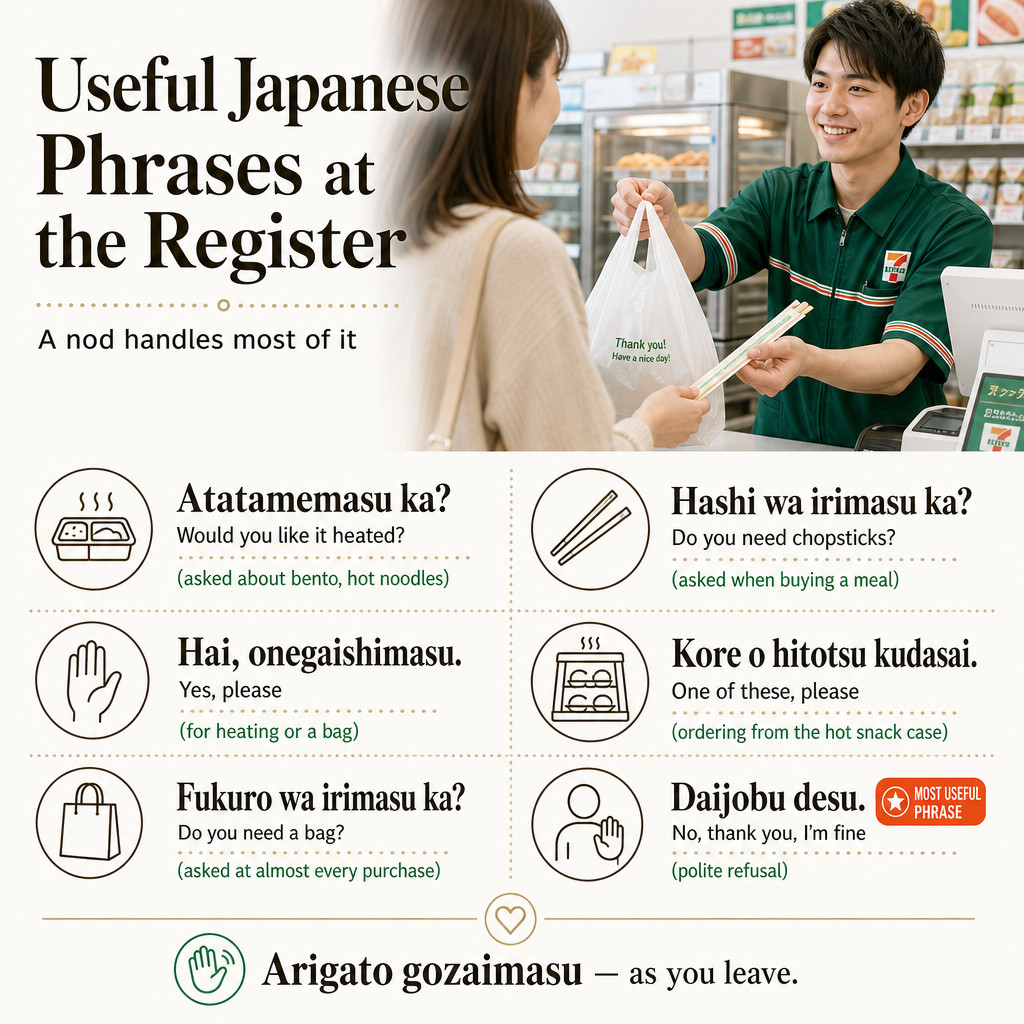
You do not need to speak Japanese, since gestures and a nod handle most transactions. Still, recognising four or five spoken phrases removes almost all of the uncertainty. The table below lists what staff say and what you can say back.
温めますか?Atatamemasu ka?Would you like it heated?Staff ask this about bento and hot noodles
はい、お願いします。Hai, onegaishimasu.Yes, please.Your answer when you want heating or a bag
大丈夫です。Daijobu desu.No, thank you. I am fine.Your polite refusal for anything offered
袋は要りますか?Fukuro wa irimasu ka?Do you need a bag?Staff ask this at almost every purchase
お箸は要りますか?Hashi wa irimasu ka?Do you need chopsticks?Staff ask when you buy a meal
これを一つください。Kore o hitotsu kudasai.One of these, please.Ordering from the hot snack case
Pronounce the romanised forms with even stress and short vowels, and you will be understood. “Daijobu desu” is the single most useful phrase in the list, because it politely declines anything. Finally, “arigato gozaimasu” as you leave always lands well.
Vegetarian, Vegan, Halal and Allergy Information
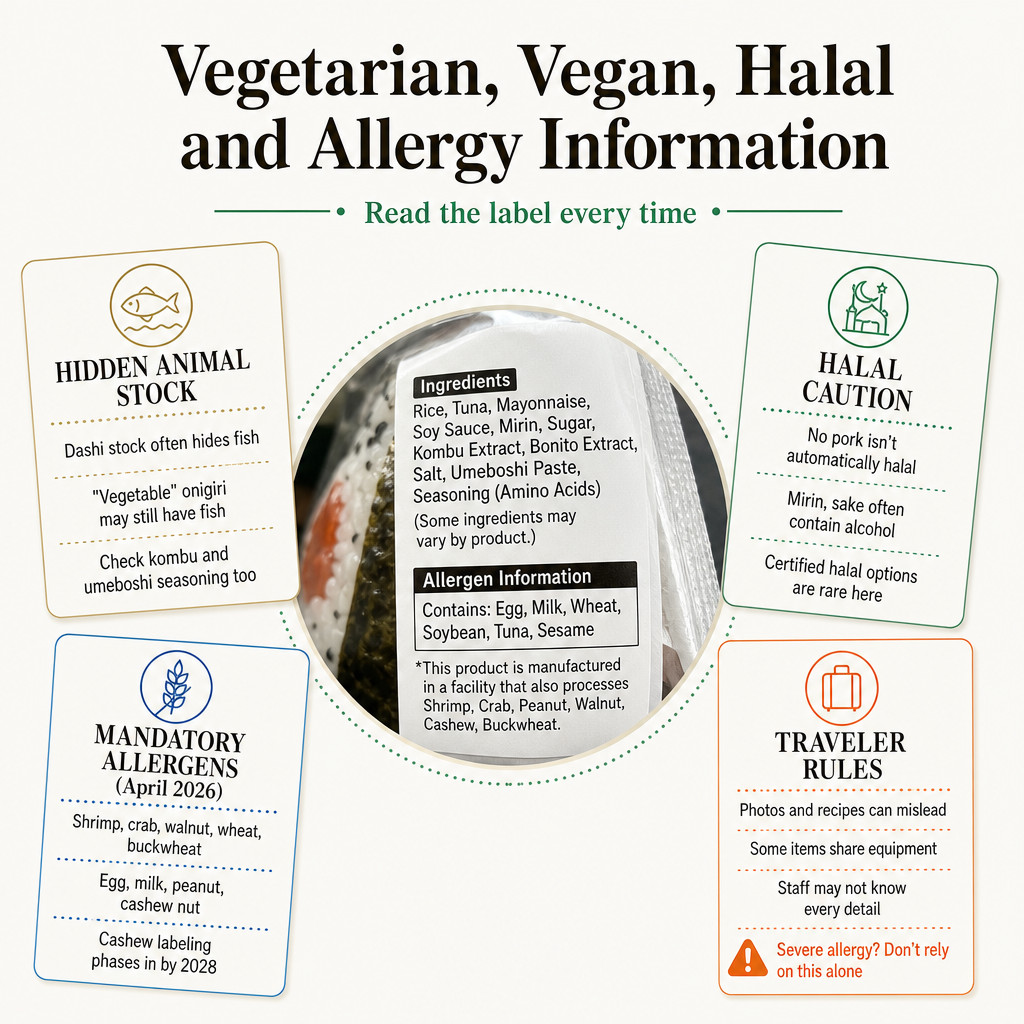
Japanese convenience stores are easier than small restaurants for anyone reading labels, because packaged food carries an ingredient list and an allergen statement. However, they are not straightforward for strict diets. Animal-derived stock hides in many vegetable-looking products, and certification is rare. Read the label every time, and treat this section as orientation rather than clearance.
Start with the biggest trap. Dashi, the stock that flavours much of Japanese cooking, usually contains bonito or other fish. As a result, a vegetable-filled onigiri, a plain-looking soup or a simmered side dish may still contain fish or meat extract. Kombu kelp and umeboshi plum fillings sometimes qualify as plant-based, and sometimes they do not, depending on the seasoning used. Our guide to vegetarian and vegan dining in Japan covers the vocabulary in more detail.
Halal shoppers face a related problem. A product without pork is not automatically halal, because alcohol appears in many Japanese seasonings, including mirin and cooking sake. Certified products exist in Japan, but convenience stores rarely stock them. As a practical approach, plan around packaged items with short, readable ingredient lists, and use certified restaurants or specialist shops for your main meals.
For allergies, Japan’s labelling system provides useful information, but travellers still need to check every package. As of April 2026, the mandatory allergen list includes shrimp, crab, walnut, wheat, buckwheat, egg, milk, peanut and cashew nut. However, a transition period for cashew-nut labelling continues until March 31, 2028, so some packages may not yet reflect the new requirement. Other allergens, including soybean, sesame and pistachio, belong to a recommended labelling category. The Consumer Affairs Agency publishes English-language material and a free multilingual food allergy communication sheet that you can download and show on your phone.
Do not judge a product by its appearance or its photograph.
Recipes and manufacturing processes change without announcement.
Many products are made on shared equipment, and packages often say so.
Store staff cannot always answer detailed ingredient questions.
Learn the Japanese characters for your own allergen and look for them first.
If your allergy is severe, never rely on a travel article alone.
Please read before you rely on this section
To be explicit about what this guide can and cannot tell you: we do not label any product here as vegan, gluten-free, halal or allergy-safe. Some items may be suitable, but you must check the current label on the package in front of you. Nothing in this article is a guarantee for people with allergies or religious dietary requirements.
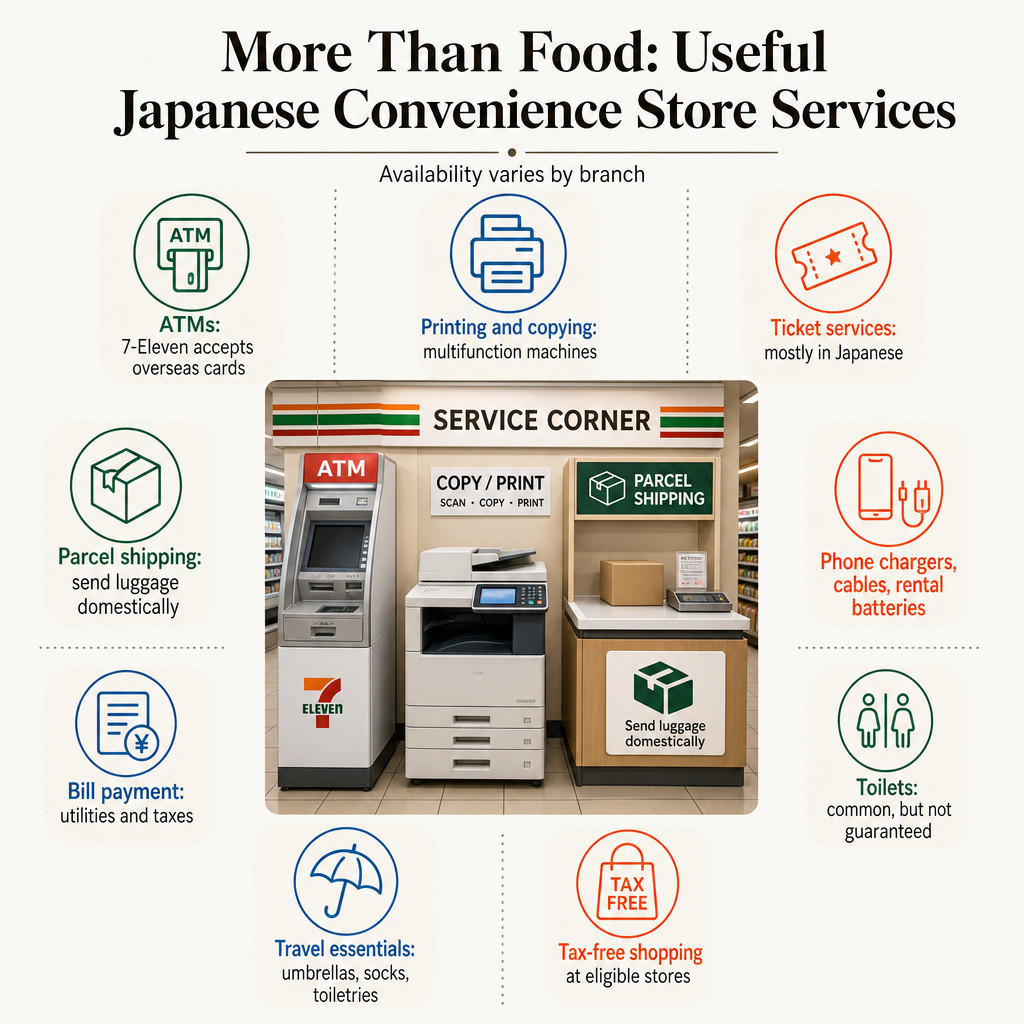
More Than Food: Useful Japanese Convenience Store Services
Beyond food, Japanese convenience stores handle cash withdrawals, printing, parcel shipping, bill payment and ticket collection. These services save travellers a great deal of time. However, availability differs by store, by equipment and by maintenance schedule, so never assume that every branch offers everything.
ATMs. Machines inside 7-Eleven stores accept many overseas-issued cards and display instructions in multiple languages. Details of accepted brands appear on the Seven Bank international card page.
Printing and copying. Multifunction machines scan, copy and print, including from a phone in many cases.
Ticket services. In-store terminals handle concert, event and some transport bookings, mainly in Japanese.
Parcel shipping. You can send luggage or souvenirs domestically from the counter, which is useful before a flight.
Bill payment. Locals pay utilities and taxes here, which explains the occasional long queue.
Phone chargers and cables. Most stores stock basic accessories, and some offer rental battery packs.
Toilets. Many branches have them, though not all, and some require you to ask.
Travel essentials. Umbrellas, socks, shirts, toiletries and phone cables all appear on the non-food shelves.
Tax-free shopping. Eligible stores offer it on qualifying purchases, and the conditions vary by chain and branch.
Payment options are broad. Cash works everywhere, and major credit cards, transport IC cards and QR code payments work at most branches. Even so, machine outages happen, and some rural stores keep shorter hours. Carrying a small amount of cash remains sensible.
Common Japanese Convenience Store Mistakes to Avoid
Most Japanese convenience store problems come from packaging, from assumptions about services, or from misreading the etiquette. The list below collects the mistakes that catch visitors most often. Read it once before your first visit and you will avoid nearly all of them.
Tearing an onigiri wrapper open in one go, which shreds the seaweed.
Opening a cold noodle tray without checking for a separate sauce sachet.
Declining the heating offer on a bento, then eating it cold at the hotel.
Forgetting to take chopsticks or a spoon, and finding out too late.
Assuming you may eat anywhere inside the store rather than at a designated counter.
Judging allergy suitability from a product photograph instead of the label.
Expecting a seasonal product to be available at every branch nationwide.
Assuming every store has a bin, a toilet, a microwave or an ATM.
Blocking a busy shelf while photographing products at peak hours.
Photographing staff or other customers without asking permission.
Assuming that convenience store food is automatically cheaper than a local set-meal restaurant.
Buying only from one chain, then concluding that Japanese konbini food is all the same.
Japanese Convenience Store FAQ
What is a convenience store called in Japanese?
Japanese speakers call it a konbini, a shortened form of the Japanese pronunciation of “convenience store.” You will also see the spelling conbini in English writing. Staff and signage use the Japanese term almost exclusively. Either spelling works if you ask for directions, though most people will understand “convenience store” as well.
Which Japanese convenience store is best?
Every Japanese convenience store chain leads in a different category, so the best choice depends on what you want. 7-Eleven offers the widest private-label range and the most useful traveller services. Lawson has a strong reputation for desserts and bread, while FamilyMart draws visitors mainly for its counter fried chicken. Smaller chains such as Ministop, Seicomart and Daily Yamazaki each have a genuine speciality, so try two or three chains rather than picking one.
What is Seicomart and is it worth visiting?
Seicomart is a Hokkaido-based chain, founded in Sapporo in 1971, and it is well worth a stop. Its Hot Chef counter cooks rice bowls, onigiri and fried chicken in a kitchen inside the store, so the food arrives genuinely hot. Katsudon is the best-known item. Almost all branches sit in Hokkaido, with small clusters in Ibaraki and Saitama prefectures.
Which Japanese convenience store has the best ice cream?
Ministop is the chain most associated with ice cream, because it has sold freshly made soft-serve since it opened in 1980. It also offers Halo Halo shaved-ice desserts and parfaits, with flavours that change by season. Seating is more common at Ministop than at rival chains, though facilities vary by branch. The national chains sell good packaged ice cream, though nothing made to order.
Can Japanese convenience stores heat food for me?
Yes, staff at most Japanese convenience stores will microwave eligible meals at the register. They usually ask “atatamemasu ka?” and you can answer “hai, onegaishimasu.” Procedures differ by product, though, so cold noodles and sandwiches stay cold. Check the packaging or simply follow the cashier’s lead if you are unsure.
How do I order fried chicken?
Point at the heated glass case beside the register and name the item, or say “kore o hitotsu kudasai” for one of those. Staff will pick it up with tongs and bag it separately. You pay for it with the rest of your shopping. Eat it within about ten minutes, because the coating softens quickly.
Can I eat inside a Japanese convenience store?
Only in Japanese convenience stores that provide a designated eat-in counter or seating area. Many branches have no such space, and eating while browsing the shelves is not acceptable. Where a seating area exists, keep your visit short and quiet, and clear your table. Note that eating in the store can change the tax rate applied to reduced-tax food items.
Do Japanese convenience stores accept foreign credit cards?
Most branches accept major international credit cards, transport IC cards and QR code payments. Acceptance is broad but not universal, and small or rural stores sometimes limit their options. Terminals also fail occasionally. Carry a modest amount of cash so that a declined card never becomes a problem.
Can I use an international card at a convenience store ATM?
Often yes, particularly at the Seven Bank machines inside 7-Eleven stores, which display instructions in several languages. Accepted card brands change over time, so check the operator’s current list before you rely on a specific card. Machines also go offline for maintenance, sometimes late at night. Fees depend on your own bank and card brand.
Are Japanese convenience stores open 24 hours?
Many are, especially in city centres and near stations. However, staffing pressures have led a number of branches to shorten their hours, particularly in rural areas and inside office buildings. Check the door sign if you plan a late-night visit. Some stores also close their hot food counter well before the shop itself closes.
Are there vegetarian or halal options?
Some products may suit you, but convenience stores rarely certify anything, and you must read the current label. Fish-based dashi appears in many items that look purely vegetable, and alcohol-based seasonings are common. Certified halal products exist in Japan, though konbini seldom stock them. Learn the Japanese words for the ingredients you avoid, and check every package individually.
Can I bring convenience store food onto a train?
Yes on long-distance and shinkansen services, where eating at your seat is completely normal. Avoid eating on crowded local commuter trains, because passengers there consider it inconsiderate. Choose items that do not leak and do not smell strongly, such as sandwiches, onigiri and sealed drinks. Take all of your rubbish with you, since station bins have become scarce.
Conclusion
Japanese convenience stores reward a small amount of preparation. Learn how the onigiri wrapper works, learn to recognise the heating question, and learn that the hot case beside the register holds the most interesting food in the shop. After that, the whole category opens up to you.
Visit at least two chains on your trip, because 7-Eleven, Lawson and FamilyMart genuinely differ in what they do best. Look out for the smaller chains as well. Ministop prepares food in the store and often has seating, Daily Yamazaki bakes its own bread, and Seicomart in Hokkaido cooks hot meals at its Hot Chef counter. Build meals rather than buying single items, check the label whenever ingredients matter to you, and treat the seasonal shelf as a reason to go back. For many travellers, these ordinary shops end up producing some of the most memorable eating of the whole trip.
Last updated: July 2026. Product availability, prices and services vary by store, region and season. Prices shown on shelf labels are the only reliable prices, and tax treatment differs between takeaway and eat-in purchases.
Ryo Iwa is the founder and editor of foodinjapan.org. Born and raised in Japan, he writes from regional travel, market visits, and Japanese-language primary sources that rarely reach English readers, including brewing institute publications and industry glossaries. Where a figure cannot be traced to a source, the article says so.
He has been a Google Maps Local Guide for over 10 years, with more than 1,800 reviews and over 41,000 photos viewed hundreds of millions of times. He previously spent two decades as an IT consultant in Japan, the US, and the UK.















Comments