




Ten dollars does not buy much lunch in London or New York any more. In Japan, it still buys a proper meal, and often a very good one.
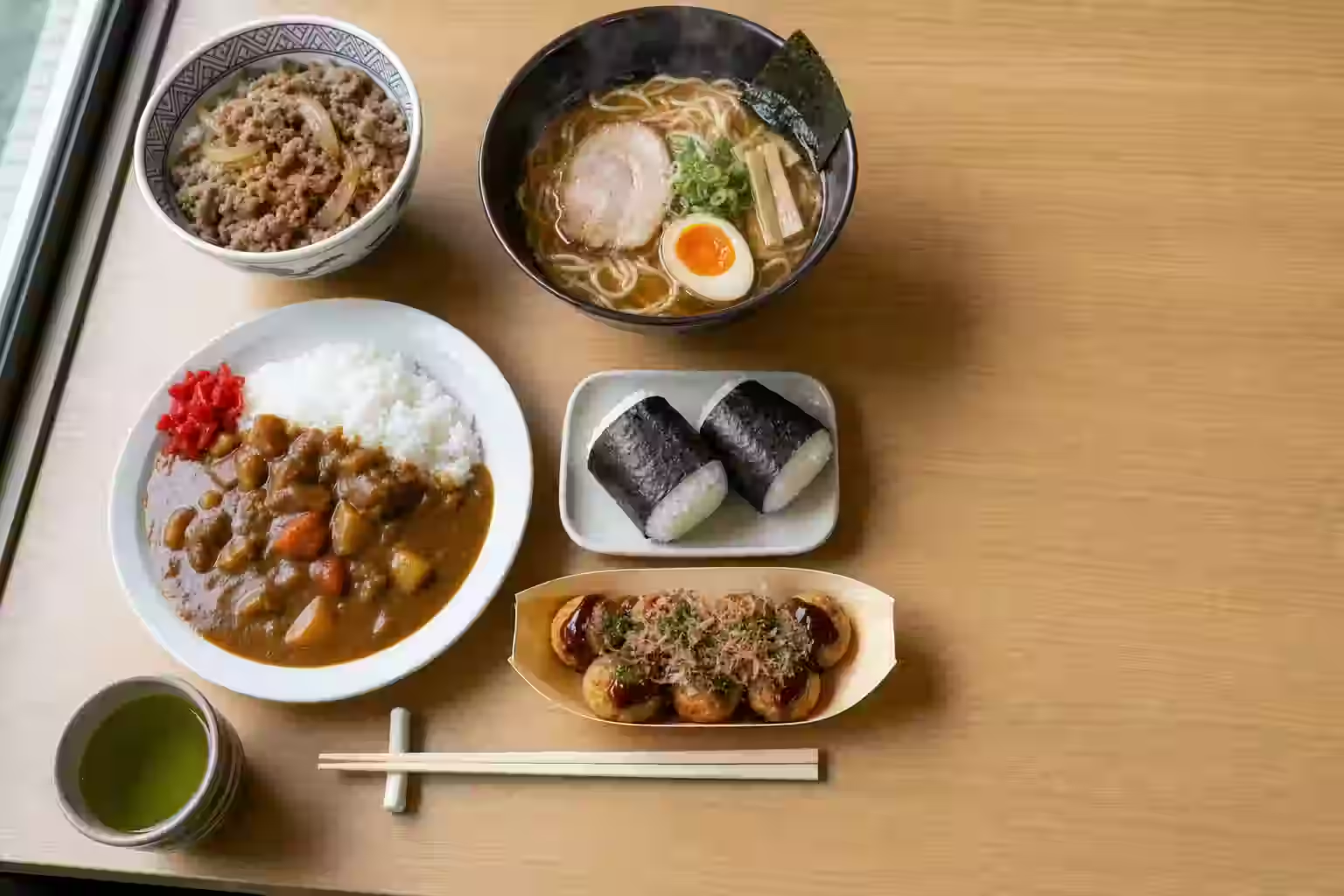
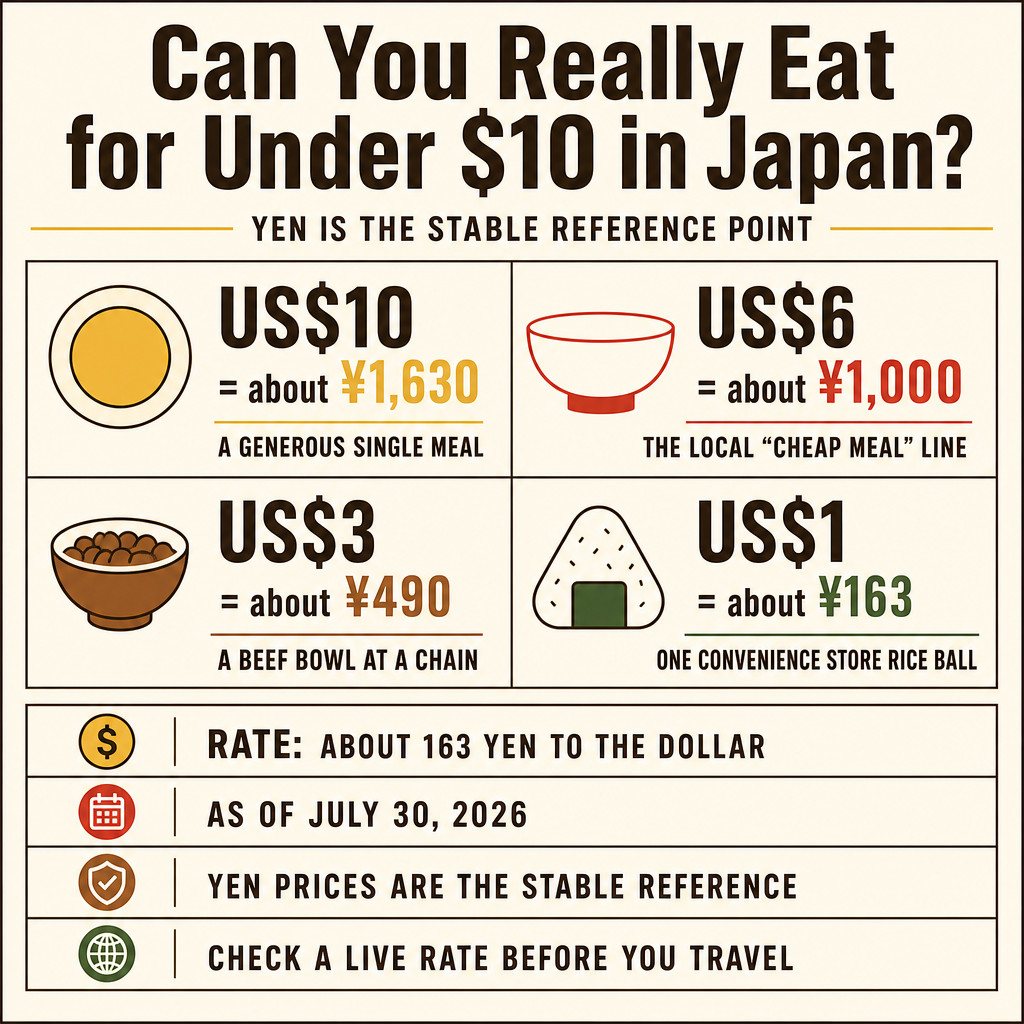
Yes, you can eat well in Japan for under $10. At roughly 163 yen to the dollar in late July 2026, ten dollars converts to about 1,630 yen. That covers a bowl of ramen (around 700 to 1,000 yen), a beef bowl at a chain (460 to 500 yen), curry rice, station soba, or a convenience store meal, usually with change left over.
Part of the reason, of course, is the exchange rate. The yen has been sitting near 40-year lows, trading around 163 to the US dollar at the end of July 2026. Nor are cheap eats in Japan a compromise. A bowl of ramen, a beef rice bowl, a plate of curry rice or a tray of station soba all sit well under that line, and locals eat them daily.
This guide covers what you can actually eat for under ten dollars, where to find it, which chains are worth knowing, how ordering and payment work, and how to plan a daily food budget. Prices move constantly, though, so treat every figure here as a snapshot from July 2026 rather than a promise.
Can You Really Eat for Under $10 in Japan?
Yes, and generally without much effort. Most Japanese cities are built around fast, affordable everyday eating, because office workers and students need it. As a result, the cheap end of the market is competitive and surprisingly good.
What $10 Buys in 2026
Start with the arithmetic, since it changes the whole picture. At roughly 163 yen to the dollar, ten dollars gives you about 1,630 yen. Meanwhile 1,000 yen, the classic Japanese benchmark for a cheap meal, works out at around six dollars.
About the dollar figures. Exchange rates move, sometimes sharply. The yen prices in this guide are the stable reference point, whereas the dollar equivalents assume roughly 163 yen to the dollar as of 30 July 2026. Check a converter before you travel, because a shift to 150 or 175 changes what ten dollars buys.
Because of that rate, the ten-dollar line is genuinely generous in 2026. In fact you can often eat two meals inside it. A rice ball breakfast and a beef bowl lunch together land near 900 yen, which leaves change.
Why Japan Suits Budget Travellers
Three things, in particular, work in your favour. First, there is no tipping anywhere in Japan, so the menu price is what you pay. Second, tap water and tea arrive free at almost every restaurant. Third, portion sizes at cheap restaurants are designed to fill a working adult.
Meanwhile, consumption tax adds a small twist. Takeaway food carries 8 percent, whereas eating in the shop carries 10 percent. Consequently the same bento costs slightly less if you carry it to a park bench.
One change is worth watching. The government has been preparing a temporary cut to the reduced food rate, reported at 1 percent from April 2027, while the eat-in rate for restaurants would stay at 10 percent. Nothing has passed into law yet, so check the current rate if you travel after that date.
Still, food is not free money. Japan Tourism Agency figures put food and drink at roughly a fifth of what overseas visitors spent in Japan during 2025, at 21.9 percent of a record total. Average spending came to about 229,000 yen per person for the whole trip, which suggests most travellers eat well above the budget line rather than at it.
Best Japanese Meals Under $10
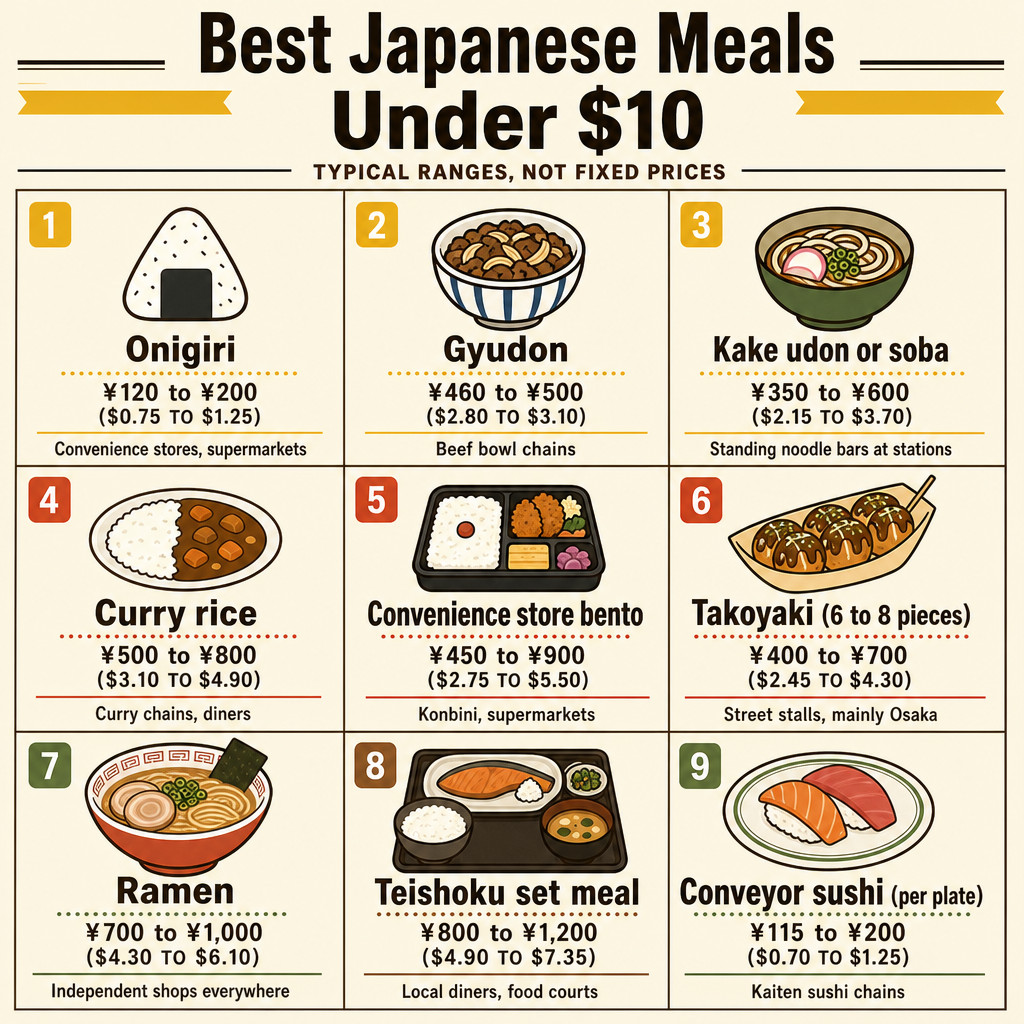
The table below therefore covers the dishes that reliably come in under the ten-dollar mark. Prices vary by city and by shop, of course, so read these as typical ranges rather than fixed figures.
| Dish | Typical price | Roughly | Where to find it |
|---|---|---|---|
| Onigiri (rice ball) | ¥120 to ¥200 | $0.75 to $1.25 | Convenience stores, supermarkets |
| Gyudon (beef bowl) | ¥460 to ¥500 | $2.80 to $3.10 | Beef bowl chains |
| Kake udon or soba | ¥350 to ¥600 | $2.15 to $3.70 | Standing noodle bars at stations |
| Curry rice | ¥500 to ¥800 | $3.10 to $4.90 | Curry chains, diners |
| Convenience store bento | ¥450 to ¥900 | $2.75 to $5.50 | Konbini, supermarkets |
| Takoyaki (6 to 8 pieces) | ¥400 to ¥700 | $2.45 to $4.30 | Street stalls, mainly Osaka |
| Ramen | ¥700 to ¥1,000 | $4.30 to $6.10 | Independent shops everywhere |
| Teishoku set meal | ¥800 to ¥1,200 | $4.90 to $7.35 | Local diners, food courts |
| Conveyor sushi (per plate) | ¥115 to ¥200 | $0.70 to $1.25 | Kaiten sushi chains, dearer in city centres |
Ramen
Ramen remains the classic cheap meal, though it has become less cheap than it was. According to retail price data compiled by the Statistics Bureau, the national average sat at 721 yen in November 2025. Five years earlier it was 601 yen.
Japanese diners talk about the “1,000 yen wall,” meaning the point where a bowl starts to feel expensive. Many shops therefore hold their standard bowl just under it, even as costs rise. That pressure is real: Teikoku Databank recorded 59 ramen shop bankruptcies during 2025, mostly among very small operators.
So for a traveller, the practical advice is simple. Order the plain shop standard rather than the loaded special, and skip the extra toppings. If you want to look like you know what you are doing, our guide on how to eat ramen covers the small etiquette points.
Gyudon and Other Rice Bowls
If one dish defines cheap eating in Japan, it is gyudon: thin beef and onion simmered in a sweet soy broth, poured over rice. A regular size at the three big chains cost between 460 and 500 yen in July 2026. That is roughly three dollars for a hot meal served in about ninety seconds.
Prices have climbed, mind you, and they move often. The same bowl cost under 400 yen at some chains in 2020, while one major chain raised its regular bowl from 450 to 480 yen as recently as 8 July 2026. Even so, few countries offer a cooked meal this cheap.
Similarly, other rice bowls follow the same logic. Katsudon layers a breaded pork cutlet with egg, oyakodon uses chicken and egg, and butadon uses grilled pork. All three usually land between 600 and 900 yen at a local shop.
Japanese Curry Rice
Curry rice is mild, thick and slightly sweet, so it rarely frightens anyone. Specialist chains let you pick the rice quantity and the spice level, which means you can keep the bill low by ordering the base plate without toppings.
Diners and food courts sell it too, usually with a scoop of pickled ginger on the side. Honestly, a plain curry rice is one of the least glamorous things on this list. It is also one of the most filling.
Udon and Soba
Standing noodle bars are, without doubt, the cheapest hot meal in the country. You buy a ticket from a machine, hand it over, and eat at a counter within five minutes. A plain bowl of udon or soba often costs 350 to 450 yen, and a tempura topping adds around 150.
Generally, these places cluster inside and around train stations. Nobody lingers, and there is frequently nowhere to sit. Still, the broth is made properly, and commuters would not tolerate it otherwise.
Bento and Onigiri
A bento gives you rice, a main dish and two or three sides on one tray. Convenience store versions generally run from 450 to 900 yen, and staff will microwave them at the register if you ask.
Onigiri sit even lower, usually between 120 and 200 yen each. Two of them plus a bottle of tea therefore makes a genuine breakfast for under 500 yen. Our guide to convenience store onigiri explains which fillings suit first-timers, because umeboshi catches people out.
Takoyaki and Street Food
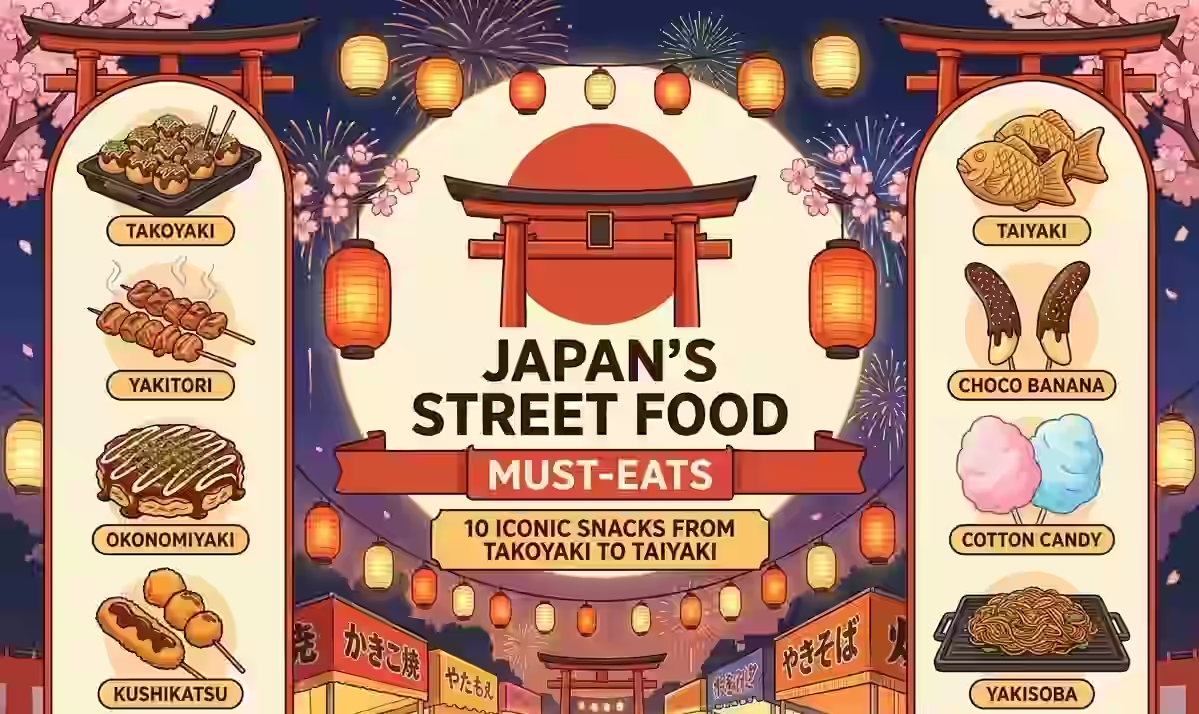
Street food works best as a supplement rather than a full meal. Takoyaki, the octopus batter balls Osaka is known for, typically costs 400 to 700 yen for six to eight pieces. Okonomiyaki from a stall, similarly, sits a little higher.
In practice, festival stalls and covered shopping streets are where you find these. Prices climb in heavily touristed spots, though, so walk one block away from the main drag before you buy.
Where to Find Cheap Food in Japan
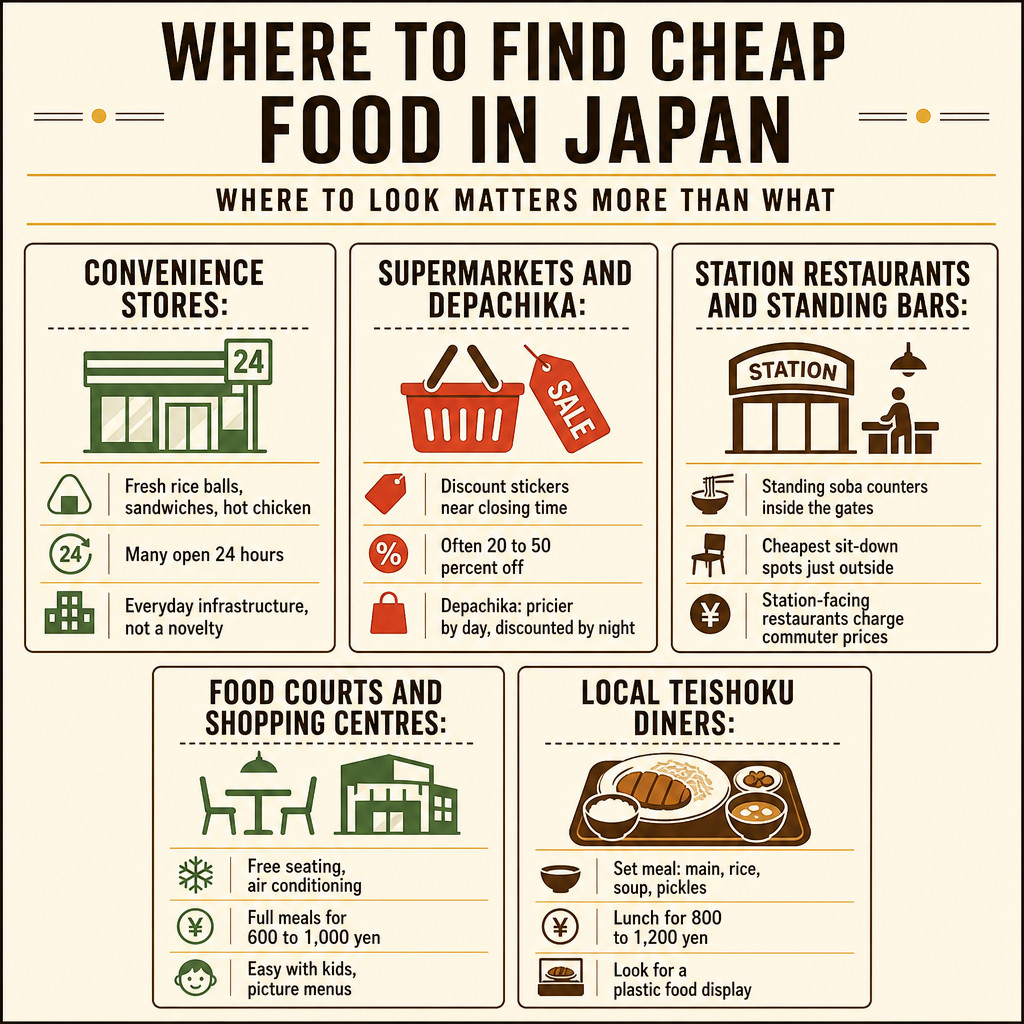
Knowing the dishes matters less than knowing where to look. Five categories of place cover almost every cheap meal in the country.
Convenience Stores
Japanese convenience stores, or konbini, are nothing like their overseas equivalents. They sell fresh rice balls, sandwiches, boxed meals, hot fried chicken and decent coffee, and many stay open all night. Our full convenience store food guide breaks down what to buy at each chain.
Academic work also backs up the everyday role these shops play. A survey of 453 young Japanese consumers, published in the International Journal of Retail and Distribution Management, found that access, location and store atmosphere drove their preference for the format. In other words, konbini are not a tourist novelty; they are ordinary infrastructure.
Supermarkets and Depachika
Supermarkets beat konbini on price, particularly late in the day. Staff apply discount stickers to prepared food as closing time approaches, often in the range of 20 to 50 percent. So look for the yellow or red labels marked with a percentage.
Department store food halls, called depachika, sit in the basement of large stores. Quality there is noticeably higher, and daytime prices reflect it. Nevertheless the same late-evening discounting applies, which can bring a premium tray down into ordinary supermarket territory.
Station Restaurants and Standing Bars
Japanese stations are, in fact, food destinations in their own right. Inside the ticket gates you find standing soba counters, bakeries and small ramen shops. Outside them, the streets behind the station usually hold the cheapest sit-down restaurants in the area.
The rule of thumb is worth remembering. Restaurants facing a famous temple charge tourist prices, while restaurants facing a commuter station charge commuter prices.
Food Courts and Shopping Centres
Shopping mall food courts rarely appear in travel guides, yet they solve several problems at once. Seating is free, there is air conditioning, picture menus are common, and most stalls sell a complete meal for 600 to 1,000 yen. Families with children will find them especially easy.
Local Teishoku Diners
A teishoku is a set meal: a main dish, rice, miso soup and pickles on one tray. Small family-run diners, often called shokudo, serve them at lunchtime for 800 to 1,200 yen. These places look plain from outside, and that is precisely the point.
Look for a plastic food display in the window, a hand-written lunch board, and a row of office workers eating in silence. If the menu has no English and no photographs, point at what your neighbour ordered.
Cheap Breakfast in Japan
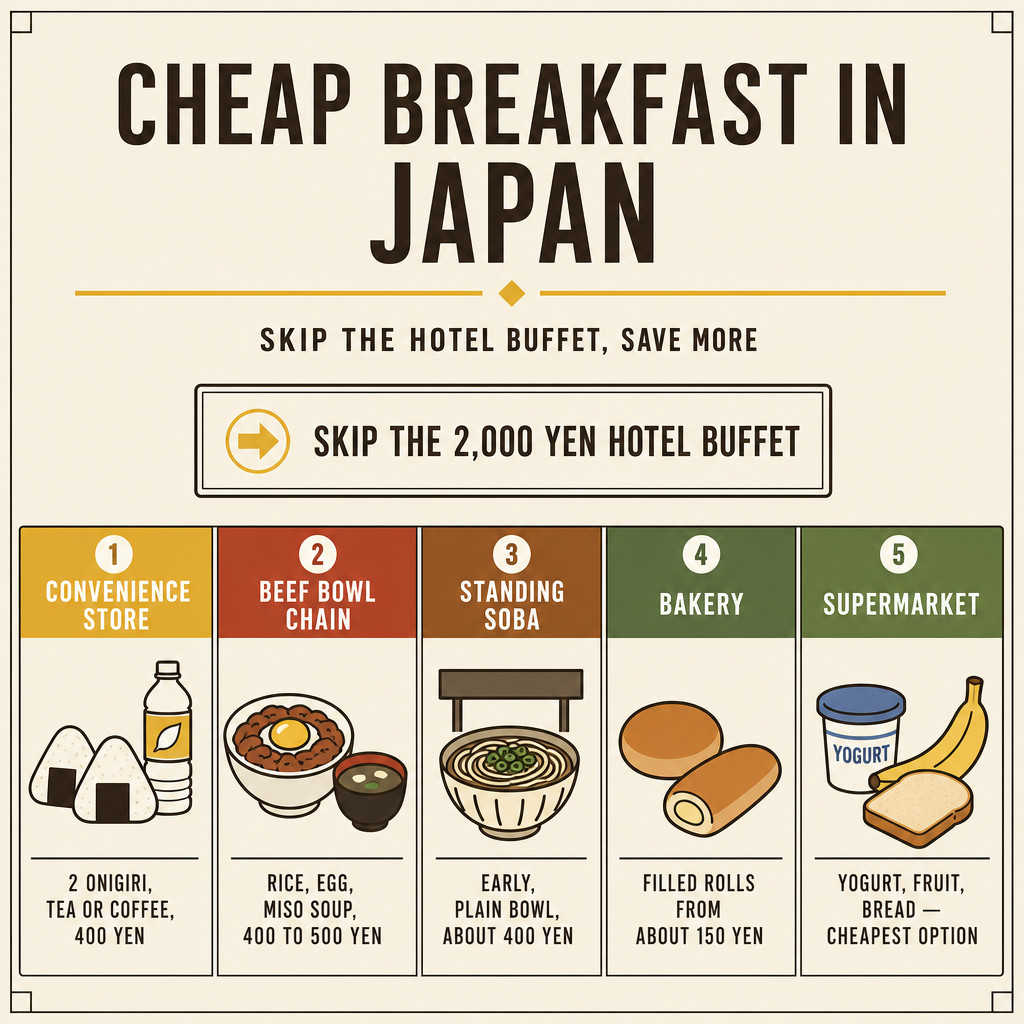
Breakfast is where budget travellers save the most, because hotel buffets in Japan often cost 2,000 yen or more. Skipping one buys you two cheap meals elsewhere.
- Convenience store set: two onigiri, a carton of milk tea or a machine coffee, roughly 400 yen.
- Beef bowl chain breakfast: most chains run a separate morning menu with rice, egg and miso soup, typically 400 to 500 yen.
- Standing soba: station counters open early, and a plain bowl costs around 400 yen.
- Bakery: station bakeries sell filled rolls and pastries from about 150 yen each.
- Supermarket: yogurt, fruit and bread bought the night before, at the lowest cost of all.
The beef bowl chains deserve a special mention here. Their morning sets are among the best value in Japanese food, since they include soup and rice for less than the price of a coffee at a café.
Cheap Japanese Restaurant Chains Worth Knowing
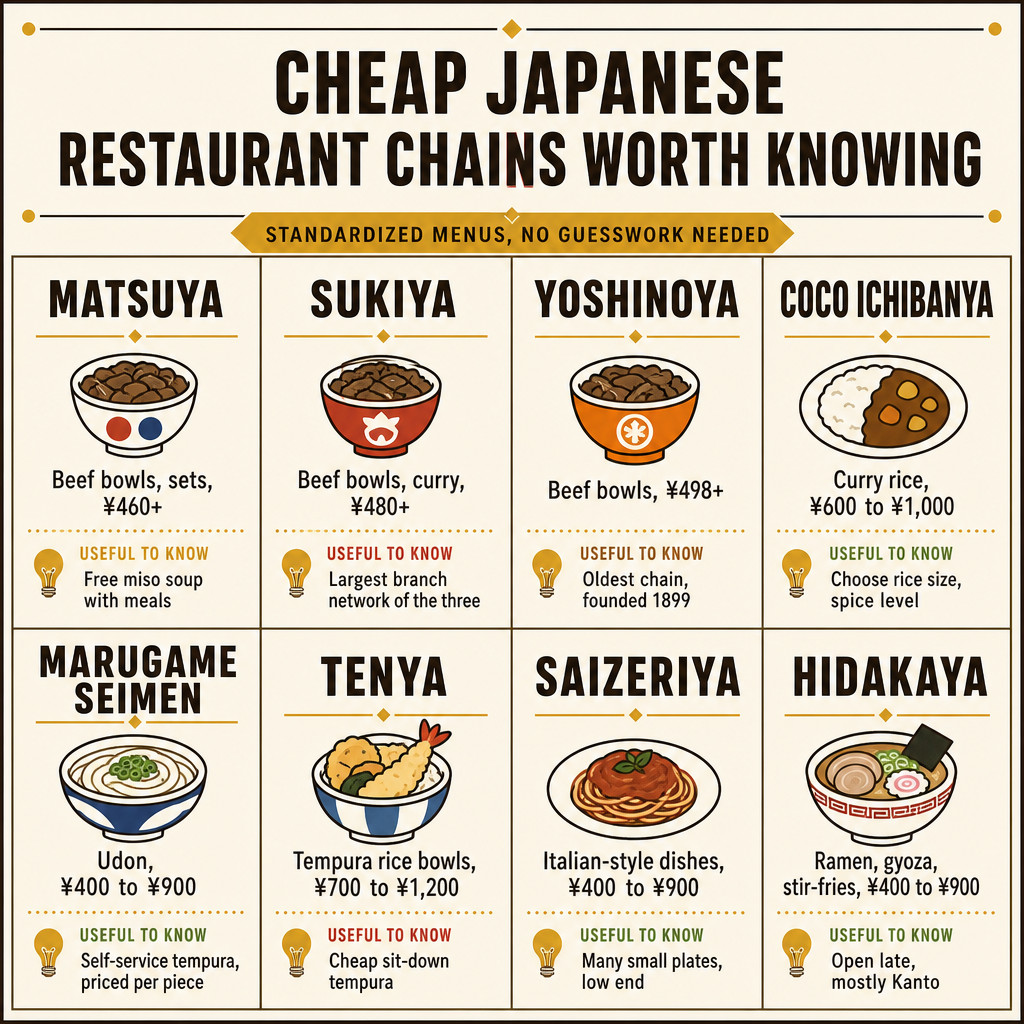
Chains, meanwhile, take the guesswork out of budget eating. Menus are standardised, many chains order by machine or touchscreen, and English options appear at a good number of branches.
| Chain | Known for | Rough price range | Useful to know |
|---|---|---|---|
| Matsuya | Beef bowls, set meals | Around ¥460 and up | Miso soup comes free with rice meals |
| Sukiya | Beef bowls, curry | Around ¥480 and up | Largest branch network of the three |
| Yoshinoya | Beef bowls | Around ¥498 and up | The oldest chain, founded in 1899 |
| CoCo Ichibanya | Curry rice | Roughly ¥600 to ¥1,000 | Choose rice size and spice level |
| Marugame Seimen | Udon | Roughly ¥400 to ¥900 | Self-service tempura priced per piece |
| Tenya | Tempura rice bowls | Roughly ¥700 to ¥1,200 | One of the cheapest ways to eat tempura sitting down |
| Saizeriya | Italian-style dishes | Roughly ¥400 to ¥900 | Many small plates at the low end of that range |
| Hidakaya | Ramen, gyoza, stir-fries | Roughly ¥400 to ¥900 | Open late, mostly in the Kanto region |
A note on prices. Chain menus change several times a year, and dine-in and takeaway prices differ because of the tax rate. Sukiya and Matsuya also add a late-night surcharge of about 7 percent between 10pm and 5am, whereas Yoshinoya does not. Always read the board rather than trusting an article, including this one.
How Paying and Ordering Works
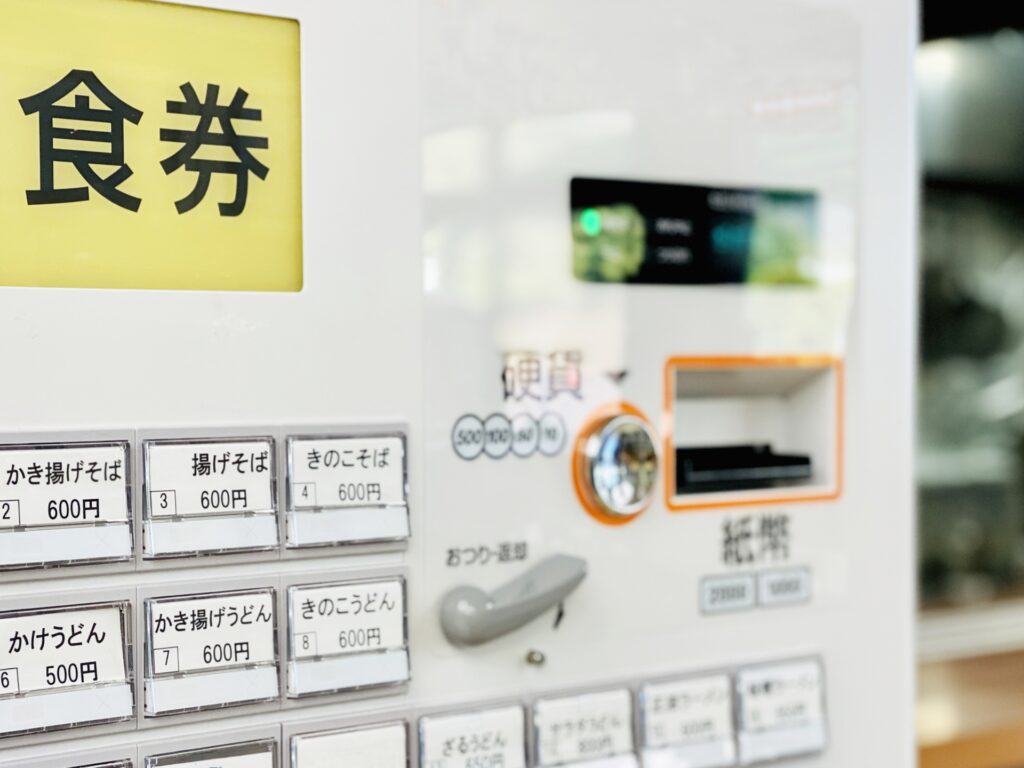
Cheap restaurants in Japan often skip the waiter entirely, which confuses first-time visitors more than the food does. Three systems cover almost everything.
- Ticket machine (shokkenki): pay at a machine near the door, take the printed ticket, hand it to the counter. Matsuya and Sukiya use touchscreen versions with an English option, whereas Yoshinoya still takes orders verbally at the counter.
- Table touchscreen: common at family restaurants and conveyor sushi, with photographs and a language toggle. You pay on the way out.
- Order at the counter: standard at food courts and street stalls, where pointing works fine.
A few practical points follow from that. Tipping does not exist in Japan, so never leave money on the table. Cashless payment has spread widely, yet small diners, market stalls and some standing bars still take cash only. Carry a few thousand yen in notes and coins, because the shops least likely to accept cards are often the cheapest ones.
I found the ticket machines genuinely intimidating on a first visit, mostly because a queue forms behind you. The trick is to look for the top-left button, which is nearly always the shop’s standard bowl.
Cheap Eats by City
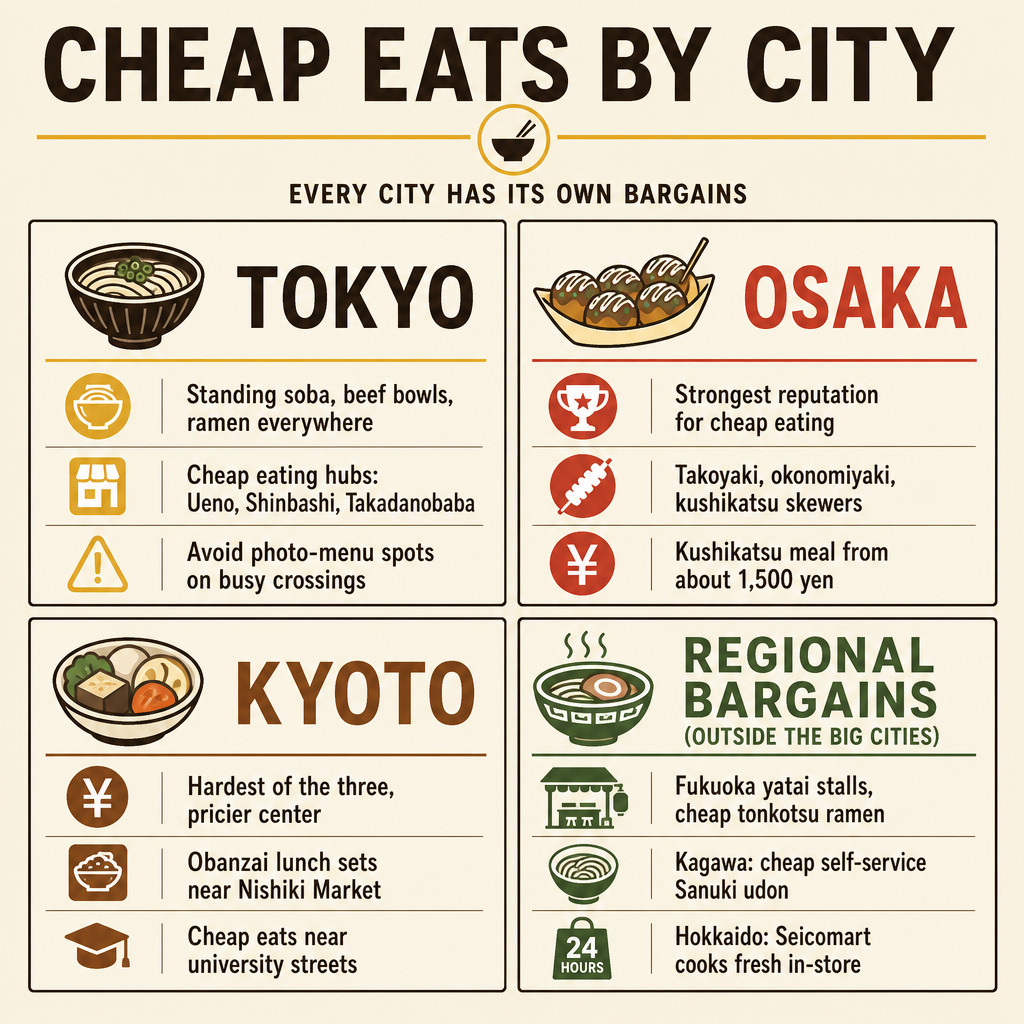
Budget eating works everywhere in Japan, though each city has its own bargains.
Cheap Food in Tokyo
Tokyo has a reputation for expense that its everyday food scene does not deserve. Standing soba bars, beef bowl chains and ramen shops sit outside almost every station in the city. Meanwhile the areas around Ueno, Shinbashi and Takadanobaba are known locally for cheap eating rather than sightseeing.
Even so, avoid the obvious traps. A restaurant with a photo menu on a busy Shibuya crossing charges for its address. Our guide to what to eat in Tokyo covers the dishes worth prioritising, and the Tokyo food section goes deeper into local specialities.
Cheap Food in Osaka
Osaka has the strongest reputation for cheap eating in Japan, and locals lean into it. The word kuidaore, which describes eating until you ruin yourself, gets used constantly. Takoyaki, okonomiyaki and kushikatsu skewers all belong to the cheap end of the market.
Kushikatsu shops in Shinsekai price each skewer individually, so you control the total precisely. A full meal there generally runs from about 1,500 yen, though ordering five or six skewers with rice keeps it far lower. See our Osaka food guide and the wider Osaka section for specific dishes.
Cheap Food in Kyoto
Kyoto is the hardest of the three, mainly because the tourist districts price accordingly. Even so, cheap food exists once you step away from Gion and Arashiyama.
Obanzai, the city’s everyday home cooking, appears as affordable lunch sets around Nishiki Market. Kyoto also has a large student population, so the streets near its universities carry cheap noodle and rice bowl shops. Our Kyoto food guide lists the dishes to look for, while the Kyoto section covers regional background.
Regional Bargains Outside the Big Cities
Some of the best value sits well outside Tokyo, Osaka and Kyoto. Fukuoka runs open-air yatai stalls along the river in Tenjin and Nakasu, where a bowl of tonkotsu ramen and a beer cost less than a mid-range Tokyo dinner.
Kagawa Prefecture, meanwhile, is the home of Sanuki udon, and self-service shops there sell a plain bowl for a few hundred yen. In Hokkaido, the regional chain Seicomart cooks rice bowls and fried chicken in a kitchen inside the store, which beats any national convenience store on both price and quality. Our food by area guide maps out what each region does best.
Building a Konbini Meal Under $10
A convenience store meal works best when you treat it as a set rather than a snack. So pick one carbohydrate, one protein, one vegetable or fruit item, and one drink.
- Carbohydrate: onigiri, a bread roll, a sandwich or a small bento tray.
- Protein: hot fried chicken from the counter case, a boiled egg, or grilled fish.
- Vegetable or fruit: a packaged salad, a cup of cut fruit, or a small side of simmered vegetables.
- Drink: unsweetened bottled tea, which costs very little and cuts through fried food.
- Optional extra: instant miso soup, though you will need hot water and not every store provides it.
That combination generally lands between 700 and 1,100 yen, so it fits inside ten dollars with room to spare. Karaage fried chicken and korokke croquettes are the two hot items most visitors enjoy immediately. For the wider cultural context, our piece on Japanese konbini culture is a good companion read.
One warning about eating locations. Convenience stores are not restaurants, and eating while walking through the shop is not acceptable. Take the food to a park, your hotel, or a designated eat-in counter where one exists.
Eight Tips for Eating in Japan on a Budget
- Eat your big meal at lunch. Lunch sets at good restaurants often cost half the dinner price for similar food.
- Shop supermarkets after 7pm. Discount stickers appear on prepared food as closing time approaches.
- Walk away from the landmark. One block back from a famous street usually cuts prices noticeably.
- Choose takeaway when you can. The 8 percent tax rate applies instead of 10 percent.
- Use ticket machine restaurants. The price is printed on the button, so nothing surprises you at the till.
- Check the menu board outside. Almost every Japanese restaurant displays prices at the door, and walking away costs nothing.
- Drink the free water. Tap water and tea come free, and bottled drinks add up faster than people expect.
- Carry some cash. Cashless payment is widespread now, but small diners and stalls still refuse cards.
The lunch tip deserves emphasis. Restaurants that charge 4,000 yen in the evening frequently serve a 1,200 yen set at midday, using the same kitchen and similar ingredients. Booking is rarely needed either, although queues form quickly between noon and one o’clock.
A Realistic One-Day Food Budget
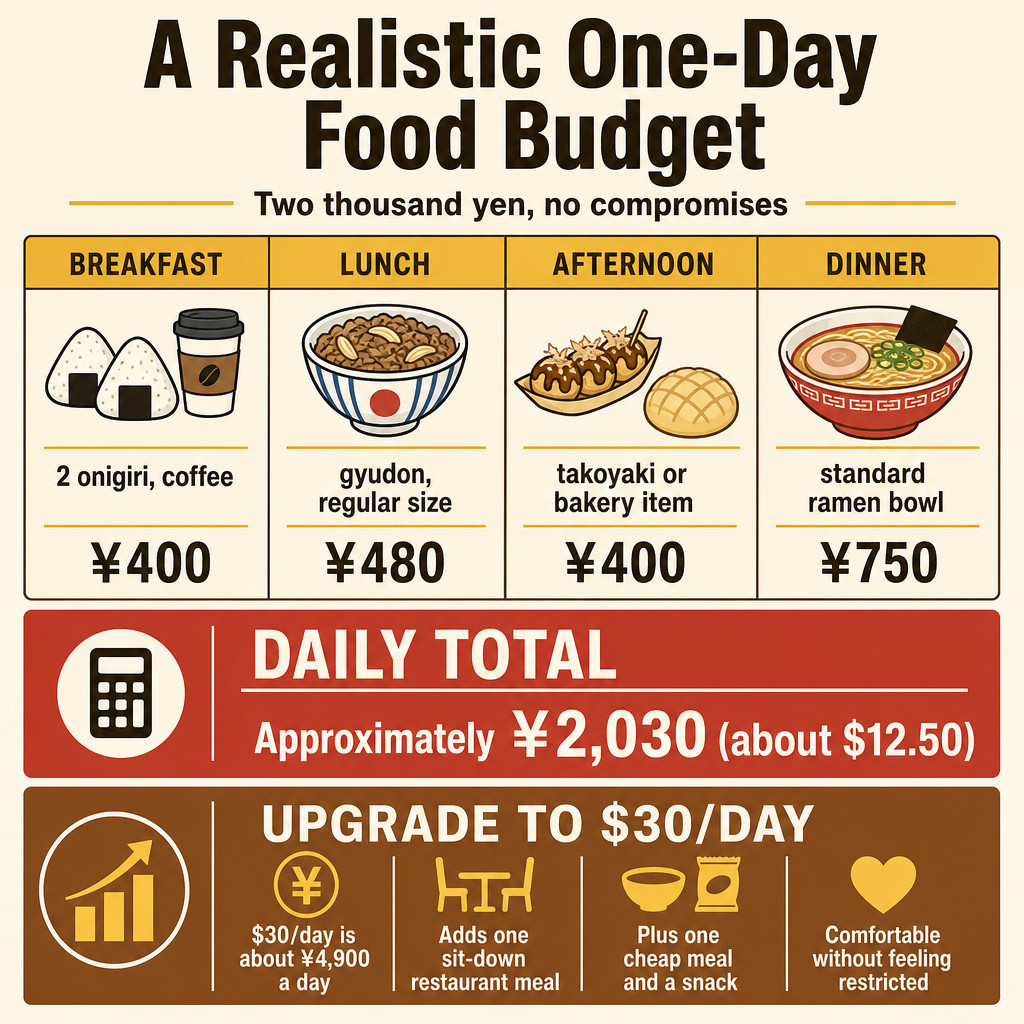
Here is what a genuinely cheap day looks like in practice. Notably, nothing in this plan involves skipping meals or eating badly.
| Meal | What you eat | Cost |
|---|---|---|
| Breakfast | Two onigiri and a convenience store coffee | About ¥400 |
| Lunch | Gyudon, regular size | About ¥480 |
| Afternoon | Takoyaki or a bakery item | About ¥400 |
| Dinner | A standard bowl of ramen | About ¥750 |
Push the budget to 30 dollars a day, or roughly 4,900 yen, and the picture changes considerably. That allows one proper sit-down restaurant meal, one cheap meal and a snack. Most travellers find that level comfortable without feeling restricted.
Two costs, above all, break a food budget. Café drinks add up quickly, since a basic coffee runs roughly 300 to 400 yen at chains such as Doutor, Veloce and Starbucks, while milk and speciality drinks cost more. Alcohol at restaurants climbs faster still. Therefore, if money is tight, cut the drinks rather than the meals.
Are Cheap Eats in Japan Healthy?
Broadly yes, though the answer depends on what you choose. Budget Japanese food leans on rice, fish, soy and vegetables more than most cheap food elsewhere. However, it also tends to be salty, and the fried options are genuinely heavy.
Better Balanced Choices
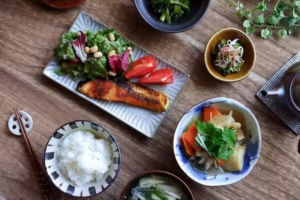
Teishoku sets are the strongest option, because the format builds in a protein, rice, soup and a vegetable side. Grilled fish sets are particularly good value at lunchtime. Soba usually carries more fibre and protein than udon, although many Japanese soba noodles blend buckwheat with wheat flour, so the difference is smaller than it sounds.
At a convenience store, the balanced version of a cheap meal exists if you look for it. Add a packaged salad or a boiled egg to your rice item, and skip the second fried thing.
Vegetarian, Vegan and Halal Notes
This is where budget eating gets harder, so plan ahead. Dashi, the stock behind much of Japanese cooking, usually contains bonito or other fish. As a result, a vegetable dish or a plain-looking soup may still contain fish extract.
Halal travellers face a related issue, since mirin and cooking sake appear in many seasonings. Certified options exist in larger cities, though rarely at cheap chains. Our guide to vegetarian and vegan dining in Japan covers the vocabulary you need.
For allergies, packaged food carries a mandatory allergen statement, which makes convenience stores easier than small restaurants. Recipes change without notice, however, so read the label on the package in front of you every time. Nothing in this article is a guarantee for anyone with a severe allergy.
Final Thoughts
Cheap eats in Japan are not a consolation prize. A 480 yen beef bowl, a 400 yen bowl of station soba and a 750 yen bowl of ramen are all made with the same care as expensive food, just at speed and volume. For first-time visitors, that combination is one of the best things about the country.
Three habits, then, will keep your costs down without narrowing your experience. Eat your main meal at lunch, follow commuters rather than tour groups, and treat convenience stores and supermarkets as real food options rather than emergency backups.
From here, our Japan food guide covers regional specialities in more depth, and the Japanese food section sorts dishes by type. Prices will keep moving, so check the board before you sit down.
Cheap Eats in Japan FAQ
Can you eat in Japan for under 10 dollars?
Yes, and easily. At around 163 yen to the dollar in July 2026, ten dollars converts to roughly 1,630 yen. That covers a bowl of ramen, a beef bowl, a curry rice plate or a set meal at a local diner. In fact many cheap meals cost half that amount.
What can I buy in Japan for under 1,000 yen?
Almost every everyday Japanese meal. A standard bowl of ramen averaged 721 yen nationally in November 2025, while beef bowls sit near 480 yen and station soba starts around 350 yen. Convenience store bento boxes generally cost 450 to 900 yen. Only sushi counters and sit-down dinners regularly push past that line.
What is the cheapest meal in Japan?
A plain bowl of udon or soba at a standing noodle bar, usually 350 to 450 yen. Convenience store rice balls come close, since two of them plus tea costs under 500 yen. Beef bowls at chains, meanwhile, are the cheapest cooked restaurant meal at roughly 460 to 500 yen.
What is a good cheap breakfast in Japan?
Beef bowl chains serve morning sets with rice, egg and miso soup for roughly 400 to 500 yen, which is the best value going. Two convenience store onigiri and a coffee cost about the same. Station soba counters and bakeries also open early. Skipping the hotel buffet, which often costs 2,000 yen or more, saves the most.
Do you tip at restaurants in Japan?
No, and you should not try. Tipping is not part of Japanese restaurant culture, so the menu price is the final price. Staff may chase you down the street to return money left on a table. Some upmarket restaurants and hotels add a service charge instead, which appears on the bill.
Where can I find cheap food in Tokyo?
Look near commuter stations rather than tourist sights. Areas such as Ueno, Shinbashi and Takadanobaba carry dense clusters of cheap restaurants. Standing soba bars inside station buildings are cheaper still. As a general rule, walking one block away from a famous crossing cuts prices noticeably.
Is convenience store food in Japan any good?
Genuinely, yes. Japanese convenience stores receive fresh food deliveries several times a day, and locals eat from them constantly rather than treating them as a last resort. Rice balls, egg sandwiches, counter fried chicken and seasonal desserts are, generally, the items visitors rate most highly. Quality varies by chain, so try more than one.
Can you eat sushi in Japan for under 10 dollars?
At conveyor belt restaurants, comfortably. Base plates start at about 115 to 120 yen at suburban branches, although city-centre stores begin nearer 150 yen. Eight plates can therefore still land under 1,600 yen. Traditional counter sushi, however, is a different matter and costs several times more. Lunch sets at ordinary sushi restaurants often sit near 1,000 to 1,500 yen.
How much should I budget for food per day in Japan?
Around 2,000 yen a day covers three cheap meals plus a snack, which is roughly 12 dollars. Budget 4,000 to 5,000 yen if you want one sit-down restaurant meal daily. Coffee shops and alcohol are what usually break the budget, rather than the food itself. For context, Japan Tourism Agency data show food and drink at about 22 percent of total visitor spending in 2025.
References
- Japan Tourism Agency, Consumption Trend Survey for Foreigners Visiting Japan, https://www.mlit.go.jp/kankocho/content/001897812.pdf (Accessed July 2026)
- TRAICY Global, Japan Tourism Agency 2025 preliminary results (food and drink 21.9 percent of a record 9.4559 trillion yen; 229,000 yen per visitor), https://en.traicy.com/posts/2026012232033/ (Accessed July 2026)
- Teikoku Databank, Ramen Restaurant Bankruptcy Trends 2025 (59 bankruptcies, down from 79 in 2024), https://www.tdb.co.jp/report/industry/20260110-ramen25y/ (Accessed July 2026)
- Nikkei BizGate, The Ramen Industry and the 1,000 Yen Wall (national average 721 yen in November 2025, against 601 yen five years earlier), https://bizgate.nikkei.com/article/DGXZQOKC062FU006012026000000 (Accessed July 2026)
- Trading Economics, Japanese Yen (USD/JPY around 163.5 on 30 July 2026), https://tradingeconomics.com/japan/currency (Accessed July 2026)
- The Food Industry Newspaper, Yoshinoya Menu Price Revision, April 2025, https://www.ssnp.co.jp/foodservice/608204/ (Accessed July 2026)
- Osaka Tourism, Osaka Food Guide (takoyaki 400 to 700 yen for six to eight pieces; kushikatsu meals in Shinsekai from about 1,500 yen), https://www.osakatourism.org/osaka-food-guide/ (Accessed July 2026)
- Kura Sushi, Menu by store price tier (base plates at 115, 120, 130 and 150 yen depending on location), https://www.kurasushi.co.jp/takeout/menu.html (Accessed July 2026)
- Nikkei, Doutor Blend Coffee Reaches 300 Yen (price revision of 23 July 2026), https://www.nikkei.com/article/DGXZQOUC018YH0R00C26A7000000/ (Accessed July 2026)
- Trading Economics, Japan Food Inflation (reported plan to set the food sales tax at 1 percent from April 2027), https://tradingeconomics.com/japan/food-inflation (Accessed July 2026)
- Seven-Eleven Japan, Information for Visitors to Japan, https://www.sej.co.jp/in/en.html (Accessed July 2026)
- Marshall, D., Convenience Stores and Well-being of Young Japanese Consumers, International Journal of Retail and Distribution Management (survey of 453 consumers), https://www.research.ed.ac.uk/en/publications/convenience-stores-and-well-being-of-young-japanese-consumers (Accessed July 2026)
- Consumer Affairs Agency, Food Labelling and Allergen Information, https://www.caa.go.jp/en/policy/food_labeling/ (Accessed July 2026)
Related Articles
- What to Buy at a Japanese Convenience Store (Surveyed: July 2026)
- Japanese Konbini Culture (Surveyed: July 2026)
- Convenience Store Onigiri (Surveyed: July 2026)
- Gyudon (牛丼) (Surveyed: July 2026)
- Japanese Curry Rice (Surveyed: July 2026)
- Bento (弁当) (Surveyed: July 2026)
- Onigiri (おにぎり) (Surveyed: July 2026)
- What to Eat in Tokyo (Surveyed: July 2026)
- What to Eat in Osaka (Surveyed: July 2026)
- What to Eat in Kyoto (Surveyed: July 2026)
- How to Eat Ramen Like a Japanese Person (Surveyed: July 2026)
- Japanese Food by Area (Surveyed: July 2026)
- Japan Food Guide (Surveyed: July 2026)




Comments