


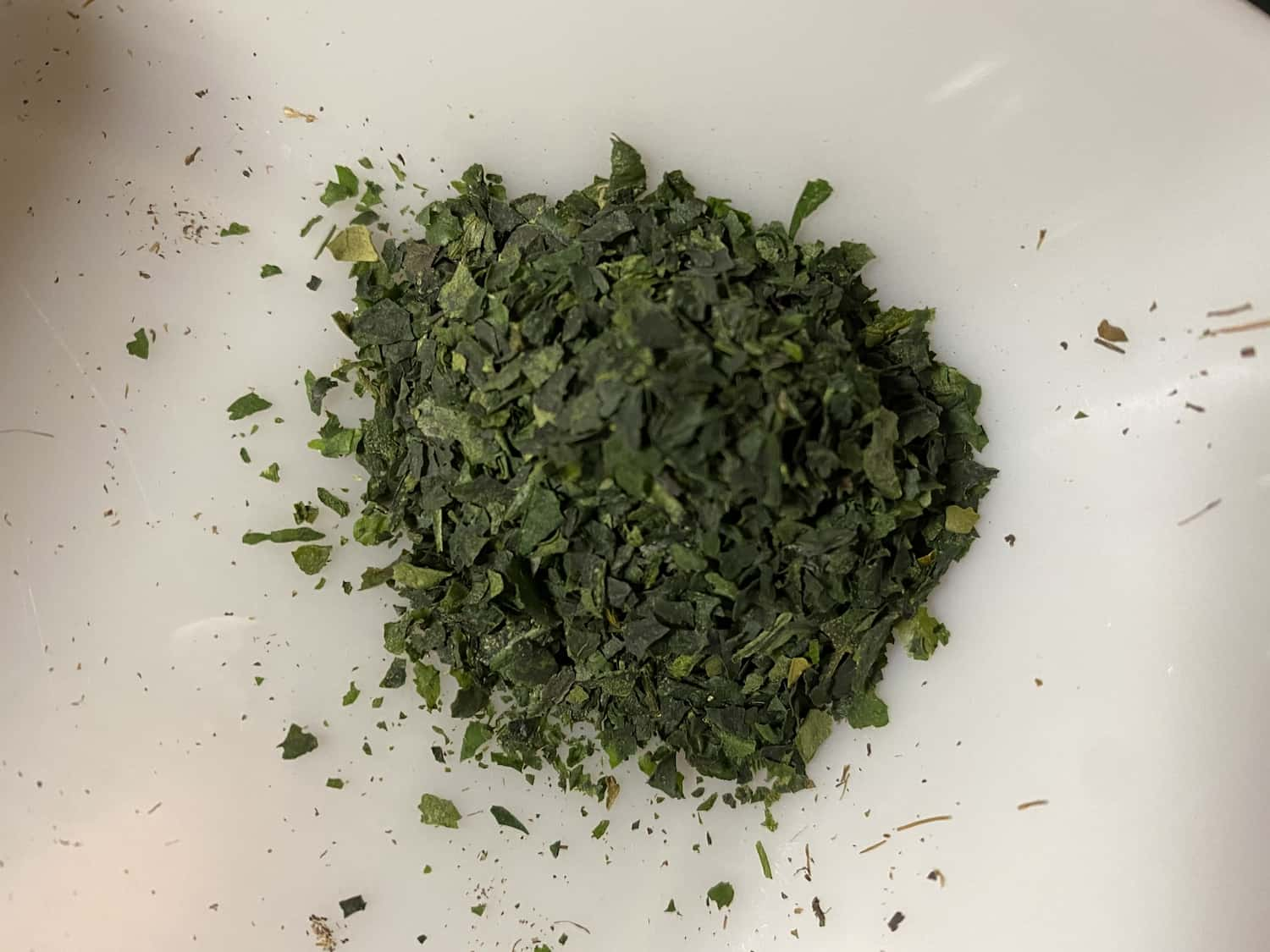

Open a bag of matcha and you find a silky green powder. Open a bag of the tea it comes from, and you might not recognize it as tea at all. The leaves are flat, thin and papery, more like flakes of dried seaweed than the dark needles of sencha. That tea is tencha, and almost all of it disappears into a stone mill before most people ever see it.
Tencha (碾茶) is a shade-grown Japanese green tea that is steamed and dried without being rolled. It is the raw leaf that is ground into matcha, but it can also be brewed on its own as a leaf tea. In this guide, you’ll learn what the name means, how it is grown and made, where it comes from, how it differs from gyokuro and sencha, and how to drink it as a leaf tea if you can find it.
The short answer
Tencha is the leaf tea used to make matcha. The tea plants are shaded for about three weeks before harvest, and the leaves are steamed and dried flat, without rolling. After the stems and veins come out, a mill grinds the soft leaf into matcha. A few producers also sell tencha whole, to brew as a leaf tea.
What Is Tencha?
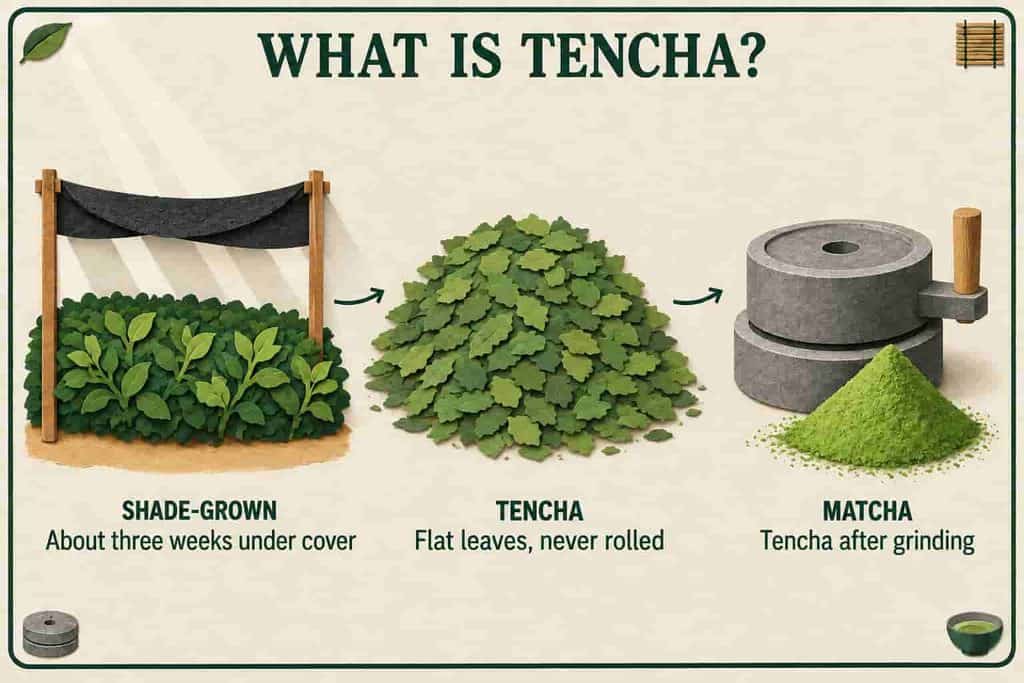
Tencha is a type of Japanese green tea made for one main purpose: to become matcha. Like gyokuro, it is grown under shade. Unlike gyokuro or sencha, it is never rolled, so the finished leaves stay flat and open.
Tencha Quick Facts
- Japanese name
- 碾茶, also written てん茶; read tencha
- Type
- Shade-grown, steamed green tea, dried without rolling
- Main use
- Ground in a mill to make matcha
- Shading
- About three weeks before harvest
- Leaf shape
- Flat, thin, papery flakes, with stems and veins removed
- Top producers
- Kagoshima, Kyoto and Shizuoka (2025)
- As a leaf tea
- Pale golden cup with a rich, savory umami
What the Name Tencha Means
The first character, 碾, means to grind, and it can also stand for usu, the word for a mortar or millstone. Put it together with 茶 (tea), and tencha means “tea for grinding.” The name describes the leaf’s destiny rather than its taste. Because 碾 is a rare character, many packages and documents simply use hiragana: てん茶. These words help you follow the tea from the field to the cup:
From leaf to matcha
碾茶
tencha
Shaded tea dried without rolling
てん茶
tencha
The same word in hiragana
荒碾茶
ara-tencha
Rough leaf, before finishing
仕立て
shitate
Finishing: cutting, sorting, sifting
石臼
ishiusu
Stone mill that grinds matcha
抹茶
matcha
The leaf after grinding
Not the same as “sweet tea”
In Japanese, 甜茶 is also read tencha, but it is a completely different drink. Chinese sweet tea is an herbal tea made from the leaves of a blackberry plant, Rubus suavissimus, not from the tea plant. If you’re shopping for matcha’s raw leaf, look for 碾茶 or てん茶 on the label.
How Tencha Is Grown
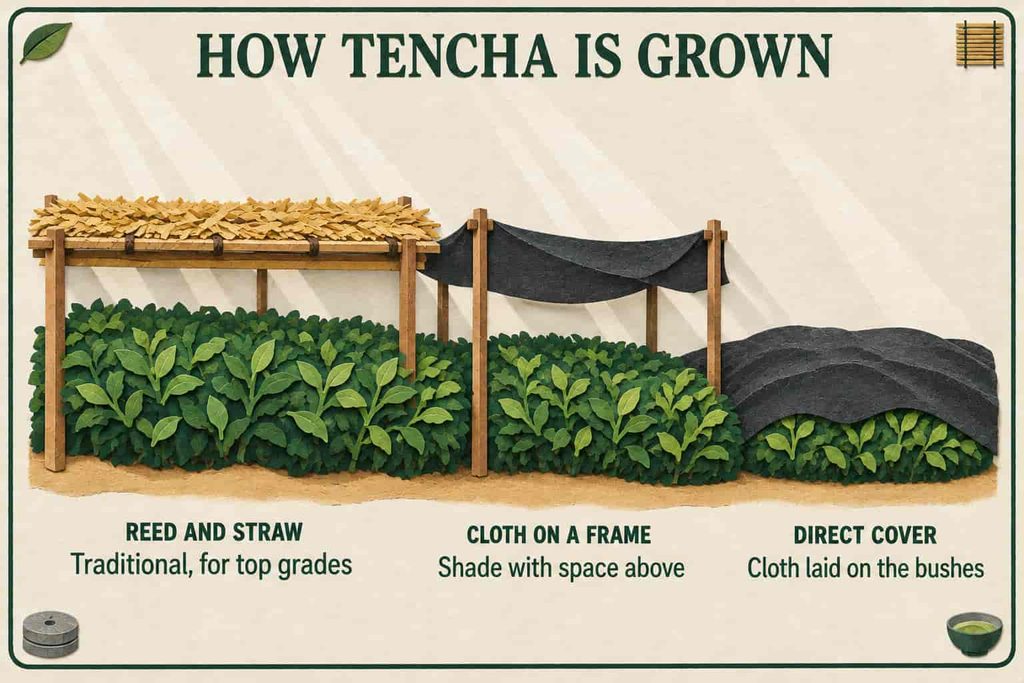
Shade is what makes tencha. For roughly the last three weeks before the spring harvest, the tea plants are covered to block most of the sunlight. With less light, the young leaves grow thinner, softer and a deeper green, and they keep more of the amino acids that give matcha its savory sweetness.
Farmers use several kinds of cover. In a 2020 trial report, the Aichi Agricultural Research Center described the conventional method as black shade cloth laid directly on the bushes, blocking about 85 percent of the light, for 21 days. Some traditional growers, notably in Uji, still use reed screens and rice straw on a frame above the plants.
Traditional cover
よしず・稲わら
Reed screens topped with rice straw on a frame. Labor-intensive and prized for top grades.
Shade cloth on a frame
棚がけ
Black cloth stretched over posts, leaving space above the bushes.
Direct cover
直がけ
Shade cloth laid right on the bushes. Simpler and now widely used.
Shading is a balancing act. In the same Aichi trial, which used Yabukita plants under direct cover, stronger shade and a shorter covering period raised taste scores but tended to lower the harvest. That is one trial rather than a rule, but it shows the trade-off: each grower chooses a method based on the quality and volume their buyers need.
How Tencha Is Made
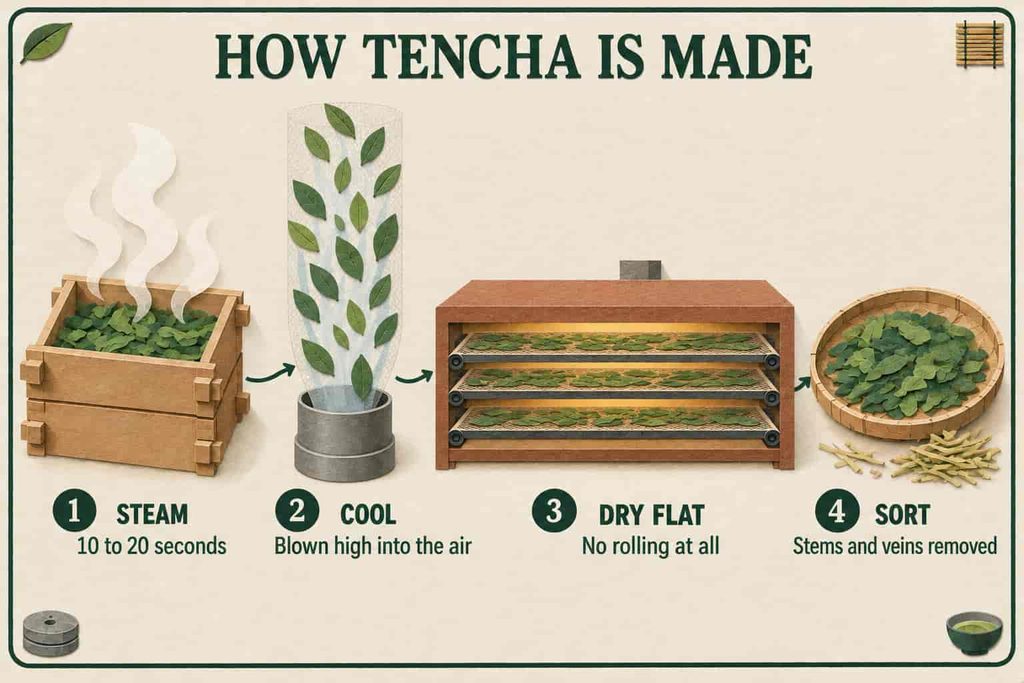
Tencha processing looks quite different from sencha processing. Sencha leaves are rolled again and again into tight needles. Tencha leaves stay flat from start to finish, because they will be ground anyway. The steps below follow a description by Yamamotoyama, a long-established tea company, and a Q&A from Saitama Prefecture’s tea research staff.
- Steaming: fresh leaves are steamed for about 10 to 20 seconds to stop oxidation and keep their green color.
- Cooling and scattering: fans blow the steamed leaves high into the air, as much as 5 to 6 meters, so they cool, lose surface moisture and separate from each other.
- Drying flat: the leaves pass through a long drying oven, over 10 meters, without any rolling. This special oven, called a tencha-ro (碾茶炉), carries the leaves on several tiers of conveyor belts.
- Separating: stems and tough parts are removed, leaving the soft, flat leaf. This rough leaf, or ara-tencha, holds only about 3 to 4 percent moisture. It is not yet the finished tea: the final sorting comes in the next stage.
Finishing and Grinding into Matcha
Before tencha can become matcha, it goes through a finishing stage called shitate. According to the Saitama Q&A, producers cut the leaves, remove the remaining stems and leaf veins, and trim the leaf to a size a stone mill can handle. A sieve takes out fine dust, and some producers also run the tea through a color sorter to remove pale or yellowed leaves. What remains is finished tencha, ready for the mill.
Only then is the tea ground. Traditional granite stone mills turn slowly, and Yamamotoyama notes that one mill produces only about 40 to 50 grams of matcha an hour. That slow pace is one reason good matcha is expensive.
Worth knowing
Why skip rolling? Rolling breaks the leaf cells and shapes sencha so it releases flavor slowly in a teapot. This leaf doesn’t need that, because it is going straight to the mill. Leaving the leaves flat also makes it easier to strip out the stems and veins, which would make matcha gritty.
Tencha vs. Matcha, Gyokuro and Sencha
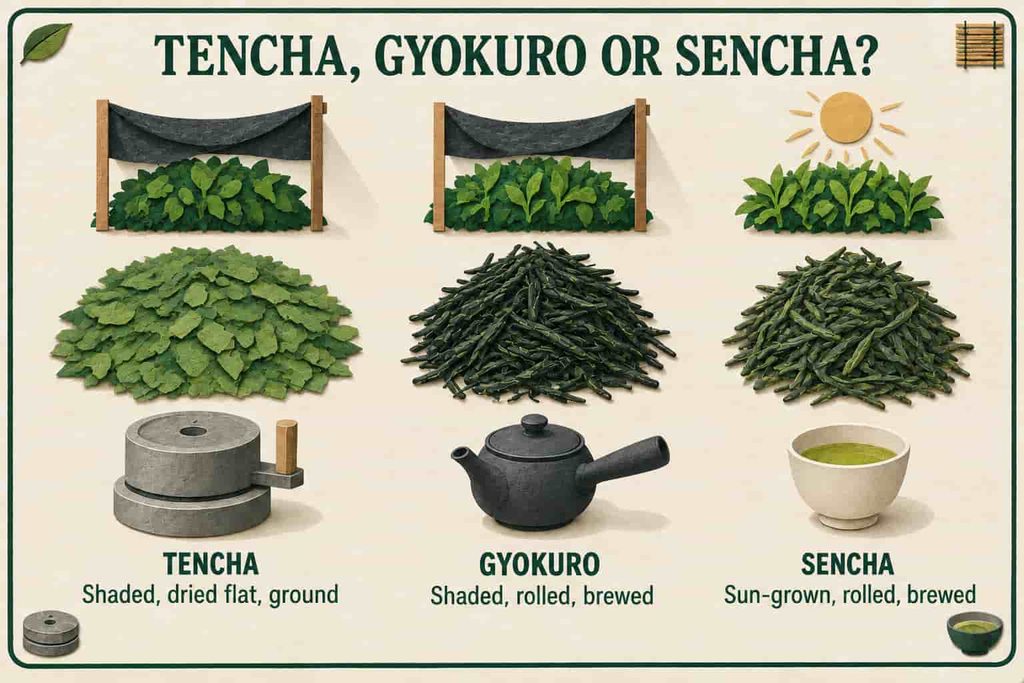
Tencha sits at a crossroads of Japanese tea. It shares its shade with gyokuro, its steaming with sencha, and its future with matcha. The table shows how the four compare.
| Tea | Shaded? | Rolled? | What it looks like | How it’s used |
|---|---|---|---|---|
| Tencha (碾茶) | Yes, about 3 weeks | No | Flat, thin flakes | Ground into matcha; sometimes brewed |
| Matcha (抹茶) | Yes (made from the same leaf) | No | Fine, bright green powder | Whisked and drunk whole |
| Gyokuro (玉露) | Yes, about 3 weeks | Yes | Dark, glossy needles | Brewed slowly at low temperature |
| Sencha (煎茶) | Usually not | Yes | Dark green needles | Brewed in a teapot |
The key point is simple: tencha and gyokuro are grown in almost the same way, and they part ways in the factory. Gyokuro is rolled into needles for brewing. Tencha is dried flat for grinding. Grind that flat leaf, and you get matcha, which is why the international technical report on matcha, ISO/TR 21380, defines matcha by its plant, its cultivation and its production method.
Where Tencha Comes From
Kyoto’s Uji area is the historic home of tencha and matcha, but production has spread and grown fast. Japan’s Ministry of Agriculture, Forestry and Fisheries (MAFF) reports that, with rising demand, tencha production in 2025 was about 3.2 times what it was in 2014.
| Rank (2025) | Prefecture | Note |
|---|---|---|
| 1 | Kagoshima | Largest producer in Japan |
| 2 | Kyoto | Home of Uji tea; also 2nd for gyokuro |
| 3 | Shizuoka | Japan’s best-known tea region |
Tencha is still a small share of Japanese tea overall. According to the same MAFF report, it made up 8.6 percent of Japan’s crude tea production in 2025. It is also valuable: its average crude tea price was about 8,562 yen per kilogram, roughly 4.9 times that of ordinary sencha.
What Does Tencha Taste Like?
Most people taste tencha only as matcha, but you can also brew the leaf on its own, and it is a surprise. The cup is a pale golden color, much lighter than you’d expect from such a green leaf. The aroma, though, is strong.
Oyaizu Seiichi Shoten, a Shizuoka tea wholesaler that sells it as a leaf tea, describes the tencha it sells as having a thick, smooth umami similar to dashi, with a gentle sweetness. The first infusion is fresh and savory. The second is cleaner, with a sweet finish. Because the leaves stay flat and unbroken, they release their flavor slowly and reward patience.
Compared with matcha, brewed tencha has none of the thick texture of whole powdered leaf, because you drink only the liquid. It is a quiet, elegant tea that shows the shaded leaf in a completely different light.
How to Drink Tencha
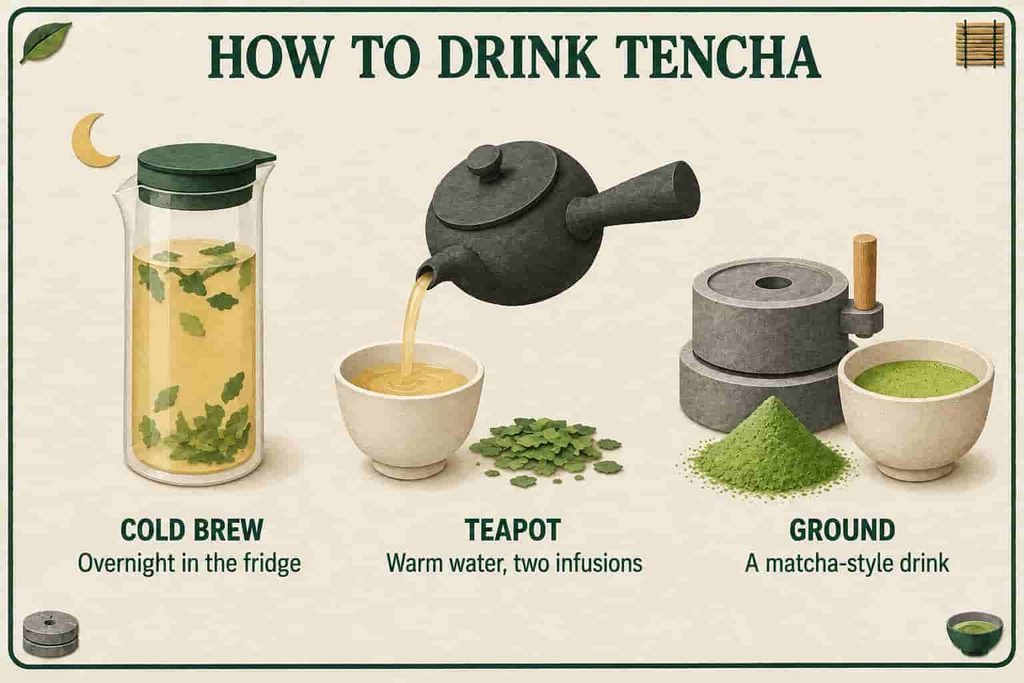
If you find tencha sold as a leaf tea, there are three ways to enjoy it. Start with the method printed on the package, since leaf size and grade vary between producers. The flat leaves are bulky, so you’ll need more volume of leaf than you would for sencha.
Cold brew
Sweet and smooth
- Leaf
- A little more than usual
- Water
- Cold, in a cold-brew pot
- Time
- Overnight in the fridge
Teapot
Savory and aromatic
- Leaf
- As on the package
- Water
- Warm, not boiling
- Infusions
- Two or more; the second is sweeter
Ground at home
A matcha-style drink
- Tool
- Tea mill or spice grinder
- Result
- Coarser than stone-milled matcha
- Use
- Drinks, sweets, cooking
Cold brewing is the easiest way to start. Oyaizu Seiichi Shoten suggests putting a little more leaf than usual into a cold-brew pot with water and leaving it in the fridge overnight. Hot and cold water bring out different flavors, so it’s worth trying both. Grinding the leaves at home won’t match the fineness of stone-milled matcha, but it is a fun way to see how matcha begins.
How to Buy and Store Tencha
Tencha is hard to find as a leaf tea, because nearly all of it becomes matcha. You’re most likely to see it at specialist tea shops, matcha producers and some online stores in Japan. A few points help you choose well.
- Check the characters: look for 碾茶 or てん茶, not 甜茶, which is an herbal sweet tea.
- Look at the leaf: choose flat, evenly colored leaves with few visible stems. Appearance helps, but origin, processing, freshness and the producer’s grade matter too.
- Check the origin: labels may name Uji (Kyoto), Kagoshima, Shizuoka or another region.
- Check the harvest: producers usually make the best matcha from first-flush (spring) leaf.
- Buy small amounts: the thin leaves lose aroma quickly once opened.
Store tencha sealed in a cool, dark, dry place, away from strong smells. If you keep it in the fridge, let the bag reach room temperature before opening, so condensation doesn’t form on the cold leaves. Saitama Prefecture’s tea research staff give the same advice to producers taking the leaf out of cold storage in summer. Follow any storage advice on the package.
Why Tencha Is Worth Knowing
You may never buy a bag of tencha, but knowing it changes how you see matcha.
- It explains matcha: matcha’s color, sweetness and price all start with how farmers shade it and how factories dry it.
- It connects the family: once you know this tea, the links between gyokuro, sencha and matcha make sense.
- It’s a rare treat: brewed tencha shows a side of the shaded leaf that few tea drinkers ever taste.
Next time you whisk a bowl of matcha, picture the flat green flakes it started as, and the slow turn of the stone mill that brought them to your cup.
Tencha FAQ
About the Tea
Is tencha the same as matcha?
Not quite. Tencha is the leaf, and matcha is what you get when you grind it into powder. Matcha is made from tencha, but tencha itself is a flat, dried leaf.
What is the difference between tencha and gyokuro?
Both are shaded for about three weeks before harvest. Gyokuro is then rolled into needles for brewing, while tencha is dried flat so it can be ground into matcha.
Is tencha the same as Chinese sweet tea?
No. Chinese sweet tea (甜茶) also has the Japanese reading tencha, but it is an herbal tea made from a blackberry plant. Labels write matcha’s raw leaf as 碾茶 or てん茶.
Drinking and Buying
Can you drink tencha without grinding it?
Yes. A few producers sell it as a leaf tea. It brews a pale golden cup with a rich, savory umami, and it works well as a cold brew left overnight in the fridge.
Can I make matcha at home from tencha?
You can grind tencha with a tea mill or spice grinder, but the powder will be coarser than stone-milled matcha. It works for drinks and cooking, though it won’t whisk as smoothly.
Where is most tencha made?
According to MAFF, Kagoshima was Japan’s largest tencha producer in 2025, followed by Kyoto and Shizuoka. Kyoto’s Uji area is its historic home.
References
- Ministry of Agriculture, Forestry and Fisheries of Japan – The situation of tea (お茶をめぐる情勢), on tencha production growth, leading prefectures, share and price (2025 data). (Accessed October 2026)
- Aichi Agricultural Research Center – Direct-cover cultivation of tencha (2020), on shade cloth, shading rate and covering period. (Accessed October 2026)
- Saitama Prefecture – Tencha Q&A (碾茶Q&A), on rough tencha moisture, finishing before matcha, and cold storage. (Accessed October 2026)
- Yamamotoyama – How matcha is made, on steaming, cooling, drying and stone-mill output. (Accessed October 2026)
- Oyaizu Seiichi Shoten – Tencha sold as a leaf tea (2017 press release), on the flavor of brewed tencha and cold brewing. (Accessed October 2026)
- Kotobank – Matcha (抹茶), on shading for about 20 days with reed screens, straw and cloth, and tencha as matcha before grinding. (Accessed October 2026)
- ISO – ISO/TR 21380:2022 Matcha tea: Definition and characteristics, on the international definition of matcha. (Accessed October 2026)
- Wikipedia – Chinese sweet tea, on 甜茶 made from Rubus suavissimus. (Accessed October 2026)



Comments