


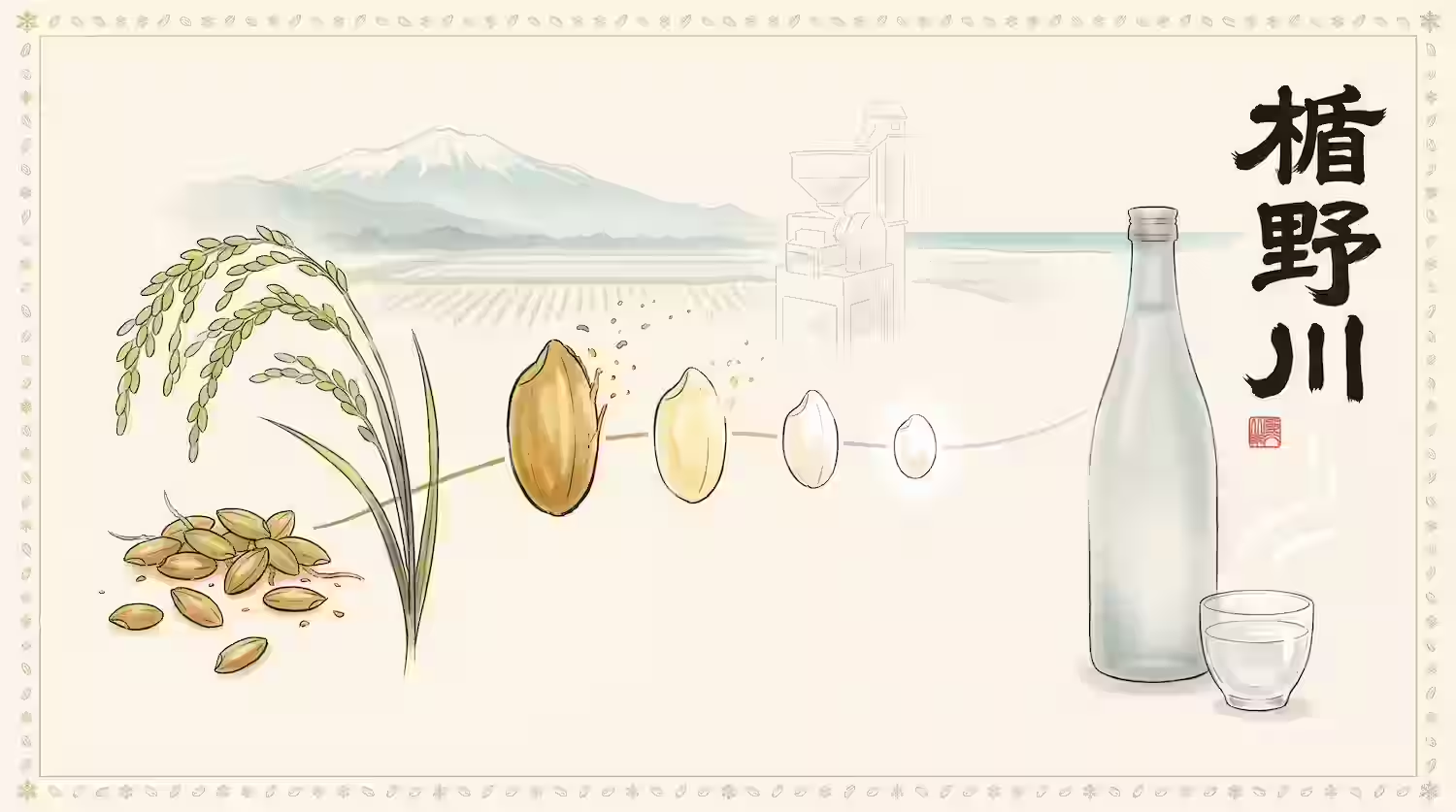

Tatenokawa (楯野川) is best known for a sake made from rice polished until only 1 percent of its original weight remains. Yet the brewery is more than one record number. In Sakata, on Yamagata’s Shonai Plain, it has built a whole range around clean, aromatic Junmai Daiginjo, from an easygoing 50 percent bottle to the rare Komyo.
This guide explains how the bottles differ in taste and price, what those polishing ratios really mean, and why more polishing does not automatically make “better” sake. Choosing your first bottle? If so, start with the buying guide, then dig into the rice, the brewing, and the history.
What Is Tatenokawa Sake?
Tatenokawa is a sake brand from Sakata, Yamagata Prefecture, made by Tatenokawa, Inc. (楯の川酒造). Since 2010, every sake sold under the brand has been Junmai Daiginjo, brewed without added distilled alcohol. As a result, its range spans polishing ratios from 50 percent down to an exceptional 1 percent.
Quick Facts
- Brand
- Tatenokawa (楯野川), English name “Castle Brook”
- Producer
- Tatenokawa, Inc. (楯の川酒造株式会社)
- Location
- Yamadate, Sakata City, Yamagata Prefecture, in the Shonai region of northern Japan
- Roots
- Founding year 1832; formal sake brewing began in 1854
- Specialty
- Junmai Daiginjo only, since 2010
- Main rice
- Dewasansan and Miyama Nishiki from Yamagata, plus Yamada Nishiki from Hyogo
- Signature bottles
- Seiryu (50%), Kyuryu (33%), Kyokugen (8%), Komyo (1%)
- Exports
- 27 countries and regions listed by the brewery
Next, two names appear in Japanese sources. Tatenokawa (楯野川) is the brand on the label, while 楯の川酒造 is the company. Also note that the Junmai Daiginjo rule covers Tatenokawa sake. Meanwhile, the wider corporate group runs separate companies and brands for other drinks, such as liqueur and whisky.
Which Tatenokawa Sake Should You Choose?
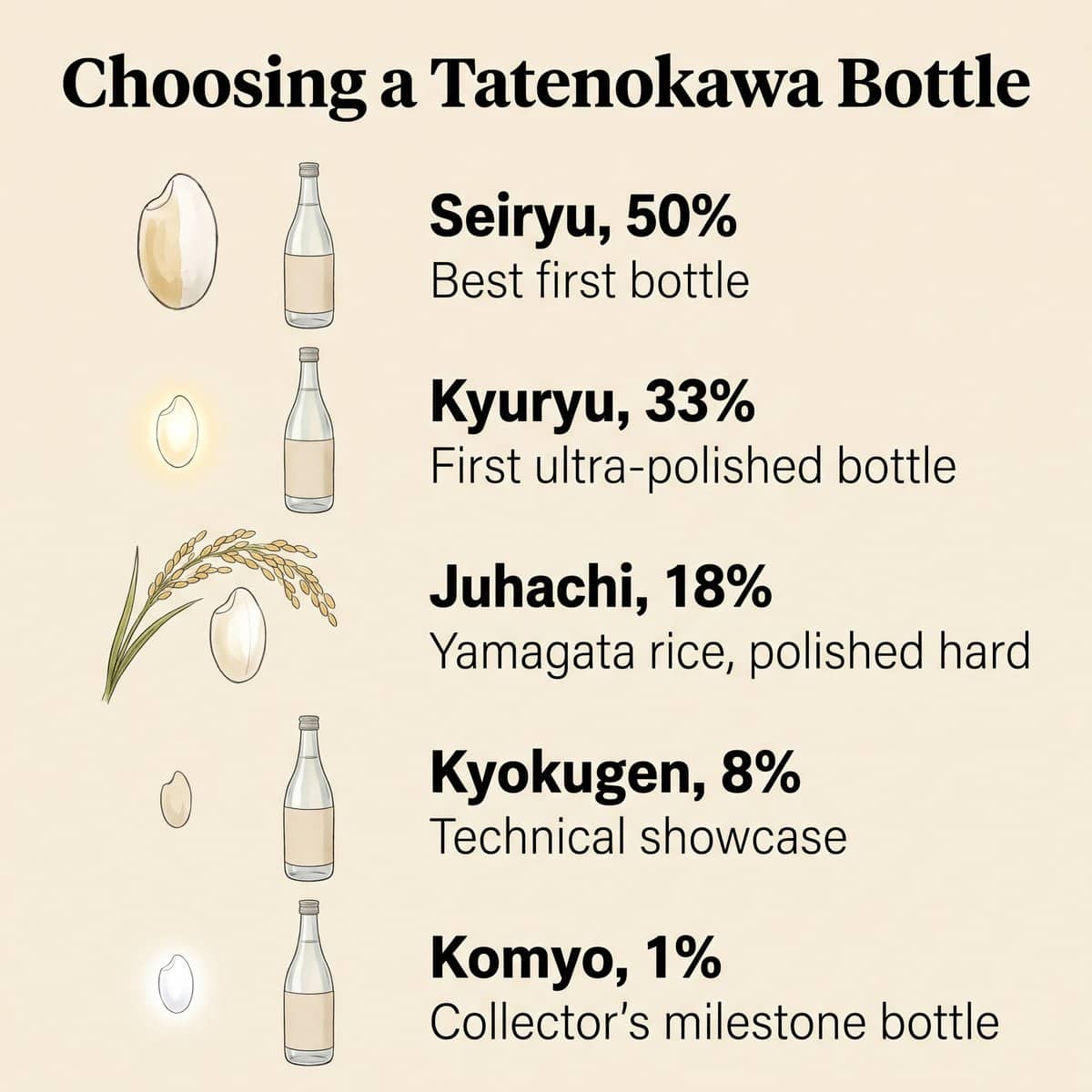
For a first bottle, Seiryu at 50 percent is the easiest start. Next, Kyuryu at 33 percent is the brewery’s own entry point into ultra-polished sake. Finally, Kyokugen and Komyo are showcase bottles for drinkers who already know they enjoy this style. Below, the table pairs each Japanese name with its romanized and English names.
| Bottle | Rice | Polishing ratio | Availability | Price (720 ml) |
|---|---|---|---|---|
| Seiryu (清流) | Dewasansan, Yamagata | 50% | Year-round | ¥2,035 |
| Kyuryu (急流), “Stream Red” | Dewasansan, Yamagata | 33% | Limited | ¥4,620 |
| Juhachi (十八), “Eighteen” | Yukimegami, Yamagata | 18% | Limited | ¥19,800 |
| Kyokugen (極限), “Ultra” | Yamada Nishiki, Hyogo | 8% | Limited | ¥38,500 |
| Komyo Dewasansan (光明), “Zenith” | Dewasansan, Yamagata | 1% | Limited | ¥165,000 |
| Komyo Yamada Nishiki (光明), “Zenith” | Yamada Nishiki, Hyogo | 1% | Limited | ¥308,000 |
Note that prices are the brewery’s suggested retail prices in Japan, tax included. We checked them on the official product pages on October 25, 2026, and they may change. “Limited” means the brewery labels the bottle as a limited-quantity release.
Best first bottle
Seiryu, 50%. The brewery describes a gentle aroma and a light, smooth texture.
First ultra-polished bottle
Kyuryu, 33%. The entry model of the Extreme series.
Yamagata rice, polished hard
Juhachi, 18%, made with Yukimegami rice developed in Yamagata.
Technical showcase
Kyokugen at 8%, or Komyo at 1% for a collector’s milestone bottle.
What Does Tatenokawa Sake Taste Like?
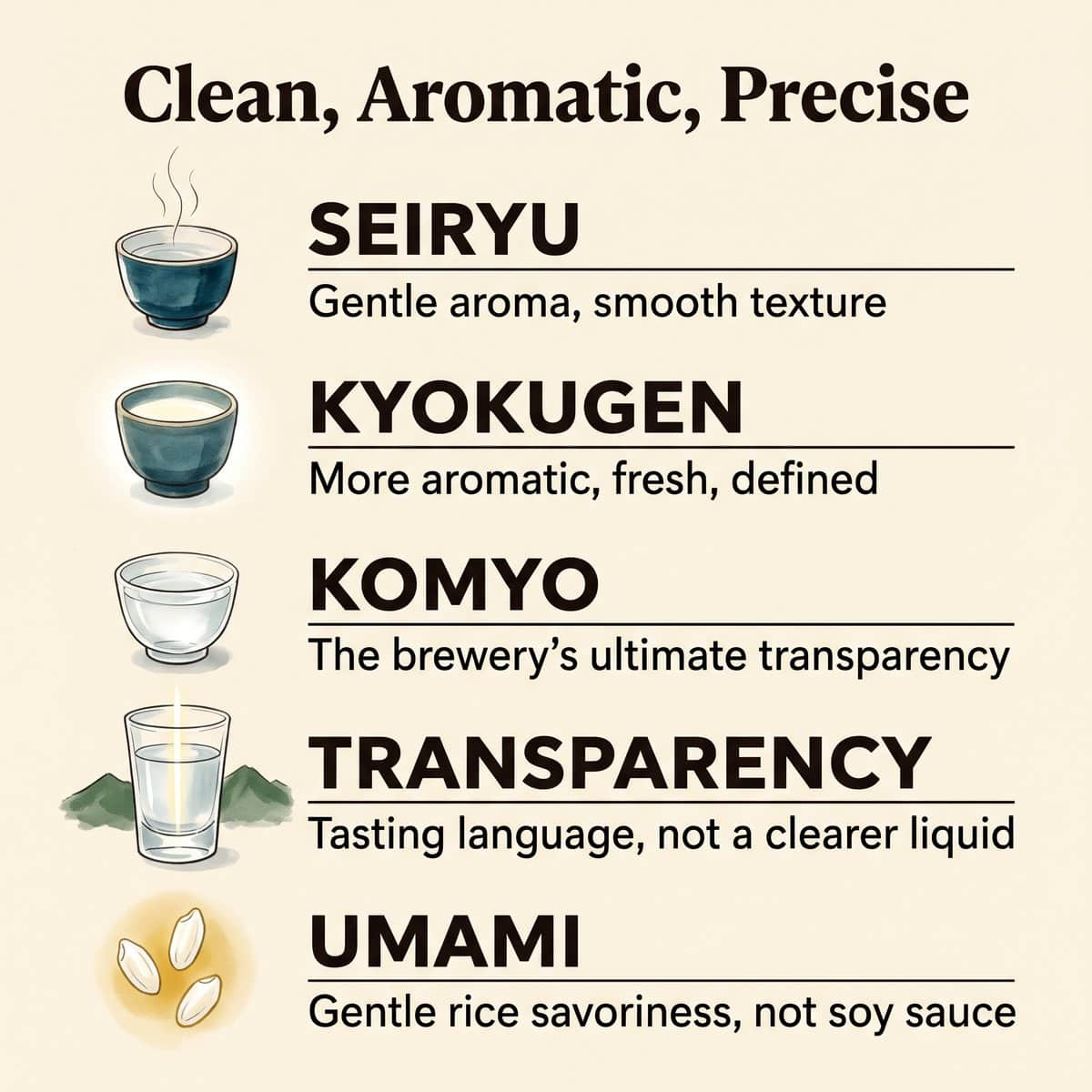
Tatenokawa’s shared style is clean and aromatic, but sweetness and intensity vary by bottle. The brewery sums up its house style as “clean sake that has an aroma and umami.” Seiryu sits at the light, easy end of the range. Beyond that, however, the brewery’s descriptions move toward more aroma, definition, and delicacy.
For Seiryu, the brewery describes an aroma that spreads gently, a smooth texture, and a refreshing finish that fades quickly. Similarly, it calls the latest Kyokugen “more aromatic, fresh, and well-defined.” For Komyo, it stresses “ultimate transparency.” These are the brewery’s words, not results from an outside tasting panel.
Two terms also deserve a quick translation. Here, “transparency” does not mean the liquid looks clearer. Instead, it is tasting language for sake that feels light and precise, without obvious roughness. Likewise, umami in sake usually shows up as a gentle, rice-derived savoriness or breadth on the palate. However, it does not mean the sake tastes like soy sauce or broth.
Dry or Sweet? Reading the Official Specs
Fortunately, the brewery publishes basic numbers for each bottle. The sake meter value (SMV) gives a rough hint: a lower or negative value tends to signal a sweeter impression. Still, acidity, aroma, and temperature also change how sweet a sake feels, so treat SMV as a clue, not a verdict.
| Bottle | Alcohol | SMV | Acidity | Yeast |
|---|---|---|---|---|
| Seiryu | 14% | +1 | 1.5 | Yamagata KA |
| Kyuryu | 14% | -5 | 1.4 | Yamagata KA, Kyokai 1801 |
| Juhachi | 14% | -8 | 1.6 | Yamagata KA, M310 |
| Kyokugen | 15% | -4 | 1.6 | Yamagata KA, M310 |
| Komyo Dewasansan | 15% | -1 | 1.4 | Yamagata KA, Kyokai 1801 |
| Komyo Yamada Nishiki | 15% | -2 | 1.3 | Yamagata KA, Kyokai 1801 |
These figures come from the official Japanese product pages, checked in October 2026. Because of vintage changes, they can shift from year to year. On paper, Seiryu reads as the driest of the group, while Juhachi and Kyuryu lean sweeter. Our guide on how to read a sake label explains these terms further.
How to Serve and Store Tatenokawa Sake
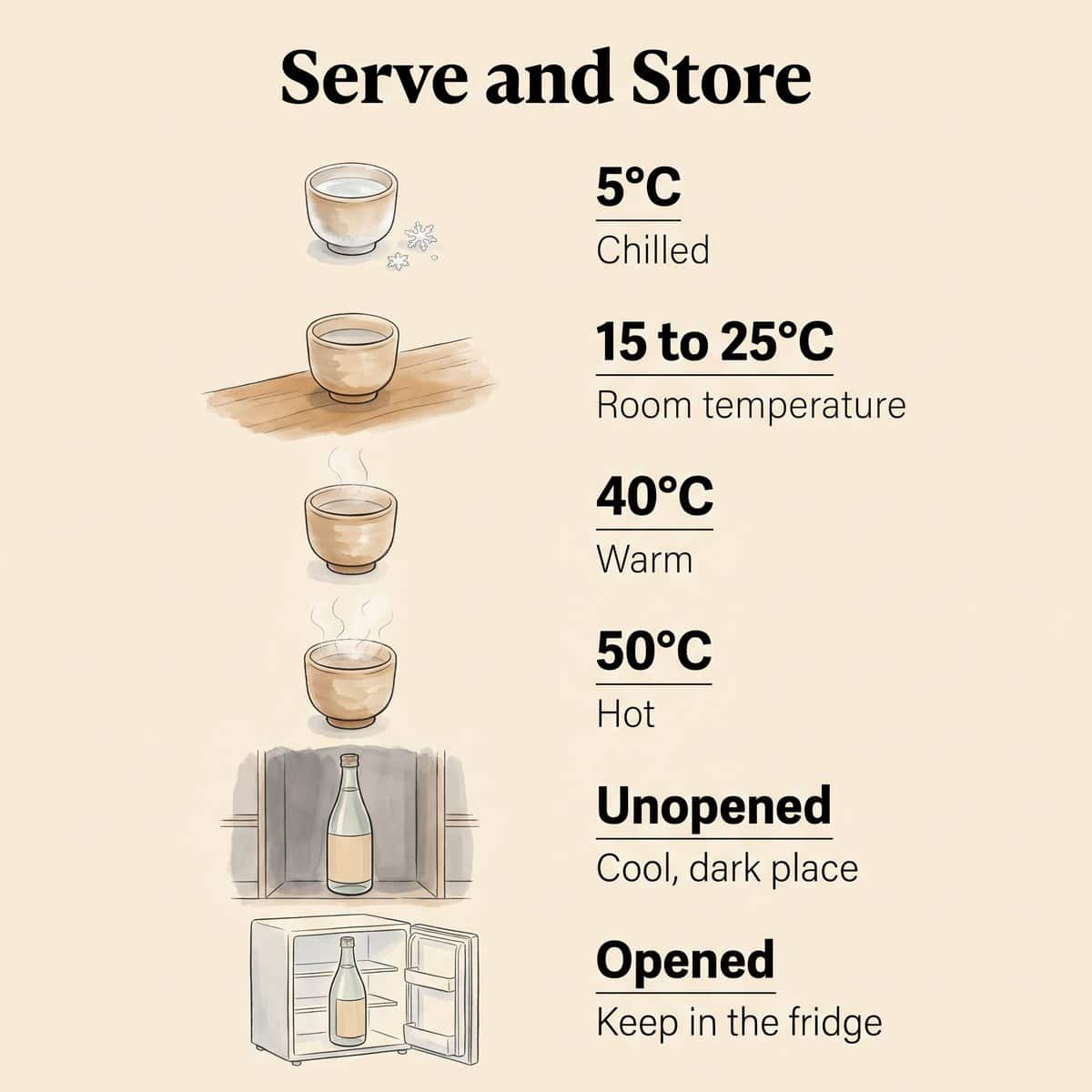
Overall, serving temperature is a matter of taste, and the brewery leaves room for choice. For instance, each product page shows a temperature scale from chilled (5°C) through room temperature (15 to 25°C) to warm (40°C) and hot (50°C). The text does not name one ideal point for every bottle, though its older brand guide suggested about 15°C for Seiryu.
A reasonable approach is to start cool, then let the glass warm a little and notice how the aroma changes. For storage, the brewery says it keeps its bottled sake at low temperatures. At home, a cool, dark place works for unopened bottles, and the fridge is the usual choice once opened. Above all, follow any instructions on the label, and see our guide on how to store sake for details.
Outside Japan, the brewery lists 27 countries and regions on its export page, including the United States, Canada, the United Kingdom, and Australia. Since local importers handle sales, availability and prices differ by market. Finally, please remember that sake is alcohol. In Japan, the legal drinking age is 20, and drinking before driving is never acceptable.
What Does Junmai Daiginjo Mean?
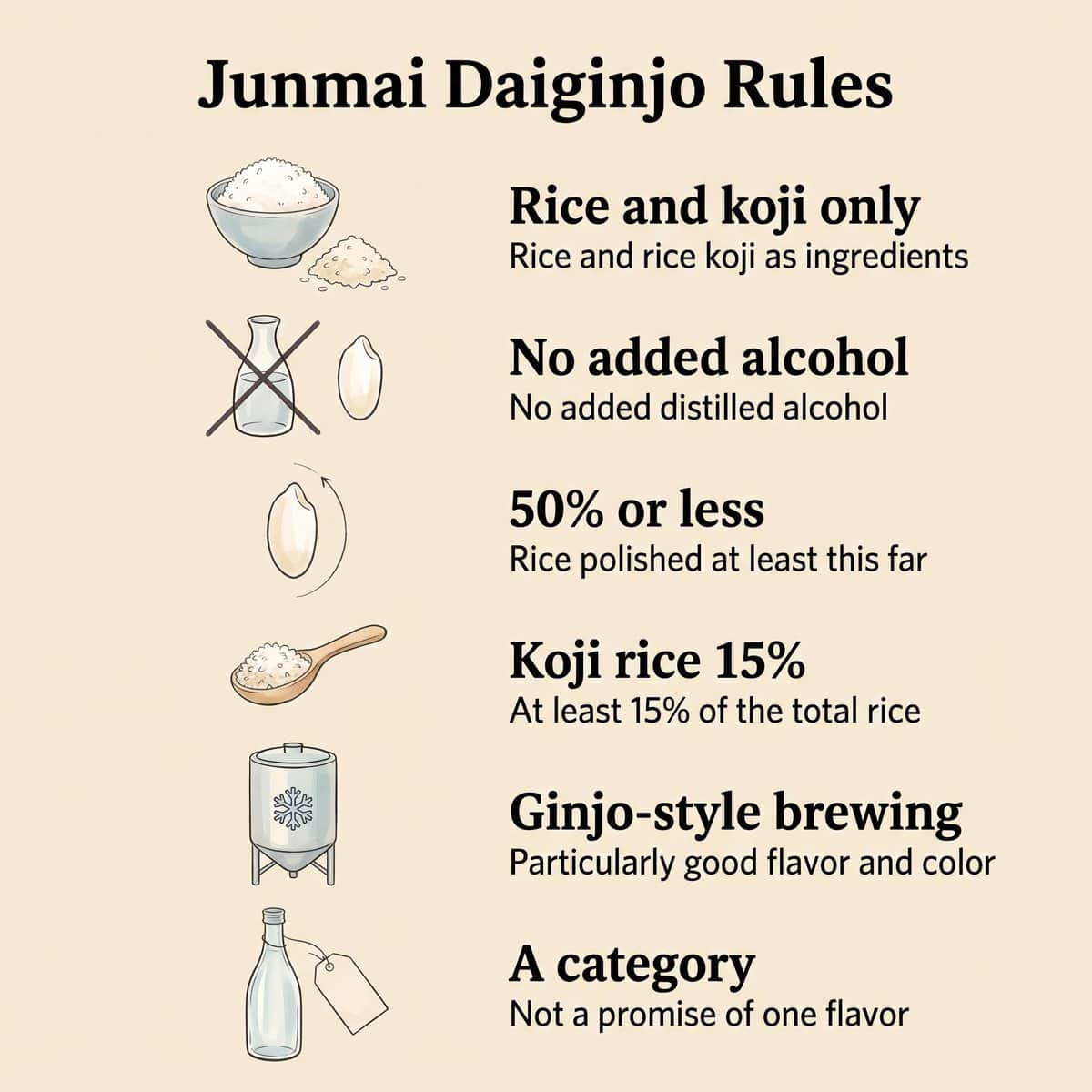
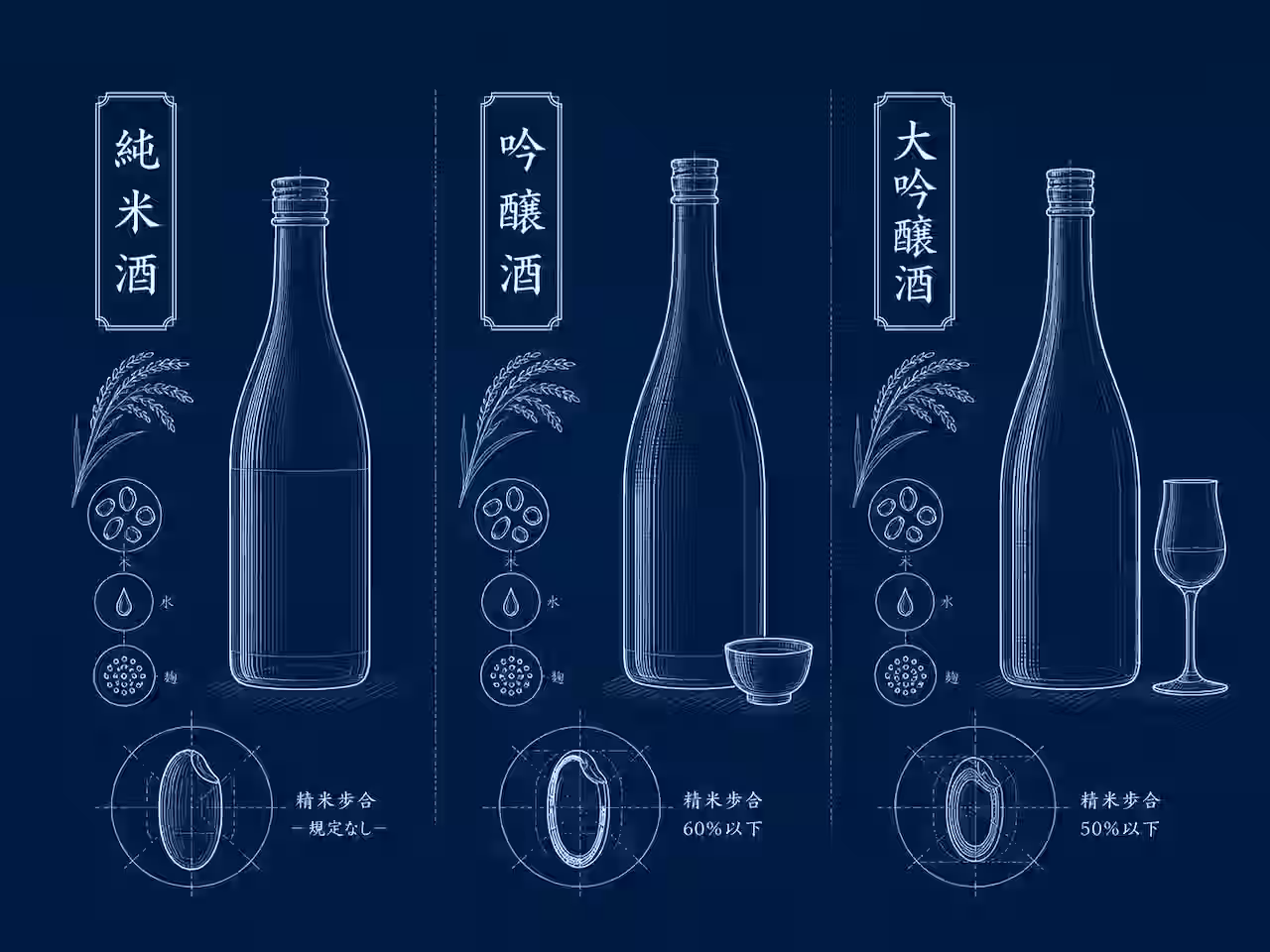
Junmai Daiginjo is a legal labeling category set by Japan’s National Tax Agency. Specifically, it has the strictest polishing threshold among the pure-rice ginjo designations. That does not make every Junmai Daiginjo objectively better than other styles of sake.
To qualify, a sake must list only rice and rice koji as ingredients, with no added distilled alcohol. Of course, brewers also use water, and koji mold and yeast drive the fermentation. In addition, the rice must be polished to 50 percent or less, and koji rice must make up at least 15 percent of the total rice. Finally, the sake must also use ginjo-style brewing and show a particularly good flavor and color.
The 50 percent line is a ceiling, not a target. For example, a sake polished to 33, 8, or even 1 percent still sits in the same category. For a broader primer, see our guides to Junmai sake, Daiginjo, and the main types of Japanese sake.
Key idea
Junmai Daiginjo is a regulated category, not a promise of one particular flavor.
Why Does Tatenokawa Make Only Junmai Daiginjo?
Tatenokawa shifted to Junmai Daiginjo-only production in 2010 for two reasons: to make its range easier to understand, and to concentrate its brewing resources on one category. The brewery presents this as a strategy of clarity and focus. In other words, it does not claim that other sake categories are inferior.
On clarity, the brewery argues that Japan’s eight official “special designation” categories confuse newcomers. Therefore, it wanted Japanese beginners and overseas drinkers alike to understand its sake at a glance. On quality, it says one grade gives the whole team a clear target to keep improving. It also states, though, that it does not reject sake made with added brewing alcohol.
Tatenokawa describes itself as the first brewery in Yamagata to make only Junmai Daiginjo. However, that is a brewery claim, and we did not find an independent prefectural or industry register that confirms it.
Making one category does not mean making one sake, however. Indeed, the range still varies by rice, polishing ratio, yeast, and batch size, as the tables above show. Specialization sets the frame; the individual bottles fill it in different ways.
Rice Polishing and the 1% Challenge
Above all, rice polishing is the heart of Tatenokawa’s identity. The brewery has polished its own rice since the 1990s, and its range climbs from 50 percent to 1 percent. To read those numbers correctly, you first need to know what a polishing ratio measures. Meanwhile, our rice polishing guide covers the basics in more depth.
What a 1% Polishing Ratio Means
A 1 percent rice polishing ratio means that only 1 percent of the original brown rice weight remains after milling; 99 percent has been removed. In other words, it does not mean that 1 percent was removed. After all, Japan’s labeling rules define the ratio as the weight of polished rice compared with the original brown rice.
| Tatenokawa example | Polishing ratio | Rice weight remaining | Rice weight removed |
|---|---|---|---|
| Seiryu (Dewasansan) | 50% | Half remains | Half removed |
| Kyuryu (Dewasansan) | 33% | About one-third remains | About two-thirds (67%) removed |
| Kyokugen (Yamada Nishiki) | 8% | 8% remains | 92% removed |
| Komyo (Dewasansan or Yamada Nishiki) | 1% | 1% remains | 99% removed |
These figures describe weight, not size. Because polishing removes material from all sides, a grain at 50 percent is not half as long, either. For Komyo, the brewery says the finished grain measures about 1 millimeter across.
Why Polish Further?
The outer part of brown rice holds more protein, lipids, and minerals. Japan’s National Research Institute of Brewing notes that too much of these can cause unpleasant flavors. Polishing therefore removes them and leaves more of the starchy center. Ginjo brewers then pair that rice with cool, slow fermentation to create the style’s characteristic flavor.
Time, Cost, and Cracked Grains
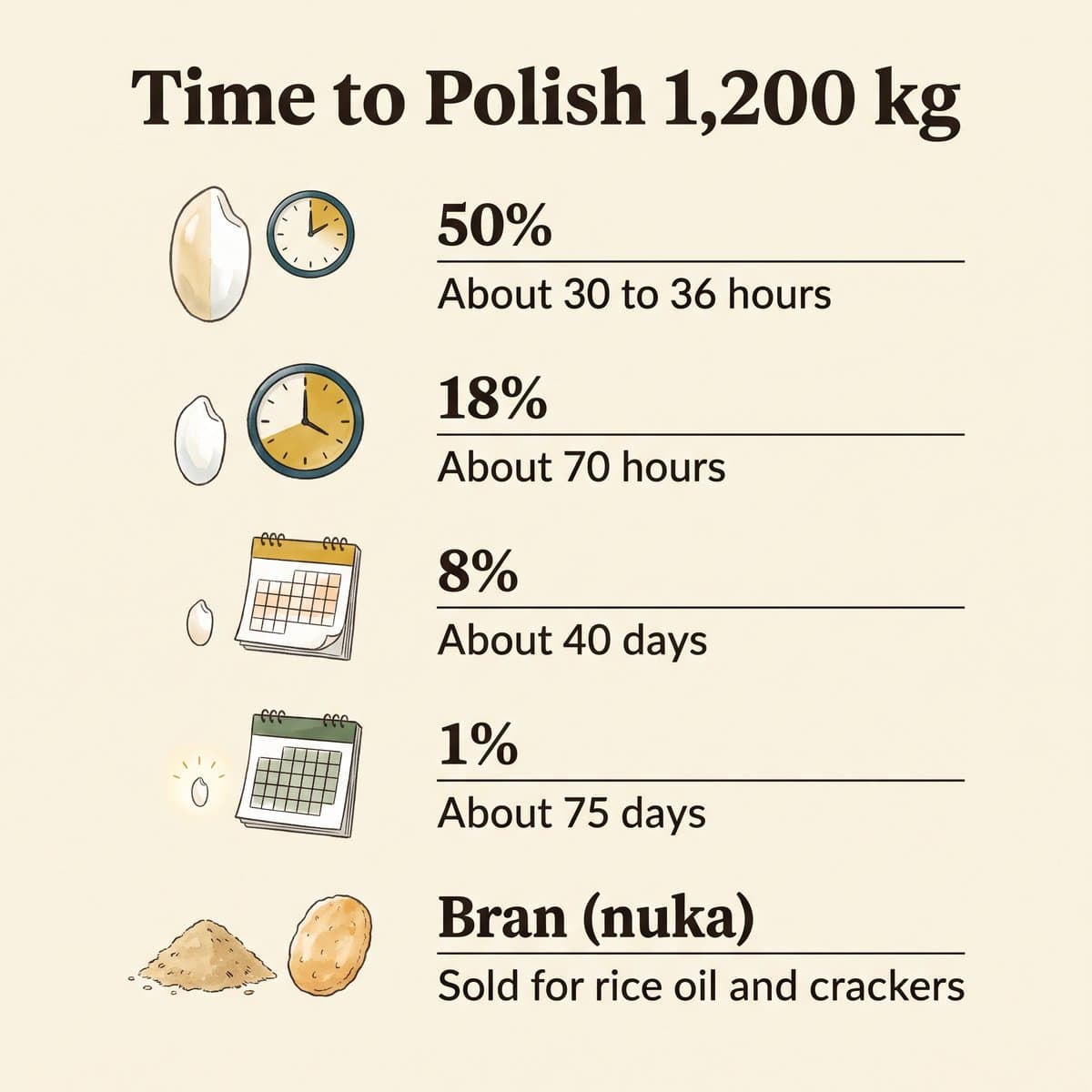
Time climbs fast. Tatenokawa’s brand guide says polishing 1,200 kilograms of rice to 50 percent takes about 30 to 36 hours, and around 70 hours to reach 18 percent. At the far end, it reports roughly 40 days for 8 percent and about 75 days for its 1 percent Dewasansan. Fortunately, the brewery sells the removed bran, or nuka, for uses such as rice oil and rice crackers.
Moreover, extreme polishing is hard on the grain. The National Research Institute of Brewing notes that highly polished rice cracks easily, and cracked rice absorbs water less predictably. Similarly, a 2009 study in Plant Production Science found that varieties with larger air spaces in the white core break more easily during polishing. As of September 2019, the brewery reported running three in-house polishing machines, each holding 20 bales.
Tatenokawa’s Signature Bottles
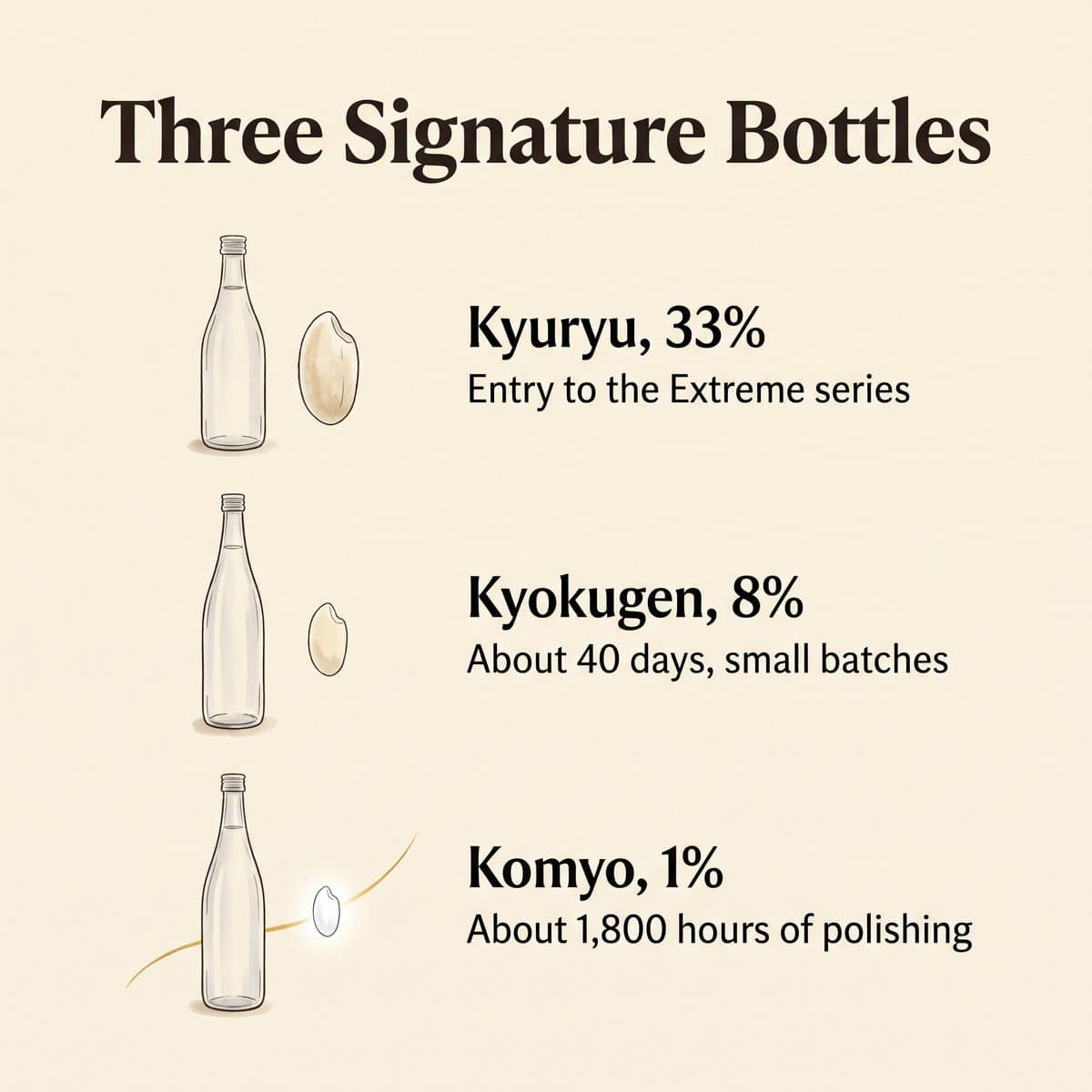
Three bottles show how far the brewery takes polishing: Kyuryu at 33 percent, Kyokugen at 8 percent, and Komyo at 1 percent. Yet each also shows that the work does not stop at the polishing machine.
Komyo: The One-Percent Bottle
Komyo (光明) uses rice polished to 1 percent. According to the brewery, it reached that ratio in the 2016 brewing year, and that no other brewery had produced it when Komyo went on sale. No independent registry certifies that “first,” so the claim remains the brewery’s own.
In fact, Komyo comes in two versions. Komyo Dewasansan, released in 2017, uses Yamagata-grown Dewasansan and takes about 1,800 hours, or roughly 75 days, of polishing. The Yamada Nishiki version, from 2019, uses Hyogo-grown rice and takes about two and a half months. The same number, then, does not mean the same rice.
Kyokugen: Precision and Small Batches
Kyokugen (極限), meaning “the limit,” debuted in 2013, and the brewery calls it a flagship. Specifically, it uses Hyogo-grown Yamada Nishiki polished to 8 percent over roughly 40 days. Today, Kyokugen comes from the brewhouse completed in 2021.
There, the brewery says it brews Kyokugen in small batches and manages the moromi, or mash, in steps of 0.1°C. Note that this figure describes how finely staff set and track the temperature. It does not mean the mash never moves beyond 0.1°C. Its two yeasts, Yamagata KA and M310, also shape the aroma.
Kyuryu: The Entry to the Extreme Series
Kyuryu (急流), meaning “rapid stream” and sold in English as Stream Red, is the entry model of the Extreme series. In addition, it uses Yamagata-grown Dewasansan polished to 33 percent. Accordingly, the brewery presents it as a first step toward single-digit bottles like Kyokugen and Komyo. It is also a way to taste high polishing and Yamagata rice in one glass.
Does More Rice Polishing Always Mean Better Sake?
No. Polishing changes the raw material and can open a route to delicate, refined styles. Yet a lower number is not a score. A polishing ratio is a production specification, not a universal measure of quality.
What high polishing can offer
- Different raw-material character, with fewer outer-layer components
- A possible route to delicate, refined styles
- Proof of technical precision
- A distinctive product identity
What it cannot guarantee
- A preferred style for every drinker
- Better food pairing in every situation
- Greater complexity in every bottle
- Better value for every budget
Koji, yeast, fermentation temperature, and aging all shape the final glass, so two sakes at the same ratio can taste quite different. Meanwhile, less polished sake, slowly aged jukusei sake, and traditional yamahai brews offer depth and structure that ultra-polished sake does not aim for. Tatenokawa’s achievement shows how far one category can go, not that 1 percent beats 50 percent.
Tatenokawa vs. Dassai: What Is the Difference?
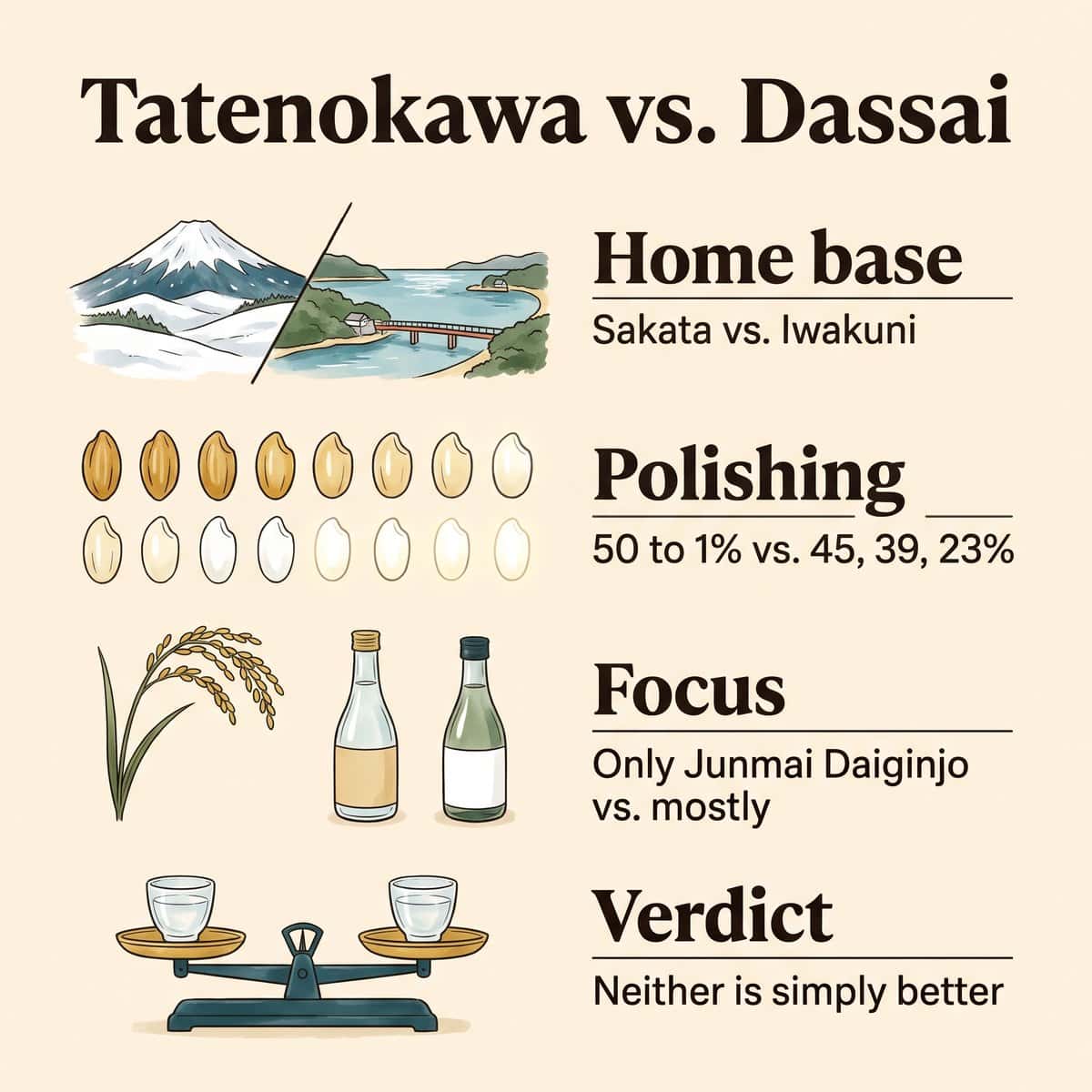
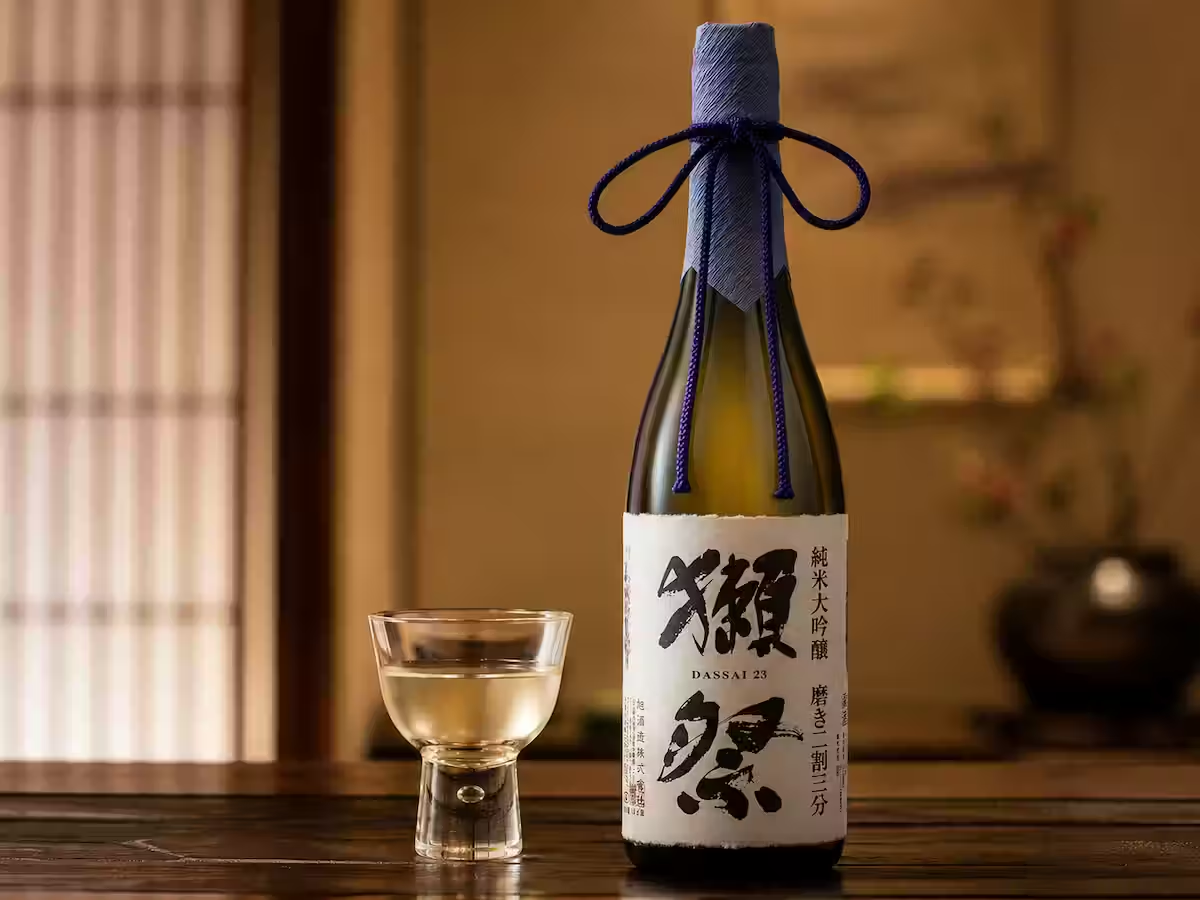
Because both brands are known for Junmai Daiginjo drinkers often compare them. Still, the main differences lie in home region, polishing range, and how strictly each limits itself to one category. Neither is simply “better”; they suit different curiosities.
| Point | Tatenokawa | Dassai |
|---|---|---|
| Home base | Sakata, Yamagata Prefecture | Iwakuni, Yamaguchi Prefecture |
| Core polishing ratios | 50%, 33%, 18%, 8%, and 1% bottles | 45%, 39%, and 23% in its main lineup |
| Brewing focus | Junmai Daiginjo only since 2010 | Mostly Junmai Daiginjo, according to Dassai |
| Regional rice | Yamagata rice through local contract farming, plus Hyogo Yamada Nishiki | See our Dassai guide |
If you like the idea of exploring regional rice and extreme polishing side by side, Tatenokawa is a natural fit. If you want to compare a different approach to Junmai Daiginjo, read our Dassai guide next.
Rice, Region, and Contract Farming
Overall, Tatenokawa’s regional identity runs mainly through rice. An earlier brand guide said about 80 percent of its sake used Yamagata’s Dewasansan or Miyama Nishiki, and the brewery grows both varieties with local contract farmers. Climate and water help too. Even so, rice, method, equipment, and people all work together.
Shonai and Yamagata
First, Sakata lies on the Shonai Plain, facing the Sea of Japan. The brewery’s guide calls it one of Japan’s leading rice-growing areas, with mountains on three sides and excellent water. It also describes coastal Shonai winters as relatively moderate for northern Japan because of the sea’s influence. For brewing water, Tatenokawa uses soft water from Mount Chokai, a major peak on the Yamagata–Akita border.
In 2016, Japan’s National Tax Agency designated “Yamagata” as a geographical indication for sake. Our guide to Yamagata sake covers that wider story, including Dewazakura and Juyondai (14dai).
Three Main Rice Varieties
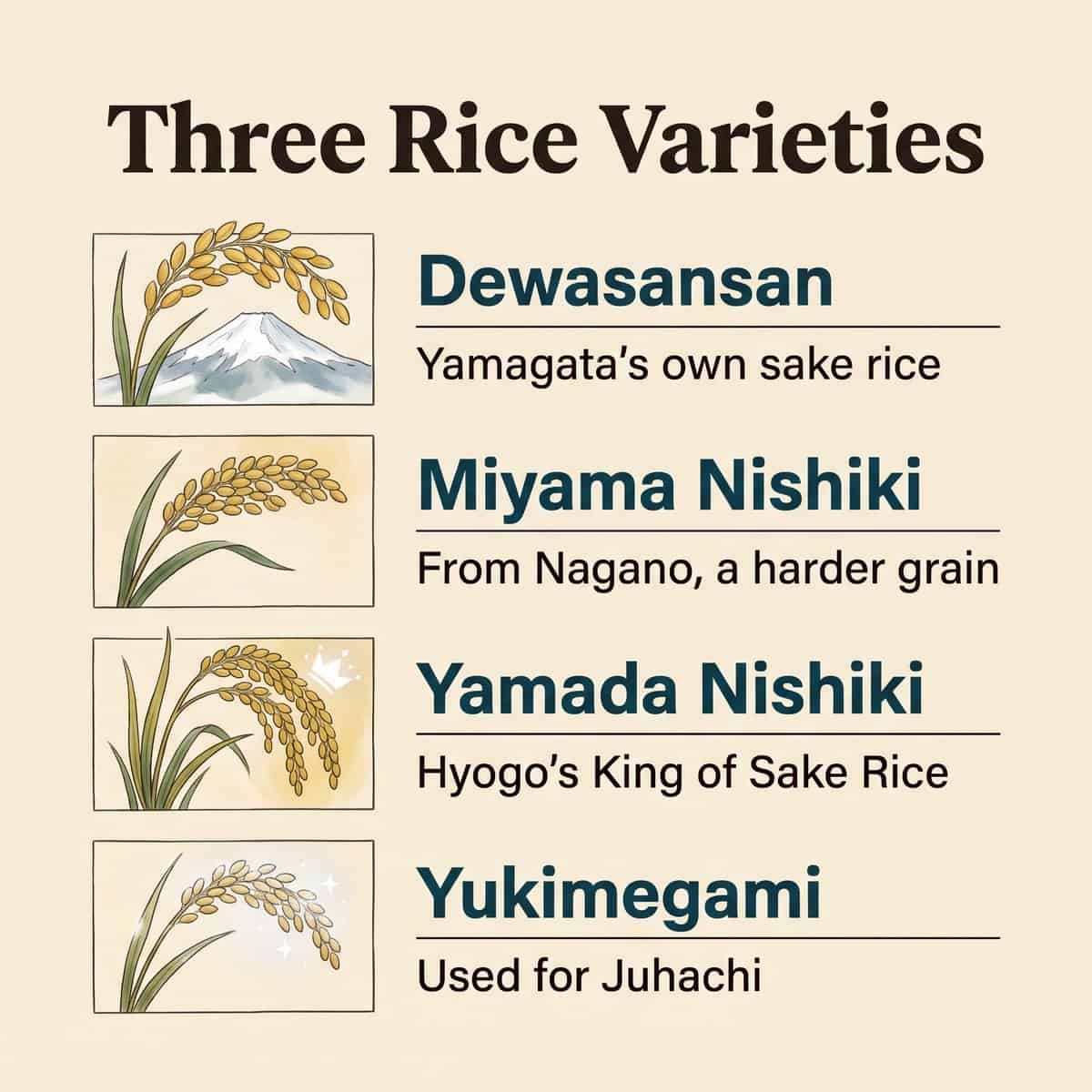
Dewasansan (出羽燦々) is Yamagata’s own sake rice. According to the prefecture, breeders crossed Miyama Nishiki with a line later named Hana Fubuki in 1985. Later, Yamagata adopted it as a superior variety in 1995, and breeders registered it in 1997. Moreover, breeding notes describe a large grain with a high rate of shinpaku, the opaque starchy core prized for brewing.
Miyama Nishiki came from Nagano, according to the brewery, which describes it as a harder grain that gives up less flavor. By contrast, it calls Dewasansan softer, so more of its flavor carries into the sake. Yamada Nishiki, which the brewery buys from Hyogo and calls the “King of Sake Rice,” goes into Kyokugen and one version of Komyo. Our sake rice guide compares these varieties further.
The brewery also works with heirloom Shonai rice such as Kame-no-o and Sobei Wase, and with Yukimegami for Juhachi. Different varieties offer different brewing possibilities, rather than a single ranking of quality.
Contract Farming and Special Cultivation
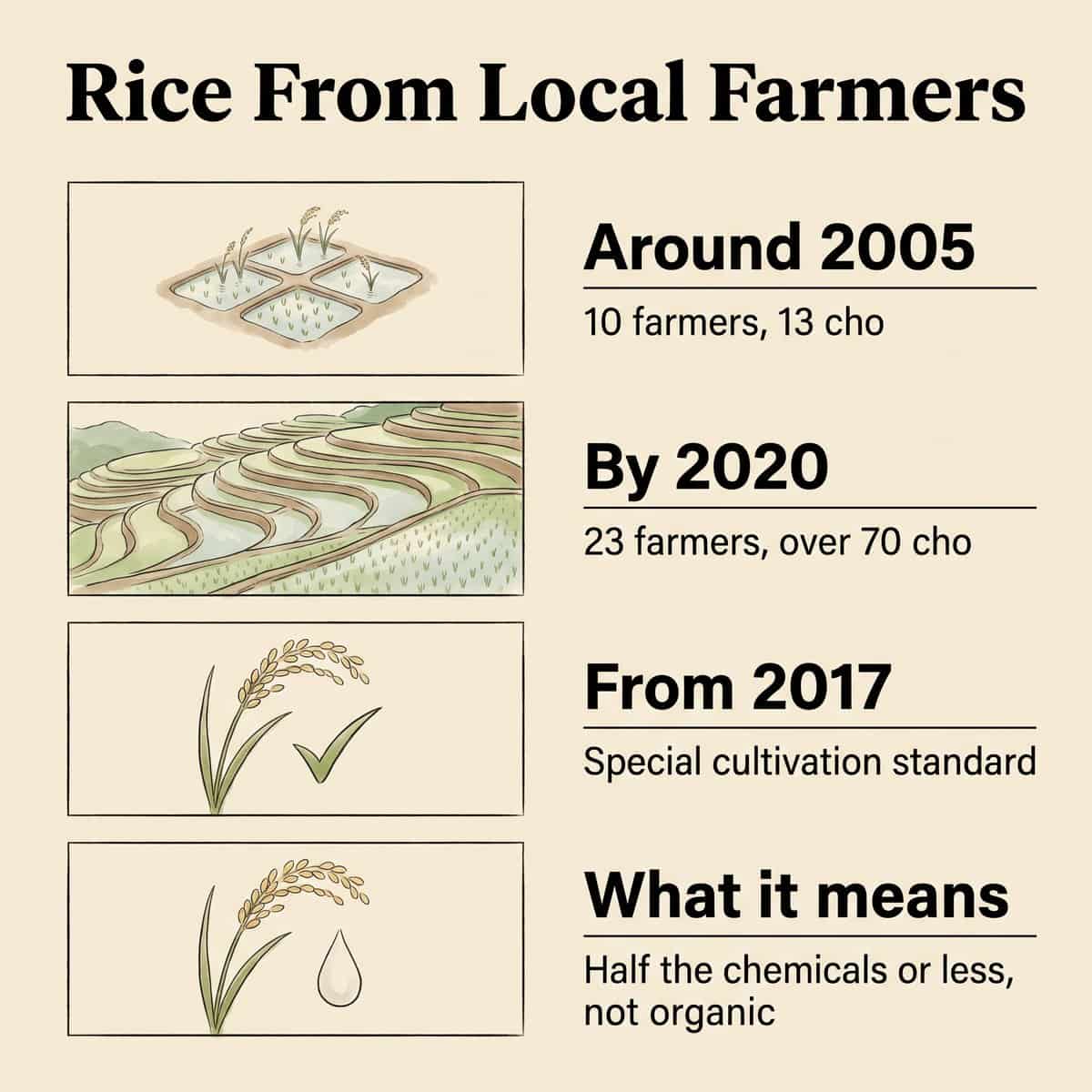
By its own account, Tatenokawa once bought rice the customary way. Then, around 2005, it began contracting directly with 10 local farmers on 13 cho of land; one cho is close to one hectare. By 2020, the network had grown to 23 farmers and more than 70 cho. Since then, the figures may have changed.
From the 2017 planting, the brewery says its contracted Dewasansan and Miyama Nishiki meet Japan’s “special cultivation” standard or better. Under that standard, farmers cut pesticide and chemical fertilizer use to half or less of local conventional practice. It does not mean organic. The program covers specific varieties and years, although the brewery’s stated goal is for all its rice to be contract-grown and specially cultivated.
There is a practical payoff, too. The brewery says it polishes rice farmer by farmer where possible, then sorts it for koji or the main mash. As a result, this reduces uneven water absorption during washing. Knowing whose rice is in the machine supports the same goal as extreme polishing: control.
Inside the Brewhouse: Equipment and Quality Control
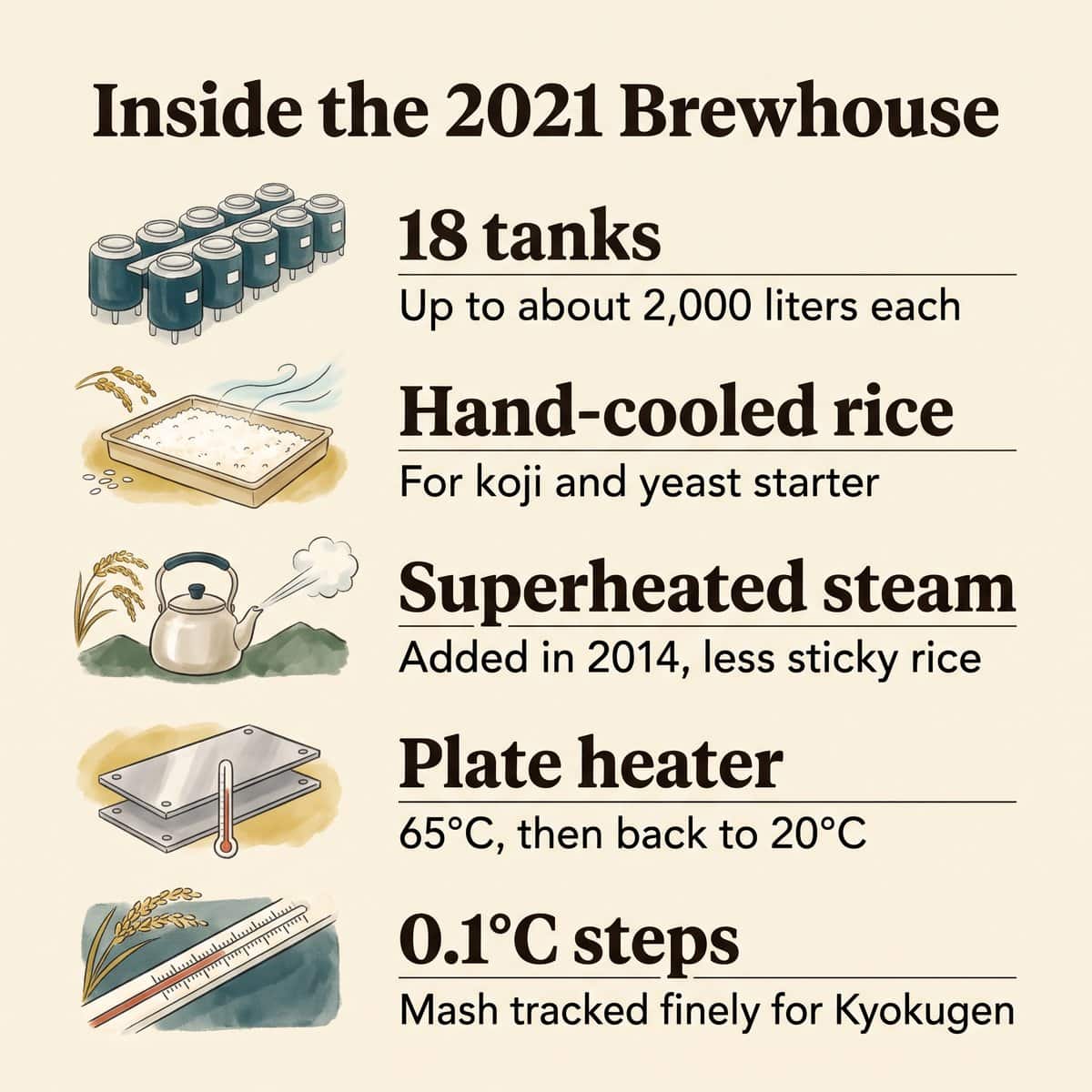
Tatenokawa’s newer brewhouse, completed in 2021, exists mainly for premium sake. According to the brewery, it holds 18 fermentation tanks of up to about 2,000 liters each, all with close temperature control. As the brewery explains, smaller tanks make temperature differences inside the mash less likely, creating what it calls a healthier, more ideal fermentation environment.
Meanwhile, machines and handwork share the job, according to the brand guide. For example, staff cool rice for koji and the yeast starter by hand, while a machine cools rice for the main mash. In 2014, the brewery added a superheater to its steaming kettle to dry the steam and reduce sticky rice. It uses the sokujo method for a yeast starter of about 13 days, followed by a three-stage mash and 28 to 30 days of fermentation.
After pressing, a plate heater pasteurizes the sake, heating it quickly to 65°C and cooling it back to 20°C. On its own, none of these steps is unusual. What stands out is how the brewery ties each one to a single aim: steady quality from very delicate rice.
The History of Tatenokawa
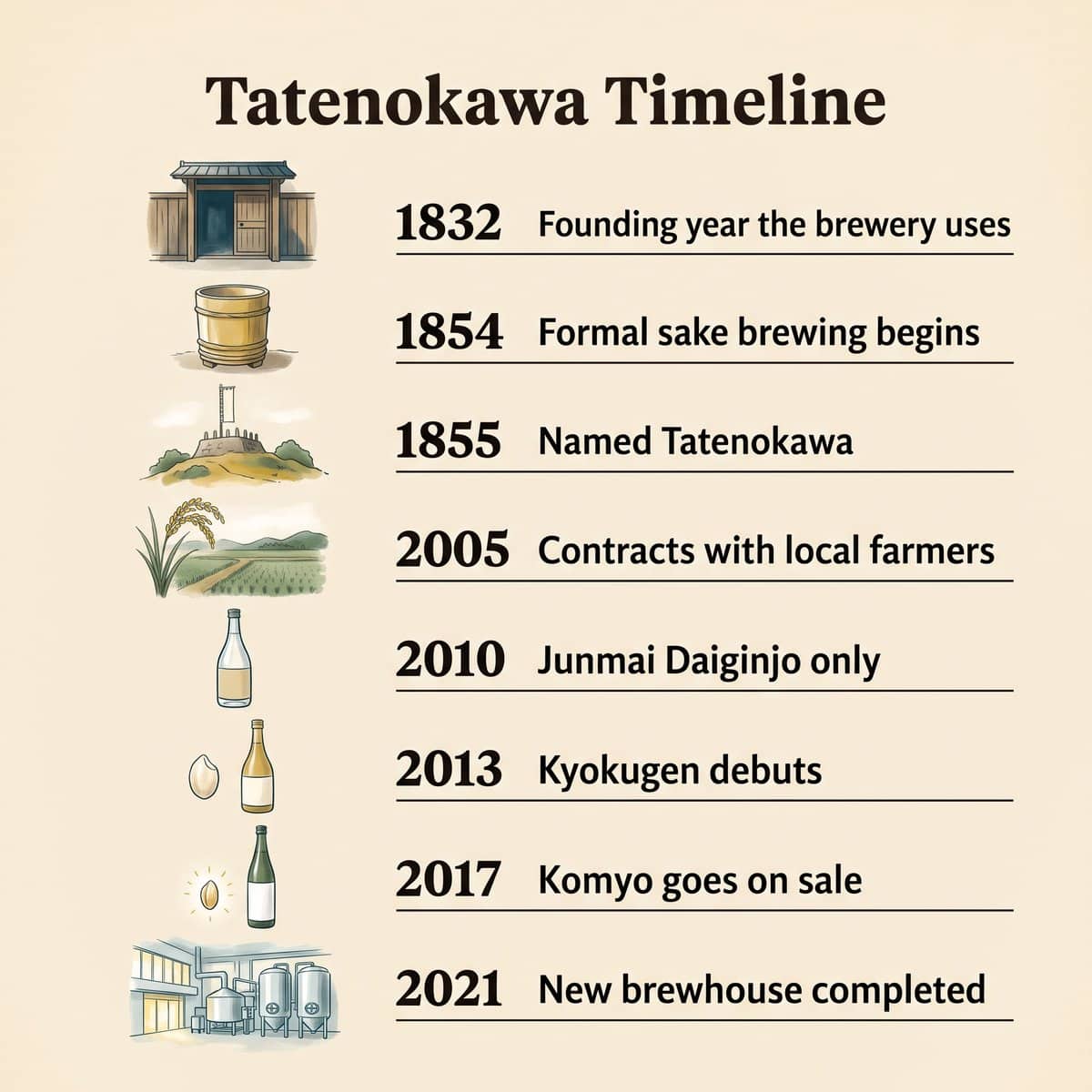
The brewery treats 1832 as its founding year. However, its official history says formal sake brewing began in 1854, and the Tatenokawa name followed in 1855. Also, the detailed origin story comes from the brewery’s own account rather than independently verified contemporary records.
Tatenokawa Timeline
- 1832A visitor connected with the Uesugi family admires Shonai’s water and urges the first-generation head, Heishiro, to make sake.
- 1854The family formally starts its sake brewing business.
- 1855A lord of the Sakai family, rulers of the Shonai domain, names the sake Tatenokawa.
- 1990sIn-house rice polishing begins.
- 2005Direct contracts with local rice farmers begin.
- 2008Overseas exports start.
- 2010Production shifts to Junmai Daiginjo only.
- 2013Kyokugen, polished to 8%, debuts.
- 2017Komyo Dewasansan, polished to 1%, goes on sale.
- 2019Komyo Yamada Nishiki follows.
- 2021The brewery completes a new brewhouse for premium sake.
Still, one detail differs between the brewery’s own pages. Its Japanese history calls the 1832 visitor a retainer of the Uesugi domain, while its English guide describes the head of the Uesugi clan. Because of that gap, we treat the visitor’s exact identity as uncertain. Today, the company’s site features a memoir by its sixth-generation brewer, Sato Jumpei, and a “100-year vision” for the brand.
Why Is It Called Tatenokawa?
As for the name, it comes from the land, not a river. According to the brewery, the area once held a tate (楯), an old word for a fort, so people called it Tateyama. Today, that site is Yamadate Castle Ruins Park. Similarly, the English name, Castle Brook, sounds like a real stream, yet the brewery states that no river called Tatenokawa exists.
Common Misconceptions About Tatenokawa
A brand built on striking numbers attracts a few myths. Here are the ones most worth clearing up.
Tatenokawa is a type of sake.
It is a brand. Junmai Daiginjo is the type, and Tatenokawa sells only that type.
The brewery started making sake in 1832.
1832 is the founding year it uses, but formal brewing began in 1854.
All Tatenokawa sake uses Yamada Nishiki.
Much of the range uses Yamagata rice such as Dewasansan and Miyama Nishiki.
Every bottle uses the same process.
Rice, polishing ratio, yeast, and batch size vary from bottle to bottle.
The name refers to a real river.
The brewery says no river called Tatenokawa, or Castle Brook, exists.
Final Thoughts: More Than a Number
It would be easy to sum up Tatenokawa as “the 1 percent brewery,” but that sells the story short. The real arc runs from a Shonai family business to a bold bet on one category. After that came precision polishing, local rice, and tight control in a modern brewhouse.
The question behind it all is a good one: what can Junmai Daiginjo become if you focus on nothing else? Komyo is one answer; however, an affordable Seiryu is another. If you get the chance, taste a modest bottle and an extreme one side by side, and decide which style you prefer. For another brewery that shaped premium sake, see our guide to Kokuryu.
Research note
We checked product specifications and prices against Tatenokawa’s official Japanese product pages on October 25, 2026. Legal definitions follow Japan’s National Tax Agency. Origin stories and “first” claims are labeled as brewery accounts where we found no independent contemporary record.
Frequently Asked Questions about Tatenokawa Sake
The Brand and Its Name
- What is Tatenokawa sake?
-
Tatenokawa is a sake brand from Tatenokawa, Inc. in Sakata, Yamagata Prefecture. Since 2010, every sake under the brand has been Junmai Daiginjo. Its range runs from 50 percent polished rice down to 1 percent.
- What does the name Tatenokawa mean?
-
It comes from Tateyama, an old name for the brewery’s area, where a tate (fort) once stood. The English name is Castle Brook, though the brewery says no such river exists.
Polishing and Products
- What is the difference between Kyokugen and Kyuryu?
-
Kyokugen uses Hyogo-grown Yamada Nishiki polished to 8 percent, brewed in small batches. Kyuryu, or Stream Red, uses Yamagata Dewasansan polished to 33 percent. In fact, the brewery calls Kyuryu the entry bottle of its Extreme series.
- Is Tatenokawa worth the price?
-
Ultimately, it depends on what you want. For example, Seiryu and Kyuryu offer the house style at moderate prices in Japan. Komyo’s price comes with months of polishing and limited supply, which matters most to collectors and enthusiasts.
Taste, Serving, and Buying
- Is Tatenokawa sake dry or sweet?
-
In short, it varies by bottle. Seiryu has a sake meter value of +1, the driest reading among the bottles in this guide. Kyuryu and Juhachi have negative values that suggest a sweeter impression, though acidity and aroma also matter.
- How should I serve Tatenokawa?
-
The brewery’s product pages show a scale from chilled to hot without one fixed rule. Starting cool and letting the sake warm slightly is a sensible approach. Once opened, keep bottles in the fridge.
- Can I buy Tatenokawa outside Japan?
-
Yes, in many markets, because the brewery exports widely. The brewery lists 27 export countries and regions, including the United States, Canada, the United Kingdom, and Australia. However, availability and prices depend on local importers.
- What food pairs well with Tatenokawa?
-
We did not find fixed pairing rules on the brewery’s product pages. As a general rule, match delicate, aromatic bottles with lighter dishes. For more ideas, see our sake and food pairing guide.
References
Government and Industry Sources
- National Tax Agency – Overview of the Sake Production and Quality Labeling Standards (Accessed October 2026)
- Yamagata Prefecture – Consultation on Revising Recommended and Superior Crop Varieties, February 2020 (PDF) (Accessed October 2026)
- National Tax Agency – Standards for Manufacturing Methods and Quality Labeling of Sake (Notice No. 8) (Accessed October 2026)
- DASSAI Inc. – Company Profile (Accessed October 2026)
- National Tax Agency – List of Geographical Indications for Alcoholic Beverages (Accessed October 2026)
- DASSAI Inc. – How Dassai Is Made (Accessed October 2026)
- NARO Tohoku Agricultural Research Center – Variety Notes: Dewasansan (PDF) (Accessed October 2026)
- DASSAI Inc. – Product Lineup (Accessed October 2026)
Academic and Research Sources
- National Research Institute of Brewing – The Story of Sake 2: The Integration of Science and Technology (PDF) (Accessed October 2026)
- J-STAGE – Tamaki, M., Itani, T., & Suetsugu, M. (2009). Relationship between the Starch Properties of White-Core Tissue and Polishing Characteristics in Brewers’ Rice Kernels. Plant Production Science, 12(2), 233–236 (Accessed October 2026)
Brewery Sources: History, Strategy, and Brewing
- Tatenokawa, Inc. – An In Depth Guide, Volume 1: Origins of the Name (Accessed October 2026)
- Official Tatenokawa Website – Company Profile and History (Japanese) (Accessed October 2026)
- Tatenokawa, Inc. – An In Depth Guide, Volume 2: The Aim of Junmai Daiginjo Only Production (Accessed October 2026)
- Official Tatenokawa Online Shop – About Tatenokawa Brewery (Japanese) (Accessed October 2026)
- Tatenokawa, Inc. – Sixth-Generation Brewer Sato Jumpei’s Resume (Accessed October 2026)
- Official Tatenokawa Website – An In Depth Guide, Volume 5: Polishing, Brewing Water, and Rice Processing (Accessed October 2026)
- Tatenokawa, Inc. – An In Depth Guide, Volume 6: Koji and Yeast Starter (Accessed October 2026)
- Official Tatenokawa Website – An In Depth Guide, Volume 7: Mash and Fermentation (Accessed October 2026)
- Tatenokawa, Inc. – An In Depth Guide, Volume 8: Pressing, Pasteurization, Bottling, and Storage (Accessed October 2026)
- Official Tatenokawa Online Shop – Our Commitment to Sake Brewing (Japanese) (Accessed October 2026)
- Tatenokawa, Inc. – An In Depth Guide, Volume 9: Sales and Exports (Accessed October 2026)
Brewery Sources: Rice, Products, and Exports
- Tatenokawa, Inc. – An In Depth Guide, Volume 3: Sake Rice (Accessed October 2026)
- Official Tatenokawa Website – About Our Rice: Message From the Brewery (Japanese) (Accessed October 2026)
- Tatenokawa, Inc. – An In Depth Guide, Volume 4: Seiryu, Miyama Nishiki Nakadori, and Yeast (Accessed October 2026)
- Official Tatenokawa Website – Export Countries and Regions (Japanese) (Accessed October 2026)
- Tatenokawa, Inc. – Junmai Daiginjo Seiryu (Japanese) (Accessed October 2026)
- Official Tatenokawa Website – Junmai Daiginjo Kyuryu (Japanese) (Accessed October 2026)
- Tatenokawa, Inc. – Junmai Daiginjo Juhachi (Japanese) (Accessed October 2026)
- Official Tatenokawa Website – Junmai Daiginjo Kyokugen (Japanese) (Accessed October 2026)
- Tatenokawa, Inc. – Junmai Daiginjo Kyokugen (English) (Accessed October 2026)
- Official Tatenokawa Website – Komyo Series (Japanese) (Accessed October 2026)
- Tatenokawa, Inc. – Komyo Series (English) (Accessed October 2026)
- Official Tatenokawa Website – Junmai Daiginjo Komyo Dewasansan (Japanese) (Accessed October 2026)
- Tatenokawa, Inc. – Junmai Daiginjo Komyo Yamada Nishiki (Japanese) (Accessed October 2026)
- Official Tatenokawa Website – Extreme Series (English) (Accessed October 2026)
Related Articles
- Dassai Sake: The Story Behind Japan’s Global Junmai Daiginjo Brand (Surveyed: October 2026)
- Kokuryu Sake: The Fukui Brewery That Helped Pioneer Premium Daiginjo (Surveyed: October 2026)
- Dewazakura Sake: The Brewery That Helped Bring Ginjo to the Public (Surveyed: October 2026)
- Yamagata Sake (山形の酒) (Surveyed: October 2026)
- Rice Polishing (精米歩合) (Surveyed: October 2026)
- Sake Rice (酒米): The Foundation of Premium Sake (Surveyed: October 2026)
- Daiginjo (大吟醸) (Surveyed: October 2026)
- Types of Japanese Sake: A Beginner’s Guide to Junmai, Ginjo, and Daiginjo (Surveyed: October 2026)
- How to Read a Japanese Sake Label: A Beginner’s Guide (Surveyed: October 2026)
- How to Store Sake: A Practical Guide to Freshness and Storage (Surveyed: October 2026)
- Sake and Food Pairing: How to Match Japanese Sake with Food (Surveyed: October 2026)




Comments