


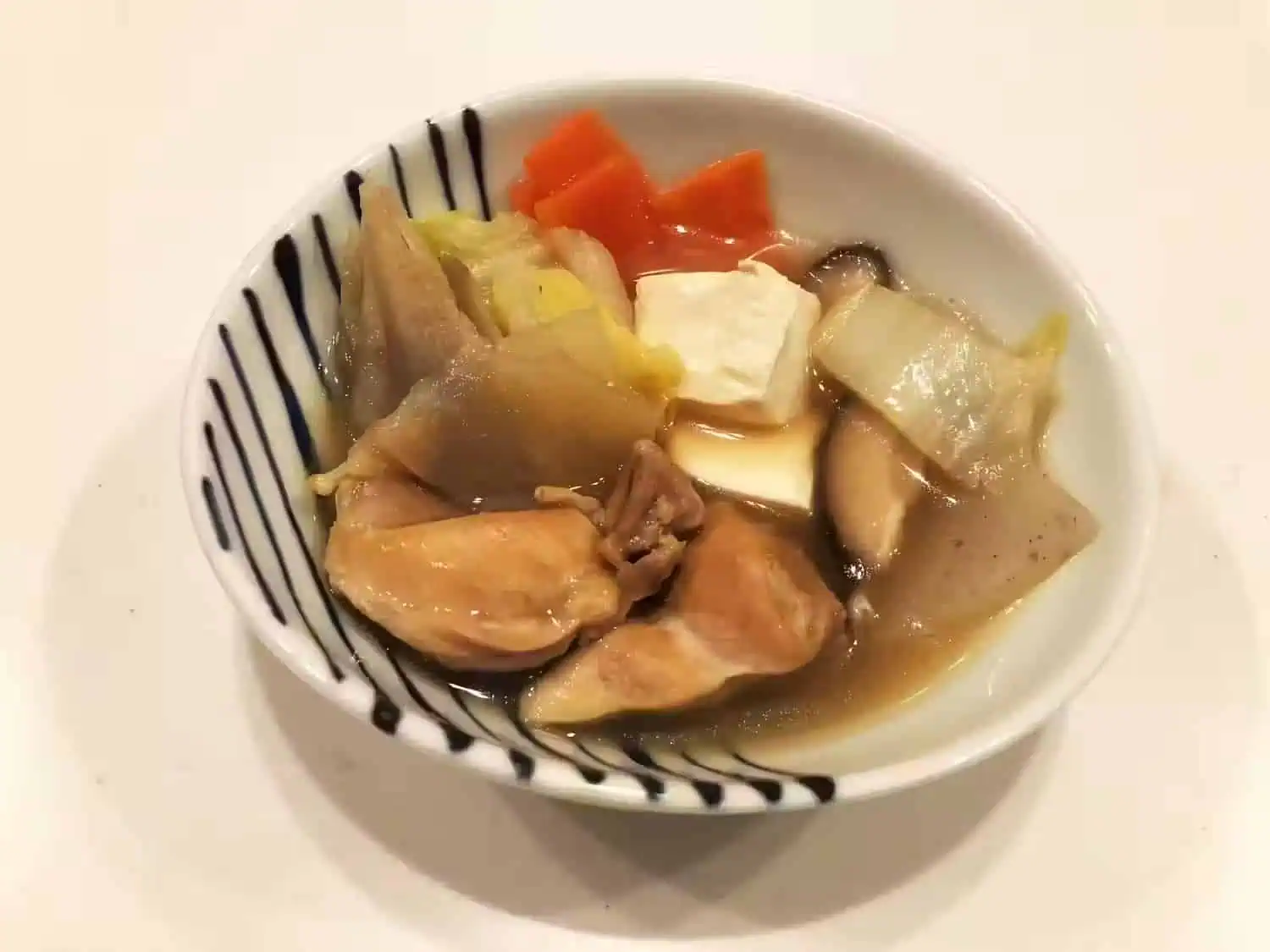

Picture a family gathering on Tsushima, a remote island of Nagasaki Prefecture. A big pot simmers at the center of the table, full of chicken or fresh local fish, vegetables and tofu. In the past, the family might even kill one of its own chickens for the occasion. That pot is iriyaki (いりやき), a hot pot that has welcomed guests for generations.
This guide explains what iriyaki is, why chicken and fish versions exist, and how locals finish the broth with noodles. It also covers the name, the island’s traditional native chicken and a recipe from Tsushima City.
What Is Iriyaki?
Iriyaki is the traditional hot pot of Tsushima, an island in Nagasaki Prefecture. It is made with either chicken or locally caught fish, plus vegetables, tofu and konnyaku. Families have long served it to guests at celebrations and ceremonies. Finally, the flavorful leftover broth goes over somen noodles or local Taishu soba.
Quick Facts: Iriyaki
- Japanese name
- いりやき (iriyaki)
- Region
- Tsushima City, Nagasaki Prefecture
- Dish type
- Hot pot (nabe); Japan’s agriculture ministry calls it a yosenabe
- Main protein
- Chicken or local fish such as yellowtail
- Typical extras
- Napa cabbage, burdock root, shiitake, tofu, konnyaku, leeks
- Seasoning
- Varies by household; soy sauce with sugar and mirin gives a slightly sweet taste, while fish versions are often just salt and soy sauce
- Noodle finish
- Somen or Taishu soba in the leftover broth
- Traditional role
- Served to guests at celebrations, funerals and Buddhist memorial gatherings
- Where to try it
- Homes, some local restaurants and also homestay programs on Tsushima
What Makes Iriyaki Different From Other Japanese Hot Pots?
Three things set iriyaki apart. First, it traditionally uses either home-raised chicken or fish from the island’s own waters, depending on where a family lives. Second, it grew up as food for hospitality, served at weddings, funerals and memorial gatherings. Third, the meal is not over when the pot is empty, because the broth becomes a noodle course. For a side-by-side view, see the hot pot comparison below.
Where Is Tsushima?
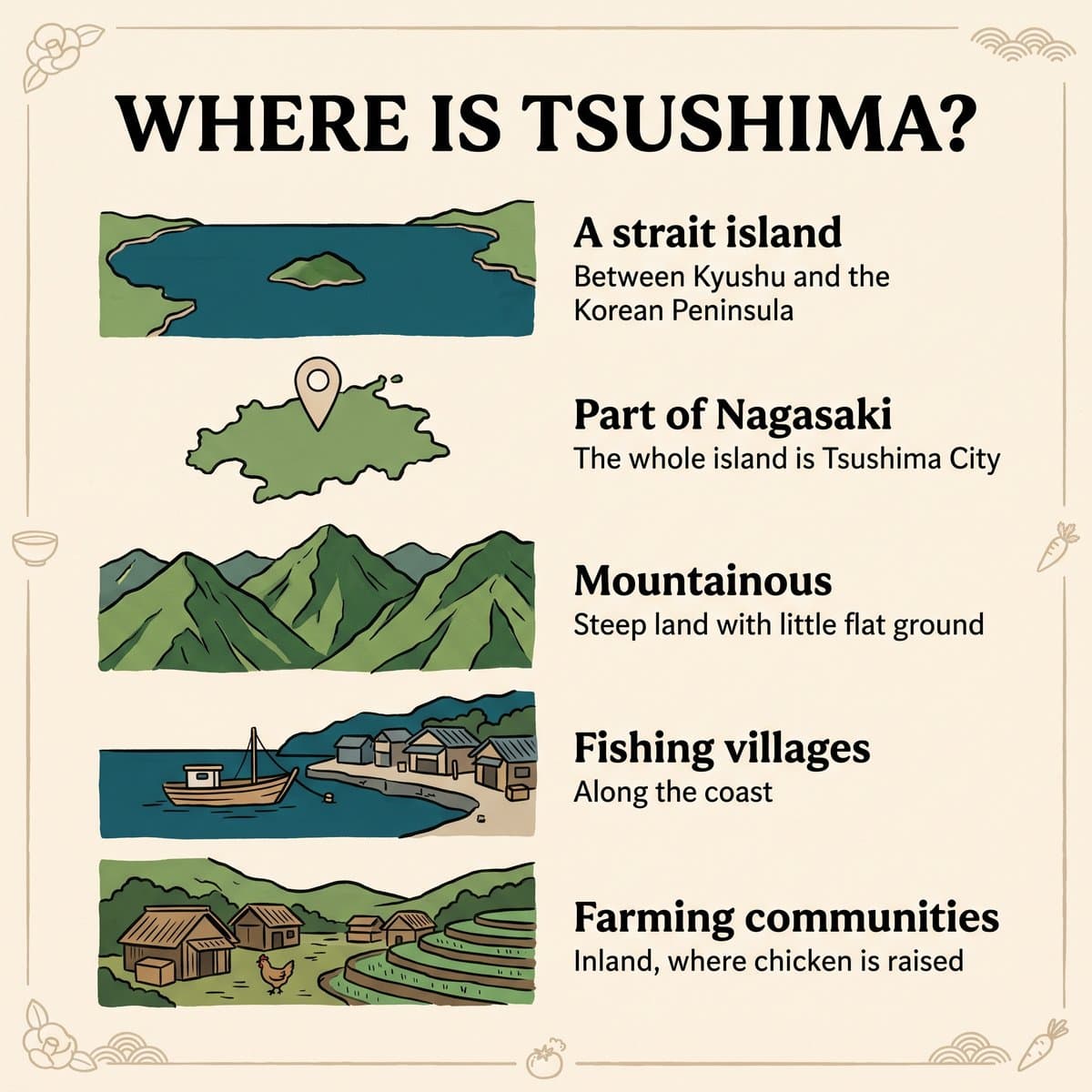
Tsushima sits in the strait between Kyushu and the Korean Peninsula. Administratively, it belongs to Nagasaki Prefecture, and the whole island forms Tsushima City. The island is also mountainous, with fishing villages along the coast and farming communities inland. As you will see, that split matters for iriyaki.
A Hot Pot for Guests and Ceremonies
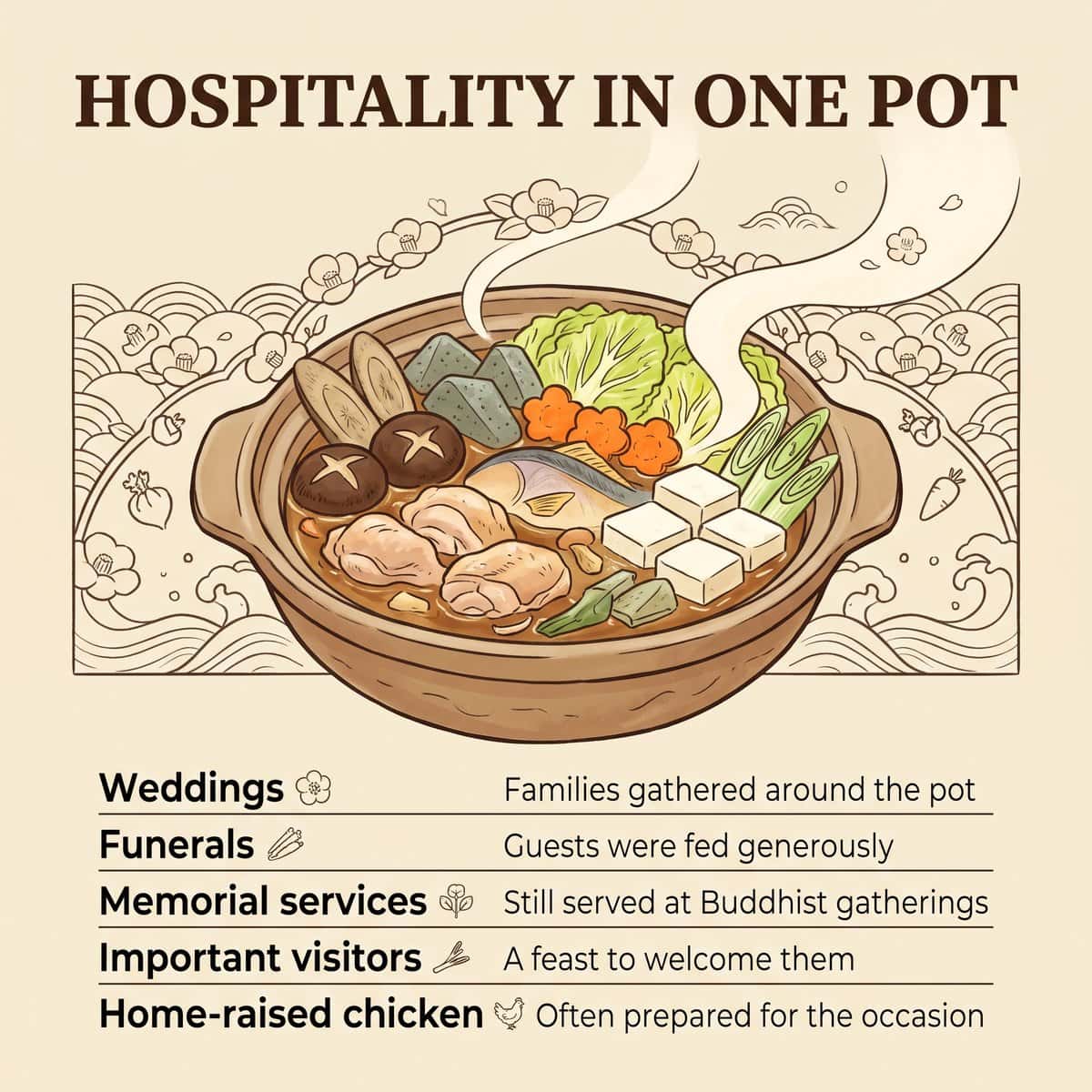
Iriyaki is rooted in special days, not everyday suppers. According to Japan’s Ministry of Agriculture, Forestry and Fisheries (MAFF), families gathered for weddings, funerals and other ceremonies. On those days, they often slaughtered a home-raised chicken. They then served it to guests as a hot pot.
Nagasaki Prefecture describes it the same way, as a feast for ceremonies and important visitors. Even today, MAFF notes, households make iriyaki to welcome guests at celebrations and Buddhist memorial services. Meanwhile, some restaurants serve it as a local specialty all year, so visitors can try it too.
Why Chicken Meant a Special Occasion
Why would chicken feel so festive? Oral-history research helps here. In a 2018 study, researchers interviewed 20 long-time residents of five Nagasaki areas, including Tsushima. They asked about home cooking in the 1950s and 1960s. As a result, they found that seafood dominated daily meals. Chicken, by contrast, came from birds kept at home and was mostly eaten at events, as food for hospitality.
That context changes how iriyaki reads. A pot of chicken was a gesture of welcome, not just a meal. Honestly, it makes the dish feel warmer than any recipe can.
Chicken Iriyaki and Fish Iriyaki
Traditional accounts describe two basic versions: one built on chicken and one built on fish. Tsushima City and Nagasaki Prefecture both say coastal homes tend to use fish, while inland homes tend to use chicken. Still, this is a local tendency, not a strict rule.
Inland style
Chicken iriyaki
- Traditionally made with home-raised chicken
- Simmered for a long time so the broth builds flavor
- Soy-based broth, sometimes sweetened with sugar and mirin
Coastal style
Fish iriyaki
- Made with fish from nearby waters
- Yellowtail is especially popular in winter
- Often seasoned more simply, with salt and soy sauce
Inland Chicken Iriyaki
Generally, chicken iriyaki depends on patience. Tsushima City’s recipe starts jidori, a local breed of chicken, in cold water. Then it simmers for about an hour while the cook skims the surface. MAFF’s recipe adds that the longer it cooks, the softer the meat and the better the broth.
Coastal Fish Iriyaki
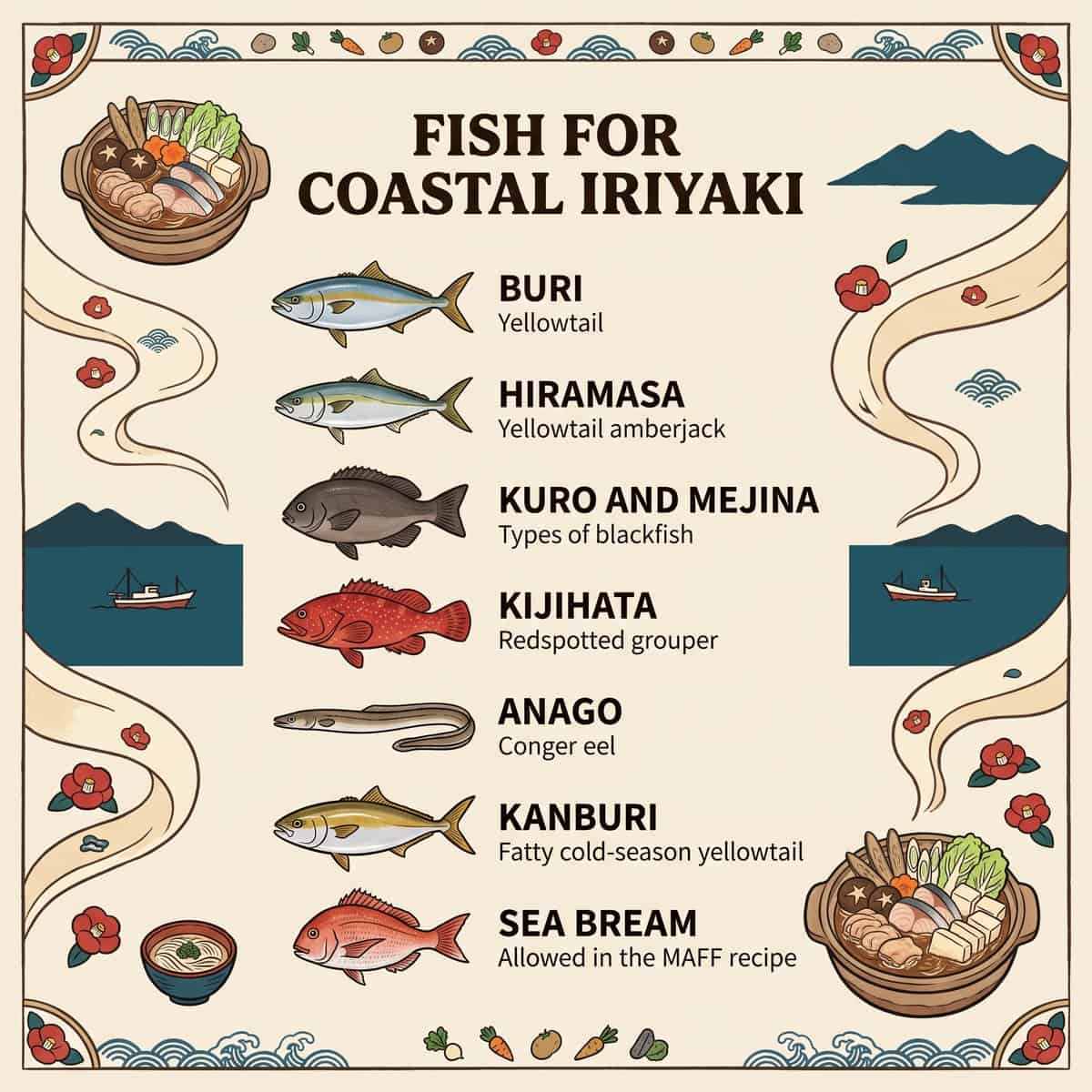
Fishing villages, however, used whatever came from nearby waters. MAFF lists buri (yellowtail) and hiramasa (yellowtail amberjack). It also names kuro and mejina (types of blackfish), kijihata (redspotted grouper) and anago (conger eel). In winter, fatty kanburi, or cold-season yellowtail, is the standard choice. MAFF’s recipe also allows white fish such as sea bream, and fish versions are often seasoned simply.
Can Iriyaki Use Both?
Some modern recipes do. For instance, a Nagasaki Prefecture recipe combines yellowtail with chicken wings in one pot. That is a contemporary example, though, not the traditional standard. In short, think of iriyaki as chicken or fish first, with combined versions as a newer option.
Traditional Iriyaki Ingredients
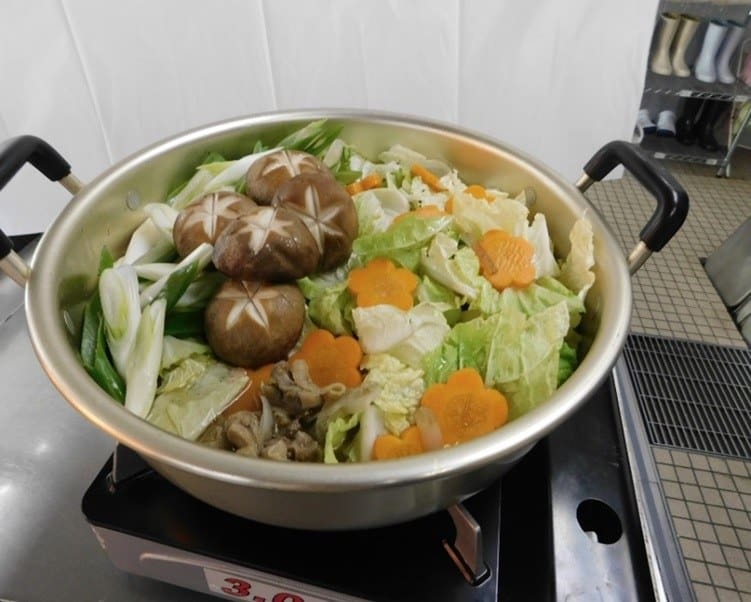
Overall, iriyaki uses simple, hearty ingredients. Recipes differ by area and household, but official versions share a core set.
- Protein: chicken, often local jidori, or fish such as yellowtail, blackfish or sea bream
- Vegetables: napa cabbage, burdock root, leeks, carrots, onions and sometimes chrysanthemum greens
- Mushrooms: fresh shiitake
- Soy products and more: tofu and konnyaku, a firm jelly made from konjac yam
- Seasoning: soy sauce, sugar, sake and, in some homes, mirin
- To finish: somen noodles or soba
Still, burdock root may be unfamiliar outside Japan. It is a long, slender root with an earthy flavor, and recipes usually shave it into thin slivers. Konnyaku, meanwhile, adds a springy bite but little flavor of its own.
What Does Iriyaki Taste Like?
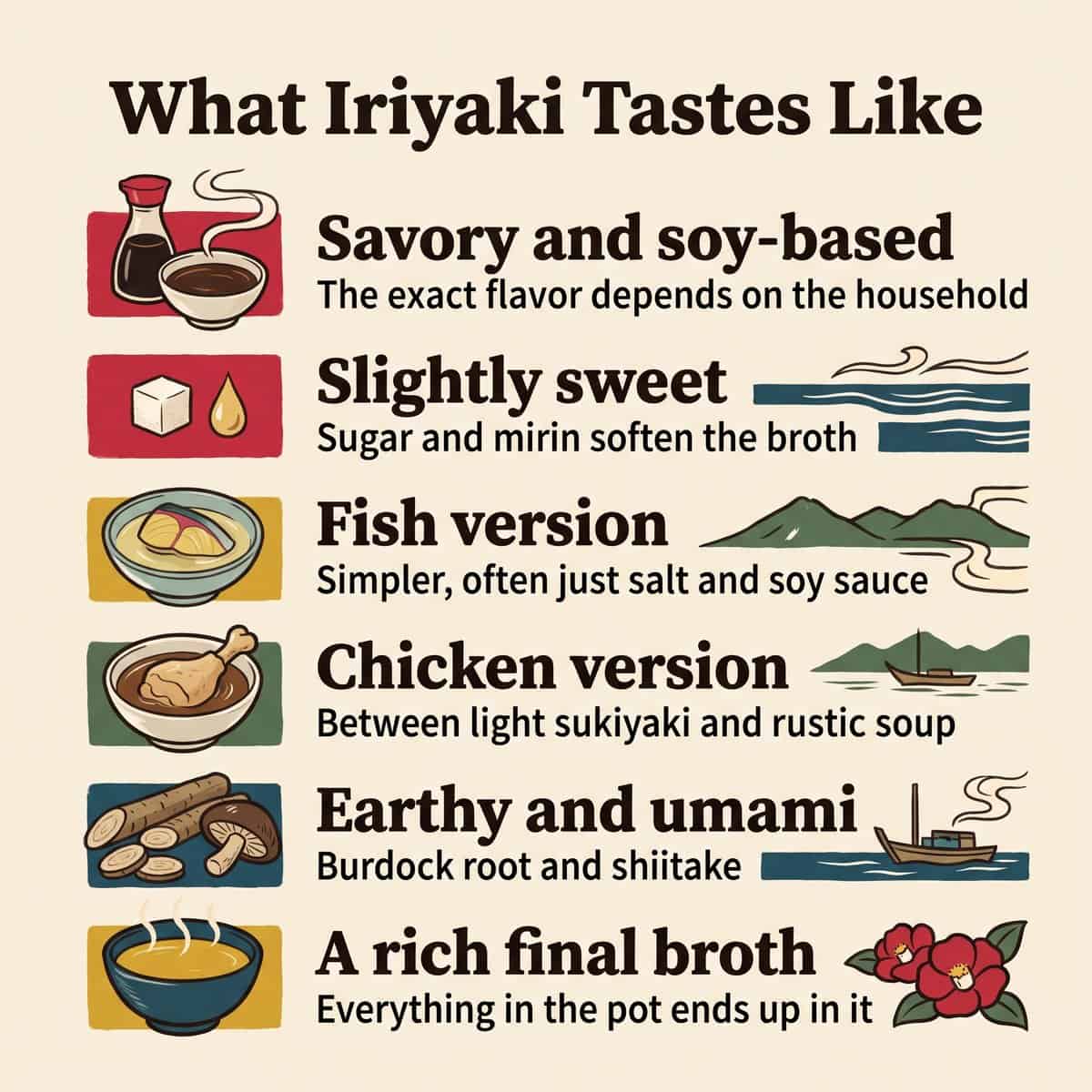
Iriyaki is savory and soy-based, but the exact flavor depends on the household. MAFF notes that soy sauce with sugar and mirin gives the broth a slightly sweet taste. Fish iriyaki, on the other hand, is often seasoned with only salt and soy sauce. So expect a simpler broth that leans on the fish itself.
If you need a reference point, chicken iriyaki may land somewhere between a light sukiyaki and a rustic chicken soup. The fish version, by contrast, is closer to a gentle seafood stew with a cleaner finish. These are rough comparisons, not exact matches.
Above all, much of the flavor comes from time. Since the chicken simmers for a long while, its savory depth soaks into the broth, then into the vegetables. Burdock adds an earthy note, while shiitake brings umami. In the end, the broth has picked up everything in the pot. That is exactly why locals save it for noodles.
Texture matters too, of course. As for the chicken itself, Nagasaki Prefecture describes its modern Nagasaki Tsushima jidori as moderately chewy and juicy. The jidori section below explains how that bird relates to the island’s native breed. We have not tasted a home-cooked pot on Tsushima ourselves, so we would treat these notes as a guide. Still, that slow, comforting build is hard not to imagine on a cold evening.
How to Make Iriyaki: Tsushima City’s Recipe
For home cooks, Tsushima City publishes a simple four-serving recipe for its school food education program. The card below follows it as published. You can use either fish or chicken, and the city’s notes explain how the method changes.
Iriyaki (Tsushima City recipe)
Ingredients
- Fish (blackfish, or mejina) 400 g, or jidori chicken 1 kg
- Water 2,400 ml
- Burdock root 200 g
- Konnyaku 1 block
- Fresh shiitake 4
- Napa cabbage 400 g
- Chrysanthemum greens 1 bunch
- Leeks 2
- Tofu 1 block
- Sugar 2 tbsp
- Soy sauce 4 tbsp
- Somen 2 bundles
Instructions
- Shave the burdock into thin slivers. Cut the other vegetables, konnyaku and tofu into bite-size pieces. Boil the somen.
- Chop the fish or chicken into chunks.
- For fish: bring water to a boil, add the fish, then add sugar and soy sauce. For chicken, start it in cold water instead. Then simmer over medium heat for about an hour, skimming, to make the broth.
- Add the vegetables and somen, and eat as they cook.
How Other Official Recipes Differ
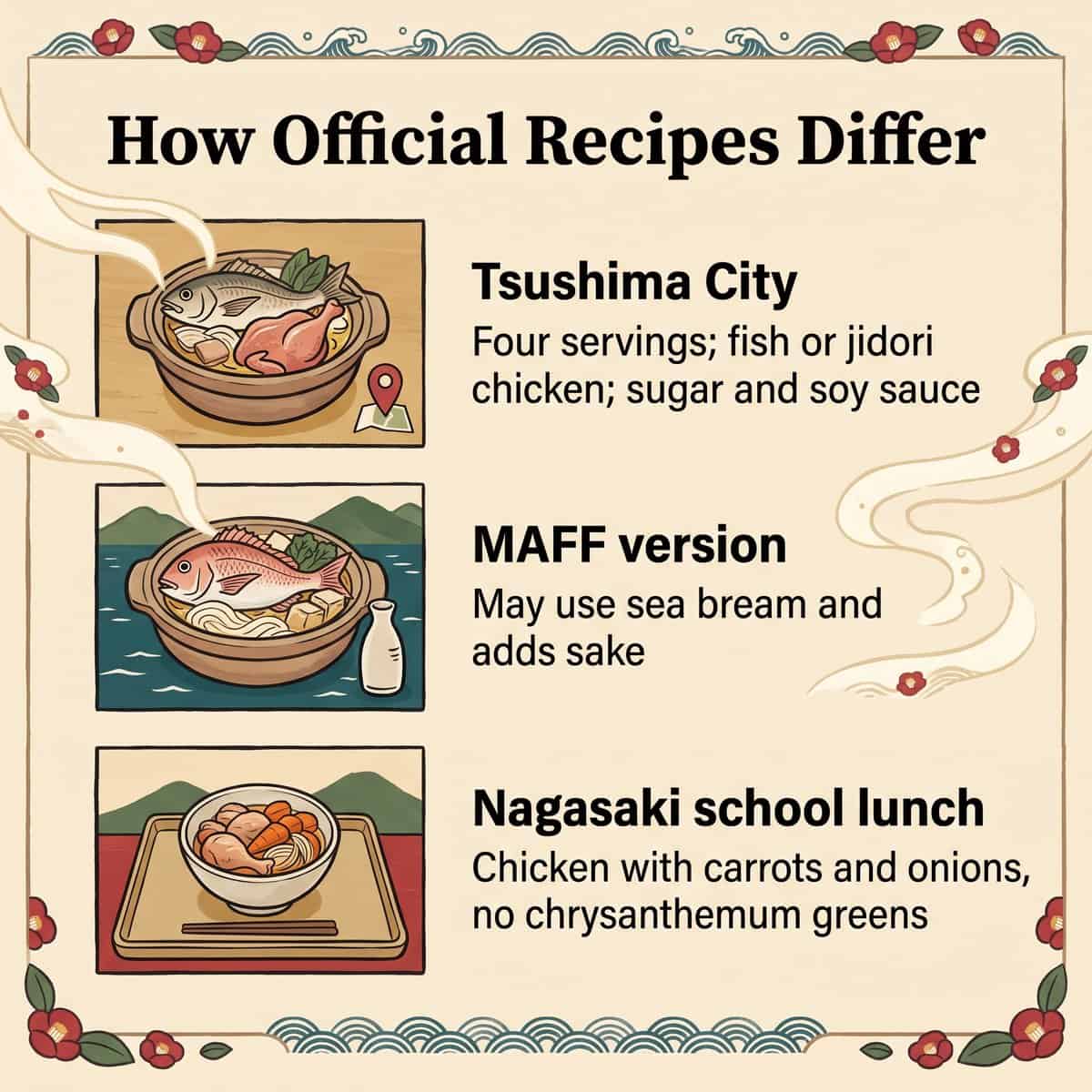
Other official recipes show how flexible iriyaki is. MAFF’s version, from the Nagasaki Dietetic Association, allows white fish such as sea bream in place of jidori. It also adds sake. Nagasaki Prefecture’s school lunch recipe uses chicken with carrots and onions and skips chrysanthemum greens. As MAFF puts it, recipes vary by area and household.
When cooking chicken, make sure it is fully cooked before eating. Likewise, handle fresh fish with care and keep it cold until it goes into the pot.
Can You Make Iriyaki Without Tsushima Ingredients?
Yes, within limits. The official recipe above stays as published, but cooks outside Japan may not find every item. The notes below are our editorial suggestions, not part of any official recipe, and the result will taste a little different.
- Jidori chicken: bone-in chicken thighs are an easy stand-in, though jidori is firmer and more flavorful
- Mejina or yellowtail: any firm white fish works, and MAFF’s recipe itself allows sea bream
- Burdock root: many Asian grocers sell it; otherwise, parsnip gives a similar earthy sweetness
- Konnyaku: shirataki noodles are made from the same konjac, or you can simply leave it out
- Chrysanthemum greens: optional, since Nagasaki Prefecture’s school lunch recipe skips them
- Taishu soba: hard to find abroad, so somen or other dried soba is the practical choice
How to Eat Iriyaki
Locals enjoy iriyaki in two stages. First, everyone shares the chicken or fish, vegetables and tofu straight from the pot. Then the broth, now full of flavor, becomes the base for noodles.
- 1Simmer and shareEat the chicken or fish and vegetables as they cook.
- 2Keep the brothLet it soak up flavor from everything in the pot.
- 3Finish with noodlesPour it over somen or Taishu soba.
This finish is so central that it inspired a local saying, MAFF reports. In Japanese it reads 「いりやきは後食え」 (iriyaki wa ato kue), roughly “eat iriyaki for what comes after.” Nagasaki Prefecture also mentions “iriyaki soba,” the dish paired with local soba.
What Is Taishu Soba?
Taishu Soba (対州そば) at a glance
- A native buckwheat of Tsushima; “Taishu” is an old name for the island
- Registered as Japan’s Geographical Indication No. 61 on April 9, 2018
- Small grains, yet a bitterness close to that of the original buckwheat, according to the registration
- According to the registration, Tsushima is said to be where buckwheat first reached Japan, via the Korean Peninsula
That bitterness is not just marketing talk. In a 2007 to 2009 study, Nagasaki’s agricultural research center measured Taishu soba with a taste sensor. Its samples scored highest for bitterness among the buckwheat it compared. Of course, flavor still varies with milling and cooking. For more buckwheat noodle dishes, see our soba articles. You can also browse all Japanese noodles, from soba to udon.
Why Is It Called Iriyaki?
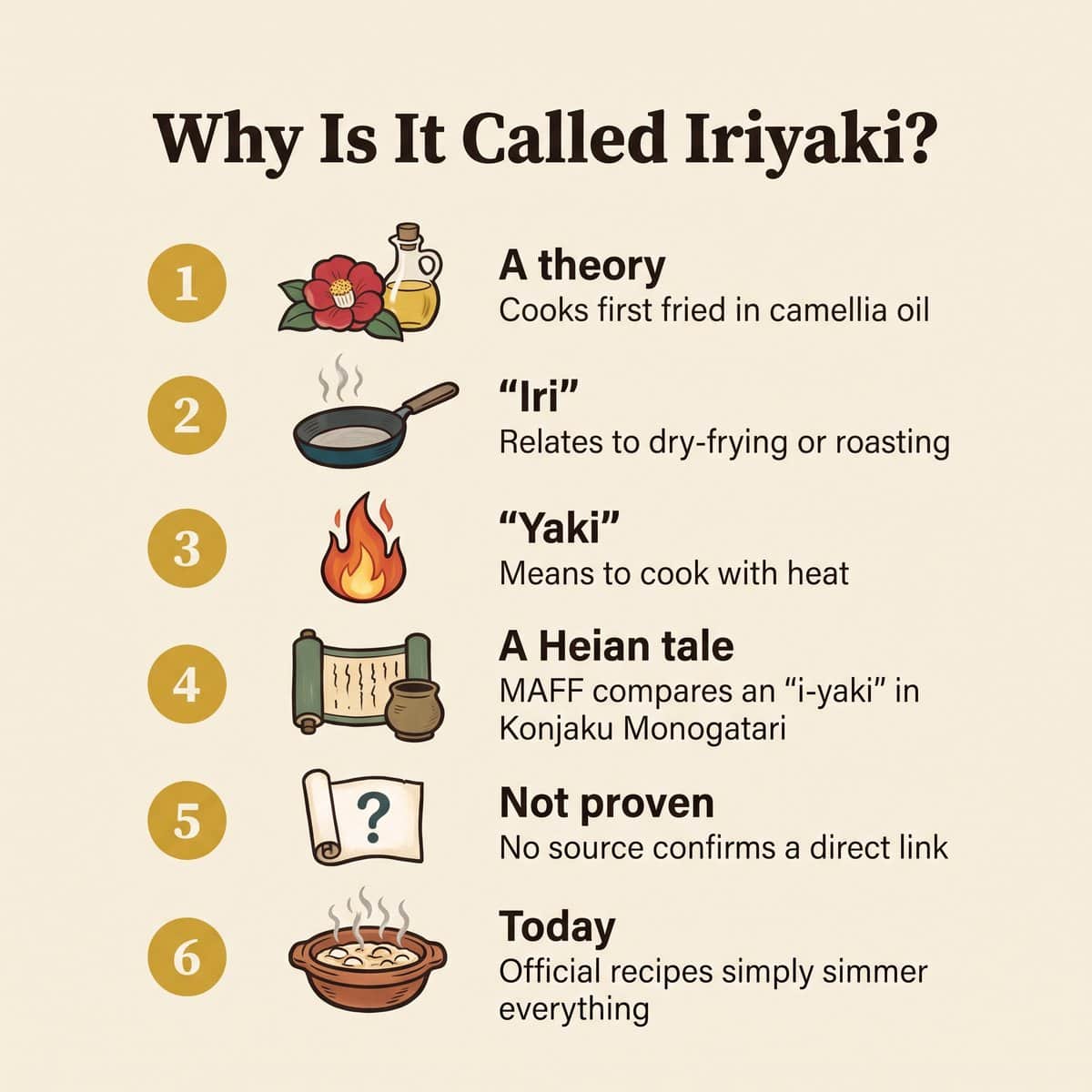
The exact origin of the name is uncertain. One theory, cited by Nagasaki Prefecture, says cooks first fried the fish or chicken in camellia oil before simmering it. “Iri” relates to a verb for dry-frying or roasting, and “yaki” means to cook with heat.
MAFF goes a step further. It notes that the cooking method may resemble an “i-yaki” described in the Konjaku Monogatari, a Heian-period collection of tales. However, MAFF does not cite a specific passage. We also found no academic source confirming a direct link between that text and today’s iriyaki. So treat it as an interesting theory, not proven history. Notably, the official recipes we checked, including Tsushima City’s, simply simmer the ingredients without a frying step.
Tsushima Jidori and Nagasaki Tsushima Jidori
Two similar names can cause confusion here. Tsushima jidori is the island’s traditional native chicken breed. Nagasaki Tsushima jidori, by contrast, is a modern cross developed from it.
Native breed
Tsushima jidori (対馬地鶏)
- Raised on the island since long ago
- Prized for iriyaki because of its flavor
- The traditional chicken behind the dish
Modern brand
Nagasaki Tsushima jidori (長崎対馬地どり)
- Developed in fiscal 2016 by Nagasaki’s agricultural research center
- Tsushima jidori on the mother’s side, a gamecock line on the father’s
- About 10,000 birds a year since fiscal 2018
For its part, Nagasaki Prefecture describes the modern bird as moderately firm, juicy and full of umami. A producers’ council has worked to expand its supply since fiscal 2018. So when a menu mentions jidori, it may mean either bird, and asking is perfectly reasonable.
Iriyaki vs Other Japanese Hot Pots
Iriyaki belongs to Japan’s broad family of hot pot dishes. In fact, MAFF describes it as a kind of yosenabe, a mixed hot pot. What sets it apart is its island setting, its chicken-or-fish split and its noodle finish.
| Point | Iriyaki | Yosenabe | Mizutaki |
|---|---|---|---|
| Region | Tsushima, Nagasaki | Found across Japan | Fukuoka |
| Main protein | Chicken or local fish | Mixed seafood, meat and more | Chicken |
| Seasoning | Soy-based broth, often lightly sweet | Varies widely | Plain chicken broth with dipping sauce |
| Finish | Somen or Taishu soba, a central tradition | Varies | Varies by shop; noodles optional |
| Tradition | Ceremonies and guests | Everyday home cooking | Restaurant and home dish |
If you enjoy chicken hot pots, our guide to mizutaki is a natural next read. For a heartier, sumo-style pot, see chanko nabe.
Where to Eat Iriyaki in Tsushima
On Tsushima, some restaurants serve iriyaki as a local specialty all year, according to MAFF. MAFF also mentions a local group that offers iriyaki as part of a homestay experience. Since menus and programs change, check with the Tsushima tourism office or the business itself for current details before you go.
Also, when ordering, ask whether the pot uses chicken or fish. Then ask which noodles come at the end. Many visitors also explore other Nagasaki foods, from champon to the banquet cuisine of shippoku ryori.
Final Thoughts on Iriyaki
In short, iriyaki is more than a regional hot pot. It grew from a custom of welcoming guests with home-raised chicken, while coastal families used fresh fish instead. Then, when the pot is empty, the broth carries on into somen or Taishu soba.
If you visit Tsushima, look for it on a local menu or through a homestay program. At home, meanwhile, Tsushima City’s simple recipe is a good starting point. Either way, save room for the noodles. As the island saying suggests, that may be the best part.
Frequently Asked Questions About Iriyaki
The Dish
- Is iriyaki made with chicken or fish?
-
Traditionally, there is both a chicken version and a fish version. Coastal homes tend to use fish, while inland homes tend to use chicken. Some modern recipes combine the two in one pot.
- What is the best fish for iriyaki?
-
There is no single best fish. In winter, fatty cold-season yellowtail is the standard choice, according to MAFF. Tsushima City’s recipe uses blackfish, known locally as mejina, and other local fish such as grouper and conger eel also appear.
- Is iriyaki only eaten in winter?
-
No. Instead, families make it for celebrations and memorial gatherings throughout the year. Some restaurants on Tsushima also serve it year-round. Winter simply brings fatty yellowtail for the fish version.
- Can vegetarians eat iriyaki?
-
Traditional iriyaki is built on chicken or fish, and the broth takes its flavor from them. So the classic dish is not vegetarian. A home cook could simmer the vegetables, tofu and shiitake on their own, but that would be a new variation rather than traditional iriyaki.
Eating and Cooking
- Is iriyaki usually served with rice?
-
We found no reliable source describing rice as the traditional side dish. Instead, official descriptions focus on finishing the meal with somen or Taishu soba in the remaining broth.
- Can I make iriyaki outside Japan?
-
Yes. MAFF’s official recipe already allows white fish such as sea bream in place of local chicken, and recipes vary by household anyway. For hard-to-find items such as burdock root or jidori, see our substitution notes in the recipe section.
- How is iriyaki different from mizutaki?
-
Mizutaki is a Fukuoka chicken hot pot in a plain broth, and diners usually dip the chicken in sauce. Iriyaki comes from Tsushima, uses chicken or fish and seasons the broth itself. It also ends with somen or soba.
- Can I eat iriyaki outside Tsushima?
-
Official sources describe iriyaki as a Tsushima dish, and we found no reliable list of restaurants serving it elsewhere. Your best chance is on the island itself. Otherwise, the Tsushima City recipe makes it easy to cook at home.
References
- Ministry of Agriculture, Forestry and Fisheries – Iriyaki, Our Regional Cuisines (Accessed October 2026)
- Ministry of Agriculture, Forestry and Fisheries – Iriyaki, Nagasaki Prefecture (Japanese) (Accessed October 2026)
- Nagasaki Prefecture – Iriyaki (Tsushima) (Accessed October 2026)
- Nagasaki Prefecture – Regional Ingredient Recipe: Iriyaki (Accessed October 2026)
- Tsushima City – Iriyaki, Local Cuisine Recipe (PDF) (Accessed October 2026)
- Nagasaki Prefecture – Nagasaki Tsushima Jidori (Accessed October 2026)
- Ministry of Agriculture, Forestry and Fisheries – Geographical Indication No. 61: Taishu Soba (Accessed October 2026)
- Nagasaki Agricultural and Forestry Technical Development Center – Quality Characteristics of Taishu Soba (PDF) (Accessed October 2026)
- J-STAGE – Tominaga, M., Kugino, M. and Iwami, M. (2018), Characteristics of Main Dishes in Nagasaki Home Cooking: Diverse Seafood and Chicken for Hospitality, Proceedings of the Annual Meeting of the Japan Society of Cookery Science, Vol. 30 (Accessed October 2026)
Related Articles
- Mizutaki (水炊き) (Surveyed: October 2026)
- Chanko Nabe (Surveyed: October 2026)
- Sukiyaki (すき焼き) (Surveyed: October 2026)
- Nagasaki Champon (ちゃんぽん) (Surveyed: October 2026)
- Nagasaki Shippoku Ryori (卓袱料理) (Surveyed: October 2026)
- Nagasaki Goto Udon (五島うどん) (Surveyed: October 2026)
- Nagasaki Hikado (ヒカド) (Surveyed: October 2026)
- Soba (Surveyed: October 2026)
- Japanese Noodles (Surveyed: October 2026)
- Best Japanese Winter Foods: 10 Must-Try Dishes to Warm You Up (Surveyed: October 2026)
Photo credits: Source: Ministry of Agriculture, Forestry and Fisheries website – Iriyaki, Nagasaki Prefecture (Our Regional Cuisines). Second photo provided by the Nagasaki Dietetic Association.




Comments