


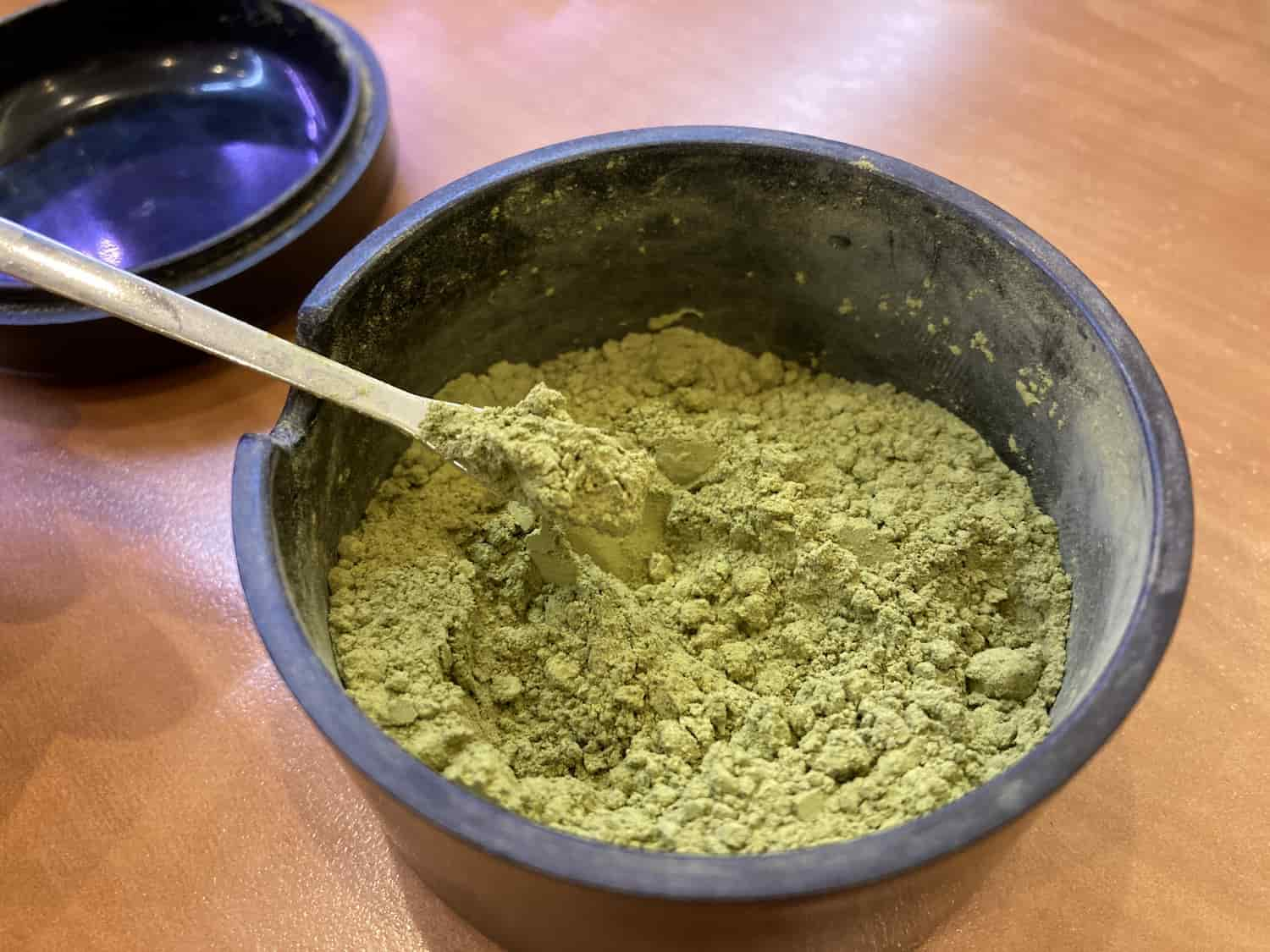

At many conveyor-belt sushi restaurants in Japan, every seat comes with the same small kit: a stack of cups, a hot-water tap built into the counter, and a little jar of bright green powder with a tiny scoop. You add a scoop, press the tap, give it a stir, and you have a cup of green tea in seconds. That powder is powdered green tea, or funmatsucha.
Funmatsucha (粉末茶) is Japanese tea that has been milled into a fine powder, most often green tea, so you drink the whole leaf instead of brewing it and throwing the leaves away. It looks a lot like matcha, but it’s usually made from ordinary green tea such as sencha rather than shade-grown tencha. In this guide, you’ll learn how funmatsucha is made, how it differs from matcha, how to use it at a sushi counter and at home, and what to look for on the label.
The short answer
Funmatsucha is powdered green tea. You stir it into hot or cold water and drink it without straining, so nothing is left in the pot. It isn’t the same as matcha: matcha is made from shade-grown tencha ground into powder, while funmatsucha is usually made from everyday green tea and costs much less.
What Is Funmatsucha?
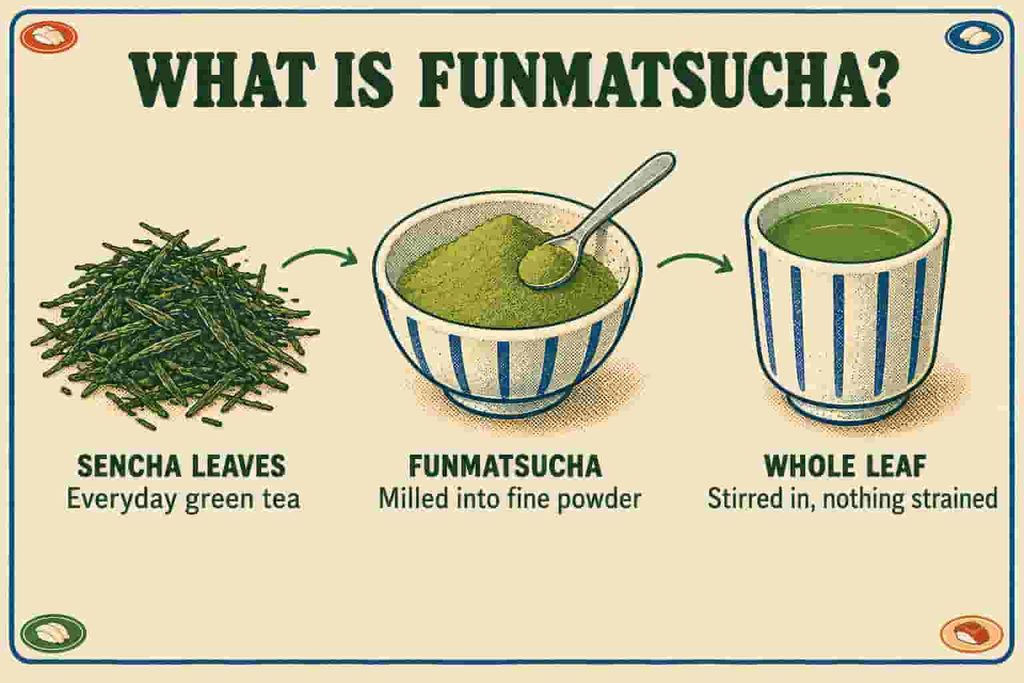
Funmatsucha is any Japanese tea that has been ground into a powder you can mix straight into water. Most of it is made from sencha or other everyday green tea, but you’ll also find powdered hojicha, genmaicha and other teas sold the same way. Instead of steeping leaves and pouring off the liquid, you drink the tea leaf itself.
Funmatsucha Quick Facts
- Japanese name
- 粉末茶, read funmatsucha; also sold as 粉末緑茶 (funmatsu ryokucha)
- English name
- Powdered green tea; sometimes loosely called “instant green tea”
- Made from
- Usually sencha or other everyday green tea, milled into powder
- How you drink it
- Stirred into hot or cold water and drunk whole, with no straining
- Flavor
- Usually fresh and grassy, with body and some astringency; depends on the base tea
- Often found at
- Self-serve tea stations at conveyor-belt sushi restaurants
- Not the same as
- Matcha (shade-grown tencha) or konacha (fine leaf particles you brew)
What the Name Funmatsucha Means
The name joins two words: 粉末 (funmatsu), meaning powder, and 茶 (cha), meaning tea. Read literally, it simply means “powdered tea.” That makes it a description rather than a single kind of tea, so the base tea is what tells you how a powder will taste. These are the words you’re most likely to see on a package:
On the package
粉末茶
funmatsucha
Powdered tea, the general term
粉末緑茶
funmatsu ryokucha
Powdered green tea
粉末煎茶
funmatsu sencha
Powdered sencha
粉末ほうじ茶
funmatsu hojicha
Powdered hojicha (roasted tea)
抹茶入り
matcha-iri
Contains some matcha
原材料名
genzairyō-mei
Ingredient list: check it here
Funmatsucha vs. Konacha
The names sound alike, and both teas are linked to sushi, so they’re easy to mix up. Konacha (粉茶) is made of tiny leaf particles sifted out while refining sencha. It looks like dark green sand, and you brew and strain it like loose-leaf tea. Funmatsucha is milled much finer, so it mixes into the water and you drink everything. Traditional sushi counters often serve brewed konacha, while conveyor-belt restaurants usually set out powdered tea for guests to make themselves.
How Funmatsucha Is Made
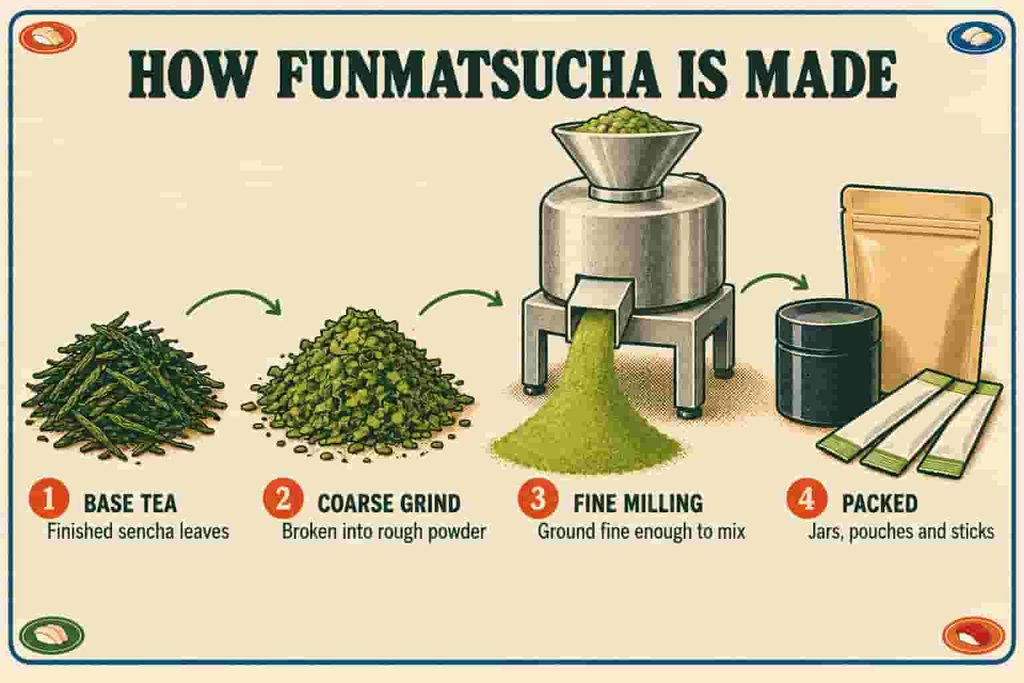
Funmatsucha starts as finished tea. The leaves have already been steamed, rolled and dried into sencha or another green tea, just like the tea you’d brew in a teapot. The difference comes at the end, when the dry leaves go into a mill instead of a tea bag or a pouch.
- Choose the base tea: producers start with dry green tea, often sencha. Hojicha and genmaicha powders start from those teas instead.
- Grind coarsely: the leaves are broken down into a rough powder first.
- Mill finely: ball mills, stone mills or jet mills grind the tea into a powder fine enough to mix into water.
- Finish and pack: some products are granulated so they mix more easily, then the powder is sealed in jars, pouches or single-serve sticks.
How fine is fine? In a 2016 study by the Mie Prefectural Industrial Research Institute, green tea that was jet-milled twice reached a median particle size of about 8 micrometers. That was as fine as, or finer than, the commercial matcha the researchers measured for comparison, which came in at about 15 micrometers. These are results from that test, not a standard size for every powdered tea.
Worth knowing
Very fine tea powder tends to clump and float on top of water. In the same Mie study, adding a little dextrin and granulating the powder helped it disperse. That’s why some funmatsucha packages list dextrin as an ingredient alongside the tea, though many contain tea alone.
Whole-Leaf Powder vs. Instant Tea Extract
Not every green powder is ground leaf. Some “instant” green teas are made from brewed tea or pressed tea juice that has been dried into a powder. These usually dissolve fully and leave little or no sediment, but they contain only what came out in the liquid. True funmatsucha is the whole leaf, so a fine layer may settle at the bottom of the cup if you let it sit.
Funmatsucha
粉末茶
Whole green tea leaves milled into powder. Mixes into water; a little may settle.
Instant tea extract
インスタント茶
Tea liquid dried into powder. Usually dissolves fully, with no leaf left.
Matcha
抹茶
Shade-grown tencha ground in a mill. Whisked into a smooth, frothy bowl.
Funmatsucha vs. Matcha
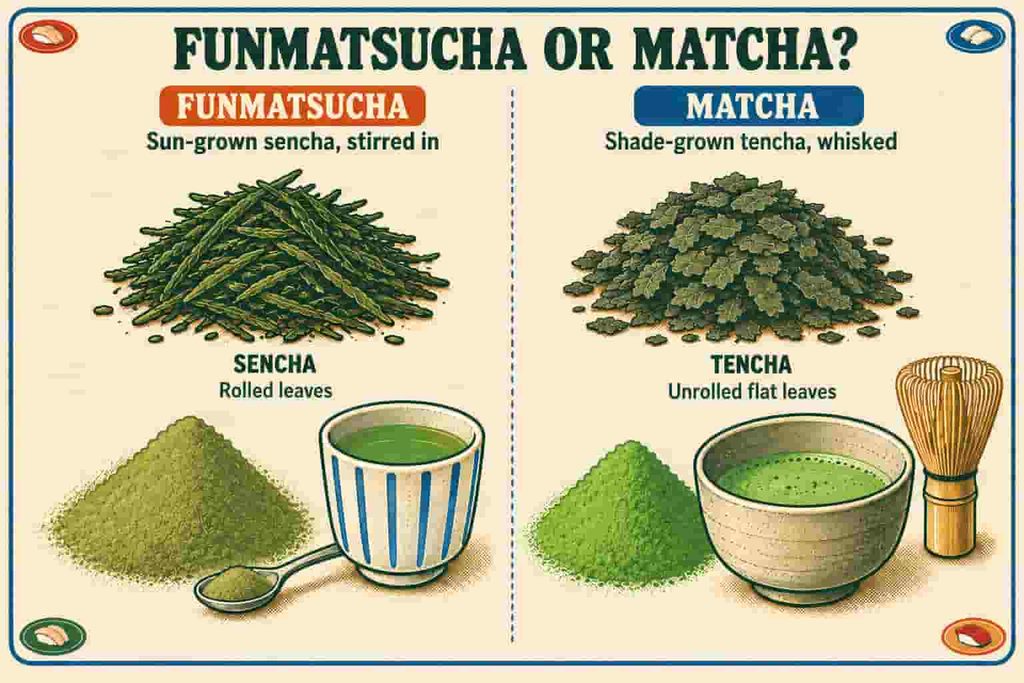
Funmatsucha and matcha are both green powders that you drink whole, and in a bag they can look almost identical. The difference is the leaf. Matcha is made from tencha: tea grown under shade for about 20 days before harvest, steamed, dried without rolling and then ground. Funmatsucha is usually made from sencha grown in full sun.
| Point | Funmatsucha (粉末茶) | Matcha (抹茶) |
|---|---|---|
| Raw leaf | Usually sencha or other everyday green tea | Tencha, grown in shade before harvest |
| Rolling | Rolled, like sencha | Not rolled |
| Color | Green to olive green, often less vivid | Bright, vivid green in good grades |
| Taste | Fresh, grassy, more astringent | Rich, sweet and savory in good grades |
| How you prepare it | Stirred or shaken into water | Whisked with a bamboo whisk |
| Price | Low; an everyday tea | Higher, especially ceremonial grades |
Why the Names Get Mixed Up
Outside Japan, “matcha” is often used for any green tea powder. A JETRO market report on New York found that some pastry and bakery businesses describe green tea powder as matcha, and that buyers there cared more about color and flavor than about which powder it was. For a drink, that may not matter much. If you’re paying matcha prices, though, check the ingredient list for 抹茶 (matcha) or てん茶 (tencha) rather than 緑茶 (green tea).
What Does Funmatsucha Taste Like?
A cup of funmatsucha tastes like a strong, full-bodied sencha. Because the whole leaf is in the cup, it feels thicker in the mouth than brewed tea, and the green color is opaque rather than clear.
The flavor is fresh and grassy, with a firm astringency and a slight bitterness. Powders made from first-flush sencha tend to be brighter and sweeter, while those from later harvests can taste flatter or more astringent. Processing and freshness matter too. Powdered hojicha is a different story altogether: roasty, mellow and brown in color, with very little bitterness.
The way you mix it also changes the taste. A heaping scoop in a small cup gives a bold, almost soupy tea, while a light scoop in a large glass of cold water is clean and refreshing. Leaves left in a teapot keep steeping and turn bitter. Funmatsucha has no leaves left to steep, so the main change over time is that the powder settles. A quick stir brings it back.
Funmatsucha at Conveyor-Belt Sushi
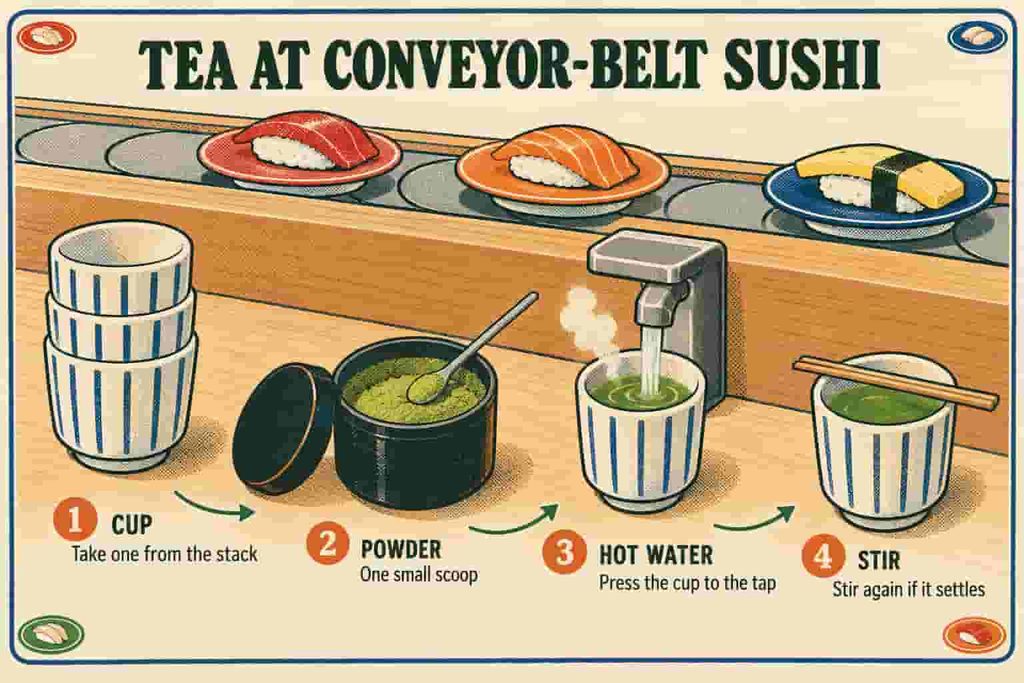
For many visitors, the first cup of funmatsucha is at a conveyor-belt sushi restaurant, or kaiten-zushi. The tea is usually free and self-serve, and it suits the fast pace of these restaurants: no teapots to wash and no staff needed to pour. Here’s how to make it at your seat.
- Take a cup from the stack, usually above the belt or beside your seat.
- Add the powder: start with one small scoop, or the amount shown on the jar. Add more for stronger tea.
- Fill with hot water: press your cup gently against the button or lever on the tap. The water is very hot, so keep your fingers clear.
- Stir and sip: stir with a chopstick or the scoop handle, and stir again if the powder settles.
Some diners also use the powder as a seasoning. In a 2021 Kobe Shimbun feature, Kura Sushi, a major conveyor-belt chain, listed powdered green tea mixed with salt as a dip for tempura, a homemade take on the matcha salt served at high-end restaurants. If you want to learn about the tea served at traditional sushi counters, see our guide to konacha and the sushi-shop word agari.
How to Make Funmatsucha at Home
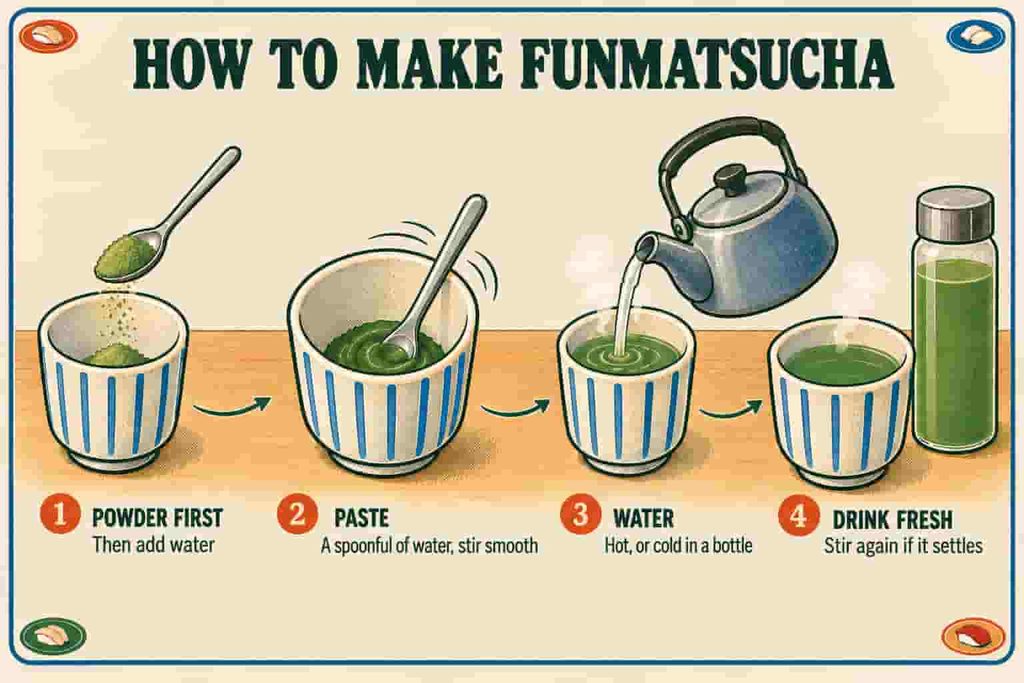
Making funmatsucha at home is even easier than brewing loose-leaf tea. You don’t need a teapot, a filter or a timer. Start with the amount printed on the package, then adjust to taste. Hot and cold water both work.
Hot cup
Quick everyday tea
- Powder
- As on the package, usually a small scoop
- Water
- Hot, not boiling, for a smoother taste
- Mix
- Stir well; stir again before drinking
Cold bottle
Fresh and light
- Powder
- Same amount per cup of water
- Water
- Cold, in a bottle with a lid
- Mix
- Shake hard for a few seconds
In the kitchen
Color and tea flavor
- Use
- Tea salt, rice, dough, smoothies
- Tip
- Mix with dry ingredients first
- Note
- Color may dull when heated
Step by Step
- Put the powder in the cup before the water, not after.
- Make a paste: add a spoonful of water and stir until smooth. This stops the powder from clumping or floating.
- Add the rest of the water and stir well.
- Drink it fresh and give it one more stir if the powder starts to settle.
Common Funmatsucha Mistakes
- Dumping powder on top of water: it floats and forms lumps.
- Using a damp spoon in the jar: moisture makes the whole jar clump.
- Treating it like matcha: a bamboo whisk works, but a spoon or a shaker bottle is all you need.
Funmatsucha is also handy for cooking because it brings tea flavor and color without a strong-tasting extract. Mix it with salt for tempura, stir it into rice, or add it to bread dough and smoothies. For delicate sweets where a bright green color matters, many cooks still prefer matcha.
What Happens When You Drink the Whole Leaf?
When you brew tea in a pot, only part of the leaf ends up in your cup. Kawaguchi City in Saitama Prefecture notes in a guide to reusing tea leaves that only about 20 to 30 percent of tea’s components dissolve in hot water, and that most of the rest, including dietary fiber and vitamins, stays in the used leaves. The exact share depends on the tea and how you brew it.
Funmatsucha changes that, because you drink the leaf itself. You take in the parts that don’t dissolve as well as the parts that do. That doesn’t make it a health food or a medicine. It’s simply a different way of drinking the same tea.
Funmatsucha and Caffeine
Like other green teas, funmatsucha contains caffeine. How much you get depends on the product and on how much powder you use, since nothing is left behind in a pot. If you’re sensitive to caffeine, start with a smaller scoop and check the package. Powdered hojicha has a roasted flavor, but it isn’t caffeine-free unless the label says so.
How to Choose and Store Funmatsucha
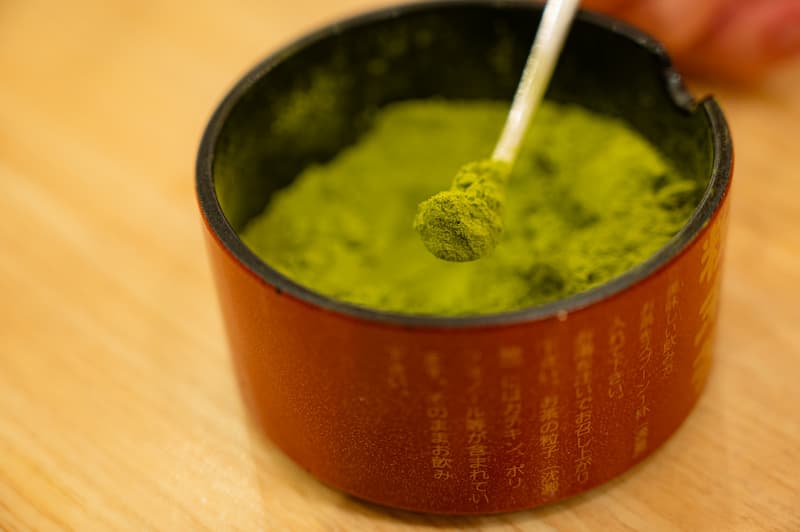
Funmatsucha is sold in supermarkets, drugstores and tea shops across Japan, in jars, resealable pouches and single-serve sticks. The ingredient list tells you most of what you need to know.
- Read the ingredients: If “緑茶” (green tea) is the only ingredient, nothing else has been added. Some products add dextrin to help mixing or vitamin C to protect the color.
- Check the base tea: powdered sencha, hojicha and genmaicha taste very different. Some blends add a little matcha for color.
- Check the origin: look for the prefecture or region, such as Shizuoka or Kagoshima, on the label.
- Choose the format: single-serve sticks are easy to carry and stay fresh until opened; jars suit daily use at home.
- Look at the color: fresh powder is usually a lively green. A dull, brownish green can be a sign of old tea, though the base tea matters too (hojicha powder is naturally brown).
Fine powder has a huge surface area, so it picks up moisture, light and smells quickly. Close the jar or pouch tightly after each use and keep it in a cool, dark, dry place, away from strong-smelling foods. Always use a dry spoon. If you keep an unopened pack in the fridge, let it reach room temperature before opening so condensation doesn’t make it clump. Once opened, follow the storage advice on the package and use it while it still smells fresh.
Why Funmatsucha Is Worth Trying
Funmatsucha isn’t a rare or ceremonial tea, and that’s exactly its appeal.
- Quick to prepare: a full cup in seconds, with no teapot and no used leaves to throw away.
- The whole leaf in your cup: you drink the parts of the tea that a teapot leaves behind.
- A souvenir that travels well: light single-serve sticks make it easy to bring a taste of Japan home.
If you’ve enjoyed the self-serve tea at a conveyor-belt sushi restaurant, a jar of funmatsucha lets you recreate it at home. Try it side by side with a cup of brewed sencha, and you’ll taste how much difference the whole leaf makes.
Funmatsucha FAQ
About the Tea
Is funmatsucha the same as matcha?
No. Matcha is made from shade-grown tencha that is not rolled before grinding. Funmatsucha is usually made from ordinary sencha, tastes more astringent and costs less.
Is the green powder at conveyor-belt sushi restaurants funmatsucha?
Usually, yes: it’s powdered green tea that you mix with the hot water at your seat. The exact product varies by restaurant, and some blends include a little matcha. Traditional sushi counters more often serve brewed tea such as konacha.
Making and Buying
Does funmatsucha dissolve completely?
Not quite. Because it’s ground leaf, it mixes into the water but a fine layer can settle if the cup sits. Stir again before drinking. Instant tea made from dried tea extract usually dissolves more fully.
Can I use funmatsucha with cold water?
Yes. Shake the powder with cold water in a bottle with a lid, or make a paste with a little water first and then add the rest.
Can I use funmatsucha instead of matcha in recipes?
For drinks, tea salt, rice and bread, it works well. For sweets where a bright green color and a smooth, sweet taste matter, matcha usually gives a better result.
How should I store funmatsucha?
Keep it sealed in a cool, dark, dry place and always use a dry spoon. Moisture is the main cause of clumping.
References
- Mie Prefectural Industrial Research Institute – Research report on fine powdering and granulating green tea (2016), on jet milling, particle size compared with matcha, and dispersion with dextrin. (Accessed October 2026)
- Kyoto Prefectural Tea Research Institute – Powder made from pressed tea-leaf juice, on soluble tea powders used for instant tea. (Accessed October 2026)
- Kawaguchi City – Using tea leaves after brewing (茶殻の活用), on how much of tea’s components dissolve in hot water. (Accessed October 2026)
- JETRO – Japanese green tea market report, New York, on green tea powder being described as matcha. (Accessed October 2026)
- ISO – ISO/TR 21380:2022 Matcha tea: Definition and characteristics, on the international definition of matcha by plant source, cultivation and production. (Accessed October 2026)
- Kotobank – Matcha (抹茶), on how matcha is made from shaded, unrolled tencha. (Accessed October 2026)
- Kobe Shimbun – Kura Sushi’s powdered green tea and salt with tempura (2021), on using powdered tea as a seasoning. (Accessed October 2026)



Comments