


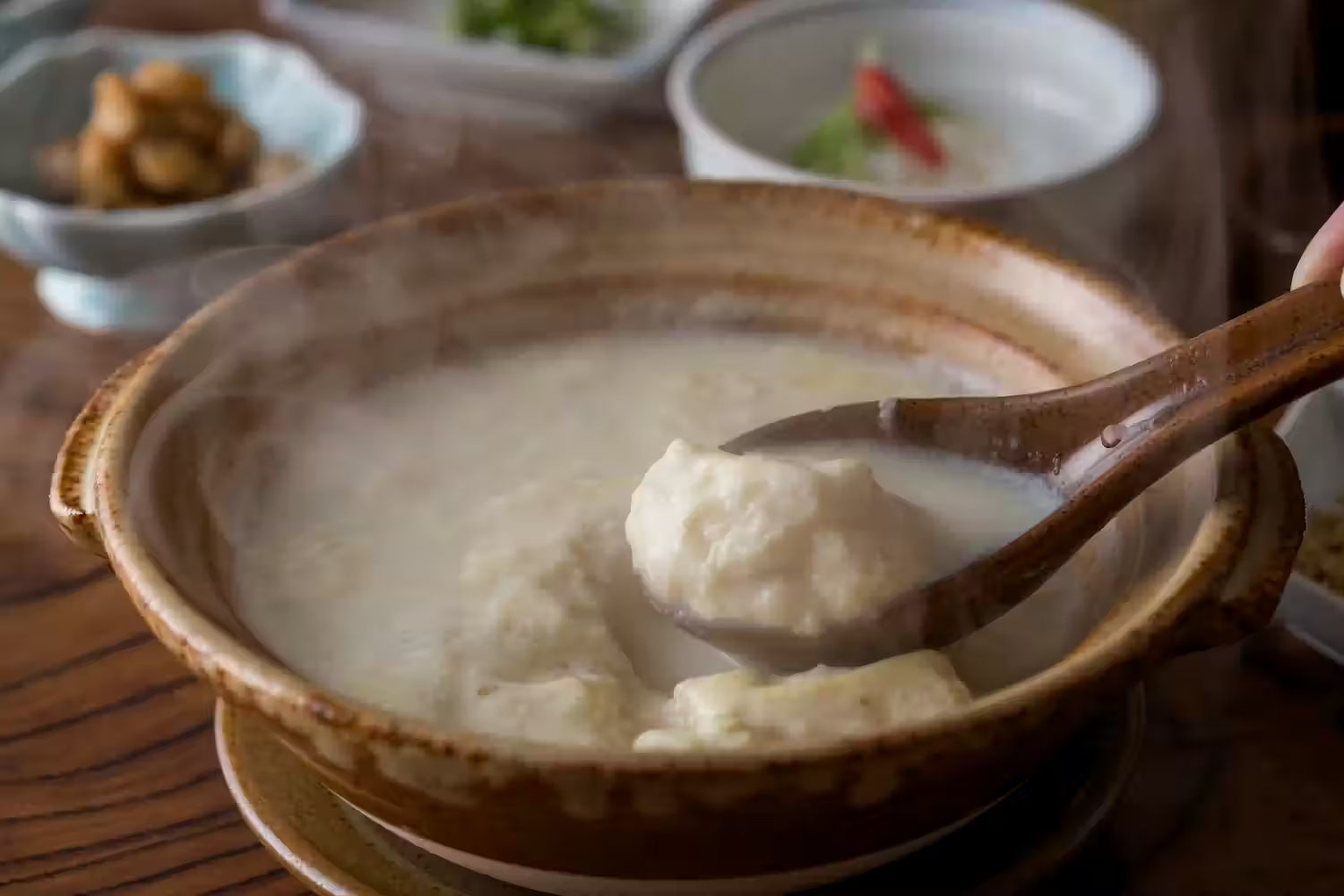



Picture a small clay pot filled with clear water and cubes of tofu. As it simmers, the corners round off, the surface turns creamy, and the liquid clouds like pale soy milk. This is Ureshino Onsen Yudofu (嬉野温泉湯どうふ), a specialty of Ureshino in Saga Prefecture.
The dish uses cooking water tied to the local hot spring, not used bath water. Above all, its appeal lies in the change itself. Rather than falling apart at once, the tofu softens gradually into the broth.
What Is Ureshino Onsen Yudofu?
Ureshino Onsen Yudofu is a regional hot pot from Ureshino City, Saga Prefecture. Cooks simmer momen tofu in cooking water associated with the local hot spring. As the surface softens, the liquid turns milky. Diners then eat the tofu with the broth, sesame sauce, ponzu, or yuzu kosho.
Quick Facts
- Japanese name
- 嬉野温泉湯どうふ (also 温泉湯豆腐)
- Region
- Ureshino City, Saga Prefecture, Kyushu
- Typical ingredients
- Momen tofu, often made with local Fukuyutaka soybeans, and dedicated cooking water; details vary by maker
- Spring source data
- Sodium bicarbonate-chloride spring, pH 7.5 to 8.5 (source water, not product specs)
- Texture
- Creamy outer layer, no dairy by default; broth turns milky
- Cooking time
- About 15 to 20 minutes after boiling (one maker’s guide)
- How to eat
- Broth first, then sesame sauce, ponzu, or yuzu kosho
- Example price
- ¥620 for basic yudofu at Soan Yokocho, checked October 24, 2026 (one restaurant, not a citywide average)
- Access
- West Kyushu Shinkansen to Ureshino-Onsen Station, then bus or taxi
In Japanese, you will see both 湯どうふ and 湯豆腐. Likewise, English writers use both “yudofu” and “yudoufu.” This article uses “yudofu,” apart from the title of our Kyoto guide.
Is It Really Made with Hot-Spring Water?
Traditionally, local sources describe the dish as tofu simmered in Ureshino hot-spring water. Retail sets, however, use dedicated cooking water supplied for the dish. Restaurants and sets may not use identical water. For product details, check the label or ask the business directly.
Three kinds of water
- Hot-spring source water: water drawn from the geothermal source.
- Bath water: water in bathing tubs, which this dish does not use.
- Cooking water: water supplied for cooking yudofu; check each maker or restaurant for its source.
What Does It Taste Like?
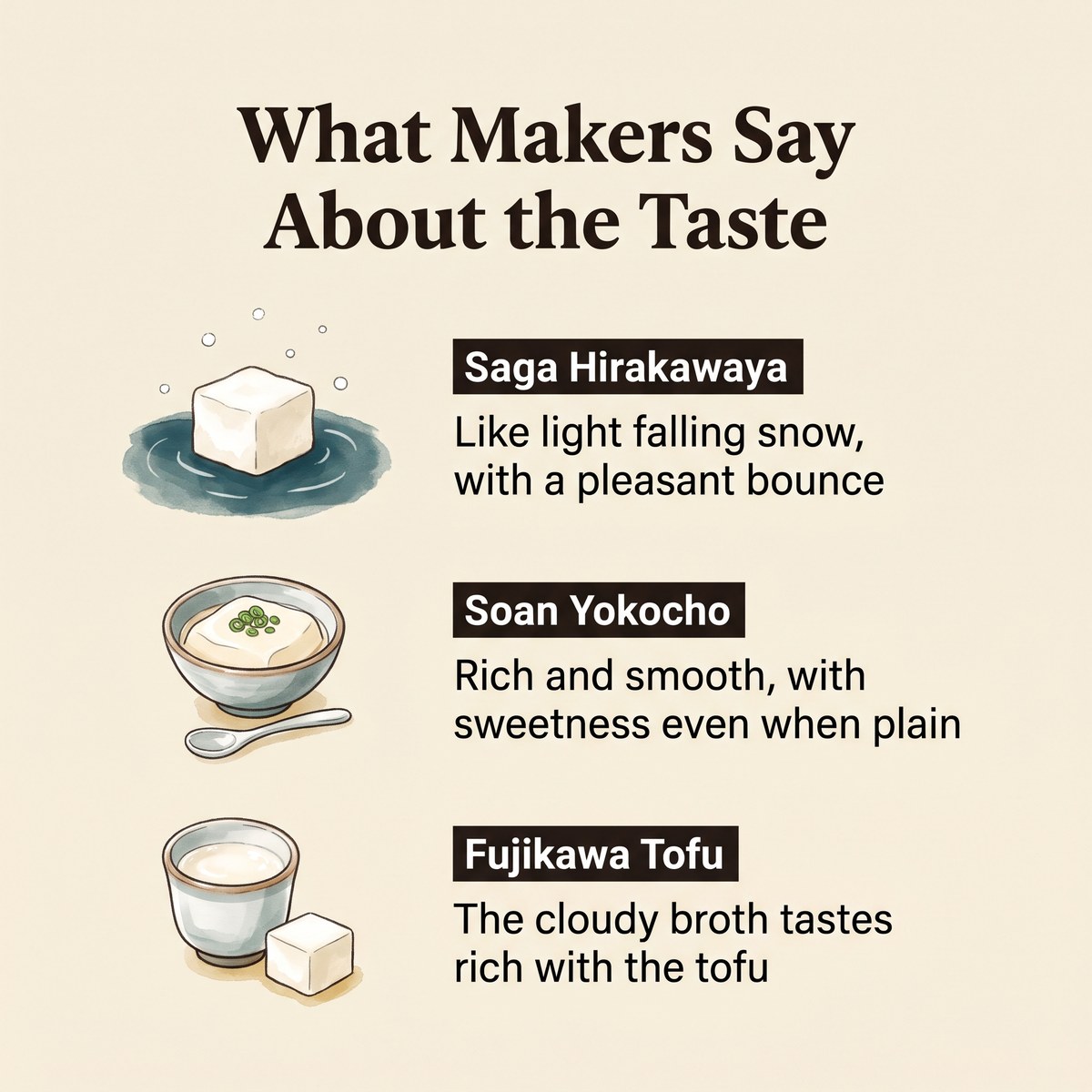
Makers describe it in vivid terms. Saga Hirakawaya compares the tofu to light, falling snow, with a pleasant bounce and gentle soybean sweetness. Soan Yokocho calls its tofu rich and smooth, with sweetness even when eaten plain. Fujikawa Tofu, meanwhile, says the cloudy broth tastes rich when sipped with the tofu.
Admittedly, a cloudy broth can look odd at first. Still, “creamy” here describes texture only, since the basic dish contains no dairy. A little green onion or yuzu kosho then adds a fresh, sharp edge.
Its pleasure is gentle rather than dramatic. Even so, on a cold evening in a spa town, few dishes feel more comforting.
How to Eat Ureshino Onsen Yudofu
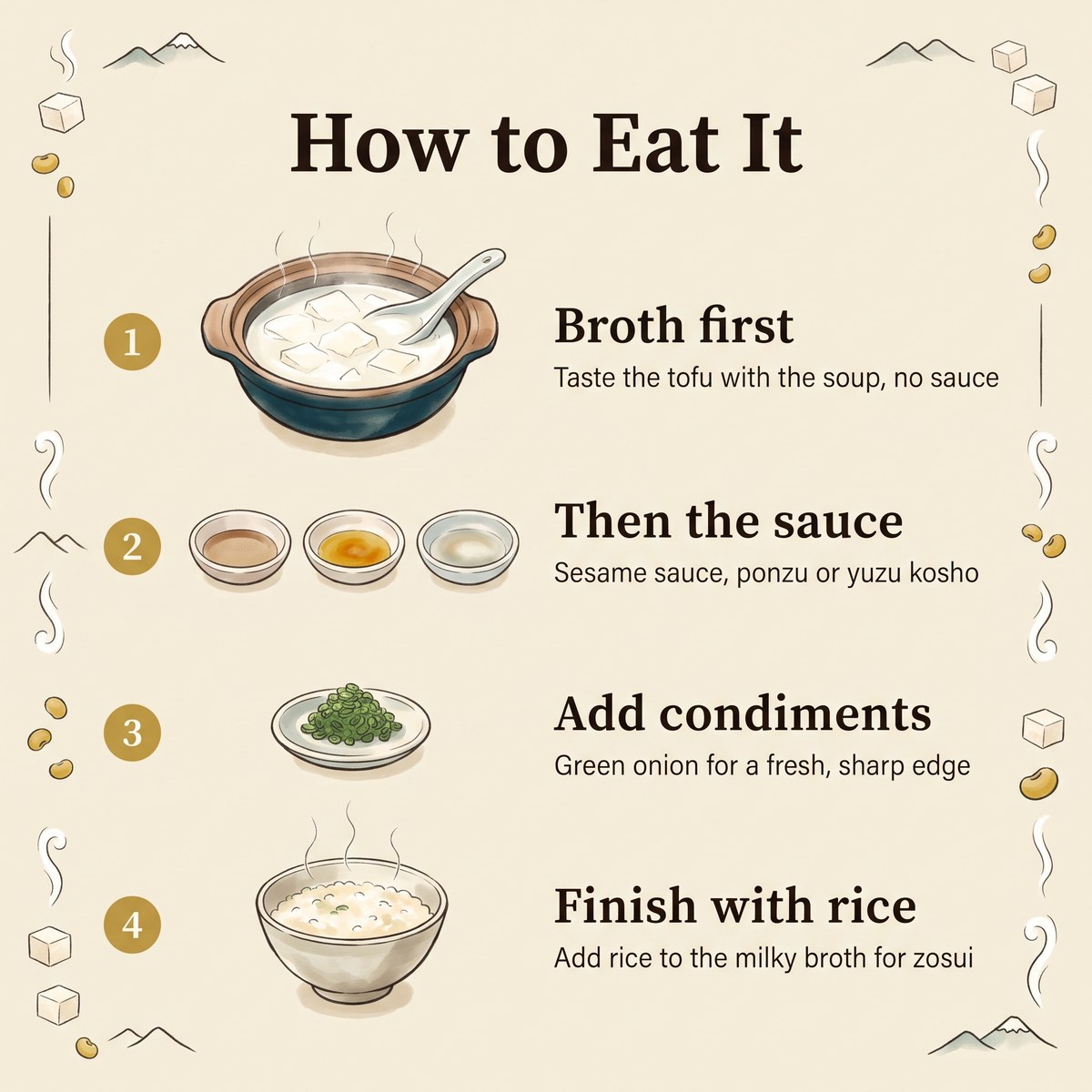
There is no single rule, and that freedom is part of the fun. Still, the restaurant and makers reviewed here point to two main styles. Both Fujikawa Tofu and Saga Hirakawaya also suggest finishing with rice.
Style 1: Broth First, Then Sauce
At Soan Yokocho, the broth comes seasoned from the start. The restaurant suggests adding condiments to the pot first. Next, eat the tofu with the soup and no sauce. After that, dip it in the house tare for a second flavor.
Style 2: Plain Pot with Sauces
Meanwhile, Fujikawa Tofu suggests sesame sauce, ponzu, or yuzu kosho with green onion. Sesame adds richness, and ponzu brings bright citrus. Yuzu kosho, a Kyushu favorite, gives a peppery kick.
The Finish: Zosui
Once the tofu is gone, add rice to the milky broth. It simmers into a soft zosui that uses every drop. Fujikawa Tofu also suggests turning leftover broth into miso soup. For shared pots, our guide to nabe etiquette may help.
Ureshino Onsen Yudofu vs Conventional Kombu Yudofu
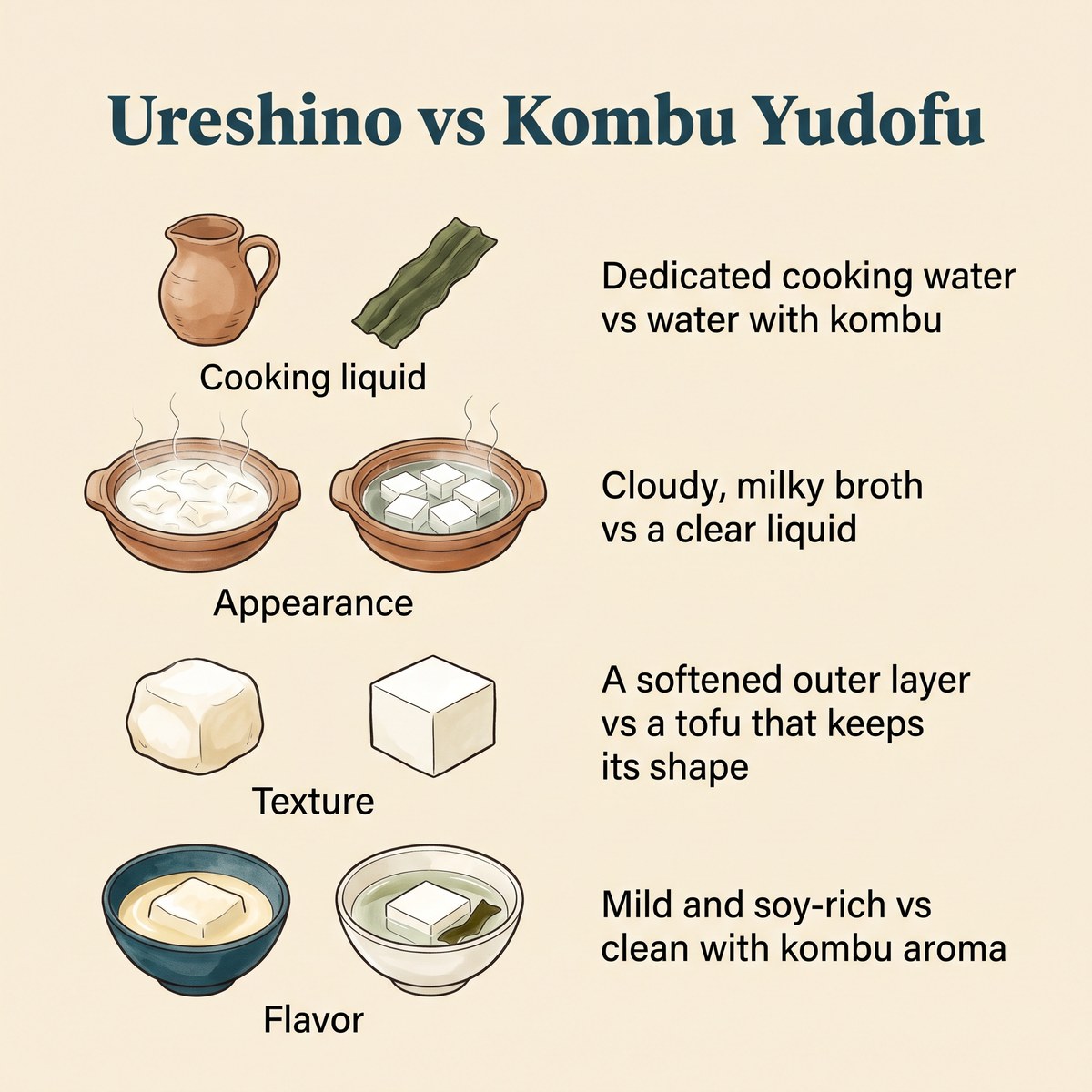
If you know Kyoto-style Yudoufu, the contrast is striking. Both dishes warm tofu gently in a pot. Yet they aim for very different results.
| Point | Ureshino Onsen Yudofu | Conventional kombu yudofu |
|---|---|---|
| Cooking liquid | Dedicated cooking water | Water with kombu (kelp) |
| Appearance | Broth turns cloudy or milky | Liquid usually stays clear |
| Texture | Outer layer softens | Tofu generally keeps its shape |
| Typical flavor | Mild and soy-rich | Clean tofu flavor with kombu aroma |
| Seasoning | Seasoned broth or sauces, by shop | Often ponzu or a soy-based sauce |
| Fish dashi | Possible in broth or sauces; ask | Possible in sauces; ask |
| Home cooking | Best with a maker’s set | Easy with tofu, water, and kombu |
It also differs from soy milk hot pot, which starts with tonyu as the base. In Ureshino, the milky color comes from the tofu itself. All three dishes belong to the wider family of Japanese nabe.
Where to Try Ureshino Onsen Yudofu
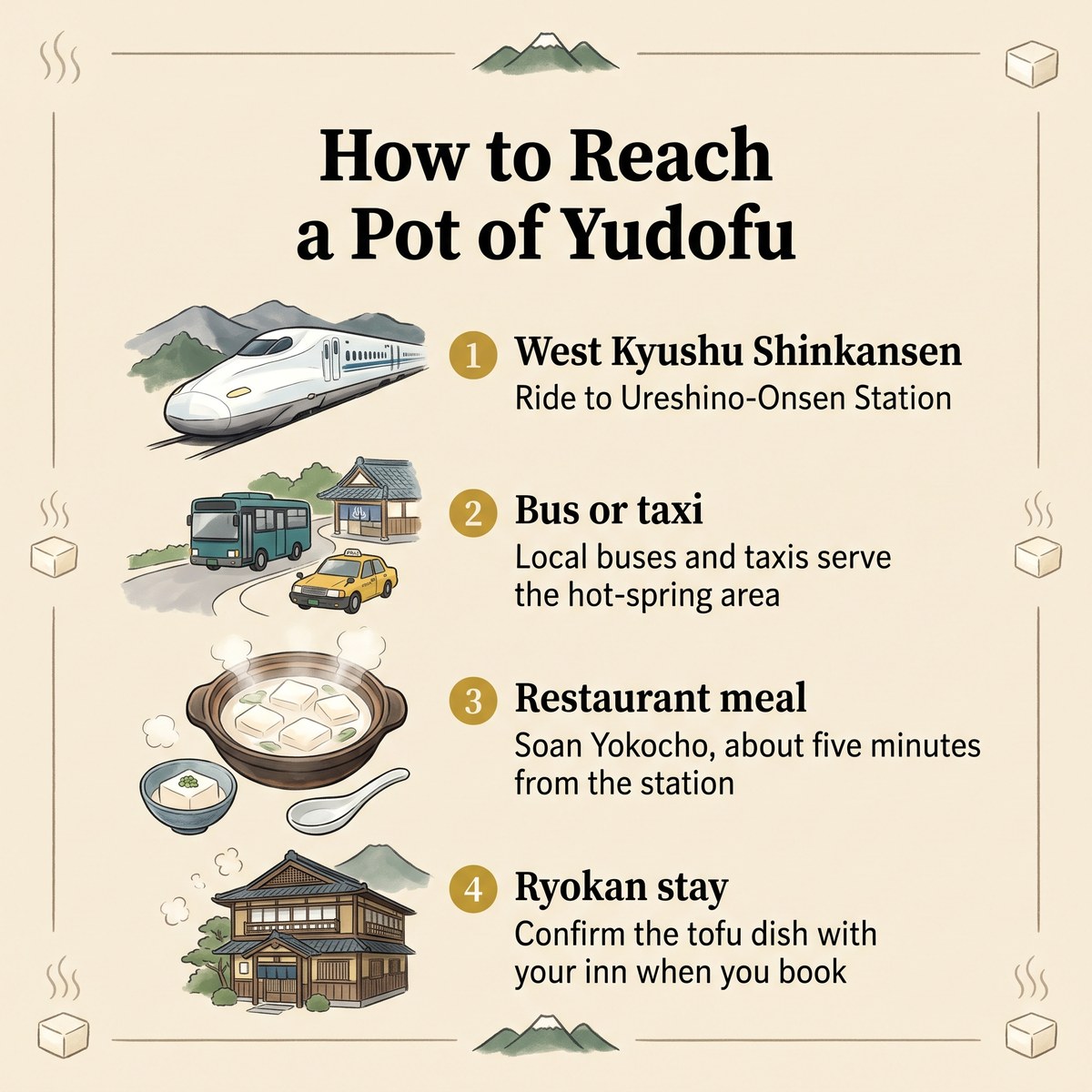
First, take the West Kyushu Shinkansen to Ureshino-Onsen Station. From there, local buses and taxis serve the hot-spring area. You can then choose a restaurant meal or an inn.
For a Restaurant Meal: Soan Yokocho
Soan Yokocho (宗庵よこ長) describes itself as the shop where onsen yudofu originated. The other sources reviewed here do not independently confirm that claim. Its menu lists a plain yudofu at ¥620 and a set meal with rice and side dishes at ¥1,100. A deluxe set with a fish-and-tofu pot costs ¥1,340, and a children’s yudofu set costs ¥760. According to the restaurant, the trip from the station takes about five minutes by bus or taxi.
Official listing as of October 24, 2026: lunch 11:00 to 15:00 (last order 14:30). Dinner runs 17:30 to 21:00 (last order 20:30). Closed Wednesdays, with exceptions around holidays, plus occasional temporary closures. Parking for 18 cars, with more nearby. The site does not mention English menus. Prices and hours may change, so please check the official website before you visit.
For a Ryokan Stay: Local Inns
The tourism association’s current page says all 25 member inns and hotels serve dishes using the tofu. Saga Hirakawaya adds that the dish is a breakfast standard at Ureshino inns. However, membership and menus can change, so confirm with your inn when you book.
How to Make Ureshino Onsen Yudofu at Home
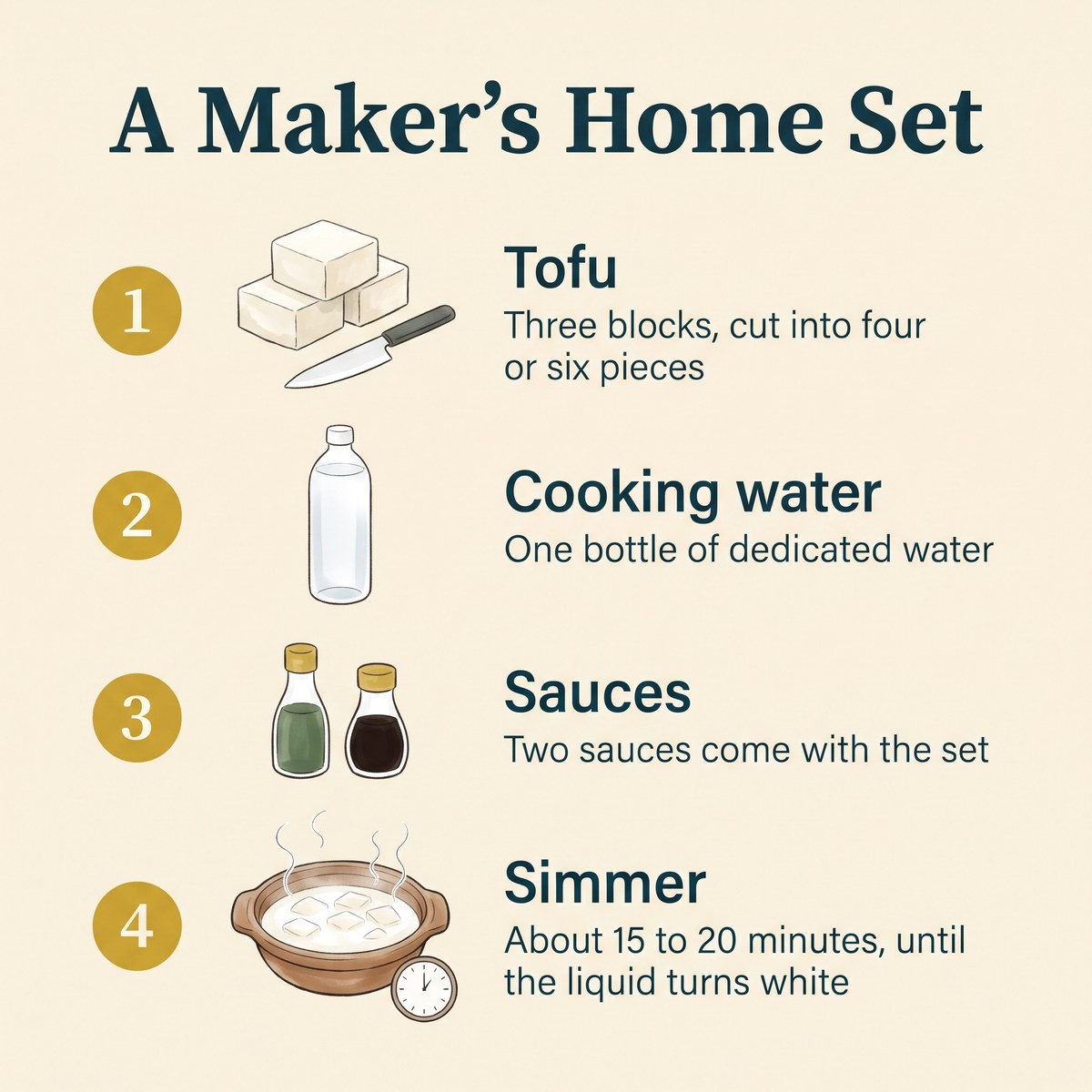
The easiest route is a maker’s set. Soan Yokocho, for example, sells three blocks of tofu with one bottle of cooking water and two sauces. Saga Hirakawaya, a tofu maker based in Takeo, Saga, sells its own version online. Back in 2012, a Saga report also noted packs on sale at inn shops and local grocers. Ordinary tap water is unlikely to reproduce the effect reliably, so makers recommend their dedicated water.
For example, Fujikawa Tofu gives these basic steps for its own set.
- Cut each block of tofu into four or six pieces.
- Pour the dedicated cooking water into a pot.
- Add the tofu and bring the water to a boil.
- Simmer for about 15 to 20 minutes, until the liquid turns white.
- Serve once the tofu feels soft, with sauce or condiments.
Fujikawa Tofu also suggests adding napa cabbage, chrysanthemum greens, or pork. Other makers may give different times or heat levels, so follow the instructions on your set. These sets are perishable, and storage rules and use-by dates vary by seller. Soan Yokocho even asks buyers to pick a delivery time when someone can receive the package.
Why Does the Tofu Soften in Ureshino Water?
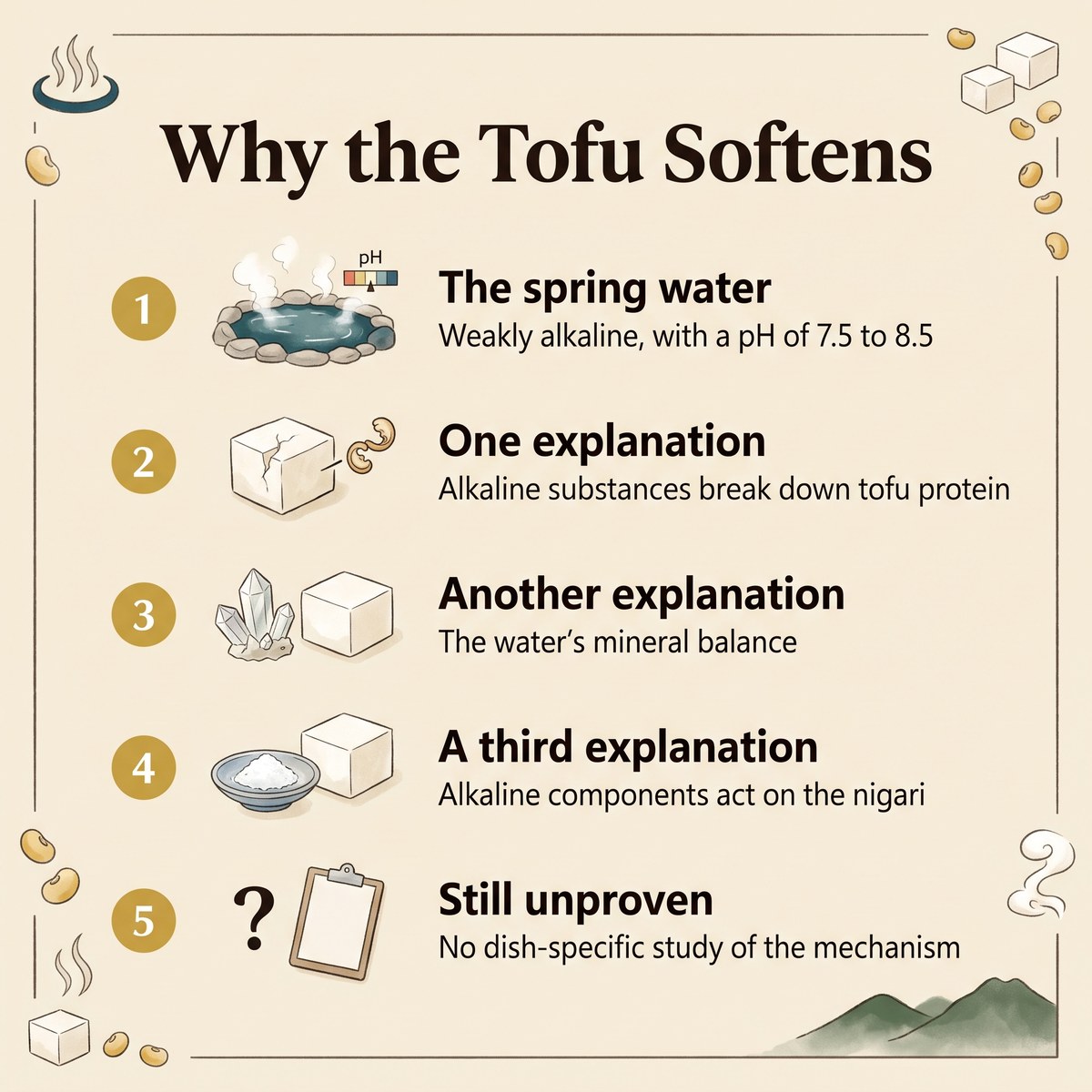
In short, the weakly alkaline cooking environment changes the tofu’s outer structure as it heats. The surface softens, and soy material spreads into the liquid. Official tourism sources explain the cause in different ways. Moreover, the sources reviewed for this article include no dish-specific, peer-reviewed study of the mechanism.
That is what makes the pot so curious. In ordinary water, momen tofu usually keeps its shape and can even firm up with long heating. Here, by contrast, the surface grows softer the longer it cooks. How much of the block stays intact depends on the tofu, the water, the heat, and the time.
What the Sources Say
First, Ureshino Onsen Haito, the local hot-spring supply company, lists the source as a sodium bicarbonate-chloride spring. It reports a weakly alkaline pH of 7.5 to 8.5. Sodium comes to about 400 to 500 mg per kilogram. Again, these figures describe the source water rather than any bottled product.
Tofu holds its shape because coagulants such as nigari bind soy proteins into a gel. Japan’s tourism database says alkaline substances break down the tofu’s protein. The Ureshino Onsen Tourism Association credits the water’s mineral balance instead. Saga’s official tourism site, on the other hand, says the alkaline components act on the nigari.
Good to know
Don’t assume every hot spring gives this result. Local makers build the dish around Ureshino water and tofu made for this method. Oita’s Jigokumushi shows a very different way Kyushu cooks with hot springs.
The Tofu and Its Producers
First of all, the dish relies on momen tofu, a pressed Japanese tofu. It is firmer than silken tofu but often softer than products labeled extra-firm overseas. Ureshino-grown Fukuyutaka soybeans have a close link to the branded tofu. Even so, sourcing varies by producer.
A MAFF case study describes the local promotion council’s program as using contract-grown Ureshino soybeans and additive-free tofu. That describes one branding program, not a spec for every product. Fujikawa Tofu, for its part, states that its own tofu uses 100% Ureshino-grown Fukuyutaka soybeans.
The Ureshino Onsen Tourism Association lists five producers for the branded product. They may not be the only tofu makers in town.
- Fukuda Tofu (福田豆腐店), Ureshino, Saga
- Fujikawa Tofu (藤川豆腐店), Ureshino, Saga
- Taishoya Yudofu Honpo (大正屋湯どうふ本舗), Ureshino, Saga
- 豆匠よこ長, Ureshino, Saga
- Konome no Sato (このめの里), Ureshino, Saga
A Short History: From Post Town to Manga Fame
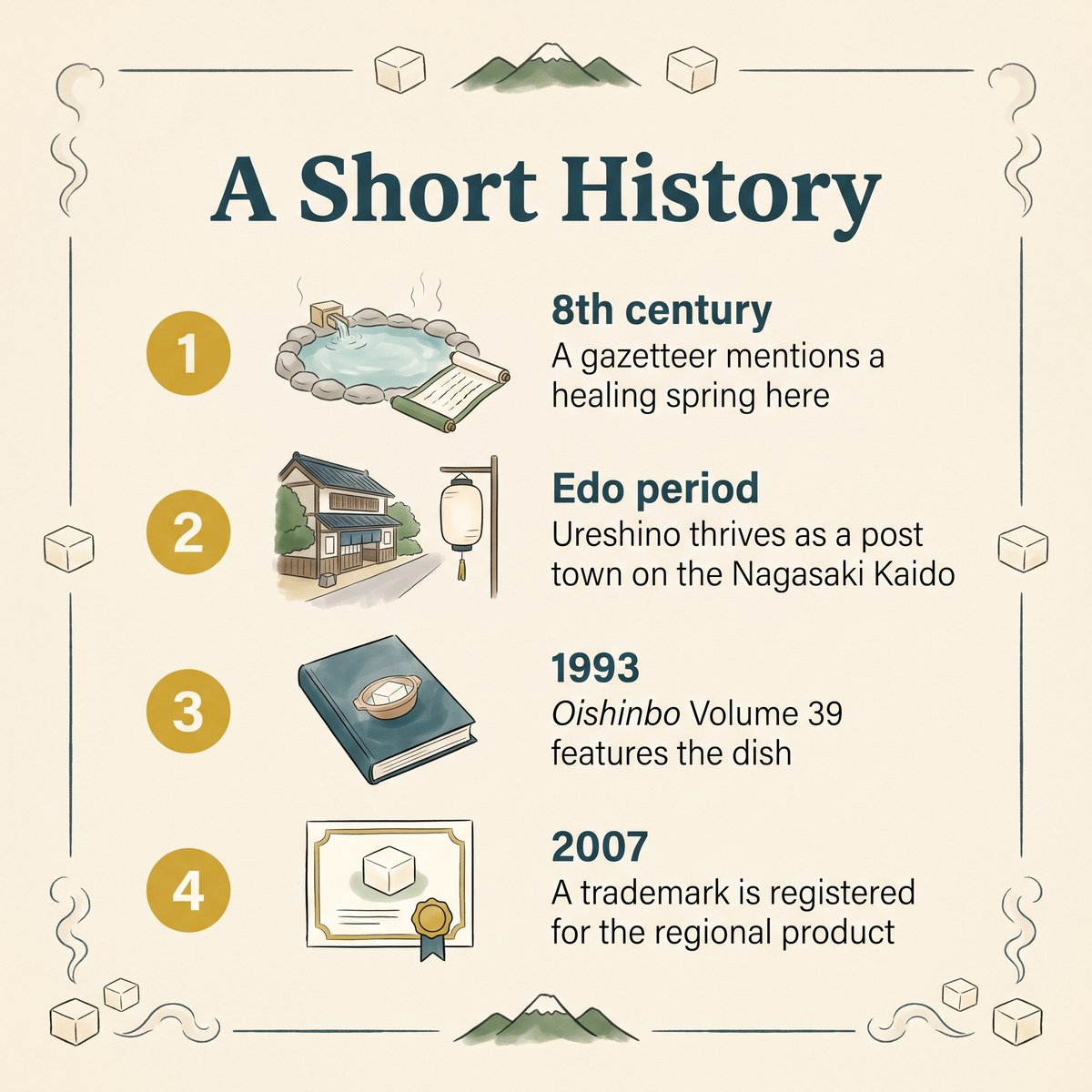
Ureshino is an old spa town. According to the local hot-spring supply company, an 8th-century gazetteer, the Hizen no Kuni Fudoki, mentions a healing spring here. Later, in the Edo period, Ureshino thrived as a post town on the Nagasaki Kaido highway.
Japan’s official tourism database places the discovery of the softening method in the Edo period. However, the sources reviewed here identify no surviving Edo-era document. So it works best as the accepted local account rather than a firm date.
Key Moments
- Edo periodJapan’s tourism database places the softening method in this era.
- Date not establishedSoan Yokocho describes itself as the shop where onsen yudofu originated.
- 1993Oishinbo Vol. 39, Episode 5, titled “Onsen Yudofu,” features the dish.
- 2007MAFF reports a trademark registration for the regional product.
- 2009 dataA 2012 Saga report counts 41 inns and hotels plus 23 eateries serving the tofu from October 2009.
- Current listingThe tourism association lists 25 member inns and hotels serving it.
Then Oishinbo, a hugely popular food comic, ran the episode in Volume 39. Shogakukan published that volume in 1993. Saga’s official tourism site says the appearance helped bring the dish national recognition. Yet it offers no audience or sales data to measure that effect.
Soan Yokocho’s origin claim, by contrast, carries no date in its own materials. Meanwhile, the tourism association lists trademark No. 5077556 for the regional product. Inns, tofu makers, and tourism groups then promoted the modern brand together. MAFF’s case study also notes an autumn Yudofu Festa that drew about 6,000 visitors.
Allergy and Vegetarian Notes
Tofu contains soy, of course. Sesame sauce contains sesame, and ponzu or seasoned broth may include wheat or fish dashi. Recipes vary by restaurant, so asking is always smart. These phrases can help when you order.
Does the broth or sauce contain bonito or dried sardines?
だしやたれに、かつお節や煮干しは入っていますか。
Dashi ya tare ni, katsuobushi ya niboshi wa haitte imasu ka?
Does this contain wheat or sesame?
小麦やごまは入っていますか。
Komugi ya goma wa haitte imasu ka?
Do you use the same pot or tools for meat or fish?
肉や魚と同じ鍋や調理器具を使っていますか。
Niku ya sakana to onaji nabe ya chori kigu o tsukatte imasu ka?
Tofu itself is plant-based, and some unseasoned cooking-water sets may contain no animal ingredients. Still, restaurant broths, sauces, and shared pots differ. For more tips, see our guide to vegetarian dining in Japan.
Conclusion: Why Ureshino Onsen Yudofu Is Worth the Detour
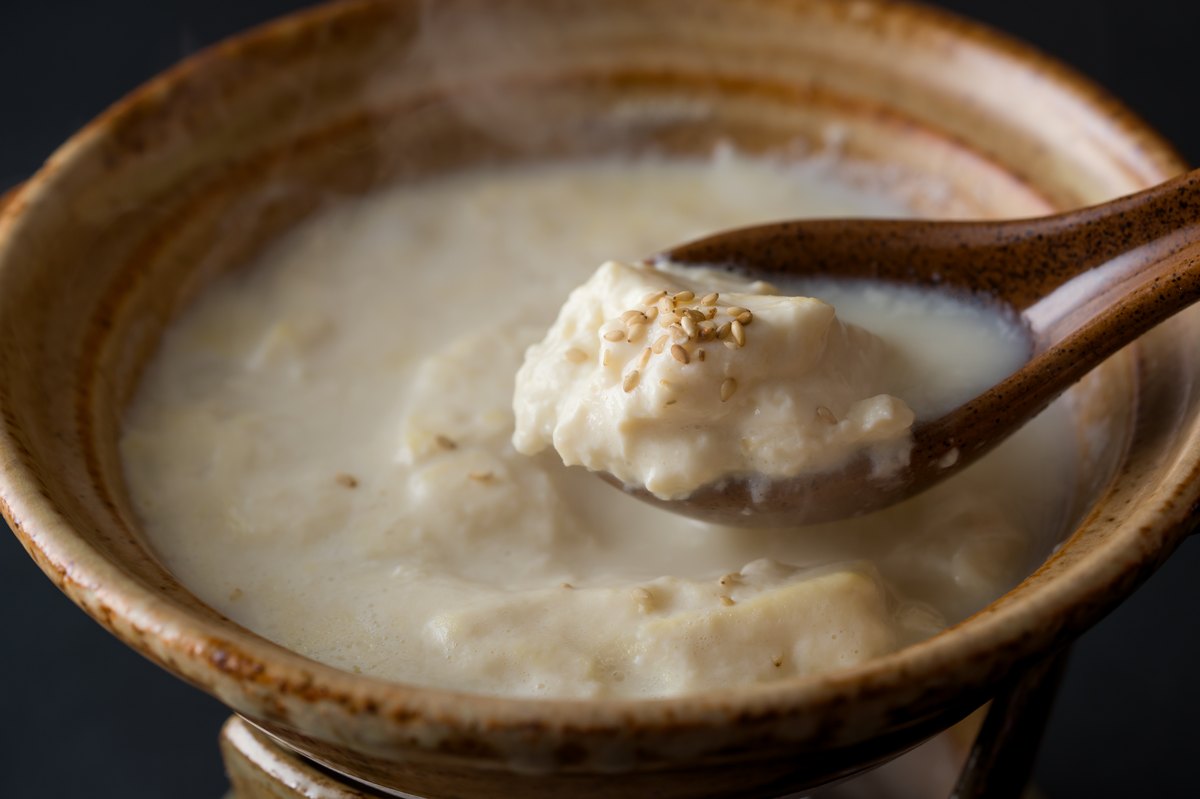
Ureshino Onsen Yudofu looks humble, yet it rewards curiosity. A creamy outer layer, a firmer center, and a soy-rich broth make it unlike other tofu pots. If your trip includes Saga, order the basic pot, taste the broth first, and save room for zosui.
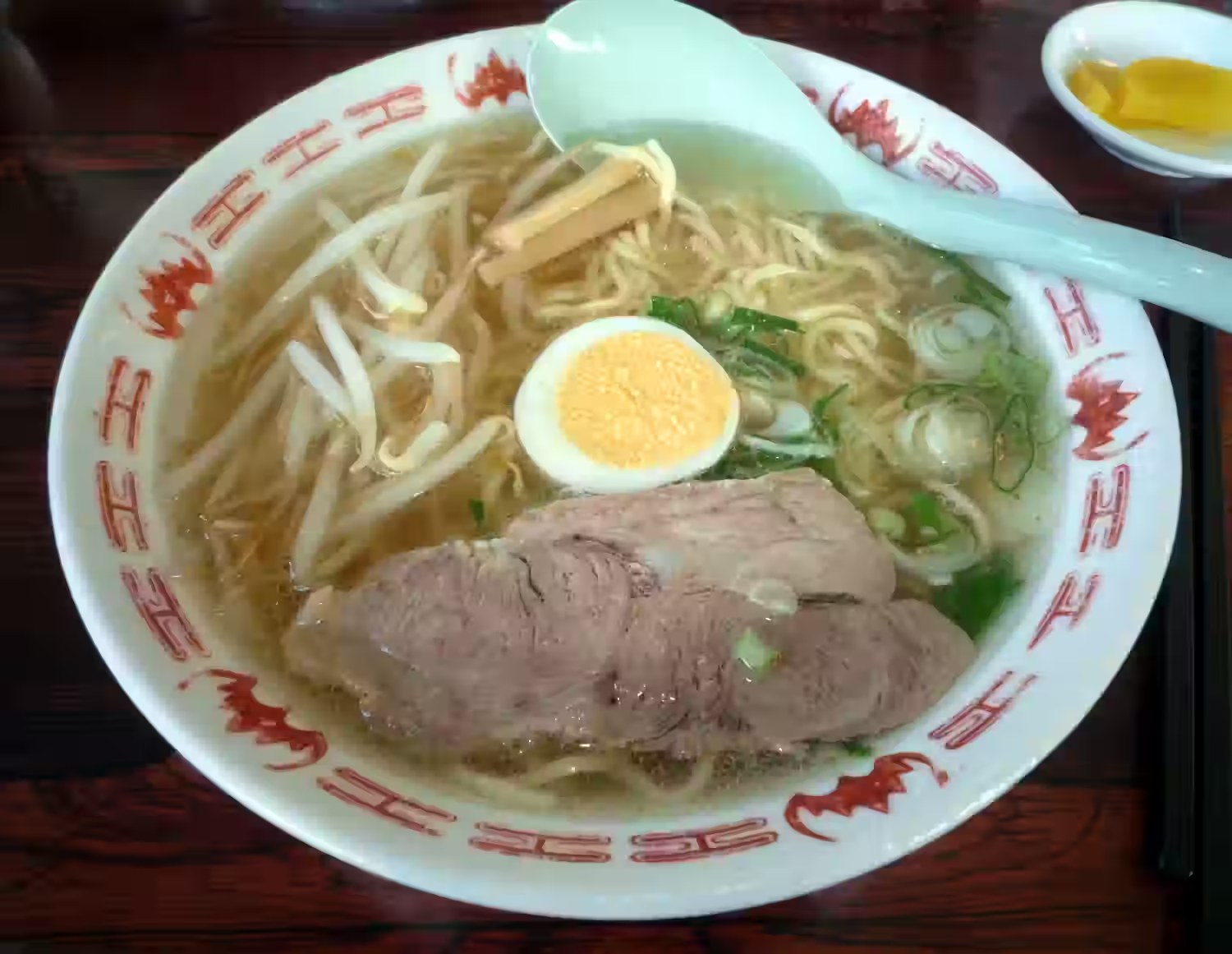
For more regional ideas, browse our Kyushu food guide or the hearty bowls of Saga Ramen.
Frequently Asked Questions about Ureshino Onsen Yudofu
About the Water
- Is Ureshino Onsen Yudofu made with bath water?
-
No. Makers sell dedicated cooking water, and restaurants use water meant for the dish. Restaurant water and retail sets may still differ. Ask the business or read the label for specifics.
- Can I drink the broth?
-
Yes, when it is the prepared broth from a restaurant pot or a set whose instructions allow it. Fujikawa Tofu, for example, suggests reusing leftover broth for miso soup or zosui. However, that does not make raw spring water safe to drink. Only drink spring water that a facility clearly marks as drinkable.
- Can I make it at home with regular water?
-
Regular tap water is unlikely to give the same texture reliably. Instead, buy a set that includes tofu and dedicated cooking water. Then follow the package instructions for time and heat. That route gives you the closest result outside Ureshino.
About the Tofu and Dining
- Why does the tofu soften?
-
Tourism sources credit the water’s alkaline or mineral components. Some say they act on soy protein, while others point to the nigari coagulant. The sources reviewed do not pin down the exact mechanism. Either way, heat and time drive the change.
- Does the tofu completely dissolve?
-
No, it softens rather than dissolving all at once. The surface turns creamy and partly spreads into the broth. How much of each block remains depends on the tofu, water, heat, and simmering time. “Melting tofu” is a nickname for the texture.
- How is it different from Kyoto yudofu?
-
Kyoto-style yudofu warms tofu in kombu water and aims to keep its shape. Ureshino’s version softens the surface on purpose and clouds the broth. Diners in Ureshino often enjoy that broth with the tofu, then finish it as zosui.
- Is Ureshino Onsen Yudofu vegan?
-
Not automatically. Tofu is plant-based, but broths and sauces may use bonito or sardine dashi. Some set meals include fish, and one maker suggests adding pork. Confirm the broth, sauce, and shared equipment with staff before ordering.
References
- Japan Tourism Agency (MLIT) Multilingual Commentary Database – Hot-Spring Tofu (Accessed October 2026)
- MAFF Kyushu Regional Agricultural Administration Office – Discover the Treasures of Rural Japan program, Saga Prefecture case studies, p. 29: Ureshino Onsen Yudofu (Accessed October 2026)
- Ureshino Onsen Tourism Association – Ureshino Onsen Specialty: Onsen Yudofu (Accessed October 2026)
- Asobo Saga (Saga Prefecture Official Tourism Site) – Onsen Yudofu Made with Ureshino Hot Spring Water (Accessed October 2026)
- Ureshino Onsen Haito Co., Ltd. – About the Hot Spring Source (Accessed October 2026)
- Soan Yokocho – Official Website: Menu, Hours, Access, and Home Sets (Accessed October 2026)
- Ureshino Onsen Haito Co., Ltd. – About Ureshino Onsen (Accessed October 2026)
- Soan Yokocho – How to Enjoy Our Yudofu (Accessed October 2026)
- Fujikawa Tofu – What Is Ureshino Onsen Yudofu? (Accessed October 2026)
- Saga Hirakawaya – Onsen Yudofu Product Page (Accessed October 2026)
- Shogakukan – Oishinbo Vol. 39 (1993), Episode 5 “Onsen Yudofu” (Accessed October 2026)
- Saga Regional Economic Research Society – Building a Tourist Destination Combining Hot Springs, Food, and Culture, Regional Issues Survey Report No. 3 (March 2012) (Accessed October 2026)
- OSTI ETDEWEB – Chemical Studies on the Hot Springs in Saga Prefecture: The Ureshino Hot Spring (journal article record; background on spring chemistry, not a study of tofu) (Accessed October 2026)
Related Articles
- Yudoufu (湯豆腐) (Surveyed: October 2026)
- Momen Tofu (木綿豆腐) (Surveyed: October 2026)
- Tofu (豆腐) (Surveyed: October 2026)
- Tonyu (豆乳) (Surveyed: October 2026)
- Zosui (雑炊) (Surveyed: October 2026)
- Jigokumushi (地獄蒸し) (Surveyed: October 2026)
- The Ultimate Kyushu Food Guide: 10 Local Dishes You Must Eat (Surveyed: October 2026)
Reporting note: Prices, hours, set contents, and cooking steps reflect official restaurant, tourism, and maker sources as of October 24, 2026. Details may change.
Photo credit: ©Saga Prefectural Cultural Tourism Federation (写真提供:佐賀県文化観光連盟)




Comments