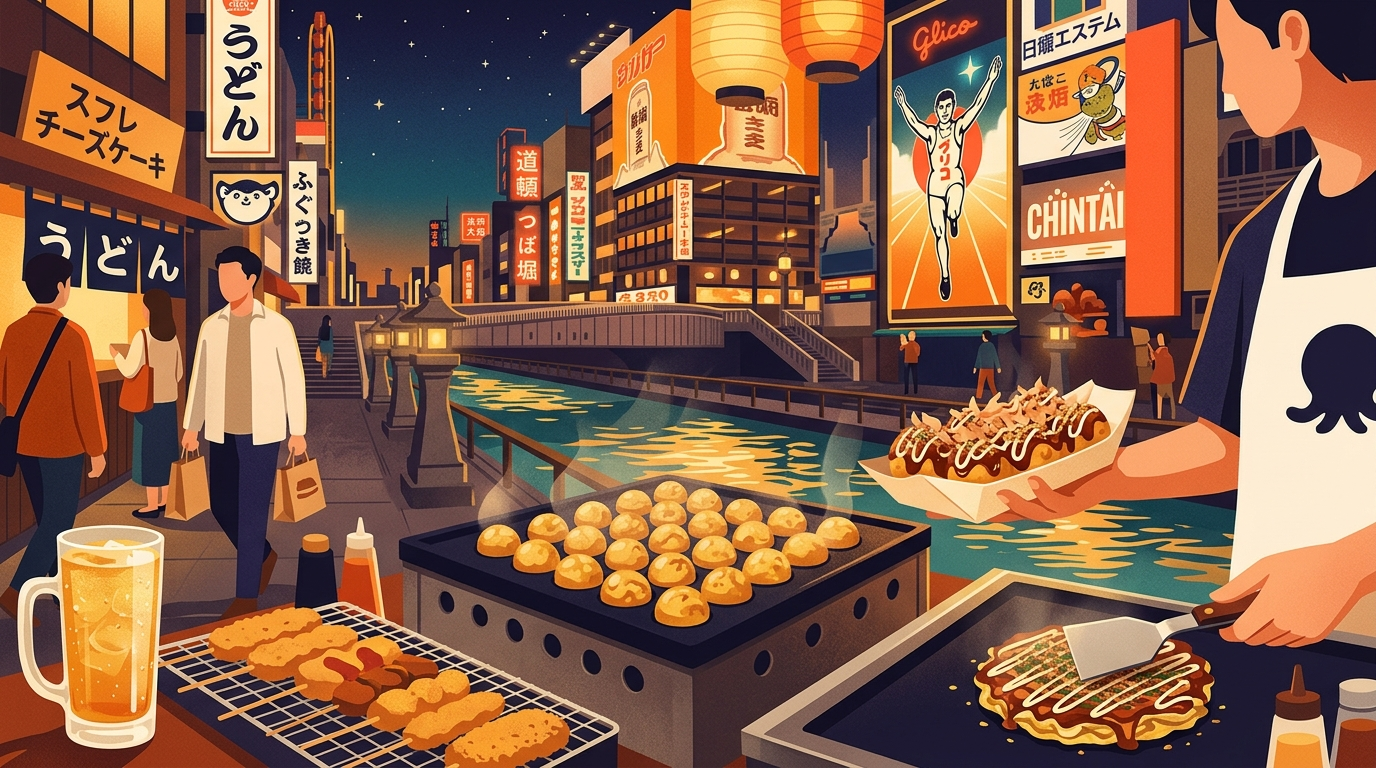
Osaka does not do subtle. Japan’s old merchant capital built its cooking around volume, speed and sauce, and it gave the country a word for the result: kuidaore, eating yourself into ruin. This is the birthplace of takoyaki, the home of the no-double-dipping kushikatsu rule, and a city where flour, cabbage and a hot iron plate turn into half a dozen distinct dishes. This guide covers 20 essential dishes with rough prices, the best areas, and what to know before you order.
Takoyaki is the dish everyone arrives for: round balls of dashi-flavoured batter with diced octopus inside, cooked in a dimpled iron pan and turned with a metal pick. The outside should be barely set, the inside almost liquid. Toppings are sauce, Japanese mayonnaise, aonori seaweed and dancing bonito flakes. The shop generally credited as the birthplace, Aizuya in Nishinari, opened in 1933, and its founder Tomekichi Endo created takoyaki there in 1935.
The centre is molten. Wait a moment before biting, or you will burn your mouth. A tray of six or eight is the standard order, and most stalls are cash-only.
The Osaka version of okonomiyaki mixes everything together before it hits the griddle: wheat batter, shredded cabbage, egg, dashi, and your choice of pork, squid or prawn. Grated nagaimo yam is the local trick that keeps the inside light rather than dense. Hiroshima layers its version instead, and the difference is the subject of a friendly national argument. Osaka finishes with sauce, mayonnaise, aonori and bonito flakes.
Some shops cook for you, others hand you the bowl and let you try. Ask before sitting if you would rather watch. Do not press the pancake down with the spatula, since that squeezes out the air.
Modanyaki is okonomiyaki with a nest of yakisoba noodles built into it. Some cooks mix the noodles through the batter, others layer them underneath and press the pancake on top. Either way you get fluffy batter, crisp cabbage and springy noodles in the same forkful. It is unapologetically carb on carb, and it is the order to make when you are genuinely hungry rather than grazing.
One modanyaki easily feeds two people alongside a couple of other dishes. Order it to share rather than one each.
Negiyaki swaps cabbage for a mountain of sliced green onion, producing something thinner, lighter and far more fragrant than okonomiyaki. The classic filling is sujikon, a mixture of simmered beef tendon and konjac. Unlike its cabbage cousin, negiyaki is usually eaten with a soy-based dipping sauce and a squeeze of lemon rather than thick brown sauce. A Yodogawa-ku restaurant registered the name as a trademark in 1994.
If sweet okonomiyaki sauce is not to your taste, order negiyaki instead. The citrus and soy finish is much cleaner.
5Ikayaki
いか焼き · Pressed Squid Pancake
¥ · ¥200 to ¥400 (~$1.30 to $2.50)
Elsewhere in Japan, ikayaki means grilled squid on a stick. In Osaka it means something else entirely: chopped squid folded into a thin batter, then flattened between two hot iron plates under heavy pressure for about a minute. The result is chewy, savoury and closer to a crepe than a pancake, brushed with sauce and folded in half. Department store food halls in Umeda are where most locals buy it, and queues form at lunchtime.
Ask for the version with egg (tamago iri) if it is on the menu. It costs a little more and is noticeably richer.
🍢
Skewers and Stews
Shinsekai’s working-class cooking, built for drinking and designed to be cheap
Kushikatsu is beef, pork, prawn, quail egg, lotus root or almost anything else, skewered, coated in a fine panko batter and deep-fried to order. The batter is lighter than tonkatsu breading, so a good skewer shatters rather than crunches. Everything is dipped in a communal vat of thin Worcestershire-style sauce, which leads to the city’s most famous rule.
No double dipping. The sauce is shared, so one dip per skewer. Use the free shredded cabbage as a scoop if you want more sauce. Shinsekai around Tsutenkaku Tower has the densest cluster of shops.
Doteyaki is beef tendon skewered and simmered for hours in sweet miso and mirin until it collapses at the touch of a chopstick. The name refers to the bank, or dote, of miso packed around the edge of the iron pan in the original method. It appeared in Osaka around 1920 and remains firmly a downtown dish, usually eaten with beer and a sprinkle of shichimi pepper. Kushikatsu shops in Shinsekai almost always have it on the menu.
Order it early. Doteyaki takes the edge off the fried skewers, and the sweet miso works better before your palate is coated in sauce.
8Kanto-daki
関東煮 · Osaka-Style Oden
¥ to ¥¥ · ¥150 to ¥400 per piece (~$1 to $2.50)
Osaka calls oden kanto-daki, a name that hints at where the dish arrived from. The local broth is paler and lighter than the Tokyo version, built on kombu kelp and bonito rather than dark soy sauce, which reflects the Kansai preference for a clean dashi that lets ingredients speak. Daikon, boiled egg, konjac, fried tofu pouches and beef tendon all sit in the same simmering pot. It is a winter dish above all, sold at old counters and standing bars.
Point at what you want in the pot rather than reading the menu. Mustard on the side is standard, and the broth can be requested as a small cup at the end.
🍜
Noodles and Soups
Osaka is udon country, and the dashi is the whole point
9Kitsune Udon
きつねうどん · Fried Tofu Udon
¥¥ · ¥500 to ¥900 (~$3 to $6)
Soft udon noodles in a pale kombu and bonito broth, topped with a sheet of sweet simmered aburaage fried tofu. Osaka udon is deliberately softer than the chewy Sanuki style, because here the broth leads and the noodle follows. The sweetness of the tofu bleeding into the clean dashi is the entire idea. Kitsune means fox, a reference to old folklore linking foxes and fried tofu. For the tempura-bit version and how regional naming differs, see our tanuki udon guide.
Confusingly, ordering tanuki udon in Osaka often gets you soba with fried tofu rather than udon with tempura bits. Kitsune is the safer order.
10Kasu Udon
かすうどん · Crisp Offal Udon
¥¥ · ¥700 to ¥1,100 (~$4 to $7)
Kasu udon is the dish most visitors have never heard of and most locals adore. It uses abura kasu, beef intestine slowly rendered until crisp and concentrated, dropped into udon broth where it softens and releases an enormous amount of savoury fat. The dish comes from southern Osaka Prefecture, where the ingredient was originally a by-product rather than a delicacy. The broth ends up glossy, deep and completely unlike ordinary udon.
If offal makes you hesitate, abura kasu is a gentler introduction than a full horumon plate. The texture is crisp and chewy rather than soft.
11Nikusui
肉吸い · Beef Soup Without the Noodles
¥¥ · ¥700 to ¥1,200 (~$4 to $8)
Nikusui began as an off-menu request at a Namba udon shop: beef udon, hold the udon. What arrived was a bowl of thinly sliced beef in clear dashi, often with a soft tofu piece and a raw egg dropped in. The story goes that a hungover comedian asked for something lighter, and the dish stuck. It is now a small Osaka legend, usually ordered with a bowl of rice on the side. Simple, salty and restorative.
Order it with kotamago, a raw egg, and a separate bowl of rice. Locals treat this as the classic morning-after breakfast.
🥩
Meat and Offal
Osaka eats parts of the animal that other cities quietly discard
12Horumonyaki
ホルモン焼き · Grilled Offal
¥¥ to ¥¥¥ · ¥1,500 to ¥3,500 per person (~$10 to $22)
Horumon means offal, and horumonyaki means grilling it over charcoal at your own table. Intestine, tripe, heart and diaphragm each behave differently: some turn crisp, some stay springy, some render into pure fat. The dish is closely associated with Osaka, where it developed alongside the city’s yakiniku culture. Sauce is usually a sweet soy tare, occasionally salt and lemon for the leaner cuts.
Start with harami (diaphragm) if you are new to offal, since it eats much like steak. Save the fattier intestine for later in the meal.
13Tsuruhashi Yakiniku
鶴橋焼肉 · Korean-Town Grilled Beef
¥¥¥ · ¥3,000 to ¥6,000 per person (~$19 to $38)
Tsuruhashi holds one of Japan’s largest Korean communities, and the smell of grilling beef hangs over the market arcade from mid-afternoon. Yakiniku here leans closer to its Korean roots than the polished chains elsewhere: heavier marinades, more offal on the menu, kimchi made in the neighbourhood, and cold naengmyeon noodles to finish. Eating in Tsuruhashi is as much about the market streets as the restaurants.
Walk the covered market first, then eat. Kimchi shops sell by weight and make excellent, if pungent, hand luggage.
14Butaman
豚まん · Steamed Pork Buns
¥ · ¥200 to ¥300 each (~$1.30 to $2)
Osaka says butaman where Tokyo says nikuman, and the local version tends to be larger, juicier and more heavily filled with coarsely chopped pork and onion. Steamed buns arrived through the city’s Chinese trading connections and became an everyday snack sold from station kiosks and department store counters. They are eaten standing up, straight from the paper, usually with a smear of hot mustard.
Buy them hot rather than as a frozen souvenir pack. Queues at the well-known Namba and station counters move faster than they look.
🍣
Sushi and Seafood
Osaka’s sushi is pressed rather than hand-shaped, and the city changed how the world eats it
Osaka sushi predates the Tokyo nigiri that now dominates. Rice and topping are pressed together in a wooden box, then cut into neat rectangles. Battera, made with vinegar-cured mackerel and a sheet of kombu, is the best known version. Because it is pressed and cured rather than raw and immediate, it keeps well, which is exactly why it suited a merchant city and long journeys. The flavour is sharper and more vinegared than nigiri.
Boxed sushi travels well and makes a good train meal. Department store basements sell it packed and ready for the shinkansen.
16Kaiten-zushi
回転寿司 · Conveyor-Belt Sushi
¥¥ · ¥1,500 to ¥3,000 (~$9 to $19)
Conveyor-belt sushi is generally credited to Osaka, where the first restaurant of its kind opened in Higashiosaka in the late 1950s. The inspiration, according to the widely repeated account, came from a beer bottling line. The format then spread worldwide and became most people’s first experience of sushi. Eating it in the city where it started, with a tablet menu and plates arriving on their own track, has a certain circularity to it.
Plates are colour-coded by price, and staff count them at the end. Tablet ordering is usually faster and fresher than taking whatever passes by.
17Tecchiri
てっちり · Pufferfish Hot Pot
¥¥¥¥ · ¥6,000 to ¥15,000 per person (~$38 to $94)
Osaka eats more pufferfish than anywhere else in Japan, and tecchiri is the classic winter treatment: fugu simmered at the table with vegetables and tofu, eaten with ponzu, then finished by cooking rice in the remaining broth. The flesh is firm and clean rather than strongly flavoured, and the broth is where the real depth ends up. Only licensed chefs may prepare fugu, so this is a restaurant dish rather than a casual one.
Winter is the season. Lunch courses cost considerably less than dinner, and reservations are usually required. Confirm current pricing when booking.
🍮
Sweets and Drinks
Osaka’s dessert culture runs through old coffee shops rather than tea houses
18Soufflé Cheesecake
スフレチーズケーキ · Jiggly Baked Cheesecake
¥¥ · ¥900 to ¥1,200 per cake (~$6 to $8)
The wobbling, freshly baked cheesecake sold near Namba has become one of Osaka’s most photographed foods. It is barely sweet, closer to a baked custard than a New York cheesecake, and it deflates visibly as it cools. Whole cakes come stamped and boxed straight from the oven, and the smell alone draws a queue down the street. Eat it warm on the same day rather than refrigerating it.
Cakes are sold whole, not by the slice. One easily feeds three or four people, so it works better as a group purchase.
19Mixed Juice
ミックスジュース · Kissaten Fruit Blend
¥ · ¥250 to ¥500 (~$1.60 to $3)
Mixed juice is banana, canned peach, canned mandarin and milk blended with ice, and it is an Osaka institution rather than a health drink. It appeared in the city’s postwar coffee shops and stand-up juice bars, where it used up fruit that was past its best. The texture is thick and creamy, the sweetness is unapologetic, and it costs almost nothing. You will find it at old kissaten and at stand bars inside station arcades.
Try it at a standing counter near Shinsekai or in the Namba arcades. It pairs surprisingly well with a plate of kushikatsu.
20Zenzai
ぜんざい · Sweet Red Bean Soup
¥¥ · ¥600 to ¥1,000 (~$4 to $6)
Zenzai is a warm, thick soup of sweetened azuki beans with grilled mochi floating in it. In Osaka the dish carries an extra literary weight: a famous Namba shop serves it in two small bowls rather than one large one, a habit immortalised in Sakunosuke Oda’s novel Meoto Zenzai. The salted kombu served alongside is not a garnish. It resets your palate between mouthfuls of an extremely sweet dish.
Order it after kushikatsu rather than before. The sweetness lands better once the fried food is finished.
📍
Where to Eat by Area
Osaka’s food districts sit close together, and most are a short subway ride apart
🎡 Dotonbori and Namba
Takoyaki stalls (all day)
Okonomiyaki and modanyaki
Soufflé cheesecake
Zenzai and old sweet shops
🗼 Shinsekai
Kushikatsu (densest cluster)
Doteyaki
Stand bars and mixed juice
Kanto-daki counters
🏙️ Umeda and Kita
Ikayaki (department store halls)
Boxed Osaka sushi
Underground restaurant arcades
Late-night udon counters
🥩 Tsuruhashi
Yakiniku and horumonyaki
Kimchi shops by weight
Korean market arcade
🐟 Kuromon Market
Grilled seafood and skewers
Fugu shops (winter)
Fruit and standing counters
🛍️ Tenjinbashisuji
Japan’s longest shopping arcade
Kasu udon and everyday food
Old kissaten coffee shops
Budget Breakdown: A Day of Eating in Osaka
Meal
Dish
Cost (¥)
Cost (USD)
Breakfast
Kissaten toast set and mixed juice
¥500 to ¥800
~$3 to $5
Lunch
Okonomiyaki or modanyaki
¥900 to ¥1,600
~$6 to $10
Afternoon snack
Takoyaki, tray of six
¥500 to ¥700
~$3 to $4
Dinner (casual)
Kushikatsu, doteyaki and beer
¥2,000 to ¥3,000
~$13 to $19
Dinner (splurge)
Tecchiri fugu course
¥6,000 and above
~$38 and above
Day total (casual)
~¥3,900 to ¥6,100
~$25 to $38
💡
Practical Tips for Eating in Osaka
What to know before your first plate
The one rule to remember: never double dip at a kushikatsu shop. The sauce vat is shared by everyone at the counter, and cabbage is provided free precisely so you can scoop more sauce without going back in.
🕐 Hours and Access
Takoyaki stalls run through the afternoon, while kushikatsu shops and stand bars fill up from early evening. Many small kitchens close between lunch and dinner. Osaka sits about 2 hours 30 minutes from Tokyo by shinkansen, and roughly 15 minutes from Shin-Osaka to Namba by subway.
💳 Cash vs. Card
Street stalls, older counters and market shops are frequently cash-only, even though cards and transit IC cards work at most larger restaurants. Carrying ¥5,000 to ¥10,000 in small notes for a day of eating avoids most problems. Convenience store ATMs accept international cards reliably.
🌿 Dietary Restrictions
Osaka is difficult for strict vegetarians, since dashi made from bonito underpins okonomiyaki batter, udon broth and oden alike. Dedicated vegan okonomiyaki and takoyaki do exist in the city, though they need searching out in advance. Pescatarians have far more options.
🚇 Getting Around
Osaka Metro links every district in this guide, and Dotonbori, Namba and Shinsekai are walkable from one another. Subway day passes are sold at station machines and pay off quickly if you visit three or more areas. Check current prices at the station, since fares and pass conditions change.
Osaka food represents a hearty and energetic culinary culture from the Kansai region. Chefs make it with savory wheat batter, rich sauces, and fresh seafood. Food lovers know it for its “kuidaore” (eat until you drop) philosophy and satisfying street snacks.
Where does Osaka food come from?
Osaka food originates from Japan’s historic merchant capital, Osaka City. Locals have developed these hearty specialties since the Edo period.
What does Osaka food taste like?
Osaka food delivers a rich, savory, and sweet-and-tangy flavor. The textures range from crispy deep-fried skewers to gooey, molten octopus balls. Diners often compare it to the ultimate Asian street food experience.
Where can I eat Osaka food in Japan?
You will find the best Osaka food right in Osaka City. Famous areas include the vibrant Dotonbori, Namba, and Shinsekai districts. Many casual restaurants also serve these famous dishes nationwide.
How much does Osaka food cost?
Osaka street food typically costs between 500 and 1,500 yen per dish. Prices vary depending on the food stall and the specific meat or seafood you order.
Is Osaka food vegetarian or vegan friendly?
Traditional Osaka cuisine heavily features pork belly, octopus, and fish broth. However, vegans and vegetarians can easily find plant-based Okonomiyaki and Takoyaki at specialized modern restaurants by searching online before their trip.
What are the main ingredients in Osaka food?
The main ingredients in Osaka food include wheat flour, dashi broth, cabbage, pork, and sweet-and-savory brown sauce. The rich dashi broth gives local dishes their distinctive savory umami depth.
Can I cook Osaka food at home?
Yes, you can easily cook Osaka food at home. Japanese grocery stores stock the key ingredients — okonomiyaki flour, takoyaki sauce, and mayonnaise. Home cooks master these fun, interactive recipes quickly with just a little practice.
What is the difference between Osaka food and Kyoto food?
The main difference involves the flavor profile and dining atmosphere. Osaka cuisine features bold savory sauces and energetic street food stalls, while Kyoto food relies on delicate broths and quiet, formal dining rooms.
Is Osaka food popular outside Japan?
Osaka food enjoys massive popularity globally. Diners enthusiastically consume Takoyaki and Okonomiyaki at Japanese festivals and restaurants across North America, Europe, and Asia. This vibrant culinary tradition successfully introduced Japanese street food culture to the entire world.
Ryo Iwa is the founder and editor of foodinjapan.org. Born and raised in Japan, he writes from regional travel, market visits, and Japanese-language primary sources that rarely reach English readers, including brewing institute publications and industry glossaries. Where a figure cannot be traced to a source, the article says so.
He has been a Google Maps Local Guide for over 10 years, with more than 1,800 reviews and over 41,000 photos viewed hundreds of millions of times. He previously spent two decades as an IT consultant in Japan, the US, and the UK.












Comments