


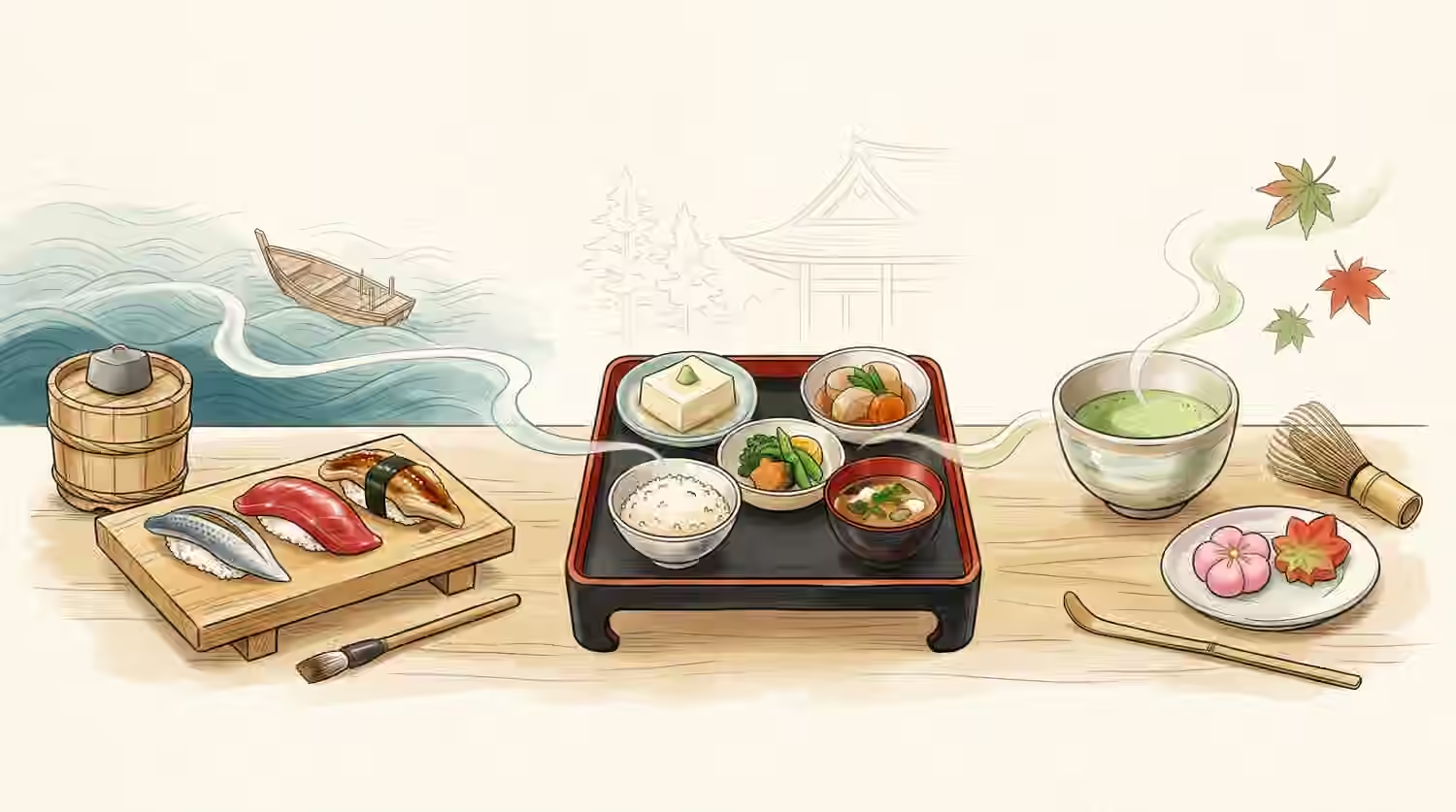

Picture a cedar sushi counter in Tokyo. The chef places one piece of nigiri in front of you: glossy fish, warm rice and almost no decoration. Yet that bite reflects centuries of fermentation, preservation and the fast-moving street-stall culture of Edo.
Japanese food becomes easier to read when you know what to notice. This guide uses Edomae sushi, shojin ryori and wagashi to show how history, Buddhism and the seasons shape a meal. It also offers a simple 10-minute routine for learning that context while you travel.
What Is the Difference Between Washoku and Japanese Food?
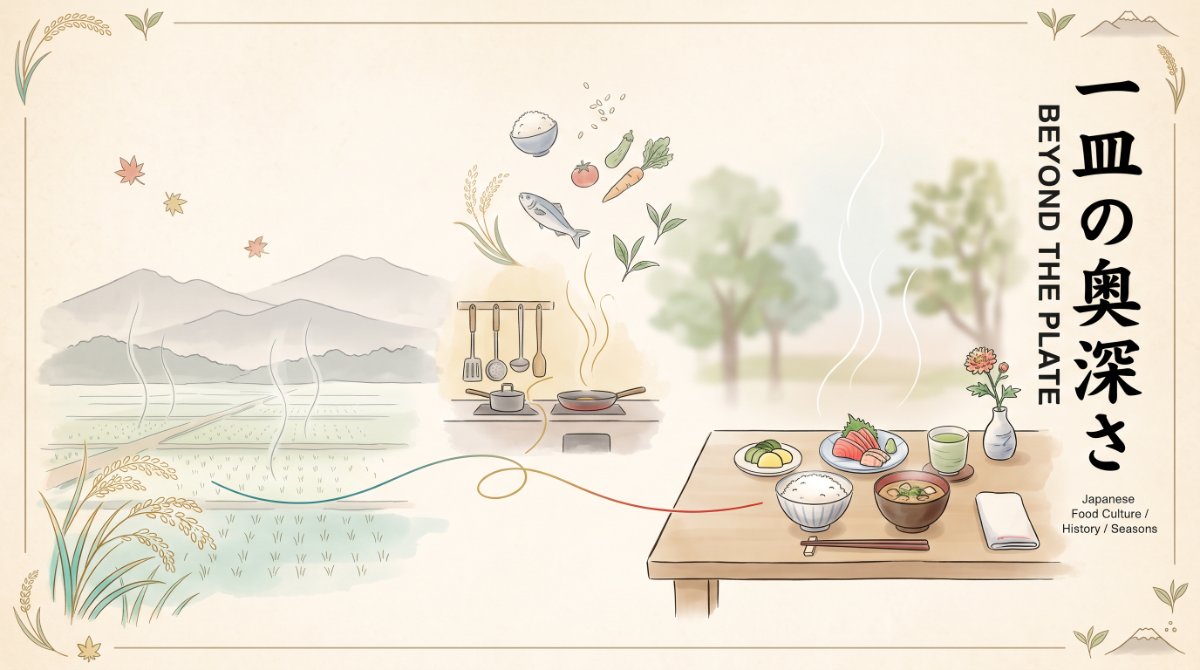
Washoku is Japan’s traditional food culture, not simply a list of dishes. UNESCO describes it as a social practice that covers how people produce, prepare and share food. Respect for nature sits at its core. Seasonal ingredients, regional practices and occasions such as New Year also give meals their meaning. By contrast, Japanese food is a broader English label. It also covers dishes shaped by overseas influence, such as ramen and curry rice.
Quick Facts
- Term
- Washoku (和食), Japan’s traditional food culture
- UNESCO listing
- Intangible Cultural Heritage of Humanity, 2013
- Core idea
- Respect for nature and seasonal ingredients (shun)
- Dishes covered
- Edomae sushi, shojin ryori, wagashi with matcha
- Roots
- Fish preservation, Buddhist practice, seasonal sweets and tea
- Learning tip
- A 10-minute routine before a meal
UNESCO’s listing surprises many people, though. It did not honor sushi or kaiseki as single dishes. Instead, it recognized the customs around food, especially the New Year meals that families prepare and share together. Our guide to how washoku expresses the seasons covers the basics in more detail.
The three dishes in this guide do not belong to one category, either. One grew from fish preservation, another from Buddhist practice and the third from seasonal confectionery and tea. Still, each opens a different door into the same culture.
Four Ideas That Help You Read a Japanese Meal
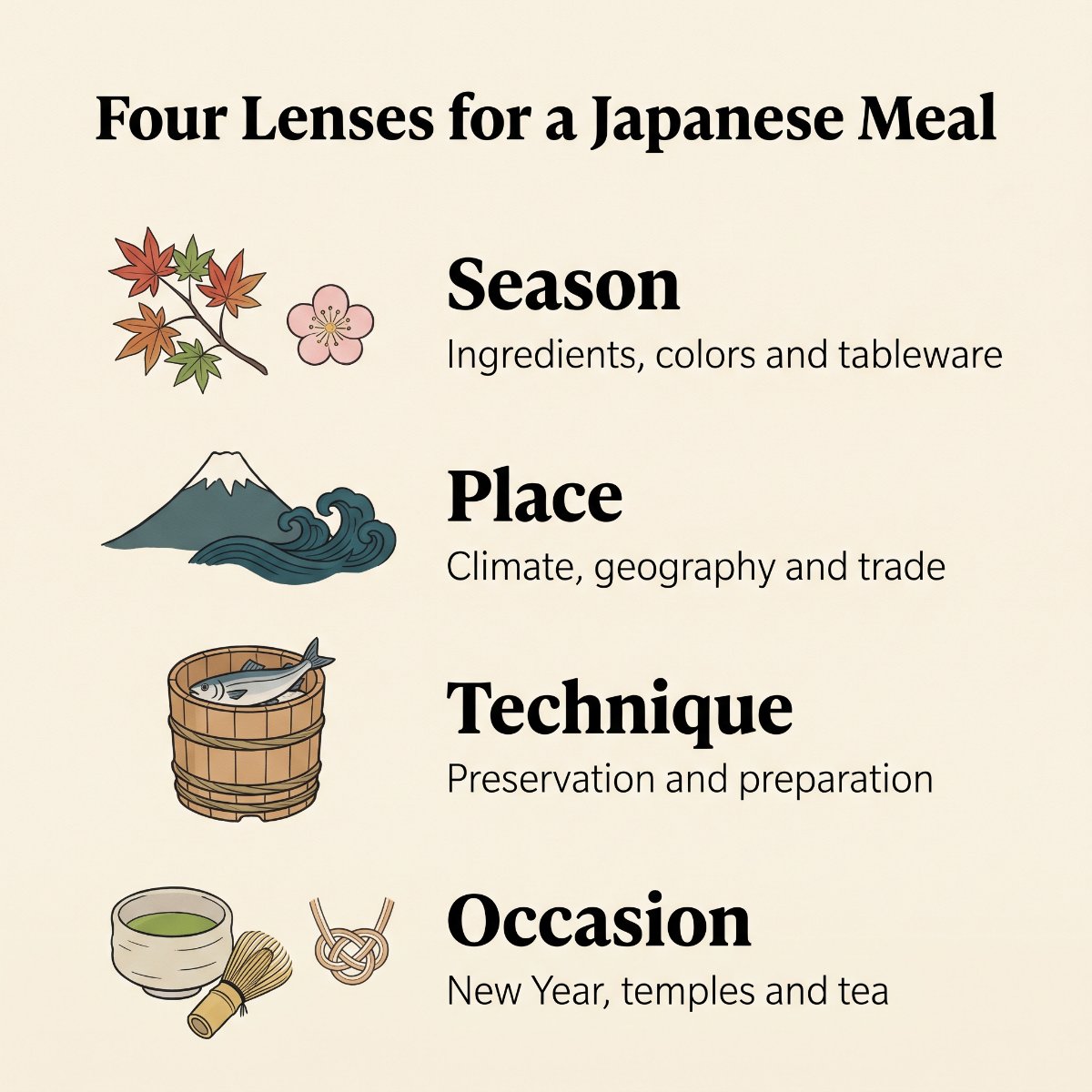
Before looking at specific dishes, it helps to know what to watch for. These four ideas run through all three examples in this guide.
Four lenses for any Japanese meal
- SeasonIngredients, colors and even tableware often reflect the time of year
- PlaceClimate, geography and trade shape what each region cooks
- TechniquePreservation and preparation can matter as much as freshness
- OccasionNew Year, temple practice and tea gatherings give food social meaning
Edomae Sushi: From Fermented Fish to Prepared Toppings
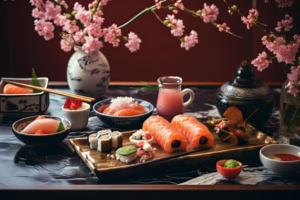
Edomae sushi is a Tokyo tradition centered on nigiri. Chefs season the rice and prepare many toppings before service. MAFF lists techniques such as vinegar curing, simmering, steaming, marinating and kelp curing. These methods developed before modern refrigeration and remain central to the style, although menus may also include simpler toppings.
What does Edomae actually mean? Tokyo’s official tourism guide, GO TOKYO, links the word to the waters off Edo, today’s Tokyo Bay. Over time, however, the name came to describe a Tokyo style of sushi more than the origin of each fish.
| Term | Clear definition |
|---|---|
| Sushi | A broad family of foods based on seasoned or fermented rice |
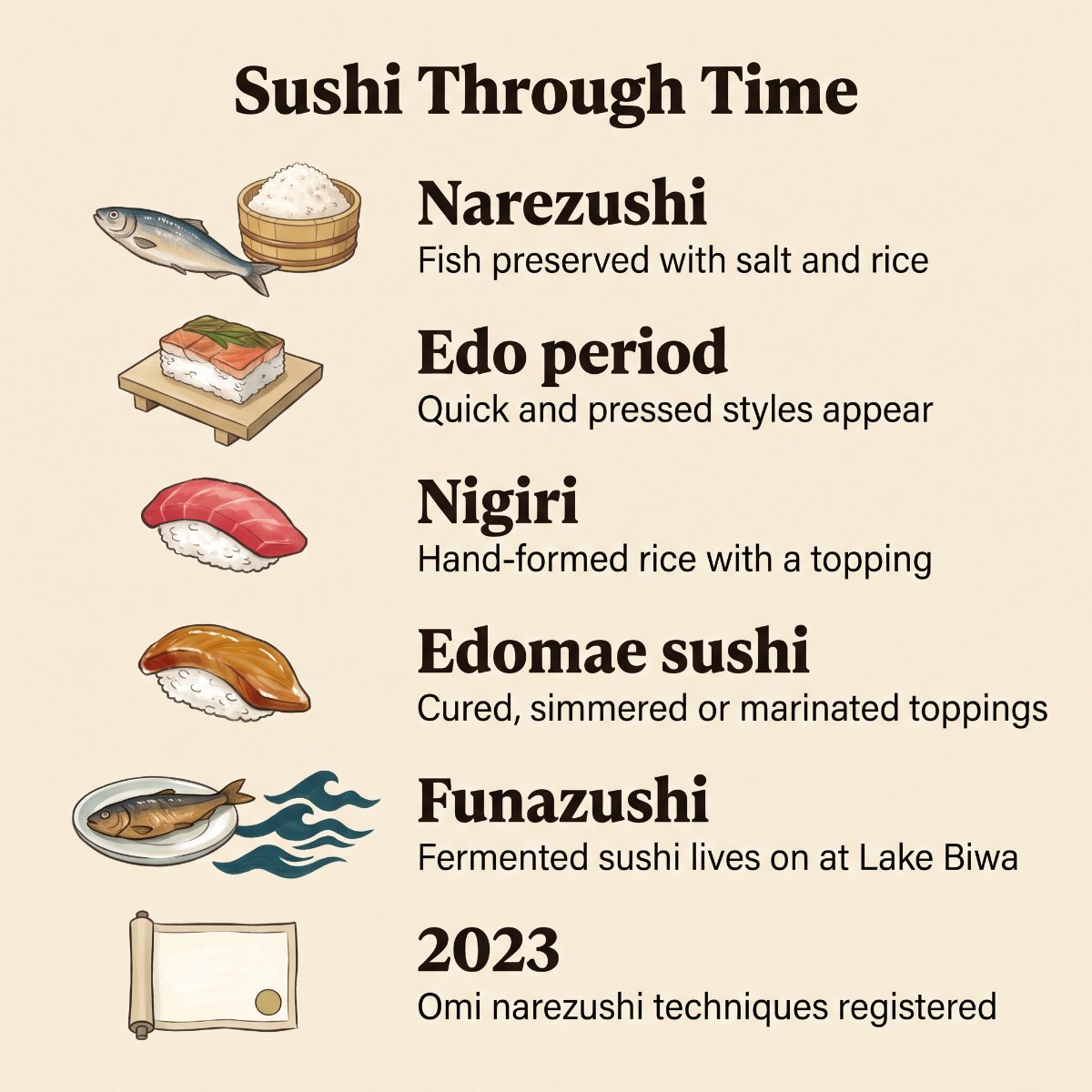
| Narezushi | Fish preserved through fermentation with salt and rice |
| Nigiri | Hand-formed vinegared rice topped with fish or another ingredient |
| Edomae sushi | A Tokyo style of nigiri known for cured, simmered or marinated toppings |
Early forms of sushi preserved salted fish through fermentation with rice. Depending on the style, the rice often served as a fermentation medium rather than the main food. Later styles used the rice itself more and more. According to MAFF, quick and pressed versions appeared during the Edo period. Hand-formed nigiri then spread as a quick street-stall food, sold at yatai.
Fermented sushi never vanished, though. Around Lake Biwa, families and shops still make fermented funazushi from Lake Biwa. In March 2023, Japan registered Omi narezushi-making techniques as a national Intangible Folk Cultural Property. In other words, sushi history looks less like a straight line and more like a family tree.
Good to know
In 2025, Lake Biwa Museum researchers reported recreating a funazushi method from a 1689 cookbook. They used it as evidence for studying historical fermentation.
What to Expect at the Sushi Counter
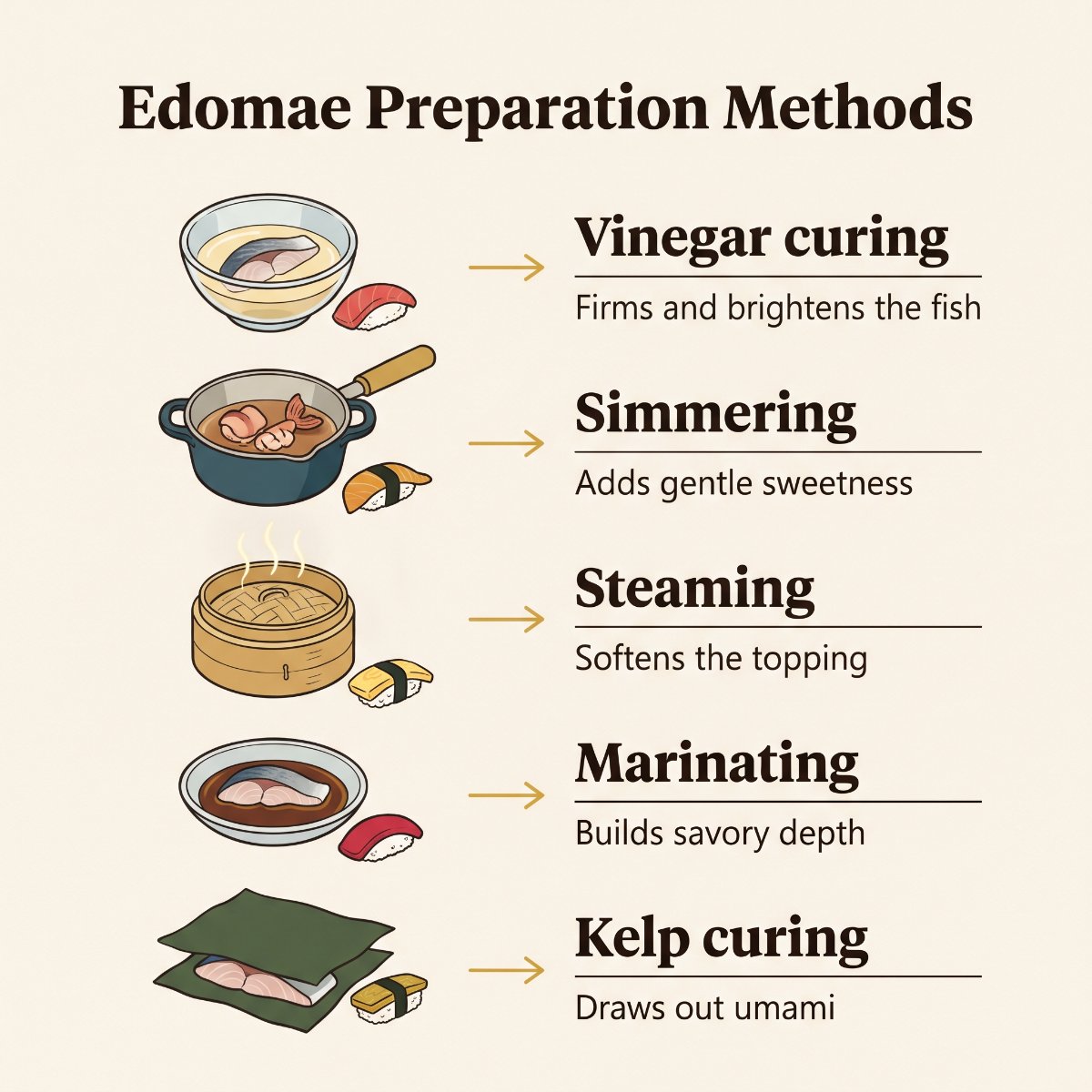
Edomae sushi at a glance
- TasteDepending on the topping, bright acidity from vinegar, savory depth from soy or gentle sweetness from simmering
- TextureVinegar curing can firm the fish, although results vary by fish and preparation
- Look forA light brush of nikiri, a chef-made soy-based seasoning that varies by restaurant
- AskHow did you prepare this topping? Keep it brief, and wait until the chef is free
If the chef has already brushed a piece with nikiri, taste it before adding more soy sauce. Practices differ by restaurant, so follow the chef’s guidance. Similarly, our guide to traditional Edomae sushi preparation lists the classic toppings and how chefs treat each one.
Shojin Ryori: When the Kitchen Becomes Practice
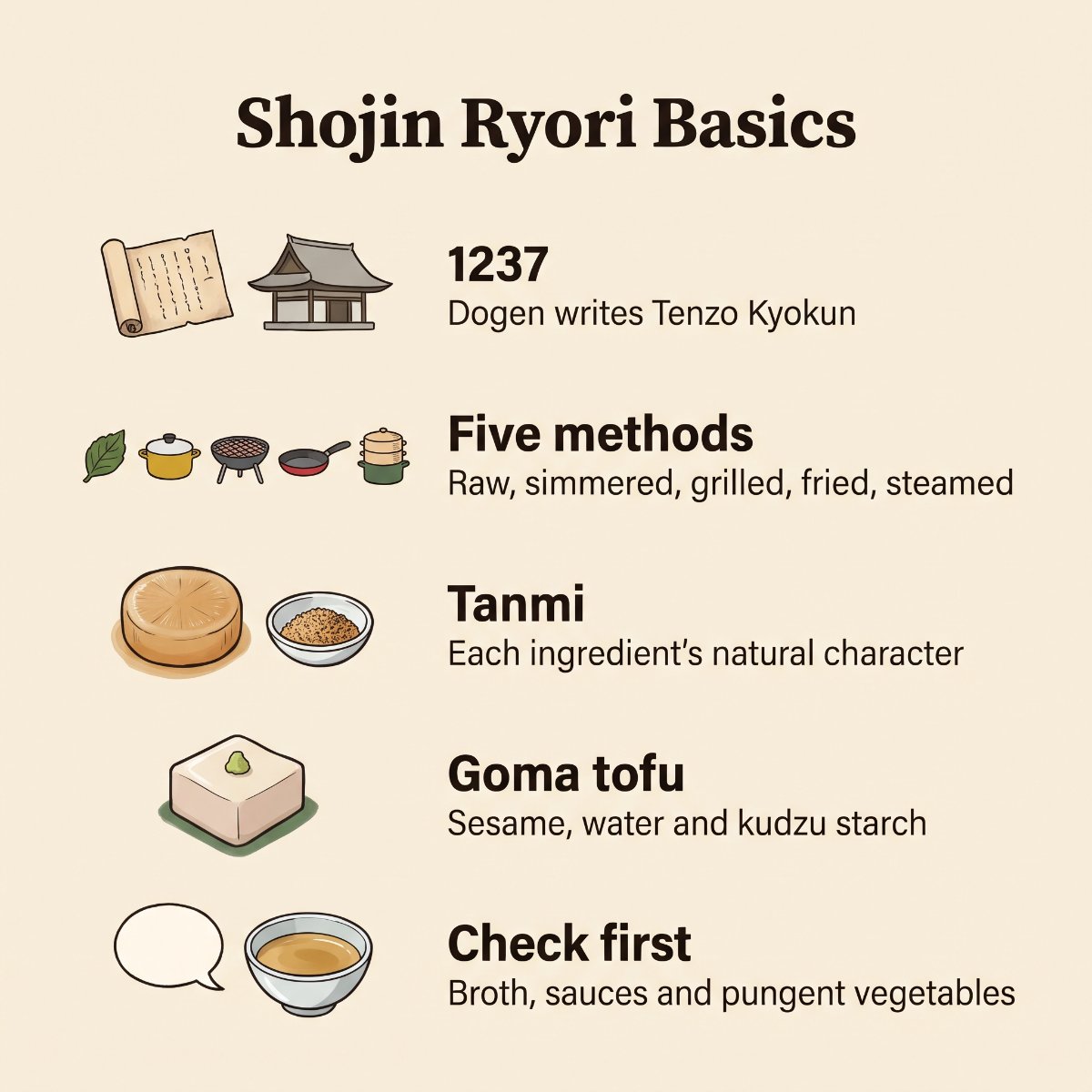
Shojin ryori is a form of Buddhist cuisine closely associated with temple practice and careful use of ingredients. Its rules vary among schools and occasions. Soto Zen treats preparing food as part of Buddhist practice. Meals seek balance through five tastes, five cooking methods and five colors.
In 1237, the Zen monk Dogen wrote Tenzo Kyokun, a guide for the temple cook. The Soto Zen school explains that he saw cooking as Buddhist practice rather than a chore.
Soto Zen teaching lists the five methods as raw, simmered, grilled, fried and steamed. It also describes tanmi. This is not a scientific sixth basic taste, but an appreciation of each ingredient’s natural character. Soto Zen Net also notes that training temples make foods such as pickles and miso in-house. Planning each step around the ingredients helps reduce waste.
Shojin ryori may resemble vegan cuisine, but Buddhist practice defines it. A 2021 paper in the Journal of Cookery Science of Japan makes this point. Its rules and manners differ by school and ritual.
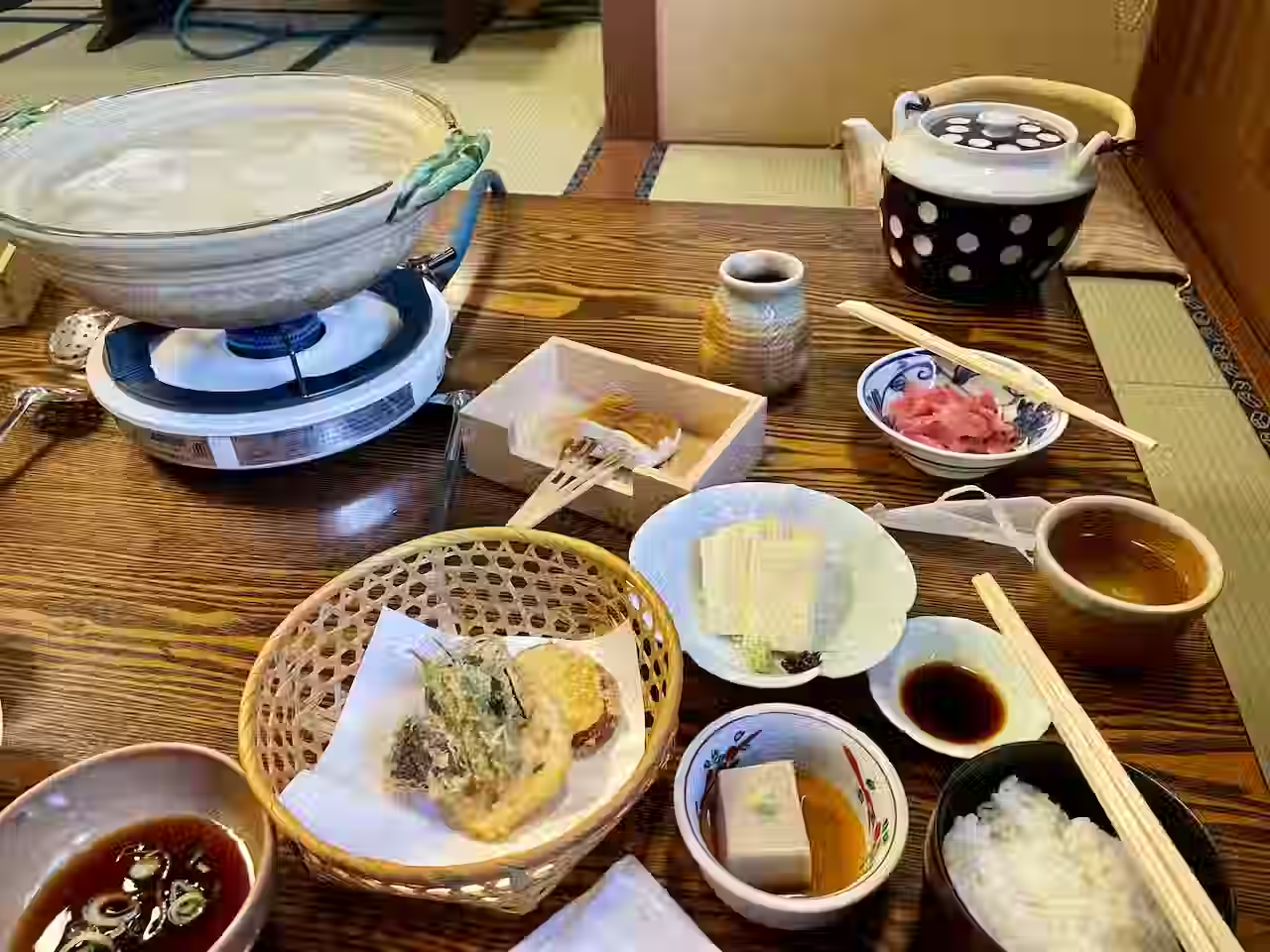
Despite its name, traditional goma tofu is not made from soybeans. MAFF lists sesame, water and kudzu starch as its main ingredients. It also links the dish to Buddhist meals at Mount Koya. Its dense, smooth texture feels closer to a savory sesame pudding than to soybean tofu. Commercial recipes may differ, though.
Restaurants may serve it cool or at room temperature. MAFF notes that people usually eat goma tofu with wasabi soy sauce or vinegared miso. Some add broth, while others treat it like a dessert with black sugar syrup. Since sesame is a major allergen for some travelers, check both the tofu and its sauce. Our beginner’s guide to goma tofu covers where to try it.
What to Expect at a Temple Meal
Shojin ryori at a glance
- TasteGentle seasoning, nutty sesame and the natural sweetness of vegetables
- TextureSoft simmered vegetables beside dense, creamy goma tofu
- CheckAsk about broth, sauces and pungent vegetables, since rules differ by temple
- ExpectDifferences between schools, temples and occasions
You do not always need to stay overnight at a temple to try shojin ryori. Some temples and specialist restaurants serve meals to day visitors, often by reservation. Availability and dietary options vary, so check directly before you travel.
Wagashi and Matcha: Sweets That Read the Calendar
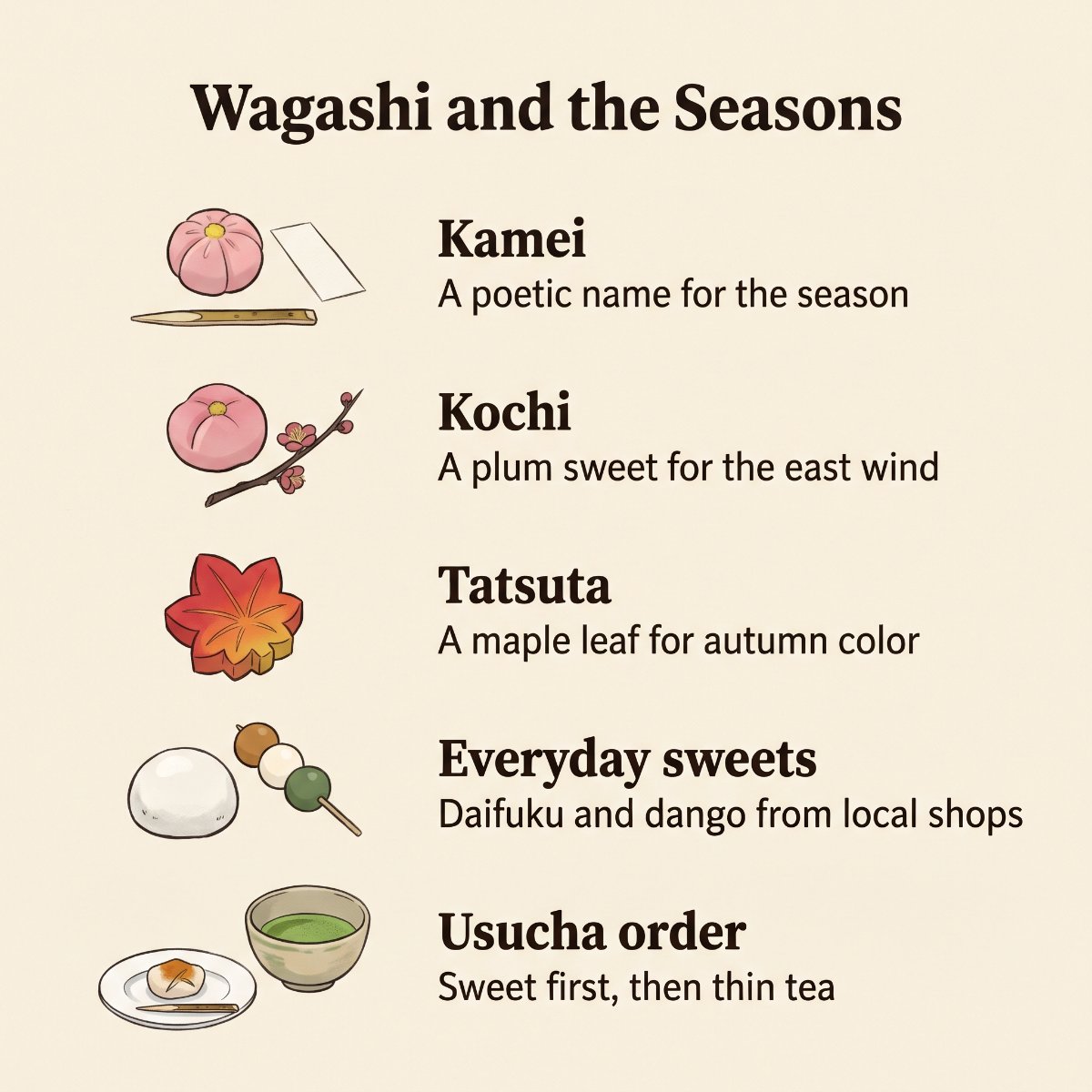
Wagashi often express a season through color, shape and a poetic name called kamei. A MAFF feature, supervised by the Japan Wagashi Association, traces these names to poetry, nature, local history and famous places. Confectioners mainly give kamei to nerikiri, although yokan can carry them too.
For example, a plum-shaped sweet named Kochi refers to the east wind that carries spring. Tatsuta, by contrast, is a maple leaf named after a river famous for autumn color. So a single nerikiri can work like a tiny seasonal poem. It typically combines white bean paste with a binder such as glutinous rice dough or yam. Missing the reference is fine. Catching it, though, adds a quiet smile.
Not every wagashi belongs in the tea room, though. Daifuku and dango, for instance, are everyday snacks you can buy at a local shop. Our overview of the main types of wagashi explains the differences.
In a tea setting, however, the order matters. MAFF’s aff magazine shows a beginner usucha sequence. In it, guests finish the sweet before the bowl of thin matcha arrives. Etiquette can differ by school and setting. Matcha can then combine bitterness or astringency with umami and aroma, although the balance varies by grade and preparation.
A 2013 sensor study measured matcha’s astringency and umami. It did not, however, test the effect of pairing matcha with wagashi.
What to Expect in a Tea Setting
Wagashi and matcha at a glance
- TasteConcentrated sweetness first, then grassy, savory and astringent tea
- TextureSmooth bean paste, soft nerikiri or the dry, crumbly texture of pressed sweets such as rakugan
- OrderIn a typical usucha setting, finish the sweet before the thin tea and follow the host
- AskThe name of the sweet and the season it suggests
Curious about the tea itself? Our guide on how to drink matcha covers grades, temperature and freshness.
How Context Shapes What You Notice
Background knowledge does not alter the food itself. However, it can direct your attention toward specific aromas, textures and techniques. Take kohada, a small silver-skinned fish that sushi chefs often cure with salt and vinegar. Knowing the technique helps a diner notice its brightness, firmness and balance with the rice.
The same thing happens with temple food. At first, a shojin meal can taste mild, maybe even a little plain. Then tanmi becomes easier to understand through simmered daikon, toasted sesame and the delicate texture of goma tofu. It sounds abstract on paper, admittedly. On the plate, though, it often clicks within a few bites.
A 10-Minute Pre-Meal Routine for Travelers
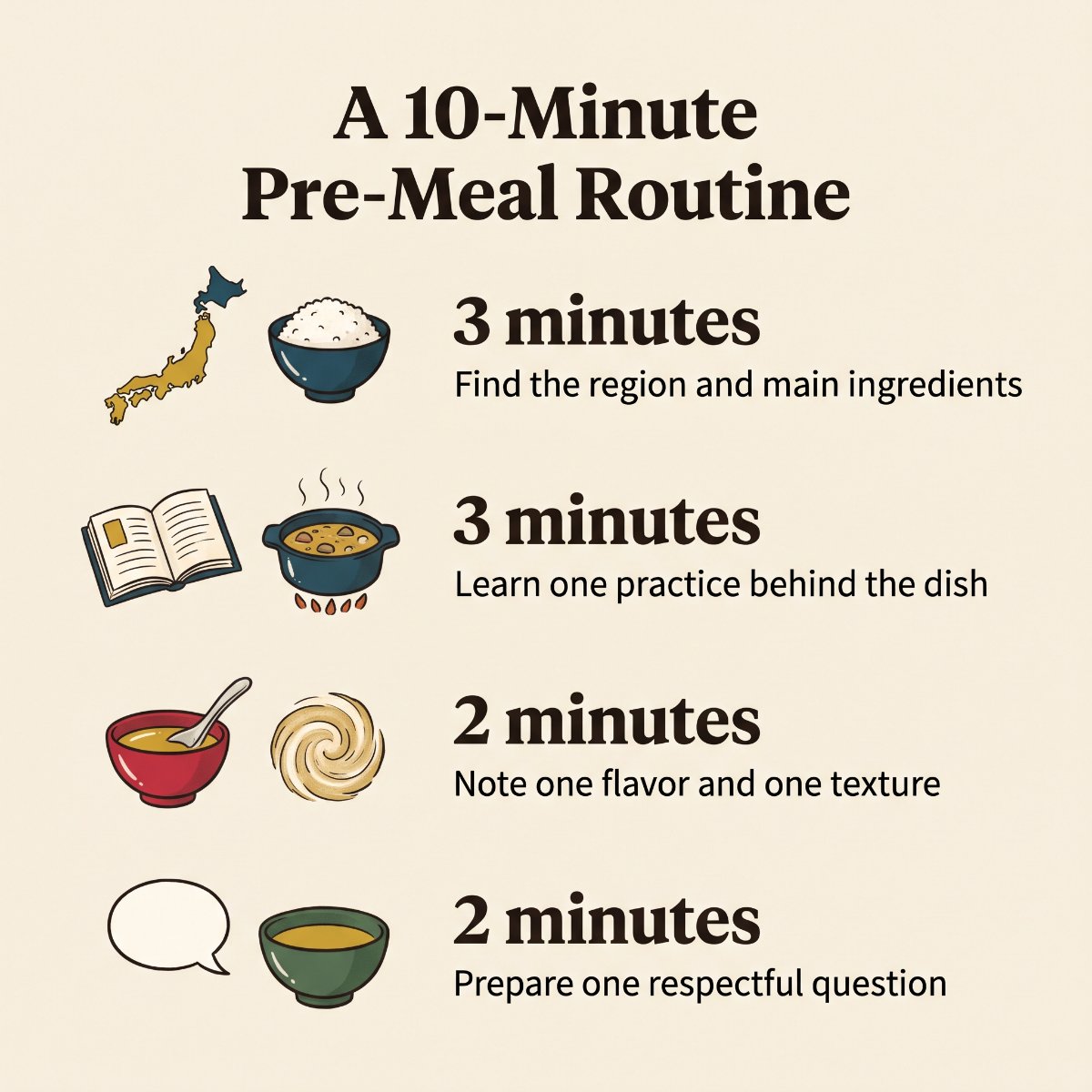
Does short-form learning actually work? A 2025 systematic review in Heliyon found positive effects on learning outcomes in schools and workplaces. The authors also warn that definitions vary widely. So the design of a lesson matters as much as its length, and a simple plan helps.
- Three minutes: Identify the dish’s region and main ingredients.
- Three minutes: Learn one preservation, cooking or religious practice behind it.
- Two minutes: Note one flavor and one texture to look for.
- Two minutes: Prepare one short, respectful question for the chef or staff.
Where should you look? Start with the restaurant’s official page, a local tourism authority or MAFF’s regional cuisine database. Travel articles can spark ideas, but confirm hours, ingredients and booking rules with the restaurant itself.
Three research shortcuts for any regional dish
- TradeMAFF traces Nagasaki tempura to fritters that Portuguese traders ate about 400 years ago. The word itself has several origin theories
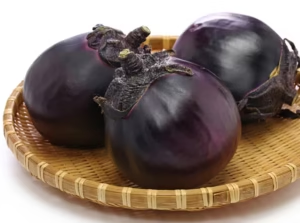
- Protected originMAFF’s GI system registers product names whose quality or reputation links to a production area. Kamo nasu eggplant appears as Kyo Kamonasu, No. 165, registered on March 18, 2025
- ContrastMAFF quotes a saying that Ryukyuan cooking starts and ends with pork. Kyoto City, meanwhile, links its vegetables to the court, temples and townspeople
Partner Option: Using Nibble on a Food Trip
Partner feature: this section introduces a learning app that supports this article.
If you prefer an app for the routine above, Nibble is one option. It is an interactive microlearning app for iOS, Android and the web. Its topics include food, history, religion and travel.
What Nibble offers, according to its official site
- 670+ content pieces across 35+ topics (checked November 2026)
- Interactive lessons with quizzes, plus games
- Video and audio episodes
- Chats with historical personalities and AI tutors
- Most lessons take about 3 to 10 minutes
True to its name, Nibble serves each bite-sized piece of content as a Nibble. A short lesson on religion, history or trade may give useful background before a temple meal. Available lessons, pricing and offline access may change. Check the current App Store, Google Play or web listing before relying on the app during a trip.
What to Remember: Feed Your Curiosity, One Bite at a Time
Japanese food asks you to slow down. When you know where a dish came from, its details become easier to notice and interpret. Vinegared fish recalls Edo street stalls. A maple-shaped sweet turns a quick tea break into a small seasonal ritual.
You do not need a degree in food history to feel that shift. Instead, ten minutes on a train and one well-timed question at the counter will carry you a long way. So stay curious, learn in small doses and enjoy every bite.
Editorial note: Our sources include UNESCO, Japan’s Ministry of Agriculture, Forestry and Fisheries, local governments, Buddhist institutions and academic journals. Claims about Nibble come from the app’s official website and appear only in the partner section.
Frequently Asked Questions
Washoku and Sushi
- What is the difference between washoku and Japanese food?
-
Japanese food is a broad English label for dishes associated with Japan, including ramen and curry rice. Washoku refers to a traditional food culture that UNESCO listed in 2013. It covers how people produce, prepare and share food, with respect for nature at its center.
- How is Edomae sushi different from nigiri in general?
-
Nigiri simply means hand-formed vinegared rice with a topping. Edomae sushi is a Tokyo style of nigiri known for toppings that the chef prepares in advance. Common methods include vinegar curing, simmering, steaming, marinating and kelp curing.
- Should I add soy sauce to Edomae sushi?
-
Some pieces arrive already seasoned with nikiri, salt or another preparation. Taste each piece as served first. If you are unsure, follow the chef’s guidance before adding soy sauce.
Temple Food and Allergies
- Is shojin ryori vegan?
-
Shojin ryori commonly avoids meat and fish, and some traditions also avoid pungent plants such as garlic and green onions. However, the term does not guarantee every modern vegan or allergy standard. Confirm broth, sauces and garnishes directly with the temple or restaurant.
- Is goma tofu safe for someone with a soy allergy?
-
Traditional goma tofu uses sesame and kudzu starch rather than soybeans. Still, recipes, sauces and factory handling differ. Check the label and allergen information instead of relying on the name, and remember that sesame itself is an allergen.
Sweets, Tea and Learning
- Is all wagashi served with matcha?
-
No, many wagashi are everyday snacks, such as daifuku and dango. Tea gatherings use specific sweets chosen for the occasion and season. You can enjoy most wagashi with any tea or on their own.
- Do you eat the sweet before or after the matcha?
-
In a typical usucha, or thin-tea, setting, guests finish the sweet before the tea arrives. Etiquette can differ by school, gathering and cafe. When in doubt, follow the host’s lead.
- What should I learn in ten minutes before a Japanese meal?
-
Spend three minutes on the dish’s region and ingredients, then three minutes on one technique or custom. Use two minutes to choose a flavor and texture to notice. Finally, prepare one short question for the staff.
- Can I learn about Japanese food in Nibble specifically?
-
Nibble lists food, history, religion and travel among its topics. We could not confirm lessons devoted only to Japanese cuisine on its public website. Check the current library in the app for lessons that match your trip.
References
Show all 18 references
- UNESCO Intangible Cultural Heritage – Washoku, Traditional Dietary Cultures of the Japanese, Notably for the Celebration of New Year (2013) (Accessed November 2026)
- Ministry of Agriculture, Forestry and Fisheries (MAFF) – Geographical Indication (GI) Protection System: List of Registered Products (2026) (Accessed November 2026)
- Ministry of Agriculture, Forestry and Fisheries (MAFF) – Our Regional Cuisines: Nigirizushi, Tokyo (Accessed November 2026)
- Ministry of Agriculture, Forestry and Fisheries (MAFF) – Our Regional Cuisines: Nagasaki Tempura, Nagasaki Prefecture (Accessed November 2026)
- Ministry of Agriculture, Forestry and Fisheries (MAFF) – Our Regional Cuisines: Goma Tofu, Wakayama Prefecture (Accessed November 2026)
- Ministry of Agriculture, Forestry and Fisheries (MAFF) – Our Regional Cuisines: Okinawa Prefecture (Accessed November 2026)
- Ministry of Agriculture, Forestry and Fisheries (MAFF) – aff February 2020: Feeling the Seasons in Wagashi Names, supervised by the Japan Wagashi Association (2020) (Accessed November 2026)
- Ministry of Agriculture, Forestry and Fisheries (MAFF) – aff April 2017: A First Experience of the Tea Ceremony (2017) (Accessed November 2026)
- GO TOKYO (Tokyo Convention & Visitors Bureau) – Discover Edomae Sushi in Tokyo, Where Nigiri Continues to Evolve (Accessed November 2026)
- Shiga Prefecture – Registered Intangible Folk Cultural Property: Omi Narezushi-Making Techniques (2026) (Accessed November 2026)
- Shiga Prefecture – Results of the Edo-Period Funazushi Reproduction Experiment, Lake Biwa Museum (2025) (Accessed November 2026)
- City of Kyoto – About Kyoto’s Traditional Vegetables (2025) (Accessed November 2026)
- Soto Zen Net (Sotoshu Shumucho) – Cooking as Buddhist Practice (Accessed November 2026)
- Soto Zen Net (Sotoshu Shumucho) – What Is the Taste of Shojin Cuisine? (Accessed November 2026)
- J-STAGE – Yanagihara, N. (2021). Shojin Ryori: Buddhist Vegetarian Cuisine in Japanese Cuisine. Journal of Cookery Science of Japan, 54(1), 66–69 (Accessed November 2026)
- J-STAGE – Ujihara, T., Hayashi, N., & Ikezaki, H. (2013). Objective Evaluation of Astringent and Umami Taste Intensities of Matcha using a Taste Sensor System. Food Science and Technology Research, 19(6), 1099–1105 (Accessed November 2026)
- PubMed Central – Monib, W. K., Qazi, A., & Apong, R. A. (2025). Microlearning beyond boundaries: A systematic review and a novel framework for improving learning outcomes. Heliyon, 11(2), e41413 (Accessed November 2026)
- Nibble – The Microlearning App for Curious Minds, official site (Accessed November 2026)
Related Articles
 Gifu
Ayu nare sushi (鮎なれ寿司)
Surveyed: November 2026
 Wagashi
Rakugan (落雁)
Surveyed: November 2026
 Kyoto
Kamo nasu (賀茂なす)
Surveyed: November 2026
 Okinawa
Tebichi soba (てびちそば)
Surveyed: November 2026





Comments