





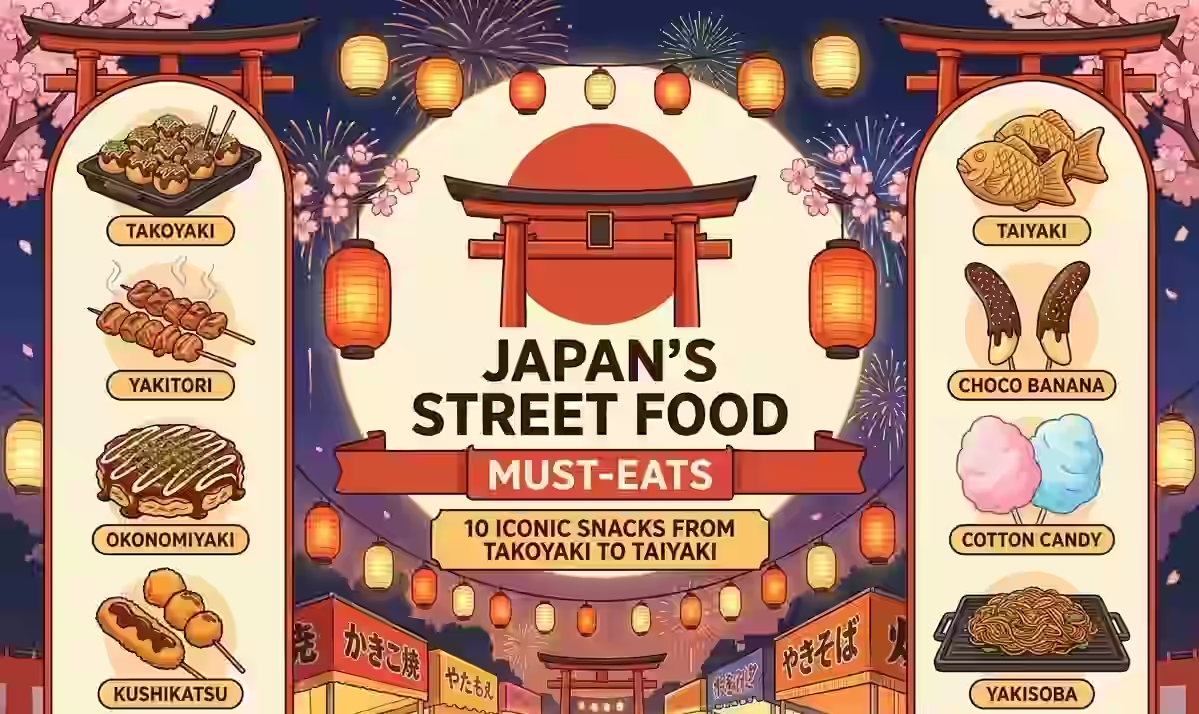
Japanese street food hits you before you even see the stall. First comes the smell: charcoal, sweet soy glaze, and something sizzling on a hot iron plate. You follow your nose without a plan. That’s how most great matsuri food memories start.
This guide covers 15 must-try Japanese street foods, how yatai culture actually works, and where to eat across Japan’s regions. You’ll also learn why Japanese street food is less common in daily life than many visitors expect. Whether you’re planning a first trip to Tokyo or just curious about Japan’s food scene, this is a solid starting point.
Yatai Culture: The Heart of Japanese Street Food
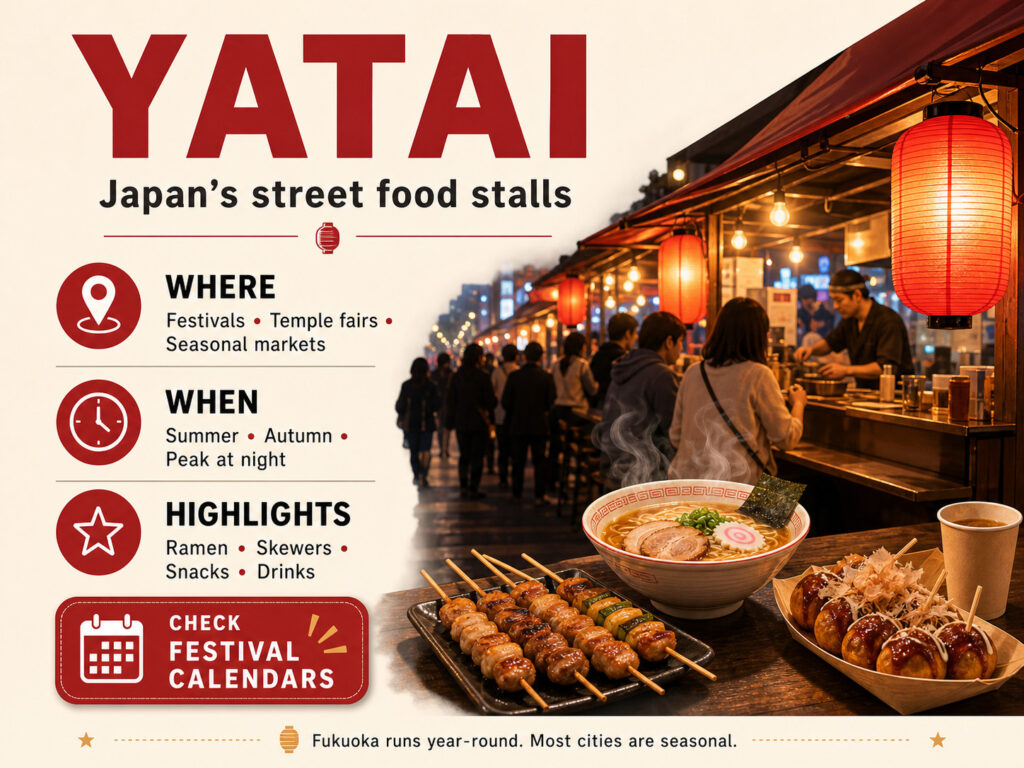
In many countries, street food is a daily affair. However, Japan works differently. The core of Japanese street food culture is the yatai, a portable food stall that appears at festivals, temple fairs, and seasonal markets. These stalls don’t operate like permanent cafés. Instead, they show up, feed the crowd, and disappear.
Specifically, yatai come alive at matsuri (festivals), hanami events, and summer fireworks gatherings. Lanterns glow overhead. Meanwhile, crowds shuffle between stalls, clutching paper cups and skewers. The atmosphere is electric in the best possible way, and the variety of food can genuinely surprise you even on a second or third visit.
Some cities do host yatai year-round. Fukuoka is famous for its open-air ramen yatai along the Naka River. Osaka’s Dotonbori district feels like a permanent street food festival. In most other cities, yatai remain a seasonal treat tied to local events and calendars.
Timing matters here. Check local festival calendars before your trip. Summer and autumn are the peak seasons for the full yatai experience. Arrive in August and you’ll be wonderfully overwhelmed with options.
Why Doesn’t Japan Have Street Food Everywhere?
This is one of the first questions visitors ask. Japan has extraordinary food culture, so why isn’t street food on every corner the way it is in Bangkok or Mexico City? The answer involves law, history, and deeply rooted cultural norms.
Japanese regulations require road use permits for outdoor food stalls. Getting permission to occupy public space is not straightforward. Health and food safety laws also set strict standards for outdoor cooking. These rules limit who can set up a stall and where they can do it.
History plays a role too. Many informal stalls that thrived after World War II were gradually removed as Japanese cities modernized during the 1960s and 1970s. Permanent restaurants took over, zoning laws tightened, and the casual street food culture of the postwar years slowly faded. What survived became connected to specific events rather than everyday streets.
Today, Japanese street food survives mainly at matsuri and seasonal events. Some yokocho alley districts offer a semi-permanent street food atmosphere in major cities. But the spontaneous every-corner stall culture common in Southeast Asia simply doesn’t exist here in the same way. That’s not a flaw. Finding a great yatai ends up feeling like a genuine discovery.
Festival Foods vs Daily Street Foods: A Useful Distinction
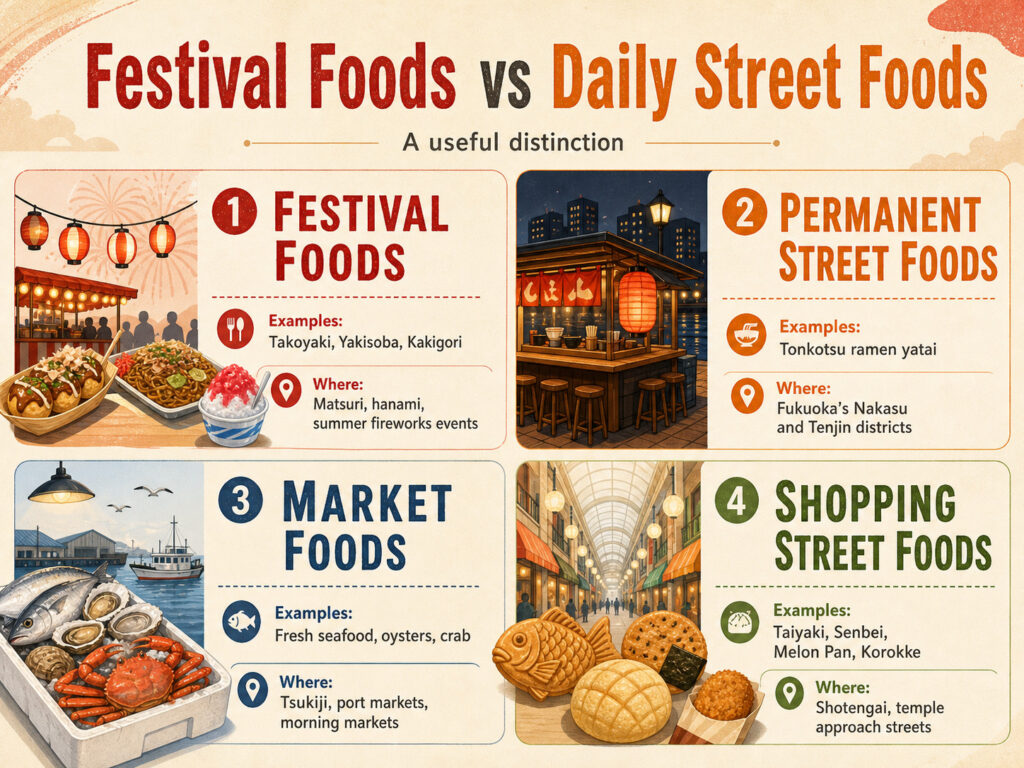
Not all Japanese street food works the same way. Some visitors assume food stalls are open every day. That’s only true in certain places. Here’s a useful breakdown of the different types you’ll encounter:
| Type | Examples | Where to Find |
|---|---|---|
| Festival foods | Takoyaki, Yakisoba, Kakigori | Matsuri, hanami, summer fireworks events |
| Permanent street foods | Tonkotsu ramen yatai | Fukuoka’s Nakasu and Tenjin districts |
| Market foods | Fresh seafood, oysters, crab | Tsukiji, port markets, morning markets |
| Shopping street foods | Taiyaki, Senbei, Melon Pan, Korokke | Shotengai, temple approach streets |
Understanding this helps you plan smarter. For example, for takoyaki at a festival stall, check the event calendar. Meanwhile, for senbei grilled fresh over open flames, head to Asakusa’s Nakamise shopping street. In other words, different cravings point you to different destinations, and knowing the difference saves a lot of confusion on the ground.
Top 15 Japanese Street Foods You Have to Try
These are the dishes you’ll encounter most often at yatai stalls and markets. Some are festival classics. Others appear year-round at shopping streets or permanent stalls. All of them are worth trying at least once.
1. Takoyaki (Octopus Balls)
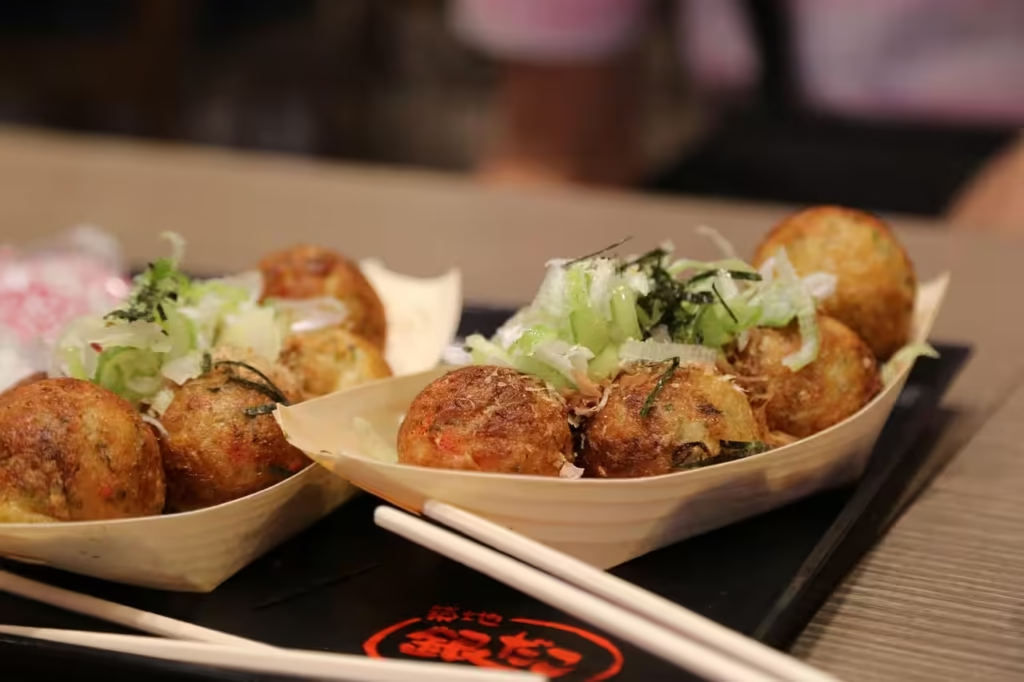
This is the one. Takoyaki is Osaka’s signature street snack and unlike anything else. Round balls of batter hide a piece of tender octopus inside. A special iron mold cooks them until golden and crispy on the outside. The toppings are generous: takoyaki sauce, Japanese mayo, aonori, and dancing katsuobushi flakes.
The bonito flakes wiggle in the heat of freshly cooked balls. It looks theatrical. Eating takoyaki is its own small art form, though. They’re dangerously hot inside, so take small bites or you’ll regret it immediately. Find them everywhere across Osaka’s street food scene and at festivals across the country.
2. Okonomiyaki (Savory Pancake)

Okonomiyaki is a thick, savory pancake popular in Osaka and Hiroshima. Cabbage, egg, and your choice of meat or seafood go inside. The same sauce-and-mayo combination as takoyaki finishes the top. Tokyo has a different version called monjayaki: a thinner, almost liquid batter spreads across the griddle and forms a crispy, slightly gooey pancake you scrape directly off the iron.
At festivals, okonomiyaki is the more common find. For monjayaki, head to Tsukishima in Tokyo. The whole street there dedicates itself to this one dish. Both are worth the detour, though locals from each city have strong opinions about which version is better.
3. Yakitori (Grilled Chicken Skewers)
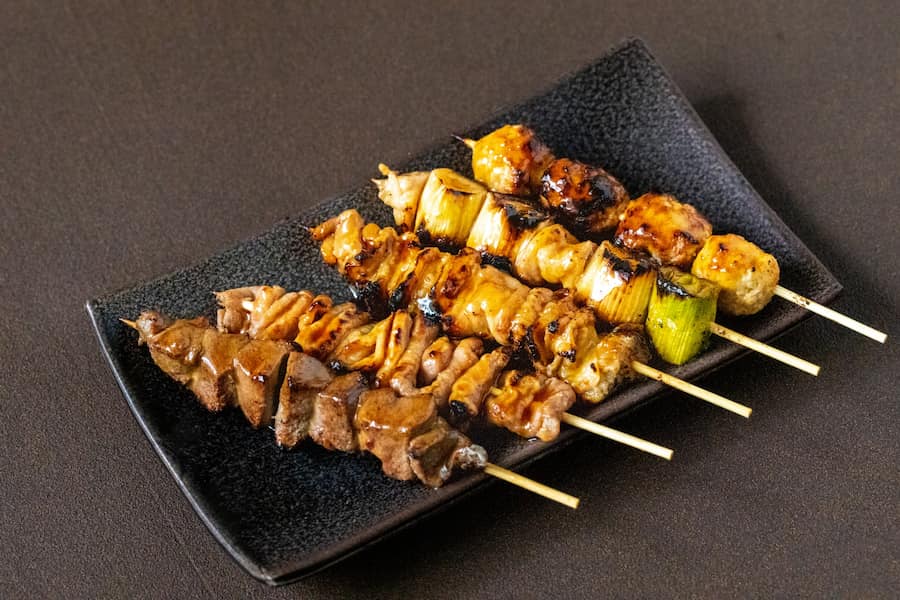
Few smells are as universally appealing as yakitori over charcoal. Skewers of chicken, including thighs, skin, cartilage, and liver, grill over binchotan white charcoal. Your choice is shio (salt) or tare (sweet soy glaze). At yatai stalls, the experience is simple and fast: you point, you pay, you eat standing up.
Start with momo (thigh) or negima (chicken and spring onion) if you’re new to this. Both are tender and crowd-pleasing. Adventurous eaters should try tsukune, a chicken meatball served with a raw egg yolk for dipping. There’s something about eating yakitori fresh off a stall grill that hits differently from an izakaya version.
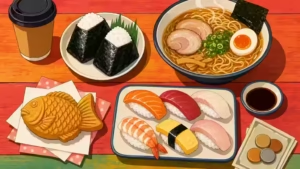
4. Taiyaki (Fish-Shaped Cake)
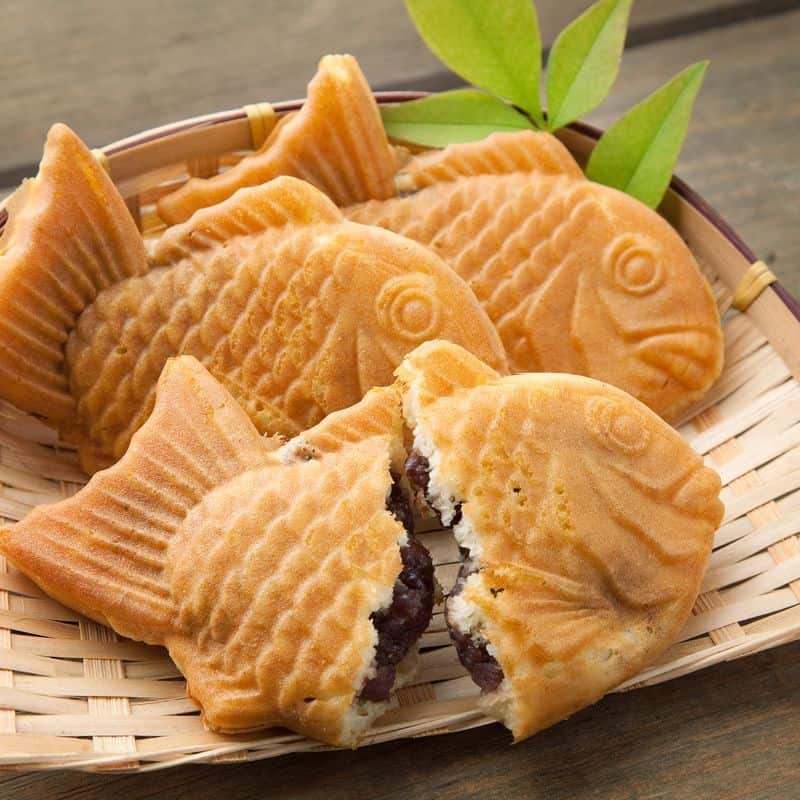
Don’t let the fish shape fool you. Taiyaki is entirely sweet. A crispy waffle-like batter bakes inside a fish-shaped iron mold, with anko (sweet red bean paste) as the traditional filling. Modern versions have expanded considerably: custard cream, matcha, chocolate, and sweet potato are all common at stalls and specialty shops.
Buy one warm from the stall and walk slowly. The shell is thin, slightly crispy at the edges, and soft in the middle. Eat it before it cools. It’s the kind of snack that makes you feel unreasonably happy. You might not expect to love it, but most people do.
5. Yakisoba (Fried Noodles)
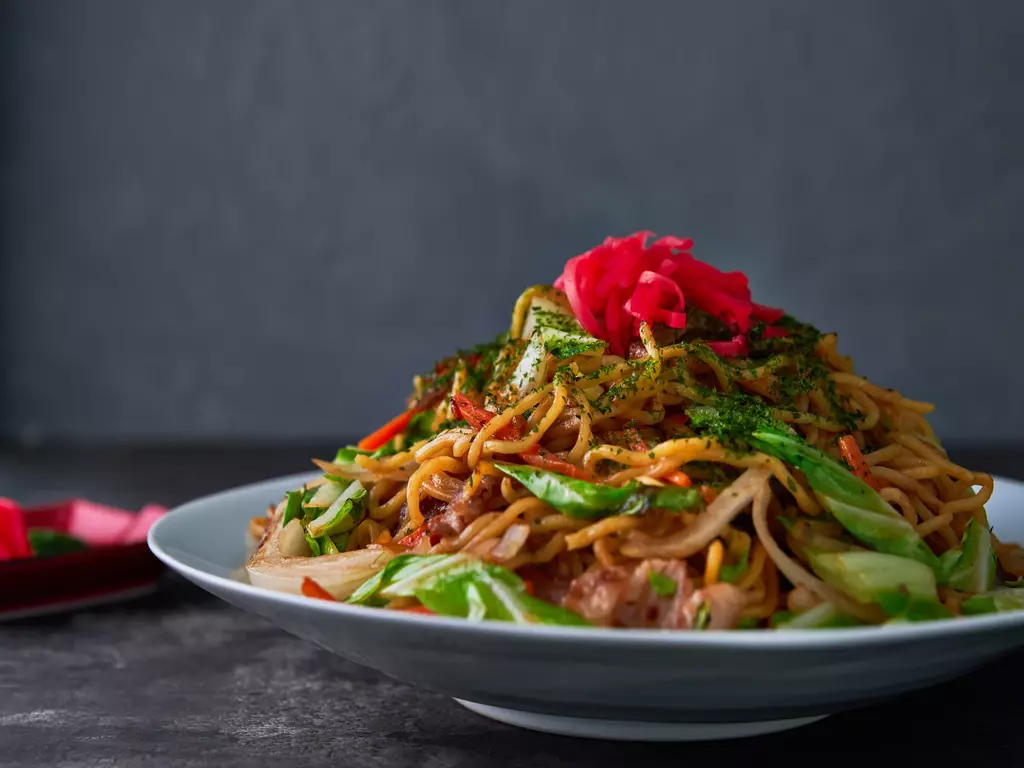
Yakisoba is one of the most comforting street foods at any Japanese festival. Thick wheat noodles stir-fry with cabbage, pork, and a tangy Worcestershire-style sauce on a large iron griddle. Aonori and pickled ginger go on top. Vendors serve it on a paper tray, eaten with chopsticks or a small plastic fork.
The smell of yakisoba cooking is festival-specific. Indeed, it lodges in your memory and stays there long after the trip ends. Moreover, in skilled hands, this simple dish is genuinely great. For example, high heat and a well-seasoned griddle make all the difference.
6. Dango (Rice Dumplings)
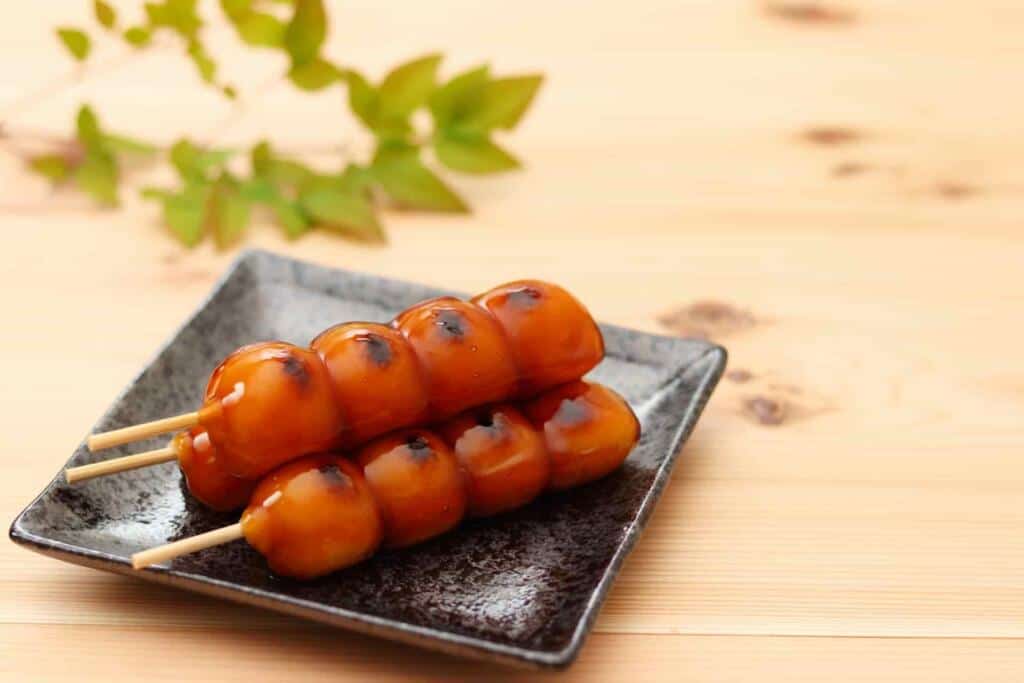
Dango are small, chewy rice flour dumplings served on skewers, usually three to five per stick. The most iconic type is mitarashi dango, lightly grilled dumplings coated in a glossy sweet soy glaze. The texture is unlike anything in Western desserts: bouncy, dense, and slightly sticky. The first bite might need a moment to appreciate, but most people come back for more.
Other varieties include hanami dango (three colors: pink, white, and green) and sesame-coated dango. Hanami dango appears everywhere during cherry blossom season. It has become one of Japan’s most recognizable traditional food icons and pairs naturally with a cup of green tea.
7. Imagawayaki and Obanyaki
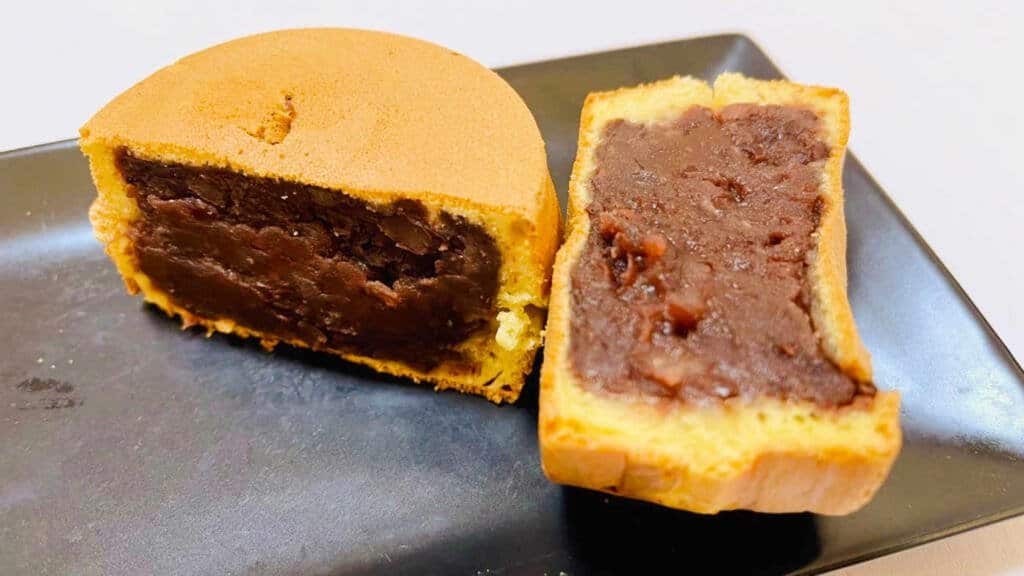
Think of these as taiyaki’s rounder cousins. Cast iron molds cook disc-shaped cakes filled with sweet red bean paste or custard. The name changes by region: imagawayaki in Tokyo, obanyaki in Kansai, bandoryaki elsewhere. They’re thicker than taiyaki with a slightly cakey interior. Warm from the stall, they’re an excellent cold-weather snack, and you’ll smell them before you see them.
8. Senbei (Rice Crackers)
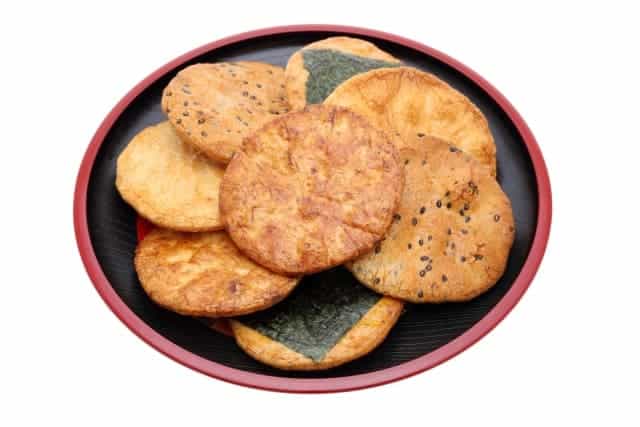
Senbei might seem humble next to other items on this list. A freshly grilled senbei, brushed with soy sauce right in front of you, is something else entirely. At festivals and temple markets, vendors grill senbei on wire racks over open flames. The crackers puff up and brown in seconds. Soy sauce caramelizes slightly on the surface. You eat them hot, standing right at the stall.
Flavors range from classic soy to sesame, seaweed, and spicy shrimp. Packaged senbei also make excellent souvenirs. You’ll find them at temple approach streets like Asakusa’s Nakamise throughout the year.
9. Nikuman and Gyoza
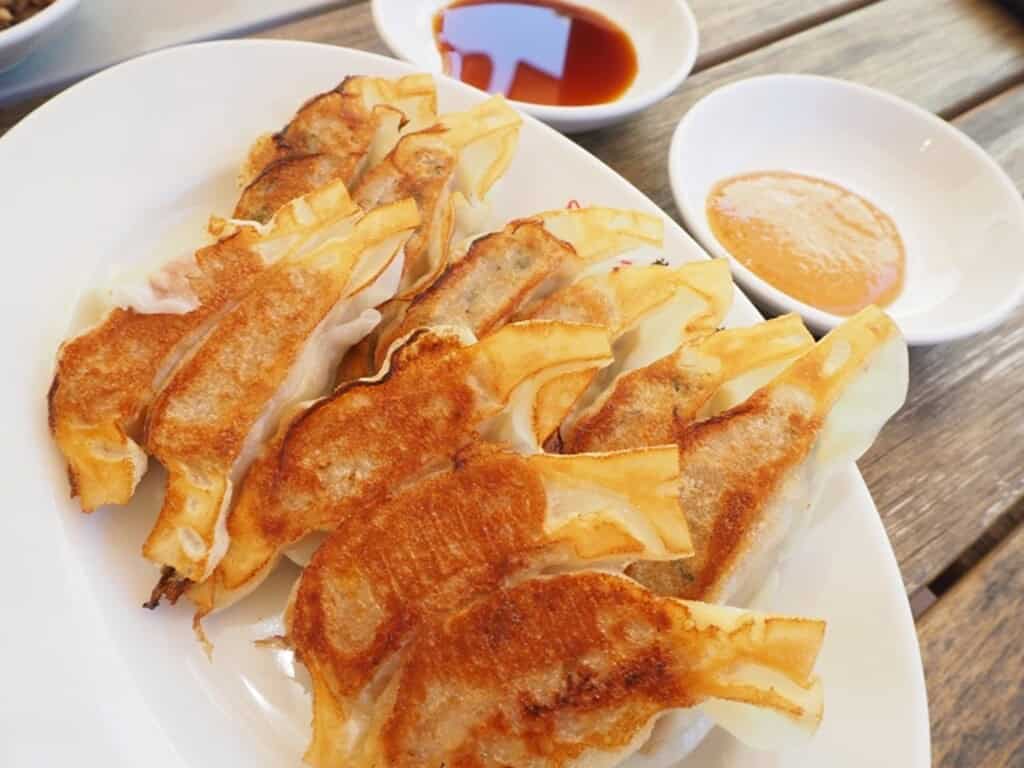
Nikuman are steamed buns filled with seasoned pork and vegetables. Japan adopted this Chinese-influenced food as its own a long time ago. At convenience stores, they sit under warming lamps year-round. At festival stalls, vendors make them fresh and the difference is noticeable. The bun is soft and pillowy. The filling is savory and slightly sweet. Together, they’re filling enough for a small meal.
Gyoza, pan-fried dumplings with crispy bottoms and juicy pork-and-cabbage filling, also appear at yatai stalls, particularly in the Kansai region. Dip them in ponzu or the provided soy sauce mixture. Don’t skip the chili oil.
10. Kakigori (Shaved Ice)
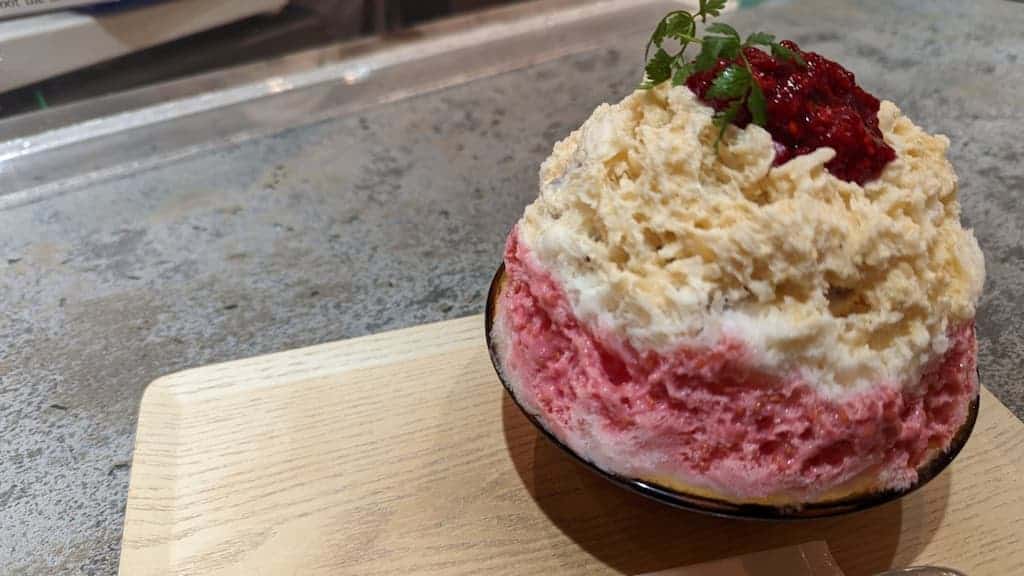
Summer in Japan means kakigori. Mounds of finely shaved ice sit topped with flavored syrup: strawberry, melon, matcha, or condensed milk. High-end stalls shave the ice so finely it almost dissolves on contact with your tongue. Festival stalls offer the classic crowd-pleaser version: bright colors, instant refreshment, and a queue that moves quickly.
You’ll eat it faster than expected, then feel the cold hit your forehead. Completely worth it. Premium kakigori cafés have elevated this snack to an art form in recent years. Even so, the festival version is where the real memories are made.
11. Ichigo Ame (Candied Strawberries)
Ichigo ame became a social media sensation and hasn’t slowed down since. Fresh strawberries dip into a hard, transparent sugar shell and fix onto a stick. The contrast between tart berry and crispy sweet coating is almost addictive. Festival stalls often have long queues for these, particularly in spring. Variations exist with grapes, mandarin segments, and kiwi, but the strawberry version remains the most popular by far.
12. Baby Castella (Mini Sponge Cakes)
Baby castella are tiny golden sponge cakes, each cooked in a small round mold at the stall. The outside is lightly crispy. Inside, the texture is soft and just barely sweet. Vendors sell them by the bag, usually 15 to 20 pieces at a time, and it’s very easy to finish the whole bag without noticing.
Watching the technique is half the appeal. Batter pours into rows of small round holes on a hot iron plate. Each piece flips and seals into a perfect sphere. Major summer festivals in Osaka and Tokyo both have dedicated baby castella stalls worth finding.
13. Ikayaki (Grilled Squid)
Ikayaki is a whole squid grilled on a stick over charcoal. Vendors brush a soy sauce and mirin glaze on during cooking, which caramelizes into something deeply savory and slightly smoky. The texture is chewy. Popular at coastal festivals and around Osaka’s Dotonbori market area, ikayaki is less common at inland events. Near the coast, though, it’s absolutely worth seeking out.
14. Choco Banana
Choco banana is exactly what it sounds like: a banana on a stick, coated in chocolate and covered in colorful sprinkles. It sounds simple, because it is. Banana stalls at summer festivals are always brightly decorated, often run by young vendors with elaborate setups. Kids love them. Adults pretend otherwise, then usually end up buying one anyway. This is a childhood staple of Japanese matsuri culture, and it shows.
15. Gyū Kushi (Beef Skewers)
Gyū kushi are marinated beef skewers cooked over charcoal at larger matsuri and night markets. The beef slices thin, marinates in soy and mirin, and grills quickly over high heat. More expensive than chicken yakitori, but the quality difference is immediately clear. A good yatai beef skewer is genuinely difficult to beat. Seek them out at major summer events and urban market food districts.
Regional Japanese Street Food Specialties
Japan’s street food shifts significantly by region. What you find in Osaka is not what you’ll find in Fukuoka or Sendai. Part of the joy of traveling Japan is stumbling on regional variations you didn’t expect. Follow your nose, order things you can’t identify, and let the regional food culture guide you.
West Side of Japan
Osaka is Japan’s undisputed street food capital. The city has a concept called kuidaore, which roughly means eating yourself into ruin. Takoyaki, okonomiyaki, and kushikatsu (deep-fried skewers) define the scene. Dotonbori is ground zero for all of it, and the energy there at night is unlike anywhere else in Japan.
Fukuoka is famous for its tonkotsu ramen yatai along the Naka River. These open-air stalls operate late into the night. The ramen is rich, fatty, and built with real craft. This is the one city in Japan where yatai culture feels closest to an everyday dining experience rather than a seasonal event.
Kyoto leans toward tofu-based snacks, warabi mochi (bracken starch jelly), and traditional sweets sold near temple markets. Nishiki Market is the best starting point. The vibe is quieter and more refined than Osaka, though no less delicious. This is where Japanese sweets and seasonal ingredients shine most clearly.
Hiroshima is oyster country. At port markets near Miyajima Island, vendors grill, fry, or skewer fresh oysters. Hiroshima-style okonomiyaki is also a must: layers stack differently here than in Osaka, and the result is a denser, more complex pancake. Both cities have a long-standing, friendly rivalry over which version is better. Try both before deciding.
Nagoya has a street food identity built on miso. Miso kushikatsu is the signature item: deep-fried skewers dipped in rich red miso sauce. The Osu Kannon area is the best place to explore Nagoya’s casual eating scene, alongside tapioca stalls and local bakeries selling melon pan with a regional twist.
Okinawa offers sata andagi, a round fried doughnut with a dense, cakey interior. Simple but satisfying. Also look for champuru-inspired snacks, taco rice at casual stalls, and Okinawan soba. The food culture here feels genuinely distinct from mainland Japan, shaped by a separate history and a subtropical climate.
East Side of Japan
Hokkaido offers corn on the cob with butter and soy sauce, fresh crab at port markets, and jingisukan (grilled lamb barbecue). The ingredients reflect the northern climate and agricultural abundance. Sapporo’s Tanuki Koji shopping street is worth exploring for street-style snacks throughout the year.
Sendai, in the Tohoku region, is known for gyū tan (beef tongue). Thin slices of salted beef tongue grill over charcoal and vendors serve them with barley rice and oxtail soup. Locals take this tradition seriously, and the quality at even casual stalls is consistently high. It’s one of Japan’s clearest examples of a regional street food tradition that doesn’t exist anywhere else.
Japanese Street Food by Season
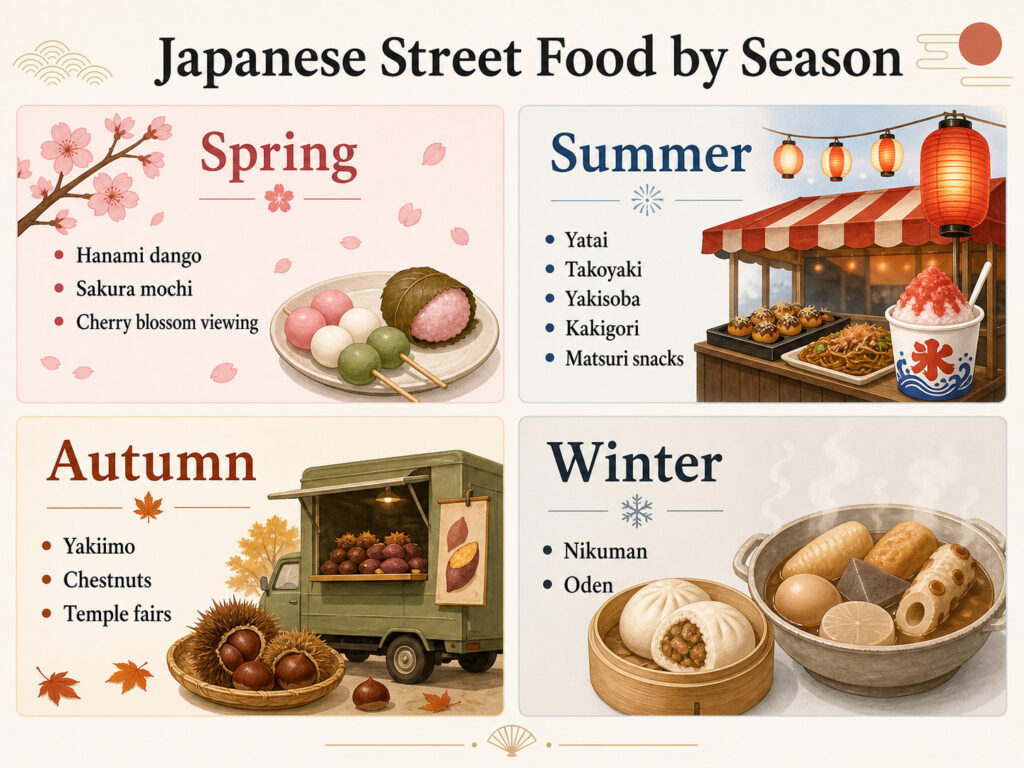
One thing many visitors don’t realize is that Japanese street food changes with the seasons. The calendar shapes what’s available at stalls and markets. Some of the best items only appear for a few weeks each year, which makes finding them feel like catching something rare.
Spring (March to May) brings hanami dango at cherry blossom viewing spots. Pink, white, and green dumplings on a single skewer are everywhere during this season. Sakura-flavored mochi and seasonal sweet shop offerings also appear near popular parks. The crowds are large, but the food is worth it, especially when enjoyed outdoors under blooming trees.
Summer (June to August) is peak yatai season. Takoyaki, yakisoba, yakitori, and kakigori are everywhere at outdoor events. Choco banana and ichigo ame stalls appear at almost every matsuri. This is the easiest season to explore Japanese street food as a first-time visitor. Hot, crowded, and completely memorable.
Autumn (September to November) brings yakiimo, sweet potatoes slow-roasted in stone ovens on small trucks that travel through residential neighborhoods. The sound of the vendor’s loudspeaker is one of Japan’s most nostalgic seasonal experiences. Roasted chestnuts and seasonal manju also appear at temple fairs across the country.
Winter (December to February) is nikuman and oden season. Nikuman, steamed pork buns, warm you up at convenience stores and festival stalls alike. Oden is a slow-simmered soup of daikon, tofu, boiled eggs, and fish cakes in a dashi broth. Both dishes are deeply tied to Japan’s cold-weather food culture, and convenience store versions are genuinely good when the temperature drops.
Japanese Street Food Etiquette
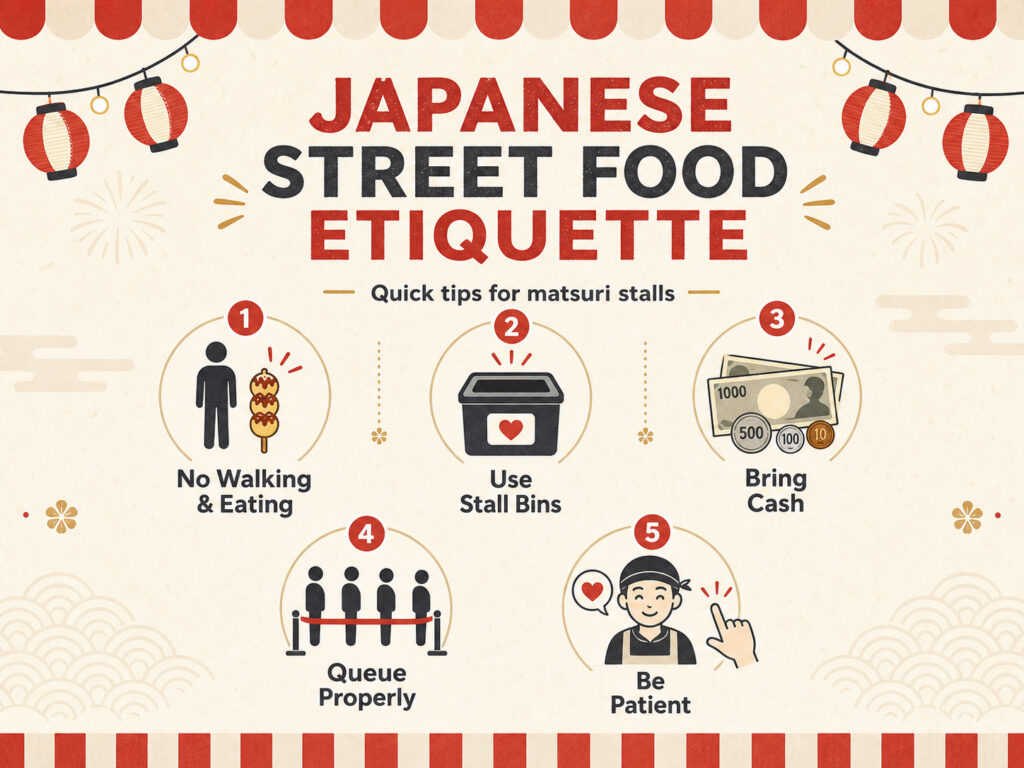
A few cultural norms apply at Japanese food stalls. Following them shows respect for vendors and other visitors. They’re easy to learn and worth knowing before you arrive.
Don’t walk and eat. Walking while eating is considered poor manners in many parts of Japan. At matsuri, attitudes are more relaxed. Still, the default is to step to the side, finish your food, and then continue walking. Watching what locals do is the best guide in any situation.
Dispose of waste at the stall. Japan has very few public trash cans on streets and sidewalks. Most yatai stalls provide a small bin for your waste. Return skewers, cups, and paper trays directly to the vendor. Don’t leave them on a ledge or bench.
Use cash. Most traditional festival stalls don’t accept credit cards or IC cards. Carry small bills and coins. Having exact change speeds up the line and earns quiet appreciation from vendors. A few larger stalls in tourist-heavy areas may accept PayPay or card, but don’t count on it.
Queue properly. Japanese queue culture is orderly and taken seriously. Join the line, wait your turn, and don’t push forward. Lines at most stalls move quickly, so patience is rarely tested for long.
Be patient with language differences. Most stall vendors don’t speak much English. Pointing and gesturing works perfectly well in most situations. Vendors at tourist-heavy festivals are used to foreign visitors and are usually quite welcoming.
Tips for Enjoying Japanese Street Food
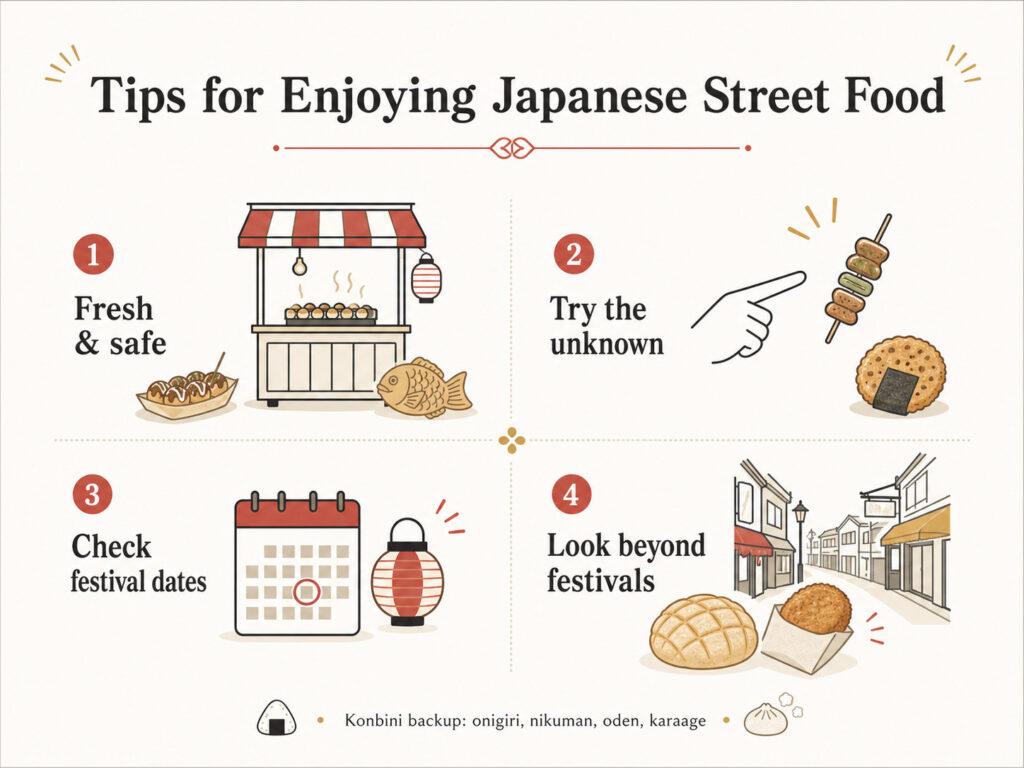
Hygiene at Japanese street food stalls is generally excellent. Ingredients are fresh, cooking temperatures are correct, and turnover is fast. Eat without worry. Try the unfamiliar items too. The best festival moments often come from pointing at something you can’t identify and ordering it anyway. Vendors are usually happy to gesture you through the experience.
Check festival schedules in advance. The biggest yatai gatherings happen at major matsuri. Summer festivals run from July through August, and autumn temple fairs peak in October and November. Planning around these events is genuinely worth the effort. Also, onigiri (rice balls) from convenience stores make a quick, filling backup when stalls are closed. Japan’s konbini carry a surprisingly strong range of snacks year-round, including nikuman, oden in winter, and fresh karaage at any time of day.
Shopping streets (shotengai) and temple approach streets are often overlooked by visitors. Korokke (potato croquettes) from butcher shops, melon pan from local bakeries, and freshly grilled senbei from market stalls are all examples of everyday Japanese street food that doesn’t require a festival. Some of the best eating in Japan happens quietly, between major landmarks, on streets where only locals usually stop.
Go Hungry, Come Back Full
Japan’s street food is one of those travel experiences that resists full preparation. The sights, sounds, and smells of a busy matsuri at night are hard to describe accurately. Yatai glow under lantern light. The smell of takoyaki drifts through the crowd. Those moments stay with you long after the trip ends, and they’re worth building your itinerary around.
Go with an open mind and a real appetite. Try things you’ve never heard of. Talk to vendors with gestures and enthusiasm. And if you find a perfect snack, stand there and finish it before moving on. That’s the only right way to do it.
Tried one of these street foods in Japan? Share your favorite memory or photo in the comments. If you’re cooking at home, start with yakisoba. It’s easier than it looks and endlessly satisfying.
Japanese Street Food FAQ
What is the most famous street food in Japan?
Takoyaki is widely considered Japan’s most famous street food. Osaka invented it and still defines how it’s made. You’ll find it at festivals, markets, and dedicated shops across the whole country. Yakitori and taiyaki follow closely behind in terms of nationwide recognition.
Which city has the best street food in Japan?
Osaka and Fukuoka are the two strongest cities for Japanese street food. Osaka offers the widest variety, with takoyaki, okonomiyaki, and kushikatsu available everywhere. Fukuoka’s licensed yatai ramen stalls along the Naka River are unique in Japan. Both cities are worth visiting if street food is a priority on your trip.
What food should first-time visitors to Japan try?
Start with takoyaki, yakitori, and kakigori (for summer visits). These three give you a quick overview of savory, grilled, and sweet street food options. All three are easy to find, reasonably priced, and beginner-friendly. Taiyaki is also a good first Japanese street food choice for visitors who prefer something sweet.
Is Japanese street food expensive?
Most Japanese street food is very affordable by international standards. Items typically cost between 300 and 800 yen each. Festival stalls can be slightly pricier than everyday shops, but not significantly. A full evening of tasting different yatai dishes usually costs under 3,000 yen per person.
Are food stalls open year-round in Japan?
Food stalls are not open year-round in most Japanese cities. Summer and autumn are the busiest seasons for yatai, tied to matsuri and temple events. Fukuoka is one notable exception, with licensed yatai operating throughout most of the year. Shopping street and market food stalls often operate more regularly than festival-style yatai.
Is Japanese street food safe to eat?
Yes, Japanese street food offers a very safe dining experience. Japan maintains high food hygiene standards across all food settings. Street stall vendors take freshness seriously and cook meals directly to order. Follow standard travel precautions: eat hot, freshly cooked items and avoid food that has been sitting out for an extended time.
How do I find yatai in Japan?
Check local festival calendars on city tourism websites before your trip. Fukuoka’s Nakasu and Tenjin districts have vendors operating year-round. Osaka features permanent food stalls along the Dotonbori area. Festival-style yatai appear most frequently during summer and autumn. Google Maps also shows current stall locations in major cities.
What’s the difference between okonomiyaki and monjayaki?
The main difference is batter thickness and regional origin. Osaka and Hiroshima make okonomiyaki as a thick, savory pancake. Tokyo makes monjayaki with a thin, almost liquid batter that crisps up and forms a gooey texture on the hot iron surface. Both use similar ingredients but produce very different textures and experiences.
What are the most popular sweet street foods in Japan?
Taiyaki (fish-shaped cakes), kakigori (shaved ice), dango (sweet rice dumplings), and ichigo ame (candied strawberries) are among the most popular sweet street foods. Choco banana is a summer festival favorite. Baby castella are a crowd-pleasing festival snack available across most regions. All of these appear at festivals and busy shopping streets throughout the year.
Is Japanese street food vegetarian or vegan friendly?
Traditional street food often contains fish broth (dashi) or meat. Vegans and vegetarians can safely enjoy plain roasted sweet potatoes (yaki-imo), candied strawberries (ichigo ame), and soy-glazed rice dumplings (mitarashi dango). Taiyaki with sweet potato or matcha filling is also usually animal-product-free, though it’s worth confirming with the vendor.
Can I walk and eat at the same time in Japan?
Japanese culture generally discourages walking while eating. Standing near the stall to finish your food is the expected behavior in most settings. At matsuri, attitudes are more relaxed. Even so, stepping to the side before eating is a good habit. Return trash to the stall when you’re done, since public bins are rare on Japanese streets.
Do street food vendors accept credit cards?
Most traditional festival stalls and small street vendors only accept cash. Carry plenty of 100-yen and 500-yen coins when exploring Japanese street food markets. Some larger stalls in tourist-heavy areas may accept QR code payment apps like PayPay, but cash remains the safest option for festival settings.
What is Taiyaki?
Taiyaki is a classic fish-shaped pastry from Japan. A sweet waffle-like batter bakes inside a fish-shaped mold, traditionally filled with hot red bean paste or creamy custard. The shell is thin and crispy at the tail, with a soft, warm center. Find it at shopping streets, temple markets, and festival stalls across Japan.
References
- Japan National Tourism Organization (JNTO). “Food & Drink Guide” (accessed 2024). https://www.japan.travel/en/guide/food-drink/
- Osaka Convention & Tourism Bureau. “Osaka Food Culture” (accessed 2024). https://osaka-info.jp/en/
- Fukuoka City Tourism. “Yatai Culture in Fukuoka” — approx. 100+ licensed yatai stalls as of 2023. https://www.yokanavi.com/en/
- Ministry of Health, Labour and Welfare, Japan. “Food Sanitation Law Overview” (2021 revision). https://www.mhlw.go.jp/english/policy/health/food-hygiene/
- Japan Tourism Agency. “Tourism Statistics: Food-Related Travel Behavior” (2023 Annual Report). https://www.mlit.go.jp/kankocho/en/





Comments