






Picture a bowl of ramen with a pale golden broth. You lean in, and the smell is sweet and toasty, yet it isn’t pork at all. That’s Tottori Gyukotsu Ramen (鳥取牛骨ラーメン), a regional ramen made with beef bone broth. Today, you’ll find it mainly in central and western Tottori Prefecture, on the Sea of Japan coast of western Honshu.
Beef bone broth is rare in Japan, so this bowl tends to surprise people. Stranger still, most locals didn’t even have a special name for it before 2009. Below, we explain how it tastes, why beef took hold here, and where to try it.
What Is Tottori Gyukotsu Ramen?
Tottori gyukotsu ramen is a soy sauce or salt ramen built on broth from simmered beef bones. In addition, shops usually pair it with wavy noodles and simple toppings like bean sprouts, menma (seasoned bamboo shoots), and green onion. According to Tottori Prefecture, this style is rare across Japan. Even so, its shops dot the central and western parts of the prefecture.
Quick Facts
- Japanese name
- 鳥取牛骨ラーメン (gyukotsu means “beef bone”)
- Region
- Central and western Tottori, including Yonago, Kurayoshi, Kotoura, and Hokuei
- Broth
- Beef bones; some shops also blend in pork bones
- Seasoning
- Soy sauce or salt
- Noodles
- Wavy noodles (chijire-men)
- Toppings
- Chashu (sliced braised pork), bean sprouts, menma, green onion, and sometimes kamaboko fish cake
- Origins
- Postwar; the Yonago shop Masumi dates its opening to 1946
- Number of shops
- More than 100, mostly in central and western Tottori, according to the Tottori Prefectural Tourism Federation
- Typical price
- About ¥550 to ¥750 for a standard bowl at five shops (as of October 23, 2026)
First, the name is easy to unpack. Gyu means beef, while kotsu means bone. One more thing before we go on: gyukotsu describes the bones in the broth, not a premium cut of wagyu.
What Does Tottori Gyukotsu Ramen Taste Like?
Tottori gyukotsu ramen tastes lighter than its beefy name suggests. According to Tottori’s official tourism site, the broth has a toasty beef aroma, a gentle sweetness, and deep beef umami. In fact, the site says it’s so easy to drink that you may finish the whole bowl.
Aroma
Toasty and fragrant, from the beef bones and fat
Taste
Gentle sweetness with beef umami
Finish
Light and clean, not greasy
Summarized from the Tottori Prefectural Tourism Federation’s official descriptions.
So, does it taste like beef stew? Not really. That contrast is what makes the first sip memorable: the aroma promises richness, yet the soup itself goes down easily. Similarly, the tourism federation’s ramen feature notes the sweet taste of the fat and a clean aftertaste.
Japan’s Ministry of Agriculture, Forestry and Fisheries (MAFF) adds a visual clue in a 2020 feature. It says the bowl looks like an ordinary soy sauce (shoyu) ramen. Even so, it notes the mellow sweetness of beef bones and a refined, easy-to-eat flavor.
As for texture, the wavy noodles hold the broth in their curls. Meanwhile, crunchy bean sprouts add a fresh bite between sips. So if tonkotsu usually feels too heavy for you, this might be your bowl. Then again, fans of thick, creamy soups may find it a little too gentle at first. Honestly, it’s hard to say which camp you’ll fall into until you try it.
Gyukotsu vs Tonkotsu: What’s the Difference?
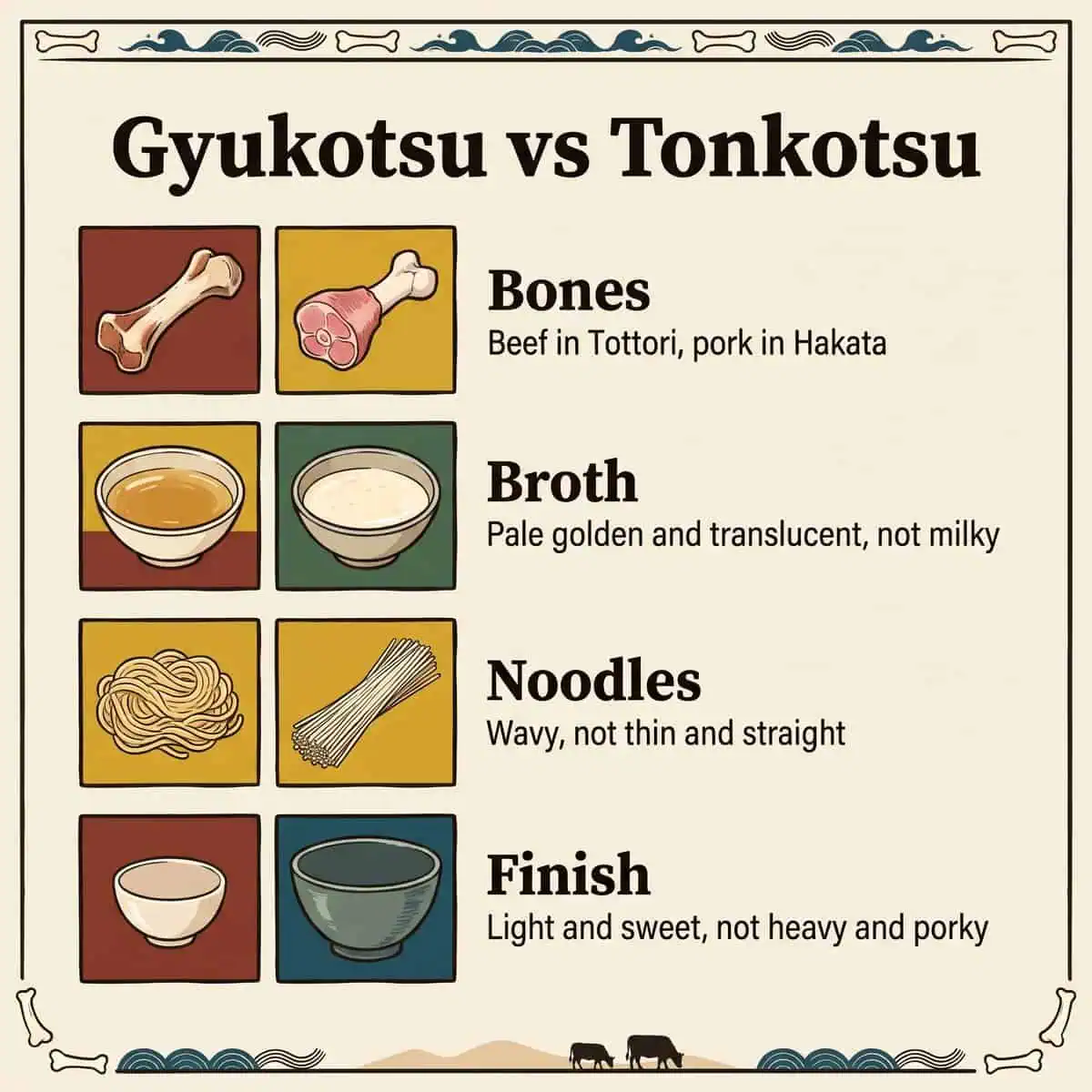
Gyukotsu and tonkotsu sound alike, but they make very different bowls. Tottori’s version has a pale golden, translucent broth that tastes aromatic and lightly sweet. By contrast, Hakata tonkotsu from Fukuoka is cloudy, creamy, and distinctly porky. The difference starts with the bones, since tonkotsu means pork bone.
| Feature | Tottori Gyukotsu Ramen | Hakata Tonkotsu Ramen |
|---|---|---|
| Home region | Central and western Tottori | Fukuoka, Kyushu |
| Main bones | Beef, sometimes blended with pork | Pork |
| Broth look | Pale golden and translucent, not milky | Cloudy and creamy white |
| Seasoning | Soy sauce or salt | Pork bone base with a salty tare |
| Aroma and finish | Toasty beef aroma, gentle sweetness, light finish | Rich and porky, with a heavier body |
| Noodles | Wavy | Thin and straight |
| Typical toppings | Chashu, bean sprouts, menma, green onion, kamaboko | Chashu, green onion, pickled ginger |
For context, a 2024 study by Nami Fukutome and Aina Takashima traced pork bone ramen’s growth to Kyushu. They also sorted ramen into clear soups and cloudy white soups. Tottori’s bowl sits closer to the clear type, even if the broth isn’t fully see-through. Meanwhile, if you want the pork side of the story, read our guides to tonkotsu ramen and Hakata ramen.
Beef ramen does exist elsewhere in Japan, too. Yamagata, for example, has its own Obanazawa beef ramen. Still, Tottori is where a beef bone soup became an everyday local standard. If you enjoy comparing regional ramen styles in western Japan, it makes a fine stop.
Inside the Bowl: Broth, Noodles, and Toppings
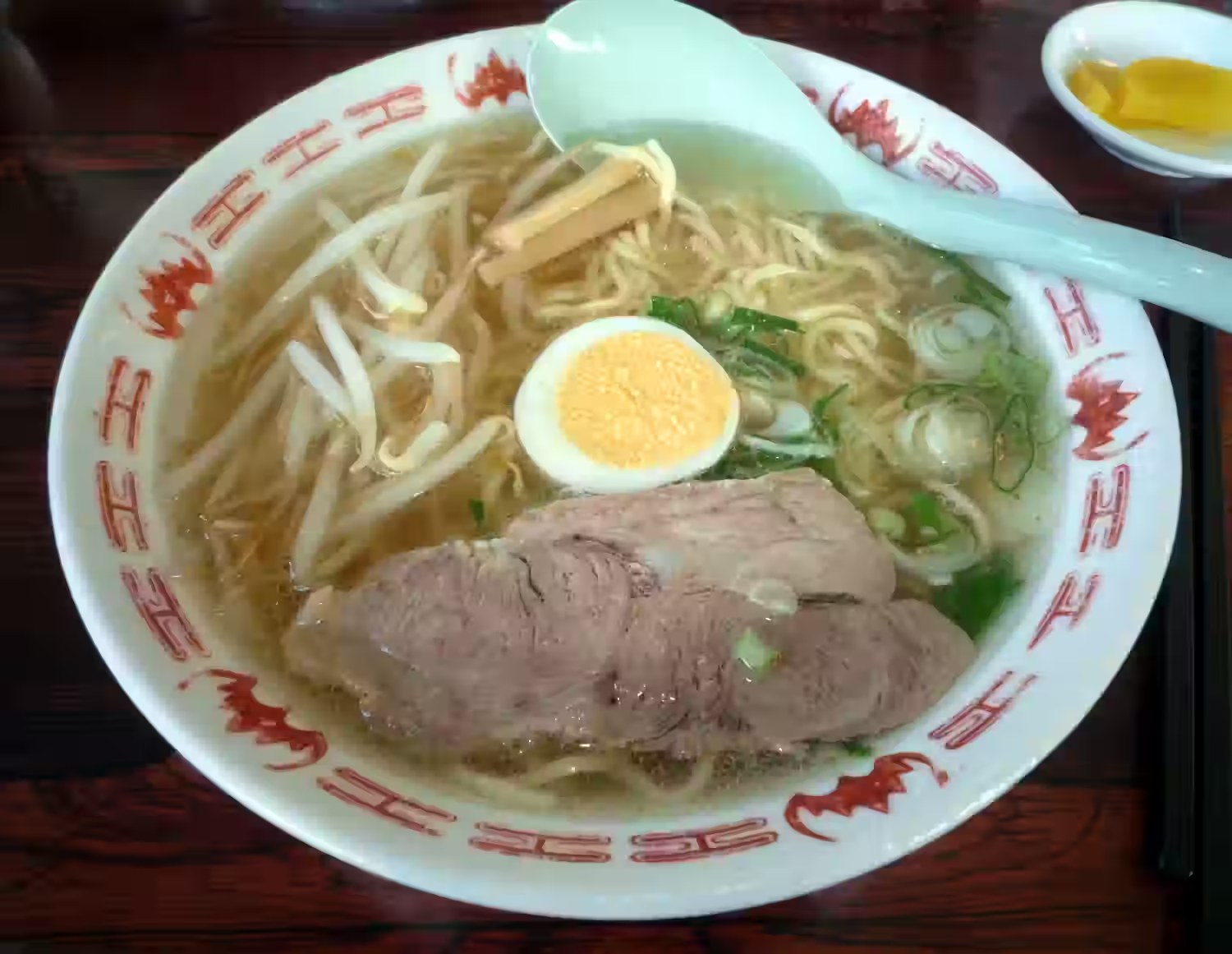
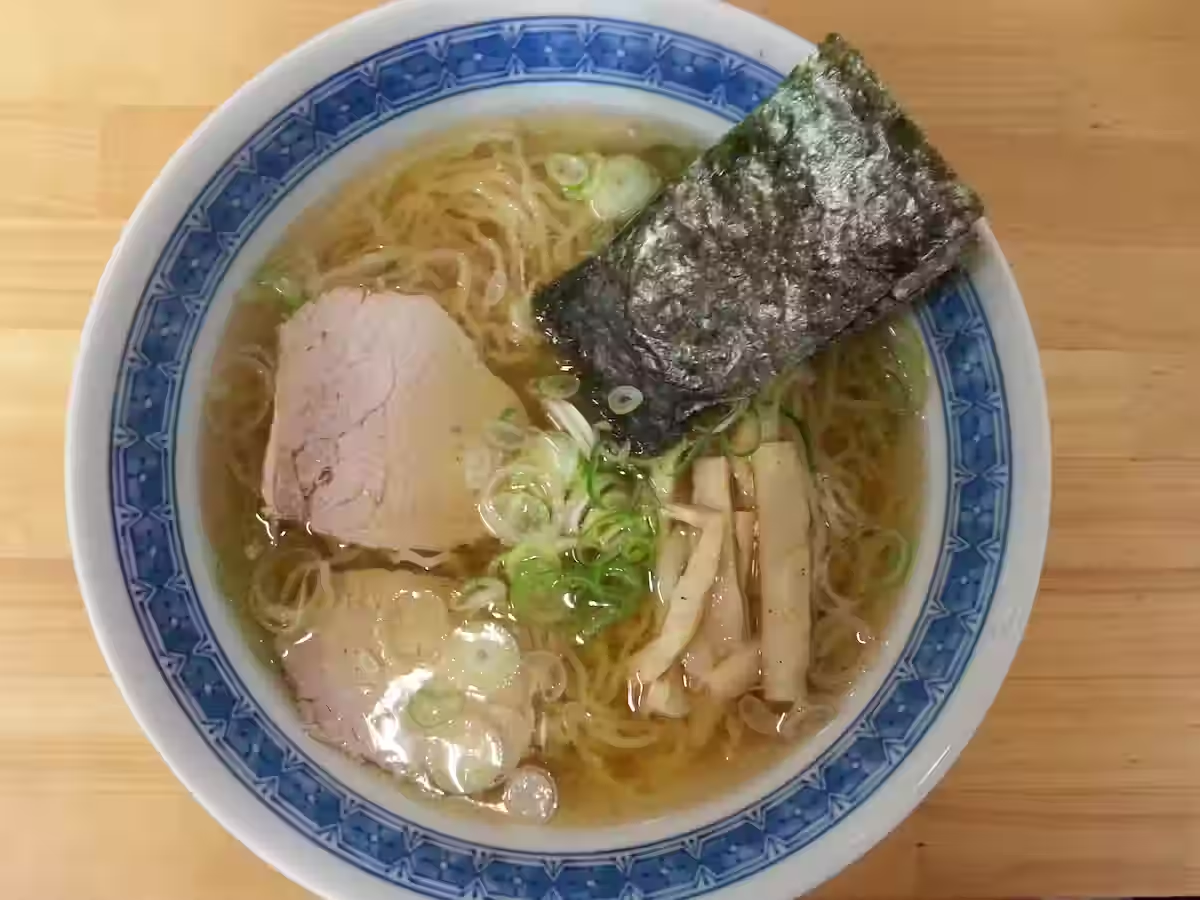
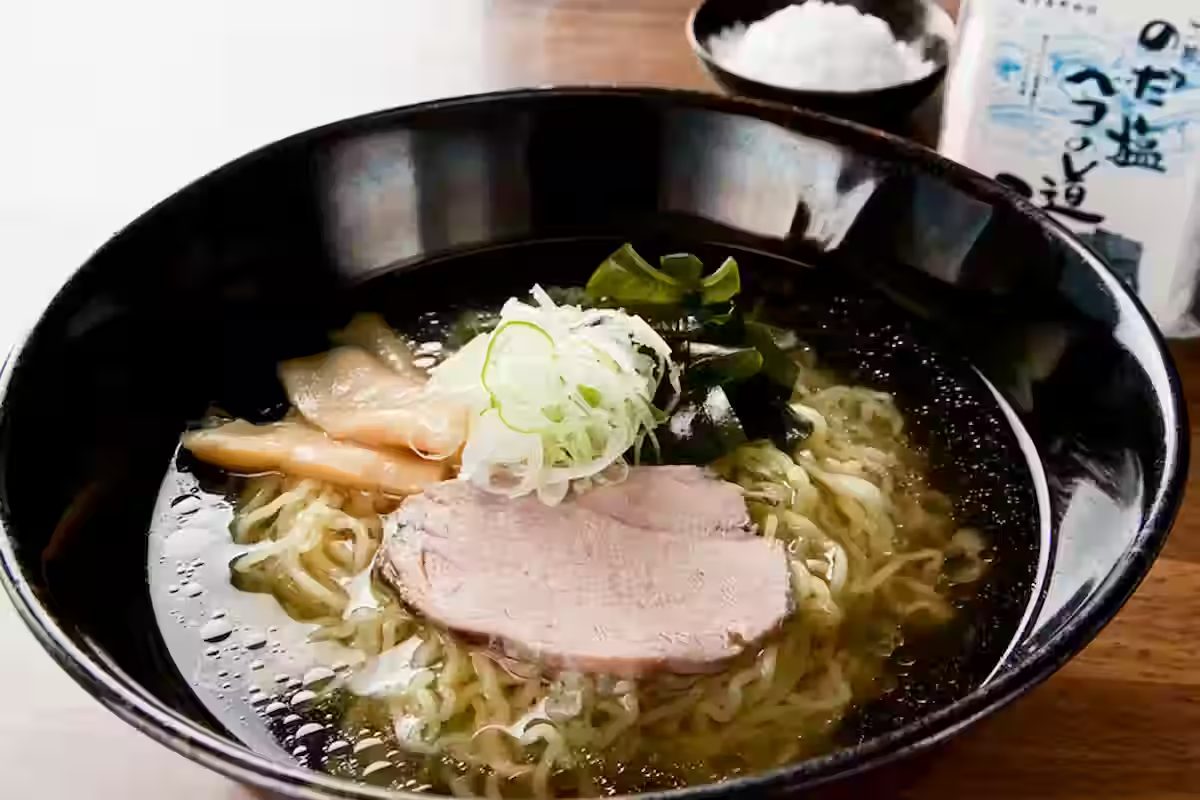
At first glance, a bowl of gyukotsu ramen can look like simple soy sauce ramen. Look closer, however, and its local character shows. Fragrant beef fat floats on the pale golden broth. Meanwhile, the wavy noodles catch the soup, and crisp bean sprouts lighten each bite.
Top layer
Beef fat that carries the sweet, toasty aroma
Middle layer
Beef bone broth seasoned with soy sauce or salt
Base
Wavy noodles, bean sprouts, menma, chashu, and sometimes kamaboko
In the bowl we photographed for this article, the broth was pale golden and translucent. It wasn’t milky like tonkotsu, yet you couldn’t see clearly to the bottom either. That bowl also came with half a boiled egg alongside the bean sprouts, menma, chashu, and green onion.
The Beef Bone Broth
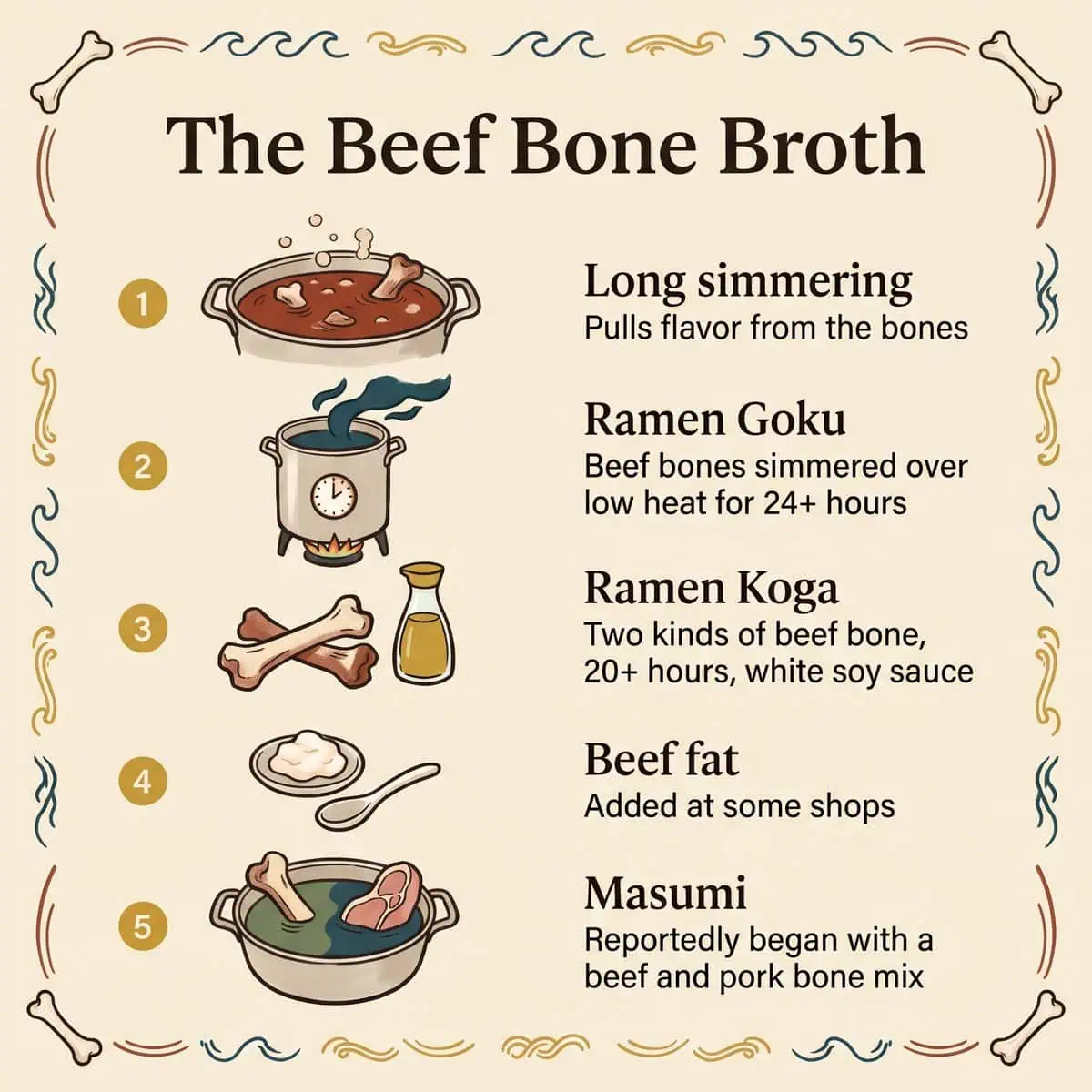
The broth is where each shop builds its identity. Long simmering pulls flavor from the bones, yet the result doesn’t have to be thick or creamy. For example, Ramen Goku in Yonago says it simmers beef bones over low heat for more than 24 hours. Likewise, Ramen Koga in Hokuei simmers two kinds of beef bone for over 20 hours. Then it pairs the broth with white soy sauce.
Some shops also add beef fat, according to the same MAFF feature. Not every gyukotsu broth is pure beef, though. According to the Yonago Gyukotsu Ramen Alliance, Masumi used a mix of beef and pork bones from the start. The alliance adds that pork may have dropped out later. However, it calls this only one of several theories.
Wavy Noodles
Tottori’s tourism site lists curly noodles, called chijire-men, as part of the classic bowl. Because of their kinks and folds, they pick up the broth and its thin layer of fat. So each bite brings some of that aroma along with it.
Simple Toppings and Kamaboko
The toppings are humble on purpose: bean sprouts, menma, green onion, and chashu. In addition, some shops add slices of kamaboko, a steamed fish cake. Notably, the tourism site mentions it alongside the ramen’s roots in the decade after 1945.
A Local Ramen Without a Name
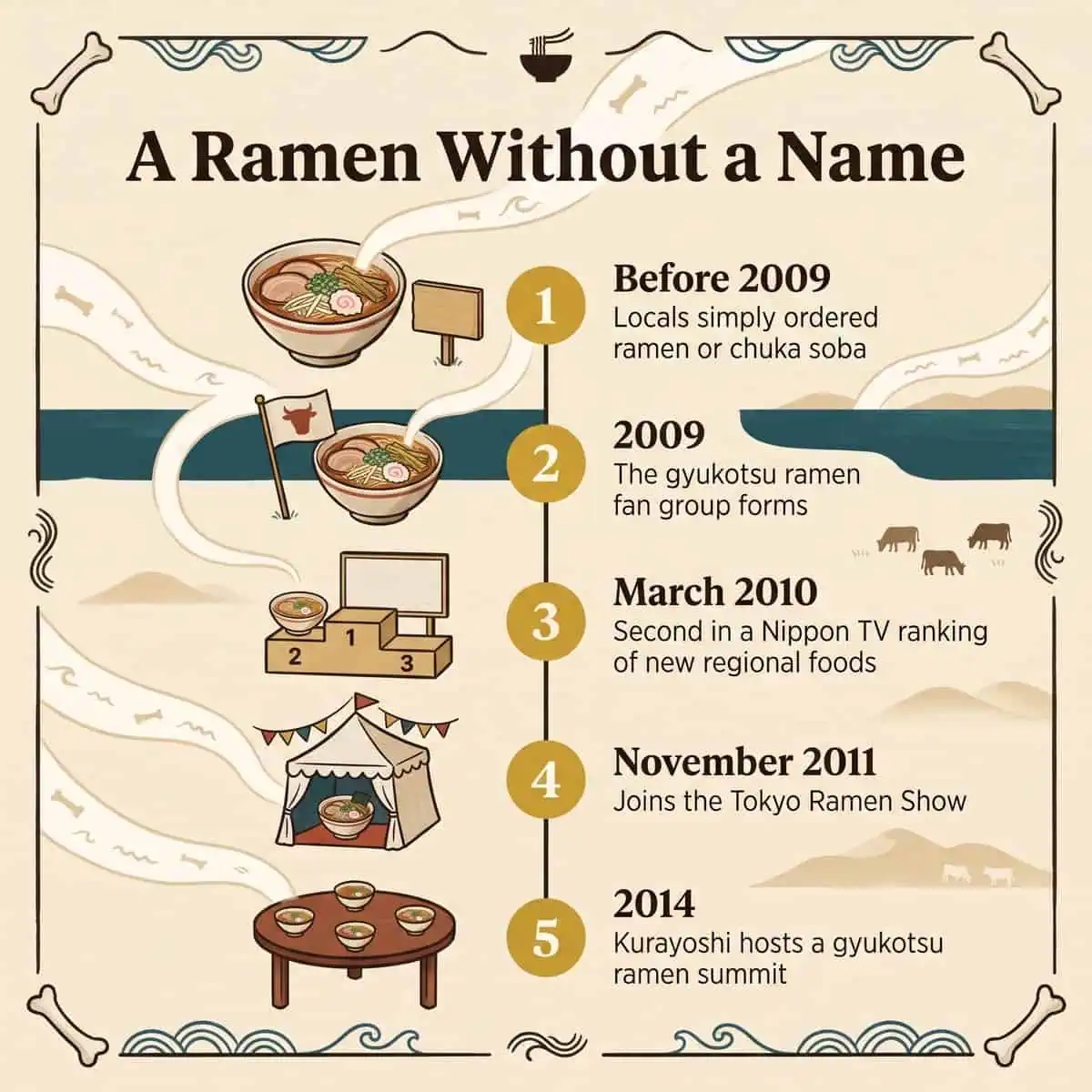
For most of its history, Tottori’s beef bone ramen had no special name. Locals simply ordered ramen or chuka soba, because beef bone broth was part of everyday food. The label “gyukotsu ramen” spread only after local fans began promoting it in 2009.
Ryojun Yoneda, who leads the Tottori Gyukotsu Ramen fan group, says almost no shop used the name before then. To them, it was just normal ramen, or old-style chuka soba. That older name means “Chinese soba.” As researcher Yasushi Masuko notes, Japanese ramen grew out of Chinese noodle dishes. Tottori Prefecture describes the same thing: residents ate it without noticing how rare it was, and shops saw it as ordinary.
Then the fan group formed in 2009, and attention grew quickly. In March 2010, the style ranked second in a Nippon TV ranking of new regional foods. After that, the group joined Tokyo Ramen Show in November 2011. Later, in 2014, Kurayoshi hosted a gyukotsu ramen summit. Step by step, an unnamed local habit became a regional specialty.
Where Did Beef Bone Ramen Come From?
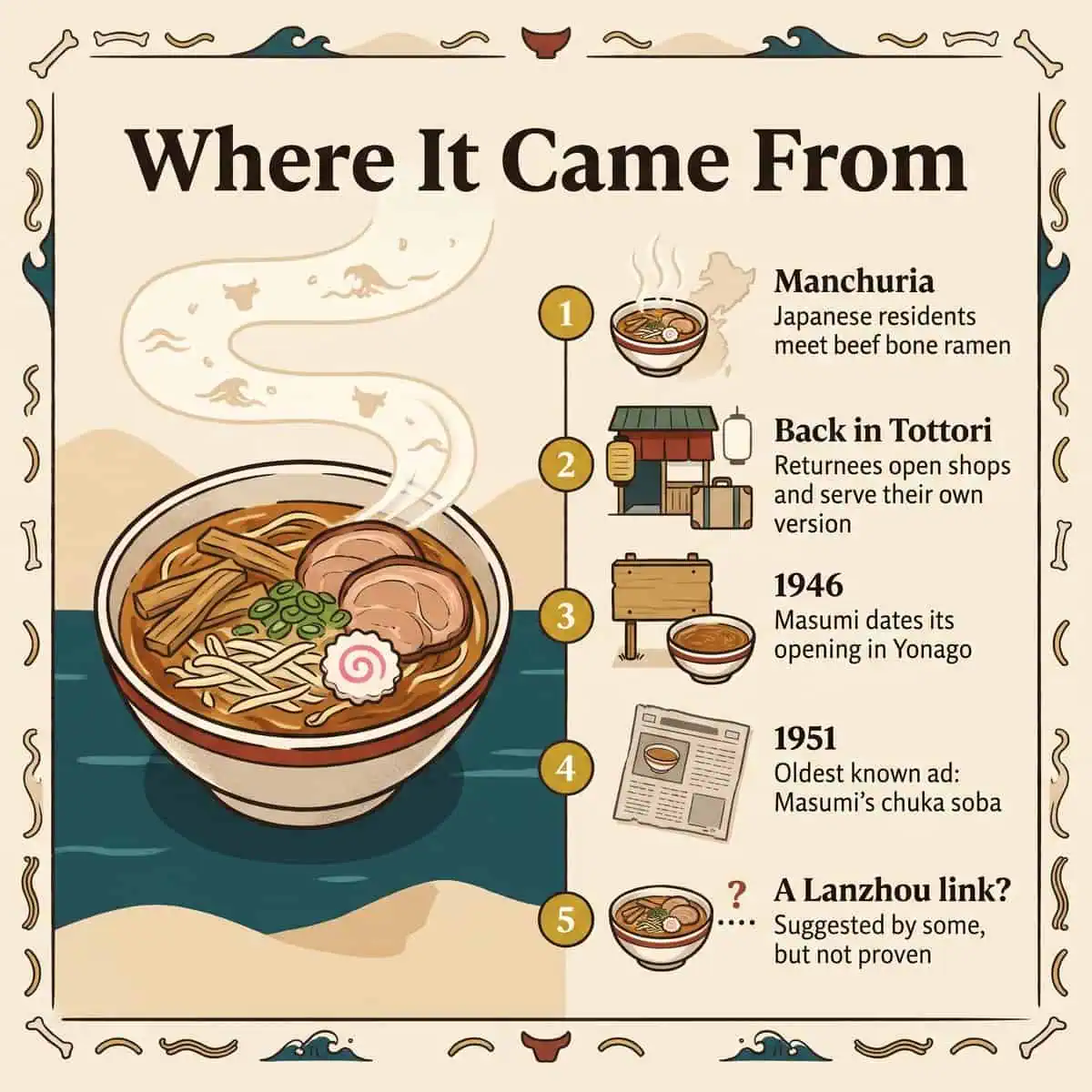
Tottori gyukotsu ramen seems to have taken shape right after World War II, but its exact birthplace isn’t documented. Local groups link it to beef bone soups that Japanese residents met in Manchuria. What’s clearer is why it lasted: Tottori already had a long cattle tradition and a steady supply of beef bones.
A Postwar Bowl and the Manchuria Story
One widely repeated local account starts in wartime Manchuria, now part of northeast China. According to the Tottori Gyukotsu Ramen Shop Owners’ Association, Japanese residents there met beef bone ramen. Later, after returning to Tottori, some opened shops and served their own version. The tourism federation describes Masumi in Yonago, which dates its opening to 1946, as the original.
Written evidence comes later, however. The Yonago Gyukotsu Ramen Alliance points to a 1951 ad for Masumi’s chuka soba in the local Nihonkai Shimbun newspaper. In its view, this is the oldest record of the style. Even so, the alliance admits the exact birthplace isn’t settled.
Some local writers go further back. Yoneda, for instance, suggests a link with Lanzhou beef noodles from China’s Gansu Province. Both use beef-based soup. Still, no document directly links the two. So treat it as a possible influence, not a proven origin.
Why Beef? Tottori’s Cattle Country
A new ramen style only survives if cooks can buy the ingredients every day. That’s exactly where Tottori’s cattle history comes in. According to the shop owners’ association, livestock farming thrived in Tottori, so beef bones were affordable. Yoneda also makes the same point, arguing that restaurants need ingredients that are cheap and always available.
- 1716–1736
The Daisen Cattle and Horse Market begins meeting regularly during the Kyoho era
- Mid-Meiji
More than 10,000 cattle and horses traded each year
- 1920
Japan’s first wagyu pedigree registration program starts in Tottori
- 1937
The Daisen market closes in spring as railways change trade
- 1946
Masumi opens in Yonago, by its own account
Sources: Tottori Prefecture; Tottori Prefectural Tourism Federation.
The market met at Hakuroza, a site below Daisenji Temple on Mount Daisen. According to Tottori Prefecture, it became one of Japan’s three great cattle and horse markets. Rather than causing the ramen directly, it shows how deeply cattle trading ran in western Tottori long before 1946. Then, in 1920, Tottori started Japan’s first program to register each wagyu by pedigree.
Does that mean your bowl uses wagyu? Not necessarily. The sources we checked don’t say which cattle the shops’ bones come from. So treat gyukotsu as “beef bone ramen,” not “wagyu ramen.”
Why Didn’t It Spread Across Japan?
It’s a fair question, and no single record answers it. Still, the local accounts offer a clue. They tie the style’s survival to a cheap, steady supply of beef bones, which Tottori happened to have. Elsewhere, ramen grew around other stocks, such as the pork bone broths of Kyushu. Even today, the Yonago alliance admits that the idea of “beef bone ramen means Tottori” never fully caught on nationwide. That said, MAFF noted in 2020 that some shops had begun opening in Tokyo.
How to Eat Tottori Gyukotsu Ramen Like a Local
There’s no formal etiquette, but the first sip deserves a little thought. Because the fragrant fat floats on top, a deep scoop mixes that aroma with the broth below. After that, you can try the shop’s suggested extras.
Scoop deep with the spoon
Ramen Goku suggests dipping the spoon deep for your first sip. That way, the fat on top and the broth below mix together.
Add garlic halfway
At Masumi, a little garlic gives the gentle broth more punch. Try it after you’ve tasted the soup on its own.
Order a side dish
Several shops pair ramen with karaage fried chicken or gyoza dumplings. Masumi even offers a karaage ramen.
Try half bowls in Yonago
The Yonago alliance promotes half-size bowls, so you can visit several shops in one trip.
Where to Try Tottori Gyukotsu Ramen
For a first gyukotsu ramen trip, focus on central and western Tottori rather than Tottori City in the east. Yonago ties closely to the style’s postwar history. Meanwhile, Kurayoshi, Kotoura, and Hokuei mix long-running diners with dedicated ramen shops.
Western Tottori
Yonago
Home of Masumi, often called the original, and of newer shops like Ramen Goku.
Central Tottori
Kurayoshi, Kotoura, Hokuei
Long-running diners and former caterers serve it, and the fan group started here.
The tourism federation counts more than 100 gyukotsu ramen shops, mostly in these two areas. So don’t limit yourself to ramen shops. For example, in Kotoura and Kurayoshi, family diners and restaurants serve it as well.
No single shop shows every version of the dish. Some keep the old-style chuka soba feel, while others push longer simmering or newer seasonings. The five shops below, all profiled by the tourism federation, are a starting point rather than a ranking.
| Shop | Area | Since | Good to know | Listed price |
|---|---|---|---|---|
| Masumi (満洲味) | Yonago | 1946 | Often described as the original | ¥750 |
| Kamitoku (香味徳) | Kotoura | 1949 | Serving gyukotsu ramen since around 1952 | ¥650 |
| Masagoya (まさご屋) | Kurayoshi | 50+ years | A former caterer with one ramen on the menu | ¥550 |
| Ramen Goku (ラーメン悟空) | Yonago (Yodoe) | 2005 | Broth simmered for 24+ hours | ¥600 (soy sauce) |
| Ramen Koga (ラーメン幸雅) | Hokuei | 2008 | Moved from Kurayoshi in 2023 | ¥700 |
Prices as shown on the Tottori Prefectural Tourism Federation’s site, checked October 23, 2026. Prices and opening details may change, so please check each shop’s official information before you visit.
Kamitoku’s story, in particular, shows how the style spread. According to the tourism federation, its former owner learned gyukotsu ramen at Shogetsu, an early shop in central Tottori. Similarly, Masagoya began as a catering business and first offered ramen at lunchtime.
Planning a Ramen Day
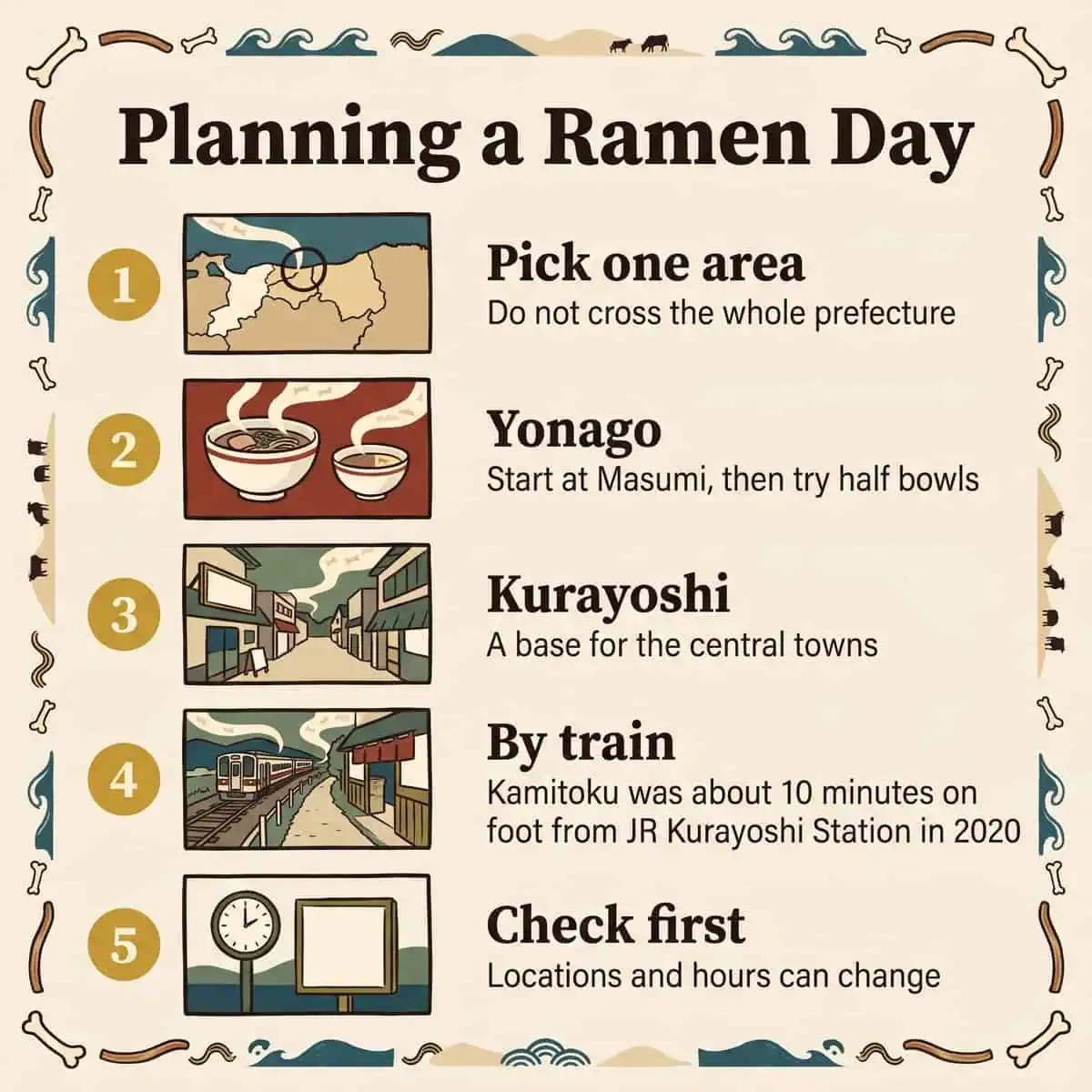
If you only have one day, pick one area instead of crossing the whole prefecture. Yonago suits a history-minded visit, since you can start at Masumi and then sample half bowls elsewhere. Alternatively, base yourself in Kurayoshi to explore the central towns. If you’re arriving by train, MAFF’s 2020 feature placed Kamitoku’s Kurayoshi branch about a 10-minute walk from JR Kurayoshi Station. Either way, check each shop’s current location and hours first, because they can change.
Before You Order
Avoiding pork?
Gyukotsu names the broth’s key ingredient, but it doesn’t guarantee a pork-free bowl. Some shops blend beef and pork bones, and chashu in Japan is usually pork. If you have dietary or religious needs, ask about the broth, oil, and toppings separately.
Also, don’t assume a shop lacks gyukotsu ramen just because the menu says ramen or chuka soba. At older places, beef bone broth may still be the local default rather than a separate style. If you’re not sure, simply ask whether the soup uses beef bones.
Final Thoughts: Why Tottori Gyukotsu Ramen Is Worth the Trip
Tottori gyukotsu ramen is worth seeking out because it overturns what its name suggests. Beef bones give it a fragrant, savory broth, yet the soup is gently sweet and light. It’s especially good for travelers who like soy sauce ramen but want a style most of Japan doesn’t serve.
Its history is just as unusual. What began as an everyday postwar bowl went unnamed for decades before locals saw it as rare. So a bowl in Yonago or Kurayoshi gives you a taste of Tottori’s cattle culture, too. While you’re in the area, you could also try Matsuba crab in winter or Tottori’s tofu chikuwa.
Key Takeaways
- The broth comes from beef bones, seasoned with soy sauce or salt.
- It tastes sweet and toasty, yet finishes light.
- Locals simply called it ramen until fans named it in 2009.
- Its exact origin is unclear, but Tottori’s cattle trade helped it last.
- Some bowls include pork, so ask if you avoid it.
Frequently Asked Questions
About the Ramen
- Is beef bone ramen common in Japan?
-
No, it’s rare. According to Tottori Prefecture, beef bone broth ramen is unusual nationwide. Central and western Tottori, with more than 100 shops, is where you’ll find it most easily.
- Does Tottori gyukotsu ramen use wagyu?
-
Not necessarily. Gyukotsu means beef bone, and the sources we checked don’t say which cattle the bones come from. Tottori is a historic wagyu region, but that doesn’t make the dish wagyu ramen.
- How does it compare with Lanzhou beef noodles?
-
They are different dishes. Some local writers suggest a historical link, since both use beef-based soup, but no direct record proves it. Tottori’s version is a Japanese ramen with soy sauce or salt seasoning.
- Can I order a smaller bowl?
-
In Yonago, it’s worth asking. The Yonago Gyukotsu Ramen Alliance promotes half-size bowls so visitors can try several shops. Availability varies by shop, so check the menu or ask.
Visiting and Ordering
- Where can I try Tottori gyukotsu ramen?
-
Head to central or western Tottori, especially Yonago, Kurayoshi, Kotoura, and Hokuei. The tourism federation counts more than 100 shops in the prefecture. Family diners serve it too, not just ramen shops.
- How much does a bowl cost?
-
At the five shops the tourism federation profiles, a standard bowl costs about ¥550 to ¥750. We checked those prices on October 23, 2026. Prices change, so confirm with each shop before you go.
- Is Tottori gyukotsu ramen halal or pork-free?
-
Not automatically. Some shops blend beef and pork bones, and chashu toppings are usually pork. If you avoid pork, ask the shop about the broth, oil, and toppings before ordering.
References
- Tottori Prefecture – Gyukotsu Ramen (Accessed October 2026)
- Tottori Prefecture – Gyukotsu Ramen Fan Group (Accessed October 2026)
- Tottori Prefecture – Japan Heritage: The Daisen Cattle and Horse Market (Accessed October 2026)
- Tottori Prefecture – Wagyu Is Valuable Intellectual Property (Accessed October 2026)
- Tottori Prefectural Tourism Federation – Tottori Gyukotsu Ramen (Accessed October 2026)
- Tottori Prefectural Tourism Federation – Chugoku Gourmet Feature: Tottori Gyukotsu Ramen (Accessed October 2026)
- Ministry of Agriculture, Forestry and Fisheries – aff September 2020: Regional Ramen Featuring Pork, Beef, and Chicken (Accessed October 2026)
- Yonago Gyukotsu Ramen Alliance – About the Alliance (Accessed October 2026)
- JR West Yonago Branch, Guttokuru San’in – Yoneda, R. (2016). Gyukotsu Ramen as Tottori Culture, Winter 2016 Issue (Accessed October 2026)
- J-STAGE – Fukutome, N., & Takashima, A. (2024). 日本におけるラーメンの変遷とタイプ分類 [Changes and type classification of ramen in Japan]. Proceedings of the Annual Meeting of the Japan Society of Home Economics, 76, 135 (Accessed October 2026)
- J-STAGE – Masuko, Y. (2018). 変化するラーメン像 [Changing images of ramen: The “Chuka” and “Wa” images]. Kokusai Joho Kenkyu, 15(1), 12–23 (Accessed October 2026)
Related Articles
- Tonkotsu Ramen (豚骨ラーメン) (Surveyed: October 2026)
- Hakata Ramen (博多ラーメン) (Surveyed: October 2026)
- Obanazawa Beef Ramen (尾花沢牛ラーメン) (Surveyed: October 2026)
- Shoyu Ramen (醤油ラーメン) (Surveyed: October 2026)
- Onomichi Ramen (尾道ラーメン) (Surveyed: October 2026)
- Shina Soba (志那そば) (Surveyed: October 2026)
- Kamaboko (蒲鉾) (Surveyed: October 2026)
- Wagyu Beef (和牛) (Surveyed: October 2026)
- Matsuba Crab (松葉ガニ) (Surveyed: October 2026)




Comments