




Firefly squid, known as hotaru ika (ホタルイカ) in Japanese, is a small bioluminescent squid that Japan treats as a spring delicacy. Toyama Bay is the place most closely associated with it, because every spring huge numbers of females rise from deep water toward the coast, and their blue light turns the night sea into something people travel a long way to see.
On the plate, though, hotaru ika is simply excellent food. Cooks boil it whole, dress it with vinegared miso, marinate it in soy sauce, grill it or toss it through pasta. This guide covers what firefly squid tastes like, when it is in season, how Japan eats it, why it glows and how to handle it safely.
What Is Firefly Squid?
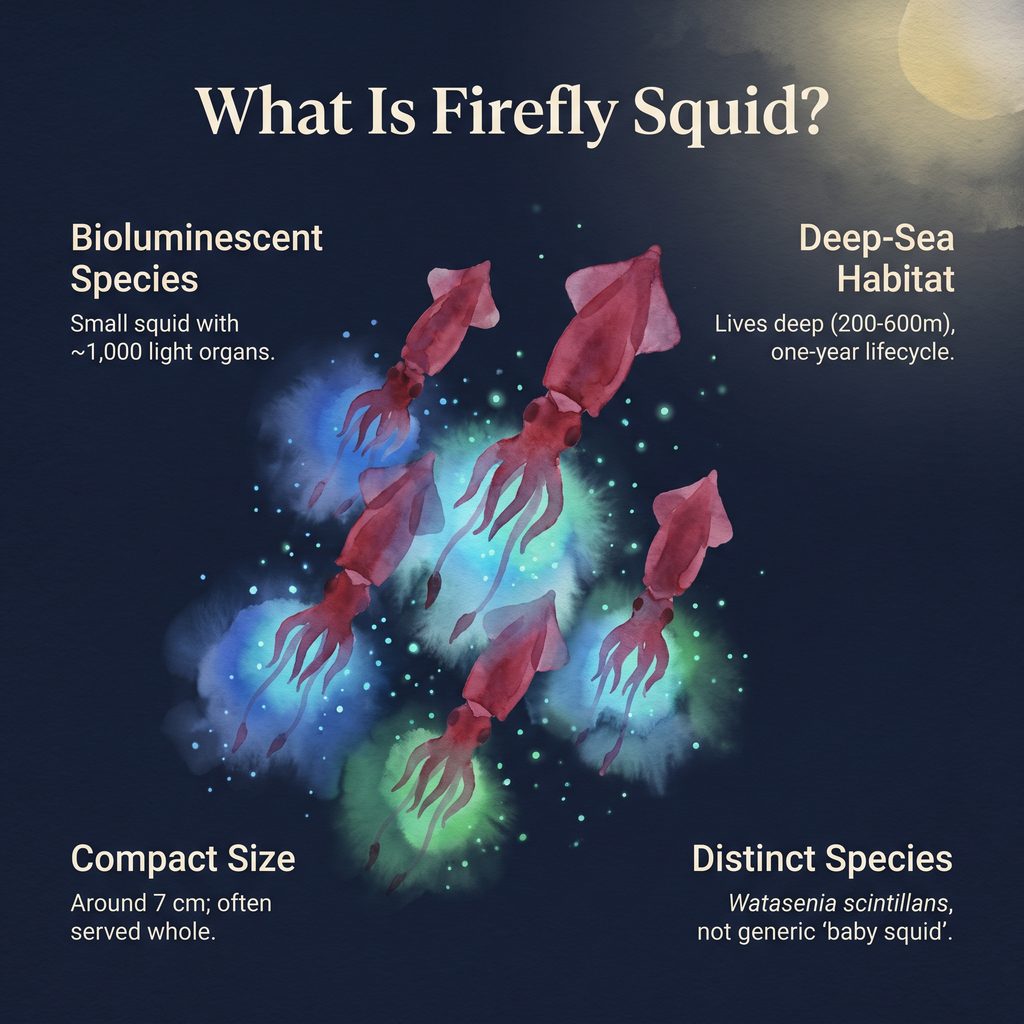
Firefly squid is a small squid species, Watasenia scintillans, that lives in the waters around Japan. Namerikawa City in Toyama describes it as a squid roughly 7 cm in mantle length and about 10 g in weight, living at depths of 200 to 600 meters and completing its life cycle in a single year. Its body carries around a thousand tiny light organs, and those organs are what gave the species its name.
Firefly Squid at a Glance
- Japanese name
- ホタルイカ / 蛍烏賊 (hotaru ika)
- Scientific name
- Watasenia scintillans
- Size
- Around 7 cm mantle length, roughly 10 g
- Habitat
- Depths of about 200 to 600 m; rises toward the coast to spawn
- Light organs
- About 1,000 photophores, brightest at the arm tips
- Fishing season
- Roughly March to June in Toyama, peaking from late March
- Classic dishes
- Kamaage (whole boiled), sumiso dressing, okizuke
- Flavor
- Concentrated umami, mild sweetness, rich from the viscera
- Raw consumption
- Only from product processed for raw use; see the safety section
- Allergens
- Squid (mollusc); marinated products may add soy and wheat
What Firefly Squid Is Called in Japanese
The Japanese name breaks into two words: hotaru means firefly, and ika means squid. Fishing communities in Toyama also used older local names such as koika and matsuika before the modern name spread. The scientific name honours the zoologist Shozaburo Watase, who studied the species in the early twentieth century.
English menus write the Japanese name inconsistently, so you may see hotaru ika, hotaru-ika or simply firefly squid. This article uses hotaru ika whenever it refers specifically to the Japanese name.
Size, Appearance and Habitat
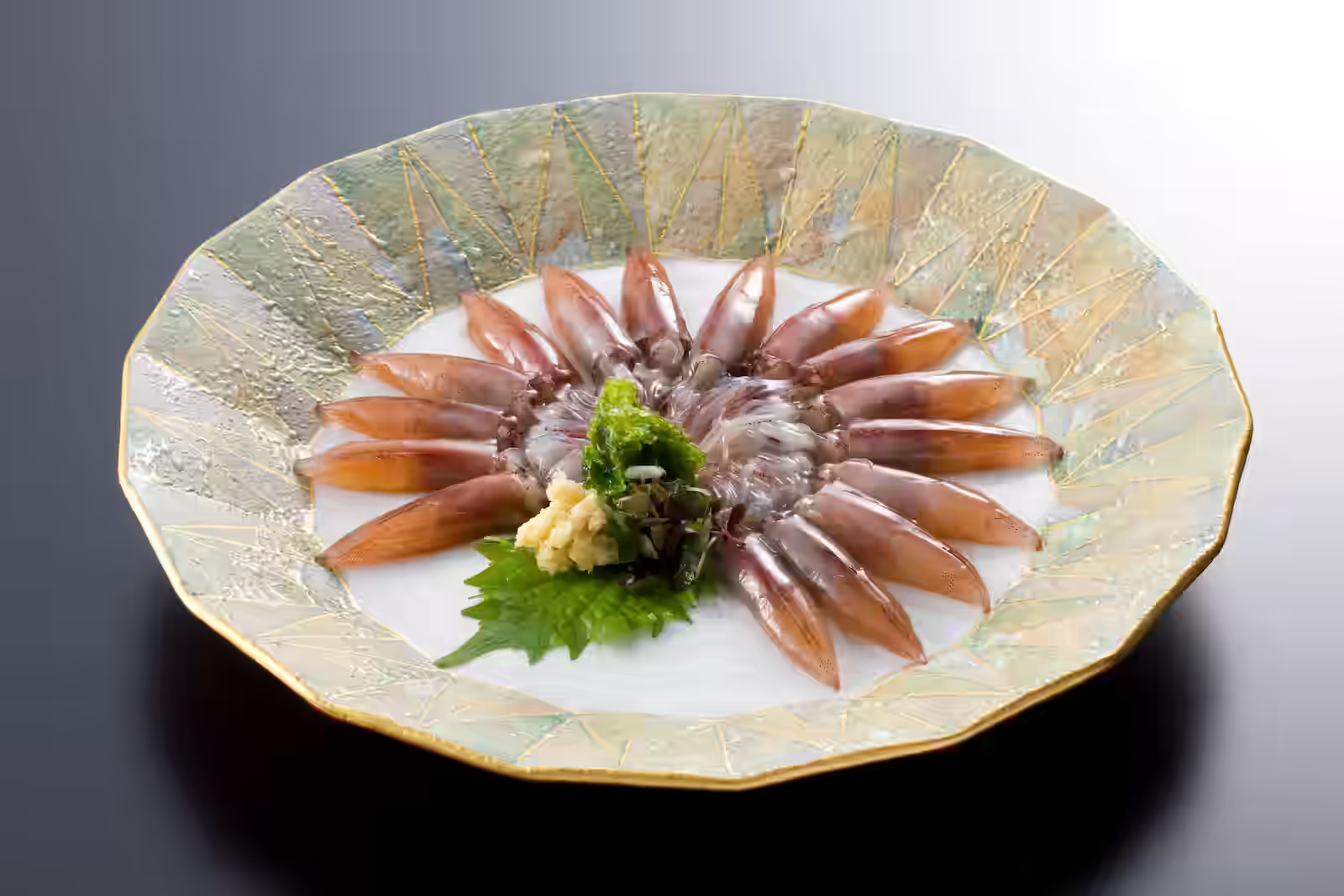
Firefly squid is far smaller than the squid you usually meet as sashimi or grilled seafood. It has a compact body, short arms and a reddish-brown to purplish color out of the water. Because it fits comfortably on a spoon, restaurants serve it whole rather than cut into pieces.
The photophores sit on several parts of the body. According to Toyama’s official food culture site and Namerikawa City, the arm-tip organs shine brightest, while roughly a thousand smaller skin photophores spread across the body and cluster on the underside. During the day the squid stays in deep water, and at night it rises toward the surface, which is exactly why spring fishing works the way it does.
Is Firefly Squid the Same as Baby Squid?
No. Firefly squid is a distinct species that stays small for its whole life, whereas “baby squid” is a loose English term for young or naturally small squid from several species. Menus abroad sometimes blur the two for convenience. If the species matters to you, look for hotaru ika or the scientific name on the label.
What Does Firefly Squid Taste Like?
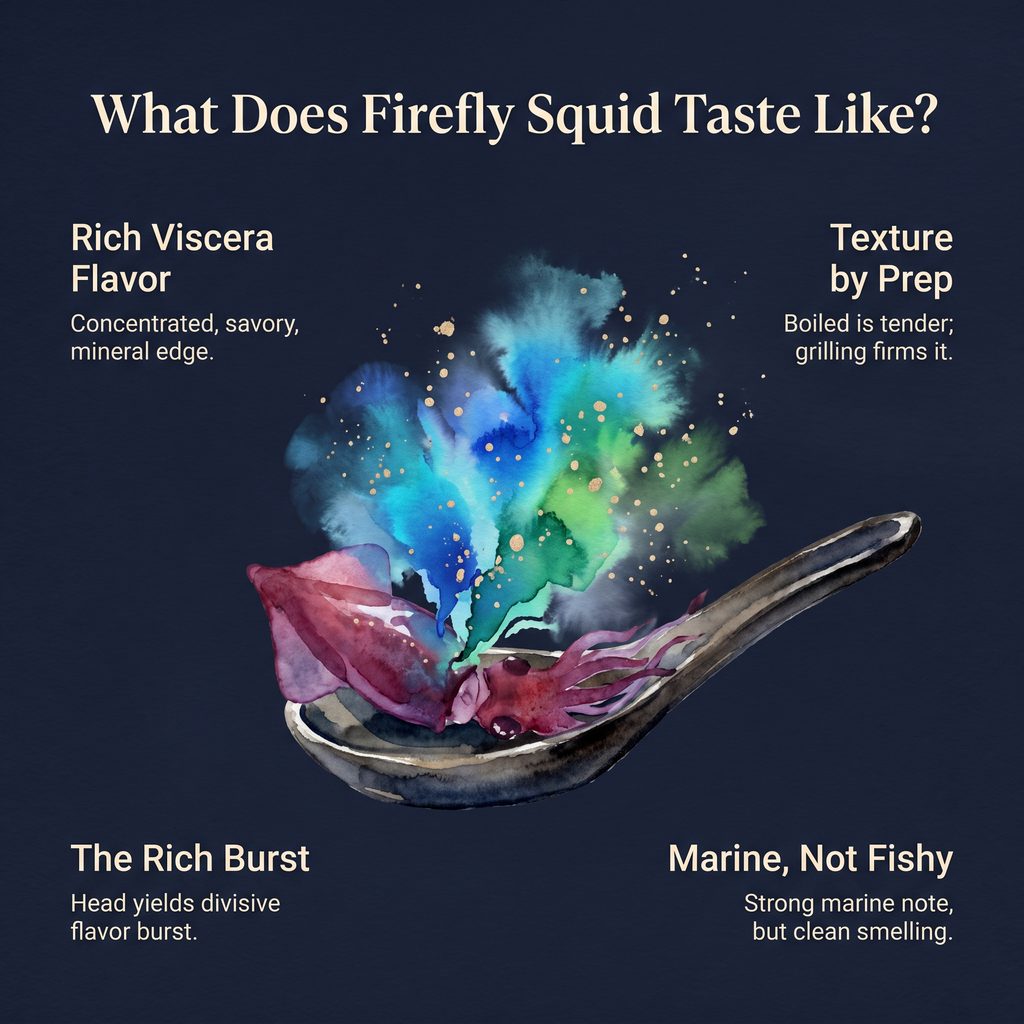
Firefly squid tastes far more concentrated than plain squid meat. Because you eat the whole animal, the viscera come with it, and they carry most of the flavor: deeply savory, faintly sweet, with a mineral edge that some people read as a gentle bitterness. I remember hesitating over my first one, and then reaching straight for a second.
Flavor and Texture
Texture depends almost entirely on preparation. Properly boiled hotaru ika stays tender with a light spring to it, grilling firms it up and adds a roasted aroma, and marinating softens the body while pushing the seasoning deep inside. The head yields a small burst of richness, which is the part that divides opinion most.
People who already enjoy squid, shellfish or strongly flavored seafood usually take to it immediately. Anyone who prefers very mild fish will notice the richness more sharply, so a first taste alongside vinegared miso makes a gentler introduction.
Does Firefly Squid Taste Fishy?
Fresh, well-handled firefly squid smells clean, although its marine flavor runs stronger than white fish. Some diners call that fishiness, yet the impression really depends on freshness, storage and cooking. A sharp or genuinely unpleasant odor is not a normal characteristic of the ingredient, so treat it as a warning sign rather than a quirk.
What Goes Well with Firefly Squid
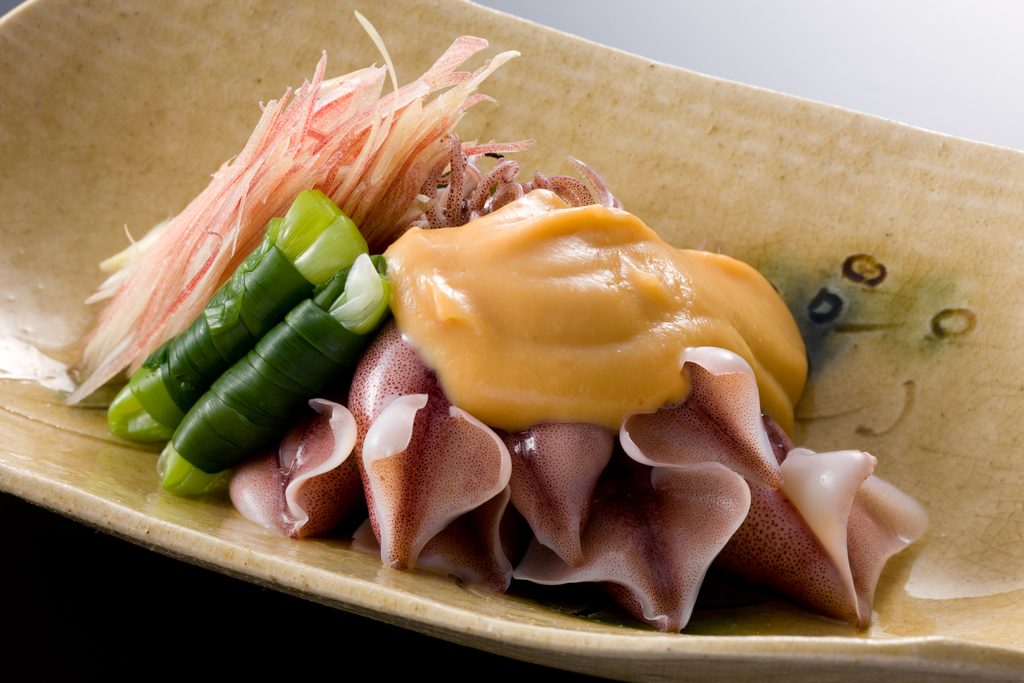
Acidity and aromatics do the heavy lifting here, since both cut through the richness of the viscera.
- Sumiso, a vinegared miso sauce, sometimes sharpened with mustard
- Ginger, green onion and shiso
- Soy sauce and citrus such as yuzu or sudachi
- Nanohana (rapeseed blossoms) and other spring greens
- Plain white rice, which absorbs the marinade beautifully
- Japanese sake, especially dry styles from the Hokuriku coast
When Is Firefly Squid Season in Japan?
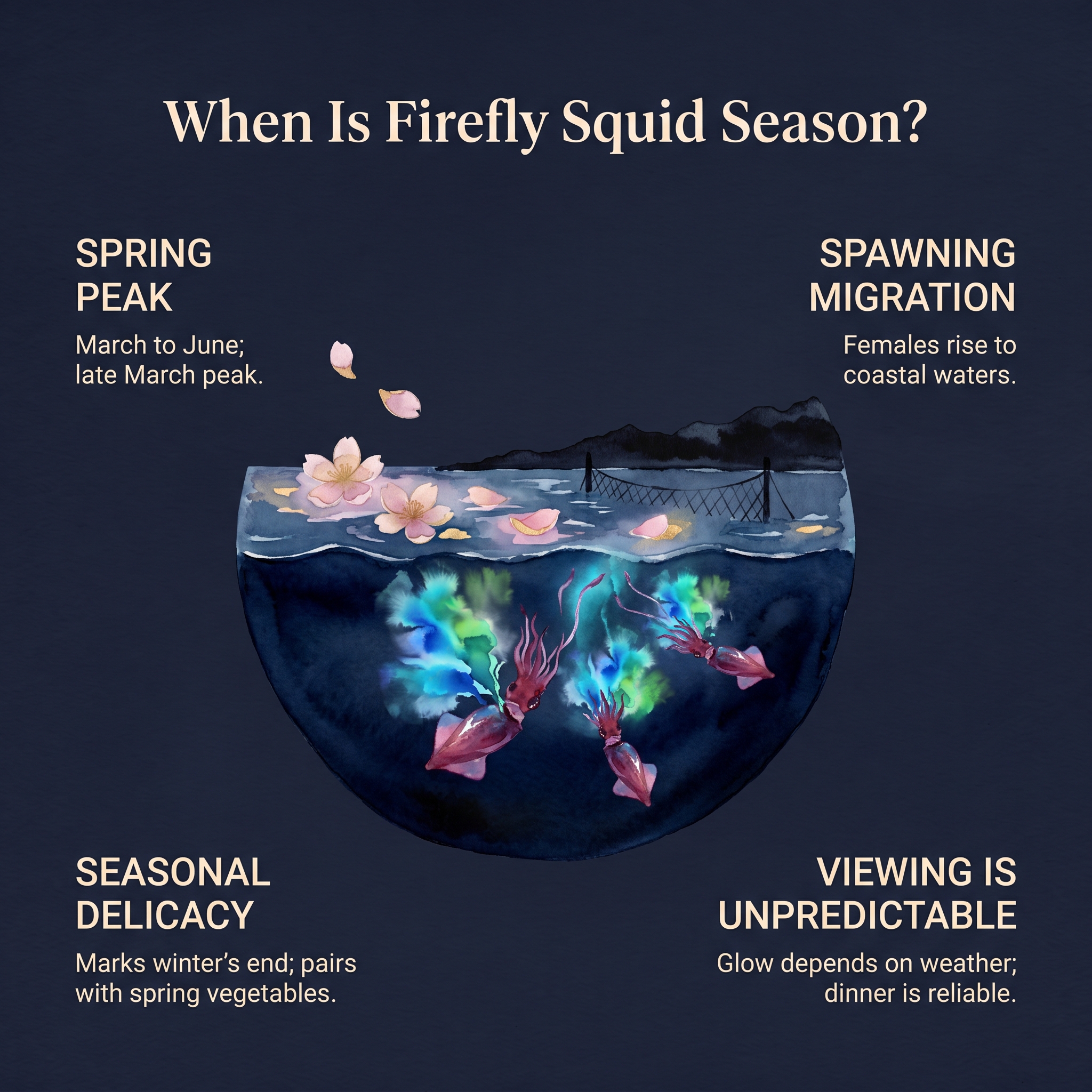
Spring is the season. Toyama Prefecture’s official food culture site gives a fishing period of roughly March to June, with the peak arriving in the month or so after late March. Namerikawa City describes the squid gathering in the bay from March through May to spawn.
The Fishing Season and Its Variation
Those dates describe a normal year rather than a guarantee. Weather, sea temperature, squid movement and the size of the catch all shift the picture, so availability in any given week can differ from the year before. Boiled, frozen, marinated and dried products stay on sale well beyond the fishing season, but fresh seasonal dishes cluster firmly in spring.
Why Firefly Squid Is a Spring Delicacy
The biology and the cooking line up neatly. Females rise toward coastal waters to spawn, which puts them within reach of the fixed nets, and that timing pushes hotaru ika onto menus exactly when spring vegetables appear. Japanese cooking prizes ingredients partly for the moment they represent, so seasonality is not just marketing here.
In Toyama, the first boiled squid at a seafood counter functions as a small announcement that winter has finished. Restaurants add seasonal dishes, shops fill with regional products, and the ingredient becomes briefly unavoidable.
Eating Season Versus Viewing Season
Eating hotaru ika and seeing it glow are two different plans. Bioluminescence viewing depends on squid movement, weather, sea conditions, moonlight and local safety restrictions, so neither a good catch nor a good display can be promised for a particular night. A spring trip may deliver both, though it may also deliver only dinner.
Anyone planning night-time observation should follow official local guidance and avoid entering unfamiliar coastal water without proper support. Conditions on a dark shoreline change quickly.
How Do Japanese People Eat Firefly Squid?
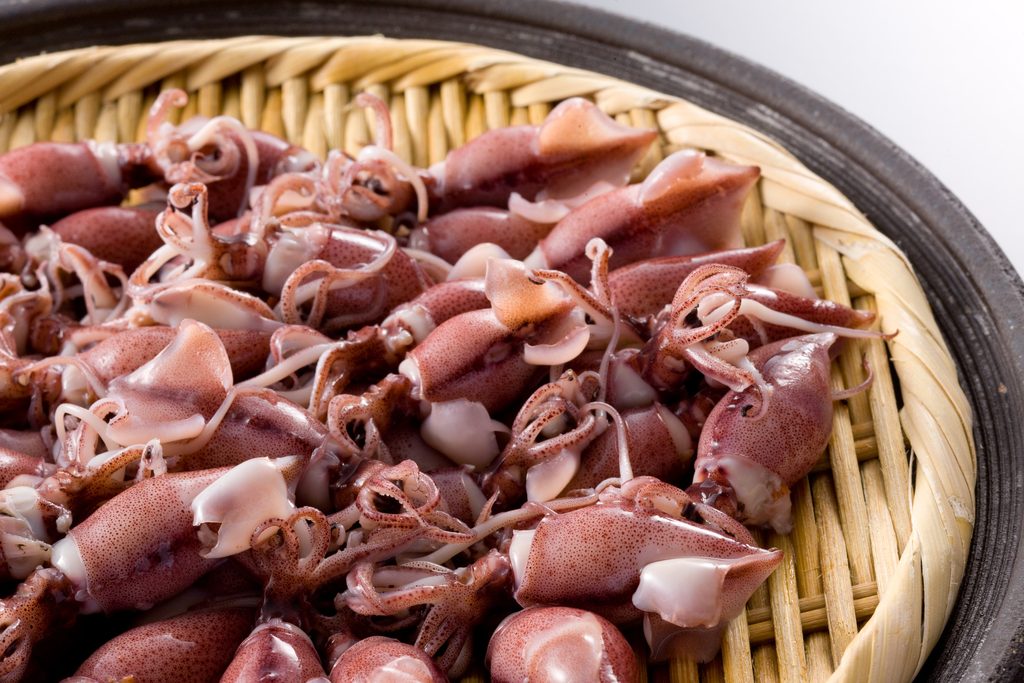
Japanese cooks lean on preparations that respect the squid’s size. Since the whole animal goes into the dish, even a small portion delivers a lot of flavor, so hotaru ika usually appears as a side dish, an appetizer or something to drink sake with rather than as a main course.
Kamaage: Whole Boiled Firefly Squid
Kamaage means boiling the squid whole in a large pot of water, and Toyama’s official food site calls it the oldest and most popular preparation. The method does two jobs at once: it firms the texture pleasantly and it satisfies the national cooking guidance for firefly squid, which is covered further down this page. Most boiled hotaru ika sold in Japan reaches shops already cooked this way.
Boiled Firefly Squid with Sumiso
Sumiso combines miso, vinegar and sugar into a sweet-tart dressing, and depending on the recipe it may include mustard as well. For that reason, “vinegared miso” describes the sauce more accurately than assuming every version contains mustard.
Cooks arrange the boiled squid in a small dish with a modest spoonful of sauce, often adding wakame, cucumber, green onion or seasonal vegetables. The acidity cuts the richness of the viscera cleanly, which makes this the easiest starting point for a first-time diner.
Hotaru Ika Okizuke
Okizuke is a marinated preparation built on a soy-based mixture that may also contain sake, mirin or other seasonings. The result tastes salty, savory and considerably more intense than boiled squid, with a softer texture.
Recipes differ sharply between producers, so sweetness, salt level and texture vary from jar to jar. Packaged okizuke also carries its own storage and consumption instructions, and those instructions deserve more trust than any general rule.
Grilled, Tempura and Dried
Grilling concentrates the umami and brings out a roasted aroma, and restaurants finish grilled hotaru ika with salt, citrus, soy sauce or a little mayonnaise. Dried and semi-dried products suit grilling especially well, and their concentrated flavor makes them a favorite drinking snack.
Tempura gives a crisp shell around a soft, rich center, usually served with salt or lemon. Not every tempura restaurant offers it, though, since it tends to appear as a spring special at places that feature Sea of Japan ingredients.
Pasta and Modern Japanese Cooking
Hotaru ika has moved well beyond traditional dishes. Chefs pair it with garlic, olive oil and chili, letting the squid season the sauce while spring vegetables add color. Common combinations include nanohana, spring cabbage, tomato, and butter with soy sauce.
These dishes sit closer to modern Japanese-Western cooking than to sumiso or okizuke. Even so, they keep the ingredient’s link to spring intact, which is presumably why they caught on.
Why Do Firefly Squid Glow?
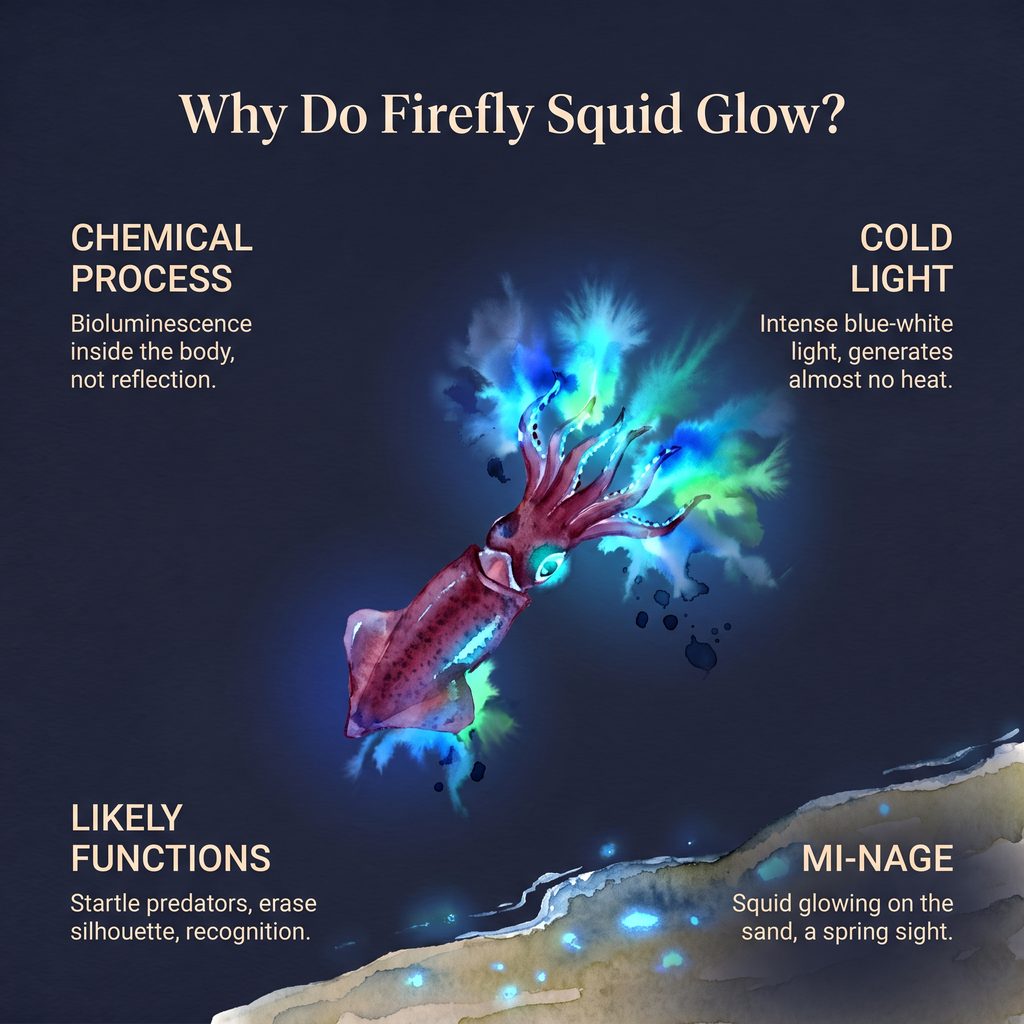
Firefly squid produces its own light through bioluminescence, a chemical process inside the body rather than a reflection of anything external. The light is cold light, so it generates almost no heat. Blue travels well through seawater, which is why the glow reads as an intense blue-white in dark conditions.
How the Bioluminescence Works
The light organs fall into three groups: arm photophores, eye photophores and skin photophores. Arm-tip organs produce the brightest light, while the roughly one thousand skin photophores spread across the body with a concentration on the underside. Stimulation triggers the display, which is why a net full of squid lights up as it breaks the surface.
What the Light May Be For
Toyama Prefecture and Namerikawa City both describe several likely functions rather than one. The commonly cited possibilities include startling or dazzling predators, erasing the squid’s silhouette against faint light from above, and helping individuals recognize each other.
Not every proposed function rests on the same weight of evidence. It is therefore fairer to say the light may serve several purposes than to claim a single explanation settles the matter.
Mi-nage: The Squid That Come Ashore
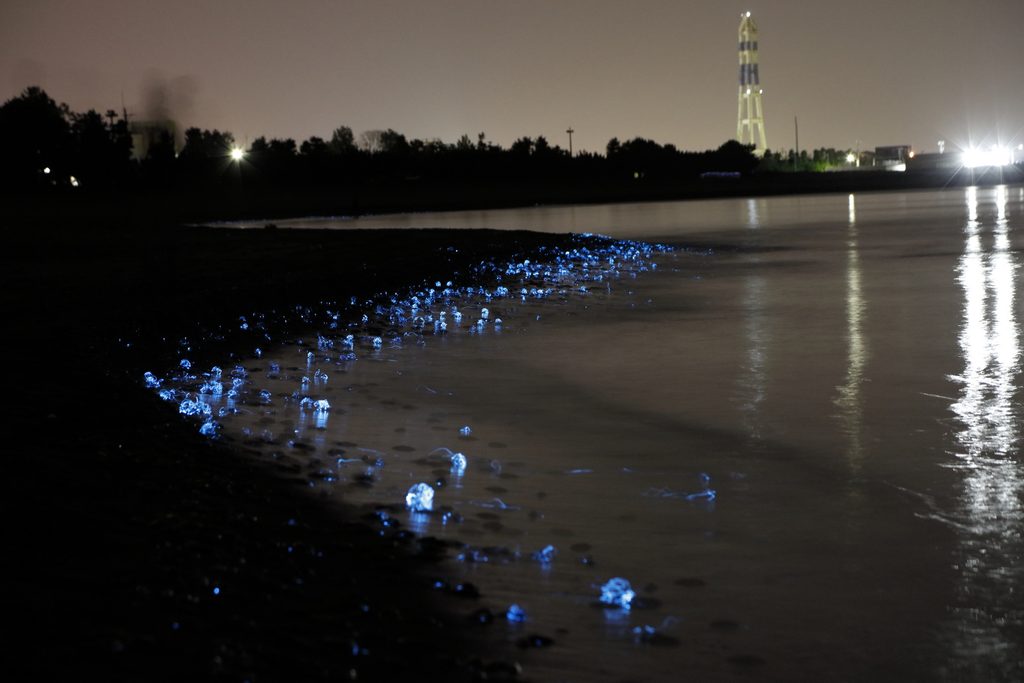
Locals call it mi-nage, literally “throwing themselves in”, when firefly squid wash up along the water’s edge and glow on the sand. Toyama’s cultural heritage records describe this as one of the prefecture’s defining spring sights. The display depends heavily on conditions, so nobody can promise it on a given night.
Why Is Toyama Bay Famous for Firefly Squid?
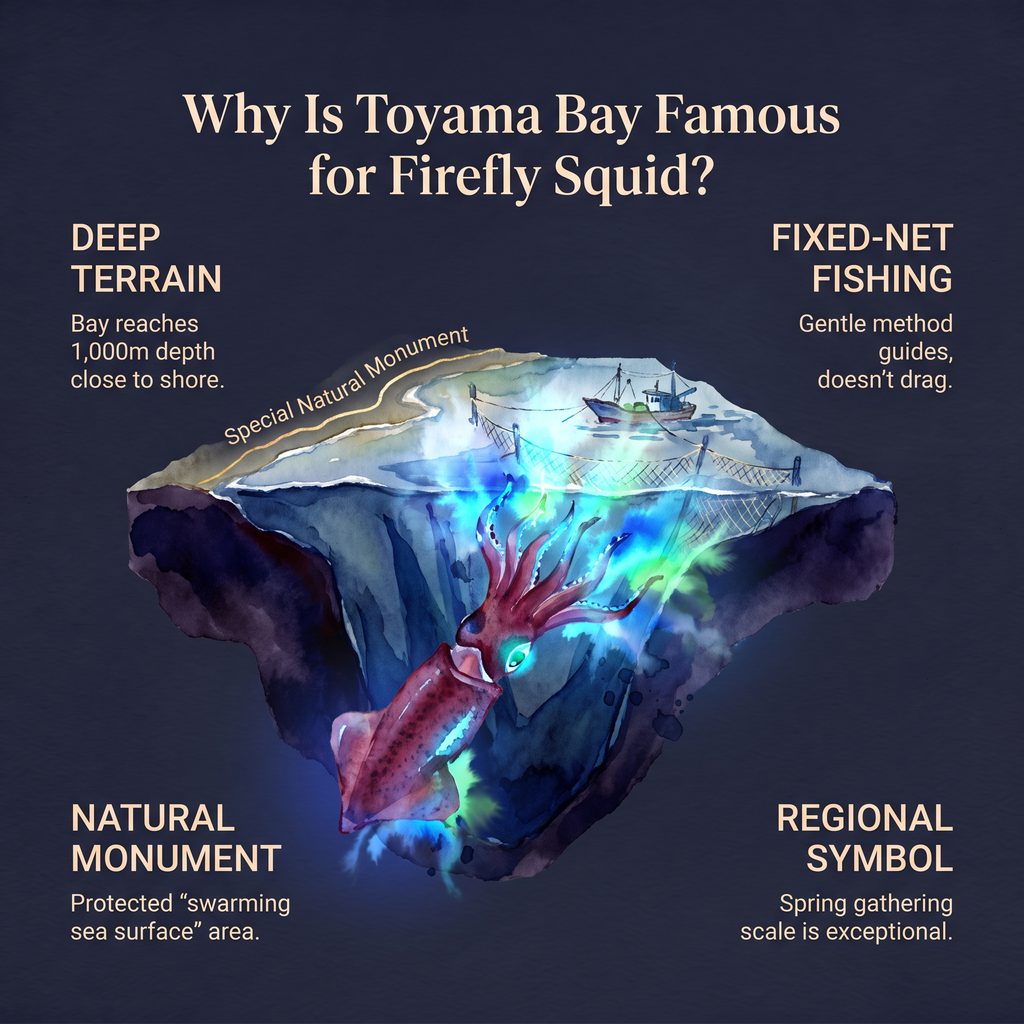
Toyama Bay combines unusual underwater terrain, a spring fishery and a genuinely spectacular natural display. That combination has made hotaru ika a regional symbol, and it appears throughout Toyama’s restaurants, markets, souvenir shops and tourism material.
Toyama Bay and Its Underwater Terrain
The bay reaches depths beyond 1,000 meters, and it does so remarkably close to shore. Toyama’s official food site attributes the concentration of firefly squid to this terrain, particularly the submarine valleys known locally as aigame. Deep water sits within easy reach of the coast, so a species that normally lives far below the surface ends up nearby.
Fixed-Net Fishing in Toyama
Toyama’s firefly squid fishery uses fixed nets (teichiami) that guide the spawning females in rather than dragging the seabed. Namerikawa City operates eleven fixed-net setups within about three kilometers of its port and describes the method as gentle on the resource. Boats also use deep sea water to keep the catch in good condition on the way back to the market.
Catch volumes still vary year to year with weather, water conditions and squid movement. Phrases like “always abundant” therefore overstate matters, and current fishery information gives a truer picture each season.
A Special Natural Monument
Japan protects the sea area itself. The stretch of coast running roughly fifteen kilometers from Toyama City to Uozu, extending about 1.3 kilometers offshore, carries the designation Hotaruika Gunyu Kaimen, or “firefly squid swarming sea surface”. Authorities first designated it a natural monument in 1922 and raised it to special natural monument status in 1952. Very few food-related sites in Japan hold that rank.
Is Firefly Squid Only Found in Toyama?
No. The species occurs across a much wider area of Japanese waters, and other regions catch and distribute it too. What makes Toyama Bay exceptional is the scale of the spring gathering, which Namerikawa City notes has few parallels anywhere. Describe hotaru ika as a specialty strongly associated with Toyama, then, rather than a squid unique to it.
Can You Eat Firefly Squid Raw?
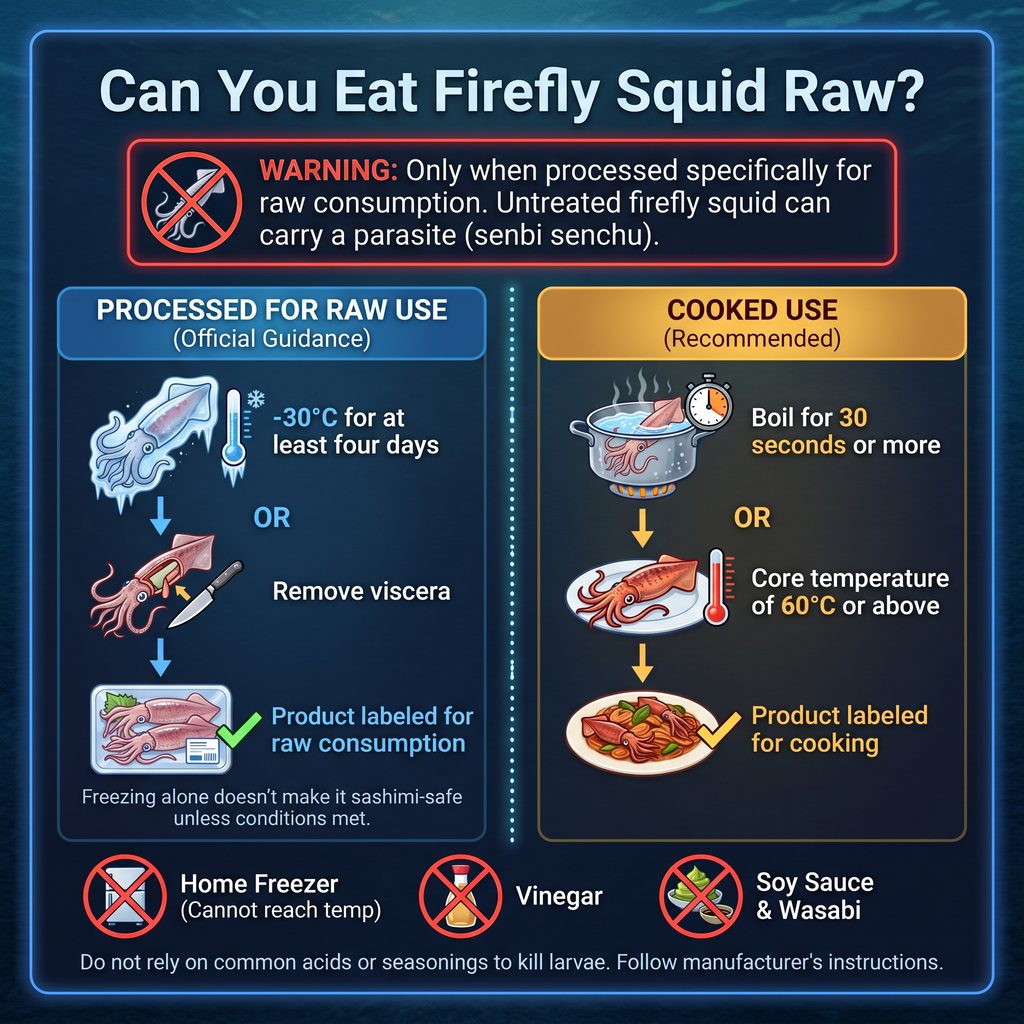
Only when the product has been processed specifically for raw consumption. This is not a matter of freshness or personal judgement, because untreated firefly squid can carry a parasite that causes serious illness, and Japan’s health ministry has issued formal guidance on exactly how to handle it.
Food safety warning
Never eat untreated firefly squid raw. Some individuals carry larvae of a nematode known in Japan as senbi senchu, which can cause creeping eruption or intestinal obstruction in humans. Buy only products labeled and processed for raw consumption, or cook the squid thoroughly. Follow the instructions from the seller, the manufacturer and your national food safety authority.
What Japan’s Food Safety Notice Says
The Ministry of Health, Labour and Welfare issued a notice on firefly squid intended for raw consumption in June 2000, and it remains the reference point for Japanese businesses. The notice sets out the following conditions.
- For raw consumption: freeze at −30°C for at least four days, or under conditions of equivalent effect (the notice gives −35°C core temperature for 15 hours or more, and −40°C for 40 minutes or more), and label the product accordingly. Alternatively, remove the viscera, or state on the label that viscera removal is necessary.
- For everything else: heat the squid, either by holding it in boiling water for 30 seconds or more, or by reaching a core temperature of 60°C or above.
Toyama City repeats the same guidance for residents and adds that fresh raw firefly squid circulates mainly from March to June. The Aichi Prefectural Institute of Public Health, summarising the same notice, reports infection rates in firefly squid of roughly 2 to 7 percent, and notes that the larvae are only about 10 mm long and 0.1 mm wide, which makes them very hard to spot.
Why Vinegar, Soy Sauce and a Home Freezer Do Not Help
Aichi’s public health institute states plainly that ordinary cooking acids and seasonings, including vinegar, soy sauce and wasabi, do not kill the larvae. Japan’s Food Safety Commission adds that a domestic refrigerator freezer cannot reach the conditions the notice requires. So if you obtain untreated raw firefly squid, cooking is the only realistic option at home.
Freezing alone also does not make a product suitable for sashimi unless the required conditions have actually been met and verified. A package labeled for cooking should never be treated as raw-use product.
Cooking Firefly Squid at Home
Check the packaging before anything else, since Japanese labels state clearly whether a product is for raw or cooked use. Then work through the basics.
- Confirm whether the squid has already been boiled
- Note the storage temperature, the use-by date and the recommended defrosting method
- Follow the manufacturer’s heating instructions rather than a generic cooking time
- Keep raw seafood and ready-to-eat foods on separate boards and utensils
- Avoid leaving seafood at room temperature for long periods
Many cooks also remove the eyes, beak and internal cartilage before serving, which noticeably improves the texture. Readers who are pregnant, immunocompromised or otherwise at higher risk from foodborne illness should follow medical and official food safety guidance rather than a food article.
Is Firefly Squid Healthy?
Firefly squid supplies protein and a striking amount of certain micronutrients, largely because you eat the viscera along with the flesh. The figures below come from Japan’s Standard Tables of Food Composition, maintained by the Ministry of Education, Culture, Sports, Science and Technology.
| Per 100 g edible portion | Raw | Boiled |
|---|---|---|
| Energy | 74 kcal | 91 kcal |
| Protein | 11.8 g | 17.7 g |
| Fat | 3.5 g | 2.9 g |
| Cholesterol | 240 mg | 380 mg |
| Vitamin A (retinol activity eq.) | 1,500 µg | 1,900 µg |
| Vitamin B12 | 14.0 µg | 14.0 µg |
| Vitamin E (α-tocopherol) | 4.3 mg | 4.5 mg |
| Copper | 3.42 mg | 2.97 mg |
| Iron | 0.8 mg | 1.1 mg |
| Salt equivalent | 0.7 g | 0.6 g |
Reading Those Numbers
Two entries stand out. Vitamin A and vitamin B12 both sit far above the levels in ordinary squid meat, and copper does too, which reflects the viscera rather than the flesh. Cholesterol runs high for the same reason.
A single serving is small, though, so these per-100 g figures overstate what one appetizer delivers. Treat firefly squid as a nutrient-dense seasonal seafood within a varied diet rather than as a health product, and remember that “superfood” is a marketing term rather than a scientific one.
Salt in Prepared Products
Fresh, boiled and marinated firefly squid are not nutritionally interchangeable. Okizuke and similar soy-seasoned products can contain considerably more sodium than the table above suggests, and sumiso adds sugar and salt of its own. Anyone watching sodium intake should read the nutrition panel on the specific product and keep the portion modest.
Allergies and Dietary Considerations
People with squid or mollusc allergies should avoid firefly squid unless a doctor has advised otherwise. Prepared products may additionally contain soy, wheat, miso, alcohol-derived seasonings or other seafood ingredients. Check allergen labels carefully on marinades and packaged sauces, since those are where the extra ingredients hide.
Where to Eat and Buy Firefly Squid
Toyama is the obvious destination, particularly in spring, but hotaru ika travels further than many people expect.
In Toyama
Look for it in Toyama City and Namerikawa, at coastal seafood markets, local izakaya, sushi restaurants, hotel dining rooms and station food shops. Namerikawa also runs the Hotaruika Museum, which displays living firefly squid glowing in a darkened room during the season and keeps exhibits on the bay’s deep-sea life year-round.
Menus follow the catch, so a restaurant that served fresh hotaru ika last year may not offer it on the same date this year. Check the venue’s official information before making a special trip.
Outside Toyama
Seafood izakaya, regional cuisine restaurants, department store food halls, well-stocked supermarkets and Japanese specialty shops all carry hotaru ika during spring. Frozen, boiled and marinated products travel much better than freshly landed squid, so those are what you will usually find away from the production areas.
Buying, Storing and Defrosting
Firefly squid sells fresh, boiled, frozen, marinated and dried, and each form suits different dishes. Before buying, check the place of origin, the product type, the raw-use or cooking-use designation, the storage temperature, the date, the defrosting and heating instructions, the allergen information and the condition of the package itself. Skip anything in damaged, leaking or poorly chilled packaging.
Storage instructions on the package always take priority. Keep frozen products frozen until the recommended defrosting stage, then handle them promptly according to the producer’s guidance. Do not assume that every product can be refrozen, and if something smells wrong or shows signs of poor temperature control, throw it away rather than tasting it to check.
Tasting note
We tasted [product name] from [producer or restaurant] in [place], in [month and year]. We tried it as kamaage on its own, with sumiso, and as okizuke for comparison. Flavor and texture vary with the catch, the handling and the preparation, so your own bowl may sit differently.
Firefly Squid and Toyama’s Food Culture
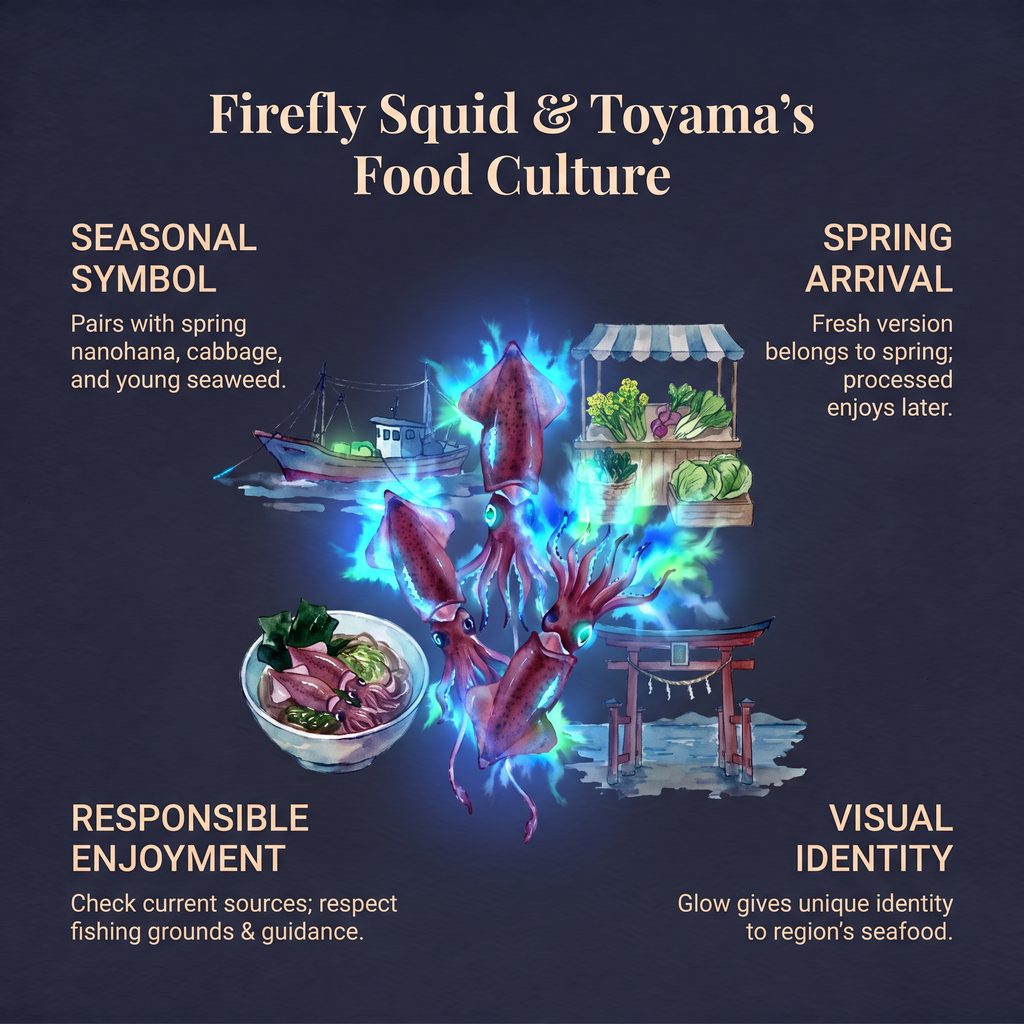
Few ingredients connect a place to its sea as directly as this one. The spring arrival of hotaru ika ties together fishing, restaurant menus, home cooking, tourism and a protected stretch of coastline, and the glow gives all of it a visual identity that other local foods simply do not have.
A Seasonal Symbol
Alongside white shrimp and yellowtail, firefly squid is one of the three seafoods Toyama introduces first. Seasonal menus pair it with nanohana, spring cabbage and young seaweed, which reinforces the association with a particular few weeks of the year. Processed products remain enjoyable at other times, of course, but the fresh version belongs to spring.
Enjoying It Responsibly
Fishing conditions and stock assessments change over time, so claims about sustainability need current sources rather than assumptions. When it matters to you, check recent information from fisheries agencies or recognized certification schemes, note the production area on the label, and respect local guidance about fishing grounds, wildlife observation and coastal access.
Final Thoughts
Firefly squid earns its reputation twice over. As food it delivers concentrated umami in a very small package, and Japan eats it boiled with sumiso, marinated as okizuke, grilled, fried or folded through pasta. As a natural phenomenon it lights up a protected stretch of Toyama Bay every spring, which is a rare thing for an ingredient you can also buy at a supermarket.
If you plan to try it, the two things worth checking are the season and the label. Confirm current local information before traveling, and confirm whether the product in your hand is intended for raw or cooked use. Get those right, and the rest is simply a very good spring dish.
Frequently Asked Questions About Firefly Squid
What is firefly squid called in Japanese?
Japanese speakers call it hotaru ika, written ホタルイカ or 蛍烏賊. Hotaru means firefly and ika means squid, so the name points straight at the animal’s light. Its scientific name is Watasenia scintillans.
What does firefly squid taste like?
It tastes concentrated and savory, with mild sweetness and a rich, slightly mineral quality from the viscera. Boiling keeps it tender with a light spring, while grilling firms it up and adds a roasted aroma. Most people find it stronger than ordinary squid meat.
When is firefly squid season in Japan?
Spring. Toyama’s official food site puts the fishing period at roughly March to June, with the peak arriving after late March. Weather, sea conditions and the catch shift those dates each year, so check current local information before traveling.
Why do firefly squid glow?
Light organs called photophores generate blue light chemically inside the body. Toyama’s official sources describe several likely purposes, including startling predators, hiding the squid’s silhouette and helping individuals recognize each other. Researchers have not settled on a single explanation, so treat any one-line answer with caution.
Can you eat firefly squid whole?
Yes, and Japan usually serves it that way in boiled, grilled and marinated dishes. Many cooks still remove the eyes, beak and cartilage first, which improves the texture. Buy a product intended for your chosen cooking method and follow the producer’s instructions.
Can firefly squid be eaten raw?
Only when a business has processed it specifically for raw consumption. Untreated firefly squid may carry parasite larvae, and Japan’s health ministry sets out required freezing or viscera-removal conditions for raw-use product. Never eat untreated raw firefly squid on the assumption that freshness makes it safe.
Is firefly squid only found in Toyama?
No. The species ranges much more widely in Japanese waters, and other regions catch and distribute it too. Toyama Bay stands out because of the scale of its spring gathering, its fixed-net fishery and the coastal bioluminescence, which together made hotaru ika a regional emblem.
Where can you eat firefly squid in Japan?
Toyama City and Namerikawa offer the widest choice during spring, from seafood markets to izakaya and hotel restaurants. Elsewhere in Japan, look at seafood-focused izakaya, department store food halls and seasonal regional fairs. Availability follows the catch, so confirm before you make a special trip.
References
- Namerikawa City, Firefly Squid and Deep Sea Water, https://www.city.namerikawa.toyama.jp/soshiki/13/2/5329.html (Surveyed: August 2026)
- Toyama Prefecture, Ecchu Toyama Shoku no Okoku (official food culture site), Firefly Squid, https://shoku-toyama.jp/product/10271/ (Surveyed: August 2026)
- Toyama Cultural Heritage Portal, Hotaruika Gunyu Kaimen (Firefly Squid Swarming Sea Surface), https://toyama-bunkaisan.jp/search/2177/ (Surveyed: August 2026)
- Ministry of Health, Labour and Welfare, Handling of Firefly Squid Intended for Raw Consumption (Notice, 21 June 2000), https://www.mhlw.go.jp/web/t_doc?dataId=00tb2665&dataType=1&pageNo=1 (Surveyed: August 2026)
- Toyama City, Spirurina Larvae in Firefly Squid, https://www.city.toyama.lg.jp/kurashi/seikatsu/1010297/1010300/1010301/1004208.html (Surveyed: August 2026)
- Aichi Prefectural Institute of Public Health, Spirurina Larva Migrans, https://www.pref.aichi.jp/eiseiken/5f/senbisentyu.html (Surveyed: August 2026)
- Ministry of Education, Culture, Sports, Science and Technology, Food Composition Database — firefly squid, raw (food no. 10348), https://fooddb.mext.go.jp/details/details.pl?ITEM_NO=10_10348_7 (Surveyed: August 2026)
- Standard Tables of Food Composition in Japan (MEXT), firefly squid, boiled (food no. 10349), https://fooddb.mext.go.jp/details/details.pl?ITEM_NO=10_10349_7 (Surveyed: August 2026)
Image Credits
- Photographs of firefly squid and Toyama Bay: ©公益社団法人とやま観光推進機構 (Toyama Tourism Organization), https://www.info-toyama.com/ (Surveyed: August 2026)
- Photo library and usage terms: Toyama Tourism Organization Photo Library, https://www.info-toyama.com/business/images (Surveyed: August 2026)
Related Articles
- Toyama Cuisine: Local Dishes and Regional Seafood (Surveyed: August 2026)
- Japanese Seasonal Seafood Guide (Surveyed: August 2026)
- Japanese Squid Varieties (Surveyed: August 2026)
- What Is Sumiso? Japanese Vinegared Miso Sauce (Surveyed: August 2026)
- Hotaru Ika Okizuke: A Toyama Seafood Specialty (Surveyed: August 2026)
- Japanese Spring Foods (Surveyed: August 2026)
- Toyama Bay Seafood (Surveyed: August 2026)
- White Shrimp from Toyama (Surveyed: August 2026)
- Regional Cuisine of Hokuriku (Surveyed: August 2026)




Comments