




Slice a piece of karasumi paper-thin, put it on your tongue, and wait a second. The salt hits first. Then something richer arrives, closer to aged cheese than to fish, and it lingers well after the piece has gone.
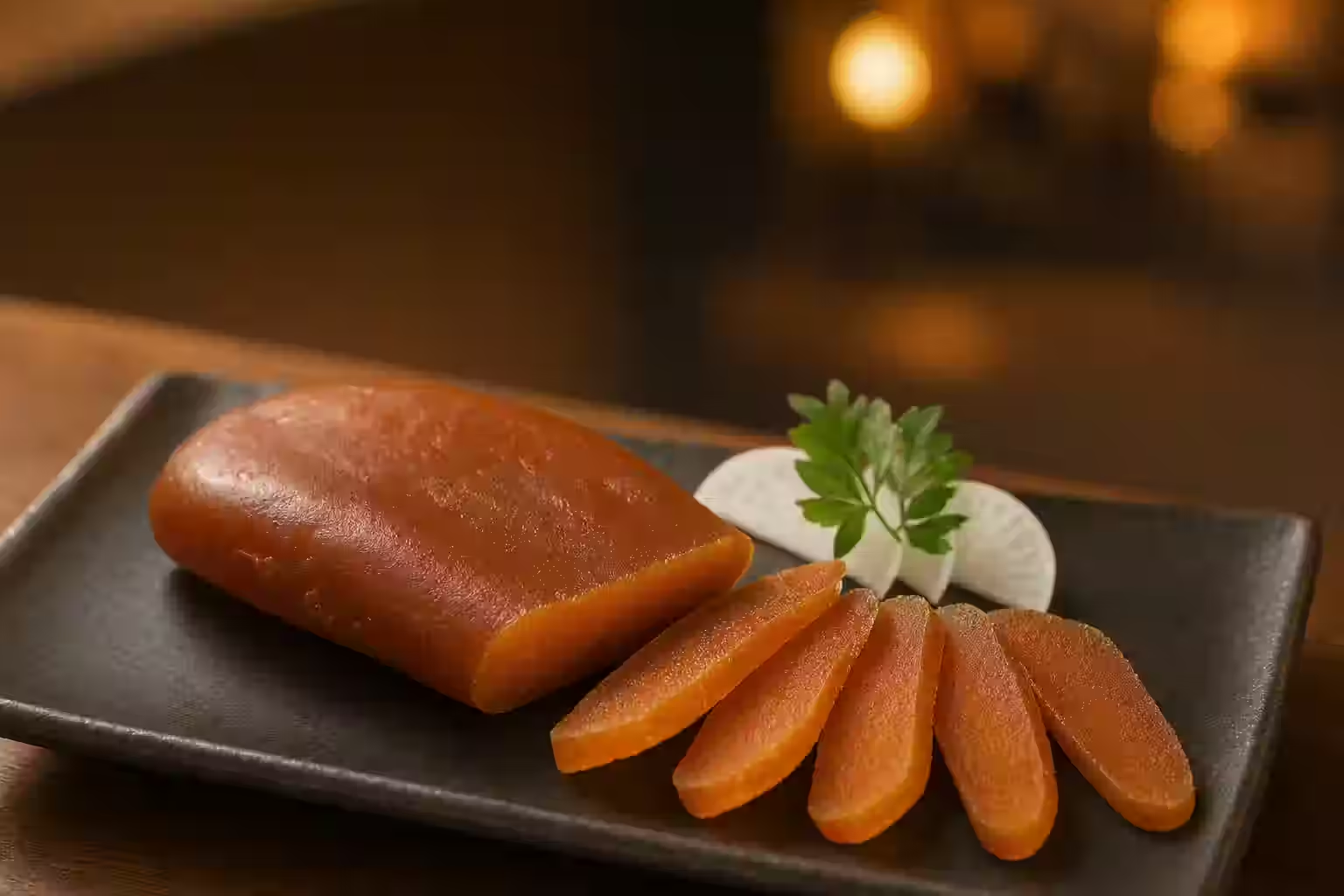
Karasumi (からすみ) is dried, salted mullet roe, often described in English as Japanese bottarga. Producers cure whole roe sacs of grey mullet in salt, then sun-dry them for several weeks until they turn amber and firm. Nagasaki is the most famous source, and karasumi counts as one of Japan’s three great delicacies. Most people eat it sliced thin with sake, or grated over rice and pasta.
The name itself is a small puzzle. Written 唐墨, it means “Chinese ink stick,” and the accepted explanation is simply that the dried slab looked like one. Before refrigeration the surface darkened over time, which made the resemblance stronger still.
This guide covers what karasumi is, how producers make it, what it actually tastes like, and how to eat it without wasting an expensive ingredient. We also compare it with Italian bottarga, since the two are closely related yet not identical.
What Is Karasumi?
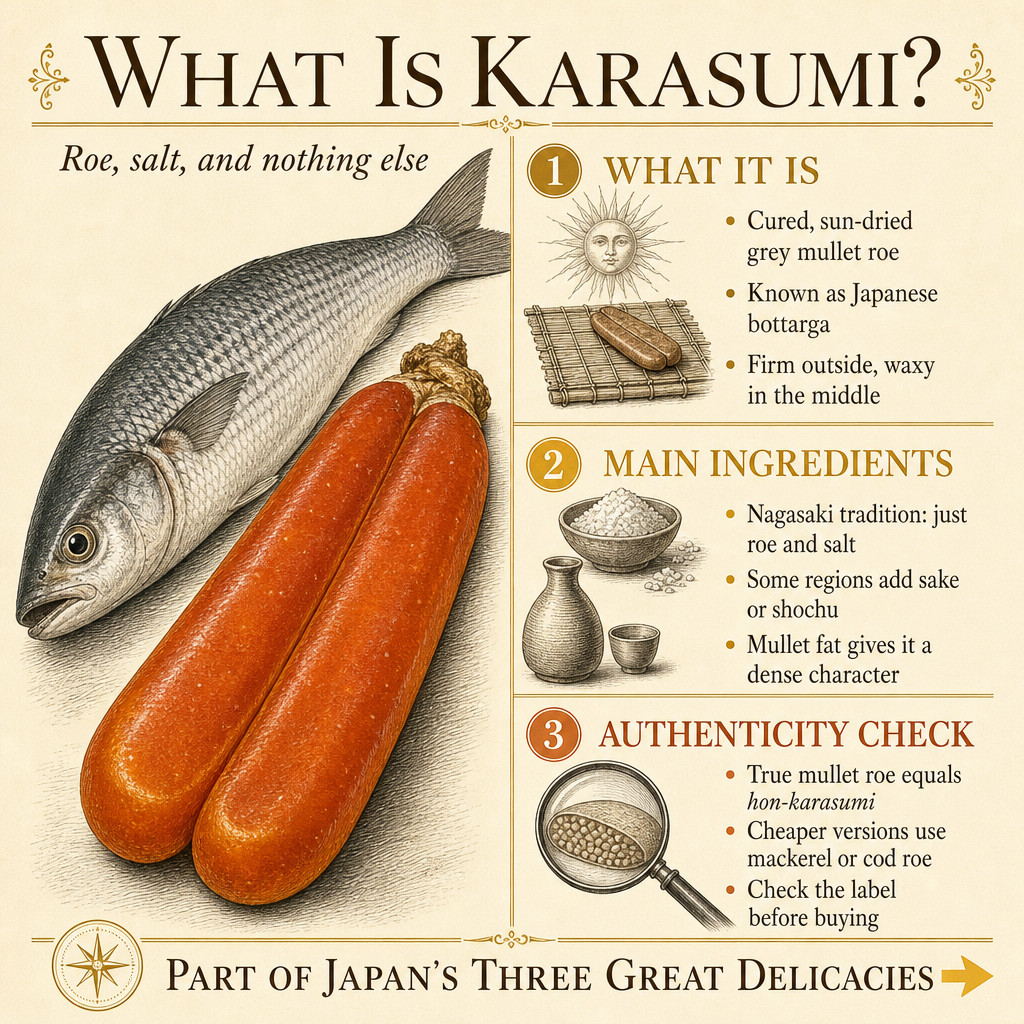
Karasumi is a preserved food made from the ovaries of grey mullet, cured with salt and dried in the sun. English menus and shops often label it Japanese bottarga, which is a fair shorthand. The finished piece looks like a flattened amber slab, firm on the outside and slightly waxy in the middle.
Main Ingredients
The ingredient list is refreshingly short. Traditional Nagasaki producers use mullet roe and salt, nothing else. Some makers elsewhere add sake or shochu during curing, though the Nagasaki houses tend to avoid it.
Grey mullet, called bora in Japanese, is the classic fish. Its roe carries more fat than most, which is precisely why it works. That fat is what gives the finished karasumi its dense, almost cheese-like character rather than a dry, crumbly one.
Because mullet roe is scarce and expensive, cheaper versions exist. Producers in Kagawa and elsewhere use Spanish mackerel or cod roe instead. Roe from actual mullet earns the label hon-karasumi (本からすみ), meaning “true karasumi,” so that word is worth checking before you buy.
One more thing shapes how Japan sees this ingredient: its place among the country’s three great delicacies. That deserves a section of its own, which follows next.
Karasumi and Japan’s Three Great Delicacies
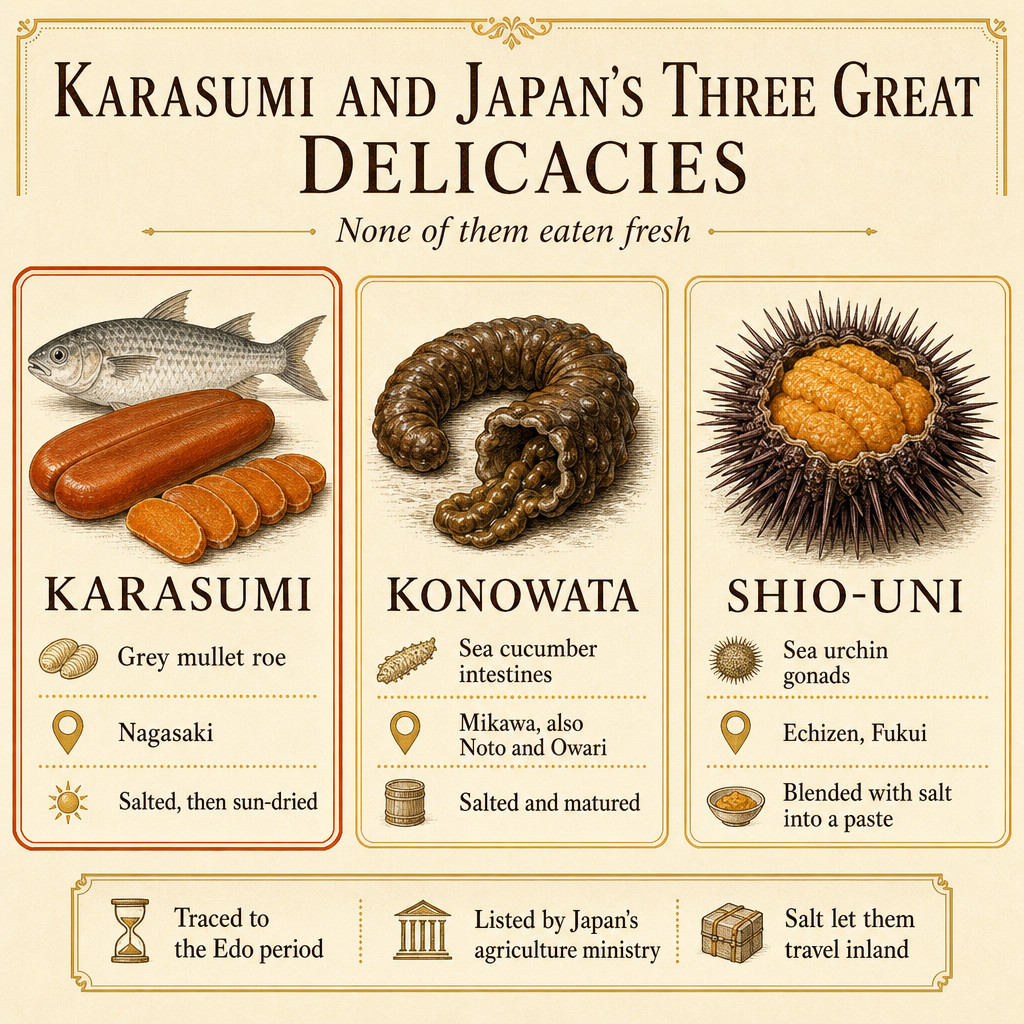
Japan recognises a traditional trio of prized foods, called nihon sandai chinmi (日本三大珍味). Karasumi holds one of the three places, which explains much about its price and its status.
The Three, and Where They Come From
Japan’s Ministry of Agriculture, Forestry and Fisheries lists the trio and traces the grouping to the Edo period. Each item is a preserved product rather than a fresh one, which is the thread connecting them.
| Delicacy | Made from | Classic region | Method |
|---|---|---|---|
| Karasumi | Grey mullet roe | Nagasaki | Salted, then sun-dried |
| Konowata | Sea cucumber intestines | Mikawa, also Noto and Owari | Salted and matured |
| Shio-uni | Sea urchin gonads | Echizen, in Fukui | Blended with salt into a paste |
Notice the pattern. None of the three is eaten fresh, and all three concentrate a small, seasonal ingredient through salt. Before refrigeration that was the only way to move such foods inland, and the concentration happens to taste extraordinary.
Why the Grouping Still Matters
Each of the three travelled to the shogunate or the imperial court as tribute. That history left them with a formal, ceremonial character that persists today.
You therefore meet karasumi at New Year, in tea kaiseki, and at celebration meals rather than at an ordinary dinner. The trio is not a fixed legal category either, and some writers argue for kuchiko, dried sea cucumber ovaries, in place of sea urchin.
Comparisons with the European trio of caviar, foie gras and truffle come up often. The logic differs, though. Japan’s three grew out of preservation technique rather than pure rarity, which is a small but telling distinction.
The History and Origin of Karasumi
Dried roe is an old idea, and Japan came to it comparatively late. The same ministry traces earlier production to Greece, Turkey and Egypt, where salting and sun-drying solved the problem of keeping food without cold storage.
Arrival Through Nagasaki
The technique reached Japan from China through Nagasaki, the port that handled foreign trade while the rest of the country stayed closed. Japan’s Ministry of Agriculture, Forestry and Fisheries gives 1652 as the transmission year, though other accounts place the arrival somewhat earlier, in the late sixteenth century.
The Chinese original apparently used Spanish mackerel roe. Japanese producers switched to grey mullet, which was landed in quantity around the Nomozaki peninsula south of Nagasaki. That substitution is what made karasumi a Japanese product rather than an import.
Local accounts credit a fishmonger named Takano Yusuke with developing the Nagasaki style, with his shop dating its founding to 1675. Nomozaki karasumi later went to the Tokugawa shogunate as tribute, and Nagasaki magistrates reportedly struggled to secure enough of it.
Why the Stories Vary
Several origin tales circulate, and not all of them agree. One popular version has Toyotomi Hideyoshi asking what the strange food was called, prompting an official to answer “Chinese ink” on the spot.
Treat that anecdote as folklore rather than record. The shape-based explanation for the name is the one most producers and reference sources give, and it needs no famous warlord to work.
How Karasumi Is Made
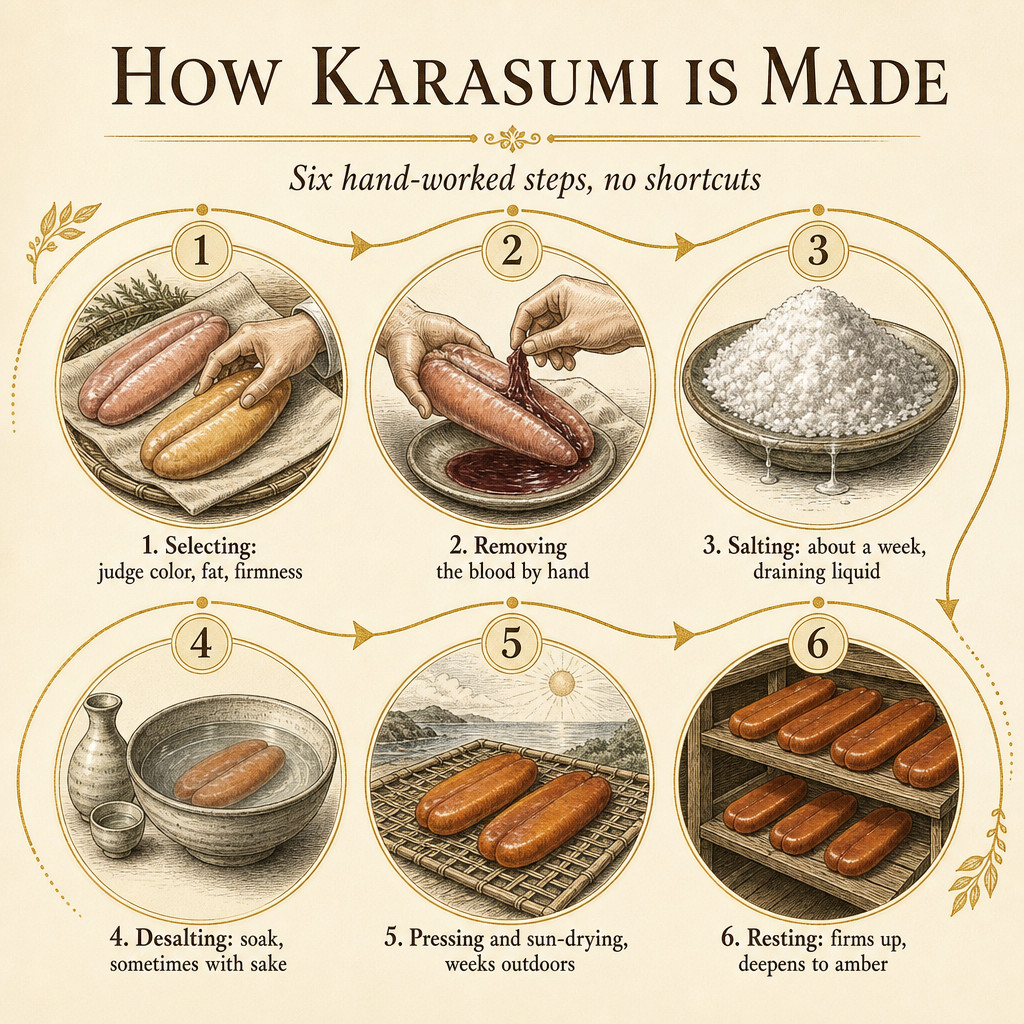
The process is simple to describe and difficult to execute. Each stage is done by hand, and a single mistake ruins an expensive piece of roe.
- Selecting the roeMakers choose mullet ovaries by colour, thickness, firmness and fat content, judging each pair individually.
- Removing the bloodCraftsmen work out blood and veins by hand. Skip this and the finished karasumi keeps a muddy, fishy edge.
- SaltingThe roe sits in salt for around a week, with liquid drawn off daily. Producers adjust the amount of salt to the thickness of each piece.
- DesaltingSoaking removes excess salt, and some makers use sake or shochu at this stage. Judgement here decides the final balance.
- Pressing and sun-dryingThe roe is flattened and dried outdoors, turned repeatedly, for two weeks to well over a month depending on size.
- RestingThe finished slabs firm up and deepen in colour, developing the amber tone buyers look for.
Why Drying Takes So Long
Thickness governs the timetable. One Nagasaki producer notes that particularly thick roe can take three to six weeks before the centre finally sets. Rush the drying and you get a hard shell with a raw core.
Weather matters just as much. Makers aim for the cool, dry air around early winter, since humidity slows everything down and invites spoilage. Karasumi is therefore a seasonal product, with new stock appearing from late November.
Modern workshops use temperature and humidity control, yet the sequence has barely changed. Nobody has found a shortcut that produces the same texture, which is part of why the price stays where it is.
What Does Karasumi Taste Like?
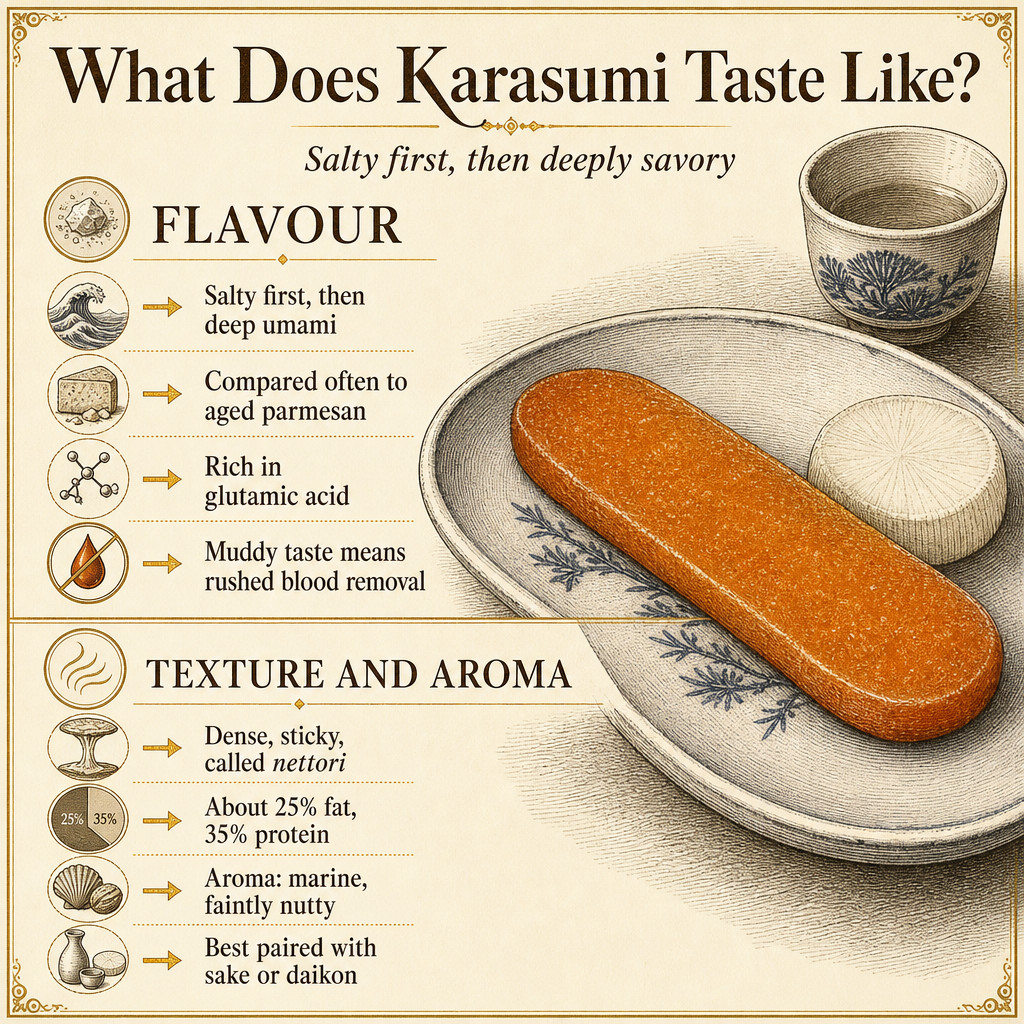
Salty first, then deeply savoury. That is the short version, although it undersells what happens after the first second.
Flavour
The dominant impression is concentrated umami with a briny edge. Comparisons to aged parmesan come up constantly, and they are fair, since both deliver a salt-and-glutamate punch in a small piece.
Chemistry supports the comparison. Research on Nagasaki karasumi found glutamic acid among the most abundant amino acids in the roe protein, alongside proline and lysine. Glutamate is the compound behind savoury depth in everything from kombu to cured cheese.
Good karasumi is not aggressively fishy. If a piece tastes muddy or unpleasantly strong, the blood-removal stage was probably rushed. That is the clearest quality marker for a first-time buyer.
Texture and Aroma
Texture is where karasumi surprises people. It is dense and slightly sticky, clinging to the roof of the mouth rather than dissolving. Japanese descriptions use the word nettori, which sits somewhere between waxy and creamy.
Fat explains much of that. Analysis of Nagasaki karasumi put lipid content around 25 percent and protein around 35 percent, so a thin slice carries a lot of both. The aroma is marine and faintly nutty, more restrained than the flavour suggests.
I will admit the first piece I tried was slightly overwhelming. It came alone, on an empty palate, and the salt dominated everything. Paired with sake or a slice of daikon a few minutes later, it made far more sense.
How to Eat Karasumi
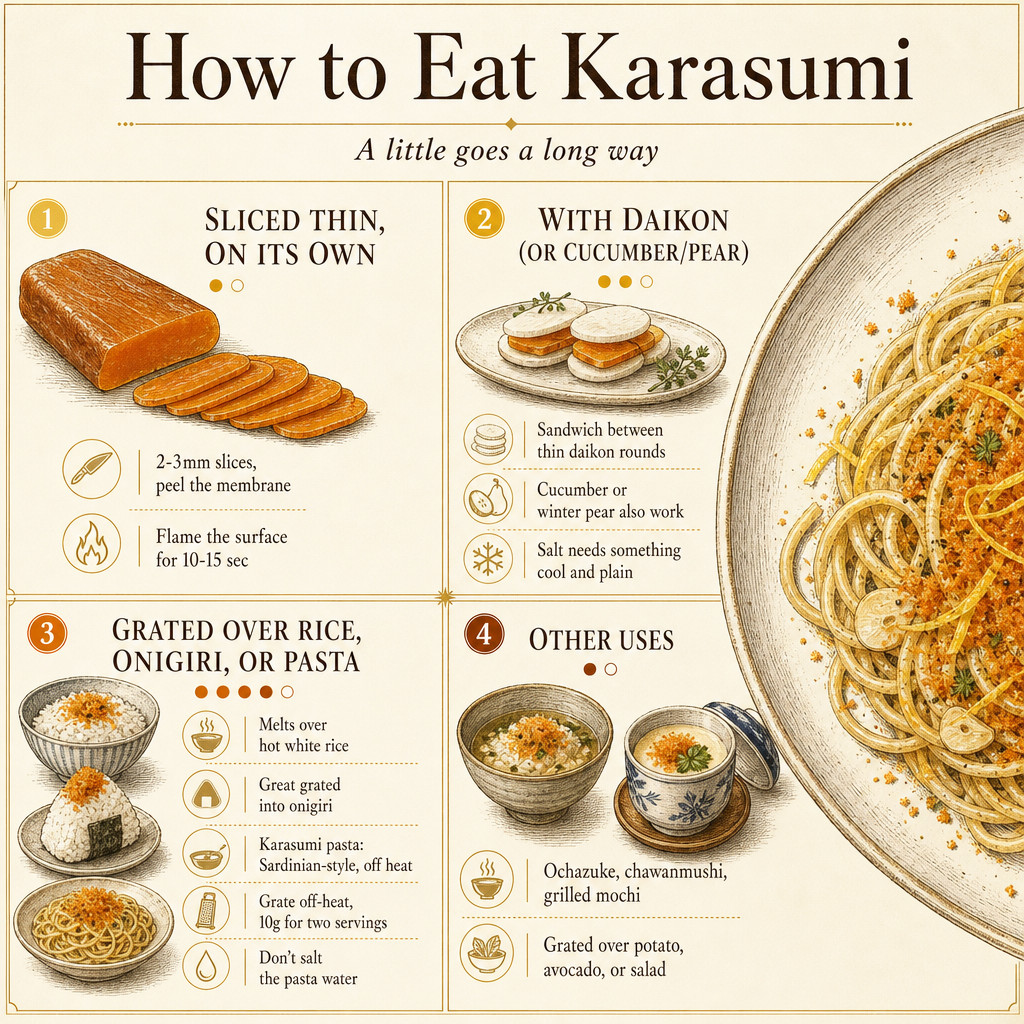
The governing rule is restraint. Karasumi is a seasoning as much as a food, so a little goes a long way.
Sliced Thin, on Its Own
The classic presentation is two or three millimetre slices, served as a small appetiser. Peel off the thin outer membrane first, since it can be tough. Many people lightly grill or flame the surface for ten to fifteen seconds, which softens the interior and brings out the aroma.
With Daikon Radish
This is the pairing to try first. A slice of karasumi sandwiched between two thin rounds of raw daikon balances the salt with something cool, watery and faintly sweet.
Cucumber works similarly, and so does a slice of Japanese pear in winter. The principle stays the same: give the salt something plain to lean against.
Grated Over Rice or Pasta
Dried karasumi grates beautifully, which turns it into a finishing seasoning. Over hot white rice it melts slightly and seasons the whole bowl. A little grated karasumi in onigiri makes an unusually good rice ball.
Karasumi Pasta
Pasta is the modern favourite, borrowed straight from Sardinia, where grated bottarga has topped spaghetti for generations. The Japanese version uses the same technique with a slightly stickier roe.
Method matters more than quantity here. Warm olive oil with garlic, toss the drained spaghetti through it, then take the pan off the heat before adding the karasumi. Grate roughly ten grams for two servings and finish with lemon zest.
Two mistakes spoil it. Adding karasumi to a hot pan drives off the aroma and can turn the fat bitter, and salting the pasta water heavily makes the finished dish inedible. Salt the water lightly, or skip it altogether.
Japan has form with roe pasta. Mentaiko pasta began when a Tokyo restaurant substituted cod roe for caviar in the 1960s, and karasumi pasta follows the same logic with a costlier ingredient.
Other Uses
- Ochazuke: grated over rice, then hot green tea or dashi poured on top.
- Chawanmushi: shaved over savoury steamed egg custard just before serving.
- Mochi: a slice pressed onto grilled rice cake, a New Year favourite.
- Potato or avocado: grated over something starchy and mild, which carries the salt well.
- Salad: shaved thin over greens in place of parmesan.
Best Drinks to Pair with Karasumi
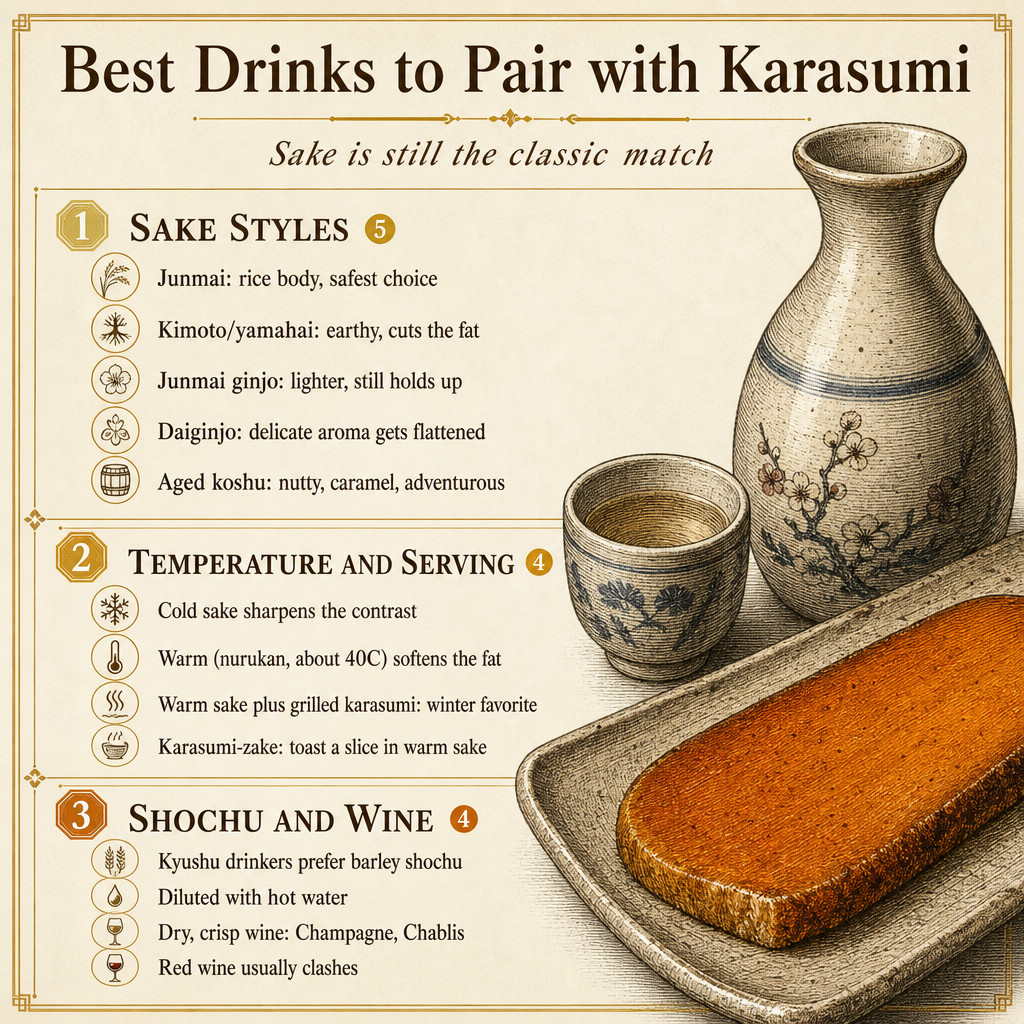
Karasumi is a classic otsumami, meaning a snack built for drinking. The salt and fat practically demand something alongside.
Which Sake Styles Work
Sake is the traditional match, and still the best one. The principle is straightforward: karasumi is salty, fatty and concentrated, so it needs a sake with enough body and acidity to stand up rather than one built on delicate aroma.
| Sake style | How it works | Verdict |
|---|---|---|
| Junmai | Rice-driven body and acidity carry the salt | The safest choice |
| Kimoto or yamahai | Higher acidity and earthy depth cut the fat | Excellent with aged karasumi |
| Junmai ginjo | Cleaner and lighter, still holds its shape | Works, though less complex |
| Daiginjo | Delicate fruit aroma gets flattened by salt | Better saved for milder food |
| Koshu (aged) | Nutty, caramel notes echo the roe | Adventurous but rewarding |
Aromatic daiginjo is the common mistake, understandably so, since it costs the most. Pairing an expensive delicacy with an expensive sake feels right, yet the salt simply erases the melon and pear notes you paid for.
Temperature and Serving
Serving temperature changes the pairing more than most people expect. Cold sake sharpens the contrast, whereas warming to around 40°C, the range Japanese drinkers call nurukan, softens the fat on the palate and rounds everything out.
Try both if you have the chance. Warm sake with grilled karasumi is a particularly good winter combination, and it is the version you most often meet at traditional izakaya. Our guide to types of Japanese sake explains the categories in more detail.
There is also the karasumi-zake trick, borrowed from the way people drink hire-zake with grilled fin. Drop a small toasted slice into warm sake and let it sit for a minute. The sake picks up a savoury edge, and you eat the piece afterwards.
Shochu and Wine
Kyushu drinkers often reach for shochu instead, which makes regional sense given that Nagasaki sits in Kyushu. Barley shochu with hot water is the usual serve, and the dilution keeps the salt in check.
For wine, go dry and crisp. Champagne works, and so does a mineral white such as Chablis or Vermentino. Red wine generally clashes, since tannin and cured roe rarely get along.
Karasumi vs Bottarga
Calling karasumi Japanese bottarga is convenient, and largely accurate. Both are salted, dried mullet roe, and both come from the same fish species. Yet anyone who tastes them side by side notices differences.
| Karasumi (Japan) | Bottarga (Italy) | |
|---|---|---|
| Main fish | Grey mullet, sometimes Spanish mackerel | Grey mullet or bluefin tuna |
| Added ingredients | Salt only in Nagasaki; sake or shochu elsewhere | Salt only |
| Drying | Sun-dried, typically two weeks to over a month | Air-dried, often several weeks |
| Finish | Usually sold plain | Often coated in wax for storage |
| Texture | Denser and stickier | Firmer and drier, easy to grate |
| Typical use | Sliced with sake, grated over rice | Grated over pasta |
| Sold as | Whole lobes, halves, or pre-sliced | Whole lobes or grated in jars |
Which Should You Try?
It depends on what you plan to do with it. Bottarga is easier to find outside Japan, cheaper, and better suited to grating over pasta on a weeknight.
Karasumi rewards eating slowly and in small pieces. Its stickier texture shows up best when sliced rather than grated, which is exactly how Japanese drinkers serve it. Buy the Japanese version if you want the experience; buy bottarga if you want the ingredient.
Why Karasumi Is So Expensive
Prices startle people, so the reasons are worth setting out plainly. Three factors do most of the work.
- Scarcity of raw material. One mullet yields one pair of ovaries, and only during a short season.
- Labour. Blood removal, salting, desalting and drying are handled by hand, piece by piece.
- Time and loss. Weeks of drying cut the weight sharply, and any piece that cracks or spoils is written off.
About these prices. The figures above come from a long-established Nagasaki producer in July 2026, for domestic mullet roe. Imported roe, usually from Australia, costs noticeably less. Prices also climb before New Year, when demand peaks.
There is a sensible way to start. Buy the offcuts, called kirego, rather than a whole lobe. They cost a fraction of the price and taste the same, since the only difference is that the piece broke during production.
Karasumi and Other Japanese Roe
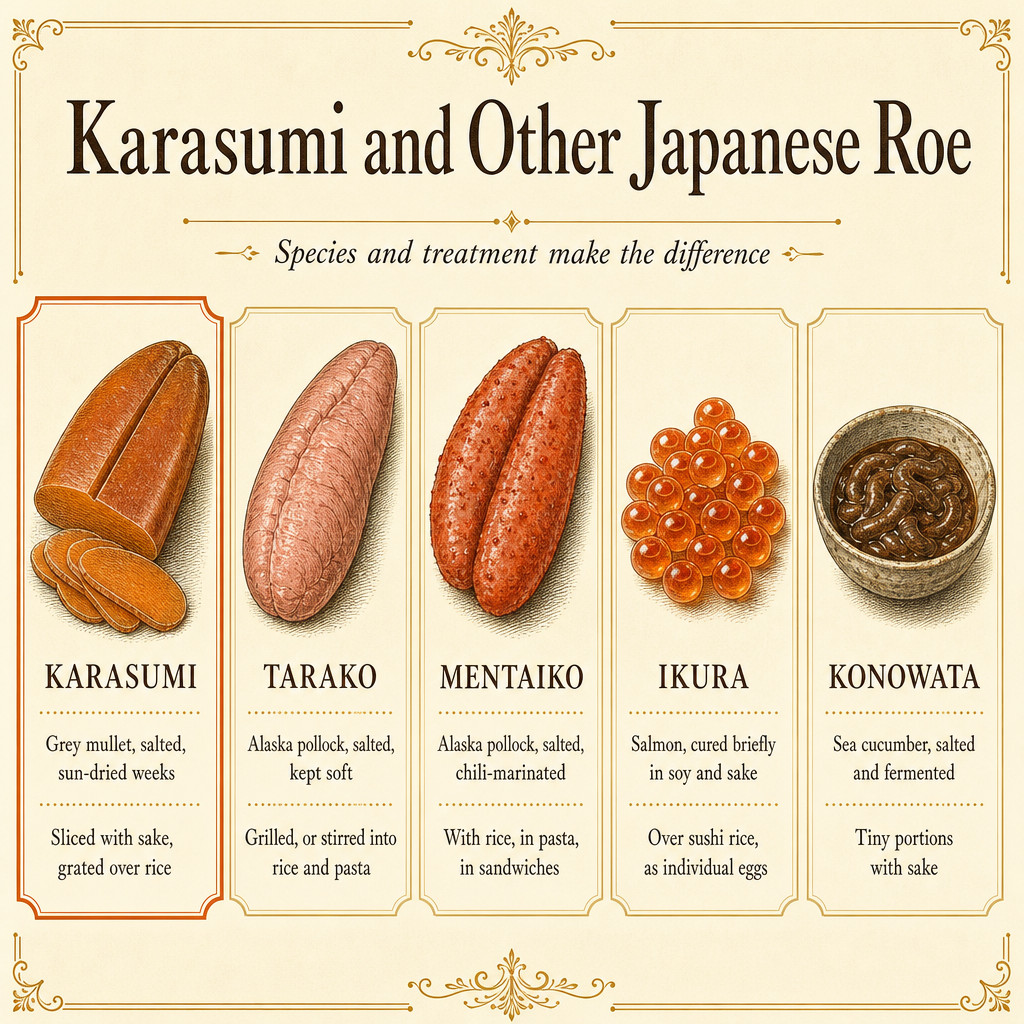
Japan uses fish roe widely, so newcomers understandably mix the names up. The differences come down to species and treatment.
| Name | Fish | Treatment | How it is eaten |
|---|---|---|---|
| Karasumi | Grey mullet | Salted, then sun-dried for weeks | Sliced with sake, grated over rice |
| Tarako | Alaska pollock | Salted, kept soft | Grilled, or stirred into rice and pasta |
| Mentaiko | Alaska pollock | Salted and marinated with chilli | With rice, in pasta, in sandwiches |
| Ikura | Salmon | Cured briefly in soy and sake | Over sushi rice, as individual eggs |
| Konowata | Sea cucumber | Salted and fermented | In tiny portions with sake |
Texture separates karasumi from the rest most clearly. Mentaiko and tarako stay soft and are eaten by the spoonful, whereas karasumi is dried solid and shaved thin.
Price separates them too. A pack of mentaiko costs a few hundred yen at any supermarket, while karasumi belongs in the gift and celebration category alongside konowata.
How to Choose Good Karasumi
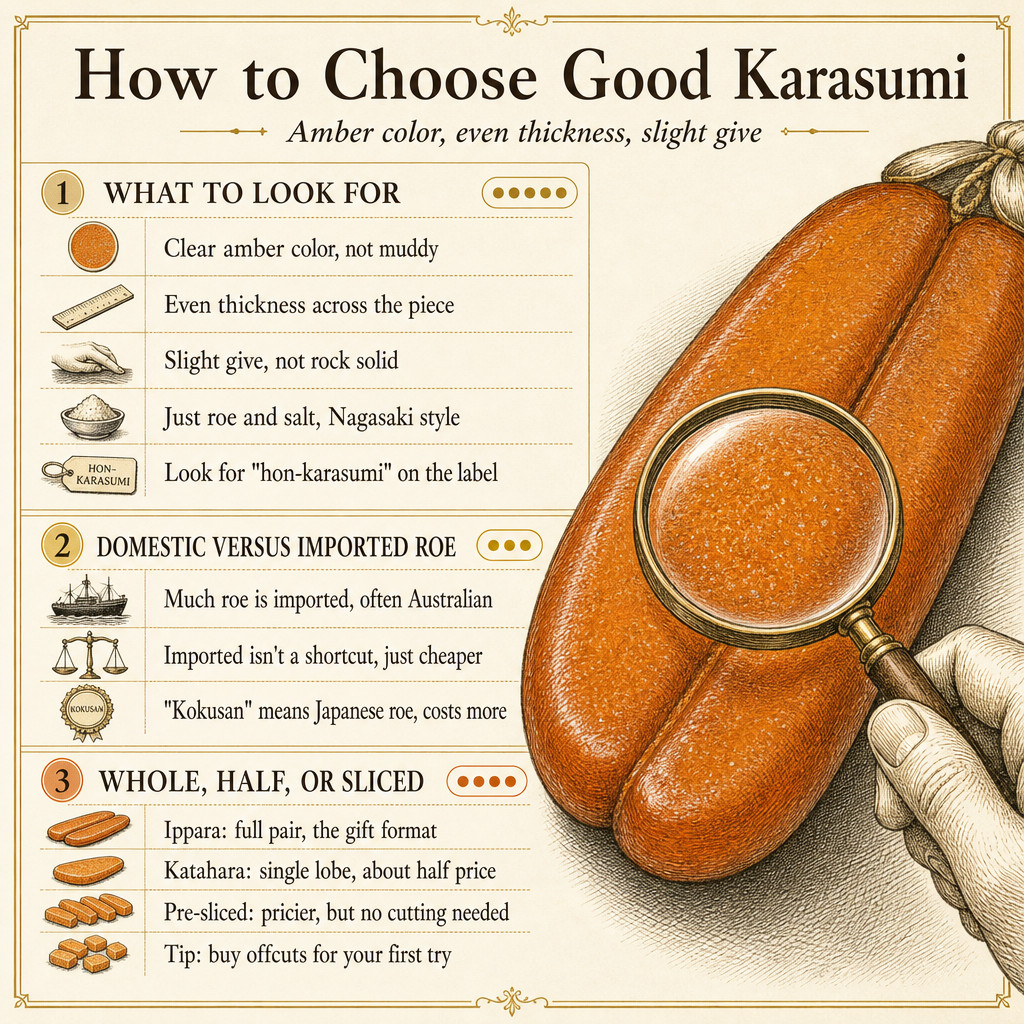
Quality varies enormously, and the label rarely tells you everything. A few checks help before you spend serious money.
What to Look For
- Colour: a clear amber tone suggests careful blood removal. Dark, muddy patches often mean the opposite.
- Even thickness: the piece should look uniform, since thin edges dry out and turn hard.
- Firmness: it should give slightly under pressure rather than feeling rock solid.
- Ingredients: mullet roe and salt only, in the Nagasaki style. Longer lists usually indicate colouring or preservatives.
- The word hon-karasumi: this confirms mullet roe rather than a cheaper substitute.
Domestic Versus Imported Roe
Here is a detail that catches buyers out. Many Nagasaki producers use imported mullet roe, particularly from Australia, and they say so openly. One long-running maker cites Australian waters for their clean water quality.
Imported roe is not a shortcut, then. It is simply cheaper, because domestic mullet is scarce. Products labelled kokusan (国産) use Japanese roe and cost considerably more, so decide whether that origin matters to you before paying the difference.
Whole, Half or Sliced
Karasumi comes in three main formats. A full pair of lobes, called ippara, is the gift presentation. A single lobe, katahara, costs roughly half. Pre-sliced boxes cost more per gram but remove the guesswork of cutting.
For a first purchase I would skip all three and buy offcuts. They look untidy, yet the flavour is identical, and you learn what you actually think of the ingredient before committing.
Where to Find Karasumi in Japan
Nagasaki is the obvious destination, though you do not need to travel there to buy some.
Nagasaki
Specialist shops cluster near Nagasaki Station and around the Tsukimachi area in the city centre. Several have operated for generations, and staff will usually let you taste before committing to a purchase.
The city is worth a food trip regardless. Champon and sara udon both grew out of the port’s Chinese connections, and our Nagasaki food section covers the wider local repertoire.
Elsewhere in Japan
Department store food halls in Tokyo and Osaka stock karasumi year-round, usually in the dried goods or delicacy section. Ask for karasumi rather than Japanese bottarga, since staff will recognise the Japanese name. Selection widens considerably in December, ahead of New Year.
Restaurants are the other route, and often the better one. Traditional izakaya and kaiseki restaurants serve karasumi by the slice, which lets you try it without buying a whole lobe. Some sushi counters offer it as a small course too.
Karasumi as a Nagasaki Souvenir
Karasumi is the classic Nagasaki gift, and it suits the role well. Vacuum packing makes it shelf-stable, the presentation boxes look formal, and the recipient almost certainly cannot buy it at home.
- Pre-sliced boxes are the easiest gift, since the recipient needs no knife skills and no idea how thin to cut.
- A single lobe in a wooden box is the formal option, and the one Japanese buyers choose for business or New Year gifts.
- Offcuts suit you rather than a recipient, and cost a fraction as much.
- Karasumi mochi and karasumi powder are cheaper processed spin-offs, useful for spreading a budget across several people.
- Buy late in the trip, because the product keeps better refrigerated and hotel rooms are warm.
Nagasaki Airport and the main station both stock karasumi, though specialist shops in the city offer better range and often a tasting. Prices at the airport are not noticeably lower, so convenience is the only real advantage.
Taking It Out of Japan
Customs rules are the catch, because many countries restrict fish products in luggage. Australia, New Zealand, the United States and the European Union all set their own conditions for processed seafood, and those conditions change.
Check your own country’s rules before buying an expensive gift box, and keep the original sealed packaging with its ingredient label. Declaring the item at the border costs nothing, whereas an undeclared seafood product can cost you both the karasumi and a fine.
Nutrition and Storage
Karasumi is nutrient-dense in both the good and the awkward sense. Portion size does most of the work here.
Nutritional Points
Research on Nagasaki karasumi recorded roughly 35 percent protein and 26 percent lipid, with a well-balanced essential amino acid profile. Studies on Mediterranean bottarga likewise report meaningful levels of the omega-3 fatty acids EPA and DHA.
The trade-offs are salt and cholesterol. Bottarga samples from Sardinia measured 389 to 417 milligrams of cholesterol per 100 grams, and karasumi is salty by definition. Anyone managing blood pressure or cholesterol should treat it as an occasional garnish.
In practice a serving is two or three thin slices, perhaps ten grams. At that scale the concern largely disappears, which is roughly how Japanese diners have always eaten it.
How to Store It
- Unopened: keep vacuum-sealed karasumi refrigerated, and check the producer’s date.
- After opening: wrap tightly in plastic film, then refrigerate and use within a few weeks.
- Longer storage: freezing works well, and slices can be cut straight from frozen.
- Watch for: a rancid or sharply oily smell, which signals the fat has oxidised.
- Avoid: leaving it exposed to light and warm air, since both accelerate oxidation.
Oxidation is the genuine enemy. Laboratory work on bottarga found that grated product oxidises faster than whole lobes, which argues for grating only what you need and keeping the rest intact.
Final Thoughts
Karasumi is a small, expensive, intensely savoury thing, and it does not pretend otherwise. Salted mullet roe, sun-dried for weeks, sliced thin and eaten with a drink: the whole idea fits in one sentence, yet the making takes a month and a good deal of skill.
Start small if you are curious. Buy offcuts rather than a gift box, eat a slice with daikon and a cup of junmai sake, and grate whatever remains over rice. Our Japanese food section covers the other cured and preserved specialities that sit alongside it.
Karasumi FAQ
What is karasumi made from?
Grey mullet roe and salt, in the traditional Nagasaki style. Producers cure whole ovary sacs, desalt them, then sun-dry the pressed roe for weeks. Cheaper versions substitute Spanish mackerel or cod roe, so look for the term hon-karasumi if you want the real thing.
Is karasumi the same as bottarga?
Very close, which is why English sources call karasumi Japanese bottarga. Both are salted, dried mullet roe, and researchers treat the two names as one product category. Karasumi tends to be denser and stickier, whereas Italian bottarga is drier and often wax-coated. Serving style differs too, since Japan slices it and Italy usually grates it.
What does karasumi taste like?
Salty and intensely savoury, with a texture closer to firm cheese than to fresh fish. Aged parmesan is the comparison people reach for most often. Analysis of Nagasaki karasumi found glutamic acid among its most abundant amino acids, which explains the depth. Good karasumi should not taste muddy or aggressively fishy.
How do you eat karasumi?
Slice it two to three millimetres thick and eat it as an appetiser, ideally with sake. Sandwiching a slice between rounds of raw daikon is the classic pairing. Alternatively, grate it over hot rice or finished pasta. Many people flame the surface briefly first, which lifts the aroma.
Can you eat karasumi raw?
Yes, since curing and drying have already preserved it. Karasumi needs no cooking and is normally served as it comes. Light grilling is a matter of preference rather than safety, because the heat softens the interior and releases aroma.
Why is karasumi so expensive?
Scarcity, labour and time all push the price up. Each mullet gives only one pair of ovaries, and the season is short. Producers then handle every stage manually over several weeks, losing considerable weight to drying. A full lobe from a Nagasaki maker ran to roughly 8,600 yen for 80 grams in July 2026.
Where does karasumi come from in Japan?
Nagasaki is the historic centre, particularly the Nomozaki area south of the city. The technique arrived from China through the port, and local producers switched to grey mullet caught nearby. Karasumi is also made in Kagawa, Hyogo, Kochi and elsewhere, sometimes using other fish species.
What should you drink with karasumi?
Sake is the traditional match, and junmai styles with body handle the richness best. Warming the sake gently softens the fat on the palate. Shochu suits it too, which makes sense given Nagasaki sits in Kyushu. For wine, choose something dry and mineral rather than red.
Is karasumi healthy?
In small amounts it offers useful nutrition. Studies record roughly 35 percent protein with a balanced essential amino acid profile, plus omega-3 fatty acids. However, it is high in salt, and bottarga samples measured 389 to 417 milligrams of cholesterol per 100 grams. A normal serving is only about ten grams, which keeps that in perspective.
How should karasumi be stored after opening?
Wrap it tightly in plastic film and refrigerate, then use it within a few weeks. Freezing works well for longer keeping, and you can slice it straight from frozen. Grate only what you need, since research on bottarga shows grated product oxidises faster than whole lobes.
Can tourists bring karasumi home from Japan?
Often, though it depends entirely on your destination. Vacuum-packed karasumi is shelf-stable and travels well as a gift. Many countries restrict fish products in luggage, so check your own customs rules before buying an expensive box. Requirements differ widely and change over time.
References
- Ministry of Agriculture, Forestry and Fisheries of Japan, Japan’s Three Great Delicacies (Edo-period grouping; transmitted from China to Nagasaki in 1652; earlier production in Greece, Turkey and Egypt), https://www.maff.go.jp/j/heya/sodan/1601/01.html (Accessed July 2026)
- Onohara Honten, Nagasaki and Karasumi (salted, desalted and sun-dried mullet roe), https://onohara.co.jp/pages/nagasaki-karasumi (Accessed July 2026)
- Nagasaki365, Interview with Zenichiro Onohara (roe and salt only; one week of salting; Australian roe used; scarcity behind prices), https://nagasaki365.com/topics/16599/ (Accessed July 2026)
- Takanoya, Domestic Karasumi Prices (20g offcuts 1,728 yen; 50g 4,320 yen; 80g 8,640 yen; 120g 12,960 yen), https://www.karasumi.jp/?mode=cate&cbid=2464366&csid=0 (Accessed July 2026)
- Fujii Karasumi Ten (three to six weeks of drying), https://karasumi.co.jp/?page_id=6 (Accessed July 2026)
- Kitakohaku (hon-karasumi defined as mullet roe; name from Chinese ink sticks), https://shop.kitakohaku.maruki-abeshoten.com/pages/日本三大珍味 (Accessed July 2026)
- Amina Collection (Takano Yusuke of Nomozaki; shogunate tribute 1712 to 1867), https://aminaflyers.amina-co.jp/list/detail/1719 (Accessed July 2026)
- Chefrepi Magazine (founding year 1675; mullet roe chosen for high lipid content), https://chefrepi.com/magazine/ingredients-dictionary/karasumi-japanese-three-delicacies-origin-charm/ (Accessed July 2026)
- Studies on the Composition of Mullet Roe and Karasumi Produced in Nagasaki (protein 35.5 percent, lipids 25.7 percent; glutamic acid, proline, lysine), https://www.researchgate.net/publication/250157726 (Accessed July 2026)
- Proximate Nutritional Composition of Roe, Int. J. Gastronomy and Food Science (karasumi, bottarga and avgotaracho as one category), https://www.sciencedirect.com/science/article/pii/S1878450X24000775 (Accessed July 2026)
- Microbiological Control and Characterization of Bottarga, Applied Sciences, DOI 10.3390/app15041714 (cholesterol 417 and 389 mg per 100 g), https://doi.org/10.3390/app15041714 (Accessed July 2026)
- Influence of the Technological Process on Fresh Roe and Bottarga, Foods, 9(10), 1408 (raised essential amino acid ratio and omega-3 levels), https://www.mdpi.com/2304-8158/9/10/1408 (Accessed July 2026)
- Oxidative Stability of Mullet Roe and Bottarga, Food Chemistry (grated less stable than whole lobes), https://www.sciencedirect.com/science/article/abs/pii/S0308814609000260 (Accessed July 2026)
Related Articles
- Mentaiko and Tarako (明太子 / たらこ) (Surveyed: July 2026)
- Mentaiko Pasta (Surveyed: July 2026)
- Champon (ちゃんぽん): Nagasaki’s Noodle Specialty (Surveyed: July 2026)
- Sara Udon (皿うどん) (Surveyed: July 2026)
- Nagasaki Food Guide (Surveyed: July 2026)
- Convenience Store Onigiri (Surveyed: July 2026)
- Types of Japanese Sake (Surveyed: July 2026)
- Japanese Sake Guide (Surveyed: July 2026)
- Japanese Fusion Food (Surveyed: July 2026)
- Japanese Food Guide (Surveyed: July 2026)




Comments