


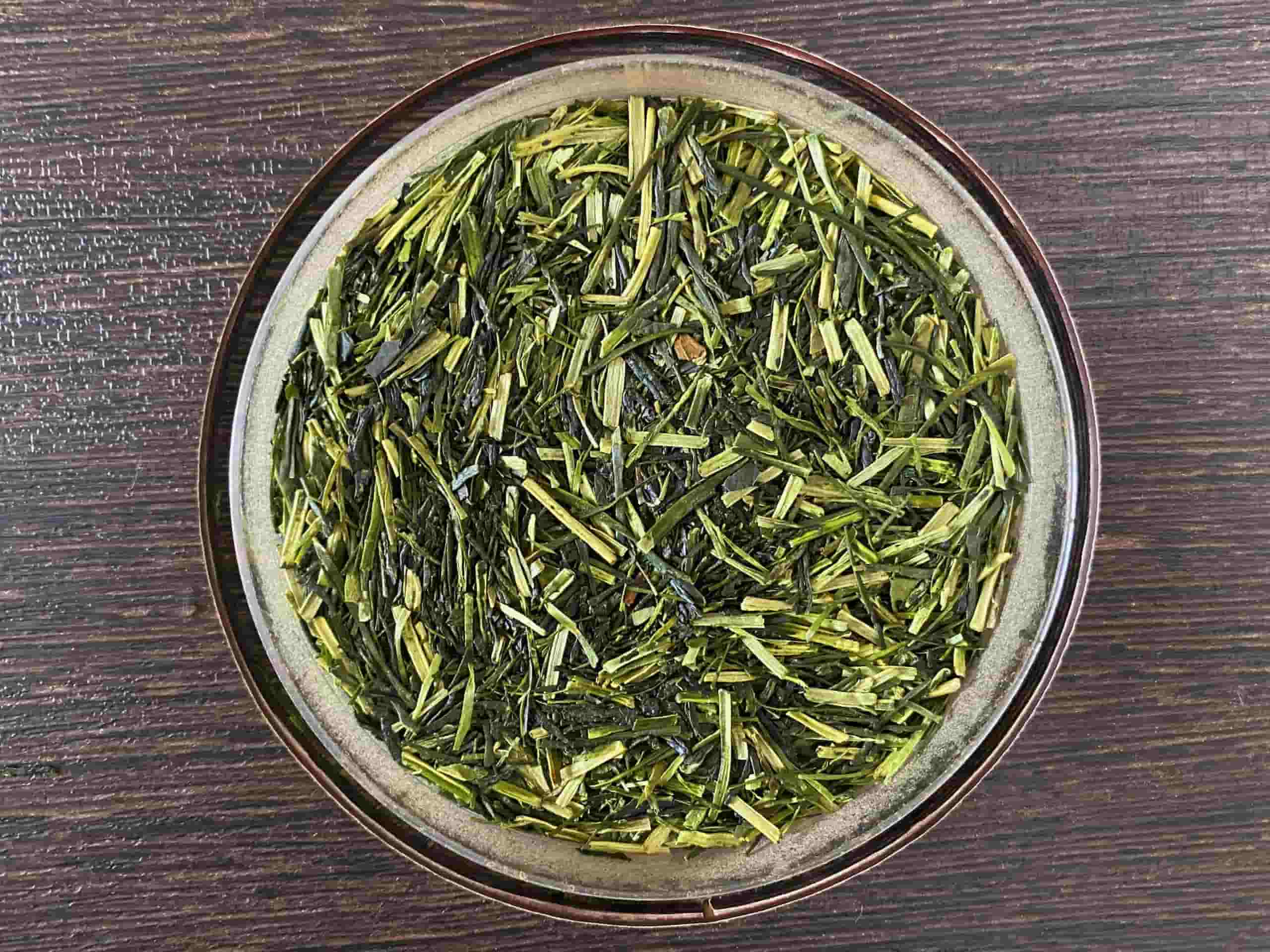

Most Japanese green teas are judged by their leaves. Kukicha (茎茶) turns that idea around. It’s a Japanese green tea made mainly from the stems and leaf stalks of the tea plant, the parts that finishers sort away when they want a neat, leafy sencha or gyokuro. In English, it often goes by “twig tea” or “stem tea.”
Those pale little stems don’t make a lesser cup, though. They usually brew into a light, clear, yellow-green tea with a fresh, almost creamy sweetness and very little bitterness. Japan’s Ministry of Agriculture describes it as a tea with a distinctive sweetness that even beginners find easy to prepare.
Quick Facts
茎茶 (kukicha), also 棒茶 (bōcha)
Twig tea, stem tea, stick tea
Green tea made mainly from stems and leaf stalks
Sorted out during the finishing of teas such as sencha and gyokuro
Fresh, sweet, mildly nutty, low in bitterness
Generally lower than leaf sencha, but not caffeine-free
This guide explains which parts of the plant go into this tea, how tea finishers separate it from leaf tea, and what names it’s sold under. It also covers green versus roasted styles, flavor, caffeine, brewing, buying, and storage. For the leaf tea most stem tea is sorted from, see the complete Sencha guide.
What Is Kukicha?
A Tea Built From the “Other” Parts of the Plant
Japan’s green tea labeling standard defines it, under the names kukicha or bōcha, as tea that contains a high proportion of stems and leaf stalks, selected during the finishing of crude tea. Small leaf pieces usually remain in the mix, so a bag rarely looks like pure sticks. What defines it is the balance: stems do most of the work, and leaf plays a supporting role.
The name is simple. “Kuki” (茎) means stem, and “cha” (茶) means tea. The same standard lists bōcha (棒茶), or “stick tea,” as an equivalent name. In everyday use, though, sellers and regions don’t always use the two names the same way, as the names section below explains.
Which Parts of the Plant Go Into Kukicha
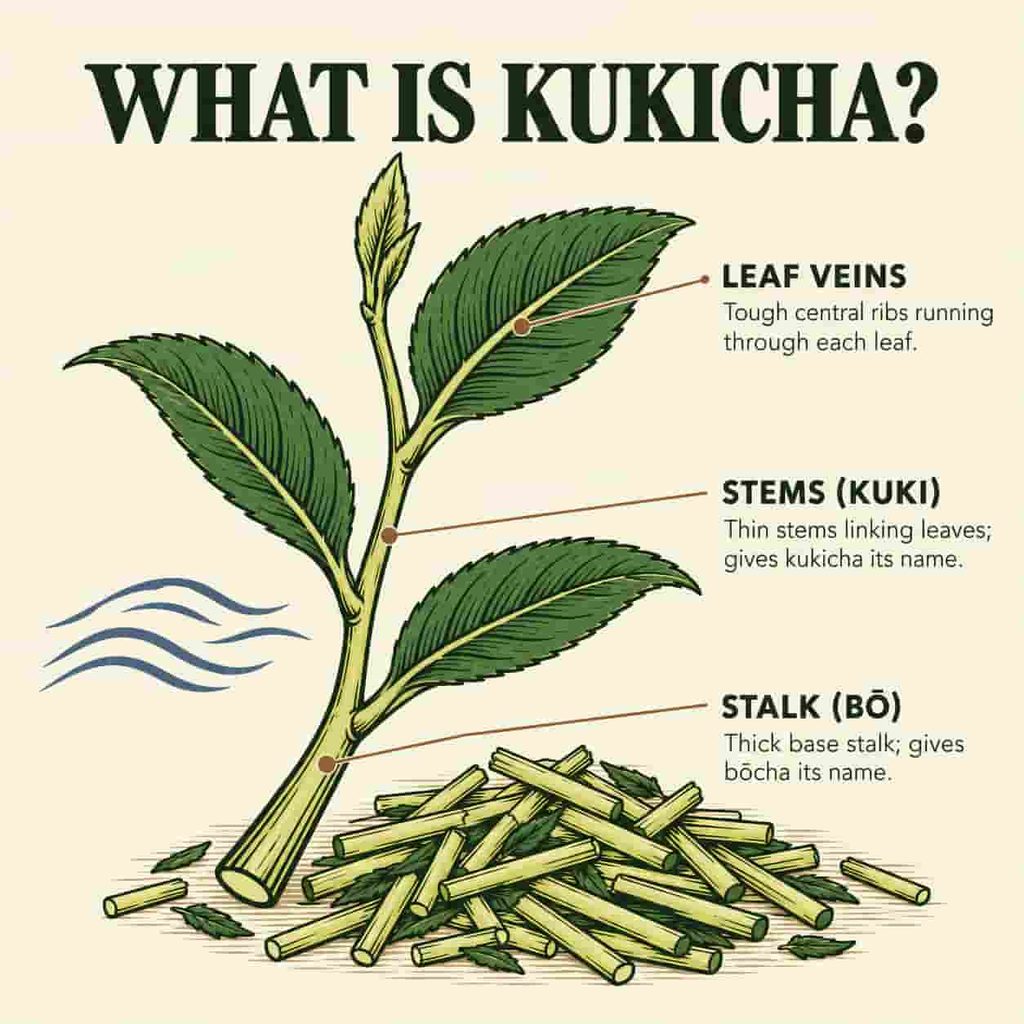
A single tea shoot contains more than one kind of stem material. Tea specialists often use these terms to describe them:
- Bō (棒): the thicker base stalk of the shoot, which gives bōcha its name.
- Kuki (茎): the thinner stems and leaf stalks that connect the leaves to the stalk, which give kukicha its name.
- Yōmyaku (葉脈): the leaf veins, the tough central ribs that run through each leaf. Some processing, especially for tea destined to become matcha, separates these as well.
Stems and leaf stalks make up the core of the blend, and the exact mix depends on the tea they came from and how finely it was sorted. Japanese tea sellers note that slender, glossy, vivid green stems tend to brew a sweeter cup than dull or thick, woody ones.
How Kukicha Is Made
Nobody grows a tea bush just for its stems. Instead, it comes out of the same production chain as leaf tea, at a stage most tea drinkers never see. Japanese green tea is made in two broad phases: primary processing into aracha (crude tea), then finishing. Stem tea belongs to the second phase.
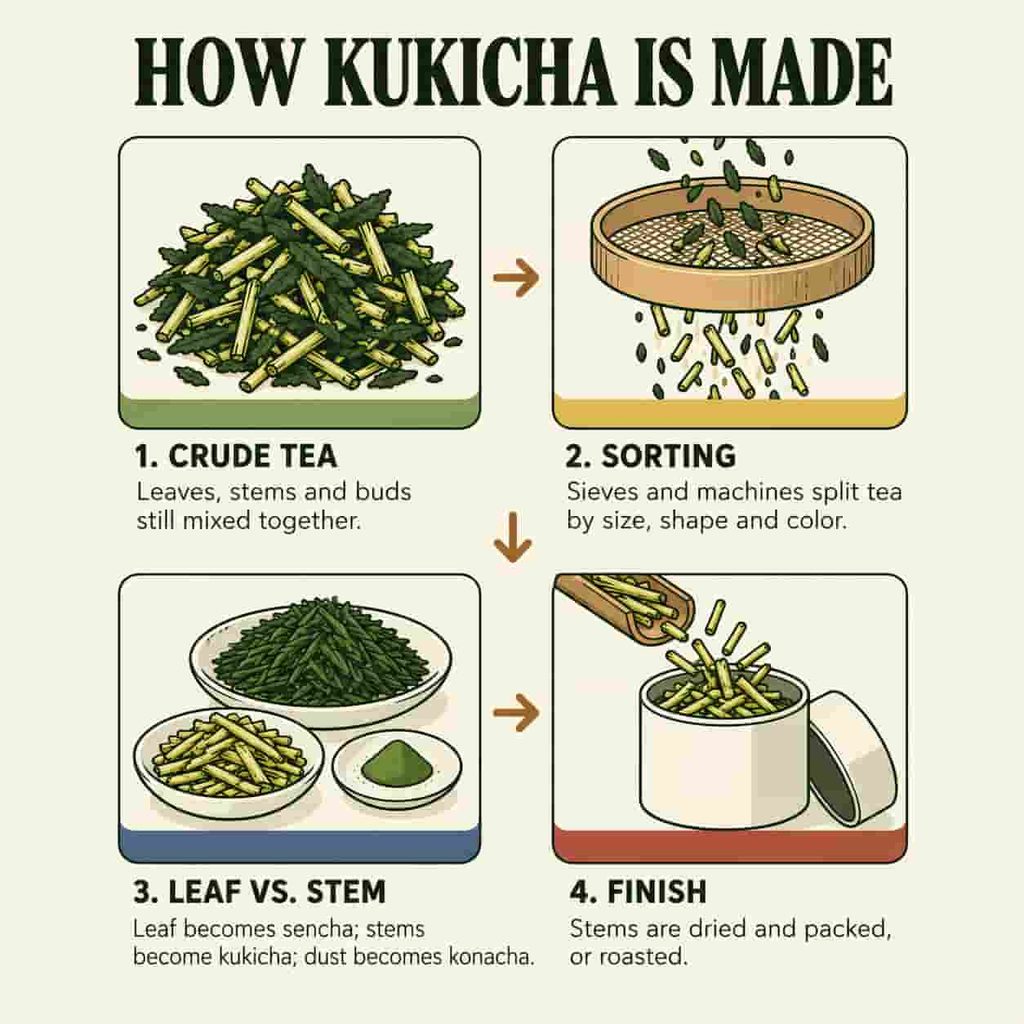
Fresh shoots are steamed, rolled, and dried into aracha, a rough, unsorted tea. At this point, leaves, stems, buds, and fine particles are still mixed together.
Tea finishers sift and cut the aracha, then separate the material by size and shape. Machines such as stem separators pull out the stems and leaf stalks, and some finishers also use color sorters to pick out the paler stems.
The main leaf portion continues on and is sold as sencha or gyokuro, depending on the tea it came from. The stem-rich portion becomes kukicha. Separated bud tips are sold as mecha (bud tea), and the fine particles as konacha (powder tea).
The stems are dried again and packed as green stem tea. Some batches go to a roaster instead and become roasted stem tea.
In Japan, these sorted-out teas are often called demono (出物), roughly “things that come out” of the finishing process. The name sounds modest, but it simply describes where the tea comes from, not how good it is. Stem tea sorted from a fine sencha or gyokuro carries much of that tea’s quality with it.
Kukicha Names: Karigane, Shiraore, and Bōcha
The word works as an umbrella term, and several overlapping names sit around it. These names aren’t an official grading system. Producers, regions, and shops use them in slightly different ways, but the table below shows how they’re commonly understood.
For buyers, the most useful clue is the base tea rather than the name alone. Stems sorted from ordinary sencha taste light and fresh. Stems from gyokuro, the shaded tea covered in the Gyokuro guide, tend to carry more sweetness and depth, and sellers often label them karigane. Because shops don’t use these names consistently, a product description that states the base tea is more reliable than the label.
Kaga Bōcha is a separate case. It’s an Ishikawa specialty made by roasting tea stems, with its own regional history and roasting methods.
Green Kukicha vs. Roasted Kukicha
This tea comes in two broad styles. The green, unroasted version is common in Japanese tea shops. Roasted stem tea, on the other hand, is especially familiar to shoppers in some Western natural-food stores. Knowing which one you’re buying makes a big difference to what ends up in the cup.
Green Kukicha
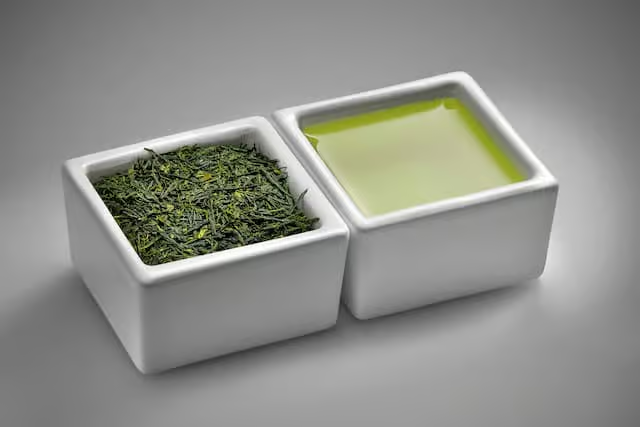
Look: Pale green to yellow-green stems
Cup: Clear, light yellow-green
Taste: Fresh, sweet, creamy, gently vegetal
Water: Around 75 to 80°C
Roasted Kukicha
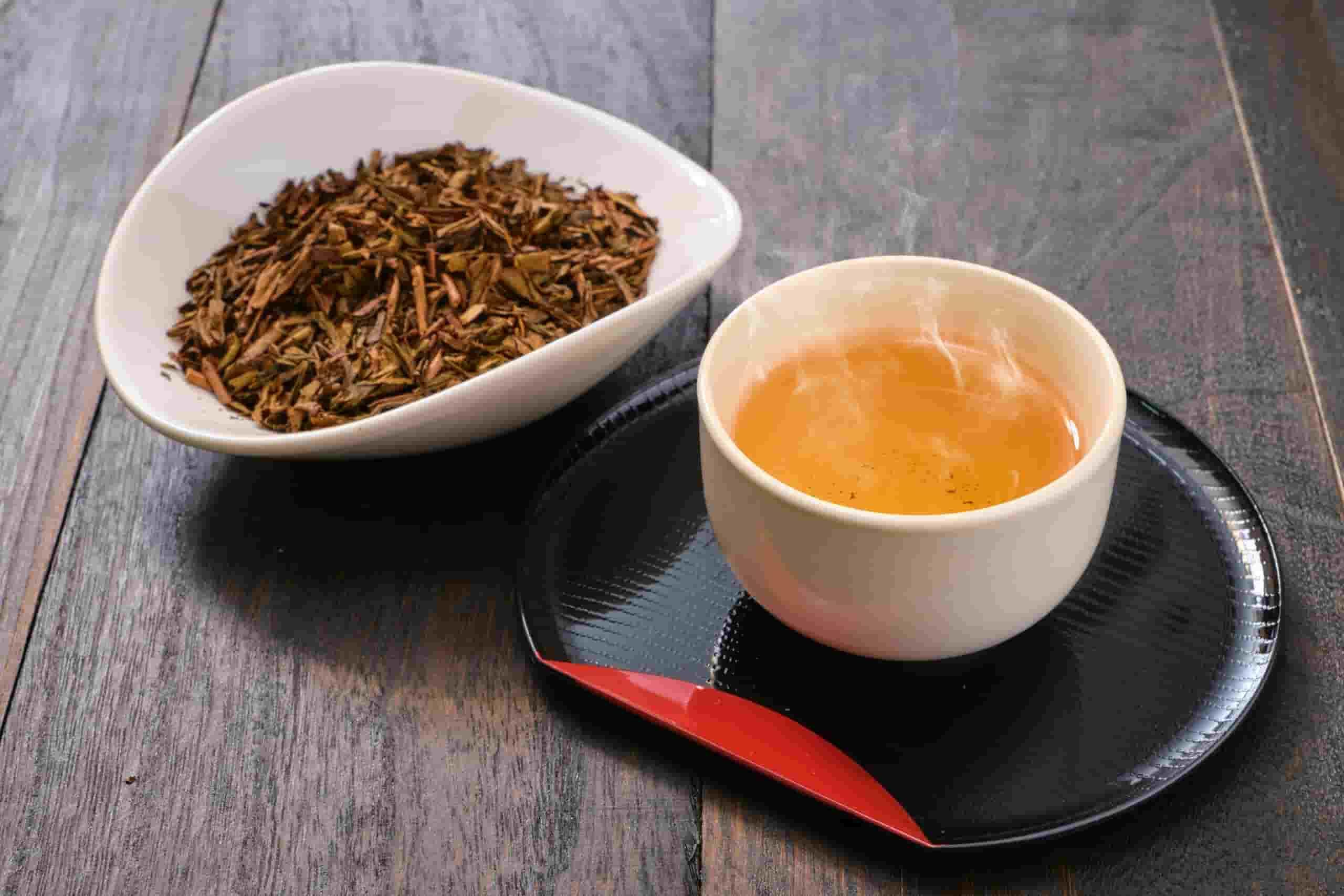
Look: Light to deep brown stems
Cup: Amber to golden brown
Taste: Toasty, nutty, with very little bitterness
Water: Close to boiling
Roasted stem tea is technically a kind of hōjicha, since hōjicha simply means roasted green tea. Kaga Bōcha is a well-known roasted stem tea from Ishikawa, and roasted gyokuro stems have their own following, covered in the Karigane Hōjicha guide. This article focuses mainly on the green style.
Kukicha Flavor and Aroma
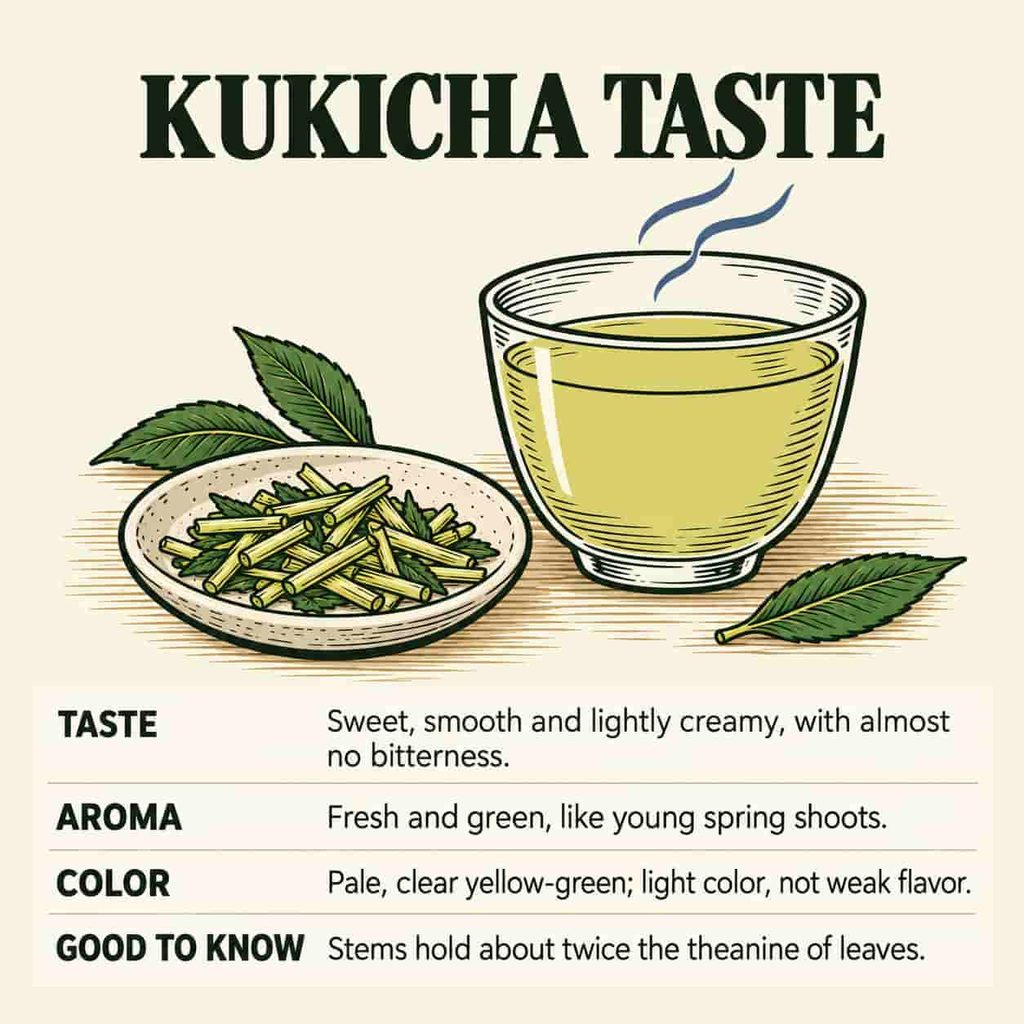
The green style tastes lighter than most sencha, but it isn’t thin. The first sip is usually sweet and smooth, with a soft, almost milky roundness. A mild nuttiness follows, and the finish stays clean rather than drying. Compared with a typical sencha, the bitterness and astringency are much softer. Tea writers often place its flavor somewhere between a light sencha and a gentle gyokuro.
The aroma is fresh and green, a bit like cut grass or young spring shoots. Japanese tea sellers link that scent partly to “leaf alcohol” (aoba alcohol), a green-smelling compound found in stems. Research backs up the idea that stems really do differ from leaves. A 1993 Japanese study comparing a stem tea with a sencha found more theanine, a sweet, savory amino acid, in the stem tea. It also found more of the floral aroma compounds linalool and geraniol, and less catechin and caffeine. Those results describe the samples studied, not every bag on the market, but they help explain why stem tea tastes sweeter and less bitter.
In the cup, it brews pale and clear. Don’t mistake that light color for weak flavor.
Caffeine in Kukicha
Kukicha is generally lower in caffeine than leaf-heavy green teas such as sencha, mainly because stems store less caffeine than young leaves and buds. The 1993 study mentioned above also found less caffeine in its stem tea sample than in its sencha sample. Even so, there’s no single fixed figure for a cup. The amount varies with the base tea, how much leaf is mixed in, and how you brew it.
That makes it a popular choice for a gentler cup later in the day. It still contains caffeine, though, so treat it like any other green tea rather than as a caffeine-free drink.
How Kukicha Reached the West
Many Western tea drinkers met kukicha through the macrobiotic movement, a Japanese-inspired approach to eating that George Ohsawa and later Michio and Aveline Kushi helped spread in the twentieth century. Stem tea became a familiar everyday drink in macrobiotic cooking, and natural-food stores in North America and Europe have sold “kukicha twig tea” for decades.
That history explains a common mix-up. Much of the kukicha sold in Western natural-food stores is roasted, brown, and toasty, while the green style is common in Japanese tea shops. Both are genuine stem teas, so check the color of the stems before you buy.
How to Brew Kukicha at Home
Kukicha is forgiving. Stems release flavor more slowly than leaves, so a slightly long steep rarely ruins the cup. These steps are for the green style. For the roasted version, simply use water close to boiling and a 30-second steep.
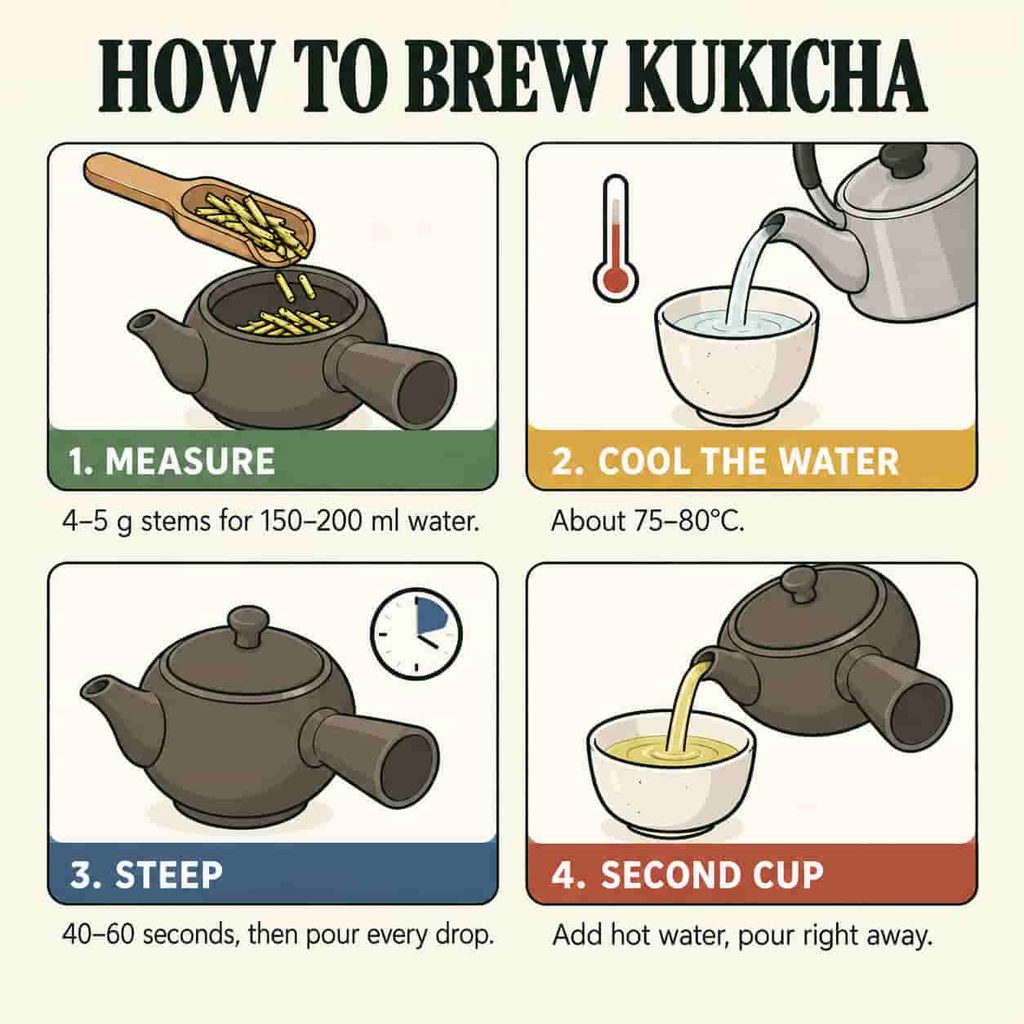
Use about 4 to 5g of kukicha for 150 to 200ml of water. Stems are lighter and bulkier than leaves, so this looks like more tea in the spoon than you’d use for sencha.
Let boiled water cool to about 75 to 80°C. Pouring it into the empty cups first, then into the teapot, is an easy way to drop the temperature without a thermometer.
Kukicha needs a little longer than sencha because stems open more slowly. Pour every last drop into the cups, so the stems don’t sit in leftover water.
Add fresh hot water and pour almost immediately. Standard stem tea usually gives two good infusions, and higher-grade karigane often lasts a little longer.
It also makes a good cold brew. Add about 5g of stems to 500ml of cold water, then leave it in the refrigerator for several hours or overnight. Cold water brings out the sweetness while keeping bitterness low, which suits kukicha’s gentle character.
Choosing and Buying Kukicha
Kukicha quality varies a lot from one bag to the next. A few checks help you find a good one.
- 🍃Decide green or roasted first. Brown stems mean a roasted tea with a toasty flavor. Pale green stems mean the fresh, sweet style common in Japanese tea shops.
- 🍃Look for the base tea. Stems from gyokuro or first-flush sencha tend to make a sweeter, richer cup. Labels like “karigane” or “ichibancha” (first harvest) are useful clues.
- 🍃Check the color and shape. Glossy, bright green, slender stems usually mean a sweeter tea. Lots of dust or thick, woody sticks suggest coarser sorting.
- 🍃Don’t judge by price alone. Because stem tea is sorted from leaf tea, a modest price doesn’t necessarily mean poor quality.
Storing Kukicha
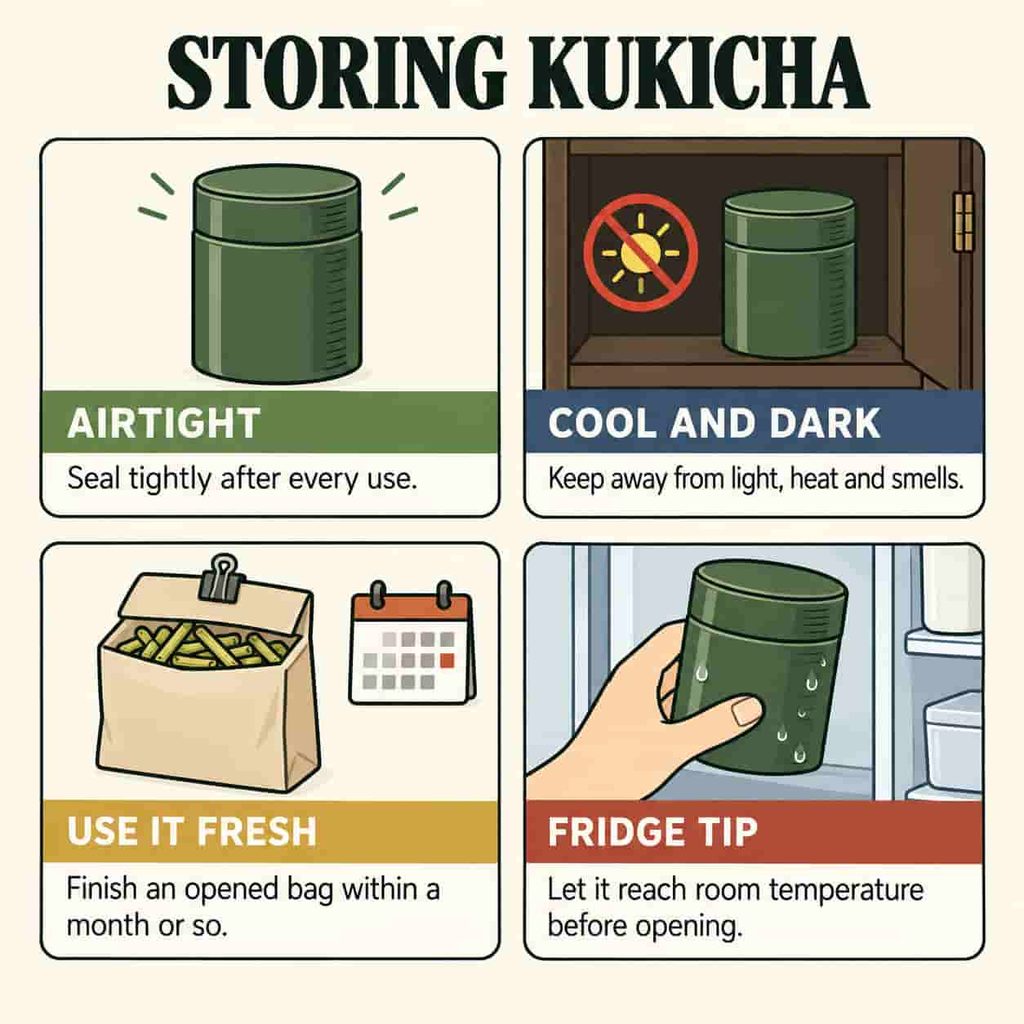
Store kukicha in an airtight container, away from light, heat, moisture, and strong smells. The green style is unroasted, so its fresh aroma fades fairly quickly once the bag is open. Japanese tea guides suggest buying small amounts and finishing an opened bag within a few weeks to a month. If you keep unopened tea in the refrigerator, let it return to room temperature before opening. That stops moisture from condensing on the cold stems. Roasted stem tea holds up better over time, but it still tastes best while fresh.
Common Kukicha Myths
Final Thoughts
Kukicha shows how little Japanese tea culture wastes. The stems that would spoil the look of a fine sencha become a tea of their own, and one that’s very hard to brew badly.
If you’re new to Japanese green tea, kukicha makes a gentle starting point. If you already drink sencha, try brewing a cup of each from the same producer. The leaf and the stem come from the same harvest, yet they taste surprisingly different side by side.
To explore more Japanese tea culture, read these related guides:
.jpg)
Kukicha FAQ
What is kukicha?
Kukicha is a Japanese green tea made mainly from stems and leaf stalks. These are separated from crude tea during the finishing of teas such as sencha and gyokuro.
What does kukicha taste like?
Green kukicha tastes light, sweet, and slightly creamy, with a mild nuttiness and very little bitterness. Roasted kukicha tastes toasty and nutty instead.
Is kukicha the same as hōjicha?
Not usually. Kukicha describes the plant parts used, mainly stems, while hōjicha describes roasting. Green kukicha isn’t roasted at all, but roasted kukicha counts as a stem-based hōjicha.
What is the difference between kukicha and karigane?
Karigane is a name often used for premium kukicha, especially stems sorted from gyokuro or high-grade sencha. It usually has more sweetness and umami than everyday kukicha, though sellers don’t all use the name the same way.
Does kukicha have caffeine?
Yes. Kukicha is generally lower in caffeine than leaf-heavy green teas such as sencha, but it isn’t caffeine-free. The exact amount depends on the base tea and how you brew it.
What temperature should I use to brew kukicha?
Use about 75 to 80°C water for green kukicha and steep for 40 to 60 seconds. For roasted kukicha, use water close to boiling and steep for about 30 seconds.
References
- Japan Tea Central Public Interest Incorporated Association, Green Tea Labeling Standard (in Japanese), on the definitions of kukicha/bōcha, mecha, konacha, hōjicha, and aracha.
- Hara, Fukatsu and Ina, Comparison of Flavor Components Between Kukicha and Sencha, Tea Research Journal (1993, in Japanese), on differences in theanine, caffeine, catechins, linalool, and geraniol between a kukicha and a sencha sample.
- Ministry of Agriculture, Forestry and Fisheries of Japan, Green Tea Feature (in Japanese), on kukicha’s distinctive sweetness and ease of brewing.
- Ministry of Agriculture, Forestry and Fisheries of Japan, Kaga Bocha, on Ishikawa’s roasted stem tea.
- Ocha.tv, Kukicha, Mecha, and Konacha (in Japanese), on sorting during the finishing stage and how stem color relates to sweetness.
- Ocha.tv, How to Store Tea (in Japanese), on airtight, cool, dark storage and letting refrigerated tea reach room temperature before opening.
- Global Japanese Tea Association, Kukicha, on the bō, kuki, and yōmyaku parts of the shoot, and green versus roasted flavor.
- Cha no Niwa, What Is Kukicha? (in Japanese), on the green “leaf alcohol” aroma associated with stems and the difference from hōjicha.
- e-cha, Kukicha Characteristics and Brewing (in Japanese), on brewing amount, temperature, and steeping time.
- Shizuokatea, The Differences Between Kukicha, Kariganecha, and Shiraore, on how sellers use these names and the number of infusions each style typically gives.
- Smithsonian National Museum of American History, Michio and Aveline Kushi Macrobiotics Collection, on the history of the macrobiotic movement in the United States.
- Wikipedia, Kukicha, on alternative English names and kukicha’s place in the macrobiotic diet.



Comments