


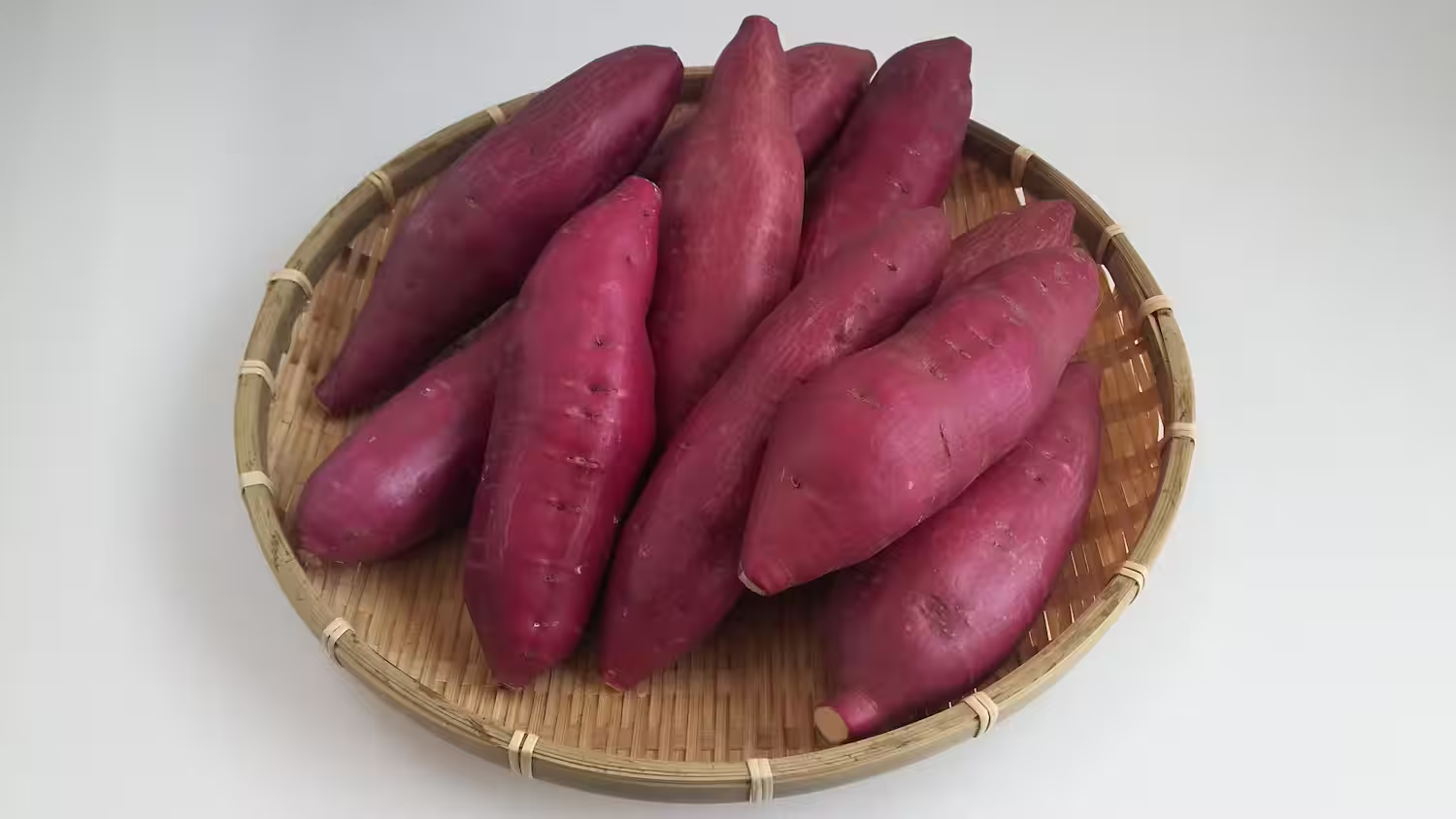

In autumn, shoppers across Kansai are likely to see one Tokushima name repeated on produce signs: Naruto Kintoki. This Naruto Kintoki sweet potato comes from sandy fields in Tokushima Prefecture, on the island of Shikoku. Roast one slowly, and the Japanese sweet potato opens up to golden flesh with a chestnut-like, fluffy texture.
So what exactly are you buying when the label says Naruto Kintoki? This guide covers that question first, because the answer surprises many readers. After that, it moves on to taste, season, storage and an easy oven recipe. Most facts come from Japan’s trademark registry, Tokushima research reports and peer-reviewed papers rather than sales copy.
What Is Naruto Kintoki?
Naruto Kintoki (なると金時) is a regional brand of Japanese sweet potato from northeastern Tokushima. Growers produce it in the sandy-field districts of Naruto City, Tokushima City and Itano District covered by the trademark. The potatoes descend from Kokei No. 14 (高系14号), a cultivar from neighboring Kochi Prefecture that this article shortens to Kokei 14. In short, the name tells you where and how the potato grew, not that it is a new cultivar.
Quick Facts: Naruto Kintoki
- Japanese name
- なると金時 (registered form). Many shops write 鳴門金時.
- Type
- Regional brand of satsumaimo (Ipomoea batatas)
- Genetic base
- Selected lines of the cultivar Kokei No. 14
- Trademark area
- Naruto City, Tokushima City and Itano District, Tokushima
- Legal status
- Regional collective trademark No. 5043110, registered April 20, 2007
- Skin and flesh
- Red-crimson skin, cream flesh that turns golden when cooked
- Texture
- Dry, fluffy and chestnut-like (hokuhoku)
- Season
- Harvested mainly from late summer into autumn; storage extends shipping well beyond the harvest
- Best uses
- Roasting, tempura, daigaku imo and Japanese sweets
A Regional Sweet Potato Brand from Tokushima
Tokushima sits on the eastern edge of Shikoku, across the Naruto Strait from Awaji Island. Its northeastern corner, near the mouth of the Yoshino River, holds wide belts of sandy farmland. These coastal and delta fields form the core production zone for Naruto Kintoki.
JA Zen-Noh Tokushima, the prefectural arm of Japan’s farm co-op federation, identifies four principal areas. These are Naruto City, Tokushima City, Matsushige and Kitajima. Four local agricultural cooperatives handle shipments. The organization also reports that Tokushima ranked fifth in Japan for sweet potato harvest in 2024.
Is Naruto Kintoki a Cultivar or a Brand?
This question trips up most readers, so let’s settle it early. Naruto Kintoki is not a separately bred cultivar, even though many websites call it one. A 2017 NARO breeding report explains how growers in each production area selected derived lines of Kokei 14. They then branded them, as with Naruto Kintoki. The Japan Root and Tuber Crops Development Association adds a related point. Many local names for Kokei 14 come from bud sports that differ in skin color. In other words, growers selected distinctive mutations and lines within Kokei 14 rather than creating a new cultivar through a cross.
Commercially, three things make it Naruto Kintoki. They are its Kokei 14 lineage, production in the trademarked Tokushima area and authorized use of the regional brand. Kokei 14 grown in Kochi or Kagoshima may share some characteristics, but it does not fall within the registered product designation for なると金時.
An easy way to keep the names straight
- Kokei No. 14 (Kokei 14)The cultivar, named in Kochi in 1945
- Naruto KintokiThe regional brand for selected Kokei 14 lines from the Tokushima area
- Satomusume and othersLocal co-op labels inside the Naruto Kintoki brand
The Meaning of the Name “Naruto Kintoki”
Naruto refers to the production area centered on Naruto City and its strait, famous for tidal whirlpools. The exact reason the word Kintoki was chosen has not been confirmed in a contemporary naming record. In Japanese food names, however, kintoki is commonly associated with red-colored beans, vegetables and sweet potatoes, such as Gorōjima Kintoki from Ishikawa. Some modern sellers connect the name with the potato’s golden cooked flesh instead.
Spelling causes confusion too. The registered trademark mixes hiragana and kanji as なると金時. Shops and menus, by contrast, often write 鳴門金時 in full kanji. Still, both point to the same potato.
Where Is Naruto Kintoki Grown?
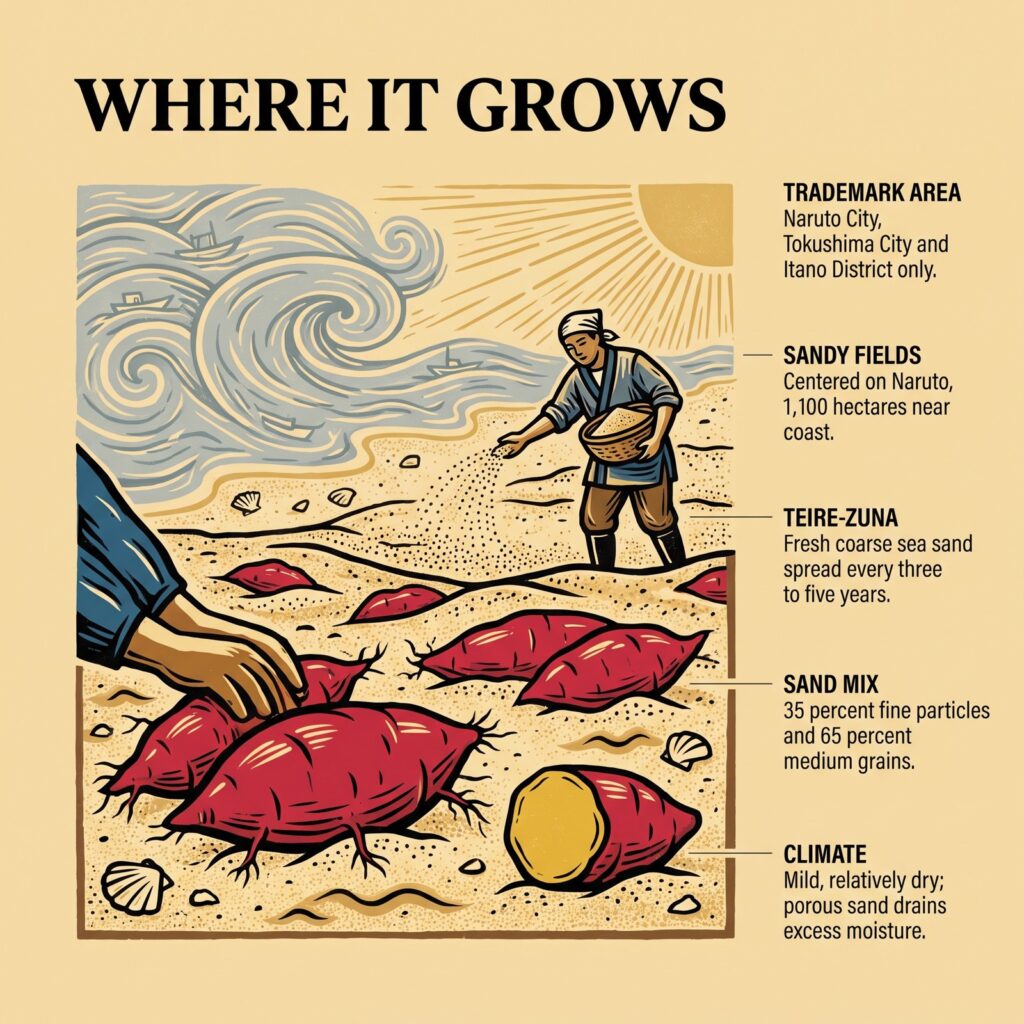
Naruto City, Tokushima City and Itano District
The trademark covers kintoki sweet potatoes from three places only: Naruto City, Tokushima City and Itano District. A potato grown outside that area therefore does not fall within the registered product designation. Inside Naruto itself, meanwhile, the local tourism association names Satoura, Ōtsu and Ōge Island as the main districts.
Across the river, farmers in Matsushige and Kitajima work similar ground too. A 1976 farm weather study placed Matsushige on a delta between the old and new Yoshino rivers. As a result, the soil there is sandy throughout.
How Sandy Coastal Soil Shapes the Sweet Potato
Sand is most of the story here. In 1999, the Tokushima Prefectural Agricultural Experiment Station counted about 1,100 hectares of sandy fields centered on Naruto. Farmers grew sweet potatoes there in summer, then daikon radish in winter. Every three to five years, they also spread fresh coarse sea sand over each field. Locally, this practice goes by the name teire-zuna, roughly “care sand.”
The researchers then tested different sand mixes. In the end, a mix of about 35 percent fine particles and 65 percent medium grains worked best. That mix steadied yields, and it also gave smoother skins, smaller pores and rounder tips. A 2002 paper by the same researchers later revisited the topic in a national soil science journal.
What about the famous sea minerals? The trademark description says the crop absorbs minerals from seawater. That explanation is part of the official regional description. However, the cited soil studies measured yield and appearance. By themselves, they do not establish that seawater-derived minerals increase sweetness or flavor.
Tokushima’s Climate and Growing Conditions
The trademark entry also credits the Setouchi climate, which stays mild and relatively dry. Sweet potatoes generally perform better in well-drained soil than in persistently waterlogged conditions. Together with the region’s relatively low rainfall, the porous sand helps prevent excess moisture around the roots.
History of Naruto Kintoki

The brand is young, but the farming behind it is not. The timeline below separates the long story of Naruto sweet potatoes from the shorter story of the name.
- Early Meiji eraNaruto farmers already grow around 265 ha of sweet potatoes.
- 1945Kochi breeders name the cultivar Kokei 14.
- 1955 to 1964Kokei 14 reaches the Naruto area and then spreads.
- 1965 to 1974The sandy-field zone grows to about 1,000 ha.
- Around 1980The name Naruto Kintoki comes into use.
- 2007The Japan Patent Office registers なると金時.
Before the Brand: Naruto’s Early Sweet Potato Fields
A 2011 article by a Tokushima farm extension officer traces the crop back to the early Meiji era. Citing Naruto city history, it records about 265 hectares of sweet potatoes at that time. It also passes on a local account. In it, a farmer from Satoura selected a superior line from sweet potatoes carried on a ship from Ōmura in Nagasaki.
He reportedly named it Ainoko imo, after the hybrid steam-and-sail vessels known locally as ainoko-bune that passed through the strait. Kansai buyers, meanwhile, knew it as Muya imo. The fields have an unusual past as well. Salt damage once left low coastal wetlands useless. So farmers laid coal cinders from local salt works, then hauled in beach sand. Eventually, those patches became today’s sandy fields.
The Kokei No. 14 Lineage
Kokei 14 came from Kochi, Tokushima’s neighbor on Shikoku. According to the Japan Root and Tuber Crops Development Association, its parents were Nancy Hall and Siam. Breeders in Kochi named it in 1945. Because it sized up early, yielded well and tasted good, it soon spread across western Japan.
Naruto growers adopted it later, in the late 1950s and early 1960s. Kokei 14 also throws off bud sports with slightly different skin tones. So farmers kept picking plants with the best color and shape. A common industry shorthand captures its former geographic reach: Beniazuma in the east, Kokei 14 in the west.
From Local Potato to Registered Brand
By the early 1970s, the zone covered roughly 1,000 hectares across two cities and two towns. Then, around 1980, potatoes from this zone started selling as Naruto Kintoki, JA Zen-Noh Tokushima says. Some shops credit Ōge Island as the birthplace. Even so, no contemporary naming record located for this article confirms Ōge Island as the single birthplace of the brand.
The legal step came on April 20, 2007, when the Japan Patent Office registered the name. Zen-Noh holds the right. However, this is a regional collective trademark, not a Geographical Indication (GI). That difference matters if you compare it with GI foods such as Tanegashima’s Anno Imo.
What Does Naruto Kintoki Taste Like?
Natural Sweetness and Chestnut-Like Flavor
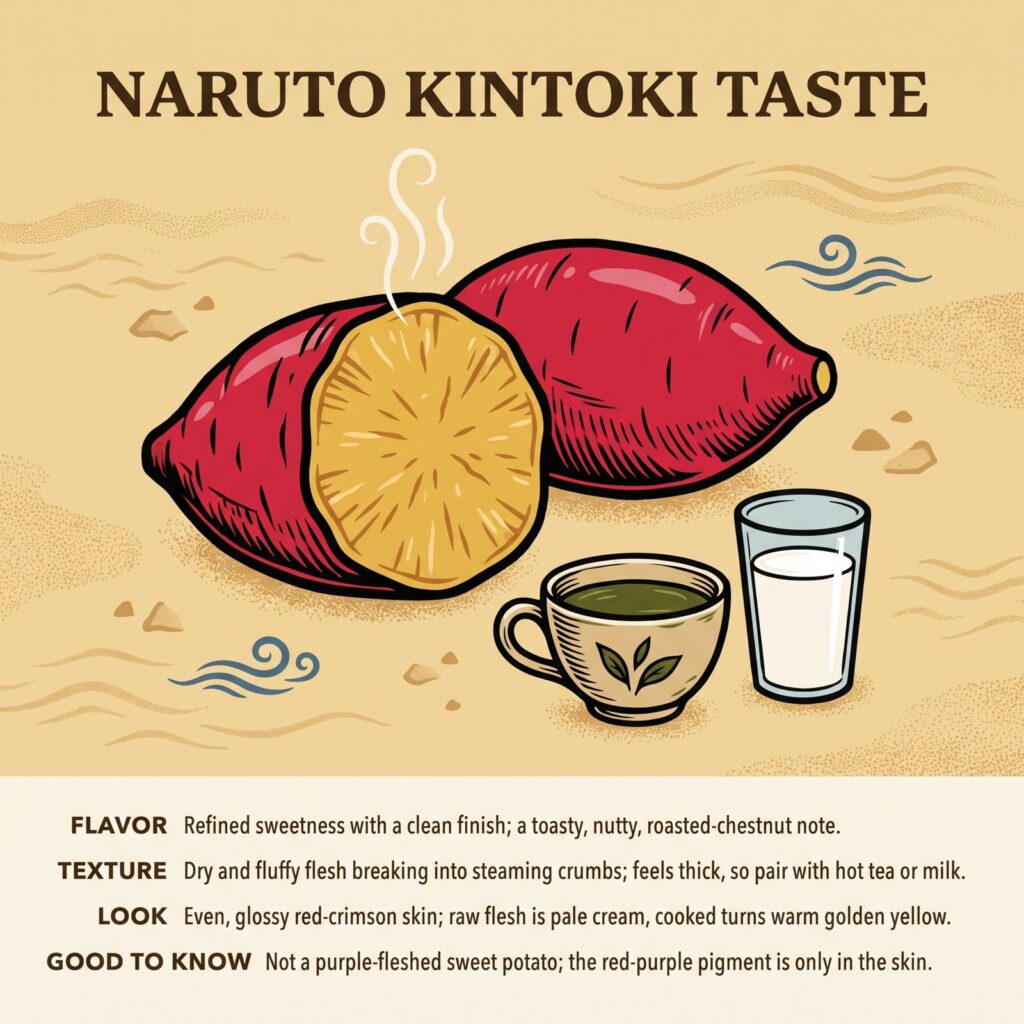
Expect sweetness, but not candy. JA Zen-Noh Tokushima describes a refined sweetness with a clean finish. After a slow roast, tasters often describe a toasty, nutty note close to roasted chestnuts. Japanese cooks often choose it precisely because it does not overwhelm a dish.
If you love the syrupy center of a Beni Haruka, though, your first bite may feel a little restrained. Is that a flaw? Honestly, it depends on the plate. Next to salty tempura batter or a pat of butter, though, that restraint starts to look like a strength.
Fluffy and Starchy Texture
Texture is where Naruto Kintoki really stands apart. Japanese cooks call it hokuhoku: dry, fluffy flesh that breaks into steaming crumbs. A baked russet potato gives a rough idea, although this one tastes far sweeter. A study in the journal Food Preservation Science likewise compares the texture to chestnuts.
One small warning. Because the flesh stays so dry, it can feel a bit thick in the mouth. So a cup of hot green tea or a glass of cold milk on the side helps.
Red Skin and Golden Flesh
Looks matter in Japanese produce, and this potato photographs well. The skin, for one thing, shows an even, glossy red-crimson color. Raw flesh looks pale cream, yet heat turns it a warm golden yellow. Sellers love cut-open displays as a result. It is not a purple-fleshed sweet potato. The red-purple pigment is concentrated in the skin, while the flesh remains cream to golden yellow.
Naruto Kintoki vs Other Japanese Sweet Potatoes
Japan grows dozens of named sweet potatoes, and our Japanese sweet potato varieties guide covers the major ones. Here, Naruto Kintoki goes head to head with three famous names. All descriptions stay relative, since storage and cooking change sweetness a lot.
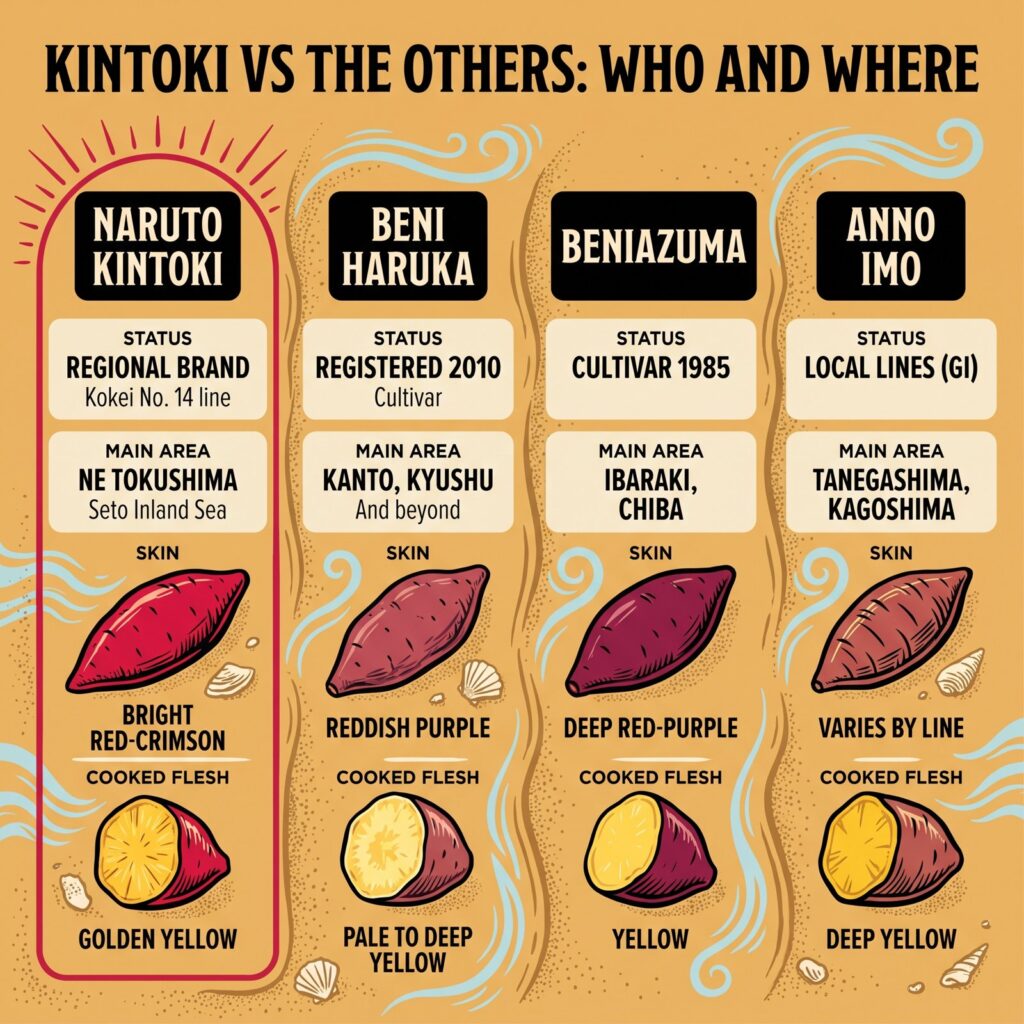
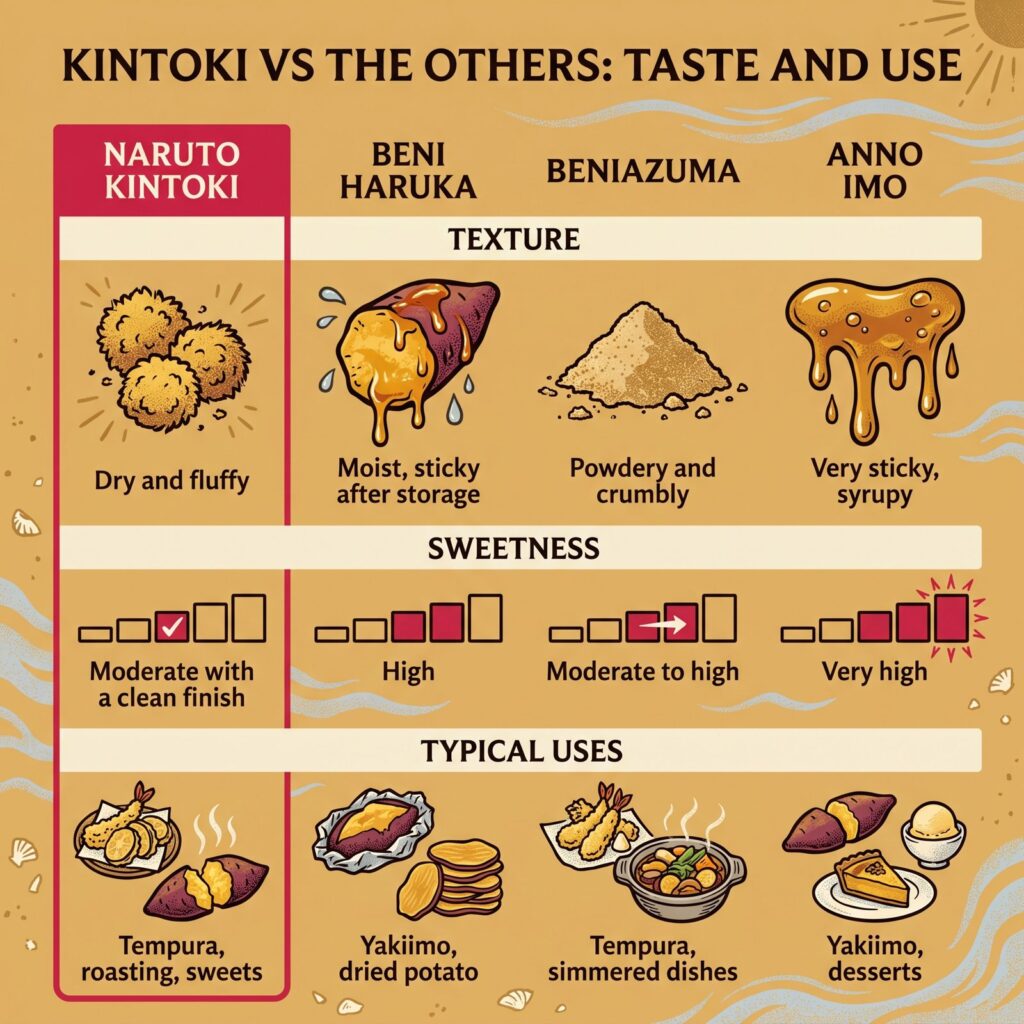
| Feature | Naruto Kintoki | Beni Haruka | Beniazuma | Anno Imo |
|---|---|---|---|---|
| Status | Regional brand (Kokei No. 14 line) | Cultivar, registered 2010 | Cultivar from 1985 | Local lines with a GI name |
| Main area | Northeastern Tokushima | Kanto, Kyushu and beyond | Ibaraki and Chiba | Tanegashima, Kagoshima |
| Skin | Bright red-crimson | Reddish purple | Deep red-purple | Varies by line |
| Cooked flesh | Golden yellow | Pale to deep yellow | Yellow | Deep yellow |
| Texture | Dry and fluffy | Moist, sticky after storage | Powdery and crumbly | Very sticky, syrupy |
| Sweetness | Moderate, clean finish | High | Moderate to high | Very high |
| Typical uses | Tempura, roasting, sweets | Yakiimo, dried potato | Tempura, simmered dishes | Yakiimo, desserts |
Naruto Kintoki vs Beni Haruka
This is the matchup most shoppers care about. Beni Haruka came out of national breeding in Kyushu, and it turns moist, then sticky, as it ages in storage. Naruto Kintoki, however, stays dry and crumbly. So which should you buy?
Pick Beni Haruka when you want a dessert-like yakiimo. For tempura, savory dishes or a classic fluffy roast, choose Naruto Kintoki instead. Our Beni Haruka guide explains the other side in detail.
Naruto Kintoki vs Beni Azuma
These two, unlike Beni Haruka, share the fluffy camp. The easiest tell is the skin: Beniazuma looks darker and more purple, whereas Naruto Kintoki shows a brighter red. Most home recipes let you swap one for the other. Our Beniazuma guide tells its Kanto story.
Naruto Kintoki vs Anno Imo
Anno Imo sits at the opposite end of the scale. It comes from Tanegashima, an island in Kagoshima Prefecture, and bakes into a sticky, almost syrupy flesh. Naruto Kintoki, by comparison, never gets that wet. Think of Anno Imo as a dessert on its own, while Naruto Kintoki works more like an all-purpose kitchen potato.
Which Sweet Potato Is Best for Roasting?
Honestly, the answer depends on what you want from a roast. For creamy, honey-like yakiimo, moist types such as Beni Haruka usually come out ahead. For a fluffy roast with a crisp skin, though, Naruto Kintoki is hard to beat. Chiba’s Benikomachi, a Kokei 14 offspring, also offers a similar dry style if you can find it.
When Is Naruto Kintoki in Season?
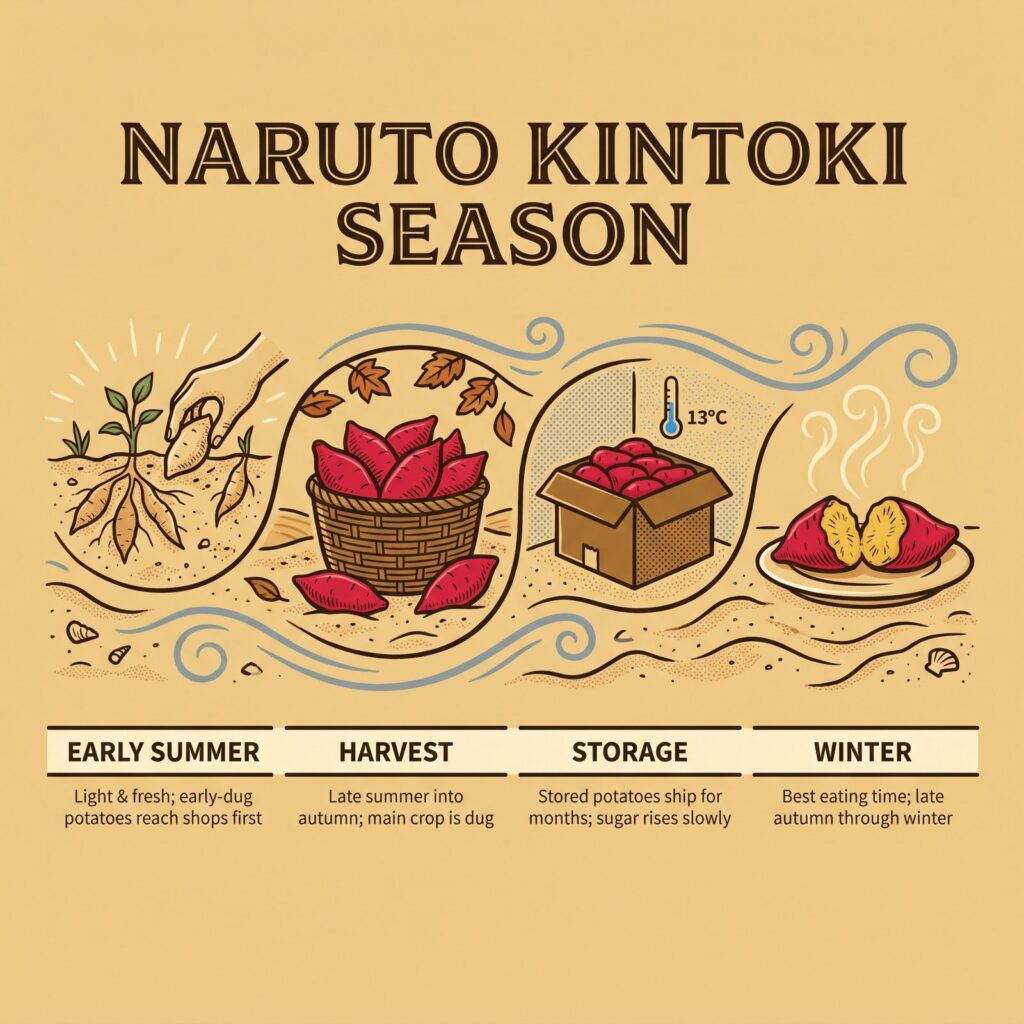
Harvest and Shipping Periods
Harvest runs mainly from late summer into autumn, according to Arudeyo Tokushima, a prefectural trade promotion site. Growers then store the potatoes and keep shipping for months after the harvest. Early-dug potatoes reach shops before the main harvest.
For example, JA Satoura opened sales of its 2026 crop on July 20, 2026. Its 2025 crop, meanwhile, sold until February 18, 2026. Those dates give a useful real-world window for online orders.
Why Storage Can Increase Sweetness
Fresh-dug is not always best with sweet potatoes. In 2014, researchers at Ishikawa Prefectural University reported that Kokei 14 has little sugar right after harvest. Its sugar then rises slowly in storage. Cold speeds that process up, but it also invites rot.
Similarly, a later study in Food Preservation Science explored the same trade-off for Naruto Kintoki. It treats 13°C as the usual storage target. Below that, starch turns to sugar faster, yet chilling injury becomes a real risk. The team found that a conditioning step plus a heat treatment, before cold storage, avoided the damage. Those are export and laboratory conditions, though, not a home storage method.
The Best Time to Eat Naruto Kintoki
So when should you buy? Late autumn through winter is a safe bet, since stored potatoes have had time to sweeten. Early summer potatoes, on the other hand, taste lighter and fresher. Neither choice is wrong. They are simply two moods of the same crop.
How to Cook Naruto Kintoki
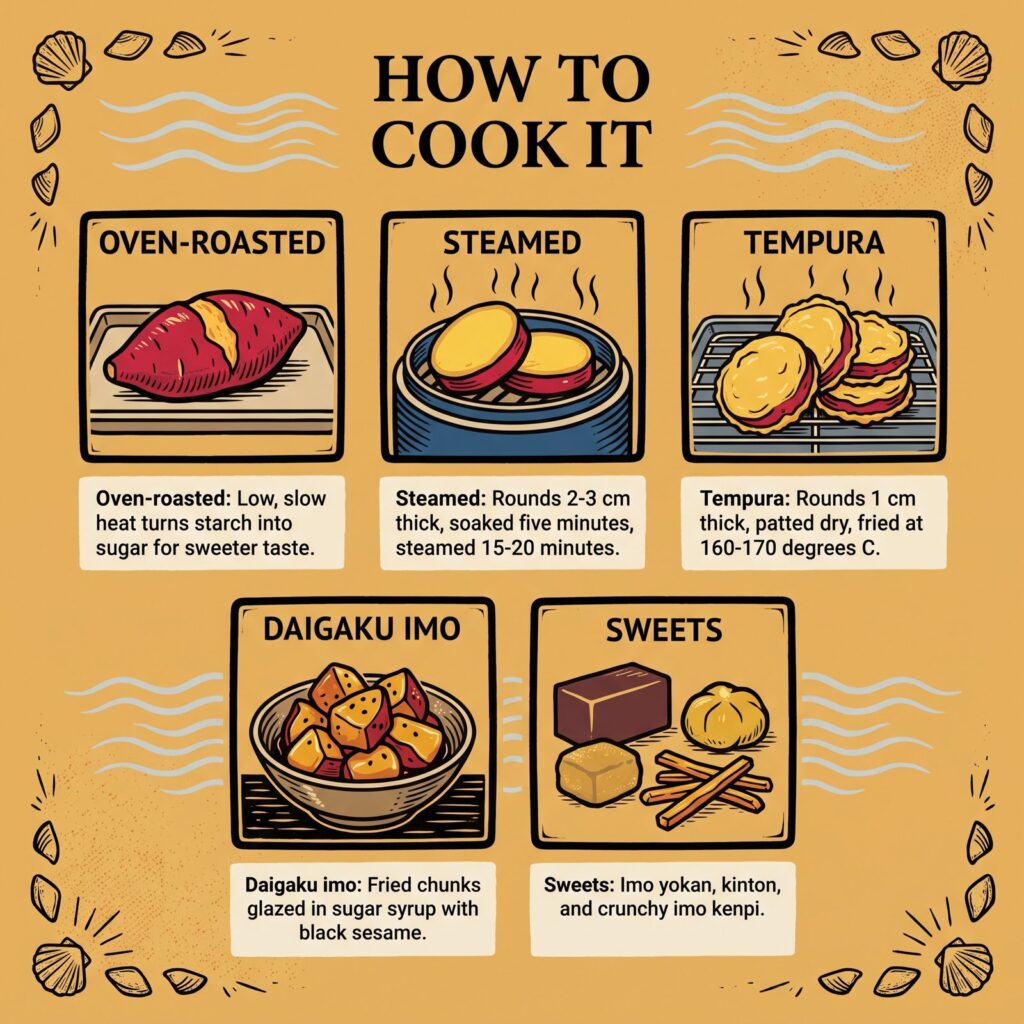
Dry, fluffy potatoes reward gentle heat and a little patience. The methods below suit a home kitchen. Still, timing depends on size and on your stove or oven, so treat every number as a starting point.
Oven-Roasted Naruto Kintoki
Roasting is the classic choice. Low heat, in particular, keeps the flesh in the range where the potato’s enzymes turn starch into sugar. As a result, a slow roast tastes sweeter than a quick microwave job. Japan’s street version, ishi-yaki imo, uses hot stones, and our yakiimo guide explains that tradition.
Steamed Naruto Kintoki
Steaming shows off the hokuhoku texture best. First, cut the potato into rounds 2 to 3 cm thick and soak them in water for five minutes. Then steam for about 15 to 20 minutes, until a skewer slides through. A pinch of salt is all it needs.
Naruto Kintoki Tempura
Tempura may be where this potato shines brightest. The dry flesh stays fluffy under crisp batter instead of turning gummy. Slice rounds about 1 cm thick and pat them dry. Then fry them at 160 to 170°C (320 to 340°F). That moderate heat lets the center soften before the batter browns.
Candied Sweet Potato
Daigaku imo coats fried chunks in a glossy sugar syrup with black sesame. Because dry varieties hold their shape under the glaze, Naruto Kintoki makes a natural fit. Our daigaku imo article covers the history and a full recipe.
Japanese Sweets and Desserts
Confectioners like fluffy potatoes because the mashed flesh forms a firm paste that holds its shape. As a result, you may meet it in imo yokan, a sweet potato cake or kinton, a cousin of kurikinton. Shikoku also loves imo kenpi, crunchy candied sweet potato sticks.
Easy Oven-Roasted Naruto Kintoki Recipe
This simple roast lets the potato speak for itself. Besides an ordinary oven, you only need two ingredients. The times are starting points, so always check with a skewer before you pull the tray.
Simple Oven-Roasted Naruto Kintoki
Ingredients
- 2 medium Naruto Kintoki, about 200 to 250 g each
- Flaky salt, to taste
- Butter, optional
- Aluminum foil, optional
Instructions
- First, heat the oven to 160°C (320°F) and line a tray with parchment.
- Meanwhile, scrub the potatoes under running water, leaving the skin on.
- Wrap them in foil for softer skin, or leave them bare for a toasty finish.
- Bake 70 to 90 minutes, turning once halfway through.
- Then push a skewer into the thickest part until it slides in easily.
- Finally, switch off the oven and rest the potatoes inside for 10 minutes.
Oven Temperature and Cooking Time
Why such a low setting? Gentle heat gives the enzymes time to work, so the flesh ends up sweeter. Small, slim potatoes may finish in about 60 minutes. Large ones, by contrast, can need well over 90. When in doubt, add ten minutes and test again.
Serving Suggestions
Split the potato while it still steams and add a pinch of flaky salt. A little butter works too. In Japan, roasted sweet potato often comes with hot green tea or cold milk. Leftovers? Mash them into pancake batter, or fold the cubes into freshly cooked rice.
Nutrition and Dietary Features
We could not find an official nutrition analysis for Naruto Kintoki alone. So the figures below come from Japan’s Standard Tables of Food Composition, Eighth Revised Edition, 2023 supplement. They describe sweet potatoes in general, per 100 g of peeled flesh.
| Per 100 g | Raw, peeled | Baked, peeled |
|---|---|---|
| Energy | 126 kcal | 151 kcal |
| Protein | 1.2 g | 1.4 g |
| Fat | 0.2 g | 0.2 g |
| Carbohydrate | 31.9 g | 39.0 g |
| Dietary fiber | 2.2 g | 4.5 g |
| Potassium | 480 mg | 500 mg |
| Vitamin C | 29 mg | 13 mg |
Carbohydrates and Dietary Fiber
Like all sweet potatoes, Naruto Kintoki is mostly carbohydrate. Baking drives off water, so the numbers per 100 g climb. That also explains the jump in calories. Fiber looks higher in the baked entry too, partly because of water loss.
Vitamins and Minerals
Sweet potatoes also supply potassium and some vitamin C. However, heat lowers the vitamin C, as the table shows. Potassium, by comparison, holds fairly steady.
Is Naruto Kintoki Healthy?
It can fit well into a balanced diet. A plain roasted potato needs no added oil or sugar, and it fills you up. Toppings change the picture fast, though. Butter, syrup and deep-frying all add calories. If you manage a health condition, ask a doctor or dietitian for advice that fits you.
How to Choose and Store Naruto Kintoki
How to Select Good Sweet Potatoes
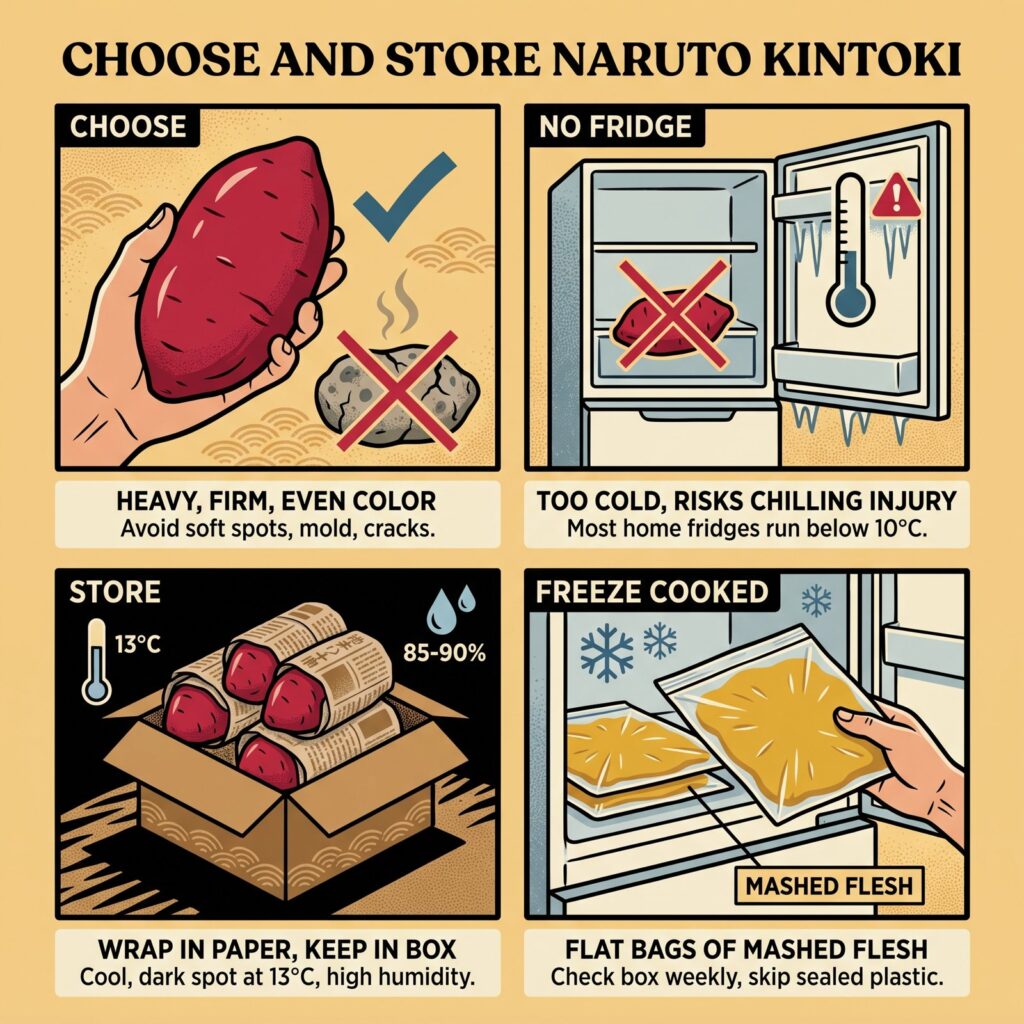
Pick potatoes that feel heavy for their size, with firm, evenly colored skin. Also avoid soft spots, mold, sour smells or deep cracks. Medium, evenly shaped roots roast more evenly than very thin or very fat ones. Still, a few small scuffs near the ends are normal.
Why You Should Avoid Refrigeration
Sweet potatoes dislike cold. Most home fridges run well below 10°C, so they can cause chilling injury and rot. Even controlled research storage walks a fine line, as the Food Preservation Science study shows. So keep whole potatoes out of the fridge. Cut or cooked potatoes are another matter; wrap them well and chill them.
Recommended Storage Conditions
Arudeyo Tokushima gives 13°C and 85 to 90 percent humidity as the ideal. Few homes hit that exactly, but these habits get you close:
- Wrap each potato in newspaper or kraft paper.
- Then keep them in a cardboard box in a cool, dark spot.
- Skip sealed plastic bags, because they trap moisture.
- Check the box weekly, and use damaged potatoes before the rest.
- Freeze cooked, mashed flesh in flat bags for baking later.
Regional Naruto Kintoki Brands
Within the brand, some local co-ops add their own labels. JA Zen-Noh Tokushima lists three of them. Spotting these names is a handy way to know exactly where your potatoes grew.
Satomusume (里むすめ)
JA Satoura in Naruto ships Satomusume from sandy fields beside the strait. The co-op markets it as its top-grade Naruto Kintoki, praising the fine skin and refined sweetness. JA Satoura also sells it through its own online shop.
Matsushige Bijin (松茂美人)
Matsushige Bijin comes from the Matsushige branch of JA Ōtsu-Matsushige in Itano District. The name roughly means “Matsushige beauty.” It also grows on the same delta sand described earlier.
Amahime (甘姫)
Amahime ships from the Kawauchi branch of JA Tokushima-shi. Its name translates as “sweet princess.” Like the other two labels, it still falls under the Naruto Kintoki trademark.
Where to Buy Naruto Kintoki
Buying It in Japan
Western Japan, especially Kansai, offers the best odds. Look in supermarkets, department store food halls and farm stands, particularly from late summer onward. Labels may read なると金時, 鳴門金時 or simply Naruto Kintoki. When a sign only says satsumaimo, ask the staff which variety it is.
Online Stores and Seasonal Availability
Several co-op shops sell boxes online. JA Satoura, for instance, runs its own store with fresh potatoes and processed treats. Most such shops target buyers inside Japan, so check the shipping page before ordering. Supplies can thin out by late winter, as JA Satoura’s February closing date suggests.
Finding Naruto Kintoki Outside Japan
Overseas interest is real. For example, the Food Preservation Science study points to rising demand abroad. A grower-owned company in Tokushima has also published an export plan through Japan’s agriculture ministry. Even so, fresh sweet potatoes face plant quarantine rules in most countries. Check your local import regulations first, and expect availability to vary by season.
Naruto Kintoki Sweets as Souvenirs
Can’t carry fresh potatoes home? Processed sweets, on the other hand, travel far better. In Tokushima, you can find Naruto Kintoki tarts, cakes, chips and yokan. Read the label, though, because some products contain only a small share of local potato.
Experience Naruto Kintoki in Tokushima
Food Markets and Local Shops
Naruto makes an easy day trip from Tokushima City, or from Kansai by highway bus. The Naruto Uzushio Tourism Association runs Naruto Bussankan, a local product shop with a page devoted to Naruto Kintoki. In autumn, co-op farm stores in the growing area stock fresh potatoes too.
Timing a trip? Around October 13, Japan’s informal Sweet Potato Day, Tokushima’s promotion council runs tastings in consumer markets across Japan. It is also a fun chance to taste the potato far from Tokushima.
Other Regional Foods to Try
Save room for more than potatoes. Tokushima ramen pairs sweet-savory pork with a raw egg. Handa somen offers thick, hand-stretched noodles instead. Then there is Awaodori chicken, a local breed with deep flavor. For the wider picture, start with our Shikoku food guide.
Why Naruto Kintoki Still Matters
Naruto Kintoki is valued less for extreme sweetness than for its bright skin, golden flesh and dry, fluffy texture. That bite suits tempura as well as a slow roast. Behind it sits more than a century of sandy-field farming. A trademark also ties the name to one corner of Tokushima.
The brand does face pressure. For example, a Tokushima research summary notes competition from high-sugar Beni Haruka and cheaper Kanto-grown Beniazuma. In response, the prefecture started breeding next-generation varieties for its sandy fields. Still, if you like your sweet potato fluffy rather than syrupy, this is the one to look for. Roast it slowly, add a little salt and judge for yourself.
Naruto Kintoki FAQ
Brand and Name
- Is Naruto Kintoki a variety or a regional brand?
-
It is a regional brand, not a separately bred cultivar. The potatoes come from lines that growers selected within Kokei 14, a cultivar named in Kochi in 1945. In 2007, the Japan Patent Office registered なると金時 as a regional collective trademark. The brand is reserved for authorized use on qualifying sweet potatoes from the Tokushima production area.
- Why is it called Naruto Kintoki?
-
Naruto points to the production area centered on Naruto City and its famous strait. No contemporary naming record explains why the word kintoki was chosen. In Japanese food names, kintoki usually refers to red-colored beans, vegetables and sweet potatoes, though some sellers link it to the golden cooked flesh. The name came into use around 1980.
- Is Naruto Kintoki the same as satsumaimo?
-
Satsumaimo is the general Japanese word for sweet potato, so every Naruto Kintoki is a satsumaimo. The reverse, however, is not true. Naruto Kintoki is one regional brand within that broad category, with its own lineage, growing area and trademark.
- Is Naruto Kintoki a purple sweet potato?
-
No. The red-purple pigment sits in the skin, while the flesh looks pale cream when raw. Cooking then turns the flesh golden yellow. Purple sweet potatoes such as Ayamurasaki, by contrast, have purple flesh all the way through.
Cooking and Storage
- Can you eat the skin of Naruto Kintoki?
-
Yes. Scrub it well under running water first. The thin skin crisps nicely in the oven and adds color to tempura and rice dishes. Cut away any moldy, soft or deeply damaged spots before cooking.
- Why should Naruto Kintoki not be refrigerated?
-
Sweet potatoes suffer chilling injury at the low temperatures inside a typical fridge, and rot can follow. Growers aim for about 13°C in storage, so a cool, dark cupboard comes much closer. Refrigerate only cut or cooked potatoes, and use them within a few days.
Buying
- Can you buy Naruto Kintoki outside Japan?
-
Sometimes, but supply is limited. Tokushima growers have published an export plan, and a Food Preservation Science study notes rising demand abroad. Fresh sweet potatoes still face plant quarantine rules in most countries, so check local import regulations. Processed sweets made with Naruto Kintoki travel more easily.
References
- Japan Patent Office – Regional Collective Trademark No. 5043110, なると金時 (Accessed October 2026)
- JA Zen-Noh Tokushima – Naruto Kintoki (Accessed October 2026)
- Arudeyo Tokushima – Naruto Kintoki (Accessed October 2026)
- J-STAGE – Yoshida et al., Postharvest Sweetening and Chilling Injury Control in Naruto Kintoki for Export, Food Preservation Science 49(2): 87–94 (Accessed October 2026)
- NARO Repository – Kai et al. (2017), Breeding of the Sweet Potato Cultivar Beniharuka, Bulletin of the NARO Kyushu Okinawa Agricultural Research Center No. 66 (Accessed October 2026)
- Tokushima Prefecture – Kakehashi and Kuroshima (1999), Proper Particle Size Composition of the Sandy Field Soil in Sweet Potato Cultivation (Accessed October 2026)
- J-STAGE – Kakehashi et al. (2002), Sandy Soil Particle Size and Sweet Potato Yield and Quality, Japanese Journal of Soil Science and Plant Nutrition 73(3) (Accessed October 2026)
- J-STAGE – Tosa (1976), Alternate Planting in Sweet Potato Cultivation, Journal of Agricultural Meteorology 32(2) (Accessed October 2026)
- Imo Shinkōkai – Minami (2011), History and Regional Branding of Naruto Kintoki, Imo-rui Shinkō Jōhō No. 107 (Accessed October 2026)
- Japan Root and Tuber Crops Development Association – Sweet Potato Varieties and Characteristics (Accessed October 2026)
- Ministry of Agriculture, Forestry and Fisheries – aff Magazine (November 2017), Sweet Potato Varieties (Accessed October 2026)
- Ishikawa Prefectural University – Press Release (2014) on How Kokei 14 Sweetens at the Gene Level (Accessed October 2026)
- Tokushima Prefecture – Breeding Varieties to Expand the Naruto Kintoki Brand (Accessed October 2026)
- Naruto Uzushio Tourism Association – About Naruto Kintoki (Accessed October 2026)
- JA Satoura – Naruto Kintoki Satomusume (Accessed October 2026)
- JA Satoura Beppindo – Online Shop Sales Notices (Accessed October 2026)
- MAFF – GFP Export Plan for Naruto Kintoki (Accessed October 2026)
- MEXT – Standard Tables of Food Composition in Japan, 2023 Supplement (Accessed October 2026)
Related Articles
- Japanese Sweet Potato (Satsumaimo) Guide (Surveyed: October 2026)
- Beniharuka Sweet Potato: Taste, Origin and Uses (Surveyed: October 2026)
- Beniazuma Sweet Potato: Taste, Season and Uses (Surveyed: October 2026)
- Benikomachi Sweet Potato: Taste, History and Uses (Surveyed: October 2026)
- Yakiimo (焼き芋) (Surveyed: October 2026)
- Daigaku Imo (大学芋) (Surveyed: October 2026)
- Hoshiimo: Japanese Dried Sweet Potato (Surveyed: October 2026)
- Tokushima Ramen (徳島ラーメン) (Surveyed: October 2026)
- Shikoku Food Guide (Surveyed: October 2026)




Comments