


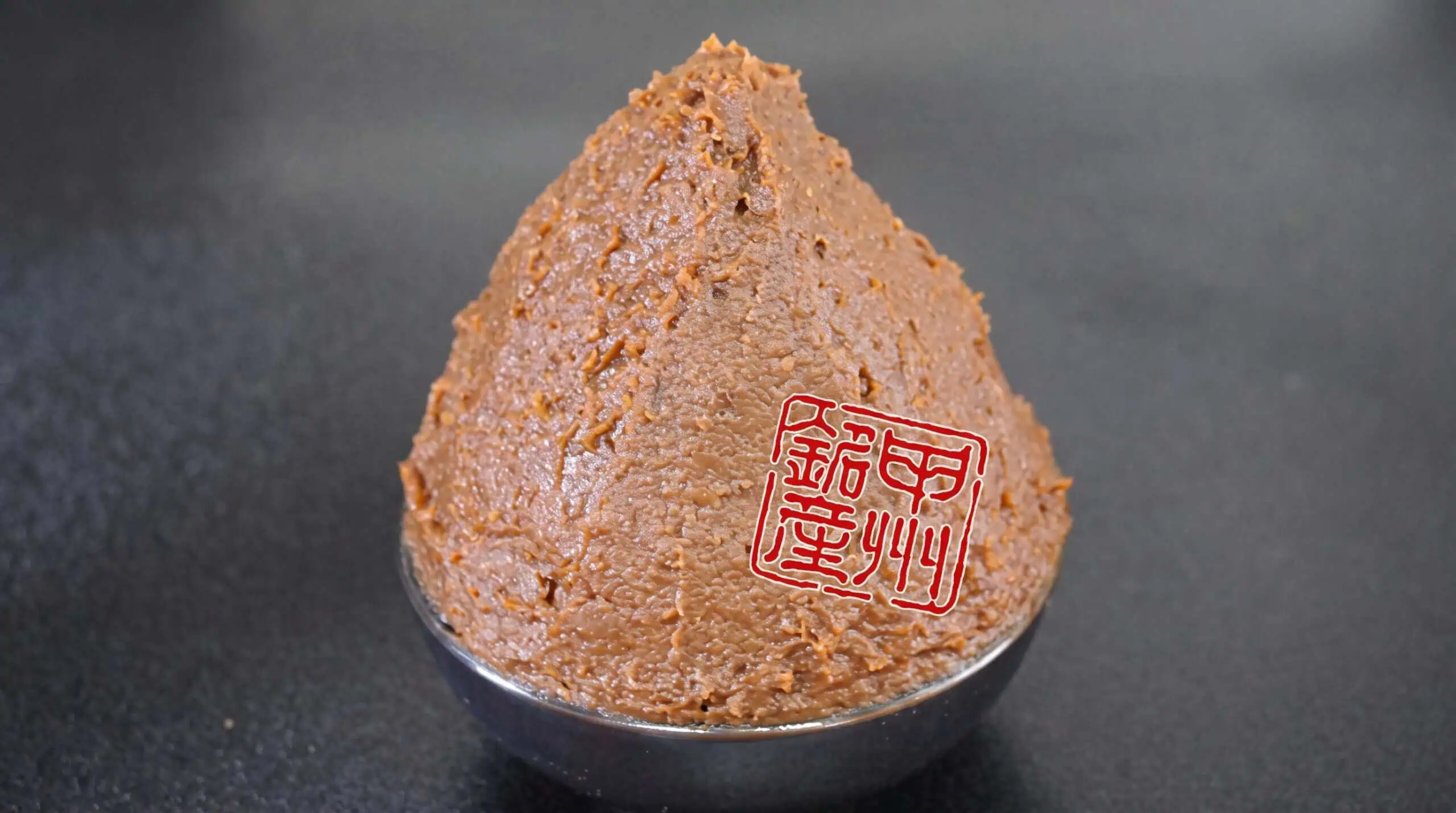


Koshu miso (甲州味噌, Kōshū miso) is a regional miso associated with Yamanashi Prefecture in central Japan. In its traditional form, producers ferment soybeans with both rice koji and barley koji in the same batch, which gives the paste a balance of gentle sweetness and a lightly toasted grain aroma.
Production methods are not identical across brands, however. Some products now sold under the Koshu miso name instead blend separately fermented rice and barley misos. This guide covers the documented history, ingredients, flavor, production, cooking uses and buying options behind the style, and it keeps the documented record separate from local folklore.
What Is Koshu Miso?
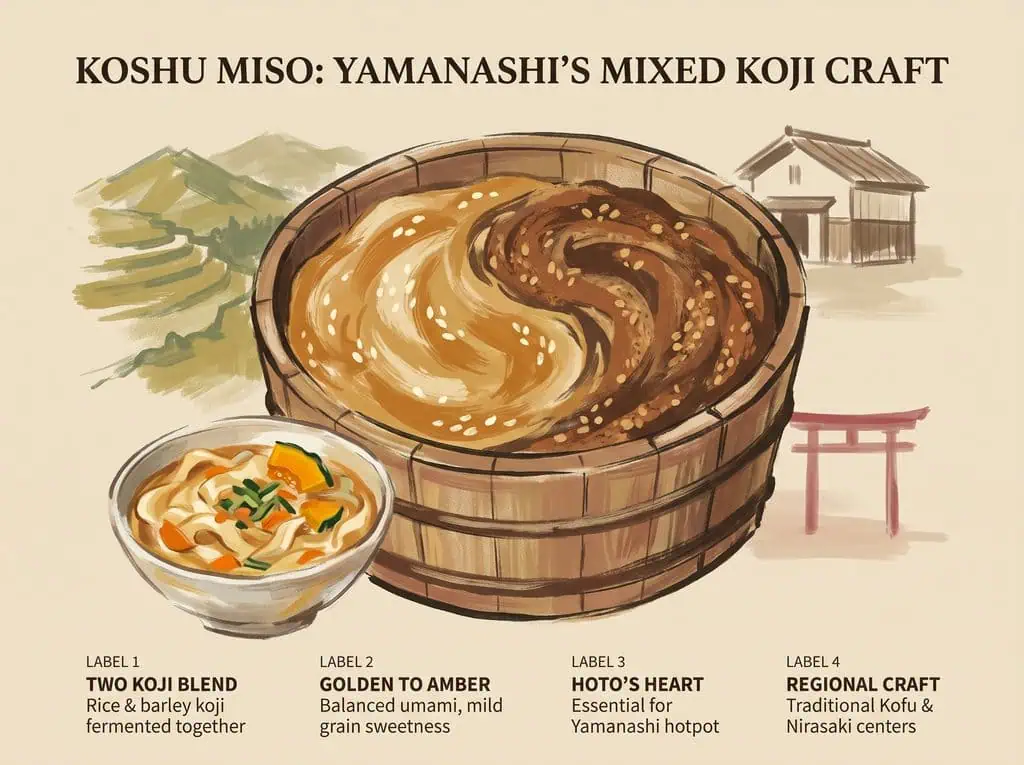
Koshu miso is a mixed-koji soybean paste from Yamanashi Prefecture. Producers combine steamed soybeans, salt, rice koji and barley koji, then leave the mash to ferment for months. Japan’s Ministry of Agriculture, Forestry and Fisheries (MAFF) reports that many makers use the two koji in roughly equal proportions, although ratios differ by company and by product.
Koshu Miso at a Glance
- Japanese name
- 甲州味噌 (Kōshū miso)
- Region
- Yamanashi Prefecture; Kofu and Nirasaki are traditional centers
- Category
- Mixed-koji miso; often labeled chōgō miso (blended miso)
- Typical ingredients
- Soybeans, rice koji, barley koji, salt, water
- Koji ratio
- Often roughly equal, but varies by maker
- Color
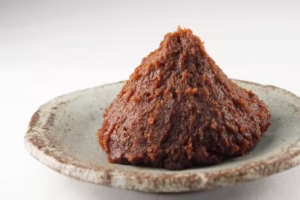
- Golden amber through reddish brown
- Flavor tendency
- Balanced umami, mild grain sweetness, toasted aroma
- Aging
- Roughly six months to a year, depending on the producer
- Associated dish
- Hoto, the flat-noodle and kabocha hotpot of Yamanashi
- Allergens
- Contains soy and barley; not gluten-free
Co-Fermented or Blended?
Two production routes now share a single name, so the distinction is worth holding onto. Originally the term covered only miso that fermented with both koji added together at the start. More recently, some makers brew rice miso and barley miso separately, then blend them to suit a customer or a dish, and those products also carry the Koshu miso label. Check the maker’s own description if the traditional method matters to you.
Where It Sits Among Japanese Miso Types
Japanese miso divides broadly by the grain that carries the koji mold. Rice koji gives kome miso, common in Tohoku and Kanto. Barley koji gives mugi miso, familiar across Kyushu, Shikoku and the Chugoku region. Soybean koji gives mame miso, of which Aichi’s Hatcho miso is the best-known example.
Because traditional Koshu miso uses both rice koji and barley koji, it does not fit neatly into those single-koji categories. On Japanese labels, products of this kind often appear as chōgō miso (調合みそ), meaning blended miso. The traditional production method is therefore unusual, although labeling and production practices differ among manufacturers.
Where Koshu Miso Comes From
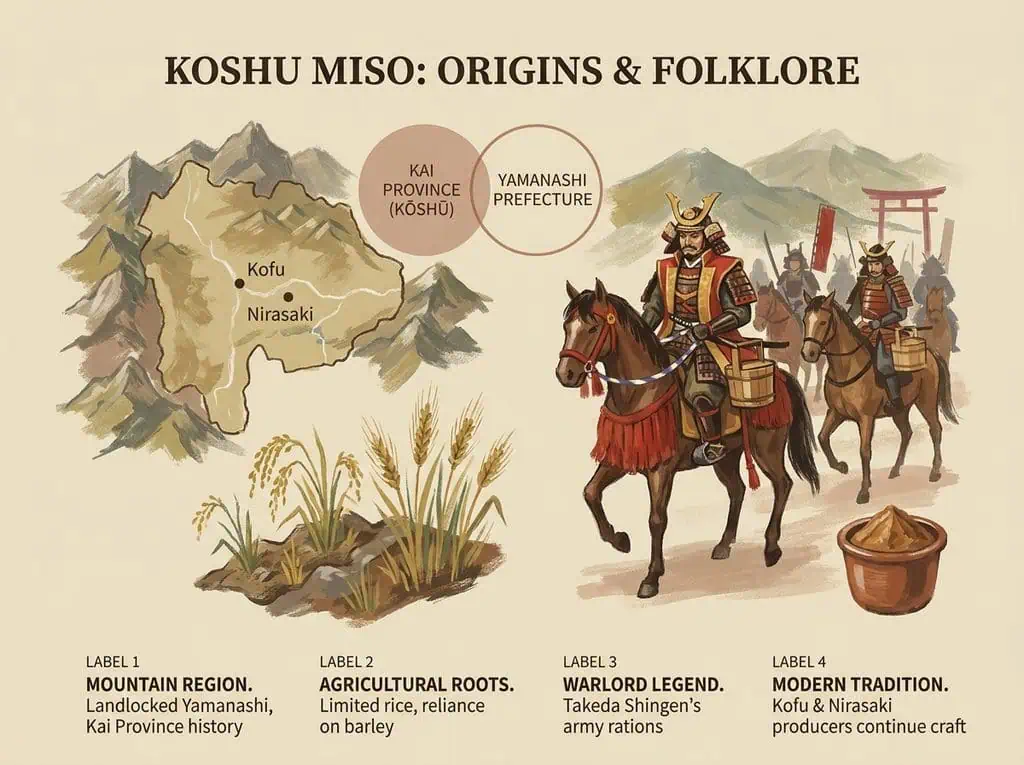
Koshu miso comes from Yamanashi Prefecture, a landlocked, mountain-ringed region west of Tokyo. MAFF names Kofu City, Nirasaki City and the wider prefecture as the areas where the tradition continues today.
Kai Province and Present-Day Yamanashi
Kōshū is a historical name for Kai Province, which corresponds broadly to present-day Yamanashi Prefecture. The name still appears across regional products, from Koshu grapes and Koshu wine to Koshu beef. Related pastes sometimes carry other descriptions, such as Yamanashi miso, mixed-koji miso or awase miso. Those terms are not always interchangeable, so check whether the two koji fermented together or whether the maker blended finished misos afterward.
The Agricultural Background
One widely cited explanation for the style’s development begins with limited grain supplies. MAFF notes that high elevation and difficult geology made rice cultivation hard across much of Yamanashi, so households could not obtain rice in quantity. Barley grew more readily, yet people ate most of it as a staple, which left little to spare for koji. Using both grains together may therefore have allowed households to make enough koji without relying entirely on either one.
As a landlocked region, Yamanashi also had less routine access to fresh marine fish than many coastal areas. Preserved foods, legumes, grains and fermented seasonings consequently played important roles in everyday meals, alongside river fish and other local ingredients.
Historical Evidence and the Takeda Shingen Legend
Local retellings often credit Takeda Shingen (1521–1573), the warlord who ruled Kai Province, with encouraging miso production as a portable ration for his armies. Writers on Kofu’s fermentation culture generally treat that connection as a popular tale rather than settled history. Yamanashi Prefecture takes a similarly careful line on hoto, noting that the Shingen origin story circulates widely while documentary references appear mostly from the Edo period onward.
So read the Shingen link as folklore that shaped local identity, not as a documented founding date. The agricultural explanation rests on firmer ground.
The Tradition Today
Producers around Kofu and Nirasaki continue to brew Koshu miso by long-established methods, and several work to keep the culture visible. Gomi Shoyu in Kofu, founded in 1868, runs miso-making workshops and promotes the temae miso habit of mixing your own batch at home. Okame Koji, another Kofu maker dating to 1894, sells brewing ingredients and rents out tools. Itsutsuya Shoyu in Nirasaki produces a Koshu miso that carries the Yamanashi governor’s certification mark, and a profile of that brewery appears further down this page.
Ingredients and Production
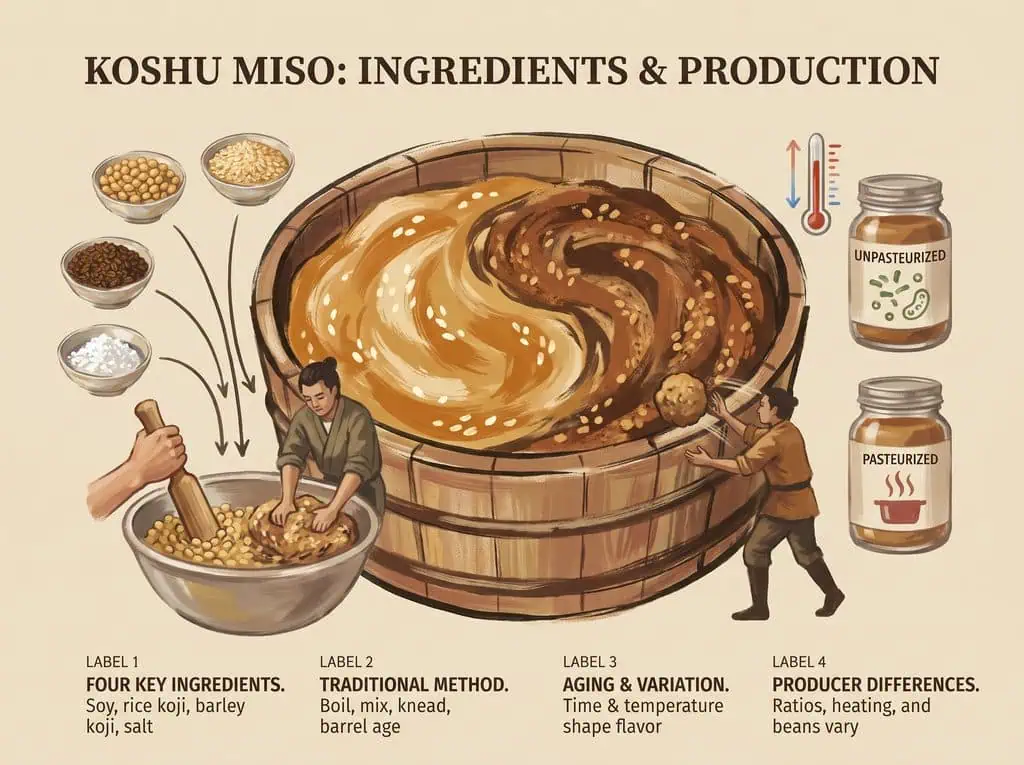
Traditional Koshu miso typically calls for soybeans, rice koji, barley koji and salt, plus water during preparation. Formulations still vary between producers, so the ingredient panel remains the reliable guide.
Soybeans, Rice Koji, Barley Koji and Salt
Soybeans supply the protein that fermentation converts into amino acids, and they carry much of the paste’s savory weight. Rice koji contributes a clean sweetness and a smoother body, while barley koji contributes a toasted, faintly grainy aroma. Salt shapes which microbes thrive and keeps fermentation slow through the warm months. Several Yamanashi makers specify prefecture-grown soybeans, though beans from elsewhere in Japan appear on plenty of labels too.
The Traditional Process
MAFF documents the traditional home method step by step.
- Boil the soybeans until a finger crushes them easily.
- While the beans cool, mix rice koji and barley koji with salt.
- Add the cooled beans, then knead the mixture with cooking liquid until it firms up.
- Shape the mash into fist-sized balls and throw them into a wooden barrel, which drives out trapped air.
- Smooth the surface, cover it with washi paper, and move the barrel to a cool storeroom.
- Leave the miso alone until the following winter.
Aging, Pasteurization and Producer Differences
MAFF’s traditional timeline runs about a year, from one winter to the next. Commercial schedules vary: Gomi Shoyu ages its Koshu miso naturally for roughly six to ten months. Small breweries often favor wooden vats and no final heat treatment, while larger operations control temperature more tightly and frequently pasteurize.
Temperature drives much of the difference. Warmer conditions generally accelerate microbial and enzymatic activity, while cooler storage slows the process, and each brewery manages that balance in its own way. Itsutsuya Shoyu in Nirasaki, for instance, describes the basin’s sharp seasonal temperature swings as well suited to brewing miso and soy sauce. Unpasteurized miso may also contain viable microorganisms when it reaches your kitchen, though their types and numbers depend on production, packaging, transport and storage. Heating reduces their viability, while many flavor compounds formed during fermentation remain.
Two jars labeled Koshu miso can therefore taste noticeably different. Koji ratio, aging time, salt level, soybean origin and pasteurization all vary, so treat the category as a family rather than a fixed formula.
What Koshu Miso Tastes Like
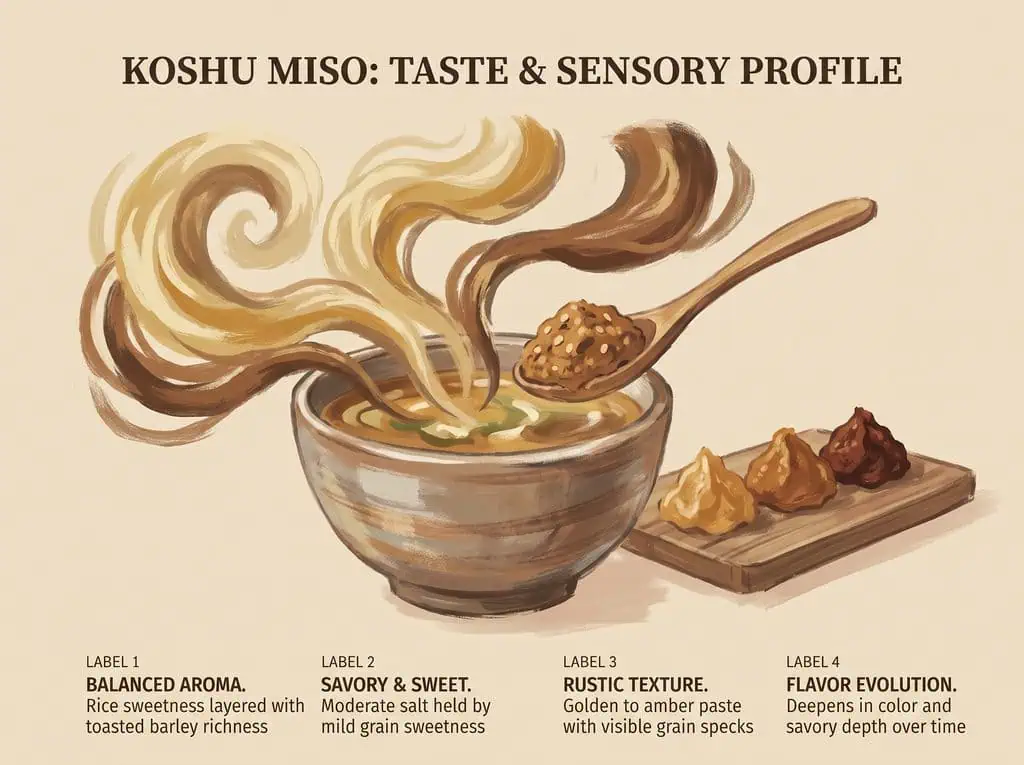
Koshu miso reads as balanced rather than dramatic, and MAFF sums up the general character as the light flavor of rice miso with the roasted richness of barley layered on top. Individual products differ a good deal, so take the notes below as style tendencies rather than a fixed profile.
Aroma, Sweetness, Saltiness and Umami
The aroma leans warm and nutty, with a malt-like edge that separates it from a plain rice miso. Moderate saltiness holds the middle of the palate while grain sweetness rounds off the corners. In many examples the rice sweetness registers first, and the toasted barley note settles in only at the finish, which is easy to miss on a first taste.
Color and Texture
Color runs from golden amber to a deeper reddish brown, depending largely on aging. Softened grain specks often stay visible, which gives the paste a rustic texture rather than a silky one. Whisked into hot broth, those specks disappear almost immediately.
How Aging Changes the Flavor
Longer aging darkens the paste and deepens its savory depth, thanks to the Maillard reaction between sugars and amino acids. Unpasteurized products keep changing after purchase, so a paste bought in spring may taste rounder by autumn. Refrigeration slows that shift considerably.
Tasting note
We tasted [product name] from [producer], purchased in [month and year]. We sampled it straight from the tub and again in a simple kombu-dashi soup, alongside [comparison miso]. Flavor varies by producer, koji ratio and age, so your jar may sit slightly differently on the palate.
Koshu Miso Compared with Other Misos
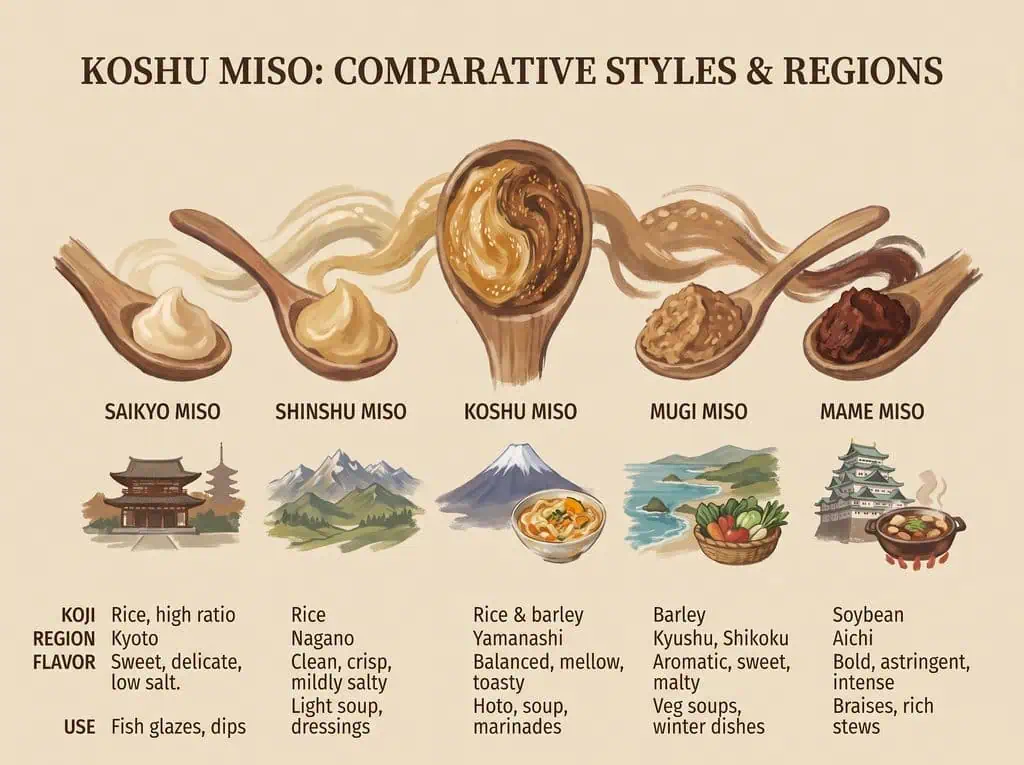
The table below places Koshu miso beside four styles you are more likely to meet in an overseas grocery aisle. These are broad style tendencies rather than fixed specifications, since color, sweetness, saltiness and aging all vary by producer.
| Style | Koji | Region | Color | Flavor tendency | Common uses |
|---|---|---|---|---|---|
| Koshu miso | Rice and barley | Yamanashi | Amber to russet | Balanced, mellow, lightly toasty | Hoto, daily soup, marinades |
| Shinshu miso | Rice | Nagano | Pale gold | Clean, crisp, mildly salty | Light soup, dressings |
| Saikyo miso | Rice, high ratio | Kyoto | Pale cream | Sweet, delicate, low salt | Fish glazes, vegetable dips |
| Mugi miso | Barley | Kyushu, Shikoku | Light to mid brown | Aromatic, sweet, malty | Vegetable soups, winter dishes |
| Mame miso (Hatcho style) | Soybean | Aichi | Dark brown | Bold, astringent, intense | Braises, rich stews, udon broth |
One clarification on the last row: mame miso is the general category, while Hatcho miso refers to a specific Okazaki tradition, and certified products carry stricter conditions than the style name suggests. Compared with the rice-koji misos that dominate overseas shelves, traditional Koshu miso simply adds barley koji to the same batch.
How to Use Koshu Miso
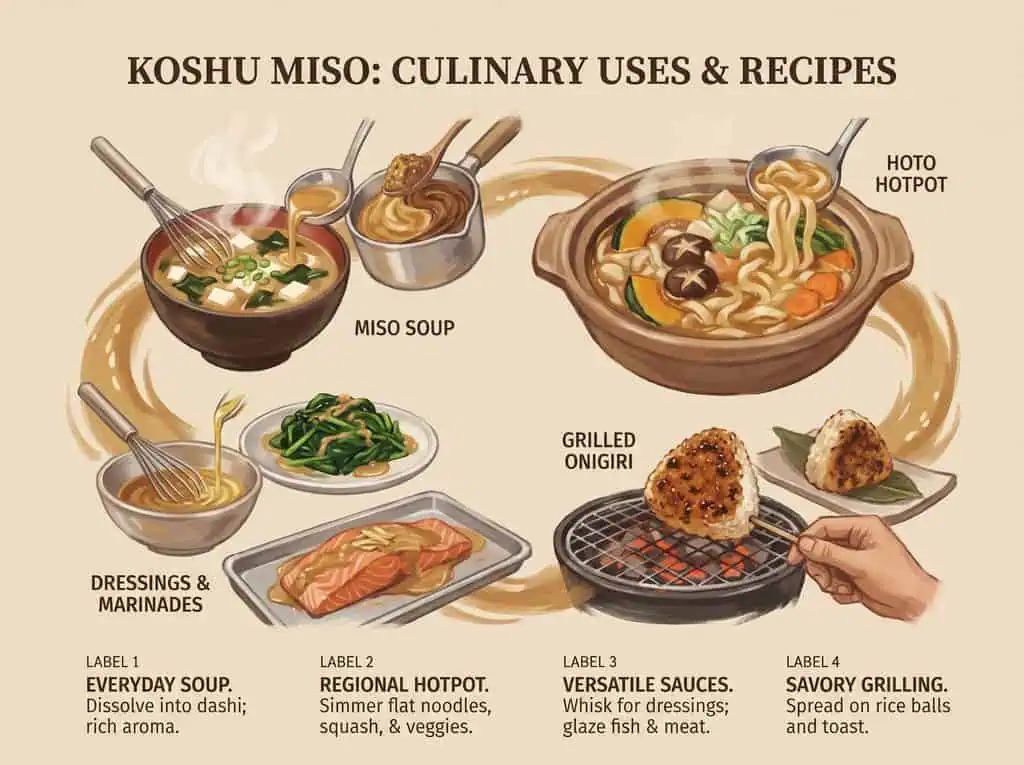
MAFF describes Koshu miso as an everyday seasoning in Yamanashi, useful for miso soup, hoto, stir-fried vegetables and meat, and grilled rice balls. Because it sits between sweet and salty, it slots into most recipes that call for a general-purpose blended miso.
Miso Soup
Dissolve roughly three-quarters to one tablespoon per serving into kombu or bonito dashi. The broth gains more aromatic body than a plain white miso delivers, and some cooks reduce the dashi because the barley koji already carries depth. Start at the lower end and taste, since salt levels differ sharply between brands.
Hoto
Hoto is one of the dishes most closely associated with miso-based cooking in Yamanashi, and the prefecture lists it among its defining foods. Cooks simmer wide, flat wheat noodles directly in a miso broth with kabocha squash, mushrooms, daikon and seasonal greens. Because the raw noodles release starch into the pot, the broth thickens as it cooks. Some cooks and restaurants use local Koshu miso, while others rely on their own blends.
Dressings, Marinades and Grilled Dishes
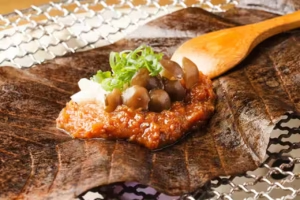
Whisk the paste with mirin, rice vinegar and a little sesame oil for a dressing that suits blanched spinach or chilled tofu. For misozuke, blend it with sake and grated ginger, then marinate salmon, chicken thigh, pork or thick slices of eggplant before grilling. Wipe off the excess marinade first, otherwise the sugars scorch under high heat. A thin layer spread on onigiri before toasting also works nicely.
Easy Koshu Miso Soup Recipe
This is a plain showcase for the paste, and it takes about fifteen minutes from start to finish. The recipe serves two.
Ingredients
- 2 cups (480 ml) kombu or bonito dashi, or 2 cups (480 ml) water plus 1/2 tsp instant dashi granules
- 100 g (3.5 oz) silken or firm tofu, cut into 1 cm cubes
- 1 to 2 tsp dried wakame, rehydrated and drained (follow the package, since expansion rates differ)
- 1.5 to 2 tbsp Koshu miso, to taste
- 1 scallion, thinly sliced
Instructions
- Bring the dashi to a gentle simmer in a small saucepan.
- Slide in the tofu cubes and cook them gently for one to two minutes.
- Lower the heat, then whisk the miso through a ladle or small strainer until it dissolves completely.
- Stir in the wakame, turn off the heat, and top each bowl with sliced scallion.
Tips and Vegan Option
For the best aroma, avoid a vigorous boil after adding the miso, though gentle reheating is fine if the soup cools. For a vegan version, use kombu or kombu-shiitake dashi and confirm that the miso itself contains no added fish dashi. If you cannot find Koshu miso, the substitutes further down this page cover similar ground.
Dietary and Allergen Information
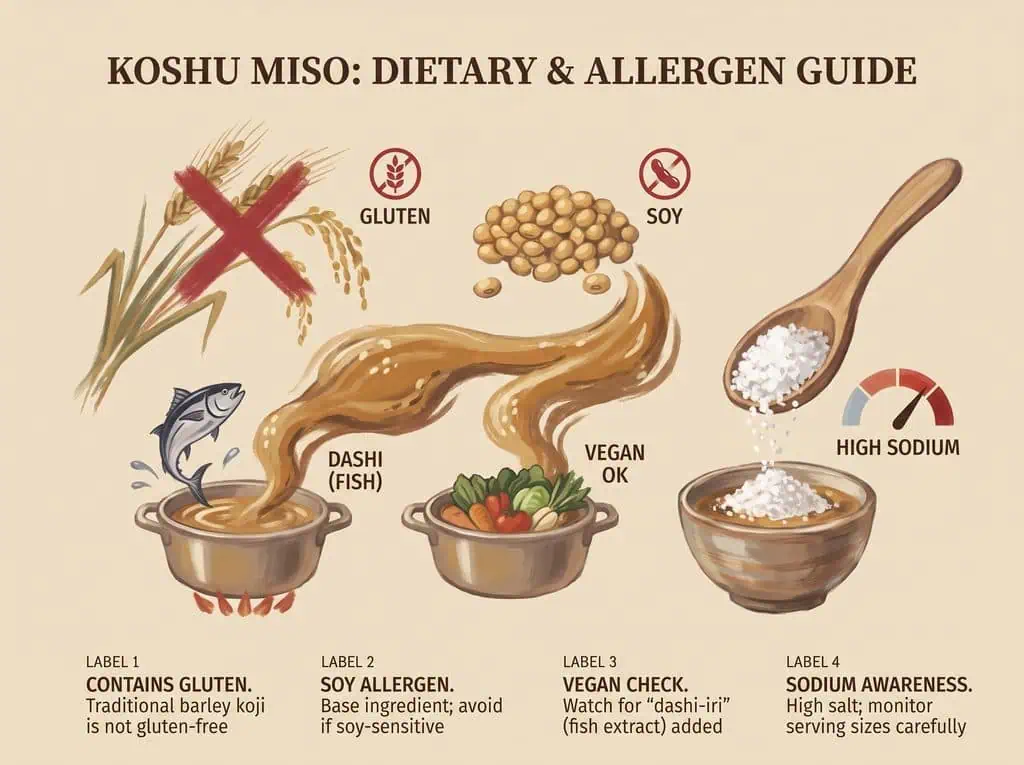
Two questions come up constantly, and the answers point in opposite directions. Always confirm details against the specific product in front of you.
Barley and Gluten
Gluten warning
Traditional Koshu miso uses barley koji, so it contains gluten. People with celiac disease or gluten sensitivity should avoid it and choose a rice miso (kome miso) that carries a verified gluten-free label. Check the allergen statement on each product, because ingredients and cross-contact policies vary between manufacturers.
Dashi and Vegan Suitability
Products made only from soybeans, rice, barley and salt suit a vegan diet. Some convenience items add bonito or other fish extract, and Japanese packaging marks these as dashi-iri miso (だし入りみそ). Scan the ingredient list before buying, particularly on instant soup packets and seasoning blends.
Soy and Other Allergens
Miso is a soybean product, so anyone avoiding soy should avoid it entirely. Barley appears in every traditional Koshu miso, and some commercial blends include wheat as well. Japanese labels list allergens near the ingredient panel, and importers usually reproduce that information in translation.
Nutrition, Sodium and Serving Size
Miso provides soybean protein and fermentation-derived amino acids, although its nutrient profile varies by recipe and brand. It is also high in sodium, so serving size and the rest of the meal matter. The recipe above uses roughly three-quarters to one tablespoon per serving, and sodium content differs significantly between products, so use the nutrition label to work out the amount in a specific bowl. Anyone managing sodium for medical reasons should follow their own clinician’s advice.
Reading Japanese Labels
- 大豆 — soybeans
- 米 / 米こうじ — rice / rice koji (no gluten)
- 大麦 / 麦こうじ — barley / barley koji (contains gluten)
- かつおだし / だし入り — bonito dashi / dashi added (not vegan)
- 調合みそ — blended miso, the category most Koshu miso sits in
Meet a Producer: Itsutsuya Shoyu in Nirasaki
Reading about a regional seasoning only goes so far, so here is one brewery that actually makes it. Itsutsuya Shoyu works in Nirasaki, north of Kofu, and its Koshu miso carries the Yamanashi governor’s certification mark.
Itsutsuya Shoyu Co., Ltd. (井筒屋醤油株式会社)
- Founded
- 1930; incorporated in 1952
- Location
- 2-9-26 Honmachi, Nirasaki, Yamanashi
- Access
- About five minutes on foot from JR Nirasaki Station
- Signature product
- Koshu miso, 750 g, certified by the Governor of Yamanashi
- Official site
- itutuya.co.jp
- Online shop
- Yahoo! Shopping store (ships within Japan)
From Merchants to Brewers
The Yamadera family has traded in Nirasaki since the Edo period, when its ancestors kept a general goods store. They took the Itsutsuya name in 1873, later moved into sericulture, and brewed miso and soy sauce on the side. When silk prices collapsed at the end of the Taisho era, that sideline became the main trade, and the brewery dates its founding to 1930. The shop still trades from a kura-style building put up in 1919, and its soy sauce carries the Kikkogen mark, which sets the character gen, from second-generation head Gentaro, inside an auspicious tortoiseshell hexagon. The company incorporated in 1952, and Soichiro Yamadera now leads it as the fifth-generation head.
The company also records how thin the local industry has grown. By its own account, Yamanashi supported around sixty soy sauce and miso makers in the mid-1940s, whereas only two soy sauce producers and a handful of miso producers remain today. That context explains why regional styles like Koshu miso need active protection rather than nostalgia.
Place, Ingredients and Range
Itsutsuya attributes much of its flavor to location. Nirasaki sits among the Southern Alps, Yatsugatake and Kayagatake, with the Kamanashi and Shiokawa rivers running through a grain-growing basin, and the brewery treats the basin’s wide seasonal temperature swings as ideal for brewing. Its soybeans, wheat and salt all come from domestic sources, and several products go further by specifying Yamanashi-grown ingredients. The operation stays small: a team of three brews roughly twenty tonnes of miso and twenty thousand litres of soy sauce a year, aging the miso for about a year in wooden barrels and fiberglass tanks.
Its miso range runs wider than the Koshu style alone. Alongside the governor-certified Koshu miso, the brewery makes Takeda Hachiman miso, another rice-and-barley blend, named after a nearby shrine connected to the Takeda clan. The rest of the list covers a sweet white miso, a high-koji miso brewed with twice the usual rice koji and correspondingly less salt, a barley miso, a sweeter barley miso that doubles the barley koji, a chunky whole-bean miso, and Rin, made with soybeans from Hokuto and Koshihikari rice grown in Nirasaki. Tasting two of them side by side shows quickly how much a koji ratio changes the result.
Visiting and Ordering
The brewery runs a shop on the same site as its brewing plant, and the company notes that this lets it supply quantities outside its standard package sizes, including bulk and commercial orders. The shop opens from 9:00 to 17:00 and closes on Sundays and public holidays, with parking beside the building. It stands about five minutes on foot from JR Nirasaki Station, or five minutes by car from the Nirasaki interchange. This is a working brewery with a retail counter rather than a visitor attraction, so go to buy rather than to tour. The company also runs an online store through Yahoo! Shopping. Opening hours, stock and shipping areas all change, so check the current pages before you visit or order.
Buying and Storing Koshu Miso
Koshu miso is an artisanal regional product, so it appears far less often overseas than mainstream rice miso.
What to Look For
- Ingredients: soybeans, rice koji, barley koji and salt, ideally without flavor enhancers
- Koji type: both grains listed, not rice alone
- Whether the maker co-fermented the koji or blended finished misos
- Pasteurized or unpasteurized, since unpasteurized miso keeps fermenting
- Country and prefecture of origin
- Allergen statement, storage instructions and best-before date
Where to Look
In Yamanashi, working breweries around Kofu and Nirasaki remain the most rewarding option, and roadside stations and supermarkets across the prefecture stock local brands as well. Gomi Shoyu, Okame Koji and Itsutsuya Shoyu all list miso through their own shops, though availability, shipping areas and opening hours change, so check the current product page before visiting or ordering. The prefecture also runs an antenna shop in Tokyo, which is worth a look if you are not traveling west.
Outside Japan, check Japanese supermarkets, regional-food importers and specialist fermentation shops. Stock varies constantly, and products labeled awase miso are not necessarily made in Yamanashi. Searching in Japanese for 甲州味噌 usually returns more than the English spelling alone.
If You Cannot Find It
Mixing equal parts rice miso and barley miso gives the closest everyday match, because it mirrors the intended balance of sweetness and grain aroma. A commercial awase miso works as a quicker stand-in, and a medium-aged yellow miso covers soups and marinades acceptably. None of these reproduces co-fermentation exactly, so expect a slightly flatter aroma.
Storing It at Home
Follow the manufacturer’s storage and handling instructions first, since packaging and pasteurization differ. As a general rule, move the paste to the refrigerator once you open it and keep it in an airtight container. Pressing parchment or plastic wrap directly onto the surface before you close the lid limits drying and surface discoloration. Gradual darkening is normal, and miso will not freeze solid because of its salt content, so a freezer suits long-term storage.
Food safety
Some unpasteurized miso products release gas during storage. If a sealed container is unexpectedly swollen, leaking or damaged, do not open or taste it before consulting the seller or manufacturer. Discard the product if the packaging is damaged or if the miso develops an unexpected odor, appearance or visible mold. Do not taste it to decide whether it is safe, and when in doubt, follow the manufacturer’s advice or throw it away.
Final Thoughts
Koshu miso answers a specific question about Yamanashi: what do you season with when the sea is distant and the rice harvest never quite stretches? The most widely cited answer is that farmers put two koji in one barrel, and the method outlasted the shortage that shaped it. Today, Koshu miso remains closely connected with Yamanashi home cooking, and it works particularly well in dishes such as hoto and everyday miso soup.
If a trip to Yamanashi is on your list, buy a small tub from a working brewery and taste it against your usual miso. That comparison teaches more in one evening than any amount of reading.
Frequently Asked Questions About Koshu Miso
What is Koshu miso?
Koshu miso is a regional miso associated with Yamanashi Prefecture. In the traditional method, brewers ferment soybeans with rice koji and barley koji in the same batch. Some modern products blend separately fermented misos instead, so it is worth checking the maker’s description.
What is Koshu miso made from?
Traditional examples use soybeans, rice koji, barley koji and salt, with water added during preparation. Commercial formulations vary, however. Check the label for added seasonings, preservatives or fish-based dashi before you buy.
What does Koshu miso taste like?
It generally tastes moderately salty, gently sweet and rounded rather than sharp. Rice koji supplies sweetness and a smooth body, while barley koji adds a lightly toasted aroma at the finish. Color and intensity depend on aging and on the individual producer.
How is Koshu miso different from regular miso?
There is no single “regular miso,” but most miso sold internationally is rice-koji miso. Traditional Koshu miso also uses barley koji in the same batch, which MAFF describes as unusual nationally. That dual base gives more aromatic complexity than a plain rice miso.
Is Koshu miso gluten-free?
Usually not. Traditional Koshu miso contains barley koji, and barley contains gluten. People who need to avoid gluten should choose a rice miso specifically labeled gluten-free and verify the allergen statement on that product.
Is Koshu miso vegan?
Products made only from soybeans, rice, barley and salt suit a vegan diet. Some convenience items add bonito or other fish extract, and Japanese packaging marks these as dashi-iri miso. Read the ingredient list, especially on instant soup mixes.
What can I use instead of Koshu miso?
Mix equal parts rice miso and barley miso for the closest everyday match. A commercial awase miso works as a faster stand-in, and a medium-aged yellow miso covers soups and marinades. None of these reproduces co-fermentation, so the aroma sits a little flatter.
References
- Ministry of Agriculture, Forestry and Fisheries, Koshu Miso (Nippon Traditional Food Encyclopedia), https://www.maff.go.jp/j/keikaku/syokubunka/traditional-foods/menu/kosyu_miso.html (Surveyed: August 2026)
- Yamanashi Prefecture, Hoto (Noshi-ire, Noshi-komi), https://www.pref.yamanashi.jp/shokuhin-st/shokuiku/yamanashinoshoku/houtou.html (Surveyed: August 2026)
- Fujinokuni Yamanashi Tourism Net (Yamanashi Prefecture official tourism site), Hoto Restaurant Feature, https://www.yamanashi-kankou.jp/special/gourmet_hoto.html (Surveyed: August 2026)
- Fujinokuni Yamanashi Tourism Net, Itsutsuya Shoyu, https://www.yamanashi-kankou.jp/kankou/specialty/n_8250.html (Surveyed: August 2026)
- Nirasaki City Tourism Association, Itsutsuya Shoyu Co., Ltd., https://www.nirasaki-kankou.jp/syukuhaku_onsen_tokusanbutsu_osyokujidokoro/omiyage/oisiimono/6568.html (Surveyed: August 2026)
- Gomi Shoyu (Kofu), What Is Koshu Miso?, https://yamagomiso.com/blog/5989/ (Surveyed: August 2026)
- Gomi Shoyu Online Shop, Koshu Miso 1 kg product page, https://yamagomiso.shop-pro.jp/?pid=26756254 (Surveyed: August 2026)
- Okame Koji (Kofu), Official site, https://okamekoji.co.jp/ (Surveyed: August 2026)
- Itsutsuya Shoyu Co., Ltd., About Itsutsuya Shoyu (company profile), https://www.itutuya.co.jp/about.html (Surveyed: August 2026)
- Itsutsuya Shoyu Co., Ltd., Why Customers Choose Us, https://www.itutuya.co.jp/reason.html (Surveyed: August 2026)
- Itsutsuya Shoyu Co., Ltd., Miso Product Range, https://www.itutuya.co.jp/items/category/miso/ (Surveyed: August 2026)
- Itsutsuya Shoyu Co., Ltd., Official Yahoo! Shopping store, https://store.shopping.yahoo.co.jp/itutuya/ (Surveyed: August 2026)
Related Articles
- Types of Miso in Japan (Surveyed: August 2026)
- What Is Miso? Ingredients, Types and Uses (Surveyed: August 2026)
- Japanese Fermented Foods (Surveyed: August 2026)
- Rice Miso (Kome Miso) (Surveyed: August 2026)
- Barley Miso (Mugi Miso) (Surveyed: August 2026)
- Koji in Japanese Cuisine (Surveyed: August 2026)
- Hoto Noodles (Surveyed: August 2026)
- Yamanashi Local Food Guide (Surveyed: August 2026)
- Regional Cuisine of Japan (Surveyed: August 2026)





Comments