




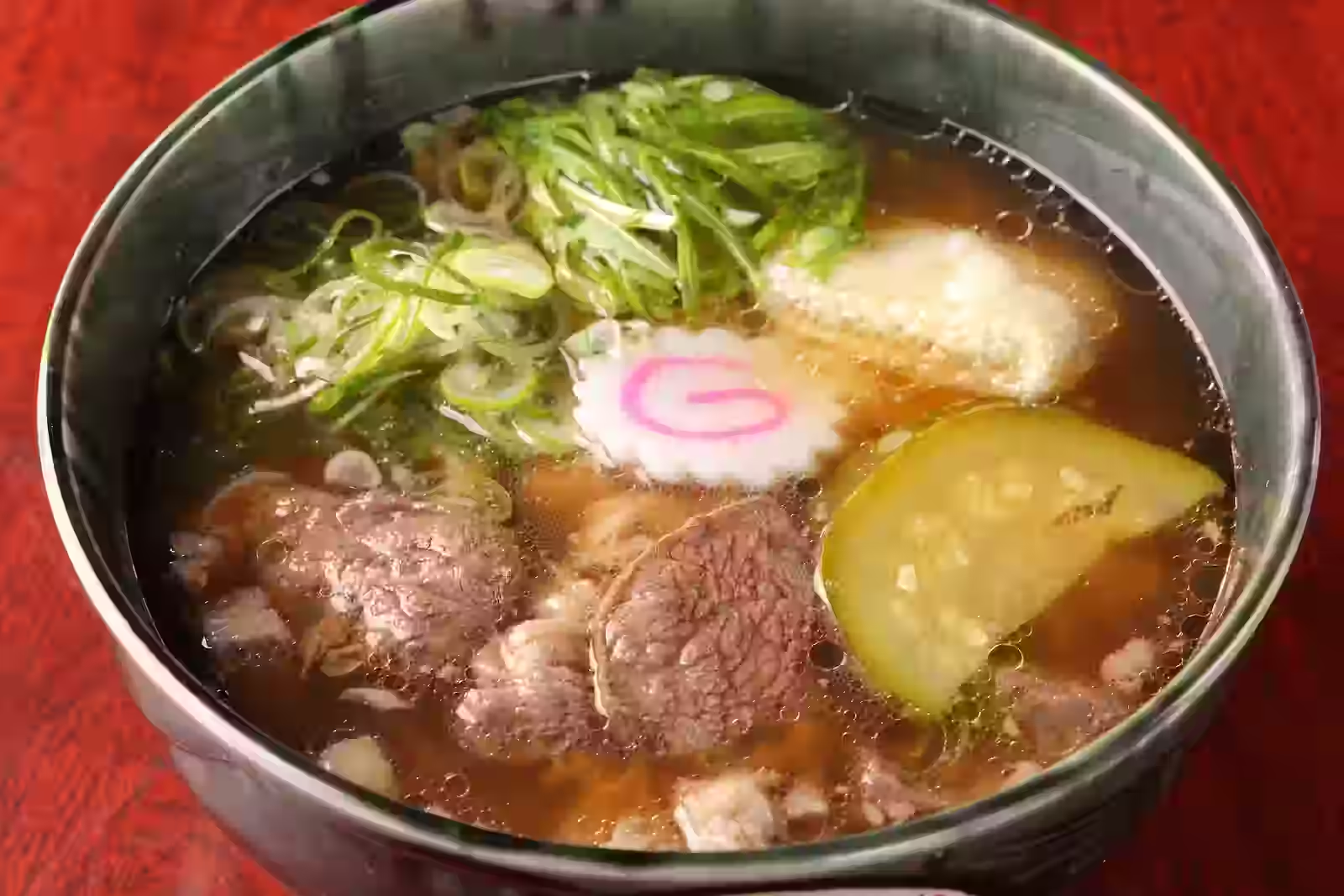
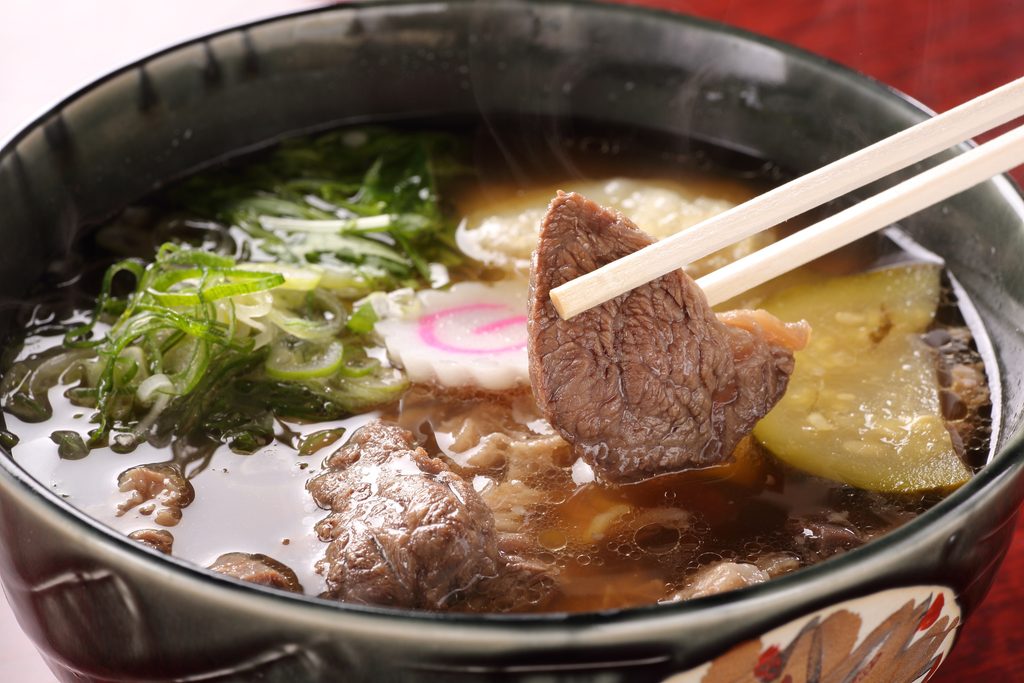
Obanazawa beef ramen is a local noodle specialty from Obanazawa City in Yamagata Prefecture. It pairs slow-simmered Obanazawa beef, a branded wagyu, with a chili-pickled watermelon called pesora-zuke. Order a bowl here and that bright red pickle really does sit on top of the soup. It surprises almost every first-time visitor.
The same city holds Ginzan Onsen, so many travellers eat this ramen on a hot spring trip. However, the two sit roughly 30 to 40 minutes apart, which matters when you plan the day. So this Yamagata food guide covers the beef, the broth, the eight shops and the travel practicalities. It also flags clearly where the official sources stop short.
What Is Obanazawa Beef Ramen?
Obanazawa beef ramen is a ramen dish built on two local products. Those are Obanazawa beef and suika no pesora-zuke, a chili pickle made from thinned watermelon. The Obanazawa Chamber of Commerce and Industry promotes it as a city specialty, while the prefecture’s tourism association lists it as a local dish. However, cuts, seasoning and broth all differ between shops. So the name describes a shared idea rather than a fixed formula.
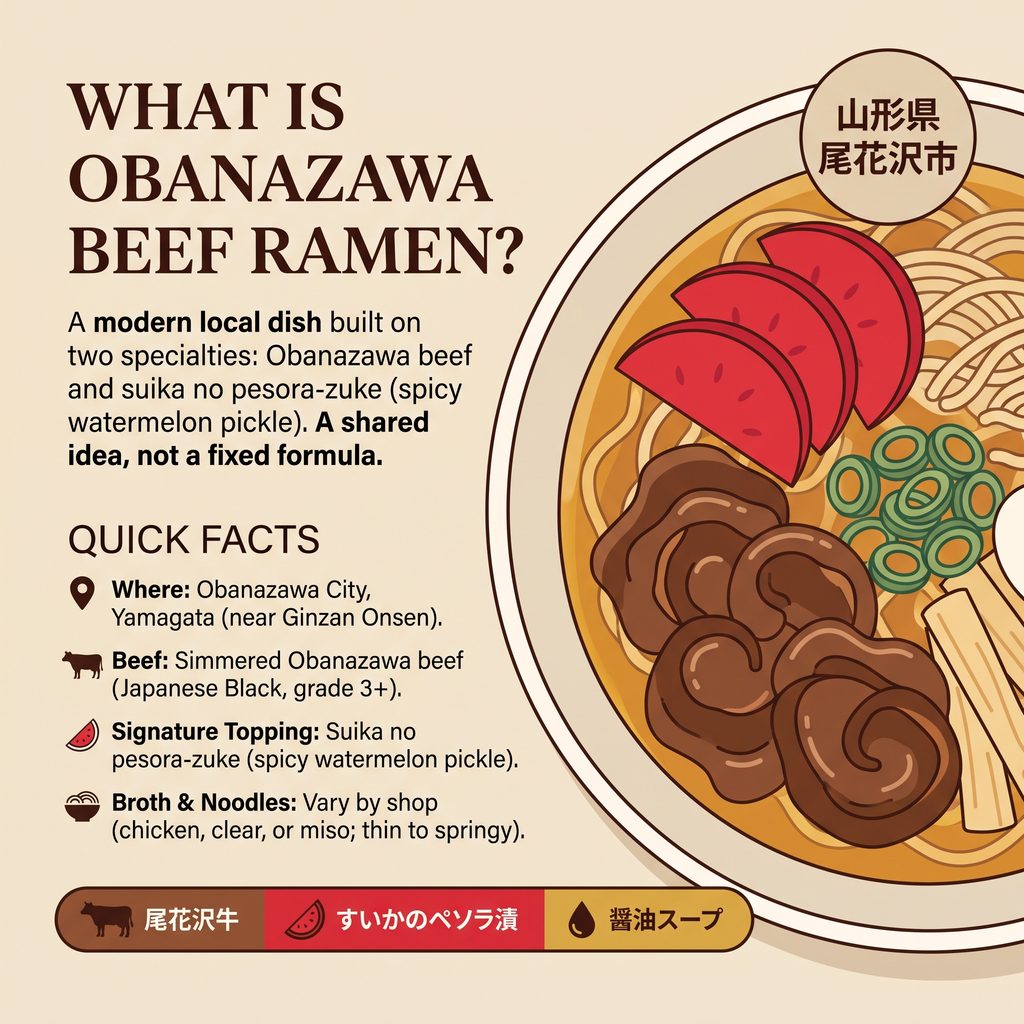
Quick Facts
- Japanese name
- おばなざわ牛ラーメン (Obanazawa gyu ramen)
- Where
- Obanazawa City, Murayama area, Yamagata Prefecture, Tohoku
- Category
- Modern local ramen, since the city chamber of commerce coordinates it
- Beef
- Obanazawa beef, mostly sinew and shin, simmered until soft
- Beef standard
- Japanese Black, raised in the city, meat quality grade 3 or higher
- Signature topping
- Suika no pesora-zuke, a chili pickle from thinned watermelon
- Broth
- Varies by shop, so expect chicken bone, clear Japanese style or miso
- Noodles
- Usually house-made, though styles run from thin to springy
- Participating shops
- Eight on the chamber list, though the prefecture cites 13
- Nearest hot spring
- Ginzan Onsen, about 30 to 40 minutes away by road
- Price
- Not published by official sources, so call ahead
The Main Components
Four elements appear in every description the chamber of commerce publishes. First comes the beef, which cooks slowly until it falls apart. Then the broth, since each shop builds on a different base. Noodles follow, though most kitchens make their own. Finally the pickle arrives, so the bowl gains a sour edge.
- Beef. Sinew and shin cuts of Obanazawa beef, simmered until they fall apart.
- Broth. No default exists, since every shop picks its own base.
- Noodles. Mostly house-made, though styles run from thin to springy.
- Pesora-zuke. A sour, salty, chili-spiked watermelon pickle, so the bowl never turns heavy.
That pickle deserves a moment of its own. Obanazawa is Japan’s number one producer of summer watermelon, so farmers thin the small immature fruit to help the rest grow. Producers then pickle those thinned melons in the style of pesora-zuke, a regional eggplant pickle. As a result, the topping tastes sour and mildly hot.
Is It a Traditional Dish or a Modern Local Specialty?
This is a modern promotional dish, not an old folk recipe. Japanese food writing draws a line between kyodo ryori and go-tochi gurume. The first term means home-rooted regional cooking, while the second means a specialty built to promote a town. Obanazawa beef ramen clearly belongs in the second group.
However, the available sources do not establish the year it launched, or who first proposed it. They do name the organiser, at least. The chamber of commerce runs the project under its local product promotion work. Yamagata Prefecture also records a teamwork prize at a prefectural B-grade local gourmet festival. In addition, the watermelon pickle behind the signature topping only reached the market in the early 2000s. So the whole concept sits firmly in recent decades.
What Is Obanazawa Beef?
Production Area and Official Standards
Obanazawa sits in a basin ringed by the Ou Mountains, in one of the snowiest parts of Japan. Indeed, the Japan Tourism Agency notes that farmers there have raised Japanese Black cattle for more than a century. Around 20 farms now keep over 8,000 head under the Obanazawa Beef name.
The standard itself has two clear conditions. First, cattle must grow up inside the city limits. Second, the carcass must reach meat quality grade 3 or higher on the Japanese Meat Grading Association scale. Above that sits a premium tier called Yukifuri Wagyu Obanazawa. That tier uses only heifers which have never calved. Moreover, the animals stay in production for 32 months, so their fat develops enough oleic acid.
A quick word on terminology. Wagyu is not a synonym for Japanese beef in general. Instead, the term covers four native cattle breeds, and Japanese Black accounts for the large majority. Obanazawa beef therefore qualifies as wagyu, since it comes from Japanese Black cattle. By contrast, imported breeds fattened in Japan fall outside the term. For the full picture, see our guide to wagyu beef.
Marbling, Fat and Grading
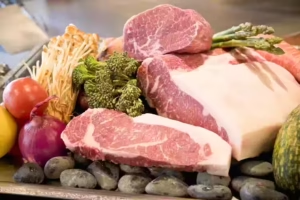
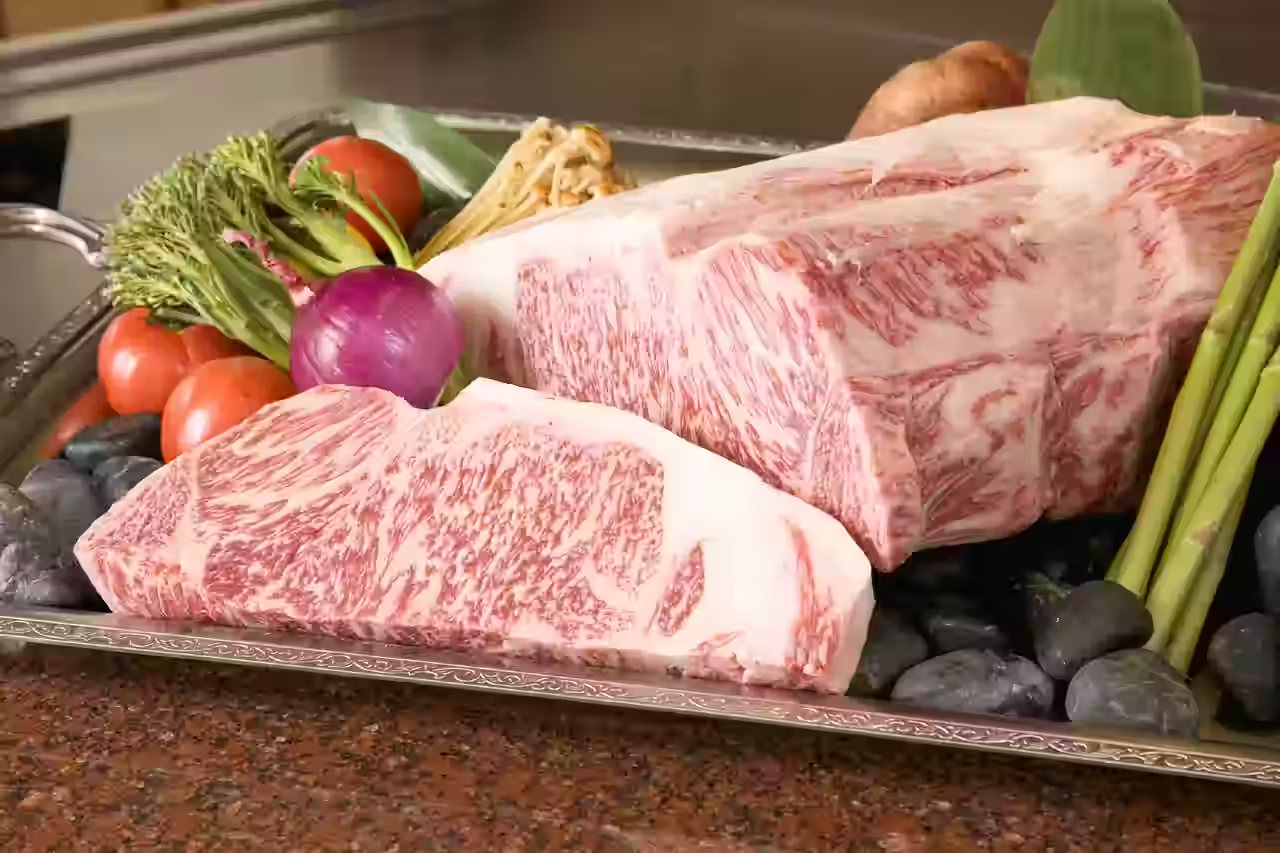
Producers describe Obanazawa beef as finely marbled, with fat that melts easily. In fact, the chamber of commerce compares the mouthfeel to powder snow, which explains the Yukifuri name. Research on Japanese Black cattle links that softness to monounsaturated fat, especially oleic acid.
Here is the catch, though. Ramen shops do not use the marbled loin you see in steak or sukiyaki. They reach for the tough working muscles instead, and a later section explains why that choice makes sense.
How It Compares With Other Yamagata Beef Names
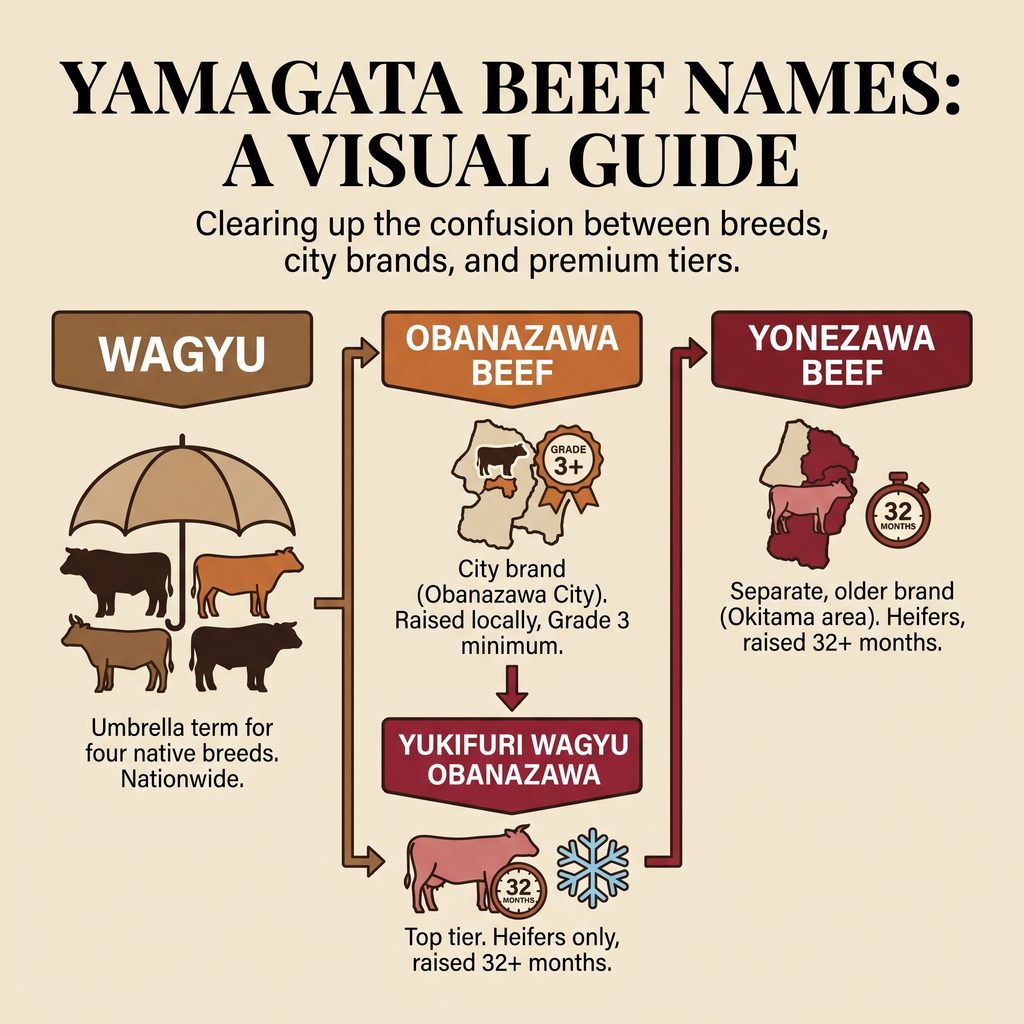
Yamagata carries several beef names, so travellers mix them up constantly. The table below sets out what each term actually covers.
| Name | What it means | Area | Key condition |
|---|---|---|---|
| Wagyu | Umbrella term for four Japanese cattle breeds | Nationwide | Breed-based, so place does not decide it |
| Obanazawa Beef | City brand for Japanese Black cattle | Obanazawa City | Raised in the city, and grade 3 at least |
| Yukifuri Wagyu Obanazawa | Top tier within the Obanazawa brand | Obanazawa City | Heifers only, then 32 months of raising |
| Yonezawa Beef | A separate, older Yamagata brand | Okitama area | Heifers, though raised over 32 months |
In short, Obanazawa beef and Yonezawa beef are different brands with different rules. Both come from one prefecture and one breed, though neither name means the same thing as Yamagata beef.
What Does Obanazawa Beef Ramen Taste Like?
The Beef
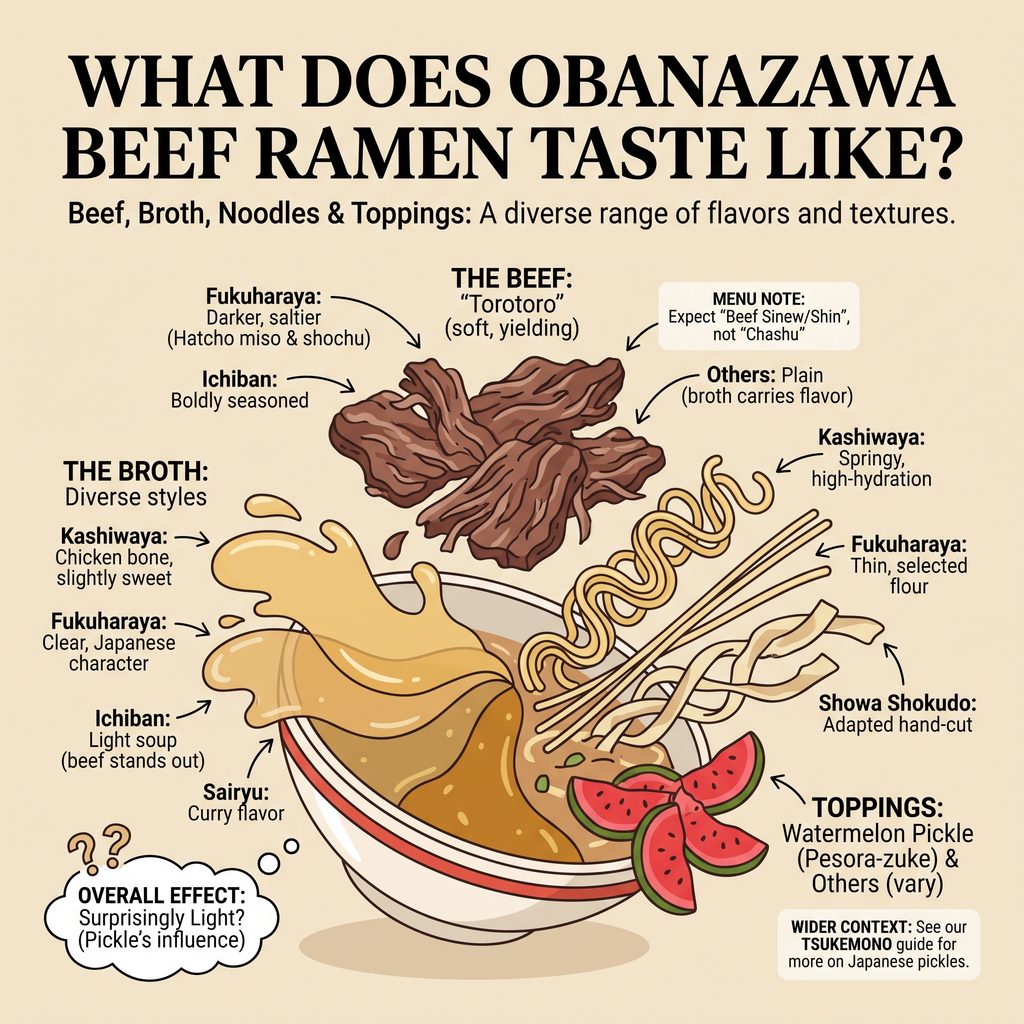
Shops describe the beef as torotoro, a word Japanese cooks use for meat gone soft and yielding. It shreds under chopsticks rather than holding a neat slice. Fukuharaya finishes its version with hatcho miso and shochu, so that bowl tastes darker and saltier. Ichiban seasons its beef boldly as well. Others keep it plain instead, then let the broth carry the flavour.
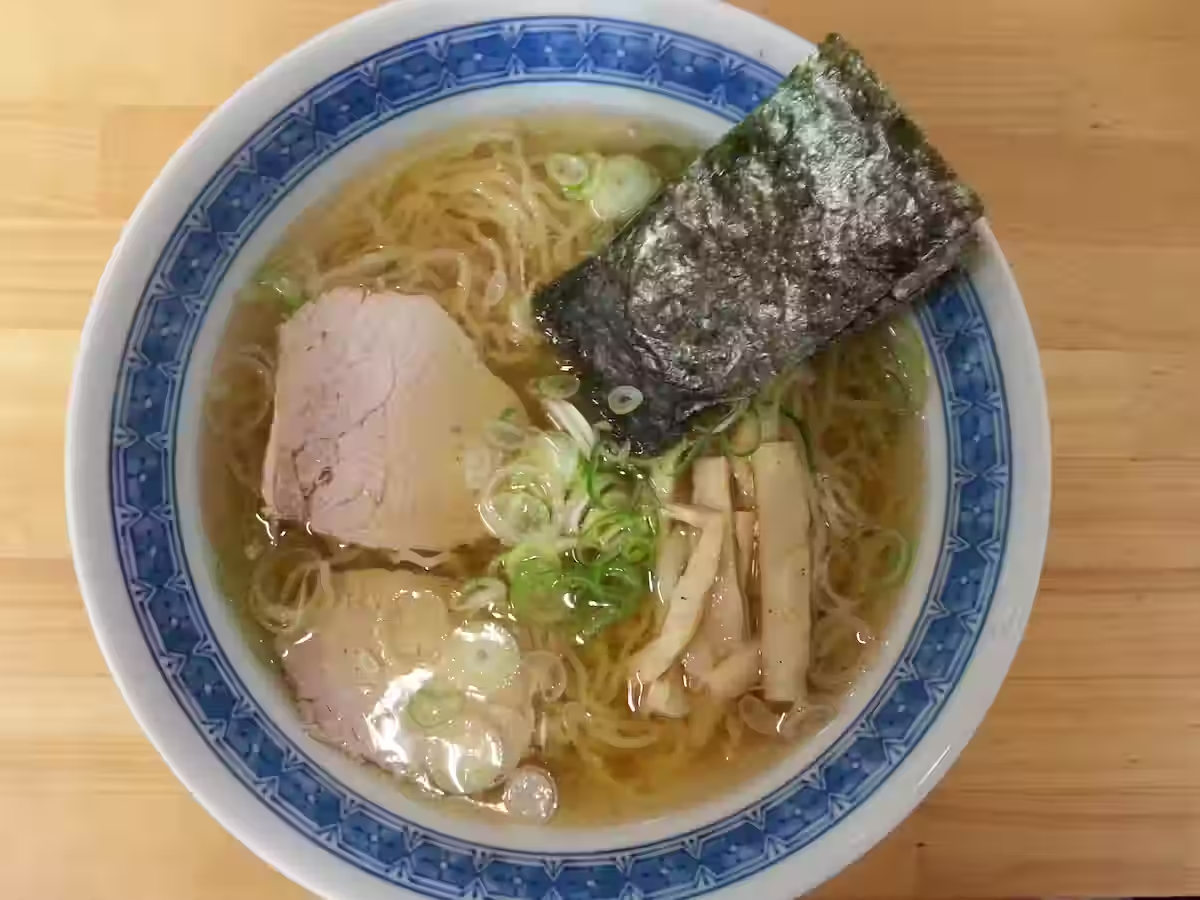
One practical note on menu language. Do not expect the word chashu here, since that usually points to pork in a ramen context. These shops talk about beef sinew and beef shin.
The Broth
Broth is where the shops diverge most. Kashiwaya builds on chicken bones, then finishes slightly sweet. Fukuharaya, by contrast, keeps its broth clear and Japanese in character. Ichiban holds the soup deliberately light, so the heavily seasoned beef stands out. Meanwhile Sairyu goes furthest of all and gives the beef a curry flavour.
Yamagata’s tourism association describes the overall effect as surprisingly light. That sounds counterintuitive for a beef soup, though the pickle probably explains it. Whether the lightness convinces you may depend on your feelings about sour pickles in hot broth.
The Noodles and Toppings
Kashiwaya serves a springy, high-hydration noodle. Fukuharaya goes thin instead, using selected flour and alkaline ionised water. Meanwhile Showa Shokudo adapted an inherited hand-cut recipe specifically for this bowl. Other toppings vary too, though no official list fixes them.
For the wider context on Japanese pickles, our tsukemono guide covers the main styles.
Why Shin and Sinew? The Cooking Behind the Bowl
Collagen, Gelatin and the Long Simmer
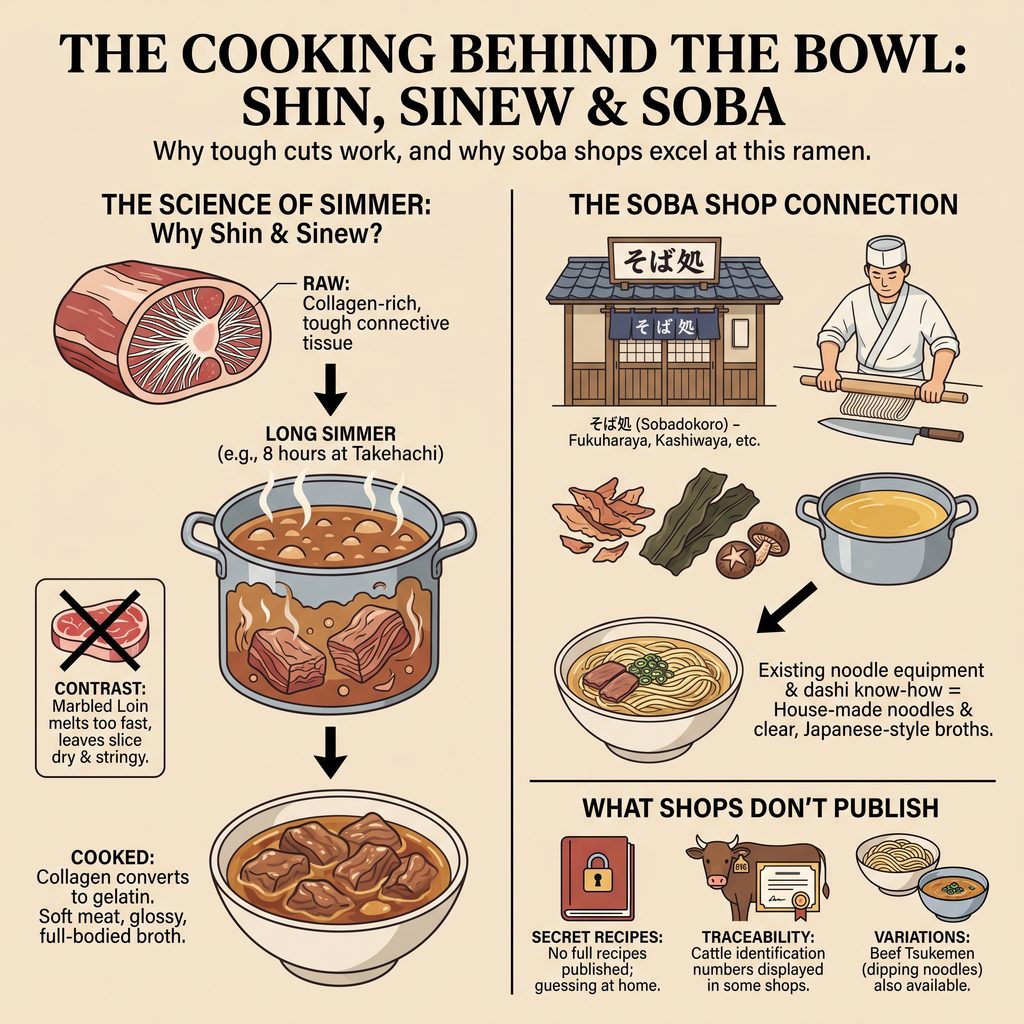
Shin and sinew carry far more connective tissue than loin does. That tissue is mostly collagen, which stays stubbornly tough at ordinary cooking temperatures. Hold it near a simmer for hours, though, and the collagen converts into gelatin. So the meat turns soft, while the broth picks up body and a glossy mouthfeel.
Takehachi runs that process for eight hours. Marbled loin would behave very differently. Its fat would melt into the soup within minutes, then leave the slice dry and stringy. Tough cuts therefore suit hot noodle soup better than premium steak cuts do. Choosing them is a cooking decision, not a cost-cutting one.
Why So Many Soba Shops Serve It
Look down the shop list and a pattern appears. Two carry sobadokoro in their name, while several others run as general shokudo rather than dedicated ramen bars. The city tourism association lists both Fukuharaya and Kashiwaya on its soba pages too.
Obanazawa has promoted soba for years through the Oku no Hosomichi Obanazawa Soba Kaido. So these kitchens already owned noodle-making equipment and dashi know-how before the beef ramen project started. That background explains two things at once: the house-made noodles, and the clear Japanese-style broths several shops favour.
What the Shops Do Not Publish
Beyond the long simmer, every kitchen keeps its own method. None of them publish full recipes, so anyone claiming to reproduce a specific bowl at home is guessing. Takehachi does display the individual identification number of its cattle inside the shop. If traceability matters to you, that is a useful detail. The same shop also offers a beef tsukemen, where you dip the noodles rather than eat them in soup.
Where Can You Eat Obanazawa Beef Ramen?
Which Shop Should You Choose?
Eight options can paralyse a visitor with one afternoon to spend. So here is a rough way to narrow it down before you read the table.
- For a clear, soba-style dashi: Nadai Sobadokoro Fukuharaya or Sobadokoro Obanaya, since both come from the soba tradition.
- For a richer, slightly sweet bowl: Kashiwaya Shokudo, because it builds on a chicken-bone base.
- For something unusual: Chugoku Ramen Sairyu with curry-spiced beef, or Takehachi if you want beef tsukemen.
- For the most restrained beef: Wakaba Shokudo, though Ichiban goes the opposite way with bold seasoning.
Shops Listed by the Chamber of Commerce
The chamber of commerce lists eight participating restaurants, all in central Obanazawa. Yamagata Prefecture’s tourism site, by contrast, refers to 13 shops in the city. That gap suggests the roster has changed, so treat the chamber list as the current reference. We checked the details below in August 2026.
| Restaurant | Address (Obanazawa City) | Phone | House style |
|---|---|---|---|
| Kashiwaya Shokudo | Kanmachi 5-1-5 | 0237-22-0151 | Chicken-bone broth, so the finish turns slightly sweet |
| Wakaba Shokudo | Kanmachi 5-3-3 | 0237-22-0845 | Neck and shin, though the fat stays restrained |
| Nadai Sobadokoro Fukuharaya | Yokomachi 1-3-1 | 0237-22-0035 | Clear Japanese broth, while the beef simmers in miso |
| Sobadokoro Obanaya | Yokomachi 1-10-1 | 0237-22-0267 | Light broth, so the beef leads the bowl |
| Shina Soba Ichiban | Shinmachi-chuo 1-26 | 0237-22-0137 | Bold beef seasoning, therefore a lighter soup |
| Showa Shokudo | Shinmachi 1-13-8 | 0237-22-0445 | Hours of simmering, then hand-cut noodles tuned to the bowl |
| Takehachi | Shinmachi 1-12-3 | 0237-23-5539 | Eight-hour simmer, and also a beef tsukemen |
| Chugoku Ramen Sairyu | Obanazawa 1733-3 | 0237-23-4060 | Curry-seasoned beef, clearly the outlier here |
Prices, Hours and Availability
No official source publishes a price for this dish, so we will not invent one. For rough context, Kashiwaya’s own website lists other ramen between ¥950 and ¥1,100. Opening information also conflicts between sources. The chamber lists Kashiwaya as closed on the second and fourth Wednesday. However, the city tourism association records irregular closing days, with hours of 11:00 to 15:00 and 17:30 to 20:00.
Nothing in the official material calls the dish seasonal or limited in quantity. Even so, several of these are small family restaurants with irregular days off. So a given afternoon may not work out.
What to Check Before You Go
- Call ahead, since most of these shops run no online reservation system.
- Confirm the closing day, because the two official sources disagree for at least one restaurant.
- Ask whether the beef ramen is on the menu that day, since it may not be the shop’s main product.
- Bring cash, because small regional restaurants in Japan often take nothing else.
- Do not assume English menus exist, though a photo of おばなざわ牛ラーメン helps a lot.
Useful Japanese at the counter
- おばなざわ牛ラーメンはありますか?
- Obanazawa gyu ramen wa arimasu ka?
Do you have Obanazawa beef ramen today? - これをください。
- Kore o kudasai.
This one, please. Point at a photo while you say it. - 今日は営業していますか?
- Kyo wa eigyo shite imasu ka?
Are you open today? Useful on the phone before you travel.
How to Get There, and How Near Ginzan Onsen It Is
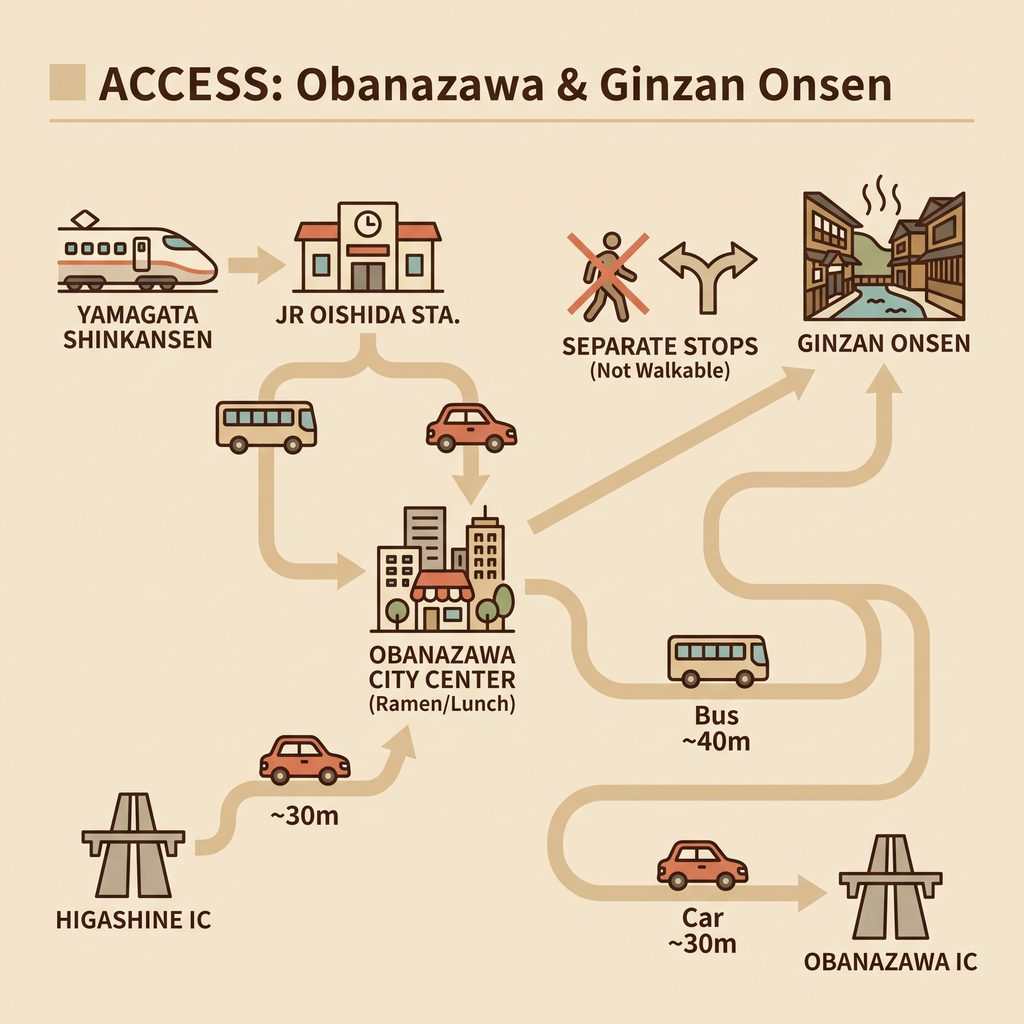
Obanazawa has no train station of its own. So most visitors reach it via JR Oishida Station on the Yamagata Shinkansen line, then continue by bus or car. The city tourism association gives roughly 30 minutes by car from the Higashine interchange.
Many travellers arrive in this area for Ginzan Onsen, the Taisho-era hot spring town. Ginzan sits inside Obanazawa City, though it is not next door to these restaurants. Indeed, the official Ginzan Onsen site puts the bus from the Obanazawa transfer stop at about 40 minutes. The drive from the Obanazawa interchange also takes roughly 30 minutes. So treat lunch in town and the onsen as two separate stops, rather than a short walk between them.
Other Foods to Try in Obanazawa
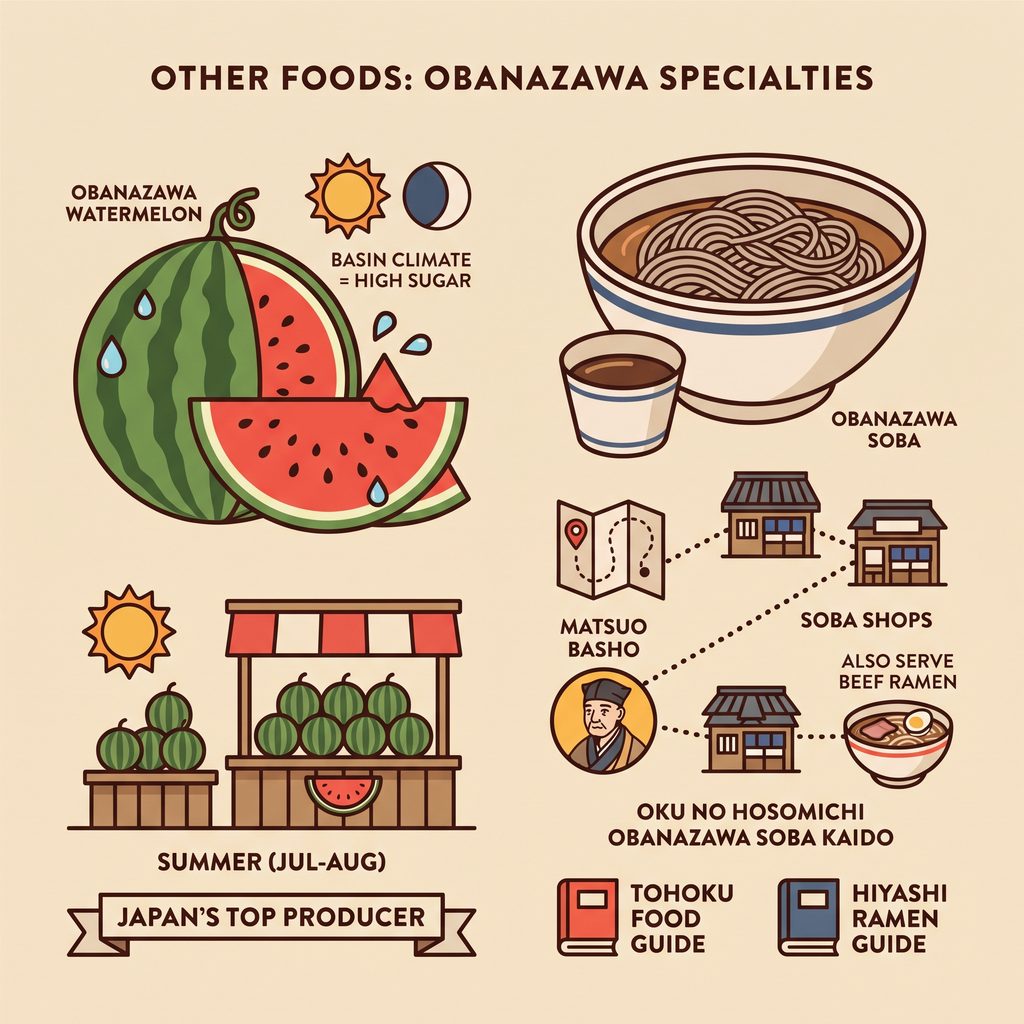
Beef is only one part of the local table. Obanazawa produces more summer watermelon than any other municipality in Japan. In fact, the city credits its basin climate and wide day-to-night temperature swing for the high sugar content. Whole fruit appears at roadside stands through July and August.
Soba matters here too, as the cooking section already hinted. The Oku no Hosomichi Obanazawa Soba Kaido links a route of soba shops to Matsuo Basho’s stay in the town. Several restaurants on that route also serve the beef ramen, so a two-course afternoon works easily. For the wider regional picture, see our Tohoku food guide. Meanwhile our piece on hiyashi ramen covers another Yamagata noodle specialty.
Final Thoughts
Obanazawa beef ramen is a modern local specialty rather than an inherited village dish. The sources stay honest about that, at least. Eight shops in one snowy city take the same two local products, then build their own bowl around them. Because the beef comes from tough cuts softened over hours, it delivers depth instead of marbled richness.
That variation is the appeal, though it is also the catch. No definitive version exists to tick off a list. If you go, check hours and menus with the shop first, since official listings already disagree. Then pick one bowl, and treat the other seven as a reason to come back.
What is Obanazawa beef ramen?
Obanazawa beef ramen is a local noodle specialty from Obanazawa City in Yamagata Prefecture. Shops top it with slow-simmered Obanazawa beef, then add a chili-pickled watermelon called pesora-zuke. The local chamber of commerce coordinates the project across eight restaurants. However, each kitchen chooses its own broth, noodles and seasoning.
What is pesora-zuke, and why does it go on ramen?
Pesora-zuke is a sour, salty and mildly hot pickle from the Obanazawa area, traditionally made with eggplant. Farmers thin young watermelons so the remaining fruit grows large. Producers then pickle those thinned melons the same way. As a result, the sharpness cuts through the fat of a beef broth.
Is Obanazawa beef Wagyu?
Yes. Obanazawa beef comes from Japanese Black cattle, so it sits inside the wagyu category. The Japan Tourism Agency gives two conditions: raising inside the city limits, and meat quality grade 3 or higher. Moreover, a premium tier called Yukifuri Wagyu Obanazawa adds stricter rules on top.
Why do shops use shin and sinew instead of marbled beef?
Those cuts carry heavy connective tissue, which converts to gelatin during a long simmer. So the meat turns soft, while the broth gains body. Marbled loin would lose its fat into the soup within minutes, then dry out. The choice is therefore about texture, not about saving money.
What does Obanazawa beef ramen taste like?
Taste varies by restaurant, so no single answer covers every bowl. Shops describe deeply savoury beef against broths that run from lightly sweet to clear and Japanese in style. Meanwhile the pickle adds sourness and a little chili heat. Sairyu takes a different route entirely, since it seasons the beef with curry.
Is it a traditional dish?
No, and the sources do not claim otherwise. Instead it belongs to the go-tochi gurume category, meaning a specialty built to promote a region. In addition, the watermelon pickle behind its topping only reached the market in the early 2000s. Available records still do not establish exactly when the ramen project began.
Can you eat it near Ginzan Onsen?
Ginzan Onsen lies inside Obanazawa City, though the ramen shops all sit in the town centre. The official Ginzan Onsen site puts the bus from the Obanazawa transfer stop at about 40 minutes. Driving from the Obanazawa interchange takes roughly 30 minutes. So plan the two as separate stops on the same day.
Where can you eat it, and what does it cost?
Eight restaurants in central Obanazawa appear on the chamber of commerce list, and the table above gives addresses. However, no official source publishes a price. Kashiwaya lists its other ramen between ¥950 and ¥1,100, which offers rough context only. So call the shop first, because listings disagree on closing days.
Does the recipe differ by restaurant?
Yes, and the organisers actively encourage that. The chamber of commerce states that cuts and seasoning differ from shop to shop. Broth bases run from chicken bone to clear Japanese style, though miso-simmered versions also appear. Noodles differ too, since several kitchens are soba specialists making their own.
References
- Obanazawa Chamber of Commerce and Industry, Obanazawa Gyu Ramen, https://obanazawa-shokokai.or.jp/ramen/ (Surveyed: August 2026)
- Japan Tourism Agency, Multilingual Explanation Database: Obanazawa Beef, https://www.mlit.go.jp/tagengo-db/R3-00460.html (Surveyed: August 2026)
- Yamagata Prefecture Tourism and Product Association, Obanazawa Gyu Ramen, https://yamagatakanko.com/attractions/detail_3447.html (Surveyed: August 2026)
- Yamagata Prefecture Tourism and Product Association, Meat Dishes (English), https://yamagatakanko.com/en/meat-dishes (Surveyed: August 2026)
- Obanazawa City Tourism and Products Association, Food and Dining, https://obanazawa-kankou.jp/food/ (Surveyed: August 2026)
- Obanazawa City, Obanazawa Beef, https://www.city.obanazawa.yamagata.jp/kanko/gourmet/1319 (Surveyed: August 2026)
- Obanazawa City, Obanazawa Summer Watermelon, https://www.city.obanazawa.yamagata.jp/kanko/gourmet/1321 (Surveyed: August 2026)
- Kashiwaya Shokudo, Ramen Menu, https://kashiwayashokudou.web.fc2.com/custom.html (Surveyed: August 2026)
- Ginzan Onsen Tourist Information, Access, https://www.ginzanonsen.jp/access/ (Surveyed: August 2026)
- Japan National Tourism Organization, Wagyu: All You Need to Know, https://www.japan.travel/en/guide/wagyu-all-you-need-to-know/ (Surveyed: August 2026)
- Gotoh, T., Takahashi, H., Nishimura, T., Kuchida, K., & Mannen, H. (2014). Meat produced by Japanese Black cattle and Wagyu. Animal Frontiers, 4(4), 46-54, https://academic.oup.com/af/article/4/4/46/4638819 (Surveyed: August 2026)
- J-STAGE, Transition and Type Classification of Ramen in Japan (2024), https://www.jstage.jst.go.jp/article/kasei/76/0/76_135/_article/-char/ja/ (Surveyed: August 2026)
- J-STAGE, Effects of Food-Based Regional Revitalization Initiatives on Restaurants (2025), https://www.jstage.jst.go.jp/article/jrps/5/1/5_1/_article/-char/ja (Surveyed: August 2026)
Related Articles
- Wagyu Beef (Surveyed: August 2026)
- Yonezawa Beef (Surveyed: August 2026)
- Kuroge Wagyu (Japanese Black Beef) (Surveyed: August 2026)
- Hiyashi Ramen: Yamagata’s Cold Ramen (Surveyed: August 2026)
- Imoni (Surveyed: August 2026)
- Tsukemono (Japanese Pickles) (Surveyed: August 2026)
- Tohoku Food Guide (Surveyed: August 2026)
- Japan Food Guide (Surveyed: August 2026)




Comments