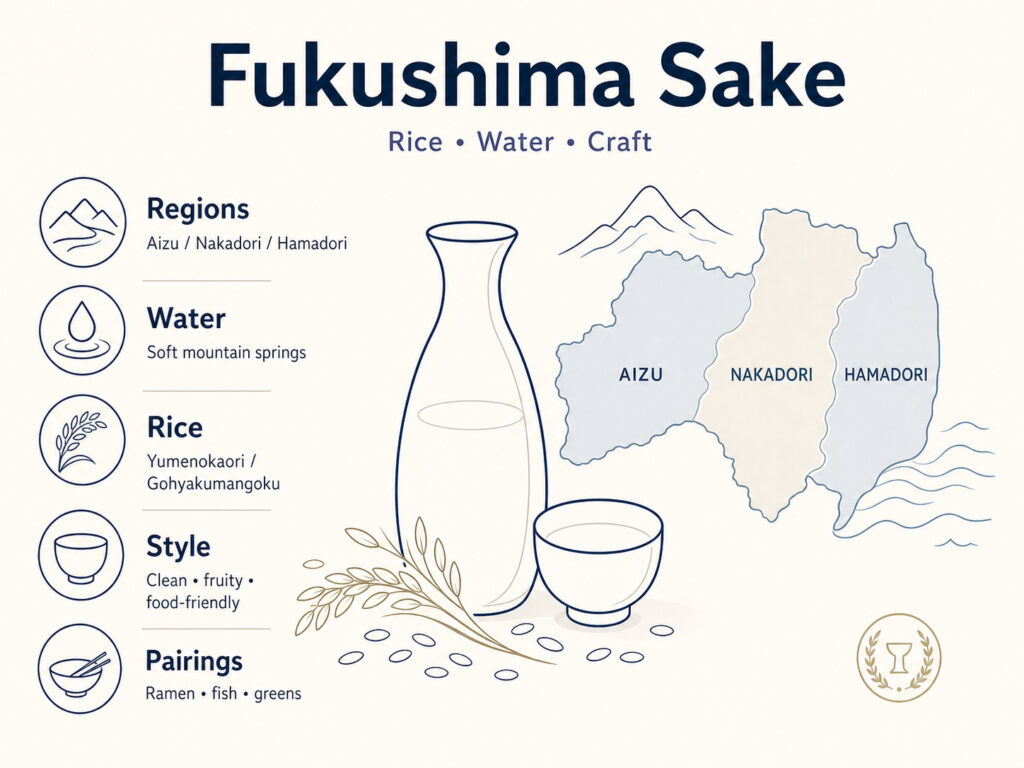
Fukushima sake is one of Japan’s most highly regarded regional sake styles. The prefecture is known for soft water, rice-growing areas, skilled brewers, and repeated success at national competitions. Many drinkers now connect Fukushima Japanese sake with clean texture, fruity aroma, and a crisp finish.
The region’s reputation did not appear by chance. Breweries, research centers, local rice growers, and toji communities built quality over many years. Today, Fukushima craft sake from Japan represents both technical precision and regional recovery.
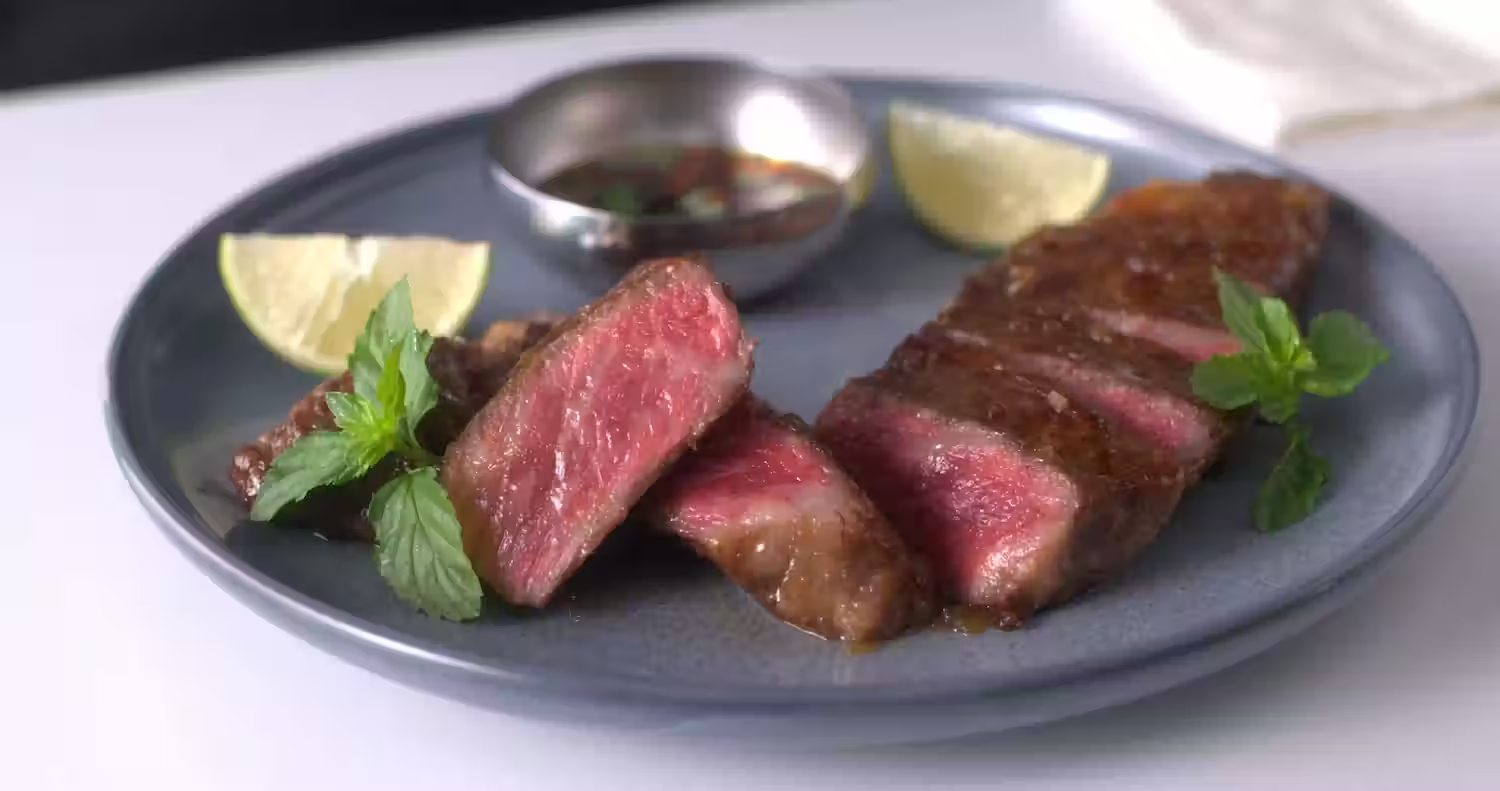
Kitakata ramen, Aizu cuisine, seafood, grilled fish, and mountain vegetables
In short, Fukushima rice wine from Tohoku is shaped by water, rice, craft, and regional diversity. In particular, the prefecture is strong in balanced and elegant Fukushima Ginjo.
What Makes This Regional Sake Unique?
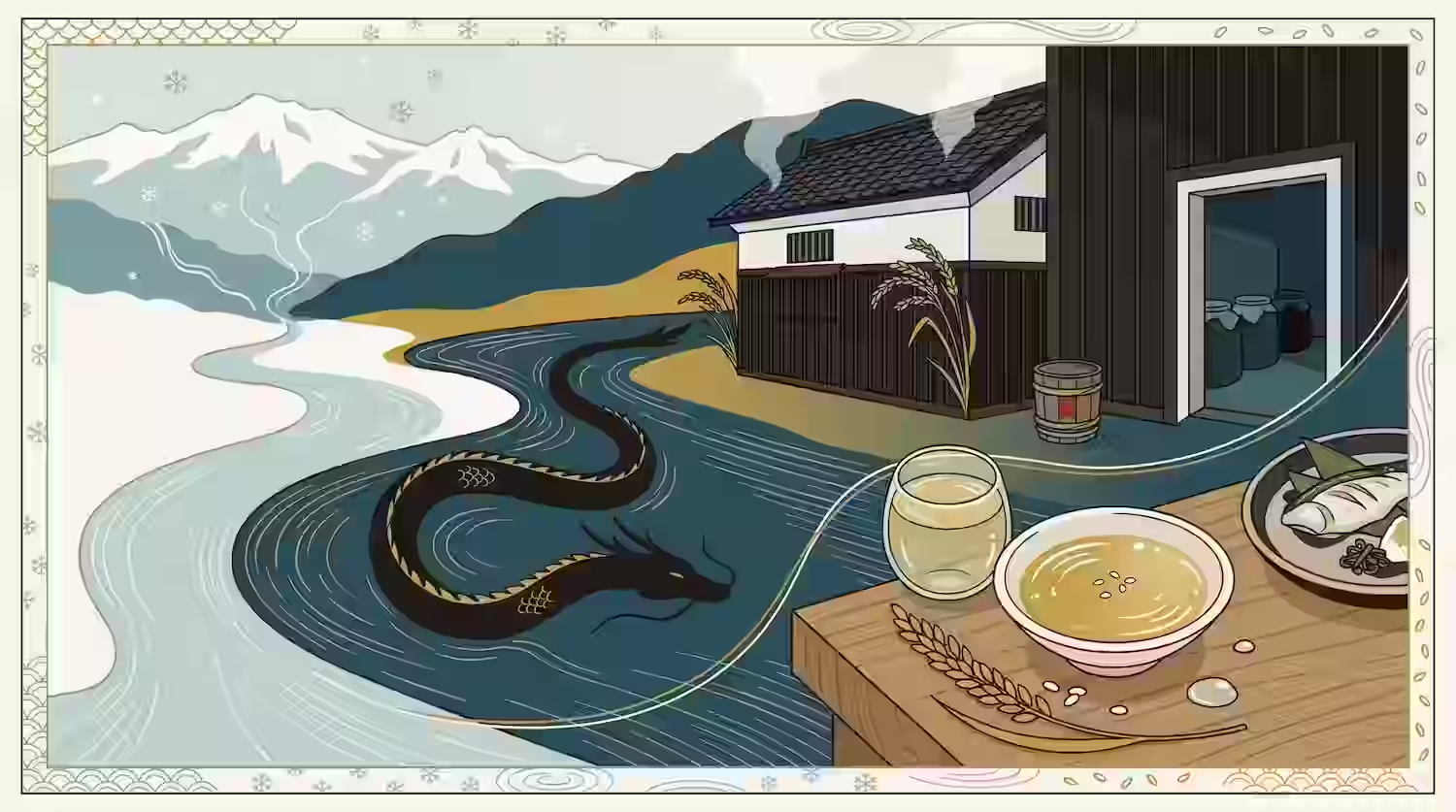
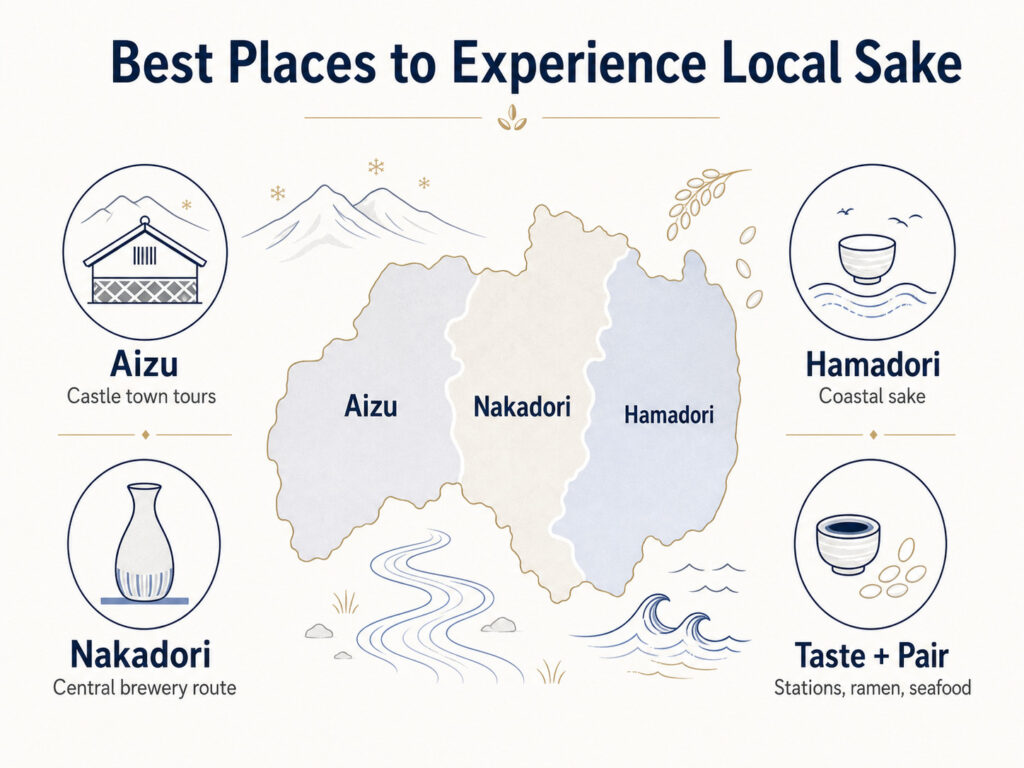
First, Fukushima has unusual geographic variety. The prefecture divides naturally into Aizu, Nakadori, and Hamadori. Mountains, basins, inland towns, and coastal areas all affect brewing conditions.
Second, water matters. Many breweries use soft water from mountain systems and underground sources. As a result, soft water can support gentle fermentation and smooth texture.
Third, rice gives the region depth. Fukushima is a rice-producing prefecture, and breweries use local varieties such as Yumenokaori and Fukunoka. Therefore, these grains help create soft sweetness, umami, and a clean finish.
Finally, technical cooperation is central. The prefecture has invested in brewing research, yeast development, and training for young brewers. In practice, this shared effort helps explain why local breweries perform so well at competitions.
Award-Winning Fukushima Sake and National Recognition
Fukushima sake Japan Sake Awards gold prize results are a major part of the region’s modern story. In the Reiwa 6 Annual Japan Sake Awards, announced in 2025, the prefecture had 30 award-winning entries and 16 gold prizes. That result placed Fukushima first nationwide for gold prizes that year.
In addition, the region built a remarkable record after 2011. Fukushima City tourism information notes that in 2019, sake from the prefecture won the most gold prizes for a record seventh year in a row. This helped create the image of Fukushima as a top-ranked sake region in Japan.
Awards do not tell the whole story. Even so, they show consistency. They also suggest that many breweries can produce technically polished sake, not only a few famous labels.
This success matters because it came during a difficult period. After the 2011 earthquake, tsunami, and nuclear disaster, producers faced severe reputational damage. Sake quality became one way to rebuild trust.
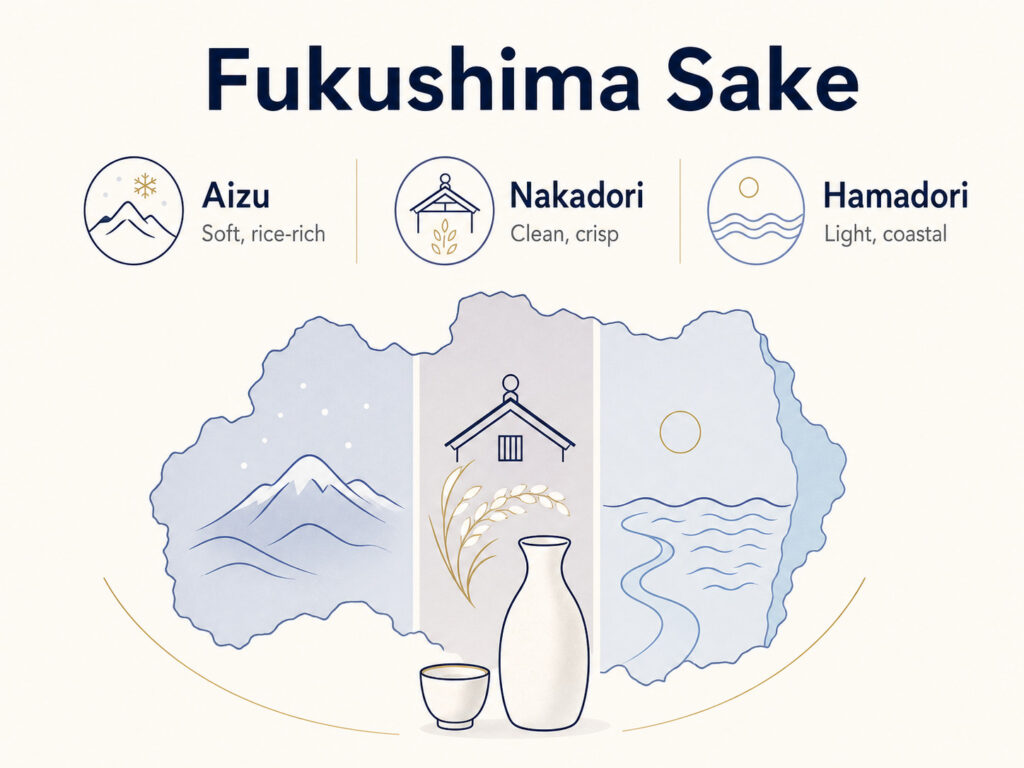
Aizu, Nakadori, and Hamadori
Geographically, Fukushima is easier to understand through its three main areas. Each region has different climate, food culture, and brewing identity. Therefore, a single flavor description would be too simple.
Area
Brewing identity
Typical context
Aizu
Fruity aroma, rice umami, soft water, many breweries
Aizuwakamatsu, Aizubange, Minamiaizu
Nakadori
Clean, crisp, technical, and varied
Nihonmatsu, Koriyama, Fukushima City, Ten’ei, Yabuki
Hamadori
Lighter, coastal, refreshing, and food-friendly
Iwaki, Soma, coastal seafood culture
Fukushima sake from Aizu region often shows soft texture and rice depth. Aizu sake has long links with castle town culture, snowy winters, and rice production.
Nakadori Fukushima sake route areas include Nihonmatsu and Koriyama breweries. Meanwhile, the region often feels practical and varied, with traditional kimoto houses and modern aromatic producers.
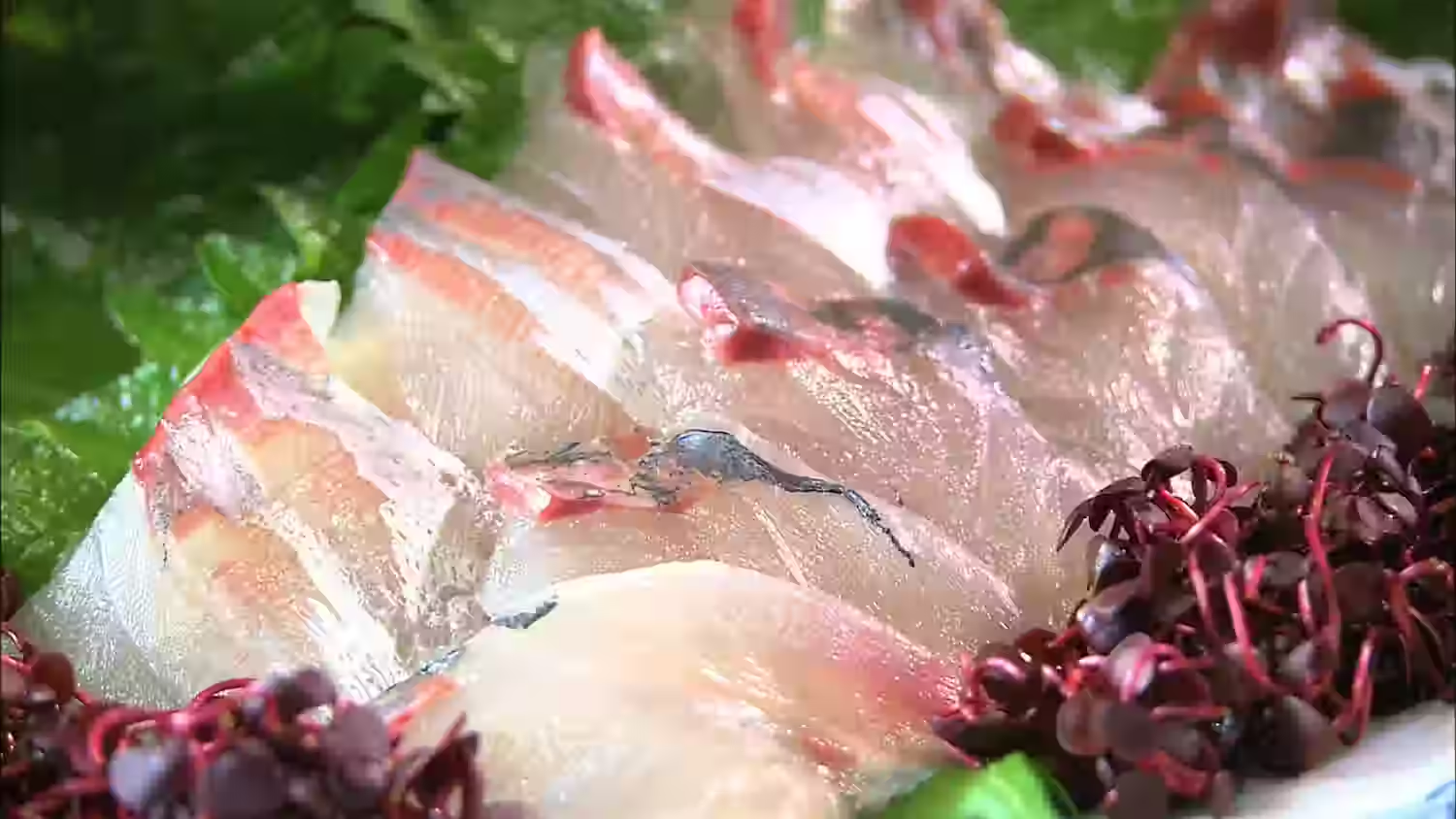
Hamadori coastal Fukushima sake connects naturally with seafood. Even with fewer breweries than Aizu, the area adds an important coastal identity.
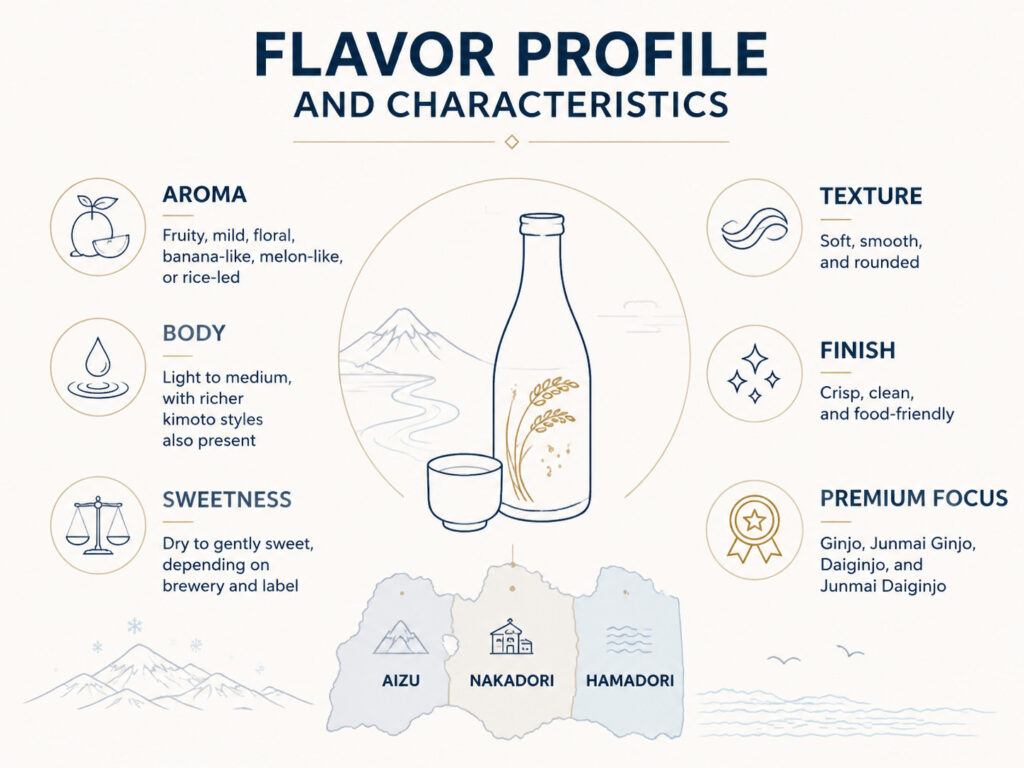
Flavor Profile and Characteristics
Fukushima sake flavor profile usually centers on balance. In general, many bottles show gentle fruit, soft rice sweetness, moderate acidity, and a clean finish. At their best, the examples feel polished without becoming thin.
Character
Typical regional expression
Aroma
Fruity, mild, floral, banana-like, melon-like, or rice-led
Body
Light to medium, with richer kimoto styles also present
Sweetness
Dry to gently sweet, depending on brewery and label
Texture
Soft, smooth, and rounded
Finish
Crisp, clean, and food-friendly
Premium focus
Ginjo, Junmai Ginjo, Daiginjo, and Junmai Daiginjo
Balanced and elegant Fukushima Ginjo often shows fruit without excessive perfume. Fukushima clean and refined Junmai can show rice depth and a gentle finish. Meanwhile, some labels are fuller, especially kimoto sake from traditional breweries.
Fukushima sake with fruity aroma and crisp finish is common in modern premium bottles. However, the region should not be reduced to aroma alone. Food compatibility remains central.
Rice, Water, and Yeast
Technically, the prefecture’s sake depends on three foundations. The first is water. Soft water from mountains and springs often produces a gentle texture and mild sweetness.
Second, rice matters. Yumenokaori was developed as an original sake rice for the prefecture. Fukunoka is another local variety linked with aroma, soft sweetness, and a clean finish.
Third, yeast matters. Utsukushima Yume yeast can produce fruity aromas such as banana and melon. Utsukushima Kirameki yeast can create strawberry-like and apple-like fragrance.
Together, these materials help explain the modern style. They also show why Fukushima local sake breweries are not simply copying older famous regions. The prefecture built its own technical vocabulary.
Fukushima Japanese sake has older roots in local rice culture and castle town brewing. Aizu, Nihonmatsu, Kitakata, and other areas supported breweries for generations. These breweries served local households, inns, restaurants, and seasonal gatherings.
Later, modern quality improvement became especially visible from the late 20th century onward. Research support, technical exchange, and brewer training raised the overall level. Many producers began focusing on Ginjo, Junmai Ginjo, and Junmai Daiginjo.
However, the 2011 earthquake and nuclear disaster changed the region’s public image. Many producers had to face harmful rumors and market hesitation. Quality awards helped demonstrate that the region remained serious, safe, and technically strong.
Fukushima sake revival after 2011 earthquake and nuclear disaster is not only a sentimental story. Instead, it is also a technical story. Breweries responded through sharper quality control, clearer branding, and stronger local cooperation.
Today, award-winning Fukushima sake carries both regional pride and practical proof. It shows how a sake region can rebuild reputation through repeated excellence.
Famous Breweries and Brands
Fukushima local sake breweries are diverse. This section is not a ranking. Instead, it gives a reference map for major names, areas, and identities.
Brewery or brand
Area
Notes
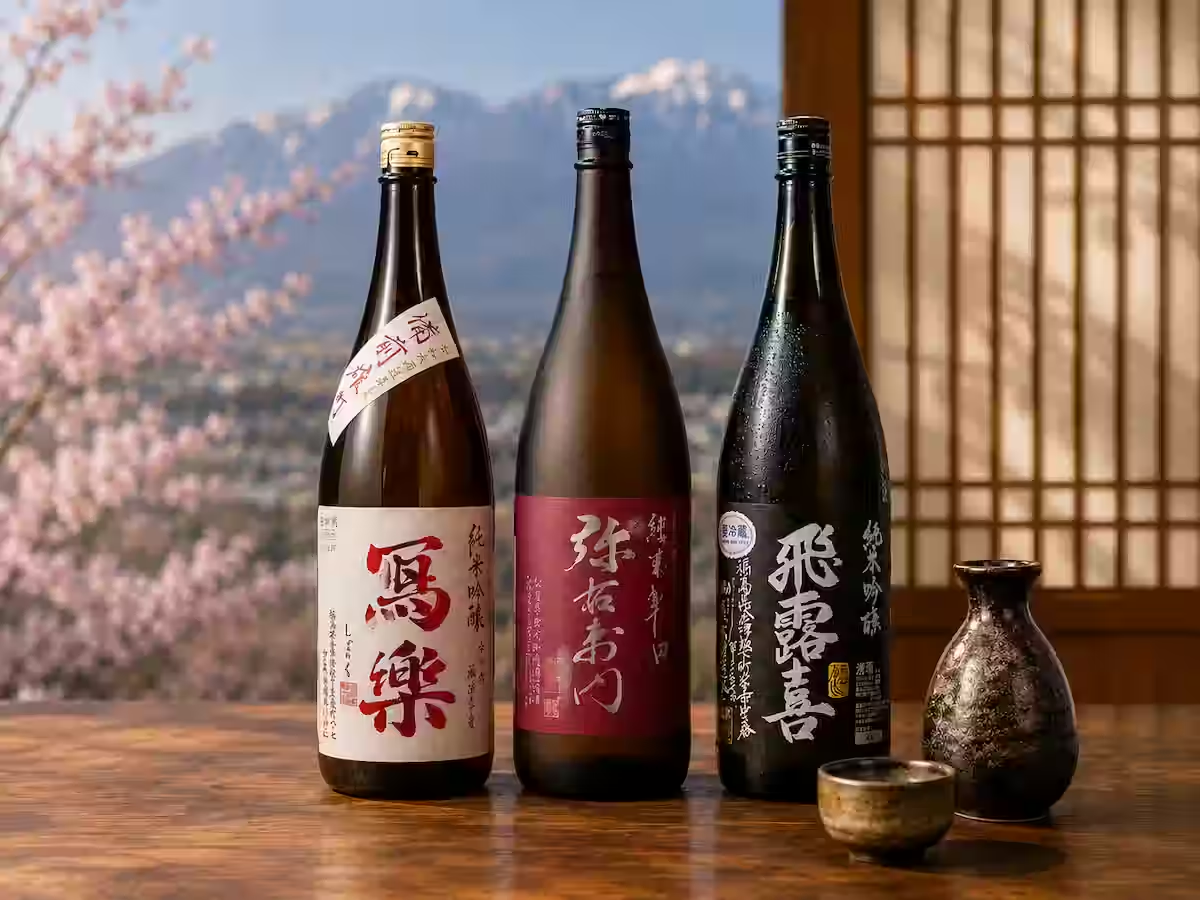
Hiroki sake – Hiroki Shuzo brewery in Aizubange, Fukushima
Aizu
Hiroki Junmai Ginjo is known for balance and limited availability
Sharaku sake – Miyaisen Meijo brewery in Aizuwakamatsu, Fukushima
Aizu
Sharaku Junmai Ginjo is modern, aromatic, and clean
Okunomatsu sake – Okunomatsu Sake Brewery in Nihonmatsu
Nakadori
Known for Okunomatsu Junmai Daiginjo and broad production
Daishichi sake – Daishichi Sake Brewery in Nihonmatsu
Nakadori
Famous for traditional kimoto brewing and rich umami
Aizu Chujo sake – Tsurunoe Shuzo in Aizu
Aizu
Known for elegant local sake and regional food pairing
Suehiro sake – Suehiro Shuzo in Aizuwakamatsu
Aizu
A classic Aizu producer with brewery tours and Yamahai styles
Kinsuisho sake – Kinsuisho Sake Brewery in Fukushima City
Nakadori
Award-winning sake from Fukushima City
Ninki-ichi sake – Ninki Shuzo brewery in Nihonmatsu
Nakadori
Known for modern labels and sparkling sake
Kokken sake – Kokken Brewery in Minamiaizu
Aizu
Local brewery with strong regional identity
Hirotogawa sake – Matsuzaki Shuzo in Ten’ei
Nakadori
Often associated with clean balance and steady popularity
Still, some names need careful handling. Dassai and Denshu are not Fukushima brands, so this article focuses only on local producers. That keeps the regional map accurate.
In addition, other important names include Toyokuni Shuzo, Akebono Shuzo, Yamatogawa Shuzo, Hanaizumi Sake Brewery, Homare Sake Brewery, and Aizu Shuzo. Together, they show why the prefecture has one of Japan’s richer brewery landscapes.
Famous Local Sake Types
In general, the region appears across many sake categories. Junmai can show rice umami and clean structure. Ginjo and Junmai Ginjo often highlight fruit, freshness, and precise fermentation.
In particular, Fukushima premium Junmai Daiginjo is important for competition and export. These bottles often use polished rice, careful yeast control, and low-temperature fermentation. The style can feel elegant, aromatic, and refined.
Meanwhile, Daishichi Kimoto shows a different direction. Traditional kimoto brewing can create depth, acidity, and long food pairing strength. This gives Fukushima more range than a simple Ginjo image.
Moreover, seasonal styles also matter. Namazake brings freshness after winter brewing. Genshu gives more strength when breweries skip dilution.
Best Food Pairings
Fukushima sake pairing with local cuisine works because many bottles balance fragrance with clean structure. The sake can support soup, noodles, mountain dishes, and seafood without taking over.
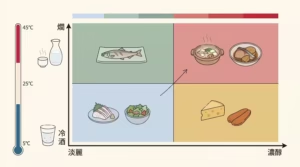
For example, fruity Ginjo works with lighter seafood and vegetables. Richer Junmai suits ramen, grilled fish, and simmered foods. Kimoto sake can handle stronger flavors and warmed serving.
Fukushima sake is best understood through regional comparison. Aizu, Nakadori, and Hamadori each show different styles. However, the goal is not only tourism. The goal is to understand local sake culture.
Useful routes include these.
Aizu sake brewery tour – Fukushima Aizu region
Aizu Wakamatsu sake and castle town brewery tours
Nakadori Fukushima sake route – Nihonmatsu and Koriyama breweries
Hamadori coastal Fukushima sake – Iwaki and Soma breweries
Aizu-Nakadori local brewery tours in Fukushima
Local tasting counters and product centers near major stations
Restaurants pairing sake with Kitakata ramen, Aizu cuisine, and seafood
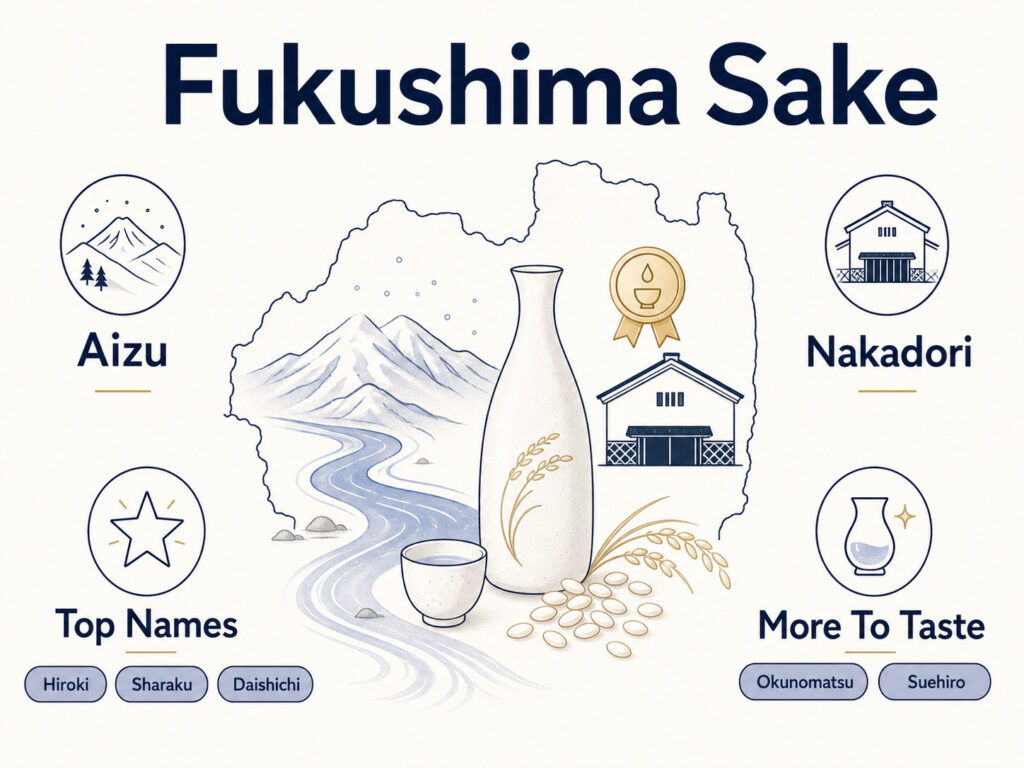
How to choose Fukushima sake from Hiroki to Sharaku depends on preference. Start with Hiroki or Sharaku for refined modern balance. Choose Daishichi for kimoto depth. Okunomatsu or Suehiro offers classic regional familiarity.
Final Thoughts
Overall, Fukushima sake is one of the most important modern regional sake stories in Japan. It combines soft water, rice, yeast research, technical training, and strong local identity. The result is balanced, elegant, and often award-winning.
Finally, the region also shows how sake culture can recover and grow after hardship. Aizu, Nakadori, and Hamadori each add different voices. For readers studying Japanese regional sake, Fukushima is essential.
FAQ About Fukushima Sake
What is Fukushima sake?
Fukushima sake is Japanese sake brewed in Fukushima Prefecture in Tohoku. It is known for soft water, local rice, skilled brewers, and many award-winning breweries. The style often feels balanced, clean, fruity, and food-friendly. Aizu, Nakadori, and Hamadori each add different regional traits.
Why is Fukushima famous for sake?
The prefecture is famous because its breweries have won many gold prizes at national competitions. The region also has clean water, rice-growing areas, original sake rice, local yeast, and strong technical training. These factors support consistent quality across many breweries.
What does Fukushima sake taste like?
Many bottles taste clean, smooth, and balanced. Ginjo and Junmai Ginjo styles often show melon, banana, apple, or soft floral notes. Junmai styles can show rice sweetness and umami. Kimoto styles from breweries such as Daishichi can feel deeper and more savory.
What is the Aizu region known for?
Aizu is known for snowy winters, soft water, rice culture, and many traditional breweries. Aizu sake often shows rice umami, fruity aroma, and a rounded texture. Aizuwakamatsu also offers castle town brewery tours and classic local food pairings.
Which Fukushima sake brands are famous?
Famous local brands include Hiroki, Sharaku, Okunomatsu, Daishichi, Aizu Chujo, Suehiro, Kinsuisho, Ninki-ichi, Kokken, and Hirotogawa. Each brand has a different style. Some focus on modern aromatic sake, while others emphasize kimoto, Junmai, or regional food pairing.
What food pairs well with Fukushima sake?
Local sake pairs well with Kitakata ramen, Aizu cuisine, Hamadori seafood, grilled fish, mountain vegetables, and miso-based dishes. Fruity Ginjo suits lighter foods. Richer Junmai and kimoto styles work well with savory dishes and warmed serving.
How should I choose Fukushima sake?
Choose by region and style. Aizu offers many fruity and rice-rich bottles. Nakadori gives strong brewery variety, from kimoto to modern sparkling styles. Hamadori pairs naturally with coastal seafood. If unsure, start with Junmai Ginjo or a clean Junmai.
References
FUKUSHIMA SAKE – Official Website – checked in 2026; official brewery map, more than 50 breweries, three regional areas, and Fukushima sake overview.
FUKUSHIMA SAKE – About Fukushima Sake – checked in 2026; rice, water, producer training, Aizu, Nakadori, Hamadori, Yumenokaori, Fukunoka, and Fukushima yeast.
Ryo Iwa is the founder and editor of foodinjapan.org. Born and raised in Japan, he writes from regional travel, market visits, and Japanese-language primary sources that rarely reach English readers, including brewing institute publications and industry glossaries. Where a figure cannot be traced to a source, the article says so.
He has been a Google Maps Local Guide for over 10 years, with more than 1,800 reviews and over 41,000 photos viewed hundreds of millions of times. He previously spent two decades as an IT consultant in Japan, the US, and the UK.














Comments